AB 2727: Office of Emergency Services: Maritime Firefighting Mutual Aid Program.
- Session Year: 2023-2024
- House: Assembly
- Latest Version Date: 2024-02-14
Current Status:
Failed
(2024-05-16: Joint Rule 62(a), file notice suspended. (Page 5215.))
Introduced
In Committee
First Chamber
In Committee
Second Chamber
Enacted
Existing law, the California Emergency Services Act, creates the Office of Emergency Services (OES) in the office of the Governor. The OES is responsible for addressing natural, technological, or man-made disasters and emergencies, including responsibility for activities necessary to prevent, respond to, recover from, and mitigate the effects of emergencies and disasters to people and property.
This bill would establish the Maritime Firefighting Mutual Aid Program within OES for the purpose of enhancing maritime firefighting capabilities of local fire departments. The bill, upon appropriation by the Legislature, would require OES to conduct an all-risk maritime response capabilities assessment, as specified, and acquire and provide fire boats to local fire departments, as specified, and would require the local fire departments to utilize the fire boats to enhance local, regional, and mutual aid response capabilities. By requiring local fire departments to utilize fire boats, as provided, the bill would impose a state-mandated local program. The bill would also establish the Maritime Firefighting Mutual Aid Fund for purposes of the program.
The California Constitution requires the state to reimburse local agencies and school districts for certain costs mandated by the state. Statutory provisions establish procedures for making that reimbursement.
This bill would provide that, if the Commission on State Mandates determines that the bill contains costs mandated by the state, reimbursement for those costs shall be made pursuant to the statutory provisions noted above.
(a)The Maritime Firefighting Mutual Aid Program is hereby established, to be administered by the office, for the purpose of enhancing maritime firefighting capabilities of local fire departments.
(b)For purposes of this article, the following definitions shall apply:
(1)Disaster has the same meaning as in Section 8680.3.
(2)Office means the Office of Emergency Services.
(3)Program means the Maritime Firefighting Mutual Aid Program.
(4)Fire boat means a vessel designed primarily for firefighting operations that may also be capable of water rescue and hazardous materials spill mitigation. A fire boat may also have the capability of pumping a large volume of water from a drafting operation.
8619.21.Upon appropriation by the Legislature, the office shall do all of the following:
(a)Conduct an all-risk maritime response capabilities assessment to identify local and regional gaps in maritime firefighting capabilities in responding to major vessel fires, fires following earthquakes, emergency medical services, or hazardous materials emergencies in ports, whether afloat or at a berth in dry dock.
(b)To mitigate preparedness gaps identified by the all-risk maritime response capabilities assessment conducted pursuant to subdivision (a), acquire and provide fire boats to local fire departments.
(c)Provide sustainment funding to local fire departments for costs associated with fire boats provided under this article.
8619.22.Upon receipt of a fire boat pursuant to Section 8619.21, a local fire department shall utilize the fire boat to enhance local, regional, and mutual aid response capabilities.
8619.23.(a)The Maritime Firefighting Mutual Aid Fund is hereby established in the State Treasury for purposes of this article. Moneys in the fund shall be allocated, upon appropriation by the Legislature, to the department for use in accordance with this article.
(b)The office may retain up to 3 percent of moneys in the fund for the purpose of administering this article.
SEC. 2.If the Commission on State Mandates determines that this act contains costs mandated by the state, reimbursement to local agencies and school districts for those costs shall be made pursuant to Part 7 (commencing with Section 17500) of Division 4 of Title 2 of the Government Code.
REVISIONS: HeadingLines 3 and 4.|
Date
|
Status
|
|---|---|
| May 16, 2024 | In committee: Held under submission. |
| May 16, 2024 | Joint Rule 62(a), file notice suspended. (Page 5215.) |
| May 15, 2024 | In committee: Set, first hearing. Referred to APPR. suspense file. |
| Apr 23, 2024 | Coauthors revised. |
| Apr 23, 2024 | From committee: Do pass and re-refer to Com. on APPR. (Ayes 8. Noes 0.) (April 22). Re-referred to Com. on APPR. |
| Mar 4, 2024 | Referred to Com. on E.M. |
| Feb 15, 2024 | From printer. May be heard in committee March 16. |
| Feb 14, 2024 | Read first time. To print. |
|
Date
|
Description
|
Location
|
Votes
|
|
|---|---|---|---|---|
| Apr 22, 2024 | Do pass and be re-referred to the Committee on [Appropriations] | Assembly Standing Committee on Emergency Management |
Passed |
This list shows positions taken on this bill by organizations on the date displayed, which is linked to the original source.
Positions by individuals are not included.
|
Organization
|
Position
|
Date
|
|---|---|---|
| Board of Supervisors of Ventura County | * Support | Apr 22, 2024 |
| California Professional Firefighters | * Support | Apr 22, 2024 |
| County of Ventura | * Support | Apr 22, 2024 |
| Oakland Fire Department | ** Support | |
| San Diego Fire Rescue Department | * Support | Apr 22, 2024 |
Date of Hearing: May 15, 2024
ASSEMBLY COMMITTEE ON APPROPRIATIONS
Buffy Wicks, Chair
ABPCA Bill Id:AB 2727
Author:(Committee on Emergency Management) – As Introduced Ver:February 14, 2024
Policy Committee: | Emergency Management | Vote: | 8 - 0 |
|
| ||
|
|
Urgency: No State Mandated Local Program: Yes Reimbursable: Yes
SUMMARY:
This bill establishes the Maritime Firefighting Mutual Aid Program (Program) within the Office of Emergency Services (OES) to enhance the maritime firefighting capabilities of local fire departments.
Specifically, this bill:
- Requires, upon appropriation, OES to conduct an all-risk maritime response capabilities assessment to identify local and regional gaps in maritime firefighting capabilities and acquire and provide fire boats to local fire departments to mitigate those preparedness gaps. OES must provide sustainment funding to local fire departments for costs associated with provided fire boats.
- Establishes the Maritime Firefighting Mutual Aid Fund in the State Treasury, with moneys in the fund allocated for the Program. OES may retain up to 3% of fund money for program administration.
FISCAL EFFECT:
- General Fund (GF) cost pressures of an unknown, but likely significant amount, potentially in the millions of dollars, to appropriate funding to OES to conduct the gap assessment and procure and distribute the requisite number of fire boats. OES staff workload or contract costs would depend on the amount appropriated for this purpose and results of the assessment.
- By requiring a local fire department to utilize, upon receipt, a fire boat to enhance local, regional, and mutual aid response capabilities, this bill may create a state-mandated local program. If the Commission on State Mandates determines the provisions of this bill create a new program or impose a higher level of service for which the state must reimburse local costs, local agencies associated could claim reimbursement from the state (GF). However, this bill also requires OES to provide going funding to local fire departments for costs associated with provided boats.
According to the Legislative Analyst’s Office, the GF faces a structural deficit in the tens of billions of dollars over the next several fiscal years.
COMMENTS:
- Purpose. According to the author:
Specialized firefighting boats provide a waterfront avenue of attack when fires occur near the shore or on a floating watercraft. They can be especially useful when fires occur in ports because of accidents or disasters like earthquakes. However, firefighting boats can be prohibitively expensive for every jurisdiction with a shoreline to purchase for themselves.
This bill is supported by firefighter associations and local governments.
- Maritime Strategy. The California Maritime Security Council is led by OES and serves as an advisory body to the Governor for the development of an open, integrated, and multi-faceted maritime strategy to build a safe, secure, and resilient maritime community in California. Last year, OES partnered with federal and local emergency managers and held exercises at the ports of West Sacramento, Hueneme, San Diego, Long Beach, and Los Angeles. These exercises underscored the need for additional maritime firefighting resources. This bill establishes the Program to enhance maritime firefighting capabilities by providing local fire departments with fire boats.
Analysis Prepared by: Irene Ho / APPR. / (916) 319-2081
Date of Hearing: April 22, 2024
ASSEMBLY COMMITTEE ON EMERGENCY MANAGEMENT
Freddie Rodriguez, Chair
ABPCA Bill Id:AB 2727 (
Author:Committee on Emergency Management) – As Introduced Ver:February 14, 2024
SUBJECT: Office of Emergency Services: Maritime Firefighting Mutual Aid Program
SUMMARY: Establishes the Maritime Firefighting Mutual Aid Program within the California Office of Emergency Services (Cal OES) for the purpose of enhancing maritime firefighting capabilities of local fire departments, as specified. Specifically, this bill:
- Establishes the Maritime Firefighting Mutual Aid Program within Cal OES for the purpose of enhancing maritime firefighting capabilities of local fire departments.
- Directs Cal OES, upon appropriation, to conduct an all-risk maritime response capabilities assessment to identify local and regional gaps in maritime firefighting capabilities in responding to major vessel fires, fires following earthquakes, and other emergencies, as specified.
- Authorizes Cal OES to acquire and provide fire boats to local fire departments to mitigate preparedness gaps identified in the all-risk assessment.
- Authorizes Cal OES to provide sustainment funding to local fire departments for costs associated with fire boats provided under the Maritime Firefighting Mutual Aid Program.
- Defines the term “fire boat” as a vessel designed primarily for firefighting operations that may also be capable of water rescue and hazardous materials spill mitigation. A fire boat may also have the capability of pumping a large volume of water from a drafting operation.
- Establishes the Maritime Firefighting Mutual Aid Fund in the State Treasury for the purposes of the Maritime Firefighting Mutual Aid Program.
- Allows Cal OES to retain up to 3 percent of moneys in the fund for the purpose of administering the Maritime Firefighting Mutual Aid Program.
EXISTING LAW:
1) Establishes the California Office of Emergency Services (Cal OES) within the office of the Governor and makes Cal OES responsible for the state’s emergency and disaster response services for natural, technological, or manmade disasters and emergencies. (Gov. Code § 8550)
2) Authorizes the Governor to proclaim a state of emergency and local officials and local governments to proclaim a local emergency, when specified conditions of disaster or extreme peril to the safety of persons and property exist, and authorizes the Governor or the appropriate local government to exercise certain powers in response to that emergency. (Gov. Code § 8558)
3) Establishes the FIRESCOPE Program for the improvement of fire incident management and the coordination of multiagency firefighting resources on major or multiple incidents. (Health and Safety Code § 13070 – 13073)
4) Defines “state of emergency” and “local emergency” to mean a duly proclaimed existence of conditions of disaster or of extreme peril to the safety of persons and property within the state or territorial limits of a local government caused by, among other things, a sudden and severe energy shortage. (Gov. Code § 8558)
5) Requires the Standardized Emergency Management System (SEMS) for managing multiagency and multijurisdictional responses to emergencies in California. State agencies are required to use SEMS and local government entities must use SEMS in order to be eligible for any reimbursement of response-related costs under the state’s disaster assistance programs. (Gov. Code § 8607)
6) Requires Cal OES to complete an after-action report within 180 days after each declared disaster. (Gov. Code § 8607)
7) Authorizes state agencies and political subdivisions to exercise mutual aid powers in accordance with the Master Mutual Aid Agreement (MMAA) and local ordinances, resolutions, agreements, or plans. (Gov. Code § 8617)
8) Defines the MMAA to mean the California Disaster and Civil Defense Master Mutual Aid Agreement, made and entered into by and between the State of California, its various departments and agencies, the various political subdivisions of the state. (Gov. Code § 8561)
FISCAL EFFECT: This bill has not been analyzed by a fiscal committee.
COMMENTS:
Purpose of the bill: According to the author, “California is a disaster prone state. Catastrophic plans for earthquakes in the San Francisco Bay Area and Los Angeles Area anticipate thousands of fire ignitions and disruptions to water suppression systems following a major earthquake. Having a more robust maritime firefighting mutual aid program will help local jurisdictions quickly contain these fires and prevent them from becoming major conflagrations. This bill establishes the Maritime Mutual Aid Program within Cal OES for the purpose of enhancing regional maritime firefighting capabilities by acquiring fire boats for local fire departments based upon an all-risk maritime response capabilities assessment to identify local and regional gaps in maritime firefighting capabilities in responding to major vessel fires, fires following earthquakes, and other emergencies.”
The author continues, “Specialized firefighting boats provide a waterfront avenue of attack when fires occur near the shore or on a floating watercraft. They can be especially useful when fires occur in ports because of accidents or disasters like earthquakes. However, firefighting boats can be prohibitively expensive for every jurisdiction with a shoreline to purchase for themselves.”
Equity Impact: According to the author’s staff, “As determined by a report from the State Auditor in 2019, California is not prepared to protect its most vulnerable residents from natural disasters. When an emergency strikes, vulnerable populations, including low income individuals, undocumented individuals, and access and functional needs populations, face the highest risk. This bill will ensure proper mutual aid preparedness and maritime firefighting resources are available for the most catastrophic of scenarios, thus ensuring emergency impacts to vulnerable populations are significantly mitigated.”
Background
Emergency Preparedness and Response: Cal OES is responsible for addressing natural, technological, or manmade disasters and emergencies, and preparing the State to prevent, respond to, quickly recover from, and mitigate the effects of both intentional and natural disasters. As part of their overall preparedness mission, Cal OES is required to develop a State Emergency Plan (SEP) and State Hazard Mitigation Plan (SHMP); maintain the Standardized Emergency Management System (SEMS) and the Emergency Management Mutual Aid System (EMMA); and assist counties with their local Emergency Operation Plans (EOP). Cal OES, in coordination with FEMA and local partners, has developed four Catastrophic Plans to augment the State Emergency Plan.
Master Mutual Aid Agreement (MMAA): The Master Mutual Aid Agreement is an agreement
made and entered into by and between the State of California, its various departments and agencies, and the various political subdivisions, municipal corporations, and other public agencies of the State of California to facilitate implementation of Chapter 7 of Division 1 of Title 2 of the Government Code entitled "California Emergency Services Act." Mutual aid agreements and the operational plans that support them, guide the sending and receiving parties in managing and providing effective aid to other operational areas in need. These plans are essential to identify specific resources, tasks, personnel, asset allocations, roles, responsibilities, integration, and actions that mutual aid participants execute respective to their assignments.
FIRESCOPE Program: Under the Health and Safety Code Sections (13070 – 13073), the goal of the FIRESCOPE Program is the improvement of fire incident management and the coordination of multiagency firefighting resources on major or multiple incidents. The program shall include, but is not limited to, the following areas as part of its research, development, and implementation objectives:
(a) Improved methods to coordinate multiagency firefighting resources during major incidents.
(b) Improved methods for forecasting fire behavior.
(c) The capability to assess fire, weather, and terrain conditions at the scene of an incident.
(d) Standard fire terminology for improving incident management.
(e) Improved multiagency fire communications.
(f) Multiagency training on FIRESCOPE components and products.
(g) A common mapping system, including orthophoto maps.
(h) Improved fire information management systems.
(i) Regional operational coordination centers for regional multiagency coordination of firefighting resources.
According to Cal OES, “the FIRESCOPE vision is to continue national leadership in the development of all-hazard incident and multi-agency coordination systems, to enhance and encourage full participation by the California fire service in the statewide Fire and Rescue Mutual Aid System, and to provide a common voice for the California fire service relating to these issues.”
FIRESCOPE’s Maritime Operations Subcommittee: The FIRESCOPE Maritime Operations Subcommittee has been established to develop procedures and policies based on the approval of the Task Force. The subcommittee's mission is to review, update and maintain minimum operational standards necessary to maritime operations on both coastal and inland waterways. The group will strive to produce products utilizing a best practice model, free of political or geographical bias, drawing upon the experience and knowledge experienced in the delivery of public service by all members in accordance with all FIRESCOPE policies and procedures.
California Maritime Security Council (CMSC): The CMSC, which is chaired by Cal OES, was established by Executive Order S-19-06 and serves as an advisory body to the Governor for the development of an open, integrated, and multi-faceted maritime strategy to build a safe, secure, and resilient maritime community in the state of California. According to Cal OES, among the CMSC’s accomplishments last year, members of the council continued efforts to plan for natural disasters or other disruptions at California’s eleven deep water ports. Cal OES also partnered with federal and local emergency managers and held exercises at the ports of West Sacramento, Hueneme, San Diego, Long Beach, and Los Angeles. These exercises underscored the need for additional maritime firefighting resources.
Arguments in support: The Oakland Fire Chief write in support, “As a professional fire department serving the community of Oakland, we face the ongoing threat of fires following earthquakes, major vessel fires, hazardous materials emergencies in ports, and other emergencies that would be mitigated by having more robust maritime firefighting capabilities in the region. While California’s overall firefighting mutual aid system and California’s Master Mutual Aid Agreement are the strongest and most comprehensive in the country, there are gaps in maritime firefighting resources and mutual aid capabilities across the state. By directing Cal OES to conduct an all-risk maritime response capabilities assessment to identify local and regional gaps in maritime firefighting capabilities, AB 2727 (Rodriguez), upon funding, will establish critical support and fire protection in California’s port and coastal communities.”
The County of Ventura writes in support, “The Committee’s proposal significantly assists maritime firefighting programs for coastal counties. The County of Ventura has a diverse 42-mile coastline with various terrains. Currently, Ventura County Fire Department has only one mixed-use fireboat, with limited capabilities to fight fires on the water or support shore-based operations next to the water. However, given the increased vessel traffic in the Santa Barbara Channel, local marinas, and the Port of Hueneme, as well as the risks associated with spills along our coast, a more robust program and state-supported fireboat would significantly enhance our ability to address future events.”
Related legislation: AB 2594 (Committee on Emergency Management) of this Session. Would require the Cal OES to prepare a gap analysis of the State’s mutual aid systems on a biennial basis, beginning January 1, 2025. The gap analysis should be based on the firefighting, law enforcement, emergency medical services, mass care, shelter, and hospital surge capacity necessary to react to two simultaneous, major disasters occurring in California.
Prior legislation: AB 536 (Rodriguez) of the 2021-2022 Session. Substantively similar to AB 2594 (Committee on Emergency Management) of this session. (Held in Senate Appropriations.)
AB 1071 (Rodriguez) of the 2021-2022 Session. Would require Cal OES to conduct tabletop exercises of California’s catastrophic response plans on a biennial basis with representatives of the whole community and lifeline operators. (Held in Senate Appropriations.)
REGISTERED SUPPORT / OPPOSITION:
Support
California Professional Firefighters
County of Ventura
Oakland/Alameda Firefighters Local 55
Oakland Fire Department
Opposition
None on file.
Analysis Prepared by: Mike Dayton / E.M. / (916) 319-3802
Discussed in Hearing
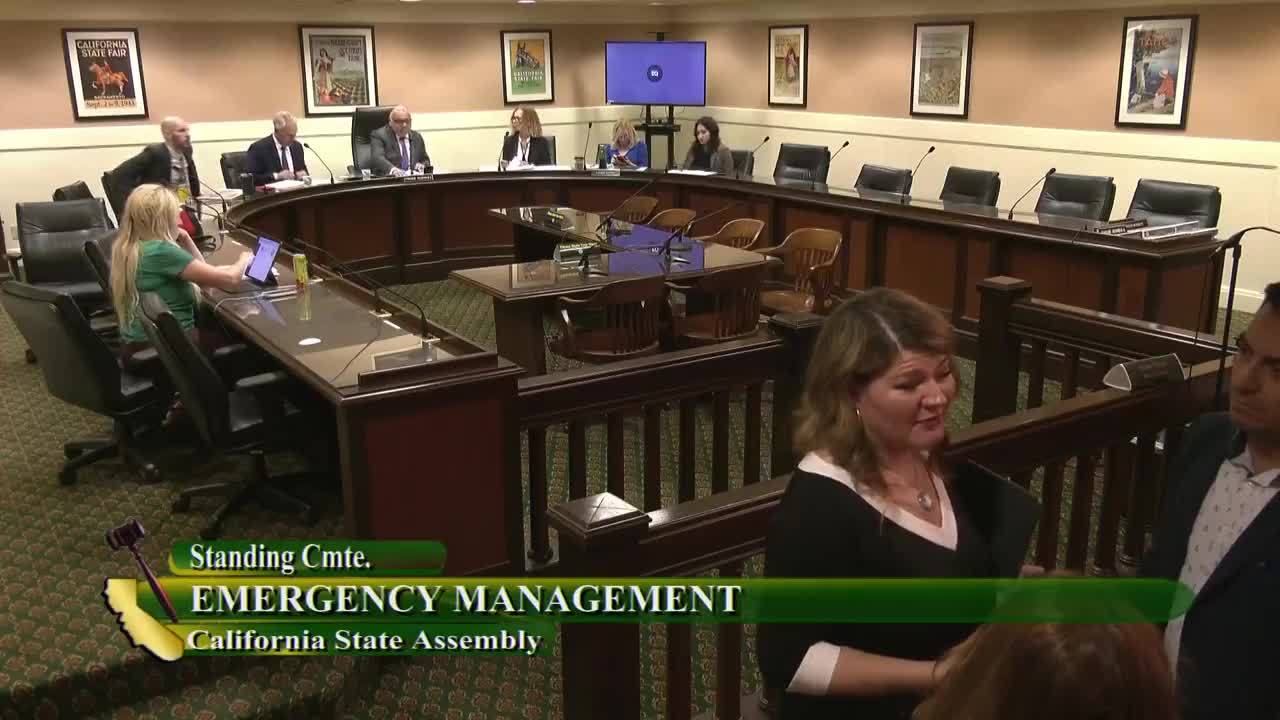 6MIN
Assembly Standing Committee on Emergency Management
Bill Author
Bill Co-Author(s):