AB 2751: Employer communications during nonworking hours.
- Session Year: 2023-2024
- House: Assembly
- Latest Version Date: 2024-03-21
Current Status:
Failed
(2024-05-16: In committee: Held under submission.)
Introduced
In Committee
First Chamber
In Committee
Second Chamber
Enacted
Existing law, including statutory provisions and orders of the Industrial Welfare Commission, as enforced by the Division of Labor Standards Enforcement, regulates the wages, hours, and working conditions of employees. Existing law makes it a crime for an employer to require or cause any employee to work for longer hours than those fixed or under conditions of labor prohibited by an order of the commission or to violate or refuse or neglect to comply with specified statutes on wages, hours, and working conditions or any order or ruling of the commission.
This bill would require a public or private employer to establish a workplace policy that provides employees the right to disconnect from communications from the employer during nonworking hours, except as specified. The bill would define the right to disconnect to mean that, except for an emergency or for scheduling, as defined, an employee has the right to ignore communications from the employer during nonworking hours. The bill would require nonworking hours to be established by written agreement between an employer and employee. The bill would authorize an employee to file a complaint of a pattern of violation of the bills provisions with the Labor Commissioner, punishable by a specified civil penalty.
Existing law permits the duties and administrative power granted to public officers under the Labor Code to be administered by authorized deputies.This bill would make nonsubstantive changes to that provision.Existing law permits the duties and administrative power granted to public officers under the Labor Code to be administered by authorized deputies.
This bill would make nonsubstantive changes to that provision.
(a)As used in this section:
(1)Emergency means an unforeseen situation that threatens an employee, customer, or the public; disrupts or shuts down operations; or causes physical or environmental damage.
(2)Employer includes the state, political subdivisions of the state, and municipalities.
(3)Nonworking hours means hours before and after an employees assigned hours of work, whether stated in their job description or stated otherwise.
(4)Pattern of violation means three or more documented instances of violating the right to disconnect.
(5)Right to disconnect means that, except as provided in subdivision (d), an employee has the right to ignore communications from the employer during nonworking hours.
(6)Scheduling means changes to a schedule within 24 hours.
(b)An employer shall establish a workplace policy that provides employees the right to disconnect from communications from the employer during nonworking hours.
(c)Nonworking hours shall be established by written agreement between an employer and employee.
(d)An employer may contact an employee during nonworking hours for an emergency or for scheduling.
(e)An employee may file a complaint of a pattern of violation of this section with the Labor Commissioner.
(f)A pattern of violation of this section shall not be punished as a misdemeanor pursuant to Section 1199. A pattern of violation of this section shall be punishable by a fine of not less than one hundred dollars ($100).
(g)This section does not apply to an employee who is covered by a valid collective bargaining agreement.
SECTION 1.Section 7 of the Labor Code is amended to read:7.If by the provisions of this code, an administrative power is granted to, or a duty is imposed upon, a public officer, the power may be exercised or the duty performed by a deputy of the officer or by a person authorized pursuant to law.Whenever, If by the provisions of this code, an administrative power is granted to to, or a duty is imposed upon, a public officer or a duty imposed upon such an officer, the power may be exercised or the duty performed by a deputy of the officer or by a person authorized pursuant to law.
|
Date
|
Status
|
|---|---|
| May 16, 2024 | In committee: Held under submission. |
| May 8, 2024 | In committee: Set, first hearing. Referred to APPR. suspense file. |
| Apr 18, 2024 | From committee: Do pass and re-refer to Com. on APPR. (Ayes 4. Noes 2.) (April 17). Re-referred to Com. on APPR. |
| Apr 1, 2024 | Re-referred to Com. on L. & E. |
| Mar 21, 2024 | From committee chair, with author's amendments: Amend, and re-refer to Com. on L. & E. Read second time and amended. |
| Mar 21, 2024 | Referred to Com. on L. & E. |
| Feb 16, 2024 | From printer. May be heard in committee March 17. |
| Feb 15, 2024 | Read first time. To print. |
|
Date
|
Description
|
Location
|
Votes
|
|
|---|---|---|---|---|
| Apr 17, 2024 | Do pass and be re-referred to the Committee on [Appropriations] | Assembly Standing Committee on Labor and Employment |
Passed |
This list shows positions taken on this bill by organizations on the date displayed, which is linked to the original source.
Positions by individuals are not included.
|
Organization
|
Position
|
Date
|
|---|---|---|
| Acclamation Insurance Management Services | ** Against | |
| Allied Managed Care | ** Against | |
| American Petroleum and Convenience Store Association | ** Against | |
| Associated General Contractors Of California | * Against | Apr 17, 2024 |
| Association of California Healthcare Districts | * Against | Apr 17, 2024 |
| Association Of California School Administrators | * Against | Apr 17, 2024 |
| Brea Chamber of Commerce | ** Against | |
| Building Owners and Managers Association | ** Against | |
| California Association Of Licensed Security Agencies, Guards & Associates | ** Against | |
| California Association Of Sheet Metal Air Conditioning Contractors National Association | ** Against | |
| California Association of Wine Grape Growers | * Against | Apr 17, 2024 |
| California Business Properties Association | ** Against | |
| California Chamber Of Commerce | * Against | Apr 17, 2024 |
| California Credit Union League | * Against | Apr 17, 2024 |
| California Employment Lawyers Association | * Support | Apr 17, 2024 |
| California Farm Bureau | * Against | Apr 17, 2024 |
| California Financial Services Association | ** Against | |
| California Fuels And Convenience Alliance | ** Against | |
| California League of Food Producers | ** Against | |
| California Special Districts Association | * Against | Apr 17, 2024 |
| California State Association Of Counties | * Against | Apr 17, 2024 |
| California State Council of SHRM | * Against | Apr 17, 2024 |
| California State Council of The Society for Human Resource Management | ** Against | |
| California Trucking Association | ** Against | |
| Carlsbad Chamber of Commerce | ** Against | |
| CAWA - Representing the Automotive Parts Industry | ** Against | |
| Coalition of Small and Disabled Veteran Businesses | ** Against | |
| Construction Employers' Association | ** Against | |
| Corona Chamber of Commerce | ** Against | |
| Cupertino Chamber of Commerce | ** Against | |
| Danville Area Chamber of Commerce | ** Against | |
| Family Business Association Of California | * Against | Apr 17, 2024 |
| Flasher Barricade Association | ** Against | |
| Fontana Chamber of Commerce | ** Against | |
| Garden Grove Chamber Of Commerce | ** Against | |
| Glendora Chamber of Commerce | ** Against | |
| Greater Coachella Valley Chamber of Commerce | ** Against | |
| Greater Concord Chamber of Commerce | ** Against | |
| Greater Conejo Valley Chamber of Commerce | ** Against | |
| Greater High Desert Chamber of Commerce | ** Against | |
| Greater Irvine Chamber of Commerce | ** Against | |
| Greater Riverside Chambers of Commerce | ** Against | |
| Gualco Group | * Against | Apr 17, 2024 |
| Housing Contractors Of California | ** Against | |
| HR Consulting Firm | * Against | Apr 17, 2024 |
| Huntington Beach Chamber of Commerce | ** Against | |
| LA Canada Flintridge Chamber of Commerce | ** Against | |
| Laguna Nigel Chamber of Commerce | ** Against | |
| League Of California Cities | * Against | Apr 17, 2024 |
| lodi district chamber of commerce | ** Against | |
| Long Beach Area Chamber of Commerce | ** Against | |
| Los Angeles Area Chamber Of Commerce | * Against | Apr 17, 2024 |
| Mammoth Lakes Chamber of Commerce | ** Against | |
| Marborg Industries | * Against | Apr 17, 2024 |
| Modesto Chamber of Commerce | ** Against | |
| MyOHR | * Against | Apr 17, 2024 |
| Naiop California | ** Against | |
| National Federation Of Independent Business | ** Against | |
| Newport Beach Chamber of Commerce | ** Against | |
| None | * Against | Apr 17, 2024 |
| None | * Support | Apr 17, 2024 |
| Oceanside Chamber of Commerce | ** Against | |
| Palos Verdes Peninsula Chamber Of Commerce | ** Against | |
| Rancho Mirage Chamber of Commerce | ** Against | |
| Redondo Beach Chamber of Commerce | ** Against | |
| Roseville Area Chamber Of Commerce | ** Against | |
| Rural County Representatives Of California | * Against | Apr 17, 2024 |
| San Marcos Chamber Of Commerce | ** Against | |
| San Pedro Chamber of Commerce | ** Against | |
| Santa Ana Chamber of Commerce | ** Against | |
| Santa Maria Valley Chamber of Commerce | ** Against | |
| Santee Chamber of Commerce | ** Against | |
| Securitas Security Services Inc | * Against | Apr 17, 2024 |
| Simi Valley Chamber of Commerce | ** Against | |
| Society For Human Resource Management | ** Against | |
| Society of Human Resource Management | ** Against | |
| South Bay Association of Chambers of Commerce | ** Against | |
| Southwest California Legislative Council | ** Against | |
| TDC Consulting Inc | * Against | Apr 17, 2024 |
| TechEquity Collaborative | * Support | Apr 17, 2024 |
| Torrance Area Chamber of Commerce | ** Against | |
| Tri County Chamber Alliance | ** Against | |
| Tulare Chamber of Commerce | ** Against | |
| UCLA Extension | * Against | Apr 17, 2024 |
| Ufcw Western States Council | * Support | Apr 17, 2024 |
| Urban Counties of California | * Against | Apr 17, 2024 |
| Vacaville Chamber of Commerce | ** Against | |
| West Ventura County Business Alliance | ** Against | |
| Western Growers Association | ** Against |
Date of Hearing: May 8, 2024
ASSEMBLY COMMITTEE ON APPROPRIATIONS
Buffy Wicks, Chair
ABPCA Bill Id:AB 2751
Author:(Haney) – As Amended Ver:March 21, 2024
Policy Committee: | Labor and Employment | Vote: | 4 - 2 |
|
| ||
|
|
Urgency: No State Mandated Local Program: No Reimbursable: No
SUMMARY:
This bill requires a public or private employer to establish a workplace policy that provides an employee the right to disconnect from employer communications during non-work hours.
Specifically, this bill:
- Requires a written agreement between an employer and an employee that details the employee’s right to disconnect from or ignore employer communications during non-work hours, except when the communication is regarding an emergency or changes to a schedule within 24 hours. An “employer” includes the state, political subdivisions of the state, and municipalities.
- Allows an employee to file a complaint of a pattern of violation with the Labor Commissioner (LC), punishable by a fine of $100 or more. A pattern of violation means three or more documented instances of violating the right to disconnect.
- Provides such protections do not apply to an employee covered by a valid collective bargaining agreement (CBA).
FISCAL EFFECT:
- Ongoing costs of an unknown amount, potentially in excess of $150,000, to the Division of Labor Standards Enforcement (also known as the LC) for complaint intake, investigation, and enforcement against patterns of violation, partially offset by fine revenue (Labor Enforcement and Compliance Fund). Additionally, the LC will likely need to develop guidance for both employees and employers to ensure sufficient education about and implementation of written agreements.
- Initial costs of an unknown amount, potentially in excess of $150,000, to the state to establish and negotiate right-to-disconnect policies for employees not covered by a CBA, and ongoing costs of an unknown amount to implement and update such policies (GF). Likely similar non-reimbursable costs to covered local government employers.
According to the Legislative Analyst’s Office, the GF faces a structural deficit in the tens of billions of dollars over the next several fiscal years.
COMMENTS:
- Purpose. According to the author:
Many people will tell you that they have felt pressure to work while not being paid, or respond to workplace communications while they were off. The cultural shift to working from home and the use of smartphones has made many employees feel like they are tethered to the office – even if they are at home.
- Support and Opposition. This bill is supported by the California Employment Lawyers Association and TechEquity Collaborative, with the former arguing, “workers in companies with Right to Disconnect policies have reported higher levels of job satisfaction and fewer health issues based on a study published by the European Union.”
This bill is opposed by a large coalition of employer organizations led by the California Chamber of Commerce (CalChamber), which argues, “This blanket rule is a step backwards for workplace flexibility. It fails to consider California’s longstanding laws regarding hours worked, exempt employees, and fails to account for the uniqueness of different industries and professions.”
- Right to Disconnect. In 2017, France passed a law requiring an employer with 50 or more employees to give employees the right to ignore communications after working hours. Subsequently, Germany, Italy, and Belgium adopted similar laws. Other counties with laws protecting workers’ personal time include Ireland, Greece, Ukraine, Portugal, Spain, Argentina, Chile, Mexico, and the Philippines. A 2018 measure proposed in New York City would have prohibited retaliation against an employee for refusing to respond to after-hours employer communication, but did not become law.
This bill requires an employer to establish a workplace policy providing an employee the right to disconnect from or ignore employer communications during non-work hours, except when the communication is regarding an emergency or scheduling change. Enforcement by the LC may occur only if there is a pattern of violation by an employer not abiding by the right to disconnect agreed upon in their workplace policy. However, as noted by the CalChamber, “to determine whether the worker can ignore the email because it is not an emergency or scheduling issue, they would have to first read it. Otherwise, they have no way of knowing whether they can ignore it.” Additionally, as noted in the Assembly Labor Committee’s analysis of this bill:
Committee staff recommends the author consider exempting from the bill employees who are exempt professionals under wage and hour law, and narrowing the exemption for employees who are covered by a valid [CBA] to only exempt those with a [CBA] that provides a similar right to disconnect. The author may also wish to consider other amendments to clarify the definitions of “employer,” “contact,” and “emergency.”
Analysis Prepared by: Irene Ho / APPR. / (916) 319-2081
Date of Hearing: April 17, 2024
ASSEMBLY COMMITTEE ON LABOR AND EMPLOYMENT
Liz Ortega, Chair
ABPCA Bill Id:AB 2751 (
Author:Haney) – As Amended Ver:March 21, 2024
SUBJECT: Employer communications during nonworking hours
SUMMARY: Requires public and private employers to establish a workplace policy that provides employees the right to disconnect from communications from the employer during nonworking hours, except as specified, and provides for enforcement by the Labor Commissioner (LC). Specifically, this bill:
- Requires public and private employers to establish a workplace policy that provides employees the right to disconnect from communications from the employer during nonworking hours.
- Requires nonworking hours to be established by a written agreement between an employer and employee.
- Provides that an employer may contact an employee during nonworking hours for an emergency or for scheduling.
- Authorizes an employee to file a complaint of a pattern of violation of the bill’s provisions with the LC, punishable by a fine of not less than one hundred dollars ($100).
- Provides that the above provisions do not apply to an employee who is covered by a valid collective bargaining agreement.
- Defines “right to disconnect” to mean that, except for an emergency or for scheduling, an employee has the right to ignore communications from the employer during nonworking hours.
- Defines “nonworking hours” to mean hours before and after an employee’s assigned hours of work, whether stated in their job description or stated otherwise.
- Defines “pattern of violation” to mean three or more documented instances of violating the right to disconnect.
- Defines “emergency” to mean an unforeseen situation that threatens an employee, customer, or the public; disrupts or shuts down operations; or causes physical or environmental damage.
- Defines “scheduling” to mean changes to a schedule within 24 hours.
EXISTING LAW:
- Establishes the Division of Labor Standards Enforcement (DLSE), under the direction of the LC, within the Department of Industrial Relations (DIR), and authorizes the LC to investigate employee complaints and enforce labor laws, as specified. Labor Code § 79 et seq.
- Prohibits an employer to require or cause any employee to work for longer hours than those fixed or under conditions of labor prohibited by an order of the Industrial Welfare Commission. Labor Code § 1198.
- Makes it a crime for an employer to violate or refuse or neglect to comply with specified statutes on wages, hours, and working conditions or any order or ruling of the commission. Labor Code § 1199.
FISCAL EFFECT: Unknown
COMMENTS: In a 2023 survey by Eurofound, 80 percent of workers reported receiving work-related communications outside their contractual working hours during a typical working week, and nine out of 10 said they responded to the after-hours communication.[1]
In recent years, there has been a push for so-called “right to disconnect” legislation in some countries. In 2017, France passed a law requiring employers with 50 or more employees to give employees the right to ignore communications after working hours. After France passed its law, Germany, Italy and Belgium adopted similar legislation. Other countries that have laws protecting workers’ personal time include Ireland, Argentina, Chile, Mexico, Greece, Ukraine, Portugal, Spain, and Philippines, and additional measures have been proposed in Kenya and Australia.
New York City in 2018 tried to pass a measure that did not advance but would have prohibited retaliation against employees for refusing to respond to after-hours employer communications. Washington also attempted to pass right to disconnect legislation but it failed to advance.
According to the author, “Many people will tell you that they have felt pressure to work while not being paid, or respond to workplace communications while they were off. The cultural shift to working from home and the use of smartphones has made many employees feel like they are tethered to the office – even if they are at home. This isn’t changing any time soon and we need to recognize that employees are happier and more productive when they are able to completely disconnect from work during their non-working hours. This type of policy not only benefits workers, but also employers who are looking to retain employee’s long term.”
The author adds, “This bill will help all Californians. However, it specifically help individuals with families – including women and mothers. Many working mothers have turned down a better job offer because they couldn’t fit that job into their life while also being the primary caretaker for their children. This bill would help give women the flexibility to balance their work and also pursue promotions for career developing opportunities, keeping them in the workforce.”
Committee Comments
Committee staff recommends the author consider exempting from the bill employees who are exempt professionals under wage and hour law, and narrowing the exemption for employees who are covered by a valid collective bargaining agreement to only exempt those with a collective bargaining agreement that provides a similar right to disconnect. The author may also wish to consider other amendments to clarify the definitions of “employer,” “contact,” and “emergency.”
Arguments in Support
None on file.
Arguments in Opposition
A coalition of organizations, including the California Chamber of Commerce, are opposed and state, “The bill will effectively subject all employees to a rigid working schedule and prohibit communication between employers and employees absent an emergency. This blanket rule is a step backwards for workplace flexibility. It fails to consider California’s longstanding laws regarding hours worked, exempt employees, and fails to account for the uniqueness of different industries and professions. It would prevent the Governor and State agencies from contacting their staff outside of normal work hours, which would lead to basic functions of the state being imperiled. One of the only groups of people exempt from this would be the legislature, which would be a disincentive for someone to work for an Assemblymember or Senator.”
Prior Legislation
AB 60 (Knox) Chapter 134, Statutes of 1999 established a comprehensive framework for the payment of daily overtime compensation: 1) time and one-half pay after eight hours of daily work; 2) personal time off for a personal obligation of an employee which may be made up during a workweek without payment of overtime compensation within specified limits; and, 3) the adoption through an employee election of an alternative work week schedule or menu of schedules offered by an employer.
REGISTERED SUPPORT / OPPOSITION:
Support
None on file.
Opposition
Acclamation Insurance Management Services
Allied Managed Care
American Petroleum and Convenience Store Association
Brea Chamber of Commerce
Building Owners and Managers Association
California Association of Licensed Security Agencies, Guards & Associates
California Association of Sheet Metal & Air Conditioning Contractors National Association
California Association of Winegrape Growers
California Business Properties Association
California Chamber of Commerce
California Credit Union League
California Farm Bureau
California Financial Services Association
California Fuels and Convenience Alliance
California League of Food Producers
California State Council of The Society for Human Resource Management (CALSHRM)
California Trucking Association
Carlsbad Chamber of Commerce
Cawa - Representing the Automotive Parts Industry
Coalition of Small and Disabled Veteran Businesses
Construction Employers' Association
Corona Chamber of Commerce
Cupertino Chamber of Commerce
Danville Area Chamber of Commerce
Family Business Association of California
Flasher Barricade Association
Fontana Chamber of Commerce
Garden Grove Chamber of Commerce
Glendora Chamber of Commerce
Greater Coachella Valley Chamber of Commerce
Greater Concord Chamber of Commerce
Greater Conejo Valley Chamber of Commerce
Greater High Desert Chamber of Commerce
Greater Irvine Chamber of Commerce
Greater Riverside Chambers of Commerce
Housing Contractors of California
Huntington Beach Chamber of Commerce
LA Canada Flintridge Chamber of Commerce
Laguna Niguel Chamber of Commerce
Lodi District Chamber of Commerce
Long Beach Area Chamber of Commerce
Mammoth Lakes Chamber of Commerce
Modesto Chamber of Commerce
Naiop California
National Federation of Independent Business
Newport Beach Chamber of Commerce
Oceanside Chamber of Commerce
Palos Verdes Peninsula Chamber of Commerce
Rancho Mirage Chamber of Commerce
Redondo Beach Chamber of Commerce
Roseville Area Chamber of Commerce
San Marcos Chamber of Commerce
San Pedro Chamber of Commerce
Santa Ana Chamber of Commerce
Santa Maria Valley Chamber of Commerce
Santee Chamber of Commerce
Simi Valley Chamber of Commerce
Society for Human Resource Management
Society of Human Resources Management
South Bay Association of Chambers of Commerce
Southwest California Legislative Council
Torrance Area Chamber of Commerce
Tri County Chamber Alliance
Tulare Chamber of Commerce
Vacaville Chamber of Commerce
West Ventura County Business Alliance
Western Growers Association
Analysis Prepared by: Erin Hickey / L. & E. /
Eurofound (2023), Right to disconnect: Implementation and impact at company level, Publications Office of the European Union, Luxembourg ↑
Discussed in Hearing
 25MIN
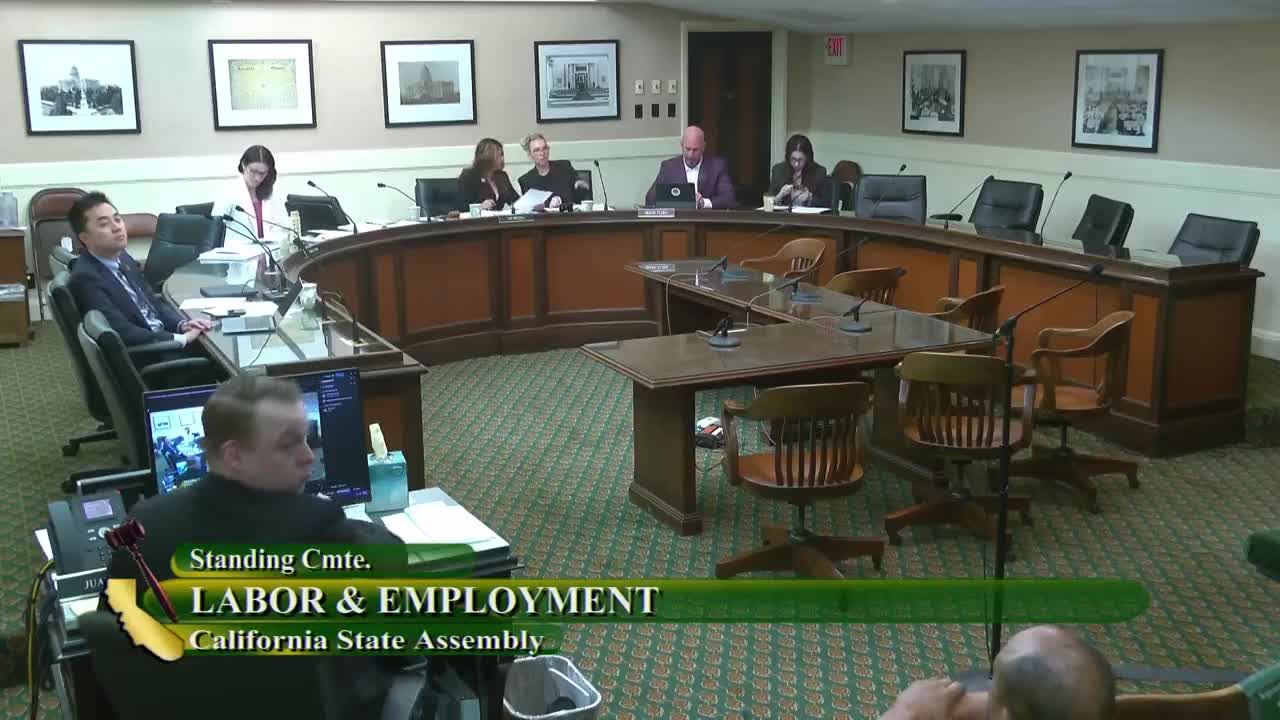
Assembly Standing Committee on Labor and Employment
Bill Author

Bill Co-Author(s):