AB 3106: School employees: COVID-19 cases: protections.
- Session Year: 2023-2024
- House: Assembly
- Latest Version Date: 2024-04-01
Current Status:
Failed
(2024-05-16: In committee: Held under submission.)
Introduced
In Committee
First Chamber
In Committee
Second Chamber
Enacted
What does this bill do?
The bill requires school districts, county offices of education, and charter schools to keep school employees who test positive for COVID-19 out of the workplace until state return-to-work rules are met. While excluded, those employees must keep their pay, seniority, and other job rights as if they had not been kept out of work. Exceptions apply if the employee receives disability or workers’ compensation, and the state standards board must extend these protections to other workplace infectious diseases for school employees.
The summary is provided by generative AI which can make mistakes. For original language, please view the details in the table below.
Existing law grants the Division of Occupational Safety and Health, which is within the Department of Industrial Relations, jurisdiction over all employment and places of employment, with the power necessary to enforce and administer all occupational health and safety laws and standards. The Occupational Safety and Health Standards Board, an independent entity within the department, has the exclusive authority to adopt occupational safety and health standards within the state. Existing law, the California Occupational Safety and Health Act of 1973, requires employers to comply with certain standards ensuring healthy and safe working conditions, as specified, and charges the division with enforcement of the act. Other existing law relating to occupational safety imposes special provisions on certain industries and charges the division with enforcement of these provisions.
This bill would require an employer employer, defined to be a school district, county office of education, or charter school, to ensure that COVID-19 cases, defined as persons specified school employees, who have a positive COVID-19 test, are excluded from the workplace until prescribed return-to-work requirements are met. To the extent administering these provisions imposes additional duties on local educational agencies, the bill would impose a state-mandated local program. The bill, with specified exceptions, would require an employer to continue and maintain an excluded school employees earnings, wages, seniority, and all other employee rights and benefits, including the employees right to their former job status, as if the employee had not been excluded from the workplace, as prescribed. The bill would require the standards board, by February 3, 2025, to adopt a standard that extends these protections to any occupational infectious disease covered by any permanent infectious disease standard adopted to succeed an existing standard for COVID-19 prevention. prevention for those school employees. The bill would require the division to enforce the bill by the issuance of a citation alleging a violation and a notice of civil penalty, as specified. The bill would authorize any person who receives a citation and penalty to appeal the citation and penalty to the Occupational Safety and Health Appeals Board.
The California Constitution requires the state to reimburse local agencies and school districts for certain costs mandated by the state. Statutory provisions establish procedures for making that reimbursement.
This bill would provide that, if the Commission on State Mandates determines that the bill contains costs mandated by the state, reimbursement for those costs shall be made pursuant to the statutory provisions noted above.
Existing law grants the Division of Occupational Safety and Health, which is within the Department of Industrial Relations, jurisdiction over all employment and places of employment, with the power necessary to enforce and administer all occupational health and safety laws and standards. The Occupational Safety and Health Standards Board, an independent entity within the department, has the exclusive authority to adopt occupational safety and health standards within the state. Existing law, the California Occupational Safety and Health Act of 1973, requires employers to comply with certain standards ensuring healthy and safe working conditions, as specified, and charges the division with enforcement of the act. Other existing law relating to occupational safety imposes special provisions on certain industries and charges the division with enforcement of these provisions.
This bill would require an employer to ensure that COVID-19 cases, defined as persons who have a positive COVID-19 test, are excluded from the workplace until prescribed return-to-work requirements are met. The bill, with specified exceptions, would require an employer to continue and maintain an excluded employees earnings, wages, seniority, and all other employee rights and benefits, including the employees right to their former job status, as if the employee had not been excluded from the workplace, as prescribed. The bill would require the standards board, by February 3, 2025, to adopt a standard that extends these protections to any occupational infectious disease covered by any permanent infectious disease standard adopted to succeed an existing standard for COVID-19 prevention. The bill would require the division to enforce the bill by the issuance of a citation alleging a violation and a notice of civil penalty, as specified. The bill would authorize any person who receives a citation and penalty to appeal the citation and penalty to the Occupational Safety and Health Appeals Board.
As used in this part, COVID-19 the following definitions apply:
(a)COVID-19 case means a person school employee who has a positive COVID-19 test that has been approved or granted an emergency use authorization by the United States Food and Drug Administration to diagnose current infection with the SARS-CoV-2 virus.
(b)Employer means a school district, county office of education, or charter school.
(c)School employee means an employee of a school district, county office of education, or charter school employed in a position requiring certification qualifications or employed in a position not requiring certification qualifications.
9256.(a)An employer shall ensure that COVID-19 cases are excluded from the workplace until the return-to-work requirements of subdivision (c) are met.
(b)(1)For an a school employee excluded from the workplace under subdivision (a), an employer shall continue and maintain the employees earnings, wages, seniority, and all other employee rights and benefits, including the employees right to their former job status, as if the employee had not been excluded from the workplace. Wages Both of the following apply to wages due under this paragraph are paragraph:
(A)Wages may be limited to the period in which the employee is excluded from the workplace pursuant to subdivision (c).
(B)Wages are subject to existing wage payment obligations and shall be paid at the employees regular rate of pay no later than the regular payday for any pay period in which the employee is excluded. Unpaid wages owed to an employee under this paragraph are subject to enforcement through procedures available in existing law. If an employer determines that one of the exceptions in paragraph (2) or (3) applies, the employer shall inform the employee of the denial and the applicable exception.
(2)Paragraph (1) does not apply where the employee received disability payments or was covered by workers compensation and received temporary disability.
(3)Paragraph (1) does not limit any other applicable law, employer policy, or collective bargaining agreement that provides for greater protection.
(c)COVID-19 cases with COVID-19 symptoms shall not return to work until all either of the following have occurred: conditions have been met, as applicable:
(1)Consistent with the COVID-19 Isolation Guidance updated by the State Department of Public Health on January 9, 2024, for COVID-19 cases with COVID-19 symptoms, both of the following have occurred:
(1)(A)At least 24 hours have passed since a fever of 100.4 degrees Fahrenheit or higher has resolved without the use of fever-reducing medications.
(2)(B)COVID-19 symptoms are mild and have improved.
(3)At least 10 days have passed since COVID-19 symptoms first appeared.(2)If the State Department of Public Health revises its COVID-19 Isolation Guidance after January 9, 2024, the return-to-work requirements in the revised guidance have occurred.
(d)By February 3, 2025, the Occupational Safety and Health Standards Board shall adopt a standard that extends the protections of subdivision (b) to any occupational infectious disease covered by any permanent infectious disease standard adopted to succeed Section 3205 of Title 8 of the California Code of Regulations. Regulations for school employees.
9257.The division shall enforce this part by the issuance of a citation alleging a violation of this part and a notice of civil penalty in a manner consistent with Section 6317. Any person who receives a citation and penalty may appeal the citation and penalty to the appeals board in a manner consistent with Section 6319.
SEC. 2.If the Commission on State Mandates determines that this act contains costs mandated by the state, reimbursement to local agencies and school districts for those costs shall be made pursuant to Part 7 (commencing with Section 17500) of Division 4 of Title 2 of the Government Code.
As used in this part, COVID-19 case means a person who has a positive COVID-19 test that has been approved or granted an emergency use authorization by the United States Food and Drug Administration to diagnose current infection with the SARS-CoV-2 virus.
9256.(a)An employer shall ensure that COVID-19 cases are excluded from the workplace until the return-to-work requirements of subdivision (c) are met.
(b)(1)For an employee excluded from the workplace under subdivision (a), an employer shall continue and maintain the employees earnings, wages, seniority, and all other employee rights and benefits, including the employees right to their former job status, as if the employee had not been excluded from the workplace. Wages due under this paragraph are subject to existing wage payment obligations and shall be paid at the employees regular rate of pay no later than the regular payday for any pay period in which the employee is excluded. Unpaid wages owed to an employee under this paragraph are subject to enforcement through procedures available in existing law. If an employer determines that one of the exceptions in paragraph (2) or (3) applies, the employer shall inform the employee of the denial and the applicable exception.
(2)Paragraph (1) does not apply where the employee received disability payments or was covered by workers compensation and received temporary disability.
(3)Paragraph (1) does not limit any other applicable law, employer policy, or collective bargaining agreement that provides for greater protection.
(c)COVID-19 cases with COVID-19 symptoms shall not return to work until all of the following have occurred:
(1)At least 24 hours have passed since a fever of 100.4 degrees Fahrenheit or higher has resolved without the use of fever-reducing medications.
(2)COVID-19 symptoms have improved.
(3)At least 10 days have passed since COVID-19 symptoms first appeared.
(d)By February 3, 2025, the Occupational Safety and Health Standards Board shall adopt a standard that extends the protections of subdivision (b) to any occupational infectious disease covered by any permanent infectious disease standard adopted to succeed Section 3205 of Title 8 of the California Code of Regulations.
9257.The division shall enforce this part by the issuance of a citation alleging a violation of this part and a notice of civil penalty in a manner consistent with Section 6317. Any person who receives a citation and penalty may appeal the citation and penalty to the appeals board in a manner consistent with Section 6319.
|
Date
|
Status
|
|---|---|
| May 16, 2024 | In committee: Held under submission. |
| May 8, 2024 | In committee: Set, first hearing. Referred to APPR. suspense file. |
| Apr 18, 2024 | From committee: Do pass and re-refer to Com. on APPR. (Ayes 6. Noes 0.) (April 17). Re-referred to Com. on APPR. |
| Apr 2, 2024 | Re-referred to Com. on L. & E. |
| Apr 1, 2024 | From committee chair, with author's amendments: Amend, and re-refer to Com. on L. & E. Read second time and amended. |
| Mar 11, 2024 | Referred to Com. on L. & E. |
| Feb 17, 2024 | From printer. May be heard in committee March 18. |
| Feb 16, 2024 | Read first time. To print. |
|
Date
|
Description
|
Location
|
Votes
|
|
|---|---|---|---|---|
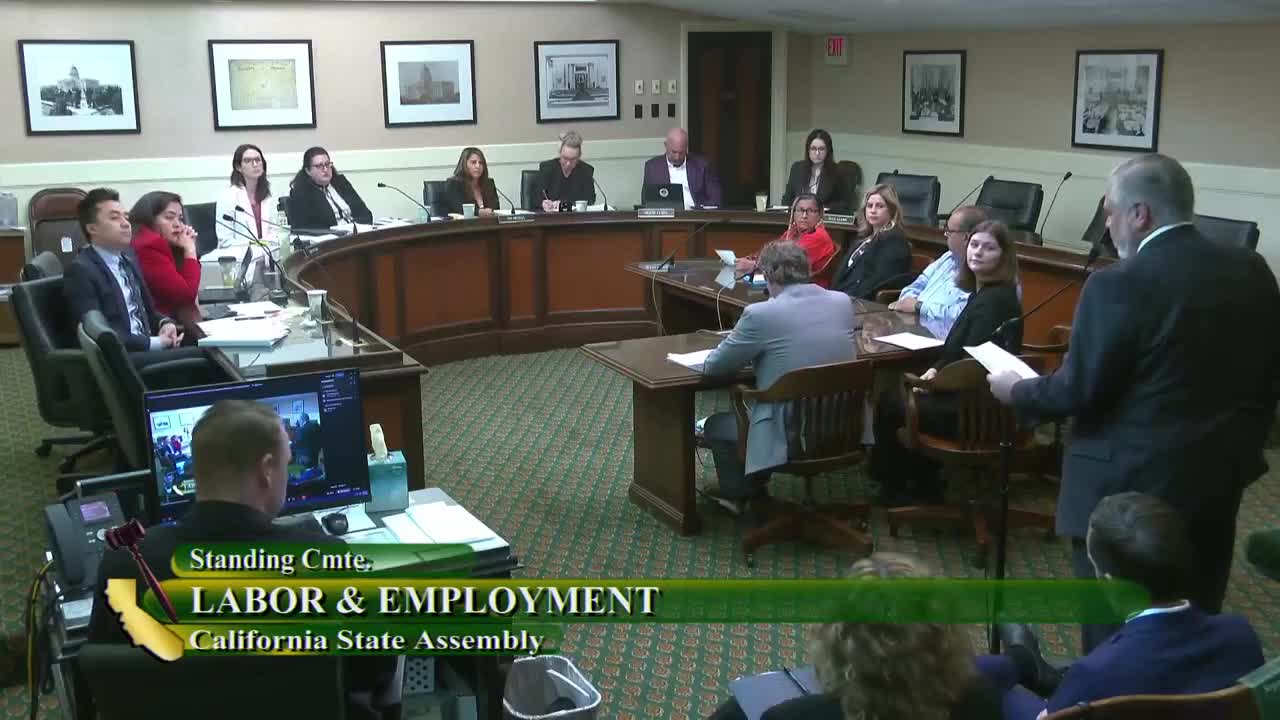
| Apr 17, 2024 | Do pass and be re-referred to the Committee on [Appropriations] | Assembly Standing Committee on Labor and Employment |
Passed |
This list shows positions taken on this bill by organizations on the date displayed, which is linked to the original source.
Positions by individuals are not included.
|
Organization
|
Position
|
Date
|
|---|---|---|
| American Federation of State and County Municipal Employees | * Support | Apr 17, 2024 |
| California Commission on the Status of Women and Girls | ** Support | |
| California Federation Of Teachers | * Support | Apr 17, 2024 |
| California Labor Federation | * Support | Apr 17, 2024 |
| California Nurses Association | * Support | Apr 17, 2024 |
| California School Employees Association | * Support | Apr 17, 2024 |
| California Teachers Association | * Support | Apr 17, 2024 |
| County Health Executives Association Of California | ** Against | |
| Health Officers Association Of California | * Against Unless Amend | Apr 17, 2024 |
Date of Hearing: May 8, 2024
ASSEMBLY COMMITTEE ON APPROPRIATIONS
Buffy Wicks, Chair
ABPCA Bill Id:AB 3106
Author:(Schiavo) – As Amended Ver:April 1, 2024
Policy Committee: | Labor and Employment | Vote: | 6 - 0 |
|
| ||
|
|
Urgency: No State Mandated Local Program: Yes Reimbursable: Yes
SUMMARY:
This bill requires a school employer to exclude an employee with a positive COVID-19 test from the workplace until certain return-to-work requirements are met.
Specifically, this bill:
- Requires a school district, county office of education, or charter school to ensure a school employee testing positive for COVID-19 is excluded from the workplace until the employee meets the return-to-work requirements in the Department of Public Health’s (CDPH’s) COVID-19 Isolation Guidance.
- Requires an employer to continue an excluded employee’s earnings, wages, seniority, and all other rights and benefits, as if the employee was not excluded.
- Requires, by February 3, 2025, the Occupational Safety and Health Standards Board (OSHSB) to adopt a standard for school employees that extends these protections to any occupational infectious disease covered by a permanent infectious disease standard adopted by OSHSB to replace the current regulation regarding COVID-19 prevention.
- Requires the Division of Occupational Safety and Health (Cal/OSHA) to enforce a violation of these provisions by issuing a citation and notice of civil penalty.
FISCAL EFFECT:
- Costs of an unknown amount, likely in the low hundreds of thousands of dollars, to OSHSB to adopt the specified standard for school employees, as well as costs of an unknown, but potentially significant, amount to Cal/OSHA to enforce the exclusion protection for school employees (Occupational Safety and Health Fund).
- By requiring public school employers to establish an exclusion policy for an employee with COVID-19, this bill likely imposes a state-mandated local program with unknown, but potentially significant, costs to the state. To the extent the Commission on State Mandates determines the provisions of this bill create a new program or impose a higher level of service on local education agencies (LEAs), an LEA could claim General Fund (GF) reimbursement of those costs.
Additionally, likely ongoing Proposition 98 GF costs of an unknown, but definitely significant, amount to LEAs to provide continued pay or additional benefits (by not requiring the use of existing leave) to an excluded employee, with the magnitude of such costs depending on the number of sick employees and the duration such employees cannot return to work. LEAs would also incur additional costs for substitute personnel or overtime pay for existing personnel to cover residual workload.
According to the Legislative Analyst’s Office, the GF faces a structural deficit in the tens of billions of dollars over the next several fiscal years.
COMMENTS:
- Purpose. According to the author, “This legislation requires school employers to continue to offer exclusionary pay for those employees that have active symptoms of COVID.”
- Support and Opposition. This bill is sponsored by the California Federation of Teachers, which argues, “Without this reform, COVID-positive workers will either lose earned sick leave – or pay, if no leave remains – and be forced to either risk their own financial or physical health, to say nothing of the risk to their students.”
This bill is opposed by a coalition of school administrator organizations led by the Association of California School Administrators, arguing, “We support providing a work environment that protects the health of school employees and students but AB 3106 would unfortunately impose new burdens on Proposition 98 resources, codify out of date practices, and create a new category of unlimited paid sick leave for a single virus.” This bill is also opposed by public health officer associations.
- Background.
COVID-19 Supplemental Sick Leave. Prior to 2023, various iterations of state law generally provided an employee with an additional 40 hours of paid sick leave if the employee tested positive or had to care for a family member with COVID-19. However, since January 1, 2023, state law does not provide an employee with COVID-19 sick leave beyond general leave benefits required under other applicable laws, such as the five paid sick days allowed under the Healthy Workplaces, Healthy Families Act.
CDPH’s COVID-19 Isolation Guidance. On January 9, 2024, CDPH updated its COVID-19 Isolation Guidance for individuals who test positive for the virus. Generally, the guidance instructs individuals who have tested positive to stay home if they have symptoms, until both of the following occur: (a) at least 24 hours have passed since a fever of 100.4 degrees Fahrenheit or higher has resolved without the use of fever-reducing medications and (b) symptoms are mild and have improved. This bill requires a school employer to exclude an employee who has tested positive for COVID-19 from the workplace, until the employee may return to work pursuant to current CDPH guidance, and requires the employee to continue to receive pay and benefits during such time period, effectively recreating a version of COVID-19 supplemental sick leave specifically for school employees. This bill also requires OSHSB to adopt a standard extending this de facto sick leave policy for school employees to apply to other infectious diseases.
Analysis Prepared by: Irene Ho / APPR. / (916) 319-2081
Date of Hearing: April 17, 2024
ASSEMBLY COMMITTEE ON LABOR AND EMPLOYMENT
Liz Ortega, Chair
ABPCA Bill Id:AB 3106 (
Author:Schiavo) – As Amended Ver:April 1, 2024
SUBJECT: School employees: COVID-19 cases: protections
SUMMARY: Requires a school employer to ensure that COVID-19 cases are excluded from the workplace while continuing to pay an excluded employee their regular earnings until either their symptoms have improved, as specified, or the employer has complied with return-to-work requirements under the California Department of Public Health’s (CDPH) revised isolation guidance. Specifically, this bill:
- Defines employer to means a school district, county office of education, or charter school.
- Defines school employee to mean an employee of a school district, county office of education, or charter school employed in a position requiring certification qualifications or employed in a position not requiring certification qualifications.
- Requires an employer to ensure that COVID-19 cases are excluded from the workplace until either of the following return-to-work requirements are met:
- Consistent with the COVID-19 Isolation Guidance updated by the State Department of Public Health on January 9, 2024, for COVID-19 cases with COVID-19 symptoms, both of the following have occurred:
- At least 24 hours have passed since a fever of 100.4 degrees Fahrenheit or higher has resolved without the use of fever-reducing medications.
- COVID-19 symptoms are mild and have improved.
- If the State Department of Public Health revises its COVID-19 Isolation Guidance after January 9, 2024, the return-to-work requirements in the revised guidance have occurred.
- Consistent with the COVID-19 Isolation Guidance updated by the State Department of Public Health on January 9, 2024, for COVID-19 cases with COVID-19 symptoms, both of the following have occurred:
- Requires, for a school employee excluded from the workplace under 3) above, an employer to continue and maintain the employee’s earnings, wages, seniority, and all other employee rights and benefits, including the employee’s right to their former job status, as if the employee had not been excluded from the workplace. Both of the following apply to wages due under this paragraph:
- Wages may be limited to the period in which the employee is excluded from the workplace pursuant to 3) above.
- Wages are subject to existing wage payment obligations and shall be paid at the employee’s regular rate of pay no later than the regular payday for any pay period in which the employee is excluded. Unpaid wages owed to an employee under this paragraph are subject to enforcement through procedures available in existing law. If an employer determines that one of the exceptions in 5) or 6) below applies, the employer shall inform the employee of the denial and the applicable exception.
- States that the wage obligations in 4) above do not apply where the employee received disability payments or was covered by workers’ compensation and received temporary disability.
- States that 4) above does not limit any other applicable law, employer policy, or collective bargaining agreement that provides for greater protection.
- Requires, by February 3, 2025, the Occupational Safety and Health Standards Board (board) to adopt a standard that extends the protections of 3) above to any occupational infectious disease covered by any permanent infectious disease standard adopted to succeed “COVID-19 Prevention,” Section 3205 of Title 8 of the California Code of Regulations, for school employees.
- Requires the Division of Occupational Safety and Health (Cal/OSHA) to enforce this part by the issuance of a citation alleging a violation of this part and a notice of civil penalty in a manner consistent with existing citation procedures. Any person who receives a citation and penalty may appeal the citation and penalty to the appeals board in a manner consistent with existing appeal procedures.
EXISTING STATE LAW:
- Establishes Cal/OSHA within the Department of Industrial Relations (DIR) to, among other things, propose, administer, and enforce occupational safety and health standards.
Labor Code §6300 et seq. - Requires, under the California Occupational Safety and Health Act, an employer to:
- Furnish employment and a place of employment that is safe and healthful for its employees.
- Furnish and use safety devices and safeguards, and to adopt and use practices, means, methods, operations, and processes, which are reasonably adequate to render employment and the place of employment safe and healthful.
- Do everything reasonably necessary to protect the life, safety, and health of employees. Lab. Code, § 6300 et seq.
- Establishes the board within DIR, to promote, adopt, and maintain reasonable and enforceable standards that will ensure a safe and healthful workplace for workers.
Labor Code, § 140 et seq.
State Regulations
- Requires employers to immediately exclude from the workplace all COVID-19 cases and employees, as specified. The employer shall demonstrate it has met, among other things, the following requirements:
- COVID-19 cases who do not develop COVID-19 symptoms shall not return to work during the infectious period.
- COVID-19 cases who develop COVID-19 symptoms shall not return to work during the shorter of the following: the infectious period; or through 10 days after the onset of symptoms and at least 24 hours have passed since a fever of 100.4 degrees Fahrenheit or higher has resolved without the use of fever-reducing medication. CCR Title 8 Section 3205(c)(5)(A).
FISCAL EFFECT: Unknown
COMMENTS: On January 9, 2024, the California Department of Public Health updated its COVID-19 Isolation Guidance for those who test positive for the virus. In general, the guidance instructs those who have tested positive to say home if they have symptoms until they have not had a fever for 24 hours without using fever reducing medication and other COVID-19 symptoms are mild and improving. Another key recommendation is to avoid contact with higher-risk individuals, such as the elderly or the immunocompromised, for ten days.
A number of studies have found a relatively strong link between school aged children and the transmission of COVID-19. One national transmission study that surveyed over 862,000 individuals found that children play a significant role in the spread of COVID-19 within households, heightened when school was in session.[1] In addition, outbreak data reported to local health departments in California from January 1, 2021 to May 1, 2023, found that elementary and secondary schools were the most common outbreak setting, even higher than residential or skilled nursing facilities.[2] School outbreaks during that time-frame constituted approximately 29 percent of all reported outbreaks.[3]
According to the author, “This legislation requires school employers to continue to offer exclusionary pay for those employees that have active symptoms of COVID.” In addition, “Underserved communities are the most vulnerable population when it comes to infectious diseases, in particular when kids bring home viruses and other infections home to their families. These families could be on limited incomes and health care resulting in detrimental effects on the family’s stability.”
Arguments in Support
The California Federation of Teachers, sponsor of the bill, states, “AB 3106 will guarantee that COVID-positive education workers required by law to stay home will be paid for that time. Given that the law requires them to stay home in such cases, the law should also guarantee that they’ll be fairly compensated for missing work, especially given the high likelihood that their COVID infection was contracted at work.
Without this reform, COVID-positive workers will either lose earned sick leave—or pay, if no leave remains—and be forced to either risk their own financial or physical health, to say nothing of the risk to their students. Additionally, nothing protects these workers from retaliation or termination for taking this time off, should a dispute arise between the employer and the worker over when the forced isolation period has ended. This impossible choice forces many to downplay their symptoms, choose to not test, or simply work while sick to avoid financial harm. The outcomes of putting workers in this situation will be catastrophic for our education workers and our students.
Finally, policy similar to AB 3106 existed for years under the Cal/OSHA COVID standard as well as when Supplemental Paid Sick Leave was in effect; no evidence exists that these policies unduly harmed the economy while in effect. Rather, the reforms proposed will reintroduce science-based policy to this difficult issue and significantly reduce the risk of serious—if not fatal—infectious disease-related outcomes for students, education workers, and the public.”
Arguments in Opposition
The County Health Executives Association of California and the Health Officers Association of California are opposed unless amended, and state, “While we acknowledge the importance of preventing the spread of infectious disease in the workplace and school settings, particularly in the context of the COVID-19 pandemic, we believe setting worker exclusion criteria in statute is not the most effective approach to achieving this goal. Setting worker exclusion criteria in statute overlooks the rapidly evolving nature of infectious disease management and the need for flexibility in response to emerging evidence and public health guidance. By enshrining specific exclusionary measures in law, we risk perpetuating outdated or ineffective strategies that may not align with the latest scientific understanding or best practices in infectious disease control.
Health officers and health department directors are committed to preventing the transmission of infectious diseases, including COVID-19. Although excluding infectious workers is a key part of preventing the spread of disease, specific exclusion criteria should not be set in statute, especially for a virus as rapidly evolving as SARS-CoV-2. These criteria should remain flexible and responsive to changing circumstances, and we believe the approach outlined in AB 3106 may inadvertently jeopardize the health and safety of school employees by potentially subjecting them to outdated guidance. If the bill mandates that school employers adhere to certain COVID-19 workplace exclusion criteria, we urge that it defer to CDPH guidance without codifying the specific criteria in statute.”
Prior Legislation
AB 152 (Committee on Budget) Chapter 736, Statutes of 2022 extended the COVID-19 Supplemental Paid Sick Leave provisions to December 31, 2022.
SB 1114 (Committee on Budget and Fiscal Review) Chapter 4, Statutes of 2022 extended the COVID-19 Supplemental Paid Sick Leave provisions until September 30, 2022.
SB 95 (Skinner) Chapter 13, Statutes of 2021 reestablished and extended the COVID-19 Supplemental Paid Sick Leave provisions to September 30, 2021.
AB 1867 (Committee on Budget) Chapter 45, Statutes of 2020 established the COVID-19 Supplemental Paid Sick Leave and COVID-19 Food Sector Supplemental Paid Sick Leave, to, until December 31, 2020, provide 80 hours of supplemental paid sick leave, as specified.
REGISTERED SUPPORT / OPPOSITION:
Support
California Federation of Teachers (Sponsor)
California Commission on The Status of Women and Girls
California School Employees Association
California Teachers Association
Oppose Unless Amended
County Health Executives Association of California
Health Officers Association of California
Analysis Prepared by: Megan Lane / L. & E. /
Yi-Ju Tseng, Karen L. Olson, Danielle Bloch, et al. “Smart Thermometer-based Participatory Surveillance to Discern the Role of Children in Household Viral Transmission During the COVID-19 Pandemic,” JAMA Open Network, June 1, 2023, p. 1. ↑
COVID-19 Outbreak Data, dated May 5, 2023, CDPH website. “Outbreak” for purposes of this data collection was defined as three or more cases of COVID-19 in a workplace within 14 days. ↑
Ibid. ↑
Discussed in Hearing
 6MIN
Assembly Standing Committee on Labor and Employment
Bill Author

Bill Co-Author(s):