ACA 14: University of California: basic state labor standards.
- Session Year: 2023-2024
- House: Assembly
- Latest Version Date: 2023-09-13
Current Status:
Failed
(2024-05-24: In Senate. Read first time. To Com. on RLS. for assignment.)
Introduced
In Committee
First Chamber
In Committee
Second Chamber
Enacted
What does this bill do?
The measure would amend the California Constitution to require that people who work for the Regents of the University of California be covered by basic state labor protections, such as minimum wage, equal pay, overtime, timely wage payment, and prevailing wages in certain cases. It would also let the Legislature write laws to define those standards and create other health, safety, and labor protections for individuals who perform work for the regents.
The summary is provided by generative AI which can make mistakes. For original language, please view the details in the table below.
The California Constitution provides that the University of California constitutes a public trust, and requires the university to be administered by the Regents of the University of California, a corporation in the form of a board, with full powers of organization and government, subject to legislative control only for specified purposes. These provisions grant the regents all the powers necessary or convenient for the effective administration of its trust.
This measure would require employees of the Regents of the University of California to have the right to, and be covered by, certain basic state labor standards, as provided. The measure would require individuals who perform certain work for the regents to have the right to the payment of a prevailing wage. The measure would authorize the Legislature to enact laws that further these rights, establish, define, or specify the basic state labor standards applicable to the regents, or establish other health, safety, and labor protections for individuals performing work for the regents.
WHEREAS, California did not have basic state labor standards in place when Section 9 of Article IX of the California Constitution (hereafter Article IX) was amended in 1879 to constitute the University of California as a public trust; and
WHEREAS, Despite the California Supreme Court previously holding in San Francisco Labor Council v. Regents of the University of California (1980) (26 Cal.3d 785, 789-790) that it is well settled that general police power regulations governing private persons and corporations may be applied to the university and that state legislation may be made applicable to the University when the legislation regulates matters of statewide concern, and despite the fact that the Legislature has adopted such laws, the University of California has continually taken the position that Article IX excludes hundreds of thousands of Californians who work or perform work for the University of California from basic state labor standards that apply to all other California employers; and
WHEREAS, Some intermediate California courts have held that Article IX excludes Californians who work or perform work for the University of California from some basic state labor standards that apply to all other California employers; and
WHEREAS, Every California worker should have the same basic state labor standards, including equal pay standards, payment of a minimum wage, overtime pay, timely payment of wages, payment of a prevailing wage, and restrictions on outsourcing of jobs; and
WHEREAS, The outdated nearly 150-year-old exclusion of basic state labor standards for Californians who work or perform work for the University of California can be changed only by amending Article IX by a vote of the People of California; now, therefore, be it
Resolved by the Assembly, the Senate concurring, That the Legislature of the State of California at its 202324 Regular Session commencing on the fifth day of December 2022, two-thirds of the membership of each house concurring, hereby proposes to the people of the State of California, that the Constitution of the State be amended as follows:
This measure shall be known, and may be cited, as the Basic Labor Standards at the University of California Act.
|
Date
|
Status
|
|---|---|
| May 24, 2024 | In Senate. Read first time. To Com. on RLS. for assignment. |
| May 23, 2024 | Ordered to the Senate. |
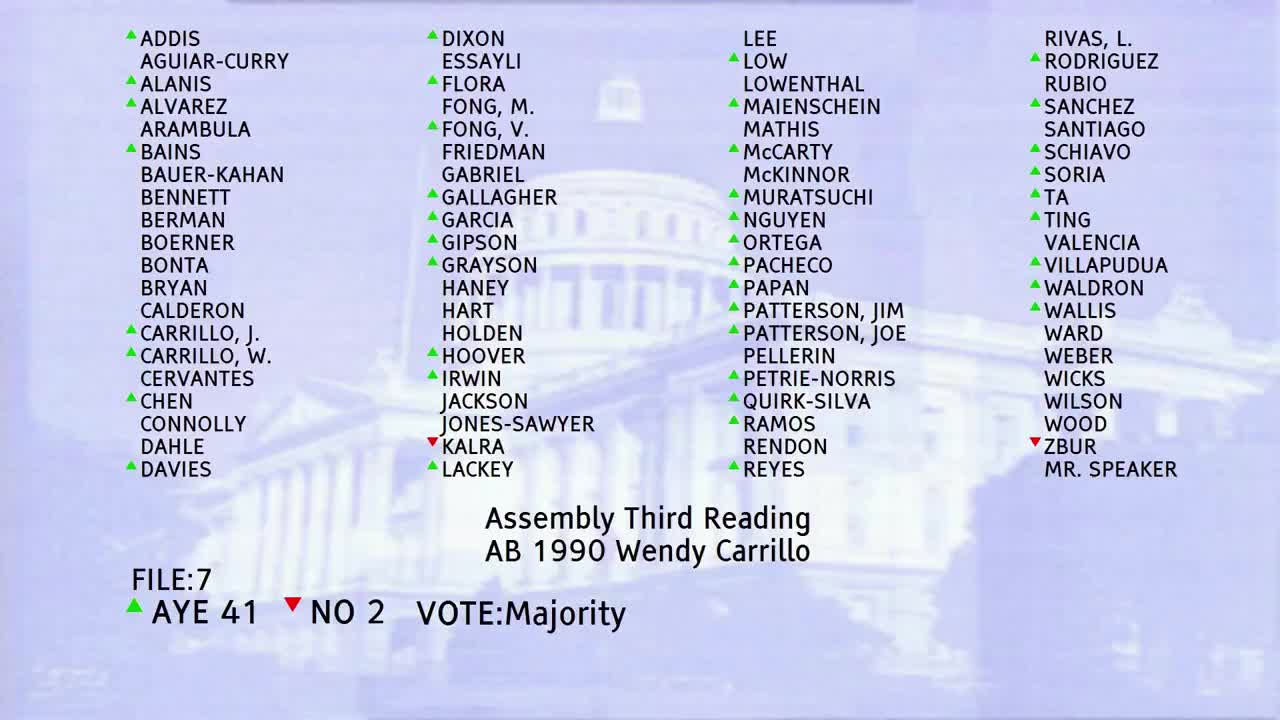
| May 23, 2024 | Read third time. Adopted. (Ayes 57. Noes 9. Page 5645.) |
| May 20, 2024 | Read second time. Ordered to third reading. |
| May 16, 2024 | Coauthors revised. |
| May 16, 2024 | From committee: Be adopted. (Ayes 11. Noes 4.) (May 16). |
| Apr 10, 2024 | In committee: Set, first hearing. Referred to APPR. suspense file. |
| Mar 14, 2024 | From committee: Be adopted, and re-refer to Com. on APPR. Re-referred. (Ayes 5. Noes 0.) (March 13). Re-referred to Com. on APPR. |
| Feb 12, 2024 | Referred to Com. on L. & E. |
| Sep 14, 2023 | From printer. May be heard in committee October 14. |
| Sep 13, 2023 | Read first time. To print. |
|
Date
|
Description
|
Location
|
Votes
|
|
|---|---|---|---|---|
| May 23, 2024 | ACA 14 Ortega Assembly Third Reading | Assembly Floor |
Passed |
|
| May 16, 2024 | Be adopted. | Assembly Standing Committee on Appropriations |
Passed |
|
| Mar 13, 2024 | Be adopted and re-referred to the Committee on [Appropriations] | Assembly Standing Committee on Labor and Employment |
Passed |
This list shows positions taken on this bill by organizations on the date displayed, which is linked to the original source.
Positions by individuals are not included.
|
Organization
|
Position
|
Date
|
|---|---|---|
| AFSCME 3299 | * Support | Mar 13, 2024 |
| AFSCME California | * Support | Mar 13, 2024 |
| Bay Area Council | ** Against | |
| Berkeley Chamber of Commerce | ** Against | |
| Berkeley Disabled Students' Program | ** Against | |
| California Association Of Public Hospitals And Health Systems | * Against | Mar 13, 2024 |
| California Chamber Of Commerce | * Against | Mar 13, 2024 |
| California Hospital Association | * Against | Mar 13, 2024 |
| California Labor Federation | * Support | Mar 13, 2024 |
| California Nurses Association | * Support | Mar 13, 2024 |
| Central City Association | ** Against | |
| Greater Irvine Chamber of Commerce | ** Against | |
| Greater Riverside Chambers of Commerce | ** Against | |
| livermore valley chamber of commerce | ** Against | |
| Los Angeles Area Chamber Of Commerce | * Against | Mar 13, 2024 |
| Los Angeles County Business Federation | ** Against | |
| Merced County Hispanic Chamber of Commerce | ** Against | |
| Newport Beach Area Chamber of Commerce | ** Against | |
| Numerous individuals | ** Against | |
| Orange County Business Council | * Against | Mar 13, 2024 |
| Sacramento Metropolitan Chamber of Commerce | ** Against | |
| San Diego City of Refuge | ** Against | |
| San Diego Regional Chamber Of Commerce | * Against | Mar 13, 2024 |
| Santa Cruz County Chamber of Commerce | ** Against | |
| South Orange County Economic Coalition | ** Against | |
| Spectra Surgical | ** Against | |
| Staxi Corporation | ** Against | |
| Student Accessibility Services, UC Merced | ** Against | |
| The Davis Chamber of Commerce | ** Against | |
| UC Davis Health | ** Against | |
| UC Davis Student Disability Center | ** Against | |
| UC Riverside Student Disability Resource Center | ** Against | |
| Uc San Diego Health | ** Against | |
| UC San Diego Office for Students with Disabilities | ** Against | |
| UC Santa Barbara Disabled Students Program | ** Against | |
| UC Santa Cruz Disability Resource Center | ** Against | |
| UCI Disability Services Center | ** Against | |
| UCI Health | ** Against | |
| UCLA Center for Accessible Education | ** Against | |
| UCLA Health | ** Against | |
| UCR Health | ** Against | |
| UCSF Health | * Against | Mar 13, 2024 |
| UCSF Student Disability Center | ** Against | |
| University of California | ** Against | |
| University of California Academic Affairs | * Against | Mar 13, 2024 |
| University of California Academic Senate | ** Against | |
| University of California Health System | * Against | Mar 13, 2024 |
| University of California, Los Angeles | * Against | Mar 13, 2024 |
| University of California, Merced | * Against | Mar 13, 2024 |
| VALLEY INDUSTRY AND COMMERCE ASSOCIATION | ** Against | |
| West Los Angeles Chamber of Commerce | ** Against | |
| Winsupply San Diego | ** Against |
ASSEMBLY THIRD READING
ATR Bill Id:ACA 14
Author:(Ortega and Haney)
As Introduced Ver:September 13, 2023
2/3 vote
SUMMARY
Applies basic state labor standards that apply to the employees of the state to employees of the Regents of the University of California (UC).
Major Provisions
- Makes findings and declarations regarding the need for the application of basic labor standards to UC employees.
- States that, notwithstanding other state constitutional provisions and unless otherwise provided by state law, UC employees shall have the right to, and shall be covered by, the following basic state labor standards that apply to employees of the state, on or after January 1, 2025:
- Equal pay standards, as specified.
- The payment of a minimum wage.
- The timely payment of wages.
- The payment of overtime and standards governing the hours of work.
- Occupational safety and health standards.
- Meal and rest breaks.
- Paid leave, including paid sick leave.
- Standards against displacement and contracting out of work as provided for in state laws governing the nonemergency use of personal service contracts by the state.
- Payment of a prevailing wage for work paid for, in whole or in part, out of University of California funds, if that work would be considered public works under state prevailing wage laws.
- Permits, notwithstanding other state constitutional provisions, the Legislature to enact laws to further the rights established in 2) above, to establish, define, or specify basic labor standards applicable to the Regents of the UC, or to establish other health, safety, and labor protections for UC employees.
- Prohibits the application of the above provisions to a contract entered into before January 1, 2025, if compliance with them would impair the obligations of that contract.
- States that nothing in bill precludes the state labor standards and protections listed above from being superseded by more favorable terms in a collective bargaining agreement.
COMMENTS
Courts continue to rule that the UC is largely exempt from basic labor laws. In McGee v. Regents of the University of California,[1] the plaintiff, a clinical engineer at a UCLA health system, sued the Regents for pay discrimination under the state Equal Pay Act. The district court found the Regents to be immune from a suit "for violations of California Labor Code Section 1197.5."[2] Similarly, in Gomez v. Regents of the University of California,[3] plaintiff, a former UC employee, claimed the Regents failed to pay her the required minimum wage for all hours she worked due to the timekeeping practice of rounding hours and automatically deducting 30 minute meal breaks. Here, the appellate court declined to attach minimum wage law to the Regents on the grounds that "the Regents are exempt from statutes and regulations that govern wages and benefits of public employees."[4] Finally, in another appellate case, the court found the Regents exempt from paying overtime because of their constitutional status and did so relying on cases finding the Regents also exempt from the payment of prevailing wages.[5]
According to the Author
"I'm proud to stand with my colleagues in the Assembly, including Republican colleagues who supported ACA 6 last year. Assembly Member Haney's statement last year reflects my views:
150 years ago, women couldn’t vote. That’s when a section was added to the State Constitution that made the University of California exempt from basic labor standards…
exempt from overtime pay, exempt from minimum wage orders, exempt from equal pay for women. The courts have ruled that this remains the case. Californians will change this. ACA 14- It's about time.’
I'm joining this effort because California voters deserve the opportunity to decide whether the 250,000 workers at UC have equal pay and basic labor standards as every other worker in the state. The Assembly did the right thing – on a bipartisan vote. ACA 14 will give the State Senate another chance to vote. I am confident that if the Senate does the right thing and allows Californians to vote... Californians will do the right thing."
The author further states that ACA 14 promotes equity solutions "by ensuring that all UC workers are afforded the same labor standards as all other Californians and addresses systemic gender and racial pay gap issues at the UC. AFSCME Local 3299, a union presenting UC's lowest-paid workers, is the most diverse segment of the University's workforce- 79% non-white, and 56% female. A 2018 report on UC workers found that 'on average, Latinos and Latinas earn starting wages 21% lower than white workers, and Blacks earn 20% less than whites.'"
Arguments in Support
The American Federation of State, County, and Municipal Employees, AFL-CIO, Local 3299, co-sponsor to the ACA, states, "Article IX, Section 9 of the State Constitution was adopted nearly 150 years ago before basic labor standards were in place – before equal pay for women, minimum wage, overtime pay, meal and rest breaks, sick leave, prevailing wages, or restrictions on outsourcing of jobs.
This outdated provision of the State Constitution has allowed UC to repeatedly prevail in court and exclude those working for them from basic state labor standards. Most recently in 2021, UC prevailed in their assertion they are exempt from the minimum wage and in the same year, they prevailed on being exempt from the Equal Pay Act.
Other workers in California are not forced to negotiate for these basic labor standards."
Furthermore, the California Labor Federation, co-sponsor of the bill, states, "Despite the Supreme Court holding that state legislation "may be made applicable to the University when the legislation regulates matters of statewide concern," and despite the fact that the Legislature has adopted such laws, the University of California has repeatedly prevailed in excluding hundreds of thousands of Californians who perform work for the University of California from basic state labor standards that apply to all other California employers."
Arguments in Opposition
The UC is opposed and states, "the limits placed on the University by ACA 14 relative to contracting for support services would impair UC's ability to secure sufficient staffing and resources for campuses and medical centers. The UC Health enterprise, for example, would face significant barriers for the safe and affordable delivery of health care. Medical centers need flexibility to fill temporary, and often urgent, staffing vacancies in the event of unexpected leaves or surges in patient census. These issues arise for critical functions including physicians, nurse practitioners, nurses, and technicians. For example, quickly ramping up staffing during the Covid-19 pandemic through a mix of direct hiring and contingent staffing was the only way to meet changing care needs and fluctuating patient volumes. However, under ACA 14, the State Personnel Board would be required to approve any UC proposed service contract, creating unnecessary bureaucratic delays. This extends to other operations, as well, including professional service contracts for information security and technology, legal services, construction and engineering, and more. Together, this portfolio of activities has an annual spend of roughly $1.5 billion.
ACA 14 would also impose unnecessary risk to the University's contract for managing the U.S. Department of Energy's Lawrence Berkeley National Laboratory. Imposing State governance on this federal activity – already subject to federal acquisition regulations and Department of Energy policies common to all the U.S. national labs – is in direct violation of federal policy and would imperil the University's contractual partnership with the Department and the Laboratory, which brings in more than $1.5 billion annually and benefits the State, its researchers, and its students in countless ways."
The California Chamber of Commerce, also in opposition, states, "ACA 14 will further drive up costs by compelling academic and clinical employees – such as students working part-time or teaching assistants and medical residents – to be treated as if they were not students, but instead full-time employees. Similarly, faculty and medical clinicians are educators, long recognized under state and federal law as unique stakeholders with differing employment needs. Imposing new uniform standards across all stakeholder groups will significantly add to UC costs, thus increasing pressure on UC's affordability and accessibility. Notably, ACA 14 is inconsistent with how other public universities are treated in California. Even private California universities are afforded special treatment as education institutions to fulfill their unique academic missions."
FISCAL COMMENTS
According to the Assembly Appropriations Committee,
- Ongoing costs in the low hundreds of millions of dollars to UC to comply with newly imposed contracting standards, manage the review of approximately 1,500 personal service contracts through the State Personnel Board (SPB) process, and, anticipating a 50% rejection rate of reviewed contracts by SPB, hire new UC staff to provide services in-house (General Fund (GF) cost pressure and non-GF UC clinical enterprise). For example, UC cites $1.56 billion in contracts ($668 million in campus services and $898 million in hospital services) from fiscal year 2022-23 would have become subject to SPB review and assumes, due to hiring and management costs, a 20% to 40% insourcing premium on the rejected contract value to bring services in-house. Thus, UC estimates total ongoing costs of approximately $160.3 million to $317.4 million to follow contract standards applicable to state employees.
- One-time costs of approximately $13.2 million to UC to reopen collective bargaining agreements, revisit existing UC policies, and reprogram systems such as payroll and timekeeping (GF cost pressure).
- Costs of approximately $466,000 in the first year and $444,000 ongoing to the Division of Labor Standards Enforcement to provide oversight and enforcement of specified labor protections for UC employees (Labor Enforcement and Compliance Fund).
- Ongoing costs of approximately $3.4 million to SPB to hire additional attorneys, administrative law judges, and other legal staff necessary to review UC's personal services contracts, as set forth in the State Civil Service Act (GF). SPB cites the approximately 1,500 personal services contracts presently in use by UC and notes the analysis required to determine whether the contracts meet cost-saving requirements or whether the services can or should be performed by UC employees instead of a contractor would be novel, complicated, and time consuming.
- One-time costs in the hundreds of thousands of dollars to the Secretary of State (SOS) for printing and mailing expenses associated with placing the measure on the ballot at the next statewide election (GF). Based on the average cost per page for prior elections, the SOS estimates such costs to be approximately $123,000 per page, and the magnitude of costs for this bill depends on the length of the title and summary, analysis by the Legislative Analyst's Office, proponent and opponent arguments, and text of the proposal for publication in the Voter Information Guide.
According to the Legislative Analyst's Office, the GF faces a structural deficit in the tens of billions of dollars over the next several fiscal years.
VOTES
ASM LABOR AND EMPLOYMENT: 5-0-2
YES: Ortega, Wendy Carrillo, Lee, Ward, Zbur
ABS, ABST OR NV: Flora, Alanis
ASM APPROPRIATIONS: 11-4-0
YES: Wicks, Arambula, Bryan, Calderon, Wendy Carrillo, Mike Fong, Grayson, Haney, Hart, Pellerin, Villapudua
NO: Sanchez, Dixon, Jim Patterson, Ta
UPDATED
VERSION: September 13, 2023
CONSULTANT: Megan Lane / L. & E. / (916) 319-2091 FN: 0003240
Date of Hearing: April 10, 2024
ASSEMBLY COMMITTEE ON APPROPRIATIONS
Buffy Wicks, Chair
ABPCA Bill Id:ACA 14
Author:(Ortega) – As Introduced Ver:September 13, 2023
Policy Committee: | Labor and Employment | Vote: | 5 - 0 |
|
| ||
|
|
Urgency: State Mandated Local Program: No Reimbursable: No
SUMMARY:
This measure, if approved by voters, enacts the Basic Labor Standards at the University of California (UC) Act.
Specifically, this measure:
- Grants employees of the UC Regents the right to the following state labor standards as they apply to state employees on or after January 1, 2025: (a) equal pay standards, (b) payment of a minimum wage, (c) timely payment of wages, (d) payment of overtime and standards governing the hours of work, (e) occupational safety and health standards, (f) meal and rest breaks, (g) paid leave, and (h) standards against displacement and contracting out of work, as provided for in state laws governing the non-emergency use of personal service contracts.
- Grants individuals performing work for the UC Regents the right to the payment of a prevailing wage for work paid out of UC funds, if that work would be considered public works under prevailing wage laws applicable to the state on or after January 1, 2025.
- Provides these rights do not apply to a contract entered into before January 1, 2025, if compliance will impair the obligations of the contract.
FISCAL EFFECT:
- Ongoing costs in the low hundreds of millions of dollars to UC to comply with newly imposed contracting standards, manage the review of approximately 1,500 personal service contracts through the State Personnel Board (SPB) process, and, anticipating a 50% rejection rate of reviewed contracts by SPB, hire new UC staff to provide services in-house (General Fund (GF) cost pressure and non-GF UC clinical enterprise). For example, UC cites $1.56 billion in contracts ($668 million in campus services and $898 million in hospital services) from fiscal year 2022-23 would have become subject to SPB review and assumes, due to hiring and management costs, a 20% to 40% insourcing premium on the rejected contract value to bring services in-house. Thus, UC estimates total ongoing costs of approximately $160.3 million to $317.4 million to follow contract standards applicable to state employees.
- One-time costs of approximately $13.2 million to UC to reopen collective bargaining agreements, revisit existing UC policies, and reprogram systems such as payroll and timekeeping (GF cost pressure).
- Costs of approximately $466,000 in the first year and $444,000 ongoing to the Division of Labor Standards Enforcement to provide oversight and enforcement of specified labor protections for UC employees (Labor Enforcement and Compliance Fund).
- Ongoing costs of approximately $3.4 million to SPB to hire additional attorneys, administrative law judges, and other legal staff necessary to review UC’s personal services contracts, as set forth in the State Civil Service Act (GF). SPB cites the approximately 1,500 personal services contracts presently in use by UC and notes the analysis required to determine whether the contracts meet cost-saving requirements or whether the services can or should be performed by UC employees instead of a contractor would be novel, complicated, and time consuming.
- One-time costs in the hundreds of thousands of dollars to the Secretary of State (SOS) for printing and mailing expenses associated with placing the measure on the ballot at the next statewide election (GF). Based on the average cost per page for prior elections, the SOS estimates such costs to be approximately $123,000 per page, and the magnitude of costs for this bill depends on the length of the title and summary, analysis by the Legislative Analyst’s Office, proponent and opponent arguments, and text of the proposal for publication in the Voter Information Guide.
According to the Legislative Analyst’s Office, the GF faces a structural deficit in the tens of billions of dollars over the next several fiscal years.
COMMENTS:
- Purpose. According to the author, “California voters deserve the opportunity to decide whether the 250,000 workers at UC have equal pay and basic labor standards as every other worker in the state.”
- Support and Opposition. This bill is co-sponsored by AFSCME Local 3299, which represents service workers at UC, and the California Labor Federation. AFSCME Local 3299 notes “Article IX, Section 9 of the State Constitution was adopted nearly 150 years ago before basic labor standards were in place” and argues the “outdated provision…has allowed UC to repeatedly prevail in court and exclude those working for them from basic state labor standards.” AFSCME Local 3299 concludes that “Other workers in California are not forced to negotiate for these basic labor standards.”
This bill is opposed by the UC, the California Hospital Association, and various business organizations. UC argues:
The measure unfairly singles out the [UC] by unilaterally applying public sector employment laws not just for its rank-and-file workers, but also for its students, researchers, faculty, and clinicians, thus creating unique challenges for the University’s academic and healthcare missions. ACA 14 also needlessly limits our ability to efficiently (and cost-effectively) meet operational needs as they occur at our campuses and hospitals.
- Background.
Exempt Employer. UC is one of California’s largest employers, with October 2023 data showing UC employed approximately 246,295 full-time and part-time academic employees and non-academic employees. In April 2021, a California court of appeal affirmed a lower court judgement holding that the UC Regents could not be held liable for timekeeping procedures that allegedly deprived a university employee of the wages to which they were entitled. The court of appeal noted that the California Constitution established the Regents as a “public trust,” and the Legislature may regulate the Regents’ conduct in limited circumstances only. Courts have consistently held the Regents are exempt from statutes regulating the wages and benefits of workers, including overtime pay and prevailing wages, as such matters are internal affairs of the university that do not come within any of the exceptions to the Regents’ constitutional immunity.
Equal Pay for Equal Work. In 2019, UC Regents adopted Regents’ Policy 5402, which generally prohibits UC from contracting out for services and functions that UC staff could perform just as well, except under “exigent and limited circumstances.” Policy 5402 also mandates any outside contracts adhere to an “Equal Pay for Equal Work” standard, which generally requires vendor employees to receive at least equal pay and benefits to what UC employees would receive for performing the same work. This measure grants employees of the UC Regents the right to specified state labor standards applicable to state employees, including standards against displacement and contracting out of work.
- Prior Legislation. SB 27 (Durazo), Chapter 480, Statutes of 2023, established mechanisms for monitoring and enforcing compliance with the UC’s Equal Pay for Equal Work policy.
ACA 14 (Gonzalez), of the 2019-20 Legislative Session, if approved by voters, would have limited contract services at UC and required UC to ensure all contract workers are afforded the same equal employment opportunity standards as UC employees performing similar services. ACA 14 failed passage on the Senate Floor.
- Related Legislation. ACA 6 (Haney) is identical to this measure. ACA 6 failed passage in the Senate Elections and Constitutional Amendments Committee. However, when ACA 6 passed this committee, the measure, if approved by voters, would have granted individuals performing work for the UC Regents the right to specified state labor standards applicable to private sector employees, not state employees.
SCA 8 (Durazo) is substantively identical to this measure. SCA 8 is pending referral by the Senate Rules Committee.
Analysis Prepared by: Irene Ho / APPR. / (916) 319-2081
Date of Hearing: March 13, 2024
ASSEMBLY COMMITTEE ON LABOR AND EMPLOYMENT
Liz Ortega, Chair
ABPCA Bill Id:ACA 14 (
Author:Ortega) – As Introduced Ver:September 13, 2023
SUBJECT: University of California: basic state labor standards
SUMMARY: Applies basic state labor standards that apply to the employees of the state to employees of the Regents of the University of California (UC). Specifically, this constitutional amendment:
- Makes findings and declarations regarding the need for the application of basic labor standards to UC employees.
- States that, notwithstanding other state constitutional provisions and unless otherwise provided by state law, UC employees shall have the right to, and shall be covered by, the following basic state labor standards that apply to employees of the state, on or after January 1, 2025:
- Equal pay standards, as specified.
- The payment of a minimum wage.
- The timely payment of wages.
- The payment of overtime and standards governing the hours of work.
- Occupational safety and health standards.
- Meal and rest breaks.
- Paid leave, including paid sick leave.
- Standards against displacement and contracting out of work as provided for in state laws governing the nonemergency use of personal service contracts by the state.
- Payment of a prevailing wage for work paid for, in whole or in part, out of University of California funds, if that work would be considered public works under state prevailing wage laws.
- Permits, notwithstanding other state constitutional provisions, the Legislature to enact laws to further the rights established in 2) above, to establish, define, or specify basic labor standards applicable to the Regents of the UC, or to establish other health, safety, and labor protections for UC employees.
- Prohibits the application of the above provisions to a contract entered into before January 1, 2025, if compliance with them would impair the obligations of that contract.
- States that nothing in bill precludes the state labor standards and protections listed above from being superseded by more favorable terms in a collective bargaining agreement.
EXISTING LAW:
- Establishes the UC as a public trust under the administration of the Regents. (Cal. Const., art. IX, § 9 (a).)
- Grants to the Regents all the powers necessary or convenient for the effective administration of this public trust. (Cal. Const., art. IX, § 9 (f).)
- Provides that the Regents are subject only to such legislative control as may be necessary to insure the security of its funds and compliance with the terms of the endowments of the university and such competitive bidding procedures as may be made applicable to the university by statute for the letting of construction contracts, sales of real property, and purchasing of materials, goods, and services. (Cal. Const., art. IX, § 9 (a).)
- Provides that the Regents are comprised of seven ex officio members, as specified, 18 members appointed by the Governor and approved by the Senate, a majority of the membership concurring, and permits a student representative if appointed by the Regents. (Cal. Const., art. IX, § 9 (a).)
FISCAL EFFECT: Unknown
COMMENTS: As of October 2020, the UC employed 73,012 academic employees and 143,188 non-academic employees.[1]According to the UC, these totals represent all unique employees with any earnings at UC, regardless of full-time or part-time status.[2] A total of 216,200 workers employed by the UC are potentially exempt from various state labor laws due to the UC’s constitutional exemption.
Courts continue to rule that the UC is largely exempt from basic labor laws. In McGee v. Regents of the University of California,[3] the plaintiff, a clinical engineer at a UCLA health system, sued the Regents for pay discrimination under the state Equal Pay Act. The district court found the Regents to be immune from a suit “for violations of California Labor Code §1197.5.”[4] Similarly, in Gomez v. Regents of the University of California,[5] plaintiff, a former UC employee, claimed the Regents failed to pay her the required minimum wage for all hours she worked due to the timekeeping practice of rounding hours and automatically deducting 30 minute meal breaks. Here, the appellate court declined to attach minimum wage law to the Regents on the grounds that “the Regents are exempt from statutes and regulations that govern wages and benefits of public employees.”[6] Finally, in another appellate case, the court found the Regents exempt from paying overtime because of their constitutional status and did so relying on cases finding the Regents also exempt from the payment of prevailing wages.[7]
According to the author, “I’m proud to stand with my colleagues in the Assembly, including Republican colleagues who supported ACA 6 last year. Assembly Member Haney’s statement last year reflects my views:
‘150 years ago, women couldn’t vote. That’s when a section was added to the State Constitution that made the University of California exempt from basic labor standards…
exempt from overtime pay, exempt from minimum wage orders, exempt from equal pay for women. The courts have ruled that this remains the case. Californians will change this. ACA 14- It’s about time.’
I’m joining this effort because California voters deserve the opportunity to decide whether the 250,000 workers at UC have equal pay and basic labor standards as every other worker in the state. The Assembly did the right thing – on a bipartisan vote. ACA 14 will give the State Senate another chance to vote. I am confident that if the Senate does the right thing and allows Californians to vote... Californians will do the right thing.”
The author further states that ACA 14 promotes equity solutions “by ensuring that all UC workers are afforded the same labor standards as all other Californians and addresses systemic gender and racial pay gap issues at the UC. AFSCME Local 3299, a union presenting UC’s lowest-paid workers, is the most diverse segment of the University’s workforce- 79% non-white, and 56% female. A 2018 report on UC workers found that ‘on average, Latinos and Latinas earn starting wages 21% lower than white workers, and Blacks earn 20% less than whites.’”
Arguments in Support
The American Federation of State, County, and Municipal Employees, AFL-CIO, Local 3299, co-sponsor to the ACA, states, “Article IX, Section 9 of the State Constitution was adopted nearly 150 years ago before basic labor standards were in place – before equal pay for women, minimum wage, overtime pay, meal and rest breaks, sick leave, prevailing wages, or restrictions on outsourcing of jobs.
This outdated provision of the State Constitution has allowed UC to repeatedly prevail in court and exclude those working for them from basic state labor standards. Most recently in 2021, UC prevailed in their assertion they are exempt from the minimum wage and in the same year, they prevailed on being exempt from the Equal Pay Act.
Other workers in California are not forced to negotiate for these basic labor standards.”
Furthermore, the California Labor Federation, co-sponsor of the bill, states, “Despite the Supreme Court holding that state legislation “may be made applicable to the University when the legislation regulates matters of statewide concern,” and despite the fact that the Legislature has adopted such laws, the University of California has repeatedly prevailed in excluding hundreds of thousands of Californians who perform work for the University of California from basic state labor standards that apply to all other California employers.”
Arguments in Opposition
The UC is opposed and states, “the limits placed on the University by ACA 14 relative to contracting for support services would impair UC’s ability to secure sufficient staffing and resources for campuses and medical centers. The UC Health enterprise, for example, would face significant barriers for the safe and affordable delivery of health care. Medical centers need flexibility to fill temporary, and often urgent, staffing vacancies in the event of unexpected leaves or surges in patient census. These issues arise for critical functions including physicians, nurse practitioners, nurses, and technicians. For example, quickly ramping up staffing during the Covid-19 pandemic through a mix of direct hiring and contingent staffing was the only way to meet changing care needs and fluctuating patient volumes. However, under ACA 14, the State Personnel Board would be required to approve any UC proposed service contract, creating unnecessary bureaucratic delays. This extends to other operations, as well, including professional service contracts for information security and technology, legal services, construction and engineering, and more. Together, this portfolio of activities has an annual spend of roughly $1.5 billion.
ACA 14 would also impose unnecessary risk to the University’s contract for managing the U.S. Department of Energy's Lawrence Berkeley National Laboratory. Imposing State governance on this federal activity – already subject to federal acquisition regulations and Department of Energy policies common to all the U.S. national labs – is in direct violation of federal policy and would imperil the University's contractual partnership with the Department and the Laboratory, which brings in more than $1.5 billion annually and benefits the State, its researchers, and its students in countless ways.”
The California Chamber of Commerce, also in opposition, states, “ACA 14 will further drive up costs by compelling academic and clinical employees – such as students working part-time or teaching assistants and medical residents – to be treated as if they were not students, but instead full-time employees. Similarly, faculty and medical clinicians are educators, long recognized under state and federal law as unique stakeholders with differing employment needs. Imposing new uniform standards across all stakeholder groups will significantly add to UC costs, thus increasing pressure on UC’s affordability and accessibility. Notably, ACA 14 is inconsistent with how other public universities are treated in California. Even private California universities are afforded special treatment as education institutions to fulfill their unique academic missions.”
Prior Legislation
ACA 6 (Haney) of 2023 is substantially similar to this constitutional amendment and is in the Senate Committee on Elections and Constitutional Amendments.
SCA 8 (Durazo) of 2023 is substantially similar to this constitutional amendment and is awaiting referral in the Senate.
SB 27 (Durazo) Chapter 480, Statutes of 2023 establishes mechanisms for monitoring and enforcing compliance with the UC’s Equal Pay for Equal Work policy which requires covered vendors who supply services to the UC to provide at least equal pay and benefits to their employees when compared with what UC employees would receive for performing the same work.
SB 1364 (Durazo) of 2022 would have required a vendor that contracts with the UC to perform services, to provide their employees with the higher of the total compensation rate specified in the vendor's contract with the university or as required by university policy. Also would have required a vendor, twice yearly, to provide basic payroll information, as defined, to the UC and members of any meeting body established with the exclusive representative of university employees who perform the same or similar services. This bill was vetoed by Governor Newsom.
SCA 5 (Glazer) of 2022 would have required the UC Board of Regents to add an additional student member to the Board, to serve for at least one year and be a voting member of the Board with the same participation rights as other Regents. This SCA was held under submission in the Assembly Appropriations Committee.
ACA 10 (Valladares) of 2021 would have prohibited the UC Regents from increasing the total amount of tuition and mandatory system wide fees charged to students of the university above those in effect as of June 15, 2021, until the 2027–28 academic year. This ACA died in the Assembly.
ACA 14 (Gonzalez) of 2019 would have required the Regents of the UC to ensure that all contract workers who are paid to perform support services for the UC to be afforded the same equal employment opportunity standards as university employees performing similar services. This ACA died on the Senate inactive file.
REGISTERED SUPPORT / OPPOSITION:
Support
AFSCME Local 3299 (Co-Sponsor)
California Labor Federation (Co-Sponsor)
Opposition
Bay Area Council
Berkeley Chamber of Commerce
Berkeley Disabled Students' Program
CalChamber
California Association of Public Hospitals & Health Systems
California Hospital Association
Central City Association
Greater Irvine Chamber of Commerce
Greater Riverside Chambers of Commerce
Livermore Valley Chamber of Commerce
Los Angeles Area Chamber of Commerce
Los Angeles County Business Federation
Merced County Hispanic Chamber of Commerce
Newport Beach Area Chamber of Commerce
Numerous Individuals
Orange County Business Council
Sacramento Metropolitan Chamber of Commerce
San Diego City of Refuge
Santa Cruz County Chamber of Commerce
South Orange County Economic Coalition
Spectra Surgical
Staxi Corporation
Student Accessibility Services, UC Merced
The Davis Chamber of Commerce
UC Davis Student Disability Center
UC Davis Health
UC Riverside Student Disability Resource Center
UC San Diego Health
UC San Diego Office for Students with Disabilities
UC Santa Barbara Disabled Students Program
UC Santa Cruz Disability Resource Center
UCI Disability Services Center
UCI Health
UCLA Center for Accessible Education
UCLA Health
UCR Health
UCSF Health
UCSF Student Disability Center
University of California
University of California Academic Senate
Valley Industry and Commerce Association
West Los Angeles Chamber of Commerce
Winsupply San Diego
Analysis Prepared by: Megan Lane / L. & E. /
Discussed in Hearing
 6MIN
Assembly Floor
 25MIN