ACA 4: Elections: eligibility to vote.
- Session Year: 2023-2024
- House: Assembly
- Latest Version Date: 2023-02-06
Current Status:
Failed
(2023-09-14: Ordered to inactive file at the request of Assembly Member Bryan.)
Introduced
In Committee
First Chamber
In Committee
Second Chamber
Enacted
The California Constitution authorizes a person to vote if the person is a United States citizen, at least 18 years of age, and a resident of the state. The California Constitution requires the Legislature to provide for the disqualification of electors while serving a state or federal prison term for the conviction of a felony.
This measure would repeal that requirement regarding the disqualification of electors incarcerated for felony convictions, thereby authorizing an otherwise qualified elector serving a state or federal prison term for the conviction of a felony to vote.
Resolved by the Assembly, the Senate concurring, That the Legislature of the State of California at its 202324 Regular Session commencing on the fifth day of December 2022, two-thirds of the membership of each house concurring, hereby proposes to the people of the State of California that the Constitution of the State be amended as follows:
(a)A United States citizen who is at least 18 years of age and a resident in this State may vote.
(b)An elector disqualified from voting while serving a state or federal prison term, as described in Section 4, shall have their right to vote restored upon the completion of their prison term.The Legislature shall prohibit improper practices that affect elections and shall provide for the disqualification of electors while mentally incompetent or serving a state or federal prison term for the conviction of a felony. incompetent.
|
Date
|
Status
|
|---|---|
| Sep 14, 2023 | Ordered to inactive file at the request of Assembly Member Bryan. |
| May 18, 2023 | Coauthors revised. |
| May 18, 2023 | From committee: Be adopted. (Ayes 11. Noes 4.) (May 18). |
| May 18, 2023 | Read second time. Ordered to third reading. |
| May 10, 2023 | In committee: Set, first hearing. Referred to APPR. suspense file. |
| Apr 19, 2023 | Coauthors revised. |
| Apr 19, 2023 | From committee: Be adopted, and re-refer to Com. on APPR. Re-referred. (Ayes 6. Noes 2.) (April 19). Re-referred to Com. on APPR. |
| Mar 30, 2023 | Referred to Com. on ELECTIONS. |
| Feb 7, 2023 | From printer. May be heard in committee March 9. |
| Feb 6, 2023 | Read first time. To print. |
|
Date
|
Description
|
Location
|
Votes
|
|
|---|---|---|---|---|
| May 18, 2023 | Be adopted. | Assembly Standing Committee on Appropriations |
Passed |
|
| Apr 19, 2023 | Be adopted and re-referred to the Committee on [Appropriations] | Assembly Standing Committee on Elections |
Passed |
This list shows positions taken on this bill by organizations on the date displayed, which is linked to the original source.
Positions by individuals are not included.
|
Organization
|
Position
|
Date
|
|---|---|---|
| A New Way of Life Reentry Project | ** Support | |
| AAPI Equity Alliance | ** Support | |
| Aclu California Action | * Support | Apr 19, 2023 |
| Africa Town Coalition | * Support | Apr 19, 2023 |
| All of Us or None | * Support | Apr 19, 2023 |
| Alliance of Boys and Men of Color | * Support | Apr 19, 2023 |
| Alliance San Diego | ** Support | |
| Anti Recidivism Coalition | * Support | Apr 19, 2023 |
| AntiRecidivism Coalition Arc | * Support | Apr 19, 2023 |
| ARC | * Support | Apr 19, 2023 |
| Asian America's Advancing Justice Asian Law Caucus | * Support | Apr 19, 2023 |
| Bay Rising | ** Support | |
| Black Los Angeles Young Democrats | ** Support | |
| Black Women Organized for Political Action | ** Support | |
| Calaveras County | * Against | Apr 19, 2023 |
| California Attorney for Criminal Justice | * Support | Apr 19, 2023 |
| California Black Power Network | * Support | Apr 19, 2023 |
| California Calls | * Support | Apr 19, 2023 |
| California Coalition for Women Prisoners | * Support | Apr 19, 2023 |
| California Democratic Central Committee | * Support | Apr 19, 2023 |
| California Federation of Teachers, AFL-CIO | ** Support | |
| California Hawaii NAACP | * Support | Apr 19, 2023 |
| California Immigrant Policy Center | * Support | Apr 19, 2023 |
| California Judiciary Rights | * Support | Apr 19, 2023 |
| Californians United for a Responsible Budget | ** Support | |
| Center for Employment Opportunities | * Support | Apr 19, 2023 |
| CEO | * Support | Apr 19, 2023 |
| CEO | * Support | Apr 19, 2023 |
| Change Begins With Me | * Support | Apr 19, 2023 |
| Chinese for Affirmative Action | ** Support | |
| Clergy and Laity United for Economic Justice | ** Support | |
| Communities United for Restorative Justice | * Support | Apr 19, 2023 |
| Community Health Councils | ** Support | |
| Congregations Organized for Prophetic Engagement | * Support | Apr 19, 2023 |
| County of Sacramento | * Against | Apr 19, 2023 |
| County Of Santa Clara | * Against | Apr 19, 2023 |
| County Of Santa Clara | * Support | Apr 19, 2023 |
| Culver City Democratic Club | * Support | Apr 19, 2023 |
| Democratic Party of the San Fernando Valley | ** Support | |
| Disability Rights California | * Support | Apr 19, 2023 |
| EAPCA | * Against | Apr 19, 2023 |
| Ear Hustle | * Support | Apr 19, 2023 |
| East Bay Community Law Center | ** Support | |
| East Bay for Everyone | ** Support | |
| Election Integrity Project | * Against | Apr 19, 2023 |
| Election Integrity Project California | * Against | Apr 19, 2023 |
| Ella Baker Center | * Support | Apr 19, 2023 |
| Ella Baker Center For Human Rights | * Support | Apr 19, 2023 |
| Empowering Pacific Islander Communities Fiscally Sponsored by Community Partners | ** Support | |
| Empowering Women Impacted by Incarceration | * Support | Apr 19, 2023 |
| Empowerment Avenue | * Support | Apr 19, 2023 |
| Esperanza Community Housing Corporation | ** Support | |
| Fair Chance Project | ** Support | |
| Families United to End Life Without Parole | ** Support | |
| For Courage California | * Support | Apr 19, 2023 |
| Friends Committee on Legislation in California | * Support | Apr 19, 2023 |
| Grip Training Institute | ** Support | |
| Human Rights Watch | ** Support | |
| Immigrant Defense Advocates | ** Support | |
| Indivisible California State Strong | * Support | Apr 19, 2023 |
| Indivisible East Bay | * Support | Apr 19, 2023 |
| Initiate Justice | * Support | Apr 19, 2023 |
| Initiate Justice Action | * Support | Apr 19, 2023 |
| Initiative Justice Action | * Support | Apr 19, 2023 |
| Inland Empire United | * Support | Apr 19, 2023 |
| Insight Prison Project, a Division of Five Keys Schools and Programs | ** Support | |
| Jewish Center for Justice | ** Support | |
| Justice Fuel | * Support | Apr 19, 2023 |
| LA County Democratic Party Central Committee | * Support | Apr 19, 2023 |
| Law Enforcement Action Partnership | ** Support | |
| Lawyers' Committee for Civil Rights of the San Francisco Bay Area | ** Support | |
| League of Woman Voters of California | * Support | Apr 19, 2023 |
| Legal Services for Prisoners with Children | * Support | Apr 19, 2023 |
| Los Angeles County | * Against | Apr 19, 2023 |
| Los Angeles LGBT Center | ** Support | |
| Los Angeles Urban League | ** Support | |
| NARAL Pro-Choice California | ** Support | |
| National Association of Social Work, California Chapter | * Support | Apr 19, 2023 |
| National Association of Social Workers | * Support | Apr 19, 2023 |
| Norcal Resist | ** Support | |
| Orange County | * Against | Apr 19, 2023 |
| Orange County Environments and Justice | * Support | Apr 19, 2023 |
| Pillars of the Community | ** Support | |
| Ryse Center | ** Support | |
| Santa Monica Democratic Club | * Support | Apr 19, 2023 |
| Secure Justice | ** Support | |
| Showing Up For Racial Justice - Bay Area | ** Support | |
| Showing Up for Racial Justice North County San Diego | ** Support | |
| Sister Word Freedom Coalition Policy Associate | * Support | Apr 19, 2023 |
| Smart Justice California | * Support | Apr 19, 2023 |
| South Asian Network | ** Support | |
| Starting Over, Inc. | ** Support | |
| Stonewall Democratic Club | ** Support | |
| Team Justice | ** Support | |
| Thai Community Development Center | ** Support | |
| The Black Alliance for Just Immigration | ** Support | |
| The Collective Healing and Transformation Project | ** Support | |
| the san diego lgbt community center | ** Support | |
| The San Fernando Valley Young Democrats | ** Support | |
| The Santa Monica Democratic Club | ** Support | |
| The Sentencing Project | ** Support | |
| The Transformative In-prison Workgroup | ** Support | |
| The W. Haywood Burns Institute | ** Support | |
| Wellstone Democratic Renewal Club | ** Support | |
| White People 4 Black Lives | ** Support |
ASSEMBLY THIRD READING
ATR Bill Id:ACA 4
Author:(Bryan)
As Introduced Ver:February 6, 2023
2/3 vote
SUMMARY
Repeals a constitutional requirement for the Legislature to provide for the disqualification of electors while serving a state or federal prison term for the conviction of a felony, subject to the approval of the voters.
Major Provisions
COMMENTS
California Constitution Article II, Section 4 provides "[t]he Legislature shall prohibit improper practices that affect elections and shall provide for the disqualification of electors while mentally incompetent or serving a state or federal prison term for the conviction of a felony."
Elections Code Section 2101 is the statute that implements Article II, Section 4 of the California Constitution. Section 2101 states "[a] person entitled to register to vote shall be a United States citizen, a resident of California, not imprisoned for the conviction of a felony, and at least 18 years of age at the time of the next election."
California law does not restrict the voting rights of people who are on probation or parole, or who are on other types of supervision as a result of a criminal proceeding (such as mandatory supervision, post-release community supervision, or federal supervised release). Similarly, state law does not restrict the voting rights of individuals who are in a local detention facility while doing any of the following: 1) serving a misdemeanor sentence, 2) serving jail time as a condition of probation, 3) serving a felony jail sentence, or 4) awaiting trial.
By contrast, a person who is in a local detention facility while serving a state prison term is not eligible to vote under existing law. Under certain circumstances, a person who is serving a state prison sentence may nonetheless be housed in a local detention facility.
Until 2020, California law prohibited a person who was on parole for the conviction of a felony from registering to vote or voting. ACA 6 (McCarty), Chapter 24, Statutes of 2020, proposed an amendment to the state constitution to allow a person who is on parole for the conviction of a felony to register to vote and to vote. ACA 6 was approved by the Assembly by a 54-19 vote. ACA 6 appeared on the ballot at the November 2020 statewide general election as Proposition 17. According to the final official election results prepared by the Secretary of State, Proposition 17 was approved by the voters with 58.6% of ballots cast in favor of the amendment, and 41.4% cast in opposition.
According to information from the National Conference of State Legislatures, state approaches to felon disenfranchisement vary tremendously. In two states (Maine and Vermont) and the District of Columbia, felons never lose their right to vote, even while incarcerated. California is one of 23 states in which felons lose their voting rights only while incarcerated, and receive automatic restoration of voting rights upon release. In 14 states, felons lose their voting rights during incarceration, and for a period after, typically while on parole or probation. In those states, a person may have to pay any outstanding fines, fees, or restitution before the person's voting rights are restored.
Finally, 11 states are more restrictive about reinstating a person's voting rights after a felony conviction. In some of those states, felons lose their voting rights indefinitely for some crimes, or may face an additional waiting period after completion of any sentence (including parole and probation) before voting rights can be restored. Other states require a person to receive a pardon, or to apply to a court or to the governor, to have their voting rights restored.
According to information from the California Department of Corrections and Rehabilitation (CDCR), as of April 5, 2023, there are about 93,000 people in institutions and camps operated by CDCR. Additionally, data from the Federal Bureau of Prisons shows that approximately 14,000 individuals were incarcerated in federal prisons in California as of March 23, 2023. Not all of those individuals would become eligible to vote if this measure becomes law, as some of those individuals likely do not meet other requirements to register to vote and to vote (for instance, individuals who are not citizens or are not residents of California).
AB 1595 (Bryan) of the current legislative session which is pending on the Assembly Floor, is the implementing legislation for this constitutional amendment. In addition to making conforming changes to state law to implement this constitutional amendment, if approved by voters, AB 1595 additionally specifies that the residence for voting purposes of a person who is serving time in a state or federal prison is based on the person's last voluntary residence in the state.
As a constitutional amendment, this measure requires the approval of the voters to take effect.
According to the Author
"California voters deserve the opportunity to decide if our Democracy should include everyone. ACA 4 will give the people of California a choice to undue a wrong in our State Constitution that was designed to disenfranchise voters solely based on their contact with the criminal legal system- a system that has been documented time and again to disproportionately impact Black, Brown, Poor, Indigenous, and Veteran communities. Preserving the right to vote for all people, including those who are currently incarcerated, will have significant and positive impacts both on democracy and public safety. Over 95% of all people currently incarcerated in state prison will eventually return home. Data shows that people who vote while incarcerated and shortly thereafter are 50% less likely to ever be rearrested. The rates of these legal barriers to civic participation and social engagement are shocking: Black people are disenfranchised at a rate 10 times that of white men; Latino and Native American communities at a rate double that of white men. This disenfranchisement also disproportionately impacts our veterans, many of whom return to civilian life with visible and invisible trauma, and face a greater likelihood becoming arrested. California currently has more than 7,000 veterans who are denied their voting rights, despite having served our country, solely because they are incarcerated. There are several States and United States territories that allow everyone to participate in the democratic process. Democracies around the world have also normalized this standard. ACA 4 will give voters in Californians the opportunity to decide if a thriving Democracy includes everybody or if historic suppression and disenfranchisement measures should remain a feature of our civil society."
Arguments in Support
One of the co-sponsors of this measure, Initiate Justice, writes in support, "For much of its history, California has taken steps to restrict the rights of both poor and nonwhite citizens. Until 1962, the state refused to ratify the 14th Amendment, which guaranteed equal protection of the law after the Civil War, and the 15th Amendment, which prohibits voting restrictions based on race. But in recent years, California has led the nation in ensuring the right to participate in free and fair elections. Protecting the right to vote – and ensuring that the voices of all citizens are heard, equally and without bias or favoritism, is a core Californian value…California voters should have the opportunity to decide if our Democracy is one that thrives with the participation of everyone. ACA 4 will give the people of California a choice – should we be an inclusive, democratic society, or should we turn back to our own dark history of racially motivated disenfranchisement, voter suppression, and restriction of civil rights and participation."
Arguments in Opposition
In opposition to this measure, Election Integrity Project California, Inc. writes, "While in jail or prison, convicted individuals must necessarily lose many freedoms and civil rights that law-abiding citizens can enjoy: the rights of speech or expression, movement, parental privilege, public assistance, and even personal liberties such as the choice of wardrobe, diet, occupation, hygiene, social interactions and recreation. Until quite recently, one of the freedoms lost almost everywhere has been the right to vote. When a person voluntarily breaks the social contract and hurts someone or 'takes their stuff,' societies world-wide have seen the logic in removing their right to participate in the activity of choosing society's governors and governing policies, i.e., voting…Voting is a privilege and not an absolute right of citizenship. Losing the right to vote, as an incarcerated felon, is part of paying their debt to society. This is not an issue of disenfranchisement because every felon is being treated equally in losing their right to vote while incarcerated. Upon serving their sentence, felons equally can have their rights restored."
FISCAL COMMENTS
According to the Assembly Appropriations Committee:
- One-time costs in the hundreds of thousands of dollars to the Secretary of State (SOS) for printing and mailing expenses associated with placing the measure on the ballot at the next statewide election (General Fund (GF)). Based on the average cost per page for the last three elections, the SOS estimates such costs to be approximately $123,000 per page, and the magnitude of costs for this bill depends on the length of the title and summary, analysis by the Legislative Analyst's Office, proponent and opponent arguments, and text of the proposal for publication in the Voter Information Guide.
- Costs of an unknown, but potentially significant amount, in excess of $150,000, to CDCR to facilitate voting for incarcerated individuals (GF). CDCR notes costs will vary across prison facilities, as each houses a specific population, with implementation dependent on the level of individualized support and resources needed to ensure voting rights are carried out timely, confidentially, and appropriately. Although not every incarcerated person would be eligible to vote, there are approximately 93,000 people currently incarcerated in CDCR's institutions and camps.
VOTES
ASM ELECTIONS: 6-2-0
YES: Bryan, Bennett, Lee, Low, Pellerin, Blanca Rubio
NO: Lackey, Essayli
ASM APPROPRIATIONS: 11-4-1
YES: Holden, Bryan, Calderon, Wendy Carrillo, Mike Fong, Hart, Lowenthal, Papan, Pellerin, Weber, Ortega
NO: Megan Dahle, Dixon, Mathis, Sanchez
ABS, ABST OR NV: Robert Rivas
UPDATED
VERSION: February 6, 2023
CONSULTANT: Ethan Jones / ELECTIONS / (916) 319-2094 FN: 0000847
Date of Hearing: May 10, 2023
ASSEMBLY COMMITTEE ON APPROPRIATIONS
Chris Holden, Chair
ABPCA Bill Id:ACA 4
Author:(Bryan) – As Introduced Ver:February 6, 2023
Policy Committee: | Elections | Vote: | 6 - 2 |
|
| ||
|
|
Urgency: State Mandated Local Program: No Reimbursable: No
SUMMARY:
This measure, if approved by voters, repeals the constitutional provision disqualifying a person from voting if the person is serving a state or federal prison term for the conviction of a felony.
FISCAL EFFECT:
- One-time costs in the hundreds of thousands of dollars to the Secretary of State (SOS) for printing and mailing expenses associated with placing the measure on the ballot at the next statewide election (General Fund (GF)). Based on the average cost per page for the last three elections, the SOS estimates such costs to be approximately $123,000 per page, and the magnitude of costs for this bill depends on the length of the title and summary, analysis by the Legislative Analyst’s Office, proponent and opponent arguments, and text of the proposal for publication in the Voter Information Guide.
- Costs of an unknown, but potentially significant amount, in excess of $150,000, to the Department of Corrections and Rehabilitation (CDCR) to facilitate voting for incarcerated individuals (GF). CDCR notes costs will vary across prison facilities, as each houses a specific population, with implementation dependent on the level of individualized support and resources needed to ensure voting rights are carried out timely, confidentially, and appropriately. Although not every incarcerated person would be eligible to vote, there are approximately 93,000 people currently incarcerated in CDCR’s institutions and camps.
COMMENTS:
- Purpose. According to the author, “California voters should have the opportunity to decide if our Democracy is one that thrives with the participation of everyone.” The author notes Black men and women, as well as Latino and Native American men, are disproportionately more likely to be barred from voting than white men and argues California should follow the lead of Maine, Vermont, Washington D.C. and Puerto Rico, which allow people in prison to vote.
- Support and Opposition. This measure is co-sponsored by Initiate Justice (IJ) and League of Women Voters of California. IJ notes “The vast majority of people incarcerated in state prison – upward of 95% – will eventually return home. Data shows that people who vote while incarcerated and shortly thereafter are 50% less likely to ever be arrested.” This measure is also supported by a large coalition of civil rights groups.
This measure is opposed by Election Integrity Project California, which argues “convicted individuals must necessarily lose many freedoms and civil rights that law-abiding citizens can enjoy” while in jail or prison, such as the right to vote.
- Background.
California’s Disenfranchisement Laws. ACA 6 (McCarty), Resolution Chapter 24, Statutes of 2020, proposed an amendment to the California Constitution to allow a person on parole for a felony conviction to register to vote and vote, which was ultimately approved by 58.6% of voters as Proposition 17 during the November 2020 election. However, the California Constitution still provides “for the disqualification of electors while mentally incompetent or serving a state or federal prison term for the conviction of a felony.” Existing law implementing this provision provides that “a person entitled to register to vote shall be a United States citizen, a resident of California, not imprisoned for the conviction of a felony, and at least 18 years of age at the time of the next election.” This measure repeals the above-described constitutional provision.
Prior Initiative Effort. In 2017, IJ proposed an initiative constitutional amendment to eliminate restrictions on voting by persons in prison or on parole for the conviction of a felony. The measure did not obtain the necessary amount of signatures needed to qualify for the ballot.
- Related Legislation. AB 1595 (Bryan) repeals the statutory references disqualifying an incarcerated person from voting and bases the person’s place of residence, for voting purposes, on their last voluntary residence in the state. AB 1595 is operative only if this measure is approved by voters and is pending hearing in this committee.
Analysis Prepared by: Irene Ho / APPR. / (916) 319-2081
Date of Hearing: April 19, 2023
ASSEMBLY COMMITTEE ON ELECTIONS
Isaac G. Bryan, Chair
ABPCA Bill Id:ACA 4 (
Author:Bryan) – As Introduced Ver:February 6, 2023
SUBJECT: Elections: eligibility to vote.
SUMMARY: Repeals a constitutional provision that provides for the disqualification of electors while serving a state or federal prison term, subject to the approval of the voters. Specifically, this measure:
- Repeals a constitutional requirement for the Legislature to provide for the disqualification of electors while serving a state or federal prison term for the conviction of a felony.
- Makes conforming and technical changes.
EXISTING LAW:
- Authorizes a person to vote if the person is a United States (US) citizen, at least 18 years of age, and a resident of California. (California Constitution, Article II, §2(a))
- Requires the Legislature to provide for the disqualification of electors while mentally incompetent or serving a state or federal prison term for the conviction of a felony. (California Constitution, Article II, §4) Prohibits a person who is imprisoned for the conviction of a felony from registering to vote. (Elections Code §2101)
- Provides that an elector disqualified from voting while serving a state or federal prison term, as specified, shall have their right to vote restored upon the completion of their prison term. (California Constitution, Article II, §2(b))
FISCAL EFFECT: Unknown
COMMENTS:
- Purpose of the Measure: According to the author:
California voters should have the opportunity to decide if our Democracy is one that thrives with the participation of everyone. ACA 4 will give the people of California a choice – should we be an inclusive, democratic society, or should we turn back to our own dark history of racially motivated disenfranchisement, voter suppression, and restriction of civil rights and participation.
The rates of these legal barriers to civic participation and social engagement are shocking: Black men are disenfranchised at a rate 10 times that of white men; Black women at a rate 5 times greater; Latino and Native American men at a rate double that of white men.
This disenfranchisement also disproportionately impacts our veterans, many of whom return to civilian life with visible and invisible trauma, and face a likelihood of becoming unhoused and arrested that is significantly higher than the general public. California currently has nearly 7,000 veterans who are denied their voting rights because they are incarcerated.
There are States and U.S. territories that allow everyone to participate in the democratic process. Maine, Vermont, Washington D.C. and Puerto Rico all allow people in prison to vote. ACA 4 will allow Californians to decide whether they want California to join other states who have moved away from disenfranchising their community members and allow for an inclusive democratic society.
- California Disenfranchisement Laws: Article II, Section 4 of the California Constitution provides “[t]he Legislature shall prohibit improper practices that affect elections and shall provide for the disqualification of electors while mentally incompetent or serving a state or federal prison term for the conviction of a felony.”
Elections Code Section 2101 is the statute that implements Article II, Section 4 of the California Constitution. Section 2101 states “[a] person entitled to register to vote shall be a United States citizen, a resident of California, not imprisoned for the conviction of a felony, and at least 18 years of age at the time of the next election.”
California law does not restrict the voting rights of people who are on probation or parole, or who are on other types of supervision as a result of a criminal proceeding (such as mandatory supervision, post-release community supervision, or federal supervised release). Similarly, state law does not restrict the voting rights of individuals who are in a local detention facility while doing any of the following: (1) serving a misdemeanor sentence, (2) serving jail time as a condition of probation, (3) serving a felony jail sentence, or (4) awaiting trial.
By contrast, a person who is in a local detention facility while serving a state prison term is not eligible to vote under existing law. Under certain circumstances, a person who is serving a state prison sentence may nonetheless be housed in a local detention facility. - Voting Rights of People on Parole: Until 2020, California law prohibited a person who was on parole for the conviction of a felony from registering to vote or voting. ACA 6 (McCarty, et al.), Res. Chapter 24, Statutes of 2020, proposed an amendment to the state constitution to allow a person who is on parole for the conviction of a felony to register to vote and to vote. ACA 6 was approved by the Assembly Elections & Redistricting Committee (the predecessor to this committee) by a 6-1 vote, and was approved on the Assembly Floor by a 54-19 vote. ACA 6 appeared on the ballot at the November 2020 statewide general election as Proposition 17. According to the final official election results prepared by the Secretary of State, Proposition 17 was approved by the voters with 58.6% of ballots cast in favor of the amendment, and 41.4% cast in opposition.
- States and Felony Disenfranchisement: According to information from the National Conference of State Legislatures (NCSL), state approaches to felon disenfranchisement vary tremendously. In two states (Maine and Vermont) and the District of Columbia, felons never lose their right to vote, even while incarcerated. California is one of 23 states in which felons lose their voting rights only while incarcerated, and receive automatic restoration of voting rights upon release. In 14 states, felons lose their voting rights during incarceration, and for a period of time after, typically while on parole or probation. In those states, a person may have to pay any outstanding fines, fees, or restitution before the person’s voting rights are restored.
Finally, 11 states are more restrictive about reinstating a person’s voting rights after a felony conviction. In some of those states, felons lose their voting rights indefinitely for some crimes, or may face an additional waiting period after completion of any sentence (including parole and probation) before voting rights can be restored. Other states require a person to receive a pardon, or to apply to a court or to the governor, to have their voting rights restored.
NCSL notes that over the last few decades, the general trend has been towards reinstating the right to vote at some point. NCSL identified the following actions that states have taken in just the last four years related to the restoration of voting rights:
2019
- Kentucky Gov. Andy Beshear signed an executive order to automatically restore the right to vote (and to hold public office) to certain offenders, excluding those convicted of violent crimes, sex crimes, bribery, or treason.
- Nevada enacted AB 431, restoring the right to vote to anyone convicted of a felony upon release from prison.
- Colorado enacted HB 1266, giving voting rights to individuals on parole.
- Washington enacted SB 5207, requiring that inmates be notified of the process for restoration of voting rights before leaving the authority of the department of corrections.
- Oklahoma HB 2253 clarified that persons convicted of a felony shall be "eligible to register to vote when they have fully served their sentence of court-mandated calendar days, including any term of incarceration, parole, or supervision, or completed a period of probation ordered by the court."
- Florida Gov. Ron DeSantis signed SB 7066, which defined “completion of sentence” to include release from imprisonment, termination of any ordered probation, fulfillment of any terms ordered by the courts, termination of any ordered supervision, full payment of any ordered restitution and the full payment of any ordered fines, fees or costs.
2020
- California voters passed Proposition 17 restoring voting rights to citizens on parole (more details are provided above).
- Washington, D.C., passed B 825, allowing convicted felons to vote while incarcerated.
- Iowa Gov. Kim Reynolds issued an executive order restoring the voting rights of felons who have served their sentences, excluding certain categories of homicide and sexual abuse crimes.
- New Jersey enacted AB 5823, restoring the right to vote to people with a felony conviction upon release from prison and allowing people on parole or probation to vote.
2021
- Connecticut passed SB 1202 restoring voting rights to citizens on parole.
- New York passed SB 830 restoring voting rights to citizens on parole.
- Washington passed HB 1078 restoring voting rights to citizens on parole.
- Virginia Gov. Ralph Northam announced an executive action that will allow any person released from incarceration to qualify to have their voting rights restored.
2023
- New Mexico passed H 4 restoring voting rights to citizens on parole.
- Virginia Gov. Glenn Youngkin reversed the practice put in place by Gov. Ralph Northam in 2021, and began requiring individuals to apply for rights restoration once again.
- Minnesota passed HF 28 restoring voting rights to citizens on parole.
- Prior Initiative Effort: In 2017, Initiate Justice proposed an initiative constitutional amendment, entitled “The Voting Restoration and Democracy Act of 2018,” which would have eliminated restrictions on preregistering to vote, registering to vote, and voting by persons while they are in prison or on parole for the conviction of a felony. Under the California Constitution, in order to qualify for the ballot, a constitutional amendment petition must contain signatures equal to 8 percent of the most recent gubernatorial vote (585,407 signatures were required at the time). The ballot measure did not obtain the necessary signatures and failed to qualify for the ballot.
- California Prison Population: According to information from the California Department of Corrections and Rehabilitation (CDCR), as of April 5, 2023, there are about 93,000 people in institutions and camps operated by CDCR. Additionally, data from the Federal Bureau of Prisons shows that approximately 14,000 individuals were incarcerated in federal prisons in California as of March 23, 2023. Not all of those individuals would become eligible to vote if this measure becomes law, as some of those individuals likely do not meet other requirements to register to vote and to vote (for instance, individuals who are not citizens or are not residents of California).
- Arguments in Support: One of the co-sponsors of this measure, Initiate Justice, writes in support:
In 2020, over 5.1 million citizens in the United States were prohibited from voting because of their contact with the criminal legal system. This included over 50,000 Black people and over 77,000 Latinx people in California alone. The rates of these legal barriers to civic participation and social engagement are shocking: Black men are disenfranchised at a rate 10 times that of white men; Black women at a rate 5 times greater; Latino and Native American men at a rate double that of white men.
This disenfranchisement also disproportionately impacts our veterans, many of whom return to civilian life with visible and invisible trauma and face a likelihood of becoming unhoused and arrested that is significantly higher than the general public. California currently has nearly 7,000 veterans who are denied their voting rights because they are incarcerated.
Preserving the right to vote for all people, including those who are currently incarcerated, will have significant and positive impacts on community safety. The vast majority of people incarcerated in state prison – upward of 95% – will eventually return home. Data shows that people who vote while incarcerated and shortly thereafter are 50% less likely to ever be arrested.
California voters should have the opportunity to decide if our Democracy is one that thrives with the participation of everyone. ACA 4 will give the people of California a choice – should we be an inclusive, democratic society, or should we turn back to our own dark history of racially motivated disenfranchisement, voter suppression, and restriction of civil rights and participation.
- Related Legislation: AB 1595 (Bryan), which is also being heard in this committee today, is the implementing legislation for this constitutional amendment. In addition to making conforming changes to state law to implement this constitutional amendment, if approved by voters, AB 1595 additionally specifies that the residence for voting purposes of a person who is serving time in a state or federal prison is based on the person’s last voluntary residence in the state.
AB 544 (Bryan), which is also being heard in this committee today, requires a county jail facility to provide a polling location that permits any eligible incarcerated person to perform specified activities, including voting, for elections held on or after November 1, 2024. - Approval by Voters: As a constitutional amendment, this measure requires the approval of the voters to take effect.
REGISTERED SUPPORT / OPPOSITION:
Support
Anti-Recidivism Coalition (Co-Sponsor)
Initiate Justice (Co-Sponsor)
League of Women Voters of California (Co-Sponsor)
A New Way of Life Reentry Project
AAPI Equity Alliance
ACLU California Action
Advancing Justice - Asian Law Caucus
Alliance for Boys and Men of Color
Alliance San Diego
Bay Rising
Black Los Angeles Young Democrats
Black Women Organized for Political Action (BWOPA)
California Black Power Network
California Federation of Teachers AFL-CIO
California Immigrant Policy Center
California-Hawaii State Conference of The NAACP
Californians United for A Responsible Budget
Change Begins With Me Indivisible Group
Chinese for Affirmative Action
Clergy and Laity United for Economic Justice
Communities United for Restorative Youth Justice (CURYJ)
Community Health Councils
Courage California
Democratic Party of The San Fernando Valley
Disability Rights California
East Bay Community Law Center
East Bay for Everyone
East Valley Indivisibles
Ella Baker Center for Human Rights
Empowering Pacific Islander Communities (EPIC) Fiscally Sponsored by Community Partners
Esperanza Community Housing Corporation
Fair Chance Project
Families United to End Life Without Parole
Friends Committee on Legislation of California
Grip Training Institute
Human Rights Watch
Immigrant Defense Advocates
Indivisible CA Statestrong
Indivisible Marin
Indivisible Yolo
Initiate Justice Action
Inland Empire United
Insight Prison Project, a Division of Five Keys Schools and Programs
Jewish Center for Justice
Law Enforcement Action Partnership
Lawyers' Committee for Civil Rights of The San Francisco Bay Area
Los Angeles LGBT Center
Los Angeles Urban League
NARAL Pro-Choice California
National Association of Social Workers, California Chapter
NorCal Resist
Pillars of The Community
RYSE Center
Secure Justice
Showing Up for Racial Justice (SURJ) Bay Area
Showing Up for Racial Justice North County San Diego
Sister Warriors Freedom Coalition
Smart Justice California
South Asian Network
Starting Over, Inc.
Stonewall Democratic Club
Team Justice
Thai Community Development Center
The Black Alliance for Just Immigration
The Collective Healing and Transformation Project
The San Diego Lgbt Community Center
The San Fernando Valley Young Democrats
The Santa Monica Democratic Club
The Sentencing Project
The Transformative In-Prison Workgroup
The W. Haywood Burns Institute
Wellstone Democratic Renewal Club
White People 4 Black Lives
1 individual
Opposition
None on file.
Analysis Prepared by: Ethan Jones / ELECTIONS / (916) 319-2094
Discussed in Hearing
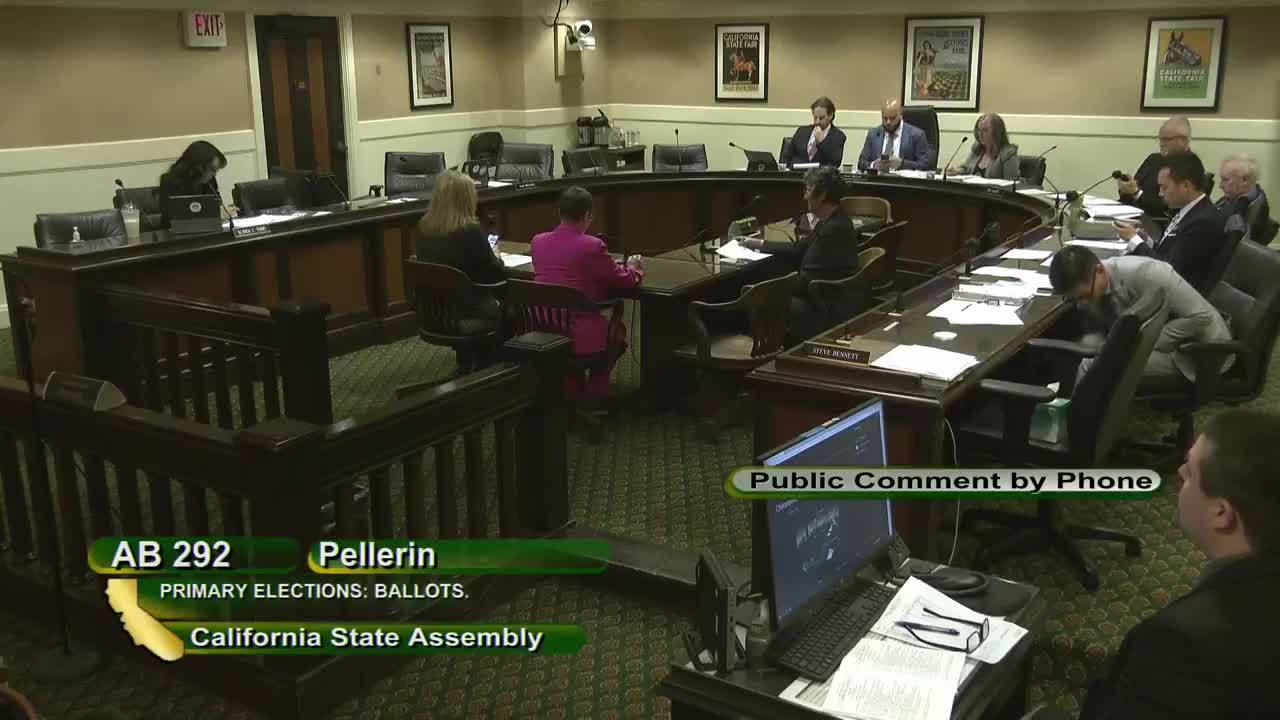 43MIN