SB 31: Encampments: sensitive areas: penalties.
- Session Year: 2023-2024
- House: Senate
- Latest Version Date: 2023-03-22
Current Status:
Failed
(2024-02-01: Returned to Secretary of Senate pursuant to Joint Rule 56.)
Introduced
In Committee
First Chamber
In Committee
Second Chamber
Enacted
What does this bill do?
This bill bans people from sitting, lying, sleeping, or storing or placing personal belongings on streets, sidewalks, or other public rights-of-way within 1,000 feet of a school, daycare, park, or library. Violations are treated as a public nuisance that officials can stop or charge as a misdemeanor or infraction, but authorities must give a written notice at least 72 hours before enforcing and provide information about shelters and services in a language the person understands.
The summary is provided by generative AI which can make mistakes. For original language, please view the details in the table below.
Under existing law, a person who lodges in a public or private place without permission is guilty of disorderly conduct, a misdemeanor. Existing law also provides that a person who willfully and maliciously obstructs the free movement of any person on any street, sidewalk, or other public place is guilty of a misdemeanor.
Under existing law, a public nuisance is anything that is injurious to health, or is indecent or offensive to the senses, so as to interfere with the comfortable enjoyment of life or property by an entire community, neighborhood, or considerable number of persons. Existing law provides various remedies against a public nuisance, including abatement by any public body or officer authorized by law.
This bill would prohibit a person from sitting, lying, sleeping, or storing, using, maintaining, or placing personal property upon any street, sidewalk, or other public right-of-way within 1000 feet of a sensitive area, as defined. The bill would specify that a violation of this prohibition is a public nuisance that can be abated and prevented, as provided. The bill would also provide that a violation of the prohibition may be charged as a misdemeanor or an infraction, at the discretion of the prosecutor. The bill would prohibit a person from being found in violation of the bills provisions unless provided notice, at least 72 hours before commencement of any enforcement action, as provided. By imposing criminal penalties for a violation of these provisions, this bill would impose a state-mandated local program.
The California Constitution requires the state to reimburse local agencies and school districts for certain costs mandated by the state. Statutory provisions establish procedures for making that reimbursement.
This bill would provide that no reimbursement is required by this act for a specified reason.
(a)For the purposes of this section: section, the following definitions apply:
(1)Peace officer means a person described in Section 830.
(2)Sensitive area means a school, daycare center, park, or library.
(b)A person shall not sit, lie, sleep, or store, use, maintain, or place personal property upon any street, sidewalk, or other public right-of-way within 1000 feet of a sensitive area.
(c)Subject to subdivision (d), this section may be enforced as follows:
(1)A violation of this section is a public nuisance that may be enjoined, abated, and prevented. The district attorney, county counsel of the county, or the city attorney of any incorporated city or of any city and county, in the name of the people, may maintain an action to abate and prevent the nuisance. Before pursuing abatement authorized by this paragraph, the district attorney, county counsel, or city attorney, as applicable, shall ensure that the person found to be in violation of this section has received verbal or written information regarding alternative locations to sleep, homeless and mental health services, or homeless shelters in the area.
(2)A violation of this section may be charged as a misdemeanor or an infraction, at the discretion of the prosecutor.
(d)A person shall not be found to be in violation of this section unless a peace officer employed by the county or city, as applicable, with jurisdiction over the sensitive area has provided that person written notice, at least 72 hours before commencement of any enforcement action described in subdivision (c), that the person is prohibited from sitting, lying, sleeping, or storing, using, maintaining, or placing personal property upon a street, sidewalk, or other public right-of-way within 1000 feet of a sensitive area pursuant to this section. A written notice shall only be deemed to have been provided for the purposes of this subdivision if the notice is given in a language understood by the person receiving the notice.
SEC. 2.No reimbursement is required by this act pursuant to Section 6 of Article XIIIB of the California Constitution because the only costs that may be incurred by a local agency or school district will be incurred because this act creates a new crime or infraction, eliminates a crime or infraction, or changes the penalty for a crime or infraction, within the meaning of Section 17556 of the Government Code, or changes the definition of a crime within the meaning of Section 6 of Article XIIIB of the California Constitution.
(a)For the purposes of this section:
(1)Peace officer means a person described in Section 830.
(2)Sensitive area means a school, daycare center, park, or library.
(b)A person shall not sit, lie, sleep, or store, use, maintain, or place personal property upon any street, sidewalk, or other public right-of-way within 1000 feet of a sensitive area.
(c)Subject to subdivision (d), this section may be enforced as follows:
(1)A violation of this section is a public nuisance that may be enjoined, abated, and prevented. The district attorney, county counsel of the county, or the city attorney of any incorporated city or of any city and county, in the name of the people, may maintain an action to abate and prevent the nuisance. Before pursuing abatement authorized by this paragraph, the district attorney, county counsel, or city attorney, as applicable, shall ensure that the person found to be in violation of this section has received verbal or written information regarding alternative locations to sleep, homeless and mental health services, or homeless shelters in the area.
(2)A violation of this section may be charged as a misdemeanor or an infraction, at the discretion of the prosecutor.
(d)A person shall not be found to be in violation of this section unless a peace officer employed by the county or city, as applicable, with jurisdiction over the sensitive area has provided that person written notice, at least 72 hours before commencement of any enforcement action described in subdivision (c), that the person is prohibited from sitting, lying, sleeping, or storing, using, maintaining, or placing personal property upon a street, sidewalk, or other public right-of-way within 1000 feet of a sensitive area pursuant to this section. A written notice shall only be deemed to have been provided for the purposes of this subdivision if the notice is given in a language understood by the person receiving the notice.
SEC. 2.No reimbursement is required by this act pursuant to Section 6 of Article XIIIB of the California Constitution because the only costs that may be incurred by a local agency or school district will be incurred because this act creates a new crime or infraction, eliminates a crime or infraction, or changes the penalty for a crime or infraction, within the meaning of Section 17556 of the Government Code, or changes the definition of a crime within the meaning of Section 6 of Article XIIIB of the California Constitution.
|
Date
|
Status
|
|---|---|
| Feb 1, 2024 | Returned to Secretary of Senate pursuant to Joint Rule 56. |
| Dec 20, 2023 | January 9 set for first hearing canceled at the request of author. |
| Dec 7, 2023 | Set for hearing January 9. |
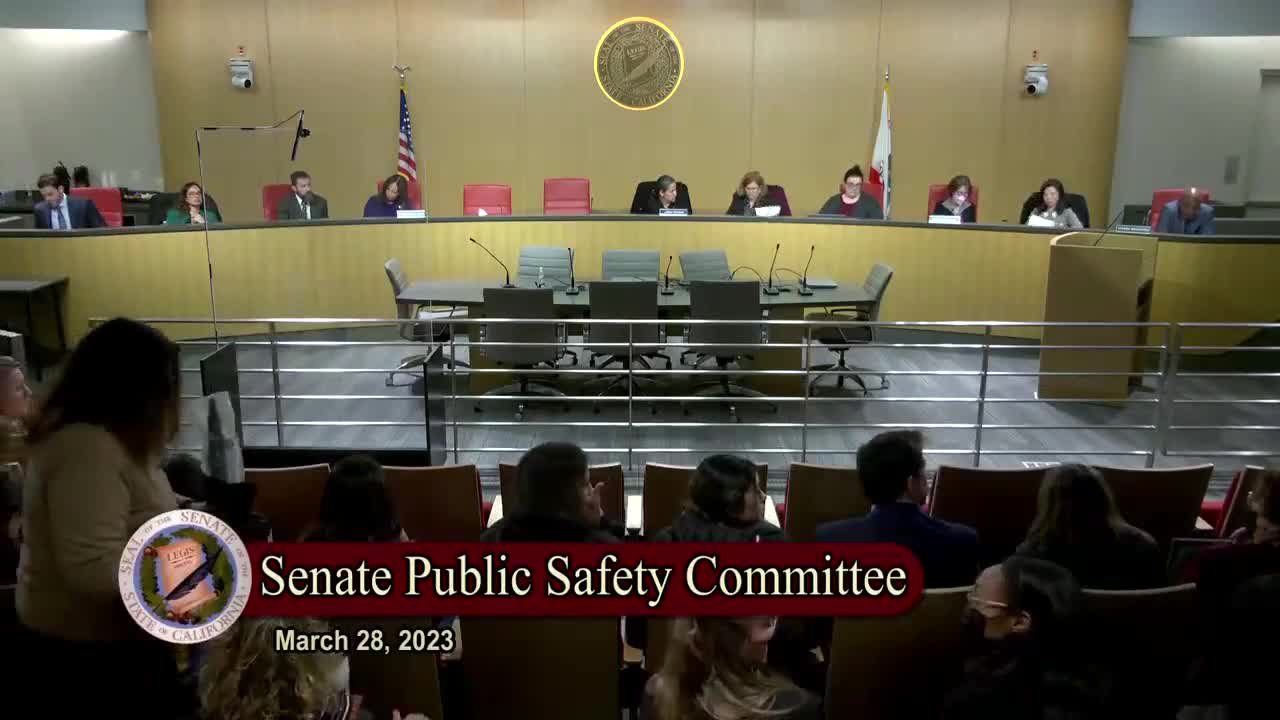
| Mar 28, 2023 | March 28 set for first hearing. Failed passage in committee. (Ayes 1. Noes 1. Page 577.) Reconsideration granted. |
| Mar 22, 2023 | From committee with author's amendments. Read second time and amended. Re-referred to Com. on PUB S. |
| Mar 1, 2023 | Set for hearing March 28. |
| Jan 18, 2023 | Referred to Com. on PUB S. |
| Dec 6, 2022 | From printer. May be acted upon on or after January 5. |
| Dec 5, 2022 | Introduced. Read first time. To Com. on RLS. for assignment. To print. |
|
Date
|
Description
|
Location
|
Votes
|
|
|---|---|---|---|---|
| Mar 28, 2023 | [First] hearing set for [03-29-2023]: Failed passage in Committee. Reconsideration granted | Senate Standing Committee on Public Safety |
Passed |
|
| Mar 28, 2023 | Do pass, but first be re-referred to the Committee on [Appropriations] | Senate Standing Committee on Public Safety |
Failed |
This list shows positions taken on this bill by organizations on the date displayed, which is linked to the original source.
Positions by individuals are not included.
|
Organization
|
Position
|
Date
|
|---|---|---|
| ACLU California | * Against | Mar 28, 2023 |
| Alliance San Diego | * Against | Mar 28, 2023 |
| Break the Cycle Project | ** Against | Mar 28, 2023 |
| California Public Defenders Association | * Against | Mar 28, 2023 |
| City Of San Diego | * Support | Mar 28, 2023 |
| Disability Rights California | * Against | Mar 28, 2023 |
| Disability Rights of California | * Against | Mar 28, 2023 |
| Ella Baker Center For Human Rights | * Against | Mar 28, 2023 |
| Friends Committee On Legislation Of California | * Against | Mar 28, 2023 |
| Initiate Justice | * Against | Mar 28, 2023 |
| Initiate Justice Action | * Against | Mar 28, 2023 |
| Lawyers Committee for Civil Rights | * Against | Mar 28, 2023 |
| Project Amiga | ** Against | Mar 28, 2023 |
| Public Advocates | * Against | Mar 28, 2023 |
| Public Health Advocates | * Against | Mar 28, 2023 |
| Riverside Sheriff's Office | * Support | Mar 28, 2023 |
| San Bernardino Free Them All | ** Against | Mar 28, 2023 |
| San Francisco Public Defenders Office | * Against | Mar 28, 2023 |
| Sheriff Chad Bianco | * Support | Mar 28, 2023 |
| Starting Over Inc | * Against | Mar 28, 2023 |
| UCLA Alternative Breaks | * Against | Mar 28, 2023 |
| UCLA Alternative Breaks | * Against | Mar 28, 2023 |
| UCLA Alternative Breaks | * Against | Mar 28, 2023 |
| We The People San Diego | * Against | Mar 28, 2023 |
| Western Center On Law & Poverty | ** Against | Mar 28, 2023 |
SENATE COMMITTEE ON PUBLIC SAFETY
Senator Aisha Wahab, Chair
2023 - 2024 Regular
Bill No: SB 31 Hearing Date: March 28, 2023
Author: | Jones | ||
Version: | March 22, 2023 | ||
Urgency: | No | Fiscal: | Yes |
Consultant: | MK | ||
Subject: Encampments: sensitive areas: penalties
HISTORY
Source: Author
Prior Legislation: None applicable
Support: Over 1,000 individuals in Support
Opposition: Abundant Housing LA; ACLU California Action; Active San Gabriel Valley; Alameda County Homeless Action Center; All Home; Ascencia; Avalanche; Bet Tzedek Legal Services; Black Women for Wellness; Break the Cycle Project; Brilliant Corners; Build Affordable Faster CA; California Coalition for Women Prisoners; California Housing Partnership; California Public Defenders Association; Californians for Safety and Justice; Center for Community Action and Environmental Justice; Center on Juvenile and Criminal Justice; Centro Legal De LA Raza; Climate Resolve; Coalition on Homelessness, San Francisco; Communities United for Restorative Youth Justice (CURYJ); Community Works; Corporation for Supportive Housing; Disability Community Resource Center; Disability Rights California; Downtown Women's Center; East Yard Communities for Environmental Justice; Elder Law and Disability Rights Center; Ella Baker Center; Ensuring Opportunity Campaign to End Poverty in Contra Costa; First to Serve INC; Friends Committee on Legislation of California; Grace - End Child Poverty in California; Haven Hills, INC.; Healing and Justice Center; Home Preservation and Prevention, INC.; Homebase; Homeless Health Care Los Angeles; Housing California; Housing Equality & Advocacy Resource Team (HEART); Housing Is a Human Right - Orange County; How to Adu; Indivisible CA 45; Indivisible CA Statestrong; Indivisible Sacramento; Indivisible San Francisco; Indivisible Sonoma County; Initiate Justice; Initiate Justice Action; Inner City Law Center; Koreatown Immigrant Workers Alliance; LA Family Housing; LA Voice; Law Foundation of Silicon Valley; Lawyers Committee for Civil Rights of The San Francisco Bay Area; Leadership Counsel for Justice and Accountability; Legal Aid of Marin; Multiple Individuals; My Friend's Place; Napa-Solano for Everyone; National Alliance to End Homelessness; National Homelessness Law Center; National Housing Law Project; No Care Court California Coalition; Noho Home Alliance; Northern Neighbors SF; Norwalk Unides; Peninsula for Everyone; People for Housing Orange County; Pico California; Project Amiga; Public Advocates; Residents United Network Los Angeles; Sacramento Homeless Organizing Committee; Sacramento Regional Coalition to End Homelessness; Safe Place for Youth; San Bernardino Free Them All; San Francisco Public Defender's Office; San Luis Obispo Legal Assistance Foundation; Santa Cruz Yimby; Santa Rosa Yimby; Silicon Valley De-bug; Sister Warriors Freedom Coalition; South Bay Yimby; South County Homelessness Task Force; Southern California Association of Non-profit Housing (SCANPH); Southside Forward; Strategic Actions for A Just Economy; Streets for All; Streets for People; The Center in Hollywood; The Midnight Mission; The People Concern; The People's Resource Center; The Public Interest Law Project; The Row LA - the Church Without Walls - Skid Row; Transitions Clinic Network Trust South LA; Union Station Homeless Services; United Way of Greater Los Angeles; University of Southern California; Urban Environmentalists; Venice Community Housing Corporation; Ventura County Yimby; Voices for Progress; Western Center on Law and Poverty; Western Regional Advocacy Project; Yimby Action; Yimby SLO
PURPOSE
The purpose of this bill is to make sitting, lying, sleeping, or storing, using, maintaining, or placing personal property upon any street, sidewalk, or other public right-of-way within 1000 feet of a sensitive area an alternative misdemeanor/infraction.
Existing law makes disorderly conduct a misdemeanor. Disorderly conduct includes an individual: who solicits or engages in lewd conduct in a public place; an individual who solicits or agrees to engage in prostitution; who accosts other persons in any public place or in any place open to the public for the purposes of begging for soliciting alms; who loiters in or about any toilet open to the public for the purpose of engaging in or soliciting any lewd or lascivious or any unlawful act; who lodges in any building, structure, vehicle, or place, whether public or private without permission of the owner; who is found in any public place under the influence of an intoxicating liquor, or drug in a condition where they are unable to exercise care for their own safety or the safety of others; who loiters, prowls, or wanders upon the private property of another without visible or lawful business with the owner; who while loitering, prowling, or wandering upon the private property of another peeks in the door or window of an occupied structure; and who uses a device to peek at another. (Penal Code §647)
Existing law provides that any peace officer may transport as quickly as is feasible, to the nearest homeless shelter, or any runaway youth or youth in crisis to the nearest runaway shelter, if the officer inquires whether the person desires the transportation, and the person does not object to the transportation. (Penal Code 647a)
Existing law provides that every person who loiters about any school in which adults are in attendance at courses, and who annoys or molests any person in attendance is guilty of a misdemeanor. (Penal Code § 547b)
Existing law provides that every person who willfully and maliciously obstructs the free movement of any person on any street, sidewalk, or other public place or in any place open to the public is guilty of a misdemeanor. (Penal Code § 647c)
Existing law provides that every person who loiters about any school or public place at or near which children attend or normally congregate and remains or reenters the place within 72 hours of being asked to leave, is vagrant and punishable by a misdemeanor. (Penal Code § 653b)
Existing law defines a public nuisance as anything which is injurious to health, or is indecent, or offensive to the senses, or an obstruction to the free use of property, so as to interfere with the comfortable enjoyment of life or property by an entire community or neighborhood, or by any considerable number of persons, or unlawfully obstructs the free passage or use, in the customary manner, of any navigable lake, or river, bay, stream, canal, or basin, or any public park, square, street, or highway. (Penal Code§ 370.)
This bill provides that a person shall not sit, lie, sleep, or store, use, maintain, or place personal property upon any street, sidewalk, or other public right-of-way with in 1000 of a sensitive area.
This bill, except as otherwise provided, provides a violation of this section is a public nuisance that may be enjoined, abated, and prevented.
This bill provides that the district attorney, county counsel, or city attorney may maintain an action to abate and prevent a nuisance.
This bill provides that before pursuing abatement, the district attorney, county counsel, or city attorney, shall ensure that the person found to be in violation of this section has received verbal or written information regarding alternative locations to sleep, homeless and mental health services, or homeless shelters in the area.
This bill provides that a violation may be charged as a misdemeanor or an infraction at the discretion of the prosecutor.
This bill provides that a person shall not be found to be in violation of this section unless a peace officer employed by the county, city, or city and county with jurisdiction over the sensitive area has provided the person written notice, at least 72 hours before the commencement of any enforcement action, that the person is maintaining, or placing personal property upon a street, sidewalk or other public right-of-way within 1000 feet of a sensitive area pursuant to this action. A written notice shall only be deemed to have been provided for the purpose of this subdivision if the notice is given in a language understood by the person receiving the notice.
This bill defines “sensitive area” means a school, daycare center, park, or library.
This bill defines a peace officer as a person described in Section 830.
COMMENTS
1. Need for This Bill
According to the author:
California has 30% of the nation’s homeless population yet makes up less than 12% of the total population. The homeless are our veterans, our neighbors, our friends. Many are struggling with substance abuse or mental health issues. Unfortunately, California has a horrible record of getting people off the streets and into safe environments. California’s current approach to homelessness is clearly failing and it is time we tried something new.
SB 31 does 3 things to help compassionately clear encampments. First, it prohibits encampments near the sensitive community areas of schools, parks, libraries, and day-care centers, protecting our most vulnerable population—our children. Second, the bill requires a 72-hour warning before an encampment sweep, giving homeless folks a chance to find alternatives. Third, when conducting the sweep, the bill requires enforcement officers to provide information about shelters, sleeping alternatives, and mental health services in the area, connecting individuals to the services they desperately need.
This measure, along with Governor Newsom’s CARE Court and CA Senate Republicans ACT priorities, will help end the public camping in these areas, while also compassionately assisting the homeless with getting treatment for their physical and mental health needs and finding a more suitable place to stay.
The goal is not to criminalize homelessness but to protect the public and help lift homeless individuals off the street through a compassionate approach. Every Californian deserves a path off the streets
2. Wobblette for sitting, sleeping, storing, etc. near a sensitive area.
This bill makes it an alternative misdemeanor/infraction (woblette) for a person to sit, lie, sleep, or store, use maintain, or place personal property upon any street, sidewalk, or other public right-of-way with in 1000feet of a sensitive area. It declares these actions a public nuisance and sets forth a process for abating the nuisance.
3. Eighth Amendment Implications
Local agencies that have passed ordinances prohibiting camping have faced repeated litigation challenging their ability to prohibit camping in their jurisdiction when individuals experiencing homelessness lack shelter or other housing options. In Martin v. City of Boise (9th Cir. 2019) 920 F.3d 584, a group of homeless individuals sued the city of Boise, ID seeking relief from criminal prosecution pursuant to city ordinances related to public camping. Plaintiffs argued that the ordinances violated the Cruel and Unusual Punishments Clause of the Eighth Amendment. (Id. at 606.) This clause proscribes not only excessive punishment, but also places limits on what the government may criminalize in the first place. (Id. at 615.) It has been found to prohibit the criminalization of “status.” (Id. at 616, citing Robinson v. California (1962) 370 U.S. 660 [overturning a California law which made the “status’ of a narcotics addict a criminal offense].)
The Court of Appeals held that the Eighth Amendment prohibits the imposition of criminal penalties for sleeping outside on public property for homeless individuals who cannot obtain shelter. (Id. at pp. 615, 616, & 617.) In other words, the government cannot prosecute homeless people for sleeping in public if there are more homeless individuals in a jurisdiction than the number of available shelter beds. (Id. at 617.) The court observed that the conduct at issue in the ordinance -sitting, lying, and sleeping- was involuntary and inseparable from status in light of the fact that human beings biologically have a need to sleep. (Ibid.) The court did note that its holding was not meant to suggest that a jurisdiction without sufficient shelter beds could never criminalize sleeping outside; it left open the possibility that restrictions on sleeping outside at particular times or near particular places might be constitutional. (Ibid., fn. 8.)
In this respect, it should be noted that California has one of the worst homelessness rates in the nation. According to the US Department of Housing and Urban Development’s (HUD) AB 257 Annual Homeless Assessment Report to Congress, in January 2022 California accounted for 30% of the nation’s homeless population (or 171,521 people). California accounted for half of all unsheltered people in the country (115,491 people) including people living in vehicles, abandoned buildings, parks, or on the street. In California, 67 percent of people experiencing homelessness did so outdoors. This is more than nine times the number of unsheltered people in the state with the next highest number, Washington. California also had the highest rate of homelessness, with 44 people experiencing homelessness out of every 10,000 people in the state. (See The 2022 Annual Homelessness Assessment Report (AHAR) to Congress Part 1: Point-In-Time Estimates of Homelessness, December 2022, p. 16, 2022.)
According to the California Interagency Council on Homelessness 2021 Statewide Homelesness Assessment to the Legislature, the Housing Inventory Count (HIC), which depicts general trends in the provision of shelter and permanent Housing, shows about 60,500 total shelter/interim housing beds statewide. (see Legislative Report: Statewide Homelessness Landscape Assessment, p. 72; https://bcsh.ca.gov/calich/documents/homelessness_assessment.pdf .) Given that there are around 171,500 people in the HUD point-in-time count, that’s roughly 1 shelter bed for every 3 people.
4. Due Process Issues
This bill prohibits sitting, lying, sleeping, or storing, using, or maintaining or placing personal property on any street, sidewalk or other public right of way within 1000 feet of a sensitive area. Sensitive area is defined as a school, daycare center, park, or library.
For reference, 1000 feet is about twice as high (long) as the Washington Monument and the approximate length of most large cruise ships. (https://dimensionofstuff.com/things-that-are-about-1000-feet-ft-long/) In any city or town with regular city parks, and a normal number of schools, is this distance long enough that it would prohibit a person from sitting on a sidewalk anywhere? Even a person who is sleeping in a shelter at night would need some place to stay during the day, as many shelters are open only for sleeping.
This bill does not contain a requirement that the person know that they are near one of these facilities when they are warned by law enforcement officer. While it might be obvious where most playgrounds or schools are located, that is not necessarily the case with day care centers and youth centers. Some daycares are located within residential homes. Others can be located within office buildings or churches. For example, there is a day care center in the Secretary of State building, and until recently there was a daycare center within the Legislative Office Building. This would not have been known to a passerby. Some private schools may even be tucked into unexpected places inside other office buildings or churches. With regards to daycare centers, and possible schools, it is arguable that the proposed statute is unconstitutionally vague. The Fifth Amendment to the U.S. Constitution prohibits the taking of a person's liberty under a criminal law that is so vague it fails to provide adequate notice of the conduct it proscribes or allows for arbitrary enforcement. A criminal statute must give fair warning of the conduct that it makes criminal. (Bouie v. Columbia (1964) 378 U.S. 347, 350-351.) “The constitutional requirement of definiteness is violated by a criminal statute that fails to give a person of ordinary intelligence fair notice that his contemplated conduct is forbidden by the statute. The underlying principle is that no man shall be held criminally responsible for conduct which he could not reasonably understand to be proscribed." (United States v. Harriss (1954) 347 U.S. 612, 617.) The vagueness doctrine, which derives from the due process concept of fair notice, “bars the government from enforcing a provision that ‘forbids or requires the doing of an act in terms so vague’ that people of ‘common intelligence must necessarily guess at its meaning and differ as to its application.’” (People v. Hall (2017) 2 Cal.5th 494, 500.) A statute is unconstitutionally vague if it fails to provide adequate notice of the proscribed conduct or lacks "sufficiently definite guidelines . . . in order to prevent arbitrary and discriminatory enforcement." (Tobe v. City of Santa Ana (1995) 9 Cal.4th 1069, 1106-1107.)
This bill does require at least 72 hours written notice by a peace officer before enforcing its provisions, so it is possible this will overcome the vagueness concerns in this bill.
5. Argument in Opposition
The many organizations opposing this bill state:
Given the ubiquity of schools, parks, libraries, and daycare centers, this policy would effectively make it a crime for any unhoused Californian to exist in public space, and put police officers at the frontlines of responding to our state’s affordable housing and homelessness crisis. By framing the bill as means to protect children and families, this measure perpetuates false narratives that unhoused people are inherently dangerous. It also ignores that our unhoused neighbors include families and children who attend schools and visit parks and libraries. Further, given the fact that Black people and other people of color disproportionately live without housing or shelter and are unjustly targeted by law enforcement, SB 31 also reinforces dangerous racialized stereotypes that continue to reproduce systemic inequity in housing, health, employment, and legal outcomes.
Only housing ends homelessness, and at present, California is experiencing a housing affordability crisis decades in the making, with a statewide shortage of 1.2 million affordable homes. Without housing options, criminalizing basic activities of living cannot solve homelessness and may make it worse. As shown by recent research and reporting from across the state, sweeping encampments and criminalizing unhoused people with nowhere else to go is traumatic, destabilizing, and ineffective. People displaced by sweeps regularly lose access to important belongings, including identity documents, medication and healthcare resources, and irreplaceable belongings such as photographs or family heirlooms or have them seized and destroyed. Penalties for sleeping create legal and financial barriers that may make it harder to access housing or services in the future. Sweeps can disrupt service provision and exacerbate well-founded mistrust of government workers and institutions. Under SB 31’s proposed enforcement zones, people would almost certainly be pushed to areas far away from critical services and resources. Finally, a police-based response to homelessness is extremely costly to local governments, diverting critical resources away from long-term solutions like affordable and supportive housing, mental health services, infrastructure, and other critical life-affirming resources.
Criminalizing unhoused people because they are homeless violates their constitutional and civil rights. Courts have found that, where people experiencing homelessness have no alternative housing or shelter, the state is prohibited from criminalizing acts such as sitting, lying, sleeping, or other life-sustaining activities. People cannot be restricted from public spaces by reason of their housing status, especially given that decades of underinvestment mean that services, shelters, and housing options do not exist in this state for everyone who needs them. The effect of such a blatantly discriminatory law will lead to further stigmatization and discrimination of people experiencing houselessness.
SB 31 perpetuates a harmful trend of scapegoating our unhoused neighbors and wasting public resources on inequitable and ineffective enforcement-driven homelessness policy. If the legislation’s goal is, as its authors claim, to increase safety for families and children as well as people living in encampments, there are many ways to do so that do not require police or criminal penalties: ongoing sanitation services, regular trash pickup, housing navigation resources, and on-site support services at encampment sites while people wait to be connected to interim and permanent housing and services.
While we vehemently oppose SB 31, we reiterate our interest in working with the Legislature to secure additional state resources to deliver on our neighbors’ basic health and housing needs, including through budget investments in supportive and affordable housing, service provider outreach, community-based mental health and substance use treatment services to support our unhoused neighbors in connecting to the housing and care they want and need.
-- END –
Discussed in Hearing
 33MIN
Senate Standing Committee on Public Safety
Bill Author

Bill Co-Author(s):