SB 330: Labor Code Private Attorneys General Act of 2004.
- Session Year: 2023-2024
- House: Senate
- Latest Version Date: 2023-03-15
Current Status:
Failed
(2024-02-01: Returned to Secretary of Senate pursuant to Joint Rule 56.)
Introduced
In Committee
First Chamber
In Committee
Second Chamber
Enacted
What does this bill do?
The bill changes notice rules for workers suing under the state’s Private Attorneys General Act, requiring that notices list the relevant facts, legal contentions, and authorities for each alleged Labor Code violation, estimate how many current or former employees are affected, and describe the harm claimed. If the notice seeks relief for 10 or more employees it must be sworn under penalty of perjury and include a proposed complaint, and both the notice and any employer response must be filed with a $75 fee paid into the Labor and Workforce Development Fund; notices must also tell employers about their right to cure certain violations.
The summary is provided by generative AI which can make mistakes. For original language, please view the details in the table below.
Existing law, the Labor Code Private Attorneys General Act of 2004, permits an aggrieved employee, on behalf of themselves and other current or former employees, to bring a civil action pursuant to specified procedures for a violation of a provision of the Labor Code that provides for a civil penalty to be assessed and collected by the Labor and Workforce Development Agency. Existing law imposes specified filing requirements on the aggrieved employee or representative in order to bring the action, including providing notice to the agency and the employer with the specific provisions of the Labor Code alleged to have been violated, and the facts and theories that support the alleged violations. Existing law provides an employer, for certain of those violations, a right to cure the violation within 33 days, as specified. For alleged violations of specified provisions of the Labor Code relating to safety in employment, existing law requires the Division of Occupational Safety and Health to investigate the allegations in the notice.
This bill would make a nonsubstantive change to the provision naming the act. require the notice, for alleged violations of the Labor Code other than those specified provisions relating to safety in employment, to instead include a statement setting forth the relevant facts, legal authorities, and authorities supporting each alleged violation. For those alleged violations that provide an employer a right to cure, the bill would require the notice to inform the employer of their right to cure the violation. The bill would also require the notice to include an estimate of the number of employees on whose behalf relief is being sought. The bill would require the aggrieved employee or representative, if that number of employees is 10 or more, to verify the notice under penalty of perjury, as specified. By expanding the crime of perjury, this bill would impose a state-mandated local program. The bill would make a conforming change.
The California Constitution requires the state to reimburse local agencies and school districts for certain costs mandated by the state. Statutory provisions establish procedures for making that reimbursement.
This bill would provide that no reimbursement is required by this act for a specified reason.
Existing law, the Labor Code Private Attorneys General Act of 2004, permits an aggrieved employee, on behalf of themselves and other current or former employees, to bring a civil action pursuant to specified procedures for a violation of a provision of the Labor Code that provides for a civil penalty to be assessed and collected by the Labor and Workforce Development Agency.
This bill would make a nonsubstantive change to the provision naming the act.
(a)Notwithstanding any other provision of law, any provision of this code that provides for a civil penalty to be assessed and collected by the Labor and Workforce Development Agency or any of its departments, divisions, commissions, boards, agencies, or employees, for a violation of this code, may, as an alternative, be recovered through a civil action brought by an aggrieved employee on behalf of himself or herself themselves and other current or former employees pursuant to the procedures specified in Section 2699.3.
(b)For purposes of this part, person has the same meaning as defined in Section 18.
(c)For purposes of this part, aggrieved employee means any person who was employed by the alleged violator and against whom one or more of the alleged violations was committed.
(d)For purposes of this part, cure means that the employer abates each violation alleged by any aggrieved employee, the employer is in compliance with the underlying statutes as specified in the notice required by this part, and any aggrieved employee is made whole. A violation of paragraph (6) or (8) of subdivision (a) of Section 226 shall only be considered cured upon a showing that the employer has provided a fully compliant, itemized wage statement to each aggrieved employee for each pay period for the three-year period prior to the date of the written notice sent pursuant to paragraph (1) of subdivision (c) of Section 2699.3.
(e)(1)For purposes of this part, whenever the Labor and Workforce Development Agency, or any of its departments, divisions, commissions, boards, agencies, or employees, has discretion to assess a civil penalty, a court is authorized to exercise the same discretion, subject to the same limitations and conditions, to assess a civil penalty.
(2)In any action by an aggrieved employee seeking recovery of a civil penalty available under subdivision (a) or (f), a court may award a lesser amount than the maximum civil penalty amount specified by this part if, based on the facts and circumstances of the particular case, to do otherwise would result in an award that is unjust, arbitrary and oppressive, or confiscatory.
(f)For all provisions of this code except those for which a civil penalty is specifically provided, there is established a civil penalty for a violation of these provisions, as follows:
(1)If, at the time of the alleged violation, the person does not employ one or more employees, the civil penalty is five hundred dollars ($500).
(2)If, at the time of the alleged violation, the person employs one or more employees, the civil penalty is one hundred dollars ($100) for each aggrieved employee per pay period for the initial violation and two hundred dollars ($200) for each aggrieved employee per pay period for each subsequent violation.
(3)If the alleged violation is a failure to act by the Labor and Workplace Development Agency, or any of its departments, divisions, commissions, boards, agencies, or employees, there shall be no civil penalty.
(g)(1)Except as provided in paragraph (2), an aggrieved employee may recover the civil penalty described in subdivision (f) in a civil action pursuant to the procedures specified in Section 2699.3 filed on behalf of himself or herself themselves and other current or former employees against whom one or more of the alleged violations was committed. Any employee who prevails in any action shall be entitled to an award of reasonable attorneys fees and costs, including any filing fee paid pursuant to subparagraph (B) (C) of paragraph (1) of subdivision (a) or subparagraph (B) (C) of paragraph (1) of subdivision (c) of Section 2699.3. Nothing in this part shall operate to This part does not limit an employees right to pursue or recover other remedies available under state or federal law, either separately or concurrently with an action taken under this part.
(2)No action shall An action shall not be brought under this part for any violation of a posting, notice, agency reporting, or filing requirement of this code, except where the filing or reporting requirement involves mandatory payroll or workplace injury reporting.
(h)No action may An action shall not be brought under this section by an aggrieved employee if the agency or any of its departments, divisions, commissions, boards, agencies, or employees, on the same facts and theories, cites a person within the timeframes set forth in Section 2699.3 for a violation of the same section or sections of the Labor Code under which the aggrieved employee is attempting to recover a civil penalty on behalf of himself or herself themselves or others or initiates a proceeding pursuant to Section 98.3.
(i)Except as provided in subdivision (j), civil penalties recovered by aggrieved employees shall be distributed as follows: 75 percent to the Labor and Workforce Development Agency for enforcement of labor laws, including the administration of this part, and for education of employers and employees about their rights and responsibilities under this code, to be continuously appropriated to supplement and not supplant the funding to the agency for those purposes; and 25 percent to the aggrieved employees.
(j)Civil penalties recovered under paragraph (1) of subdivision (f) shall be distributed to the Labor and Workforce Development Agency for enforcement of labor laws, including the administration of this part, and for education of employers and employees about their rights and responsibilities under this code, to be continuously appropriated to supplement and not supplant the funding to the agency for those purposes.
(k)Nothing contained in this part is intended to This part does not alter or otherwise affect the exclusive remedy provided by the workers compensation provisions of this code for liability against an employer for the compensation for any injury to or death of an employee arising out of and in the course of employment.
(l)(1)For cases filed on or after July 1, 2016, the aggrieved employee or representative shall, within 10 days following commencement of a civil action pursuant to this part, provide the Labor and Workforce Development Agency with a file-stamped copy of the complaint that includes the case number assigned by the court.
(2)The superior court shall review and approve any settlement of any civil action filed pursuant to this part. The proposed settlement shall be submitted to the agency at the same time that it is submitted to the court.
(3)A copy of the superior courts judgment in any civil action filed pursuant to this part and any other order in that action that either provides for or denies an award of civil penalties under this code shall be submitted to the agency within 10 days after entry of the judgment or order.
(4)Items required to be submitted to the Labor and Workforce Development Agency under this subdivision or to the Division of Occupational Safety and Health pursuant to paragraph (4) of subdivision (b) of Section 2699.3, shall be transmitted online through the same system established for the filing of notices and requests under subdivisions (a) and (c) of Section 2699.3.
(m)This section shall not apply to the recovery of administrative and civil penalties in connection with the workers compensation law as contained in Division 1 (commencing with Section 50) and Division 4 (commencing with Section 3200), including, but not limited to, Sections 129.5 and 132a.
(n)The agency or any of its departments, divisions, commissions, boards, or agencies may promulgate regulations to implement the provisions of this part.
SEC. 2.Section 2699.3 of the Labor Code is amended to read:2699.3.(a)A civil action by an aggrieved employee pursuant to subdivision (a) or (f) of Section 2699 alleging a violation of any provision listed in Section 2699.5 shall commence only after the following requirements have been met:
(1)(A)The aggrieved employee or representative shall give written notice by online filing with the Labor and Workforce Development Agency and by certified mail to the employer of the specific provisions of this code alleged to have been violated, including the facts and theories to support the a statement setting forth the relevant facts, legal contentions, and authorities supporting each alleged violation. The notice shall also include an estimate of the number of current and former employees against whom the alleged violations were committed and on whose behalf relief is being sought. The notice shall also include a description of the harm alleged to have been suffered by each employee.
(B)If the aggrieved employee or representative is seeking relief on behalf of 10 or more employees, the notice required by subparagraph (A) shall be verified in the manner prescribed by Section 446 of the Code of Civil Procedure and a copy of the proposed complaint shall be attached to the notice.
(B)(C)A notice filed with the Labor and Workforce Development Agency pursuant to subparagraph (A) and any employer response to that notice shall be accompanied by a filing fee of seventy-five dollars ($75). The fees required by this subparagraph are subject to waiver in accordance with the requirements of Sections 68632 and 68633 of the Government Code.
(C)(D)The fees paid pursuant to subparagraph (B) (C) shall be paid into the Labor and Workforce Development Fund and used for the purposes specified in subdivision (j) of Section 2699.
(2)(A)The agency shall notify the employer and the aggrieved employee or representative by certified mail that it does not intend to investigate the alleged violation within 60 calendar days of the postmark date of the notice received pursuant to paragraph (1). Upon receipt of that notice or if no notice is provided within 65 calendar days of the postmark date of the notice given pursuant to paragraph (1), the aggrieved employee may commence a civil action pursuant to Section 2699.
(B)If the agency intends to investigate the alleged violation, it shall notify the employer and the aggrieved employee or representative by certified mail of its decision within 65 calendar days of the postmark date of the notice received pursuant to paragraph (1). Within 120 calendar days of that decision, the agency may investigate the alleged violation and issue any appropriate citation. If the agency determines that no citation will a citation will not be issued, it shall notify the employer and aggrieved employee of that decision within five business days thereof by certified mail. Upon receipt of that notice or if no citation is issued by the agency within the time limits prescribed by subparagraph (A) and this subparagraph or if the agency fails to provide timely or any notification, the aggrieved employee may commence a civil action pursuant to Section 2699.
(C)Notwithstanding any other provision of law, a plaintiff may as a matter of right amend an existing complaint to add a cause of action arising under this part at any time within 60 days of the time periods specified in this part.
(b)A civil action by an aggrieved employee pursuant to subdivision (a) or (f) of Section 2699 alleging a violation of any provision of Division 5 (commencing with Section 6300) other than those listed in Section 2699.5 shall commence only after the following requirements have been met:
(1)The aggrieved employee or representative shall give notice by online filing with the Division of Occupational Safety and Health and by certified mail to the employer, with a copy to the Labor and Workforce Development Agency, of the specific provisions of Division 5 (commencing with Section 6300) alleged to have been violated, including the facts and theories to support the alleged violation.
(2)(A)The division shall inspect or investigate the alleged violation pursuant to the procedures specified in Division 5 (commencing with Section 6300).
(i)If the division issues a citation, the employee may shall not commence an action pursuant to Section 2699. The division shall notify the aggrieved employee and employer in writing within 14 calendar days of certifying that the employer has corrected the violation.
(ii)If by the end of the period for inspection or investigation provided for in Section 6317, the division fails to issue a citation and the aggrieved employee disputes that decision, the employee may challenge that decision in the superior court. In such an action, the superior court shall follow precedents of the Occupational Safety and Health Appeals Board. If the court finds that the division should have issued a citation and orders the division to issue a citation, then the aggrieved employee may shall not commence a civil action pursuant to Section 2699.
(iii)A complaint in superior court alleging a violation of Division 5 (commencing with Section 6300) other than those listed in Section 2699.5 shall include therewith a copy of the notice of violation provided to the division and employer pursuant to paragraph (1).
(iv)The superior court shall not dismiss the action for nonmaterial differences in facts or theories between those contained in the notice of violation provided to the division and employer pursuant to paragraph (1) and the complaint filed with the court.
(B)If the division fails to inspect or investigate the alleged violation as provided by Section 6309, the provisions of subdivision (c) shall apply to the determination of the alleged violation.
(3)(A)Nothing in this subdivision shall be construed to This subdivision does not alter the authority of the division to permit long-term abatement periods or to enter into memoranda of understanding or joint agreements with employers in the case of long-term abatement issues.
(B)Nothing in this subdivision shall be construed to This subdivision does not authorize an employee to file a notice or to commence a civil action pursuant to Section 2699 during the period that an employer has voluntarily entered into consultation with the division to ameliorate a condition in that particular worksite.
(C)An employer who has been provided notice pursuant to this section may shall not then enter into consultation with the division in order to avoid an action under this section.
(4)The superior court shall review and approve any proposed settlement of alleged violations of the provisions of Division 5 (commencing with Section 6300) to ensure that the settlement provisions are at least as effective as the protections or remedies provided by state and federal law or regulation for the alleged violation. The provisions of the settlement relating to health and safety laws shall be submitted to the division at the same time that they are submitted to the court. This requirement shall be construed to authorize and permit the division to comment on those settlement provisions, and the court shall grant the divisions commentary the appropriate weight.
(c)A civil action by an aggrieved employee pursuant to subdivision (a) or (f) of Section 2699 alleging a violation of any provision other than those listed in Section 2699.5 or Division 5 (commencing with Section 6300) shall commence only after the following requirements have been met:
(1)(A)The aggrieved employee or representative shall give written notice by online filing with the Labor and Workforce Development Agency and by certified mail to the employer of the specific provisions of this code alleged to have been violated, including the facts and theories to support the alleged violation. a statement setting forth the relevant facts, legal contentions, and authorities supporting each alleged violation, as well as notice informing the employer of their right to cure the violation pursuant to paragraph (2). The notice shall also include an estimate of the number of current and former employees against whom the alleged violations were committed and on whose behalf relief is being sought. The notice shall also include a description of the harm alleged to have been suffered by each employee.
(B)If the aggrieved employee or representative is seeking relief on behalf of 10 or more employees, the notice required by subparagraph (A) shall be verified in the manner prescribed by Section 446 of the Code of Civil Procedure and a copy of the proposed complaint shall be attached to the notice.
(B)(C)A notice filed with the Labor and Workforce Development Agency pursuant to subparagraph (A) and any employer response to that notice shall be accompanied by a filing fee of seventy-five dollars ($75). The fees required by this subparagraph are subject to waiver in accordance with the requirements of Sections 68632 and 68633 of the Government Code.
(C)(D)The fees paid pursuant to subparagraph (B) (C) shall be paid into the Labor and Workforce Development Fund and used for the purposes specified in subdivision (j) of Section 2699.
(2)(A)The employer may cure the alleged violation within 33 calendar days of the postmark date of the notice sent by the aggrieved employee or representative. The employer shall give written notice within that period of time by certified mail to the aggrieved employee or representative and by online filing with the agency if the alleged violation is cured, including a description of actions taken, and no civil action pursuant to Section 2699 may commence. If the alleged violation is not cured within the 33-day period, the employee may commence a civil action pursuant to Section 2699.
(B)(i)Subject to the limitation in clause (ii), no employer may avail himself or herself an employer shall not avail themselves of the notice and cure provisions of this subdivision more than three times in a 12-month period for the same violation or violations contained in the notice, regardless of the location of the worksite.
(ii)No employer may avail himself or herself An employer shall not avail themselves of the notice and cure provisions of this subdivision with respect to alleged violations of paragraph (6) or (8) of subdivision (a) of Section 226 more than once in a 12-month period for the same violation or violations contained in the notice, regardless of the location of the worksite.
(3)If the aggrieved employee disputes that the alleged violation has been cured, the aggrieved employee or representative shall provide written notice by online filing with the agency and by certified mail to the employer, including specified grounds to support that dispute, to the employer and the agency. Within 17 calendar days of the receipt of that notice, the agency shall review the actions taken by the employer to cure the alleged violation, and provide written notice of its decision by certified mail to the aggrieved employee and the employer. The agency may grant the employer three additional business days to cure the alleged violation. If the agency determines that the alleged violation has not been cured or if the agency fails to provide timely or any notification, the employee may proceed with the civil action pursuant to Section 2699. If the agency determines that the alleged violation has been cured, but the employee still disagrees, the employee may appeal that determination to the superior court.
(d)The periods specified in this section are not counted as part of the time limited for the commencement of the civil action to recover penalties under this part.
(e)This section shall become operative on July 1, 2021.SEC. 3.No reimbursement is required by this act pursuant to Section 6 of Article XIIIB of the California Constitution because the only costs that may be incurred by a local agency or school district will be incurred because this act creates a new crime or infraction, eliminates a crime or infraction, or changes the penalty for a crime or infraction, within the meaning of Section 17556 of the Government Code, or changes the definition of a crime within the meaning of Section 6 of Article XIIIB of the California Constitution.
SECTION 1.Section 2698 of the Labor Code is amended to read:2698.This part shall be known, and may be cited, as the Labor Code Private Attorneys General Act of 2004.This part shall be known and may be cited known, and may be cited, as the Labor Code Private Attorneys General Act of 2004.
|
Date
|
Status
|
|---|---|
| Feb 1, 2024 | Returned to Secretary of Senate pursuant to Joint Rule 56. |
| Apr 20, 2023 | April 19 set for first hearing. Failed passage in committee. (Ayes 1. Noes 4. Page 832.) Reconsideration granted. |
| Apr 11, 2023 | Set for hearing April 19. |
| Mar 29, 2023 | Re-referred to Coms. on L., P.E. & R. and JUD. |
| Mar 15, 2023 | From committee with author's amendments. Read second time and amended. Re-referred to Com. on RLS. |
| Feb 15, 2023 | Referred to Com. on RLS. |
| Feb 8, 2023 | From printer. May be acted upon on or after March 10. |
| Feb 7, 2023 | Introduced. Read first time. To Com. on RLS. for assignment. To print. |
|
Date
|
Description
|
Location
|
Votes
|
|
|---|---|---|---|---|
| Apr 19, 2023 | [First] hearing set for [04-20-2023]: Failed passage in Committee. Reconsideration granted | Senate Standing Committee on Labor, Public Employment and Retirement |
Passed |
|
| Apr 19, 2023 | Do pass, but first be re-referred to the Committee on [Judiciary] | Senate Standing Committee on Labor, Public Employment and Retirement |
Failed |
This list shows positions taken on this bill by organizations on the date displayed, which is linked to the original source.
Positions by individuals are not included.
|
Organization
|
Position
|
Date
|
|---|---|---|
| Acclamation Insurance Management Services | ** Support | |
| Allied Managed Care | ** Support | |
| American Federation of State, County and Municipal Employees | * Against | Apr 19, 2023 |
| Anaheim Chamber Of Commerce | ** Support | |
| Antelope Valley Chambers of Commerce | ** Support | |
| Brea Chamber of Commerce | ** Support | |
| California Apartment Association | ** Support | |
| California Assisted Living Association | ** Support | |
| California Association For Health Services At Home | ** Support | |
| California Association Of Health Facilities | ** Support | |
| California Association Of Sheet Metal And Air Conditioning Contractors National Association | ** Support | |
| California Chamber Of Commerce | * Support | Apr 19, 2023 |
| California Conference Of Machinists | ** Against | |
| California Conference of the Amalgamated Transit Union | ** Against | |
| California Employment Lawyers Association | * Against | Apr 19, 2023 |
| California Farm Bureau | * Support | Apr 19, 2023 |
| California Fuels And Convenience Alliance | * Support | Apr 19, 2023 |
| California Grocers Association | * Support | Apr 19, 2023 |
| California Labor Federation | * Against | Apr 19, 2023 |
| California New Car Dealers Association | * Support | Apr 19, 2023 |
| California Restaurant Association | * Support | Apr 19, 2023 |
| California Retailers Association | * Support | Apr 19, 2023 |
| California Rural Legal Assistance Foundation | * Against | Apr 19, 2023 |
| California State Council of The Society for Human Resource Management | ** Support | |
| California Trucking Association | * Support | Apr 19, 2023 |
| Chino Valley Chamber of Commerce | ** Support | |
| Citrus Heights Chamber of Commerce | ** Support | |
| Civil Justice Association Of California | * Support | Apr 19, 2023 |
| Coalition of Small and Disabled Veteran Businesses | ** Support | |
| Consumer Attorneys Of California | * Against | Apr 19, 2023 |
| Dana Point Chamber of Commerce | ** Support | |
| Engineers and Scientists of California | ** Against | |
| Equal Rights Advocates | ** Against | |
| Family Business Association Of California | * Support | Apr 19, 2023 |
| Flasher Barricade Association | ** Support | |
| Fontana Chamber of Commerce | ** Support | |
| Fremont Chamber of Commerce | ** Support | |
| Glendora Chamber of Commerce | ** Support | |
| Greater Coachella Valley Chamber of Commerce | ** Support | |
| Greater High Desert Chamber of Commerce | ** Support | |
| Greater Riverside Chambers of Commerce | ** Support | |
| Housing Contractors Of California | ** Support | |
| Imperial Valley Regional Chamber of Commerce | * Support | Apr 19, 2023 |
| Job Creators for Workplace Fairness Coalition | ** Support | |
| LA Canada Flintridge Chamber of Commerce | ** Support | |
| La Verne Chamber of Commerce | ** Support | |
| Legal Aid At Work | * Against | Apr 19, 2023 |
| Mission Viejo Chamber of Commerce | ** Support | |
| Modesto Chamber of Commerce | ** Support | |
| Murrieta/Wildomar Chamber of Commerce | ** Support | |
| National Association of Theater Owners of California | ** Support | |
| National Federation Of Independent Business | ** Support | |
| Oceanside Chamber of Commerce | ** Support | |
| Orange County Business Council | ** Support | |
| Palm Desert Area Chamber of Commerce | ** Support | |
| Paso Robles Chamber of Commerce | ** Support | |
| Rancho Cordova Area Chamber of Commerce | ** Support | |
| Roseville Area Chamber Of Commerce | ** Support | |
| San Gabriel Valley Economic Partnership | * Support | Apr 19, 2023 |
| San Jose Chamber of Commerce | ** Support | |
| San Marcos Chamber Of Commerce | ** Support | |
| Santa Barbara South Coast Chamber of Commerce | ** Support | |
| Santa Clara County Wage Theft Coalition | ** Against | |
| Santa Clarita Valley Chamber of Commerce | ** Support | |
| Santa Maria Valley Chamber of Commerce | ** Support | |
| Santee Chamber of Commerce | ** Support | |
| SEIU California | ** Against | |
| Teamsters | * Against | Apr 19, 2023 |
| Templeton Chamber of Commerce | ** Support | |
| Torrance Area Chamber of Commerce | ** Support | |
| Tulare Chamber of Commerce | ** Support | |
| Ufcw Western States Council | * Against | Apr 19, 2023 |
| Unite Here | ** Against | |
| United Chamber Advocacy Network | * Support | Apr 19, 2023 |
| Utility Workers Union of America | ** Against | |
| Walnut Creek Chamber of Commerce | ** Support | |
| Western Carwash Association | ** Support | |
| Western Growers | * Support | Apr 19, 2023 |
| Worksafe | ** Against |
SENATE COMMITTEE ON LABOR, PUBLIC EMPLOYMENT AND RETIREMENT
Senator Dave Cortese, Chair
2023 - 2024 Regular
Bill No: SB 330 Hearing Date: April 19, 2023
Author: | Niello | ||
Version: | March 15, 2023 | ||
Urgency: | No | Fiscal: | Yes |
Consultant: | Alma Perez-Schwab | ||
SUBJECT: Labor Code Private Attorneys General Act of 2004
KEY ISSUES
Should the Legislature require an aggrieved employee or representative when, pursuing a Private Attorneys General Act (PAGA) claim, to include in their written notice to the Labor and Workforce Development Agency and to the employer providing the alleged labor code violations to additionally include a statement setting forth the relevant facts, legal contentions, and authorities supporting each alleged violation?
Should they also be required to include an estimate of the number of current and former employees against whom the alleged violations were committed and on whose behalf relief is being sought?
Should they also be required to include a description of the harm alleged to have been suffered by each employee?
Should this written notice be verified, under penalty of perjury, when an aggrieved employee or representative is seeking relief on behalf of 10 or more employees?
ANALYSIS
Existing law:
- Establishes a comprehensive set of protections for employees, including a time-sure minimum wage, meal and rest periods, overtime, prevailing wages on public works projects, and a broad series of occupational health and safety protective orders.
(Labor Code §§201, 226.7, 246, 511, 512, 1182.12, 1771, & 6300) - Establishes the Private Attorneys General Act (PAGA) of 2004, which permits aggrieved employees to a pursue civil action (file lawsuits) to recover civil penalties on behalf of themselves, other employees, and the State of California for Labor Code violations.
(Labor Code §2698-2699.8)
- PAGA specifies that, notwithstanding any other provision of law, any provision of the Labor Code that provides for a civil penalty to be assessed and collected by the Labor and Workforce Development Agency (Labor Agency) or any of its departments, divisions, commissions, boards, agencies, or employees, for a violation of this code, may, as an alternative, be recovered through a civil action brought pursuant to specified procedures. In order to file a PAGA action, the following requirements must be met:
For violations specified under Labor Code section 2699.5 (various specified provisions of the Labor Code):
- The aggrieved employee or representative must give written notice by online filing with the Labor Agency and by certified mail to the employer of the specific provisions of the Labor Code alleged to have been violated, including the facts and theories to support the alleged violation and pay a $75 filing fee.
- The Labor Agency must notify the employer and the aggrieved employee or representative by certified mail whether it does or does not intend to investigate the alleged violation within 60-65 calendar days of the notice postmark date.
- If the Agency decides to investigate the alleged violation, it has up to 120 calendar days to investigate and cite the employer.
For violations of any provision of Division 5 – occupational safety and health violations:
- The aggrieved employee or representative shall give notice by online filing with the Division of Occupational Safety and Health (Cal/OSHA) and by certified mail to the employer, with a copy to the Labor Agency, of the specific provisions of Division 5 (commencing with Section 6300) alleged to have been violated, including the facts and theories to support the alleged violation.
- Cal/OSHA shall inspect or investigate the alleged violation pursuant to the procedures specified in Division 5 (commencing with Section 6300). If Cal/OSHA issues a citation, the employee may not commence an action. Cal/OSHA must notify the aggrieved employee and employer in writing within 14 days of certifying that the employer has corrected the violation.
- If Cal/OSHA fails to issue a citation and the aggrieved employee disputes that decision, the employee may challenge that decision in the superior court. If the court finds that the division should have issued a citation and orders the division to issue a citation, then the aggrieved employee may not commence a civil action pursuant to Section 2699.
For violations of any provision other than those listed in 2699.5 or Division 5:
- The aggrieved employee or representative shall give written notice by online filing with the Labor Agency and by certified mail to the employer of the specific provisions alleged to have been violated, including the facts and theories to support the alleged violation and a $75 filing fee.
- Authorizes the employer to cure the alleged violation within 33 calendar days of the postmark date of the notice sent by the aggrieved employee or representative, as specified. If the alleged violation is not cured, the employee may commence a civil action. Includes limitation on the number of times an employer may avail his/herself of the cure provisions.
(Labor Code §2699.3)
- Specifies that no action may be brought under this section by an aggrieved employee if the agency or any of its departments, divisions, commissions, boards, agencies, or employees, on the same facts and theories, cites a person within the specified timeframes for a violation of the same section or sections of the Labor Code under which the aggrieved employee is attempting to recover a civil penalty, as specified. If the Agency declines to investigate or issue a citation, the aggrieved employee or representative may then file a PAGA claim. (Labor Code §§2699-2699.5)
- Provides that civil penalties recovered by aggrieved employees shall be distributed as follows: 75 percent to the Labor Agency for enforcement of labor laws, including the administration of PAGA, and for education of employers and employees about their rights and responsibilities; and 25 percent to the aggrieved employees.
(Labor Code §2699(i))
This bill:
For violations specified under Labor Code section 2699.5:
- When an aggrieved employee or representative provides written notice of the specific provisions of the Labor Code alleged to have been violated, strikes the facts and theories to support the violation provision and instead requires the notice to include:
- a statement setting forth the relevant facts, legal contentions, and authorities supporting each alleged violation.
- an estimate of the number of current and former employees against whom the alleged violations were committed and on whose behalf relief is being sought.
- a description of the harm alleged to have been suffered by each employee.
- If the aggrieved employee or representative is seeking relief on behalf of 10 or more employees, requires the notice to be verified in the manner prescribed by Section 446 of the Code of Civil Procedure (under penalty of perjury) and a copy of the proposed complaint shall be attached to the notice.
For violations of any provision of Division 5 – occupational safety and cure provisions:
- Changes various provisions from “may not” to “shall not” to make explicitly clear that an aggrieved employee shall not commence a PAGA action as specified in existing law.
For violations of any provision other than those listed in 2699.5 or Division 5:
- When an aggrieved employee or representative provides written notice of the specific provisions of the Labor Code alleged to have been violated, strikes the facts and theories to support the violation provision and instead requires the notice to include:
- a statement setting forth the relevant facts, legal contentions, and authorities supporting each alleged violation, as well as notice informing the employer of their right to cure the violation, as specified.
- an estimate of the number of current and former employees against whom the alleged violations were committed and on whose behalf relief is being sought.
- a description of the harm alleged to have been suffered by each employee.
- If the aggrieved employee or representative is seeking relief on behalf of 10 or more employees, requires the notice to be verified in the manner prescribed by Section 446 of the Code of Civil Procedure (under penalty of perjury) and a copy of the proposed complaint shall be attached to the notice.
- Strikes an obsolete operative date and makes gender non-conforming changes to various PAGA provisions.
COMMENTS
1. Background on the Private Attorneys General Act (PAGA):
Enacted in 2003 and going into effect in 2004 (SB 796, Dunn, Chapter 906, Statutes of 2003), PAGA allows an aggrieved employee to recover civil penalties normally assessed and collected by the Labor and Workforce Development Agency through a civil action. PAGA grants an aggrieved employee a private right of action to file lawsuits on behalf of themselves, other employees, and the State of California. The Legislature passed PAGA in response to growing underground businesses in California operating outside the state’s tax and licensing requirements at a time when regulatory agency staffing levels had dramatically decreased.
Specifically, as was noted in the 2003 Senate Labor Committee and Senate Judiciary Committee analyses, many stakeholders noted that the California Labor and Workforce Development Agency’s budget had not kept up with the growth of California’s economy. This was in part by design: under Governor George Deukmejian, Cal-OSHA positions were slashed and all hiring was frozen in 1983, and then Cal-OSHA was abolished until court action and a ballot initiative brought Cal-OSHA back into existence in 1988. Under Governor Pete Wilson, hiring freezes and limited resources for labor law enforcement was the norm. By the time Governor Gray Davis assumed office in 1998, labor law enforcement had been deprioritized for sixteen years. Moreover, the impact of this neglect has had a very long tail. To this day, the Department of Industrial Relations continues to be severely underfunded given the size and complexity of our workforce, as evidenced by the wage theft backlog currently impacting the Labor Commissioner’s unit.
The Department of Industrial Relations is prioritizing the hiring of more staff and have instituted new initiatives to reduce the backlogs and streamline hiring. Civil penalties recovered through a PAGA action are split between the employees and the state with the Labor and Workforce Development Agency receiving 75% of the amount and the employee bringing the action receiving 25% as well as attorney’s fees and costs. Funds received by the Labor Agency are used for enforcement of labor laws, including the administration of PAGA, and for education of employers and employees about their rights and responsibilities under the Labor Code.
2. PAGA Initiative: “Fair Pay and Employer Accountability Act”
The PAGA Repeal Initiative (#21-0027A1) gathered enough signatures and has qualified for the November 5, 2024 ballot. The initiative would do the following:
- Repeal PAGA;
- Labor Commissioner retains authority to enforce labor laws and impose penalties;
- Eliminates Labor Commissioner’s authority to contract with private organizations or attorneys to assist with enforcement;
- Requires Legislature to provide funding of unspecified amount for Labor Commissioner enforcement;
- Requires Labor Commissioner to provide pre-enforcement advice – allowing employers to correct identified labor-law violations without penalties;
- Authorizes increased penalties for willful violations.
According to the summary estimate by Legislative Analyst and Director of Finance on the fiscal impact of the initiative on state local governments: Likely increase in state costs to enforce labor laws that could exceed $100 million per year. Reduction in state penalty revenue used for labor law enforcement in the tens of millions of dollars annually.
Staff notes that this bill proposes changes to PAGA that, if adopted, would go into effect January 1, 2024 and potentially be repealed by the end of 2024 if the initiative is approved by the voters on November 5th.
3. Need for this bill?
According to the author, “This bill seeks to address two problems as follows:
- Existing law provides a right to cure a narrow, limited number of labor code violations within 33 days from the postmark date of a notice (that alleges a labor code violation). The deficiency of the law is that while an employer may have 33 days (a very small window of time to cure an alleged violation), many businesses- especially small to medium sized businesses- are unaware of their opportunity to cure until it is too late to do so.
- Existing law imposes specified filing requirements on the aggrieved employee or representative in order to bring the action, including providing notice to the agency and the employer with the specific provisions of the Labor Code alleged to have been violated, and the facts and theories that support the alleged violations. Existing law allows, under PAGA, for an employee to bring an action on behalf of other (current and former) employees. However, the law does not require the notice to include an estimate of the number of employees the action seeks to be on the behalf of. Additionally, there no description of the alleged harm to have been suffered by the employee(s).”
According to the author, “SB 330 seeks to propose two modest reforms to address the two problems listed above:
- SB 330 improves compliance by including a notification requirement of the existing right to cure for minor PAGA violations. This will help businesses comply with state law and utilize the right to cure provision without providing additional days.
- SB 330 additionally requires that a notice provides relevant facts, legal contentions and alleged harm when an employee or their representative seek to bring a civil action by an aggrieved employee. When am action is brought, it is important to understand what the alleged harm is and the alleged number of employees that an action is seeking to be brought on the behalf of.”
4. Proponent Arguments:
The Orange County Business Council is in support of the measure and argues that this bill, “A 2021 report discovered PAGA cases have grown exponentially in recent years, averaging 5,200 cases statewide between Fiscal Years 16/17-19/20. Many smaller businesses lack the legal resources to navigate a PAGA case, and therefore may be unaware of the right to cure process or other important information regarding PAGA compliance. SB 330 enables employers subject to alleged violations of the Labor Code, except those related to safety, to be equipped with the knowledge needed to adequately respond to a PAGA case.”
A coalition of employer organizations are in support of the bill arguing, “California has some of the most onerous and complex labor laws in the country. This complexity is exemplified by PAGA, which essentially allows an individual to pursue a “representative action” on behalf of similarly aggrieved employees without being subject to the filing requirements of a class action. Thousands of PAGA lawsuits are filed every year and continue to grow. Employers have paid about $8 billion in PAGA settlements since 2016 with a $3 billion dollar surge just in the last two years. The breadth of the law and resulting case law has allowed attorneys to abuse PAGA by threatening employers with costly litigation for alleged Labor Code violations to secure a financial settlement, with a substantial amount of the money going to attorneys rather than the injured employees or the state.
They conclude by stating that, “SB 330 is a reasonable, modest proposal that gives employers more information about the allegations at hand and notifies them whether PAGA’s right to cure applies. This is beneficial to both the employer and employee because it provides more clarity about the case up front and ensures the employer is aware of the ability to cure the violation, if applicable.”
5. Opponent Arguments:
The California Labor Federation is opposed to the measure arguing, “This bill contains provisions meant to discourage low-wage workers from using PAGA when their rights are violated. It would require PAGA claims to provide both factual documentation and legal reasoning beyond what a worker would often know or be able to access. For example, the worker has to document how many other workers are impacted and the harm to each individual. This is a nearly impossible task at this stage in the process. It would also require that workers sign under penalty of perjury which would intimidate workers from filing claims for fear of having made a mistake. None of these proposed changes would actually address the issues frequently raised by the business lobby around the role of unscrupulous lawyers or the inadequacy of settlements. All this bill would do is make it even harder for low-wage and immigrant workers to get justice.”
Additional opposition from a coalition of organizations representing and advocating on behalf of workers writes, “In addition, any rise in PAGA lawsuits can be directly linked to the dramatic increase in the number of workers forced into arbitration “agreements” as a condition of their employment. These “agreements” almost universally include class action waivers that effectively prevent workers from vindicating their rights in court. However, the California Supreme Court has held that PAGA claims, because they are enforcement actions on behalf of the State, cannot be forced into individual arbitration. (See Iskanian v. CLS Transportation Los Angeles LLC, 59 Cal. 4th 348 (2014). Without PAGA all workers would be forced to pursue labor violations on an individual basis in private, secret arbitrations. Thus, PAGA now stands as one of the last remaining tools for workers to take collective action to remedy violations of their rights under the Labor Code. With workers losing an estimated $15 billion in minimum wage violations alone every year, it is imperative that we focus on strengthening, not weakening, enforcement mechanisms under the Labor Code.”
Furthermore, the coalition argues, “current law already requires the aggrieved employee or representative to give written notice to the agency and the employer of the specific provisions of the Labor Code alleged to have been violated, including the facts and theories to support the alleged violation. This effect of the heightened notice requirements proposed under this bill would be to reduce or eliminate meritorious claims. No other administrative notice requirement requires the kind of detail contemplated by SB 330. Even a claim under the Fair Employment and Housing Act – which requires a sworn statement from the charging party – does not require the level of detail SB 330 would mandate.
There is good reason for the current standard, which already far exceeds the “notice pleading” requirements in place in our Superior Courts. The most obvious reason is that the kind of information SB 330 would require is largely – and in many cases, exclusively – known by the employer. Each worker will have personal knowledge of her experience, and the alleged violations of law; however, each worker cannot be expected to know what practices are common among all employees (across managers, shifts, and job sites, to name but three variables). This is the purpose of an inquiry and investigation by the LWDA and of discovery in a civil action.”
They conclude by stating, “Employers that steal wages should not be able to escape liability and penalties because a worker fails to meet burdensome filing requirements. And delaying workers' ability to get into court helps no one - it is just meant to discourage workers from enforcing their rights under the Labor Code. For all the reasons stated above, we must respectfully oppose SB 330.”
6. Double referral:
This bill has been double referred and if approved by this Committee today, will be sent to Senate Judiciary Committee for a hearing.
7. Prior Legislation:
AB 2016 (Fong, 2018) attempted to modify the procedures for bringing a civil action under PAGA, what violations may be cured, the time line for curing those violation and the remedies available to aggrieved employees. AB 2016 failed passage in its first policy committee.
AB 281 (Salas, 2017) would have extended the period of time in which an employer may cure violations of the Labor Code enforced by PAGA from 33 to 65 calendar days. First policy committee hearing cancelled at the request of the author.
AB 1429 (Fong, 2017) would have limited the violations for which an aggrieved employee is authorized to bring a civil action under PAGA and would have required the employee to follow specified procedures before bringing an action. The bill would have capped the civil penalties recoverable under PAGAs at $10,000 per claimant and would have excluded the recovery of filing fees by a successful claimant. AB 1429 would have also required the superior court to review any penalties sought as part of a settlement agreement under PAGA. Bill was never set for hearing.
AB 1430 (Fong, 2017) would have revised PAGA to require the LWDA, after receiving notification of an alleged PAGA violation, to investigate the alleged violation and either issue a citation or determine if there is a reasonable basis for a civil action. Would have authorized an aggrieved employee to commence an action upon receipt of notice from the LWDA that there is a reasonable basis for a civil action, or if the LWDA fails to provide timely or any notification, as specified. Bill was never set for hearing. Bill never set for hearing.
SB 836 (Committee on Budget, Chapter 31, Statutes of 2016), among other provisions, this budget trailer bill made several changes to PAGA, including an extension of the time period for LWDA to review and investigate PAGA claims. SB 836 also requires a copy of proposed settlement of a PAGA claim to be submitted to LWDA at same that it is submitted to court, and requires parties to provide the LWDA with a copy of the court’s judgement.
AB 1506 (R. Hernández, Chapter 445, Statutes of 2015) provides an employer with the right to cure a violation of failing to provide its employees with a wage statement containing the inclusive dates of the pay period and the name and address of the legal entity that is the employer.
SB 1255 (Wright, Chapter 843, Statutes of 2012) provides a statutory definition of what constitutes “suffering injury” for purposes of recovering damages pursuant to the itemized wage statements requirements including failure by the employer to provide a wage statement or failure to provide accurate or complete information regarding the other specified items, as specified.
SB 899 (Poochigian, Chapter 34, Statutes of 2004) exempted workers compensation provisions of the Labor Code from enforcement through PAGA.
SB 1809 (Dunn, Chapter 221, Statutes of 2004) significantly amended PAGA provisions by enacting specified procedural and administrative requirements that must be met prior to bringing a private action to recover civil penalties for Labor Code violations.
SB 796 (Dunn, Chapter 906, Statutes of 2003) created PAGA as an alternative private attorney general system for labor law enforcement in order to augment the enforcement abilities of the Labor Commissioner.
SUPPORT
Acclamation Insurance Management Services (AIMS)
Allied Managed Care (AMC)
Anaheim Chamber of Commerce
Antelope Valley Chambers of Commerce
Brea Chamber of Commerce
California Apartment Association
California Assisted Living Association
California Association for Health Services at Home
California Association of Health Facilities
California Association of Sheet Metal and Air Conditioning Contractors National Association
California Chamber of Commerce
California Farm Bureau
California Fuels and Convenience Alliance (CFCA)
California Grocers Association
California New Car Dealers Association
California Restaurant Association
California Retailers Association
California State Council of the Society for Human Resource Management
California Trucking Association
Chino Valley Chamber of Commerce
Citrus Heights Chamber of Commerce
Civil Justice Association of California (CJAC)
Coalition of Small and Disabled Veteran Businesses
Dana Point Chamber of Commerce
Family Business Association of California
Flasher Barricade Association (FBA)
Fontana Chamber of Commerce
Fremont Chamber of Commerce
Glendora Chamber of Commerce
Greater Coachella Valley Chamber of Commerce
Greater High Desert Chamber of Commerce
Greater Riverside Chambers of Commerce
Housing Contractors of California
Job Creators for Workplace Fairness Coalition
La Cañada Flintridge Chamber of Commerce
La Verne Chamber of Commerce
Mission Viejo Chamber of Commerce
Modesto Chamber of Commerce
Murrieta/Wildomar Chamber of Commerce
National Federation for Independent Business (NFIB)
National Association of Theater Owners of California
Oceanside Chamber of Commerce
Orange County Business Council
Palm Desert Area Chamber of Commerce
Paso Robles Chamber of Commerce
Rancho Cordova Area Chamber of Commerce
Roseville Area Chamber of Commerce
San Jose Chamber of Commerce
San Marcos Chamber of Commerce
Santa Barbara South Coast Chamber of Commerce
Santa Clarita Valley Chamber of Commerce
Santa Maria Valley Chamber of Commerce
Santee Chamber of Commerce
Templeton Chamber of Commerce
Torrance Area Chamber of Commerce
Tulare Chamber of Commerce
Walnut Creek Chamber of Commerce
Western Carwash Association
Western Growers Association
OPPOSITION
American Federation of State, County and Municipal Employees (AFSCME)
California Conference of the Amalgamated Transit Union
California Conference of Machinists
California Employment Lawyers Association
California Labor Federation
California Rural Legal Assistance Foundation
California Teamsters Political Affairs Council
Consumer Attorneys of California
Engineers and Scientists of California
Equal Rights Advocates
Legal Aid at Work
Santa Clara County Wage Theft Coalition
SEIU California
UFCW Western States Council
UNITE HERE
Utility Workers Union of America
Worksafe
-- END --
Discussed in Hearing
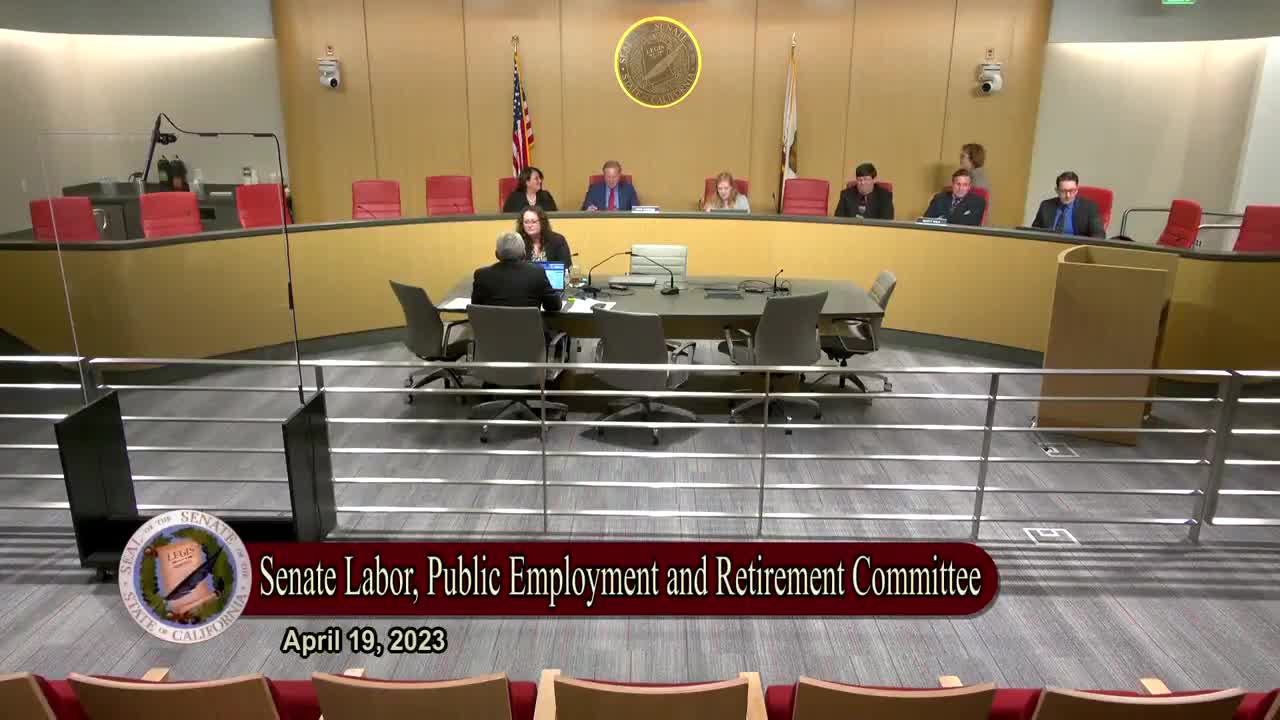 24MIN
Senate Standing Committee on Labor, Public Employment and Retirement
Bill Author
Bill Co-Author(s):