SB 559: Offshore oil drilling: leases.
- Session Year: 2023-2024
- House: Senate
- Latest Version Date: 2024-01-10
Current Status:
Failed
(2024-02-01: Returned to Secretary of Senate pursuant to Joint Rule 56.)
Introduced
In Committee
First Chamber
In Committee
Second Chamber
Enacted
What does this bill do?
The bill directs the State Lands Commission to negotiate with companies that hold active offshore oil and gas leases in California state waters to get them to voluntarily give up their leases and stop production. If no voluntary deal is reached by December 31, 2026, the commission must terminate the leases and may provide fair compensation to leaseholders based on a cost study and other factors. Leaseholders would also be required to seal and abandon wells, remove and decommission platforms, pipelines, and other facilities, and restore the tidelands and submerged lands under applicable law.
The summary is provided by generative AI which can make mistakes. For original language, please view the details in the table below.
Existing law establishes the State Lands Commission in the Natural Resources Agency. Existing law authorizes the commission to lease tide and submerged lands and beds of navigable rivers and lakes for purposes of the extraction of oil and gas, as provided. Existing law prohibits a state agency or state officer from entering into any new lease for the extraction of oil or gas from the California Coastal Sanctuary, except as provided.
Existing law requires, contingent upon an appropriation of funds by the Legislature for this purpose, the commission to develop, on or before December 31, 2024, a cost study that evaluates the fiscal impact of a voluntary relinquishment of any lease interests in actively producing state offshore oil and gas leases in state waters.
This bill would require, before or upon the publication of the cost study, the commission to seek to initiate negotiations with the lessees for the active oil and gas leases in state waters, with the goal of reaching an agreement for the voluntary relinquishment of the leases and termination of all oil and gas production associated with these leases. The bill would require, if the commission is unable to reach an agreement with the lessees that results in voluntary relinquishments of the leases on or before December 31, 2025, 2026, the commission to terminate the leases and provide fair compensation, as determined through the cost study, if warranted, to the lessees. The bill would describe fair compensation for these purposes. The bill would also require the lessees to plug and abandon all oil and gas wells, decommission pipelines, offshore platforms, and attendant production facilities, and restore the tidelands and submerged lands in compliance with the requirements of the applicable law. The bill would include legislative findings and declarations.
Existing law establishes the State Lands Commission in the Natural Resources Agency. Existing law authorizes the commission to lease tide and submerged lands and beds of navigable rivers and lakes for purposes of the extraction of oil and gas, as provided. Existing law prohibits a state agency or state officer from entering into any new lease for the extraction of oil or gas from the California Coastal Sanctuary, except as provided.
Existing law requires, contingent upon an appropriation of funds by the Legislature for this purpose, the commission to develop, on or before December 31, 2024, a cost study that evaluates the fiscal impact of a voluntary relinquishment of any lease interests in actively producing state offshore oil and gas leases in state waters.
This bill would require, before or upon the publication of the cost study, the commission to seek to initiate negotiations with the lessees for the active oil and gas leases in state waters, with the goal of reaching an agreement for the voluntary relinquishment of the leases and termination of all oil and gas production associated with these leases. The bill would require, if the commission is unable to reach an agreement with the lessees that results in voluntary relinquishments of the leases on or before December 31, 2025, the commission to terminate the leases and provide fair compensation, as determined through the cost study, to the lessees. The bill would also require the lessees to plug and abandon all oil and gas wells, decommission pipelines, offshore platforms, and attendant production facilities, and restore the tidelands and submerged lands in compliance with the requirements of the applicable law. The bill would include legislative findings and declarations.
The Legislature finds and declares all of the following:
(a)California has a longstanding policy that offshore oil and gas production in certain areas of state waters poses an unacceptably high risk of damage and disruption to the marine environment of the state.
(b)Offshore oil and gas production creates the risk of oil spills and other pollution that threaten Californias coastal environment, community, and economy.
(c)Offshore oil and gas production is inconsistent with state climate policy, including, but not limited to, Section 38566 of the Health and Safety Code, that seeks to reduce dangers to the environment and public health, and threats to environmental justice, from climate change.
(d)There are 11 remaining active oil and gas leases in California state waters managed on behalf of the state by the State Lands Commission. There are only three active offshore oil and gas platforms in state waters.
(e)The economic lives of these offshore oil and gas platforms have been largely exhausted, and continuing operations increase the risks of failure of aging infrastructure and that the government will have to pay for decommissioning costs.
(f)Oil and gas production impairs bathing, fishing, navigation, and recreation opportunities, is no longer in the interest of the state, and presents an ongoing public nuisance that jeopardizes our beautiful California coastline and the $44,000,000,000 it generates each year in economic activity.
(g)It is in the best interests of the State of California to end offshore oil and gas production, and to terminate these leases through voluntary negotiations, if possible, and to obtain the following outcomes through that termination:
(1)The end of all offshore oil and gas production.
(2)The plugging and abandonment of all oil and gas wells on the platform to the satisfaction of the Geologic Energy Management Division.
(3)The complete removal of all infrastructure, including the platform, pipelines, and production facilities, if any, attendant to the wells.
(4)The restoration of the sites of this infrastructure to the extent feasible.
SEC. 2.Section 6881 is added to the Public Resources Code, to read:6881.(a)Before or upon the publication of the cost study ordered pursuant to Section 6880, the commission shall seek to initiate negotiations with the lessees for the active oil and gas leases in state waters, with the goal of reaching an agreement for the voluntary relinquishment of the leases and termination of all oil and gas production associated with these leases.
(b)If the commission is unable to reach an agreement, as described in subdivision (a), with the lessees that results in voluntary relinquishments of the leases on or before December 31, 2025, 2026, the commission shall terminate the leases and provide fair compensation, as determined through the cost study, to the lessees. if warranted, to the lessees. Fair compensation shall be determined through the consideration of the results of the cost study ordered pursuant to Section 6880, and additional factors, including the ongoing costs to the community of the continuing hazard of offshore oil and gas production, including to public and environmental health and safety, underserved communities, cultural and tribal resources, climate change, harm to the coastal recreation and tourism economy, capital investment and recoupment of those costs, and any applicable legal factors.
(c)Lessees shall plug and abandon all oil and gas wells, decommission pipelines, offshore platforms, and attendant production facilities, and restore the tidelands and submerged lands in compliance with the requirements of the applicable law.
(d)The provisions of this section are severable. If any provision of this section or its application is held invalid, that invalidity shall not affect other provisions or applications that can be given effect without the invalid provision or application.
The Legislature finds and declares all of the following:
(a)California has a longstanding policy that offshore oil and gas production in certain areas of state waters poses an unacceptably high risk of damage and disruption to the marine environment of the state.
(b)Offshore oil and gas production creates the risk of oil spills and other pollution that threaten Californias coastal environment, community, and economy.
(c)Offshore oil and gas production is inconsistent with state climate policy, including, but not limited to, Section 38566 of the Health and Safety Code, that seeks to reduce dangers to the environment and public health, and threats to environmental justice, from climate change.
(d)There are 11 remaining active oil and gas leases in California state waters managed on behalf of the state by the State Lands Commission. There are only three active offshore oil and gas platforms in state waters.
(e)The economic lives of these offshore oil and gas platforms have been largely exhausted, and continuing operations increase the risks of failure of aging infrastructure and that the government will have to pay for decommissioning costs.
(f)Oil and gas production impairs bathing, fishing, navigation, and recreation opportunities, is no longer in the interest of the state, and presents an ongoing public nuisance that jeopardizes our beautiful California coastline and the $44,000,000,000 it generates each year in economic activity.
(g)It is in the best interests of the State of California to end offshore oil and gas production, and to terminate these leases through voluntary negotiations, if possible, and to obtain the following outcomes through that termination:
(1)The end of all offshore oil and gas production.
(2)The plugging and abandonment of all oil and gas wells on the platform to the satisfaction of the Geologic Energy Management Division.
(3)The complete removal of all infrastructure, including the platform, pipelines, and production facilities, if any, attendant to the wells.
(4)The restoration of the sites of this infrastructure to the extent feasible.
SEC. 2.Section 6881 is added to the Public Resources Code, to read:6881.(a)Before or upon the publication of the cost study ordered pursuant to Section 6880, the commission shall seek to initiate negotiations with the lessees for the active oil and gas leases in state waters, with the goal of reaching an agreement for the voluntary relinquishment of the leases and termination of all oil and gas production associated with these leases.
(b)If the commission is unable to reach an agreement, as described in subdivision (a), with the lessees that results in voluntary relinquishments of the leases on or before December 31, 2025, the commission shall terminate the leases and provide fair compensation, as determined through the cost study, to the lessees.
(c)Lessees shall plug and abandon all oil and gas wells, decommission pipelines, offshore platforms, and attendant production facilities, and restore the tidelands and submerged lands in compliance with the requirements of the applicable law.
(d)The provisions of this section are severable. If any provision of this section or its application is held invalid, that invalidity shall not affect other provisions or applications that can be given effect without the invalid provision or application.
|
Date
|
Status
|
|---|---|
| Feb 1, 2024 | Returned to Secretary of Senate pursuant to Joint Rule 56. |
| Jan 18, 2024 | January 18 hearing: Held in committee and under submission. |
| Jan 17, 2024 | Set for hearing January 18. |
| Jan 16, 2024 | January 16 hearing: Placed on APPR suspense file. |
| Jan 12, 2024 | Set for hearing January 16. |
| Jan 10, 2024 | Read second time and amended. Re-referred to Com. on APPR. |
| Jan 9, 2024 | From committee: Do pass as amended and re-refer to Com. on APPR. (Ayes 7. Noes 3. Page 2958.) (January 9). |
| Dec 21, 2023 | Set for hearing January 9. |
| Mar 28, 2023 | March 28 hearing: Heard for testimony only. |
| Mar 7, 2023 | Set for hearing March 28. |
| Feb 22, 2023 | Referred to Com. on N.R. & W. |
| Feb 16, 2023 | From printer. May be acted upon on or after March 18. |
| Feb 15, 2023 | Introduced. Read first time. To Com. on RLS. for assignment. To print. |
|
Date
|
Description
|
Location
|
Votes
|
|
|---|---|---|---|---|
| Jan 16, 2024 | Placed on suspense file | Senate Standing Committee on Appropriations |
Passed |
|
| Jan 9, 2024 | Do pass as amended, but first amend, and re-refer to the Committee on [Appropriations] | Senate Standing Committee on Natural Resources and Water |
Passed |
This list shows positions taken on this bill by organizations on the date displayed, which is linked to the original source.
Positions by individuals are not included.
|
Organization
|
Position
|
Date
|
|---|---|---|
| Center for Biological Diversity | * Support | Jan 16, 2024 |
| Elders Climate Action, Northern California Chapter | ** Support | |
| Elders Climate Action, Southern California Chapter | ** Support | |
| Heal The Bay | * Support | Jan 16, 2024 |
| Social Compassion In Legislation | ** Support | |
| Western States Petroleum Association | * Against | Jan 16, 2024 |
SENATE COMMITTEE ON
Senator Anthony Portantino, Chair
2023 - 2024 Regular Session
SB 559 (Min) - Offshore oil drilling: leases
Version: | Policy Vote: |
Urgency: | Mandate: |
Hearing Date: | Consultant: |
Bill Summary:
This bill would require the State Lands Commission (SLC) to terminate its leases that authorize oil and gas production in state waters if voluntary relinquishment cannot be negotiated, including the payment of fair compensation, as provided.
Fiscal Impact:
- To the extent this bill results in relinquishment or termination of offshore oil and gas leases managed by SLC that otherwise would not occur, state revenue losses of up to $100 million annually (General Fund).
- To the extent this bill results in voluntarily negotiated lease relinquishments that otherwise would not occur, unknown but potentially very significant ongoing costs, possibly in the tens of millions of dollars annually (General Fund), to reimburse lessees for lost profits depending on the negotiated terms. Staff notes that SLC has existing authority to pursue voluntary relinquishment.
- To the extent this bill results in unilateral lease terminations, it could possibly result in unknown but potentially significant state liability. (See staff comments for additional details.)
Background:
California is a major oil and gas producing state. According to the US Energy Information Administration, the state was 7th (2021) and 14th (2020) for oil and marketed natural gas production, respectively, among the 50 states. Production of oil was about 131M barrels in 2021 and continues to decline from the 1985 peak.
Offshore oil production in state waters is a small contributor to the state’s total oil production. State offshore production has generally been declining for decades. For example, production was as high as 40M barrels annually in the mid-1980s, and is now less than 10M barrels annually (6.9M in 2019 according to data from the Geologic Energy Management Division (CalGEM)). Most of the oil is produced offshore Long Beach under City of Long Beach leases. For 2009 – 2019, about 19% on average of the offshore oil production in state waters was from leases issued by the State Lands Commission – just over 25M barrels during the ten year time period.
State jurisdiction for oil and gas production. SLC has exclusive jurisdiction over ungranted tidelands and submerged lands owned by the state, and has had exclusive jurisdiction over the leasing of offshore state lands for oil and gas production since 1938. The commission also issues right-of-way leases for pipelines necessary to support offshore oil and gas infrastructure, and onshore oil and gas infrastructure located in tidelands may also require a commission lease. The Division of Geologic Energy Management (CalGEM) within the Department of Conservation is the state’s oil and gas regulator, and has jurisdiction over the wells.
The California Coastal Sanctuary Act of 1994. The California Coastal Sanctuary Act of 1994 (Public Resources Code (PRC) §§6240 et seq.) extended the California coastal sanctuary which removed the authority of the commission to issue new oil and gas leases for unleased tide and submerged lands underlying the Pacific Ocean with limited exceptions. Legislative findings state that “offshore oil and gas production in certain areas of state waters poses an unacceptably high risk of damage and disruption to the marine environment of the state.” (PRC §6241). Under the California Coastal Sanctuary Act, existing leases already in effect continued. When a lease is terminated or quitclaimed back to the state, the areas returned become part of the coastal sanctuary and cannot be re-leased for oil and gas production, with limited exception.
Active state leases. There are eleven active leases in state waters that continue to produce oil or are used to produce oil and gas today. Seven are for the offshore portion of the Huntington Beach oil field (Orange County), two are for the Belmont Offshore field (Orange County), and two for the offshore West Montalvo oil field (Ventura County). These Commission leases are in good standing. The Commission received about $20.7M in royalties for the oil and gas produced under these leases in fiscal year 2020/2021.
In general, lease terms provide for the leases to remain in effect so long as oil and gas production continues in paying or commercial quantities. A lessee generally has 60 days to cure any compliance issue or demonstrate diligent steps to reaching compliance if the cure would take longer, subject to certain terms and conditions.
State efforts to increase financial protections related to offshore oil and gas production.
The bankruptcies of the operators of Rincon Island (2016) and Platform Holly (2017) revealed the inadequate indemnity bonding and other protections held by the state against the costs of the decommissioning of offshore oil operations. SB 1147 (Hertzberg, Chapter 607, Statutes of 2018) required CalGEM and the commission to review and update requirements, as applicable. CalGEM holds bonds or other financial surety for the plugging and abandonment of the wells, and the commission for the infrastructure, including platforms and pipelines. A January 2022 report provided an overview of recent efforts, where possible, to update the value of the bonds or financial protection held by the state.
For Platform Emmy, CalGEM and the commission estimated total costs to be on the order of $91.9M to plug and abandon all wells and pipelines, decommission all facilities and completely remove the platform from state waters. The operator considers the liability to be $34M, and the report acknowledges that operators may well be able to plug and abandon wells, decommission facilities and infrastructure, and remediate sites at a lower cost than the state and its contractors can. For one of the Belmont Offshore leases, the bond amount is limited to $50,000 by the terms of the lease and cannot be increased. CalGEM estimates that the cost of plugging and abandoning the associated wells is about $14M. For Platforms Eva and Esther, CalGEM estimates the cost to abandon all of the the wells is $79M, and the commission estimates the cost to decommission infrastructure and facilities is $83M. The January 2022 report notes that an additional $100M was obtained from operators, including former operators, to help protect the state’s interests.
Local government leases. The City of Long Beach, Port of Los Angeles, and City of Newport Beach have or had issued leases of their own for oil and gas production on certain granted lands from the State Lands Commission where the Commission has delegated its authority to issue leases.
The AB 2257 study’s preliminary results. AB 2257 (Boerner, Chapter 692, Statutes of 2022) (AB 2257) requires, contingent upon appropriation, that the commission perform a cost study (cost study) that evaluates the fiscal impact of the voluntary relinquishment of any active oil and gas state leases in state waters by December 31, 2024, as provided. The cost study – for which $1M was appropriated – requires the commission to hold a public hearing by December 31, 2023, to discuss the cost study and to provide information about the status of the cost study at that public hearing. A draft of the AB 2257 study was released in advance on the commission’s December 5, 2023, agenda where its presentation was informational item #61.
The December 5, 2023 commission hearing included an informational item presenting the AB 2257 study’s preliminary results. These include:
- The estimated remaining life of the lease areas (from December 31, 2023) is 11.3 – 19.8 years.
- The state will receive revenues of approximately $460M over the anticipated lifetime of the offshore facilities (almost entirely royalty revenue and not discounted for the time value of money).
- There are approximately $376M in decommissioning costs associated with the leases.
- Over the estimated remaining lifetime of the offshore leases, lessees will gain approximately $2B in gross unrealized revenues to the lessees and $680M in unrealized profits. These two values have been discounted at an annual rate of 10%.
According to the study, these estimates use a fixed price of $77 per barrel of oil and $3.60 MM BTU of gas (although, as discussed below, this may not be so). In general, the study contractor and its subcontractors used both public and proprietary information, and proprietary methods and/or models to determine the estimates. The estimated unrealized profits are the same order of magnitude as the recent litigation settlements and spill response costs included above.
Proposed Law:
This bill would require SLC to terminate its leases that authorize oil and gas production in state waters if voluntary relinquishment cannot be negotiated, including the payment of fair compensation, as provided. It is derived from SB 953. Specifically, this bill would:
- Before or upon the publication of the cost study, require the commission to seek to initiate negotiations with the lessees of the active oil and gas leases in state waters with the goal of reaching an agreement for the voluntary relinquishment of the leases and termination of all oil and gas production associated with the leases.
- Require the commission, if voluntary relinquishments of the leases has not occurred by December 31, 2026, to terminate the leases and provide fair compensation, if warranted, to the lessees.
- Provide that “fair compensation” shall be determined through the consideration of the results of the cost study pursuant to section 6880; and additional factors including the ongoing costs to the community of the continuing hazard of offshore oil and gas production including to public and environmental health and safety, underserved communities, cultural and tribal resources; climate change; harm to the coastal recreation and tourism economy; capital investment and recoupment of those costs, and any applicable legal factors.
- Require the lessees to plug and abandon all oil and gas wells, decommission pipelines and other attendant facilities, and restore the tidelands and submerged lands in compliance with requirements, as specified.
- Provide that the provisions of (1) – (3) are severable, as provided.
- Make relevant and extensive legislative findings and declarations, including that it is in the best interests of the state to end offshore oil and gas production, and to terminate the commission’s leases through voluntary negotiation, if possible, and that termination will result in the end of all offshore oil and gas production, the plugging-and-abandonment of all oil and gas wells, the removal of all infrastructure attendant to the wells, and site restoration, as provided.
Related Legislation:
SB 704 (Min, Chapter 292, Statutes of 2023) removes oil and gas production from the coastal industrial use override provisions in the Coastal Act.
AB 1167 (Carrillo, Chapter 359, Statutes of 2023) requires a person who acquires the right to operate a well or production facility by purchase, transfer, assignment, conveyance, exchange, or other disposition, to file with the State Oil and Gas Supervisor an individual indemnity bond for the well or production facility or a blanket indemnity bond for multiple wells or facilities in an amount determined by the supervisor to be sufficient to cover, in full, all costs of plugging and abandonment, decommissioning, and site restoration, with certain exceptions, as provided, among other provisions.
SB 1423 (Stern, 2022) would have removed oil and gas production from the coastal industrial use override provisions in the Coastal Act. (This bill was held on the Senate Appropriations Committee suspense file.)
SB 953 (Min, 2022) would have required the commission to terminate its leases that authorize oil and gas production in state waters if voluntary relinquishment could not be negotiated, including the payment of fair compensation, as specified. (This bill was held on the Senate Appropriations Committee suspense file.)
AB 2257 (Boerner Horvath, Chapter 692, Statutes of 2022) requires that the commission perform a cost study that evaluates the fiscal impact of a voluntary relinquishment of any active oil and gas state leases in state waters by December 31, 2024, as provided.
AB 1057 (Limón, Chapter 771, Statutes of 2019) authorized CalGEM to seek additional financial surety from at risk operators, among other things.
AB 585 (Limón, Chapter 123, Statutes of 2019) authorizes the commission, when considering the approval of an assignment, transfer, or sublet of an oil and gas lease, to consider whether a proposed assignee is likely to comply with the provisions of the assigned, transferred, or sublet lease for the duration of the lease term, among other requirements.
SB 1147 (Hertzberg, Chapter 607, Statutes of 2018) required the commission to work with CalGEM to assess the adequacy bonding for offshore oil and gas wells and infrastructure, among other things.
SB 834 (Jackson, Chapter 309, Statutes of 2018) bars the commission from issuing new leases or amending or renewing existing leases to facilitate oil or gas exploration, development and production for new leases in federal waters.
AB 1775 (Muratsuchi, Chapter 310, Statutes of 2018) bars the commission from issuing new leases or amending or renewing existing leases to facilitate oil or gas exploration, development and production for new leases in federal waters
SB 788 (McGuire, 2015) would have removed the drainage exception – if federal leases are draining a state-owned oil and gas pool – to the California Marine Sanctuary Act so the commission could no longer issue new leases in that instance. (This bill was held on the Assembly Appropriations Committee suspense file.)
Staff Comments:
Existing SLC authority to pursue voluntary lease relinquishment. The Commission has the existing authority to pursue voluntary relinquishment, and the terms of the leases can be changed by mutual agreement. In 2019 the commission terminated three oil and gas leases for lack of production and failure to pay rent, and also terminated a pipelines lease for failure to pay rent. In recent years, the commission has also, where possible and applicable, increased indemnity bond requirements on pipelines from offshore, and negotiated a sinking fund and other terms to limit the state’s financial exposure to Platform Emmy and related Huntington Beach oil field operations.
This bill proposes to provide up to two years for negotiation, but then terminate the leases and pay fair compensation to the operators. This could result in additional voluntary lease relinquishments if the lessee is incentivized by the provisions of the bill to avoid lease termination or litigation.
State authority to terminate leases unclear. The terms of the existing leases generally authorize certain amendments to those leases through mutual agreement only. The leases are contracts between the commission and the operators. If the lease is in compliance, the state is generally restricted from changing the terms without reaching mutual agreement with the lessee by the Contracts Clause. The Western States Petroleum Association (WSPA) has raised concerns about ensuring compensation is paid for any private property lost through lease termination by the state. These issues may well ultimately be settled in court if negotiations fail and will depend upon the specific facts of each case.
Termination of leases as required by this bill could potentially result in state liability. To the extent this bill results in unilateral lease terminations that violate the terms of the leases, it could result in litigation and the state could incur unknown but potentially significant related costs (General Fund). In the event of litigation, it is possible that a court could assign decommissioning liability, the cost of which is in excess of several hundreds of millions of dollars (General Fund) to the state.
Tidelands oil revenue is one example of state revenue from oil and gas facilities. SLC receives royalty revenues from oil extraction activities on state tidelands. SB 271 (Ducheny and Thompson), Chapter 293, Statutes of 1997, established the principle that royalty revenues received by SLC from oil extraction activities should be dedicated, in large part, to various coastal and natural resources protections that benefit the entire state. Through subsequent legislation and budget actions, the Legislation funded various programs through the Resources Trust Fund (RTF) including marine management, natural resources infrastructure, and State Parks deferred maintenance.
In 2002, the budget proposed eliminating the current statutory requirements for distributing tidelands oil revenues to various special funds to fund resource activities. As a separate issue, a lawsuit between the state and the City of Long Beach required the city to direct funds to a Tidelands-related fund, the Oil Trust Fund, per Public Resources Code §6217.8. This fund is intended to be an abandonment reserve fund, for use when the oil production comes to an end. The maximum amount to be deposited into the fund was established at $300 million, with continued funding to be deposited as Tidelands Oil revenue and (per current law), deposited into the General Fund. The Trust Fund has reached its maximum and therefore up to $2 million per month is now being deposited into Tidelands Revenue that had not been available prior to 2013.
In 1997, when the Legislature first established the principle that Tidelands Oil revenues should be allocated to natural resource and coastal activities, the royalties totaled a little over $50 million. Today, due mostly to the price of oil, these funds bring between $250 and $350 million to the General Fund annually. Since 2006, all of the Tidelands royalties have been directed to the General Fund, in part for budget balancing.
-- END --
SENATE COMMITTEE ON NATURAL RESOURCES AND WATER
Senator Dave Min, Chair
2023 - 2024 Regular
Bill No: SB Hearing Date: January 9, 2024
Author: | Min | ||
Version: | February 15, 2023 Amended | ||
Urgency: | No | Fiscal: | Yes |
Consultant: | Katharine Moore | ||
Subject: Offshore oil drilling: leases
SUMMARY
This bill would require the State Lands Commission to terminate its leases that authorize oil and gas production in state waters if voluntary relinquishment cannot be negotiated, including the payment of fair compensation, as provided.
BACKGROUND AND EXISTING LAW
- California is a major oil and gas producing state. According to the US Energy Information Administration, the state was 7th (2021) and 15th (2021) for oil and marketed natural gas production, respectively, among the 50 states. Production of oil was about 123M barrels in 2022, and continues to decline from the 1985 peak.
- Offshore oil production in state waters is a small contributor to the state’s total oil production. State offshore production has generally been declining for decades. For example, production was as high as 40M barrels annually in the mid-1980s, and is now less than 10M barrels annually (6.9M in 2019 declining to approximately 5.9M in 2022). Most of the oil is produced offshore Long Beach under City of Long Beach leases. For 2009 – 2019, about 19% on average of the offshore oil production in state waters was from leases issued by the State Lands Commission – just over 25M barrels during that ten-year time period.
- Existing law establishes the State Lands Commission (commission) in the Natural Resources Agency. The commission has exclusive jurisdiction over ungranted tidelands and submerged lands owned by the state. The commission has had exclusive jurisdiction over the leasing of offshore state lands for oil and gas production since 1938. The commission also issues right-of-way leases for pipelines necessary to support offshore oil and gas infrastructure. Onshore oil and gas infrastructure located in tidelands may also require a commission lease. The Geologic Energy Management Division (CalGEM) in the California Department of Conservation, the state’s oil and gas regulator, has jurisdiction over the wells, and the commission for the other infrastructure, including the platforms.
- The City of Long Beach, Port of Los Angeles, and City of Newport Beach have or had issued leases of their own for oil and gas production on certain granted lands from the commission where the commission no longer has direct authority to issue leases.
- The Legislature, beginning in 1921 and repeatedly since, has passed laws that exclude offshore areas of the state from oil and gas leasing.
- According to the commission, it issued over 50 offshore oil and gas leases between 1938 and 1968. In general, lease terms provide for the leases to remain in effect so long as oil and gas production continues in paying or commercial quantities. A lessee generally has 60 days to cure any compliance issue or demonstrate diligent steps to reaching compliance if the cure would take longer, subject to certain terms and conditions. When production ceases, a lease should be quitclaimed back to the commission once the infrastructure has been removed and the lease terms satisfied.
- In January 1969, a blowout occurred on a well drilled from one of the platforms in federal waters offshore Santa Barbara, which resulted in a spill of approximately 80,000 – 100,000 barrels of crude oil. This spill oiled two hundred square miles of ocean and thirty-five miles of state coastline, and killed thousands of animals. The commission has not issued any new oil and gas leases since.
- The California Coastal Sanctuary Act of 1994 (Public Resources Code (PRC) §§6240 et seq.) extended the California coastal sanctuary, which removed the authority of the commission to issue new oil and gas leases for unleased tide and submerged lands underlying the Pacific Ocean with limited exception. Legislative findings state that “offshore oil and gas production in certain areas of state waters poses an unacceptably high risk of damage and disruption to the marine environment of the state.” (PRC §6241)
- Under the California Coastal Sanctuary Act, existing leases already in effect continued. When a lease is terminated or quitclaimed back to the state, the areas returned become part of the coastal sanctuary and cannot be re-leased for oil and gas production, with limited exception.
- There are eleven active leases in state waters that continue to produce oil or are used to produce oil and gas today. Seven are for the offshore portion of the Huntington Beach oil field (Orange County), two are for the Belmont Offshore field (Orange County), and two for the offshore West Montalvo oil field (Ventura County). The West Montalvo field is produced from onshore wells drilled offshore. The offshore portion of the Huntington Beach oil field is produced from onshore wells drilled offshore, and wells on Platforms Eva and Emmy. The Belmont Offshore field is produced from wells on Island Chafee and Platform Esther. Platforms Eva, Emmy, and Esther are in state waters. Oil production from Eva, Emmy, and Esther is approximately on the order of 0.03% of US oil production.
- These commission leases are in good standing. The commission received about $20.7M in royalties for the oil and gas produced under these leases in fiscal year 2020/2021.
- On the evening of Friday, October 1, 2021, the first reports of observed oil sheen in federal waters off the coast of Huntington Beach began to be reported. The spill was verified the next day. Pipeline P00547 operated by Amplify Energy that carries oil from Platform Elly in federal waters to the shore had cracked about 5 miles offshore. Approximately 25,000 gallons of oil was released, and joint federal/state/local government and private party oil spill response ensued that collected oil and tar balls from Orange County south to the border with Mexico. Millions of dollars of environmental damage – including the soiling of beaches and the deaths of dozens of birds and other species – resulted.
- In December 2023, the National Transportation Safety Board (NTSB) found that efforts to anchor by two large container ships in poor weather conditions in January 2021 resulted in the anchors dragging a portion of the pipeline out of position. This pipeline displacement produced the conditions that led to the spill nine months later. The NTSB recommended the US Coast Guard take steps to increase the distance between the pipeline and anchoring locations, and implement improved communication and planning requirements, among other recommendations. Amplify was not notified of the anchoring difficulties and risk to the pipeline, and Amplify’s personnel also did not immediately shut down the pipeline when the leak started despite multiple alarms. The NTSB estimated damage and response costs of $160Mfor the spill.
- Following the spill, Amplify pleaded no contest to state charges and agreed to pay $4.9M in fines and penalties. Amplify also pleaded guilty to federal charges of violating the Clean Water Act and agreed to pay $13M in fines and compensation. Amplify also reached a $50M settlement in April 2023 in a federal suit to compensate commercial fishers, property owners and others impacted by the spill. Two shipping companies agreed to pay $45M to settle with the same plaintiffs, and also agreed to pay Amplify $96.5M to settle litigation.
- Federal regulators approved restarting pipeline operations in April 2023.
- In response to the oil spill, SB 953 (Min, 2022) (SB 953) would have required the commission to terminate its leases that authorize oil and gas production in state waters if voluntary relinquishment could not be negotiated, including the payment of fair compensation, as specified. The bill also would have required a study to be completed to determine the estimated amortization cost of the leases. SB 953 was held on Senate Appropriations Committee suspense file.
- AB 2257 (Boerner, Chapter 692, Statutes of 2022) (AB 2257) requires, contingent upon appropriation, that the commission perform a cost study (cost study) that evaluates the fiscal impact of the voluntary relinquishment of any active oil and gas state leases in state waters by December 31, 2024, as provided. The cost study – for which $1M was appropriated – requires the commission to hold a public hearing by December 31, 2023, to discuss the cost study and to provide information about the status of the cost study at that public hearing.
- A draft of the AB 2257 study was released in advance on the commission’s December 5, 2023, agenda where its presentation was informational item #61. (The study results are described below.)
- The California Climate Crisis Act declares state policy to achieve net zero greenhouse gas emissions no later than 2045, and to achieve and maintain net negative greenhouse gas emissions thereafter, and requires the Air Resources Board to update the scoping plan for greenhouse gas emissions reductions to identify and recommend measures to achieve those policy goals, as specified. (AB 1279 (Muratsuchi), Chapter 336, Statutes of 2022)
PROPOSED LAW
This bill is derived from SB 953, and would require the commission to terminate its leases that authorize oil and gas production in state waters if voluntary relinquishment cannot be negotiated, including the payment of fair compensation, as provided. Specifically, this bill would:
- Before or upon the publication of the cost study, require the commission to seek to initiate negotiations with the lessees of the active oil and gas leases in state waters with the goal of reaching an agreement for the voluntary relinquishment of the leases and termination of all oil and gas production associated with the leases.
- Require the commission, if voluntary relinquishments of the leases has not occurred by December 31, 2025, to terminate the leases and provide fair compensation, as determined by the cost study, to the lessees.
- Require the lessees to plug and abandon all oil and gas wells, decommission pipelines and other attendant facilities, and restore the tidelands and submerged lands in compliance with requirements, as specified.
- Provide that the provisions of (1) – (3) are severable, as provided.
- Make relevant and extensive legislative findings and declarations, including that it is in the best interests of the state to end offshore oil and gas production, and to terminate the commission’s leases through voluntary negotiation, if possible, and that termination will result in the end of all offshore oil and gas production, the plugging-and-abandonment of all oil and gas wells, the removal of all infrastructure attendant to the wells, and site restoration, as provided.
ARGUMENTS IN SUPPORT
According to the author, “Every oil spill in California has had massive implications that not only result in direct costs to the state, but indirect costs from the damage to our coastal economy, which generates nearly $2 trillion in GDP each year. SB 559 eliminates the risk of future oil spills where aging infrastructure, coupled with the lack of incentive for greater investments to prevent catastrophic spills, are existential threats posed by oil platforms in state waters. Furthermore, this legislation offers a fair and judicious process that requires the State Lands Commission to negotiate in good faith with oil and gas producers to bring about shared agreements that would voluntarily relinquish all leases. This consensus building process would bring about the closure of the remaining platforms in state waters and help the state meet its long-term greenhouse reduction goals. On behalf of our state, its taxpayers, its coastal ecosystems, and future generations, this plan of action is urgent and necessary to end offshore drilling in state jurisdiction.”
The Center for Biological Diversity notes that its support “is premised upon an expectation that the ‘fair compensation’ to oil companies contemplated by the bill following termination of the leases would be zero” because the continued operation of the leases is a public nuisance, and decommissioning and restoration costs exceed any remaining value of the lease.
ARGUMENTS IN OPPOSITION
The Western States Petroleum Association (WSPA) writing in opposition states that “The California Constitution, like the United States Constitution, prohibits the government from a public taking of private property without providing just compensation. By authorizing the State to unilaterally terminate longstanding contracts that effectively go into perpetuity, [this bill] is unconstitutional and thus could result in substantial liability to the state for takings claims.”
WSPA continues, “The cost study is an inadequate solution to the “takings” issues raised by this bill. There is no assurance that the cost study would adequately compensate producers for the full value of the existing assets.”
“California already imports 75% of its crude oil supplies from foreign countries that don’t share California’s values. This bill will likely create an even greater dependence on foreign oil which threatens reliability, sustainability, and affordability for California’s diverse communities. In addition, reliance of foreign energy imports creates risks and could impact our energy supply, market volatility, international turmoil, global environmental quality, and increased global air emissions.”
COMMENTS
The AB 2257 study’s preliminary results.
As noted above, the December 5, 2023, commission hearing included an informational item presenting the AB 2257 study’s preliminary results. These include:
- The estimated remaining life of the lease areas (from December 31, 2023) is 11.3 – 19.8 years.
- The state will receive revenues of approximately $460M over the anticipated lifetime of the offshore facilities (almost entirely royalty revenue and not discounted for the time value of money).
- There are approximately $376M in decommissioning costs associated with the leases.
- Over the estimated remaining lifetime of the offshore leases, lessees will gain approximately $2B in gross unrealized revenues to the lessees and $680M in unrealized profits. These two values have been discounted at an annual rate of 10%.
According to the study, these estimates use a fixed price of $77 per barrel of oil and $3.60 MM BTU of gas (although, as discussed below, this may not be so). In general, the study contractor and its subcontractors used both public and proprietary information, and proprietary methods and/or models to determine the estimates. The estimated unrealized profits are the same order of magnitude as the recent litigation settlements and spill response costs included above.
Relevant factors and associated costs not included in the AB 2257 study’s preliminary results.
While AB 2257’s language authorizes the commission to include other factors and costs in the study beyond those specifically identified, the commission appears to have generally chosen not to do so (an exception is noted below). There are costs imposed upon the community by the continued operation of the offshore platforms to, among other things, public and environmental health and safety, vulnerable communities, and cultural and tribal resources. There is a fair argument that the costs associated with these and other relevant factors should be incorporated into the negotiations between the commission and industry. Much of this infrastructure is decades old and continues to age in the marine environment raising the risk of another spill. The commission has taken these and other factors into consideration in other matters before the commission.
The author has proposed amendments to revise how fair compensation is determined to include relevant additional factors that are not incorporated into the AB 2257 study to replace the existing requirement that the AB 2257 study alone be used as the basis for fair compensation. In addition, the amendments authorize two years for negotiation prior to lease termination as originally proposed. The Committee may wish to require a broader consideration of factors to determine fair compensation and provide two years for negotiation. [Amendment #1]
Comparison to earlier studies and additional observations regarding the AB 2257 study.
In the last few years there have been additional efforts to estimate the potential remaining life of the leases and decommissioning costs.
In a staff report for an informational item presented at the commission’s April 26, 2022, hearing, the economic lifetime of the offshore oil platforms in state waters was estimated for different prices of oil - $45, $85 and $100 per barrel. As the price per barrel rose, the economic lifetime of the field increased as did the reservoir reserves, state revenues, and the lessee’s gross income. The estimated economic life of the fields were in the range of 7 – 24 years (estimated from December 31, 2023). State revenues were estimated to be about $150 million in total for all three platforms at a per barrel price of $85. Gross income to the lessees was estimated at about $270 million in total. No discount rates were used in this analysis, so it is difficult to put the gross amounts of revenue estimated into context that takes into consideration the time value of money.
The time value of money is relevant to future revenues, particularly when these revenues are years in the future and the estimated value of these future revenues are important to evaluating decisions to be made today. There are well-established methods to quantify the time value of money: the value of $1 earned ten years from now is about 40 cents (at a 10% discount rate). To be sure, these calculations incorporate assumptions about the future which may not be accurate. However, they are a standard, essential, and widely-used method of economic analysis.
SB 1147 (Hertzberg, Chapter 607, Statutes of 2018) required the commission and CalGEM to review and update requirements protecting the state’s interests with respect to the decommissioning of the offshore platforms, wells, and related facilities. Estimates of the decommissioning costs ranged from about $14M (for the Belmont Offshore field wells) to $92M for all wells and facilities at Platform Emmy.
The estimated productive lifetimes of the leases are reasonably consistent between the AB 2257 study’s preliminary results and the 2022 commission staff report for the per barrel price of oil chosen. The decommissioning costs are reasonably similar given the inclusion of an additional $100M in onshore decommissioning costs at the Huntington Beach field in the AB 2257 study.
Elements of the preliminary results may warrant further consideration as the AB 2257 study is finalized. These include:
- There is a factor of 3 difference between the 2022 commission report and the higher preliminary estimates for state revenue in the AB 2257 report. While some of these differences stem from varying treatment of the Huntington Beach field, as noted above, this does not appear to account for all of it.
- The study clearly states that a constant value of $77 per barrel for oil and $3.60 MM BTU for gas were used in the calculations. However, the tables provided use varying prices for oil and gas produced in the different fields to generate the revenues reported. There does not appear to be an explanation provided for the use of these different values in the provided tables.
- Similarly in calculating the state’s revenues from a particular field, the contractor appears to have taken the royalty rate into consideration by reducing the production reported for a given field. This appears to be an effort to continue to use the same spreadsheet for different purposes (?), and serves to obscure how the results are calculated. Royalty rates are public information and should be provided.
In addition, while there are justifiable reasons for many of the assumptions made in the study, it is inexplicable that the time value of money is not considered in calculating state revenues. This is frankly inconsistent with the approach taken in calculating the lessee’s revenues and makes for an apples-to-oranges comparison – particularly in the context of this bill. This is not a new concern, and was discussed by commission and committee staff when the 2022 commission study became public and in the context of AB 2257.
These concerns should be addressed as the results are finalized.
Voluntary carbon credits?
According to the AB 2257 study, commission staff requested that the study contractor estimate the potential value of voluntary carbon credits associated with “prematurely” decommissioning the leases. This is the exception to the explicit statutory requirements for the AB 2257 study noted above. It is unclear if this preliminary effort takes into consideration that certain emissions associated with the platforms are currently covered under the state’s cap-and-trade program. Further, it is worth noting that the state’s low carbon fuel standard provides carbon intensity estimates for each field in California which is not apparently cited in the study and would make some of the boilerplate documentation provided as part of the study unnecessary. The Legislature has recently taken action to address concerns raised by voluntary credits (e.g. AB 1305 (Gabriel, Chapter 365, Statutes of 2023), among others).
Further comment regarding state offshore oil revenues.
It is important to note that state government has determined to forego potentially significant offshore oil revenues in state waters repeatedly over the years since the California Coastal Sanctuary Act became law.
A relevant lesson from Platform Holly.
Significant repairs to Platform Holly were required after the Venoco bankruptcy to return its infrastructure to an appropriate condition to perform certain portions of the decommissioning process. It is unknown, despite regular commission inspections of Holly’s infrastructure and equipment, if the state was aware how significantly this infrastructure was compromised prior to taking over control of the platform. The commission, as of the fall of 2021, has spent over $150M from the General Fund to pay for work on Platform Holly following the bankruptcy of the operators. The commission has since obtained additional General Fund ($3.66M one-time in the 2023 budget) to continue to undertake caretaker operations. There may well be unexpected decommissioning costs related to decommissioning these platforms. The subcontractor who performed the decommissioning estimates reports visiting the platforms which helps to lend credence to its estimates.
Resolve the shell mounds!
There are two active, but non-producing leases, in state waters where oil infrastructure has been removed, but legacy issues related to oil and gas production remain. For example, the status of the shellmounds remaining after the decommissioning of the 4H platforms decades ago has still not fully been resolved. The shellmounds interfere with some forms of fishing and contain hazardous materials from drilling muds and cuttings. The lessees continue to pay nominal rent.
Submitted letters.
The bill analysis includes position letters submitted through the portal to this Committee’s attention that met the Committee’s deadlines. In addition, position letters submitted through the portal to other Committees or to earlier bill versions may be included if determined to be relevant.
Recent related legislation
SB 704 (Min, Chapter 292, Statutes of 2023) removes oil and gas production from the coastal industrial use override provisions in the Coastal Act.
AB 1167 (Carrillo, Chapter 359, Statutes of 2023) requires a person who acquires the right to operate a well or production facility by purchase, transfer, assignment, conveyance, exchange, or other disposition, to file with the State Oil and Gas Supervisor an individual indemnity bond for the well or production facility or a blanket indemnity bond for multiple wells or facilities in an amount determined by the supervisor to be sufficient to cover, in full, all costs of plugging and abandonment, decommissioning, and site restoration, with certain exceptions, as provided, among other provisions.
SB 1423 (Stern, 2022) would have removed oil and gas production from the coastal industrial use override provisions in the Coastal Act. (This bill was held on the Senate Appropriations Committee suspense file.)
SB 953 (Min, 2022) would have required the commission to terminate its leases that authorize oil and gas production in state waters if voluntary relinquishment could not be negotiated, including the payment of fair compensation, as specified. (This bill was held on the Senate Appropriations Committee suspense file.)
AB 2257 (Boerner Horvath, Chapter 692, Statutes of 2022) requires that the commission perform a cost study that evaluates the fiscal impact of a voluntary relinquishment of any active oil and gas state leases in state waters by December 31, 2024, as provided.
AB 1057 (Limón, Chapter 771, Statutes of 2019) authorized CalGEM to seek additional financial surety from at risk operators, among other things.
AB 585 (Limón, Chapter 123, Statutes of 2019) authorizes the commission, when considering the approval of an assignment, transfer, or sublet of an oil and gas lease, to consider whether a proposed assignee is likely to comply with the provisions of the assigned, transferred, or sublet lease for the duration of the lease term, among other requirements.
SB 1147 (Hertzberg, Chapter 607, Statutes of 2018) required the commission to work with CalGEM to assess the adequacy bonding for offshore oil and gas wells and infrastructure, among other things.
SB 834 (Jackson, Chapter 309, Statutes of 2018) bars the commission from issuing new leases or amending or renewing existing leases to facilitate oil or gas exploration, development and production for new leases in federal waters.
AB 1775 (Muratsuchi, Chapter 310, Statutes of 2018) bars the commission from issuing new leases or amending or renewing existing leases to facilitate oil or gas exploration, development and production for new leases in federal waters
SB 788 (McGuire, 2015) would have removed the drainage exception – if federal leases are draining a state-owned oil and gas pool – to the California Marine Sanctuary Act so the commission could no longer issue new leases in that instance. (This bill was held on the Assembly Appropriations Committee suspense file.)
SUGGESTED AMENDMENTS
AMENDMENT 1
Please amend proposed PRC 6881(b) (p 3, lines 20 – 25) as follows:
(b) If the commission is unable to reach an agreement, as described in subdivision (a), with the lessees that results in voluntary relinquishments of the leases on or before December 31, 2025, 2026, the commission shall terminate the leases and provide fair compensation, if warranted, to the lessees. Fair compensation shall be determined through the consideration of the results of the cost study pursuant to section 6880; and additional factors including the ongoing costs to the community of the continuing hazard of offshore oil and gas production including to public and environmental health and safety, underserved communities, cultural and tribal resources; climate change; harm to the coastal recreation and tourism economy; capital investment and recoupment of those costs, and any applicable legal factors. , as determined through the cost study, to the lessees.
SUPPORT
Center for Biological Diversity
Elders Climate Action, Northern California Chapter
Elders Climate Action, Southern California Chapter
Social Compassion in Legislation
OPPOSITION
Western States Petroleum Association
-- END --
SENATE COMMITTEE ON NATURAL RESOURCES AND WATER
Senator Dave Min, Chair
2023 - 2024 Regular
Bill No: SB Hearing Date: March 28, 2023
Author: | Min | ||
Version: | February 15, 2023 Introduced | ||
Urgency: | No | Fiscal: | Yes |
Consultant: | Katharine Moore | ||
Subject: Offshore oil drilling: leases
BACKGROUND AND EXISTING LAW
- California is a major oil and gas producing state. According to the US Energy Information Administration, the state was 7th (2021) and 15th (2021) for oil and marketed natural gas production, respectively, among the 50 states. Production of oil was about 123M barrels in 2022, and continues to decline from the 1985 peak.
- Offshore oil production in state waters is a small contributor to the state’s total oil production. State offshore production has generally been declining for decades. For example, production was as high as 40M barrels annually in the mid-1980s, and is now less than 10M barrels annually (6.9M in 2019 declining to approximately 5.9M in 2022). Most of the oil is produced offshore Long Beach under City of Long Beach leases. For 2009 – 2019, about 19% on average of the offshore oil production in state waters was from leases issued by the State Lands Commission – just over 25M barrels during that ten year time period.
- Existing law establishes the State Lands Commission (commission) in the Natural Resources Agency. The commission has exclusive jurisdiction over ungranted tidelands and submerged lands owned by the state. The commission has had exclusive jurisdiction over the leasing of offshore state lands for oil and gas production since 1938. The commission also issues right-of-way leases for pipelines necessary to support offshore oil and gas infrastructure. Onshore oil and gas infrastructure located in tidelands may also require a commission lease. The Geologic Energy Management Division (CalGEM) in the California Department of Conservation, the state’s oil and gas regulator, has jurisdiction over the wells, and the commission for the other infrastructure, including the platforms.
- The City of Long Beach, Port of Los Angeles, and City of Newport Beach have or had issued leases of their own for oil and gas production on certain granted lands from the commission where the commission has delegated its authority to issue leases.
- The Legislature, beginning in 1921 and repeatedly since, has passed laws that exclude offshore areas of the state from oil and gas leasing.
- According to the commission, it issued over 50 offshore oil and gas leases between 1938 and 1968. In general, lease terms provide for the leases to remain in effect so long as oil and gas production continues in paying or commercial quantities. A lessee generally has 60 days to cure any compliance issue or demonstrate diligent steps to reaching compliance if the cure would take longer, subject to certain terms and conditions. When production ceases, a lease should be quitclaimed back to the commission once the infrastructure has been removed and the lease terms satisfied.
- In January 1969, a blowout occurred on a well drilled from one of the platforms in federal waters offshore Santa Barbara, which resulted in a spill of approximately 80,000 – 100,000 barrels of crude oil. This spill oiled two hundred square miles of ocean and thirty-five miles of state coastline, and killed thousands of animals. The commission has not issued any new oil and gas leases since.
- The California Coastal Sanctuary Act of 1994 (Public Resources Code (PRC) §§6240 et seq.) extended the California coastal sanctuary, which removed the authority of the commission to issue new oil and gas leases for unleased tide and submerged lands underlying the Pacific Ocean with limited exception. Legislative findings state that “offshore oil and gas production in certain areas of state waters poses an unacceptably high risk of damage and disruption to the marine environment of the state.” (PRC §6241)
- Under the California Coastal Sanctuary Act, existing leases already in effect continued. When a lease is terminated or quitclaimed back to the state, the areas returned become part of the coastal sanctuary and cannot be re-leased for oil and gas production, with limited exception.
- There are eleven active leases in state waters that continue to produce oil or are used to produce oil and gas today. Seven are for the offshore portion of the Huntington Beach oil field (Orange County), two are for the Belmont Offshore field (Orange County), and two for the offshore West Montalvo oil field (Ventura County). The West Montalvo field is produced from onshore wells drilled offshore. The offshore portion of the Huntington Beach oil field is produced from onshore wells drilled offshore, and wells on Platforms Eva and Emmy. The Belmont Offshore field is produced from wells on Island Chafee and Platform Esther. Platforms Eva, Emmy, and Esther are in state waters. Oil production from Eva, Emmy, and Esther is approximately on the order of 0.03% of US oil production.
- These commission leases are in good standing. The commission received about $20.7M in royalties for the oil and gas produced under these leases in fiscal year 2020/2021.
- On the evening of Friday, October 1, 2021, the first reports of observed oil sheen in federal waters off the coast of Huntington Beach began to be reported. The spill was verified the next day. Pipeline P00547 operated by Amplify Energy that carries oil from Platform Elly in federal waters to the shore had cracked about 5 miles offshore. Approximately 25,000 gallons of oil was released, and joint federal/state/local government and private party oil spill response ensued that collected oil and tar balls from Orange County south to the border with Mexico. While the investigation remains underway, news reports suggest the pipeline crack stemmed from the pipeline having been dragged by a ship’s anchor months earlier. Bolstering the anchor dragging hypothesis, two international shipping companies have recently reached multi-million dollar settlements for lawsuits related to the oil spill.
- In response to the oil spill, SB 953 (Min, 2022) (SB 953) would have required the commission to terminate its leases that authorize oil and gas production in state waters if voluntary relinquishment could not be negotiated, including the payment of fair compensation, as specified. The bill also would have required a study to be completed to determine the estimated amortization cost of the leases. SB 953 was held on Senate Appropriations Committee suspense file.
- AB 2257 (Boerner Horvath, Chapter 692, Statutes of 2022) requires, contingent upon appropriation, that the commission perform a cost study (cost study) that evaluates the fiscal impact of the voluntary relinquishment of any active oil and gas state leases in state waters by December 31, 2024, as provided. The cost study – for which $1M was appropriated – requires the commission to hold a public hearing by December 31, 2023 to discuss the cost study and to provide information about the status of the cost study at that public hearing.
- The California Climate Crisis Act declares state policy to achieve net zero greenhouse gas emissions no later than 2045, and to achieve and maintain net negative greenhouse gas emissions thereafter, and requires the Air Resources Board to update the scoping plan for greenhouse gas emissions reductions to identify and recommend measures to achieve those policy goals, as specified. (AB 1279 (Muratsuchi), Chapter 336, Statutes of 2022)
PROPOSED LAW
This bill is derived from SB 953, and would require the commission to terminate its leases that authorize oil and gas production in state waters if voluntary relinquishment could not be negotiated, including the payment of fair compensation, as provided. Specifically, this bill would:
- Before or upon the publication of the cost study, require the commission to seek to initiate negotiations with the lessees of the active oil and gas leases in state waters with the goal of reaching an agreement for the voluntary relinquishment of the leases and termination of all oil and gas production associated with the leases.
- Require the commission, if voluntary relinquishments of the leases has not occurred by December 31, 2025, to terminate the leases and provide fair compensation, as determined by the cost study, to the lessees.
- Require the lessees to plug and abandon all oil and gas wells, decommission pipelines and other attendant facilities, and restore the tidelands and submerged lands in compliance with requirements, as specified.
- Provide that the provisions of (1) – (3) are severable, as provided.
- Make relevant and extensive legislative findings and declarations, including that it is in the best interests of the state to end offshore oil and gas production, and to terminate the commission’s leases through voluntary negotiation, if possible, and that termination will result in the end of all offshore oil and gas production, the plugging-and-abandonment of all oil and gas wells, the removal of all infrastructure attendant to the wells, and site restoration, as provided.
ARGUMENTS IN SUPPORT
According to the author, “Every oil spill in California has had massive implications that not only result in direct costs to the state, but indirect costs from the damage to our coastal economy, which generates nearly $2 trillion in GDP each year. SB 559 eliminates the risk of future oil spills where aging infrastructure, coupled with the lack of incentive for greater investments to prevent catastrophic spills, are existential threats posted by oil platforms in state waters. Furthermore, this legislation offers a fair and judicious process that requires the State Lands Commission to negotiate in good faith with oil and gas producers to bring about shared agreements that would voluntarily relinquish all leases. This consensus building process would bring about the closure of the remaining platforms in state waters and help the state meet its long-term greenhouse reduction goals. On behalf of our state, its taxpayers, its coastal ecosystems, and future generations, this plan of action is urgent and necessary to end offshore drilling in state jurisdiction.”
The Center for Biological Diversity notes that its support “is premised upon an expectation that the ‘fair compensation’ to oil companies contemplated by the bill following termination of the leases would be zero” because the continued operation of the leases is a public nuisance, and decommissioning and restoration costs exceed any remaining value of the lease.
ARGUMENTS IN OPPOSITION
The Western States Petroleum Association (WSPA) writing in opposition states that “The California Constitution, like the United States Constitution, prohibits the government from a public taking of private property without providing just compensation. By authorizing the State to unilaterally terminate longstanding contracts that effectively go into perpetuity, [this bill] is unconstitutional and thus could result in substantial liability to the state for takings claims.”
WSPA continues, “The cost study is an inadequate solution to the “takings” issues raised by this bill. There is no assurance that the cost study would adequately compensate producers for the full value of the existing assets.”
“California already imports 75% of its crude oil supplies from foreign countries that don’t share California’s values. This bill will likely create an even greater dependence on foreign oil which threatens reliability, sustainability, and affordability for California’s diverse communities. In addition, reliance of foreign energy imports creates risks and could impact our energy supply, market volatility, international turmoil, global environmental quality, and increased global air emissions.”
COMMENTS
This bill is a work-in-progress. The commission’s implementation of this bill depends upon information gained from the cost study required by AB 2257. The cost study is not due to be completed until December 31, 2024 with an interim status report required to be available by the end of this year. While waiting for the cost study’s interim status report to (potentially) inform the bill’s language next winter, the author may wish to continue to review and refine the bill’s language to ensure the author’s goals are met and to address stakeholder concerns, as feasible.
One issue, among others, to consider is that there are few enough leases that the proposal may benefit from addressing each, as needed, on a case-by-case basis to reflect the differences between them. Of particular note, there are two active, but non-producing leases, in state waters where oil infrastructure has been removed, but legacy issues related to oil and gas production remain. For example, the status of the shellmounds remaining after the decommissioning of the 4H platforms decades ago has still not fully been resolved. The shellmounds interfere with some forms of fishing and contain hazardous materials from drilling muds and cuttings. Termination of this lease, for example, may result in increased liability to the state.
The Committee may wish to direct Committee staff to continue working with the author’s office to assist in these efforts.
What can the state do about the open-ended oil and gas leases in state waters offshore? The commission’s existing oil and gas leases – originally issued decades ago – can be operated to produce oil and gas into perpetuity so long as “paying quantities” of oil and gas are produced and the lessee continues to keep the lease in compliance. These open-ended lease terms present difficulties to the state. The commission has the existing authority to pursue voluntary relinquishment, and the terms of the leases can be changed by mutual agreement. This bill’s solution proposes to provide at least one year for negotiation, but then terminate the leases and pay fair compensation to the operators. The bill requires the operators to plug and abandon all wells and decommission all infrastructure and facilities. This will help to ensure that “polluters pay” to decommission and restore the sites used.
However, as a recent effort to estimate the costs associated with decommissioning offshore platforms shows, there may well be widely varying estimates on the costs and values associated with the offshore leases between the operators and the commission (the decommissioning cost estimates are discussed below).
Open-ended leases are not unique to offshore oil and gas production, and may well factor into any phase-out of onshore oil and gas production too in some circumstances.
State efforts to increase financial protections related to offshore oil and gas production.
The bankruptcies of the operators of Rincon Island (2016) and Platform Holly (2017) revealed the inadequate indemnity bonding and other protections held by the state against the costs of the decommissioning of offshore oil operations. SB 1147 (Hertzberg, Chapter 607, Statutes of 2018) required CalGEM and the commission to review and update requirements protecting the state’s interests, as provided. CalGEM holds bonds or other financial surety for the plugging and abandonment of the wells, and the commission for the infrastructure, including platforms and pipelines. A January 2022 report provided an overview of recent efforts, where possible, to update the value of the bonds or financial protection held by the state.
For Platform Emmy, CalGEM and the commission estimated total costs to be on the order of $91.9M to plug and abandon all wells and pipelines, decommission all facilities and completely remove the platform from state waters. The operator considers the liability to be $34M, and the report acknowledges that operators may well be able to plug and abandon wells, decommission facilities and infrastructure, and remediate sites at a lower cost than the state and its contractors can. For one of the Belmont Offshore leases, the bond amount is limited to $50,000 by the terms of the lease and cannot be increased. CalGEM estimates that the cost of plugging and abandoning the associated wells is about $14M. For Platforms Eva and Esther, CalGEM estimates the cost to abandon all of the wells is $79M, and the commission estimates the cost to decommission infrastructure and facilities is $83M. The January 2022 report notes that an additional $100M was obtained from operators, including former operators, to help protect the state’s interests.
In addition, in 2019 the commission terminated three oil and gas leases for lack of production and failure to pay rent, and also terminated a pipeline lease for failure to pay rent. In recent years, the commission has also, where possible and applicable, increased indemnity bond requirements on pipelines from offshore, and negotiated a sinking fund and other terms to limit the state’s financial exposure to Platform Emmy and related Huntington Beach oil field operations.
Platforms Emmy, Eva, and Esther are in shallow water. Platforms Emmy, Eva, and Esther are in 45, 58, and 30 feet of water, respectively. In all likelihood, given US Coast Guard requirements, these platforms are too shallow to be considered for rigs-to-reefs.
Another leak from an offshore pipeline off Huntington Beach. Pipeline 0919 from Platform Eva to shore started leaking in December 2021 about 1 mile offshore Huntington Beach in about 40 feet of water. The leak was not resolved until January 2022. An 1/8” diameter hole was found in the pipeline. The pipeline was evacuated, and removed from service. Hundreds of gallons of oil/water mix was recovered and on the order of 20 pounds of tarballs. Production remains shut-in on the platform.
Recent related legislation
SB 1423 (Stern, 2022) would remove oil and gas production from the coastal industrial use override provisions in the Coastal Act. (This bill was held on the Senate Appropriations Committee suspense file.)
SB 953 (Min, 2022) would have required the commission to terminate its leases that authorize oil and gas production in state waters if voluntary relinquishment could not be negotiated, including the payment of fair compensation, as specified. (This bill was held on the Senate Appropriations Committee suspense file.)
AB 2257 (Boerner Horvath, Chapter 692, Statutes of 2022) requires that the commission perform a cost study that evaluates the fiscal impact of a voluntary relinquishment of any active oil and gas state leases in state waters by December 31, 2024, as provided.
AB 353 (O’Donnell, Chapter 516, Statutes of 2022) removes the $300M cap on the Oil Trust Fund to help pay for the state’s portion of the eventual decommissioning of offshore oil and gas production in Long Beach.
AB 1057 (Limón, Chapter 771, Statutes of 2019) authorized CalGEM to seek additional financial surety from at risk operators, among other things.
AB 926 (O’Donnell, 2019) would have removed the $300M cap on the Oil Trust Fund to help pay for the state’s portion of the eventual decommissioning of offshore oil and production in Long Beach. (This bill was held on the Senate Appropriations Committee suspense file.)
AB 585 (Limón, Chapter 123, Statutes of 2019) authorizes the commission, when considering the approval of an assignment, transfer, or sublet of an oil and gas lease, to consider whether a proposed assignee is likely to comply with the provisions of the assigned, transferred, or sublet lease for the duration of the lease term, among other requirements.
SB 1147 (Hertzberg, Chapter 607, Statutes of 2018) required the commission to work with CalGEM to assess the adequacy bonding for offshore oil and gas wells and infrastructure, among other things.
SB 834 (Jackson, Chapter 309, Statutes of 2018) bars the commission from issuing new leases or amending or renewing existing leases to facilitate oil or gas exploration, development and production for new leases in federal waters.
AB 1775 (Muratsuchi, Chapter 310, Statutes of 2018) bars the commission from issuing new leases or amending or renewing existing leases to facilitate oil or gas exploration, development and production for new leases in federal waters
SB 788 (McGuire, 2015) would have removed the drainage exception – if federal leases are draining a state-owned oil and gas pool – to the California Marine Sanctuary Act so the commission could no longer issue new leases in that instance. (This bill was held on the Assembly Appropriations Committee suspense file.)
SUGGESTED AMENDMENTS: none
SUPPORT
Center for Biological Diversity
Elders Climate Action, Northern California Chapter
Elders Climate Action, Southern California Chapter
Social Compassion in Legislation
OPPOSITION
Western States Petroleum Association
-- END --
Discussed in Hearing
 3MIN
Senate Standing Committee on Appropriations
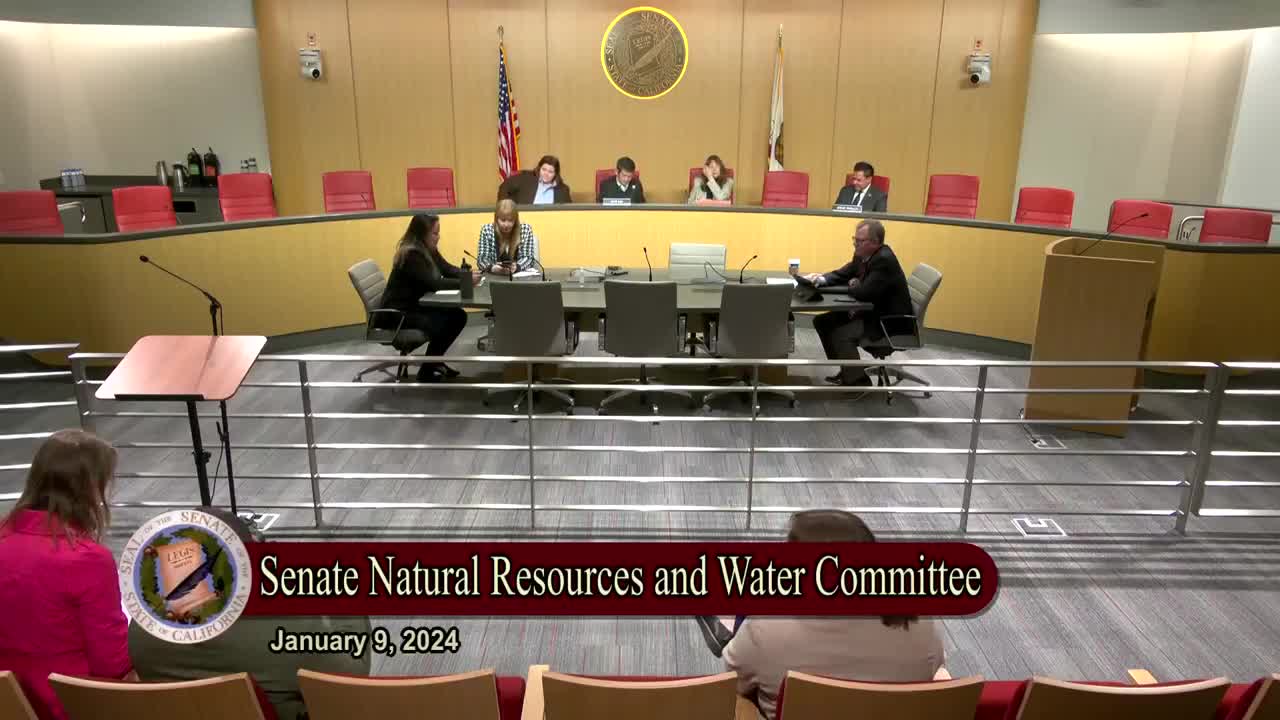 13MIN
Senate Standing Committee on Natural Resources and Water
 8MIN
Senate Standing Committee on Natural Resources and Water
Bill Author
Bill Co-Author(s):