SB 912: Colorimetric field drug tests.
- Session Year: 2023-2024
- House: Senate
- Latest Version Date: 2024-02-29
Current Status:
Failed
(2024-05-16: May 16 hearing: Held in committee and under submission.)
Introduced
In Committee
First Chamber
In Committee
Second Chamber
Enacted
Existing law prohibits the possession of certain controlled substances. The California Constitution provides for the Right to Truth-in-Evidence, which requires a 2/3 vote of the Legislature to exclude any relevant evidence from any criminal proceeding, as specified.
This bill would require law enforcement agencies and prosecutorial entities to adopt policies for the arrest and prosecution of drug possession charges to ensure reliable and accurate identifications of controlled substances and to maintain the integrity of convictions, as specified. Unless a test from a crime laboratory confirms the presence of a controlled substance in the sample, the bill would prohibit the use of a colorimetric field drug test, as defined, by law enforcement for a determination of probable cause for an arrest, by a prosecutor when deciding whether to charge a person, by a prosecutor as evidence against a defendant in an arraignment or preliminary hearing, or by a court for a conviction or sentencing, as specified. By excluding relevant evidence from a criminal proceeding, this bill would require a 2/3 vote of the Legislature. The bill would, when a colorimetric field drug test is used for any reason, allow an individual who pleads guilty to a charge of drug possession to withdraw the plea and move for dismissal of charges in the event of a confirmatory laboratory test that finds that there was no controlled substance in the sample. The bill would allow a defendant to request a confirmatory test at any time during the pendency of the case or, subsequent to the entry of the plea, up to a year after the adjudication of the case. By increasing the duties of local law enforcement, this bill would impose a state-mandated local program.
The California Constitution requires the state to reimburse local agencies and school districts for certain costs mandated by the state. Statutory provisions establish procedures for making that reimbursement.
This bill would provide that, if the Commission on State Mandates determines that the bill contains costs mandated by the state, reimbursement for those costs shall be made pursuant to the statutory provisions noted above.
Existing law prohibits the possession of certain controlled substances. The California Constitution provides for the Right to Truth-in-Evidence, which requires a 2/3 vote of the Legislature to exclude any relevant evidence from any criminal proceeding, as specified.
This bill would require law enforcement agencies and prosecutorial entities to adopt policies for the arrest and prosecution of drug possession charges to ensure reliable and accurate identifications of controlled substances and to maintain the integrity of convictions, as specified. Unless a test from a crime laboratory confirms the presence of a controlled substance in the sample, the bill would prohibit the use of a colorimetric field drug test, as defined, by law enforcement for a determination of probable cause for an arrest, by a prosecutor when deciding whether to charge a person, or by a court for a conviction or sentencing, as specified. By excluding relevant evidence from a criminal proceeding, this bill would require a 2/3 vote of the Legislature. The bill would, when a colorimetric field drug test is used for any reason, allow an individual who pleads guilty to a charge of drug possession to withdraw the plea and move for dismissal of charges in the event of a confirmatory laboratory test that finds that there was no controlled substance in the sample. The bill would allow a defendant to request a confirmatory test at any time during the pendency of the case or, subsequent to the entry of the plea, up to a year after the adjudication of the case. By increasing the duties of local law enforcement, this bill would impose a state-mandated local program.
The California Constitution requires the state to reimburse local agencies and school districts for certain costs mandated by the state. Statutory provisions establish procedures for making that reimbursement.
This bill would provide that, if the Commission on State Mandates determines that the bill contains costs mandated by the state, reimbursement for those costs shall be made pursuant to the statutory provisions noted above.
(a)All law enforcement agencies and prosecutorial entities shall adopt policies for the arrest and prosecution of a violation of Section 11350 or 11377 of the Health and Safety Code to ensure reliable and accurate identifications of controlled substances and to maintain the integrity of convictions. The policies shall include procedures that ensure they are abiding by the requirements in subdivision (b).
(b)Unless a test from a crime laboratory confirms the presence of a controlled substance in the sample, a colorimetric field drug test conducted by a law enforcement agency shall not be used for any of the following reasons:
(1)By a law enforcement agency for a determination of probable cause for an arrest under Section 11350 or 11377 of the Health and Safety Code.
(2)By a prosecutor when deciding whether to charge a person under Section 11350 or 11377 of the Health and Safety Code.
(3)By a prosecutor as evidence against a defendant charged with a violation of Section 11350 or 11377 of the Health and Safety Code in an arraignment or preliminary hearing.
(4)By a court for conviction or sentencing under Section 11350 or 11377 of the Health and Safety Code.
(c)When a colorimetric field drug test is used for any reason, an individual who pleads guilty to a violation of Section 11350 or 11377 of the Health and Safety Code shall be entitled to withdraw the plea and move for dismissal of charges if a confirmatory laboratory test finds that there was no controlled substance in the sample. The defendant may request a confirmatory test at any time during the pendency of the case or, subsequent to the entry of the plea, up to a year after the adjudication of the case. If the defendant pleads guilty without an attorney, the court shall advise them of their right to a confirmatory lab test.
(d)For purposes of this section, colorimetric field drug test means a field-testing drug kit that consists of color test reagents for the preliminary identification of narcotics in their pure or diluted forms. It does not apply to kits that use thin layer chromatography as the identification procedure nor to kits that identify drugs in body fluids.
SEC. 2.If the Commission on State Mandates determines that this act contains costs mandated by the state, reimbursement to local agencies and school districts for those costs shall be made pursuant to Part 7 (commencing with Section 17500) of Division 4 of Title 2 of the Government Code.
(a)All law enforcement agencies and prosecutorial entities shall adopt policies for the arrest and prosecution of a violation of Section 11350 or 11377 of the Health and Safety Code to ensure reliable and accurate identifications of controlled substances and to maintain the integrity of convictions. The policies shall include procedures that ensure they are abiding by the requirements in subdivision (b).
(b)Unless a test from a crime laboratory confirms the presence of a controlled substance in the sample, a colorimetric field drug test conducted by a law enforcement agency shall not be used for any of the following reasons:
(1)By a law enforcement agency for a determination of probable cause for an arrest under Section 11350 or 11377 of the Health and Safety Code.
(2)By a prosecutor when deciding whether to charge a person under Section 11350 or 11377 of the Health and Safety Code.
(3)By a prosecutor as evidence against a defendant charged with a violation of Section 11350 or 11377 of the Health and Safety Code in an arraignment or preliminary hearing.
(3)(4)By a court for conviction or sentencing under Section 11350 of the Health and Safety Code.
(c)When a colorimetric field drug test is used for any reason, an individual who pleads guilty to a violation of Section 11350 or 11377 of the Health and Safety Code shall be entitled to withdraw the plea and move for dismissal of charges if a confirmatory laboratory test finds that there was no controlled substance in the sample. The defendant may request a confirmatory test at any time during the pendency of the case or, subsequent to the entry of the plea, up to a year after the adjudication of the case. If the defendant pleads guilty without an attorney, the court shall advise them of their right to a confirmatory lab test.
(d)For purposes of this section, colorimetric field drug test means a field-testing drug kit that consists of color test reagents for the preliminary identification of narcotics in their pure or diluted forms. It does not apply to kits that use thin layer chromatography as the identification procedure nor to kits that identify drugs in body fluids.
SEC. 2.If the Commission on State Mandates determines that this act contains costs mandated by the state, reimbursement to local agencies and school districts for those costs shall be made pursuant to Part 7 (commencing with Section 17500) of Division 4 of Title 2 of the Government Code.
(a)All law enforcement agencies and prosecutorial entities shall adopt policies for the arrest and prosecution of a violation of Section 11350 of the Health and Safety Code to ensure reliable and accurate identifications of controlled substances and to maintain the integrity of convictions. The policies shall include procedures that ensure they are abiding by the requirements in subdivision (b).
(b)Unless a test from a crime laboratory confirms the presence of a controlled substance in the sample, a colorimetric field drug test conducted by a law enforcement agency shall not be used for any of the following reasons:
(1)By a law enforcement agency for a determination of probable cause for an arrest under Section 11350 of the Health and Safety Code.
(2)By a prosecutor when deciding whether to charge a person under Section 11350 of the Health and Safety Code.
(3)By a court for conviction or sentencing under Section 11350 of the Health and Safety Code.
(c)When a colorimetric field drug test is used for any reason, an individual who pleads guilty to a violation of Section 11350 of the Health and Safety Code shall be entitled to withdraw the plea and move for dismissal of charges if a confirmatory laboratory test finds that there was no controlled substance in the sample. The defendant may request a confirmatory test at any time during the pendency of the case or, subsequent to the entry of the plea, up to a year after the adjudication of the case. If the defendant pleads guilty without an attorney, the court shall advise them of their right to a confirmatory lab test.
(d)For purposes of this section, colorimetric field drug test means a field-testing drug kit that consists of color test reagents for the preliminary identification of narcotics in their pure or diluted forms. It does not apply to kits that use thin layer chromatography as the identification procedure nor to kits that identify drugs in body fluids.
SEC. 2.If the Commission on State Mandates determines that this act contains costs mandated by the state, reimbursement to local agencies and school districts for those costs shall be made pursuant to Part 7 (commencing with Section 17500) of Division 4 of Title 2 of the Government Code.
|
Date
|
Status
|
|---|---|
| May 16, 2024 | May 16 hearing: Held in committee and under submission. |
| May 10, 2024 | Set for hearing May 16. |
| Apr 8, 2024 | April 8 hearing: Placed on APPR suspense file. |
| Mar 28, 2024 | Set for hearing April 8. |
| Mar 12, 2024 | From committee: Do pass and re-refer to Com. on APPR. (Ayes 4. Noes 1. Page 3283.) (March 12). Re-referred to Com. on APPR. |
| Feb 29, 2024 | From committee with author's amendments. Read second time and amended. Re-referred to Com. on PUB S. |
| Feb 28, 2024 | From committee with author's amendments. Read second time and amended. Re-referred to Com. on PUB S. |
| Feb 23, 2024 | Set for hearing March 12. |
| Feb 14, 2024 | Referred to Com. on PUB S. |
| Jan 9, 2024 | From printer. May be acted upon on or after February 8. |
| Jan 8, 2024 | Introduced. Read first time. To Com. on RLS. for assignment. To print. |
|
Date
|
Description
|
Location
|
Votes
|
|
|---|---|---|---|---|
| Apr 8, 2024 | Placed on suspense file | Senate Standing Committee on Appropriations |
Passed |
|
| Mar 12, 2024 | Do pass, but first be re-referred to the Committee on [Appropriations] | Senate Standing Committee on Public Safety |
Passed |
This list shows positions taken on this bill by organizations on the date displayed, which is linked to the original source.
Positions by individuals are not included.
|
Organization
|
Position
|
Date
|
|---|---|---|
| Aclu California Action | * Support | Mar 12, 2024 |
| California Attorneys For Criminal Justice | * Support | Mar 12, 2024 |
| California District Attorneys Association | * Against | Mar 12, 2024 |
| California Innocence Coalition | * Support | Mar 12, 2024 |
| California Narcotic Officers Association | * Against | Mar 12, 2024 |
| California Public Defenders Association | * Support | Mar 12, 2024 |
| Californians for Safety and Justice | * Support | Mar 12, 2024 |
| Drug Policy Alliance | * Support | Mar 12, 2024 |
| Ella Baker Center For Human Rights | * Support | Mar 12, 2024 |
| Initiate Justice | * Support | Mar 12, 2024 |
| Riverside Sheriff's Office | * Against | Mar 12, 2024 |
| Roadside Drug Test Innocence Alliance | * Support | Mar 12, 2024 |
| Roadside Drug Test Innocence Alliance | * Support | Mar 12, 2024 |
| San Francisco Public Defenders Association | * Support | Mar 12, 2024 |
| Smart Justice California | * Support | Mar 12, 2024 |
SENATE COMMITTEE ON APPROPRIATIONS
Senator Anna Caballero, Chair
2023 - 2024 Regular Session
SB 912 (Wiener) - Colorimetric field drug tests
Version: February 29, 2024 | Policy Vote: PUB. S. 4 - 1 |
Urgency: No | Mandate: Yes |
Hearing Date: April 8, 2024 | Consultant: Robert Ingenito |
Bill Summary:
SB 912 would prohibit (as specified) the use of colorimetric field drug tests by (1) law enforcement as a determinant of probable cause, and (2) prosecutors as a determinant of charge or a source of evidence.
Fiscal Impact:
- This bill would result in administrative costs to impacted state departments to adopt and implement the requisite policies related to colorimetric field drug tests. The aggregate one-time impact across all state entities has yet to be determined, but is potentially greater than $50,000 (General Fund and special funds). The California Department of Human Resources (CalHR) has identified 33 state departments that use peace officer employment classifications. However, the majority of them do not employ positions with full peace officer status, and thus would not be impacted by this bill (See Staff Comments).
- By making specified changes to law enforcement agencies and prosecutorial entities related to colorimetric field drug tests, this bill creates a state-mandated local program. To the extent the Commission on State Mandates determines that the provisions of this bill create a new program or impose a higher level of service on local agencies, local agencies could claim reimbursement of those costs. The magnitude is unknown, but potentially in excess of $50,000 (General Fund).
Background:
Colorimetric field drug tests are filed drug-testing kits that are designed to show the presence of a narcotic by turning a specified color. They are also known as “presumptive field drug test kits.” They show that a specified type of narcotic may be present by changing to a specified color. Whether they color is determined by the person doing the testing. They are inexpensive and some law enforcement agencies nationwide have used these tests to arrest people for possession of illegal narcotics and the arrest can often lead to guilty pleas before further testing is done.
A study by the Quattrone Center at the University of Pennsylvania used survey data and national estimates of drug arrests to determine the impact of presumptive tests, and determined that 773,000 of the more than 1.5 million drug arrests in the United States involve colorimetric presumptive tests. The study noted that “presumptive field drug test kits are known to produce ‘false positive’ errors and were never designed or intended to provide conclusive evidence of the presence of drugs…but in our criminal legal system, where plea bargaining is the norm and actual fact-finding by trial is exceedingly rare, these error-prone tests have become de facto determinants of guilt in a substantial share of criminal cases in the United States and, as a result, a significant cause of wrongful convictions.”
Proposed Law:
This bill would, among other things, do the following:
- Provide that all law enforcement agencies and prosecutorial entities shall adopt policies for the arrest and prosecution of controlled substances to ensure reliable and accurate identifications of controlled substances and to maintain the integrity of convictions.
- Provide that the policies shall ensure that unless a test from a crime laboratory confirms the presence of a controlled substance in a sample, a colorimetric field drug test (as defined) conducted by a law enforcement agency shall not be used for any of the following reasons: (1) by a law enforcement agency for a determination of probable cause for an arrest of drug possession, (2) by a prosecutor for when deciding whether to charge a person for drug possession, (3) by a prosecutor as evidence against a defendant charged with a violation of drug possession in an arraignment or preliminary hearing, and (4) by a court for a conviction or sentencing for drug possession.
- Provide that when a colorimetric field dug test is used for any reason, an individual who pleads guilty to a drug possession violation shall be entitled to withdraw the plea and move for a dismissal of charges if a confirmatory laboratory test finds that there was not controlled substance in the sample.
- Provide that the defendant may request a confirmatory test at any time during the pendency of the case or, subsequent to the entry of the plea, up to a year after the adjudication of the case.
- Provide that if the defendant pleads guilty without an attorney, the court shall advise them of their right to a confirmatory lab test.
Staff Comments: As noted above, this bill would result in administrative costs to specified state departments to (1) adopt and implement policies for the arrest and prosecution of drug possession charges, and (2) preclude the use of colorimetric field drug tests. The list of state affected state departments is still being determined; however, at a minimum, the bill likely would apply to the Department of Justice, the California Highway Patrol (CHP), the University of California, the California State University System, and the California Community Colleges System (CCC). CHP indicates that it discontinued the use of colorimetric tests in 2017; their use by other state departments is still being determined.
To the extent that state and local entities currently use colorimetric field drug tests, their elimination under this bill would result in savings related to the expense of the testing kit. Available information indicates that each kit costs roughly $2; consequently, the aggregate savings across all entities would likely be, at a minimum, in the hundreds of thousands of dollars annually. Additionally, to the extent that this bill results in a reduced number of cases where an individual is falsely implicated, a reduction in annual court cases (and resulting expenses) could result. The magnitude is unknown.
-- END --
SENATE COMMITTEE ON PUBLIC SAFETY
Senator Aisha Wahab, Chair
2023 - 2024 Regular
Bill No: SB 912 Hearing Date: March 12, 2024
Author: | Wiener | ||
Version: | February 29, 2024 | ||
Urgency: | No | Fiscal: | Yes |
Consultant: | MK | ||
Subject: Colorimetric field drug tests
HISTORY
Source: Roadside Drug Test Innocence Alliance
Drug Policy Alliance
Prior Legislation: N/A
Support: Alliance for Boys and Men of Color; California Alliance for Youth and Community Justice; California; Innocence Coalition; California Public Defenders Association; Californians United for A Responsible Budget; Center for Policing Equity (UNREG); Communities United for Restorative Youth Justice (CURYJ); Drug Policy Alliance; Ella Baker Center for Human Right; Initiate Justice (UNREG); Initiate Justice Action Innocence Project; LA Defensa; Legal Services for Prisoner With Children; National Police Accountability Project (UNREG); Oak Analytics; Roadside Drug Test Innocence Alliance; Rubicon Programs; San Francisco Public Defender’s Office; Santa Cruz Barrios Unidos; Smart Justice California; Uncommon Law; Young Women's Freedom Center
Opposition: Arcadia Police Officers' Association; Burbank Police Officers' Association; California Coalition of School Safety Professionals; California District Attorneys Association; California Narcotic Officers' Association; California Reserve Peace Officers Association; Claremont Police Officers Association; Corona Police Officers Association; Culver City Police Officers' Association; Deputy Sheriffs' Association of Monterey County; Fullerton Police Officers' Association; Murrieta Police Officers' Association; Newport Beach Police Association; Novato Police Officers Association; Palos Verdes Police Officers Association; Placer County Deputy Sheriffs' Association; Pomona Police Officers' Association; Riverside County Sheriff's Office; Riverside Police Officers Association; Santa Ana Police Officers Association; Upland Police Officers Association
PURPOSE
The purpose of this bill is to require law enforcement agencies and prosecutors to adopt policies for the arrest and prosecution of drug possession charges to ensure reliable and accurate identifications of controlled substance.
Existing law generally regulates the use of some tools by law enforcement and generally prescribes what can be used as evidence in a prosecution.
Existing law makes the possession of controlled substances a misdemeanor. (Health and Safety Code §§ 11350; 11377)
This bill provides that all law enforcement agencies and prosecutorial entities shall adopt policies for the arrest and prosecution of controlled substances to ensure reliable and accurate identifications of controlled substances and to maintain the integrity of convictions.
This bill provides that the policies shall ensure that unless a test from a crime laboratory confirms the presence of a controlled substance in a sample, a colorimetric field drug test conducted by a law enforcement agency shall not be used for any of the following reasons:
- By a law enforcement agency for a determination of probable cause for an arrest of drug possession.
- By a prosecutor for when deciding whether to charge a person for drug possession.
- By a prosecutor as evidence against a defendant charged with a violation of drug possession in an arraignment or preliminary hearing.
- By a court for a conviction or sentencing for drug possession.
This bill provides that when a colorimetric field dug test is used for any reason, an individual who pleads guilty to a drug possession violation shall be entitled wo withdraw the plea and move for a dismissal of charges if a confirmatory laboratory test finds that there was not controlled substance in the sample.
This bill provides that the defendant may request a confirmatory test at any time during the pendency of the case or, subsequent to the entry of the plea, up to a year after the adjudication of the case.
This bill provides that if the defendant pleads guilty without an attorney, the court shall advise them of their right to a confirmatory lab test.
This bill provides that for this section “colorimetric field drug test” means a filed-testing drug kit that consists of color test reagents for the preliminary identification of narcotics in their pure or diluted forms. It does not apply to kits that use a thin layer of chromatography as the identification procedure nor to kids that identify drugs in bodily fluids.
COMMENTS
1. Need for This Bill
According to the author:
Senate Bill 912, the Requiring Objective and Accurate Drug (ROAD) Testing Act, prohibits law enforcement agencies from using the results of a colorimetric field drug test – already abandoned by the California Highway Patrol and a number of police departments – as probable cause for arrest or as the basis for a drug possession charge prior to a confirmatory test from a crime laboratory.
With accurate, scientific alternatives available, there is no reason to rely on junk colorimetric tests to make arrests when a suspicious substance is discovered in the field. Inaccurate drug tests like these – which have falsely implicated generic household items such as powdered milk, folic acid, and vitamins in egregious cases – undermine basic principles of justice and fairness and their use is unacceptable now that the risk of wrongful conviction has been confirmed.
2. Colorimetric Field Drug Tests
Colorimetric field drug tests are filed drug testing kits that are designed to show the presence of a narcotic by turning a specified color. They are also known as “presumptive field drug test kits.” They show that a specified type of narcotic may be present by changing to a color—green, purple etc. Whether they color is there is determined by the person doing the testing. They are inexpensive and some law enforcement agencies nationwide have used these tests to arrest people for possession of illegal narcotics and the arrest can often lead to guilty pleas before further testing is done.
A study by the Quattrone Center for the Fair Administration of Justice at the University of Pennsylvania Carey Law School used survey data and national estimates of drug arrests to determine the impact of presumptive tests. They found that approximately 773,000 of the more than 1.5 million drug arrests in the United States involve colorimetric presumptive tests. In part they found:
“Presumptive field drug test kits are known to produce ‘false positive’ errors and were never designed or intended to provide conclusive evidence of the presence of drugs,” says Ross Miller, Quattrone Center Assistant Director and lead author of the report. “But in our criminal legal system, where plea bargaining is the norm and actual fact-finding by trial is exceedingly rare, these error-prone tests have become de facto determinants of guilt in a substantial share of criminal cases in the United States and, as a result, a significant cause of wrongful convictions.”
Although originally developed as a preliminary-only testing method due to their unreliability and unknown false-positive rate, widespread use of these tests has negatively impacted the entire criminal justice process. Almost 90% of prosecutors surveyed by the Quattrone Center reported that guilty pleas are permitted in their jurisdictions without verification of the field test by an accredited toxicology laboratory. Further, 67% of drug labs in the national sample reported that they are not asked to review samples when the case is resolved by plea agreements, and 24% do not receive samples for testing when there are field test results available. Even when labs do receive samples, 46% reported that they do not conduct a confirmatory test if a guilty plea has already been filed for a case.
The report also details racially disparate impacts resulting from these tests, finding that a Black individual is three times more likely to experience a drug arrest with a false positive from a field test compared to a white individual. (University of Pennsylvania, Carey law “’False Positive’ field drug Tests Lead to Wrongful Convictions” January 9, 2024 https://www.law.upenn.edu/live/news/16363-false-positive-field-drug-tests-lead-to-wrongful)
The Quattrone report made a number suggestions regarding policy reforms:
- Conduct regular blind audits of cases involving presumptive testing to determine rates of false positives.
- Use more accurate presumptive tests that identify compounds by structural information (e.g. Raman spectroscopy) rather than simply by the presence of chemical groups.
- Limit or forbid the use of colorimetric presumptive field tests.
- Should field test kits continue to be used in simple drug possession cases, adopt a cite-and-release policy to avoid the coercive effect of detention and its impact on wrongful convictions.
- Require confirmatory testing whenever a guilty plea is accepted, with the right to withdraw the guilty plea following a no-controlled substance finding (https://www.law.upenn.edu/live/files/12890-fdt-guilty-until-proven-innocent)
The suggestions in the U Penn report are consistent with the much earlier USDOJ recommendations in a 2000 report.
The U.S. Department of Justice, Office of Justice Programs, National Institute of
Justice, in its publication "Color Test Reagents/Kits for Preliminary Identification of Drugs of Abuse NIJ Standard-0604.01" (2000) includes in its list of "requirements" item 4.1.4 General, which provides:
a) A statement that the kit is intended to be used for presumptive identification purposes only, and that all substances tested should be subjected to more definitive examination by qualified scientists in a properly equipped crime laboratory.
b) A statement that users of the kit should receive appropriate training in its use and should be taught that the reagents can give false-positive as well as false-negative results.
c) A discussion of the possibility of reagent and/or sample contamination and consequent misleading results.
d) A discussion of proper kit storage in buildings and vehicles.
In an unpublished 2018 Imperial Superior Court case looking at whether colorimetric tests could be used as evidence at grand juries used to prosecute persons incarcerated at CDCR facilities, it was clear that the guards conducting the colorimetric tests at those facilities were not aware that there can be false positive tests. (People v Chacon April 24, 2018 Case No. JCF36904 and combined cases) Based on their unreliability and the fact that some of the tests had not been validated, the court found that the tests alone were not sufficient as proof that the defendant’s possessed drug, but stated they were giving no opinion on their utility in the field.
According to background provided by the author:
Several states and police departments across the country have recognized the risks in relying on colorimetric field test results to identify a substance. California Highway Patrol protocols state that departmental personnel shall not perform presumptive field tests solely to confirm the presence of suspected narcotics. Protocols instead ask that the substance suspected of being a narcotic be packaged and sent to the appropriate lab for identification. In September 2023, in Florida, the Jacksonville Sheriff’s Office instructed officers to stop using the colorimetric tests after they discovered that Benadryl and other over-the-counter medications could yield false positive results from these tests. In an investigative report in Georgia in 2017, reporters found 145 instances of false positive results that year that were later found negative by confirmatory testing. These results included 64 false positive results for methamphetamines.
3. Requires Law Enforcement and Prosecutorial Entities to Develop Policies
This bill would require all law enforcement agencies and prosecutorial entities to adopt policies for the arrest and prosecution of controlled substances to ensure the reliable and accurate identification of controlled substances and to maintain the integrity of convictions. The bill provides that the policies shall provide that unless a test from a crime laboratory confirms the presence of a controlled substance in a sample, a colorimetric field drug test conducted by a law enforcement agency shall not be used for any of the following reasons:
- By a law enforcement agency for a determination of probable cause for arrest for possession of a controlled substance.
- By a prosecutor when deciding whether or not to chare a person for possession of a controlled substance.
- By a prosecutor as evidence against a defendant charged with possession of a controlled substance.
- By a court for conviction or sentencing for possession of a controlled substance.
These requirements are in line with the recommendations of those who have studied the use of colorimetric tests. If they are used there needs to be a follow up test to confirm the substance before a person is prosecuted. At some point, the author may wish to clarify that a person could be arrested by cite and release after a colorimetric test but not held in solely because of the test, if that is what is intended.
The bill further provides that if a colorimetric field drug test is used for any reason, an individual who pleads guilty to possession of controlled substances shall be entitled to withdraw the plea and move for dismissal of charges if a confirmatory sample test find there was not controlled substance in the sample. Existing law provides that controlled substances taken as evidence shall be destroyed no sooner than 60 days after the case is final. (Penal Code §1417.6) In a misdemeanor a notice of appeal must be filed within 30 days, so in many cases the case will be final after that 30 days. The author may wish to consider amending Penal Code Section 1417.6 to provide that controlled substances that have not been subject to an in lab test should not be destroyed for one year after judgement.
A defendant may request a confirmatory test at any time during the pendency of the case, or subsequent to the entry of a plea, up to a year after the adjudication of the case.
If the defendant pleads guilty without an attorney, the court shall advise them their right to a confirmatory the lab test.
4. Argument in Support
The California Innocence Coalition supports this bill stating:
Each year, according to the 2023 study from the Quattrone Center for the Fair Administration of Justice at the University of Pennsylvania, over 750,000 people are arrested based on field drug test kits, known to give false positives. The report found that every year, approximately 30,000 drug-related arrests involve people who do not possess illegal substances but are falsely implicated by presumptive tests. The study noted that false positive rates of 15% and as high as 38% have been observed, and determined that field drug test kits are likely the largest contributing factor in wrongful arrests and convictions in the United States. In addition, the study determined that Black people were falsely arrested based on inaccurate field drug tests at a rate three times higher than their white counterparts.
The Quattrone Center estimates that 216,886 people are arrested on drug charges in California annually. Of those, an estimated 4,099 arrests involve individuals not carrying controlled substances who are falsely implicated by presumptive tests. In cases across the United States, cotton candy, powdered milk, sugar, lidocaine, folic acid vitamins, bird feces, and even a loved one’s ashes produced positive results on presumptive field tests.
Some departments across California are already leading the way in abandoning these unreliable tests. The San Francisco, Santa Barbara, and Tracy Police Departments, and the Kings, Madera, and Siskiyou County Sheriffs do not use the colorimetric field tests and instead use accurate handheld electronic devices that can identify an exact substance based on its chemical structure.
Due to the substantial risk of wrongful incarceration posed by the continued use of presumptive field drug tests, we support SB 912, The ROAD Act, which will result in justice for thousands of innocent people each year who are falsely implicated by presumptive tests. Thank you for considering our support for this important legislation.
5. Argument in Opposition
The California District Attorneys Association opposes this bill stating:
This bill would eliminate the ability for police officers to rely on colorimetric tests for probable cause to arrest, and for prosecutors and the courts to use for the purposes of probable cause, charging, or sentencing. SB 912 would apply to possession of heroin, synthetic opioids (fentanyl), cocaine, and methamphetamine pursuant to Health and Safety Code sections 11377 and 11350. SB 912 creates a right for a person whose possession case involved the use of such tests who pled guilty or was convicted in the absence of a confirmatory test to request a confirmatory test up to a year post-conviction. The person would be entitled to a dismissal if a confirmatory laboratory test finds there was no controlled substance.
This technology remains in use by both local law enforcement and federal law enforcement for purposes of establishing probable cause when other presumptive testing is unavailable. Furthermore, there is no definition of colorimetric test within the bill leaving open the possibility that lateral flow immunoassay tests which are strip tests used for testing fentanyl and xylazine at crime scenes where deaths have occurred will not be permitted for determining probable cause despite the urgency of determining the substance for a death investigation. These tests have been commonly used in rapid COVID testing and pregnancy testing but would potentially be unusable by law enforcement for probable cause determinations in cases that begin as simple possession cases but evolve into larger investigations. This law only applies to simple possession charges and would exclude possession for sale cases potentially creating an Equal Protection issue.
-- END –
Discussed in Hearing
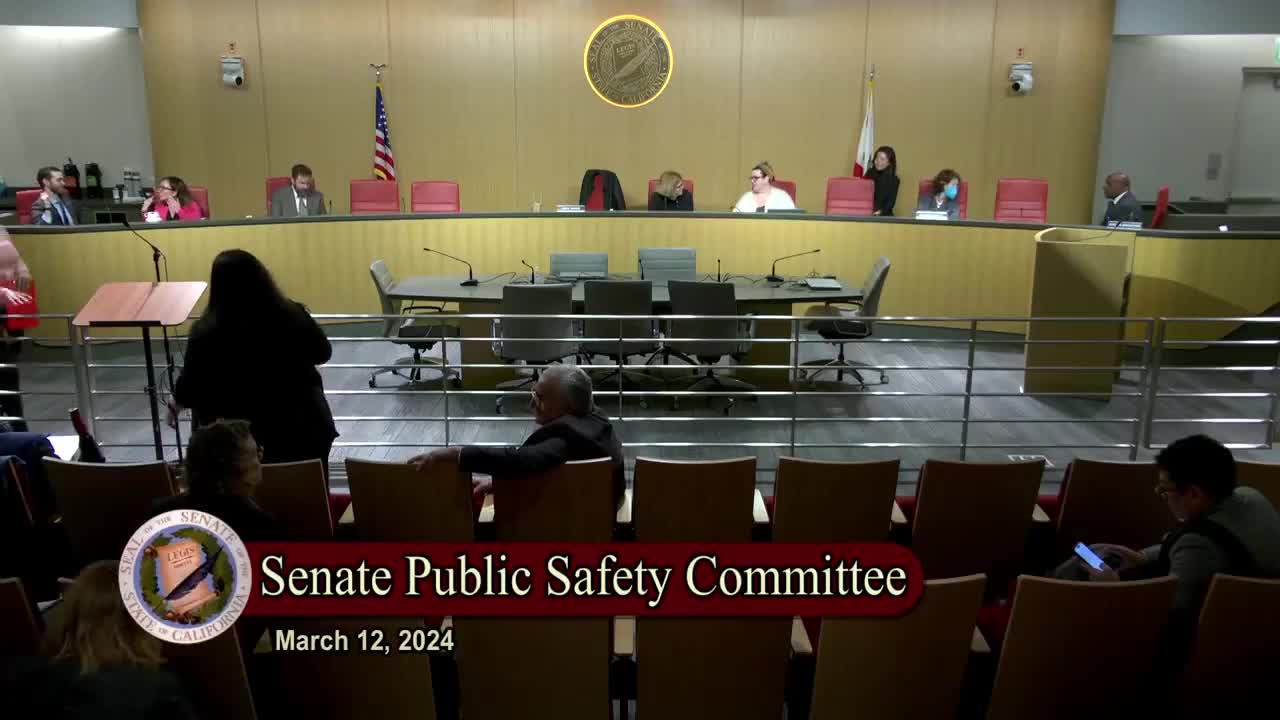 29MIN
Senate Standing Committee on Public Safety
Bill Author

Bill Co-Author(s):