SCR 163: Local agency formation commissions.
- Session Year: 2023-2024
- House: Senate
- Latest Version Date: 2024-06-26
Current Status:
Failed
(2024-07-03: July 3 hearing: Reconsideration granted.)
Introduced
In Committee
First Chamber
In Committee
Second Chamber
Enacted
This measure would reaffirm the sole authority of local agency formation commissions for the initiation, conduct, and completion of changes of organization and reorganization organization, reorganizations, and extraterritorial services for cities and districts.
This measure would reaffirm the sole authority of local agency formation commissions for the initiation, conduct, and completion of changes of organization and reorganization for cities and districts.
WHEREAS, It is the policy of the state to encourage orderly growth and development, which are essential to the social, fiscal, and economic well-being of the state; and
WHEREAS, The Legislature recognizes that the logical formation and determination of local agency boundaries is an important factor in promoting orderly development and in balancing that development with sometimes competing state interests of discouraging urban sprawl, preserving open-space and prime agricultural lands, and efficiently extending government services; and
WHEREAS, This policy should be effected by the logical formation and modification of the boundaries of local agencies, with a preference granted to accommodating additional growth within, or through the expansion of, the boundaries of those local agencies, which can best accommodate and provide necessary governmental services and housing for persons and families of all incomes in the most efficient manner feasible; and
WHEREAS, The Cortese-Knox-Hertzberg Local Government Reorganization Act of 2000 provides each local agency formation commission (LAFCO) with the sole and exclusive authority and procedure for the initiation, conduct, and completion of changes of organization and reorganization organization, reorganizations, and extraterritorial services for cities and districts; and
WHEREAS, Each county in the state has a LAFCO established locally, LAFCO, which includes membership is composed of elected city and county members and members, at least one public member; member, and, in 32 counties, special district members; and
WHEREAS, The LAFCO develops and determines the sphere of influence of each city and each special district within the county and enacts policies designed to promote the logical and orderly development of areas within that sphere; and
WHEREAS, The 50-billion-dollar a year agricultural industry is crucial to the economic well-being of the state, and LAFCOs are called upon to protect that industry by assuring the stability of fire protection districts, water districts, and public trusts; andWHEREAS, The LAFCO is responsible for the formation of county service areas, which enable essential services, including water and sanitation, to be provided in a given area; and
WHEREAS, The original LAFCO legislation was passed in 1963, 1963 and updated in 1985 and 2000, and charged LAFCOs with preserving that industry; 2000; and
WHEREAS, The Legislature has continually reaffirmed LAFCOs authority to encourage orderly growth and the preservation of prime farmland and open space; and
WHEREAS, LAFCOs have independently and successfully enforced orderly growth for over one-half century; and
WHEREAS, The Cortese-Knox-Hertzberg Local Government Reorganization Act of 2000 clearly endows LAFCOs with authority over districts exercising latent powers concerning new or different functions; and
WHEREAS, Corporate interests bypassing the normal planning process by quietly purchasing tens of thousands of acres of farmland with the intent of creating an urban area is contrary to this precedent; now, therefore, be it
Resolved by the Senate of the State of California, the Assembly thereof concurring, That the Legislature reaffirms the sole authority of LAFCOs for the initiation, conduct, and completion of changes of organization and reorganization organization, reorganizations, and extraterritorial services for cities and districts; and be it further
Resolved, That the Secretary of the Senate transmit copies of this resolution to the author for appropriate distribution.
WHEREAS, It is the policy of the state to encourage orderly growth and development, which are essential to the social, fiscal, and economic well-being of the state; and
WHEREAS, The Legislature recognizes that the logical formation and determination of local agency boundaries is an important factor in promoting orderly development and in balancing that development with sometimes competing state interests of discouraging urban sprawl, preserving open-space and prime agricultural lands, and efficiently extending government services; and
WHEREAS, This policy should be effected by the logical formation and modification of the boundaries of local agencies, with a preference granted to accommodating additional growth within, or through the expansion of, the boundaries of those local agencies, which can best accommodate and provide necessary governmental services and housing for persons and families of all incomes in the most efficient manner feasible; and
WHEREAS, The Cortese-Knox-Hertzberg Local Government Reorganization Act of 2000 provides each local agency formation commission (LAFCO) with the sole and exclusive authority and procedure for the initiation, conduct, and completion of changes of organization and reorganization for cities and districts; and
WHEREAS, Each county in the state has a LAFCO established locally, which includes membership of elected city and county members and at least one public member; and
WHEREAS, The LAFCO develops and determines the sphere of influence of each city and each special district within the county and enacts policies designed to promote the logical and orderly development of areas within that sphere; and
WHEREAS, The 50-billion-dollar a year agricultural industry is crucial to the economic well-being of the state, and LAFCOs are called upon to protect that industry by assuring the stability of fire protection districts, water districts, and public trusts; and
WHEREAS, The original LAFCO legislation was passed in 1963, updated in 1985 and 2000, and charged LAFCOs with preserving that industry; and
WHEREAS, The Legislature has continually reaffirmed LAFCOs authority to encourage orderly growth and the preservation of prime farmland and open space; and
WHEREAS, LAFCOs have independently and successfully enforced orderly growth for over one-half century; and
WHEREAS, The Cortese-Knox-Hertzberg Local Government Reorganization Act of 2000 clearly endows LAFCOs with authority over districts exercising latent powers concerning new or different functions; and
WHEREAS, Corporate interests bypassing the normal planning process by quietly purchasing tens of thousands of acres of farmland with the intent of creating an urban area is contrary to this precedent; now, therefore, be it
Resolved by the Senate of the State of California, the Assembly thereof concurring, That the Legislature reaffirms the sole authority of LAFCOs for the initiation, conduct, and completion of changes of organization and reorganization for cities and districts; and be it further
Resolved, That the Secretary of the Senate transmit copies of this resolution to the author for appropriate distribution.
|
Date
|
Status
|
|---|---|
| Jul 3, 2024 | July 3 hearing: Failed passage in committee. (Ayes 2. Noes 0. Page 4933.) |
| Jul 3, 2024 | July 3 hearing: Reconsideration granted. |
| Jun 27, 2024 | Set for hearing July 3. |
| Jun 26, 2024 | From committee with author's amendments. Read second time and amended. Re-referred to Com. on L. GOV. |
| Jun 26, 2024 | Re-referred to Com. on L. GOV. |
| Jun 19, 2024 | Introduced. Referred to Com. on RLS. |
|
Date
|
Description
|
Location
|
Votes
|
|
|---|---|---|---|---|
| Jul 3, 2024 | [07-03-2024] hearing: Motion to Reconsider. [Reconsideration Granted.] | Senate Standing Committee on Local Government |
Passed |
|
| Jul 3, 2024 | Be adopted. Ordered to third reading | Senate Standing Committee on Local Government |
Failed |
This list shows positions taken on this bill by organizations on the date displayed, which is linked to the original source.
Positions by individuals are not included.
|
Organization
|
Position
|
Date
|
|---|---|---|
| CA Association of Local Agency Formation Commissions | ** Support | |
| California Association of Local Agency Formation Commissions (CALAFCO) | * Support | Jul 3, 2024 |
| California Building Industry Association | * Against | Jul 3, 2024 |
| Local Agency Formation Commission for the County of Los Angeles | * Support | Jul 3, 2024 |
SENATE COMMITTEE ON LOCAL GOVERNMENT
Senator María Elena Durazo, Chair
2023 - 2024 Regular
Bill No: | SCR 163 | Hearing Date: | 7/3/24 |
Author: | Cortese | Fiscal: | No |
Version: | 6/26/24 | Consultant: | Favorini-Csorba |
Local agency formation commissions
Reaffirms the role of Local Agency Formation Commissions (LAFCOs) in ensuring orderly growth and efficient service delivery.
Background
The Legislature has the authority to create, dissolve, or otherwise modify the boundaries and services of local governments. Beginning in 1963, the Legislature delegated the ongoing responsibility to control the boundaries of cities, county service areas, and most special districts to local agency formation commissions (LAFCOs) in each county. Subsequent legislation has modified the responsibilities and authority of LAFCOs, including a major revision of the LAFCO statutes in the Cortese-Knox-Hertzberg Local Government Reorganization Act of 2000 (AB 2838, Hertzberg). The Cortese-Knox-Hertzberg Act emphasizes the state’s policy to encourage orderly growth and development, as well as efficient and effective delivery of governmental services by the local agencies that can best provide them.
Each LAFCO is governed by a commission comprising local elected officials and one or two members of the public. With a few exceptions, every commission has either five or seven members: two members of the county board of supervisors, two members of city councils from cities within the county, and one member of the public, as well as two members of special district boards in the 32 counties where special districts have elected to be represented on LAFCOs. State law prescribes greater numbers of local officials to sit on the LAFCOs in Los Angeles, San Diego, and Kern counties, and counties with no cities—Alpine, Mariposa, and Trinity—have three members of the board of supervisors and two public members.
Setting local government boundaries. The courts often refer to LAFCOs as the Legislature’s watchdog over boundary changes. Cities and special districts—which includes county service areas (CSAs) that are formed to provide a higher level of service to particular areas within a county—can only exercise their powers and provide services where LAFCO allows them to. LAFCOs must approve:
- Incorporations of new cities;
- Formation of new special districts;
- Annexations or detachments of territory by a city or special district;
- Exercise of a new power by a special district (latent power);
- Consolidations or mergers of special districts;
- Dissolution of special districts and disincorporation of cities;
- A combination of the above; and
- Extension of services outside of a city or special district’s jurisdictional boundary.
LAFCOs’ boundary decisions must be consistent with spheres of influence that LAFCOs adopt to show the future boundaries and service areas of the cities and special districts. Before LAFCOs can adopt their spheres of influence, they must conduct a “municipal service review” (MSR) to inform their decisions. When conducting an MSR, a LAFCO must comprehensively review all of the agencies that provide services within an area designated by the LAFCO. MSRs must analyze and make determinations about specified topics. An MSR may also assess various alternatives for improving efficiency and affordability of infrastructure and services in the area in and around a sphere of influence. Because spheres must be reviewed every five years, MSRs must also be conducted on that schedule. LAFCO law also allows LAFCOs to perform special studies of existing government agencies to determine their maximum service area and service capacities.
Procedures for boundary changes. Most boundary changes begin when a city or special district applies to LAFCO, or when registered voters or landowners file petitions with a LAFCO. In 1993, the Legislature allowed LAFCO to initiate some special district boundary changes: consolidations, dissolutions, mergers, subsidiary districts, or reorganizations (AB 1335, Gotch). Boundary changes, including dissolutions, require four (sometimes five) steps:
- First, there must be a completed application to LAFCO, including a petition or resolution, an environmental review document, an agreement on how property taxes will be transferred, and a plan for services that describes what services will be provided at what level and how those services will be financed.
- Second, LAFCO must hold a noticed public hearing, take testimony, and may approve the proposed reorganization. The LAFCO may impose terms and conditions that spell out what happens to the assets and liabilities of affected local agencies. If LAFCO disapproves, the proposed reorganization stops.
- Third, LAFCO must hold another public hearing to count written protests in order to determine whether an election is needed, as described below. In nearly all cases, if a majority of voters or landowners protest, the reorganization stops.
- Fourth, if an election is required, it occurs among the affected voters, requiring majority voter approval.
- Finally, LAFCO files formal documents to complete the reorganization.
If the LAFCO initiates the boundary change, it must also determine that the costs of the proposal are likely to be less than or substantially similar to the costs of an alternative means of providing the service, and that the boundary change promotes public access and accountability.
California Forever and the East Solano Plan. California Forever (CA Forever), a development group backed by a group of venture capitalists, has spent around $900 million to buy 62,000 acres of farmland in Solano County since 2017. Its goal is build a new community on these lands to attract an initial 50,000 residents, which could grow up to 400,000, doubling the county’s population.
To build out what the group calls its East Solano Plan, CA Forever submitted an initiative to voters in Solano County to approve the plan. The initiative will be considered by voters at the November 2024 election. The East Solano plan includes proposals for various community benefits, including creation of specified numbers of jobs above average wages for the county, construction of a sports facility, expenditure on homebuyer assistance programs, and others. In exchange, the initiative proposes to amend to the Solano County General Plan and County Code, which would:
- Authorize construction of a “New Community” on 17,500 acres in east Solano County. The initiative would designate the New Community as a Special Purpose Area – Specific Project Area, which means the type, location, and density of development in these areas is prescribed in a specific plan. This land is currently designated as agricultural or special purpose area.
- Condition going above 50,000 residents on satisfying the commitment to support a certain number of jobs.
- Provide the New Community must provide all municipal services, and is not required to obtain municipal services from existing service provider, and is not subject to municipal service area provisions of the general plan.
- Create the Travis Security Zone by doubling the size of the existing Travis Reserve Area, and allows this land to be used for more purposes, such as solar farms (if Air Force approves).
- Create the Rio Vista Parkland.
- Outline specific design standards for the New Community area.
- Require the county to review all projects in New Community ministerially, and require the county to review other planning documents within specified timelines.
- Require the county to make efforts to expedite California Environmental Quality Act (CEQA) review.
There are questions surrounding the governance structure of the proposed new community, including whether it would be a new city, or be served by the county, perhaps through a county service area (CSA), or be served by one or more special districts. The author wants to raise awareness of LAFCO’s role in ensuring he state grows responsibly.
Proposed Law
Senate Concurrent Resolution 163:
- Reaffirms the policy of the state to encourage orderly growth and development, with a preference granted to accommodating growth within or through the expansion of the boundaries of those local agencies;
- Recognizes the logical formation and determination of local agency boundaries is an important factor in promoting orderly development and in balancing that development with sometimes competing state interests of discouraging urban sprawl, preserving open-space and prime agricultural lands, and efficiently extending government services;
- Describes the authority and history of LAFCOs;
- States that corporate interests bypassing the normal planning process by quietly purchasing tens of thousands of acres of farmland with the intent of creating an urban area is contrary to the above precedents; and
- Makes other related findings and declarations.
Comments
1. Purpose of the bill. According to the author, “Local Agency Formation Commissions (LAFCOs) have been responsible for orderly growth in California for over half a century. Unfortunately, in some cases, corporate interests are attempting to undermine orderly growth and usurp resources by assembling tens of thousands of acres of farmland and water rights with the intent of promoting mass urbanization and displacement and the monopolization of precious farmland and resources. In light of this situation, I introduced SCR 163, which reaffirms the sole authority of the statutory authority of LAFCOS for the initiation, conduct, and approval of changes of organization and reorganization for cities and districts.
2. Why now? By and large, the authority of LAFCOs to regulate boundaries of cities and special districts is relatively unquestioned. The Legislature created LAFCOs and gave them the power to change boundaries based on the principal that local officials and a local LAFCO process can better reflect the needs of the community. From time to time, however, state legislation overrides specific LAFCO determinations or requires LAFCOs to take actions they wouldn’t on their own. SCR 163 reaffirms the sole authority of LAFCOs to initiate, conduct, and complete changes of organization and reorganization for cities and districts, and refers to certain interests purchasing agricultural land for urbanization outside of existing city boundaries. CA Forever’s East Solano Plan is proposed for development on agricultural land in unincorporated Solano County, and if voters approve the initiative in November, then the East Solano Plan will receive its necessary land use approvals. However, if the East Solano Plan entails residents of a new community receiving services from a new CSA, a new or existing special district, or a new city, LAFCO will have the final say. In that way, SCR 163 doesn’t change anything about what would be required of the East Solano Plan. However, if there are other concerns about the process the East Solano Plan is using to gain its land use approvals or other approvals that may be needed along the way, additional legislation may be needed.
Support and Opposition
(6/28/24)
Support: CA Association of Local Agency Formation Commissions
Opposition: None submitted.
-- END --
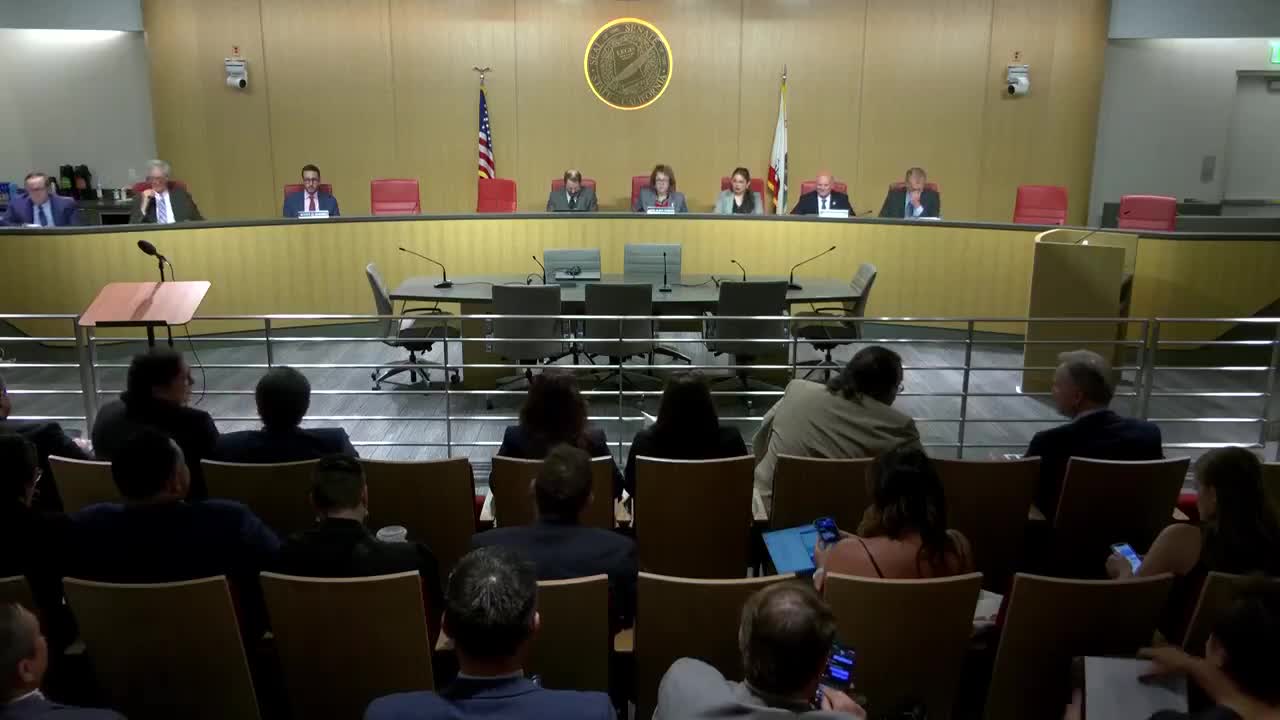
Discussed in Hearing
 12MIN
Senate Standing Committee on Local Government


Bill Co-Author(s):
