AB 1053: Educational technology: evaluation and selection.
- Session Year: 2025-2026
- House: Assembly
- Latest Version Date: 2025-04-21
Current Status:
Failed
(2026-02-02: From committee: Filed with the Chief Clerk pursuant to Joint Rule 56.)
Introduced
In Committee
Awaiting First Chamber Vote
Passed First Chamber
In Committee
Awaiting Second Chamber Vote
Passed Second Chamber
Enacted
Existing law states the intent of the Legislature to provide for the adoption and selection of quality instructional materials for use in elementary and secondary schools and requires each governing board of a school district to provide for substantial teacher involvement in the selection of instructional materials and to promote the involvement of parents and other members of the community in the selection of instructional materials. Existing law authorizes the governing board of a school district, when adopting instructional materials for use in school, to include relevant technology-based materials, defined for these purposes to mean basic or supplemental instructional materials that are designed for use by pupils and teachers as learning resources and that require the availability of electronic equipment in order to be used as a learning resource, as provided.
This bill would require the governing board or body of a local educational agency, defined to be a school district, county office of education, charter school, or educational joint powers authority, to, before adopting and using digital supplemental instructional materials or approving the expenditure of public funds for licensure, purchase, or other use of digital supplemental instructional materials, (1) convene a publicly noticed workgroup consisting of specified personnel to evaluate the proposed digital supplemental instructional materials and (2) consider the reported evaluation from the workgroup, as provided. The bill would require the workgroup to evaluate, among other things, the cost of the materials and the impact the materials will have on the behavioral health of pupils, and to report its findings to the governing board or body of the local educational agency. To the extent that this bill would impose additional duties on local officials or local educational agencies, the bill would impose a state-mandated local program.This bill would require the governing board or body of each school district, county office of education, and charter school to provide for substantial teacher involvement in the evaluation and selection of educational technology, as defined, that is required to be used by all teachers or all paraprofessionals of the local educational agency, and to promote the involvement of parents and other members of the community in the evaluation and selection process. By imposing additional duties on local educational agencies, the bill would impose a state-mandated local program. The bill would require the Superintendent of Public Instruction, on or before January 1, 2027, to develop, and post on the State Department of Educations internet website, best practices and resources to guide school districts, county offices of education, charter schools, and joint powers authorities providing educational services in the evaluation and selection of educational technology that is required to be used by all teachers or all paraprofessionals, as specified. The bill would, commencing January 1, 2027, encourage school districts, county offices of education, and charter schools to follow those best practices for the evaluation and selection of educational technology.
The California Constitution requires the state to reimburse local agencies and school districts for certain costs mandated by the state. Statutory provisions establish procedures for making that reimbursement.
This bill would provide that, if the Commission on State Mandates determines that the bill contains costs mandated by the state, reimbursement for those costs shall be made pursuant to the statutory provisions noted above.
Existing law states the intent of the Legislature to provide for the adoption and selection of quality instructional materials for use in elementary and secondary schools and requires each governing board of a school district to provide for substantial teacher involvement in the selection of instructional materials and to promote the involvement of parents and other members of the community in the selection of instructional materials. Existing law authorizes the governing board of a school district, when adopting instructional materials for use in school, to include relevant technology-based materials, defined for these purposes to mean basic or supplemental instructional materials that are designed for use by pupils and teachers as learning resources and that require the availability of electronic equipment in order to be used as a learning resource, as provided.
This bill would state the intent of the Legislature to enact future legislation to increase transparency and oversight over the procurement of technology-based supplemental instructional materials and to provide stakeholder input prior to a local educational agency approving an expenditure to license software that provides instructional materials or assessments.This bill would require the governing board or body of a local educational agency, defined to be a school district, county office of education, charter school, or educational joint powers authority, to, before adopting and using digital supplemental instructional materials or approving the expenditure of public funds for licensure, purchase, or other use of digital supplemental instructional materials, (1) convene a publicly noticed workgroup consisting of specified personnel to evaluate the proposed digital supplemental instructional materials and (2) consider the reported evaluation from the workgroup, as provided. The bill would require the workgroup to evaluate, among other things, the cost of the materials and the impact the materials will have on the behavioral health of pupils, and to report its findings to the governing board or body of the local educational agency. To the extent that this bill would impose additional duties on local officials or local educational agencies, the bill would impose a state-mandated local program.
The California Constitution requires the state to reimburse local agencies and school districts for certain costs mandated by the state. Statutory provisions establish procedures for making that reimbursement.
This bill would provide that, if the Commission on State Mandates determines that the bill contains costs mandated by the state, reimbursement for those costs shall be made pursuant to the statutory provisions noted above.
Existing law states the intent of the Legislature to provide for the adoption and selection of quality instructional materials for use in elementary and secondary schools and requires each governing board of a school district to provide for substantial teacher involvement in the selection of instructional materials and to promote the involvement of parents and other members of the community in the selection of instructional materials. Existing law authorizes the governing board of a school district, when adopting instructional materials for use in school, to include relevant technology-based materials, defined for these purposes to mean basic or supplemental instructional materials that are designed for use by pupils and teachers as learning resources and that require the availability of electronic equipment in order to be used as a learning resource, as provided.
This bill would state the intent of the Legislature to enact future legislation to increase transparency and oversight over the procurement of technology-based supplemental instructional materials and to provide stakeholder input prior to a local educational agency approving an expenditure to license software that provides instructional materials or assessments.
The Legislature finds and declares all of the following:
(a)It is the intent and purpose of the Legislature to provide for substantial teacher input in the evaluation and selection of quality educational technology for use by local educational agencies.
(b)Due to the common needs and interests of the citizens of this state and the nation, there is a need to establish best practices and resources to guide the local selection of educational technology by local educational agencies.
(c)The governing board or body of a local educational agency has the responsibility to evaluate and select educational technology that is appropriate to its courses of study, supports pupil academic achievement, respects the academic freedom and autonomy of educators to meet the needs of individual pupils, avoids inequitable access to learning, and is aligned with the academic content standards adopted by the State Board of Education.
SEC. 2.Section 60003 is added to the Education Code, to read:60003.(a)The governing board or body of a local educational agency shall provide for substantial teacher involvement in the evaluation and selection of educational technology, as defined in paragraph (1) of subdivision (a) of Section 60004, that is required to be used by all teachers or all paraprofessionals of the local educational agency, and shall promote the involvement of parents and other members of the community in the evaluation and selection process. Commencing January 1, 2027, local educational agencies are encouraged to follow best practices for the evaluation and selection of educational technology developed by the Superintendent pursuant to Section 60004.
(b)For purposes of this section, local educational agency means a school district, county office of education, or charter school.
SEC. 3.Section 60004 is added to the Education Code, to read:60004.(a)For purposes of this section, the following definitions apply:
(1)Educational technology means educational software in the form of downloadable or web-based applications or other digital formats that is used to manage information, instruction, attendance, pupil grades and assessment data, notifications, and communication with parents.
(2)Local educational agency means a school district, county office of education, charter school, or joint powers authority providing educational services.
(b)On or before January 1, 2027, the Superintendent shall develop, and post on the departments internet website, best practices and resources to guide local educational agencies in the evaluation and selection of educational technology that is required to be used by all teachers or all paraprofessionals of the local educational agency. The best practices and resources identified by the Superintendent shall address all of the following:
(1)User interface and agency, including the extent to which the design of the product interface and user experience helps teachers quickly and reliably achieve instructional goals and the impact of the product on the workload of teachers.
(2)Learning design, including the extent to which the product has features that promote design and customization of learning activities in ways that align with research-based best practices.
(3)Digital pedagogy, including the extent to which the product is designed to support the development of pupils digital age learning skills, capacities, and knowledge.
(4)Inclusivity and equity, including the extent to which the product helps teachers provide instruction that is relevant to pupils of many cultures, backgrounds, and abilities, and support pupil motivation and agency in the learning process.
(5)Assessment and data, including the extent to which the product uses assessments that generate data to inform teachers about pupil knowledge and provide pupils feedback.
(6)Privacy and security of data, including the extent to which the product complies with privacy requirements of state and federal law, whether or not the software allows for the selling of data or surveillance of pupils or teachers, and whether or not there is regular human oversight in the processing, evaluation, collection, and safeguarding of pupil performance and other pupil information.
SEC. 4.If the Commission on State Mandates determines that this act contains costs mandated by the state, reimbursement to local agencies and school districts for those costs shall be made pursuant to Part 7 (commencing with Section 17500) of Division 4 of Title 2 of the Government Code.
SECTION 1.Section 60049 is added to the Education Code, to read:60049.(a)It is the intent and purpose of the Legislature in enacting this section to provide for the adoption and selection of quality digital supplemental instructional materials for use by local educational agencies.(b)The Legislature hereby recognizes that because of the common needs and interests of the citizens of this state and the nation, there is a need to establish broad minimum standards and general educational guidelines for the selection of digital supplemental instructional materials for local educational agencies, but that because of economic, geographic, physical, political, educational, and social diversity, specific choices about digital supplemental instructional materials may need to be made at the local level.(c)The Legislature further recognizes that the governing board or body of a local educational agency has the responsibility to establish courses of study and that if they use digital supplemental instructional materials, they must choose materials that are appropriate to their courses of study, support pupil academic achievement, respect the academic freedom and autonomy of educators to meet the needs of individual pupils, avoid inequitable access to learning, and are aligned with the academic content standards adopted by the state board.(d)The governing board or body of a local educational agency shall, before adopting and using digital supplemental instructional materials or approving the expenditure of public funds for licensure, purchase, or other use of digital supplemental instructional materials, do both of the following:(1)(A)Convene a publicly noticed workgroup consisting of at least two employed teachers, two classified employees that perform paraeducator duties or aid in classroom instruction, and one employee that is tasked with managing the informational technology needs of the local educational agency.(B)The workgroup shall evaluate the proposed digital supplemental instructional materials and report its findings to the governing board or body of the local educational agency. At a minimum, the workgroup shall evaluate all of the following, as applicable:(i)The cost, including any tools to use the materials, maintenance, and long-term reliability.(ii)The academic benefit to pupils and the percentage of pupils that will benefit from the materials.(iii)The impact on all of the following:(I)Instructional time in the classroom.(II)The local educational agencys homework policy, as encouraged by Section 52000.(III)The behavioral health of pupils.(IV)The workload of educators.(iv)The academic and social integrity of the company and its materials.(v)The interests of superintendents, trustees, board or body members, or other administrative or elected officers of the local educational agency that are required to be reported pursuant to Article 3 (commencing with Section 87300) of Chapter 7 of Title 9 of the Government Code and that may be linked to a vendor of digital supplemental instructional materials.(vi)How the software complies with privacy standards in current law, whether or not the software allows for the selling of data, and whether or not the software may be used for the surveillance of pupils or teachers.(vii)The extent to which the use of the software promotes or upholds equity for pupils and recognizes technological access or disparity in digital literacy among a diverse pupil population.(viii)Whether or not there is regular human oversight in the processing, evaluation, collection, and safeguarding of pupil performance and other pupil information.(C)Before the workgroup reports an evaluation pursuant to subparagraph (B), the workgroup shall solicit information from parents, teachers, classified employees, and pupils regarding their experience using the proposed digital supplemental instructional materials and consider this information when reporting to the governing board or body of the local educational agency.(2)Consider the reported evaluation from the workgroup.(e)It is the intent of the Legislature that the workgroups reported findings to the governing board or body of the local educational agency will ensure that expenditures for digital supplemental instructional materials reflect the best interest of pupils, use of public funds, and the autonomy of educators to best meet the needs of pupils.(f)For purposes of this section, the following definitions apply:(1)Digital supplemental instructional materials means any digital educational software, including, but not limited to, providing information, lessons, attendance tracking, examinations, grades, notifications, or other communications among educators, parents, or pupils, through the use of a downloadable application, a web-based application, or other digital format.(2)Local educational agency means a school district, county office of education, charter school, or educational joint powers authority.SEC. 2.If the Commission on State Mandates determines that this act contains costs mandated by the state, reimbursement to local agencies and school districts for those costs shall be made pursuant to Part 7 (commencing with Section 17500) of Division 4 of Title 2 of the Government Code.(a)It is the intent and purpose of the Legislature in enacting this section to provide for the adoption and selection of quality digital supplemental instructional materials for use by local educational agencies.
(b)The Legislature hereby recognizes that because of the common needs and interests of the citizens of this state and the nation, there is a need to establish broad minimum standards and general educational guidelines for the selection of digital supplemental instructional materials for local educational agencies, but that because of economic, geographic, physical, political, educational, and social diversity, specific choices about digital supplemental instructional materials may need to be made at the local level.
(c)The Legislature further recognizes that the governing board or body of a local educational agency has the responsibility to establish courses of study and that if they use digital supplemental instructional materials, they must choose materials that are appropriate to their courses of study, support pupil academic achievement, respect the academic freedom and autonomy of educators to meet the needs of individual pupils, avoid inequitable access to learning, and are aligned with the academic content standards adopted by the state board.
(d)The governing board or body of a local educational agency shall, before adopting and using digital supplemental instructional materials or approving the expenditure of public funds for licensure, purchase, or other use of digital supplemental instructional materials, do both of the following:
(1)(A)Convene a publicly noticed workgroup consisting of at least two employed teachers, two classified employees that perform paraeducator duties or aid in classroom instruction, and one employee that is tasked with managing the informational technology needs of the local educational agency.
(B)The workgroup shall evaluate the proposed digital supplemental instructional materials and report its findings to the governing board or body of the local educational agency. At a minimum, the workgroup shall evaluate all of the following, as applicable:
(i)The cost, including any tools to use the materials, maintenance, and long-term reliability.
(ii)The academic benefit to pupils and the percentage of pupils that will benefit from the materials.
(iii)The impact on all of the following:
(I)Instructional time in the classroom.
(II)The local educational agencys homework policy, as encouraged by Section 52000.
(III)The behavioral health of pupils.
(IV)The workload of educators.
(iv)The academic and social integrity of the company and its materials.
(v)The interests of superintendents, trustees, board or body members, or other administrative or elected officers of the local educational agency that are required to be reported pursuant to Article 3 (commencing with Section 87300) of Chapter 7 of Title 9 of the Government Code and that may be linked to a vendor of digital supplemental instructional materials.
(vi)How the software complies with privacy standards in current law, whether or not the software allows for the selling of data, and whether or not the software may be used for the surveillance of pupils or teachers.
(vii)The extent to which the use of the software promotes or upholds equity for pupils and recognizes technological access or disparity in digital literacy among a diverse pupil population.
(viii)Whether or not there is regular human oversight in the processing, evaluation, collection, and safeguarding of pupil performance and other pupil information.
(C)Before the workgroup reports an evaluation pursuant to subparagraph (B), the workgroup shall solicit information from parents, teachers, classified employees, and pupils regarding their experience using the proposed digital supplemental instructional materials and consider this information when reporting to the governing board or body of the local educational agency.
(2)Consider the reported evaluation from the workgroup.
(e)It is the intent of the Legislature that the workgroups reported findings to the governing board or body of the local educational agency will ensure that expenditures for digital supplemental instructional materials reflect the best interest of pupils, use of public funds, and the autonomy of educators to best meet the needs of pupils.
(f)For purposes of this section, the following definitions apply:
(1)Digital supplemental instructional materials means any digital educational software, including, but not limited to, providing information, lessons, attendance tracking, examinations, grades, notifications, or other communications among educators, parents, or pupils, through the use of a downloadable application, a web-based application, or other digital format.
(2)Local educational agency means a school district, county office of education, charter school, or educational joint powers authority.
SEC. 2.If the Commission on State Mandates determines that this act contains costs mandated by the state, reimbursement to local agencies and school districts for those costs shall be made pursuant to Part 7 (commencing with Section 17500) of Division 4 of Title 2 of the Government Code.
SECTION 1.It is the intent of the Legislature to enact future legislation to increase transparency and oversight over the procurement of technology-based supplemental instructional materials and to provide stakeholder input prior to a local educational agency approving an expenditure to license software that provides instructional materials or assessments.It is the intent of the Legislature to enact future legislation to increase transparency and oversight over the procurement of technology-based supplemental instructional materials and to provide stakeholder input prior to a local educational agency approving an expenditure to license software that provides instructional materials or assessments.
|
Date
|
Status
|
|---|---|
| Feb 2, 2026 | From committee: Filed with the Chief Clerk pursuant to Joint Rule 56. |
| Jan 31, 2026 | Died pursuant to Art. IV, Sec. 10(c) of the Constitution. |
| May 23, 2025 | In committee: Held under submission. |
| May 14, 2025 | In committee: Set, first hearing. Referred to APPR. suspense file. |
| May 1, 2025 | From committee: Do pass and re-refer to Com. on APPR. (Ayes 7. Noes 1.) (April 30). Re-referred to Com. on APPR. |
| Apr 22, 2025 | Re-referred to Com. on ED. |
| Apr 21, 2025 | From committee chair, with author's amendments: Amend, and re-refer to Com. on ED. Read second time and amended. |
| Mar 25, 2025 | Re-referred to Com. on ED. |
| Mar 24, 2025 | From committee chair, with author's amendments: Amend, and re-refer to Com. on ED. Read second time and amended. |
| Mar 24, 2025 | Referred to Com. on ED. |
| Feb 21, 2025 | From printer. May be heard in committee March 23. |
| Feb 20, 2025 | Read first time. To print. |
|
Date
|
Description
|
Location
|
Votes
|
|
|---|---|---|---|---|
| Apr 30, 2025 | Do pass and be re-referred to the Committee on [Appropriations] | Assembly Standing Committee on Education |
Passed |
This list shows positions taken on this bill by organizations on the date displayed, which is linked to the original source.
Positions by individuals are not included.
|
Organization
|
Position
|
Date
|
|---|---|---|
| Alameda County Office Of Education | ** Against | |
| Association Of California School Administrators | ** Against | |
| California Association Of School Business Officials | ** Against | |
| California County Superintendents | ** Against | |
| California Federation Of Teachers | ** Support | |
| California It In Education | ** Against | |
| Fullerton Joint Union High School District | ** Against | |
| Office of the Riverside County Superintendent of Schools | ** Against | |
| San Benito High School District | ** Against | |
| San Joaquin County Office Of Education | ** Against |
Date of Hearing: May 14, 2025
ASSEMBLY COMMITTEE ON APPROPRIATIONS
Buffy Wicks, Chair
ABPCA Bill Id:AB 1053
Author:(Zbur) – As Amended Ver:April 21, 2025
Policy Committee: | Education | Vote: | 7 - 1 |
|
| ||
|
|
Urgency: No State Mandated Local Program: Yes Reimbursable: Yes
SUMMARY:
This bill requires a local educational agency (LEA) governing board or body to provide for substantial teacher involvement in the evaluation and selection of educational technology required for use by all teachers or paraprofessionals of the LEA, and to promote the involvement of parents and other community members in this process. The bill also requires the Superintendent of Public Instruction (SPI) to develop best practices and resources to guide LEAs in the evaluation and selection of education technology and post them on the California Department of California’s (CDE) internet website.
FISCAL EFFECT:
One-time General Fund costs of approximately $300,000 for the CDE to contract with a county office of education (COE) to develop the required best practices and resources for LEAs.
If the Commission on State Mandates determines the bill’s requirements to be a reimbursable state mandate, the state would need to reimburse these costs to LEAs or provide funding through the K-12 Mandate Block Grant.
COMMENTS:
- Purpose. According to the author:
AB 1053 will ensure that educators are involved in the process of adopting digital supplemental materials by requiring the board of a local educational agency to convene an educator workgroup to evaluate proposed digital supplemental materials and requiring the board to consider the reported evaluation of the workgroup before adopting materials. In doing so, this bill will improve the quality of digital supplemental materials, allowing educators to use the most effective tools to teach, and allowing students to focus on learning.
- Background. Educational Technology in Schools. According to the “California Digital Learning Integration and Standards Guidance,” adopted by the State Board of Education (SBE) in 2021:
Years of substantial investment in technology infrastructure for schools, including equipping students and teachers with internet connectivity and devices, have set the conditions for transformative innovation of learning. When used effectively in online (synchronously or asynchronously), hybrid, or face-to-face environments, digital tools can accelerate sound pedagogical practices and facilitate student growth as lifelong, empowered learners. Benefits of strategic technology use to support learning include.
Educational technology may also pose risks. Artificial intelligence (AI), for example, may produce new curriculum, instruction, assessment, and administrative tools for educators, as well as new opportunities for individualized support for students, but it also may compromise privacy, perpetuate bias, facilitate plagiarism, lead to poor quality instruction, exacerbate inequities, and threaten educator agency and stability. A 2019 Learning Policy Institute article notes that “when technologies try to replace teachers, research consistently finds little benefit.”
Instructional Materials Review Process. Existing law requires each school district governing board to provide for substantial teacher involvement in the selection of instructional materials and to promote the involvement of parents and other members of the community in the selection of instructional materials. This bill attempts to mirror this process for the selection of educational technology required for use by teachers and paraprofessionals.
Analysis Prepared by: Aaron Heredia / APPR. / (916) 319-2081
Date of Hearing: April 30, 2025
ASSEMBLY COMMITTEE ON EDUCATION
Al Muratsuchi, Chair
ABPCA Bill Id:AB 1053 (
Author:Zbur) – As Amended Ver:April 21, 2025
SUBJECT: Educational technology: evaluation and selection
SUMMARY: Requires the governing board of each local educational agency (LEA) and the governing body of each charter school to provide for substantial teacher and paraprofessional involvement in the selection of educational technology they are required to use, and to promote the involvement of parents and other members of the community in the selection process; and requires the Superintendent of Public Instruction (SPI) to develop best practices and resources on the evaluation and selection of educational technology. Specifically, this bill:
- Establishes, for purposes of this requirement, the following definitions:
- “Educational technology” means educational software in the form of downloadable or web-based applications or other digital formats which is used to manage information, instruction, attendance, pupil grades and assessment data, and notifications and communication with parents; and
- “Local educational agency” means a school district, county office of education (COE), charter school, or educational joint powers authority (JPA).
- Requires the governing board of each LEA and the governing body of each charter school to provide for substantial teacher involvement in the selection of educational technology that is required to be used by all teachers or paraprofessionals of the LEA or charter school, and promote the involvement of parents and other members of the community in the selection process. Encourages LEAs and charter schools to follow best practices for the evaluation of educational technology identified by the SPI.
- Requires, on or before January 1, 2027, the SPI to develop, and post on the website of the California Department of Education (CDE), best practices and resources to guide LEAs in the evaluation and selection of educational technology which is required to be used by all teachers and paraprofessionals employed by the LEA. Requires that the best practices and resources identified by the SPI address the following:
- User interface and agency, including the extent to which the design of the product interface and user experience helps teachers quickly and reliably achieve instructional goals, and including the impact of the product on the workload of teachers;
- Learning design, including the extent to which the product has features that promote design and customization of learning activities in ways that align with research-based best practices;
- Digital pedagogy, including the extent to which the product is designed to support the development of pupils’ digital age learning skills, capacities, and knowledge;
- Inclusivity and equity, including the extent to which the product helps teachers provide instruction that is relevant to students of many cultures, backgrounds, and abilities, and support pupil motivation and agency in the learning process;
- Assessment and data, including the extent to which the product uses assessments that generate data to inform teachers about pupil knowledge and provide pupils feedback; and
- Privacy and security of data, including the extent to which the product complies with privacy requirements of current law, whether or not the software allows for the selling of data or surveillance of pupils or teachers, and whether or not there is regular human oversight in the processing, evaluation, collection, and safeguarding of pupil performance and other pupil information.
EXISTING LAW:
- Requires each school district governing board to provide for substantial teacher involvement in the selection of instructional materials and shall promote the involvement of parents and other members of the community in the selection of instructional materials. (Education Code (EC) 60002)
- Requires that if an LEA chooses to use instructional materials that have not been adopted by the State Board of Education (SBE), the LEA ensure that a majority of the participants of any review process conducted by the LEA are classroom teachers who are assigned to the subject area or grade level of the materials. (EC 60210)
- Defines “technology-based materials” to mean basic or supplemental instructional materials that are designed for use by pupils and teachers as learning resources and that require the availability of electronic equipment in order to be used as a learning resource. Technology-based materials include, but are not limited to, software programs, video disks, compact disks, optical disks, video and audiotapes, lesson plans, and databases. Technology-based materials also includes the electronic equipment required to make use of those materials used by pupils and teachers as a learning resource, including, but not limited to, laptop computers and devices that provide internet access. (EC 60010)
FISCAL EFFECT: This bill has been keyed a possible state-mandated local program by the Office of Legislative Counsel.
COMMENTS:
Need for the bill. According to the author, “Technology has become ubiquitous in all aspects of life including in the classroom. Digital instructional materials allow students to be educated in novel and innovative ways, and can improve learning outcomes and subject mastery. However, these materials can also expose drastic disparities in access and opportunity, or lead to perpetual frustration due to faulty or poorly designed software. Without a thorough adoption process, teachers, parents, and students are serving as guinea pigs for the software they are required to use every day.
AB 1053 will ensure that educators are involved in the process of adopting digital supplemental materials by requiring the board of a local educational agency to convene an educator workgroup to evaluate proposed digital supplemental materials and requiring the board to consider the reported evaluation of the workgroup before adopting materials. In doing so, this bill will improve the quality of digital supplemental materials, allowing educators to use the most effective tools to teach, and allowing students to focus on learning.”
Choice of educational technology is consequential for learning. According to the California Digital Learning Integration and Standards Guidance, adopted by the State Board of Education (SBE) in 2021, educational technology can have many benefits:
Years of substantial investment in technology infrastructure for schools, including equipping students and teachers with internet connectivity and devices, have set the conditions for transformative innovation of learning. When used effectively in online (synchronously or asynchronously), hybrid, or face-to-face environments, digital tools can accelerate sound pedagogical practices and facilitate student growth as lifelong, empowered learners. Benefits of strategic technology use to support learning include:
- Promoting active student engagement in the learning process;
- Nurturing opportunities for ongoing collaboration with peers, educators, families, and a global community of experts;
- Building on prior knowledge to deeply reinforce essential skills, such as executive functioning, critical thinking and reasoning, creativity, communication, cross-cultural understanding, and decision-making;
- Providing means of authentically connecting students’ learning to the world beyond their physical learning environment; and
- Fostering student agency to set personal learning goals and plans, and continuously monitor and evaluate their own progress.
Educational technology may also pose risks. Artificial intelligence (AI), for example, may produce new curriculum, instruction, assessment, and administrative tools for educators, as well as new opportunities for individualized support for students, but it also may compromise privacy, perpetuate bias, facilitate plagiarism, lead to poor quality instruction, exacerbate inequities, and threaten educator agency and stability. A 2019 Learning Policy Institute (LPI) article notes that “when technologies try to replace teachers, research consistently finds little benefit.”
Limited evidence on educational technology purchasing decisions suggests room for improvement. The author states that “while school districts purchase software licenses for applications that are to be used by teachers, administrators, parents, and students for various functions, there is little accountability as to the efficacy of the software for student achievement, parental involvement, ease of use, or other benefit to the classroom environment.” The author further assets that there is no standardized process for adopting these materials in the law, and that “a more thoughtful, uniform process would involve the educators who will be using the software every day and who know the needs of their students and their classroom better than anyone else.”
The International Society for Technology in Education (ISTE) similarly notes that “districts often do not have the capacity to effectively evaluate the functional qualities of edtech products, resulting in teachers being frustrated with tools that may not be intuitive or usable vehicles for delivering instruction.”
One recent study of districts in 31 states (Morrison, 2019) investigated the process by which school districts in 31 states discover, evaluate, and acquire educational technology products, and also how vendors market them. It found that, in contrast to best practices:
- Needs assessments were rarely, if at all, conducted;
- Districts and vendors lack a central source of information for product information and evidence of effectiveness; and
- Decisions were often made on small-scale pilot tryouts, peer references, and less often by examining rigorous evaluation evidence.
Districts reported best practices to include best practices included conducting pilots and trials, involving end-users, learning from peers, conducting a needs assessment, and using more formal processes such as requests for proposals and obtaining bids. Districts also reported that among the most helpful tools would be guidelines for conducting pilot studies, and pilot best practices and standard evaluation rubrics for judging the quality of products. Among other recommendations, the authors noted that “end-users, such as teachers and principals, should be integrally involved because they are the ones most responsible for implementation and most immediately affected by outcomes.”
Existing law on teacher review of instructional materials is minimal, but results in a robust local process. Existing law requires each school district governing board to provide for substantial teacher involvement in the selection of instructional materials and to promote the involvement of parents and other members of the community in the selection of instructional materials. This bill seeks to mirror this process for the selection of educational technology that teachers and paraprofessionals are required to use.
The SBE’s Guidance for Local Instructional Materials Adoption (GLIMA), describes the process as follows:
The process of selecting instructional materials at the LEA level usually begins with the appointment of a committee of educators, including teachers and curriculum specialists, and possibly students, who determine what instructional materials are needed, develop evaluation criteria and rubrics for reviewing materials, and establish a review process that involves teachers and content-area experts on review committees. After the review panel develops a list of instructional materials that are being considered for adoption, the next step is to pilot the instructional materials. An effective piloting process helps determine if the materials provide teachers with the resources necessary to implement an instructional program based on the California standards.
The primary role of an instructional materials review panel is to determine to what extent the materials under consideration:
- Align with the relevant SBE-adopted content standards;
- Align to the guidance and evaluation criteria in the relevant curriculum framework; and
- Adhere to the California Standards for Evaluating Instructional Materials for Social Content, 2013 Edition.
The Committee may wish to consider that the single sentence in existing law translates into a significant local process for the evaluation and selection of instructional materials in content areas, such as mathematics and English language arts, and that this bill could require a similarly robust process.
No state standards, guidance, or adoption of educational technology. This bill would require the SPI to develop best practices and resources to guide LEAs in the evaluation and selection of educational technology which is required to be used by all teachers and paraprofessionals.
As noted above, the SBE’s GLIMA helps to guide school districts in the selection of instructional materials. No such state guidance has been developed to guide the selection of educational technology products.
In addition, for instructional materials used in grades K-8, LEAs benefit from of a list of state-adopted list of materials which have been reviewed and approved as meeting a standards of quality and alignment to the state’s curriculum frameworks. No such adoption process state exists for educational technology, and establishing one on the schedule used for instructional materials would be virtually impossible given the how rapidly technology products change. The ISTE, an independent organization, does evaluate and give educational technology products a seal of approval.
During COVID 19 pandemic, state issued instructional guidance for technology use in distance learning. The 2020-21 state budget provided funding to the Sacramento COE to develop draft distance learning curriculum and instructional guidance for mathematics, English language arts, and English language development that included a framework for addressing critical standards, guidance and resources for formative and diagnostic assessment, guidance on recommended aggregate time for instruction and independent work by grade span, and guidance on embedding social emotional supports for pupils into distance learning curricula.

The California Digital Learning Integration and Standards Guidance was adopted by the SBE in 2021. Among other content, it addresses ensuring equity and access, preparing and supporting teachers for digital learning, and designing meaningful online and blended learning experiences.
What kind of educational technology are we talking about? This bill defines education technology, for purposes of its requirements, to mean “software in the form of downloadable or web-based applications or other digital formats which is used to manage information, instruction, attendance, pupil grades and assessment data, and notifications and communication with parents.”
School districts use many digital systems for instruction and administration. A few examples include:
- Student information systems to manage information about enrollment, attendance, course completion, transcripts, and compliance information, among many other functions;
- Systems for management of curriculum, instruction, and assessment, such as course management, online course material and instructional programs, and formative and interim assessments;
- Systems for state reporting of student data to numerous state data systems which collect information on attendance, academic and other student outcomes, student demographics, and teacher assignment;
- Systems for administration of state assessments in various subjects;
- Systems for management of personnel, including course assignments;
- Systems for local data collection (i.e. school climate and parent surveys); and
- Teacher-initiated systems for curriculum, instruction, assessment, and behavior.
One recent study (Bacak, 2023) proposed a technology classification framework including educational technologies, management technologies, support technologies, networking technologies, and security technologies in addition to identifying various technologies that are currently used by school districts based on this framework. This framework is represented in the graphic on the preceding page. The kinds of technology addressed by this bill largely fall into the “educational technologies” quadrant in that graphic.
International Society for Technology in Education standards for the evaluation of educational technology. This bill requires, on or before January 1, 2027, the SPI to develop and post on the CDE website best practices and resources to guide LEAs in the evaluation and selection of educational technology which is required to be used by all teachers and paraprofessionals.
To do so, the CDE could identify existing standards, such as those published by the ISTE. The ISTE is a non-profit organization that seeks to promote the integration of technology in teaching and learning, with the goal of improving technology use in schools worldwide by using best practices associated with learning and technology to create high-impact, sustainable, scalable, and equitable learning experiences for all learners.
The ISTE publishes an EdTech Product Evaluation Guide to help decision-makers, as well as leaders and teachers, validly and reliably evaluate educational technology products so that they select the high-quality products that will lead to the best teaching and learning experiences. The guide helps educators evaluate products based on the following criteria:
- User interface and agency: The design of the product interface and user experience helps teachers quickly and reliably achieve instructional goals;
- Learning design: The product has features that promote design and customization of learning activities in ways that align with research-based best practices, including those rooted in learning sciences;
- Digital pedagogy: The product is designed to support the development of digital age learning skills, capacities, and knowledge;
- Inclusivity: The product helps teachers provide learning experiences that are relevant to students of many cultures, backgrounds, and abilities, and support learner motivation and agency in the learning process; and
- Assessment and data: The product uses assessments that generate data to inform teachers about student knowledge and provide students feedback.
State and regional technology support insufficient to support LEAs on technology evaluation and selection. Current state-supported resources are insufficient to support LEAs in the evaluation and selection of educational technology.
The CDE maintains the Information and Technology Branch, which primarily serves as an internal department that manages the information technologies for CDE employees and handles the educational data relating to assessments and accountability of schools and students. The Branch is not equipped to support the technical support needs of individual LEAs.
Prior to 2012, the state supported a robust Educational Technology program, which included the California Technology Assistance Project (CTAP) and Statewide Education Technology Services (SETS). The CTAP provided a regional network of technical assistance, coordination, and services to schools and school districts in education technology throughout 11 regions throughout the State. The SETS provided was a centralized program that addressed locally defined needs through four projects, including an online resource list aligned with state content standards, online resource providing training and support for school information technology staff, resources to support school administrators for school management and data-driven decision making, and access to online assessments and student proficiency assessment data. In 2012, the CTAP and SETS were subsumed into the Local Control Funding Formula.
Arguments in support. The California Federation of Teachers states, “In today’s fast-paced digital world, the proliferation of software for use by teachers and other educators to complete their routine tasks, communicate with parents, keep attendance and grades and even used for mandated testing is on the rise. Applications like ‘iReady’ or ‘ClassDojo’ and many, many others are being required as a part of having students enrolled in public schools.
The landscape of these digital applications is far and wide without any structural guidelines for the proper use of public funds to pay for software licenses or a useful method of obtaining feedback from educators, parents, or students on how these applications benefit their work. Instances where parents are required to juggle the use of multiple applications in order to be kept abreast of their students’ progress, the events on campus, or even receiving emergency communications are common. Parents with multiple students are often required to juggle multiple applications that accomplish the same work, since the chosen applications may differ from school site to school site.
Further, the landscape of digital applications is one where constant software upgrades often, or eventually, will require hardware upgrades that place certain households at a disadvantage. Anecdotal evidence from parents who are unable to access information on certain applications, or where the application fails to even launch to begin with are common. This situation begs the question as to why local education agencies are spending precious funds on digital applications without any quality control or assurance that these applications provide a benefit to the households that are served.
AB 1053 addresses this landscape with well-established practices. It is our hope that this bill will increase the quality of the applications used, make sure that dollars are spent in a way that brings the most return on investment, and increases the academic outcomes of students.”
Arguments in opposition. The California County Superintendents writes, “It’s a truth universally acknowledged that software changes can be unpleasant. But not every software change requires a state mandate. In the public school setting, software changes are managed by the LEA to minimize disruption to employees. AB 1053 appears to address cases where that process may fall short. In doing so, AB 1053 swings the pendulum in the opposite direction, which is counter to the concept of local control and would establish an unprecedented infringement upon the authority of school governing boards.
AB 1053’s ‘substantial teacher involvement’ requirement is unprecedented in its application to a governing board’s regular course of business. AB 1053 would elevate the purchase of ‘educational technology’ to the same level of interest holder engagement, process, and scrutiny as the adoption of instructional materials and textbooks. A comparable level of mandated ‘involvement’ is prescribed for the adoption of the Local Control and Accountability Plan, a foundational strategic planning document updated annually by LEAs and their communities. AB 1053 provides no funding to support the significant staff time required for the LEA employees required to participate in the input process.
The definition of ‘educational technology’ is overly broad and could apply to any software used to manage the business and operations of LEAs (specifically, to ‘manage information, instruction, attendance, pupil grades and assessment data, notifications, and communications with parents’). Governing boards would be forced to enter into the substantial involvement process multiple times throughout the school year, depending on whether there are software or applications implicated for teachers or paraprofessionals within the district. Notably, federal and state laws already govern data utilization and data privacy requirements when LEAs procure technology and software.
We laud Assembly Member Zbur’s efforts to improve equity and access to educational technology that supports all students. Given the reasons stated above, however, we must respectfully oppose AB 1053.”
Related legislation. AB 903 (Farias and Solache) of the 2025-26 Session would require the CDE to establish a School Technology Empowerment Advisory Committee to advise the SPI on best practices to harness the power of technology to support pupil academic success and accelerate pupil academic achievement for LEAs.
AB 1288 (Becker), Chapter 893, Statutes of 2024 requires the SPI to convene a working group on AI, and requires that working group to develop expanded guidance and a model policy on AI for use by LEAs and charter schools.
AB 2652 (Muratsuchi) of the 2023-24 Session would require the SPI to convene a workgroup related to AI in educational settings to develop guidance and a model policy for local educational agencies on the safe use of AI in education. This bill was held in the Assembly Appropriations Committee.
AB 1087 (Jackson), Chapter 229, Statutes of 2023, makes various changes to the adoption of instructional materials for use in schools, including a provision that would prohibit a governing board from disallowing the use of an existing textbook, other instructional material, or curriculum that contains inclusive and diverse perspectives, as specified.
REGISTERED SUPPORT / OPPOSITION:
Support
California Federation of Teachers
Oppose
Alameda County Office of Education
Association of California School Administrators
California Association of School Business Officials
California County Superintendents
California IT in Education
Fullerton Joint Union High School District
Office of the Riverside County Superintendent of Schools
San Benito High School District
San Joaquin County Office of Education
Analysis Prepared by: Tanya Lieberman / ED. / (916) 319-2087
Discussed in Hearing
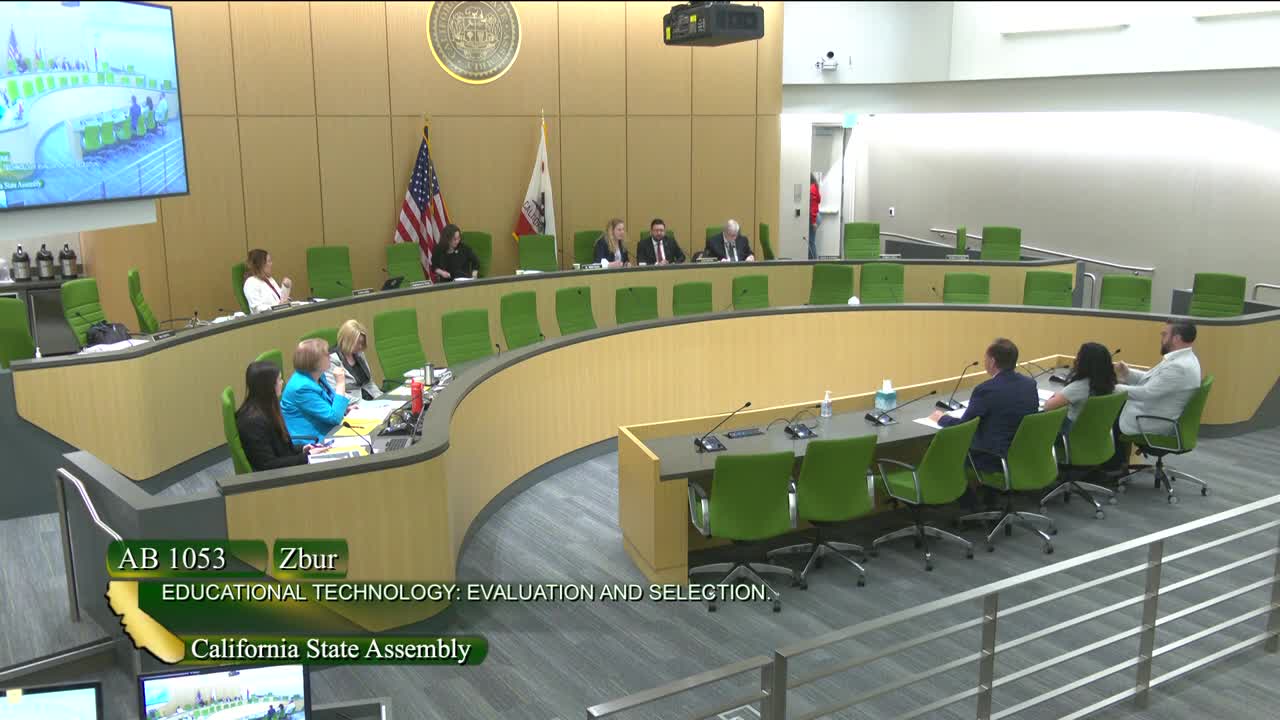 16MIN
Assembly Standing Committee on Education
Bill Author

Bill Co-Author(s):