AB 239: State-led County of Los Angeles disaster housing task force.
- Session Year: 2025-2026
- House: Assembly
- Latest Version Date: 2025-09-10
Current Status:
Failed
(2026-01-22: Consideration of Governor's veto stricken from file.)
Introduced
In Committee
Awaiting First Chamber Vote
Passed First Chamber
In Committee
Awaiting Second Chamber Vote
Passed Second Chamber
Enacted
Existing law establishes the Department of Housing and Community Development (HCD) and sets forth its powers and duties, including updating and revising the California Statewide Housing Plan, as provided. Existing law establishes the Office of Emergency Services (OES), which is responsible for the states emergency and disaster response services for natural, technological, or human-induced disasters and emergencies, including responsibility for activities necessary to prevent, respond to, recover from, and mitigate the effects of emergencies and disasters on people and property.
This bill would require HCD to convene a state-led County of Los Angeles disaster housing task force, as specified, for the purpose of coordinating and streamlining efforts between HCD, the Federal Emergency Management Agency, OES, and local governments to rebuild housing in communities impacted by the wildfires that began on January 7, 2025, in the County of Los Angeles. The bill would require the task force to appoint a state disaster housing coordinator to accelerate the delivery of resources to communities impacted by the wildfires, and report to the Legislature on the status of rebuilding housing in communities impacted by the wildfires on April 1, 2026, and annually thereafter, as specified. The bill would repeal these provisions on June 30, 2028.
This bill would make legislative findings and declarations as to the necessity of a special statute for the Counties of Los Angeles and Ventura.
This bill would declare that it is to take effect immediately as an urgency statute.
Existing law establishes the Department of Housing and Community Development (HCD) and sets forth its powers and duties, including updating and revising the California Statewide Housing Plan, as provided. Existing law establishes the Office of Emergency Services (OES), which is responsible for the states emergency and disaster response services for natural, technological, or human-induced disasters and emergencies, including responsibility for activities necessary to prevent, respond to, recover from, and mitigate the effects of emergencies and disasters on people and property.
This bill would require HCD and OES to jointly to convene a state-led County of Los Angeles disaster housing task force, as specified, for the purpose of coordinating and streamlining efforts between HCD, the Federal Emergency Management Agency, OES, and local governments to rebuild housing in communities impacted by the wildfires that began on January 7, 2025, in the County of Los Angeles. The bill would require the task force to appoint a state disaster housing coordinator to accelerate the delivery of resources to communities impacted by the wildfires, and report to the Legislature on the status of rebuilding housing in communities impacted by the wildfires on April 1, 2026, and every quarter annually thereafter, as specified. The bill would repeal these provisions on June 30, 2028.
This bill would make legislative findings and declarations as to the necessity of a special statute for the Counties of Los Angeles and Ventura.
This bill would declare that it is to take effect immediately as an urgency statute.
Existing law establishes the Department of Housing and Community Development (HCD) and sets forth its powers and duties, including updating and revising the California Statewide Housing Plan, as provided. Existing law establishes the Office of Emergency Services (OES), which is responsible for the states emergency and disaster response services for natural, technological, or human-induced disasters and emergencies, including responsibility for activities necessary to prevent, respond to, recover from, and mitigate the effects of emergencies and disasters on people and property.
This bill would require HCD and OES to jointly convene a state-led County of Los Angeles disaster housing task force, as specified, for the purpose of coordinating and streamling streamlining efforts between HCD, the Federal Emergency Management Agency, OES, and local governments to rebuild housing in communities impacted by the wildfires that began on January 7, 2025, in the County of Los Angeles. The bill would require the task force to appoint a state disaster housing coordinator to accelerate the delivery of resources to communities impacted by the wildfires. The bill would require the task force to create a central rebuilding database published on HCDs internet website, as described, and wildfires, and report to the Legislature on the status of rebuilding housing in communities impacted by the wildfires, wildfires on April 1, 2026, and every quarter thereafter, as specified.
This bill would make legislative findings and declarations as to the necessity of a special statute for the Counties of Los Angeles and Ventura.
This bill would declare that it is to take effect immediately as an urgency statute.
Existing law establishes the Department of Housing and Community Development (HCD) and sets forth its powers and duties, including updating and revising the California Statewide Housing Plan, as provided. Existing law establishes the Office of Emergency Services (OES), which is responsible for the states emergency and disaster response services for natural, technological, or human-induced disasters and emergencies, including responsibility for activities necessary to prevent, respond to, recover from, and mitigate the effects of emergencies and disasters on people and property.
This bill would require HCD and OES to jointly convene a state-led County of Los Angeles disaster housing task force, as specified, for the purpose of coordinating and streamling efforts between HCD, the Federal Emergency Management Agency, OES, and local governments to rebuild housing in communities impacted by the wildfires that began on January 7, 2025, in the County of Los Angeles. The bill would require the task force to appoint a state disaster housing coordinator to accelerate the delivery of resources to communities impacted by the wildfires. The bill would require the task force to create a central rebuilding database published on HCDs internet website, as described, and report to the Legislature on the status of rebuilding housing in communities impacted by the wildfires, on April 1, 2026, and every quarter thereafter, as specified.
This bill would make legislative findings and declarations as to the necessity of a special statute for the Counties of Los Angeles and Ventura.
This bill would declare that it is to take effect immediately as an urgency statute.
Existing law establishes the Department of Housing and Community Development (HCD) and sets forth its powers and duties, including updating and revising the California Statewide Housing Plan, as provided. Existing law establishes the Office of Emergency Services (OES), which is responsible for the states emergency and disaster response services for natural, technological, or human-induced disasters and emergencies, including responsibility for activities necessary to prevent, respond to, recover from, and mitigate the effects of emergencies and disasters on people and property.
This bill would require HCD and OES to jointly convene a state-led County of Los Angeles disaster housing task force, as specified, for the purpose of coordinating and streamling efforts between HCD, the Federal Emergency Management Agency, OES, and local governments to rebuild housing in communities impacted by the wildfires that began on January 7, 2025, in the County of Los Angeles. The bill would require the task force to appoint a state disaster housing coordinator to accelerate the delivery of resources to communities impacted by the wildfires. The bill would require the task force to report to the Legislature on the status of rebuilding housing in communities impacted by the wildfires, on April 1, 2026, and every quarter thereafter, as specified.
This bill would make legislative findings and declarations as to the necessity of a special statute for the Counties of Los Angeles and Ventura.
This bill would declare that it is to take effect immediately as an urgency statute.
(a)The Department of Housing and Community Development shall convene a state-led County of Los Angeles disaster housing task force for the purpose of coordinating and streamlining efforts between the Department of Housing and Community Development, Federal Emergency Management Agency (FEMA), Office of Emergency Services, and local governments to rebuild housing in communities impacted by the wildfire.
(b)The task force shall include representatives of all of the following:
(1)The Department of Housing and Community Development.
(2)The Federal Emergency Management Agency (FEMA).
(3)The Office of Emergency Services.
(4)The City of Los Angeles.
(5)The County of Los Angeles.
(c)The task force shall appoint a state disaster housing coordinator, to be housed within the Department of Housing and Community Development, to accelerate the delivery of resources, including, but not limited to, funding and technical assistance, to communities impacted by the wildfire.
(d)(1)On April 1, 2026, and annually thereafter, the task force shall report to the Legislature on the status of rebuilding housing in communities impacted by the wildfire.
(2)A report to be submitted pursuant to paragraph (1) shall be submitted in compliance with Section 9795 of the Government Code.
(e)For the purposes of this section, wildfire means the wildfires that began on January 7, 2025, in the County of Los Angeles.
50351.This chapter shall remain in effect only until June 30, 2028, and as of that date is repealed.
SEC. 2.The Legislature finds and declares that a special statute is necessary and that a general statute cannot be made applicable within the meaning of Section 16 of Article IV of the California Constitution because of the unique need to coordinate and streamline efforts to rebuild housing in communities in the Counties of Los Angeles and Ventura impacted by the wildfires that began on January 7, 2025, in the County of Los Angeles.
SEC. 3.This act is an urgency statute necessary for the immediate preservation of the public peace, health, or safety within the meaning of Article IV of the California Constitution and shall go into immediate effect. The facts constituting the necessity are:
The immediate need to coordinate and streamline efforts to rebuild housing in communities in the Counties of Los Angeles and Ventura impacted by the wildfires that began on January 7, 2025, in the County of Los Angeles.
(a)The Department of Housing and Community Development and the Office of Emergency Services shall jointly shall convene a state-led County of Los Angeles disaster housing task force for the purpose of coordinating and streamlining efforts between the Department of Housing and Community Development, Federal Emergency Management Agency (FEMA), Office of Emergency Services, and local governments to rebuild housing in communities impacted by the wildfire.
(b)The task force shall include representatives of all of the following:
(1)The Department of Housing and Community Development.
(2)The Federal Emergency Management Agency (FEMA).
(3)The Office of Emergency Services.
(4)The City of Los Angeles.
(5)The County of Los Angeles.
(c)The task force shall appoint a state disaster housing coordinator coordinator, to be housed within the Department of Housing and Community Development, to accelerate the delivery of resources, including, but not limited to, funding and technical assistance, to communities impacted by the wildfire.
(d)(1)On April 1, 2026, and every quarter annually thereafter, the task force shall report to the Legislature on the status of rebuilding housing in communities impacted by the wildfire.
(2)The requirement for submitting a report imposed under paragraph (1) is inoperative on April 1, 2030, pursuant to Section 10231.5 of the Government Code.(3)(2)A report to be submitted pursuant to paragraph (1) shall be submitted in compliance with Section 9795 of the Government Code.
(e)For the purposes of this section, wildfire means the wildfires that began on January 7, 2025, in the County of Los Angeles.
50351.This chapter shall remain in effect only until June 30, 2028, and as of that date is repealed.
SEC. 2.The Legislature finds and declares that a special statute is necessary and that a general statute cannot be made applicable within the meaning of Section 16 of Article IV of the California Constitution because of the unique need to coordinate and streamline efforts to rebuild housing in communities in the Counties of Los Angeles and Ventura impacted by the wildfires that began on January 7, 2025, in the County of Los Angeles.
SEC. 3.This act is an urgency statute necessary for the immediate preservation of the public peace, health, or safety within the meaning of Article IV of the California Constitution and shall go into immediate effect. The facts constituting the necessity are:
The immediate need to coordinate and streamline efforts to rebuild housing in communities in the Counties of Los Angeles and Ventura impacted by the wildfires that began on January 7, 2025, in the County of Los Angeles.
(a)The Department of Housing and Community Development and the Office of Emergency Services shall jointly convene a state-led County of Los Angeles disaster housing task force for the purpose of coordinating and streamlining efforts between the Department of Housing and Community Development, Federal Emergency Management Agency (FEMA), Office of Emergency Services, and local governments to rebuild housing in communities impacted by the wildfire.
(b)The task force shall include representatives of all of the following:
(1)The Department of Housing and Community Development.
(2)The Federal Emergency Management Agency (FEMA).
(3)The Office of Emergency Services.
(4)The City of Los Angeles.
(5)The County of Los Angeles.
(c)The task force shall appoint a state disaster housing coordinator to accelerate the delivery of resources, including, but not limited to, funding and technical assistance, to communities impacted by the wildfire.
(d)The task force shall create a central rebuilding database, and publish it on the Department of Housing and Community Developments website. The database shall include all of the following:(1)Any urgency ordinances adopted in response to the Palisades and Eaton fires, in addition to any prior wildfires.(2)Temporary housing information published by local governments in response to these and any other wildfires.(3)Resources on any other rebuilding best practices. (e)(d)(1)On April 1, 2026, and every quarter thereafter, the task force shall report to the Legislature on the status of rebuilding housing in communities impacted by the wildfire.
(2)The requirement for submitting a report imposed under paragraph (1) is inoperative on April 1, 2030, pursuant to Section 10231.5 of the Government Code.
(3)A report to be submitted pursuant to paragraph (1) shall be submitted in compliance with Section 9795 of the Government Code.
(f)(e)For the purposes of this section, wildfire means the wildfires that began on January 7, 2025, in the County of Los Angeles.
SEC. 2.The Legislature finds and declares that a special statute is necessary and that a general statute cannot be made applicable within the meaning of Section 16 of Article IV of the California Constitution because of the unique need to coordinate and streamline efforts to rebuild housing in communities in the Counties of Los Angeles and Ventura impacted by the wildfires that began on January 7, 2025, in the County of Los Angeles.
SEC. 3.This act is an urgency statute necessary for the immediate preservation of the public peace, health, or safety within the meaning of Article IV of the California Constitution and shall go into immediate effect. The facts constituting the necessity are:
The immediate need to coordinate and streamline efforts to rebuild housing in communities in the Counties of Los Angeles and Ventura impacted by the wildfires that began on January 7, 2025, in the County of Los Angeles.
(a)The Department of Housing and Community Development and the Office of Emergency Services shall jointly convene a state-led County of Los Angeles disaster housing task force for the purpose of coordinating and streamlining efforts between the Department of Housing and Community Development, Federal Emergency Management Agency (FEMA), Office of Emergency Services, and local governments to rebuild housing in communities impacted by the wildfire.
(b)The task force shall include representatives of all of the following:
(1)The Department of Housing and Community Development.
(2)The Federal Emergency Management Agency (FEMA).
(3)The Office of Emergency Services.
(4)Local governments.
(4)The City of Los Angeles.
(5)The County of Los Angeles.
(c)The task force shall appoint a state disaster housing coordinator to accelerate the delivery of resources, including, but not limited to, funding and technical assistance, to communities impacted by the wildfire.
(d)The task force shall create a central rebuilding database, and publish it on the Department of Housing and Community Developments website. The database shall include all of the following:
(1)Any urgency ordinances adopted in response to the Palisades and Eaton fires, in addition to any prior wildfires.
(2)Temporary housing information published by local governments in response to these and any other wildfires.
(3)Resources on any other rebuilding best practices.
(d)(e)(1)On April 1, 2026, and every quarter thereafter, the task force shall report to the Legislature on the status of rebuilding housing in communities impacted by the wildfire.
(2)The requirement for submitting a report imposed under paragraph (1) is inoperative on April 1, 2030, pursuant to Section 10231.5 of the Government Code.
(3)A report to be submitted pursuant to paragraph (1) shall be submitted in compliance with Section 9795 of the Government Code.
(e)(f)For the purposes of this section, wildfire means the wildfires that began on January 7, 2025, in the County of Los Angeles.
SEC. 2.The Legislature finds and declares that a special statute is necessary and that a general statute cannot be made applicable within the meaning of Section 16 of Article IV of the California Constitution because of the unique need to coordinate and streamline efforts to rebuild housing in communities in the Counties of Los Angeles and Ventura impacted by the wildfires that began on January 7, 2025, in the County of Los Angeles.
SEC. 3.This act is an urgency statute necessary for the immediate preservation of the public peace, health, or safety within the meaning of Article IV of the California Constitution and shall go into immediate effect. The facts constituting the necessity are:
The immediate need to coordinate and streamline efforts to rebuild housing in communities in the Counties of Los Angeles and Ventura impacted by the wildfires that began on January 7, 2025, in the County of Los Angeles.
(a)The Department of Housing and Community Development and the Office of Emergency Services shall jointly convene a state-led County of Los Angeles disaster housing task force for the purpose of coordinating and streamlining efforts between the Department of Housing and Community Development, Federal Emergency Management Agency (FEMA), Office of Emergency Services, and local governments to rebuild housing in communities impacted by the wildfire.
(b)The task force shall include representatives of all of the following:
(1)The Department of Housing and Community Development.
(2)The Federal Emergency Management Agency (FEMA).
(3)The Office of Emergency Services.
(4)Local governments.
(c)The task force shall appoint a state disaster housing coordinator to accelerate the delivery of resources, including, but not limited to, funding and technical assistance, to communities impacted by the wildfire.
(d)(1)On April 1, 2026, and every quarter thereafter, the task force shall report to the Legislature on the status of rebuilding housing in communities impacted by the wildfire.
(2)The requirement for submitting a report imposed under paragraph (1) is inoperative on April 1, 2030, pursuant to Section 10231.5 of the Government Code.
(3)A report to be submitted pursuant to paragraph (1) shall be submitted in compliance with Section 9795 of the Government Code.
(e)For the purposes of this section, wildfire means the wildfires that began on January 7, 2025, in the County of Los Angeles.
SEC. 2.The Legislature finds and declares that a special statute is necessary and that a general statute cannot be made applicable within the meaning of Section 16 of Article IV of the California Constitution because of the unique need to coordinate and streamline efforts to rebuild housing in communities in the Counties of Los Angeles and Ventura impacted by the wildfires that began on January 7, 2025, in the County of Los Angeles.
SEC. 3.This act is an urgency statute necessary for the immediate preservation of the public peace, health, or safety within the meaning of Article IV of the California Constitution and shall go into immediate effect. The facts constituting the necessity are:
The immediate need to coordinate and streamline efforts to rebuild housing in communities in the Counties of Los Angeles and Ventura impacted by the wildfires that began on January 7, 2025, in the County of Los Angeles.
REVISIONS: HeadingLine 3.|
Date
|
Status
|
|---|---|
| Jan 22, 2026 | Consideration of Governor's veto stricken from file. |
| Oct 13, 2025 | Consideration of Governor's veto pending. |
| Oct 13, 2025 | Vetoed by Governor. |
| Sep 15, 2025 | Enrolled and presented to the Governor at 4:30 p.m. |
| Sep 8, 2025 | Senate amendments concurred in. To Engrossing and Enrolling. (Ayes 79. Noes 0. Page 3022.). |
| Sep 4, 2025 | In Assembly. Concurrence in Senate amendments pending. |
| Sep 4, 2025 | Read third time. Urgency clause adopted. Passed. Ordered to the Assembly. (Ayes 39. Noes 0. Page 2518.). |
| Sep 2, 2025 | Read second time. Ordered to third reading. |
| Aug 29, 2025 | Read second time and amended. Ordered returned to second reading. |
| Aug 29, 2025 | From committee: Amend, and do pass as amended. (Ayes 7. Noes 0.) (August 29). |
| Aug 18, 2025 | In committee: Referred to suspense file. |
| Jul 8, 2025 | From committee: Do pass and re-refer to Com. on APPR. with recommendation: To Consent Calendar. (Ayes 15. Noes 0.) (July 8). Re-referred to Com. on APPR. |
| Jun 25, 2025 | From committee: Do pass and re-refer to Com. on G.O. (Ayes 11. Noes 0.) (June 24). Re-referred to Com. on G.O. |
| Jun 11, 2025 | Referred to Coms. on HOUSING and G.O. |
| Jun 3, 2025 | In Senate. Read first time. To Com. on RLS. for assignment. |
| Jun 2, 2025 | Read third time. Urgency clause adopted. Passed. Ordered to the Senate. (Ayes 79. Noes 0. Page 1898.). |
| May 27, 2025 | Read second time. Ordered to third reading. |
| May 23, 2025 | Read second time and amended. Ordered returned to second reading. |
| May 23, 2025 | From committee: Amend, and do pass as amended. (Ayes 11. Noes 0.) (May 23). |
| May 23, 2025 | Assembly Rule 63 suspended. (Ayes 51. Noes 16. Page 1644.) |
| Apr 30, 2025 | In committee: Set, first hearing. Referred to suspense file. |
| Apr 8, 2025 | From committee: Do pass and re-refer to Com. on APPR. (Ayes 7. Noes 0.) (April 7). Re-referred to Com. on APPR. |
| Mar 28, 2025 | Re-referred to Com. on E.M. |
| Mar 27, 2025 | Read second time and amended. |
| Mar 26, 2025 | From committee: Amend, and do pass as amended and re-refer to Com. on E.M. (Ayes 11. Noes 0.) (March 26). |
| Feb 27, 2025 | Coauthors revised. |
| Feb 10, 2025 | Referred to Coms. on H. & C.D. and E.M. |
| Jan 14, 2025 | From printer. May be heard in committee February 13. |
| Jan 13, 2025 | Read first time. To print. |
|
Date
|
Description
|
Location
|
Votes
|
|
|---|---|---|---|---|
| Sep 8, 2025 | AB 239 Harabedian Concurrence in Senate Amendments | Assembly Floor |
Passed |
|
| Sep 4, 2025 | Assembly 3rd Reading AB239 Harabedian et al. By Pérez Urgency Clause | Senate Floor |
Passed |
|
| Aug 29, 2025 | Do pass as amended | Senate Standing Committee on Appropriations |
Passed |
|
| Aug 18, 2025 | Placed on suspense file | Senate Standing Committee on Appropriations |
Passed |
|
| Jul 8, 2025 | Do pass, but first be re-referred to the Committee on [Appropriations] with the recommendation: To Consent Calendar | Senate Standing Committee on Governmental Organization |
Passed |
|
| Jun 24, 2025 | Do pass, but first be re-referred to the Committee on [Governmental Organization] | Senate Standing Committee on Housing |
Passed |
|
| Jun 2, 2025 | AB 239 Harabedian Third Reading Urgency | Assembly Floor |
Passed |
|
| May 23, 2025 | Do pass as amended. | Assembly Standing Committee on Appropriations |
Passed |
|
| Apr 7, 2025 | Do pass and be re-referred to the Committee on [Appropriations] | Assembly Standing Committee on Emergency Management |
Passed |
|
| Mar 26, 2025 | Do pass as amended and be re-referred to the Committee on [Emergency Management] | Assembly Standing Committee on Housing and Community Development |
Passed |
This list shows positions taken on this bill by organizations on the date displayed, which is linked to the original source.
Positions by individuals are not included.
|
Organization
|
Position
|
Date
|
|---|---|---|
| Apartment Association of Greater Los Angeles | ** Support | |
| Associated General Contractors, California Chapters | ** Support | |
| California Apartment Association | ** Support | |
| California Charter Schools Association | ** Support | |
| California-Hawaii State Conference Of The Naacp | ** Support | |
| CDP Rural Caucus | ** Support | |
| City of Pasadena | ** Support | |
| City of Santa Monica | ** Support | |
| Eaton Fire Survivors Network | ** Support | |
| Glendora Chamber of Commerce | ** Support | |
| Habitat For Humanity California | ** Support | |
| LeadingAge California | ** Support | |
| Mono County Board of Supervisors | ** Support | |
| Multicultural Business Alliance | ** Support | |
| Regional Chamber of Commerce San Gabriel Valley | ** Support | |
| San Gabriel Valley Economic Partnership | ** Support | |
| Southern California Association Of Governments | ** Support | |
| VALLEY INDUSTRY AND COMMERCE ASSOCIATION | ** Support | |
| Western Manufactured Housing Communities Association | ** Support |
GOVERNOR′S VETO
GV Bill Id:AB 239
Author:(Harabedian and Irwin)
As Enrolled Ver:September 10, 2025
2/3 vote
SUMMARY
Establishes a State-Led County of Los Angeles Disaster Housing Task Force (Task Force).
- Requires the Department of Housing and Community Development (HCD) to convene a state-led County of Los Angeles disaster housing task force for the purpose of coordinating and streamlining efforts between HCD, Federal Emergency Management Agency (FEMA), California Office of Emergency Services (Cal OES), and local governments to rebuild housing in communities impacted by the wildfire.
- Requires the housing task force to include representatives from HCD, FEMA, Cal OES, the City of Los Angeles, and the County of Los Angeles.
- Requires the task force to appoint a state disaster housing coordinator, to be housed within HCD, to accelerate the delivery of resources, including, but not limited to, funding and technical assistance, to communities impacted by the wildfire.
- Requires the task force, on April 1, 2026, and annually thereafter, to report to the Legislature on the status of rebuilding housing in communities impacted by the wildfire.
- Sunset the task force′s reporting requirement on June 30, 2028.
- Defines ″wildfire″ as the wildfires that began on January 7, 2025, in the County of Los Angeles.
- Contains an urgency clause.
Governor′s Veto Message
This bill would require the Department of Housing and Community Development (HCD) to convene a state-led County of Los Angeles disaster housing task force to coordinate and streamline efforts to rebuild housing in the communities impacted by the 2025 Los Angeles Wildfires.
I appreciate the author′s intent to provide a strong and coordinated recovery in Los Angeles County. However, California already has a robust disaster housing coordination structure that delivers on this very goal. Following the Eaton and Palisades Fires, HCD and Cal OES created a Housing Task Force within the Joint Field Office, regularly convening state, federal, and local partners to accelerate delivery of resources and provide technical assistance in rebuilding efforts. That task force has launched resiliency centers, held rebuild workshops, and is actively advancing housing recovery for affected communities. This same framework has guided recovery from countless disasters - from the Camp Fire to the North Complex Fire and beyond - consistently showing that California has the tools and partnerships needed to drive recovery.
This bill would duplicate longstanding work already underway, create additional costs and reporting requirements, and limit the flexibility that has proven essential in disaster response.
My Administration remains fully committed to supporting Los Angeles County′s wildfire recovery, and we will continue to build on the progress achieved through the existing task force framework by pursuing efforts that are additive to, rather than duplicative of, this proven structure.
COMMENTS
Palisades and Eaton Fires: On January 7, 2025, two devastating wildfires, the Palisades Fire and Eaton Fire, both ignited in Los Angeles County. The Palisades Fire began in the Santa Monica Mountains, rapidly spreading across over 23,000 acres and destroying over 6,800 structures, primarily in the Pacific Palisades community of the City of Los Angeles.[1] The Eaton Fire ignited in Eaton Canyon near Altadena, burning more than 14,000 acres, destroying over 9,400 structures.[2] Both fires were fully contained by January 31, 2025. Of the more than 16,000 homes and other structures destroyed, the vast majority were located in what is referred to as the wildland-urban interface, or WUI.[3] The WUI is where human development meets or mixes with the undeveloped natural environment or wildlands.[4]
Executive Orders: In response to the Palisades and Eaton fires, Governor Newsom issued four executive orders in January and February 2025 intended to help the Los Angeles region rebuild permanent housing quickly. Many of the actions in the executive orders are directly related to expediting the housing approvals process, and removing permitting barriers at the state and local levels. These include requiring HCD to coordinate with local governments to identify and recommend procedures to establish rapid permitting and approval processes to expedite the reconstruction or replacement of residential properties destroyed or damaged by fire. Governor Newsom also committed to collaborating with the Legislature to identify and propose statutory amendments that durably address barriers impeding rapid rebuilding efforts in the areas affected by this emergency.
Furthermore, Los Angeles Mayor Karen Bass issued an Executive Order on Expedited Community Rebuilding and Recovery on January 13, 2025. This executive order aims to expedite the rebuilding process for affected residents by streamlining local permitting procedures.
Task Force: This bill would establish a state-led County of Los Angeles disaster housing task force, comprising representatives from HCD, OES, FEMA, and representatives from the City and County of Los Angeles. It would require the task force to appoint a state disaster housing coordinator, located in HCD, to accelerate the delivery of resources, including, but not limited to, funding and technical assistance, to communities impacted by the wildfires. The task force would also have to report to the Legislature on the status of rebuilding annually, from April 1, 2026 until June 30, 2028, after which the provisions of this bill will be repealed. This may help to provide transparency and structure to the rebuilding process in the Los Angeles region.
Fire Risk and Response: The devastating Palisades and Eaton Fires were not the first firestorms to destroy homes in California, nor will they be the last. A 2021 analysis by Next 10 and the University of California, Berkeley, found that more than one in 12 Californian homes is located in a high-risk wildfire area, though researchers caution that this is likely an underestimate.[5] The report also highlighted the growing severity of wildfires, noting that before the 2020 fire season, 15 of California′s 20 most destructive wildfires had occurred after 2000, with 10 of those since 2015. [6] In 2020 alone, Californians endured five of the six largest fires in the state′s history, measured by total acreage burned. [7] Further projections estimate that due to climate change, California′s wildfire burn area could increase by 77% by the end of the century.[8]
While Cal OES coordinates immediate disaster response and recovery efforts, long-term rebuilding in California has historically been less coordinated, often left to local and regional governments. This bill would establish a state-led County of Los Angeles Disaster Housing Task Force within HCD to coordinate and accelerate the delivery of resources, such as funding and technical assistance, to wildfire-impacted communities. Beginning April 1, 2026, and annually thereafter, the task force must report to the Legislature on rebuilding progress, with the reporting requirement ending on June 30, 2028. This bill contains an urgency clause so it would become effective immediately after passage.
According to the Author
″The devastating Los Angeles fires have left thousands without homes or businesses, turning entire communities to ashes. The long and complex rebuilding process must be accelerated to provide relief to those whose lives have been shattered. AB 239 establishes a state-led disaster housing task force to coordinate recovery efforts, cutting through red tape to ensure homes are rebuilt swiftly and resiliently. This vital legislation will not only restore neighborhoods but also bring hope and stability to those facing unimaginable loss.″
Arguments in Support
The San Gabriel Valley Economic Partnership, Regional Chamber of Commerce San Gabriel Valley, Multicultural Business Alliance, and Glendora Chamber of Commerce write together in support: ″It is critical that we rebuild quickly to ensure that residents are not driven out of their communities due to delays in construction. This has been a significant issue in other communities affected by wildfires, where prolonged reconstruction timelines have displaced residents and disrupted local economies. To avoid a similar problem, we must identify bottlenecks in the process and implement solutions to address them quickly. AB 239′s requirement of quarterly reports that outline housing recovery progress, challenges, fund distribution, and future plans will provide accountability and transparency. It will ensure that impediments can be addressed and housing rebuilt quickly. By prioritizing streamlined coordination and leveraging the expertise of state, federal, and local agencies, AB 239 will help ensure that affected communities can rebuild faster and stronger.″
Arguments in Opposition
None on file.
FISCAL COMMENTS
According to the Assembly Committee on Appropriations:
- General Fund (GF) costs to HCD, likely in the mid-hundreds of thousands of dollars in fiscal year (FY) 2025-26 and ongoing through 2029-30. These costs include additional staff positions to support additional workload to the department, including developing and implementing a data collection and reporting framework and strategy, meeting quarterly reporting requirements. This estimate assumes the housing coordinator position is staffed at HCD. The bill does not specify where the housing coordinator position is housed.
- Cal OES estimates GF costs pressures of $1.05 million in FY 2025-26 and ongoing through FY 2029-30, for three staff positions to support administrative work and the ongoing quarterly reporting requirements. If Cal OES assumes the housing coordinator position, rather than HCD, Cal OES would require one additional position.
- Although the bill is not keyed as a local mandate by Legislative Counsel, this bill requires the City of Los Angeles and the County of Los Angeles to participate on the task force. These local entities are likely to incur costs as a result of this mandate. These costs are potentially reimbursable by the state, subject to a determination by the Commission on State Mandates.
VOTES
ASM HOUSING AND COMMUNITY DEVELOPMENT: 11-0-0
YES: Haney, Patterson, Ávila Farías, Caloza, Gallagher, Kalra, Lee, Quirk-Silva, Ta, Wicks, Wilson
ASM EMERGENCY MANAGEMENT: 7-0-0
YES: Ransom, Hadwick, Arambula, Bains, Bennett, Calderon, DeMaio
ASM APPROPRIATIONS: 11-0-4
YES: Wicks, Arambula, Calderon, Caloza, Elhawary, Fong, Mark González, Hart, Pacheco, Pellerin, Solache
ABS, ABST OR NV: Sanchez, Dixon, Ta, Tangipa
ASSEMBLY FLOOR: 79-0-0
YES: Addis, Aguiar-Curry, Ahrens, Alanis, Alvarez, Arambula, Ávila Farías, Bains, Bauer-Kahan, Bennett, Berman, Boerner, Bonta, Bryan, Calderon, Caloza, Carrillo, Castillo, Chen, Connolly, Davies, DeMaio, Dixon, Elhawary, Ellis, Flora, Fong, Gabriel, Gallagher, Garcia, Gipson, Jeff Gonzalez, Mark González, Hadwick, Haney, Harabedian, Hart, Hoover, Irwin, Jackson, Kalra, Krell, Lackey, Lee, Lowenthal, Macedo, McKinnor, Muratsuchi, Nguyen, Ortega, Pacheco, Papan, Patel, Patterson, Pellerin, Petrie-Norris, Quirk-Silva, Ramos, Ransom, Celeste Rodriguez, Michelle Rodriguez, Rogers, Blanca Rubio, Sanchez, Schiavo, Schultz, Sharp-Collins, Solache, Soria, Stefani, Ta, Tangipa, Valencia, Wallis, Ward, Wicks, Wilson, Zbur, Rivas
SENATE FLOOR: 39-0-1
YES: Allen, Alvarado-Gil, Archuleta, Arreguín, Ashby, Becker, Blakespear, Cabaldon, Caballero, Cervantes, Choi, Cortese, Dahle, Durazo, Gonzalez, Grayson, Grove, Hurtado, Jones, Laird, Limón, McGuire, McNerney, Menjivar, Niello, Ochoa Bogh, Padilla, Pérez, Richardson, Rubio, Seyarto, Smallwood-Cuevas, Stern, Strickland, Umberg, Valladares, Wahab, Weber Pierson, Wiener
ABS, ABST OR NV: Reyes
ASSEMBLY FLOOR: 79-0-1
YES: Addis, Aguiar-Curry, Ahrens, Alanis, Alvarez, Arambula, Ávila Farías, Bains, Bauer-Kahan, Bennett, Berman, Boerner, Bonta, Bryan, Calderon, Caloza, Carrillo, Castillo, Chen, Connolly, Davies, DeMaio, Dixon, Elhawary, Ellis, Flora, Fong, Gabriel, Gallagher, Garcia, Gipson, Jeff Gonzalez, Mark González, Hadwick, Haney, Harabedian, Hart, Hoover, Irwin, Jackson, Johnson, Kalra, Krell, Lackey, Lee, Lowenthal, Macedo, McKinnor, Muratsuchi, Ortega, Pacheco, Papan, Patel, Patterson, Pellerin, Petrie-Norris, Quirk-Silva, Ramos, Ransom, Celeste Rodriguez, Michelle Rodriguez, Rogers, Blanca Rubio, Sanchez, Schiavo, Schultz, Sharp-Collins, Solache, Soria, Stefani, Ta, Tangipa, Valencia, Wallis, Ward, Wicks, Wilson, Zbur, Rivas
ABS, ABST OR NV: Nguyen
UPDATED
VERSION: September 10, 2025
CONSULTANT: Dori Ganetsos / H. & C.D. / (916) 319-2085 FN: 0002187
CONCURRENCE IN SENATE AMENDMENTS
CSA1 Bill Id:AB 239
Author:(Harabedian and Irwin)
As Amended Ver:August 29, 2025
2/3 vote. Urgency
SUMMARY
Establishes a State-Led County of Los Angeles Disaster Housing Task Force (Task Force).
Senate Amendments
Amendments taken in the Senate:
- Clarify that the Department of Housing and Community Development (HCD) will convene the task force, rather than HCD and the Office of Emergency Services (OES) jointly convening the task force.
- Provide that the state disaster housing coordinator will be housed within HCD.
- Change Task Force reporting requirements from quarterly reports to annual reports.
- Repeal the provisions of this bill on June 30, 2028.
COMMENTS
Palisades and Eaton Fires: On January 7, 2025, two devastating wildfires, the Palisades Fire and Eaton Fire, both ignited in Los Angeles County. The Palisades Fire began in the Santa Monica Mountains, rapidly spreading across over 23,000 acres and destroying over 6,800 structures, primarily in the Pacific Palisades community of the City of Los Angeles.[1] The Eaton Fire ignited in Eaton Canyon near Altadena, burning more than 14,000 acres, destroying over 9,400 structures.[2] Both fires were fully contained by January 31, 2025. Of the more than 16,000 homes and other structures destroyed, the vast majority were located in what is referred to as the wildland-urban interface, or WUI.[3] The WUI is where human development meets or mixes with the undeveloped natural environment or wildlands.[4]
Executive Orders: In response to the Palisades and Eaton fires, Governor Newsom issued four executive orders in January and February 2025 intended to help the Los Angeles region rebuild permanent housing quickly. Many of the actions in the executive orders are directly related to expediting the housing approvals process, and removing permitting barriers at the state and local levels. These include requiring HCD to coordinate with local governments to identify and recommend procedures to establish rapid permitting and approval processes to expedite the reconstruction or replacement of residential properties destroyed or damaged by fire. Governor Newsom also committed to collaborating with the Legislature to identify and propose statutory amendments that durably address barriers impeding rapid rebuilding efforts in the areas affected by this emergency.
Furthermore, Los Angeles Mayor Karen Bass issued an Executive Order on Expedited Community Rebuilding and Recovery on January 13, 2025. This executive order aims to expedite the rebuilding process for affected residents by streamlining local permitting procedures.
Task Force: This bill would establish a state-led County of Los Angeles disaster housing task force, comprising representatives from HCD, OES, FEMA, and representatives from the City and County of Los Angeles. It would require the task force to appoint a state disaster housing coordinator, located in HCD, to accelerate the delivery of resources, including, but not limited to, funding and technical assistance, to communities impacted by the wildfires. The task force would also have to report to the Legislature on the status of rebuilding annually, from April 1, 2026 until June 30, 2028, after which the provisions of this bill will be repealed. This may help to provide transparency and structure to the rebuilding process in the Los Angeles region.
Fire Risk and Response: The devastating Palisades and Eaton Fires were not the first firestorms to destroy homes in California, nor will they be the last. A 2021 analysis by Next 10 and the University of California, Berkeley, found that more than one in 12 Californian homes is located in a high-risk wildfire area, though researchers caution that this is likely an underestimate.[5] The report also highlighted the growing severity of wildfires, noting that before the 2020 fire season, 15 of California's 20 most destructive wildfires had occurred after 2000, with 10 of those since 2015. [6] In 2020 alone, Californians endured five of the six largest fires in the state's history, measured by total acreage burned. [7] Further projections estimate that due to climate change, California’s wildfire burn area could increase by 77% by the end of the century.[8]
While Cal OES coordinates immediate disaster response and recovery efforts, long-term rebuilding in California has historically been less coordinated, often left to local and regional governments. This bill would establish a state-led County of Los Angeles Disaster Housing Task Force within HCD to coordinate and accelerate the delivery of resources, such as funding and technical assistance, to wildfire-impacted communities. Beginning April 1, 2026, and annually thereafter, the task force must report to the Legislature on rebuilding progress, with the reporting requirement ending on June 30, 2028. This bill contains an urgency clause so it would become effective immediately after passage.
According to the Author
"The devastating Los Angeles fires have left thousands without homes or businesses, turning entire communities to ashes. The long and complex rebuilding process must be accelerated to provide relief to those whose lives have been shattered. AB 239 establishes a state-led disaster housing task force to coordinate recovery efforts, cutting through red tape to ensure homes are rebuilt swiftly and resiliently. This vital legislation will not only restore neighborhoods but also bring hope and stability to those facing unimaginable loss."
Arguments in Support
The San Gabriel Valley Economic Partnership, Regional Chamber of Commerce San Gabriel Valley, Multicultural Business Alliance, and Glendora Chamber of Commerce write together in support: "It is critical that we rebuild quickly to ensure that residents are not driven out of their communities due to delays in construction. This has been a significant issue in other communities affected by wildfires, where prolonged reconstruction timelines have displaced residents and disrupted local economies. To avoid a similar problem, we must identify bottlenecks in the process and implement solutions to address them quickly. AB 239's requirement of quarterly reports that outline housing recovery progress, challenges, fund distribution, and future plans will provide accountability and transparency. It will ensure that impediments can be addressed and housing rebuilt quickly. By prioritizing streamlined coordination and leveraging the expertise of state, federal, and local agencies, AB 239 will help ensure that affected communities can rebuild faster and stronger."
Arguments in Opposition
None on file.
FISCAL COMMENTS
According to the Assembly Committee on Appropriations:
- General Fund (GF) costs to HCD, likely in the mid-hundreds of thousands of dollars in fiscal year (FY) 2025-26 and ongoing through 2029-30. These costs include additional staff positions to support additional workload to the department, including developing and implementing a data collection and reporting framework and strategy, meeting quarterly reporting requirements. This estimate assumes the housing coordinator position is staffed at HCD. The bill does not specify where the housing coordinator position is housed.
- Cal OES estimates GF costs pressures of $1.05 million in FY 2025-26 and ongoing through FY 2029-30, for three staff positions to support administrative work and the ongoing quarterly reporting requirements. If Cal OES assumes the housing coordinator position, rather than HCD, Cal OES would require one additional position.
- Although the bill is not keyed as a local mandate by Legislative Counsel, this bill requires the City of Los Angeles and the County of Los Angeles to participate on the task force. These local entities are likely to incur costs as a result of this mandate. These costs are potentially reimbursable by the state, subject to a determination by the Commission on State Mandates.
VOTES:
ASM HOUSING AND COMMUNITY DEVELOPMENT: 11-0-0
YES: Haney, Patterson, Ávila Farías, Caloza, Gallagher, Kalra, Lee, Quirk-Silva, Ta, Wicks, Wilson
ASM EMERGENCY MANAGEMENT: 7-0-0
YES: Ransom, Hadwick, Arambula, Bains, Bennett, Calderon, DeMaio
ASM APPROPRIATIONS: 11-0-4
YES: Wicks, Arambula, Calderon, Caloza, Elhawary, Fong, Mark González, Hart, Pacheco, Pellerin, Solache
ABS, ABST OR NV: Sanchez, Dixon, Ta, Tangipa
ASSEMBLY FLOOR: 79-0-0
YES: Addis, Aguiar-Curry, Ahrens, Alanis, Alvarez, Arambula, Ávila Farías, Bains, Bauer‑Kahan, Bennett, Berman, Boerner, Bonta, Bryan, Calderon, Caloza, Carrillo, Castillo, Chen, Connolly, Davies, DeMaio, Dixon, Elhawary, Ellis, Flora, Fong, Gabriel, Gallagher, Garcia, Gipson, Jeff Gonzalez, Mark González, Hadwick, Haney, Harabedian, Hart, Hoover, Irwin, Jackson, Kalra, Krell, Lackey, Lee, Lowenthal, Macedo, McKinnor, Muratsuchi, Nguyen, Ortega, Pacheco, Papan, Patel, Patterson, Pellerin, Petrie-Norris, Quirk-Silva, Ramos, Ransom, Celeste Rodriguez, Michelle Rodriguez, Rogers, Blanca Rubio, Sanchez, Schiavo, Schultz, Sharp-Collins, Solache, Soria, Stefani, Ta, Tangipa, Valencia, Wallis, Ward, Wicks, Wilson, Zbur, Rivas
SENATE FLOOR: 39-0-1
YES: Allen, Alvarado-Gil, Archuleta, Arreguín, Ashby, Becker, Blakespear, Cabaldon, Caballero, Cervantes, Choi, Cortese, Dahle, Durazo, Gonzalez, Grayson, Grove, Hurtado, Jones, Laird, Limón, McGuire, McNerney, Menjivar, Niello, Ochoa Bogh, Padilla, Pérez, Richardson, Rubio, Seyarto, Smallwood-Cuevas, Stern, Strickland, Umberg, Valladares, Wahab, Weber Pierson, Wiener
ABS, ABST OR NV: Reyes
UPDATED
VERSION: August 29, 2025
CONSULTANT: Dori Ganetsos / H. & C.D. / (916) 319-2085 FN: 0001673
SENATE RULES COMMITTEE Office of Senate Floor Analyses (916) 651-1520 Fax: (916) 327-4478 | AB 239 |
THIRD READING
Bill No: AB 239
Author: Harabedian (D) and Irwin (D), et al.
Amended: 8/29/25 in Senate
Vote: 27 - Urgency
SENATE HOUSING COMMITTEE: 11-0, 6/24/25
AYES: Wahab, Seyarto, Arreguín, Cabaldon, Caballero, Cortese, Durazo, Gonzalez, Grayson, Ochoa Bogh, Padilla
SENATE GOVERNMENTAL ORG. COMMITTEE: 15-0, 7/8/25
AYES: Padilla, Valladares, Archuleta, Ashby, Blakespear, Cervantes, Dahle, Hurtado, Jones, Ochoa Bogh, Richardson, Rubio, Smallwood-Cuevas, Wahab, Weber Pierson
SENATE APPROPRIATIONS COMMITTEE: 7-0, 8/29/25
AYES: Caballero, Seyarto, Cabaldon, Dahle, Grayson, Richardson, Wahab
ASSEMBLY FLOOR: 79-0, 6/2/25 - See last page for vote
SUBJECT: State-led County of Los Angeles disaster housing task force
SOURCE: Author
DIGEST:
This urgency bill requires the state Department of Housing and Community Development (HCD) and the California Governor’s Office of Emergency Services (Cal-OES) to convene a County of Los Angeles disaster housing task force, as specified.
ANALYSIS:
Existing law:
- Creates the California Emergency Services Act, which establishes the framework for disaster response, emergency management, and governmental powers during emergencies.
- Establishes the Governor’s authority to declare a state of emergency and exercise emergency powers. Authorizes the Governor to suspend regulatory statutes during emergencies to facilitate response efforts.
- Grants local governments authority to declare local emergencies and request state assistance.
- Creates Cal-OES to coordinate disaster response and recovery and requires it, in coordination with state agencies and local emergency management agencies, to establish emergency management systems and mutual aid agreements.
- Requires state and local agencies to cooperate in emergency response and recovery efforts.
- Authorizes emergency funding and financial assistance for disaster recovery.
- Establishes, under federal law, the Community Development Block Grant Program – Disaster Recovery (CDBG-DR), under which HUD provides flexible grants to help cities, counties, and states recover from presidentially declared disasters, particularly in low-income areas. HCD is responsible for administering CDBG-DR funds allocated to the state.
This bill:
- Requires HCD and Cal-OES to jointly convene a state-led County of Los Angeles disaster housing task force to coordinate and streamline efforts between HCD, the Federal Emergency Management Agency (FEMA), Cal-OES, and local governments to rebuild housing in communities impacted by the January 2025 wildfires.
- Requires the task force to include representatives from HCD, FEMA, Cal-OES, the City of Los Angeles, and the County of Los Angeles.
- Requires the task force to appoint a state disaster housing coordinator to accelerate the delivery of resources, including but not limited to funding and technical assistance, to communities impacted by the January 2025 wildfires.
- Requires the task force, on April 1, 2026 and quarterly thereafter until April 1, 2030, to report to the Legislature on the status of rebuilding housing in communities impacted by the January 2025 wildfires.
- Provides that this bill is an urgency statute.
Background
HCD’s role. In addition to its role in helping to provide stable, safe homes affordable to a variety of populations, including homeless individuals, HCD is the designated agency responsible for federal CDBG-DR disaster funds. In recent years, HCD has administered more than $1.5 billion in CDBG-DR funds allocated to California to assist with recovery from various wildfires, floods, landslides, and mudslides across the state.
Cal-OES role. Cal-OES is responsible for mitigating the effects of disasters and coordinating the state’s disaster response and recovery, including working with state agencies and local emergency management agencies. Cal-OES also supports local jurisdictions through planning and preparedness activities and training, and is the lead agent in securing federal funds through the FEMA.
Comments
- Author’s statement. “The devastating Los Angeles fires have left thousands without homes or businesses, turning entire communities to ashes. The long and complex rebuilding process must be accelerated to provide relief to those whose lives have been shattered. AB 239 establishes a state-led disaster housing task force to coordinate recovery efforts, cutting through red tape to ensure homes are rebuilt swiftly and resiliently. This vital legislation will not only restore neighborhoods but also bring hope and stability to those facing unimaginable loss.”
- Los Angeles County wildfires. Los Angeles County was hit by multiple catastrophic wildfires starting on January 7, 2025, of which the Palisades and Eaton Fires were the most destructive. The Palisades Fire started in the Santa Monica Mountains and caused major destruction in Pacific Palisades (a neighborhood of the City of Los Angeles), Topanga (an unincorporated area of Los Angeles County), and the City of Malibu. This fire burned 23,448 acres, destroying nearly 7,000 structures and damaging an additional 973 structures. The Eaton Fire started in the Eaton Canyon area of the San Gabriel Mountains and was driven by Santa Ana winds into several foothill communities, particularly Altadena (an unincorporated area of Los Angeles County). This fire burned 14,000 acres, destroying more than 9,000 structures and damaging an additional 1,074 structures. Both fires were brought to full containment by January 31st.[1]
- State response to Palisades and Eaton fires. On January 7th, Governor Newsom immediately declared a state of emergency and subsequently issued several Executive Orders, including: suspending CEQA review and California Coastal Act permitting for reconstruction of properties substantially damaged or destroyed in the fires; directing state agencies to identify additional permitting requirements that could be suspended or streamlined to accelerate rebuilding; and extending protections against price gouging on building materials and construction.[2] On January 16th, the Governor issued another Executive Order directing state departments to help local governments develop temporary housing for fire victims; streamlining construction and occupancy of accessory dwelling units; facilitating placement of temporary trailers and other housing on burned properties; suspending fees for mobile home parks; directing Cal-OES to make fairgrounds available to help fire victims; and extending price gouging prohibitions on hotel, motels, and rental housing.[3]
- Construction and rebuilding in high risk areas. California is currently experiencing a serious housing crisis and it is essential to expedite construction – and reconstruction – of critically needed housing units. The state faces a difficult policy question in that it must balance the protection of its residents from wildfires, sea level rise, floods, earthquakes, and other risks, against meeting the need for more housing. While some critics argue that housing should not be built – or rebuilt – in high-risk areas, it would be extremely challenging to relocate the thousands of residents who have lost their homes in disasters such as the Palisades and Eaton Fires.
To address these concerns, the state has taken steps to facilitate safer housing in wildfire areas. The state Board of Forestry and Fire Protection designates high fire hazard severity zones throughout the state; landowners in these areas must follow specified fire prevention practices and meet standards developed by the Board. These practices and standards include maintaining defensible space around structures, reducing flammable materials near and on structures, and meeting specific building standards. The building standards, which took effect in 2008 and are periodically updated, are commonly referred to as the Chapter 7A standards and apply to all new construction in specified high fire risk zones. Requirements include measures such as fire-retardant-treated wood and shingles; wire mesh coverings on all ventilation openings; exterior glazing on all windows; and non-combustible decking material.
- Who’s in charge? Pursuant to federal legislation[4], FEMA was tasked with developing, coordinating, and maintaining a National Disaster Housing Strategy (NHDS) in concert with other federal agencies, state and local governments, tribal governments, and other organizations. The NHDS led to the establishment of the National Disaster Housing Task Force; one of the main goals of the task force is to coordinate with state and tribal governments to develop state-led housing task forces.
While Cal-OES is the state’s lead agency in coordinating immediate disaster response and recovery, long-term rebuilding is generally left to regional and local governments. This bill would establish a state-led task force that would be led jointly by Cal-OES and HCD and would include representatives from FEMA, the City of Los Angeles, and the County of Los Angeles. This task force would appoint a disaster housing coordinator, who would be tasked with coordinating and expediting the delivery of funding, technical assistance, and other resources to communities impacted by the Palisades and Eaton Fires. The task force would be required to report to the Legislature on the progress of rebuilding efforts on a quarterly basis between April 2026 and April 2030.
Requirements include measures such as fire-retardant-treated wood and shingles; wire mesh coverings on all ventilation openings; exterior glazing on all windows; and non-combustible decking material.
- Senate Appropriations Amendments. Author’s amendments taken in the Senate Appropriations Committee make the following changes:
- Specifies the coordinator of the Disaster Housing Task Force shall be housed within HCD;
- Changes the reporting timeline of the task force to the Legislature from quarterly to annually;
- Adds a sunset provision to the bill, specifying its provisions shall only remain in effect until June 30, 2028.
FISCAL EFFECT: Appropriation: No Fiscal Com.: Yes Local: No
According to the Senate Appropriations Committee:
- HCD estimates costs of approximately $582,000 annually for two years for 2.0 PY of limited-term staff, including the specified housing coordinator position, for workload to coordinate with local officials, gather data on housing production in affected communities, and to develop and submit reports to the Legislature. (General Fund)
- OES estimates costs in the mid- to high hundreds of thousands of dollars annually for two years for up to 4.0 PY of limited-term staff to support the administrative workload of the task force and assist with the reporting requirements. These costs include a full-time attorney position to advise the task force and oversee compliance. (General Fund)
- Unknown local costs for representatives of both the City and County of Los Angeles to participate on the disaster housing task force. While Legislative Counsel did not key the bill as a state-mandated local program, there could be additional state General Fund costs, subject to a determination by the Commission on State Mandates, if either or both of these local agencies submitted a successful claim for reimbursement of staffing and administrative costs associated with participation on the task force.
SUPPORT: (Verified: 8/29/25)
Apartment Association of Greater Los Angeles
Associated General Contractors, California Chapters
California Apartment Association
California Charter Schools Association
California-hawaii State Conference of the NAACP
Cdp Rural Caucus
City of Santa Monica
Eaton Fire Survivors Network
Leadingage California
Southern California Association of Governments
OPPOSITION: (Verified: 8/29/25)
None received.
ASSEMBLY FLOOR: 79-0, 6/2/25
AYES: Addis, Aguiar-Curry, Ahrens, Alanis, Alvarez, Arambula, Ávila Farías, Bains, Bauer-Kahan, Bennett, Berman, Boerner, Bonta, Bryan, Calderon, Caloza, Carrillo, Castillo, Chen, Connolly, Davies, DeMaio, Dixon, Elhawary, Ellis, Flora, Fong, Gabriel, Gallagher, Garcia, Gipson, Jeff Gonzalez, Mark González, Hadwick, Haney, Harabedian, Hart, Hoover, Irwin, Jackson, Kalra, Krell, Lackey, Lee, Lowenthal, Macedo, McKinnor, Muratsuchi, Nguyen, Ortega, Pacheco, Papan, Patel, Patterson, Pellerin, Petrie-Norris, Quirk-Silva, Ramos, Ransom, Celeste Rodriguez, Michelle Rodriguez, Rogers, Blanca Rubio, Sanchez, Schiavo, Schultz, Sharp-Collins, Solache, Soria, Stefani, Ta, Tangipa, Valencia, Wallis, Ward, Wicks, Wilson, Zbur, Rivas
Prepared by: Ryan Hardmeyer / HOUSING / (916) 651-4124
9/2/25 17:50:01
**** END ****
CalFire website at Palisades Fire | CAL FIRE and Eaton Fire | CAL FIRE. ↑
Governor Newsom signs executive order to help Los Angeles rebuild faster and stronger | Governor of California ↑
Governor Newsom Issues Executive Order To Fast-Track Temporary Housing For Los Angeles Firestorm Area | California Department of Housing and Community Development ↑
The Post Katrina Emergency Management Reform Act of 2006, Title VI of Public Law 109-295, Subtitle E, Section 683. ↑
SENATE COMMITTEE ON
Senator Anna Caballero, Chair
2025 - 2026 Regular Session
AB 239 (Harabedian) - State-led County of Los Angeles disaster housing task force
Version: | Policy Vote: |
Urgency: | Mandate: |
Hearing Date: | Consultant: |
Bill Summary:
AB 239, an urgency measure, would require the Department of Housing and Community Development (HCD) and the Office of Emergency Services (OES) to jointly convene a specified state-led County of Los Angeles disaster housing task force to coordinate and streamline state, federal, and local efforts to rebuild housing in communities impacted by 2025 wildfires.
*********** ANALYSIS ADDENDUM – SUSPENSE FILE ***********
The following information is revised to reflect amendments
adopted by the committee on August 29, 2025
Fiscal Impact:
- HCD estimates costs of approximately $582,000 annually for two years for 2.0 PY of limited-term staff, including the specified housing coordinator position, for workload to coordinate with local officials, gather data on housing production in affected communities, and to develop and submit reports to the Legislature. (General Fund)
- OES estimates costs in the mid- to high hundreds of thousands of dollars annually for two years for up to 4.0 PY of limited-term staff to support the administrative workload of the task force and assist with the reporting requirements. These costs include a full-time attorney position to advise the task force and oversee compliance. (General Fund)
- Unknown local costs for representatives of both the City and County of Los Angeles to participate on the disaster housing task force. While Legislative Counsel did not key the bill as a state-mandated local program, there could be additional state General Fund costs, subject to a determination by the Commission on State Mandates, if either or both of these local agencies submitted a successful claim for reimbursement of staffing and administrative costs associated with participation on the task force.
Author Amendments:
- Require HCD to convene the task force, rather than requiring a joint effort with OES.
- Require the state disaster housing coordinator to be housed within HCD.
- Change the reporting requirement from quarterly to annually.
- Sunset the task force and requirements of the bill on January 1, 2028.
-- END --
SENATE COMMITTEE ON
Senator Anna Caballero, Chair
2025 - 2026 Regular Session
AB 239 (Harabedian) - State-led County of Los Angeles disaster housing task force
Version: | Policy Vote: |
Urgency: | Mandate: |
Hearing Date: | Consultant: |
Bill Summary:
AB 239, an urgency measure, would require the Department of Housing and Community Development (HCD) and the Office of Emergency Services (OES) to jointly convene a specified state-led County of Los Angeles disaster housing task force to coordinate and streamline state, federal, and local efforts to rebuild housing in communities impacted by 2025 wildfires.
Fiscal Impact:
- HCD estimates ongoing costs of approximately $582,000 for 2.0 PY of staff for workload to coordinate with local officials, gather data on housing production in affected communities, and to develop and submit quarterly reports to the Legislature. These costs assume that the housing coordinator position specified in the bill would be within HCD. Staff notes that HCD’s costs would be in the range of $235,000 if the housing coordinator position is not staffed at the department. See Staff Comments. (General Fund)
- OES estimates ongoing costs of approximately $1.22 million and 5.0 PY of staff to support the administrative workload of the task force and the quarterly reporting requirements. These costs assume that the housing coordinator position specified in the bill would be within OES, and also include a full-time attorney position to advise the task force and oversee compliance. Staff notes that OES costs would be in the high hundreds of thousands annually if the housing coordinator position is not staffed within OES. See Staff Comments. (General Fund)
- Unknown local costs for representatives of both the City and County of Los Angeles to participate on the disaster housing task force. While Legislative Counsel did not key the bill as a state-mandated local program, there could be additional state General Fund costs, subject to a determination by the Commission on State Mandates, if either or both of these local agencies submitted a successful claim for reimbursement of staffing and administrative costs associated with participation on the task force.
Background:
Existing law, the California Emergency Services Act, establishes the framework for disaster response, emergency management, and governmental powers during an emergency. OES is responsible for the state’s emergency and disaster response services for natural, technological, or man-made disasters and emergencies, including activities necessary to prevent, respond to, recover from, and mitigate the effects of emergencies and disasters to people and property. Among its tasks, Cal OES prepares and maintains the State Emergency Plan (SEP), which describes how response to “natural” or “human-caused” emergencies occurs in California, and the Disaster Recovery Framework. OES also serves as the state’s agent to secure federal government resources through the Federal Emergency Management Agency (FEMA). Recent federal guidance from FEMA recommends that states establish a state-led disaster housing task force to develop a disaster housing plan, based on lessons learned from recent disasters, either as part of the SEP or as a standalone document, and to update this plan at least once every two years. FEMA suggests that these task forces lead and coordinate state, local, private, and community-based actions to assess housing impacts, identify appropriate post-disaster housing options, and establish processes for expediting post-disaster housing delivery.
On January 7, 2025, two wildfires, the Palisades Fire and Eaton Fire, ignited in Los Angeles County, and together these fires destroyed over 16,000 structures, including over 13,000 housing units, and damaged over 2,000 other structures. In response, Governor Newsom declared a state of emergency and issued four Executive Orders (EOs) in January and February 2025 intended to help the Los Angeles region rebuild permanent housing quickly. Many of the actions authorized in the EOs expedite the housing approval process (both temporary housing and permanent rebuilding) and remove permitting barriers at the state and local levels in areas impacted by the fires, as specified. In addition, the City of Los Angeles and the County have established expedited procedures for approving temporary housing in the form of manufactured homes, mobilehomes, and RVs on lots that contained dwelling units destroyed or severely damaged by the wildfires. These local agencies have also expedited “like-for-like” rebuilds of permanent housing that is no more than 110% of the original dwelling size and in substantially the same location on the property. One of the Governor’s EOs also allows homes that were originally designed and constructed to meet the 2019 building code to be rebuilt to those same standards, at local agency discretion.
Proposed Law:
AB 239, an urgency measure, would require HCD and OES to jointly convene a state-led disaster housing task force to coordinate and streamline state, federal, and local efforts to rebuild housing in communities impacted by wildfires that began on January 7, 2025 in Los Angeles County. Specifically, the bill would:
- Specify the membership of the task force, which must include representatives of HCD, FEMA, OES, the City of Los Angeles, and the County of Los Angeles.
- Require the task force to appoint a state disaster housing coordinator to accelerate the delivery of resources, including funding and technical assistance, to communities impacted by the wildfire.
- Require the task force to submit quarterly reports to the Legislature, beginning on April 1, 2026, on the status of rebuilding communities impacted by the wildfire.
- Specify that the reporting requirements would be inoperative on April 1, 2030.
Staff Comments:
This bill requires HCD and OES to jointly convene the disaster housing task force, but leaves it to the task force to appoint the disaster housing coordinator. The fiscal impacts noted above provide different fiscal scenarios for HCD and OES depending on which state entity would ultimately house the coordinator position. In addition, both HCD and OES have indicated that their staffing costs would be ongoing. The bill does not include a sunset date for the task force itself, but the quarterly reporting requirement would be inoperative on April 1, 2030. While there may be continued coordination with FEMA and the City and County of Los Angeles to streamline any remaining rebuilding efforts, staff assumes that any HCD and OES staffing workload and associated costs would ultimately phase out after 2030, once rebuilding efforts are fully underway and ongoing coordination related to the 2025 fires is no longer needed.
-- END --
SENATE COMMITTEE ON HOUSING
Senator Aisha Wahab, Chair
2025 - 2026 Regular
Bill No: AB 239 Hearing Date: 6/24/25
Author: | Harabedian | ||
Version: | 5/23/2025 Amended | ||
Urgency: | Yes | Fiscal: | Yes |
Consultant: | Erin Riches | ||
SUBJECT: State-led County of Los Angeles disaster housing task force
DIGEST: This urgency bill requires the state Department of Housing and Community Development (HCD) and the California Governor’s Office of Emergency Services (Cal-OES) to convene a County of Los Angeles disaster housing task force, as specified.
ANALYSIS:
Existing law:
- Creates the California Emergency Services Act, which establishes the framework for disaster response, emergency management, and governmental powers during emergencies.
- Establishes the Governor’s authority to declare a state of emergency and exercise emergency powers. Authorizes the Governor to suspend regulatory statutes during emergencies to facilitate response efforts.
- Grants local governments authority to declare local emergencies and request state assistance.
- Creates Cal-OES to coordinate disaster response and recovery and requires it, in coordination with state agencies and local emergency management agencies, to establish emergency management systems and mutual aid agreements.
- Requires state and local agencies to cooperate in emergency response and recovery efforts.
- Authorizes emergency funding and financial assistance for disaster recovery.
- Establishes, under federal law, the Community Development Block Grant Program – Disaster Recovery (CDBG-DR), under which HUD provides flexible grants to help cities, counties, and states recover from Presidentially declared disasters, particularly in low-income areas. HCD is responsible for administering CDBG-DR funds allocated to the state.
This bill:
- Requires HCD and Cal-OES to jointly convene a state-led County of Los Angeles disaster housing task force to coordinate and streamline efforts between HCD, the Federal Emergency Management Agency (FEMA), Cal-OES, and local governments to rebuild housing in communities impacted by the January 2025 wildfires.
- Requires the task force to include representatives from HCD, FEMA, Cal-OES, the City of Los Angeles, and the County of Los Angeles.
- Requires the task force to appoint a state disaster housing coordinator to accelerate the delivery of resources, including but not limited to funding and technical assistance, to communities impacted by the January 2025 wildfires.
- Requires the task force, on April 1, 2026 and quarterly thereafter until April 1, 2030, to report to the Legislature on the status of rebuilding housing in communities impacted by the January 2025 wildfires.
- Provides that this bill is an urgency statute.
Background
HCD’s role. In addition to its role in helping to provide stable, safe homes affordable to a variety of populations, including homeless individuals, HCD is the designated agency responsible for federal CDBG-DR disaster funds. In recent years, HCD has administered more than $1.5 billion in CDBG-DR funds allocated to California to assist with recovery from various wildfires, floods, landslides, and mudslides across the state.
Cal-OES role. Cal-OES is responsible for mitigating the effects of disasters and coordinating the state’s disaster response and recovery, including working with state agencies and local emergency management agencies. Cal-OES also supports local jurisdictions through planning and preparedness activities and training, and is the lead agent in securing federal funds through the Federal Emergency Management Agency (FEMA).
Comments
- Author statement. “The devastating Los Angeles fires have left thousands without homes or businesses, turning entire communities to ashes. The long and complex rebuilding process must be accelerated to provide relief to those whose lives have been shattered. AB 239 establishes a state-led disaster housing task force to coordinate recovery efforts, cutting through red tape to ensure homes are rebuilt swiftly and resiliently. This vital legislation will not only restore neighborhoods but also bring hope and stability to those facing unimaginable loss.”
- Los Angeles County wildfires. Los Angeles County was hit by multiple catastrophic wildfires starting on January 7, 2025, of which the Palisades and Eaton Fires were the most destructive. The Palisades Fire started in the Santa Monica Mountains and caused major destruction in Pacific Palisades (a neighborhood of the City of Los Angeles), Topanga (an unincorporated area of Los Angeles County), and the City of Malibu. This fire burned 23,448 acres, destroying nearly 7,000 structures and damaging an additional 973 structures. The Eaton Fire started in the Eaton Canyon area of the San Gabriel Mountains and was driven by Santa Ana winds into several foothill communities, particularly Altadena (an unincorporated area of Los Angeles County). This fire burned 14,000 acres, destroying more than 9,000 structures and damaging an additional 1,074 structures. Both fires were brought to full containment by January 31st.[1]
- State response to Palisades and Eaton fires. On January 7th, Governor Newsom immediately declared a state of emergency and subsequently issued several Executive Orders, including: suspending CEQA review and California Coastal Act permitting for reconstruction of properties substantially damaged or destroyed in the fires; directing state agencies to identify additional permitting requirements that could be suspended or streamlined to accelerate rebuilding; and extending protections against price gouging on building materials and construction.[2] On January 16th, the Governor issued another Executive Order directing state departments to help local governments develop temporary housing for fire victims; streamlining construction and occupancy of accessory dwelling units; facilitating placement of temporary trailers and other housing on burned properties; suspending fees for mobile home parks; directing Cal-OES to make fairgrounds available to help fire victims; and extending price gouging prohibitions on hotel, motels, and rental housing.[3]
- Construction and rebuilding in high risk areas. California is currently experiencing a serious housing crisis and it is essential to expedite construction – and reconstruction – of critically needed housing units. The state faces a difficult policy question in that it must balance the protection of its residents from wildfires, sea level rise, floods, earthquakes, and other risks, against meeting the need for more housing. While some critics argue that housing should not be built – or rebuilt – in high-risk areas, it would be extremely challenging to relocate the thousands of residents who have lost their homes in disasters such as the Palisades and Eaton Fires.
To address these concerns, the state has taken steps to facilitate safer housing in wildfire areas. The state Board of Forestry and Fire Protection designates high fire hazard severity zones throughout the state; landowners in these areas must follow specified fire prevention practices and meet standards developed by the Board. These practices and standards include maintaining defensible space around structures, reducing flammable materials near and on structures, and meeting specific building standards. The building standards, which took effect in 2008 and are periodically updated, are commonly referred to as the Chapter 7A standards and apply to all new construction in specified high fire risk zones. Requirements include measures such as fire-retardant-treated wood and shingles; wire mesh coverings on all ventilation openings; exterior glazing on all windows; and non-combustible decking material.
- Who’s in charge? Pursuant to federal legislation[4], FEMA was tasked with developing, coordinating, and maintaining a National Disaster Housing Strategy (NHDS) in concert with other federal agencies, state and local governments, tribal governments, and other organizations. The NHDS led to the establishment of the National Disaster Housing Task Force; one of the main goals of the task force is to coordinate with state and tribal governments to develop state-led housing task forces.
While Cal-OES is the state’s lead agency in coordinating immediate disaster response and recovery, long-term rebuilding is generally left to regional and local governments. This bill would establish a state-led task force that would be led jointly by Cal-OES and HCD and would include representatives from FEMA, the City of Los Angeles, and the County of Los Angeles. This task force would appoint a disaster housing coordinator, who would be tasked with coordinating and expediting the delivery of funding, technical assistance, and other resources to communities impacted by the Palisades and Eaton Fires. The task force would be required to report to the Legislature on the progress of rebuilding efforts on a quarterly basis between April 2026 and April 2030.
- Double referral. This bill will also be heard by the Committee on Governmental Organization.
Related/Prior Legislation
SB 715 (Allen, 2025) – revises the statutory regional housing need allocation (RHNA) methodology to require a council of government (COG) to redistribute housing units lost in one jurisdiction during a state of emergency, proportionately to all jurisdictions within the COG. This bill is pending hearing in the Assembly Housing and Community Development Committee (6/18).
SB 749 (Allen, 2025) – establishes additional protections for mobilehome owners who live in a mobilehome park in cases of a park being sold, closed, converted to another use, or destroyed by a natural disaster. This bill is pending hearing in the Assembly Housing and Community Development Committee.
AB 2139 (Gallagher, Chapter 184, Statutes of 2022) – Allows property owners to use certain template floor plans for rebuilding structures destroyed in a declared emergency without regard to subsequent building standards changes.
FISCAL EFFECT: Appropriation: Fiscal Com.: Local:
POSITIONS: (Communicated to the committee before 5:00 p.m. on Wednesday, June 18, 2025.)
SUPPORT:
Apartment Association of Greater Los Angeles
Associated General Contractors, California Chapters
California Apartment Association
California Charter Schools Association
California-Hawaii State Conference of the NAACP
Cdp Rural Caucus
Leadingage California
Southern California Association of Governments (SCAG)
OPPOSITION:
None received
-- END --
CalFire website at Palisades Fire | CAL FIRE and Eaton Fire | CAL FIRE. ↑
Governor Newsom signs executive order to help Los Angeles rebuild faster and stronger | Governor of California ↑
Governor Newsom Issues Executive Order To Fast-Track Temporary Housing For Los Angeles Firestorm Area | California Department of Housing and Community Development ↑
The Post Katrina Emergency Management Reform Act of 2006, Title VI of Public Law 109-295, Subtitle E, Section 683. ↑
ASSEMBLY THIRD READING
ATR Bill Id:AB 239
Author:(Harabedian and Irwin)
As Amended Ver:May 23, 2025
2/3 vote. Urgency
SUMMARY
Establishes a State-Led County of Los Angeles Disaster Housing Task Force.
Major Provisions
- Requires the Department of Housing and Community Development (HCD) and the Office of Emergency Services (Cal OES) to jointly convene a state-led County of Los Angeles disaster housing task force for the purpose of coordinating and streamlining efforts between HCD, Federal Emergency Management Agency (FEMA), Cal OES, and local governments to rebuild housing in communities impacted by the wildfire.
- Requires the housing task force to include representatives from HCD, FEMA, Cal OES, the City of Los Angeles, and the County of Los Angeles.
- Requires the task force to appoint a state disaster housing coordinator to accelerate the delivery of resources, including, but not limited to, funding and technical assistance, to communities impacted by the wildfire.
- Requires the task force, on April 1, 2026, and every quarter thereafter, to report to the Legislature on the status of rebuilding housing in communities impacted by the wildfire.
- Sunset the task force's reporting requirement on April 1, 2030.
- Defines "wildfire" as the wildfires that began on January 7, 2025, in the County of Los Angeles.
- Contains an urgency clause.
COMMENTS
Palisades and Eaton Fires: On January 7, 2025, two devastating wildfires, the Palisades Fire and Eaton Fire, both ignited in Los Angeles County. The Palisades Fire began in the Santa Monica Mountains, rapidly spreading across over 23,000 acres and destroying over 6,800 structures, primarily in the Pacific Palisades community of the City of Los Angeles.[1] The Eaton Fire ignited in Eaton Canyon near Altadena, burning more than 14,000 acres, destroying over 9,400 structures.[2] Both fires were fully contained by January 31, 2025. Of the more than 16,000 homes and other structures destroyed, the vast majority were located in what is referred to as the wildland-urban interface, or WUI.[3] The WUI is where human development meets or mixes with the undeveloped natural environment or wildlands.[4]
Executive Orders: In response to the Palisades and Eaton fires, Governor Newsom issued four executive orders in January and February 2025 intended to help the Los Angeles region rebuild permanent housing quickly. Many of the actions in the executive orders are directly related to expediting the housing approvals process, and removing permitting barriers at the state and local levels. These include requiring HCD to coordinate with local governments to identify and recommend procedures to establish rapid permitting and approval processes to expedite the reconstruction or replacement of residential properties destroyed or damaged by fire. Governor Newsom also committed to collaborating with the Legislature to identify and propose statutory amendments that durably address barriers impeding rapid rebuilding efforts in the areas affected by this emergency.
Furthermore, Los Angeles Mayor Karen Bass issued an Executive Order on Expedited Community Rebuilding and Recovery on January 13, 2025. This executive order aims to expedite the rebuilding process for affected residents by streamlining local permitting procedures.
Who's in Charge? Cal OES currently serves as the state's leadership hub during all major emergencies and disasters. This includes responding, directing, and coordinating local, state and federal resources and mutual aid assets across all regions to support the diverse communities across the state. Cal OES also is responsible for developing and maintaining the State Emergency Plan (SEP) and the Disaster Recovery Framework. Cal OES serves as the state's overall coordinator and agent to secure federal government resources through the Federal Emergency Management Agency. Cal OES also administers the California Disaster Assistance Acts funds and several federal emergency preparedness grant programs.
HCD also plays a critical role in the longer-term recovery process as they manage the US Department Housing and Urban Development's Community Development Block Grant-Disaster Recovery (CDBG-DR) program, which are primarily intended to assist housing recovery and to benefit low and moderate income households impacted by disasters.
This bill would establish a state-led County of Los Angeles disaster housing task force, comprising representatives from OES, HCD, FEMA, and representatives from the City and County of Los Angeles. It would require the task force to appoint a state disaster housing coordinator to accelerate the delivery of resources, including, but not limited to, funding and technical assistance, to communities impacted by the wildfires. The task force would also have to report to the Legislature on the status of rebuilding quarterly, from April 1, 2026 until April 1, 2030. This may help to provide transparency and structure to the rebuilding process in the Los Angeles region.
Fire Risk and Response: The devastating Palisades and Eaton Fires were not the first firestorms to destroy homes in California, nor will they be the last. A 2021 analysis by Next 10 and the University of California, Berkeley, found that more than one in 12 Californian homes is located in a high-risk wildfire area—though researchers caution that this is likely an underestimate.[5] The report also highlighted the growing severity of wildfires, noting that before the 2020 fire season, 15 of California's 20 most destructive wildfires had occurred after 2000, with 10 of those since 2015. [6] In 2020 alone, Californians endured five of the six largest fires in the state's history, measured by total acreage burned. [7] Further projections estimate that due to climate change, California's wildfire burn area could increase by 77% by the end of the century.[8]
While Cal OES coordinates immediate disaster response and recovery efforts, long-term rebuilding in California has historically been less coordinated, often left to local and regional governments. This bill would establish a state-led County of Los Angeles Disaster Housing Task Force to coordinate and accelerate the delivery of resources, such as funding and technical assistance, to wildfire-impacted communities. Beginning April 1, 2026, and quarterly thereafter, the task force must report to the Legislature on rebuilding progress, with the reporting requirement ending on April 1, 2030. This bill contains an urgency clause so it would become effective immediately after passage.
According to the Author
"The devastating Los Angeles fires have left thousands without homes or businesses, turning entire communities to ashes. The long and complex rebuilding process must be accelerated to provide relief to those whose lives have been shattered. AB 239 establishes a state-led disaster housing task force to coordinate recovery efforts, cutting through red tape to ensure homes are rebuilt swiftly and resiliently. This vital legislation will not only restore neighborhoods but also bring hope and stability to those facing unimaginable loss."
Arguments in Support
The San Gabriel Valley Economic Partnership, Regional Chamber of Commerce San Gabriel Valley, Multicultural Business Alliance, and Glendora Chamber of Commerce write together in support: "It is critical that we rebuild quickly to ensure that residents are not driven out of their communities due to delays in construction. This has been a significant issue in other communities affected by wildfires, where prolonged reconstruction timelines have displaced residents and disrupted local economies. To avoid a similar problem, we must identify bottlenecks in the process and implement solutions to address them quickly. AB 239's requirement of quarterly reports that outline housing recovery progress, challenges, fund distribution, and future plans will provide accountability and transparency. It will ensure that impediments can be addressed and housing rebuilt quickly. By prioritizing streamlined coordination and leveraging the expertise of state, federal, and local agencies, AB 239 will help ensure that affected communities can rebuild faster and stronger."
Arguments in Opposition
None on file.
FISCAL COMMENTS
- General Fund (GF) costs to HCD, likely in the mid-hundreds of thousands of dollars in fiscal year (FY) 2025-26 and ongoing through 2029-30. These costs include additional staff positions to support additional workload to the department, including developing and implementing a data collection and reporting framework and strategy, meeting quarterly reporting requirements. This estimate assumes the housing coordinator position is staffed at HCD. The bill does not specify where the housing coordinator position is housed.
- Cal OES estimates GF costs pressures of $1.05 million in FY 2025-26 and ongoing through FY 2029-30, for three staff positions to support administrative work and the ongoing quarterly reporting requirements. If Cal OES assumes the housing coordinator position, rather than HCD, Cal OES would require one additional position.
- Although the bill is not keyed as a local mandate by Legislative Counsel, this bill requires the City of Los Angeles and the County of Los Angeles to participate on the task force. These local entities are likely to incur costs as a result of this mandate. These costs are potentially reimbursable by the state, subject to a determination by the Commission on State Mandates.
VOTES
ASM HOUSING AND COMMUNITY DEVELOPMENT: 11-0-0
YES: Haney, Patterson, Ávila Farías, Caloza, Gallagher, Kalra, Lee, Quirk-Silva, Ta, Wicks, Wilson
ASM EMERGENCY MANAGEMENT: 7-0-0
YES: Ransom, Hadwick, Arambula, Bains, Bennett, Calderon, DeMaio
ASM APPROPRIATIONS: 11-0-4
YES: Wicks, Arambula, Calderon, Caloza, Elhawary, Fong, Mark González, Hart, Pacheco, Pellerin, Solache
ABS, ABST OR NV: Sanchez, Dixon, Ta, Tangipa
UPDATED
VERSION: May 23, 2025
CONSULTANT: Dori Ganetsos / H. & C.D. / (916) 319-2085 FN: 0000486
Date of Hearing: April 30, 2025
ASSEMBLY COMMITTEE ON APPROPRIATIONS
Buffy Wicks, Chair
ABPCA Bill Id:AB 239
Author:(Harabedian) – As Amended Ver:March 27, 2025
Policy Committee: | Housing and Community Development | Vote: | 11 - 0 |
Emergency Management | 7 - 0 | ||
|
|
Urgency: Yes State Mandated Local Program: No Reimbursable: Yes
SUMMARY:
This bill requires the Department of Housing and Community Development (HCD) and the Office of Emergency Services (Cal OES) to jointly convene a state-led County of Los Angeles disaster housing task force.
Specifically, this bill:
- Requires HCD and Cal OES to jointly convene a state-led County of Los Angeles disaster housing task force to coordinate and streamline efforts between HCD, Federal Emergency Management Agency (FEMA), Cal OES, and local governments to rebuild housing in communities impacted by the wildfires that began on Janurary 7, 2025 in the County of Los
Angeles (“the wildfire.”) - Requires the housing task force to include representatives of HCD, FEMA, Cal OES, the City of Los Angeles, and the County of Los Angeles.
- Requires the task force to appoint a state disaster housing coordinator to accelerate the delivery of resources, including, but not limited to, funding and technical assistance, to communities impacted by the wildfire.
- Requires the task force to create a central rebuilding database, and publish the database on HCD’s website, that includes urgency ordinances adopted in response to the Palisades and Eaton fires, in addition to any prior wildfires, temporary housing information published by local governments in response to these and other wildfires, and resources on any other rebuilding best practice.
- Requires the task force, beginning April 1, 2026, and quarterly thereafter, to report to the Legislature on the status of rebuilding housing in communities impacted by the wildfire. The bill sunsets the reporting requirement on April 1, 2030.
FISCAL EFFECT:
- HCD estimates General Fund (GF) costs of $842,000 in fiscal year (FY) 2025-26 and $817,000 in each of FYs 2026-27 through 2029-30. These costs include three staff positions through FY 2029-30, for additional workload to the department, including developing and implementing a data collection and reporting framework and strategy, meeting quarterly reporting requirements, and collecting and maintaining resources for the online database. This estimate assumes the housing coordinator position is staffed at HCD. If not, HCD would need only two positions. The bill does not specify where the housing coordinator position is housed.
HCD would also incur $29,800 in contract costs for the first year and $4,800 starting in the second FY and ending in FY 2029-2030, for the IT department to improve and maintain an online portal to facilitate new data and maintain the web resources. These costs include a one-time consulting cost of $25,000 for ServiceNow implementation, and $4,800 for two ServiceNow ongoing licenses.
- Cal OES estimates GF costs pressures of $1.05 million in fiscal year (FY) 2025-26 and ongoing through FY 2029-30, for three staff positions to support administrative work and the ongoing quarterly reporting requirements. If Cal OES assumes the housing coordinator position, rather than HCD, Cal OES would require one additional position.
- Although the bill is not keyed as a local mandate by Legislative Counsel, this bill requires the City of Los Angeles and the County of Los Angeles to participate on the task force. These local entities are likely to incur costs as a result of this mandate. These costs are potentially reimbursable by the state, subject to a determination by the Commission on State Mandates.
COMMENTS:
- Purpose. According to the author:
The devastating Los Angeles fires have left thousands without homes or businesses, turning entire communities to ashes. The long and complex rebuilding process must be accelerated to provide relief to those whose lives have been shattered. [This bill] establishes a state-led disaster housing task force to coordinate recovery efforts, cutting through red tape to ensure homes are rebuilt swiftly and resiliently. This vital legislation will not only restore neighborhoods but also bring hope and stability to those facing unimaginable loss.
- Background. Los Angeles Wildfires and Executive Orders (EOs). On January 7, 2025, two wildfires, the Palisades Fire and Eaton Fire, ignited in Los Angeles County. Together, these fires destroyed over 16,000 structures, including over 13,000 housing units. The destruction of homes caused by these wildfires exacerbated the housing shortage in Los Angeles County and statewide.
In response to the Palisades and Eaton fires, Governor Newsom issued several EOs intended to help the Los Angeles region rebuild permanent housing quickly. Many of the actions authorized in the EOs expedite the housing approval process and remove permitting barriers at the state and local levels in areas impacted by the fires. Los Angeles Mayor Karen Bass also issued an EO to expedite the rebuilding process for affected residents by streamlining local permitting procedures.
Disaster Response. Cal OES is responsible for the state’s emergency and disaster response services for natural, technological, or man-made disasters and emergencies, including activities necessary to prevent, respond to, recover from, and mitigate the effects of emergencies and disasters to people and property. Among its tasks, Cal OES prepares and maintains the State Emergency Plan (SEP), which describes how response to “natural” or “human-caused” emergencies occurs in California, and the Disaster Recovery Framework. Cal OES also serves as the state’s agent to secure federal government resources through the Federal Emergency Management Agency (FEMA).
Recent federal guidance from FEMA recommends states establish a state-led disaster housing task force to develop a disaster housing plan, based on lessons learned from recent disasters, as part of the SEP or as a standalone document and to update this plan at least once every two years. FEMA also recommends states establish a State Disaster Recovery Coordinator to develop a pre-disaster recovery plan to help recipients prepare for major disaster incidents, recover effectively, and enable state leadership to better organize and identify gaps in the state’s recovery capabilities. FEMA provides a Pre-Disaster Recovery Planning Guide to help states prepare for recovery.
This bill establishes a state-led County of Los Angeles disaster housing task force, comprised of OES, HCD, FEMA, and both the County and the City of Los Angeles. The bill requires the task force to appoint a state disaster housing coordinator to accelerate resource delivery, including, but not limited to, funding and technical assistance, to communities impacted by the wildfires. The task force must report quarterly to the Legislature on the status of rebuilding.
Centralized Database. Jurisdictions recovering from wildfires often seek out best practices from other cities or agencies. No statewide repository exists for sharing disaster recovery and rebuilding strategies.
To make such information more readily accessible, this bill requires the task force to create a central database, to be posted on HCD’s website, which includes housing urgency ordinances, temporary housing information, and other rebuilding best practices from jurisdictions that have experienced fires.
Analysis Prepared by: Jennifer Swenson / APPR. / (916) 319-2081
Date of Hearing: April 7, 2025
ASSEMBLY COMMITTEE ON EMERGENCY MANAGEMENT
Rhodesia Ransom, Chair
ABPCA Bill Id:AB 239 (
Author:Harabedian) – As Amended Ver:March 27, 2025
SUBJECT: State-led County of Los Angeles disaster housing task force
SUMMARY: Establishes the State-Led County of Los Angeles Disaster Housing Task Force. Specifically, this bill:
- Requires the Department of Housing and Community Development (HCD) and the Office of Emergency Services (Cal OES) to jointly convene a state-led County of Los Angeles disaster housing task force for the purpose of coordinating and streamlining efforts between HCD, Federal Emergency Management Agency (FEMA), Cal OES, and local governments to rebuild housing in communities impacted by the wildfire.
- Requires the housing task force to include representatives of all of the following: HCD, FEMA, Cal OES, the City of Los Angeles, the County of Los Angeles, and local governments.
- Requires the task force to appoint a state disaster housing coordinator to accelerate the delivery of resources, including, but not limited to, funding and technical assistance, to communities impacted by the wildfire.
- Requires the task force to create a central rebuilding database, and publish it on HCD’s website.
- Requires the central rebuilding database to include all of the following:
- Any urgency ordinances adopted in response to the Palisades and Eaton fires, in addition to any prior wildfires;
- Temporary housing information published by local governments in response to these and other wildfires; and
- Resources on any other rebuilding best practice.
- Requires the task force, on April 1, 2026, and every quarter thereafter, to report to the Legislature on the status of rebuilding housing in communities impacted by the wildfire.
- Sunset the task force’s reporting requirement on April 1, 2030.
- Defines “wildfire” as the wildfires that began on January 7, 2025, in the County of Los Angeles.
- Declares that a special statute is necessary because of the unique need to coordinate and streamline efforts to rebuild housing in communities in the Counties of Los Angeles and Ventura impacted by the wildfires that began on January 7, 2025, in the County of Los Angeles.
- Includes an urgency clause due to the immediate need to coordinate and streamline efforts to rebuild housing in communities in the Counties of Los Angeles and Ventura impacted by the wildfires that began on January 7, 2025, in the County of Los Angeles.
EXISTING LAW:
- Under the California Emergency Services Act, establishes the California Office of Emergency Services (Cal OES) within the office of the Governor for the purpose of mitigating the effects of natural, manmade, or war-caused emergencies. (Government Code Section 8550)
- Under the California Emergency Services Act, provides Cal OES to be responsible for the state’s emergency and disaster response services for natural, technological, or man-made disasters and emergencies, including responsibility for activities necessary to prevent, respond to, recover from, and mitigate the effects of emergencies and disasters to people and property. (Government Code Section 8585)
2) Under the California Disaster Assistance Act, requires the Director of Cal OES to provide financial assistance to local agencies for their personnel costs, equipment costs, and the cost of supplies and materials used during disaster response activities, incurred as a result of a state of emergency proclaimed by the Governor, subject to specified criteria. (Government Code Section 8680)
3) Provides the California Disaster Assistance Act continuously appropriates moneys in the Disaster Assistance Fund and its subsidiary account, the Earthquake Emergency Investigations Account, without regard to fiscal year. (Government Code Section 8690.25)
4) Under the Federal Robert T. Stafford Disaster Relief and Emergency Assistance Act, authorizes the Federal Emergency Management Agency (FEMA) to provide emergency assistance to states and local entities impacted by disasters. In any emergency, the President may, among other things, authorize public assistance programs aimed at providing essential emergency assistance, repairing and restoring damaged public facilities and removing debris. (Public Law 100707)
5) Under the Sandy Recovery Improvement Act of 2013, requires FEMA, in cooperation with State, local, and Tribal emergency management agencies, to review, update, and revise through rulemaking the factors that FEMA uses to determine whether to recommend provision of Individual Assistance (IA) during a major disaster. (Public Law 113-2, Section 1109).
6) Under Title I of the Housing and Community Development Act of 1974, authorizes the Community Development Block Grant - Disaster Recovery (CDBG-DR). (Subsequent Public Laws are the appropriation acts that provide funding for each disaster. In addition to any requirements cited in the appropriation acts, the CDBG regulations in 24 CFR 570 apply to CDBG-DR funds.)
FISCAL EFFECT: This bill has not been analyzed by a fiscal committee.
COMMENTS:
Purpose of the bill: According to the author, “The devastating Los Angeles fires have left thousands without homes or businesses, turning entire communities to ashes. The long and complex rebuilding process must be accelerated to provide relief to those whose lives have been shattered. AB 239 establishes a state-led disaster housing task force to coordinate recovery efforts, cutting through red tape to ensure homes are rebuilt swiftly and resiliently. This vital legislation will not only restore neighborhoods but also bring hope and stability to those facing unimaginable loss.”
Equity impact: According to the author’s staff, “The equity impacts of this legislation are particularly significant for communities like Altadena, where many homes recently burned down due to the Eaton fire. Altadena has historically been a place where Black and Brown families could build wealth through homeownership, as it avoided redlining, a discriminatory practice that denied financial services to non-white communities. However, the recent wildfire has devastated the area, destroying homes and disrupting the financial stability of residents. This disaster highlights the urgent need for targeted support to address housing recovery and economic stability. This bill promotes equity by ensuring that resources and assistance are directed toward rebuilding efforts in wildfire-affected areas like Altadena.”
January 2025 Firestorms in Los Angeles: On January 7, 2025, as a result of consistent forecasts for dangerous fire weather conditions, the Los Angeles Fire Department pre-deploys and pre-positions resources, including fire engines, command teams, brush patrols, water tenders and air operations personnel at 8:00am. Thirty minutes later, a hiker near the source of the Palisades Fire reports smelling smoke. At 10:20am, an AlertCalifornia wildfire detection camera, detects smoke rising. CAL FIRE reports the Palisades Fire has started southeast of Palisades Drive in the Pacific Palisades at 10:30am.The Palisades Fire erupts, growing from 10 to 200 acres within a half hour and prompting evacuation warnings and orders.
Governor Gavin Newsom proclaimed a State of Emergency in Los Angeles and Ventura Counties due to fire and windstorm conditions. The Palisades Fire has grown to 1,200 acres at the time of his declaration.[1] By 2:30pm, the Palisades Fire has spread to 700 acres and is making a run towards the Pacific Coast Highway. According to the Los Angeles Fire Department, 10,000 houses are threatened and there are 250 city firefighters on scene in addition to 100 Los Angeles County Fire Department Firefighters deployed to assist. Extreme fire behavior, including short and long-range spotting, continues to challenge firefighting efforts for the Palisades Fire. CAL FIRE Incident Management Team II is activated to assist Los Angeles County Fire and Los Angeles City Fire Departments as winds gust up to 60 mph and the fire grows to 1,262 acres by 4:00pm.[2]
At 6:18pm, CAL FIRE reports the Eaton Fire has begun in Altadena, describing the incident as a "fast-moving fire burning brush fueled by high winds," prompting evacuation orders.[3] Given the dire conditions of simultaneous conflagrations, the Los Angeles Fire Department calls on all of its firefighters to report for duty and the LA County Fire Department’s incident commander orders 10 strike teams (50 engines) to help contain the Eaton Fire.
Palisades and Eaton Fires: At its height, the fires placed an estimated 331,335 people on an evacuation advisory, with nearly 192,000 residents facing mandatory evacuation and roughly 140,000 subject to warnings. The blazes burned a combined 37,469 acres and leveled entire communities in the Pacific Palisades and Altadena neighborhoods of LA County.
The Eaton Fire became the second most destructive fire in California history after destroying 9,418 buildings. The Palisades Fire is the third most destructive fire in state history with 6,837 structures destroyed. As firefighters were battling the largest conflagrations, additional fires broke out in the Los Angeles area. Crews were able to stop the forward spread and contain the blazes. These fires included the Lidia, Archer, Woodley, Sunset, Kenneth, Hurst and Auto fires, which burned close to 2,400 acres between them.
Two weeks after the initial fires, the Hughes Fire began near Castaic Lake in northern Los Angeles County on January 22 and quickly grew to over 10,000 acres. It was fully contained on January 30 after covering 10,425 acres.
After the wildfires were fully contained, LA City inspectors assessed more than 15,000 structures in the Palisades. Once these inspections were completed, the focus shifted to ensuring hazardous debris is safely removed. This process is currently underway with the help of the U.S. Environmental Protection Agency (EPA) and the Army Corps of Engineers.
Major Presidential Disaster Declaration: On January 8, 2025, President Biden approves a Major Disaster Declaration for California, which makes federal disaster assistance to supplement recovery efforts in the areas affected by wildfires and straight-line winds from Jan. 7, 2025 through January 31, 2025.
The President's action makes federal funding available to affected individuals in Los Angeles County. Assistance can include grants for temporary housing and home repairs, low-cost loans to cover uninsured property losses and other programs to help individuals and business owners recover from the effects of the disaster. Federal funding is also available to state, tribal and eligible local governments and certain private nonprofit organizations on a cost-sharing basis for debris removal and emergency protective measures, including direct federal assistance.
Disasters and Housing: Disasters compound existing housing market challenges. Constrained housing supply has led to increased housing cost burdens, especially among populations vulnerable to disaster. A myriad of recovery assistance programs and timelines, and restrictions on what disasters qualify for support coalesce with these steady state challenges to slow community housing recovery efforts.
The Federal Emergency Management Agency (FEMA) is responsible for interim housing recovery efforts, and the U.S. Department of Housing and Urban Development (HUD) is responsible for those long-term recovery efforts that may extend over several years. At the state level, housing development agencies are working to address housing challenges as a normal course of action.
Disaster response and recovery: Cal OES serves as the state’s leadership hub during all major emergencies and disasters. This includes responding, directing, and coordinating local, state and federal resources and mutual aid assets across all regions to support the diverse communities across the state. Cal OES also is responsible for developing and maintaining the State Emergency Plan (SEP) and the Disaster Recovery Framework. Cal OES serves as the state’s overall coordinator and agent to secure federal government resources through the Federal Emergency Management Agency. The California Department of Housing and Community Development also plays a critical role in the longer-term recovery process as they manage the US Department Housing and Urban Development’s Community Development Block Grant-Disaster Recovery (CDBG-DR) program, which are primarily intended to assist housing recovery and to benefit low and moderate income households impacted by disasters.
State Emergency Plan: The SEP describes how response to natural or human- caused emergencies occurs in California. The plan is a requirement of the California Emergency Services Act (ESA), and describes methods for conducting emergency operations, the process for rendering mutual aid, emergency services of government agencies, how resources are mobilized, how the public is informed, and how continuity of government is maintained during emergency. The SEP further describes hazard mitigation, as well as preparedness and recovery from disasters. The SEP defines Emergency Support Functions (ESF) which are discipline- specific groups that develop functional annexes to set goals, objectives, operational concepts, capabilities, organization structures, and related policies and procedures. Under the SEP, there are 18 ESFs led by a state agency and represent an alliance of state government and other stakeholders with similar functional responsibilities:
CA EMERGENCY SUPPORT FUNCTIONS LEAD STATE AGENCY
CA-ESF 1 Transportation CA Transportation Agency
CA-ESF 2 Communication Governor’s Office of Emergency Services
CA-ESF 3 Construction and Engineering Government Operations Agency
CA-ESF 4 Fire and Rescue Governor’s Office of Emergency Services
CA-ESF 5 Management Governor’s Office of Emergency Services
CA-ESF 6 Care and Shelter CA Health and Human Services Agency
CA-ESF 7 Resources Government Operations Agency
CA-ESF 8 Public Health and Medical CA Health and Human Services Agency
CA-ESF 9 Search and Rescue Merged with ESF 13 Law and ESF 4 Fire.
CA-ESF 10 Hazardous Materials CA Environmental Protection Agency
CA-ESF 11 Food and Agriculture CA Department of Food and Agriculture
CA-ESF 12 Utilities CA Natural Resources Agency
CA-ESF 13 Law Enforcement Governor’s Office of Emergency Services
CA-ESF 14 Recovery Governor’s Office of Emergency Services
CA-ESF 15 Public Information Governor’s Office of Emergency Services
CA-ESF 16 Evacuation Merged with CA-ESF 13/Law Enforcement
CA-ESF 17 Volunteer/Donations Mgmt. California Volunteers
CA-ESF 18 Cybersecurity Governor’s Office of Emergency Services
Disaster Recovery: In late 2019, Cal OES finalized the California Disaster Recovery Framework (CDRF) and accompanying Recovery Support Function (RSF) Annexes for long-term recovery. Similar to the organization of the ESFs, the RSFs are led by a state coordinating agency, and in conjunction with the federal government, serve to coordinate recovery-specific resources and guidance to local and tribal communities impacted by disasters.
Federal guidance on recovery planning: Recent federal guidance from FEMA, recommend States and local jurisdictions prioritize three areas in disaster recovery planning: (1) disaster housing planning; (2) state disaster recovery coordinator; and (3) disaster financial management policies and procedures.
Disaster Housing Planning: FEMA recommends the establishment of a State-Led Disaster Housing Task Force (SLDHTF) based on lessons learned from recent disasters to develop a disaster housing plan as part of the SEP or as a standalone document and update this plan at least once every two years. FEMA suggests SLDHTFs lead and coordinate state, local, private sector, and community-based actions to assess housing impacts, identify appropriate post-disaster housing options, and establish processes for expediting post-disaster housing delivery.
SLDHTF plans should clearly identify the roles, responsibilities, composition, and mobilization procedures for the SLDHTF, and how the SLDHTF integrates into the incident command structure. To have a successful SLDHTF plan, FEMA encourages recipients to complete a state housing strategy template and establish a State Disaster Recovery Coordinator.
State Disaster Recovery Coordinator: FEMA provides a Pre-Disaster Recovery Planning Guide to help states prepare for recovery by developing pre-disaster recovery plans that follow a process to engage members of the whole community, develop recovery capabilities, and create an organizational framework for recovery efforts. It is strongly recommended that states establish a State Disaster Recovery Coordinator (SDRC), as an effective pre-disaster recovery plan and process is crucial to help recipients prepare for major disaster incidents, recover effectively, and enable state leadership to better organize and identify gaps in the state’s recovery capabilities.
Arguments in support: The Glendora Chamber of Commerce writes in support, “We are writing to express our strong support for your bill AB 239. The bill brings together key agencies, departments and stakeholders to assist impacted communities. It will help identify and address bottlenecks that impede rebuilding efforts. It is critical that we rebuild quickly to ensure that residents are not driven out of their communities due to delays in construction. This has been a significant issue in other communities affected by wildfires, where prolonged reconstruction timelines have displaced residents and disrupted local economies. By prioritizing streamlined coordination and leveraging the expertise of state, federal, and local agencies, AB 239 will help ensure that affected communities can rebuild faster and stronger.”
The California Apartment Association adds, “According to the UCLA Anderson School of Business, the total property and capital losses of the 2025 fires in Southern California could range from $95 billion to $164 billion. Due to this enormous scope of damage, the Legislature is anticipating an unprecedented amount of aid to the area. AB 239 is one method to coordinate a response by the State to expedite the rebuilding in Los Angeles.”
Arguments in support if amended: The Habitat for Humanity writes, “ to express our position of support if amended for AB 239 (Harabedian), an act that would establish the state-led County of Los Angeles Disaster Housing Task Force jointly convened by the California Department of Housing and Community Development (HCD) and the Office of Emergency Services (OES). We are requesting an amendment that would require the task force to include a representative from a nonprofit corporation whose primary purpose is to build, rehabilitate, or provide affordable ownership housing at or below cost to low-income households.”
Committee comment: Committee staff is aware of the ongoing dialogue with the author and other entities that would like to be expressly included the Housing Task Force. Nothing in this bill would prohibit HCD and Cal OES from adding additional members of the Housing Task Force from other impacted cities, communities or entities.
Double referral: This bill was referred from the Assembly Committee on Housing and Community Development, which approved the bill on March 26, 2025.
Urgency clause: This bill includes an urgency clause due to the immediate need to coordinate and streamline efforts to rebuild housing in communities in the Counties of Los Angeles and Ventura impacted by the wildfires that began on January 7, 2025, in the County of Los Angeles.
Related legislation: AB 783 (Caloza) of this Session. Would encourage home rebuilding by leveraging the Department of General Services to use bulk purchasing of construction materials. (Pending in the Assembly Committee on Emergency Management)
AB 1284 (Committee on Emergency Management) of this Session. Requires recovery frameworks to be developed for catastrophic planning scenarios in California. (Set to be heard on April 7, 2025 by the Committee on Emergency Management)
Previous legislation: AB 1567 (Committee on Emergency Management) of the 2021-2022 Session. Would have required Cal OES to develop a state recovery framework and assist local governments in the development of regional recovery frameworks for California’s catastrophic plans. Held in the Assembly Committee on Appropriations.
REGISTERED SUPPORT / OPPOSITION:
Support
California Apartment Association
California Charter Schools Association
City of Pasadena
Glendora Chamber of Commerce
Leading Age California
Mono County Board of Supervisors
Multicultural Business Alliance
Regional Chamber of Commerce San Gabriel Valley (RCCSGV)
San Gabriel Valley Economic Partnership
Valley Industry and Commerce Association (VICA)
Western Manufactured Housing Communities Association
Support If Amended
Habitat for Humanity California
Opposition
None on file.
Analysis Prepared by: Mike Dayton / E.M. / (916) 319-3802
https://www.gov.ca.gov/2025/01/07/governor-newsom-proclaims-state-of-emergency-meets-with-first-responders-in-pacific-palisades-amid-dangerous-fire-weather/ ↑
https://www.fire.ca.gov/incidents/2025/1/7/palisades-fire/updates/b5ee529b-be05-4c4a-8892-5463128f2c1d ↑
https://www.fire.ca.gov/incidents/2025/1/7/eaton-fire/updates/35f4cb4c-4023-4484-a7b2-d0c2a40a5880 ↑
Date of Hearing: March 26, 2025
ASSEMBLY COMMITTEE ON HOUSING AND COMMUNITY DEVELOPMENT
Matt Haney, Chair
ABPCA Bill Id:AB 239 (
Author:Harabedian) – As Introduced Ver:January 13, 2025
SUBJECT: State-led County of Los Angeles disaster housing task force
SUMMARY: Requires the Department of Housing and Community Development (HCD) and the Office of Emergency Services (Cal OES) to jointly convene a state-led County of Los Angeles disaster housing task force. Specifically, this bill:
- Requires the task force to coordinate and streamline efforts between HCD, Federal Emergency Management Agency (FEMA), OES, and local governments to rebuild housing in communities impacted by the wildfire.
- Requires the task force to include representatives of all of the following:
- HCD;
- FEMA;
- OES; and
- Local governments.
- Requires the task force to appoint a state disaster housing coordinator to accelerate the delivery of resources, including, but not limited to, funding and technical assistance, to communities impacted by the wildfire.
- Requires the task force to report to the Legislature on the status of rebuilding quarterly, from April 1, 2026 until April 1, 2030.
- Contains an urgency clause.
EXISTING LAW:
- Creates the California Emergency Services Act, which establishes the framework for disaster response, emergency management, and governmental powers during emergencies (Government Code (GOV) Sections 8550-8669.87)
- Establishes the Governor’s authority to declare a state of emergency and exercise emergency powers. (GOV 8625)
- Authorizes the Governor to suspend regulatory statutes during emergencies to facilitate response efforts. (GOV 8571)
- Grants local governments the power to declare local emergencies and request state assistance. (GOV 8630)
- Creates Cal OES to coordinate disaster response and recovery. (GOV 8585)
- Mandates Cal OES, in coordination with state agencies and local emergency management agencies, to establish emergency management systems and mutual aid agreements. (GC 8607)
- Requires state and local agencies to cooperate in emergency response and recovery efforts. (GC 8616-8617)
- Authorizes emergency funding and financial assistance for disaster recovery. (GC 8645 - 8654)
FISCAL EFFECT: Unknown.
COMMENTS:
Author’s Statement: According to the Author, “The devastating Los Angeles fires have left thousands without homes or businesses, turning entire communities to ashes. The long and complex rebuilding process must be accelerated to provide relief to those whose lives have been shattered. AB 239 establishes a state-led disaster housing task force to coordinate recovery efforts, cutting through red tape to ensure homes are rebuilt swiftly and resiliently. This vital legislation will not only restore neighborhoods but also bring hope and stability to those facing unimaginable loss.”
Palisades and Eaton Fires: On January 7, 2025, two devastating wildfires, the Palisades Fire and Eaton Fire, both ignited in Los Angeles County. The Palisades Fire began in the Santa Monica Mountains, rapidly spreading across over 23,000 acres and destroying over 6,800 structures, primarily in the Pacific Palisades community of the City of Los Angeles.[1] The Eaton Fire ignited in Eaton Canyon near Altadena, burning more than 14,000 acres, destroying over 9,400 structures.[2] Both fires were fully contained by January 31, 2025. Of the more than 16,000 homes and other structures destroyed, the vast majority were located in what is referred to as the wildland-urban interface, or WUI.[3] The WUI is where human development meets or mixes with the undeveloped natural environment or wildlands.[4]
Executive Orders: In response to the Palisades and Eaton fires, Governor Newsom issued four executive orders in January and February 2025 intended to help the Los Angeles region rebuild permanent housing quickly. Many of the actions in the executive orders are directly related to expediting the housing approvals process, and removing permitting barriers at the state and local levels. These include requiring HCD to coordinate with local governments to identify and recommend procedures to establish rapid permitting and approval processes to expedite the reconstruction or replacement of residential properties destroyed or damaged by fire. Governor Newsom also committed to collaborating with the Legislature to identify and propose statutory amendments that durably address barriers impeding rapid rebuilding efforts in the areas affected by this emergency.
Furthermore, Los Angeles Mayor Karen Bass issued an Executive Order on Expedited Community Rebuilding and Recovery on January 13, 2025. This executive order aims to expedite the rebuilding process for affected residents by streamlining local permitting procedures.
Who’s in Charge? Cal OES currently serves as the state’s leadership hub during all major emergencies and disasters. This includes responding, directing, and coordinating local, state and federal resources and mutual aid assets across all regions to support the diverse communities across the state. Cal OES also is responsible for developing and maintaining the State Emergency Plan (SEP) and the Disaster Recovery Framework. Cal OES serves as the state’s overall coordinator and agent to secure federal government resources through the Federal Emergency Management Agency. Cal OES also administers the California Disaster Assistance Acts funds and several federal emergency preparedness grant programs.
HCD also plays a critical role in the longer-term recovery process as they manage the US Department Housing and Urban Development’s Community Development Block Grant-Disaster Recovery (CDBG-DR) program, which are primarily intended to assist housing recovery and to benefit low and moderate income households impacted by disasters.
This bill would establish a state-led County of Los Angeles disaster housing task force, comprising of OES, HCD, FEMA, and unspecified local government representatives. It would require the task force to appoint a state disaster housing coordinator to accelerate the delivery of resources, including, but not limited to, funding and technical assistance, to communities impacted by the wildfires. The task force would also have to report to the Legislature on the status of rebuilding quarterly, from April 1, 2026 until April 1, 2030. This may help to provide transparency and structure to the rebuilding process in the Los Angeles region.
Fire Risk and Response: The devastating Palisades and Eaton Fires were not the first firestorms to destroy homes in California, nor will they be the last. A 2021 analysis by Next 10 and the University of California, Berkeley, found that more than one in 12 Californian homes is located in a high-risk wildfire area—though researchers caution that this is likely an underestimate.[5] The report also highlighted the growing severity of wildfires, noting that before the 2020 fire season, 15 of California’s 20 most destructive wildfires had occurred after 2000, with 10 of those since 2015. [6] In 2020 alone, Californians endured five of the six largest fires in the state’s history, measured by total acreage burned. [7] Further projections estimate that due to climate change, California’s wildfire burn area could increase by 77% by the end of the century.[8]
While Cal OES coordinates immediate disaster response and recovery efforts, long-term rebuilding in California has historically been less coordinated, often left to local and regional governments. For instance, Sonoma County has experienced four major wildfires since 2017—the 2017 Sonoma Complex Fire, the 2019 Kincade Fire, and the 2020 Wallbridge, Meyer (LNU Lightning Complex), and Glass Fires. [9] In response, Sonoma County’s Permit Sonoma created a dedicated website offering official rebuilding resources, including a step-by-step permitting guide with links to essential information for property owners. [10]
When wildfires destroy housing, local governments must act quickly, often adopting urgency ordinances and providing temporary housing resources. Sonoma County has compiled rebuilding urgency ordinances and temporary housing information, [11] but jurisdictions recovering from wildfires must often seek out best practices from other cities or agencies without a centralized source of information. Currently, no statewide repository exists for sharing disaster recovery and rebuilding strategies.
This bill would establish a state-led County of Los Angeles Disaster Housing Task Force to coordinate and accelerate the delivery of resources, such as funding and technical assistance, to wildfire-impacted communities. However, the bill does not currently require the task force to compile statewide best practices or create a central database for rebuilding and disaster recovery efforts. Establishing such a repository could help streamline recovery efforts across California, ensuring communities have access to critical rebuilding information when disaster strikes. This Committee may wish to consider whether it would be beneficial for this disaster housing task force to compile housing urgency ordinances, temporary housing information, and other rebuilding best practices from jurisdictions that have experienced fires, in order to make this information more readily accessible for communities that experience natural disasters in the future. This bill contains an urgency clause so it would become effective immediately after passage.
Committee Amendments: The Committee may wish to consider the following amendments:
- Specifying that the City of Los Angeles and County of Los Angeles are the local governments participating in this Disaster Housing Task Force.
- Requiring the task force to create a central rebuilding database on HCD’s website, which will include urgency ordinances, temporary housing information, and other rebuilding best practices from jurisdictions that have experienced fires in the past.
Arguments in Support: The San Gabriel Valley Economic Partnership, Regional Chamber of Commerce San Gabriel Valley, Multicultural Business Alliance, and Glendora Chamber of Commerce write together in support: “It is critical that we rebuild quickly to ensure that residents are not driven out of their communities due to delays in construction. This has been a significant issue in other communities affected by wildfires, where prolonged reconstruction timelines have displaced residents and disrupted local economies. To avoid a similar problem, we must identify bottlenecks in the process and implement solutions to address them quickly. AB 239’s requirement of quarterly reports that outline housing recovery progress, challenges, fund distribution, and future plans will provide accountability and transparency. It will ensure that impediments can be addressed and housing rebuilt quickly. By prioritizing streamlined coordination and leveraging the expertise of state, federal, and local agencies, AB 239 will help ensure that affected communities can rebuild faster and stronger.”
Arguments in Opposition: None on file.
Double-referred: This bill was also referred to the Assembly Committee on Emergency Management where it will be heard should it pass out of this Committee
REGISTERED SUPPORT / OPPOSITION:
Support
California Apartment Association
California Charter School Association
City of Pasadena
Glendora Chamber of Commerce
LeadingAge California
Mono County Board of Supervisors
Multicultural Business Alliance
Regional Chamber of Commerce San Gabriel Valley (RCCSGV)
San Gabriel Valley Economic Partnership
Valley Industry and Commerce Association (VICA)
Western Manufactured Housing Communities Association
Opposition
None on file.
Analysis Prepared by: Dori Ganetsos / H. & C.D. / (916) 319-2085
https://www.latimes.com/california/live/la-fire-updates-floods-mud-rain-closures-laguna-eaton-palisades ↑
IBID. ↑
https://calmatters.org/environment/wildfires/2025/01/la-county-fires-wildland-urban-interface/ ↑
IBID. ↑
https://www.next10.org/publications/rebuilding-resilient ↑
IBID ↑
IBID ↑
IBID ↑
https://permitsonoma.org/rebuilding ↑
IBID ↑
https://share.sonoma-county.org/link/UogumzzgMUQ/ ↑
Discussed in Hearing
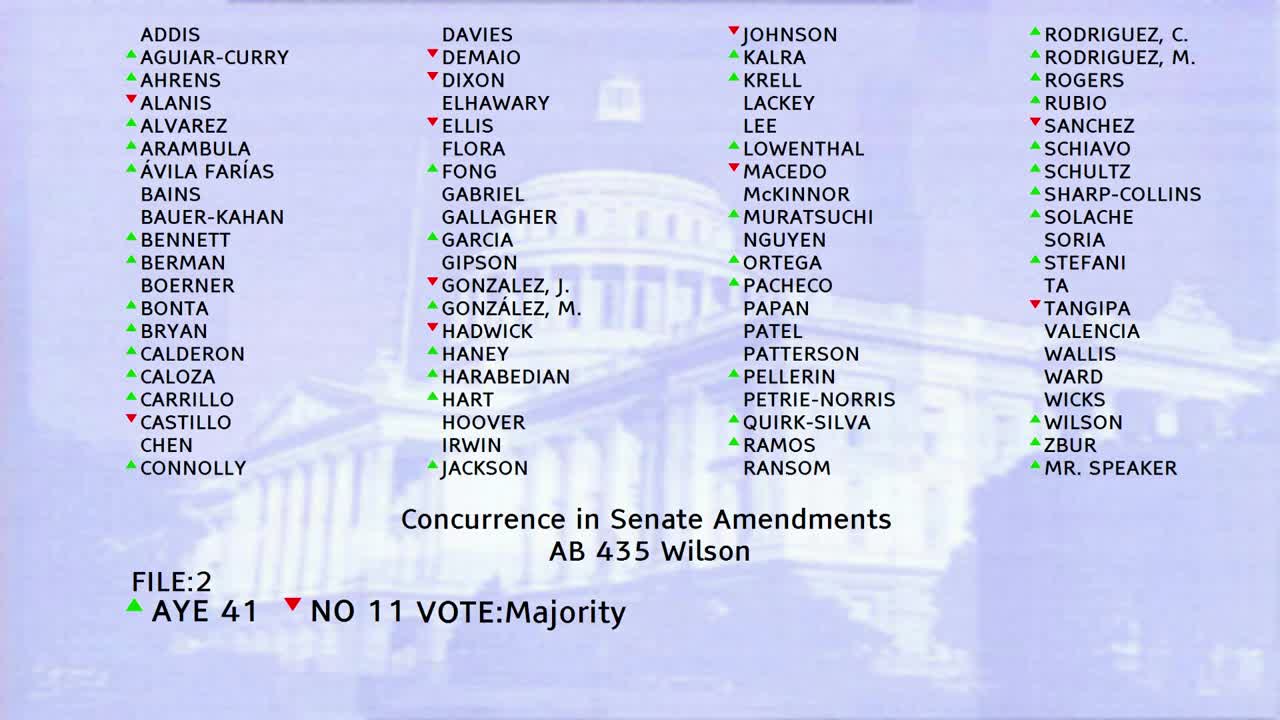 50SEC
Assembly Floor
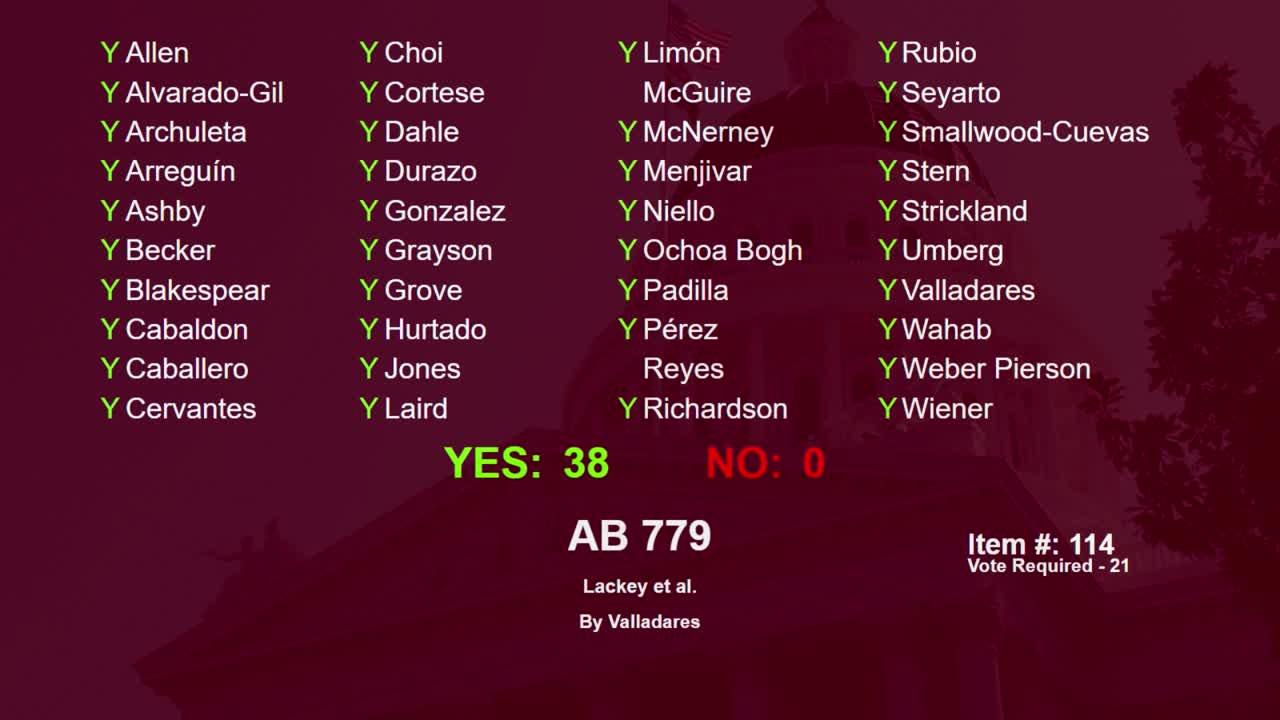 1MIN
Senate Floor
 41SEC
Senate Standing Committee on Appropriations
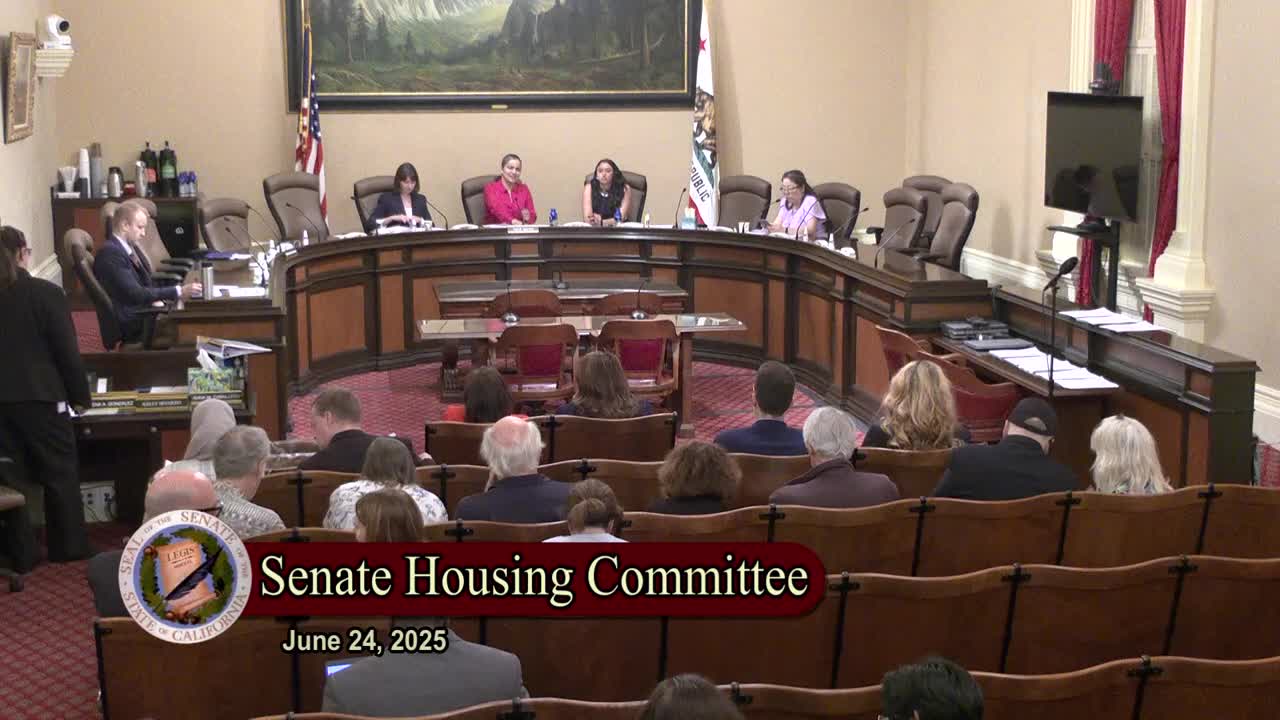 10MIN
Senate Standing Committee on Housing
 1MIN
Assembly Floor
 10MIN