AB 459: Initiatives: qualification: electronic signatures.
- Session Year: 2025-2026
- House: Assembly
- Latest Version Date: 2025-04-08
Current Status:
Failed
(2026-02-02: From committee: Filed with the Chief Clerk pursuant to Joint Rule 56.)
Introduced
In Committee
Awaiting First Chamber Vote
Passed First Chamber
In Committee
Awaiting Second Chamber Vote
Passed Second Chamber
Enacted
What does this bill do?
The bill lets voters electronically view and sign state and local initiative, referendum, and recall petitions on the Secretary of State’s website. It requires the Secretary of State and local elections officials to verify those electronic signatures and to count valid electronic signatures together with paper signatures when deciding if a measure has enough valid signatures to reach the ballot. The site must show an ongoing tally and may provide petition proponents with a list of electronic signers, and electronic signatures would not need a circulator’s affidavit.
The summary is provided by generative AI which can make mistakes. For original language, please view the details in the table below.
Existing law prescribes the procedures for circulating an initiative, referendum, or recall petition for signature by voters.
This bill would require the Secretary of State to develop a system that allows a proponent of a state or local initiative, referendum, or recall petition to have the petition posted on the Secretary of States internet website where a voter can electronically sign the petition. The bill would require the Secretary of State and elections officials to perform specified tasks in connection with the electronic circulation of petitions, including verifying the electronic signatures, as specified. By imposing additional duties on elections officials, this bill would impose a state-mandated local program.
The California Constitution requires the state to reimburse local agencies and school districts for certain costs mandated by the state. Statutory provisions establish procedures for making that reimbursement.
This bill would provide that, if the Commission on State Mandates determines that the bill contains costs mandated by the state, reimbursement for those costs shall be made pursuant to the statutory provisions noted above.
The California Constitution authorizes an initiative measure to be proposed by presenting to the Secretary of State a petition of the proposed statute or constitutional amendment that is certified to have been signed by a certain percentage of electors.This bill would state the intent of the Legislature to enact subsequent legislation that changes requirements for qualifying and voting on initiative measures.The California Constitution authorizes an initiative measure to be proposed by presenting to the Secretary of State a petition of the proposed statute or constitutional amendment that is certified to have been signed by a certain percentage of electors.
This bill would state the intent of the Legislature to enact subsequent legislation that changes requirements for qualifying and voting on initiative measures.
(a)The Secretary of State shall develop a system on the Secretary of States internet website that allows a voter to do all of the following:
(1)View an initiative, referendum, or recall petition that is required to be signed by voters of the state or the applicable county, city, school district, or special district.
(2)(A)For an initiative or referendum petition, view the arguments for and against the petition that are submitted by a proponent or opponent of the measure.
(B)For a recall petition, view the statement of the reasons for recall and the answer to that statement.
(3)Enable a voter to provide necessary identifying information and electronically sign the petition on the Secretary of States internet website.
(b)The Secretary of State shall post on its internet website an ongoing tally of the total number of electronic signatures for each petition electronically circulated pursuant to this section.
(c)Notwithstanding any other law, the total number of electronic signatures for a petition electronically circulated pursuant to this section shall be added to the total number of written signatures affixed to a hard copy section of the same petition for purposes of determining whether the total number of registered voters who have signed the petition meets or exceeds the minimum number necessary for the measure to qualify for the ballot.
(c)(d)(1)The system developed pursuant to this section shall enable the Secretary of State to verify the authenticity of an electronic signature.
(d)(2)Notwithstanding Section 16.5 of the Government Code, an electronic signature submitted pursuant to this section may be used to sign an initiative, referendum, or recall petition. The signature and information obtained pursuant to this section shall be deemed to be personally affixed to the petition, and the signature shall be treated as a signature as defined in Section 354.5.
(e)(3)Notwithstanding Section 104 or any other law, an electronic signature submitted pursuant to this section is not required to be accompanied by an affidavit or declaration signed by the circulator.
SEC. 2.Section 9023 is added to the Elections Code, to read:9023.(a)An initiative or referendum petition that is cleared for circulation may be circulated pursuant to the system established under Section 109.
(b)If a proponent informs the Secretary of State that the proponent elects to have a petition circulated pursuant to Section 109, the Secretary of State shall do all of the following:
(1)Post the text of the petition on the Secretary of States internet website.
(2)Post the arguments described in paragraph (2) of subdivision (a) of Section 109 on the Secretary of States internet website.
(3)Enable a voter to provide necessary identifying information and electronically sign the petition on the Secretary of States internet website.
(4)Post an ongoing tally of the total number of electronic signatures received by the petition pursuant to this section on the Secretary of States internet website.
(5)On an ongoing basis during the circulation period for the petition, provide the proponent with a list of individuals who signed the petition electronically.
(c)Notwithstanding Section 9022 or any other law, an electronic signature submitted pursuant to this section is not required to be accompanied by an affidavit or declaration signed by the circulator.
SEC. 3.Section 9036 is added to the Elections Code, to read:9036.(a)Upon the close of the circulation period for a petition circulated pursuant to Section 9023, the Secretary of State shall verify the signatures and determine the total number of valid signatures submitted by voters who electronically signed the petition.
(b)For purposes of determining whether the total number of registered voters who have signed the petition meets or exceeds the minimum number necessary for the measure to qualify for the ballot, the Secretary of State shall add the total number of valid electronic signatures determined pursuant to subdivision (a) to the total number of written signatures affixed to a hard copy section of the same petition determined pursuant to Section 9030.
(b)(c)(1)If the total number of valid signatures is less than 100 percent of the number of qualified voters required to find the petition sufficient, the Secretary of State shall so notify the proponents, and the Secretary of State shall take no further action with regard to the petition.
(2)If the total number of valid signatures is 100 percent or more of the number of qualified voters needed to declare the petition sufficient, the Secretary of State shall certify pursuant to Section 9033 that the measure is qualified for the ballot.
SEC. 4.Section 9107.5 is added to the Elections Code, to read:9107.5.(a)An initiative or referendum petition that is cleared for circulation may be circulated pursuant to the system established under Section 109.
(b)If a proponent informs the county elections official that the proponent elects to have a petition circulated pursuant to Section 109, the county elections official shall notify the Secretary of State, who shall do all of the following:
(1)Post the text of the petition on the Secretary of States internet website.
(2)Post the arguments described in paragraph (2) of subdivision (a) of Section 109 on the Secretary of States internet website.
(3)Enable a voter to provide necessary identifying information and electronically sign the petition on the Secretary of States internet website.
(4)Post an ongoing tally of the total number of signatures received pursuant to this section on the Secretary of States internet website.
(5)On an ongoing basis during the circulation period for the petition, provide the proponent with a list of individuals who signed the petition electronically.
(c)Notwithstanding Section 9109 or any other law, an electronic signature submitted pursuant to this section is not required to be accompanied by an affidavit signed by the circulator.
SEC. 5.Section 9118.1 is added to the Elections Code, to read:9118.1.(a)Upon the close of the circulation period for a petition circulated pursuant to Section 9107.5, the county elections official shall do both of the following:
(1)Request the electronic signature data from the Secretary of State.
(2)Examine the signatures and determine the total number of valid signatures submitted by voters who electronically signed the petition.
(b)For purposes of determining whether the total number of registered voters who have signed the petition meets or exceeds the minimum number necessary for the measure to qualify for the ballot, the county elections official shall add the total number of valid electronic signatures determined pursuant to subdivision (a) to the total number of written signatures affixed to a hard copy section of the same petition determined pursuant to Section 9113.
(b)(c)(1)If the county elections official finds the petition to be insufficient, the county elections official shall take no further action on the petition.
(2)If the county elections official finds the petition to be sufficient, the county elections official shall certify the results of the examination to the board of supervisors at the next regular meeting of the board.
SEC. 6.Section 9206.5 is added to the Elections Code, to read:9206.5.(a)An initiative or referendum petition that is cleared for circulation may be circulated pursuant to the system established under Section 109.
(b)If a proponent informs the elections official that the proponent elects to have a petition circulated pursuant to Section 109, the elections official shall notify the Secretary of State, who shall do all of the following:
(1)Post the text of the petition on the Secretary of States internet website.
(2)Post the arguments described in paragraph (2) of subdivision (a) of Section 109 on the Secretary of States internet website.
(3)Enable a voter to provide necessary identifying information and electronically sign the petition on the Secretary of States internet website.
(4)Post an ongoing tally of the total number of signatures received pursuant to this section on the Secretary of States internet website.
(5)On an ongoing basis during the circulation period for the petition, provide the proponent with a list of individuals who signed the petition electronically.
(c)Notwithstanding Section 9209 or any other law, an electronic signature submitted pursuant to this section is not required to be accompanied by an affidavit or declaration signed by the circulator.
SEC. 7.Section 9215.1 is added to the Elections Code, to read:9215.1.Upon the close of the circulation period for a petition circulated pursuant to Section 9206.5, the elections official shall examine the petition in the same manner as county petitions are examined in accordance with Section 9118.1, except that for the purposes of this section, references to the board of supervisors shall be treated as references to the legislative body of the city.
SEC. 8.Section 9304.7 is added to the Elections Code, to read:9304.7.(a)An initiative or referendum petition that is cleared for circulation may be circulated pursuant to the system established under Section 109.
(b)If a proponent informs the district elections official that the proponent elects to have a petition circulated pursuant to Section 109, the district elections official shall notify the Secretary of State, who shall do all of the following:
(1)Post the text of the petition on the Secretary of States internet website.
(2)Post the arguments described in paragraph (2) of subdivision (a) of Section 109 on the Secretary of States internet website.
(3)Enable a voter to provide necessary identifying information and electronically sign the petition on the Secretary of States internet website.
(4)Post an ongoing tally of the total number of signatures received pursuant to this section on the Secretary of States internet website.
(5)On an ongoing basis during the circulation period for the petition, provide the proponent with a list of individuals who signed the petition electronically.
(c)Notwithstanding Section 9307 or any other law, an electronic signature submitted pursuant to this section is not required to be accompanied by an affidavit signed by the circulator.
SEC. 9.Section 9311.5 is added to the Elections Code, to read:9311.5.(a)Upon the close of the circulation period for a petition circulated pursuant to Section 9304.7, the district elections official shall do both of the following:
(1)Request the electronic signature data from the Secretary of State.
(2)Examine the signatures and determine the total number of valid signatures submitted by voters who electronically signed the petition.
(b)For purposes of determining whether the total number of registered voters who have signed the petition meets or exceeds the minimum number necessary for the measure to qualify for the ballot, the district elections official shall add the total number of valid electronic signatures determined pursuant to subdivision (a) to the total number of written signatures affixed to a hard copy section of the same petition determined pursuant to Section 9308.
(b)(c)(1)If the district elections official finds the petition to be insufficient, the district elections official shall take no further action on the petition.
(2)If the district elections official finds the petition to be sufficient, the district elections official shall certify the results of the examination to the governing board of the district at the next regular meeting of the board.
SEC. 10.Section 11042.1 is added to the Elections Code, to read:11042.1.(a)A recall petition that satisfies the requirements of Section 11042 may be circulated pursuant to the system established under Section 109.
(b)If a proponent informs the Secretary of State that the proponent elects to circulate a petition pursuant to Section 109, the Secretary of State shall do all of the following:
(1)Post the text of the petition on the Secretary of States internet website.
(2)Post the statement of the reasons for recall and the answer to that statement on the Secretary of States internet website.
(3)Enable a voter to provide necessary identifying information and electronically sign the petition on the Secretary of States internet website.
(4)Post an ongoing tally of the total number of signatures received pursuant to this section on the Secretary of States internet website.
(5)On an ongoing basis during the circulation period for the petition, provide the proponent with a list of individuals who signed the petition electronically.
(c)Notwithstanding Section 11046 or any other law, an electronic signature submitted pursuant to this section is not required to be accompanied by an affidavit or declaration signed by the circulator.
SEC. 11.Section 11108.5 is added to the Elections Code, to read:11108.5.(a)Immediately after the deadline for submission of all signatures for a recall petition circulated pursuant to Section 11042.1, the Secretary of State shall verify the signatures and determine the total number of valid signatures submitted by voters who electrically electronically signed the petition.
(b)For purposes of determining whether the total number of registered voters who have signed the petition meets or exceeds the minimum number necessary for the measure to qualify for the ballot, the Secretary of State shall add the total number of valid electronic signatures determined pursuant to subdivision (a) to the total number of written signatures affixed to a hard copy section of the same petition determined pursuant to Section 11106.
SEC. 12.Section 11228 is added to the Elections Code, to read:11228.(a)Immediately after the deadline for submission of all signatures for a recall petition circulated pursuant to Section 11042.1, the elections official shall do both of the following:
(1)Request the electronic signature data from the Secretary of State.
(2)Examine the signatures and determine the total number of valid signatures submitted by voters who electronically signed the petition.
(b)For purposes of determining whether the total number of registered voters who have signed the petition meets or exceeds the minimum number necessary for the measure to qualify for the ballot, the elections official shall add the total number of valid electronic signatures determined pursuant to subdivision (a) to the total number of written signatures affixed to a hard copy section of the same petition determined pursuant to Section 11222.
(b)(c)(1)If the elections official finds the petition to be insufficient, the elections official shall take no further action on the petition.
(2)If the elections official finds the petition to be sufficient, the elections official shall submit the elections officials certificate as to the sufficiency of the petition to the governing body at its next regular meeting.
SEC. 13.If the Commission on State Mandates determines that this act contains costs mandated by the state, reimbursement to local agencies and school districts for those costs shall be made pursuant to Part 7 (commencing with Section 17500) of Division 4 of Title 2 of the Government Code.
(a)The Secretary of State shall develop a system on the Secretary of States internet website that allows a voter to do all of the following:
(1)View an initiative, referendum, or recall petition that is required to be signed by voters of the state or the applicable county, city, school district, or special district.
(2)(A)For an initiative or referendum petition, view the arguments for and against the petition that are submitted by a proponent or opponent of the measure.
(B)For a recall petition, view the statement of the reasons for recall and the answer to that statement.
(3)Enable a voter to provide necessary identifying information and electronically sign the petition on the Secretary of States internet website.
(b)The Secretary of State shall post on its internet website an ongoing tally of the total number of electronic signatures for each petition electronically circulated pursuant to this section.
(c)The system developed pursuant to this section shall enable the Secretary of State to verify the authenticity of an electronic signature.
(d)Notwithstanding Section 16.5 of the Government Code, an electronic signature submitted pursuant to this section may be used to sign an initiative, referendum, or recall petition. The signature and information obtained pursuant to this section shall be deemed to be personally affixed to the petition, and the signature shall be treated as a signature as defined in Section 354.5.
(e)Notwithstanding Section 104 or any other law, an electronic signature submitted pursuant to this section is not required to be accompanied by an affidavit or declaration signed by the circulator.
SEC. 2.Section 9023 is added to the Elections Code, to read:9023.(a)An initiative or referendum petition that is cleared for circulation may be circulated pursuant to the system established under Section 109.
(b)If a proponent informs the Secretary of State that the proponent elects to have a petition circulated pursuant to Section 109, the Secretary of State shall do all of the following:
(1)Post the text of the petition on the Secretary of States internet website.
(2)Post the arguments described in paragraph (2) of subdivision (a) of Section 109 on the Secretary of States internet website.
(3)Enable a voter to provide necessary identifying information and electronically sign the petition on the Secretary of States internet website.
(4)Post an ongoing tally of the total number of electronic signatures received by the petition pursuant to this section on the Secretary of States internet website.
(c)Notwithstanding Section 9022 or any other law, an electronic signature submitted pursuant to this section is not required to be accompanied by an affidavit or declaration signed by the circulator.
SEC. 3.Section 9036 is added to the Elections Code, to read:9036.(a)Upon the close of the circulation period for a petition circulated pursuant to Section 9023, the Secretary of State shall verify the signatures and determine the total number of valid signatures submitted by voters who electronically signed the petition.
(b)(1)If the total number of valid signatures is less than 100 percent of the number of qualified voters required to find the petition sufficient, the Secretary of State shall so notify the proponents, and the Secretary of State shall take no further action with regard to the petition.
(2)If the total number of valid signatures is 100 percent or more of the number of qualified voters needed to declare the petition sufficient, the Secretary of State shall certify pursuant to Section 9033 that the measure is qualified for the ballot.
SEC. 4.Section 9107.5 is added to the Elections Code, to read:9107.5.(a)An initiative or referendum petition that is cleared for circulation may be circulated pursuant to the system established under Section 109.
(b)If a proponent informs the county elections official that the proponent elects to have a petition circulated pursuant to Section 109, the county elections official shall notify the Secretary of State, who shall do all of the following:
(1)Post the text of the petition on the Secretary of States internet website.
(2)Post the arguments described in paragraph (2) of subdivision (a) of Section 109 on the Secretary of States internet website.
(3)Enable a voter to provide necessary identifying information and electronically sign the petition on the Secretary of States internet website.
(4)Post an ongoing tally of the total number of signatures received pursuant to this section on the Secretary of States internet website.
(c)Notwithstanding Section 9109 or any other law, an electronic signature submitted pursuant to this section is not required to be accompanied by an affidavit signed by the circulator.
SEC. 5.Section 9118.1 is added to the Elections Code, to read:9118.1.(a)Upon the close of the circulation period for a petition circulated pursuant to Section 9107.5, the county elections official shall do both of the following:
(1)Request the electronic signature data from the Secretary of State.
(2)Examine the signatures and determine the total number of valid signatures submitted by voters who electronically signed the petition.
(b)(1)If the county elections official finds the petition to be insufficient, the county elections official shall take no further action on the petition.
(2)If the county elections official finds the petition to be sufficient, the county elections official shall certify the results of the examination to the board of supervisors at the next regular meeting of the board.
SEC. 6.Section 9206.5 is added to the Elections Code, to read:9206.5.(a)An initiative or referendum petition that is cleared for circulation may be circulated pursuant to the system established under Section 109.
(b)If a proponent informs the elections official that the proponent elects to have a petition circulated pursuant to Section 109, the elections official shall notify the Secretary of State, who shall do all of the following:
(1)Post the text of the petition on the Secretary of States internet website.
(2)Post the arguments described in paragraph (2) of subdivision (a) of Section 109 on the Secretary of States internet website.
(3)Enable a voter to provide necessary identifying information and electronically sign the petition on the Secretary of States internet website.
(4)Post an ongoing tally of the total number of signatures received pursuant to this section on the Secretary of States internet website.
(c)Notwithstanding Section 9209 or any other law, an electronic signature submitted pursuant to this section is not required to be accompanied by an affidavit or declaration signed by the circulator.
SEC. 7.Section 9215.1 is added to the Elections Code, to read:9215.1.Upon the close of the circulation period for a petition circulated pursuant to Section 9206.5, the elections official shall examine the petition in the same manner as county petitions are examined in accordance with Section 9118.1, except that for the purposes of this section, references to the board of supervisors shall be treated as references to the legislative body of the city.
SEC. 8.Section 9304.7 is added to the Elections Code, to read:9304.7.(a)An initiative or referendum petition that is cleared for circulation may be circulated pursuant to the system established under Section 109.
(b)If a proponent informs the district elections official that the proponent elects to have a petition circulated pursuant to Section 109, the district elections official shall notify the Secretary of State, who shall do all of the following:
(1)Post the text of the petition on the Secretary of States internet website.
(2)Post the arguments described in paragraph (2) of subdivision (a) of Section 109 on the Secretary of States internet website.
(3)Enable a voter to provide necessary identifying information and electronically sign the petition on the Secretary of States internet website.
(4)Post an ongoing tally of the total number of signatures received pursuant to this section on the Secretary of States internet website.
(c)Notwithstanding Section 9307 or any other law, an electronic signature submitted pursuant to this section is not required to be accompanied by an affidavit signed by the circulator.
SEC. 9.Section 9311.5 is added to the Elections Code, to read:9311.5.(a)Upon the close of the circulation period for a petition circulated pursuant to Section 9304.7, the district elections official shall do both of the following:
(1)Request the electronic signature data from the Secretary of State.
(2)Examine the signatures and determine the total number of valid signatures submitted by voters who electronically signed the petition.
(b)(1)If the district elections official finds the petition to be insufficient, the district elections official shall take no further action on the petition.
(2)If the district elections official finds the petition to be sufficient, the district elections official shall certify the results of the examination to the governing board of the district at the next regular meeting of the board.
SEC. 10.Section 11042.1 is added to the Elections Code, to read:11042.1.(a)A recall petition that satisfies the requirements of Section 11042 may be circulated pursuant to the system established under Section 109.
(b)If a proponent informs the Secretary of State that the proponent elects to circulate a petition pursuant to Section 109, the Secretary of State shall do all of the following:
(1)Post the text of the petition on the Secretary of States internet website.
(2)Post the statement of the reasons for recall and the answer to that statement on the Secretary of States internet website.
(3)Enable a voter to provide necessary identifying information and electronically sign the petition on the Secretary of States internet website.
(4)Post an ongoing tally of the total number of signatures received pursuant to this section on the Secretary of States internet website.
(c)Notwithstanding Section 11046 or any other law, an electronic signature submitted pursuant to this section is not required to be accompanied by an affidavit or declaration signed by the circulator.
SEC. 11.Section 11108.5 is added to the Elections Code, to read:11108.5.Immediately after the deadline for submission of all signatures for a recall petition circulated pursuant to Section 11042.1, the Secretary of State shall verify the signatures and determine the total number of valid signatures submitted by voters who electrically signed the petition.
SEC. 12.Section 11228 is added to the Elections Code, to read:11228.Immediately after the deadline for submission of all signatures for a recall petition circulated pursuant to Section 11042.1, the elections official shall do both of the following:
(1)Request the electronic signature data from the Secretary of State.
(2)Examine the signatures and determine the total number of valid signatures submitted by voters who electronically signed the petition.
(b)(1)If the elections official finds the petition to be insufficient, the elections official shall take no further action on the petition.
(2)If the elections official finds the petition to be sufficient, the elections official shall submit the elections officials certificate as to the sufficiency of the petition to the governing body at its next regular meeting.
SEC. 13.If the Commission on State Mandates determines that this act contains costs mandated by the state, reimbursement to local agencies and school districts for those costs shall be made pursuant to Part 7 (commencing with Section 17500) of Division 4 of Title 2 of the Government Code.
SECTION 1.It is the intent of the Legislature to enact subsequent legislation that changes the requirements for qualifying and voting on initiative measures.It is the intent of the Legislature to enact subsequent legislation that changes the requirements for qualifying and voting on initiative measures.
|
Date
|
Status
|
|---|---|
| Feb 2, 2026 | From committee: Filed with the Chief Clerk pursuant to Joint Rule 56. |
| Jan 31, 2026 | Died pursuant to Art. IV, Sec. 10(c) of the Constitution. |
| Apr 30, 2025 | In committee: Set, first hearing. Failed passage. Reconsideration granted. |
| Apr 9, 2025 | Re-referred to Com. on ELECTIONS. |
| Apr 8, 2025 | From committee chair, with author's amendments: Amend, and re-refer to Com. on ELECTIONS. Read second time and amended. |
| Apr 1, 2025 | Re-referred to Com. on ELECTIONS. |
| Mar 28, 2025 | From committee chair, with author's amendments: Amend, and re-refer to Com. on ELECTIONS. Read second time and amended. |
| Mar 28, 2025 | Referred to Com. on ELECTIONS. |
| Feb 7, 2025 | From printer. May be heard in committee March 9. |
| Feb 6, 2025 | Read first time. To print. |
|
Date
|
Description
|
Location
|
Votes
|
|
|---|---|---|---|---|
| Apr 30, 2025 | Reconsideration. | Assembly Standing Committee on Elections |
Passed |
|
| Apr 30, 2025 | Do pass and be re-referred to the Committee on [Appropriations] | Assembly Standing Committee on Elections |
Failed |
This list shows positions taken on this bill by organizations on the date displayed, which is linked to the original source.
Positions by individuals are not included.
|
Organization
|
Position
|
Date
|
|---|---|---|
| California Association Of Psychiatric Technicians | ** Against | |
| California Federation of Labor Unions, Afl-cio | ** Against | |
| Election Integrity Project, California Inc. | ** Support |
Date of Hearing: April 30, 2025
ASSEMBLY COMMITTEE ON ELECTIONS
Gail Pellerin, Chair
ABPCA Bill Id:AB 459 (
Author:DeMaio) – As Amended Ver:April 8, 2025
SUBJECT: Initiatives: qualification: electronic signatures.
SUMMARY: Requires the Secretary of State (SOS) to develop a system that allows a voter to sign a state or local initiative, referendum, or recall petition electronically, as specified. Specifically, this bill:
- Requires the SOS to develop a system on the SOS’s internet website that allows a voter to do all of the following:
- View a state or local initiative, referendum, or recall petition that is required to be signed by voters of the state or the applicable county, city, school district, or special district.
- For an initiative or referendum petition, view the arguments for and against the petition that are submitted by a proponent or opponent of the measure. For a recall petition, view the statement of the reasons for recall and the answer to that statement.
- Provide necessary identifying information and electronically sign the petition on the SOS’s internet website.
- View a state or local initiative, referendum, or recall petition that is required to be signed by voters of the state or the applicable county, city, school district, or special district.
- Requires the SOS to post on its internet website an ongoing tally of the total number of electronic signatures for each petition electronically circulated.
- Requires the total number of electronic signatures for a petition electronically circulated pursuant to this bill to be added to the total number of written signatures affixed to a hard copy section of the same petition for purposes of determining whether the total number of registered voters who have signed the petition meets or exceeds the minimum number necessary for the measure to qualify for the ballot.
- Requires the system developed to enable the SOS to verify the authenticity of an electronic signature.
- Allows an electronic signature submitted pursuant to this bill to be used to sign a state or local initiative, referendum, or recall petition. Requires the signature and information obtained to be deemed to be personally affixed to the petition, and requires the signature to be treated as a “signature” as defined under existing law.
- Provides that an electronic signature submitted pursuant to this bill is not required to be accompanied by an affidavit or declaration signed by the circulator.
- Allows a state or local initiative, referendum or recall petition that is cleared for circulation to be circulated pursuant to the system established by the SOS, as described above.
- Requires the SOS, if a proponent informs the SOS or an elections official notifies the SOS that the proponent elects to have a state or local initiative, referendum, or recall petition circulated electronically through the SOS’s website, to do all of the following:
- Post the text of the petition on the SOS’s internet website.
- Post, for an initiative or referendum petition the arguments for and against the measure, or for a recall petition the statement of reasons and the answer on the SOS’s internet website.
- Enable a voter to provide necessary identifying information and electronically sign the petition on the SOS’s internet website.
- Post an ongoing tally of the total number of electronic signatures received on the petition on the SOS’s internet website.
- On an ongoing basis during the circulation period for the petition, provide the proponent with a list of individuals who signed the petition electronically.
- Requires the SOS, upon the close of the circulation period for a state initiative, referendum, or recall petition circulated through the SOS’s website, to verify the signatures and determine the total number of valid signatures submitted by voters who electronically signed the petition.
- Requires an elections official, upon the close of the circulation period for a local initiative, referendum, or recall petition that was circulated through the SOS’s website, to do both of the following:
- Request the electronic signature data from the SOS.
- Examine the signatures and determine the total number of valid signatures submitted by voters who electronically signed the petition.
- Request the electronic signature data from the SOS.
- Requires an elections official, for purposes of determining whether the total number of registered voters who have signed the petition meets or exceeds the minimum number necessary for the measure to qualify for the ballot, to add the total number of valid electronic signatures to the total number of written signatures affixed to a hard copy section of the same petition. Requires a county elections official, if the official finds the petition to be insufficient, to take no further action on the petition. Requires a county elections official, if the official finds the petition to be sufficient, to certify the results of the examination to the local governing board.
- Makes conforming changes.
EXISTING LAW:
- Allows electors to propose statutes and amendments to the Constitution and to adopt or reject them through the initiative process. (California Constitution Article II, §8) Allows electors to approve or reject statutes or parts of statutes, except as specified, through the referendum process. (California Constitution Article II, §9) Provides that recall is the power of the electors to remove an elective officer. (California Constitution, Article II, §13)
- Provides that only persons who are qualified registered voters at the time of signing a petition are entitled to sign the petition. Provides that a person can only sign a petition that is being circulated in their county of registration. Permits a petition circulator, if they are a registered voter, to sign the petition the person is circulating. (Elections Code §§100(a), 9020(b), 9021(a))
- Requires each signer to personally affix all of the following on the petition: the signer’s signature, printed name, residence address (or physical description of the location if there is no street address), and the name of the incorporated city or unincorporated community. (Elections Code §§100(b), 9020(a), 11045)
- Prohibits a person from circulating a state or local initiative, referendum, or recall petition or nominating paper unless the person is 18 years of age or older. (Elections Code §102)
- Requires each section of a petition submitted to an elections official to have attached to it a declaration signed by the circulator of the petition, that includes the printed name of the circulator, the residence address of the circulator, and the dates between which all the signatures to the petition or paper were obtained. Requires each declaration submitted to also set forth that the circulator circulated that section and witnessed the appended signatures being written, that according to the best information and belief of the circulator, each signature is the genuine signature of the person whose name it purports to be, and that the circulator is 18 years of age or older. (Elections Code §§104, 9022, 9109, 9209, 9307, 11046)
- Requires a circulator to certify the content of the declaration as to its truth and correctness, under penalty of perjury under the laws of the State of California, with the signature of the circulator’s name. Requires a circulator to state the date and the place of execution on the declaration immediately preceding the circulator’s signature. (Elections Code §104)
- Establishes criminal penalties for fraudulent activity and other misconduct related to the circulation of petitions. (Elections Code §§18600-18671)
- Provides that a person is guilty of a misdemeanor who knowingly signs their own name more than once to any initiative, referendum, or recall petition, or signs their name to a petition knowing at the time that they are not qualified to sign it. (Elections Code §18612)
- Requires an election official to determine the number of qualified voters who have signed a state or local petition, as specified. (Elections Code §§9030, 9031, 9114, 9115, 9146, 9211, 9240, 9308, 9309,11106, 11107, 11224, 11225)
FISCAL EFFECT: Unknown. State-mandated local program; contains reimbursement direction.
COMMENTS:
- Purpose of the Bill:
The petition process has been an integral aspect of Californian’s right to a direct democracy. Technology has advanced beyond a clipboard, pen and paper – and our direct democracy rules should also advance to embrace modern technology. As such, AB 459 would allow voters to sign petitions electronically and thereby modernize the petition qualification process.
- State and Local Ballot Measures: On October 10, 1911, California voters considered 23 proposed amendments to the California Constitution that the state Legislature placed on the ballot. Of the 23 ballot measures, two proposals sought to expand the tools of direct democracy available to California voters. Proposition 7, which gave voters the power of the initiative (allowing voters to propose statutes and amendments to the Constitution) and the referendum (giving voters the ability to approve or reject statutes or parts of statutes enacted by the Legislature), was approved with 76.4% of the vote. Proposition 8, which gave electors the power to remove an elected official from office prior to the end of the official’s term through the recall process, received 76.8% of the vote. Governor Hiram Johnson, who campaigned for the measures, explained that while the initiative, referendum, and recall were not the “panacea for all our political ills, yet they do give to the electorate the power of action when desired, and they do place in the hands of the people the means by which they may protect themselves.”
- Electronic Petition Signature: As described above, an initiative, referendum, or recall petition is required to be signed by voters of the jurisdiction subject to petitioning and only a person who is an eligible registered voter at the time of signing the petition is entitled to sign it. Each signer at the time of signing the petition is required to personally affix their signature, printed name, and residence address. As discussed below, a voter must physically sign the petition on paper.
This bill would, for the first time, allow a voter to sign a state or local petition using an electronic signature. Specifically, this bill tasks the SOS with developing a system that enables a voter to provide necessary identifying information and electronically sign a petition on the SOS’s website, and requires the SOS to verify the authenticity of an electronic signature submitted through the system. The bill, however, lacks crucial detail on how the process for signing petitions electronically would function.
Under existing law, elections officials verify the authenticity of a signature on a petition by comparing that signature against signatures that are part of the voter’s registration record. If the signature on a petition does not compare to signatures used by the voter when registering to vote or voting in elections, then the signature on the petition is deemed invalid. This bill does not define “electronic signature,” nor does the bill specify how a voter would provide their electronic signature. Would a voter electronically sign using their finger or a stylus on a touchscreen computer or a tablet? Under this scenario, it is unclear whether such a signature could be expected to match up with the same voter's signature(s) given the large variety of touchscreen devises that may use different touchscreen technologies and have varying signature resolution qualities.
Furthermore, the term “electronic signature” generally does not refer to a digital representation of a physical signature. Instead, the term “electronic signature” generally refers to an electronic identifier that is created by a computer and that is unique to the user. Such an electronic identifier could not be “compared” to digital images of physical signatures that are part of a voter’s registration record.
If this is the type of “electronic signature” that the author envisions voters using to sign a petition online, in order to verify such a signature the SOS would need to develop a process for determining whether the signature was affixed to petition by the person who purportedly signed the petition. This bill, however, does not specify what identifying information a voter must provide in order to electronically sign a petition through the SOS portal. Would a voter be required to provide their name and residence address? Does that level of information sufficiently protect against fraud? Or would a voter be required to provide their driver’s license number, last four digits of their social security number, or birth date? Requiring this information may provide a stronger level of protection against fraudulent activity, but it remains unclear how the SOS would determine that the petition was electronically signed by the voter themself, rather than by another person with access to the voter’s personal information. Additionally, the bill does not specify how the SOS would verify the identity of the voter and authenticate the electronic signature provided. Would the SOS be required to verify and authenticate the information by matching it with information maintained in the statewide voter registration database and a county elections management system? How would that process work if the voter’s registration record does not include the information in question?
Without more detail about how these policies or procedures would function, it is impossible to effectively evaluate the changes proposed by this bill. - Petition Signature Examination: Under current law a county elections official is responsible for examining petition signatures from records of registration to ascertain whether the petition is signed by the requisite number of voters. The SOS does not play a role in examining petition signatures to ensure they are valid. This bill, however, imposes a new duty and requires the SOS to verify and determine the total number of valid electronic petition signatures submitted for state petitions. It is unclear how the SOS would comply with these requirements.
- Security Concerns: This bill requires the SOS to develop a system that allows a person to electronically sign a state or local initiative, referendum, or recall petition, as specified. Unlike other online systems, such as the California online voter registration system, this bill does not require the SOS to employ security measures to protect and ensure the accuracy and integrity of the system and the information a voter is submitting through the system. Given heightened concerns about election integrity and cyberattacks, it is important for there to be data security safeguards in place. Thus the committee may wish to consider whether this bill contains sufficient safeguards and consider amending the bill to require the SOS to adopt and employ security measures and standards to ensure accuracy and integrity of a system that allows a voter to electronically sign a petition.
- Petition Circulators: Existing law requires an initiative circulator to declare under penalty of perjury on the petition that they witnessed each of the signatures being written on the petition and that each signature on the petition, to the best of their information and belief, is a genuine signature of the person whose name it purports to be. This bill does not require petition signatures submitted electronically to be accompanied by an affidavit or declaration signed by the circulator. The committee may wish to consider whether removing the petition circulator affidavit thereby eliminates a protection against fraud in the collection of petition signatures. In other words, although a circulator is not required to take an active measure to prevent fraud, the circulator’s affidavit effectively certifies there was no obvious fraud of which the circulator is aware.
- Previous Lawsuit: In 2011, the Court of Appeal of the State of California, First Appellate District, Division One, considered a lawsuit regarding whether or not California law permits initiative petitions to be signed by electronic means. The case, Ni v. Slocum, Case No. A128721, was an appeal of a case in which the San Mateo Superior Court ruled that existing law does not permit initiative petitions to be signed in such a manner. Specifically, the Superior Court concluded that an electronic signature did not comply with statutory requirements for submission of an initiative petition, which the court construed to require the submission of a paper petition, and that the use of an electronic signature was impermissible because it did not allow elections officials to determine whether the voter personally affixed their signature to the petition, as required by statute. The appellate court agreed with San Mateo County Superior Court and ruled that use of an electronic signature to endorse an initiative petition is not contemplated by the Elections Code.
- Other States: Committee staff research based on information from Ballotpedia found that some states specifically restrict or ban the use of an electronic signature when addressing the collection of signatures to submit ballot measures via the initiative, referendum and recall process. For instance, one state (Utah) provides for electronic signatures to be collected for citizen initiative petitions, and four states (California, Idaho, Montana, and Ohio) prohibit the collection of electronic signatures for citizen initiative petitions. Approximately 18 states (Arkansas, Arizona, Alaska, Colorado, Illinois, Maine, Massachusetts, Michigan, Mississippi, Missouri, Oregon, Nebraska, Nevada, North Dakota, Oklahoma, South Dakota, Washington, and Wyoming) have laws that require signatures to be collected in person or on paper. Moreover, one state (Florida) does not address electronic signatures and 26 states do not allow for citizen initiatives.
Utah’s law allowing for electronic petition signatures was passed in 2022. Unlike the provisions of this bill, the Utah law requires initiative sponsors to choose whether to collect signatures manually or with an electronic device, and does not allow initiative sponsors to collect signatures using both methods. Utah’s law requires electronic signatures to be collected in the physical presence of a signature gatherer, and requires people signing electronically to present specified identification that must be verified before the voter is allowed to electronically sign the petition. - Previous State Initiative Ballot Measures: Committee staff research found that in 2016, 2019, 2020, 2021, and most recently in 2023, state initiative ballot measures which contain provisions that are substantially similar to the provisions in this bill were all issued ballot titles and summaries and cleared for circulation. According to the Attorney General’s website, all of these initiatives are inactive as they failed to qualify for the ballot.
- Arguments in Support: In support of this bill, the Election Integrity Project California, Inc., writes:
Every aspect of our lives is undergoing modernization to encompass the use of digital technology.
• Californians can now register to vote or update their registration ONLINE.
• Californians can now submit their tax returns ONLINE.
• Californians can (must) now apply for university admission ONLINE.
• Californians can now sign legal documents and contracts ONLINE.
• Californians can now pay bills and handle all bank transactions ONLINE.
• Californians can now make any and all purchases ONLINE.
It is past time for California to authorize petition signatures to be provided ONLINE. Not only would such a move bring alignment with every other aspect of modern living, but it would also:
• Improve stay-healthy efforts by providing a no-contact process of self-governance.
• Reduce carbon footprint by avoiding countless gatherers having to engage in start-and- stop driving to canvass neighborhoods for signatures.
- Arguments in Opposition: In opposition to this bill, the California Federation of Labor Unions, AFL-CIO, writes:
While AB 459 purports to make access to the ballot more accessible, it raises issues of security, fraud, and opens the doors to more money flooding into the system. For one, multiple studies have questioned the security of internet-related elections from online voting to signature gathering. In addition, the CalTech/MIT Voting Technology Project finds that digital signatures could also actually prove harder to verify given the nature of how online signatures work.
Supporters of AB 459 may argue that online signature gathering would also slow the need for well-funded signature gathering operations. However, the move could lead to a flood of paid online influencers everywhere from Instagram to TikTok pushing voters to sign petitions. Given the security concerns with TikTok, it makes no sense to open California’s direct democracy to its influence. In addition, this bill would give corporations even more access to voters by directing them to sign a petition when they open an app. This is not a theoretical threat—when Proposition 22 was on the ballot in 2020, the proponents of the measure flooded users’ and drivers’ apps with pro-Proposition 22 ads.
AB 459 would undermine the security of petition gathering and open the floodgates for more money into the process. The bill has the veneer of increasing voter participation and access, but like requiring voters to show identification to vote, it brings numerous problems and obstacles that reduce equitable access for voters.
REGISTERED SUPPORT / OPPOSITION:
Support
Election Integrity Project, California Inc.
Opposition
California Association of Psychiatric Technicians
California Federation of Labor Unions, AFL-CIO
Analysis Prepared by: Nichole Becker / ELECTIONS / (916) 319-2094
Discussed in Hearing
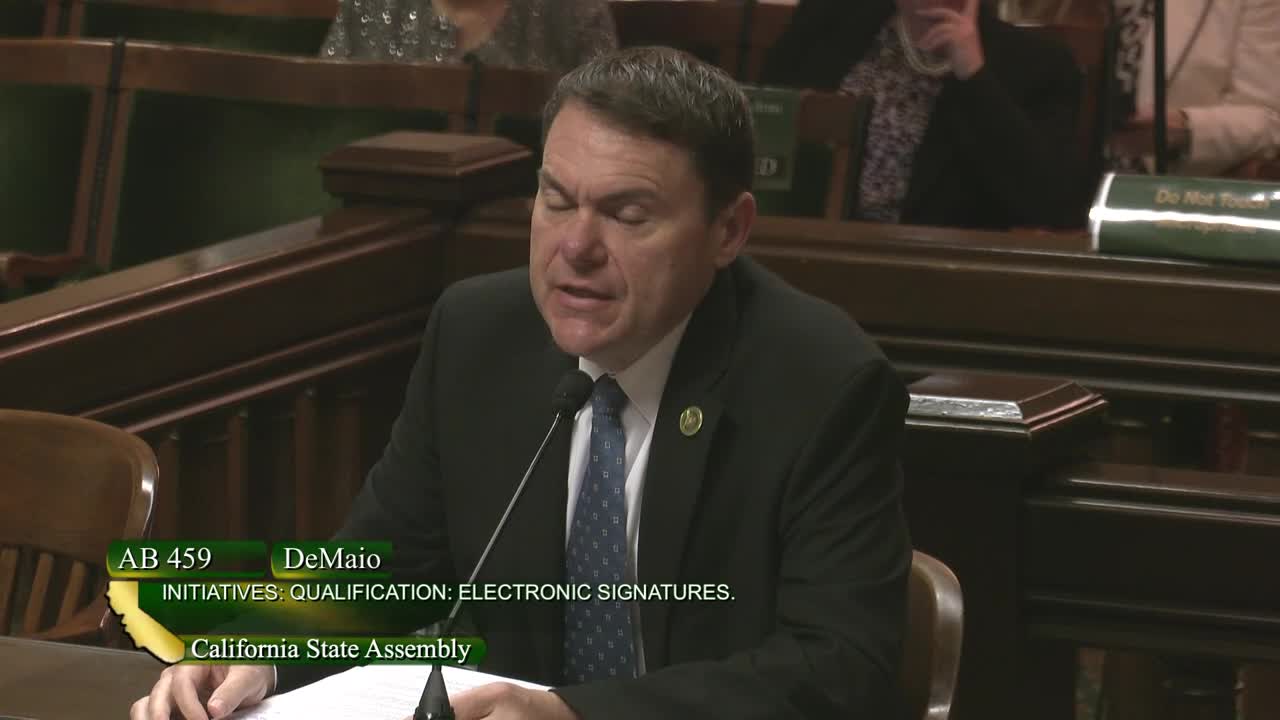 12MIN
Assembly Standing Committee on Elections
Bill Author

Bill Co-Author(s):