AB 728: Skin care product sales: age verification.
- Session Year: 2025-2026
- House: Assembly
- Latest Version Date: 2025-04-07
Current Status:
Failed
(2026-02-02: From committee: Filed with the Chief Clerk pursuant to Joint Rule 56.)
Introduced
In Committee
Awaiting First Chamber Vote
Passed First Chamber
In Committee
Awaiting Second Chamber Vote
Passed Second Chamber
Enacted
Under existing law, it is unlawful for a person who is under 18 years of age to purchase etching cream or an aerosol container of paint that is capable of defacing property. Existing law further makes it unlawful for a person, firm, or corporation, except as specified, to furnish to a person who is under 18 years of age any etching cream or aerosol container of paint without first obtaining bona fide evidence of majority and identity. Existing law punishes a violation of these provisions as a misdemeanor.
This bill would make it unlawful for a person, firm, or corporation to sell to another person, who is in fact under 18 years of age, an over-the-counter anti-aging skin care product or anti-aging cosmetic product that lists as an ingredient vitamin A or an alpha hydroxy acid, as specified, acid without first verifying the purchasers age and identity. The bill would define verifying age and identity to include, among other things, verbally asking the buyers age and asking for documents that are evidence of age and identity related to the age-based prohibitions for aerosol paint and etching cream.
Under existing law, it is unlawful for a person who is under 18 years of age to purchase etching cream or an aerosol container of paint that is capable of defacing property. Existing law further makes it unlawful for a person, firm, or corporation, except as specified, to furnish to a person who is under 18 years of age any etching cream or aerosol container of paint without first obtaining bona fide evidence of majority and identity. Existing law punishes a violation of these provisions as a misdemeanor.
This bill would make it unlawful for a person, firm, or corporation to sell to another person, who is in fact under 18 years of age, an over-the-counter skin care product or cosmetic product that lists as an ingredient vitamin A or an alpha hydroxy acid, as specified, without first verifying the purchasers age and identity. The bill would define verifying age and identity to include, among other things, verbally asking the buyers age and asking for documents that are evidence of age and identity related to the age-based prohibitions for aerosol paint and etching cream.
The Legislature finds and declares all of the following:
(a)California has enacted many laws that restrict the sale of certain products to minors at retail stores, including, but not limited to, medication, fireworks, lottery tickets, spray paint, alcohol, weapons, and tanning devices, thereby requiring retailers to verify the purchasers age.
(b)Based upon these examples, there exist many time-tested, longstanding, and familiar methods of restricting the sale of products at the retail points of sale and verifying the age of the purchaser.
(c)Regulatory bodies, including the United States Food and Drug Administration (FDA) and the European Medicines Agency (EMA), do not require testing of cosmetic products, such as anti-aging creams, on children. Only products specifically intended for use by children, such as baby lotions, sunscreens, and medications, undergo age-appropriate testing.
(d)(1)Published reports document the skyrocketing use of anti-aging products containing retinoids and alpha hydroxy acids by children, disproportionately by young girls.
(2)Use of these products can cause skin irritation, burns, breakouts, and even long-term damage, according to the Connecticut Childrens Medical Center.
(3)UCLA Health reported that retinols can cause a scaly rash and make consumers more susceptible to sunburn and sun damage.
(4)As the National Broadcasting Company (NBC) reported, seven dermatologists observed that tweens and young teenagers have been showing up at their offices in droves with red, dry, bumpy and itchy rashes after using skin care products they dont need. Some dermatologists said it happens monthly or weekly; others said they see such patients multiple times per day.
(5)The growing trend of children as young as eight years of age using (retinoid) skin care products could leave them with irreversible skin problems, the British Association of Dermatologists has warned.
(6)In 2023, a NielsonIQ report found that consumers under 14 years of age drove 49 percent of drugstore skin care product sales, and that households with teens and tweens outspend the average American household on skin care.
(e)This problem is so pervasive that in 2024, Swedens pharmacy chain Apotek Hjartat set age limits for purchasing products due to concerns of young teens consuming anti-aging personal care and beauty products designed for adults.
(f)There is no evidence to suggest an actual need for children to purchase and use anti-aging products.
(g)It is at least as important to prevent the potential of irreversible skin problems of childrens faces from products containing chemicals that are not manufactured, tested, nor intended for use by children as it is to prevent damage to property from the sale of spray paint or etching cream to children.
108991.(a)It shall be unlawful for a person, firm, or corporation to sell to another person, who is in fact under 18 years of age, an over-the-counter anti-aging skin care product or anti-aging cosmetic product that lists any of the following chemicals as an ingredient without first verifying the purchasers age and identity:
(1)Vitamin A and its derivatives, including, but not limited to, retinoids and retinol.
(2)An alpha hydroxy acid, including, but not limited to, glycolic acid, ascorbic acid (vitamin C), or citric acid. acid.
(b)For purposes of this section, verifying age and identity may include, but is not limited to, any of the following:
(1)The documents described in Section 594.1 of the Penal Code, relating to spray paint and etching cream evidencing the age and identity of an individual, which have been issued by a federal, state, or local governmental entity, including, but not limited to, a motor vehicle operators license, a registration certificate issued under the federal Selective Service Act, or an identification card issued to a member of the Armed Forces.
(2)An age verification system, including a date of birth entry or checkbox verifying age system.
(3)Asking the buyers age verbally.
The Legislature finds and declares all of the following:
(a)California has enacted many laws that restrict the sale of certain products to minors at retail stores, including, but not limited to, medication, fireworks, lottery tickets, spray paint, alcohol, weapons, and tanning devices, thereby requiring retailers to verify the purchasers age.
(b)Based upon these examples, there exist many time-tested, longstanding, and familiar methods of restricting the sale of products at the retail points of sale and verifying the age of the purchaser.
(c)Regulatory bodies, including the United States Food and Drug Administration (FDA) and the European Medicines Agency (EMA), do not require testing of cosmetic products, such as anti-aging creams, on children. Only products specifically intended for use by children, such as baby lotions, sunscreens, and medications, undergo age-appropriate testing.
(d)(1)Published reports document the skyrocketing use of anti-aging products containing retinoids and alpha hydroxy acids by children, disproportionately by young girls.
(2)Use of these products can cause skin irritation, burns, breakouts, and even long-term damage, according to the Connecticut Childrens Medical Center.
(3)UCLA Health reported that retinols can cause a scaly rash and make consumers more susceptible to sunburn and sun damage.
(4)As the National Broadcasting Company (NBC) reported, seven dermatologists observed that tweens and young teenagers have been showing up at their offices in droves with red, dry, bumpy and itchy rashes after using skin care products they dont need. Some dermatologists said it happens monthly or weekly; others said they see such patients multiple times per day.
(5)The growing trend of children as young as eight years of age using (retinoid) skin care products could leave them with irreversible skin problems, the British Association of Dermatologists has warned.
(6)In 2023, a NielsonIQ report found that consumers under 14 years of age drove 49 percent of drugstore skin care product sales, and that households with teens and tweens outspend the average American household on skin care.
(e)This problem is so pervasive that in 2024, Swedens pharmacy chain Apotek Hjartat set age limits for purchasing products due to concerns of young teens consuming anti-aging personal care and beauty products designed for adults.
(f)There is no evidence to suggest an actual need for children to purchase and use anti-aging products.
(g)It is at least as important to prevent the potential of irreversible skin problems of childrens faces from products containing chemicals that are not manufactured, tested, nor intended for use by children as it is to prevent damage to property from the sale of spray paint or etching cream to children.
108991.(a)It shall be unlawful for a person, firm, or corporation to sell to another person, who is in fact under 18 years of age, an over-the-counter skin care product or cosmetic product that lists any of the following chemicals as an ingredient without first verifying the purchasers age and identity:
(1)Vitamin A and its derivatives, including, but not limited to, retinoids and retinol.
(2)An alpha hydroxy acid, including, but not limited to, glycolic acid, ascorbic acid (vitamin C), or citric acid.
(b)For purposes of this section, verifying age and identity may include, but is not limited to, any of the following:
(1)The documents described in Section 594.1 of the Penal Code, relating to spray paint and etching cream evidencing the age and identity of an individual, which have been issued by a federal, state, or local governmental entity, including, but not limited to, a motor vehicle operators license, a registration certificate issued under the federal Selective Service Act, or an identification card issued to a member of the Armed Forces.
(2)An age verification system, including a date of birth entry or checkbox verifying age system.
(3)Asking the buyers age verbally.
|
Date
|
Status
|
|---|---|
| Feb 2, 2026 | From committee: Filed with the Chief Clerk pursuant to Joint Rule 56. |
| Jan 31, 2026 | Died pursuant to Art. IV, Sec. 10(c) of the Constitution. |
| May 23, 2025 | In committee: Held under submission. |
| May 14, 2025 | In committee: Set, first hearing. Referred to suspense file. |
| Apr 30, 2025 | From committee: Do pass and re-refer to Com. on APPR. (Ayes 4. Noes 2.) (April 29). Re-referred to Com. on APPR. |
| Apr 8, 2025 | Re-referred to Com. on E.S & T.M. |
| Apr 7, 2025 | From committee chair, with author's amendments: Amend, and re-refer to Com. on E.S & T.M. Read second time and amended. |
| Apr 7, 2025 | Referred to Coms. on E.S & T.M. and APPR. |
| Feb 19, 2025 | From printer. May be heard in committee March 21. |
| Feb 18, 2025 | Read first time. To print. |
|
Date
|
Description
|
Location
|
Votes
|
|
|---|---|---|---|---|
| Apr 29, 2025 | Do pass and be re-referred to the Committee on [Appropriations] | Assembly Standing Committee on Environmental Safety and Toxic Materials |
Passed |
This list shows positions taken on this bill by organizations on the date displayed, which is linked to the original source.
Positions by individuals are not included.
|
Organization
|
Position
|
Date
|
|---|---|---|
| Breast Cancer Prevention Partners | ** Support | |
| Brooke Jeffy, MD Dermatology | ** Support | |
| Cal Chamber | ** Against | |
| California Grocers Association | ** Against | |
| California Manufacturers & Technology Association | ** Against | |
| California Retailers Association | ** Against | |
| California Society Of Dermatology & Dermatologic Surgery | ** Against | |
| Center for Baby and Adult Hygiene Products | ** Against | |
| Children's Advocacy Institute | ** Support | |
| cleanearth4kids.org | ** Support | |
| Consumer Attorneys Of California | ** Support | |
| Consumer Federation Of California | ** Support | |
| Consumer Healthcare Products Association | ** Against | |
| Environmental Working Group | ** Support | |
| Facts Families Advocating for Chemical and Toxics Safety | ** Support | |
| North East Medical Services | ** Support | |
| Personal Care Products Council | ** Against | |
| Recolté Energy | ** Support | |
| recolte energy | ** Support |
Date of Hearing: May 14, 2025
ASSEMBLY COMMITTEE ON APPROPRIATIONS
Buffy Wicks, Chair
ABPCA Bill Id:AB 728
Author:(Lee) – As Amended Ver:April 7, 2025
Policy Committee: | Environmental Safety and Toxic Materials | Vote: | 4 - 2 |
|
| ||
|
|
Urgency: No State Mandated Local Program: No Reimbursable: No
SUMMARY:
This bill prohibits a person, firm, or corporation from selling to a person under 18 years of age an over-the-counter anti-aging skin care or cosmetic product that lists any of the ingredients specified in the bill, without first verifying the purchaser's age and identity.
Specifically, this bill, among other things:
1) Prohibits a person, firm, or corporation from selling to another person, who is in fact under 18 years of age, an over-the-counter anti-aging skin care product or anti-aging cosmetic product that lists any of the following chemicals as an ingredient, without first verifying the purchaser's age and identity:
a) Vitamin A and its derivatives, including retinoids and retinol.
b) An alpha hydroxy acid.
2) Provides that "verifying age and identity" may include any of the following:
a) Verification by the documents described in Section 594.1 of the Penal Code, relating to spray paint and etching cream evidencing the age and identity of an individual, which have been issued by a federal, state, or local governmental entity, including a motor vehicle operator’s license, a registration certificate issued under the federal Selective Service Act, or an identification card issued to a member of the Armed Forces.
b) An age verification system, including a date of birth entry or checkbox verifying age system.
c) Asking the buyer’s age verbally.
FISCAL EFFECT:
1) Possible costs (General Fund, special funds) to the Department of Justice (DOJ) of an unknown amount. Although the bill does not contain express language about enforcement, a violation of the bill’s prohibition is an unlawful business practice enforceable by DOJ under the Unfair Competition Law (UCL), described further below. DOJ has confirmed to this committee that the Attorney General (AG) has broad civil enforcement authority over product safety bills, even when there is no explicit enforcement authority referenced in the bill.
Actual costs will depend on whether DOJ pursues enforcement actions, and if so, the level of additional staffing DOJ needs to handle the related workload. If DOJ hires staff to enforce this bill’s prohibition, the department would incur costs, likely in the low hundreds of thousands of dollars annually (UCL Fund), at a minimum. If DOJ does not pursue enforcement, the department would not incur any costs.
As part of the Governor’s fiscal year 2025-26 budget, DOJ submitted a budget change proposal (BCP) seeking $329,000 (UCL Fund) annually to enforce AB 2013 (Irwin), Chapter 817, Statutes of 2024. AB 2013 was keyed non-fiscal and was not referred to any fiscal committees. According to DOJ’s BCP, AB 2013 “provides an additional basis for the Attorney General to enforce the [UCL], which requires civil penalties and injunctive relief.” This bill similarly creates a new basis for DOJ’s enforcement under the UCL.
2) Cost pressures (Trial Court Trust Fund, General Fund) of an unknown amount to the courts, potentially in excess of $150,000, to adjudicate enforcement actions. Actual costs will depend on the number of cases filed and the amount of court time needed to resolve each case. It generally costs approximately $1,000 to operate a courtroom for one hour. Although courts are not funded on the basis of workload, increased pressure on the Trial Court Trust Fund may create a demand for increased funding for courts from the General Fund. The fiscal year 2024-25 state budget provides $37.3 million ongoing General Fund to backfill declining revenue to the Trial Court Trust Fund.
COMMENTS:
1) Purpose. According to the author:
Extensive media coverage and growing consensus among experts have highlighted the harm anti-aging products with harsh active ingredients can cause to children and teenagers. Kids and teenagers do not need anti-aging products, and they should not be targeted by companies profiting from fear-mongering around aging. This bill will safeguard kids from being harmed by products that aren’t meant for them.
2) Cosmetics Safety. Neither the Food and Drug Administration nor the California Department of Public Health requires pre-market safety testing, review, or approval of cosmetic products. Recently, there has been extensive media coverage on the issue of children buying and using anti-aging products. Along with other organizations in support of the bill, Breast Cancer Prevention Partners (BCPP) notes that “social media platforms are filled with beauty 'influencers promoting skincare products, resulting in a phenomenon dubbed ‘Sephora Kids’ where children are buying skincare products designed for adults.” This is a problem because children are far more sensitive to chemical exposures than adults, and these products can cause skin irritation, redness, breakouts, and other longer-term damage, especially disruption of the natural skin barrier as children mature. BCPP argues that regulatory bodies do not require testing of anti-aging products for safety on children, because these products are not intended for use by children.
In response, this bill prohibits a person, firm, or corporation from selling to a person under 18 years of age an over-the-counter anti-aging skin care or cosmetic product that lists any of the ingredients specified in the bill, without first verifying the purchaser's age and identity.
Writing in opposition, a coalition of business organizations object to the precedent of “putting cosmetics in the same age restricted categories as tobacco, firearms, cannabis and alcohol…we do not believe a ban on products containing these chemicals otherwise deemed as safe is at all warranted.” The coalition also contends this bill presents significant practical issues with compliance and enforcement:
As written, the onus is on a retail establishment or cashier to determine two things at point of sale: whether someone is under the age of 18 and whether the product they are purchasing is covered by this bill. This creates practical compliance issues for retailers who will struggle to verify the age of a young teen who doesn’t have a form of identification. Secondly, e-commerce sales channels would further complicate enforcement of the proposed product sales restrictions. Would customers be required to upload their ID before they head to the virtual checkout?
3) UCL. According to DOJ, a UCL "unlawful" prong claim may be predicated on a violation of any law – state or federal, statutory or court-made – regardless of whether the underlying law independently carries a private right of action or explicitly provides for AG enforcement. Just last month, the AG announced settlements with various companies, resolving allegations that the companies sold seafood products in California with elevated levels of toxic heavy metals without the warnings required for exposures to such contaminants, a violation of Proposition 65 and the UCL. Similarly, a violation of this bill’s prohibition is an unlawful business practice that may be enforced by the AG.
Analysis Prepared by: Nikita Koraddi / APPR. / (916) 319-2081
Date of Hearing: April 29, 2025
ASSEMBLY COMMITTEE ON ENVIRONMENTAL SAFETY AND TOXIC MATERIALS
Damon Connolly, Chair
ABPCA Bill Id:AB 728 (
Author:Lee) – As Amended Ver:April 7, 2025
SUBJECT: Skin care product sales: age verification
SUMMARY: Prohibits a person, firm, or corporation from selling to another person, who is under 18 years of age, an over-the-counter anti-aging skin care product or anti-aging cosmetic product that lists any of specified chemicals as an ingredient, without first verifying the purchaser's age and identity. Specifically, this bill:
1) Prohibits a person, firm, or corporation from selling to another person, who is in fact under 18 years of age, an over-the-counter anti-aging skin care product or anti-aging cosmetic product that lists any of the following chemicals as an ingredient, without first verifying the purchaser's age and identity:
a) Vitamin A and its derivatives, including, but not limited to, retinoids and retinol; and,
b) An alpha hydroxy acid.
2) Provides that "verifying age and identity" may include, but is not limited to any of the following:
a) The documents described in Section 594.1 of the Penal Code, relating to spray paint and etching cream evidencing the age and identity of an individual, which have been issued by a federal, state, or local governmental entity, including, but not limited to, a motor vehicle operator’s license, a registration certificate issued under the federal Selective Service Act, or an identification card issued to a member of the Armed Forces;
b) An age verification system, including a date of birth entry or checkbox verifying age system; or,
c) Asking the buyer’s age verbally.
EXISTING LAW:
- Prohibits, commencing January 1, 2009, a person or entity from manufacturing, selling, or distributing in commerce any toy or child care article that contains di-(2-ethylhexyl) phthalate, dibutyl phthalate, or benzyl butyl phthalate. (Health and Safety Code (HSC) § 108937 (a))
- Prohibits, commencing January 1, 2009, a person or entity from manufacturing, selling, or distributing in commerce any toy or child care article intended for use by a child under three years of age if that product can be placed in the child's mouth and contains diisononyl phthalate, diisodecyl phthalate, or di-n-octyl phthalate. (HSC § 108937(b))
- Prohibits, on and after July 1, 2013, a person from manufacturing, selling, or distributing in commerce any bottle or cup that contains bisphenol A (BPA) if the bottle or cup is designed or intended to be filled with any liquid, food, or beverage intended primarily for consumption from that bottle or cup by children three years of age or younger. (HSC § 108940)
- Prohibits, on and after July 1, 2023, a person, including, but not limited to, a manufacturer, from selling or distributing in commerce in this state any new, not previously owned, juvenile product that contains regulated perfluoroalkyl and polyfluoroalkyl substances (PFAS). (HSC § 108946)
- Requires, pursuant to the federal Food, Drug & Cosmetic Act (FD&C Act), cosmetics produced or distributed for retail sale to consumers for their personal care to bear an ingredient declaration. (21 Code of Federal Regulations § 701.3)
- Defines, pursuant to the state Sherman Food, Drug, Cosmetic Law (Sherman Act), "cosmetic" as any article, or its components, intended to be rubbed, poured, sprinkled, or sprayed on, introduced into, or otherwise applied to, the human body, or any part of the human body, for cleansing, beautifying, promoting attractiveness, or altering the appearance. Provides that the term "cosmetic" does not include soap. Makes it unlawful for any person to manufacture, sell, deliver, hold, or offer for sale any cosmetic that is adulterated. Makes it unlawful for any person to adulterate any cosmetic. Makes it unlawful for any person to receive in commerce any cosmetic that is adulterated or to deliver or proffer for delivery any such cosmetic. (HSC § 109900)
- Requires, pursuant to the Safe Consumer Cosmetic Act (Cosmetics Act), a manufacturer of a cosmetic that is subject to regulation by the federal Food and Drug Administration (FDA) to submit to the California Department of Public Health (CDPH) a list of its cosmetic products sold in California that contain any ingredient that is a chemical identified as causing cancer or reproductive toxicity. (HSC § 111792)
- Prohibits any person, firm, or corporation, except a parent or guardian, from selling or giving or in any way furnishing to another person, who is in fact under the age of 18 years, any etching cream or aerosol container of paint that is capable of defacing property without first obtaining bona fide evidence of majority and identity. Provides that "bona fide evidence of majority and identity" is any document evidencing the age and identity of an individual that has been issued by a federal, state, or local government entity. Provides that a violation of this prohibition is a misdemeanor and could also be ordered by a court to perform community service or graffiti removal in addition to any other penalty. (Penal Code § 594.1)
FISCAL EFFECT: Unknown.
COMMENTS:
Need for the bill: According to the author, "Extensive media coverage and growing consensus among experts have highlighted the harm anti-aging products with harsh active ingredients can cause to children and teenagers. Kids and teenagers do not need anti-aging products, and they should not be targeted by companies profiting from fear-mongering around aging. This bill will safeguard kids from being harmed by products that aren’t meant for them."
Federal cosmetics regulatory requirements: Neither the FDA nor CDPH require premarket safety testing, review, or approval of cosmetic products. Under the FD&C Act, cosmetics and their ingredients are not required to be approved before they are sold to the public, and the FDA does not have the authority to require manufacturers to file health and safety data on cosmetic ingredients or to order a recall of a dangerous cosmetic product.
Public health concerns with cosmetics: Cosmetic products are sold to consumers across California, including to children who are still in the formative years of development. These products are used as part of daily beauty and cleansing routines, often times on the skin’s most sensitive areas, like the face, eyelids, and lips. Cosmetic products are most heavily used by women, including those of childbearing age, increasing the likelihood of exposing mothers, fetuses, and nursing children to substances that can cause cancer and reproductive toxicity. That is why it is so important that cosmetic products are safe, properly labeled, and free of contamination.
Recent social media trend dealing with cosmetics: Recently there has been a lot of media attention regarding young children purchasing and using anti-aging products and the main culprit is social media. To highlight this media coverage, below are two articles published in USA Today:
According to the article, "Young girls are flooding Sephora in what some call an 'epidemic.' So we talked to their moms," published January 20, 2024:
"People say that there's an 'epidemic' in the works, but not the infectious disease kind. Instead, it’s swarms of preteens flooding Sephora stores across the country, ravaging makeup and skincare displays for Drunk Elephant and Rare Beauty products that some experts argue are not suitable for children.
Videos of young girls crowding Sephora aisles with baskets carrying hundreds of dollars worth of products have dominated TikTok for several weeks. People say the store looks like an elementary school for the beauty-obsessed 10-year-olds, some of whom have been caught treating employees poorly and destroying displays.
Nannies have chimed in with stories of parents giving them unlimited budgets to take their kids makeup shopping, a 'humbling and embarrassing' experience, one noted on TikTok, wondering 'when do we say enough is enough when it’s not our problem to say enough is enough?'"
According to the article, "Sephora kids are mobbing retinol, anti-aging products. Dermatologists say it's a problem," published on January 26, 2024:
"Kids are swarming Sephora and have never been more obsessed with skincare − and it might be a problem. Dermatologists say they're seeing more and more children as patients with several-step skincare routines, more-often filled with products they either don't need or that are harming their skin.
Dermatologist Dr. Brooke Jeffy recalls one patient, around age 11, who developed a severe rash around her eyes from retinol, an ingredient known for anti-aging, which she says the child insisted on using. 'This rash had been going on for so long and was so intense, it's probably going to take at least a month, if not more, to totally resolve,' Jeffy says. 'All for trying to use an anti-aging product that she doesn't need.'
Now, Jeffy and other dermatologists are sounding the alarm against a beauty industry and culture that are pushing unnecessary products and fears of aging onto children too young to even drive.
'They don't understand the function of skin and that it's not just this wall you can throw anything at,' Jeffy says. 'It's kind of word of reason − word of their parents, sometimes, word of me or other physicians − against this huge industry of beauty and social media.'
Jeffy says she's seen children who use up to eight products every morning. On TikTok, where she makes videos about the dangers of adult skincare for kids, she's seen some routines as long as 12 steps.
The ingredients that are the main culprits for harming kids' skin, she says, are retinol, exfoliating acids and fragrance, which can cause irritation and the development of contact allergies. 'When the skin barrier is damaged by constant irritation like this, it gets dry,' Jeffy says. 'It's more prone to infection, more prone to getting rashes and more prone to breakouts.' She adds irritation also makes the skin barrier less efficient at protecting the skin from environmental damage, like ultraviolet radiation or pollution.
Dermatologists will sometimes recommend retinoid products to teens and tweens to treat a specific condition, such as acne; however, these decisions, Jeffy says, are weighed by medical professionals against potential downsides. For anti-aging purposes, retinol is unnecessary for those who haven't reached their twenties, which is when collagen begins to decrease, Dr. Danilo Del Campo, a dermatologist in Chicago, says. Jeffy largely blames social media for kids' preoccupation with skincare and anti-aging products. She also says the pandemic, which put many work and school activities on Zoom, also likely played a role, since people are now frequently confronted with how their face looks on screen."
Potential harm to young children when using certain skincare products intended for adults: According to the article, "How Young Is Too Young For Preventative Skincare? Here's What Experts Want You To Know," from Health.com (February 14, 2024),
"Social media is buzzing with conversations about "Sephora kids" ---children or preteens who spend a lot of time and money buying skincare products.
But, some of these popular products, like anti-aging skincare, may do more harm than good if used too early.
'A child's skincare routine should be basic,' Michele Green, MD, a board-certified cosmetic dermatologist based in New York, told Health. 'Many of the active ingredients in anti-aging skincare products may be irritating to young skin.'
She explained that skincare products can be especially damaging for children if they're using multiple topical treatments that aren't intended for their age group.
While many adults may benefit from anti-aging products, some of the ingredients in these products can be harmful to less mature skin.
According to Green, the most popular active ingredients in anti-aging skincare products are retinol and vitamin C. The former can be harmful to children and generally isn't needed until a person is in their twenties.
'Retinol is a derivative of vitamin A, which stimulates new collagen production and increases the rate of skin cell turnover,' she explained. 'Retinol is a great option for reducing fine lines, dark spots, and deeper wrinkles, and can also help keep pores clear, [while] vitamin C, a powerful antioxidant, protects against free radicals that can lead to premature signs of aging.'
Vitamin C can also improve skin tone and texture, and it has anti-inflammatory properties, Green added.
Though retinol is among the most common active ingredients found in anti-aging products, it isn't the only one that can be harmful to children.
'Retinol and chemical exfoliant ingredients like AHAs [alpha hydroxyl acids] and BHAs [beta hydroxy acids] may have a negative impact on the natural protective barrier and microbiome of young skin, which is still changing and can be more sensitive,' Green said.
These products can do even more damage when used in conjunction with one another.
'These ingredients can be particularly damaging to young skin when used together, [which is another reason] it's best to keep the skincare routine to a few simple steps to prevent irritation,' she explained.
Products branded as fragrant may also be harmful to children.
'I do not recommend teens or tweens applying products that contain fragrances that can lead to potential allergies or irritation,' Zeichner said. 'Many botanical ingredients can cause allergic reactions, so I don't recommend using them in younger patients.'
Misusing these skincare products can cause symptoms that are hard to clear up, particularly if a child uses the wrong products for a long time.
'Overuse of skincare products---especially those with harsh actives, fragrances, or botanicals---can lead to skin rashes like contact dermatitis,' Zeichner said. 'Oversuse of occlusive products---like skin masks---can also lead to perioral dermatitis, a rash characterized by red bumps and pimples around the mouth that can be challenging to treat."
Concerns with children using adult skincare products: According to 2024 article published by Connecticut Children's Medical Center, "Adult Skincare Products are Not Safe for Kids. Here’s Why":
"Is it ok for kids, preteens and teens to use adult skincare products? No. It’s not safe for kids to use adult skincare products. But thanks to TikTok 'skinfluencer' trends everywhere (#schoolgrwm, for one), kids are getting the wrong messages about what it means to keep skin healthy. Many preteens and children as young as 6 years old (!) have been using skincare products with strong, active ingredients.
The office of the Attorney General in Connecticut is urging parents to exercise caution, and even sent a letter to a major beauty retailer regarding their promotion and marketing of products to kids. Connecticut Children's Physician-in-Chief, Juan C. Salazar, MD, MPH, FAAP, stands in solidarity with this level of advocacy for children and offers 4 major considerations for parents when it comes to skincare safety.
The use of adult skincare products is a critical public health issue affecting children.
This practice of kids having an elaborate skincare routine is not only unnecessary, but potentially harmful. Many of these routines call for products designed only for adult skin, such as anti-aging creams and other serums with potent ingredients.
Children’s skin is much more sensitive than adult skin.
This is a known fact that many are alarmingly choosing to ignore. Using adult skincare products can harm the young population and cause:
- Irritation
- Redness
- Breakouts
- Other longer-term damage, especially disruption of the natural skin barrier as children mature
A skincare routine is ok, but keep it simple.
This skinfluencer trend highlights the importance of what growing kids’ skin needs—and what it doesn’t need. For curious preteens, pediatric healthcare professionals recommend:
- A gentle cleanser
- Daily sunscreen to protect skin
- A lightweight, oil-free moisturizer
If acne is at play, certain products can be helpful, but it’s crucial to ask your child’s doctor what is safe, and what isn’t. There’s a lot on the market—and it’s easy to fall into the trap of wanting to try it all.
Which skincare products should children stay away from?
Products with retinol, high-strength AHAs, other acids and 'active ingredients' are not meant for young, developing skin.
Parents, it’s time to put the parental controls on skincare just as you would for any gaming or social media platform. By working together with your child, you can help prevent unnecessary harm and ensure that they grow up with the healthiest skin possible."
Laws dealing with chemicals and children: Over the years, the Legislature has passed laws that are specific to young children. Particularly these laws have focused on prohibiting certain chemicals in products that are used by young children. Below are a few bills that prohibit the sale of products to young children, if the products contain certain chemicals:
- Phthalates in products for young children: AB 1108 (Ma, Chapter 672, Statutes of 2007). Prohibits the use of phthalates in toys and childcare products designed for babies and children under three years of age. Requires manufacturers to use the least toxic alternative when replacing phthalates.
- Product safety: BPA: AB 1319 (Butler, Chapter 467, Statutes of 2011). Prohibits the sale, manufacture, or distribution of a bottle or cup or a liquid, food or beverage in a can, jar or plastic bottle that contains BPA if the item is primarily intended for children three years of age or younger. Requires manufacturers to use the least toxic alternative when replacing BPA in containers. The bill provides that if the Department of Toxic Substances Control adopts a regulatory response regarding the use of BPA in a product that is prohibited by this bill, then this law shall not apply to that product.
- Product safety: juvenile products: chemicals: PFAS: AB 652 (Friedman, Chapter 500, Statutes of 2021) prohibits, on or after July 1, 2023, a person from selling or distributing in commerce any new juvenile products that contain regulated PFAS. Defines PFAS as intentionally added PFAS or the presence of PFAS in a product or product component at or above 100 parts per million, as measured in total organic fluorine.
- Lead in children's jewelry: SB 647 (Mitchell, Chapter 379, Statutes of 2019) prohibits, on and after June 1, 2020, a person from manufacturing, shipping, selling, or offering for sale children's jewelry if any component has more than 0.01% (100 parts per million) lead by weight and a surface coating of more than 0.009% (90 parts per million) lead by weight. Defines a child as a person under 15 years of age.
- Bisphenols in juvenile feeding products: SB 1266 (Limon, Chapter 790, Statutes of 2024) prohibits, on and after January 1, 2026, a person from manufacturing, selling, or distributing in commerce any juvenile's feeding or juvenile's sucking or teething product that contains any form of bisphenol above the practical quantitation limit. Defines "juvenile" as an individual or individuals younger than 12 years of age.
This bill: Prohibits a person, firm, or corporation from selling to another person, who is in fact under 18 years of age, an over-the-counter anti-aging skin care product or anti-aging cosmetic product that lists any of specified chemicals as an ingredient, without first verifying the purchaser's age and identity. The goal of the bill is to protect children from certain chemicals that may, especially due to their age and developmental state, be harmful to them. Social media can spread incorrect information, including encouraging children to use anti-aging products, and it can be difficult for parents to be aware and to counteract this bad information. Even though these social media trends can be short-lived, anything on the internet could live forever.
Arguments in support: According to Breast Cancer Prevention Partners (BCPP):
"Many people are surprised to learn that the cosmetics industry uses up to 10,000 chemicals to formulate the beauty and personal care products that women, girls, men and boys use every day. These are the same industrial chemicals used to grease gears, stabilize plastics, embalm dead people and create the non-stick surface of frying pans. BCPP’s Campaign for Safe Cosmetics 2015 report Anti-Aging Secrets Exposed: Chemical Linked to Breast Cancer in Skin Care revealed test results showing a toxic contaminant linked to cancer known as PFOA (perfluorooctanoic acid), a type of PFAS 'Forever Chemical' found in anti-aging products from beloved brands Garnier and CoverGirl!
But anti-aging products can and do commonly contain even more chemicals linked to negative health effects including Retinol and Retinol Compounds, and alpha hydroxy acids such as glycolic acid. These ingredients target deeper layers of skin to boost collagen production and increase cell turnover, which address signs of aging by targeting the appearance of fine lines, wrinkles, and sun damage. However, these ingredients can also cause skin irritations such as redness, itching, swelling, dryness, peeling, and potentially lead to topical dermatitis and eczema. Other chemicals of concern in anti-aging products include: Ethoxylated Ingredients, Nanomaterials, Nitrosamines, P-Phenylenediamine, Polyacrylamide, Polytetrafluoroethylene (PTFE, Aka Teflon®), Preservatives and Resorcinol linked to hormone disruption, cancer, reproductive harm and more.
Over the last year, there has been extensive media coverage from outlets such as the Associated Press, New York Times, Los Angeles Times, Washington Post, Good Morning America, National Broadcasting Company (NBC), and USA Today, on the issue of children buying and using anti-aging products. Social media platforms are filled with beauty influencers promoting skincare products, resulting in a phenomenon dubbed 'Sephora Kids' where children are buying skincare products designed for adults. This is a problem because children are far more sensitive to chemical exposures than adults."
Arguments in opposition: According to a coalition in opposition to the bill:
"We are concerned about the precedent of putting cosmetics in the same age restricted categories as tobacco, firearms, cannabis and alcohol, and we do not believe a ban on products containing these chemicals otherwise deemed as safe is at all warranted.
While we recognize the concerns about this trend, which is largely driven by social media, this bill presents significant practical issues with compliance and enforcement. AB 728 bans a wide range of OTC cosmetic products that are safe for use but may be misused by a segment of the population. Historically, the Legislature has enacted bans on many chemicals that have been shown to cause significant harm to human health such as carcinogenic chemicals and reproductive toxicants. The chemicals banned under AB 728 are neither of those. In fact, the typical adverse reaction on young skin could be redness, dryness, skin irritation all of which are reversible simply by discontinuing use of the product. We believe a ban is too heavy and blunt of an instrument when considering these facts.
As written, the onus is on a retail establishment or cashier to determine two things at point of sale: whether someone is under the age of 18 and whether the product they are purchasing is covered by this bill. This creates practical compliance issues for retailers who will struggle to verify the age of a young teen who doesn’t have a form of identification. Secondly, e-commerce sales channels would further complicate enforcement of the proposed product sales restrictions. Would customers be required to upload their ID before they head to the virtual checkout?
We believe that manufacturers, retailers, and parents have an important role to play in ensuring children are using products that are appropriate for their skin. Cosmetic and personal care product manufacturers remain committed to providing consumer education and appropriate skin care regimens for all ages."
Related legislation:
1) AB 1088 (Bains). Adds kratom products and products containing 7-hydroxymitragynine (7-OH products), as defined, to the Sherman Food, Drug, and Cosmetic Law. Prescribes specified quantities of alkaloids present in kratom products and 7-OH products and would establish labeling and packaging requirements for those products. Prohibits the sale of kratom products and 7-OH products to those under 21 years of age. This bill is pending action in the Assembly Health Committee.
2) SB 1266 (Limon, Chapter 790, Statutes of 2024). Prohibits, on and after January 1, 2026, a person from manufacturing, selling, or distributing in commerce any juvenile's feeding or juvenile's sucking or teething product that contains any form of bisphenol above the practical quantitation limit.
3) AB 2491 (Lee, 2024). Would have prohibited, beginning January 1, 2025, a person or entity from selling to a person under 13 years of age an over-the-counter skin care product or cosmetic product advertised to address skin aging that contains specified intentionally added ingredients. This bill was held on the suspense file in the Assembly Appropriations Committee.
4) AB 2316 (Gabriel). Prohibits, beginning on July 1, 2025, a public school from offering, selling, or otherwise provide any food containing specified synthetic food dyes or titanium dioxide. This bill is pending action in the Assembly Environmental Safety and Toxic Materials Committee.
5) AB 2365 (Haney, 2024). Adds kratom products to the Sherman Act and requires processors, as defined, to annually register their kratom products with the CDPH; requires a certificate of analysis from an accredited independent laboratory as part of the registration confirming kratom products meet the specified requirements; establishes labeling and packaging requirements for kratom products; and prohibits the sale of kratom products to individuals under 21 years of age. This bill was held on suspense in the Senate Appropriations Committee.
6) AB 652 (Freidman, Chapter 500, Statutes of 2021). Prohibits, on or after July 1, 2023, a person from selling or distributing in commerce any new juvenile product that contains PFAS.
7) AB 1319 (Butler, Chapter 467, Statutes of 2011). Prohibits the sale, manufacture, or distribution of a bottle or cup or a liquid, food or beverage in a can, jar or plastic bottle that contains BPA if the item is primarily intended for children three years of age or younger.
8) AB 1108 (Ma, Chapter 672, Statutes of 2007). Prohibits the use of phthalates in toys and childcare products designed for babies and children under three years of age. Requires manufacturers to use the least toxic alternative when replacing phthalates in accordance with this law.
REGISTERED SUPPORT / OPPOSITION:
Support
Breast Cancer Prevention Partners
Brooke Jeffy, MD Dermatology
Children's Advocacy Institute
Cleanearth4kids.org
Consumer Attorneys of California
Consumer Federation of California
Environmental Working Group
Facts Families Advocating for Chemical and Toxics Safety
North East Medical Services
Recolté Energy
Opposition
Cal Chamber
California Grocers Association
California Manufacturers & Technology Association
California Retailers Association
California Society of Dermatology & Dermatologic Surgery
Center for Baby and Adult Hygiene Products
Consumer Healthcare Products Association
Personal Care Products Council
Analysis Prepared by: Josh Tooker / E.S. & T.M. / (916) 319-3965
Discussed in Hearing
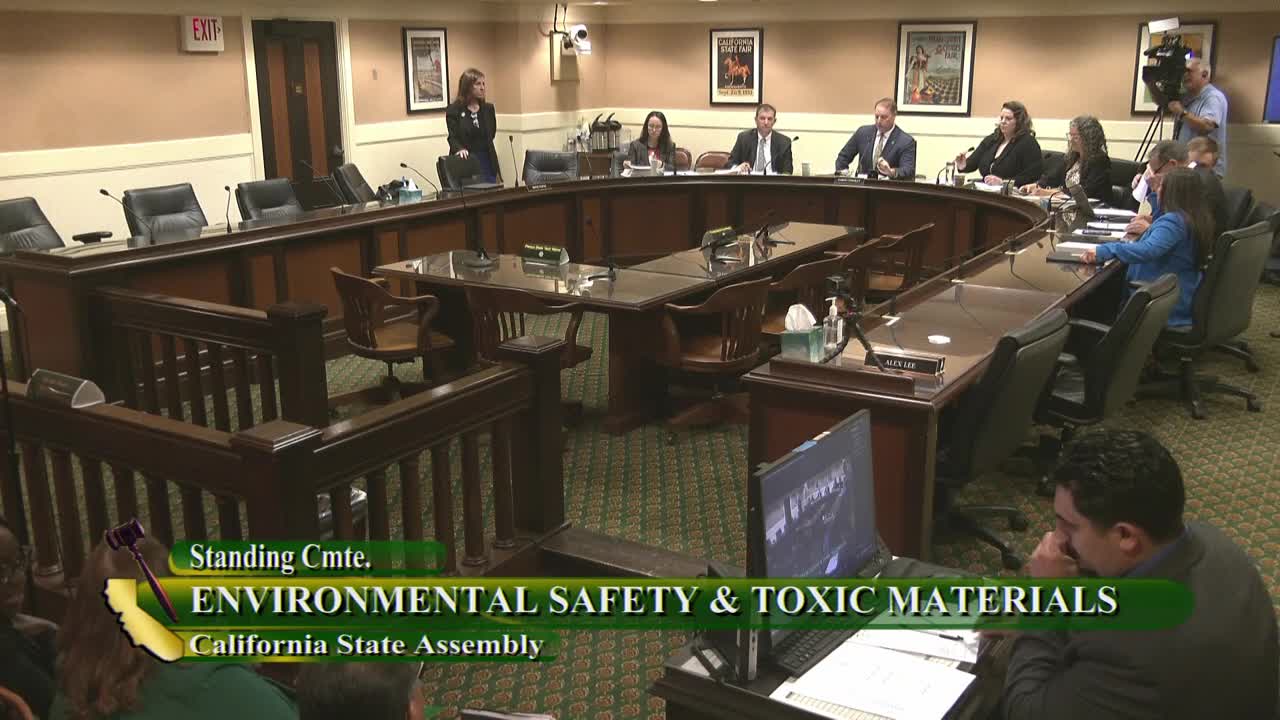 33MIN
Assembly Standing Committee on Environmental Safety and Toxic Materials
Bill Author

Bill Co-Author(s):
