AB 827: Voting: signature verification.
- Session Year: 2025-2026
- House: Assembly
- Latest Version Date: 2025-10-03
Current Status:
Passed
(2025-10-03: Chaptered by Secretary of State - Chapter 279, Statutes of 2025.)
Introduced
In Committee
Awaiting First Chamber Vote
Passed First Chamber
In Committee
Awaiting Second Chamber Vote
Passed Second Chamber
Enacted
What does this bill do?
The bill changes how counties handle vote-by-mail envelopes when the voter’s signature doesn’t match, affecting mail voters and county election officials. For regularly scheduled statewide elections, counties must notify the voter within 14 days after the election and accept signature verification through 5 p.m. on day 22; for other elections the notice must be 8 days before certification and verification by 5 p.m. two days before certification. It also lets county offices use a post‑election drop box for verification forms, requires adding a matching untimely signature to the voter file for future use, and allows shorter daily canvass hours when only ballots awaiting signature fixes remain.
The summary is provided by generative AI which can make mistakes. For original language, please view the details in the table below.
(1)Existing law requires an elections official who receives a vote by mail ballot to compare the signature on the identification envelope with the signature in the voters registration record. If the signature does not compare, or if the identification envelope is missing the signature, the elections official must provide notice to the voter no later than 8 days before certification of the election of the voters opportunity to verify their signature. The voter may verify their signature no later than 5 p.m. 2 days before certification of the election, including, if applicable, by providing their signature on an unsigned identification statement.
This bill would reduce those deadlines for a regularly scheduled statewide election to no later than 14 calendar days after the election for the elections official to provide notice, and no later than 5 p.m. 22 calendar days after the election for the voter to verify their signature. For an election that is not a regularly scheduled statewide election, the bill would reduce those deadlines to 8 calendar days before certification of the election for the elections official to provide notice, and no later than 5 p.m. 2 calendar days before certification of the election for the voter to verify their signature. The bill would permit an elections official to use a vote by mail ballot drop box to receive the form used by the voter to verify their signature pursuant to these provisions. The bill would require an elections official who receives a completed unsigned identification statement that is not timely submitted to compare the signatures and, if the signatures compare, add the signature to the voters registration record for use in future elections.
(2)Existing law requires the official canvass of an election to commence no later than the Thursday following the election, as specified, and to continue daily, with the exception of Saturdays, Sundays, and holidays, for not less than 6 hours each day until completed.
This bill would specify that if the only ballots left to count are those for which a voter has been provided, or will be provided, the opportunity to verify or to provide their signature, and the elections official does not need to conduct the official canvas for at least 6 hours per day in order to meet the deadline for certification of the results, then the canvass may be conducted for fewer than 6 hours per day until completed.
(3)This bill would incorporate additional changes to Section 2194 of the Elections Code proposed by AB 1392 to be operative only if this bill and AB 1392 are enacted and this bill is enacted last.
The bill would also incorporate additional changes to Section 3019 of the Elections Code proposed by SB 3 to be operative only if this bill and SB 3 are enacted and this bill is enacted last.
(4)By imposing new duties on local elections officials, the bill would create a state-mandated local program.
The California Constitution requires the state to reimburse local agencies and school districts for certain costs mandated by the state. Statutory provisions establish procedures for making that reimbursement.
This bill would provide that, if the Commission on State Mandates determines that the bill contains costs mandated by the state, reimbursement for those costs shall be made pursuant to the statutory provisions noted above.
(1)Existing law requires an elections official who receives a vote by mail ballot to compare the signature on the identification envelope with the signature in the voters registration record. If the signature does not compare, or if the identification envelope is missing the signature, the elections official must provide notice to the voter no later than 8 days before certification of the election of the voters opportunity to verify their signature. The voter may verify their signature no later than 5 p.m. 2 days before certification of the election, including, if applicable, by providing their signature on an unsigned identification statement.
This bill would reduce those deadlines for a regularly scheduled statewide election to no later than 14 calendar days after the election for the elections official to provide notice, and no later than 5 p.m. 22 calendar days after the election for the voter to verify their signature. For an election that is not a regularly scheduled statewide election, the bill would reduce those deadlines to 8 calendar days before certification of the election for the elections official to provide notice, and no later than 5 p.m. 2 calendar days before certification of the election for the voter to verify their signature. The bill would permit an elections official to use a vote by mail ballot drop box to receive the form used by the voter to verify their signature pursuant to these provisions. The bill would require an elections official who receives a completed unsigned identification statement that is not timely submitted to compare the signatures and, if the signatures compare, add the signature to the voters registration record for use in future elections.
(2)Existing law requires the official canvass of an election to commence no later than the Thursday following the election, as specified, and to continue daily, with the exception of Saturdays, Sundays, and holidays, for not less than 6 hours each day until completed.
This bill would specify that if the only ballots left to count are those for which a voter has been provided, or will be provided, the opportunity to verify or to provide their signature, and the elections official does not need to conduct the official canvas for at least 6 hours per day in order to meet the deadline for certification of the results, then the canvass may be conducted for fewer than 6 hours per day until completed.
(3)This bill would incorporate additional changes to Section 2194 of the Elections Code proposed by AB 1392 to be operative only if this bill and AB 1392 are enacted and this bill is enacted last.
The bill would also incorporate additional changes to Section 3019 of the Elections Code proposed by SB 3 to be operative only if this bill and SB 3 are enacted and this bill is enacted last.
(3)(4)By imposing new duties on local elections officials, the bill would create a state-mandated local program.
The California Constitution requires the state to reimburse local agencies and school districts for certain costs mandated by the state. Statutory provisions establish procedures for making that reimbursement.
This bill would provide that, if the Commission on State Mandates determines that the bill contains costs mandated by the state, reimbursement for those costs shall be made pursuant to the statutory provisions noted above.
(1)Existing law requires an elections official who receives a vote by mail ballot to compare the signature on the identification envelope with the signature in the voters registration record. If the signature does not compare, or if the identification envelope is missing the signature, the elections official must provide notice to the voter no later than 8 days before certification of the election of the voters opportunity to verify their signature. The voter may verify their signature no later than 5 p.m. 2 days before certification of the election, including, if applicable, by providing their signature on an unsigned identification statement.
This bill would reduce those deadlines for a regularly scheduled statewide election to no later than 14 calendar days after the election for the elections official to provide notice, and no later than 5 p.m. 22 calendar days after the election for the voter to verify their signature. For an election that is not a regularly scheduled statewide election, the bill would reduce those deadlines to 8 calendar days before certification of the election for the elections official to provide notice, and no later than 5 p.m. 2 calendar days before certification of the election for the voter to verify their signature. The bill would permit an elections official to use a vote by mail ballot drop box to receive the form used by the voter to verify their signature pursuant to these provisions. The bill would require an elections official who receives a completed unsigned identification statement that is not timely submitted to compare the signatures and, if the signatures compare, add the signature to the voters registration record for use in future elections.
(2)Existing law requires the official canvass of an election to commence no later than the Thursday following the election, as specified, and to continue daily, with the exception of Saturdays, Sundays, and holidays, for not less than 6 hours each day until completed.
This bill would specify that if the only ballots left to count are those for which a voter has been provided, or will be provided, the opportunity to verify or to provide their signature, and the elections official does not need to conduct the official canvas for at least 6 hours per day in order to meet the deadline for certification of the results, then the canvass may be conducted for fewer than 6 hours per day until completed.
(3)By imposing new duties on local elections officials, the bill would create a state-mandated local program.
The California Constitution requires the state to reimburse local agencies and school districts for certain costs mandated by the state. Statutory provisions establish procedures for making that reimbursement.
This bill would provide that, if the Commission on State Mandates determines that the bill contains costs mandated by the state, reimbursement for those costs shall be made pursuant to the statutory provisions noted above.
(1)Existing law requires an elections official who receives a vote by mail ballot to compare the signature on the identification envelope with the signature in the voters registration record. If the signature does not compare, or if the identification envelope is missing the signature, the elections official must provide notice to the voter no later than 8 days before certification of the election of the voters opportunity to verify their signature. The voter may verify their signature no later than 5 p.m. 2 days before certification of the election, including, if applicable, by providing their signature on an unsigned identification statement.
This bill would reduce those deadlines to no later than 14 calendar days after the election for the elections official to provide notice, and no later than 5 p.m. 22 calendar days after the election for the voter to verify their signature. The bill would permit an elections official to use a vote by mail ballot drop box to receive the form used by the voter to verify their signature pursuant to these provisions. The bill would require an elections official who receives a completed unsigned identification statement that is not timely submitted to compare the signatures and, if the signatures compare, add the signature to the voters registration record for use in future elections. By imposing new duties on local elections officials, this bill would create a state-mandated local program.
(2)Existing law requires the official canvass of an election to commence no later than the Thursday following the election, as specified, and to continue daily, with the exception of Saturdays, Sundays, and holidays, for not less than 6 hours each day until completed.
This bill would specify that if the only ballots left to count are those for which a voter has been provided, or will be provided, the opportunity to verify or to provide their signature, and the elections official does not need to conduct the official canvas for at least 6 hours per day in order to meet the deadline for certification of the results, then the canvass may be conducted for fewer than 6 hours per day until completed.
(3)By imposing new duties on local elections officials, the bill would create a state-mandated local program.
The California Constitution requires the state to reimburse local agencies and school districts for certain costs mandated by the state. Statutory provisions establish procedures for making that reimbursement.
This bill would provide that, if the Commission on State Mandates determines that the bill contains costs mandated by the state, reimbursement for those costs shall be made pursuant to the statutory provisions noted above.
Existing law requires an elections official, upon receiving a vote by mail ballot, to compare the signature on the identification envelope with the voters signature appearing on specified voter registration records. If an elections official determines that a voter has failed to sign the identification envelope, the elections official is prohibited from rejecting the vote by mail ballot if the voter signs the envelope at the office of the elections official or completes and submits an unsigned identification envelope statement, as specified. Existing law requires an elections official to accept any completed unsigned identification envelope statement that is timely submitted, as specified.
This bill would require an elections official who receives a completed unsigned identification statement that is not timely submitted to compare the signatures and, if the signatures compare, add the signature to the voters registration record for use in future elections. By imposing new duties on local elections officials, this bill would create a state-mandated local program.
The California Constitution requires the state to reimburse local agencies and school districts for certain costs mandated by the state. Statutory provisions establish procedures for making that reimbursement.
This bill would provide that, if the Commission on State Mandates determines that the bill contains costs mandated by the state, reimbursement for those costs shall be made pursuant to the statutory provisions noted above.
(a)Except as provided in Section 2194.1, the affidavit of voter registration information identified in Section 7924.000 of the Government Code:
(1)Shall be confidential and shall not appear on any computer terminal, list, affidavit, duplicate affidavit, or other medium routinely available to the public at the county elections officials office.
(2)Shall not be used for any personal, private, or commercial purpose, including, but not limited to:
(A)The harassment of any voter or voters household.
(B)The advertising, solicitation, sale, or marketing of products or services to any voter or voters household.
(C)Reproduction in print, broadcast visual or audio, or display on the internet or any computer terminal unless pursuant to paragraph (3).
(3)Shall be provided with respect to any voter, subject to the provisions of Sections 2166, 2166.5, 2166.7, 2166.8, and 2188, to any candidate for federal, state, or local office, to any committee for or against any initiative or referendum measure for which legal publication is made, and to any person for election, scholarly, journalistic, or political purposes, or for governmental purposes, as determined by the Secretary of State.
(4)May be used by the Secretary of State for the purpose of educating voters pursuant to Section 12173 of the Government Code.
(b)(1)Notwithstanding any other law, the California drivers license number, the California identification card number, the social security number, and any other unique identifier used by the State of California for purposes of voter identification shown on the affidavit of voter registration of a registered voter, or added to voter registration records to comply with the requirements of the federal Help America Vote Act of 2002 (52 U.S.C. Sec. 20901 et seq.), are confidential and shall not be disclosed to any person.
(2)Notwithstanding any other law, the signature of the voter shown on the affidavit of voter registration or an image thereof is confidential and shall not be disclosed to any person, except as provided in subdivision (c).
(c)(1)The home address or signature of any voter shall be released whenever the persons vote is challenged pursuant to Sections 15105 to 15108, inclusive, or Article 3 (commencing with Section 14240) of Chapter 3 of Division 14. The address or signature shall be released only to the challenger, to elections officials, and to other persons as necessary to make, defend against, or adjudicate the challenge.
(2)An elections official shall permit a person to view the signature of a voter for the purpose of determining whether the signature compares with a signature on an affidavit of registration or an image thereof or a petition, but shall not permit a signature to be copied.
(d)A governmental entity, or officer or employee thereof, shall not be held civilly liable as a result of disclosure of the information referred to in this section, unless by a showing of gross negligence or willfulness.
(e)For purposes of this section, voters household is defined as the voters place of residence or mailing address or any persons who reside at the place of residence or use the mailing address as supplied on the affidavit of registration pursuant to paragraphs (3) and (4) of subdivision (a) of Section 2150.
(f)(1)Notwithstanding any other law, information regarding voters who did not sign a vote by mail ballot identification envelope or whose signature on the vote by mail ballot identification envelope did not compare with the voters signature on file shall be treated as confidential voter registration information pursuant to this section and Section 7924.000 of the Government Code. This information shall be provided with respect to any voter, subject to the provisions of Sections 2166, 2166.5, 2166.7, 2166.8, and 2188, to any candidate for federal, state, or local office, to any committee for or against any initiative or referendum measure for which legal publication is made, and to any person for election, scholarly, journalistic, or political purposes, or for governmental purposes, as determined by the Secretary of State, but otherwise shall not be disclosed to any person. Any disclosure of this information shall be accompanied by a notice to the recipient regarding Sections 18109 and 18540.
(2)Voter information provided pursuant to this subdivision shall be updated daily, include the name of the voter, and be provided in a searchable electronic format. The daily update shall also include, as applicable, information regarding whether a form has been received from the voter to verify their signature pursuant to subdivision (d) of Section 3019, whether a form has been received or the voter has otherwise provided a signature pursuant to subdivision (e) of Section 3019, and whether the signature provided pursuant to subdivision (d) or (e) of Section 3019 did or did not compare.
SEC. 1.5.Section 2194 of the Elections Code is amended to read:2194.(a)Except as provided in Section 2194.1, the affidavit of voter registration information identified in Section 7924.000 of the Government Code:
(1)Shall be confidential and shall not appear on any computer terminal, list, affidavit, duplicate affidavit, or other medium routinely available to the public at the county elections officials office.
(2)Shall not be used for any personal, private, or commercial purpose, including, but not limited to:
(A)The harassment of any voter or voters household.
(B)The advertising, solicitation, sale, or marketing of products or services to any voter or voters household.
(C)Reproduction in print, broadcast visual or audio, or display on the internet or any computer terminal unless pursuant to paragraph (3).
(3)Shall be provided with respect to any voter, subject to the provisions of Sections 2166, 2166.5, 2166.7, 2166.8, 2166.9, and 2188, to any candidate for federal, state, or local office, to any committee for or against any initiative or referendum measure for which legal publication is made, and to any person for election, scholarly, journalistic, or political purposes, or for governmental purposes, as determined by the Secretary of State.
(4)May be used by the Secretary of State for the purpose of educating voters pursuant to Section 12173 of the Government Code.
(b)(1)Notwithstanding any other law, the California drivers license number, the California identification card number, the social security number, and any other unique identifier used by the State of California for purposes of voter identification shown on the affidavit of voter registration of a registered voter, or added to voter registration records to comply with the requirements of the federal Help America Vote Act of 2002 (52 U.S.C. Sec. 20901 et seq.), are confidential and shall not be disclosed to any person.
(2)Notwithstanding any other law, the signature of the voter shown on the affidavit of voter registration or an image thereof is confidential and shall not be disclosed to any person, except as provided in subdivision (c).
(c)(1)The home address or signature of any voter shall be released whenever the persons vote is challenged pursuant to Sections 15105 to 15108, inclusive, or Article 3 (commencing with Section 14240) of Chapter 3 of Division 14. The address or signature shall be released only to the challenger, to elections officials, and to other persons as necessary to make, defend against, or adjudicate the challenge.
(2)An elections official shall permit a person to view the signature of a voter for the purpose of determining whether the signature compares with a signature on an affidavit of registration or an image thereof or a petition, but shall not permit a signature to be copied.
(d)A governmental entity, or officer or employee thereof, shall not be held civilly liable as a result of disclosure of the information referred to in this section, unless by a showing of gross negligence or willfulness.
(e)For purposes of this section, voters household is defined as the voters place of residence or mailing address or any persons who reside at the place of residence or use the mailing address as supplied on the affidavit of registration pursuant to paragraphs (3) and (4) of subdivision (a) of Section 2150.
(f)(1)Notwithstanding any other law, information regarding voters who did not sign a vote by mail ballot identification envelope or whose signature on the vote by mail ballot identification envelope did not compare with the voters signature on file shall be treated as confidential voter registration information pursuant to this section and Section 7924.000 of the Government Code. This information shall be provided with respect to any voter, subject to the provisions of Sections 2166, 2166.5, 2166.7, 2166.8, 2166.9, and 2188, to any candidate for federal, state, or local office, to any committee for or against any initiative or referendum measure for which legal publication is made, and to any person for election, scholarly, journalistic, or political purposes, or for governmental purposes, as determined by the Secretary of State, but otherwise shall not be disclosed to any person. Any disclosure of this information shall be accompanied by a notice to the recipient regarding Sections 18109 and 18540.
(2)Voter information provided pursuant to this subdivision shall be updated daily, include the name of the voter, and be provided in a searchable electronic format. The daily update shall also include, as applicable, information regarding whether a form has been received from the voter to verify their signature pursuant to subdivision (d) of Section 3019, whether a form has been received or the voter has otherwise provided a signature pursuant to subdivision (e) of Section 3019, and whether the signature provided pursuant to subdivision (d) or (e) of Section 3019 did or did not compare.
SEC. 2.Section 3019 of the Elections Code is amended to read:3019.(a)(1)Upon receiving a vote by mail ballot, the elections official shall compare the signature on the identification envelope with either of the following to determine if the signatures compare:
(A)The signature appearing on the voters affidavit of registration or any previous affidavit of registration of the voter.
(B)The signature appearing on a form issued by an elections official that contains the voters signature and that is part of the voters registration record.
(2)All of the following apply to the comparison of signatures pursuant to this section, including the comparison of a voters signature on a signature verification statement, an unsigned identification envelope statement, or a combined vote by mail ballot signature verification statement and unsigned identification envelope statement, with the signature that is part of the voters registration record:
(A)A presumption exists that the signature on the identification envelope, signature verification statement, unsigned identification envelope statement, or provisional ballot envelope is the voters signature.
(B)An exact match is not required for an elections official to determine that a voters signature is valid. The fact that signatures share similar characteristics is sufficient to determine that a signature is valid.
(C)Except as provided in subparagraph (D), the elections official shall consider explanations for discrepancies between signatures that are specified in regulations promulgated by the Secretary of State. For purposes of this subparagraph, explanations include a variation in signature style over time and the haste with which a signature is written.
(D)When comparing signatures, an elections official shall not review or consider a voters party preference, race, or ethnicity.
(E)The elections official may consider characteristics of the written signature that are specified in regulations promulgated by the Secretary of State. For purposes of this subparagraph, characteristics include the slant of the signature, letter formation, and whether the signature is printed or written in cursive.
(F)The elections official may use facsimiles of voters signatures, provided that the method of preparing and displaying the facsimiles complies with the law.
(G)In comparing signatures pursuant to this section, an elections official may use signature verification technology. If signature verification technology determines that the signatures do not compare, the signature is subject to the additional procedures described in paragraph (2) of subdivision (c).
(H)The variation of a signature caused by the substitution of initials for the first or middle name, or both, is not grounds for the elections official to determine that the signatures do not compare.
(I)A signature made using a mark such as an X, or made by a signature stamp, shall be presumed valid and shall be accepted if the signature meets the requirements of Section 354.5.
(b)If upon conducting the comparison of signatures pursuant to subdivision (a) the elections official determines that the signatures compare, the elections official shall deposit the ballot, still in the identification envelope, in a ballot container in the elections officials office.
(c)(1)If upon conducting the comparison of signatures pursuant to subdivision (a) the elections official determines that the signature possesses multiple, significant, and obvious differing characteristics when compared to all signatures in the voters registration record, the signature is subject to the additional procedures described in paragraph (2).
(2)If the elections official makes the determination described in paragraph (1), the signature shall be rejected only if two additional elections officials each find beyond a reasonable doubt that the signature differs in multiple, significant, and obvious respects from all signatures in the voters registration record. If the officials determine that the signatures do not compare, the identification envelope shall not be opened and the ballot shall not be counted. The elections official shall write the cause of the rejection on the face of the identification envelope only after completing the procedures described in subdivision (d).
(d)(1)(A)Except as provided in subparagraph (E), on or before the next business day after a determination that a voters signature does not compare pursuant to subdivision (c), but not later than the applicable notification deadline after the election, the elections official shall send by first-class mail notice to the voter of the opportunity to verify the voters signature no later than 5 p.m. on the day of the applicable receipt deadline after the election. The notice shall include a return envelope, with postage paid, for the voter to return a signature verification statement.
(B)If an elections official has a telephone number or email address on file for a voter whose signature does not compare pursuant to subdivision (c), the elections official shall notify the voter by telephone, a text message, or email of the opportunity to verify the voters signature. If an elections official calls the voter and the voter does not answer, the elections official shall attempt to leave a voicemail message.
(C)Unless required pursuant to Section 3026, the elections official may send additional written notices to a voter identified pursuant to subdivision (c), and may also notify the voter in person or by other means of the opportunity to verify the voters signature.
(D)Unless required pursuant to Section 3026, the elections official may use any information in a countys election management system, or otherwise in the elections officials possession, for the purpose of notifying the voter of the opportunity to verify the voters signature.
(E)If it is impracticable under the circumstances for the elections official to send the notice described in subparagraph (A) on or before the next business day, including in the event of technological failure, the elections official shall send the notice as soon as practicable, but not later than the applicable notification deadline after the election.
(2)The notice and instructions shall be in substantially the following form. The elections official shall insert the date of the applicable receipt deadline after the election where indicated on the form.
READ THESE INSTRUCTIONS CAREFULLY. FAILURE TO FOLLOW THESE INSTRUCTIONS MAY CAUSE YOUR VOTE BY MAIL BALLOT NOT TO COUNT. | |
1. We have determined that the signature you provided on your vote by mail ballot does not compare with the signature(s) on file in your voter record. In order to ensure that your vote by mail ballot will be counted, the signature verification statement must be completed and returned as soon as possible. | |
2. The signature verification statement must be received by the elections official of the county where you are registered to vote no later than 5 p.m. on [elections official to insert date of the applicable receipt deadline after the election]. | |
3. You must sign your name where specified on the signature verification statement (Voters Signature). | |
4. Place the signature verification statement into the postage-paid return envelope if it is included with these instructions. If a return envelope is not included with these instructions, use your own mailing envelope addressed to your local elections official. Mail, deliver, or have the completed statement delivered to the elections official. If you mail your completed statement using your own envelope, be sure there is sufficient postage and that the address of the elections official is correct. | |
5. If you do not wish to send the signature verification statement by mail or have it delivered, you may submit your completed statement by email or facsimile transmission to your local elections official, or by other electronic means made available by your local elections official, or submit your completed statement to a polling place within the county or a ballot dropoff box before the close of the polls on election day. |
(3)The notice and instructions shall be translated in all languages required in that county by Section 203 of the federal Voting Rights Act of 1965 (52 U.S.C. Sec. 10503).
(4)The elections official shall not reject a vote by mail ballot identified pursuant to subdivision (c) if each of the following conditions are satisfied:
(A)The voter delivers, in person, by mail, by fax, by email, or by other means, a signature verification statement signed by the voter and the elections official receives the statement no later than 5 p.m. on the day of the applicable receipt deadline after the election, or the voter, before the close of the polls on election day, completes and submits a signature verification statement to a polling place within the county or a ballot dropoff box.
(B)Upon receipt of the signature verification statement, the elections official shall compare the signature on the statement with the signature on file in the voters record. The elections official shall not delay the comparison until later in the canvass.
(i)If upon conducting the comparison of signatures the elections official determines that the signatures compare, the elections official shall deposit the ballot, still in the identification envelope, in a ballot container in the elections officials office.
(ii)If, under the standards and procedures of subdivision (c), a determination is made that the signatures do not compare, the identification envelope shall not be opened and the ballot shall not be counted. The elections official shall write the cause of the rejection on the face of the identification envelope.
(5)The signature verification statement shall be in substantially the following form and may be included on the same page as the notice and instructions specified in paragraph (2):
SIGNATURE VERIFICATION STATEMENT | |
I,, am a registered voter of __________ County, | |
State of California. I declare under penalty of perjury that I received and returned a vote by mail ballot. I am a resident of the precinct in which I have voted, and I am the person whose name appears on the vote by mail ballot envelope. I understand that if I commit or attempt any fraud in connection with voting, or if I aid or abet fraud or attempt to aid or abet fraud in connection with voting, I may be convicted of a felony punishable by imprisonment for 16 months or two or three years. I understand that my failure to sign this statement means that my vote by mail ballot will be invalidated. | |
Voters Signature | |
Address |
(6)If the elections official determines that the signatures compare, the official shall use the signature in the signature verification statement, even if returned untimely, to update the voters signature for future elections, including updating the signature database.
(e)(1)(A)Notwithstanding any other law, if an elections official determines that a voter has failed to sign the identification envelope, the elections official shall not reject the vote by mail ballot if the voter does any of the following:
(i)Signs the identification envelope at the office of the elections official during regular business hours no later than 5 p.m. on the day of the applicable receipt deadline after the election.
(ii)No later than 5 p.m. on the day of the applicable receipt deadline after the election, completes and submits an unsigned identification envelope statement in substantially the following form:
UNSIGNED IDENTIFICATION ENVELOPE STATEMENT | |
I,, am a registered voter of __________ County, | |
State of California. I declare under penalty of perjury that I received and returned a vote by mail ballot and that I have not and will not vote more than
one ballot in this election. I am a resident of the precinct in which I have voted, and I am the person whose name appears on the vote by mail ballot envelope. I understand that if I commit or attempt any fraud in connection with voting, or if I aid or abet fraud or attempt to aid or abet fraud in connection with voting, I may be convicted of a felony punishable by imprisonment for 16 months or two or three years. I understand that my failure to sign this statement means that my vote by mail ballot will be invalidated. | |
Voters Signature | |
Address |
(iii)Before the close of the polls on election day, completes and submits an unsigned identification envelope statement, in the form described in clause (ii), to a polling place within the county or a ballot dropoff box.
(B)(i)Except as provided in clause (v), or before the next business day after discovering that a voter has failed to sign the identification envelope, but not later than the applicable notification deadline after the election, the elections official shall send by first-class mail notice and instructions to the voter of the opportunity to provide a signature no later than 5 p.m. on the day of the applicable receipt deadline after the election. The notice shall include a return envelope, with postage paid, for the voter to return the unsigned identification envelope statement.
(ii)If an elections official has a telephone number or email address on file for a voter who has failed to sign the identification envelope, the elections official shall notify the voter by telephone, a text message, or email of the opportunity to provide a signature. If an elections official calls the voter and the voter does not answer, the elections official shall attempt to leave a voicemail message.
(iii)Unless required pursuant to Section 3026, the elections official may send additional written notices to a voter identified pursuant to this subdivision, and may also notify the voter in person or by other means of the opportunity to provide a signature.
(iv)Unless required pursuant to Section 3026, the elections official may use any information in the countys election management system, or otherwise in the elections officials possession, for the purpose of notifying the voter of the opportunity to provide a signature.
(v)If it is impracticable under the circumstances for the elections official to send the notice described in clause (i) on or before the next business day, including in the event of technological failure, the elections official shall send the notice as soon as practicable, but not later than the applicable notification deadline after the election.
(C)If timely submitted, the elections official shall accept any completed unsigned identification envelope statement. Upon receipt of the unsigned identification envelope statement, the elections official shall compare the voters signature on the statement in the manner provided by this section. The elections official shall not delay the comparison until later in the canvass.
(i)If the elections official determines that the signatures compare, the elections official shall attach the unsigned identification envelope statement to the identification envelope and deposit the ballot, still in the identification envelope, in a ballot container in the elections officials office.
(ii)If, under the standards and procedures of subdivision (c), a determination is made that the signatures do not compare, the identification envelope shall not be opened and the elections official shall provide notice to the voter pursuant to subdivisions (c) and (d).
(D)An elections official may use methods other than those described in subparagraph (A) to obtain a voters signature on an unsigned identification envelope statement.
(E)If the elections official determines that the signatures compare, the official shall use the signature in the unsigned identification envelope statement, even if returned untimely, to update the voters signature for future elections, including updating the signature database.
(2)Instructions shall accompany the unsigned identification envelope statement in substantially the following form. The elections official shall insert the date of the applicable receipt deadline after the election where indicated on the form.
READ THESE INSTRUCTIONS CAREFULLY BEFORE COMPLETING THE STATEMENT. FAILURE TO FOLLOW THESE INSTRUCTIONS MAY CAUSE YOUR BALLOT NOT TO COUNT. | |
1. In order to ensure that your vote by mail ballot will be counted, your statement should be completed and returned as soon as possible, but no later than 5 p.m. on [elections official to insert date of the applicable receipt deadline after the election]. | |
2. You must sign your name on the line above (Voters Signature). | |
3.Place the statement into the postage-paid return envelope if it is included with these instructions. If a return envelope is not included with these instructions, use your own mailing envelope addressed to your local elections official. Mail, deliver, or have delivered the completed statement to the elections official. If you mail your completed statement using your own envelope, be sure there is sufficient postage and that the address of the elections official is correct. | |
4. If you do not wish to send the statement by mail or have it delivered, you may submit your completed statement by facsimile or email transmission to your local elections official, or by other electronic means made available by your local elections official, or submit your completed statement to a polling place within the county or a ballot dropoff box before the close of the polls on election day. |
(3)The notice and instructions shall be translated in all languages required in that county by Section 203 of the federal Voting Rights Act of 1965 (52 U.S.C. Sec. 10503).
(f)An elections official shall include a single, combined vote by mail ballot signature verification statement and unsigned ballot identification envelope statement, along with the instructions provided in this section for the completion of the statement, on the elections officials internet website and shall provide the elections officials mailing address, email address, and facsimile transmission number on the internet webpage containing the statement and instructions. The elections official shall accept the combined statement from a voter for the purpose of satisfying the requirements of paragraph (4) of subdivision (d) or subparagraph (C) of paragraph (1) of subdivision (e). An elections official may mail the combined statement to a voter pursuant to subdivision (d) or (e) in lieu of the signature verification statement or unsigned ballot identification envelope statement.
(g)A local elections official offering other electronic means for submission of a statement described in this section shall establish appropriate privacy and security protocols that ensure that the information transmitted is received directly and securely by the elections official and is only used for the stated purposes of verifying the signature on the voters ballot.
(h)A ballot shall not be removed from its identification envelope until the time for processing ballots. A ballot shall not be rejected for cause after the identification envelope has been opened.
(i)For purposes of this section, certification of the election means the date the particular elections official submits a certified statement of the results of the election to the governing body pursuant to Section 15372, even if that occurs before the deadline to submit the certified statement of the election results set forth in Section 15372.
(j)For purposes of this section, the following terms have the following meanings:
(1)For a regularly scheduled statewide election, applicable notification deadline means 14 calendar days after the election and applicable receipt deadline means 22 calendar days after the election.
(2)For an election that is not a regularly scheduled statewide election, applicable notification deadline means eight calendar days before certification of the election and applicable receipt deadline means two calendar days before certification of the election.
(k)In comparing signatures pursuant to this section, including when using signature verification software or other technology, an elections official shall adhere to all applicable regulations promulgated by the Secretary of State.
(l)An elections official is authorized to use contact information provided on a voters affidavit of registration to contact a voter for purposes consistent with this section.
(m)An elections official that places a vote by mail ballot drop box, as defined in Section 3025, at their office location to receive ballots, shall also use that drop box after the election in order to receive the form by which the voter provides a signature pursuant to subdivision (d) or (e), as applicable, provided that the drop box used after the election contains a clear and conspicuous label that it is to be used for this limited purpose and not for acceptance of late ballots.
(n)Notwithstanding Section 15 or any other law, if the last day for the performance of any act provided for or required by this section is a holiday, as defined in Chapter 7 (commencing with Section 6700) of Division 7 of Title 1 of the Government Code, the deadline to perform the act shall not be continued to the next business day.
SEC. 2.5.Section 3019 of the Elections Code is amended to read:3019.(a)(1)Upon receiving a vote by mail ballot, the elections official shall compare the signature on the identification envelope with either of the following to determine if the signatures compare:
(A)The signature appearing on the voters affidavit of registration or any previous affidavit of registration of the voter.
(B)The signature appearing on a form issued by an elections official that contains the voters signature and that is part of the voters registration record.
(2)All of the following apply to the comparison of signatures pursuant to this section, including the comparison of a voters signature on a signature verification statement, an unsigned identification envelope statement, or a combined vote by mail ballot signature verification statement and unsigned identification envelope statement, with the signature that is part of the voters registration record:
(A)A presumption exists that the signature on the identification envelope, signature verification statement, unsigned identification envelope statement, or provisional ballot envelope is the voters signature and that the vote will be counted.
(B)An exact match is not required for an elections official to determine that a voters signature is valid. The fact that signatures share similar characteristics is sufficient to determine that a signature is valid.
(C)Except as provided in subparagraph (D), the elections official shall consider explanations for discrepancies between signatures that are specified in regulations promulgated by the Secretary of State. For purposes of this subparagraph, explanations include a variation in signature style over time and the haste with which a signature is written.
(D)When comparing signatures, an elections official shall not review or consider any of the following:
(i)A voters party preference, race, or ethnicity.
(ii)A voters identifying information including gender, name, or address, except to confirm the identity of the voter.
(iii)The amount of time spent reviewing a signature.
(E)The elections official may consider characteristics of the written signature that are specified in regulations promulgated by the Secretary of State. For purposes of this subparagraph, characteristics include the slant of the signature, letter formation, and whether the signature is printed or written in cursive.
(F)The elections official may use facsimiles of voters signatures, provided that the method of preparing and displaying the facsimiles complies with the law.
(G)In comparing signatures pursuant to this section, an elections official may use signature verification technology. If signature verification technology determines that the signatures do not compare, the signature is subject to the additional procedures described in paragraph (2) of subdivision (c).
(H)The variation of a signature caused by the substitution of initials for the first or middle name, or both, is not grounds for the elections official to determine that the signatures do not compare.
(I)A signature made using a mark such as an X, or made by a signature stamp, shall be presumed valid and shall be accepted if the signature meets the requirements of Section 354.5.
(b)If upon conducting the comparison of signatures pursuant to subdivision (a) the elections official determines that the signatures compare, the elections official shall deposit the ballot, still in the identification envelope, in a ballot container in the elections officials office.
(c)(1)If upon conducting the comparison of signatures pursuant to subdivision (a) the elections official determines that the signature possesses multiple, significant, and obvious differing characteristics when compared to all signatures in the voters registration record, the signature is subject to the additional procedures described in paragraph (2).
(2)If the elections official makes the determination described in paragraph (1), the signature shall be rejected only if two additional elections officials each find beyond a reasonable doubt that the signature differs in multiple, significant, and obvious respects from all signatures in the voters registration record. If the officials determine that the signatures do not compare, the identification envelope shall not be opened and the ballot shall not be counted. The elections official shall write the cause of the rejection on the face of the identification envelope only after completing the procedures described in subdivision (d).
(d)(1)(A)Except as provided in subparagraph (E), on or before the next business day after a determination pursuant to paragraph (2) of subdivision (c) that a voters signature does not compare pursuant to subdivision (c), but not later than the applicable notification deadline after the election, the elections official shall send by first-class mail notice to the voter of the opportunity to verify the voters signature no later than 5 p.m. on the day of the applicable receipt deadline after the election. The notice shall include a return envelope, with postage paid, for the voter to return a signature verification statement.
(B)If an elections official has a telephone number or email address on file for a voter whose signature does not compare pursuant to subdivision (c), the elections official shall notify the voter by telephone, a text message, or email of the opportunity to verify the voters signature. If an elections official calls the voter and the voter does not answer, the elections official shall attempt to leave a voicemail message.
(C)Unless required pursuant to Section 3026, the elections official may send additional written notices to a voter identified pursuant to subdivision (c), and may also notify the voter in person or by other means of the opportunity to verify the voters signature.
(D)Unless required pursuant to Section 3026, the elections official may use any information in a countys election management system, or otherwise in the elections officials possession, for the purpose of notifying the voter of the opportunity to verify the voters signature.
(E)If it is impracticable under the circumstances for the elections official to send the notice described in subparagraph (A) on or before the next business day, including in the event of technological failure, the elections official shall send the notice as soon as practicable, but not later than the applicable notification deadline after the election.
(2)The notice and instructions shall be in substantially the following form. The elections official shall insert the date of the applicable receipt deadline after the election where indicated on the form.
READ THESE INSTRUCTIONS CAREFULLY. FAILURE TO FOLLOW THESE INSTRUCTIONS MAY CAUSE YOUR VOTE BY MAIL BALLOT NOT TO COUNT. | |
1. We have determined that the signature you provided on your vote by mail ballot does not compare with the signature(s) on file in your voter record. In order to ensure that your vote by mail ballot will be counted, the signature verification statement must be completed and returned as soon as possible. | |
2. The signature verification statement must be received by the elections official of the county where you are registered to vote no later than 5 p.m. on [elections official to insert date of the applicable receipt deadline after the election]. | |
3. You must sign your name where specified on the signature verification statement (Voters Signature). | |
4. Place the signature verification statement into the postage-paid return envelope if it is included with these instructions. If a return envelope is not included with these instructions, use your own mailing envelope addressed to your local elections official. Mail, deliver, or have the completed statement delivered to the elections official. If you mail your completed statement using your own envelope, be sure there is sufficient postage and that the address of the elections official is correct. | |
5. If you do not wish to send the signature verification statement by mail or have it delivered, you may submit your completed statement by email or facsimile transmission to your local elections official, or by other electronic means made available by your local elections official, or submit your completed statement to a polling place within the county or a ballot dropoff box before the close of the polls on election day. |
(3)The notice and instructions shall be translated in all languages required in that county by Section 203 of the federal Voting Rights Act of 1965 (52 U.S.C. Sec. 10503).
(4)The elections official shall not reject a vote by mail ballot identified pursuant to subdivision (c) if each of the following conditions are satisfied:
(A)The voter delivers, in person, by mail, by fax, by email, or by other means, a signature verification statement signed by the voter and the elections official receives the statement no later than 5 p.m. on the day of the applicable receipt deadline after the election, or the voter, before the close of the polls on election day, completes and submits a signature verification statement to a polling place within the county or a ballot dropoff box.
(B)Upon receipt of the signature verification statement, the elections official shall compare the signature on the statement with the signature on file in the voters record. The elections official shall not delay the comparison until later in the canvass.
(i)If upon conducting the comparison of signatures the elections official determines that the signatures compare, the elections official shall deposit the ballot, still in the identification envelope, in a ballot container in the elections officials office.
(ii)If, under the standards and procedures of subdivision (c), a determination is made that the signatures do not compare, the identification envelope shall not be opened and the ballot shall not be counted. The elections official shall write the cause of the rejection on the face of the identification envelope.
(5)The signature verification statement shall be in substantially the following form and may be included on the same page as the notice and instructions specified in paragraph (2):
SIGNATURE VERIFICATION STATEMENT | |
I,, am a registered voter of __________ County, | |
State of California. I declare under penalty of perjury that I received and returned a vote by mail ballot. I am a resident of the precinct in which I have voted, and I am the person whose name appears on the vote by mail ballot envelope. I understand that if I commit or attempt any fraud in connection with voting, or if I aid or abet fraud or attempt to aid or abet fraud in connection with voting, I may be convicted of a felony punishable by imprisonment for 16 months or two or three years. I understand that my failure to sign this statement means that my vote by mail ballot will be invalidated. | |
Voters Signature | |
Address |
(6)If the elections official determines that the signatures compare, the official shall use the signature in the signature verification statement, even if returned untimely, to update the voters signature for future elections, including updating the signature database.
(7)A voter may work with a nongovernmental entity to complete the requirements of this subdivision.
(8)The signature verification statement shall contain, where the voter signs, a statement that the county elections official is required to compare the voters signature appearing on the signature verification statement with the signatures appearing in the voters registration record, which may include the signature appearing on the voters drivers license or state identification card.
(e)(1)(A)Notwithstanding any other law, if an elections official determines that a voter has failed to sign the identification envelope, the elections official shall not reject the vote by mail ballot if the voter does any of the following:
(i)Signs the identification envelope at the office of the elections official during regular business hours no later than 5 p.m. on the day of the applicable receipt deadline after the election.
(ii)No later than 5 p.m. on the day of the applicable receipt deadline after the election, completes and submits an unsigned identification envelope statement in substantially the following form:
UNSIGNED IDENTIFICATION ENVELOPE STATEMENT | |
I,, am a registered voter of __________ County, | |
State of California. I declare under penalty of perjury that I received and returned a vote by mail ballot and that I have not and will not vote more than one ballot in this election. I am
a resident of the precinct in which I have voted, and I am the person whose name appears on the vote by mail ballot envelope. I understand that if I commit or attempt any fraud in connection with voting, or if I aid or abet fraud or attempt to aid or abet fraud in connection with voting, I may be convicted of a felony punishable by imprisonment for 16 months or two or three years. I understand that my failure to sign this statement means that my vote by mail ballot will be invalidated. | |
Voters Signature | |
Address |
(iii)Before the close of the polls on election day, completes and submits an unsigned identification envelope statement, in the form described in clause (ii), to a polling place within the county or a ballot dropoff box.
(B)(i)Except as provided in clause (v), or before the next business day after discovering that a voter has failed to sign the identification envelope, but not later than the applicable notification deadline after the election, the elections official shall send by first-class mail notice and instructions to the voter of the opportunity to provide a signature no later than 5 p.m. on the day of the applicable receipt deadline after the election. The notice shall include a return envelope, with postage paid, for the voter to return the unsigned identification envelope statement.
(ii)If an elections official has a telephone number or email address on file for a voter who has failed to sign the identification envelope, the elections official shall notify the voter by telephone, a text message, or email of the opportunity to provide a signature. If an elections official calls the voter and the voter does not answer, the elections official shall attempt to leave a voicemail message.
(iii)Unless required pursuant to Section 3026, the elections official may send additional written notices to a voter identified pursuant to this subdivision, and may also notify the voter in person or by other means of the opportunity to provide a signature.
(iv)Unless required pursuant to Section 3026, the elections official may use any information in the countys election management system, or otherwise in the elections officials possession, for the purpose of notifying the voter of the opportunity to provide a signature.
(v)If it is impracticable under the circumstances for the elections official to send the notice described in clause (i) on or before the next business day, including in the event of technological failure, the elections official shall send the notice as soon as practicable, but not later than the applicable notification deadline after the election.
(C)If timely submitted, the elections official shall accept any completed unsigned identification envelope statement. Upon receipt of the unsigned identification envelope statement, the elections official shall compare the voters signature on the statement in the manner provided by this section. The elections official shall not delay the comparison until later in the canvass.
(i)If the elections official determines that the signatures compare, the elections official shall attach the unsigned identification envelope statement to the identification envelope and deposit the ballot, still in the identification envelope, in a ballot container in the elections officials office.
(ii)If, under the standards and procedures of subdivision (c), a determination is made that the signatures do not compare, the identification envelope shall not be opened and the elections official shall provide notice to the voter pursuant to subdivisions (c) and (d).
(D)An elections official may use methods other than those described in subparagraph (A) to obtain a voters signature on an unsigned identification envelope statement.
(E)If the elections official determines that the signatures compare, the official shall use the signature in the unsigned identification envelope statement, even if returned untimely, to update the voters signature for future elections, including updating the signature database.
(2)Instructions shall accompany the unsigned identification envelope statement in substantially the following form. The elections official shall insert the date of the applicable receipt deadline after the election where indicated on the form.
READ THESE INSTRUCTIONS CAREFULLY BEFORE COMPLETING THE STATEMENT. FAILURE TO FOLLOW THESE INSTRUCTIONS MAY CAUSE YOUR BALLOT NOT TO COUNT. | |
1. In order to ensure that your vote by mail ballot will be counted, your statement should be completed and returned as soon as possible, but no later than 5 p.m. on [elections official to insert date of the applicable receipt deadline after the election]. | |
2. You must sign your name on the line above (Voters Signature). | |
3.Place the statement into the postage-paid return envelope if it is included with these instructions. If a return envelope is not included with these instructions, use your own mailing envelope addressed to your local elections official. Mail, deliver, or have delivered the completed statement to the elections official. If you mail your completed statement using your own envelope, be sure there is sufficient postage and that the address of the elections official is correct. | |
4. If you do not wish to send the statement by mail or have it delivered, you may submit your completed statement by facsimile or email transmission to your local elections official, or by other electronic means made available by your local elections official, or submit your completed statement to a polling place within the county or a ballot dropoff box before the close of the polls on election day. |
(3)The notice and instructions shall be translated in all languages required in that county by Section 203 of the federal Voting Rights Act of 1965 (52 U.S.C. Sec. 10503).
(4)A voter may work with a nongovernmental entity to complete the requirements of this subdivision.
(5)The identification envelope statement shall contain, where the voter signs, a statement that the county elections official is required to compare the voters signature appearing on the identification envelope statement with the signatures appearing in the voters registration record, which may include the signature appearing on the voters drivers license or state identification card.
(f)The Secretary of State shall publish on their internet website a single, combined vote by mail ballot signature verification statement and unsigned ballot identification envelope statement. An elections official shall include the combined statement developed by the Secretary of State, or a combined statement developed by the elections official that meets the requirements of this section, along with the instructions provided in this section for the completion of the statement, on the elections officials internet website and shall provide the elections officials mailing address, email address, and facsimile transmission number on the internet webpage containing the statement and instructions. The elections official shall accept the combined statement from a voter for the purpose of satisfying the requirements of paragraph (4) of subdivision (d) or subparagraph (C) of paragraph (1) of subdivision (e). An elections official may mail the combined statement to a voter pursuant to subdivision (d) or (e) in lieu of the signature verification statement or unsigned ballot identification envelope statement.
(g)A local elections official offering other electronic means for submission of a statement described in this section shall establish appropriate privacy and security protocols that ensure that the information transmitted is received directly and securely by the elections official and is only used for the stated purposes of verifying the signature on the voters ballot.
(h)A ballot shall not be removed from its identification envelope until the time for processing ballots. A ballot shall not be rejected for cause after the identification envelope has been opened.
(i)For purposes of this section, certification of the election means the date the particular elections official submits a certified statement of the results of the election to the governing body pursuant to Section 15372, even if that occurs before the deadline to submit the certified statement of the election results set forth in Section 15372.
(j)For purposes of this section, the following terms have the following meanings:
(1)For a regularly scheduled statewide election, applicable notification deadline means 14 calendar days after the election and applicable receipt deadline means 22 calendar days after the election.
(2)For an election that is not a regularly scheduled statewide election, applicable notification deadline means eight calendar days before certification of the election and applicable receipt deadline means two calendar days before certification of the election.
(k)In comparing signatures pursuant to this section, including when using signature verification software or other technology, an elections official shall adhere to all applicable regulations promulgated by the Secretary of State.
(l)An elections official is authorized to use contact information provided on a voters affidavit of registration to contact a voter for purposes consistent with this section.
(m)If an elections official establishes procedures that the official uses when comparing signatures pursuant to this section, the elections official shall post the procedures used on their internet website or provide them upon request at their office. In accordance with subdivision (k), any such procedures shall adhere to regulations promulgated by the Secretary of State.
(n)An elections official shall accept a form in satisfaction of the requirements of subdivision (d) or (e) if the form was developed by the Secretary of State or by an elections official pursuant to subdivision (d), (e), or (f). An elections official shall not accept a form created by any individual, organization, or entity other than the Secretary of State or an elections official.
(o)An elections official that places a vote by mail ballot drop box, as defined in Section 3025, at their office location to receive ballots, shall also use that drop box after the election in order to receive the form by which the voter provides a signature pursuant to subdivision (d) or (e), as applicable, provided that the drop box used after the election contains a clear and conspicuous label that it is to be used for this limited purpose and not for acceptance of late ballots.
(p)Notwithstanding Section 15 or any other law, if the last day for the performance of any act provided for or required by this section is a holiday, as defined in Chapter 7 (commencing with Section 6700) of Division 7 of Title 1 of the Government Code, the deadline to perform the act shall not be continued to the next business day.
SEC. 3.Section 3019.7 of the Elections Code is amended to read:3019.7.(a)The Secretary of State shall maintain a system to allow a vote by mail voter to track the voters vote by mail ballot through the mail system and as the vote by mail ballot is processed by the county elections official. A county elections official shall use this system unless the county makes available to voters a different vote by mail ballot tracking system that meets or exceeds the level of service provided by the Secretary of States system. The system shall, at a minimum, be accessible to voters with disabilities and allow a voter to register to receive information via email or text message from the county elections official about the status of the voters vote by mail ballot, including all of the following information:
(1)A notification when the ballot has been delivered by the county elections official to the United States Postal Service.
(2)A notification of the date, based on information from the United States Postal Service, that the voters ballot is expected to be delivered to the voter.
(3)A notification if the voters ballot is returned as undeliverable to the county elections official by the United States Postal Service.
(4)A notification when the voters completed ballot has been received by the county elections official.
(5)A notification that the voters completed ballot has been counted, or, if the ballot cannot be counted, a notification of the reason why the ballot could not be counted and instructions of any steps that the voter can take in order to have the ballot counted. If the ballot cannot be counted because the voters signature did not compare or the identification envelope is missing a signature, as described in subdivisions (c) and (e) of Section 3019, and the voter has opted in to receive notifications by text or email, the notification shall include an internet website link to the required form for verifying or providing a signature, as applicable, and instructions for completion.
(6)A reminder of the deadline for the voter to return the voters ballot if the county elections official has not received a voters completed ballot by specified dates as determined by the county elections official.
(b)The Secretary of State shall make the system maintained pursuant to subdivision (a) available for use by each county. A county elections official may use the system for the purpose of complying with Section 3019.5.
SEC. 4.Section 15301 of the Elections Code is amended to read:15301.(a)The canvass shall commence no later than the Thursday following the election, shall be open to the public, and, for state or statewide elections, shall result in a report of results to the Secretary of State.
(b)(1)Except as provided in paragraph (2), the canvass shall be continued daily, Saturdays, Sundays, and holidays excepted, for not less than six hours each day until completed.
(2)If the only ballots that the elections official has left to count as part of the official canvass are vote by mail ballots for which a voter has been provided, or will be provided, the opportunity to verify or to provide their signature pursuant to subdivision (d) or (e) of Section 3019, as applicable, and the elections official does not need to conduct the official canvass for at least six hours per day in order to meet the deadline for certification of results pursuant to this section and Section 15372, the official canvass may be conducted for fewer than six hours per day until completed.
SEC. 5.Section 1.5 of this bill incorporates amendments to Section 2194 of the Elections Code proposed by both this bill and Assembly Bill 1392. That section of this bill shall only become operative if (1) both bills are enacted and become effective on or before January 1, 2026, (2) each bill amends Section 2194 of the Elections Code, and (3) this bill is enacted after Assembly Bill 1392, in which case Section 1 of this bill shall not become operative.
SEC. 6.Section 2.5 of this bill incorporates amendments to Section 3019 of the Elections Code proposed by both this bill and Senate Bill 3. That section of this bill shall only become operative if (1) both bills are enacted and become effective on or before January 1, 2026, (2) each bill amends Section 3019 of the Elections Code, and (3) this bill is enacted after Senate Bill 3, in which case Section 2 of this bill shall not become operative.
SEC. 7.If the Commission on State Mandates determines that this act contains costs mandated by the state, reimbursement to local agencies and school districts for those costs shall be made pursuant to Part 7 (commencing with Section 17500) of Division 4 of Title 2 of the Government Code.
(a)Except as provided in Section 2194.1, the affidavit of voter registration information identified in Section 7924.000 of the Government Code:
(1)Shall be confidential and shall not appear on any computer terminal, list, affidavit, duplicate affidavit, or other medium routinely available to the public at the county elections officials office.
(2)Shall not be used for any personal, private, or commercial purpose, including, but not limited to:
(A)The harassment of any voter or voters household.
(B)The advertising, solicitation, sale, or marketing of products or services to any voter or voters household.
(C)Reproduction in print, broadcast visual or audio, or display on the internet or any computer terminal unless pursuant to paragraph (3).
(3)Shall be provided with respect to any voter, subject to the provisions of Sections 2166, 2166.5, 2166.7, 2166.8, and 2188, to any candidate for federal, state, or local office, to any committee for or against any initiative or referendum measure for which legal publication is made, and to any person for election, scholarly, journalistic, or political purposes, or for governmental purposes, as determined by the Secretary of State.
(4)May be used by the Secretary of State for the purpose of educating voters pursuant to Section 12173 of the Government Code.
(b)(1)Notwithstanding any other law, the California drivers license number, the California identification card number, the social security number, and any other unique identifier used by the State of California for purposes of voter identification shown on the affidavit of voter registration of a registered voter, or added to voter registration records to comply with the requirements of the federal Help America Vote Act of 2002 (52 U.S.C. Sec. 20901 et seq.), are confidential and shall not be disclosed to any person.
(2)Notwithstanding any other law, the signature of the voter shown on the affidavit of voter registration or an image thereof is confidential and shall not be disclosed to any person, except as provided in subdivision (c).
(c)(1)The home address or signature of any voter shall be released whenever the persons vote is challenged pursuant to Sections 15105 to 15108, inclusive, or Article 3 (commencing with Section 14240) of Chapter 3 of Division 14. The address or signature shall be released only to the challenger, to elections officials, and to other persons as necessary to make, defend against, or adjudicate the challenge.
(2)An elections official shall permit a person to view the signature of a voter for the purpose of determining whether the signature compares with a signature on an affidavit of registration or an image thereof or a petition, but shall not permit a signature to be copied.
(d)A governmental entity, or officer or employee thereof, shall not be held civilly liable as a result of disclosure of the information referred to in this section, unless by a showing of gross negligence or willfulness.
(e)For purposes of this section, voters household is defined as the voters place of residence or mailing address or any persons who reside at the place of residence or use the mailing address as supplied on the affidavit of registration pursuant to paragraphs (3) and (4) of subdivision (a) of Section 2150.
(f)(1)Notwithstanding any other law, information regarding voters who did not sign a vote by mail ballot identification envelope or whose signature on the vote by mail ballot identification envelope did not compare with the voters signature on file shall be treated as confidential voter registration information pursuant to this section and Section 7924.000 of the Government Code. This information shall be provided with respect to any voter, subject to the provisions of Sections 2166, 2166.5, 2166.7, 2166.8, and 2188, to any candidate for federal, state, or local office, to any committee for or against any initiative or referendum measure for which legal publication is made, and to any person for election, scholarly, journalistic, or political purposes, or for governmental purposes, as determined by the Secretary of State, but otherwise shall not be disclosed to any person. Any disclosure of this information shall be accompanied by a notice to the recipient regarding Sections 18109 and 18540.
(2)Voter information provided pursuant to this subdivision shall be updated daily, include the name of the voter, and be provided in a searchable electronic format. The daily update shall also include, as applicable, information regarding whether a form has been received from the voter to verify their signature pursuant to subdivision (d) of Section 3019, whether a form has been received or the voter has otherwise provided a signature pursuant to subdivision (e) of Section 3019, and whether the signature provided pursuant to subdivision (d) or (e) of Section 3019 did or did not compare.
SEC. 1.5.Section 2194 of the Elections Code is amended to read:2194.(a)Except as provided in Section 2194.1, the affidavit of voter registration information identified in Section 7924.000 of the Government Code:
(1)Shall be confidential and shall not appear on any computer terminal, list, affidavit, duplicate affidavit, or other medium routinely available to the public at the county elections officials office.
(2)Shall not be used for any personal, private, or commercial purpose, including, but not limited to:
(A)The harassment of any voter or voters household.
(B)The advertising, solicitation, sale, or marketing of products or services to any voter or voters household.
(C)Reproduction in print, broadcast visual or audio, or display on the internet or any computer terminal unless pursuant to paragraph (3).
(3)Shall be provided with respect to any voter, subject to the provisions of Sections 2166, 2166.5, 2166.7, 2166.8, 2166.9, and 2188, to any candidate for federal, state, or local office, to any committee for or against any initiative or referendum measure for which legal publication is made, and to any person for election, scholarly, journalistic, or political purposes, or for governmental purposes, as determined by the Secretary of State.
(4)May be used by the Secretary of State for the purpose of educating voters pursuant to Section 12173 of the Government Code.
(b)(1)Notwithstanding any other law, the California drivers license number, the California identification card number, the social security number, and any other unique identifier used by the State of California for purposes of voter identification shown on the affidavit of voter registration of a registered voter, or added to voter registration records to comply with the requirements of the federal Help America Vote Act of 2002 (52 U.S.C. Sec. 20901 et seq.), are confidential and shall not be disclosed to any person.
(2)Notwithstanding any other law, the signature of the voter shown on the affidavit of voter registration or an image thereof is confidential and shall not be disclosed to any person, except as provided in subdivision (c).
(c)(1)The home address or signature of any voter shall be released whenever the persons vote is challenged pursuant to Sections 15105 to 15108, inclusive, or Article 3 (commencing with Section 14240) of Chapter 3 of Division 14. The address or signature shall be released only to the challenger, to elections officials, and to other persons as necessary to make, defend against, or adjudicate the challenge.
(2)An elections official shall permit a person to view the signature of a voter for the purpose of determining whether the signature compares with a signature on an affidavit of registration or an image thereof or a petition, but shall not permit a signature to be copied.
(d)A governmental entity, or officer or employee thereof, shall not be held civilly liable as a result of disclosure of the information referred to in this section, unless by a showing of gross negligence or willfulness.
(e)For the purposes of this section, voters household is defined as the voters place of residence or mailing address or any persons who reside at the place of residence or use the mailing address as supplied on the affidavit of registration pursuant to paragraphs (3) and (4) of subdivision (a) of Section 2150.
(f)(1)Notwithstanding any other law, information regarding voters who did not sign a vote by mail ballot identification envelope or whose signature on the vote by mail ballot identification envelope did not compare with the voters signature on file shall be treated as confidential voter registration information pursuant to this section and Section 7924.000 of the Government Code. This information shall be provided with respect to any voter, subject to the provisions of Sections 2166, 2166.5, 2166.7, 2166.8, 2166.9, and 2188, to any candidate for federal, state, or local office, to any committee for or against any initiative or referendum measure for which legal publication is made, and to any person for election, scholarly, journalistic, or political purposes, or for governmental purposes, as determined by the Secretary of State, but otherwise shall not be disclosed to any person. Any disclosure of this information shall be accompanied by a notice to the recipient regarding Sections 18109 and 18540. Voter information provided pursuant to this subdivision shall be updated daily, include the name of the voter, and be provided in a searchable electronic format.
(2)Voter information provided pursuant to this subdivision shall be updated daily, include the name of the voter, and be provided in a searchable electronic format. The daily update shall also include, as applicable, information regarding whether a form has been received from the voter to verify their signature pursuant to subdivision (d) of Section 3019, whether a form has been received or the voter has otherwise provided a signature pursuant to subdivision (e) of Section 3019, and whether the signature provided pursuant to subdivision (d) or (e) of Section 3019 did or did not compare.
SEC. 2.Section 3019 of the Elections Code is amended to read:3019.(a)(1)Upon receiving a vote by mail ballot, the elections official shall compare the signature on the identification envelope with either of the following to determine if the signatures compare:
(A)The signature appearing on the voters affidavit of registration or any previous affidavit of registration of the voter.
(B)The signature appearing on a form issued by an elections official that contains the voters signature and that is part of the voters registration record.
(2)All of the following apply to the comparison of signatures pursuant to this section, including the comparison of a voters signature on a signature verification statement, an unsigned identification envelope statement, or a combined vote by mail ballot signature verification statement and unsigned identification envelope statement, with the signature that is part of the voters registration record:
(A)A presumption exists that the signature on the identification envelope, signature verification statement, unsigned identification envelope statement, or provisional ballot envelope is the voters signature.
(B)An exact match is not required for an elections official to determine that a voters signature is valid. The fact that signatures share similar characteristics is sufficient to determine that a signature is valid.
(C)Except as provided in subparagraph (D), the elections official shall consider explanations for discrepancies between signatures that are specified in regulations promulgated by the Secretary of State. For purposes of this subparagraph, explanations include a variation in signature style over time and the haste with which a signature is written.
(D)When comparing signatures, an elections official shall not review or consider a voters party preference, race, or ethnicity.
(E)The elections official may consider characteristics of the written signature that are specified in regulations promulgated by the Secretary of State. For purposes of this subparagraph, characteristics include the slant of the signature, letter formation, and whether the signature is printed or written in cursive.
(F)The elections official may use facsimiles of voters signatures, provided that the method of preparing and displaying the facsimiles complies with the law.
(G)In comparing signatures pursuant to this section, an elections official may use signature verification technology. If signature verification technology determines that the signatures do not compare, the signature is subject to the additional procedures described in paragraph (2) of subdivision (c).
(H)The variation of a signature caused by the substitution of initials for the first or middle name, or both, is not grounds for the elections official to determine that the signatures do not compare.
(I)A signature made using a mark such as an X, or made by a signature stamp, shall be presumed valid and shall be accepted if the signature meets the requirements of Section 354.5.
(b)If upon conducting the comparison of signatures pursuant to subdivision (a) the elections official determines that the signatures compare, the elections official shall deposit the ballot, still in the identification envelope, in a ballot container in the elections officials office.
(c)(1)If upon conducting the comparison of signatures pursuant to subdivision (a) the elections official determines that the signature possesses multiple, significant, and obvious differing characteristics when compared to all signatures in the voters registration record, the signature is subject to the additional procedures described in paragraph (2).
(2)If the elections official makes the determination described in paragraph (1), the signature shall be rejected only if two additional elections officials each find beyond a reasonable doubt that the signature differs in multiple, significant, and obvious respects from all signatures in the voters registration record. If the officials determine that the signatures do not compare, the identification envelope shall not be opened and the ballot shall not be counted. The elections official shall write the cause of the rejection on the face of the identification envelope only after completing the procedures described in subdivision (d).
(d)(1)(A)Except as provided in subparagraph (E), on or before the next business day after a determination that a voters signature does not compare pursuant to subdivision (c), but not later than the applicable notification deadline after the election, the elections official shall send by first-class mail notice to the voter of the opportunity to verify the voters signature no later than 5 p.m. on the day of the applicable receipt deadline after the election. The notice shall include a return envelope, with postage paid, for the voter to return a signature verification statement.
(B)If an elections official has a telephone number or email address on file for a voter whose signature does not compare pursuant to subdivision (c), the elections official shall notify the voter by telephone, a text message, or email of the opportunity to verify the voters signature. If an elections official calls the voter and the voter does not answer, the elections official shall attempt to leave a voicemail message.
(C)Unless required pursuant to Section 3026, the elections official may send additional written notices to a voter identified pursuant to subdivision (c), and may also notify the voter in person or by other means of the opportunity to verify the voters signature.
(D)Unless required pursuant to Section 3026, the elections official may use any information in a countys election management system, or otherwise in the elections officials possession, for the purpose of notifying the voter of the opportunity to verify the voters signature.
(E)If it is impracticable under the circumstances for the elections official to send the notice described in subparagraph (A) on or before the next business day, including in the event of technological failure, the elections official shall send the notice as soon as practicable, but not later than the applicable notification deadline after the election.
(2)The notice and instructions shall be in substantially the following form. The elections official shall insert the date of the applicable receipt deadline after the election where indicated on the form.
READ THESE INSTRUCTIONS CAREFULLY. FAILURE TO FOLLOW THESE INSTRUCTIONS MAY CAUSE YOUR VOTE BY MAIL BALLOT NOT TO COUNT. | |
1. We have determined that the signature you provided on your vote by mail ballot does not compare with the signature(s) on file in your voter record. In order to ensure that your vote by mail ballot will be counted, the signature verification statement must be completed and returned as soon as possible. | |
2. The signature verification statement must be received by the elections official of the county where you are registered to vote no later than 5 p.m. on [elections official to insert date of the applicable receipt deadline after the election]. | |
3. You must sign your name where specified on the signature verification statement (Voters Signature). | |
4. Place the signature verification statement into the postage-paid return envelope if it is included with these instructions. If a return envelope is not included with these instructions, use your own mailing envelope addressed to your local elections official. Mail, deliver, or have the completed statement delivered to the elections official. If you mail your completed statement using your own envelope, be sure there is sufficient postage and that the address of the elections official is correct. | |
5. If you do not wish to send the signature verification statement by mail or have it delivered, you may submit your completed statement by email or facsimile transmission to your local elections official, or by other electronic means made available by your local elections official, or submit your completed statement to a polling place within the county or a ballot dropoff box before the close of the polls on election day. |
(3)The notice and instructions shall be translated in all languages required in that county by Section 203 of the federal Voting Rights Act of 1965 (52 U.S.C. Sec. 10503).
(4)The elections official shall not reject a vote by mail ballot identified pursuant to subdivision (c) if each of the following conditions are satisfied:
(A)The voter delivers, in person, by mail, by fax, by email, or by other means, a signature verification statement signed by the voter and the elections official receives the statement no later than 5 p.m. on the day of the applicable receipt deadline after the election, or the voter, before the close of the polls on election day, completes and submits a signature verification statement to a polling place within the county or a ballot dropoff box.
(B)Upon receipt of the signature verification statement, the elections official shall compare the signature on the statement with the signature on file in the voters record. The elections official shall not delay the comparison until later in the canvass.
(i)If upon conducting the comparison of signatures the elections official determines that the signatures compare, the elections official shall deposit the ballot, still in the identification envelope, in a ballot container in the elections officials office.
(ii)If, under the standards and procedures of subdivision (c), a determination is made that the signatures do not compare, the identification envelope shall not be opened and the ballot shall not be counted. The elections official shall write the cause of the rejection on the face of the identification envelope.
(5)The signature verification statement shall be in substantially the following form and may be included on the same page as the notice and instructions specified in paragraph (2):
SIGNATURE VERIFICATION STATEMENT | |
I,, am a registered voter of __________ County, | |
State of California. I declare under penalty of perjury that I received and returned a vote by mail ballot. I am a resident of the precinct in which I have voted, and I am the person whose name appears on the vote by mail ballot envelope. I understand that if I commit or attempt any fraud in connection with voting, or if I aid or abet fraud or attempt to aid or abet fraud in connection with voting, I may be convicted of a felony punishable by imprisonment for 16 months or two or three years. I understand that my failure to sign this statement means that my vote by mail ballot will be invalidated. | |
Voters Signature | |
Address |
(6)If the elections official determines that the signatures compare, the official shall use the signature in the signature verification statement, even if returned untimely, to update the voters signature for future elections. elections, including updating the signature database.
(e)(1)(A)Notwithstanding any other law, if an elections official determines that a voter has failed to sign the identification envelope, the elections official shall not reject the vote by mail ballot if the voter does any of the following:
(i)Signs the identification envelope at the office of the elections official during regular business hours no later than 5 p.m. on the day of the applicable receipt deadline after the election.
(ii)No later than 5 p.m. on the day of the applicable receipt deadline after the election, completes and submits an unsigned identification envelope statement in substantially the following form:
UNSIGNED IDENTIFICATION ENVELOPE STATEMENT | |
I,, am a registered voter of __________ County, | |
State of California. I declare under penalty of perjury that I received and returned a vote by mail ballot and that I have not and will not vote more than
one ballot in this election. I am a resident of the precinct in which I have voted, and I am the person whose name appears on the vote by mail ballot envelope. I understand that if I commit or attempt any fraud in connection with voting, or if I aid or abet fraud or attempt to aid or abet fraud in connection with voting, I may be convicted of a felony punishable by imprisonment for 16 months or two or three years. I understand that my failure to sign this statement means that my vote by mail ballot will be invalidated. | |
Voters Signature | |
Address |
(iii)Before the close of the polls on election day, completes and submits an unsigned identification envelope statement, in the form described in clause (ii), to a polling place within the county or a ballot dropoff box.
(B)(i)Except as provided in clause (v), or before the next business day after discovering that a voter has failed to sign the identification envelope, but not later than the applicable notification deadline after the election, the elections official shall send by first-class mail notice and instructions to the voter of the opportunity to provide a signature no later than 5 p.m. on the day of the applicable receipt deadline after the election. The notice shall include a return envelope, with postage paid, for the voter to return the unsigned identification envelope statement.
(ii)If an elections official has a telephone number or email address on file for a voter who has failed to sign the identification envelope, the elections official shall notify the voter by telephone, a text message, or email of the opportunity to provide a signature. If an elections official calls the voter and the voter does not answer, the elections official shall attempt to leave a voicemail message.
(iii)Unless required pursuant to Section 3026, the elections official may send additional written notices to a voter identified pursuant to this subdivision, and may also notify the voter in person or by other means of the opportunity to provide a signature.
(iv)Unless required pursuant to Section 3026, the elections official may use any information in the countys election management system, or otherwise in the elections officials possession, for the purpose of notifying the voter of the opportunity to provide a signature.
(v)If it is impracticable under the circumstances for the elections official to send the notice described in clause (i) on or before the next business day, including in the event of technological failure, the elections official shall send the notice as soon as practicable, but not later than the applicable notification deadline after the election.
(C)If timely submitted, the elections official shall accept any completed unsigned identification envelope statement. Upon receipt of the unsigned identification envelope statement, the elections official shall compare the voters signature on the statement in the manner provided by this section. The elections official shall not delay the comparison until later in the canvass.
(i)If the elections official determines that the signatures compare, the elections official shall attach the unsigned identification envelope statement to the identification envelope and deposit the ballot, still in the identification envelope, in a ballot container in the elections officials office.
(ii)If, under the standards and procedures of subdivision (c), a determination is made that the signatures do not compare, the identification envelope shall not be opened and the elections official shall provide notice to the voter pursuant to subdivisions (c) and (d).
(D)An elections official may use methods other than those described in subparagraph (A) to obtain a voters signature on an unsigned identification envelope statement.
(E)Notwithstanding subparagraph (C), if the elections official receives a completed unsigned identification envelope statement that is not timely submitted, the elections official shall compare the voters signature on the statement in the manner provided by this section and, if the elections official determines that the signatures compare, the official shall add the signature from the unsigned identification envelope statement to the voters registration record for use in future elections. If the elections official determines that the signatures compare, the official shall use the signature in the unsigned identification envelope statement, even if returned untimely, to update the voters signature for future elections, including updating the signature database.
(2)Instructions shall accompany the unsigned identification envelope statement in substantially the following form. The elections official shall insert the date of the applicable receipt deadline after the election where indicated on the form.
READ THESE INSTRUCTIONS CAREFULLY BEFORE COMPLETING THE STATEMENT. FAILURE TO FOLLOW THESE INSTRUCTIONS MAY CAUSE YOUR BALLOT NOT TO COUNT. | |
1. In order to ensure that your vote by mail ballot will be counted, your statement should be completed and returned as soon as possible, but no later than 5 p.m. on [elections official to insert date of the applicable receipt deadline after the election]. | |
2. You must sign your name on the line above (Voters Signature). | |
3.Place the statement into the postage-paid return envelope if it is included with these instructions. If a return envelope is not included with these instructions, use your own mailing envelope addressed to your local elections official. Mail, deliver, or have delivered the completed statement to the elections official. If you mail your completed statement using your own envelope, be sure there is sufficient postage and that the address of the elections official is correct. | |
4. If you do not wish to send the statement by mail or have it delivered, you may submit your completed statement by facsimile or email transmission to your local elections official, or by other electronic means made available by your local elections official, or submit your completed statement to a polling place within the county or a ballot dropoff box before the close of the polls on election day. |
(3)The notice and instructions shall be translated in all languages required in that county by Section 203 of the federal Voting Rights Act of 1965 (52 U.S.C. Sec. 10503).
(f)An elections official shall include a single, combined vote by mail ballot signature verification statement and unsigned ballot identification envelope statement, along with the instructions provided in this section for the completion of the statement, on the elections officials internet website and shall provide the elections officials mailing address, email address, and facsimile transmission number on the internet web page webpage containing the statement and instructions. The elections official shall accept the combined statement from a voter for the purpose of satisfying the requirements of paragraph (4) of subdivision (d) or subparagraph (C) of paragraph (1) of subdivision (e). An elections official may mail the combined statement to a voter pursuant to subdivision (d) or (e) in lieu of the signature verification statement or unsigned ballot identification envelope statement.
(g)A local elections official offering other electronic means for submission of a statement described in this section shall establish appropriate privacy and security protocols that ensure that the information transmitted is received directly and securely by the elections official and is only used for the stated purposes of verifying the signature on the voters ballot.
(h)A ballot shall not be removed from its identification envelope until the time for processing ballots. A ballot shall not be rejected for cause after the identification envelope has been opened.
(i)For purposes of this section, certification of the election means the date the particular elections official submits a certified statement of the results of the election to the governing body pursuant to Section 15372, even if that occurs before the deadline to submit the certified statement of the election results set forth in Section 15372.
(j)For purposes of this section, the following terms have the following meanings:
(1)For a regularly scheduled statewide election, applicable notification deadline means 14 calendar days after the election and applicable receipt deadline means 22 calendar days after the election.
(2)For an election that is not a regularly scheduled statewide election, applicable notification deadline means eight calendar days before certification of the election and applicable receipt deadline means two calendar days before certification of the election.
(k)In comparing signatures pursuant to this section, including when using signature verification software or other technology, an elections official shall adhere to all applicable regulations promulgated by the Secretary of State.
(l)An elections official is authorized to use contact information provided on a voters affidavit of registration to contact a voter for purposes consistent with this section.
(m)An elections official that places a vote by mail ballot drop box, as defined in Section 3025, at their office location to receive ballots, shall also use that drop box after the election in order to receive the form by which the voter provides a signature pursuant to subdivision (d) or (e), as applicable, provided that the drop box used after the election contains a clear and conspicuous label that it is to be used for this limited purpose and not for acceptance of late ballots.
(n)Notwithstanding Section 15 or any other law, if the last day for the performance of any act provided for or required by this section is a holiday, as defined in Chapter 7 (commencing with Section 6700) of Division 7 of Title 1 of the Government Code, the deadline to perform the act shall not be continued to the next business day.
SEC. 2.5.Section 3019 of the Elections Code is amended to read:3019.(a)(1)Upon receiving a vote by mail ballot, the elections official shall compare the signature on the identification envelope with either of the following to determine if the signatures compare:
(A)The signature appearing on the voters affidavit of registration or any previous affidavit of registration of the voter.
(B)The signature appearing on a form issued by an elections official that contains the voters signature and that is part of the voters registration record.
(2)All of the following apply to the comparison of signatures pursuant to this section, including the comparison of a voters signature on a signature verification statement, an unsigned identification envelope statement, or a combined vote by mail ballot signature verification statement and unsigned identification envelope statement, with the signature that is part of the voters registration record:
(A)A presumption exists that the signature on the identification envelope, signature verification statement, unsigned identification envelope statement, or provisional ballot envelope is the voters signature. signature and that the vote will be counted.
(B)An exact match is not required for an elections official to determine that a voters signature is valid. The fact that signatures share similar characteristics is sufficient to determine that a signature is valid.
(C)Except as provided in subparagraph (D), the elections official shall consider explanations for discrepancies between signatures that are specified in regulations promulgated by the Secretary of State. For purposes of this subparagraph, explanations include a variation in signature style over time and the haste with which a signature is written.
(D)When comparing signatures, an elections official shall not review or consider a voters party preference, race, or ethnicity. any of the following:
(i)A voters party preference, race, or ethnicity.
(ii)A voters identifying information including gender, name, or address, except to confirm the identity of the voter.
(iii)The amount of time spent reviewing a signature.
(E)The elections official may consider characteristics of the written signature that are specified in regulations promulgated by the Secretary of State. For purposes of this subparagraph, characteristics include the slant of the signature, letter formation, and whether the signature is printed or written in cursive.
(F)The elections official may use facsimiles of voters signatures, provided that the method of preparing and displaying the facsimiles complies with the law.
(G)In comparing signatures pursuant to this section, an elections official may use signature verification technology. If signature verification technology determines that the signatures do not compare, the signature is subject to the additional procedures described in paragraph (2) of subdivision (c).
(H)The variation of a signature caused by the substitution of initials for the first or middle name, or both, is not grounds for the elections official to determine that the signatures do not compare.
(I)A signature made using a mark such as an X, or made by a signature stamp, shall be presumed valid and shall be accepted if the signature meets the requirements of Section 354.5.
(b)If upon conducting the comparison of signatures pursuant to subdivision (a) the elections official determines that the signatures compare, the elections official shall deposit the ballot, still in the identification envelope, in a ballot container in the elections officials office.
(c)(1)If upon conducting the comparison of signatures pursuant to subdivision (a) the elections official determines that the signature possesses multiple, significant, and obvious differing characteristics when compared to all signatures in the voters registration record, the signature is subject to the additional procedures described in paragraph (2).
(2)If the elections official makes the determination described in paragraph (1), the signature shall be rejected only if two additional elections officials each find beyond a reasonable doubt that the signature differs in multiple, significant, and obvious respects from all signatures in the voters registration record. If the officials determine that the signatures do not compare, the identification envelope shall not be opened and the ballot shall not be counted. The elections official shall write the cause of the rejection on the face of the identification envelope only after completing the procedures described in subdivision (d).
(d)(1)(A)Except as provided in subparagraph (E), on or before the next business day after a determination pursuant to paragraph (2) of subdivision (c) that a voters signature does not compare pursuant to subdivision (c), but not later than eight days prior to the certification of the applicable notification deadline after the election, the elections official shall send by first-class mail notice to the voter of the opportunity to verify the voters signature no later than 5 p.m. two days prior to the certification of the on the day of the applicable receipt deadline after the election. The notice shall include a return envelope, with postage paid, for the voter to return a signature verification statement.
(B)If an elections official has a telephone number or email address on file for a voter whose signature does not compare pursuant to subdivision (c), the elections official shall notify the voter by telephone, a text message, or email of the opportunity to verify the voters signature. If an elections official calls the voter and the voter does not answer, the elections official shall attempt to leave a voicemail message.
(C)Unless required pursuant to Section 3026, the elections official may send additional written notices to a voter identified pursuant to subdivision (c), and may also notify the voter in person or by other means of the opportunity to verify the voters signature.
(D)Unless required pursuant to Section 3026, the elections official may use any information in a countys election management system, or otherwise in the elections officials possession, for the purpose of notifying the voter of the opportunity to verify the voters signature.
(E)If it is impracticable under the circumstances for the elections official to send the notice described in subparagraph (A) on or before the next business day, including in the event of technological failure, the elections official shall send the notice as soon as practicable, but not later than eight days prior to the certification of the applicable notification deadline after the election.
(2)The notice and instructions shall be in substantially the following form: form. The elections official shall insert the date of the applicable receipt deadline after the election where indicated on the form.
READ THESE INSTRUCTIONS CAREFULLY. FAILURE TO FOLLOW THESE INSTRUCTIONS MAY CAUSE YOUR VOTE BY MAIL BALLOT NOT TO COUNT. | |
1. We have determined that the signature you provided on your vote by mail ballot does not compare with the signature(s) on file in your voter record. In order to ensure that your vote by mail ballot will be counted, the signature verification statement must be completed and returned as soon as possible. | |
2. The signature verification statement must be received by the elections official of the county where you are registered to vote no later than 5 p.m. two days prior to certification of the election. on [elections official to insert date of the applicable receipt deadline after the election]. | |
3. You must sign your name where specified on the signature verification statement (Voters Signature). | |
4. Place the signature verification statement into the postage-paid return envelope if it is included with these instructions. If a return envelope is not included with these instructions, use your own mailing envelope addressed to your local elections official. Mail, deliver, or have the completed statement delivered to the elections official. If you mail your completed statement using your own envelope, be sure there is sufficient postage and that the address of the elections official is correct. | |
5. If you do not wish to send the signature verification statement by mail or have it delivered, you may submit your completed statement by email or facsimile transmission to your local elections official, or by other electronic means made available by your local elections official, or submit your completed statement to a polling place within the county or a ballot dropoff box before the close of the polls on election day. |
(3)The notice and instructions shall be translated in all languages required in that county by Section 203 of the federal Voting Rights Act of 1965 (52 U.S.C. Sec. 10503).
(4)The elections official shall not reject a vote by mail ballot identified pursuant to subdivision (c) if each of the following conditions is are satisfied:
(A)The voter delivers, in person, by mail, by fax, by email, or by other means, a signature verification statement signed by the voter and the elections official receives the statement no later than 5 p.m. two days prior to the certification of the on the day of the applicable receipt deadline after the election, or the voter, before the close of the polls on election day, completes and submits a signature verification statement to a polling place within the county or a ballot dropoff box.
(B)Upon receipt of the signature verification statement, the elections official shall compare the signature on the statement with the signature on file in the voters record. The elections official shall not delay the comparison until later in the canvass.
(i)If upon conducting the comparison of signatures the elections official determines that the signatures compare, the elections official shall deposit the ballot, still in the identification envelope, in a ballot container in the elections officials office.
(ii)If, under the standards and procedures of subdivision (c), a determination is made that the signatures do not compare, the identification envelope shall not be opened and the ballot shall not be counted. The elections official shall write the cause of the rejection on the face of the identification envelope.
(5)The signature verification statement shall be in substantially the following form and may be included on the same page as the notice and instructions specified in paragraph (2):
SIGNATURE VERIFICATION STATEMENT | |
I,, am a registered voter of __________ County, | |
State of California. I declare under penalty of perjury that I received and returned a vote by mail ballot. I am a resident of the precinct in which I have voted, and I am the person whose name appears on the vote by mail ballot envelope. I understand that if I commit or attempt any fraud in connection with voting, or if I aid or abet fraud or attempt to aid or abet fraud in connection with voting, I may be convicted of a felony punishable by imprisonment for 16 months or two or three years. I understand that my failure to sign this statement means that my vote by mail ballot will be invalidated. | |
Voters Signature | |
Address |
(6)If the elections official determines that the signatures compare, the official shall use the signature in the signature verification statement, even if returned untimely, to update the voters signature for future elections. elections, including updating the signature database.
(7)A voter may work with a nongovernmental entity to complete the requirements of this subdivision.
(8)The signature verification statement shall contain, where the voter signs, a statement that the county elections official is required to compare the voters signature appearing on the signature verification statement with the signatures appearing in the voters registration record, which may include the signature appearing on the voters drivers license or state identification card.
(e)(1)(A)Notwithstanding any other law, if an elections official determines that a voter has failed to sign the identification envelope, the elections official shall not reject the vote by mail ballot if the voter does any of the following:
(i)Signs the identification envelope at the office of the elections official during regular business hours no later than 5 p.m. two days prior to the certification of the on the day of the applicable receipt deadline after the election.
(ii)No later than 5 p.m. two days prior to the certification of the on the day of the applicable receipt deadline after the election, completes and submits an unsigned identification envelope statement in substantially the following form:
UNSIGNED IDENTIFICATION ENVELOPE STATEMENT | |
I,, am a registered voter of __________ County, | |
State of California. I declare under penalty of perjury that I received and returned a vote by mail ballot and that I have not and will not vote more than one ballot in this election. I am
a resident of the precinct in which I have voted, and I am the person whose name appears on the vote by mail ballot envelope. I understand that if I commit or attempt any fraud in connection with voting, or if I aid or abet fraud or attempt to aid or abet fraud in connection with voting, I may be convicted of a felony punishable by imprisonment for 16 months or two or three years. I understand that my failure to sign this statement means that my vote by mail ballot will be invalidated. | |
Voters Signature | |
Address |
(iii)Before the close of the polls on election day, completes and submits an unsigned identification envelope statement, in the form described in clause (ii), to a polling place within the county or a ballot dropoff box.
(B)(i)Except as provided in clause (v), or before the next business day after discovering that a voter has failed to sign the identification envelope, but not later than eight days prior to the certification of the applicable notification deadline after the election, the elections official shall send by first-class mail notice and instructions to the voter of the opportunity to provide a signature no later than 5 p.m. two days prior to the certification of on the day of the applicable receipt deadline after the election. The notice shall include a return envelope, with postage paid, for the voter to return the unsigned identification envelope statement.
(ii)If an elections official has a telephone number or email address on file for a voter who has failed to sign the identification envelope, the elections official shall notify the voter by telephone, a text message, or email of the opportunity to provide a signature. If an elections official calls the voter and the voter does not answer, the elections official shall attempt to leave a voicemail message.
(iii)Unless required pursuant to Section 3026, the elections official may send additional written notices to a voter identified pursuant to this subdivision, and may also notify the voter in person or by other means of the opportunity to provide a signature.
(iv)Unless required pursuant to Section 3026, the elections official may use any information in the countys election management system, or otherwise in the elections officials possession, for the purpose of notifying the voter of the opportunity to provide a signature.
(v)If it is impracticable under the circumstances for the elections official to send the notice described in clause (i) on or before the next business day, including in the event of technological failure, the elections official shall send the notice as soon as practicable, but not later than eight days prior to the certification of the applicable notification deadline after the election.
(C)If timely submitted, the elections official shall accept any completed unsigned identification envelope statement. Upon receipt of the unsigned identification envelope statement, the elections official shall compare the voters signature on the statement in the manner provided by this section. The elections official shall not delay the comparison until later in the canvass.
(i)If the elections official determines that the signatures compare, the elections official shall attach the unsigned identification envelope statement to the identification envelope and deposit the ballot, still in the identification envelope, in a ballot container in the elections officials office.
(ii)If, under the standards and procedures of subdivision (c), a determination is made that the signatures do not compare, the identification envelope shall not be opened and the elections official shall provide notice to the voter pursuant to subdivisions (c) and (d).
(D)An elections official may use methods other than those described in subparagraph (A) to obtain a voters signature on an unsigned identification envelope statement.
(E)If the elections official determines that the signatures compare, the official shall use the signature in the unsigned identification envelope statement, even if returned untimely, to update the voters signature for future elections, including updating the signature database.
(2)Instructions shall accompany the unsigned identification envelope statement in substantially the following form: form. The elections official shall insert the date of the applicable receipt deadline after the election where indicated on the form.
READ THESE INSTRUCTIONS CAREFULLY BEFORE COMPLETING THE STATEMENT. FAILURE TO FOLLOW THESE INSTRUCTIONS MAY CAUSE YOUR BALLOT NOT TO COUNT. | |
1. In order to ensure that your vote by mail ballot will be counted, your statement should be completed and returned as soon as possible, but no later than 5 p.m. two days prior to the certification of the election. on [elections official to insert date of the applicable receipt deadline after the election]. | |
2. You must sign your name on the line above (Voters Signature). | |
3.Place the statement into the postage-paid return envelope if it is included with these instructions. If a return envelope is not included with these instructions, use your own mailing envelope addressed to your local elections official. Mail, deliver, or have delivered the completed statement to the elections official. If you mail your completed statement using your own envelope, be sure there is sufficient postage and that the address of the elections official is correct. | |
4. If you do not wish to send the statement by mail or have it delivered, you may submit your completed statement by facsimile or email transmission to your local elections official, or by other electronic means made available by your local elections official, or submit your completed statement to a polling place within the county or a ballot dropoff box before the close of the polls on election day. |
(3)The notice and instructions shall be translated in all languages required in that county by Section 203 of the federal Voting Rights Act of 1965 (52 U.S.C. Sec. 10503).
(4)A voter may work with a nongovernmental entity to complete the requirements of this subdivision.
(5)The identification envelope statement shall contain, where the voter signs, a statement that the county elections official is required to compare the voters signature appearing on the identification envelope statement with the signatures appearing in the voters registration record, which may include the signature appearing on the voters drivers license or state identification card.
(f)An elections official shall include The Secretary of State shall publish on their internet website a single, combined vote by mail ballot signature verification statement and unsigned ballot identification envelope statement, statement. An elections official shall include the combined statement developed by the Secretary of State, or a combined statement developed by the elections official that meets the requirements of this section, along with the instructions provided in this section for the completion of the statement, on the elections officials internet website and shall provide the elections officials mailing address, email address, and facsimile transmission number on the internet web page webpage containing the statement and instructions. The elections official shall accept the combined statement from a voter for the purpose of satisfying the requirements of paragraph (4) of subdivision (d) or subparagraph (C) of paragraph (1) of subdivision (e). An elections official may mail the combined statement to a voter pursuant to subdivision (d) or (e) in lieu of the signature verification statement or unsigned ballot identification envelope statement.
(g)A local elections official offering other electronic means for submission of a statement described in this section shall establish appropriate privacy and security protocols that ensure that the information transmitted is received directly and securely by the elections official and is only used for the stated purposes of verifying the signature on the voters ballot.
(h)A ballot shall not be removed from its identification envelope until the time for processing ballots. A ballot shall not be rejected for cause after the identification envelope has been opened.
(i)For purposes of this section, certification of the election means the date the particular elections official submits a certified statement of the results of the election to the governing body pursuant to Section 15372, even if that occurs before the deadline to submit the certified statement of the election results set forth in Section 15372.
(j)For purposes of this section, the following terms have the following meanings:
(1)For a regularly scheduled statewide election, applicable notification deadline means 14 calendar days after the election and applicable receipt deadline means 22 calendar days after the election.
(2)For an election that is not a regularly scheduled statewide election, applicable notification deadline means eight calendar days before certification of the election and applicable receipt deadline means two calendar days before certification of the election.
(j)(k)In comparing signatures pursuant to this section, including when using signature verification software or other technology, an elections official shall adhere to all applicable regulations promulgated by the Secretary of State.
(k)(l)An elections official is authorized to use contact information provided on a voters affidavit of registration to contact a voter for purposes consistent with this section.
(m)If an elections official establishes procedures that the official uses when comparing signatures pursuant to this section, the elections official shall post the procedures used on their internet website or provide them upon request at their office. In accordance with subdivision (k), any such procedures shall adhere to regulations promulgated by the Secretary of State.
(n)An elections official shall accept a form in satisfaction of the requirements of subdivision (d) or (e) if the form was developed by the Secretary of State or by an elections official pursuant to subdivision (d), (e), or (f). An elections official shall not accept a form created by any individual, organization, or entity other than the Secretary of State or an elections official.
(o)An elections official that places a vote by mail ballot drop box, as defined in Section 3025, at their office location to receive ballots, shall also use that drop box after the election in order to receive the form by which the voter provides a signature pursuant to subdivision (d) or (e), as applicable, provided that the drop box used after the election contains a clear and conspicuous label that it is to be used for this limited purpose and not for acceptance of late ballots.
(p)Notwithstanding Section 15 or any other law, if the last day for the performance of any act provided for or required by this section is a holiday, as defined in Chapter 7 (commencing with Section 6700) of Division 7 of Title 1 of the Government Code, the deadline to perform the act shall not be continued to the next business day.
SEC. 3.Section 3019.7 of the Elections Code is amended to read:3019.7.(a)The Secretary of State shall maintain a system to allow a vote by mail voter to track the voters vote by mail ballot through the mail system and as the vote by mail ballot is processed by the county elections official. A county elections official shall use this system unless the county makes available to voters a different vote by mail ballot tracking system that meets or exceeds the level of service provided by the Secretary of States system. The system shall, at a minimum, be accessible to voters with disabilities and allow a voter to register to receive information via email or text message from the county elections official about the status of the voters vote by mail ballot, including all of the following information:
(1)A notification when the ballot has been delivered by the county elections official to the United States Postal Service.
(2)A notification of the date, based on information from the United States Postal Service, that the voters ballot is expected to be delivered to the voter.
(3)A notification if the voters ballot is returned as undeliverable to the county elections official by the United States Postal Service.
(4)A notification when the voters completed ballot has been received by the county elections official.
(5)A notification that the voters completed ballot has been counted, or, if the ballot cannot be counted, a notification of the reason why the ballot could not be counted and instructions of any steps that the voter can take in order to have the ballot counted. If the ballot cannot be counted because the voters signature did not compare or the identification envelope is missing a signature, as described in subdivisions (c) and (e) of Section 3019, and the voter has opted in to receive notifications by text or email, the notification shall include an internet website link to the required form for verifying or providing a signature, as applicable, and instructions for completion.
(6)A reminder of the deadline for the voter to return the voters ballot if the county elections official has not received a voters completed ballot by specified dates as determined by the county elections official.
(b)The Secretary of State shall make the system maintained pursuant to subdivision (a) available for use by each county. A county elections official may use the system for the purpose of complying with Section 3019.5.
SEC. 4.Section 15301 of the Elections Code is amended to read:15301.(a)The canvass shall commence no later than the Thursday following the election, shall be open to the public, and, for state or statewide elections, shall result in a report of results to the Secretary of State.
(b)(1)Except as provided in paragraph (2), the canvass shall be continued daily, Saturdays, Sundays, and holidays excepted, for not less than six hours each day until completed.
(2)If the only ballots that the elections official has left to count as part of the official canvass are vote by mail ballots for which a voter has been provided, or will be provided, the opportunity to verify or to provide their signature pursuant to subdivision (d) or (e) of Section 3019, as applicable, and the elections official does not need to conduct the official canvass for at least six hours per day in order to meet the deadline for certification of results pursuant to this section and Section 15372, the official canvass may be conducted for fewer than six hours per day until completed.
SEC. 5.Section 1.5 of this bill incorporates amendments to Section 2194 of the Elections Code proposed by both this bill and Assembly Bill 1392. That section of this bill shall only become operative if (1) both bills are enacted and become effective on or before January 1, 2026, (2) each bill amends Section 2194 of the Elections Code, and (3) this bill is enacted after Assembly Bill 1392, in which case Section 1 of this bill shall not become operative.
SEC. 6.Section 2.5 of this bill incorporates amendments to Section 3019 of the Elections Code proposed by both this bill and Senate Bill 3. That section of this bill shall only become operative if (1) both bills are enacted and become effective on or before January 1, 2026, (2) each bill amends Section 3019 of the Elections Code, and (3) this bill is enacted after Senate Bill 3, in which case Section 2 of this bill shall not become operative.
SEC. 5.SEC. 7.If the Commission on State Mandates determines that this act contains costs mandated by the state, reimbursement to local agencies and school districts for those costs shall be made pursuant to Part 7 (commencing with Section 17500) of Division 4 of Title 2 of the Government Code.
(a)Except as provided in Section 2194.1, the affidavit of voter registration information identified in Section 7924.000 of the Government Code:
(1)Shall be confidential and shall not appear on any computer terminal, list, affidavit, duplicate affidavit, or other medium routinely available to the public at the county elections officials office.
(2)Shall not be used for any personal, private, or commercial purpose, including, but not limited to:
(A)The harassment of any voter or voters household.
(B)The advertising, solicitation, sale, or marketing of products or services to any voter or voters household.
(C)Reproduction in print, broadcast visual or audio, or display on the internet or any computer terminal unless pursuant to paragraph (3).
(3)Shall be provided with respect to any voter, subject to the provisions of Sections 2166, 2166.5, 2166.7, 2166.8, and 2188, to any candidate for federal, state, or local office, to any committee for or against any initiative or referendum measure for which legal publication is made, and to any person for election, scholarly, journalistic, or political purposes, or for governmental purposes, as determined by the Secretary of State.
(4)May be used by the Secretary of State for the purpose of educating voters pursuant to Section 12173 of the Government Code.
(b)(1)Notwithstanding any other law, the California drivers license number, the California identification card number, the social security number, and any other unique identifier used by the State of California for purposes of voter identification shown on the affidavit of voter registration of a registered voter, or added to voter registration records to comply with the requirements of the federal Help America Vote Act of 2002 (52 U.S.C. Sec. 20901 et seq.), are confidential and shall not be disclosed to any person.
(2)Notwithstanding any other law, the signature of the voter shown on the affidavit of voter registration or an image thereof is confidential and shall not be disclosed to any person, except as provided in subdivision (c).
(c)(1)The home address or signature of any voter shall be released whenever the persons vote is challenged pursuant to Sections 15105 to 15108, inclusive, or Article 3 (commencing with Section 14240) of Chapter 3 of Division 14. The address or signature shall be released only to the challenger, to elections officials, and to other persons as necessary to make, defend against, or adjudicate the challenge.
(2)An elections official shall permit a person to view the signature of a voter for the purpose of determining whether the signature compares with a signature on an affidavit of registration or an image thereof or a petition, but shall not permit a signature to be copied.
(d)A governmental entity, or officer or employee thereof, shall not be held civilly liable as a result of disclosure of the information referred to in this section, unless by a showing of gross negligence or willfulness.
(e)For the purposes of this section, voters household is defined as the voters place of residence or mailing address or any persons who reside at the place of residence or use the mailing address as supplied on the affidavit of registration pursuant to paragraphs (3) and (4) of subdivision (a) of Section 2150.
(f)(1)Notwithstanding any other law, information regarding voters who did not sign a vote by mail ballot identification envelope or whose signature on the vote by mail ballot identification envelope did not compare with the voters signature on file shall be treated as confidential voter registration information pursuant to this section and Section 7924.000 of the Government Code. This information shall be provided with respect to any voter, subject to the provisions of Sections 2166, 2166.5, 2166.7, 2166.8, and 2188, to any candidate for federal, state, or local office, to any committee for or against any initiative or referendum measure for which legal publication is made, and to any person for election, scholarly, journalistic, or political purposes, or for governmental purposes, as determined by the Secretary of State, but otherwise shall not be disclosed to any person. Any disclosure of this information shall be accompanied by a notice to the recipient regarding Sections 18109 and 18540.
(2)Voter information provided pursuant to this subdivision shall be updated daily, include the name of the voter, and be provided in a searchable electronic format. The daily update shall also include, as applicable, information regarding whether a form has been received from the voter to verify their signature pursuant to subdivision (d) of Section 3019, whether a form has been received or the voter has otherwise provided a signature pursuant to subdivision (e) of Section 3019, and whether the signature provided pursuant to subdivision (d) or (e) of Section 3019 did or did not compare.
SEC. 2.Section 3019 of the Elections Code is amended to read:3019.(a)(1)Upon receiving a vote by mail ballot, the elections official shall compare the signature on the identification envelope with either of the following to determine if the signatures compare:
(A)The signature appearing on the voters affidavit of registration or any previous affidavit of registration of the voter.
(B)The signature appearing on a form issued by an elections official that contains the voters signature and that is part of the voters registration record.
(2)All of the following apply to the comparison of signatures pursuant to this section, including the comparison of a voters signature on a signature verification statement, an unsigned identification envelope statement, or a combined vote by mail ballot signature verification statement and unsigned identification envelope statement, with the signature that is part of the voters registration record:
(A)A presumption exists that the signature on the identification envelope, signature verification statement, unsigned identification envelope statement, or provisional ballot envelope is the voters signature.
(B)An exact match is not required for an elections official to determine that a voters signature is valid. The fact that signatures share similar characteristics is sufficient to determine that a signature is valid.
(C)Except as provided in subparagraph (D), the elections official shall consider explanations for discrepancies between signatures that are specified in regulations promulgated by the Secretary of State. For purposes of this subparagraph, explanations include a variation in signature style over time and the haste with which a signature is written.
(D)When comparing signatures, an elections official shall not review or consider a voters party preference, race, or ethnicity.
(E)The elections official may consider characteristics of the written signature that are specified in regulations promulgated by the Secretary of State. For purposes of this subparagraph, characteristics include the slant of the signature, letter formation, and whether the signature is printed or written in cursive.
(F)The elections official may use facsimiles of voters signatures, provided that the method of preparing and displaying the facsimiles complies with the law.
(G)In comparing signatures pursuant to this section, an elections official may use signature verification technology. If signature verification technology determines that the signatures do not compare, the signature is subject to the additional procedures described in paragraph (2) of subdivision (c).
(H)The variation of a signature caused by the substitution of initials for the first or middle name, or both, is not grounds for the elections official to determine that the signatures do not compare.
(I)A signature made using a mark such as an X, or made by a signature stamp, shall be presumed valid and shall be accepted if the signature meets the requirements of Section 354.5.
(b)If upon conducting the comparison of signatures pursuant to subdivision (a) the elections official determines that the signatures compare, the elections official shall deposit the ballot, still in the identification envelope, in a ballot container in the elections officials office.
(c)(1)If upon conducting the comparison of signatures pursuant to subdivision (a) the elections official determines that the signature possesses multiple, significant, and obvious differing characteristics when compared to all signatures in the voters registration record, the signature is subject to the additional procedures described in paragraph (2).
(2)If the elections official makes the determination described in paragraph (1), the signature shall be rejected only if two additional elections officials each find beyond a reasonable doubt that the signature differs in multiple, significant, and obvious respects from all signatures in the voters registration record. If the officials determine that the signatures do not compare, the identification envelope shall not be opened and the ballot shall not be counted. The elections official shall write the cause of the rejection on the face of the identification envelope only after completing the procedures described in subdivision (d).
(d)(1)(A)Except as provided in subparagraph (E), on or before the next business day after a determination that a voters signature does not compare pursuant to subdivision (c), but not later than the applicable notification deadline after the election, the elections official shall send by first-class mail notice to the voter of the opportunity to verify the voters signature no later than 5 p.m. on the day of the applicable receipt deadline after the election. The notice shall include a return envelope, with postage paid, for the voter to return a signature verification statement.
(B)If an elections official has a telephone number or email address on file for a voter whose signature does not compare pursuant to subdivision (c), the elections official shall notify the voter by telephone, a text message, or email of the opportunity to verify the voters signature. If an elections official calls the voter and the voter does not answer, the elections official shall attempt to leave a voicemail message.
(C)Unless required pursuant to Section 3026, the elections official may send additional written notices to a voter identified pursuant to subdivision (c), and may also notify the voter in person or by other means of the opportunity to verify the voters signature.
(D)Unless required pursuant to Section 3026, the elections official may use any information in a countys election management system, or otherwise in the elections officials possession, for the purpose of notifying the voter of the opportunity to verify the voters signature.
(E)If it is impracticable under the circumstances for the elections official to send the notice described in subparagraph (A) on or before the next business day, including in the event of technological failure, the elections official shall send the notice as soon as practicable, but not later than the applicable notification deadline after the election.
(2)The notice and instructions shall be in substantially the following form. The elections official shall insert the date of the applicable receipt deadline after the election where indicated on the form.
READ THESE INSTRUCTIONS CAREFULLY. FAILURE TO FOLLOW THESE INSTRUCTIONS MAY CAUSE YOUR VOTE BY MAIL BALLOT NOT TO COUNT. | |
1. We have determined that the signature you provided on your vote by mail ballot does not compare with the signature(s) on file in your voter record. In order to ensure that your vote by mail ballot will be counted, the signature verification statement must be completed and returned as soon as possible. | |
2. The signature verification statement must be received by the elections official of the county where you are registered to vote no later than 5 p.m. on [elections official to insert date of the applicable receipt deadline after the election]. | |
3. You must sign your name where specified on the signature verification statement (Voters Signature). | |
4. Place the signature verification statement into the postage-paid return envelope if it is included with these instructions. If a return envelope is not included with these instructions, use your own mailing envelope addressed to your local elections official. Mail, deliver, or have the completed statement delivered to the elections official. If you mail your completed statement using your own envelope, be sure there is sufficient postage and that the address of the elections official is correct. | |
5. If you do not wish to send the signature verification statement by mail or have it delivered, you may submit your completed statement by email or facsimile transmission to your local elections official, or by other electronic means made available by your local elections official, or submit your completed statement to a polling place within the county or a ballot dropoff box before the close of the polls on election day. |
(3)The notice and instructions shall be translated in all languages required in that county by Section 203 of the federal Voting Rights Act of 1965 (52 U.S.C. Sec. 10503).
(4)The elections official shall not reject a vote by mail ballot identified pursuant to subdivision (c) if each of the following conditions are satisfied:
(A)The voter delivers, in person, by mail, by fax, by email, or by other means, a signature verification statement signed by the voter and the elections official receives the statement no later than 5 p.m. on the day of the applicable receipt deadline after the election, or the voter, before the close of the polls on election day, completes and submits a signature verification statement to a polling place within the county or a ballot dropoff box.
(B)Upon receipt of the signature verification statement, the elections official shall compare the signature on the statement with the signature on file in the voters record. The elections official shall not delay the comparison until later in the canvass.
(i)If upon conducting the comparison of signatures the elections official determines that the signatures compare, the elections official shall deposit the ballot, still in the identification envelope, in a ballot container in the elections officials office.
(ii)If, under the standards and procedures of subdivision (c), a determination is made that the signatures do not compare, the identification envelope shall not be opened and the ballot shall not be counted. The elections official shall write the cause of the rejection on the face of the identification envelope.
(5)The signature verification statement shall be in substantially the following form and may be included on the same page as the notice and instructions specified in paragraph (2):
SIGNATURE VERIFICATION STATEMENT | |
I,, am a registered voter of __________ County, | |
State of California. I declare under penalty of perjury that I received and returned a vote by mail ballot. I am a resident of the precinct in which I have voted, and I am the person whose name appears on the vote by mail ballot envelope. I understand that if I commit or attempt any fraud in connection with voting, or if I aid or abet fraud or attempt to aid or abet fraud in connection with voting, I may be convicted of a felony punishable by imprisonment for 16
months or two or three years. I understand that my failure to sign this statement means that my vote by mail ballot will be invalidated. | |
Voters Signature | |
Address |
(6)If the elections official determines that the signatures compare, the official shall use the signature in the signature verification statement, even if returned untimely, to update the voters signature for future elections.
(e)(1)(A)Notwithstanding any other law, if an elections official determines that a voter has failed to sign the identification envelope, the elections official shall not reject the vote by mail ballot if the voter does any of the following:
(i)Signs the identification envelope at the office of the elections official during regular business hours no later than 5 p.m. on the day of the applicable receipt deadline after the election.
(ii)No later than 5 p.m. on the day of the applicable receipt deadline after the election, completes and submits an unsigned identification envelope statement in substantially the following form:
UNSIGNED IDENTIFICATION ENVELOPE STATEMENT | |
I,, am a registered voter of __________ County, | |
State of California. I declare under penalty of perjury that I received and returned a vote by mail ballot and that I have not and will not vote more than
one ballot in this election. I am a resident of the precinct in which I have voted, and I am the person whose name appears on the vote by mail ballot envelope. I understand that if I commit or attempt any fraud in connection with voting, or if I aid or abet fraud or attempt to aid or abet fraud in connection with voting, I may be convicted of a felony punishable by imprisonment for 16 months or two or three years. I understand that my failure to sign this statement means that my vote by mail ballot will be invalidated. | |
Voters Signature | |
Address |
(iii)Before the close of the polls on election day, completes and submits an unsigned identification envelope statement, in the form described in clause (ii), to a polling place within the county or a ballot dropoff box.
(B)(i)Except as provided in clause (v), or before the next business day after discovering that a voter has failed to sign the identification envelope, but not later than the applicable notification deadline after the election, the elections official shall send by first-class mail notice and instructions to the voter of the opportunity to provide a signature no later than 5 p.m. on the day of the applicable receipt deadline after the election. The notice shall include a return envelope, with postage paid, for the voter to return the unsigned identification envelope statement.
(ii)If an elections official has a telephone number or email address on file for a voter who has failed to sign the identification envelope, the elections official shall notify the voter by telephone, a text message, or email of the opportunity to provide a signature. If an elections official calls the voter and the voter does not answer, the elections official shall attempt to leave a voicemail message.
(iii)Unless required pursuant to Section 3026, the elections official may send additional written notices to a voter identified pursuant to this subdivision, and may also notify the voter in person or by other means of the opportunity to provide a signature.
(iv)Unless required pursuant to Section 3026, the elections official may use any information in the countys election management system, or otherwise in the elections officials possession, for the purpose of notifying the voter of the opportunity to provide a signature.
(v)If it is impracticable under the circumstances for the elections official to send the notice described in clause (i) on or before the next business day, including in the event of technological failure, the elections official shall send the notice as soon as practicable, but not later than the applicable notification deadline after the election.
(C)If timely submitted, the elections official shall accept any completed unsigned identification envelope statement. Upon receipt of the unsigned identification envelope statement, the elections official shall compare the voters signature on the statement in the manner provided by this section. The elections official shall not delay the comparison until later in the canvass.
(i)If the elections official determines that the signatures compare, the elections official shall attach the unsigned identification envelope statement to the identification envelope and deposit the ballot, still in the identification envelope, in a ballot container in the elections officials office.
(ii)If, under the standards and procedures of subdivision (c), a determination is made that the signatures do not compare, the identification envelope shall not be opened and the elections official shall provide notice to the voter pursuant to subdivisions (c) and (d).
(D)An elections official may use methods other than those described in subparagraph (A) to obtain a voters signature on an unsigned identification envelope statement.
(E)Notwithstanding subparagraph (C), if the elections official receives a completed unsigned identification envelope statement that is not timely submitted, the elections official shall compare the voters signature on the statement in the manner provided by this section and, if the elections official determines that the signatures compare, the official shall add the signature from the unsigned identification envelope statement to the voters registration record for use in future elections.
(2)Instructions shall accompany the unsigned identification envelope statement in substantially the following form. The elections official shall insert the date of the applicable receipt deadline after the election where indicated on the form.
READ THESE INSTRUCTIONS CAREFULLY BEFORE COMPLETING THE STATEMENT. FAILURE TO FOLLOW THESE INSTRUCTIONS MAY CAUSE YOUR BALLOT NOT TO COUNT. | |
1. In order to ensure that your vote by mail ballot will be counted, your statement should be completed and returned as soon as possible, but no later than 5 p.m. on [elections official to insert date of the applicable receipt deadline after the election]. | |
2. You must sign your name on the line above (Voters Signature). | |
3.Place the statement into the postage-paid return envelope if it is included with these instructions. If a return envelope is not included with these instructions, use your own mailing envelope addressed to your local elections official. Mail, deliver, or have delivered the completed statement to the elections official. If you mail your completed statement using your own envelope, be sure there is sufficient postage and that the address of the elections official is correct. | |
4. If you do not wish to send the statement by mail or have it delivered, you may submit your completed statement by facsimile or email transmission to your local elections official, or by other electronic means made available by your local elections official, or submit your completed statement to a polling place within the county or a ballot dropoff box before the close of the polls on election day. |
(3)The notice and instructions shall be translated in all languages required in that county by Section 203 of the federal Voting Rights Act of 1965 (52 U.S.C. Sec. 10503).
(f)An elections official shall include a single, combined vote by mail ballot signature verification statement and unsigned ballot identification envelope statement, along with the instructions provided in this section for the completion of the statement, on the elections officials internet website and shall provide the elections officials mailing address, email address, and facsimile transmission number on the internet web page containing the statement and instructions. The elections official shall accept the combined statement from a voter for the purpose of satisfying the requirements of paragraph (4) of subdivision (d) or subparagraph (C) of paragraph (1) of subdivision (e). An elections official may mail the combined statement to a voter pursuant to subdivision (d) or (e) in lieu of the signature verification statement or unsigned ballot identification envelope statement.
(g)A local elections official offering other electronic means for submission of a statement described in this section shall establish appropriate privacy and security protocols that ensure that the information transmitted is received directly and securely by the elections official and is only used for the stated purposes of verifying the signature on the voters ballot.
(h)A ballot shall not be removed from its identification envelope until the time for processing ballots. A ballot shall not be rejected for cause after the identification envelope has been opened.
(i)For purposes of this section, certification of the election means the date the particular elections official submits a certified statement of the results of the election to the governing body pursuant to Section 15372, even if that occurs before the deadline to submit the certified statement of the election results set forth in Section 15372.
(j)For purposes of this section, the following terms have the following meanings:
(1)For a regularly scheduled statewide election, applicable notification deadline means 14 calendar days after the election and applicable receipt deadline means 22 calendar days after the election.
(2)For an election that is not a regularly scheduled statewide election, applicable notification deadline means eight calendar days before certification of the election and applicable receipt deadline means two calendar days before certification of the election.
(k)In comparing signatures pursuant to this section, including when using signature verification software or other technology, an elections official shall adhere to all applicable regulations promulgated by the Secretary of State.
(l)An elections official is authorized to use contact information provided on a voters affidavit of registration to contact a voter for purposes consistent with this section.
(m)An elections official that places a vote by mail ballot drop box, as defined in Section 3025, at their office location to receive ballots, shall also use that drop box after the election in order to receive the form by which the voter provides a signature pursuant to subdivision (d) or (e), as applicable, provided that the drop box used after the election contains a clear and conspicuous label that it is to be used for this limited purpose and not for acceptance of late ballots.
(n)Notwithstanding Section 15 or any other law, if the last day for the performance of any act provided for or required by this section is a holiday, as defined in Chapter 7 (commencing with Section 6700) of Division 7 of Title 1 of the Government Code, the deadline to perform the act shall not be continued to the next business day.
SEC. 3.Section 3019.7 of the Elections Code is amended to read:3019.7.(a)The Secretary of State shall maintain a system to allow a vote by mail voter to track the voters vote by mail ballot through the mail system and as the vote by mail ballot is processed by the county elections official. A county elections official shall use this system unless the county makes available to voters a different vote by mail ballot tracking system that meets or exceeds the level of service provided by the Secretary of States system. The system shall, at a minimum, be accessible to voters with disabilities and allow a voter to register to receive information via email or text message from the county elections official about the status of the voters vote by mail ballot, including all of the following information:
(1)A notification when the ballot has been delivered by the county elections official to the United States Postal Service.
(2)A notification of the date, based on information from the United States Postal Service, that the voters ballot is expected to be delivered to the voter.
(3)A notification if the voters ballot is returned as undeliverable to the county elections official by the United States Postal Service.
(4)A notification when the voters completed ballot has been received by the county elections official.
(5)A notification that the voters completed ballot has been counted, or, if the ballot cannot be counted, a notification of the reason why the ballot could not be counted and instructions of any steps that the voter can take in order to have the ballot counted. If the ballot cannot be counted because the voters signature did not compare or the identification envelope is missing a signature, as described in subdivisions (c) and (e) of Section 3019, and the voter has opted in to receive notifications by text or email, the notification shall include an internet website link to the required form for verifying or providing a signature, as applicable, and instructions for completion.
(6)A reminder of the deadline for the voter to return the voters ballot if the county elections official has not received a voters completed ballot by specified dates as determined by the county elections official.
(b)The Secretary of State shall make the system maintained pursuant to subdivision (a) available for use by each county. A county elections official may use the system for the purpose of complying with Section 3019.5.
SEC. 4.Section 15301 of the Elections Code is amended to read:15301.(a)The canvass shall commence no later than the Thursday following the election, shall be open to the public, and, for state or statewide elections, shall result in a report of results to the Secretary of State.
(b)(1)Except as provided in paragraph (2), the canvass shall be continued daily, Saturdays, Sundays, and holidays excepted, for not less than six hours each day until completed.
(2)If the only ballots that the elections official has left to count as part of the official canvass are vote by mail ballots for which a voter has been provided, or will be provided, the opportunity to verify or to provide their signature pursuant to subdivision (d) or (e) of Section 3019, as applicable, and the elections official does not need to conduct the official canvass for at least six hours per day in order to meet the deadline for certification of results pursuant to this section and Section 15372, the official canvass may be conducted for fewer than six hours per day until completed.
SEC. 5.If the Commission on State Mandates determines that this act contains costs mandated by the state, reimbursement to local agencies and school districts for those costs shall be made pursuant to Part 7 (commencing with Section 17500) of Division 4 of Title 2 of the Government Code.
(a)Except as provided in Section 2194.1, the affidavit of voter registration information identified in Section 7924.000 of the Government Code:
(1)Shall be confidential and shall not appear on any computer terminal, list, affidavit, duplicate affidavit, or other medium routinely available to the public at the county elections officials office.
(2)Shall not be used for any personal, private, or commercial purpose, including, but not limited to:
(A)The harassment of any voter or voters household.
(B)The advertising, solicitation, sale, or marketing of products or services to any voter or voters household.
(C)Reproduction in print, broadcast visual or audio, or display on the internet or any computer terminal unless pursuant to paragraph (3).
(3)Shall be provided with respect to any voter, subject to the provisions of Sections 2166, 2166.5, 2166.7, 2166.8, and 2188, to any candidate for federal, state, or local office, to any committee for or against any initiative or referendum measure for which legal publication is made, and to any person for election, scholarly, journalistic, or political purposes, or for governmental purposes, as determined by the Secretary of State.
(4)May be used by the Secretary of State for the purpose of educating voters pursuant to Section 12173 of the Government Code.
(b)(1)Notwithstanding any other law, the California drivers license number, the California identification card number, the social security number, and any other unique identifier used by the State of California for purposes of voter identification shown on the affidavit of voter registration of a registered voter, or added to voter registration records to comply with the requirements of the federal Help America Vote Act of 2002 (52 U.S.C. Sec. 20901 et seq.), are confidential and shall not be disclosed to any person.
(2)Notwithstanding any other law, the signature of the voter shown on the affidavit of voter registration or an image thereof is confidential and shall not be disclosed to any person, except as provided in subdivision (c).
(c)(1)The home address or signature of any voter shall be released whenever the persons vote is challenged pursuant to Sections 15105 to 15108, inclusive, or Article 3 (commencing with Section 14240) of Chapter 3 of Division 14. The address or signature shall be released only to the challenger, to elections officials, and to other persons as necessary to make, defend against, or adjudicate the challenge.
(2)An elections official shall permit a person to view the signature of a voter for the purpose of determining whether the signature compares with a signature on an affidavit of registration or an image thereof or a petition, but shall not permit a signature to be copied.
(d)A governmental entity, or officer or employee thereof, shall not be held civilly liable as a result of disclosure of the information referred to in this section, unless by a showing of gross negligence or willfulness.
(e)For the purposes of this section, voters household is defined as the voters place of residence or mailing address or any persons who reside at the place of residence or use the mailing address as supplied on the affidavit of registration pursuant to paragraphs (3) and (4) of subdivision (a) of Section 2150.
(f)(1)Notwithstanding any other law, information regarding voters who did not sign a vote by mail ballot identification envelope or whose signature on the vote by mail ballot identification envelope did not compare with the voters signature on file shall be treated as confidential voter registration information pursuant to this section and Section 7924.000 of the Government Code. This information shall be provided with respect to any voter, subject to the provisions of Sections 2166, 2166.5, 2166.7, 2166.8, and 2188, to any candidate for federal, state, or local office, to any committee for or against any initiative or referendum measure for which legal publication is made, and to any person for election, scholarly, journalistic, or political purposes, or for governmental purposes, as determined by the Secretary of State, but otherwise shall not be disclosed to any person. Any disclosure of this information shall be accompanied by a notice to the recipient regarding Sections 18109 and 18540.
(2)Voter information provided pursuant to this subdivision shall be updated daily, include the name of the voter, and be provided in a searchable electronic format. The daily update shall also include, as applicable, information regarding whether a form has been received from the voter to verify their signature pursuant to subdivision (d) of Section 3019, whether a form has been received or the voter has otherwise provided a signature pursuant to subdivision (e) of Section 3019, and whether the signature provided pursuant to subdivision (d) or (e) of Section 3019 did or did not compare.
SEC. 2.Section 3019 of the Elections Code is amended to read:3019.(a)(1)Upon receiving a vote by mail ballot, the elections official shall compare the signature on the identification envelope with either of the following to determine if the signatures compare:
(A)The signature appearing on the voters affidavit of registration or any previous affidavit of registration of the voter.
(B)The signature appearing on a form issued by an elections official that contains the voters signature and that is part of the voters registration record.
(2)All of the following apply to the comparison of signatures pursuant to this section, including the comparison of a voters signature on a signature verification statement, an unsigned identification envelope statement, or a combined vote by mail ballot signature verification statement and unsigned identification envelope statement, with the signature that is part of the voters registration record:
(A)A presumption exists that the signature on the identification envelope, signature verification statement, unsigned identification envelope statement, or provisional ballot envelope is the voters signature.
(B)An exact match is not required for an elections official to determine that a voters signature is valid. The fact that signatures share similar characteristics is sufficient to determine that a signature is valid.
(C)Except as provided in subparagraph (D), the elections official shall consider explanations for discrepancies between signatures that are specified in regulations promulgated by the Secretary of State. For purposes of this subparagraph, explanations include a variation in signature style over time and the haste with which a signature is written.
(D)When comparing signatures, an elections official shall not review or consider a voters party preference, race, or ethnicity.
(E)The elections official may consider characteristics of the written signature that are specified in regulations promulgated by the Secretary of State. For purposes of this subparagraph, characteristics include the slant of the signature, letter formation, and whether the signature is printed or written in cursive.
(F)The elections official may use facsimiles of voters signatures, provided that the method of preparing and displaying the facsimiles complies with the law.
(G)In comparing signatures pursuant to this section, an elections official may use signature verification technology. If signature verification technology determines that the signatures do not compare, the signature is subject to the additional procedures described in paragraph (2) of subdivision (c).
(H)The variation of a signature caused by the substitution of initials for the first or middle name, or both, is not grounds for the elections official to determine that the signatures do not compare.
(I)A signature made using a mark such as an X, or made by a signature stamp, shall be presumed valid and shall be accepted if the signature meets the requirements of Section 354.5.
(b)If upon conducting the comparison of signatures pursuant to subdivision (a) the elections official determines that the signatures compare, the elections official shall deposit the ballot, still in the identification envelope, in a ballot container in the elections officials office.
(c)(1)If upon conducting the comparison of signatures pursuant to subdivision (a) the elections official determines that the signature possesses multiple, significant, and obvious differing characteristics when compared to all signatures in the voters registration record, the signature is subject to the additional procedures described in paragraph (2).
(2)If the elections official makes the determination described in paragraph (1), the signature shall be rejected only if two additional elections officials each find beyond a reasonable doubt that the signature differs in multiple, significant, and obvious respects from all signatures in the voters registration record. If the officials determine that the signatures do not compare, the identification envelope shall not be opened and the ballot shall not be counted. The elections official shall write the cause of the rejection on the face of the identification envelope only after completing the procedures described in subdivision (d).
(d)(1)(A)Except as provided in subparagraph (E), on or before the next business day after a determination that a voters signature does not compare pursuant to subdivision (c), but not later than 14 calendar days the applicable notification deadline after the election, the elections official shall send by first-class mail notice to the voter of the opportunity to verify the voters signature no later than 5 p.m. 22 calendar days on the day of the applicable receipt deadline after the election. The notice shall include a return envelope, with postage paid, for the voter to return a signature verification statement.
(B)If an elections official has a telephone number or email address on file for a voter whose signature does not compare pursuant to subdivision (c), the elections official shall notify the voter by telephone, a text message, or email of the opportunity to verify the voters signature. If an elections official calls the voter and the voter does not answer, the elections official shall attempt to leave a voicemail message.
(C)Unless required pursuant to Section 3026, the elections official may send additional written notices to a voter identified pursuant to subdivision (c), and may also notify the voter in person or by other means of the opportunity to verify the voters signature.
(D)Unless required pursuant to Section 3026, the elections official may use any information in a countys election management system, or otherwise in the elections officials possession, for the purpose of notifying the voter of the opportunity to verify the voters signature.
(E)If it is impracticable under the circumstances for the elections official to send the notice described in subparagraph (A) on or before the next business day, including in the event of technological failure, the elections official shall send the notice as soon as practicable, but not later than 14 calendar days the applicable notification deadline after the election.
(2)The notice and instructions shall be in substantially the following form. The elections official shall insert the date that is 22 calendar days of the applicable receipt deadline after the election where indicated on the form.
READ THESE INSTRUCTIONS CAREFULLY. FAILURE TO FOLLOW THESE INSTRUCTIONS MAY CAUSE YOUR VOTE BY MAIL BALLOT NOT TO COUNT. | |
1. We have determined that the signature you provided on your vote by mail ballot does not compare with the signature(s) on file in your voter record. In order to ensure that your vote by mail ballot will be counted, the signature verification statement must be completed and returned as soon as possible. | |
2. The signature verification statement must be received by the elections official of the county where you are registered to vote no later than 5 p.m. on [elections official to insert date that is 22 calendar days of the applicable receipt deadline after the election]. | |
3. You must sign your name where specified on the signature verification statement (Voters Signature). | |
4. Place the signature verification statement into the postage-paid return envelope if it is included with these instructions. If a return envelope is not included with these instructions, use your own mailing envelope addressed to your local elections official. Mail, deliver, or have the completed statement delivered to the elections official. If you mail your completed statement using your own envelope, be sure there is sufficient postage and that the address of the elections official is correct. | |
5. If you do not wish to send the signature verification statement by mail or have it delivered, you may submit your completed statement by email or facsimile transmission to your local elections official, or by other electronic means made available by your local elections official, or submit your completed statement to a polling place within the county or a ballot dropoff box before the close of the polls on election day. |
(3)The notice and instructions shall be translated in all languages required in that county by Section 203 of the federal Voting Rights Act of 1965 (52 U.S.C. Sec. 10503).
(4)The elections official shall not reject a vote by mail ballot identified pursuant to subdivision (c) if each of the following conditions are satisfied:
(A)The voter delivers, in person, by mail, by fax, by email, or by other means, a signature verification statement signed by the voter and the elections official receives the statement no later than 5 p.m. 22 calendar days on the day of the applicable receipt deadline after the election, or the voter, before the close of the polls on election day, completes and submits a signature verification statement to a polling place within the county or a ballot dropoff box.
(B)Upon receipt of the signature verification statement, the elections official shall compare the signature on the statement with the signature on file in the voters record. The elections official shall not delay the comparison until later in the canvass.
(i)If upon conducting the comparison of signatures the elections official determines that the signatures compare, the elections official shall deposit the ballot, still in the identification envelope, in a ballot container in the elections officials office.
(ii)If, under the standards and procedures of subdivision (c), a determination is made that the signatures do not compare, the identification envelope shall not be opened and the ballot shall not be counted. The elections official shall write the cause of the rejection on the face of the identification envelope.
(5)The signature verification statement shall be in substantially the following form and may be included on the same page as the notice and instructions specified in paragraph (2):
SIGNATURE VERIFICATION STATEMENT | |
I,, am a registered voter of __________ County, | |
State of California. I declare under penalty of perjury that I received and returned a vote by mail ballot. I am a resident of the precinct in which I have voted, and I am the person whose name appears on the vote by mail ballot envelope. I understand that if I commit or attempt any fraud in connection with
voting, or if I aid or abet fraud or attempt to aid or abet fraud in connection with voting, I may be convicted of a felony punishable by imprisonment for 16 months or two or three years. I understand that my failure to sign this statement means that my vote by mail ballot will be invalidated. | |
Voters Signature | |
Address |
(6)If the elections official determines that the signatures compare, the official shall use the signature in the signature verification statement, even if returned untimely, to update the voters signature for future elections.
(e)(1)(A)Notwithstanding any other law, if an elections official determines that a voter has failed to sign the identification envelope, the elections official shall not reject the vote by mail ballot if the voter does any of the following:
(i)Signs the identification envelope at the office of the elections official during regular business hours no later than 5 p.m. 22nd calendar days on the day of the applicable receipt deadline after the election.
(ii)No later than 5 p.m. 22 calendar days on the day of the applicable receipt deadline after the election, completes and submits an unsigned identification envelope statement in substantially the following form:
UNSIGNED IDENTIFICATION ENVELOPE STATEMENT | |
I,, am a registered voter of __________ County, | |
State of California. I declare under penalty of perjury that I received and returned a vote by mail ballot and that I have not and will not vote more than
one ballot in this election. I am a resident of the precinct in which I have voted, and I am the person whose name appears on the vote by mail ballot envelope. I understand that if I commit or attempt any fraud in connection with voting, or if I aid or abet fraud or attempt to aid or abet fraud in connection with voting, I may be convicted of a felony punishable by imprisonment for 16 months or two or three years. I understand that my failure to sign this statement means that my vote by mail ballot will be invalidated. | |
Voters Signature | |
Address |
(iii)Before the close of the polls on election day, completes and submits an unsigned identification envelope statement, in the form described in clause (ii), to a polling place within the county or a ballot dropoff box.
(B)(i)Except as provided in clause (v), or before the next business day after discovering that a voter has failed to sign the identification envelope, but not later than 14 calendar days the applicable notification deadline after the election, the elections official shall send by first-class mail notice and instructions to the voter of the opportunity to provide a signature no later than 5 p.m. 22 calendar days on the day of the applicable receipt deadline after the election. The notice shall include a return envelope, with postage paid, for the voter to return the unsigned identification envelope statement.
(ii)If an elections official has a telephone number or email address on file for a voter who has failed to sign the identification envelope, the elections official shall notify the voter by telephone, a text message, or email of the opportunity to provide a signature. If an elections official calls the voter and the voter does not answer, the elections official shall attempt to leave a voicemail message.
(iii)Unless required pursuant to Section 3026, the elections official may send additional written notices to a voter identified pursuant to this subdivision, and may also notify the voter in person or by other means of the opportunity to provide a signature.
(iv)Unless required pursuant to Section 3026, the elections official may use any information in the countys election management system, or otherwise in the elections officials possession, for the purpose of notifying the voter of the opportunity to provide a signature.
(v)If it is impracticable under the circumstances for the elections official to send the notice described in clause (i) on or before the next business day, including in the event of technological failure, the elections official shall send the notice as soon as practicable, but not later than 14 calendar days the applicable notification deadline after the election.
(C)If timely submitted, the elections official shall accept any completed unsigned identification envelope statement. Upon receipt of the unsigned identification envelope statement, the elections official shall compare the voters signature on the statement in the manner provided by this section. The elections official shall not delay the comparison until later in the canvass.
(i)If the elections official determines that the signatures compare, the elections official shall attach the unsigned identification envelope statement to the identification envelope and deposit the ballot, still in the identification envelope, in a ballot container in the elections officials office.
(ii)If, under the standards and procedures of subdivision (c), a determination is made that the signatures do not compare, the identification envelope shall not be opened and the elections official shall provide notice to the voter pursuant to subdivisions (c) and (d).
(D)An elections official may use methods other than those described in subparagraph (A) to obtain a voters signature on an unsigned identification envelope statement.
(E)Notwithstanding subparagraph (C), if the elections official receives a completed unsigned identification envelope statement that is not timely submitted, the elections official shall compare the voters signature on the statement in the manner provided by this section and, if the elections official determines that the signatures compare, the official shall add the signature from the unsigned identification envelope statement to the voters registration record for use in future elections.
(2)Instructions shall accompany the unsigned identification envelope statement in substantially the following form. The elections official shall insert the date that is 22 calendar days of the applicable receipt deadline after the election where indicated on the form.
READ THESE INSTRUCTIONS CAREFULLY BEFORE COMPLETING THE STATEMENT. FAILURE TO FOLLOW THESE INSTRUCTIONS MAY CAUSE YOUR BALLOT NOT TO COUNT. | |
1. In order to ensure that your vote by mail ballot will be counted, your statement should be completed and returned as soon as possible, but no later than 5 p.m. on [elections official to insert date that is 22 calendar days of the applicable receipt deadline after the election]. | |
2. You must sign your name on the line above (Voters Signature). | |
3.Place the statement into the postage-paid return envelope if it is included with these instructions. If a return envelope is not included with these instructions, use your own mailing envelope addressed to your local elections official. Mail, deliver, or have delivered the completed statement to the elections official. If you mail your completed statement using your own envelope, be sure there is sufficient postage and that the address of the elections official is correct. | |
4. If you do not wish to send the statement by mail or have it delivered, you may submit your completed statement by facsimile or email transmission to your local elections official, or by other electronic means made available by your local elections official, or submit your completed statement to a polling place within the county or a ballot dropoff box before the close of the polls on election day. |
(3)The notice and instructions shall be translated in all languages required in that county by Section 203 of the federal Voting Rights Act of 1965 (52 U.S.C. Sec. 10503).
(f)An elections official shall include a single, combined vote by mail ballot signature verification statement and unsigned ballot identification envelope statement, along with the instructions provided in this section for the completion of the statement, on the elections officials internet website and shall provide the elections officials mailing address, email address, and facsimile transmission number on the internet web page containing the statement and instructions. The elections official shall accept the combined statement from a voter for the purpose of satisfying the requirements of paragraph (4) of subdivision (d) or subparagraph (C) of paragraph (1) of subdivision (e). An elections official may mail the combined statement to a voter pursuant to subdivision (d) or (e) in lieu of the signature verification statement or unsigned ballot identification envelope statement.
(g)A local elections official offering other electronic means for submission of a statement described in this section shall establish appropriate privacy and security protocols that ensure that the information transmitted is received directly and securely by the elections official and is only used for the stated purposes of verifying the signature on the voters ballot.
(h)A ballot shall not be removed from its identification envelope until the time for processing ballots. A ballot shall not be rejected for cause after the identification envelope has been opened.
(i)For purposes of this section, certification of the election means the date the particular elections official submits a certified statement of the results of the election to the governing body pursuant to Section 15372, even if that occurs before the deadline to submit the certified statement of the election results set forth in Section 15372.
(j)For purposes of this section, the following terms have the following meanings:
(1)For a regularly scheduled statewide election, applicable notification deadline means 14 calendar days after the election and applicable receipt deadline means 22 calendar days after the election.
(2)For an election that is not a regularly scheduled statewide election, applicable notification deadline means eight calendar days before certification of the election and applicable receipt deadline means two calendar days before certification of the election.
(j)(k)In comparing signatures pursuant to this section, including when using signature verification software or other technology, an elections official shall adhere to all applicable regulations promulgated by the Secretary of State.
(k)(l)An elections official is authorized to use contact information provided on a voters affidavit of registration to contact a voter for purposes consistent with this section.
(l)(m)An elections official may use that places a vote by mail ballot drop box, as defined in Section 3025, after the election and at their office location to receive ballots, shall also use that drop box after the election in order to receive the form by which the voter provides a signature pursuant to subdivision (d) or (e), as applicable, provided that the drop box used after the election contains a clear and conspicuous label that it is to be used for this limited purpose and not for acceptance of late ballots.
(m)(n)Notwithstanding Section 15 or any other law, if the last day for the performance of any act provided for or required by this section is a holiday, as defined in Chapter 7 (commencing with Section 6700) of Division 7 of Title 1 of the Government Code, the deadline to perform the act shall not be continued to the next business day.
SEC. 3.Section 3019.7 of the Elections Code is amended to read:3019.7.(a)The Secretary of State shall maintain a system to allow a vote by mail voter to track the voters vote by mail ballot through the mail system and as the vote by mail ballot is processed by the county elections official. A county elections official shall use this system unless the county makes available to voters a different vote by mail ballot tracking system that meets or exceeds the level of service provided by the Secretary of States system. The system shall, at a minimum, be accessible to voters with disabilities and allow a voter to register to receive information via email or text message from the county elections official about the status of the voters vote by mail ballot, including all of the following information:
(1)A notification when the ballot has been delivered by the county elections official to the United States Postal Service.
(2)A notification of the date, based on information from the United States Postal Service, that the voters ballot is expected to be delivered to the voter.
(3)A notification if the voters ballot is returned as undeliverable to the county elections official by the United States Postal Service.
(4)A notification when the voters completed ballot has been received by the county elections official.
(5)A notification that the voters completed ballot has been counted, or, if the ballot cannot be counted, a notification of the reason why the ballot could not be counted and instructions of any steps that the voter can take in order to have the ballot counted. If the ballot cannot be counted because the voters signature did not compare or the identification envelope is missing a signature, as described in subdivisions (c) and (e) of Section 3019, and the voter has opted in to receive notifications by text or email, the notification shall include an internet website link to the required form for verifying or providing a signature, as applicable, and instructions for completion.
(6)A reminder of the deadline for the voter to return the voters ballot if the county elections official has not received a voters completed ballot by specified dates as determined by the county elections official.
(b)The Secretary of State shall make the system maintained pursuant to subdivision (a) available for use by each county. A county elections official may use the system for the purpose of complying with Section 3019.5.
SEC. 4.Section 15301 of the Elections Code is amended to read:15301.(a)The canvass shall commence no later than the Thursday following the election, shall be open to the public, and, for state or statewide elections, shall result in a report of results to the Secretary of State.
(b)(1)Except as provided in paragraph (2), the canvass shall be continued daily, Saturdays, Sundays, and holidays excepted, for not less than six hours each day until completed.
(2)If the only ballots that the elections official has left to count as part of the official canvass are vote by mail ballots for which a voter has been provided, or will be provided, the opportunity to verify or to provide their signature pursuant to subdivision (d) or (e) of Section 3019, as applicable, and the elections official does not need to conduct the official canvass for at least six hours per day in order to meet the deadline for certification of results pursuant to this section and Section 15372, the official canvass may be conducted for fewer than six hours per day until completed.
SEC. 5.If the Commission on State Mandates determines that this act contains costs mandated by the state, reimbursement to local agencies and school districts for those costs shall be made pursuant to Part 7 (commencing with Section 17500) of Division 4 of Title 2 of the Government Code.
(a)Except as provided in Section 2194.1, the affidavit of voter registration information identified in Section 7924.000 of the Government Code:
(1)Shall be confidential and shall not appear on any computer terminal, list, affidavit, duplicate affidavit, or other medium routinely available to the public at the county elections officials office.
(2)Shall not be used for any personal, private, or commercial purpose, including, but not limited to:
(A)The harassment of any voter or voters household.
(B)The advertising, solicitation, sale, or marketing of products or services to any voter or voters household.
(C)Reproduction in print, broadcast visual or audio, or display on the internet or any computer terminal unless pursuant to paragraph (3).
(3)Shall be provided with respect to any voter, subject to the provisions of Sections 2166, 2166.5, 2166.7, 2166.8, and 2188, to any candidate for federal, state, or local office, to any committee for or against any initiative or referendum measure for which legal publication is made, and to any person for election, scholarly, journalistic, or political purposes, or for governmental purposes, as determined by the Secretary of State.
(4)May be used by the Secretary of State for the purpose of educating voters pursuant to Section 12173 of the Government Code.
(b)(1)Notwithstanding any other law, the California drivers license number, the California identification card number, the social security number, and any other unique identifier used by the State of California for purposes of voter identification shown on the affidavit of voter registration of a registered voter, or added to voter registration records to comply with the requirements of the federal Help America Vote Act of 2002 (52 U.S.C. Sec. 20901 et seq.), are confidential and shall not be disclosed to any person.
(2)Notwithstanding any other law, the signature of the voter shown on the affidavit of voter registration or an image thereof is confidential and shall not be disclosed to any person, except as provided in subdivision (c).
(c)(1)The home address or signature of any voter shall be released whenever the persons vote is challenged pursuant to Sections 15105 to 15108, inclusive, or Article 3 (commencing with Section 14240) of Chapter 3 of Division 14. The address or signature shall be released only to the challenger, to elections officials, and to other persons as necessary to make, defend against, or adjudicate the challenge.
(2)An elections official shall permit a person to view the signature of a voter for the purpose of determining whether the signature compares with a signature on an affidavit of registration or an image thereof or a petition, but shall not permit a signature to be copied.
(d)A governmental entity, or officer or employee thereof, shall not be held civilly liable as a result of disclosure of the information referred to in this section, unless by a showing of gross negligence or willfulness.
(e)For the purposes of this section, voters household is defined as the voters place of residence or mailing address or any persons who reside at the place of residence or use the mailing address as supplied on the affidavit of registration pursuant to paragraphs (3) and (4) of subdivision (a) of Section 2150.
(f)(1)Notwithstanding any other law, information regarding voters who did not sign a vote by mail ballot identification envelope or whose signature on the vote by mail ballot identification envelope did not compare with the voters signature on file shall be treated as confidential voter registration information pursuant to this section and Section 7924.000 of the Government Code. This information shall be provided with respect to any voter, subject to the provisions of Sections 2166, 2166.5, 2166.7, 2166.8, and 2188, to any candidate for federal, state, or local office, to any committee for or against any initiative or referendum measure for which legal publication is made, and to any person for election, scholarly, journalistic, or political purposes, or for governmental purposes, as determined by the Secretary of State, but otherwise shall not be disclosed to any person. Any disclosure of this information shall be accompanied by a notice to the recipient regarding Sections 18109 and 18540. Voter
(2)Voter information provided pursuant to this subdivision shall be updated daily, include the name of the voter, and be provided in a searchable electronic format. The daily update shall also include, as applicable, information regarding whether a form has been received from the voter to verify their signature pursuant to subdivision (d) of Section 3019, whether a form has been received or the voter has otherwise provided a signature pursuant to subdivision (e) of Section 3019, and whether the signature provided pursuant to subdivision (d) or (e) of Section 3019 did not compare.
SECTION 1.SEC. 2.Section 3019 of the Elections Code is amended to read:3019.(a)(1)Upon receiving a vote by mail ballot, the elections official shall compare the signature on the identification envelope with either of the following to determine if the signatures compare:
(A)The signature appearing on the voters affidavit of registration or any previous affidavit of registration of the voter.
(B)The signature appearing on a form issued by an elections official that contains the voters signature and that is part of the voters registration record.
(2)All of the following apply to the comparison of signatures pursuant to this section, including the comparison of a voters signature on a signature verification statement, an unsigned identification envelope statement, or a combined vote by mail ballot signature verification statement and unsigned identification envelope statement, with the signature that is part of the voters registration record:
(A)A presumption exists that the signature on the identification envelope, signature verification statement, unsigned identification envelope statement, or provisional ballot envelope is the voters signature.
(B)An exact match is not required for an elections official to determine that a voters signature is valid. The fact that signatures share similar characteristics is sufficient to determine that a signature is valid.
(C)Except as provided in subparagraph (D), the elections official shall consider explanations for discrepancies between signatures that are specified in regulations promulgated by the Secretary of State. For purposes of this subparagraph, explanations include a variation in signature style over time and the haste with which a signature is written.
(D)When comparing signatures, an elections official shall not review or consider a voters party preference, race, or ethnicity.
(E)The elections official may consider characteristics of the written signature that are specified in regulations promulgated by the Secretary of State. For purposes of this subparagraph, characteristics include the slant of the signature, letter formation, and whether the signature is printed or written in cursive.
(F)The elections official may use facsimiles of voters signatures, provided that the method of preparing and displaying the facsimiles complies with the law.
(G)In comparing signatures pursuant to this section, an elections official may use signature verification technology. If signature verification technology determines that the signatures do not compare, the signature is subject to the additional procedures described in paragraph (2) of subdivision (c).
(H)The variation of a signature caused by the substitution of initials for the first or middle name, or both, is not grounds for the elections official to determine that the signatures do not compare.
(I)A signature made using a mark such as an X, or made by a signature stamp, shall be presumed valid and shall be accepted if the signature meets the requirements of Section 354.5.
(b)If upon conducting the comparison of signatures pursuant to subdivision (a) the elections official determines that the signatures compare, the elections official shall deposit the ballot, still in the identification envelope, in a ballot container in the elections officials office.
(c)(1)If upon conducting the comparison of signatures pursuant to subdivision (a) the elections official determines that the signature possesses multiple, significant, and obvious differing characteristics when compared to all signatures in the voters registration record, the signature is subject to the additional procedures described in paragraph (2).
(2)If the elections official makes the determination described in paragraph (1), the signature shall be rejected only if two additional elections officials each find beyond a reasonable doubt that the signature differs in multiple, significant, and obvious respects from all signatures in the voters registration record. If the officials determine that the signatures do not compare, the identification envelope shall not be opened and the ballot shall not be counted. The elections official shall write the cause of the rejection on the face of the identification envelope only after completing the procedures described in subdivision (d).
(d)(1)(A)Except as provided in subparagraph (E), on or before the next business day after a determination that a voters signature does not compare pursuant to subdivision (c), but not later than eight days prior to the certification of 14 calendar days after the election, the elections official shall send by first-class mail notice to the voter of the opportunity to verify the voters signature no later than 5 p.m. two days prior to the certification of 22 calendar days after the election. The notice shall include a return envelope, with postage paid, for the voter to return a signature verification statement.
(B)If an elections official has a telephone number or email address on file for a voter whose signature does not compare pursuant to subdivision (c), the elections official shall notify the voter by telephone, a text message, or email of the opportunity to verify the voters signature. If an elections official calls the voter and the voter does not answer, the elections official shall attempt to leave a voicemail message.
(C)Unless required pursuant to Section 3026, the elections official may send additional written notices to a voter identified pursuant to subdivision (c), and may also notify the voter in person or by other means of the opportunity to verify the voters signature.
(D)Unless required pursuant to Section 3026, the elections official may use any information in a countys election management system, or otherwise in the elections officials possession, for the purpose of notifying the voter of the opportunity to verify the voters signature.
(E)If it is impracticable under the circumstances for the elections official to send the notice described in subparagraph (A) on or before the next business day, including in the event of technological failure, the elections official shall send the notice as soon as practicable, but not later than eight days prior to the certification of 14 calendar days after the election.
(2)The notice and instructions shall be in substantially the following form: form. The elections official shall insert the date that is 22 calendar days after the election where indicated on the form.
READ THESE INSTRUCTIONS CAREFULLY. FAILURE TO FOLLOW THESE INSTRUCTIONS MAY CAUSE YOUR VOTE BY MAIL BALLOT NOT TO COUNT. | |
1. We have determined that the signature you provided on your vote by mail ballot does not compare with the signature(s) on file in your voter record. In order to ensure that your vote by mail ballot will be counted, the signature verification statement must be completed and returned as soon as possible. | |
2. The signature verification statement must be received by the elections official of the county where you are registered to vote no later than 5 p.m. two days prior to certification of the election. on [elections official to insert date that is 22 calendar days after the election]. | |
3. You must sign your name where specified on the signature verification statement (Voters Signature). | |
4. Place the signature verification statement into the postage-paid return envelope if it is included with these instructions. If a return envelope is not included with these instructions, use your own mailing envelope addressed to your local elections official. Mail, deliver, or have the completed statement delivered to the elections official. If you mail your completed statement using your own envelope, be sure there is sufficient postage and that the address of the elections official is correct. | |
5. If you do not wish to send the signature verification statement by mail or have it delivered, you may submit your completed statement by email or facsimile transmission to your local elections official, or by other electronic means made available by your local elections official, or submit your completed statement to a polling place within the county or a ballot dropoff box before the close of the polls on election day. |
(3)The notice and instructions shall be translated in all languages required in that county by Section 203 of the federal Voting Rights Act of 1965 (52 U.S.C. Sec. 10503).
(4)The elections official shall not reject a vote by mail ballot identified pursuant to subdivision (c) if each of the following conditions are satisfied:
(A)The voter delivers, in person, by mail, by fax, by email, or by other means, a signature verification statement signed by the voter and the elections official receives the statement no later than 5 p.m. two days prior to the certification of 22 calendar days after the election, or the voter, before the close of the polls on election day, completes and submits a signature verification statement to a polling place within the county or a ballot dropoff box.
(B)Upon receipt of the signature verification statement, the elections official shall compare the signature on the statement with the signature on file in the voters record. The elections official shall not delay the comparison until later in the canvass.
(i)If upon conducting the comparison of signatures the elections official determines that the signatures compare, the elections official shall deposit the ballot, still in the identification envelope, in a ballot container in the elections officials office.
(ii)If, under the standards and procedures of subdivision (c), a determination is made that the signatures do not compare, the identification envelope shall not be opened and the ballot shall not be counted. The elections official shall write the cause of the rejection on the face of the identification envelope.
(5)The signature verification statement shall be in substantially the following form and may be included on the same page as the notice and instructions specified in paragraph (2):
SIGNATURE VERIFICATION STATEMENT | |
I,, am a registered voter of __________ County, | |
State of California. I declare under penalty of perjury that I received and returned a vote by mail ballot. I am a resident of the precinct in which I have voted, and I am the person whose name appears on the vote by mail ballot envelope. I understand that if I commit or attempt any fraud in connection with voting, or if I aid or
abet fraud or attempt to aid or abet fraud in connection with voting, I may be convicted of a felony punishable by imprisonment for 16 months or two or three years. I understand that my failure to sign this statement means that my vote by mail ballot will be invalidated. | |
Voters Signature | |
Address |
(6)If the elections official determines that the signatures compare, the official shall use the signature in the signature verification statement, even if returned untimely, to update the voters signature for future elections.
(e)(1)(A)Notwithstanding any other law, if an elections official determines that a voter has failed to sign the identification envelope, the elections official shall not reject the vote by mail ballot if the voter does any of the following:
(i)Signs the identification envelope at the office of the elections official during regular business hours no later than 5 p.m. two days prior to the certification of 22nd calendar days after the election.
(ii)No later than 5 p.m. two days prior to the certification of 22 calendar days after the election, completes and submits an unsigned identification envelope statement in substantially the following form:
UNSIGNED IDENTIFICATION ENVELOPE STATEMENT | |
I,, am a registered voter of __________ County, | |
State of California. I declare under penalty of perjury that I received and returned a vote by mail ballot and that I have not and will not vote more than
one ballot in this election. I am a resident of the precinct in which I have voted, and I am the person whose name appears on the vote by mail ballot envelope. I understand that if I commit or attempt any fraud in connection with voting, or if I aid or abet fraud or attempt to aid or abet fraud in connection with voting, I may be convicted of a felony punishable by imprisonment for 16 months or two or three years. I understand that my failure to sign this statement means that my vote by mail ballot will be invalidated. | |
Voters Signature | |
Address |
(iii)Before the close of the polls on election day, completes and submits an unsigned identification envelope statement, in the form described in clause (ii), to a polling place within the county or a ballot dropoff box.
(B)(i)Except as provided in clause (v), or before the next business day after discovering that a voter has failed to sign the identification envelope, but not later than eight days prior to the certification of 14 calendar days after the election, the elections official shall send by first-class mail notice and instructions to the voter of the opportunity to provide a signature no later than 5 p.m. two days prior to the certification of 22 calendar days after the election. The notice shall include a return envelope, with postage paid, for the voter to return the unsigned identification envelope statement.
(ii)If an elections official has a telephone number or email address on file for a voter who has failed to sign the identification envelope, the elections official shall notify the voter by telephone, a text message, or email of the opportunity to provide a signature. If an elections official calls the voter and the voter does not answer, the elections official shall attempt to leave a voicemail message.
(iii)Unless required pursuant to Section 3026, the elections official may send additional written notices to a voter identified pursuant to this subdivision, and may also notify the voter in person or by other means of the opportunity to provide a signature.
(iv)Unless required pursuant to Section 3026, the elections official may use any information in the countys election management system, or otherwise in the elections officials possession, for the purpose of notifying the voter of the opportunity to provide a signature.
(v)If it is impracticable under the circumstances for the elections official to send the notice described in clause (i) on or before the next business day, including in the event of technological failure, the elections official shall send the notice as soon as practicable, but not later than eight days prior to the certification of 14 calendar days after the election.
(C)If timely submitted, the elections official shall accept any completed unsigned identification envelope statement. Upon receipt of the unsigned identification envelope statement, the elections official shall compare the voters signature on the statement in the manner provided by this section. The elections official shall not delay the comparison until later in the canvass.
(i)If the elections official determines that the signatures compare, the elections official shall attach the unsigned identification envelope statement to the identification envelope and deposit the ballot, still in the identification envelope, in a ballot container in the elections officials office.
(ii)If, under the standards and procedures of subdivision (c), a determination is made that the signatures do not compare, the identification envelope shall not be opened and the elections official shall provide notice to the voter pursuant to subdivisions (c) and (d).
(D)An elections official may use methods other than those described in subparagraph (A) to obtain a voters signature on an unsigned identification envelope statement.
(E)Notwithstanding subparagraph (C), if the elections official receives a completed unsigned identification envelope statement that is not timely submitted, the elections official shall compare the voters signature on the statement in the manner provided by this section and, if the elections official determines that the signatures compare, the official shall add the signature from the unsigned identification envelope statement to the voters registration record for use in future elections.
(2)Instructions shall accompany the unsigned identification envelope statement in substantially the following form: form. The elections official shall insert the date that is 22 calendar days after the election where indicated on the form.
READ THESE INSTRUCTIONS CAREFULLY BEFORE COMPLETING THE STATEMENT. FAILURE TO FOLLOW THESE INSTRUCTIONS MAY CAUSE YOUR BALLOT NOT TO COUNT. | |
1. In order to ensure that your vote by mail ballot will be counted, your statement should be completed and returned as soon as possible, but no later than 5 p.m. two days prior to the certification of the election. on [elections official to insert date that is 22 calendar days after the election]. | |
2. You must sign your name on the line above (Voters Signature). | |
3.Place the statement into the postage-paid return envelope if it is included with these instructions. If a return envelope is not included with these instructions, use your own mailing envelope addressed to your local elections official. Mail, deliver, or have delivered the completed statement to the elections official. If you mail your completed statement using your own envelope, be sure there is sufficient postage and that the address of the elections official is correct. | |
4. If you do not wish to send the statement by mail or have it delivered, you may submit your completed statement by facsimile or email transmission to your local elections official, or by other electronic means made available by your local elections official, or submit your completed statement to a polling place within the county or a ballot dropoff box before the close of the polls on election day. |
(3)The notice and instructions shall be translated in all languages required in that county by Section 203 of the federal Voting Rights Act of 1965 (52 U.S.C. Sec. 10503).
(f)An elections official shall include a single, combined vote by mail ballot signature verification statement and unsigned ballot identification envelope statement, along with the instructions provided in this section for the completion of the statement, on the elections officials internet website and shall provide the elections officials mailing address, email address, and facsimile transmission number on the internet web page containing the statement and instructions. The elections official shall accept the combined statement from a voter for the purpose of satisfying the requirements of paragraph (4) of subdivision (d) or subparagraph (C) of paragraph (1) of subdivision (e). An elections official may mail the combined statement to a voter pursuant to subdivision (d) or (e) in lieu of the signature verification statement or unsigned ballot identification envelope statement.
(g)A local elections official offering other electronic means for submission of a statement described in this section shall establish appropriate privacy and security protocols that ensure that the information transmitted is received directly and securely by the elections official and is only used for the stated purposes of verifying the signature on the voters ballot.
(h)A ballot shall not be removed from its identification envelope until the time for processing ballots. A ballot shall not be rejected for cause after the identification envelope has been opened.
(i)For purposes of this section, certification of the election means the date the particular elections official submits a certified statement of the results of the election to the governing body pursuant to Section 15372, even if that occurs before the deadline to submit the certified statement of the election results set forth in Section 15372.
(j)In comparing signatures pursuant to this section, including when using signature verification software or other technology, an elections official shall adhere to all applicable regulations promulgated by the Secretary of State.
(k)An elections official is authorized to use contact information provided on a voters affidavit of registration to contact a voter for purposes consistent with this section.
(l)An elections official may use a vote by mail ballot drop box, as defined in Section 3025, after the election and at their office location in order to receive the form by which the voter provides a signature pursuant to subdivision (d) or (e), as applicable, provided that the drop box contains a clear and conspicuous label that it is to be used for this limited purpose and not for acceptance of late ballots.
(m)Notwithstanding Section 15 or any other law, if the last day for the performance of any act provided for or required by this section is a holiday, as defined in Chapter 7 (commencing with Section 6700) of Division 7 of Title 1 of the Government Code, the deadline to perform the act shall not be continued to the next business day.
SEC. 3.Section 3019.7 of the Elections Code is amended to read:3019.7.(a)The Secretary of State shall maintain a system to allow a vote by mail voter to track the voters vote by mail ballot through the mail system and as the vote by mail ballot is processed by the county elections official. A county elections official shall use this system unless the county makes available to voters a different vote by mail ballot tracking system that meets or exceeds the level of service provided by the Secretary of States system. The system shall, at a minimum, be accessible to voters with disabilities and allow a voter to register to receive information via email or text message from the county elections official about the status of the voters vote by mail ballot, including all of the following information:
(1)A notification when the ballot has been delivered by the county elections official to the United States Postal Service.
(2)A notification of the date, based on information from the United States Postal Service, that the voters ballot is expected to be delivered to the voter.
(3)A notification if the voters ballot is returned as undeliverable to the county elections official by the United States Postal Service.
(4)A notification when the voters completed ballot has been received by the county elections official.
(5)A notification that the voters completed ballot has been counted, or, if the ballot cannot be counted, a notification of the reason why the ballot could not be counted and instructions of any steps that the voter can take in order to have the ballot counted. If the ballot cannot be counted because the voters signature did not compare or the identification envelope is missing a signature, as described in subdivisions (c) and (e) of Section 3019, the notification shall include an internet website link to the required form for verifying or providing a signature, as applicable, and instructions for completion.
(6)A reminder of the deadline for the voter to return the voters ballot if the county elections official has not received a voters completed ballot by specified dates as determined by the county elections official.
(b)The Secretary of State shall make the system maintained pursuant to subdivision (a) available for use by each county. A county elections official may use the system for the purpose of complying with Section 3019.5.
SEC. 4.Section 15301 of the Elections Code is amended to read:15301.(a)The canvass shall commence no later than the Thursday following the election, shall be open to the public, and, for state or statewide elections, shall result in a report of results to the Secretary of State. The
(b)(1)Except as provided in paragraph (2), the canvass shall be continued daily, Saturdays, Sundays, and holidays excepted, for not less than six hours each day until completed.
(2)If the only ballots that the elections official has left to count as part of the official canvass are vote by mail ballots for which a voter has been provided, or will be provided, the opportunity to verify or to provide their signature pursuant to subdivision (d) or (e) of Section 3019, as applicable, and the elections official does not need to conduct the official canvass for at least six hours per day in order to meet the deadline for certification of results pursuant to this section and Section 15372, the official canvass may be conducted for fewer than six hours per day until completed.
SEC. 2.SEC. 5.If the Commission on State Mandates determines that this act contains costs mandated by the state, reimbursement to local agencies and school districts for those costs shall be made pursuant to Part 7 (commencing with Section 17500) of Division 4 of Title 2 of the Government Code.
(a)(1)Upon receiving a vote by mail ballot, the elections official shall compare the signature on the identification envelope with either of the following to determine if the signatures compare:
(A)The signature appearing on the voters affidavit of registration or any previous affidavit of registration of the voter.
(B)The signature appearing on a form issued by an elections official that contains the voters signature and that is part of the voters registration record.
(2)All of the following apply to the comparison of signatures pursuant to this section, including the comparison of a voters signature on a signature verification statement, an unsigned identification envelope statement, or a combined vote by mail ballot signature verification statement and unsigned identification envelope statement, with the signature that is part of the voters registration record:
(A)A presumption exists that the signature on the identification envelope, signature verification statement, unsigned identification envelope statement, or provisional ballot envelope is the voters signature.
(B)An exact match is not required for an elections official to determine that a voters signature is valid. The fact that signatures share similar characteristics is sufficient to determine that a signature is valid.
(C)Except as provided in subparagraph (D), the elections official shall consider explanations for discrepancies between signatures that are specified in regulations promulgated by the Secretary of State. For purposes of this subparagraph, explanations include a variation in signature style over time and the haste with which a signature is written.
(D)When comparing signatures, an elections official shall not review or consider a voters party preference, race, or ethnicity.
(E)The elections official may consider characteristics of the written signature that are specified in regulations promulgated by the Secretary of State. For purposes of this subparagraph, characteristics include the slant of the signature, letter formation, and whether the signature is printed or written in cursive.
(F)The elections official may use facsimiles of voters signatures, provided that the method of preparing and displaying the facsimiles complies with the law.
(G)In comparing signatures pursuant to this section, an elections official may use signature verification technology. If signature verification technology determines that the signatures do not compare, the signature is subject to the additional procedures described in paragraph (2) of subdivision (c).
(H)The variation of a signature caused by the substitution of initials for the first or middle name, or both, is not grounds for the elections official to determine that the signatures do not compare.
(I)A signature made using a mark such as an X, or made by a signature stamp, shall be presumed valid and shall be accepted if the signature meets the requirements of Section 354.5.
(b)If upon conducting the comparison of signatures pursuant to subdivision (a) the elections official determines that the signatures compare, the elections official shall deposit the ballot, still in the identification envelope, in a ballot container in the elections officials office.
(c)(1)If upon conducting the comparison of signatures pursuant to subdivision (a) the elections official determines that the signature possesses multiple, significant, and obvious differing characteristics when compared to all signatures in the voters registration record, the signature is subject to the additional procedures described in paragraph (2).
(2)If the elections official makes the determination described in paragraph (1), the signature shall be rejected only if two additional elections officials each find beyond a reasonable doubt that the signature differs in multiple, significant, and obvious respects from all signatures in the voters registration record. If the officials determine that the signatures do not compare, the identification envelope shall not be opened and the ballot shall not be counted. The elections official shall write the cause of the rejection on the face of the identification envelope only after completing the procedures described in subdivision (d).
(d)(1)(A)Except as provided in subparagraph (E), on or before the next business day after a determination that a voters signature does not compare pursuant to subdivision (c), but not later than eight days prior to the certification of the election, the elections official shall send by first-class mail notice to the voter of the opportunity to verify the voters signature no later than 5 p.m. two days prior to the certification of the election. The notice shall include a return envelope, with postage paid, for the voter to return a signature verification statement.
(B)If an elections official has a telephone number or email address on file for a voter whose signature does not compare pursuant to subdivision (c), the elections official shall notify the voter by telephone, a text message, or email of the opportunity to verify the voters signature. If an elections official calls the voter and the voter does not answer, the elections official shall attempt to leave a voicemail message.
(C)Unless required pursuant to Section 3026, the elections official may send additional written notices to a voter identified pursuant to subdivision (c), and may also notify the voter in person or by other means of the opportunity to verify the voters signature.
(D)Unless required pursuant to Section 3026, the elections official may use any information in a countys election management system, or otherwise in the elections officials possession, for the purpose of notifying the voter of the opportunity to verify the voters signature.
(E)If it is impracticable under the circumstances for the elections official to send the notice described in subparagraph (A) on or before the next business day, including in the event of technological failure, the elections official shall send the notice as soon as practicable, but not later than eight days prior to the certification of the election.
(2)The notice and instructions shall be in substantially the following form:
READ THESE INSTRUCTIONS CAREFULLY. FAILURE TO FOLLOW THESE INSTRUCTIONS MAY CAUSE YOUR VOTE BY MAIL BALLOT NOT TO COUNT. | |
1. We have determined that the signature you provided on your vote by mail ballot does not compare with the signature(s) on file in your voter record. In order to ensure that your vote by mail ballot will be counted, the signature verification statement must be completed and returned as soon as possible. | |
2. The signature verification statement must be received by the elections official of the county where you are registered to vote no later than 5 p.m. two days prior to certification of the election. | |
3. You must sign your name where specified on the signature verification statement (Voters Signature). | |
4. Place the signature verification statement into the postage-paid return envelope if it is included with these instructions. If a return envelope is not included with these instructions, use your own mailing envelope addressed to your local elections official. Mail, deliver, or have the completed statement delivered to the elections official. If you mail your completed statement using your own envelope, be sure there is sufficient postage and that the address of the elections official is correct. | |
5. If you do not wish to send the signature verification statement by mail or have it delivered, you may submit your completed statement by email or facsimile transmission to your local elections official, or by other electronic means made available by your local elections official, or submit your completed statement to a polling place within the county or a ballot dropoff box before the close of the polls on election day. |
(3)The notice and instructions shall be translated in all languages required in that county by Section 203 of the federal Voting Rights Act of 1965 (52 U.S.C. Sec. 10503).
(4)The elections official shall not reject a vote by mail ballot identified pursuant to subdivision (c) if each of the following conditions is are satisfied:
(A)The voter delivers, in person, by mail, by fax, by email, or by other means, a signature verification statement signed by the voter and the elections official receives the statement no later than 5 p.m. two days prior to the certification of the election, or the voter, before the close of the polls on election day, completes and submits a signature verification statement to a polling place within the county or a ballot dropoff box.
(B)Upon receipt of the signature verification statement, the elections official shall compare the signature on the statement with the signature on file in the voters record.
(i)If upon conducting the comparison of signatures the elections official determines that the signatures compare, the elections official shall deposit the ballot, still in the identification envelope, in a ballot container in the elections officials office.
(ii)If, under the standards and procedures of subdivision (c), a determination is made that the signatures do not compare, the identification envelope shall not be opened and the ballot shall not be counted. The elections official shall write the cause of the rejection on the face of the identification envelope.
(5)The signature verification statement shall be in substantially the following form and may be included on the same page as the notice and instructions specified in paragraph (2):
SIGNATURE VERIFICATION STATEMENT | |
I,, am a registered voter of __________ County, | |
State of California. I declare under penalty of perjury that I
received and returned a vote by mail ballot. I am a resident of the precinct in which I have voted, and I am the person whose name appears on the vote by mail ballot envelope. I understand that if I commit or attempt any fraud in connection with voting, or if I aid or abet fraud or attempt to aid or abet fraud in connection with voting, I may be convicted of a felony punishable by imprisonment for 16 months or two or three years. I understand that my failure to sign this statement means that my vote by mail ballot will be invalidated. | |
Voters Signature | |
Address |
(6)If the elections official determines that the signatures compare, the official shall use the signature in the signature verification statement, even if returned untimely, to update the voters signature for future elections.
(e)(1)(A)Notwithstanding any other law, if an elections official determines that a voter has failed to sign the identification envelope, the elections official shall not reject the vote by mail ballot if the voter does any of the following:
(i)Signs the identification envelope at the office of the elections official during regular business hours no later than 5 p.m. two days prior to the certification of the election.
(ii)No later than 5 p.m. two days prior to the certification of the election, completes and submits an unsigned identification envelope statement in substantially the following form:
UNSIGNED IDENTIFICATION ENVELOPE STATEMENT | |
I,, am a registered voter of __________ County, | |
State of California. I declare under penalty of perjury that I received and returned a vote by mail ballot and that I have not and will not vote more than
one ballot in this election. I am a resident of the precinct in which I have voted, and I am the person whose name appears on the vote by mail ballot envelope. I understand that if I commit or attempt any fraud in connection with voting, or if I aid or abet fraud or attempt to aid or abet fraud in connection with voting, I may be convicted of a felony punishable by imprisonment for 16 months or two or three years. I understand that my failure to sign this statement means that my vote by mail ballot will be invalidated. | |
Voters Signature | |
Address |
(iii)Before the close of the polls on election day, completes and submits an unsigned identification envelope statement, in the form described in clause (ii), to a polling place within the county or a ballot dropoff box.
(B)(i)Except as provided in clause (v), or before the next business day after discovering that a voter has failed to sign the identification envelope, but not later than eight days prior to the certification of the election, the elections official shall send by first-class mail notice and instructions to the voter of the opportunity to provide a signature no later than 5 p.m. two days prior to the certification of the election. The notice shall include a return envelope, with postage paid, for the voter to return the unsigned identification envelope statement.
(ii)If an elections official has a telephone number or email address on file for a voter who has failed to sign the identification envelope, the elections official shall notify the voter by telephone, a text message, or email of the opportunity to provide a signature. If an elections official calls the voter and the voter does not answer, the elections official shall attempt to leave a voicemail message.
(iii)Unless required pursuant to Section 3026, the elections official may send additional written notices to a voter identified pursuant to this subdivision, and may also notify the voter in person or by other means of the opportunity to provide a signature.
(iv)Unless required pursuant to Section 3026, the elections official may use any information in the countys election management system, or otherwise in the elections officials possession, for the purpose of notifying the voter of the opportunity to provide a signature.
(v)If it is impracticable under the circumstances for the elections official to send the notice described in clause (i) on or before the next business day, including in the event of technological failure, the elections official shall send the notice as soon as practicable, but not later than eight days prior to the certification of the election.
(C)If timely submitted, the elections official shall accept any completed unsigned identification envelope statement. Upon receipt of the unsigned identification envelope statement, the elections official shall compare the voters signature on the statement in the manner provided by this section.
(i)If the elections official determines that the signatures compare, the elections official shall attach the unsigned identification envelope statement to the identification envelope and deposit the ballot, still in the identification envelope, in a ballot container in the elections officials office.
(ii)If, under the standards and procedures of subdivision (c), a determination is made that the signatures do not compare, the identification envelope shall not be opened and the elections official shall provide notice to the voter pursuant to subdivisions (c) and (d).
(D)An elections official may use methods other than those described in subparagraph (A) to obtain a voters signature on an unsigned identification envelope statement.
(E)Notwithstanding subparagraph (C), if the elections official receives a completed unsigned identification envelope statement that is not timely submitted, the elections official shall compare the voters signature on the statement in the manner provided by this section and, if the elections official determines that the signatures compare, the official shall add the signature from the unsigned identification envelope statement to the voters registration record for use in future elections.
(2)Instructions shall accompany the unsigned identification envelope statement in substantially the following form:
READ THESE INSTRUCTIONS CAREFULLY BEFORE COMPLETING THE STATEMENT. FAILURE TO FOLLOW THESE INSTRUCTIONS MAY CAUSE YOUR BALLOT NOT TO COUNT. | |
1. In order to ensure that your vote by mail ballot will be counted, your statement should be completed and returned as soon as possible, but no later than 5 p.m. two days prior to the certification of the election. | |
2. You must sign your name on the line above (Voters Signature). | |
3.Place the statement into the postage-paid return envelope if it is included with these instructions. If a return envelope is not included with these instructions, use your own mailing envelope addressed to your local elections official. Mail, deliver, or have delivered the completed statement to the elections official. If you mail your completed statement using your own envelope, be sure there is sufficient postage and that the address of the elections official is correct. | |
4. If you do not wish to send the statement by mail or have it delivered, you may submit your completed statement by facsimile or email transmission to your local elections official, or by other electronic means made available by your local elections official, or submit your completed statement to a polling place within the county or a ballot dropoff box before the close of the polls on election day. |
(3)The notice and instructions shall be translated in all languages required in that county by Section 203 of the federal Voting Rights Act of 1965 (52 U.S.C. Sec. 10503).
(f)An elections official shall include a single, combined vote by mail ballot signature verification statement and unsigned ballot identification envelope statement, along with the instructions provided in this section for the completion of the statement, on the elections officials internet website and shall provide the elections officials mailing address, email address, and facsimile transmission number on the internet web page containing the statement and instructions. The elections official shall accept the combined statement from a voter for the purpose of satisfying the requirements of paragraph (4) of subdivision (d) or subparagraph (C) of paragraph (1) of subdivision (e). An elections official may mail the combined statement to a voter pursuant to subdivision (d) or (e) in lieu of the signature verification statement or unsigned ballot identification envelope statement.
(g)A local elections official offering other electronic means for submission of a statement described in this section shall establish appropriate privacy and security protocols that ensure that the information transmitted is received directly and securely by the elections official and is only used for the stated purposes of verifying the signature on the voters ballot.
(h)A ballot shall not be removed from its identification envelope until the time for processing ballots. A ballot shall not be rejected for cause after the identification envelope has been opened.
(i)For purposes of this section, certification of the election means the date the particular elections official submits a certified statement of the results of the election to the governing body pursuant to Section 15372, even if that occurs before the deadline to submit the certified statement of the election results set forth in Section 15372.
(j)In comparing signatures pursuant to this section, including when using signature verification software or other technology, an elections official shall adhere to all applicable regulations promulgated by the Secretary of State.
(k)An elections official is authorized to use contact information provided on a voters affidavit of registration to contact a voter for purposes consistent with this section.
SEC. 2.If the Commission on State Mandates determines that this act contains costs mandated by the state, reimbursement to local agencies and school districts for those costs shall be made pursuant to Part 7 (commencing with Section 17500) of Division 4 of Title 2 of the Government Code.
|
Date
|
Status
|
|---|---|
| Oct 3, 2025 | Chaptered by Secretary of State - Chapter 279, Statutes of 2025. |
| Oct 3, 2025 | Approved by the Governor. |
| Sep 22, 2025 | Enrolled and presented to the Governor at 3 p.m. |
| Sep 10, 2025 | Senate amendments concurred in. To Engrossing and Enrolling. (Ayes 60. Noes 5. Page 3246.). |
| Sep 9, 2025 | In Assembly. Concurrence in Senate amendments pending. |
| Sep 9, 2025 | Read third time. Passed. Ordered to the Assembly. (Ayes 30. Noes 5. Page 2673.). |
| Sep 8, 2025 | Read second time. Ordered to third reading. |
| Sep 5, 2025 | Read third time and amended. Ordered to second reading. |
| Aug 29, 2025 | Read second time. Ordered to third reading. |
| Aug 29, 2025 | From committee: Do pass. (Ayes 5. Noes 0.) (August 29). |
| Jul 14, 2025 | In committee: Referred to APPR. suspense file. |
| Jul 2, 2025 | Read second time and amended. Re-referred to Com. on APPR. |
| Jul 1, 2025 | From committee: Amend, and do pass as amended and re-refer to Com. on APPR. (Ayes 5. Noes 0.) (July 1). |
| Jun 23, 2025 | From committee chair, with author's amendments: Amend, and re-refer to committee. Read second time, amended, and re-referred to Com. on E. & C.A. |
| Jun 11, 2025 | Referred to Com. on E. & C.A. |
| Jun 3, 2025 | In Senate. Read first time. To Com. on RLS. for assignment. |
| Jun 2, 2025 | Read third time. Passed. Ordered to the Senate. (Ayes 62. Noes 3. Page 1855.) |
| May 27, 2025 | Read second time. Ordered to third reading. |
| May 23, 2025 | From committee: Do pass. (Ayes 11. Noes 0.) (May 23). |
| May 14, 2025 | In committee: Set, first hearing. Referred to APPR. suspense file. |
| Apr 30, 2025 | From committee: Do pass and re-refer to Com. on APPR. (Ayes 4. Noes 0.) (April 30). Re-referred to Com. on APPR. |
| Apr 22, 2025 | Re-referred to Com. on ELECTIONS. |
| Apr 21, 2025 | From committee chair, with author's amendments: Amend, and re-refer to Com. on ELECTIONS. Read second time and amended. |
| Mar 3, 2025 | Referred to Com. on ELECTIONS. |
| Feb 20, 2025 | From printer. May be heard in committee March 22. |
| Feb 19, 2025 | Read first time. To print. |
|
Date
|
Description
|
Location
|
Votes
|
|
|---|---|---|---|---|
| Sep 10, 2025 | AB 827 Berman Concurrence in Senate Amendments | Assembly Floor |
Passed |
|
| Sep 9, 2025 | Assembly 3rd Reading AB827 Berman et al. By Cervantes | Senate Floor |
Passed |
|
| Aug 29, 2025 | Do pass | Senate Standing Committee on Appropriations |
Passed |
|
| Jul 14, 2025 | Placed on suspense file | Senate Standing Committee on Appropriations |
Passed |
|
| Jul 1, 2025 | Do pass as amended, but first amend, and re-refer to the Committee on [Appropriations] | Senate Standing Committee on Elections and Constitutional Amendments |
Passed |
|
| Jun 2, 2025 | AB 827 Berman Assembly Third Reading | Assembly Floor |
Passed |
|
| May 23, 2025 | Do pass. | Assembly Standing Committee on Appropriations |
Passed |
|
| Apr 30, 2025 | Do pass and be re-referred to the Committee on [Appropriations] | Assembly Standing Committee on Elections |
Passed |
This list shows positions taken on this bill by organizations on the date displayed, which is linked to the original source.
Positions by individuals are not included.
CONCURRENCE IN SENATE AMENDMENTS
CSA1 Bill Id:AB 827
Author:(Berman)
As Amended Ver:September 5, 2025
Majority vote
SUMMARY
Requires that voters be given until the 22nd day after each regularly scheduled statewide election to submit a vote by mail (VBM) ballot signature verification statement or an unsigned identification statement (hereinafter referred to collectively as "signature cure forms") in order to resolve specified issues with their VBM ballots. Makes various other changes to state law related to the process for voters to resolve specified issues with VBM ballots.
Senate Amendments
- Provide that the timeline in this bill for submission of signature cure forms applies only to regularly scheduled statewide elections, and maintain the timeline in existing law for submission of such forms in all other types of elections.
- Clarify that a requirement that the state's VBM ballot tracking system must provide voters with an internet link to the signature cure form, where appropriate, applies only to voters who opted-in to receive notifications via text message or email.
- Require an elections official that places a VBM ballot drop box outside the official's office to use that drop box to accept signature cure forms after the election. The Assembly-approved version of the bill permitted such a use of a VBM ballot drop box, but did not require it.
- Make clarifying and technical changes, and add double-jointing language to avoid chaptering problems with AB 1392 (Sharp-Collins) and SB 3 (Cervantes) of the current legislative session.
COMMENTS
Existing law creates a process for a voter to verify their VBM ballot if the voter fails to sign the VBM ballot return envelope, or if the signature on the envelope does not compare to the signature in the voter's registration record. A voter must be allowed to complete this cure process until 5 p.m. two days prior to the certification of the election. Since elections officials are not required to certify election results on a specific day, however, the deadline for a voter to complete these cure processes varies from county to county, and a voter may not know when the county will certify results.
Last year, the Legislature approved and Governor Newsom signed AB 3184 (Berman), Chapter 437, Statutes of 2024, which made various changes to the signature cure process in an effort to minimize the number of VBM ballots that are unable to be counted. Some of the changes made by AB 3184 were permanent, while others were in effect only for the November 2024 statewide general election. Notably, for the November 2024 statewide general election only, AB 3184 required county elections officials to accept signature cure forms until the 26th calendar day after the election, and prevented counties from certifying election results before the 28th day before the election, except in very limited circumstances.
This bill once again proposes a uniform cure deadline throughout the state for regularly scheduled statewide elections, requiring that voters be given until 5 p.m. on the 22nd day after an election to submit cure forms. This deadline is somewhat earlier than the deadline set by AB 3184, which should help address concerns that AB 3184 forced some counties to extend the certification process even in situations where no additional ballots would be counted. While setting an earlier cure deadline may allow some counties to certify their election results earlier than in the 2024 general election, it may also reduce the number of ballots that are able to be counted if voters do not complete the cure process by the earlier deadline. While it is difficult to know exactly how many cure forms were submitted statewide after that date due to data limitations, many counties reported that between 3-5% of all cure forms were submitted after the 22nd day after the election.
That concern may be mitigated, to some extent, by the fact that this bill also requires elections officials to send cure forms to voters no later than the 14th day after the election, thereby ensuring that voters have at least eight days between the time that cure forms are sent and the deadline for returning a completed cure form.
This bill also makes other changes related to the ballot curing process, including requiring the use of ballot drop boxes at county elections offices to collect signature cure forms and requiring the state's VBM ballot tracking system to include a website link to the voter's county's signature cure forms, along with instructions for completion, when the system notifies a voter that the voter's ballot cannot be counted because the signature needs curing.
The Senate amendments make various changes to the bill—many of them clarifying—that are consistent with discussions that occurred in policy committee when this bill was heard in the Assembly. This bill, as amended in the Senate, is consistent with prior Assembly actions.
Please see the policy committee analysis for a full discussion of this bill.
According to the Author
"In our last general election in November 2024, over 69% of rejected vote by mail ballots were for either a missing or non-matching signature. That amounted to nearly 85,000 ballots. Current law provides that if there is a missing or non-matching signature on the vote by mail ballot envelope, our elections officials notify the voter of the problem, how to correct the issue, and that the voter has until 5 p.m. two days prior to the certification of the election to correct. However, because there is not a uniform date when counties certify elections, a voter may not know the date by which to make the correction and could inadvertently miss the deadline. AB 827 would provide voters with greater certainty if they are notified of missing or non-matching signature, ensuring that everyone is operating on a level playing field. AB 827 would make a number of related improvements to the process and procedures for ballot cure, including authorizing use of a ballot drop box to collect verification statements and updating our ballot tracking system to provide better additional notice."
Arguments in Support
None received.
Arguments in Opposition
None received.
FISCAL COMMENTS
According to the Senate Appropriations Committee:
- The Secretary of State indicates that this bill would result in minor and absorbable costs.
- By making specified changes to the duties of local elections officials, this bill creates a state-mandated local program. To the extent the Commission on State Mandates determines that the provisions of this bill create a new program or impose a higher level of service on local agencies, local agencies could claim reimbursement of those costs. The magnitude is unknown, but potentially in excess of $50,000 annually (General Fund).
VOTES:
ASM ELECTIONS: 4-0-3
YES: Pellerin, Berman, Solache, Stefani
ABS, ABST OR NV: Macedo, Bennett, Lackey
ASM APPROPRIATIONS: 11-0-4
YES: Wicks, Arambula, Calderon, Caloza, Elhawary, Fong, Mark González, Hart, Pacheco, Pellerin, Solache
ABS, ABST OR NV: Sanchez, Dixon, Ta, Tangipa
ASSEMBLY FLOOR: 62-3-14
YES: Addis, Aguiar-Curry, Ahrens, Alanis, Alvarez, Arambula, Ávila Farías, Bains, Bauer‑Kahan, Bennett, Berman, Boerner, Bonta, Bryan, Calderon, Caloza, Carrillo, Connolly, Davies, Elhawary, Fong, Gabriel, Garcia, Gipson, Mark González, Haney, Harabedian, Hart, Irwin, Jackson, Kalra, Krell, Lee, Lowenthal, McKinnor, Muratsuchi, Nguyen, Ortega, Pacheco, Papan, Patel, Pellerin, Petrie-Norris, Quirk-Silva, Ramos, Ransom, Celeste Rodriguez, Michelle Rodriguez, Rogers, Blanca Rubio, Schiavo, Schultz, Sharp-Collins, Solache, Soria, Stefani, Valencia, Ward, Wicks, Wilson, Zbur, Rivas
NO: DeMaio, Gallagher, Macedo
ABS, ABST OR NV: Castillo, Chen, Dixon, Ellis, Flora, Jeff Gonzalez, Hadwick, Hoover, Lackey, Patterson, Sanchez, Ta, Tangipa, Wallis
UPDATED
VERSION: September 5, 2025
CONSULTANT: Ethan Jones / ELECTIONS / (916) 319-2094 FN: 0001826
SENATE RULES COMMITTEE Office of Senate Floor Analyses (916) 651-1520 Fax: (916) 327-4478 | AB 827 |
THIRD READING
Bill No: AB 827
Author: Berman (D), et al.
Amended: 9/5/25 in Senate
Vote: 21
SENATE ELECTIONS & C.A. COMMITTEE: 5-0, 7/1/25
AYES: Cervantes, Choi, Allen, Limón, Umberg
SENATE APPROPRIATIONS COMMITTEE: 5-0, 8/29/25
AYES: Caballero, Cabaldon, Grayson, Richardson, Wahab
NO VOTE RECORDED: Seyarto, Dahle
ASSEMBLY FLOOR: 62-3, 6/2/25 - See last page for vote
SUBJECT: Voting: signature verification
SOURCE: Author
DIGEST:
This bill makes changes to the procedures when processing vote by mail (VBM) ballots with a signature issue and modifies deadlines allowing voters to submit a VBM ballot signature verification statement or an unsigned identification statement, also known as “signature cure forms.”
Senate Floor Amendments of 9/5/25 make clarifying changes and address chaptering issues between this bill, SB 3 (Cervantes) of 2025, and AB 1392 (Sharp-Collins) of 2025.
ANALYSIS:
Existing law:
- Provides that a United States citizen at least 18 years old, a resident of California, and not serving a state or federal prison term may register to vote and vote.
- Requires every active registered voter to receive a VBM ballot for any election.
- Requires election officials to begin mailing a VBM ballot no later than 29 days before Election Day.
- Provides a VBM ballot is timely cast if it is received by the voter’s elections official by mail no later than seven days after Election Day and is postmarked or time/date stamped on or before Election Day.
- Requires election officials to compare the voter’s signature on the identification envelope with the voter’s signatures on file upon receiving a VBM ballot.
- Provides the following are applicable when comparing signatures on VBM envelopes and VBM related forms:
- A presumption exists that the signature is the voter’s signature.
- An exact match is not required for an elections official to determine that a voter’s signature is valid. The fact that signatures share similar characteristics is sufficient to determine that a signature is valid.
- The elections official shall consider explanations for discrepancies between signatures and characteristics of the written signature that are specified in regulations promulgated by the Secretary of State (SOS). Explanations include a variation in signature style over time and the haste with which a signature is written. Characteristics include the slant of the signature, letter formation, and whether the signature is printed or written in cursive.
- When comparing signatures, an elections official shall not review or consider a voter’s party preference, race, or ethnicity.
- The variation of a signature caused by the substitution of initials for the first or middle name, or both, is not grounds for the elections official to determine that the signatures do not compare.
- A signature made using a mark such as an “X,” or made by a signature stamp, shall be presumed valid and shall be accepted if the signature meets specified requirements.
- Permits election officials to use facsimiles of voters’ signatures, provided that the method of preparing and displaying the facsimiles complies with the law. Election officials may also use signature verification technology.
- Provides that if an elections official determines the signatures compare, then the ballot is processed and counted.
- Provides that if two additional election officials determines the signature does not compare to the signature(s) on file, the ballot is not processed or counted.
- Permits a voter to cure a missing or noncomparing signature on a VBM envelope. This cure process includes the following procedures:
- On or before the next business day after a determination that a voter’s signature does not compare or is missing and no later than eight days prior to the certification of the election, the elections official shall send a mail notice to the voter of the opportunity to verify the voter’s signature or provide a signature no later than 5 p.m. two days prior to the certification of the election. The notice shall include a return envelope, with postage paid, for the voter to return a signature verification statement.
- If an elections official has a telephone number or email address on file for a voter whose signature does not compare or is missing, the elections official shall notify the voter by telephone, a text message, or email of the opportunity to verify the voter’s signature. If an elections official calls the voter and the voter does not answer, the elections official shall attempt to leave a voicemail message.
- The elections official may send additional written notices to a voter and may also notify the voter in person or by other means of the opportunity to verify the voter’s signature.
- If it is impracticable under the circumstances for the elections official to send the notice of a missing or noncomparing signature on or before the next business day, including in the event of technological failure, the elections official shall send the notice as soon as practicable, but not later than eight days prior to the certification of the election.
- The elections official shall not reject a VBM ballot identified if each of the following conditions is satisfied:
- The voter delivers, in person, by mail, by fax, by email, or by other means, a signature verification statement, an unsigned identification envelope statement, or a combined statement signed by the voter and the elections official receives the statement no later than 5 p.m. two days prior to the certification of the election, or the voter, before the close of the polls on election day, completes and submits a signature verification statement to a polling place within the county or a ballot drop-off box.
- If upon conducting the comparison of signatures and the elections official determines the signatures compare, then the ballot is processed and counted. If the elections official determines that the signatures compare, the elections official shall use the signature in the signature verification statement, even if returned untimely, to update the voter’s signature for future elections.
- If a determination is made that the signatures do not compare, the identification envelope shall not be opened and the ballot shall not be counted.
- Requires election officials to post updated election information at least once per week as it pertains to results, the number of ballots processed, the number of unprocessed ballots, and when the next results will be posted.
- Requires an official canvass of election results to commence no later than the Thursday following the election. The official canvass shall be open to the public and, for state elections, conclude in a report of results to the SOS. The official canvass must be continued daily (except for Saturdays, Sundays, and holidays) for not less than six hours each day until completed.
This bill:
- Changes the deadline for election officials to send notifications to voters who failed to sign their VBM ballot return envelope, or whose signature from the VBM ballot return envelope did not compare with signatures in the voter’s registration record, from the 8th day before the election is certified to the 14th day after the election.
- Changes the date until which a county elections official must accept a completed signature cure form from a voter from two days before the election is certified to the 22nd day following the election unless certain conditions are met.
- Establishes a notification deadline of eight days and a receipt deadline of two days for signature cure forms for an election that is not a regularly schedule statewide election.
- Requires election officials who place a VBM ballot drop box at their office location to allow that drop box to receive signature cure forms, provided that the drop box is clearly and conspicuously labeled that it is to be used for this limited purpose and not for the acceptance of ballots.
- Prohibits an elections official, when receiving signature cure forms from voters, from delaying the comparison of signatures on those forms with signatures that are part of the voters’ registration records until later in the official canvass.
- Provides that the deadline for sending, processing, and submission of signature cure forms is not continued to the next business day if the deadline falls on a holiday.
- Requires the California’s VBM ballot tracking system, when it notifies a voter that the voter’s ballot cannot be counted because the voter’s signature did not compare or the identification envelope is missing a signature and that voter opted in to receive notifications by text or email, to include an internet link to the signature cure form with instructions for completion.
- Requires daily updates from election officials about voters who did not sign a VBM ballot identification envelope or whose signature on the envelope did not compare with the voter’s signature on file.
- Requires election officials to use the signature in the unsigned identification envelope statement, even if returned untimely, to update the voter’s signature for future elections if the elections official determines the signatures compare.
- Provides that a county elections official is not required to continue the official canvass of the election for at least six hours per day if the only ballots that a county elections official has left to count as part of the official canvass are VBM ballots for which a voter has an opportunity to verify or provide their signature in order for the ballot to be counted.
Background
Vote by Mail. AB 37 (Berman, Chapter 312, Statutes of 2021) made permanent COVID-era legislation that required a VBM ballot be sent to every active registered voter prior to an election. As a result, today, all voters receive a VBM ballot and can choose how to return it. The VBM ballot can be mailed back to the elections official, placed in a ballot drop-off box/location, or dropped off at a polling location. If a VBM ballot is mailed, the ballot needs to be postmarked by Election Day and received within seven days of Election Day.
2024 November General Election. In 2024, the Legislature passed and the governor signed AB 3184 (Berman, Chapter 437, Statutes of 2024). AB 3184 made various changes to the signature curing process, such as creating a combined signature verification form and clarifying what information about voters needing to cure a signature was made available. Among the provisions of the bill, it prohibited county election officials from certifying the results of the election prior to the 28th calendar day following the election, unless certain conditions were met. As a result and keeping with the existing practice of having a signature cure form deadline two days before certification of an election, county election officials were required to accept a completed signature verification statement, unsigned identification envelope statement, or combined signature verification, until 5 p.m. on the 26th calendar day following the election.
Signature Verification and Voter Identity. Election officials determines a voter’s identity by comparing the signature on the VBM ballot return envelope with the signature from the voter’s registration or from a form issued by the elections official containing the voter’s signature. The accepted signature becomes part of the voter’s registration record.
If the signature on the VBM envelope compares, then the VBM ballot is counted. Alternatively, if the elections official makes the determination that the signature does not compare and two additional election officials find beyond a reasonable doubt that the signature does not compare, then the voter is contacted and provided an opportunity to remedy the situation.
Signature Curing. On or before the next business day, the elections official mails a notice, a statement, and a return envelope to the voter. The statement could be one of three options: (1) signature verification statement for noncomparing signatures, (2) unsigned verification envelope statement, or (3) a combined statement. Additionally, if the elections official has a phone number or email address on file for the voter, then the official is required to call, text, or email the voter. The elections official has until eight days prior to certification of the election to mail these notices and cure statements.
The voter has until two days before certification to return the cure statement to the elections official. If the voter’s signature on the cure form compares to the signature(s) on file, then the form is accepted and the VBM ballot is counted. The elections official also updates the signature for future elections, even if the voter returns the form after the deadline.
Specific processes and deadlines are ultimately left to each of California’s 58 counties, because each county administers its own elections. Though the process is similar throughout the state, there are 58 different ways elections are conducted. The signature cure process is not an exception. This includes, but is not limited to, how and when VBM ballots are processed, how voters are notified, how many times a voter is notified, what types of forms are used (single versus combined form), and what type of follow-up with voters occurs after the election is certified.
Ballot Tracking. AB 2218 (Berman, Chapter 432, Statutes of 2018) required the SOS to establish a system that allows voters to track and receive information about their VBM ballots as they move through the mail system and are processed by county elections officials. Voters can sign-up to use California’s system, commonly known as BallotTrax. The BallotTrax system is capable of providing the information via text message or email to a voter who has signed up for the tracking service.
Comments
Author’s Statement. In November 2024 general election, over 69% of rejected VBM ballots were for either a missing or non-matching signature. That amounted to nearly 85,000 ballots. Current law provides that if there is a missing or non-matching signature on the vote by mail ballot envelope, election officials are required to notify the voter of the problem, how to correct the issue, and that the voter has until 5 p.m. two days prior to the certification of the election to correct. Because there is no uniform date when counties certify elections, a voter may not know the date by which to make the correction and could inadvertently miss the deadline. This bill provides voters with greater certainty if they are notified of a missing or non-matching signature, ensuring that everyone is operating on a level playing field. This bill makes a number of related improvements to the process and procedures for ballot cure, including authorizing use of a ballot drop box to collect verification statements and updating our ballot tracking system to provide better additional notice.
Related/Prior Legislation
SB 3 (Cervantes) of 2025 makes changes to signature curing process, including signature cure forms, for VBM ballots.
AB 3184 (Berman, Chapter 312, Statutes of 2024) made various changes to the signature curing process, such as creating a combined signature verification form and clarifying what information about the voter needing to cure a signature was made available. The bill prohibited a county elections official from certifying the results of the election prior to the 28th calendar day following the election as well as establishing a uniform deadline of 26 days after the election for signature cure forms for the 2024 November general election.
SB 77 (Umberg, Chapter 701, Statutes of 2023) required election officials to notify a voter by telephone, text message, or email of the opportunity for a voter to verify their signature if the voter’s signature did not compare to the signature on file, or to provide a signature if the voter’s signature was missing.
FISCAL EFFECT: Appropriation: No Fiscal Com.: Yes Local: Yes
According to the Senate Committee on Appropriations:
- The SOS indicates that this bill would result in minor and absorbable costs.
- By making specified changes to the duties of local elections officials, this bill creates a state-mandated local program. To the extent the Commission on State Mandates determines that the provisions of this bill create a new program or impose a higher level of service on local agencies, local agencies could claim reimbursement of those costs. The magnitude is unknown, but potentially in excess of $50,000 annually (General Fund).
SUPPORT: (Verified 9/5/25)
None received
OPPOSITION: (Verified 9/5/25)
None received
ASSEMBLY FLOOR: 62-3, 6/2/25
AYES: Addis, Aguiar-Curry, Ahrens, Alanis, Alvarez, Arambula, Ávila Farías, Bains, Bauer-Kahan, Bennett, Berman, Boerner, Bonta, Bryan, Calderon, Caloza, Carrillo, Connolly, Davies, Elhawary, Fong, Gabriel, Garcia, Gipson, Mark González, Haney, Harabedian, Hart, Irwin, Jackson, Kalra, Krell, Lee, Lowenthal, McKinnor, Muratsuchi, Nguyen, Ortega, Pacheco, Papan, Patel, Pellerin, Petrie-Norris, Quirk-Silva, Ramos, Ransom, Celeste Rodriguez, Michelle Rodriguez, Rogers, Blanca Rubio, Schiavo, Schultz, Sharp-Collins, Solache, Soria, Stefani, Valencia, Ward, Wicks, Wilson, Zbur, Rivas
NOES: DeMaio, Gallagher, Macedo
NO VOTE RECORDED: Castillo, Chen, Dixon, Ellis, Flora, Jeff Gonzalez, Hadwick, Hoover, Lackey, Patterson, Sanchez, Ta, Tangipa, Wallis
Prepared by: Scott Matsumoto / E. & C.A. / (916) 651-4106
9/8/25 21:25:26
**** END ****
SENATE RULES COMMITTEE Office of Senate Floor Analyses (916) 651-1520 Fax: (916) 327-4478 | AB 827 |
THIRD READING
Bill No: AB 827
Author: Berman (D), et al.
Amended: 7/2/25 in Senate
Vote: 21
SENATE ELECTIONS & C.A. COMMITTEE: 5-0, 7/1/25
AYES: Cervantes, Choi, Allen, Limón, Umberg
SENATE APPROPRIATIONS COMMITTEE: 5-0, 8/29/25
AYES: Caballero, Cabaldon, Grayson, Richardson, Wahab
NO VOTE RECORDED: Seyarto, Dahle
ASSEMBLY FLOOR: 62-3, 6/2/25 - See last page for vote
SUBJECT: Voting: signature verification
SOURCE: Author
DIGEST:
This bill makes changes to the procedures when processing vote by mail (VBM) ballots with a signature issue and modifies deadlines allowing voters to submit a VBM ballot signature verification statement or an unsigned identification statement, also known as “signature cure forms.”
ANALYSIS:
Existing law:
- Provides that a United States citizen at least 18 years old, a resident of California, and not serving a state or federal prison term may register to vote and vote.
- Requires every active registered voter to receive a VBM ballot for any election.
- Requires election officials to begin mailing a VBM ballot no later than 29 days before Election Day.
- Provides a VBM ballot is timely cast if it is received by the voter’s elections official by mail no later than seven days after Election Day and is postmarked or time/date stamped on or before Election Day.
- Requires election officials to compare the voter’s signature on the identification envelope with the voter’s signatures on file upon receiving a VBM ballot.
- Provides the following are applicable when comparing signatures on VBM envelopes and VBM related forms:
- A presumption exists that the signature is the voter’s signature.
- An exact match is not required for an elections official to determine that a voter’s signature is valid. The fact that signatures share similar characteristics is sufficient to determine that a signature is valid.
- The elections official shall consider explanations for discrepancies between signatures and characteristics of the written signature that are specified in regulations promulgated by the Secretary of State (SOS). Explanations include a variation in signature style over time and the haste with which a signature is written. Characteristics include the slant of the signature, letter formation, and whether the signature is printed or written in cursive.
- When comparing signatures, an elections official shall not review or consider a voter’s party preference, race, or ethnicity.
- The variation of a signature caused by the substitution of initials for the first or middle name, or both, is not grounds for the elections official to determine that the signatures do not compare.
- A signature made using a mark such as an “X,” or made by a signature stamp, shall be presumed valid and shall be accepted if the signature meets specified requirements.
- Permits election officials to use facsimiles of voters’ signatures, provided that the method of preparing and displaying the facsimiles complies with the law. Election officials may also use signature verification technology.
- Provides that if an elections official determines the signatures compare, then the ballot is processed and counted.
- Provides that if two additional election officials determines the signature does not compare to the signature(s) on file, the ballot is not processed or counted.
- Permits a voter to cure a missing or noncomparing signature on a VBM envelope. This cure process includes the following procedures:
- On or before the next business day after a determination that a voter’s signature does not compare or is missing and no later than eight days prior to the certification of the election, the elections official shall send a mail notice to the voter of the opportunity to verify the voter’s signature or provide a signature no later than 5 p.m. two days prior to the certification of the election. The notice shall include a return envelope, with postage paid, for the voter to return a signature verification statement.
- If an elections official has a telephone number or email address on file for a voter whose signature does not compare or is missing, the elections official shall notify the voter by telephone, a text message, or email of the opportunity to verify the voter’s signature. If an elections official calls the voter and the voter does not answer, the elections official shall attempt to leave a voicemail message.
- The elections official may send additional written notices to a voter and may also notify the voter in person or by other means of the opportunity to verify the voter’s signature.
- If it is impracticable under the circumstances for the elections official to send the notice of a missing or noncamparing signature on or before the next business day, including in the event of technological failure, the elections official shall send the notice as soon as practicable, but not later than eight days prior to the certification of the election.
- The elections official shall not reject a VBM ballot identified if each of the following conditions is satisfied:
- The voter delivers, in person, by mail, by fax, by email, or by other means, a signature verification statement, an unsigned identification envelope statement, or a combined statement signed by the voter and the elections official receives the statement no later than 5 p.m. two days prior to the certification of the election, or the voter, before the close of the polls on election day, completes and submits a signature verification statement to a polling place within the county or a ballot drop-off box.
- If upon conducting the comparison of signatures and the elections official determines the signatures compare, then the ballot is processed and counted. If the elections official determines that the signatures compare, the elections official shall use the signature in the signature verification statement, even if returned untimely, to update the voter’s signature for future elections.
- If a determination is made that the signatures do not compare, the identification envelope shall not be opened and the ballot shall not be counted.
- Requires election officials to post updated election information at least once per week as it pertains to results, the number of ballots processed, the number of unprocessed ballots, and when the next results will be posted.
- Requires an official canvass of election results to commence no later than the Thursday following the election. The official canvass shall be open to the public and, for state elections, conclude in a report of results to the SOS. The official canvass must be continued daily (except for Saturdays, Sundays, and holidays) for not less than six hours each day until completed.
This bill:
- Changes the deadline for election officials to send notifications to voters who failed to sign their VBM ballot return envelope, or whose signature from the VBM ballot return envelope did not compare with signatures in the voter’s registration record, from the 8th day before the election is certified to the 14th day after the election.
- Changes the date until which a county elections official must accept a completed signature cure form from a voter from two days before the election is certified until the 22nd day following the election unless certain conditions are met.
- Establishes a notification deadline of eight days and a receipt deadline of two days for signature cure forms for an election that is not a regularly schedule statewide election.
- Requires election officials who place a VBM ballot drop box at their office location to allow that drop box to receive signature cure forms, provided that the drop box is clearly and conspicuously labeled that it is to be used for this limited purpose and not for the acceptance of ballots.
- Prohibits an elections official, when receiving signature cure forms from voters, from delaying the comparison of signatures on those forms with signatures that are part of the voters’ registration records until later in the official canvass.
- Provides that the deadline for sending, processing, and submission of signature cure forms is not continued to the next business day if the deadline falls on a holiday.
- Requires the California’s VBM ballot tracking system, when it notifies a voter that the voter’s ballot cannot be counted because the voter’s signature did not compare or the identification envelope is missing a signature and that voter opted in to receive notifications by text or email, to include an internet link to the signature cure form with instructions for completion.
- Requires daily updates from election officials about voters who did not sign a VBM ballot identification envelope or whose signature on the envelope did not compare with the voter’s signature on file.
- Requires an elections official who receives a completed unsigned identification envelope statement that is not timely submitted to compare the voter’s signature on the statement with the signatures that are part of the voter’s registration record and, if the elections official determines that the signatures compare, to add the signature from the unsigned identification envelope statement to the voter’s registration record for use in future elections.
- Provides that a county elections official is not required to continue the official canvass of the election for at least six hours per day if the only ballots that a county elections official has left to count as part of the official canvass are VBM ballots for which a voter has an opportunity to verify or provide their signature in order for the ballot to be counted.
Background
Vote by Mail. AB 37 (Berman, Chapter 312, Statutes of 2021) made permanent COVID-era legislation that required a VBM ballot be sent to every active registered voter prior to an election. As a result, today, all voters receive a VBM ballot and can choose how to return it. The VBM ballot can be mailed back to the elections official, placed in a ballot drop-off box/location, or dropped off at a polling location. If a VBM ballot is mailed, the ballot needs to be postmarked by Election Day and received within seven days of Election Day.
2024 November General Election. In 2024, the Legislature passed and the governor signed AB 3184 (Berman, Chapter 437, Statutes of 2024). AB 3184 made various changes to the signature curing process, such as creating a combined signature verification form and clarifying what information about voters needing to cure a signature was made available. Among the provisions of the bill, it prohibited county election officials from certifying the results of the election prior to the 28th calendar day following the election, unless certain conditions were met. As a result and keeping with the existing practice of having a signature cure form deadline two days before certification of an election, county election officials were required to accept a completed signature verification statement, unsigned identification envelope statement, or combined signature verification, until 5 p.m. on the 26th calendar day following the election.
Signature Verification and Voter Identity. Election officials determines a voter’s identity by comparing the signature on the VBM ballot return envelope with the signature from the voter’s registration or from a form issued by the elections official containing the voter’s signature. The accepted signature becomes part of the voter’s registration record.
If the signature on the VBM envelope compares, then the VBM ballot is counted. Alternatively, if the elections official makes the determination that the signature does not compare and two additional election officials find beyond a reasonable doubt that the signature does not compare, then the voter is contacted and provided an opportunity to remedy the situation.
Signature Curing. On or before the next business day, the elections official mails a notice, a statement, and a return envelope to the voter. The statement could be one of three options: (1) signature verification statement for noncomparing signatures, (2) unsigned verification envelope statement, or (3) a combined statement. Additionally, if the elections official has a phone number or email address on file for the voter, then the official is required to call, text, or email the voter. The elections official has until eight days prior to certification of the election to mail these notices and cure statements.
The voter has until two days before certification to return the cure statement to the elections official. If the voter’s signature on the cure form compares to the signature(s) on file, then the form is accepted and the VBM ballot is counted. The elections official also updates the signature for future elections, even if the voter returns the form after the deadline.
Specific processes and deadlines are ultimately left to each of California’s 58 counties, because each county administers its own elections. Though the process is similar throughout the state, there are 58 different ways elections are conducted. The signature cure process is not an exception. This includes, but is not limited to, how and when VBM ballots are processed, how voters are notified, how many times a voter is notified, what types of forms are used (single versus combined form), and what type of follow-up with voters occurs after the election is certified.
Ballot Rejection. A number of VBM ballots are rejected at every election for various reasons. A rejected ballot is a ballot that was not counted because of a missing signature, a noncomparing signature, the ballot was missing from the envelope, multiple ballots were returned in one envelope, the ballot was not received on time, the voter already voted, or a missing or incorrect address on the envelope. A ballot can also be rejected if a voter did not provide their driver’s license number, identification card number, or last four digits of their social security number when registering to vote and did not provide a form of identification when voting for the first time.
Ballot Tracking. AB 2218 (Berman, Chapter 432, Statutes of 2018) required the SOS to establish a system that allows voters to track and receive information about their VBM ballots as they move through the mail system and are processed by county elections officials. Voters can sign-up to use California’s system, commonly known as BallotTrax. The BallotTrax system is capable of providing the information via text message or email to a voter who has signed up for the tracking service.
Comments
Author’s Statement. In November 2024 general election, over 69% of rejected VBM ballots were for either a missing or non-matching signature. That amounted to nearly 85,000 ballots. Current law provides that if there is a missing or non-matching signature on the vote by mail ballot envelope, election officials are required to notify the voter of the problem, how to correct the issue, and that the voter has until 5 p.m. two days prior to the certification of the election to correct. Because there is no uniform date when counties certify elections, a voter may not know the date by which to make the correction and could inadvertently miss the deadline. This bill provides voters with greater certainty if they are notified of a missing or non-matching signature, ensuring that everyone is operating on a level playing field. This bill makes a number of related improvements to the process and procedures for ballot cure, including authorizing use of a ballot drop box to collect verification statements and updating our ballot tracking system to provide better additional notice.
Related/Prior Legislation
SB 3 (Cervantes) of 2025 makes changes to signature curing process, including signature cure forms, for VBM ballots.
AB 3184 (Berman, Chapter 312, Statutes of 2024) made various changes to the signature curing process, such as creating a combined signature verification form and clarifying what information about the voter needing to cure a signature was made available. The bill prohibited a county elections official from certifying the results of the election prior to the 28th calendar day following the election as well as establishing a uniform deadline of 26 days after the election for signature cure forms for the 2024 November general election.
SB 77 (Umberg, Chapter 701, Statutes of 2023) required election officials to notify a voter by telephone, text message, or email of the opportunity for a voter to verify their signature if the voter’s signature did not compare to the signature on file, or to provide a signature if the voter’s signature was missing.
FISCAL EFFECT: Appropriation: No Fiscal Com.: Yes Local: Yes
According to the Senate Committee on Appropriations:
- The Secretary of State (SOS) indicates that this bill would result in minor and absorbable costs.
- By making specified changes to the duties of local elections officials, this bill creates a state-mandated local program. To the extent the Commission on State Mandates determines that the provisions of this bill create a new program or impose a higher level of service on local agencies, local agencies could claim reimbursement of those costs. The magnitude is unknown, but potentially in excess of $50,000 annually (General Fund).
SUPPORT: (Verified 8/29/25)
None received
OPPOSITION: (Verified 8/29/25)
None received
ASSEMBLY FLOOR: 62-3, 6/2/25
AYES: Addis, Aguiar-Curry, Ahrens, Alanis, Alvarez, Arambula, Ávila Farías, Bains, Bauer-Kahan, Bennett, Berman, Boerner, Bonta, Bryan, Calderon, Caloza, Carrillo, Connolly, Davies, Elhawary, Fong, Gabriel, Garcia, Gipson, Mark González, Haney, Harabedian, Hart, Irwin, Jackson, Kalra, Krell, Lee, Lowenthal, McKinnor, Muratsuchi, Nguyen, Ortega, Pacheco, Papan, Patel, Pellerin, Petrie-Norris, Quirk-Silva, Ramos, Ransom, Celeste Rodriguez, Michelle Rodriguez, Rogers, Blanca Rubio, Schiavo, Schultz, Sharp-Collins, Solache, Soria, Stefani, Valencia, Ward, Wicks, Wilson, Zbur, Rivas
NOES: DeMaio, Gallagher, Macedo
NO VOTE RECORDED: Castillo, Chen, Dixon, Ellis, Flora, Jeff Gonzalez, Hadwick, Hoover, Lackey, Patterson, Sanchez, Ta, Tangipa, Wallis
Prepared by: Scott Matsumoto / E. & C.A. / (916) 651-4106
8/29/25 20:57:10
**** END ****
SENATE COMMITTEE ON APPROPRIATIONS
Senator Anna Caballero, Chair
2025 - 2026 Regular Session
AB 827 (Berman) - Voting: signature verification
Version: July 2, 2025 | Policy Vote: E. & C.A. 5 - 0 |
Urgency: No | Mandate: Yes |
Hearing Date: July 14, 2025 | Consultant: Robert Ingenito |
Bill Summary:
AB 827 would (1) make specified changes to the procedures when processing vote-by-mail (VBM) ballots with a signature issue, and (2) modify deadlines allowing voters to submit a VBM ballot signature verification statement or an unsigned identification statement.
Fiscal Impact:
- The Secretary of State (SOS) indicates that this bill would result in minor and absorbable costs.
- By making specified changes to the duties of local elections officials, this bill creates a state-mandated local program. To the extent the Commission on State Mandates determines that the provisions of this bill create a new program or impose a higher level of service on local agencies, local agencies could claim reimbursement of those costs. The magnitude is unknown, but potentially in excess of $50,000 annually (General Fund).
Background:
Since their introduction, Californians have increasingly relied on them to cast votes. SOS reports that in the 1962 general election fewer than 3 percent of Californians voters voted by mail. By the 2024 general election, that number had risen to over 80 percent. This increase reflects many factors, including (1) legislation expanding access to VBM ballots, (2) paid postage on return envelopes, and (3) additional elected offices resulting in longer, sometimes more complicated, and time-consuming ballots. In the 2024 general election, over voters cast over 13 million VBM ballots (80.8 percent of the total).
AB 37 (Berman, 2021) made permanent COVID-era legislation that required a VBM ballot be sent to every active registered voter prior to an election. Consequently, all voters now receive a VBM ballot and can choose to return it by mailing it back to the elections official, placing it in a ballot drop-off box/location, or dropping it off at a polling location. If a VBM ballot is mailed, the ballot needs to be postmarked by Election Day and received within seven days of Election Day.
In 2024, the Legislature enacted AB 3184 (Berman), which made various changes to the signature curing process, such as creating a combined signature verification form and clarifying what information about voters needing to cure a signature was made available. Among the provisions of the bill, it prohibited county election officials from certifying the results of the election prior to the 28th calendar day following the election, unless certain conditions were met. As a result and keeping with the existing practice of having a signature cure form deadline two days before certification of an election, county election officials were required to accept a completed signature verification statement, unsigned identification envelope statement, or combined signature verification, until 5 p.m. on the 26th calendar day following the election.
Election officials determine a voter’s identity by comparing the signature on the VBM ballot return envelope with the signature from the voter’s registration or from a form issued by the elections official containing the voter’s signature. The accepted signature becomes part of the voter’s registration record.
In addition to the parameters specified in the Elections Code surrounding the comparison of signatures, the SOS provides counties additional parameters when comparing signatures, including: (1) permitting the elections official to consider specified characteristics when visually comparing a signature to determine whether the signatures are from the same signer, and (2) requiring election officials to consider specified discrepancies as explanations, including evidence of trembling or shaking in a signature could be health-related or the result of aging, the voter’s signature style may have changed over time, and the surface of the location where the signature was made.
If the signature on the VBM envelope compares, then the VBM ballot is counted. Alternatively, if the elections official makes the determination that the signature does not compare and two additional election officials find beyond a reasonable doubt that the signature does not compare, then the voter is contacted and provided an opportunity to remedy the situation.
If a signature from the VBM identification envelope is missing or does not compare to the signature on the voter’s file, then the elections official notifies the voter that they may fix or “cure” their signature. On or before the next business day, the elections official mails a notice, a statement, and a return envelope to the voter. The statement could be one of three options: (1) signature verification statement for noncomparing signatures, (2) unsigned verification envelope statement, or (3) a combined statement. Additionally, if the elections official has a phone number or email address on file for the voter, then the official is required to call, text, or email the voter. The elections official has until eight days prior to certification of the election to mail these notices and cure statements.
The voter has until two days before certification to return the cure statement to the elections official. If the voter’s signature on the cure form compares to the signature(s) on file, then the form is accepted and the VBM ballot is counted. The elections official also updates the signature for future elections, even if the voter returns the form after the deadline.
Specific processes and deadlines are ultimately left to each of California’s 58 counties, because each county administers its own elections. Though the process is similar throughout the state, there are 58 different ways elections are conducted. The signature cure process is not an exception. This includes, but is not limited to, how and when VBM ballots are processed, how voters are notified, how many times a voter is notified, what types of forms are used (single versus combined form), and what type of follow-up with voters occurs after the election is certified.
A number of VBM ballots are rejected at every election for various reasons, including a missing signature, a noncomparing signature, the ballot was missing from the envelope, multiple ballots were returned in one envelope, the ballot was not received on time, the voter already voted, or there is a missing or incorrect address on the envelope. A ballot can also be rejected if a voter did not provide their driver’s license number, identification card number, or last four digits of their social security number when registering to vote and did not provide a form of identification when voting for the first time. In the 2024 general election, a total of 122,480 ballots were rejected; 33,016 of which reflected late arriving ballots.
Proposed Law:
This bill would, among other things, do the following:
- Change the deadline for election officials to send notifications to voters who failed to sign their VBM ballot return envelope, or whose signature from the VBM ballot return envelope did not compare with signatures in the voter’s registration record, from the 8th day before the election is certified to the 14th day after the election.
- Change the date until which a county elections official must accept a completed signature cure form from a voter from two days before the election is certified until the 22nd day following the election unless certain conditions are met.
- Establish a notification deadline of eight days and a receipt deadline of two days for signature cure forms for an election that is not a regularly schedule statewide election.
- Require election officials who place a VBM ballot drop box at their office location to allow that drop box to receive signature cure forms, provided that the drop box is clearly and conspicuously labeled that it is to be used for this limited purpose and not for the acceptance of ballots.
- Prohibit an elections official, when receiving signature cure forms from voters, from delaying the comparison of signatures on those forms with signatures that are part of the voters’ registration records until later in the official canvass.
- Provide that the deadline for sending, processing, and submission of signature cure forms is not continued to the next business day if the deadline falls on a holiday.
- Require the California’s VBM ballot tracking system, when it notifies a voter that the voter’s ballot cannot be counted because the voter’s signature did not compare or the identification envelope is missing a signature and that voter opted in to receive notifications by text or email, to include an internet link to the signature cure form with instructions for completion.
- Require daily updates from election officials about voters who did not sign a VBM ballot identification envelope or whose signature on the envelope did not compare with the voter’s signature on file.
- Require an elections official who receives a completed unsigned identification envelope statement that is not timely submitted to compare the voter’s signature on the statement with the signatures that are part of the voter’s registration record and, if the elections official determines that the signatures compare, to add the signature from the unsigned identification envelope statement to the voter’s registration record for use in future elections.
- Provide that a county elections official is not required to continue the official canvass of the election for at least six hours per day if the only ballots that a county elections official has left to count as part of the official canvass are VBM ballots for which a voter has an opportunity to verify or provide their signature in order for the ballot to be counted.
Related Legislation:
- SB 3 (Cervantes) would make changes to signature curing process, including signature cure forms, for VBM ballots. The bill is pending in the Assembly Committee on Elections.
- AB 3184 (Berman, Chapter 312, Statutes of 2024) made various changes to the signature curing process, such as creating a combined signature verification form and clarifying what information about the voter needing to cure a signature was made available. The bill prohibited a county elections official from certifying the results of the election prior to the 28th calendar day following the election as well as establishing a uniform deadline of 26 days after the election for signature cure forms for the 2024 November general election.
- SB 77 (Umberg, Chapter 701, Statutes of 2023) required election officials to notify a voter by telephone, text message, or email of the opportunity for a voter to verify their signature if the voter’s signature did not compare to the signature on file, or to provide a signature if the voter’s signature was missing.
- AB 63 (Cervantes, Chapter 514, Statutes of 2023) required election officials to update election results at least once a week until the results are complete.
- SB 503 (Becker, Chapter 319, Statutes of 2021) required election officials to apply certain presumptions about a voter’s signature when comparing a signature on a VBM ballot envelope.
- SB 523 (McGuire, Chapter 568, Statutes of 2019) required counties to notify a voter whose signature is missing on a VBM identification envelope and aligned the timeline for notices and the submission of an unsigned VBM ballot envelope with the deadlines established for mismatching signatures.
- SB 759 (McGuire, Chapter 446, Statutes of 2018, permitted a voter whose signature on their VBM ballot identification envelope does not match the signature on file in the voter’s record to return a completed signature verification statement in order to have their ballot counted.
-- END --
SENATE COMMITTEE ON
ELECTIONS AND CONSTITUTIONAL AMENDMENTS
Senator Sabrina Cervantes, Chair
2025 - 2026 Regular
Bill No: 827 Hearing Date: 7/1/25
Author: | Berman | ||
Version: | 6/23/25 Amended | ||
Urgency: | Fiscal: | ||
Consultant: | |||
Subject:
DIGEST
This bill makes changes to the procedures when processing vote by mail (VBM) ballots with a signature issue and modifies deadlines allowing voters to submit a VBM ballot signature verification statement or an unsigned identification statement, also known as “signature cure forms.”
ANALYSIS
Existing law:
- Provides that a United States citizen at least 18 years old, a resident of California, and not serving a state or federal prison term may register to vote and vote.
- Requires every active registered voter to receive a VBM ballot for any election.
- Requires election officials to begin mailing a VBM ballot no later than 29 days before Election Day.
- Provides a VBM ballot is timely cast if it is received by the voter’s elections official by mail no later than seven days after Election Day and is postmarked or time/date stamped on or before Election Day.
- Requires election officials to compare the voter’s signature on the identification envelope with the voter’s signatures on file upon receiving a VBM ballot.
- Provides the following are applicable when comparing signatures on VBM envelopes and VBM related forms:
- A presumption exists that the signature is the voter’s signature.
- An exact match is not required for an elections official to determine that a voter’s signature is valid. The fact that signatures share similar characteristics is sufficient to determine that a signature is valid.
- The elections official shall consider explanations for discrepancies between signatures and characteristics of the written signature that are specified in regulations promulgated by the Secretary of State (SOS). Explanations include a variation in signature style over time and the haste with which a signature is written. Characteristics include the slant of the signature, letter formation, and whether the signature is printed or written in cursive.
- When comparing signatures, an elections official shall not review or consider a voter’s party preference, race, or ethnicity.
- The variation of a signature caused by the substitution of initials for the first or middle name, or both, is not grounds for the elections official to determine that the signatures do not compare.
- A signature made using a mark such as an “X,” or made by a signature stamp, shall be presumed valid and shall be accepted if the signature meets specified requirements.
- Permits election officials to use facsimiles of voters’ signatures, provided that the method of preparing and displaying the facsimiles complies with the law. Election officials may also use signature verification technology.
- Provides that if an elections official determines the signatures compare, then the ballot is processed and counted.
- Provides that if two additional election officials determines the signature does not compare to the signature(s) on file, the ballot is not processed or counted.
- Permits a voter to cure a missing or noncomparing signature on a VBM envelope. This cure process includes the following procedures:
- On or before the next business day after a determination that a voter’s signature does not compare or is missing and no later than eight days prior to the certification of the election, the elections official shall send a mail notice to the voter of the opportunity to verify the voter’s signature or provide a signature no later than 5 p.m. two days prior to the certification of the election. The notice shall include a return envelope, with postage paid, for the voter to return a signature verification statement.
- If an elections official has a telephone number or email address on file for a voter whose signature does not compare or is missing, the elections official shall notify the voter by telephone, a text message, or email of the opportunity to verify the voter’s signature. If an elections official calls the voter and the voter does not answer, the elections official shall attempt to leave a voicemail message.
- The elections official may send additional written notices to a voter and may also notify the voter in person or by other means of the opportunity to verify the voter’s signature.
- If it is impracticable under the circumstances for the elections official to send the notice of a missing or noncamparing signature on or before the next business day, including in the event of technological failure, the elections official shall send the notice as soon as practicable, but not later than eight days prior to the certification of the election.
- The elections official shall not reject a VBM ballot identified if each of the following conditions is satisfied:
- The voter delivers, in person, by mail, by fax, by email, or by other means, a signature verification statement, an unsigned identification envelope statement, or a combined statement signed by the voter and the elections official receives the statement no later than 5 p.m. two days prior to the certification of the election, or the voter, before the close of the polls on election day, completes and submits a signature verification statement to a polling place within the county or a ballot drop-off box.
- If upon conducting the comparison of signatures and the elections official determines the signatures compare, then the ballot is processed and counted. If the elections official determines that the signatures compare, the elections official shall use the signature in the signature verification statement, even if returned untimely, to update the voter’s signature for future elections.
- If a determination is made that the signatures do not compare, the identification envelope shall not be opened and the ballot shall not be counted.
- Requires election officials to post updated election information at least once per week as it pertains to results, the number of ballots processed, the number of unprocessed ballots, and when the next results will be posted.
- Requires an official canvass of election results to commence no later than the Thursday following the election. The official canvass shall be open to the public and, for state elections, conclude in a report of results to the SOS. The official canvass must be continued daily (except for Saturdays, Sundays, and holidays) for not less than six hours each day until completed.
This bill:
- Changes the deadline for election officials to send notifications to voters who failed to sign their VBM ballot return envelope, or whose signature from the VBM ballot return envelope did not compare with signatures in the voter’s registration record, from the 8th day before the election is certified to the 14th day after the election.
- Changes the date until which a county elections official must accept a completed signature cure form from a voter from two days before the election is certified until the 22nd day following the election unless certain conditions are met.
- Establishes a notification deadline of eight days and a receipt deadline of two days for signature cure forms for an election that is not a regularly schedule statewide election.
- Requires election officials who place a VBM ballot drop box at their office location to allow that drop box to receive signature cure forms, provided that the drop box is clearly and conspicuously labeled that it is to be used for this limited purpose and not for the acceptance of ballots.
- Prohibits an elections official, when receiving signature cure forms from voters, from delaying the comparison of signatures on those forms with signatures that are part of the voters’ registration records until later in the official canvass.
- Provides that the deadline for sending, processing, and submission of signature cure forms is not continued to the next business day if the deadline falls on a holiday.
- Requires the California’s VBM ballot tracking system, when it notifies a voter that the voter’s ballot cannot be counted because the voter’s signature did not compare or the identification envelope is missing a signature and that voter opted in to receive notifications by text or email, to include an internet link to the signature cure form with instructions for completion.
- Requires daily updates from election officials about voters who did not sign a VBM ballot identification envelope or whose signature on the envelope did not compare with the voter’s signature on file.
- Requires an elections official who receives a completed unsigned identification envelope statement that is not timely submitted to compare the voter’s signature on the statement with the signatures that are part of the voter’s registration record and, if the elections official determines that the signatures compare, to add the signature from the unsigned identification envelope statement to the voter’s registration record for use in future elections.
- Provides that a county elections official is not required to continue the official canvass of the election for at least six hours per day if the only ballots that a county elections official has left to count as part of the official canvass are VBM ballots for which a voter has an opportunity to verify or provide their signature in order for the ballot to be counted.
BACKGROUND
Vote by Mail. Californians have increasingly relied on VBM ballots to cast a vote. According to the SOS’s office, the 1962 general election saw 2.63% of Californian voters vote by mail. For the 2024 presidential general election, 80.76% of Californian voters voted by mail. This massive increase in mail voting over the past 60 years is a result of many factors ranging from legislation expanding access to VBM ballots, paid postage on return envelopes, and additional elected offices resulting in longer, sometimes more complicated, and time-consuming ballots. Below is a table of recent statewide elections and the percentage of VBM ballots in that election:
Vote By Mail Ballots since 2012* | ||||||
Primary | General | |||||
Year | VBM Ballots | Total Ballots Cast | Percentage | VBM Ballots | Total Ballots Cast | Percentage |
2012 | 3,471,570 | 5,328,296 | 65.15% | 6,753,688 | 13,202,158 | 51.16% |
2014 | 3,096,104 | 4,461,346 | 69.40% | 4,547,705 | 7,513,972 | 60.52% |
2016 | 5,036,262 | 8,548,301 | 58.92% | 8,443,594 | 14,610,509 | 57.79% |
2018 | 4,834,975 | 7,141,987 | 67.70% | 8,302,488 | 12,712,542 | 65.31% |
2020 | 6,982,750 | 9,687,076 | 72.08% | 15,423,301 | 17,785,151 | 86.72% |
2021 | Statewide Special Election | 11,733,429 | 12,892,578 | 91.01% | ||
2022 | 6,647,212 | 7,285,230 | 91.24% | 9,755,198 | 11,146,620 | 88.64% |
2024 | 6,841,984 | 7,719,218 | 88.64% | 13,034,378 | 16,140,044 | 80.76% |
*Data compiled from reports from the SOS’s website.
AB 37 (Berman), Chapter 312, Statutes of 2021, made permanent COVID-era legislation that required a VBM ballot be sent to every active registered voter prior to an election. As a result, today, all voters receive a VBM ballot and can choose how to return it. The VBM ballot can be mailed back to the elections official, placed in a ballot drop-off box/location, or dropped off at a polling location. If a VBM ballot is mailed, the ballot needs to be postmarked by Election Day and received within seven days of Election Day.
2024 November General Election. In 2024, the Legislature passed and the governor signed AB 3184 (Berman), Chapter 437, Statutes of 2024. AB 3184 made various changes to the signature curing process, such as creating a combined signature verification form and clarifying what information about voters needing to cure a signature was made available. Among the provisions of the bill, it prohibited county election officials from certifying the results of the election prior to the 28th calendar day following the election, unless certain conditions were met. As a result and keeping with the existing practice of having a signature cure form deadline two days before certification of an election, county election officials were required to accept a completed signature verification statement, unsigned identification envelope statement, or combined signature verification, until 5 p.m. on the 26th calendar day following the election.
Signature Verification and Voter Identity. Election officials determines a voter’s identity by comparing the signature on the VBM ballot return envelope with the signature from the voter’s registration or from a form issued by the elections official containing the voter’s signature. The accepted signature becomes part of the voter’s registration record.
In addition to the parameters specified in the Elections Code surrounding the comparison of signatures, the SOS provides counties additional parameters when comparing signatures, including:
- Permitting the elections official to consider the following characteristics when visually comparing a signature to determine whether the signatures are from the same signer:
- Slant of the signature.
- Whether printed or in cursive.
- Size, proportions, or scale.
- Individual characteristics, such as how the “t’s” are crossed, “i’s” are dotted, or loops are made on the letters f, g, j, y, or z.
- Spacing between the letters within the first and/or last name and between first and last name.
- Line direction.
- Letter formations.
- Proportion or ratio of the letters in the signature.
- Initial strokes and connecting strokes of the signature.
- Similar endings such as an abrupt end, a long tail, or loop back around.
- Speed of the writing.
- Presence or absence of pen lifts.
- Misspelled names.
- Factors applicable to a particular voter, such as the age of the voter, the age of the signature(s) contained in the voter’s record, the possibility that the voter is disabled, the voter’s primary language, and the quality of any digitized signature(s) contained in the voter’s record.
- Requires election officials to consider as explanations for the following discrepancies in signatures:
- Evidence of trembling or shaking in a signature could be health-related or the result of aging.
- The voter may have used a diminutive of their full legal name, including, but not limited to the use of initials, or the rearrangement of components of their full legal name, such as a reversal of first and last names, use of a middle name in place of a first name, or omitting a second last name.
- The voter’s signature style may have changed over time.
- The signature on the VBM identification envelope or provisional ballot envelope may have been written in haste.
- A signature in the voter’s registration file may have been written with a stylus pen or other electronic signature tool that may result in a thick or fuzzy quality.
- The surface of the location where the signature was made may have been hard, soft, uneven, or unstable.
If the signature on the VBM envelope compares, then the VBM ballot is counted. Alternatively, if the elections official makes the determination that the signature does not compare and two additional election officials find beyond a reasonable doubt that the signature does not compare, then the voter is contacted and provided an opportunity to remedy the situation.
Signature Curing. On or before the next business day, the elections official mails a notice, a statement, and a return envelope to the voter. The statement could be one of three options: (1) signature verification statement for noncomparing signatures, (2) unsigned verification envelope statement, or (3) a combined statement. Additionally, if the elections official has a phone number or email address on file for the voter, then the official is required to call, text, or email the voter. The elections official has until eight days prior to certification of the election to mail these notices and cure statements.
The voter has until two days before certification to return the cure statement to the elections official. If the voter’s signature on the cure form compares to the signature(s) on file, then the form is accepted and the VBM ballot is counted. The elections official also updates the signature for future elections, even if the voter returns the form after the deadline.
Specific processes and deadlines are ultimately left to each of California’s 58 counties, because each county administers its own elections. Though the process is similar throughout the state, there are 58 different ways elections are conducted. The signature cure process is not an exception. This includes, but is not limited to, how and when VBM ballots are processed, how voters are notified, how many times a voter is notified, what types of forms are used (single versus combined form), and what type of follow-up with voters occurs after the election is certified.
Ballot Rejection. A number of VBM ballots are rejected at every election for various reasons. A rejected ballot is a ballot that was not counted because of a missing signature, a noncomparing signature, the ballot was missing from the envelope, multiple ballots were returned in one envelope, the ballot was not received on time, the voter already voted, or a missing or incorrect address on the envelope. A ballot can also be rejected if a voter did not provide their driver’s license number, identification card number, or last four digits of their social security number when registering to vote and did not provide a form of identification when voting for the first time. Below is data relating to VBM ballots that missed the seven-day deadline relative to the total number of VBM ballots rejected by statewide election.
VBM Rejected Ballots Statistics* | |||
Election | Total Number of VBMs Accepted | Total Number of VBMs Rejected** | Rejected for Late Arriving Ballots |
2020 Primary | 6,958,885 | 102,428 | 70,330^ |
2020 General | 15,393,834 | 86,401 | 15,040^^ |
2022 Primary | 6,664,084 | 105,818 | 69,914 |
2022 General | 9,755,198 | 120,609 | 57,764 |
2024 Primary | 6,855,272 | 108,982 | 75,858 |
2024 General | 13,034,378 | 122,480 | 33,016 |
*Data compiled from reports from the SOS’s website.
**Total number of ballots rejected includes all circumstances, beyond a late-arriving VBM ballot.
^Deadline for a ballot to be received by an elections official with a postmark of Election Day was three days after Election Day.
^^Deadline for a ballot to be received by an elections official with a postmark of Election Day was 17 days after Election Day.
Ballot Tracking. AB 2218 (Berman), Chapter 432, Statutes of 2018, required the SOS to establish a system that allows voters to track and receive information about their VBM ballots as they move through the mail system and are processed by county elections officials. Voters can sign-up to use California’s system, commonly known as BallotTrax. The BallotTrax system is capable of providing the following information via text message or email to a voter who has signed up for the tracking service:
- A notification when the elections official delivers the voter’s ballot to the United States Postal Service (USPS).
- A notification of the date that the ballot is expected to be delivered to the voter.
- A notification if the voter’s ballot is returned as undeliverable by the USPS.
- A notification when the voter’s completed ballot has been received by the county elections official.
- A notification that the voter’s completed ballot has been counted, or, if the ballot cannot be counted, a notification of the reason why the ballot could not be counted and instructions of any steps that the voter can take in order to have the ballot counted.
- A reminder of the deadline for the voter to return the ballot if the county elections official has not received a voter’s completed ballot by specified dates determined by the county elections official.
COMMENTS
- Author’s Statement. In November 2024 general election, over 69 percent of rejected VBM ballots were for either a missing or non-matching signature. That amounted to nearly 85,000 ballots. Current law provides that if there is a missing or non-matching signature on the vote by mail ballot envelope, election officials are required to notify the voter of the problem, how to correct the issue, and that the voter has until 5 p.m. two days prior to the certification of the election to correct. Because there is no uniform date when counties certify elections, a voter may not know the date by which to make the correction and could inadvertently miss the deadline. This bill provides voters with greater certainty if they are notified of a missing or non-matching signature, ensuring that everyone is operating on a level playing field. This bill makes a number of related improvements to the process and procedures for ballot cure, including authorizing use of a ballot drop box to collect verification statements and updating our ballot tracking system to provide better additional notice.
- Senate Informational Hearing. On March 18, 2025, the Senate Committee on Elections and Constitutional Amendments held an informational hearing on the signature curing process. The hearing was intended to inform the Senate on the different ways counties verify a signature on a VBM return envelope and contact a voter to cure a signature issue. The goal was to learn ways to improve VBM ballot processing, thereby enhancing the voter experience and helping counties expedite the overall vote count. The hearing included perspectives, insight, and recommendations from the SOS’s office, county election officials, voter advocacy organizations, and political attorneys. These panelists provided insights and thoughts about the role of the SOS and county election officials in the signature curing process.
- Adding a Coauthor. There are committee amendments to add Senator Cervantes as a principal coauthor.
RELATED/PRIOR LEGISLATION
SB 3 (Cervantes) of 2025 makes changes to signature curing process, including signature cure forms, for VBM ballots. The bill is pending in the Assembly Committee on Elections.
AB 3184 (Berman), Chapter 312, Statutes of 2024, made various changes to the signature curing process, such as creating a combined signature verification form and clarifying what information about the voter needing to cure a signature was made available. The bill prohibited a county elections official from certifying the results of the election prior to the 28th calendar day following the election as well as establishing a uniform deadline of 26 days after the election for signature cure forms for the 2024 November general election.
SB 77 (Umberg), Chapter 701, Statutes of 2023, required election officials to notify a voter by telephone, text message, or email of the opportunity for a voter to verify their signature if the voter’s signature did not compare to the signature on file, or to provide a signature if the voter’s signature was missing.
AB 63 (Cervantes), Chapter 514, Statutes of 2023, required election officials to update election results at least once a week until the results are complete.
SB 503 (Becker), Chapter 319, Statutes of 2021, required election officials to apply certain presumptions about a voter’s signature when comparing a signature on a VBM ballot envelope.
SB 523 (McGuire), Chapter 568, Statutes of 2019, required counties to notify a voter whose signature is missing on a VBM identification envelope and aligned the timeline for notices and the submission of an unsigned VBM ballot envelope with the deadlines established for mismatching signatures.
SB 759 (McGuire), Chapter 446, Statutes of 2018, permitted a voter whose signature on their VBM ballot identification envelope does not match the signature on file in the voter’s record to return a completed signature verification statement in order to have their ballot counted.
PRIOR ACTION
Assembly Floor: | 62 - 3 |
Assembly Appropriations Committee: | 11 - 0 |
Assembly Committee: |
|
POSITIONS
Sponsor: Author
Support: None received
Oppose: None received
-- END --
ASSEMBLY THIRD READING
ATR Bill Id:AB 827
Author:(Berman)
As Amended Ver:April 21, 2025
Majority vote
SUMMARY
Requires that voters be given until the 22nd day after each election to submit a vote by mail (VBM) ballot signature verification statement or an unsigned identification statement (hereinafter referred to collectively as "signature cure forms") in order to resolve specified issues with their VBM ballots. Makes various other changes to state law related to the process for voters to resolve specified issues with VBM ballots.
Major Provisions
- Changes the deadline for elections officials to notify voters who failed to sign their VBM ballot return envelope, or whose signature from the VBM ballot return envelope did not compare with signatures in the voter's registration record, from the 8th day before the election is certified to the 14th day after the election. Changes the date until which a county elections official must accept a completed signature cure form from a voter from the 2nd day before the election is certified to the 22nd day following the election.
- Prohibits an elections official from delaying the comparison of signatures on cure forms with signatures that are part of the voters' registration records until later in the official canvass.
- Permits an elections official to designate a VBM ballot drop box outside the official's office to accept signature cure forms after the election, provided that the drop box is clearly and conspicuously labeled that it is to be used for this limited purpose.
- Provides that the deadline for sending, processing, and submission of signature cure forms is not continued to the next business day if the deadline falls on a holiday.
- Requires an elections official who receives a completed unsigned identification envelope statement that is not timely submitted to compare the voter's signature on the statement with signatures that are part of the voter's registration record and, if the signatures compare, to add the signature from the statement to the voter's registration record.
- Requires the state's VBM ballot tracking system, when it notifies a voter that the voter's ballot cannot be counted because the voter's signature needs to be cured, to include an internet link to the signature cure form, along with instructions for completion.
- Requires information about which voters' VBM ballots require signature curing, which must be updated daily under existing law, to include information regarding which voters have returned signature cure forms and whether the signatures provided on those forms compared to signatures in the voters' registration records.
- Provides that a county elections official is not required to continue the official canvass of the election for at least six hours per day, notwithstanding an existing law to the contrary, if the only ballots that a county elections official has left to count as part of the official canvass are VBM ballots for which a voter has an opportunity to complete a signature cure form.
COMMENTS
Existing law creates a process for a voter to verify their VBM ballot if the voter fails to sign the VBM ballot return envelope, or if the signature on the envelope does not compare to the signature in the voter's registration record. A voter must be allowed to complete this cure process until 5 p.m. two days prior to the certification of the election. Since elections officials are not required to certify election results on a specific day, however, the deadline for a voter to complete these cure processes varies from county to county, and a voter may not know when the county will certify results.
Last year, the Legislature approved and Governor Newsom signed AB 3184 (Berman), Chapter 437, Statutes of 2024, which made various changes to the signature cure process in an effort to minimize the number of VBM ballots that are unable to be counted. Some of the changes made by AB 3184 were permanent, while others were in effect only for the November 2024 statewide general election. Notably, for the November 2024 statewide general election only, AB 3184 required county elections officials to accept signature cure forms until the 26th calendar day after the election, and prevented counties from certifying election results before the 28th day before the election, except in very limited circumstances.
This bill once again proposes a uniform cure deadline throughout the state, requiring that voters be given until 5 PM on the 22nd day after an election to submit cure forms. This deadline is somewhat earlier than the deadline set by AB 3184, which should help address concerns that AB 3184 forced some counties to extend the certification process even in situations where no additional ballots would be counted. While setting an earlier cure deadline may allow some counties to certify their election results earlier than in the 2024 general election, it may also reduce the number of ballots that are able to be counted if voters do not complete the cure process by the earlier deadline. While it is difficult to know exactly how many cure forms were submitted statewide after that date due to data limitations, many counties reported that between 3-5% of all cure forms were submitted after the 22nd day after the election.
That concern may be mitigated, to some extent, by the fact that this bill also requires elections officials to send cure forms to voters no later than the 14th day after the election, thereby ensuring that voters have at least eight days between the time that cure forms are sent and the deadline for returning a completed cure form.
This bill also makes other changes related to the ballot curing process, such as authorizing the use of ballot drop boxes at county elections offices to collect signature cure forms and requiring the state's VBM ballot tracking system to include a website link to the voter's county's signature cure forms, along with instructions for completion, when the system notifies a voter that the voter's ballot cannot be counted because the signature needs curing.
Please see the policy committee analysis for a full discussion of this bill.
According to the Author
"In our last general election in November 2024, over 69% of rejected vote by mail ballots were for either a missing or non-matching signature. That amounted to nearly 85,000 ballots. Current law provides that if there is a missing or non-matching signature on the vote by mail ballot envelope, our elections officials notify the voter of the problem, how to correct the issue, and that the voter has until 5 p.m. two days prior to the certification of the election to correct. However, because there is not a uniform date when counties certify elections, a voter may not know the date by which to make the correction and could inadvertently miss the deadline. AB 827 would provide voters with greater certainty if they are notified of missing or non-matching signature, ensuring that everyone is operating on a level playing field. AB 827 would make a number of related improvements to the process and procedures for ballot cure, including authorizing use of a ballot drop box to collect verification statements and updating our ballot tracking system to provide better additional notice."
Arguments in Support
None received.
Arguments in Opposition
None received.
FISCAL COMMENTS
According to the Assembly Appropriations Committee:
- Costs of approximately $287,000 in fiscal year 2025-26 and ongoing costs of approximately $255,362 per election to the Secretary of State (SOS) to modify the state's VBM ballot tracking system to include a website link and instructions for the signature cure form (General Fund). The SOS notes that BallotTrax, the vendor supporting the tracking system, would be required to implement a new variable for each county that includes a direct website link to county-specific signature cure forms. While system updates would be necessary across all communication formats, text and email are fairly simple to update, with the most significant operational impact stemming from the system's voice notification feature. Because each county will have a unique website link, BallotTrax would need to set up 58 distinct voice message recordings, provided in nine languages as required by federal voting rights law, resulting in the creation and management of more than 500 audio files, each needing translation, professional recording, and quality assurance.
- Costs of an unknown, but potentially significant amount, in excess of $150,000, across 58 counties to require a local elections official to revise signature curing deadlines, potentially requiring an elections official to cure ballots for a longer period of time; provide daily updates about a voter's signature curing status; and update a voter's registration record with a late unsigned identification statement that otherwise would have been accepted, offset by cost savings from potentially not needing to canvas as long toward the end of the ballot counting period. The magnitude of costs depends on the number of voters whose VBM ballots require signature curing. If the Commission on State Mandates determines this bill's requirements to be a reimbursable state mandate, the state would need to reimburse these costs to counties (General Fund).
VOTES
ASM ELECTIONS: 4-0-3
YES: Pellerin, Berman, Solache, Stefani
ABS, ABST OR NV: Macedo, Bennett, Lackey
ASM APPROPRIATIONS: 11-0-4
YES: Wicks, Arambula, Calderon, Caloza, Elhawary, Fong, Mark González, Hart, Pacheco, Pellerin, Solache
ABS, ABST OR NV: Sanchez, Dixon, Ta, Tangipa
UPDATED
VERSION: April 21, 2025
CONSULTANT: Ethan Jones / ELECTIONS / (916) 319-2094 FN: 0000595
Date of Hearing: May 14, 2025
ASSEMBLY COMMITTEE ON APPROPRIATIONS
Buffy Wicks, Chair
ABPCA Bill Id:AB 827
Author:(Berman) – As Amended Ver:April 21, 2025
Policy Committee: | Elections | Vote: | 4 - 0 |
|
| ||
|
|
Urgency: No State Mandated Local Program: Yes Reimbursable: >
SUMMARY:
This bill requires voters be given until the 22nd day after each election to submit a vote by mail (VBM) ballot signature verification statement or an unsigned identification statement (collectively referred to as “signature cure forms”) and makes other changes to facilitate signature curing.
Specifically, this bill:
- Requires information regarding which voters’ VBM ballots require signature curing, which must be updated daily under existing law, include information regarding whether the voter has received a signature cure form and whether the signatures compare.
- Revises existing signature curing deadlines to require an elections official to provide notice to a voter no later than 14 calendar days after the election that the voter’s signature on a VBM ballot needs to be cured, instead of eight days before certification of the election, and allows a voter to cure their signature no later than 5 p.m. 22 calendar days after the election, instead of 5 p.m. two days before certification of the election.
- Requires an elections official who receives a completed unsigned identification statement that is not timely submitted to add the signature to the voter’s registration record for use in future elections if the signatures compare.
- Authorizes an elections official to use a VBM ballot drop box at the official’s office to receive signature cure forms after the election, as long as the drop box contains a clear and conspicuous label that the drop box is being used for this limited purpose and not the acceptance of late ballots.
- Requires the state’s VBM ballot tracking system, when it notifies a voter that the voter’s ballot cannot be counted because the signature needs to be cured, to include a website link to the voter’s county’s signature cure forms, along with instructions for completion.
- Provides that an elections official does not need to conduct the official canvas for at least six hours per day if the only ballots left to count are those for which a voter has been or will be provided the opportunity to cure their signature.
FISCAL EFFECT:
- Costs of approximately $287,000 in fiscal year 2025-26 and ongoing costs of approximately $255,362 per election to the Secretary of State (SOS) to modify the state’s VBM ballot tracking system to include a website link and instructions for the signature cure form (General Fund). The SOS notes that BallotTrax, the vendor supporting the tracking system, would be required to implement a new variable for each county that includes a direct website link to county-specific signature cure forms. While system updates would be necessary across all communication formats, text and email are fairly simple to update, with the most significant operational impact stemming from the system’s voice notification feature. Because each county will have a unique website link, BallotTrax would need to set up 58 distinct voice message recordings, provided in nine languages as required by federal voting rights law, resulting in the creation and management of more than 500 audio files, each needing translation, professional recording, and quality assurance.
- Costs of an unknown, but potentially significant amount, in excess of $150,000, across 58 counties to require a local elections official to revise signature curing deadlines, potentially requiring an elections official to cure ballots for a longer period of time; provide daily updates about a voter’s signature curing status; and update a voter’s registration record with a late unsigned identification statement that otherwise would have been accepted, offset by cost savings from potentially not needing to canvas as long toward the end of the ballot counting period. The magnitude of costs depends on the number of voters whose VBM ballots require signature curing. If the Commission on State Mandates determines this bill’s requirements to be a reimbursable state mandate, the state would need to reimburse these costs to counties (General Fund).
COMMENTS:
- Purpose. According to the author:
In our last general election in November 2024, over 69% of rejected vote by mail ballots were for either a missing or non-matching signature. That amounted to nearly 85,000 ballots. Current law provides that if there is a missing or non-matching signature on the [VBM] ballot envelope, our elections officials notify the voter of the problem, how to correct the issue, and that the voter has until 5 p.m. two days prior to the certification of the election to correct. However, because there is not a uniform date when counties certify elections, a voter may not know the date by which to make the correction and could inadvertently miss the deadline. AB 827 would provide voters with greater certainty if they are notified of missing or non-matching signature, ensuring that everyone is operating on a level playing field.
- VBM Signature Curing. Existing law creates a process for a voter to verify their VBM ballot if the voter fails to sign the VBM ballot return envelope, or if the signature on the envelope does not compare to the signature in the voter’s registration record. A voter must be allowed to complete either cure process until 5 p.m. two days prior to the certification of the election. However, since elections officials are not required to certify election results on a specific day, the deadline for a voter to complete these cure processes varies from county to county, and a voter may not know when the county will certify results.
AB 3184 (Berman), Chapter 437, Statutes of 2024, made various changes to the signature cure process to minimize the number of uncounted VBM ballots. Some changes made by AB 3184 were permanent, while other changes were in effect only for the November 2024 statewide general election. Notably, for the November 2024 election, AB 3184 required a county elections official to accept signature cure forms until the 26th calendar day after the election, and generally prevented counties from certifying election results until the 28th day after the election. This bill once again proposes a uniform statewide cure deadline, set at 5 p.m. on the 22nd day after the election. As noted in the Assembly Elections Committee’s analysis of this bill:
This deadline is somewhat earlier than the deadline set by AB 3184, which should help address concerns that AB 3184 forced some counties to extend the certification process even in situations where no additional ballots would be counted…While setting an earlier cure deadline may allow some counties to certify their election results earlier than in the 2024 general election, it may also reduce the number of ballots that are able to be counted if voters do not complete the cure process by the earlier deadline…many counties reported that between 3-5% of all cure forms were submitted after the 22nd day after the election.
That concern may be mitigated, to some extent, by the fact that this bill also requires elections officials to send cure forms to voters no later than the 14th day after the election, thereby ensuring that voters have at least eight days between the time that cure forms are sent and the deadline for returning a completed cure form.
This bill also makes other changes related to the ballot curing process, such as authorizing the use of ballot drop boxes at county elections offices to collect signature cure forms and requiring the state’s VBM ballot tracking system to include a website link to the voter’s county’s signature cure forms, along with instructions for completion, when the system notifies a voter that the voter’s ballot cannot be counted because the signature needs curing.
- Related Legislation. SB 3 (Cervantes) proposes various changes to the signature cure process, among changes to other election processes. SB 3 is pending on the Senate Appropriations Committee’s suspense file.
SB 266 (Cervantes) expands the circumstances under which the SOS and local elections officials must translate election materials to include the provision of signature cure forms, among other documents. SB 266 is pending on the Senate Appropriations Committee’s suspense file.
Analysis Prepared by: Irene Ho / APPR. / (916) 319-2081
Date of Hearing: April 30, 2025
ASSEMBLY COMMITTEE ON ELECTIONS
Gail Pellerin, Chair
ABPCA Bill Id:AB 827 (
Author:Berman) – As Amended Ver:April 21, 2025
SUBJECT: Voting: signature verification.
SUMMARY: Requires that voters be given until the 22nd day after each election to submit a vote by mail (VBM) ballot signature verification statement or an unsigned identification statement (hereinafter referred to collectively as “signature cure forms”) in order to resolve specified issues with their VBM ballots. Makes various other changes to state law related to the process for voters to resolve specified issues with VBM ballots. Specifically, this bill:
- Changes the deadline for elections officials to send notifications to voters who failed to sign their VBM ballot return envelope, or whose signature from the VBM ballot return envelope did not compare with signatures in the voter’s registration record, from the 8th day before the election is certified to the 14th day after the election. Changes the date until which a county elections official must accept a completed signature cure form from a voter from the 2nd day before the election is certified until the 22nd day following the election.
- Prohibits an elections official, when receiving signature cure forms from voters, from delaying the comparison of signatures on those forms with signatures that are part of the voters’ registration records until later in the official canvass.
- Permits an elections official to designate a VBM ballot drop box outside the official’s office to accept signature cure forms after the election, provided that the drop box is clearly and conspicuously labeled that it is to be used for this limited purpose and not for the acceptance of ballots.
- Provides that the deadline for sending, processing, and submission of signature cure forms is not continued to the next business day if the deadline falls on a holiday.
- Requires an elections official who receives a completed unsigned identification envelope statement that is not timely submitted to compare the voter’s signature on the statement with the signatures that are part of the voter’s registration record and, if the elections official determines that the signatures compare, to add the signature from the unsigned identification envelope statement to the voter’s registration record for use in future elections.
- Requires the state’s VBM ballot tracking system, when it notifies a voter that the voter’s ballot cannot be counted because the voter’s signature did not compare or the identification envelope is missing a signature, to include an internet link to the signature cure form, along with instructions for completion.
- Requires that daily updates from elections officials about voters who did not sign a VBM ballot identification envelope or whose signature on the envelope did not compare with the voter’s signature on file, which is confidential information that is provided to people subject to certain restrictions for election, scholarly, journalistic, or political purposes, must include information about which voters have returned signature cure forms, and whether the signatures provided on those forms did or did not compare with signatures that are part of the voters’ registration records, as specified.
- Provides that a county elections official is not required to continue the official canvass of the election for at least six hours per day, notwithstanding an existing law to the contrary, if the only ballots that a county elections official has left to count as part of the official canvass are VBM ballots for which a voter has an opportunity to verify or provide their signature in order for the ballot to be counted, as specified.
EXISTING LAW:
- Requires an elections official to conduct a semifinal official canvass of each election by tabulating VBM and precinct ballots and compiling the results. Requires the semifinal official canvass to begin immediately upon the closing of the polls and to continue without adjournment until all precincts are accounted for. (Elections Code §15150)
- Requires an official canvass of election results to commence no later than the Thursday following the election. Requires the official canvass to be open to the public and, for state elections, to result in a report of results to the Secretary of State (SOS). Requires the official canvass be continued daily (except for Saturdays, Sundays, and holidays) for not less than six hours each day until completed. (Elections Code §15301)
- Requires the official canvass of election results to include various tasks, including the following:
- Processing and counting any valid VBM and provisional ballots not included in the semifinal official canvass.
- Counting any valid write-in votes.
- Reporting final results to the governing board and the SOS, as required. (Elections Code §15302)
- Requires an elections official to prepare a certified statement of the results of an election and submit it to the governing body within 30 days of the election, except as specified. (Elections Code §15372)
- Requires a county elections official, upon receiving a VBM ballot, to compare the signature on the VBM ballot identification envelope with a signature appearing on any affidavit of registration of the voter, or on any form issued by an elections official that contains the voter's signature and is part of the voter's registration record. (Elections Code §3019(a)(1))
- Provides that if the elections official determines, upon comparing signatures, that the signature on the VBM ballot identification envelope possesses multiple, significant, and obvious differing characteristics when compared to all signatures in the voter's registration record, the signature is subject to additional procedures that provide that a signature shall be rejected only if two additional elections officials each find beyond a reasonable doubt that the signature differs in multiple, significant, and obvious respects from all signatures in the voter's registration record. (Elections Code §3019(c))
- Requires, in the case of a VBM ballot identification envelope that was not signed by the voter, or in the case of an identification envelope that was signed but where the signature on the envelope did not compare to the signatures on file for the voter as detailed above in 6), that the voter be sent a signature cure form to verify under penalty of perjury that the voter completed and returned the VBM ballot in question. Requires this notice to be sent not later than eight days prior to the certification of the election. Requires the elections official to post a combined VBM ballot signature verification statement and unsigned ballot identification envelope statement on the elections official’s website. Provides that a voter’s VBM ballot shall not be rejected if the voter submits a signature cure form by 5 p.m. two days prior to the certification of the election and the signature on that statement compares to a signature on file in the voter’s registration record, as specified. (Elections Code §§3019(d), (e), (f))
- Provides that the home address, telephone number, e-mail address, precinct number, or other number specified by the SOS for voter registration purposes, and prior registration information shown on the voter registration affidavit for all registered voters, are confidential, and shall not be disclosed to any person, except that such information shall be provided with respect to any voter to any candidate for federal, state, or local office, to any committee for or against any initiative or referendum measure for which legal publication is made, and to any person for election, scholarly, journalistic, or political purposes, or for governmental purposes, as determined by the SOS, as specified. Provides that information regarding voters who did not sign a VBM ballot identification envelope or whose signature on the VBM ballot identification envelope did not compare with the voter’s signature on file shall be provided to any candidate for federal, state, or local office, to any committee for or against any initiative or referendum measure for which legal publication is made, and to any person for election, scholarly, journalistic, or political purposes, or for governmental purposes, as determined by the SOS, but otherwise shall not be disclosed to any person. (Elections Code §2194)
FISCAL EFFECT: Unknown. State-mandated local program; contains reimbursement direction.
COMMENTS:
- Purpose of the Bill: According to the author:
In our last general election in November 2024, over 69% of rejected vote by mail ballots were for either a missing or non-matching signature. That amounted to nearly 85,000 ballots. Current law provides that if there is a missing or non-matching signature on the vote by mail ballot envelope, our elections officials notify the voter of the problem, how to correct the issue, and that the voter has until 5 p.m. two days prior to the certification of the election to correct. However, because there is not a uniform date when counties certify elections, a voter may not know the date by which to make the correction and could inadvertently miss the deadline. AB 827 would provide voters with greater certainty if they are notified of missing or non-matching signature, ensuring that everyone is operating on a level playing field. AB 827 would make a number of related improvements to the process and procedures for ballot cure, including authorizing use of a ballot drop box to collect verification statements and updating our ballot tracking system to provide better additional notice.
- VBM Signature Curing and Previous Legislation: Under California law, a VBM ballot must be verified by the elections official before it can be counted. That verification includes a comparison of the signature on the VBM ballot identification envelope with the signatures that are part of the voter’s registration record to confirm that the voter who was issued the VBM ballot is the voter who completed and returned the ballot.
It is not uncommon for a VBM ballot to be returned in an envelope that is missing the voter’s signature or with a signature that doesn’t compare to signatures in the voter’s record. At the November 2024 statewide general election, for instance, more than 71,000 VBM ballots that were returned by voters to elections officials were unable to be counted because the signature on the return envelope did not compare to the signatures on file, and more than 13,000 VBM ballots were rejected because the return envelope was not signed by the voter. In the last several years, the Legislature has taken a number of steps to reduce the number of VBM ballots that are rejected for these reasons.
Notably, AB 477 (Mullin), Chapter 726, Statutes of 2015, and SB 759 (McGuire), Chapter 446, Statutes of 2018, created processes for a voter to verify their VBM ballot if the voter failed to sign the VBM ballot return envelope, or if the signature on that envelope did not compare to the signatures in the voter’s registration record. These processes are commonly referred to as “cure processes,” and the forms used by voters to verify their ballots as a part of these processes are commonly referred to as “signature cure forms.” Existing law provides that a voter must be permitted to complete either cure process until at least 5 p.m. two days prior to the certification of the election.
Because elections officials are not required to certify election results on a specific day, the deadline for a voter to complete these cure processes varies from county to county, depending on when each county certifies its election results. Furthermore, because voters are unlikely to know when a county is going to certify its election results, voters may not know the deadline for completing the cure process. While cure forms that are sent to voters by elections officials are required to notify the voters of the deadline for submitting the cure form under state law, those forms are not required to specify a date by which the forms must be completed, but instead may simply notify the voter that they must return the form two days before the election is certified.
Last year, the Legislature approved and Governor Newsom signed AB 3184 (Berman), Chapter 437, Statutes of 2024, which made various changes to the signature cure process in an effort to minimize the number of VBM ballots that are unable to be counted. Some of the changes made by AB 3184 were permanent, while others were in effect only for the November 2024 statewide general election. Perhaps most notably, for the November 2024 statewide general election only, AB 3184 required county elections officials to accept signature cure forms until the 26th calendar day after the election, and prevented counties from certifying election results before the 28th day before the election, except in very limited circumstances.
This bill once again proposes a uniform cure deadline throughout the state, requiring that voters be given until 5 PM on the 22nd day after an election to submit cure forms. This deadline is somewhat earlier than the deadline set by AB 3184, which should help address concerns that AB 3184 forced some counties to extend the certification process even in situations where no additional ballots would be counted. Unlike AB 3184, this bill does not propose to set a uniform election certification date.
While setting an earlier cure deadline may allow some counties to certify their election results earlier than in the 2024 general election, it may also reduce the number of ballots that are able to be counted if voters do not complete the cure process by the earlier deadline. Based on information from a survey conducted by the California Association of Clerks and Election Officials, voters submitted cure forms for thousands of ballots after the 22nd day after the election. While it is difficult to know exactly how many cure forms were submitted statewide after that date due to data limitations, many counties reported that between 3-5% of all cure forms were submitted after the 22nd day after the election.
That concern may be mitigated, to some extent, by the fact that this bill also requires elections officials to send cure forms to voters no later than the 14th day after the election, thereby ensuring that voters have at least eight days between the time that cure forms are sent and the deadline for returning a completed cure form. Under existing law, there may be as few as six days between the time the elections official sends the cure form and the deadline for the voter to return that form. - Special Elections: In order to comply with various provisions of existing law, an elections official generally will take at least two weeks to certify an election, and finalizing election results often takes much longer. In the case of special elections to fill vacancies in public offices, however, elections officials often are able to certify election results more quickly because special elections generally have a simpler ballot (often there is only one contest on the ballot) and tend to have fewer ballots cast. Furthermore, there may be a need to finalize election results faster than 30 days in order to ensure that preparations for a subsequent special runoff election can begin.
By requiring that voters be given until the 22nd day after an election to submit cure forms for all elections, this bill could delay the filling of vacancies and disrupt preparations for special runoff elections. The author may wish to consider future amendments to this bill to provide a different timeline for submission of cure forms at special elections. - Ballot Tracking: AB 2218 (Berman), Chapter 432, Statutes of 2018, required the SOS to establish a system that allows voters to track and receive information about their VBM ballots as they move through the mail system and are processed by county elections officials. Voters can sign-up to use California’s system, commonly known as BallotTrax, at WheresMyBallot.sos.ca.gov. Consistent with the requirements of AB 2218, the BallotTrax system is capable of providing the following information via text message or email to a voter who has signed up for the tracking service: (1) a notification when the elections official delivers the voter’s ballot to the United States Postal Service (USPS); (2) a notification of the date that the ballot is expected to be delivered to the voter; (3) a notification if the voter’s ballot is returned as undeliverable by the USPS; (4) a notification when the voter’s completed ballot has been received by the county elections official; (5) a notification that the voter’s completed ballot has been counted, or, if the ballot cannot be counted, a notification of the reason why the ballot could not be counted and instructions of any steps that the voter can take in order to have the ballot counted; and (6) a reminder of the deadline for the voter to return the ballot if the county elections official has not received a voter’s completed ballot by specified dates determined by the county elections official. While the BallotTrax system is capable of providing all of these notifications to voters who have signed up, the exact notifications that voters receive varies from county to county.
In addition to giving voters greater peace of mind that their VBM ballots were received and their votes counted, one of the purposes of AB 2218 in implementing a ballot tracking system was to reduce the number of VBM ballots that are unable to be counted by notifying voters promptly if they need to take additional steps to have their VBM ballots counted (i.e., when the voter’s signature did not compare or the identification envelope is missing a signature). This bill would require those notifications to include an internet link to the signature cure form, along with instructions for the voter to complete that cure form.
While providing voters with a link to signature cure forms as part of the notifications seems like a positive step toward facilitating the signature cure process, it is unclear whether California’s ballot tracking system can be easily modified to provide such a link. Furthermore, the BallotTrax system allows voters to sign-up to receive notifications via telephone call, as an alternative or in addition to receiving notifications via text message or email. It is unclear how the requirement to provide a link to the cure form would work for notifications via telephone call. If this bill advances from this committee, it will be important to further refine this portion of the bill to address those issues. - Related Legislation: SB 3 (Cervantes) proposes various changes to the signature cure process, among other provisions. SB 266 (Cervantes) expands the circumstances under which the SOS and county elections officials must translate election materials into languages other than English, and requires signature cure forms to be among the documents that are translated into those identified languages. SB 3 and SB 266 were scheduled to be heard in the Senate Elections & Constitutional Amendments Committee on April 29, 2025.
REGISTERED SUPPORT / OPPOSITION:
Support
None on file.
Opposition
None on file.
Analysis Prepared by: Ethan Jones / ELECTIONS / (916) 319-2094
Discussed in Hearing
 1MIN
Assembly Floor
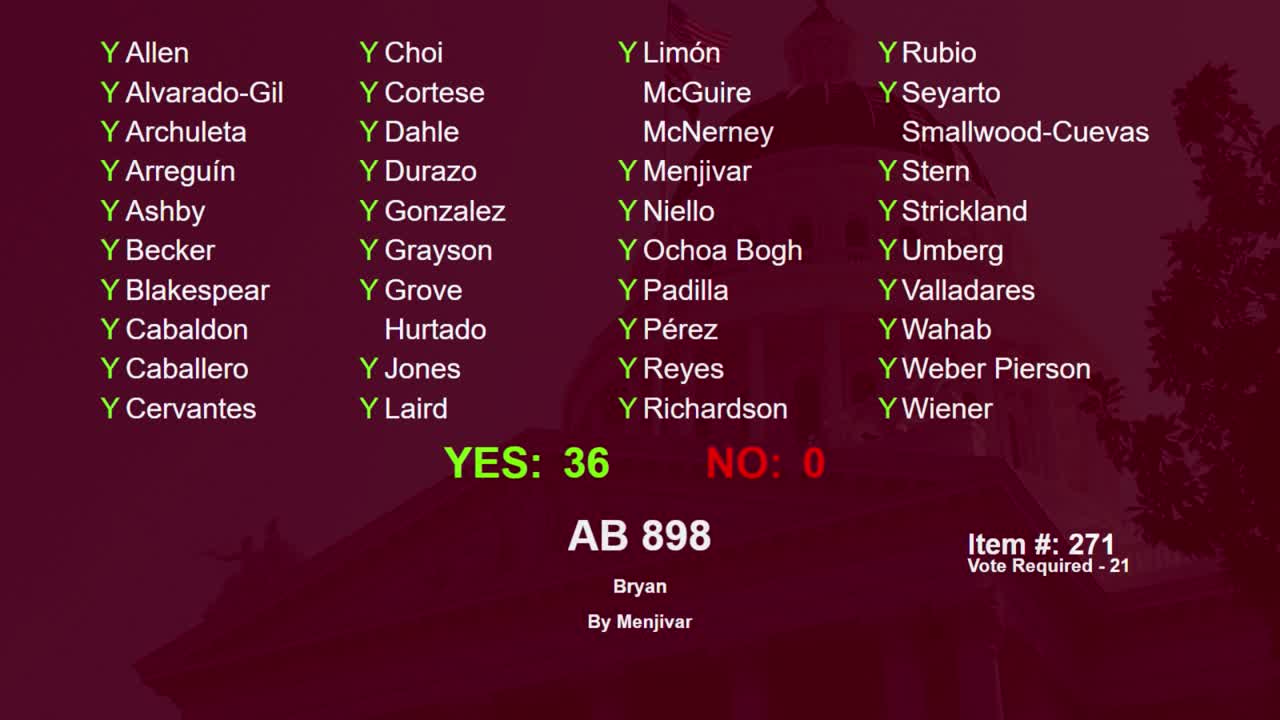 4MIN
Senate Floor
 50SEC
Senate Standing Committee on Appropriations
 3MIN
Senate Standing Committee on Elections and Constitutional Amendments
 58SEC
Assembly Floor
 5MIN
Assembly Standing Committee on Elections
Bill Author

Bill Co-Author(s):
