SB 605: State attorneys and administrative law judges: compensation.
- Session Year: 2025-2026
- House: Senate
- Latest Version Date: 2025-02-20
Current Status:
Failed
(2026-02-02: Returned to Secretary of Senate pursuant to Joint Rule 56.)
Introduced
In Committee
Awaiting First Chamber Vote
Passed First Chamber
In Committee
Awaiting Second Chamber Vote
Passed Second Chamber
Enacted
Existing law requires the Department of Human Resources to establish and adjust salary ranges for each class of position in the state civil service.
This bill would require that the salaries of state attorneys and administrative law judges in State Bargaining Unit 2 be no less than the average salaries of public sector attorneys, as specified. The bill would require the Department of Human Resources to annually conduct a survey of salary structures by March 1 of each year, as specified, and determine the average salary of public sector attorneys for each attorney classification, including the minimum salaries for entry-level attorneys, intermediate classifications, and the most senior nonmanagerial attorneys, noninclusive of negotiated differentials. The bill would require that state administrative law judges have salaries not less than the maximum salary of state attorneys classified at a specified level. The bill would require the department to make a good faith offer of parity in salary with respect to public sector agency attorneys and administrative law judges salaries in any negotiations with the exclusive bargaining representative. The bill would provide that no state attorney or administrative law judge classification shall be reduced in salary as a result of these provisions.
This bill would state that its provisions supersede any memorandum of understanding and shall become effective with respect to salary increases on March 1 of each year. It would provide that its implementation, except for the annual survey, is contingent upon the appropriation of funds in the annual Budget Act and that implementation shall be phased in over 3 fiscal years commencing on July 1, 2026. The bill would also provide that the superior court has exclusive jurisdiction over disputes arising under these provisions.
(a)It is the intent of the Legislature in the enactment of this section to provide competitive salaries to all state attorneys and administrative law judges by ensuring minimum good faith salary offers for all state attorneys and administrative law judges consistent with the principle of parity with other public sector attorneys in California. In order for the state to recruit and retain the highest qualified attorneys and administrative law judges to enforce Californias laws, to protect the public interest, to advise its officers, and to ensure enforcement of its administrative laws, the salaries paid to state attorneys in State Bargaining Unit 2 shall be no less than the average salaries paid to the public sector attorneys as set forth in subdivisions (c) to (f), inclusive. Salaries paid to administrative law judges shall be established as set forth in subdivision (g).
(b)As used in this section, the following terms have the following meanings:
(1)Department means the Department of Human Resources.
(2)Headquartered means the county in which the attorney or administrative law judge performs a majority of their work.
(3)Nonmanagerial with respect to attorneys in both local and state agencies means any attorney position that does not meet the definition of managerial set forth in Section 3513.
(4)Salary means pay or wages, and shall exclude benefits or other forms of compensation or remuneration.
(c)For purposes of this section, all state attorneys and administrative law judges shall be classified into one of three geographic regions as follows:
(1)State attorneys and administrative law judges headquartered in the Counties of Los Angeles, San Diego, Riverside, San Bernardino, Orange, Ventura, and Santa Barbara shall be classified as Region I attorneys and administrative law judges.
(2)State attorneys and administrative law judges headquartered in the Counties of San Francisco, San Mateo, Santa Cruz, Monterey, Marin, Sonoma, Napa, Contra Costa, Alameda, and Santa Clara shall be classified as Region II attorneys and administrative law judges.
(3)State attorneys and administrative law judges headquartered in any California county not enumerated in either paragraph (1) or (2) shall be classified as Region III attorneys and administrative law judges.
(d)For purposes of this section, the following public sector agencies in the three regions classified in subdivision (c) shall be surveyed in accordance with subdivision (e).
(1)For Region I, the agencies to be surveyed shall be the Court of Appeal in Region I, the California Supreme Court in Region I, the San Diego County District Attorneys office, the Los Angeles County District Attorneys office, the Los Angeles County Counsels office, the Civil Division of the Los Angeles City Attorneys office, the Orange County District Attorneys office, and the Orange County Counsels office.
(2)For Region II, the agencies to be surveyed shall be the Court of Appeal in Region II, the California Supreme Court in Region II, the San Mateo County Attorneys office, the San Mateo District Attorneys office, the San Francisco City Attorneys office, the San Francisco District Attorneys office, the Alameda County District Attorneys office, and the Alameda County Counsels office.
(3)For Region III, the agencies to be surveyed shall be the Court of Appeal in Region III, the California Supreme Court in Region III, the Sacramento County District Attorneys office, the Sacramento County Counsels office, and the Sacramento City Attorneys office.
(e)The department shall annually survey the salary structures of each of the public agencies identified in subdivision (d) and determine each of the following:
(1)The salaries paid to entry-level attorneys and the highest salaries paid to the most senior nonmanagerial attorneys, for each of those agencies.
(2)The average salary paid to entry-level attorneys and the average highest salary paid to the most senior nonmanagerial attorneys within each of the three regions.
(3)The combined average salary for entry-level attorneys and the combined average highest salary paid to the most senior managerial attorneys for the three regions, calculated by adding the salaries from each public agency identified in subdivision (d) and dividing the number by the total number of public agencies in the three regions combined.
(f)(1)The minimum salary, noninclusive of negotiated differentials, for entry-level state attorneys in their respective regions shall be no less than the average for public agency entry-level attorneys as calculated pursuant to paragraph (2) of subdivision (e) for each region, or the average of all three regions as calculated pursuant to paragraph (3) of subdivision (e), whichever is greater.
(2)The minimum salary, noninclusive of negotiated differentials, for the most senior nonmanagerial classification of state attorneys in their respective regions shall be no less than the average highest salary paid to the most senior nonmanagerial attorney classifications of public agencies as calculated pursuant to paragraph (2) of subdivision (e) for each region, or the average of all three regions as calculated pursuant to paragraph (3) of subdivision (e), whichever is greater.
(g)State administrative law judges, as defined in Section 11475.10, and senior administrative law judges, as defined by the State Personnel Board, in each region shall have salaries, noninclusive of negotiated differentials, no less than the maximum salary of state attorneys classified in the State Attorney IV level in each region.
(h)The department shall establish minimum salaries for each intermediate classification of state attorneys between the entry-level attorney classification and the most senior nonmanagerial attorney classification so as to maintain a relationship between all classifications and between all steps within all classifications proportional to the minimum salaries for the entry-level attorney and the most senior nonmanagerial attorney classifications.
(i)At a minimum, the department shall make a good faith offer of parity in salary as provided in subdivisions (c) to (g), inclusive, in any negotiations with the exclusive bargaining representative.
(j)The annual salary survey required under subdivision (e) shall be completed and provided to the exclusive bargaining representative by March 1 of each year reflecting salaries in effect on January 15 of that year. Notwithstanding subdivision (m), this annual survey shall be conducted each year regardless of whether funds are appropriated to implement this section.
(k)Notwithstanding any other provision of this section, no state attorney or administrative law judge classification shall be reduced in salary as a result of this section.
(l)This section shall become effective notwithstanding any other provision of law or any other terms or conditions in a memorandum of understanding. In the event this statute supersedes a memorandum of understanding, salary increases shall become effective March 1 of each year. The superior court shall have exclusive jurisdiction over disputes arising under this section and shall render any appropriate relief to remedy violations of this section.
(m)Except as provided in subdivision (j), implementation of this section shall be contingent upon the appropriation of the necessary funds in the annual Budget Act. Implementation shall be phased in over three fiscal years commencing on July 1, 2026, as follows:
(1)Effective July 1, 2026, no less than one-third of the total salary increases as calculated under subdivisions (e), (f), and (g).
(2)Effective July 1, 2027, no less than two-thirds of the total salary increases as calculated under subdivisions (e), (f), and (g).
(3)Effective July 1, 2028, and in every subsequent year, the total amount of the salary increases as calculated under subdivisions (e), (f), and (g).
|
Date
|
Status
|
|---|---|
| Feb 2, 2026 | Returned to Secretary of Senate pursuant to Joint Rule 56. |
| May 23, 2025 | May 23 hearing: Held in committee and under submission. |
| May 16, 2025 | Set for hearing May 23. |
| Apr 7, 2025 | April 7 hearing: Placed on APPR. suspense file. |
| Mar 28, 2025 | Set for hearing April 7. |
| Mar 26, 2025 | From committee: Do pass and re-refer to Com. on APPR. (Ayes 4. Noes 1. Page 568.) (March 26). Re-referred to Com. on APPR. |
| Mar 18, 2025 | Set for hearing March 26. |
| Mar 5, 2025 | Referred to Com. on L., P.E. & R. |
| Feb 21, 2025 | From printer. May be acted upon on or after March 23. |
| Feb 20, 2025 | Introduced. Read first time. To Com. on RLS. for assignment. To print. |
|
Date
|
Description
|
Location
|
Votes
|
|
|---|---|---|---|---|
| Apr 7, 2025 | Placed on suspense file | Senate Standing Committee on Appropriations |
Passed |
|
| Mar 26, 2025 | Do pass, but first be re-referred to the Committee on [Appropriations] | Senate Standing Committee on Labor, Public Employment and Retirement |
Passed |
This list shows positions taken on this bill by organizations on the date displayed, which is linked to the original source.
Positions by individuals are not included.
|
Organization
|
Position
|
Date
|
|---|---|---|
| California Attorneys Administrative Law Judges and Hearing Officers in State Employment | ** Support |
SENATE COMMITTEE ON
Senator Anna Caballero, Chair
2025 - 2026 Regular Session
SB 605 (Cortese) - State attorneys and administrative law judges: compensation
Version: | Policy Vote: |
Urgency: | Mandate: |
Hearing Date: | Consultant: |
Bill Summary:
SB 605 would require that the salaries of state attorneys and related state employees in Bargaining Unit (BU) 2 be no less than the average salaries of other public sector attorneys, as specified.
Fiscal Impact:
This bill would result in increased personnel costs to the State. The magnitude is unknown, but likely in the tens of millions dollars annually (General Fund, see Staff Comments). Increased administrative costs to the California Department of Human Resources (CalHR) have yet to be identified.
Background:
CalHR is responsible for overseeing the State's human resources management functions. Among other duties, it engages in collective bargaining with state employee unions and manages labor relations issues.
Budget documents indicate that over 250,000 people work for a State of California department or agency (other than a university). More than 80 percent of these employees are represented by one of the State’s 21 bargaining units in the collective bargaining process. The rest are excluded from the collective bargaining because they are managers, supervisors, or employees who assist management develop employee compensation policies.
The Dills Act authorized collective bargaining between these state employees and the Governor. The Governor is represented by CalHR. The product of the collective bargaining process is an MOU (“memorandum of understanding”). MOUs specify the terms and conditions of employment.
Employees represented by BU 2 are state-employed attorneys, administrative law judges, and other legal professionals who provide legal expertise for the State in many departments. The Department of Justice employs about a quarter of all BU 2 employees.
Proposed Law:
This bill would, among other things, do the following:
- Require that the salaries of state attorneys in BU 2 be no less than the average salaries of public sector attorneys, as determined by the creation of three geographical areas in California, as specified.
- Require that the salaries of state administrative law judges in each region be not less than the maximum salary of state attorneys classified as the Attorney IV level in each region.
- Require CalHR to annually conduct a survey of salary structures of specified public agencies in each region to determine the average salary of public sector attorneys, as specified.
- Require CalHR to conduct the survey each year, regardless of whether the Legislature appropriates funds to provide the salary increases that the survey may indicate.
- Provide that the provisions of the bill supersede any memorandum of understanding and becomes effective with respect to salary increases on March 1 of each year.
- Provide that the implementation of the bill's provisions is contingent upon the appropriation of funds in the annual Budget Act and phases in implementation over a three-year period, beginning July 1, 2026.
Related Legislation:
- AB 2872 (Calderon, 2024) would have required the state to pay sworn members of the Department of Insurance who are rank-and-file members of State BU 7 the same compensation paid to corresponding rank-and-file sworn peace officers of the Department of Justice The bill was vetoed by the Governor.
- AB 1254 (Flora, 2023) would have required CalHR to use a formula that would pay CAL FIRE BU 8 members within 15 percent of the average of the salary for corresponding ranks in 20 specified local fire departments instead of determining state firefighters’ pay through collective bargaining under the Dills Act as required by current law. The bill died on Senate inactive file.
- AB 1677 (McKinnor, 2023) would, among other things, have required the University of California at Berkeley Labor Center to undertake a study of the existing salary structure and provide recommendations for alternative models, if applicable, as applied to rank-and-file scientists in BU 10. The bill was vetoed by the Governor.
- SB 1160 (Polanco, 2001) was substantially identical to this bill, and was vetoed by the Governor.
Staff Comments:
CalHR has yet to determine the fiscal impacts that would result from this bill. However, in 2001 its predecessor, the Department of Personnel Administration (DPA), estimated the cost of SB 1160 in 2001 to be $23 million annually. As a proxy, adjusting the DPA estimate for 24 years of price changes (using the Implicit Gross Domestic Product Deflator for State and Local Governmental Purchases) suggests that this bill would result in increased personnel costs of $47 million annually.
As of 2025, BU 2 comprises approximately 3,800 positions. To the extent that BU 2 membership is higher than it was in 2001, the aforementioned proxy estimate could be higher. Finally, the estimate could be higher or lower, depending on whether the wage gap between BU 2 employees and the specified other public sector attorneys has increased or narrowed since 2001.
-- END --
SENATE COMMITTEE ON LABOR, PUBLIC EMPLOYMENT AND RETIREMENT
Senator Lola Smallwood-Cuevas, Chair
2025 - 2026 Regular
Bill No: SB 605 Hearing Date: March 26, 2025
Author: | Cortese | ||
Version: | February 20, 2025 | ||
Urgency: | No | Fiscal: | Yes |
Consultant: | Glenn Miles | ||
SUBJECT: State attorneys and administrative law judges: compensation
KEY ISSUE
This bill requires that the salaries of state attorneys and related state employees in Bargaining Unit (BU) 2 be no less than the average salaries of other public sector attorneys, as specified.
ANALYSIS
Existing law:
- Establishes the Dills Act, which provides collective bargaining rights to state employees and regulates labor relations between the state and its represented employees. (Government Code §3512 et seq.)
- Requires the California Department of Human Resources (Department) to establish and adjust salary ranges for each class of position in the state civil service. (Government Code §19826(a))
- Requires the Department, at least six months before the end of the term of an existing memorandum of understanding or immediately upon the reopening of negotiations under an existing memorandum of understanding, to submit to the parties meeting and conferring, and to the Legislature, a report containing the Department’s findings relating to the salaries of employees in comparable occupations in private industry and other governmental agencies. (Government Code §19826(c))
- Requires the state, in order to recruit and retain the highest qualified employees in specified classifications, to consider the total estimated average compensation paid to employees in comparable occupations. (Government Code §19826(c))
This bill:
- Requires that the salaries of state attorneys in Bargaining Unit (BU) 2 be no less than the average salaries of public sector attorneys, as determined by the creation of three geographical areas in California, as specified.
- Requires that the salaries of state administrative law judges in each region be not less than the maximum salary of state attorneys classified as the Attorney IV level in each region.
- Requires the California Department of Human Resources (CalHR) to annually conduct, by March 1 of each year, a survey of salary structures of specified public agencies in each region to determine the average salary of public sector attorneys, as specified.
- Requires CalHR to conduct the survey each year, regardless of whether the Legislature appropriates funds to provide the salary increases that the survey may indicate.
- Provides that the provisions of the bill supersede any memorandum of understanding and becomes effective with respect to salary increases on March 1 of each year.
- Provides that the implementation of the bill's provisions is contingent upon the appropriation of funds in the annual Budget Act and phases in implementation over a three-year period, beginning July 1, 2026.
- Provides that the superior court have exclusive jurisdiction over disputes arising from the bill's provisions.
COMMENTS
1. Committee Comments
Pursuant to the Dills Act, state employee compensation is subject to collective bargaining between the employees’ exclusive representative and the Governor who has designated CalHR as his representative. The committee notes that BU 2’s contract is expiring June 30, 2025, and that the sponsor is currently in negotiations with the Administration for a new Memorandum of Understanding (MOU).
The Legislature’s custom and practice has been to refrain from interfering with the bargaining process or attempting to set bargaining conditions between the parties. However, where the bargaining process has become fixed or frozen, the Legislature has periodically interceded to ensure that the state fulfills the Dills Act’s objectives of establishing efficient and effective labor relations in the state civil service. Obviously, the Governor has the last word on whether to sign off on this legislation should it pass both houses of the Legislature. Therefore, this bill’s success will be intricately linked to his and the sponsor’s ability to negotiate an amenable MOU.
Nevertheless, state agencies face recruiting and retention problems for BU 2 employees given the salary disparities between state attorneys/ hearing officers and those from local public agencies. State attorneys and administrative law judges are critical to insuring the proper functioning of state government, particularly in the challenging environment of recent events. Thus, the Legislature can appropriately support attempts to focus the Administration on the need to preserve and cultivate the state’s legal expertise in the face of substantial workload increases and the enticement of higher compensation in local government.
2. Need for this bill?
According to the author:
“State attorneys and administrative law judges face pay disparities compared to their counterparts in county, city, and other public sector agencies. Qualified legal professionals are leaving state service for better-paying opportunities in the public and private sectors.
Significant variations in compensation across California’s counties exacerbate the issue, as state attorneys headquartered in high-cost regions like Los Angeles and the Bay Area are not compensated at rates comparable to local public agencies. The lack of competitive salaries undermines the state’s ability to maintain a skilled workforce, which is essential for the timely enforcement of laws, the resolution of disputes, and the protection of public interests.”
3. Proponent Arguments
According to the California Attorneys, Administrative Law Judges, and Hearing Officers in State Employment:
“Despite the significant contributions these legal professionals make to the state, current salary levels for these positions lag behind those of comparable public sector roles, creating recruitment and retention challenges. Specifically, state attorneys are paid 20%-40% less in salaries and benefits than other public sector lawyers, such as district attorneys, public defenders, city attorneys, and county counsel. Additionally, there are significant variations in compensation across California’s counties, which only exacerbates this issue, as state attorneys headquartered in high-cost regions such as Los Angeles or the Bay Area are not compensated at rates comparable to local public agencies.
Ultimately, the lack of competitive salaries undermines the state’s ability to maintain a skilled workforce, which is essential for the timely enforcement of laws, resolution of disputes, and the protection of public interests.”
4. Opponent Arguments:
None received.
5. Prior Legislation:
AB 2872 (Calderon, 2024) would have required the state to pay sworn members of the Department of Insurance who are rank-and-file members of State Bargaining Unit (BU) 7 the same compensation paid to corresponding rank-and-file sworn peace officers of the Department of Justice The Governor vetoed this bill.
AB 1254 (Flora, 2023) would have required CalHR to use a formula that would pay CAL FIRE Bargaining Unit (BU) 8 members within 15 percent of the average of the salary for corresponding ranks in 20 specified local fire departments instead of determining state firefighters’ pay through collective bargaining under the Dills Act as required by current law. This bill died on Senate inactive file.
AB 1677 (McKinnor, 2023) would have required the University of California at Berkeley Labor Center to undertake a study of the existing salary structure and provide recommendations for alternative models, if applicable, as applied to rank-and-file scientists in State Bargaining Unit 10 (BU 10), among other provisions. The Governor vetoed the bill.
SB 1160 (Polanco, 2001) was substantially identical to this bill. The Governor vetoed the bill.
SUPPORT
California Attorneys, Administrative Law Judges, and Hearing Officers in State Employment (Sponsor)
OPPOSITION
None received.
-- END --
Discussed in Hearing
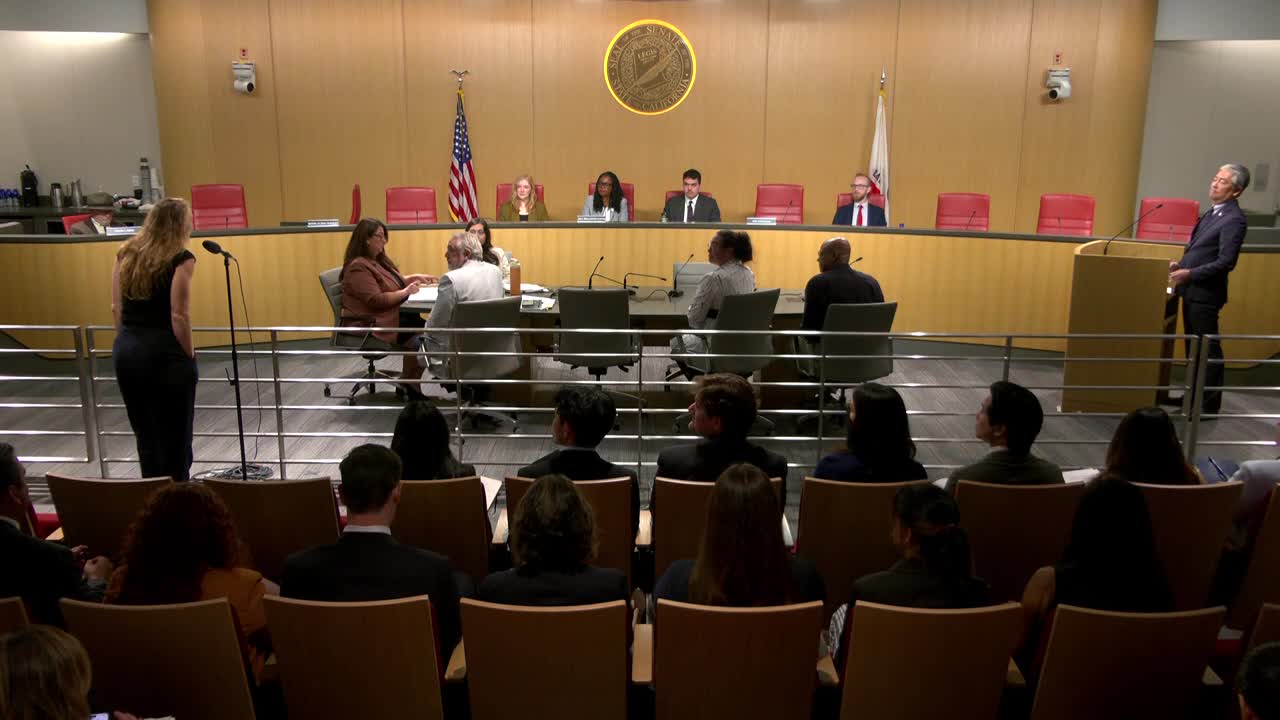 3MIN
Senate Standing Committee on Labor, Public Employment and Retirement
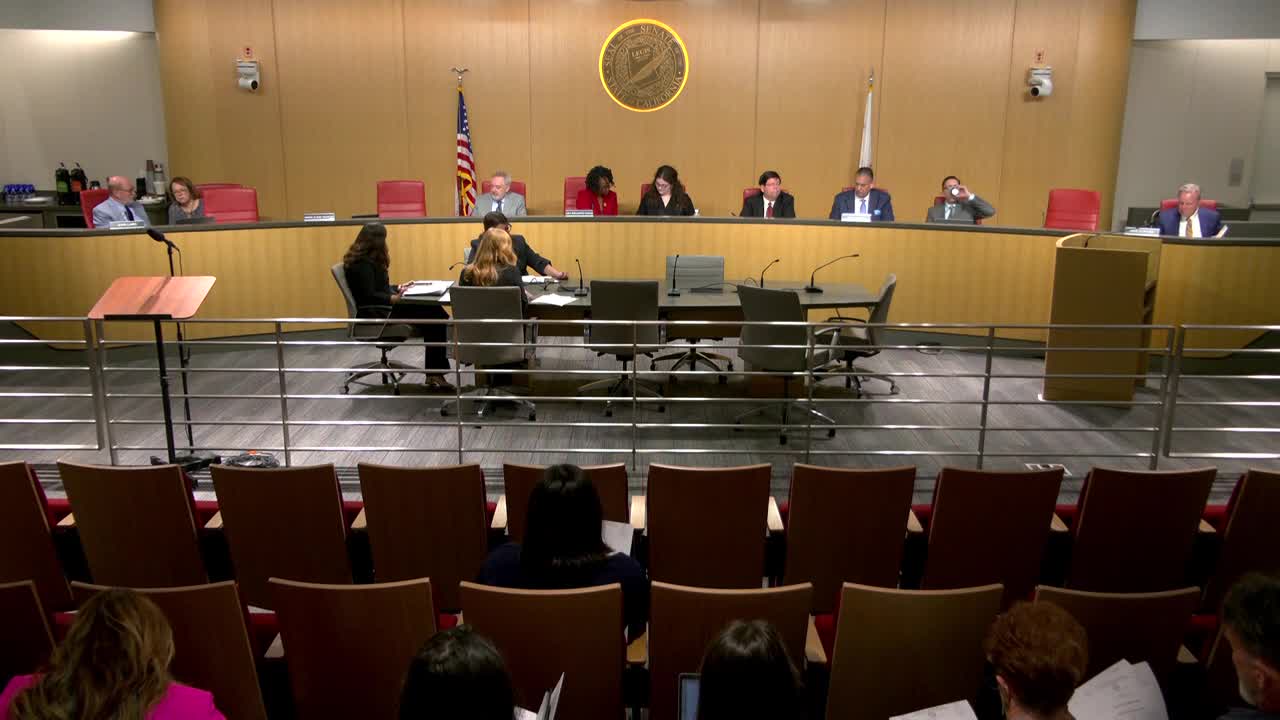 16MIN
Senate Standing Committee on Labor, Public Employment and Retirement
Bill Author