AB 1021: Sales and use taxes: smartphones: bundled transactions.
- Session Year: 2015-2016
- House: Assembly
- Latest Version Date: 2015-05-07
The Sales and Use Tax Law imposes a tax on retailers measured by the gross receipts from the sale of tangible personal property sold at retail in this state, or on the storage, use, or other consumption in this state of tangible personal property purchased from a retailer for storage, use, or other consumption in this state. Under existing sales and use tax regulations, gross receipts from a retail sale of a smartphone sold in a bundled transaction with wireless telecommunication service is generally equal to the amount of the unbundled sales price of the smartphone.
This bill would, instead, limit the gross receipts from a retail sale of a smartphone sold in a bundled transaction with wireless telecommunication service to the bundled sales price of the smartphone.
The Bradley-Burns Uniform Local Sales and Use Tax Law authorizes counties and cities to impose local sales and use taxes in conformity with the Sales and Use Tax Law, and existing law authorizes districts, as specified, to impose transactions and use taxes in accordance with the Transactions and Use Tax Law, which generally conforms to the Sales and Use Tax Law. Amendments to state sales and use taxes are incorporated into these laws.
Section 2230 of the Revenue and Taxation Code provides that the state will reimburse counties and cities for revenue losses caused by the enactment of sales and use tax exemptions.
This bill would provide that, notwithstanding Section 2230 of the Revenue and Taxation Code, no appropriation is made and the state shall not reimburse any local agencies for sales and use tax revenues lost by them pursuant to this bill.
This bill would take effect immediately as a tax levy.
The Personal Income Tax Law imposes taxes on income and provides definitions of specified terms for purposes of that law, including a definition for taxable year.
This bill would make a nonsubstantive change to those provisions.
The Personal Income Tax Law imposes taxes on income and provides definitions of specified terms for purposes of that law, including a definition for taxable year.
This bill would make a nonsubstantive change to those provisions.
(a)Notwithstanding Sections 6011 and 6012, gross receipts and sales price from the retail sale or purchase of a smartphone shall be limited to the amount charged for the sale of the smartphone when that smartphone is sold in a bundled transaction.
(b)Bundled transaction means a retail sale of a smartphone that contractually requires the a retailers customer to activate or contract with a wireless telecommunications service provider for utility service for a period greater than one month as a condition of that sale.
(c)(1)Smartphone means a cellular radio telephone or other mobile voice communications handset device that includes all of the following features:
(A)Utilizes a mobile operating system.
(B)Possesses the capability to utilize mobile software applications, access and browse the Internet, utilize text messaging, utilize digital voice service, and send and receive email.
(C)Has wireless network connectivity.
(D)Is capable of operating on a long-term evolution network or successor wireless data network communication standards.
(2)A smartphone does not include a radio cellular telephone commonly referred to as a feature or messaging telephone, a laptop, a tablet device, or a device that only has electronic reading capability.
(d)Wireless telecommunications service provider means a utility regulated by the Public Utilities Commission or Federal Communication Commission and that offers or provides wireless communication or paging services.
SEC. 2.Notwithstanding Section 2230 of the Revenue and Taxation Code, no appropriation is made by this act and the state shall not reimburse any local agency for any sales and use tax revenues lost by it under this act.
SEC. 3.This act provides for a tax levy within the meaning of Article IV of the Constitution and shall go into immediate effect.
(a)Notwithstanding Sections 6011 and 6012, gross receipts and sales price from the retail sale or purchase of a smartphone shall be limited to the amount charged for the sale of the smartphone when that smartphone is sold in a bundled transaction.
(b)Bundled transaction means a retail sale of a smartphone that contractually requires the retailers customer to activate or contract with a wireless telecommunications service provider for utility service for a period greater than one month as a condition of that sale.
(c)(1)Smartphone means a cellular radio telephone or other mobile voice communications handset device that includes all of the following features:
(A)Utilizes a mobile operating system.
(B)Possesses the capability to utilize mobile software applications, access and browse the Internet, utilize text messaging, utilize digital voice service, and send and receive email.
(C)Has wireless network connectivity.
(D)Is capable of operating on a long-term evolution network or successor wireless data network communication standards.
(2)A smartphone does not include a radio cellular telephone commonly referred to as a feature or messaging telephone, a laptop, a tablet device, or a device that only has electronic reading capability.
(d)Wireless telecommunications service provider means a utility regulated by the Public Utilities Commission or Federal Communication Commission and that offers or provides wireless communication or paging services.
SEC. 2.Notwithstanding Section 2230 of the Revenue and Taxation Code, no appropriation is made by this act and the state shall not reimburse any local agency for any sales and use tax revenues lost by it under this act.
SEC. 3.This act provides for a tax levy within the meaning of Article IV of the Constitution and shall go into immediate effect.
SECTION 1.Section 17010 of the Revenue and Taxation Code is amended to read:17010.Taxable year means either the calendar year or the fiscal year upon the basis of which the taxable income is computed under this part. If no fiscal year has been established, taxable year means the calendar year.
Taxable year means, in the case of a return made for a fractional part of a year under this part or under regulations prescribed by the Franchise Tax Board, the period for which the return is made.
Taxable year means either the calendar year or the fiscal year upon the basis of which the taxable income is computed under this part. If no fiscal year has been established, taxable year means the calendar year.
Taxable year means, in the case of a return made for a fractional part of a year under this part or under regulations prescribed by the Franchise Tax Board, the period for which the return is made.
|
Date
|
Status
|
|---|---|
| Feb 26, 2015 | Read first time. To print. |
| Feb 27, 2015 | From printer. May be heard in committee March 29. |
| Mar 26, 2015 | From committee chair, with author's amendments: Amend, and re-refer to Com. on REV. & TAX. Read second time and amended. |
| Mar 26, 2015 | Referred to Com. on REV. & TAX. |
| Apr 6, 2015 | Re-referred to Com. on REV. & TAX. |
| May 4, 2015 | In committee: Set, first hearing. Referred to suspense file. |
| May 7, 2015 | From committee chair, with author's amendments: Amend, and re-refer to Com. on REV. & TAX. Read second time and amended. |
| May 11, 2015 | Re-referred to Com. on REV. & TAX. |
| May 18, 2015 | Retained in suspense file. |
| Jan 31, 2016 | Died pursuant to Article IV, Sec. 10(c) of the Constitution. |
| Feb 1, 2016 | From committee: Filed with the Chief Clerk pursuant to Joint Rule 56. |
This list shows positions taken on this bill by organizations on the date displayed, which is linked to the original source.
Positions by individuals are not included.
|
Organization
|
Position
|
Date
|
|---|---|---|
| Howard Jarvis Taxpayers Association | ** Support | May 4, 2015 |
AB 1021
Page 4
Date of Hearing: May 18, 2015
ASSEMBLY COMMITTEE ON REVENUE AND TAXATION
Philip Ting, Chair
AB 1021 (
Steinorth) – As Amended May 7, 2015
SUSPENSE
Majority vote. Tax levy. Fiscal committee.
SUBJECT: Sales and use taxes: smartphones: bundled transactions
SUMMARY: Provides that, for purposes of the Sales and Use Tax (SUT) Law, "gross receipts" and "sales price" from the retail sale or purchase of a "smartphone" shall be limited to the amount charged for the sale of the "smartphone" when it is sold in a "bundled transaction." Specifically, this bill:
Defines a "smartphone" as a cellular radio telephone or other mobile voice communications handset device that includes all of the following features:
Utilizes a mobile operating system;
Possesses the capability to utilize mobile software applications, access and browse the Internet, utilize text messaging, utilize digital voice service, and send and receive e-mail;
Has wireless network connectivity; and,
Is capable of operating on a long-term evolution network or successor wireless data network communication standards.
Provides that a "smartphone" does not include a radio cellular telephone commonly referred to as a "feature" or "messaging" telephone, a laptop, a tablet device, or a device that only has electronic reading capability.
Defines a "bundled transaction" as a retail sale of a "smartphone" that contractually requires the retailer's customer to activate or contract with a "wireless telecommunications service provider" for utility service for a period greater than one month as a condition of that sale.
Defines a "wireless telecommunications service provider" as a utility regulated by the Public Utilities Commission or Federal Communication Commission and that offers or provides wireless communication or paging services.
Provides that, notwithstanding existing law, the state shall not reimburse local agencies for SUT revenues lost under this bill.
Takes immediate effect as a tax levy.
EXISTING LAW:
Imposes a sales tax on retailers for the privilege of selling tangible personal property (TPP), absent a specific exemption. The tax is based upon the retailer's "gross receipts" from TPP sales in this state.
Imposes a complementary use tax on the storage, use, or other consumption in this state of TPP purchased from any retailer. The tax is based upon the "sales price" of the TPP.
Provides, per State Board of Equalization (BOE) SUT Regulation 1585, that in the case of bundled transactions, tax applies to the unbundled sales price of the wireless telecommunications device.
FISCAL EFFECT: The BOE estimates annual state and local revenue losses of $370 million.
COMMENTS:
The author has provided the following statement in support of this bill:
AB 1021 will eliminate the surprise sticker shock that comes along with most smartphone purchases, and require that the sales or use tax be calculated on the actual sale price of a smartphone. California's tax code currently allows the sales tax on cell phones to be charged on the full retail price of the phone, even if a consumer is paying a substantially discounted price, leaving customers to feel confused and ultimately deceived. With retail prices of smartphones reaching up to $949, the financial impact of the existing policy upon consumers is significant. AB 1021 will clean up California's tax code to fix this flawed and unfair loophole.
This bill is supported by the Howard Jarvis Taxpayers Association, which notes the following:
AB 1021 serves to highlight the lack of transparency in our tax system. Normally, when a retail store sells an item on sale, the sales tax is imposed on that discounted price. Why is this different for mobile devices? The tax should always be based on the price at the point of sale. That way individuals know how much they are paying for a given good or service, nothing is hidden from them and they can budget accordingly.
Perhaps this inequity is most glaringly seen in the circumstance
where somebody purchases a second generation smart phone for free
with a contract. However, because sales tax is based on the retail
price of the phone, the tax will be approximately $20-40.
The BOE notes the following in its staff analysis of this bill:
Normally, the law regards a service sold in connection with a taxable good as part of the sale. Accordingly, the tax is based on the total receipts derived from that sale.
However, the marketing and retail pricing strategies associated with these devices and the telecommunications industry contradict conventional retail practices. As a result, in 1999, the Board of Equalization (BOE) adopted a regulation to specifically address the application of tax on these device sales and related service charges.
Under the regulation, retailers are required to compute the tax based on whether they sold the device in a "bundled" transaction. The regulation defines "bundled" transactions as those sales where the customer is required to activate or contract for utility service with a wireless telecommunications service provider for a one-month period or greater as a condition of sale. Generally, to receive the device's promotional or discounted sales price, customers must agree to activate or sign up with a provider for utility service for more than a one-month period. Under the regulation, the retailer is required to compute tax on the device's sale based on the "unbundled sales price."
The regulation further defines "unbundled sales price" as the price at which the retailer has sold specified devices to customers who are not required to activate or contract for utility service as a condition of sale.
Committee Staff Comments
Nothing is free: Wireless telecommunications devices such as smartphones are often provided "free" or at a significantly discounted price when a customer signs a long-term service contract. If this bill were enacted, it is not clear to Committee staff how SUT would apply in cases where the telephone is provided "free of charge" as part of a bundled transaction. Under a technical reading of this bill, it would appear that no SUT would be due, despite the fact that, in such cases, the cost of the underlying device is simply incorporated into the service contract. Thus, the amount of tax collected would depend not on the underlying value of the good sold, but rather on the method by which the sale is structured. This, in turn, could lead to the disparate tax treatment of customers purchasing the very same product.
Unsatisfied customers: Many purchasers are confused when they are charged SUT on the unbundled price of a phone. This confusion could be alleviated through better customer outreach and education, both by retailers and the state. Better customer outreach and education might prove significantly less costly than altering the manner in which taxes are calculated.
Singling out smartphones: This bill's provisions would only apply to "smartphones" sold in a bundled transaction. Sales of non-smartphone devices, such as laptops or tablet devices sold as part of a bundled transaction, would continue to be taxed on the unbundled sales price. The Committee may wish to consider whether "smartphones" are deserving of this preferential tax treatment. Moreover, creating such a statutory distinction based on the nature of the technology involved may only exacerbate the consumer confusion this bill is intending to address.
Sufficient lead time: This bill provides no lead time for the BOE to notify impacted retailers and provide instructions related to their reporting obligations. The BOE has suggested amendments in its staff analysis of this bill to address this issue.
Denied at the BOE: In February 2015, the BOE received a petition seeking the repeal of SUT Regulation 1585. Specifically, the petitioner asserted that the BOE regulation is inconsistent with the statutory definition of "gross receipts" contained in Revenue and Taxation Code Section 6012. BOE staff recommended that the petition be denied in its entirety on the grounds that the regulation is consistent with the definition of "gross receipts" and judicial precedent interpreting that definition. At the March 26, 2015 BOE meeting, the members voted to deny the petition as recommended by BOE staff.
Related legislation:
This bill is similar to AB 2691 (Harkey) of the 2013-14 Legislative Session. AB 2691 was held on this Committee's Suspense File.
This bill is similar to AB 279 (Garrick) of the 2011-12 Legislative Session. AB 279 was held on this Committee's Suspense File.
This bill is similar to AB 2320 (La Malfa) of the 2005-06 Legislative Session. AB 2320 was held on this Committee's Suspense File.
REGISTERED SUPPORT / OPPOSITION:
Support
Howard Jarvis Taxpayers Association
Opposition
None on file
Analysis Prepared by: M. David Ruff / REV. & TAX. / (916) 319-2098
AB 1021
Page 4
Date of Hearing: May 4, 2015
ASSEMBLY COMMITTEE ON REVENUE AND TAXATION
Philip Ting, Chair
AB 1021
(Steinorth) – As Amended March 26, 2015
Majority vote. Tax levy. Fiscal committee.
SUBJECT: Sales and use taxes: smartphones: bundled transactions
SUMMARY: Provides that, for purposes of the Sales and Use Tax (SUT) Law, "gross receipts" and "sales price" from the retail sale or purchase of a "smartphone" shall be limited to the amount charged for the sale of the "smartphone" when it is sold in a "bundled transaction." Specifically, this bill:
Defines a "smartphone" as a cellular radio telephone or other mobile voice communications handset device that includes all of the following features:
Utilizes a mobile operating system;
Possesses the capability to utilize mobile software applications, access and browse the Internet, utilize text messaging, utilize digital voice service, and send and receive e-mail;
Has wireless network connectivity; and,
Is capable of operating on a long-term evolution network or successor wireless data network communication standards.
Provides that a "smartphone" does not include a radio cellular telephone commonly referred to as a "feature" or "messaging" telephone, a laptop, a tablet device, or a device that only has electronic reading capability.
Defines a "bundled transaction" as a retail sale of a "smartphone" that contractually requires the retailer's customer to activate or contract with a "wireless telecommunications service provider" for utility service for a period greater than one month as a condition of that sale.
Defines a "wireless telecommunications service provider" as a utility regulated by the Public Utilities Commission or Federal Communication Commission and that offers or provides wireless communication or paging services.
Provides that, notwithstanding existing law, the state shall not reimburse local agencies for SUT revenues lost under this bill.
Takes immediate effect as a tax levy.
EXISTING LAW:
Imposes a sales tax on retailers for the privilege of selling tangible personal property (TPP), absent a specific exemption. The tax is based upon the retailer's "gross receipts" from TPP sales in this state.
Imposes a complementary use tax on the storage, use, or other consumption in this state of TPP purchased from any retailer. The tax is based upon the "sales price" of the TPP.
Provides, per State Board of Equalization (BOE) SUT Regulation 1585, that in the case of bundled transactions, tax applies to the unbundled sales price of the wireless telecommunications device.
FISCAL EFFECT: The BOE estimates annual state and local revenue losses of $370 million.
COMMENTS:
The author has provided the following statement in support of this bill:
AB 1021 will eliminate the surprise sticker shock that comes along with most smartphone purchases, and require that the sales or use tax be calculated on the actual sale price of a smartphone. California's tax code currently allows the sales tax on cell phones to be charged on the full retail price of the phone, even if a consumer is paying a substantially discounted price, leaving customers to feel confused and ultimately deceived. With retail prices of smartphones reaching up to $949, the financial impact of the existing policy upon consumers is significant. AB 1021 will clean up California's tax code to fix this flawed and unfair loophole.
This bill is supported by the Howard Jarvis Taxpayers Association, which notes the following:
AB 1021 serves to highlight the lack of transparency in our tax system. Normally, when a retail store sells an item on sale, the sales tax is imposed on that discounted price. Why is this different for mobile devices? The tax should always be based on the price at the point of sale. That way individuals know how much they are paying for a given good or service, nothing is hidden from them and they can budget accordingly.
Perhaps this inequity is most glaringly seen in the circumstance
where somebody purchases a second generation smart phone for free
with a contract. However, because sales tax is based on the retail
price of the phone, the tax will be approximately $20-40.
The BOE notes the following in its staff analysis of this bill:
Normally, the law regards a service sold in connection with a taxable good as part of the sale. Accordingly, the tax is based on the total receipts derived from that sale.
However, the marketing and retail pricing strategies associated with these devices and the telecommunications industry contradict conventional retail practices. As a result, in 1999, the Board of Equalization (BOE) adopted a regulation to specifically address the application of tax on these device sales and related service charges.
Under the regulation, retailers are required to compute the tax based on whether they sold the device in a "bundled" transaction. The regulation defines "bundled" transactions as those sales where the customer is required to activate or contract for utility service with a wireless telecommunications service provider for a one-month period or greater as a condition of sale. Generally, to receive the device's promotional or discounted sales price, customers must agree to activate or sign up with a provider for utility service for more than a one-month period. Under the regulation, the retailer is required to compute tax on the device's sale based on the "unbundled sales price."
The regulation further defines "unbundled sales price" as the price at which the retailer has sold specified devices to customers who are not required to activate or contract for utility service as a condition of sale.
Committee Staff Comments
Nothing is free: Wireless telecommunications devices such as smartphones are often provided "free" or at a significantly discounted price when a customer signs a long-term service contract. If this bill were enacted, it is not clear to Committee staff how SUT would apply in cases where the telephone is provided "free of charge" as part of a bundled transaction. Under a technical reading of this bill, it would appear that no SUT would be due, despite the fact that, in such cases, the cost of the underlying device is simply incorporated into the service contract. Thus, the amount of tax collected would depend not on the underlying value of the good sold, but rather on the method by which the sale is structured. This, in turn, could lead to the disparate tax treatment of customers purchasing the very same product.
Unsatisfied customers: Many purchasers are confused when they are charged SUT on the unbundled price of a phone. This confusion could be alleviated through better customer outreach and education, both by retailers and the state. Better customer outreach and education might prove significantly less costly than altering the manner in which taxes are calculated.
Singling out smartphones: This bill's provisions would only apply to "smartphones" sold in a bundled transaction. Sales of non-smartphone devices, such as laptops or tablet devices sold as part of a bundled transaction, would continue to be taxed on the unbundled sales price. The Committee may wish to consider whether "smartphones" are deserving of this preferential tax treatment. Moreover, creating such a statutory distinction based on the nature of the technology involved may only exacerbate the consumer confusion this bill is intending to address.
Sufficient lead time: This bill provides no lead time for the BOE to notify impacted retailers and provide instructions related to their reporting obligations. The BOE has suggested amendments in its staff analysis of this bill to address this issue.
Denied at the BOE: In February 2015, the BOE received a petition seeking the repeal of SUT Regulation 1585. Specifically, the petitioner asserted that the BOE regulation is inconsistent with the statutory definition of "gross receipts" contained in Revenue and Taxation Code Section 6012. BOE staff recommended that the petition be denied in its entirety on the grounds that the regulation is consistent with the definition of "gross receipts" and judicial precedent interpreting that definition. At the March 26, 2015 BOE meeting, the members voted to deny the petition as recommended by BOE staff.
Related legislation:
This bill is similar to AB 2691 (Harkey) of the 2013-14 Legislative Session. AB 2691 was held on this Committee's Suspense File.
This bill is similar to AB 279 (Garrick) of the 2011-12 Legislative Session. AB 279 was held on this Committee's Suspense File.
This bill is similar to AB 2320 (La Malfa) of the 2005-06 Legislative Session. AB 2320 was held on this Committee's Suspense File.
REGISTERED SUPPORT / OPPOSITION:
Support
Howard Jarvis Taxpayers Association
Opposition
None on file
Analysis Prepared by: M. David Ruff / REV. & TAX. / (916) 319-2098
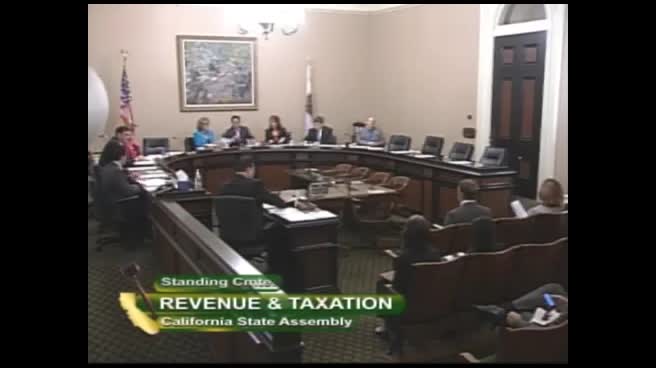
Discussed in Hearing
 7MIN
Assembly Standing Committee on Revenue and Taxation
Bill Author