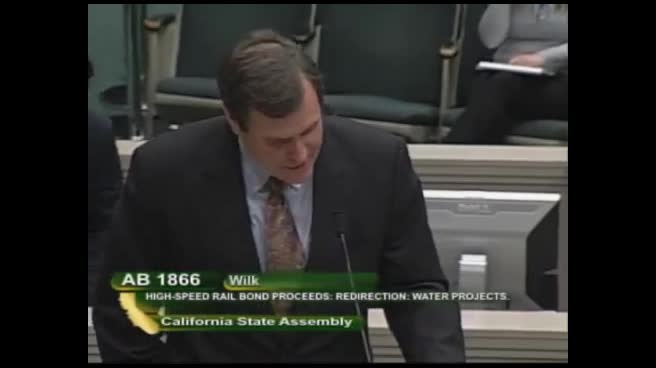
AB 1866: High-speed rail bond proceeds: redirection: water projects.
- Session Year: 2015-2016
- House: Assembly
- Latest Version Date: 2016-02-10
Existing law, the Safe, Reliable High-Speed Passenger Train Bond Act for the 21st Century, approved by the voters as Proposition 1A at the November 4, 2008, general election, provides for the issuance of general obligation bonds in the amount of $9 billion in general obligation bonds for high-speed rail purposes and $950 million for other related rail purposes. Article XVI of the California Constitution requires measures authorizing general obligation bonds to specify the single object or work to be funded by the bonds and further requires a bond act to be approved by a 2/3 vote of each house of the Legislature and a majority of the voters.
This bill would provide that no further bonds shall be sold for high-speed rail purposes pursuant to the Safe, Reliable High-Speed Passenger Train Bond Act for the 21st Century, except as specifically provided with respect to an existing appropriation for high-speed rail purposes for early improvement projects in the Phase 1 blended system. The bill, subject to the above exception, would require redirection of the unspent proceeds received from outstanding bonds issued and sold for other high-speed rail purposes prior to the effective date of these provisions, upon appropriation, for use in retiring the debt incurred from the issuance and sale of those outstanding bonds. The bill, subject to the above exception, would also require the net proceeds of other bonds subsequently issued and sold under the high-speed rail portion of the bond act to be made available, upon appropriation, to fund capital expenditures for water projects, including the construction of desalination facilities, wastewater treatment and recycling facilities, reservoirs, water conveyance infrastructure, and aquifer recharge. The bill would make no changes to the authorization under the bond act for the issuance of $950 million in bonds for rail purposes other than high-speed rail. These provisions would become effective only upon approval by the voters at the next statewide election.
(a)(1)Notwithstanding any other provision of this chapter, and except as provided in paragraph (2), no further bonds shall be issued and sold for purposes of Section 2704.06 on and after the effective date of this section.
(2)This section shall not apply to bonds issued and sold for purposes of Section 2704.06 with respect to the appropriation in Item 2665-104-6043 of Section 2.00 of the Budget Act of 2012, as added by Section 3 of Chapter 152 of the Statutes of 2012.
(b)Notwithstanding any other provision of this chapter, and except as otherwise provided in paragraph (2) of subdivision (a), the unspent proceeds received from outstanding bonds issued and sold pursuant to Section 2704.06 prior to the effective date of this section shall, upon appropriation by the Legislature, be redirected from high-speed rail purposes for use in retiring the debt incurred from the issuance and sale of those outstanding bonds.
(c)Notwithstanding any other provision of this chapter, the remaining unissued bonds, as of the effective date of this section, that were previously authorized pursuant to Section 2704.06, except as otherwise provided in paragraph (2) of subdivision (a), are hereby authorized to be issued and sold, with the net proceeds, upon appropriation by the Legislature, to be made available to fund construction of water capital projects, including the construction of desalination facilities, wastewater treatment and recycling facilities, reservoirs, water conveyance infrastructure, and aquifer recharge.
SEC. 2.Section 1 of this act would modify the single object or work of a general obligation bond act previously submitted to the voters by the Legislature pursuant to Section 1 of Article XVI of the California Constitution, and subsequently approved by the voters as Proposition 1A at the November 4, 2008, statewide general election. Accordingly, Section 1 of this act shall become effective only upon approval by the voters. The Secretary of State shall submit Section 1 of this act to the voters on the ballot of the next statewide election.
|
Date
|
Status
|
|---|---|
| Feb 10, 2016 | Read first time. To print. |
| Feb 11, 2016 | From printer. May be heard in committee March 12. |
| Feb 25, 2016 | Referred to Coms. on TRANS. and W., P., & W. |
| Mar 29, 2016 | In committee: Hearing postponed by committee. |
| Apr 12, 2016 | In committee: Set, first hearing. Failed passage. Reconsideration granted. |
|
Date
|
Description
|
Location
|
Votes
|
|
|---|---|---|---|---|
| Apr 11, 2016 | Reconsideration. | Assembly Standing Committee on Transportation |
Passed |
|
| Apr 11, 2016 | Do pass and be re-referred to the Committee on [Water, Parks, and Wildlife] | Assembly Standing Committee on Transportation |
Failed |
This list shows positions taken on this bill by organizations on the date displayed, which is linked to the original source.
Positions by individuals are not included.
|
Organization
|
Position
|
Date
|
|---|---|---|
| Associated Builders And Contractors Of California | ** Support | Apr 11, 2016 |
| California Conference Of Machinists | ** Against | Apr 11, 2016 |
| California Teamsters Public Affairs Council | ** Against | Apr 11, 2016 |
| Howard Jarvis Taxpayer Association | ** Support | Apr 11, 2016 |
| Sierra Club California | ** Against | Apr 11, 2016 |
| Southwest California Legislative Council | ** Support | Apr 11, 2016 |
| Valley Ag Water Coalition | ** Support | Apr 11, 2016 |
Date of Hearing: April 4, 2016
ASSEMBLY COMMITTEE ON TRANSPORTATION
Jim Frazier, Chair
ABPCA Bill Id:AB 1866 (
Author:Wilk) – As Introduced Ver:February 10, 2016
SUBJECT: High-speed rail bond proceeds: redirection: water projects
SUMMARY: Directs that a referendum be placed on the ballot related to high-speed rail bonds. Specifically, this bill:
- Directs the Secretary of State to put on the November 2016 general election ballot a measure which, if approved, would:
- Prohibit further issuance and sale of any authorized bonds for high-speed rail, except for early improvement projects (a.k.a. bookend projects) in the Phase 1 blended system for which appropriations have already been made.
- Redirect the proceeds of any outstanding bonds issued and sold, except for those related to the bookend projects, to debt retirement.
- Reauthorize the issuance and sale of any unissued bonds, upon appropriation by the Legislature, to fund the construction of water capital projects, including the construction of desalination facilities, wastewater treatment and recycling facilities, reservoirs, water conveyance infrastructure, and aquifer recharge.
- Does not affect the authorization of $950 million in bonds for connectivity projects.
- Is an urgency measure.
EXISTING LAW:
- Establishes the California High-Speed Rail Authority (Authority) and vests with it the responsibility to develop and implement a high-speed rail system in California.
- Authorizes the sale of $9 billion in general obligation bonds to partially fund the development and construction of California's high-speed rail system.
- Authorizes the expenditure of an additional $950 million in general obligation bonds for capital projects on other passenger rail lines to provide connectivity to the high-speed rail system as well as for capacity enhancements and safety improvements to those lines.
- Requires the Authority to complete and submit to the Legislature funding plans and financial analyses prior to requesting an appropriation of bond funds for eligible capital costs and prior to committing bond proceeds for expenditure for construction and real property and equipment acquisition.
- Appropriates $1.1 billion of the $9 billion in high-speed rail bonds for use on bookend projects.
FISCAL EFFECT: According to the Authority, $1.027 billion in Proposition 1A bonds have been issued to date. Of that total, $444.9 million (of $9 billion) have been issued for the high-speed rail project and $581.8 million (of $950 million) have been issued for connectivity projects.
COMMENTS: In 2008, voters approved Proposition 1A, the Safe, Reliable, High-Speed Passenger Train Bond Act, a $9.95 billion general obligation bond to fund the proposed California high-speed rail project and related improvements. As envisioned at the time of the ballot measure, the project was to consist of an 800-mile dedicated high-speed passenger rail system capable of speeds up to 220 miles per hour, initially serving the major metropolitan market of San Francisco through the Central Valley into Los Angeles and Anaheim (Phase 1) with service eventually extended to Sacramento, the Inland Empire, and San Diego (Phase II).
When the bonds were approved in 2008, costs for the entire project were estimated to be
$45 billion, to be paid by a mix of state bonds, federal grants, and private investments. Since then, estimated costs for the project have risen markedly. The Authority's most recent business plan estimates costs for Phase 1 to be $64 billion using the blended approach of relying in part on existing tracks in the Bay Area and parts of Los Angeles. Furthermore, federal contributions to date are limited to $3.3 billion and there have been no private investments.
In 2012, the Legislature passed and the Governor signed SB 1029 (Committee on Budget and Fiscal Review), Chapter 152, Statutes of 2012, to appropriate $8 billion to the Authority
($4.7 billion in Proposition 1A state bond funds and $3.3 billion in federal funds) to initiate construction of the high-speed rail project. This amount included $1.1 billion of Proposition 1A bond funding for the bookend projects in the San Francisco Peninsula and the Los Angeles Basin.
In February, the High-Speed Rail Authority released the Draft 2016 Business Plan which switched the focus of the Initial Operating Segment (IOS) from the LA Basin to Northern California with a terminus in San Jose. The business plan also adjusted the cost estimates for Phase I down to from $68 billion to $64 billion.
Two relevant court cases were litigated in 2013 regarding issuance of Proposition 1A bonds. Specifically, one case challenged the funding plan that submitted to the Legislature prior to the appropriation as required by Proposition 1A. The lower court found that the plan did not meet the requirements set forth in Proposition 1A. However, the appellate court found that the purpose of the funding plan was to inform the Legislature and if the Legislature acts on the plan, the plan is presumed to have been sufficient. Additionally, the Authority filed a validation suit to clear any potential legal hurdles to issuance of the Proposition 1A bonds. The lower court ruled against the Authority noting that the Authority had not met the legal standards for issuing taxpayer bonds. The ruling was overturned by the California Supreme Court and the lower court was directed to issue an order validating the issuance of the bonds.
With the continued threat of litigation on the issuance and expenditure of the Proposition 1A bonds, the funds approved by the voters remain in question. To begin construction work in the Central Valley and move forward on the other project sections, the Authority renegotiated its funding agreement with the federal government to allow a "tapered match"—i.e., to allow federal dollars to be spent first and state matching dollars to be spent later. Additionally, the 2014-15 state budget SB 862 (Committee on Budget and Fiscal Review), Chapter 36, Statutes of 2014, continuously appropriated 25% of the revenues derived from the state’s cap and trade program to the project. This equates to roughly $500 million annually.
The author introduced AB 1866 because "the ability to meet the water needs of existing and future Californians is not only dependent on our available supplies, but also on the implementation of new programs to collect, store, treat and delivery water to people.” The author sites recent studies by the U.S. Environmental Protection Agency (EPA) that showed California ranks number one in water infrastructure needs in the nation and that California could use an estimated $44.5 billion in the next two decades to fix our aging water systems. He states that, “AB 1866 would repurpose $8 billion for such programs which no one can deny are vital to the overall quality of life for all Californians.”
Committee concerns: The release of the business plan signaled a more concrete funding plan for the development of the IOS. However, the Authority continues to face funding and legal challenges and their outcomes are unclear. The high-speed rail project is under construction and proceeding and its unsteady beginning is not without precedent among mega-projects. While the project is not progressing as smoothly as hoped, it is progressing and is better off today than it was when the Legislature committed to the project.
Stopping the project now by redirecting the bonds will cause hundreds of millions of dollars of work and study to be wasted. The Legislature should continue its stringent oversight of the project and work to improve its likelihood of success.
Double referral: This bill will be referred to the Assembly Water, Parks and Wildlife Committee should it pass out of this committee.
Related legislation: AB 2049 (Melendez), requires the Secretary of State to put on the November 2016 general election ballot a legislative referendum which, if approved by the voters, would prohibit the sale of any additional high-speed rail bonds and authorize the remaining bonds be issued to fund the construction of the SHOPP, STIP, and TCIF. This bill is set for hearing in this committee on April 11, 2016.
AB 1768 (Gallagher), requires the Secretary of State to put on the November 2016 general election ballot a legislative referendum which, if approved by the voters, would prohibit the sale of any additional high-speed rail bonds and authorize the remaining bonds be issued to fund the SHOPP. This bill is set for hearing in this committee on April 11, 2016.
Previous legislation: AB 6 (Wilk), would have required the Secretary of State to put on the November 2016 general election ballot a legislative referendum which, if approved by the voters, would prohibit the sale of any additional high-speed rail bonds and authorize the remaining bonds be issued to fund the construction of school facilities for K-12 and higher education. AB 6 failed passage in this committee on April 20, 2015.
AB 397 (Mathis), would have required the Secretary of State to put on the November 2016 general election ballot a legislative referendum which, if approved by the voters, would prohibit the sale of any additional high-speed rail bonds and redirect the authorize the remaining bonds be issued to fund the construction of water capital projects. AB 397 failed in this committee on April 27, 2015 and was granted reconsideration. It failed on reconsideration on January 11, 2016.
All of the following bills would have reduced the amount of authorized indebtedness for the Authority:
AB 2650 (Conway) of 2014, failed passage in the Assembly Transportation Committee
AB 1501 (Patterson) of 2014, failed passage in the Assembly Transportation Committee.
SB 901 (Vidak) of 2014, failed passage in Senate Transportation and Housing Committee.
AB 842 (Donnelly) of 2013, failed passage in the Assembly Transportation Committee.
AB 1455 (Harkey) of 2012, failed passage in the Assembly Transportation Committee;
SB 22 (LaMalfa) of 2012, failed passage in the Senate Transportation and Housing Committee;
AB 76 (Harkey) of 2011, failed passage in the Assembly Transportation Committee; and,
AB 2121 (Harkey) of 2010, died in the Senate Rules Committee.
REGISTERED SUPPORT / OPPOSITION:
Support
Associated Builders and Contractors of California
Howard Jarvis Taxpayer Association
Southwest California Legislative Council
Valley Ag Water Coalition
Opposition
California Conference of Machinists
California Teamsters Public Affairs Council
Sierra Club California
State Building and Construction Trades Council
Analysis Prepared by: Melissa White / TRANS. / (916) 319-2093
Discussed in Hearing
 11MIN
Senate Standing Committee on Transportation and Housing
Bill Author


