AB 2145: Vehicle replacement: rebates.
- Session Year: 2015-2016
- House: Assembly
- Latest Version Date: 2016-02-17
Existing law requires the State Air Resources Board, in consultation with the Bureau of Automotive Repair, to adopt a program, known as the enhanced fleet modernization program, that allows for the voluntary retirement of passenger vehicles and light-duty and medium-duty trucks that are high polluters.
The Charge Ahead California Initiative, administered by the state board, includes goals of, among other things, placing in service at least 1,000,000 zero-emission and near-zero-emission vehicles by January 1, 2023, and increasing access for disadvantaged, low-income, and moderate-income communities and consumers to zero-emission and near-zero-emission vehicles.
Existing law, for the purposes of calculating the vehicle license fee, requires the Department of Motor Vehicles to determine the market value of the vehicle on the basis of the cost price to the purchaser, not including California sales or use tax or any local sales, transactions, use, or other local tax, as specified.
This bill, for the purpose of calculating the vehicle license fee, would authorize the amount of compensation provided to a low-income motor vehicle owner under the enhanced fleet modernization program to be deducted from the motor vehicles price, as specified. The bill would require the state board to develop a standardized certificate for issuance to recipients of compensation that states the amount of compensation received, and would require the Department of Motor Vehicles to adjust the motor vehicles price accordingly, upon submission of that certificate to the department by the vehicle owner.
This bill would also, for the purpose of calculating the vehicle license fee, authorize the amount of a vehicle replacement rebate provided to a low- or moderate-income purchaser under the Charge Ahead California Initiative to be deducted from the motor vehicles price, as specified. The bill would require the state board to develop a standardized certificate for issuance to low- or moderate-income rebate recipients that states the amount of the rebate received, and would require the Department of Motor Vehicles to adjust the motor vehicles price accordingly, upon submission of that certificate to the department by the vehicle owner.
(a)No later than July 1, 2009, the state board, in consultation with the bureau, shall adopt a program to commence on January 1, 2010, that allows for the voluntary retirement of passenger vehicles and light-duty and medium-duty trucks that are high polluters. The program shall be administered by the bureau pursuant to guidelines adopted by the state board.
(b)No later than June 30, 2015, the state board, in consultation with the bureau, shall update the program established pursuant to subdivision (a). The program shall continue to be administered by the bureau pursuant to guidelines updated and adopted by the state board.
(c)The guidelines shall ensure all of the following:
(1)Vehicles retired pursuant to the program are permanently removed from operation and retired at a dismantler under contract with the bureau.
(2)Districts retain their authority to administer vehicle retirement programs otherwise authorized under by law.
(3)The program is available for high polluting passenger vehicles and light-duty and medium-duty trucks that have been continuously registered in California for two years prior to acceptance into the program or otherwise proven to have been driven primarily in California for the last two years and have not been registered in another state or country in the last two years. The guidelines may require a vehicle to take, complete, or pass a smog check inspection.
(4)The program is focused where the greatest air quality impact can be identified.
(5)(A)Compensation for retired vehicles shall be at least one thousand five hundred dollars ($1,500) for a low-income motor vehicle owner, as defined in Section 44062.1, and no not more than one thousand dollars ($1,000) for all other motor vehicle owners.
(B)Replacement or a mobility option may be an option for all motor vehicle owners and may be in addition to compensation for vehicles retired pursuant to subparagraph (A). For low-income motor vehicle owners, as defined in Section 44062.1, compensation toward a replacement vehicle or mobility option shall be no less than two thousand five hundred dollars ($2,500). Compensation toward a replacement vehicle for all other motor vehicle owners shall not exceed compensation for low-income motor vehicle owners.
(C)Compensation for either retired or replacement vehicles or a mobility option for low-income motor vehicle owners may be increased as necessary to maximize the air quality benefits of the program while also ensuring participation by low-income motor vehicle owners, as defined in Section 44062.1. Increases in compensation amounts may be based on factors, including, but not limited to, the age of the retired or replaced vehicle, the emissions benefits of the retired or replaced vehicle, the emissions impact of any replacement vehicle, participation by low-income motor vehicle owners, as defined in Section 44062.1, and the location of the vehicle in an area of the state with the poorest air quality.
(6)Cost-effectiveness and impacts on disadvantaged and low-income populations are considered. Program eligibility may be limited on the basis of income to ensure the program adequately serves persons of low or moderate income.
(7)Provisions that coordinate the vehicle retirement and replacement and mobility option components of the program with the vehicle retirement component of the bureaus Consumer Assistance Program, established pursuant to other provisions of this chapter, to ensure vehicle owners participate in the appropriate program to maximize emissions reductions.
(8)Streamlined administration to simplify participation while protecting the accountability of moneys spent.
(9)Specific steps to ensure the vehicle replacement and mobility option component of the program is available in areas designated as federal extreme nonattainment.
(10)A requirement that vehicles eligible for retirement have sufficient remaining life. Demonstration of sufficient remaining life may include proof of current registration, passing a recent smog check inspection, or passing another test similar to a smog check inspection.
(d)When updating the guidelines to the program established pursuant to subdivision (a), the state board shall study and consider all the following elements:
(1)Methods of financial assistance other than vouchers.
(2)An option for automobile dealerships or other used car sellers to accept cars for retirement, provided the cars are dismantled consistent with the requirements of the program.
(3)An incentive structure with varied incentive amounts to maximize program participation and cost-effective emissions reductions.
(4)Increased emphasis on the replacement of high polluters with cleaner vehicles or the increased use of public transit and car sharing that results in the increased utilization of the vehicle replacement and mobility option component of the program.
(5)Increased emphasis on the reduction of greenhouse gas emissions through increased vehicle efficiency or transit and car sharing use as a result of the program.
(6)Increased partnerships and outreach with community-based organizations.
(e)The amount of compensation provided to a low-income motor vehicle owner pursuant to this section may be deducted from the replacement vehicles price when calculating the cost price to the purchaser pursuant to Section 10753 of the Revenue and Taxation Code. The state board shall develop a standardized certificate for issuance to recipients of compensation that states the amount of compensation received. Upon submission of this certificate to the Department of Motor Vehicles by the vehicle owner, the Department of Motor Vehicles shall adjust the cost price to the purchaser as authorized by this subdivision.
(e)
(f)For purposes of this section, the following terms have the following meanings:
(1)Car sharing has the same definition as in Section 44258.
(2)Mobility option means a voucher for public transit or car sharing.
SEC. 2.Section 44258.4 of the Health and Safety Code is amended to read:44258.4.(a)Any moneys utilized by this act pursuant to this chapter from the Greenhouse Gas Reduction Fund, established pursuant to Section 16428.8 of the Government Code, shall be consistent with the appropriations processes and criteria established by the Greenhouse Gas Reduction Fund Investment Plan and Communities Revitalization Act (Chapter 4.1 (commencing with Section 39710) of Part 2).
(b)The Charge Ahead California Initiative is hereby established and shall be administered by the state board. The goals of this initiative are to place in service at least 1,000,000 zero-emission and near-zero-emission vehicles by January 1, 2023, to establish a self-sustaining California market for zero-emission and near-zero-emission vehicles in which zero-emission and near-zero-emission vehicles are a viable mainstream option for individual vehicle purchasers, businesses, and public fleets, to increase access for disadvantaged, low-income, and moderate-income communities and consumers to zero-emission and near-zero-emission vehicles, and to increase the placement of those vehicles in those communities and with those consumers to enhance the air quality, lower greenhouse gases, and promote overall benefits for those communities and consumers.
(c)The state board, in consultation with the State Energy Resources Conservation and Development Commission, districts, and the public, shall do all of the following:
(1)(A)Include, commencing with the Air Quality Improvement Program funding plan for the 201617 fiscal year, a funding plan that includes the immediate fiscal year and a forecast of estimated funding needs for the subsequent two fiscal years commensurate with meeting the goals of this chapter. Funding needs may be described as a range that identifies the projected high and low funding levels needed for the two-year forecast period to contribute to technology advancement, market readiness, and consumer acceptance of zero- and near-zero-emission vehicle technologies. The funding plan shall include a market and technology assessment for each funded zero- and near-zero-emission vehicle technology to inform the appropriate funding level, incentive type, and incentive amount. The forecast shall include an assessment of when a self-sustaining market is expected and how existing incentives may be modified to recognize expected changes in future market conditions.
(B)Projects included in the forecast may include, but are not limited to, any of the following:
(i)The Clean Vehicle Rebate Project, established pursuant to Section 44274.
(ii)Light-duty zero-emission and near-zero-emission vehicle deployment projects eligible under the Alternative and Renewable Fuel and Vehicle Technology Program, established pursuant to Article 2 (commencing with Section 44272) of Chapter 8.9.
(iii)Programs adopted pursuant to paragraph (4).
(2)Update the plan required pursuant to paragraph (1) at least every three years through January 1, 2023.
(3)No later than June 30, 2015, adopt revisions to the criteria and other requirements for the Clean Vehicle Rebate Project, established pursuant to Section 44274, to ensure the following:
(A)Rebate levels can be phased down in increments based on cumulative sales levels as determined by the state board.
(B)(i)Eligibility is limited based on income.
(ii)For applicants classified as low or moderate income under the criteria adopted pursuant to this paragraph, the amount of the rebate may be deducted from the motor vehicles price when calculating the cost price to the purchaser pursuant to Section 10753 of the Revenue and Taxation Code. The state board shall develop a standardized certificate for issuance to low- or moderate-income rebate recipients that states the amount of the rebate received. Upon submission of this certificate to the Department of Motor Vehicles by the vehicle owner, the Department of Motor Vehicles shall adjust the cost price to the purchaser as authorized by this clause.
(C)Consideration of the conversion to prequalification and point-of-sale rebates or other methods to increase participation rates.
(4)(A)Establish programs that further increase access to and direct benefits for disadvantaged, low-income, and moderate-income communities and consumers from electric transportation, including, but not limited to, any of the following:
(i)Financing mechanisms, including, but not limited to, a loan or loan-loss reserve credit enhancement program to increase consumer access to zero-emission and near-zero-emission vehicle financing and leasing options that can help lower expenditures on transportation and prequalification or point-of-sale rebates or other methods to increase participation rates among low- and moderate-income consumers.
(ii)Car sharing programs that serve disadvantaged communities and utilize zero-emission and near-zero-emission vehicles.
(iii)Deployment of charging infrastructure in multiunit dwellings in disadvantaged communities to remove barriers to zero-emission and near-zero-emission vehicle adoption by those who do not live in detached homes. This clause does not preclude the Public Utilities Commission from acting within the scope of its jurisdiction.
(iv)Additional incentives for zero-emission, near-zero-emission, or high-efficiency replacement vehicles or a mobility option available to participants in the enhanced fleet modernization program, established pursuant to Article 11 (commencing with Section 44125) of Chapter 5.
(B)Programs implemented pursuant to this paragraph shall provide adequate outreach to disadvantaged, low-income, and moderate-income communities and consumers, including partnering with community-based organizations.
|
Date
|
Status
|
|---|---|
| Feb 17, 2016 | Read first time. To print. |
| Feb 18, 2016 | From printer. May be heard in committee March 19. |
| Feb 29, 2016 | Referred to Com. on TRANS. |
| Apr 4, 2016 | In committee: Set, first hearing. Failed passage. Reconsideration granted. |
|
Date
|
Description
|
Location
|
Votes
|
|
|---|---|---|---|---|
| Apr 4, 2016 | Reconsideration. | Assembly Standing Committee on Transportation |
Passed |
|
| Apr 4, 2016 | Do pass and be re-referred to the Committee on [Appropriations] | Assembly Standing Committee on Transportation |
Failed |
This list shows positions taken on this bill by organizations on the date displayed, which is linked to the original source.
Positions by individuals are not included.
Date of Hearing: April 4, 2016
ASSEMBLY COMMITTEE ON TRANSPORTATION
Jim Frazier, Chair
ABPCA Bill Id:AB 2145 (
Author:Linder) – As Introduced Ver:February 17, 2016
SUBJECT: Vehicle replacement: rebates
SUMMARY: Requires the Department of Motor Vehicles (DMV), for the purposes of calculating vehicle license fees (VLF), to adjust the purchase price of the vehicle downward to reflect the amount of compensation that low- or moderate-income recipients receive from incentive programs toward the purchase of certain clean air vehicles. Specifically, this bill:
- Requires the California Air Resources Board (ARB) to develop and issue certifications to low- and moderate-income recipients of Enhanced Fleet Modernization Program (EFMP) and the Charge Ahead California Initiative incentives used for the purchase of a newer, cleaner replacement vehicle.
- Requires DMV, once provided with the appropriate certification from ARB, to deduct the amount of incentive funding received toward the purchase of the vehicle for the purposes of calculating VLF.
- Makes related, clarifying amendments.
EXISTING LAW:
- Requires ARB, pursuant to California Global Warming Solutions Act of 2006 [AB 32 (Núñez), Chapter 488, Statutes of 2006], to reduce statewide greenhouse gas (GHG) emissions to 1990 levels by 2020 by adopting regulations to achieve maximum technologically feasible and cost-effective GHG emission reductions.
- Establishes the California Alternative and Renewable Fuel, Vehicle Technology, Clean Air, and Carbon Reduction Act of 2007 [AB 118 (Núñez), Chapter 750, Statutes of 2007], to support three programs including EFMP, under which ARB, in consultation with the Bureau of Automotive Repair (BAR), pays to permanently remove cars and small trucks from operation through voluntary retirement by their owners.
- Establishes the Charge Ahead California Initiative, [SB 1275 (de León), Chapter 530, Statutes of 2014], that, among other things, set the goal of placing 1 million zero- and near zero-emission vehicles (ZEVs) into service on California's roadways by January 1, 2023, increasing access to these vehicles for disadvantaged, low-, and moderate-income communities and consumers, and providing additional incentives for ZEV, near-ZEV, or high-efficiency replacement vehicles.
- Requires DMV, upon the sale of a new or used vehicle, to determine the market value of the vehicle based on the cost price to the purchaser, not including California sales taxes or local tax, for the purpose of calculating VLF.
- Establishes by executive order B-16-2012 that set the goal of placing 1.5 million ZEVs on California's roadways by 2025.
FISCAL EFFECT: Unknown
COMMENTS: According to the author, there are a number of incentive programs created to make clean air vehicles more affordable to low- and moderate income purchasers but these incentives, while lowering the up-front purchase price of the vehicle, do nothing to address ongoing costs associated with owning the vehicle—such as higher VLFs. Specifically, the author notes that VLFs are based on the retail value of the vehicle and, as a result, low- and moderate income consumers who buy higher-value ZEVs using incentive funding, are then required to pay higher VLFs (based on the vehicle's actual value or sales price) rather than the lower, out-of-pocket cost that were actually paid by the buyer (after incentives were applied). To correct this perceived inequity, the author has introduced this bill which would ensure that low- and moderate income individuals who purchase clean air vehicles using incentive funding, pay VLF on the vehicle's price after incentives are applied rather than before incentives are applied.
The VLF was established by the Legislature in 1935 in lieu of a property tax on vehicles. The formula for VLF assessment, established by the Legislature, is based upon the purchase price of the vehicle or the value of the vehicle when it is acquired. The VLF decreases with each renewal for the first 11 years or until the vehicle is transferred. When transferred, the depreciation of the VLF is based on the new purchase price when acquired. The VLF is part of the total fees due upon initial and annual vehicle registration renewal and is currently set at 0.65% of the vehicle's value. VLF revenues are returned to cities and counties by the DMV.
Pursuant to AB 32, it is the state's goal to reduce GHG emissions to 1990 levels by 2020. Given that the transportation sector account for nearly 40% of GHG emissions, substantial efforts have been taken to reduce the numbers of high-polluting cars in the state. To accomplish this, the state has developed a number of incentive programs to encourage individuals to retire their high-polluting cars and replace them with cleaner cars. Given that areas of the state with the poorest air quality typically coincide with higher numbers of disadvantaged communities, greater effort has been placed on increasing incentives for low- and moderate- income individuals in these areas.
A number of programs have been established to incentivize the replacement of high polluting vehicles for low- and moderate income individuals and program incentives can be "stacked" to further incentivize the purchase and use of cleaner cars and especially ZEVs. For example, EFMP provides incentives ranging from $2,500 up to $4,500, depending on income level and the type of vehicle purchased. Residents living in disadvantaged communities are also eligible for up to an additional $2,500 for the purchase of a conventional hybrid vehicle or up to an additional $5,000 for the purchase of a plug-in hybrid or ZEV. All told, low-income individuals within certain areas of the state are eligible to receive up to $9,500 if they scrap their high-polluting cars and replace them with a ZEV such as a plug-in hybrid (like a Chevy Volt) or a battery electric car (such as a Nissan Leaf). Moderate-income individuals in these same areas who opt to scrap and replace their high-polluting cars for a ZEVs can receive up to $7,500 in incentive funding toward the purchase of that car.
Low- and moderate-income individuals are also eligible to receive incentives for the purchase of new, qualifying ZEV's through the Clean Vehicle Rebate Program (CVRP). CVRP is designed to promote the purchase of new battery electric, plug-in, and fuel cell vehicles and offers rebates of up to $5,000 per qualifying new light-duty vehicle. As of March 29, 2016, as required by the Charge Ahead California Initiative (SB 1275), CVRP rebate amounts for low-income households will be increased by $1,500.
According to Valley Clean Air Now (Valley CAN), most qualifying low- and moderate-income individuals who opt to scrap their high-polluting cars and replace with a cleaner cars, typically purchase used (rather than new) ZEVs. This is the case because used ZEVs are typically more affordable (ranging in price from $10,000 to $15,000) while new ZEVs typically range in price from $35,000 to $50,000, or more depending on the make and model. Valley CAN notes that for low-income households, when the full incentives values are applied ($9,500) toward the purchase of a used ZEV, most applicants owe between $500 to $4,500, depending on the vehicle that is purchased. With available financing options, these individuals typically end up with very manageable monthly payments.
Post incentive program participation surveys conducted by Valley CAN indicate that program participants have overwhelmingly high satisfaction ratings not only about the programs but also about the ZEVs. The majority of respondents noted ZEVs saved them money because they no longer need to spend money on gas (at all or, at best, infrequently) and the cars have much lower maintenance requirements--which also saves them money. One participant reported that after opting to purchase a Nissan LEAF, after using "stacked" incentives, his monthly vehicle payments were only $60 per month, an expense that he described was more than offset by not having to purchase gasoline or pay vehicle maintenance and repair costs.
Committee concerns: While this bill is well intentioned, it seems to offer a solution where no problem exists. While VLF costs may rise slightly (in the vicinity of $100) with the purchase of a higher-value ZEV, this increased cost does not appear to be an undue burden for low- and moderate income buyers. This is evidenced by the fact that the incentive programs are consistently oversubscribed and surveys of program participants fail to reveal that slightly increased VLF fees are a deterrent to program participation. In fact, surveys of individuals who have participated in the incentive programs, indicate extreme satisfaction with the program (bordering on "giddiness") because they were able to lower their overall monthly expenses with regard to vehicle maintenance and fueling costs as well as having access to reliable transportation.
AB 2145, if implemented, would also likely result in program impacts and costs for ARB and DMV. ARB would be required to absorb costs associated with preparing certifications for all incentives issued and DMV would likely be required to increase program expenditures to retroactively adjust VLF after the point of sale. This added burden on DMV, to manually process thousands refund applications annually would likely result in increased costs to DMV as well as increased processing times. It is also likely that additional transactions to retroactively correct vehicle records and process refunds would be necessary.
Related legislation: AB 1965 (Cooper), would require ARB to expand incentive programs in disadvantaged communities and in areas with poor air quality. AB 1965 is awaiting a hearing in his committee.
Previous legislation: AB 32 (Núñez), Chapter 488, Statutes of 2006, required ARB to develop a plan of how to reduce emissions to 1990 levels by the year 2020 and also required ARB to ensure that, to the extent feasible, GHG reduction requirement and programs that direct public and private investments toward the most disadvantaged communities.
AB 118 (Núñez), Chapter 750, Statutes of 2007, established the Air Quality Improvement Program administered by ARB in consultation with local air districts, and funded through surcharges on vehicle and vessel registration fees, smog abatement fees, and identification plates.
SB 535 (de León), Chapter 830, Statutes of 2012, required the Department of Finance, when developing the three-year investment plan for cap and trade monies, to allocate 25% of the funds to projects that benefit disadvantaged communities, and to allocate a minimum of 10% of available cap and trade revenues to projects allocated within disadvantaged communities.
SB 1275 (de León), Chapter 530, Statutes of 2014, established the Charge Ahead Initiative that, among other things, set the goal of placing 1 million zero- and near zero-emission vehicles into service on California's roadways by January 1, 2023, and increasing access to these vehicles for disadvantaged, low-, and moderate-income communities and consumers.
REGISTERED SUPPORT / OPPOSITION:
Support
None on file
Opposition
None on file
Analysis Prepared by: Victoria Alvarez / TRANS. / (916) 319-2093
Discussed in Hearing
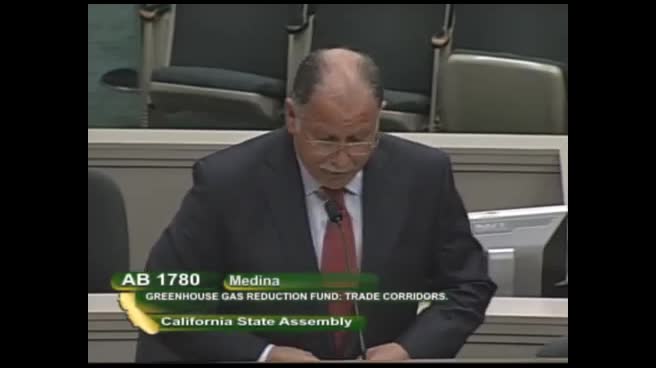 5MIN
Assembly Standing Committee on Transportation
Bill Author
Bill Co-Author(s):