AB 2319: California Infrastructure and Economic Development Bank.
- Session Year: 2015-2016
- House: Assembly
- Latest Version Date: 2016-02-18
The Bergeson-Peace Infrastructure and Economic Development Bank Act authorizes the California Infrastructure and Economic Development Bank, governed by a board of directors, to, among other things, make loans, issue bonds, and provide other financial assistance for various types of infrastructure and economic development projects. The act defines terms for its purposes and establishes the California Infrastructure and Economic Development Bank Fund, a continuously appropriated fund, for support of the bank.
This bill would expand the authority of the bank by adding affordable housing, as defined, to the types of projects to which the bank is authorized to provide financial assistance. By expanding the bankss authority to expend funds in a continuously appropriated fund, the bill would make an appropriation. This bill would also make conforming, nonsubstantive changes to cross-references to this provision.
For purposes of this division, the following words and terms shall have the following meanings unless the context clearly indicates or requires another or different meaning or intent:
(a)Act means the Bergeson-Peace Infrastructure and Economic Development Bank Act.
(b)Affordable housing means a dwelling available for purchase or lease by persons and families who qualify as low- or moderate-income, as defined in Section 50093 of the Health and Safety Code, very low income households, as defined in Section 50105 of the Health and Safety Code, or extremely low income households, as defined in Section 50106 of the Health and Safety Code.
(b)
(c)Bank means the California Infrastructure and Economic Development Bank.
(c)
(d)Board or bank board means the Board of Directors of the California Infrastructure and Economic Development Bank.
(d)
(e)Bond purchase agreement means a contractual agreement executed between the bank and a sponsor, or a special purpose trust authorized by the bank or a sponsor, or both, whereby the bank or special purpose trust authorized by the bank agrees to purchase bonds of the sponsor for retention or sale.
(e)
(f)Bonds means bonds, including structured, senior, and subordinated bonds or other securities; loans; notes, including bond, revenue, tax, or grant anticipation notes; commercial paper; floating rate and variable maturity securities; and any other evidences of indebtedness or ownership, including certificates of participation or beneficial interest, asset backed certificates, or lease-purchase or installment purchase agreements, whether taxable or excludable from gross income for federal income taxation purposes.
(f)
(g)Cost, as applied to a project or portion thereof financed under this division, means all or any part of the cost of construction, renovation, and acquisition of all lands, structures, real or personal property, rights, rights-of-way, franchises, licenses, easements, and interests acquired or used for a project; the cost of demolishing or removing any buildings or structures on land so acquired, including the cost of acquiring any lands to which the buildings or structures may be moved; the cost of all machinery, equipment, and financing charges; interest prior to, during, and for a period after completion of construction, renovation, or acquisition, as determined by the bank; provisions for working capital; reserves for principal and interest and for extensions, enlargements, additions, replacements, renovations, and improvements; and the cost of architectural, engineering, financial and legal services, plans, specifications, estimates, administrative expenses, and other expenses necessary or incidental to determining the feasibility of any project or incidental to the construction, acquisition, or financing of any project, and transition costs in the case of an electrical corporation.
(g)
(h)Economic development facilities means real and personal property, structures, buildings, equipment, and supporting components thereof that are used to provide industrial, recreational, research, commercial, utility, goods movement, or service enterprise facilities, community, educational, cultural, or social welfare facilities and any parts or combinations thereof, and all facilities or infrastructure necessary or desirable in connection therewith, including provision for working capital, but shall not include any housing. capital.
(h)
(i)Electrical corporation has the meaning set forth in Section 218 of the Public Utilities Code.
(i)
(j)Executive director means the Executive Director of the California Infrastructure and Economic Development Bank appointed pursuant to Section 63021.
(j)
(k)Financial assistance in connection with a project, includes, but is not limited to, any combination of grants, loans, the proceeds of bonds issued by the bank or special purpose trust, insurance, guarantees or other credit enhancements or liquidity facilities, and contributions of money, property, labor, or other things of value, as may be approved by resolution of the board or the sponsor, or both; the purchase or retention of bank bonds, the bonds of a sponsor for their retention or for sale by the bank, or the issuance of bank bonds or the bonds of a special purpose trust used to fund the cost of a project for which a sponsor is directly or indirectly liable, including, but not limited to, bonds, the security for which is provided in whole or in part pursuant to the powers granted by Section 63025.1; bonds for which the bank has provided a guarantee or enhancement, including, but not limited to, the purchase of the subordinated bonds of the sponsor, the subordinated bonds of a special purpose trust, or the retention of the subordinated bonds of the bank pursuant to Chapter 4 (commencing with Section 63060); or any other type of assistance deemed appropriate by the bank or the sponsor, except that no direct loans shall be made to nonpublic entities other than in connection with the issuance of rate reduction bonds pursuant to a financing order or in connection with a financing for an economic development facility.
For purposes of this subdivision, grant does not include grants made by the bank except when acting as an agent or intermediary for the distribution or packaging of financing available from federal, private, or other public sources.
(k)
(l)Financing order has the meaning set forth in Section 840 of the Public Utilities Code.
(l)
(m)Guarantee trust fund means the California Infrastructure Guarantee Trust Fund.
(m)
(n)Infrastructure bank fund means the California Infrastructure and Economic Development Bank Fund.
(n)
(o)Loan agreement means a contractual agreement executed between the bank or a special purpose trust and a sponsor that provides that the bank or special purpose trust will loan funds to the sponsor and that the sponsor will repay the principal and pay the interest and redemption premium, if any, on the loan.
(o)
(p)Participating party means any person, company, corporation, association, state, or municipal governmental entity, partnership, firm, or other entity or group of entities, whether organized for profit or not for profit, engaged in business or operations within the state and that applies for financing from the bank in conjunction with a sponsor for the purpose of implementing a project. However, in the case of a project relating to the financing of transition costs or the acquisition of transition property, or both, on the request of an electrical corporation, or in connection with financing for an economic development facility, or for the financing of insurance claims, the participating party shall be deemed to be the same entity as the sponsor for the financing.
(p)
(q)Project means designing, acquiring, planning, permitting, entitling, constructing, improving, extending, restoring, financing, and generally developing public development facilities or facilities, affordable housing, or economic development facilities within the state or financing transition costs or the acquisition of transition property, or both, upon approval of a financing order by the Public Utilities Commission, as provided in Article 5.5 (commencing with Section 840) of Chapter 4 of Part 1 of Division 1 of the Public Utilities Code.
(q)
(r)Public development facilities means real and personal property, structures, conveyances, equipment, thoroughfares, buildings, and supporting components thereof, excluding any housing, thereof that are directly related to providing the following:
(1)City streets including any street, avenue, boulevard, road, parkway, drive, or other way that is any of the following:
(A)An existing municipal roadway.
(B)Is shown upon a plat approved pursuant to law and includes the land between the street lines, whether improved or unimproved, and may comprise pavement, bridges, shoulders, gutters, curbs, guardrails, sidewalks, parking areas, benches, fountains, plantings, lighting systems, and other areas within the street lines, as well as equipment and facilities used in the cleaning, grading, clearance, maintenance, and upkeep thereof.
(2)County highways including any county highway as defined in Section 25 of the Streets and Highways Code, that includes the land between the highway lines, whether improved or unimproved, and may comprise pavement, bridges, shoulders, gutters, curbs, guardrails, sidewalks, parking areas, benches, fountains, plantings, lighting systems, and other areas within the street lines, as well as equipment and facilities used in the cleaning, grading, clearance, maintenance, and upkeep thereof.
(3)Drainage, water supply, and flood control including, but not limited to, ditches, canals, levees, pumps, dams, conduits, pipes, storm sewers, and dikes necessary to keep or direct water away from people, equipment, buildings, and other protected areas as may be established by lawful authority, as well as the acquisition, improvement, maintenance, and management of floodplain areas and all equipment used in the maintenance and operation of the foregoing.
(4)Educational facilities including libraries, child care facilities, including, but not limited to, day care facilities, and employment training facilities.
(5)Environmental mitigation measures including required construction or modification of public infrastructure and purchase and installation of pollution control and noise abatement equipment.
(6)Parks and recreational facilities including local parks, recreational property and equipment, parkways, and property.
(7)Port facilities including airports, landports, waterports, railports, docks, harbors, ports of entry, piers, ships, small boat harbors and marinas, and any other facilities, additions, or improvements in connection therewith, that transport goods or persons.
(8)Power and communications including facilities for the transmission or distribution of electrical energy, natural gas, and telephone and telecommunications service.
(9)Public transit including air and rail transport, airports, guideways, vehicles, rights-of-way, passenger stations, maintenance and storage yards, and related structures, including public parking facilities, and equipment used to provide or enhance transportation by bus, rail, ferry, or other conveyance, either publicly or privately owned, that provides to the public general or special service on a regular and continuing basis.
(10)Sewage collection and treatment including pipes, pumps, and conduits that collect wastewater from residential, manufacturing, and commercial establishments, the equipment, structures, and facilities used in treating wastewater to reduce or eliminate impurities or contaminants, and the facilities used in disposing of, or transporting, remaining sludge, as well as all equipment used in the maintenance and operation of the foregoing.
(11)Solid waste collection and disposal including vehicles, vehicle-compatible waste receptacles, transfer stations, recycling centers, sanitary landfills, and waste conversion facilities necessary to remove solid waste, except that which is hazardous as defined by law, from its point of origin.
(12)Water treatment and distribution including facilities in which water is purified and otherwise treated to meet residential, manufacturing, or commercial purposes and the conduits, pipes, and pumps that transport it to places of use.
(13)Defense conversion including, but not limited to, facilities necessary for successfully converting military bases consistent with an adopted base reuse plan.
(14)Public safety facilities including, but not limited to, police stations, fire stations, court buildings, jails, juvenile halls, and juvenile detention facilities.
(15)State highways including any state highway as described in Chapter 2 (commencing with Section 230) of Division 1 of the Streets and Highways Code, and the related components necessary for safe operation of the highway.
(16)(A)Military infrastructure, including, but not limited to, facilities on or near a military installation, that enhance the military operations and mission of one or more military installations in this state. To be eligible for funding, the project shall be endorsed by the Office of Planning and Research.
(B)For purposes of this subdivision, military installation means any facility under the jurisdiction of the Department of Defense, as defined in paragraph (1) of subsection (e) of Section 2687 of Title 10 of the United States Code.
(17)Goods movement-related infrastructure including port facilities, roads, rail, and other facilities and projects that move goods, energy, and information.
(r)
(s)Rate reduction bonds has the meaning set forth in Section 840 of the Public Utilities Code.
(s)
(t)Revenues means all receipts, purchase payments, loan repayments, lease payments, and all other income or receipts derived by the bank or a sponsor from the sale, lease, or other financing arrangement undertaken by the bank, a sponsor, or a participating party, including, but not limited to, all receipts from a bond purchase agreement, and any income or revenue derived from the investment of any money in any fund or account of the bank or a sponsor and any receipts derived from transition property. Revenues shall not include moneys in the General Fund of the state.
(t)
(u)Special purpose trust means a trust, partnership, limited partnership, association, corporation, nonprofit corporation, or other entity authorized under the laws of the state to serve as an instrumentality of the state to accomplish public purposes and authorized by the bank to acquire, by purchase or otherwise, for retention or sale, the bonds of a sponsor or of the bank made or entered into pursuant to this division and to issue special purpose trust bonds or other obligations secured by these bonds or other sources of public or private revenues. Special purpose trust also means any entity authorized by the bank to acquire transition property or to issue rate reduction bonds, or both, subject to the approvals by the bank and powers of the bank as are provided by the bank in its resolution authorizing the entity to issue rate reduction bonds.
(u)
(v)Sponsor means any subdivision of the state or local government including departments, agencies, commissions, cities, counties, nonprofit corporations formed on behalf of a sponsor, special districts, assessment districts, and joint powers authorities within the state or any combination of these subdivisions that makes an application to the bank for financial assistance in connection with a project in a manner prescribed by the bank. This definition shall not be construed to require that an applicant have an ownership interest in the project. In addition, an electrical corporation shall be deemed to be the sponsor as well as the participating party for any project relating to the financing of transition costs and the acquisition of transition property on the request of the electrical corporation and any person, company, corporation, partnership, firm, or other entity or group engaged in business or operation within the state that applies for financing of any economic development facility, shall be deemed to be the sponsor as well as the participating party for the project relating to the financing of that economic development facility.
(v)
(w)State means the State of California.
(w)
(x)Transition costs has the meaning set forth in Section 840 of the Public Utilities Code.
(x)
(y)Transition property has the meaning set forth in Section 840 of the Public Utilities Code.
SEC. 2.Section 63041.5 of the Government Code is amended to read:63041.5.(a)It is the intent of the Legislature to provide a one-time appropriation for financial assistance to local government to meet capital outlay and infrastructure needs.
(b)From the funds appropriated in Item 2920-111-0001 of the Budget Act of 1999, the sum of four hundred twenty-five million dollars ($425,000,000) shall be available for financial assistance, including, but not limited to, leveraged revolving fund loans, to local government sponsors for public development facilities, as specified in subdivision (q) (r) of Section 63010 of the Government Code.
(c)From the funds appropriated in Item 2920-111-0001 of the Budget Act of 1999 and in Item 2920-111-0001 of the Budget Act of 1998 (Chapter 324 of the Statutes of 1998), the California Infrastructure and Economic Development Bank shall make no single loan in excess of 10 percent of the combined amount of these appropriations to the bank unless approved by unanimous consent of the membership of the Board of Directors of the California Infrastructure and Economic Development Bank and the Director of Finance provides a 30-day written notice to the Chairperson and Vice-Chairperson of the Joint Legislative Budget Committee.
SEC. 3.Section 63049.64 of the Government Code is amended to read:63049.64.(a)The bank may issue bonds pursuant to Chapter 5 (commencing with Section 63070) and may loan the proceeds thereof to the association, and deposit the proceeds into a separate account in the fund, or use the proceeds to refund bonds previously issued under this article. Bond proceeds may also be used to fund necessary reserves, capitalized interest, credit enhancement costs, or costs of issuance.
(b)Bonds issued under this article shall not be deemed to constitute a debt or liability of the state or of any political subdivision thereof, other than the bank, or a pledge of the faith and credit of the state or of any political subdivision, but shall be payable solely from the fund and other revenues and assets securing the bonds. All bonds issued under this article shall contain on the face of the bonds a statement to that effect.
(c)For purposes of this article, the term project, as defined in subdivision (p) (q) of Section 63010, shall include financing of the costs of claims of insolvent workers compensation insurers, in an amount (together with associated costs of financing) that may be determined by the association in making a request for financing to the bank.
SEC. 4.Section 31070.5 of the Streets and Highways Code is amended to read:31070.5.For the purposes of this chapter, the following terms have the following meanings, unless the context requires otherwise:
(a)Authority means the Bay Area Toll Authority established under Section 30950.
(b)Account means the Toll Bridge Seismic Retrofit Account established in the State Transportation Fund under Section 188.12.
(c)Bank means the California Infrastructure and Economic Development Bank established under Section 63021 of the Government Code.
(d)Bay area bridges means the state-owned toll bridges in the region within the area of the jurisdiction of the Metropolitan Transportation Commission.
(e)Bonds has the meaning defined in subdivision (e) (f) of Section 63010 of the Government Code.
(f)Department means the Department of Transportation.
(g)TIFIA means the federal Transportation Infrastructure Finance and Innovation Act of 1998 (P.L. 105-178).
(h)Toll surcharge means the seismic retrofit surcharge imposed under Section 31010.
|
Date
|
Status
|
|---|---|
| Feb 18, 2016 | Read first time. To print. |
| Feb 19, 2016 | From printer. May be heard in committee March 20. |
| Mar 3, 2016 | Referred to Coms. on H. & C.D. and J., E.D., & E. |
| Apr 13, 2016 | From committee: Do pass and re-refer to Com. on J., E.D., & E. (Ayes 6. Noes 1.) (April 13). Re-referred to Com. on J., E.D., & E. |
| Apr 19, 2016 | From committee: Do pass and re-refer to Com. on APPR. (Ayes 6. Noes 0.) (April 19). Re-referred to Com. on APPR. |
| May 11, 2016 | In committee: Set, first hearing. Referred to APPR. suspense file. |
| May 27, 2016 | In committee: Held under submission. |
|
Date
|
Description
|
Location
|
Votes
|
|
|---|---|---|---|---|
| Apr 19, 2016 | Do pass and be re-referred to the Committee on [Appropriations] | Assembly Standing Committee on Jobs, Economic Development, and the Economy |
Passed |
|
| Apr 13, 2016 | Do pass and be re-referred to the Committee on [Jobs, Economic Development, and the Economy] | Assembly Standing Committee on Housing and Community Development |
Passed |
This list shows positions taken on this bill by organizations on the date displayed, which is linked to the original source.
Positions by individuals are not included.
|
Organization
|
Position
|
Date
|
|---|---|---|
| American Planning Association | * Support | Apr 13, 2016 |
| California Apartment Association | ** Support | Apr 13, 2016 |
| California State Association Of Counties | * Support | Apr 13, 2016 |
| City of Lakeport | ** Support | Apr 13, 2016 |
| City Of Oakland | ** Support | Apr 13, 2016 |
| League Of California Cities | ** Support | Apr 13, 2016 |
| Non-Profit Housing Association of Northern California | * Support | Apr 13, 2016 |
Date of Hearing: May 11, 2016
ASSEMBLY COMMITTEE ON APPROPRIATIONS
Lorena Gonzalez, Chair
ABPCA Bill Id:AB 2319
Author:(Gordon) – As Introduced Ver:February 18, 2016
Policy Committee: | Housing and Community Development | Vote: | 6 - 1 |
Jobs, Economic Development, and the Economy | 6 - 0 |
Urgency: No State Mandated Local Program: No Reimbursable: No
SUMMARY: This bill authorizes the financing of an affordable housing project by the California Infrastructure and Economic Development Bank (IBank), including financing through the Infrastructure State Revolving Fund (ISRF). Specifically, this bill:
- Removes the prohibition on the development of housing from the definition of economic development facility.
- Expands the definition of a project to include affordable housing.
- Authorizes the issuance of bonds and the loaning of funds from ISRF for the financing of affordable housing.
- Defines "affordable housing” to mean a dwelling available for purchase or lease by persons and families who qualify as low- or moderate-income, very low income households, or extremely low income households, as defined.
FISCAL EFFECT:
- One-time cost of approximately $100 million (GF) to initially fund an affordable housing lending program. GOBiz staff indicate that affordable housing financing is sufficiently different than general infrastructure financing to necessitate a new program within IBank. ISRF was originally funded with $110 million in state general funds that are continuously recycled and bonded against. They anticipate developing a similar affordable housing lending program.
- One-time costs of approximately $500,000 (GF) to develop criteria, priorities, and guidelines and set up the organizational structure for the program.
- Ongoing costs of approximately $800,000 (GF) to fund 6 PYs to manage the program, including 2 originating loan officers, an administering loan officer, a compliance officer, a program manager, and an administrative support position.
COMMENTS:
- Purpose. According to the author, "California is in the middle of a housing crisis, and affordability is one of the biggest challenges. Over 2.2 million low-income households compete for only 664,000 affordable rental homes. This leaves over 1.5 million in the lowest-income population without access to affordable housing.
The elimination of redevelopment agencies, together with the expiration of state housing bonds, has left the state with fewer options to finance housing projects and leverage federal dollars. AB 2319 recognizes that the state requires regional development strategies to incorporate housing, transportation, land use, and anticipated growth into long-term planning. This bill would provide housing developers, agencies, and local governments with access to an existing funding tool by allowing the IBank to accept financing applications for affordable housing projects."
- Background. The IBank was established in 1994 to finance public infrastructure and private development. Housed within GO-Biz, it is governed by a five-member board of directors comprised of the Director of GO-Biz (chair), the State Treasurer, the Director of the Department of Finance, the Secretary of the Transportation Agency, and an appointee of the Governor. The day-to-day operations are directed by the Executive Director who is an appointee of the Governor and is subject to confirmation by the California State Senate.
The IBank does not receive any ongoing GF support, but is financed through fees, interest income and other revenues derived from its public and private sector financing activities.
The IBank administers three core programs: (1) the ISRF which provides direct low-cost financing for public infrastructure projects and economic development facilities; (2) the Conduit Bond Program which provides financing for manufacturing companies, public benefit nonprofit organizations, public agencies, and other eligible entities; and (3) the Small Business Finance Center which assists small businesses access to private financing through loan guarantees, direct loans, and performance bond guarantees. There is no pledge of IBank or state general funds for any of the conduit revenue bonds.
- Infrastructure State Revolving Fund: The ISRF provides financing to assist in the development of a wide variety of infrastructure and economic development projects. ISRF Program funding is available in amounts ranging from $50,000 to $25,000,000, with loan terms of up to 30 years.
Examples of eligible projects include, but are not limited to: drainage, water supply and flood control; libraries and other educational facilities; environmental mitigation measures; sewage collection and treatment; solid waste collection and disposal; water treatment and distribution; and public safety facilities.
The IBank recently approved $56.3 million in loans to state and local governmental entities and local government-sponsored not-for-profit organizations for necessary infrastructure and economic expansion projects. The total ISRF loan outstanding balance, as of October 2015, was $294 million.
The ISRF Program operates as a “leveraged loan program,” which means its funding is derived through the issuance of revenue bonds secured by the repayments received from approved ISRF Program Financings. IBank has issued several series of tax-exempt revenue bonds to provide additional ISRF Program financing. ISRF bonds are paid solely from repayments received from ISRF borrowers, and are neither backed nor guaranteed by the state or other IBank funds.
- Related Legislation. AB 2475 (Gordon), also before this Committee today, creates the Local Government Affordable Housing Forgivable Loan Program within the IBank.
Analysis Prepared by: Jennifer Swenson / APPR. / (916) 319-2081
Date of Hearing: April 19, 2016
ASSEMBLY COMMITTEE ON JOBS, ECONOMIC DEVELOPMENT, AND THE ECONOMY
Eduardo Garcia, Chair
ABPCA Bill Id:AB 2319 (
Author:Gordon) – As Introduced Ver:February 18, 2016
Committee | Votes | Ayes | Noes |
Housing | 6-1 | Chiu, Steinorth, Burke, Chau, Lopez, Mullin | Beth Gaines |
SUBJECT: California Infrastructure and Economic Development Bank
SUMMARY: Authorizes the financing of an affordable housing project by the California Infrastructure and Economic Development Bank (IBank), including financing through the Infrastructure State Revolving Fund (ISRF). Specifically, this bill:
- Removes the prohibition on the development of housing from the definition of economic development facility.
- Expands the definition of a project to include affordable housing.
- Authorizes the issuance of bonds and the loaning of funds from ISRF for the financing of affordable housing.
- Defines "affordable housing” to mean a dwelling available for purchase or lease by persons and families who qualify as low- or moderate-income, as defined, very low income households, as defined, or extremely low income households, as defined.
EXISTING LAW:
- Establishes the IBank within the Governor's Office of Business and Economic Development (GO-Biz) and authorizes it to undertake a variety of infrastructure related financial activities including, but not limited to, the administration of the ISRF, oversight of the Small Business Finance Center, and the issuance of tax-exempt and taxable revenue bonds.
- Defines an “economic development facility” to mean real and personal property, structures, buildings, equipment, and supporting components thereof that are used to provide industrial, recreational, research, commercial, utility, goods movement, or service enterprise facilities, community, educational, cultural, or social welfare facilities and any parts or combinations thereof, and all facilities or infrastructure necessary or desirable in connection therewith, including provision for working capital, excluding housing.
- Defines a “project” to mean designing, acquiring, planning, permitting, entitling, constructing, improving, extending, restoring, financing, and generally developing public development facilities or economic development facilities within the state. These projects may be funded through the ISRF. Projects for the purpose of financing transition costs or the acquisition of transition property, or both, may be funded through a financing order by the Public Utilities Commission, as specified.
- Defines a “public development facility” to mean real and personal property, structures, conveyances, equipment, thoroughfares, buildings, and supporting components thereof, excluding any housing, that are directly related to providing the following:
- City streets, county highways, and state highways, as specified;
- Drainage, water supply, and flood control, as specified;
- Sewage collection and treatment, as specified;
- Solid waste collection and disposal including, but not limited to, vehicles, transfer stations, recycling centers, sanitary landfills, and waste conversion facilities;
- Water treatment and distribution; as specified;
- Educational facilities including libraries, child care facilities, and employment training facilities;
- Environmental mitigation measures, as specified;
- Public safety facilities including, but not limited to, police stations, fire stations, court buildings, jails, juvenile halls, and juvenile detention facilities;
- Parks and recreational facilities, as specified;
- Port facilities including, but not limited to, airports, landports, waterports, railports, docks, harbors, ports of entry, piers, ships, and marinas, as specified;
- Power and communications including facilities for the transmission or distribution of electrical energy, natural gas, and telephone and telecommunications service.
- Public transit, including, but not limited to, air and rail transport, airports, passenger stations, maintenance and storage yards, and related structures, as specified;
- Defense conversion including, but not limited to, facilities necessary for successfully converting military bases consistent with an adopted base reuse plan;
- Military infrastructure, including, but not limited to, facilities on or near a military installation, that enhance the military operations and mission of one or more military installations in this state; and
- Goods movement-related infrastructure including, but not limited to, port facilities, roads, rail, and other facilities and projects that move goods, energy, and information.
- Defines persons and families of low- or moderate-income to mean persons and families whose income does not exceed 120% of area median income, adjusted for family size and revised annually, as specified.
- Defines “very low income households” to mean persons and families whose incomes do not exceed the 50% of area median income, adjusted for family size and revised annually, as specified.
- Defines “extremely low income households” to mean persons and families whose incomes do not exceed 30% of area median income, adjusted for family size and revised annually, as specified. and revised annually.
FISCAL EFFECT: Unknown
POLICY ISSUE FRAME
California's rising housing costs have prompted the Legislature to seek additional funds and financing methods for affordable housing. This measure proposes to authorize the redirection of ISRF funds currently used for local infrastructure development, including sewer and water quality projects, for this purpose.
The analysis provides background on the IBank, the current uses for the ISRF funds, and the need for a comprehensive and balanced approach to addressing the state's affordable housing crisis. A range of amendments are discussed in Comment #8, including requiring that a separate funding source be identified should the Members wish to expand the financing authority of the IBank.
COMMENTS:
- Author Purpose: According to the author, "California is in the middle of a housing crisis, and affordability is one of the biggest challenges. Over 2.2 million low-income households compete for only 664,000 affordable rental homes. This leaves over 1.5 million in the lowest-income population without access to affordable housing.
The elimination of redevelopment agencies together with the expiration of state housing bonds has left the state with fewer options to finance housing projects and leverage federal dollars. Uncertainty in financing creates obstacles to building and improving homes. Increased funding for affordable housing is critical to stimulating development, improving local economies, and creating new construction jobs.
The California Infrastructure and Economic Development Bank (I-Bank) was created to provide low-cost financing options to eligible borrowers for a wide range of projects. However, ‘affordable housing’ projects are not included in the list of those eligible to apply. The housing shortage coupled with significant cuts in state and federal funding for affordable housing has reduced the opportunities for state and local partnerships.
AB 2319 recognizes that the state requires regional development strategies to incorporate housing, transportation, land use, and anticipated growth into long-term planning. This bill would provide housing developers, agencies, and local governments with access to an existing funding tool by allowing the IBank to accept financing applications for affordable housing projects."
- Background on the IBank: The IBank was established in 1994 to finance public infrastructure and private development that promotes a healthy climate for jobs, contributes to a strong economy, and improves the quality of life in California communities. Housed within GO-Biz, it is governed by a five-member board of directors comprised of the Director of GO-Biz (chair), the State Treasurer, the Director of the Department of Finance, the Secretary of the Transportation Agency, and an appointee of the Governor. The day-to-day operations of the IBank are directed by the Executive Director who is an appointee of the Governor and is subject to confirmation by the California State Senate.
The IBank does not receive any ongoing General Fund support, rather it is financed through fees, interest income and other revenues derived from its public and private sector financing activities.
The IBank administers three core programs: (1) the ISRF which provides direct low-cost financing for public infrastructure projects and economic development facilities; (2) the Conduit Bond Program which provides financing for manufacturing companies, public benefit nonprofit organizations, public agencies and other eligible entities; and (3) the Small Business Finance Center which assists small businesses access to private financing through loan guarantees, direct loans, and performance bond guarantees. There is no pledge of IBank or state general funds for any of the conduit revenue bonds.
Since its inception, the IBank has loaned, financed, or participated in over $34.7 billion in infrastructure and economic expansion projects. This includes over $400 million to local and state agencies, developing a high-level of expertise in the financing of public infrastructure. The IBank also serves as the state's only general purpose financing authority with broad statutory powers to issue revenue bonds, make loans, and provide guarantees. Over $33 billion in conduit revenue bonds have been issued by the IBank since 2000.
- Highlights from 2014-15 Annual Report: In December 2015, the I-Bank issued its annual report for the 2014-15 fiscal year. Among other activities, the IBank recapitalized the ISRF Program and launched a new green infrastructure bank. Additional details on these projects and other highlights are provided below:
- Clean Energy Finance Center: The IBank established the California Lending for Energy and Environmental Needs Center or CLEEN Center to support the state in meeting its greenhouse gas emission reduction goals. Among other clean energy and environmental projects, the new center will finance projects that support energy generation, distribution, transmission and storage of electrical energy, energy conservation measures, environmental mitigation measures, and water treatment and distribution. Its first program will be the Statewide Energy Efficiency Program (SWEEP), which will provide low-cost financing to state and local governments for energy efficiency projects.
Funding: Governor is requesting funding through the Legislative Budget process. The issue was heard in the Assembly Budget Subcommittee 4 on March 28, 2016 and held open by the Subcommittee in order that it be considered with other requests for cap-and-trade auction revenues.
- Infrastructure Funds: The IBank issued $90 million in ISRF Bonds to recapitalize the revolving loan fund. A portion of bond proceeds were used to refund ISRF bonds which were issued in 2008, resulting in $1,372,007 savings to the state. The 2015 ISRF bonds received high rating from the Standard and Poor’s Rating Services (AAA rating), Fitch Ratings (AAA rating), and Moody’s Investors Service (Aa1).
- Conduit Revenue Bonds: The IBank issued $270.3 million in conduit revenue bonds for qualified 501(c)(3) nonprofit entities and a California manufacturing company to create and retain jobs in the state, enhance the economic status of communities, facilitate research and cultural endeavors, and for other public purposes.
- The Infrastructure State Revolving Fund: The ISRF provides financing to public entities, nonprofit organizations, and private entities to assist in the development of a wide variety of infrastructure and economic development projects. ISRF Program funding is available in amounts ranging from $50,000 to $25,000,000, with loan terms of up to 30 years.
Examples of eligible projects include, but are not limited to: drainage, water supply and flood control; libraries and other educational facilities; environmental mitigation measures; sewage collection and treatment; solid waste collection and disposal; water treatment and distribution; and public safety facilities.
The IBank recently approved $56.3 million in loans to state and local governmental entities and local government-sponsored not-for-profit organizations for necessary infrastructure and economic expansion projects. The total ISRF loan outstanding balance, as of October 2015, was $294 million. The chart below shows the ISRF's 2015-16 project pipeline.
Infrastructure State Revolving Fund – March 22, 2016 | ||
State of Project Review | Number of Applications | Dollar Amounts |
In Review | 10 | $127,436,448 |
Pending Applications | 4 | $36,400,000 |
In Underwriting | 4 | $55,467,916 |
Source: California Infrastructure and Economic Development Bank, March 2016 | ||
This past fiscal year, the I-Bank assisted the California Department of Public Health (CDPH) by making an ISRF short-term loan of $17,904,020. This loan provided matching funds, which were required to drawdown a federal capitalization grant for the Safe Drinking Water State Revolving Fund (SDWSRF). The SDWSRF finances infrastructure improvements to water systems throughout California that are necessary to bring drinking water into compliance with applicable federal and state standards.
The ISRF Program operates as a “leveraged loan program,” which means its funding is derived through the issuance of revenue bonds secured by the repayments received from approved ISRF Program Financings. IBank has issued several series of tax-exempt revenue bonds to provide additional ISRF Program financing. Since inception, the IBank has issued five rounds of tax exempt revenue bonds for a total of $338,575,000 million. ISRF bonds are paid solely from repayments received from ISRF borrowers, and are neither backed nor guaranteed by the state or other IBank funds.
- Unscheduled Update to the State Housing Plan: In response to rapidly rising housing costs, especially in California's coastal areas, the Department of Housing and Community Development (HCD) issued an unscheduled update to the State Housing Plan in 2014. Among other concerns, HCD's update underscored the following:
- Lower income households were disproportionately being impacted by the worsening trend in housing affordability. As both employment gains and wages continued to lag, renters were facing higher rents and potential homebuyers are having to contend with tightening lending standards;
- Building starts were continuing to be sluggish, even as storages in housing supply continued to increase in coastal areas;
- Tens of thousands of affordable housing units were at-risk of converting to market rents within the next five years;
- Aging baby boomers and young millennials were shifting traditional housing demands to meet their different lifestyle choices; and
- The effects of the financial crisis were continuing to impact households, who never recovered losing their homes, loss of employment, lower credit scores due to old debt, and other pre-crisis lifestyle opportunities.
 The update to the State Housing Plan also identified the impacts of the housing crisis on California renters, which included the overpayment for rent and increasingly overcrowded conditions. For prospective homeowners, prices were rising too quickly for households to rationally keep pace. While the financial crisis resulted in significant foreclosures, HCD's Housing Plan update noted that these units were not adequate to meet the housing need based on type, tenure, and location. In February 2014, the median sales price of a home was $404,250, which was over 21% higher than in February 2013.
In its conclusion, the update to the State Housing Plan called for not only more housing, but noted that production was only one part of the solution. The state needed an integrated approach to housing development, a strategy that also considered such things as education, health, access to economic opportunity, and transportation. Further, that the interconnectivity between jobs, housing, health care, and infrastructure was particularly important to vulnerable populations.
- Not an Integrated Community Development Model: AB 2319 would, among other things, authorize the use of infrastructure funds for the purchase and lease of homes affordable to moderate- and low-income families. While there is a great need for affordable housing, there is also a significant unmet need for infrastructure to address deficiencies in public health, community facilities, and economic growth. As noted in the update to the State Housing Plan, California needs an integrated approach to community development.
- Legislative Analyst’s Study on Housing Needs and Impact on the Poor: In March 2015, the Legislative Analyst's Office (LAO) issued a report on the state's rising housing costs and impacts. The report shows that only Hawaii has higher housing prices than California. In fact, California housing costs are more than double that of the U.S average, $437,000 v. $179,000. The report also notes that housing costs vary within California, with the highest being in the coastal areas. Increasing housing costs, however, are not limited to the coastal counties.
Rising costs, the report notes, have been particularly challenging for lower income households who have been forced to spend a greater share of their income for shelter, live in crowded housing conditions, commute further to work, and, sometimes, having to change jobs. Higher housing costs also impair the ability of renters to save to purchase a home. California's homeownership rate (55.3%) is well below the national average of 64.9%.
Among other reasons, the LAO report identifies the lack of new construction one of the primary reasons housing costs are rising. Other contributing factors include higher land and building costs in coastal areas. While this analysis seems to provide a very straight forward market resolution thorough supply and demand, the LAO report also noted that the private market has not responded in a way that would historically have been expected. As other economists have looked at similar unusual patterns, there is a growing awareness that high levels of poverty and income inequality distort general market mechanisms.
The LAO report identifies further examples of traditional market breakdowns. Housing construction in Seattle was twice that of San Francisco and San Jose over the past two decades with construction in California's coastal metro areas remaining low by both national and historical standards, between 1980 and 2010. The report estimates if housing production in California had kept pace with the national average, the state would have added up to 100,000 additional units per year between 1980 and 2010. These units would have been predominantly in coastal areas, a higher percentage in inner cities, and have been considerably denser. The consequence of not producing more housing units is that shelter has become a greater burden on household finances. For low-income households, paying for housing costs require spending 67% of their income, which leaves very little left for food, health care, education, transportation, and emergencies.
In addition, the LAO report notes other significant housing challenges that inordinately impact certain areas of the state and groups of people, including: (1) facilitating housing options for the state’s homeless individuals and families; (2) mitigating adverse health effects related to living in substandard housing or housing near sources of pollution; and (3) removing noneconomic barriers to housing, such as race, ethnicity, gender, and disability status.
- Balancing Needs and Setting Priorities: Should the Committee wish to move forward on the measure, there are a range of options. The scope of the bill could be limited to the most vulnerable populations, including low- and very low-income. Alternatively or in addition to, homeownership could be excluded. Given the rise in housing prices in California, the new authority in AB 2319 could inadvertently become a moderate-income housing program. Without deep subsidies, which the ISRF does not provide, low-income households would have a difficult time qualifying for homeownership.
Another approach to addressing the policy challenges posed by the bill, would be to require separate capitalization of the affordable housing program. At some point, the IBank may be in a unique place to finance affordable housing relative to HCD or the California Housing Finance Agency. Currently, however, the ISRF is simply a loan program, which could be implemented at another state department.
By requiring separate capitalization, the new housing authority would be treated similarly to other new IBank programs. When the Small Business Loan Guarantee Program was transferred to the I-Bank in 2014, it came with its own money and statutory limitations on the funds that could be used to implement programs. More recently, the Governor's 2016-17 budget proposes the use of $20 million in cap-and-trade auction revenues to be used to capitalize the new loan program at the CLEEN Energy Finance Center.
- Related Legislation: There is no related legislation. The JEDE Committee records, going back to 2005, indicate that there has not been a bill to expand I-Bank financing authority to housing.
- Double Referral: This measure has been double referred to the Assembly Committee on Housing and Community Development (HCD) and the Assembly Committee on Jobs, Economic Development, and the Economy. AB 2319 passed HCD on a vote of 6 to 1.
REGISTERED SUPPORT / OPPOSITION:
Support
American Planning Association, California Chapter
California Apartment Association
California Association of Realtors
California State association of Counties
City of Lakeport
City of Oakland
City of San Carlos
City of Sunnyvale
League of California Cities
Opposition
None Received
Analysis Prepared by: Toni Symonds / J., E.D., & E. / (916) 319-2090
Date of Hearing: April 13, 2016
ASSEMBLY COMMITTEE ON HOUSING AND COMMUNITY DEVELOPMENT
David Chiu, Chair
ABPCA Bill Id:AB 2319 (
Author:Gordon) – As Introduced Ver:February 18, 2016
SUBJECT: California Infrastructure and Economic Development Bank
SUMMARY: Authorizes the California Infrastructure and Economic Development Bank (IBank) to provide financial assistance to affordable housing projects. Specifically, this bill:
- Defines "affordable housing" to mean a dwelling available for purchase or lease by persons and families who qualify as extremely low-, very low-, low- or moderate-income as defined.
- Makes an appropriation by expanding the authority of the IBank to expend funds in a continuously appropriated fund.
EXISTING LAW:
- Establishes the I-Bank within the Governor's Office of Business and Economic Development (GO-Biz) and authorizes it to undertake a variety of infrastructure related financial activities including, but not limited to, the administration of a revolving loan fund, oversight of the Small Business Finance Center, and the issuance of tax-exempt and taxable revenue bonds.
- Defines "project" for purposes of the IBank to mean designing, acquiring, planning, permitting, entitling, constructing, improving, extending, restoring, financing and generally development of public development facilities or economic development facilities within the state or financing transition costs or the acquisition of property or both upon approval of financing order by the Public Utilities Commission.
- Defines “extremely low-income households” to mean persons and families whose incomes do not exceed 30% of median area income.
- Defines "very low-income households” to mean persons and families whose incomes do not exceed 50% of median area income.
- Defines “low-income households” to mean persons and families whose income does not exceed 80% of median area income.
- Defines “moderate-income households” to mean persons and families of low- or moderate- income whose income exceeds the income limit for lower income households.
FISCAL EFFECT: Unknown. 2/3 vote.
COMMENTS:
Overview of the IBank: The I-Bank was established in 1994 to promote "economic revitalization, enable future development, and encourage a healthy climate for jobs in California." Housed within GO-Biz, it is governed by a five-member board of directors comprised of the Director of GO-Biz (chair), the State Treasurer, the Director Department of Finance, the Transportation Agency, and a Governor’s appointee. With the exception of funds for program support and the Small Business Loan Guarantee Program administration, which must be annually appropriated by the State Legislature, all IBank funds are continuously appropriated without regard to fiscal year. The I-Bank administers three programs: (1) the Infrastructure State Revolving Fund which provides direct low-cost financing to public agencies for a variety of public infrastructure projects; (2) the Conduit Bond Program which provides financing for manufacturing companies, public benefit nonprofit organizations, public agencies and other eligible entities; and (3) the Small Business Finance Center which helps small businesses access private financing through loan guarantees, direct loans, and performance bond guarantees.
Overview of the State's Housing Departments and Agencies:
The California Housing Finance Agency (CalHFA) is the state's affordable housing lender. CalHFA funds its programs by issuing bonds and then repays the bonds with loan proceeds. The agency is completely self-supporting and receives no General Fund money. The agency provides low interest rate mortgages to low and moderate income homebuyers in California, as well as down payment and closing costs assistance. Since inception, CalHFA has provided $19.6 billion in mortgages to 153,000 first-time homebuyers. CalHFA loans are used for the acquisition, rehabilitation and permanent financing to preserve, maintain and increase the supply of affordable multi-family rental housing. Since its creation, CalHFA has made $192 million in loans for affordable housing.
Purpose of this bill: According to the author, "AB 2475 creates a forgivable loan program, housed within the IBank, to assist local governments in financing critical new affordable housing projects. The program will hold loan recipients accountable to meeting required criteria that contribute positive outcomes back to the state as well as local communities. Through working together, local governments, developers, and the state can integrate major regional planning and development targets into much needed affordable housing projects. In return, loans will be eligible for partial or full forgiveness upon project completion. AB 2475 takes advantage of the IBank’s expertise in development financing, and places responsibility for administering this new program there. However, the bill also recognizes that meeting the specific requirements of the program are essential to its success. Because of this, the loan forgiveness determination occurs after project completion, and requires that IBank consults with the Strategic Growth Council (SGC) and California Housing Finance Agency (CalHFA) on whether the project meets the required criteria. By integrating these entities into the final project review, the IBank will be able to leverage experts in sustainable development and housing finance to ensure that the criteria of the program have been met."
Staff comments: The IBank currently has approximately $300 million of infrastructure loans in its pipeline. Adding to the types of loans it makes would add to the demand for IBanks existing programs. The IBank does not provide loans for affordable housing developments so its staff is not familiar with underwriting necessary to make these loans. The committee may wish to consider an amendment to make clear that the IBank may provide loans for infrastructure that supports affordable housing rather than the development itself.
Committee amendments:
- (b) “Infrastructure for
Aaffordable housing” means infrastructure that supports affordable housing. Affordable housing is defined as dwellings available for purchase or lease by persons and families who qualify as low- or moderate-income, as defined in Section 50093 of the Health and Safety Code, very low income households, as defined in Section 50105 of the Health and Safety Code, or extremely low income households, as defined in Section 50106 of the Health and Safety Code. p)(q) “Project” means designing, acquiring, planning, permitting, entitling, constructing, improving, extending, restoring, financing, and generally developing public development facilities facilities, infrastructure for affordable housing, or economic development facilities within the state or financing transition costs or the acquisition of transition property, or both, upon approval of a financing order by the Public Utilities Commission, as provided in Article 5.5 (commencing with Section 840) of Chapter 4 of Part 1 of Division 1 of the Public Utilities Code.- Page 5, line 16, delete the second "facilities"
Double referred: If AB 2319 passes this committee, the bill will be referred to the Committee on Jobs, Economic Development, and the Economy.
REGISTERED SUPPORT / OPPOSITION:
Support
California Apartment Association
California State Association of Counties (CSAC)
League of California Cities
City of Lakeport
City of Oakland
Opposition
None on file
Analysis Prepared by: Lisa Engel / H. & C.D. / (961) 319-2085, Lisa Engel / H. & C.D. / (916) 319-2085
Discussed in Hearing
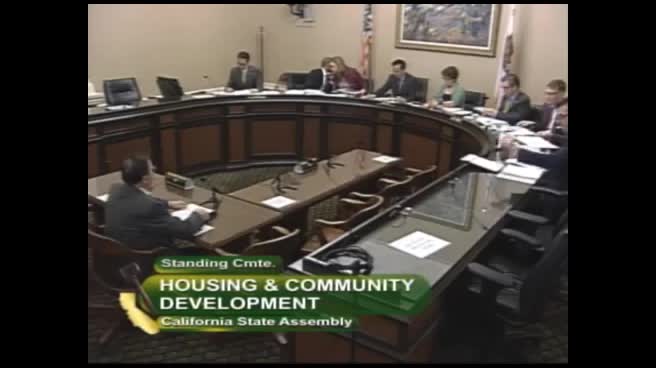 8MIN
Assembly Standing Committee on Housing and Community Development
Bill Author

Bill Co-Author(s):