AB 2647: Insurance taxes: income taxes: credits: community development financial institution investments.
- Session Year: 2015-2016
- House: Assembly
- Latest Version Date: 2016-05-17
Existing law, until January 1, 2017, allows a credit under the Personal Income Tax Law, the Corporation Tax Law, and a credit against the tax imposed on an insurer in an amount equal to 20% of a qualified investment, as defined, made into a community development financial institution, as defined, but not to exceed, in the aggregate amount under all those laws, $50,000,000 per year, and authorizes the California Organized Investment Network to certify investments for the credit until January 1, 2017.
This bill would extend the provisions relating to the authorization of the credits and certification by the Department of Insurance and the California Organized Investment Network until January 1, 2027. The bill would also increase the aggregate amount under all those laws of qualified investments allowed to be certified by the California Organized Investment Network for the credits to $120,000,000 per year.
This bill would take effect immediately as a tax levy.
Existing federal law allows a New Markets Tax Credit to a taxpayer holding a qualified equity investment in an amount equal to the applicable percentage of the amount paid to the qualified community development entity for investment in low-income communities.
The state Personal Income Tax Law and the Corporation Tax Law allow various credits against the taxes imposed by those laws. Existing state constitutional law governing insurance taxation imposes an annual tax on the gross premiums of an insurer, as defined, doing business in this state at specified rates.
Existing law establishes the Governors Office of Business and Economic Development, also known as GO-Biz, to, among other things, serve the Governor as the lead entity for economic strategy and the marketing of California on issues relating to business development, private sector investment, and economic growth.
This bill would allow a California New Markets Tax Credit under the Personal Income Tax Law, the Corporation Tax Law, and the law governing insurance taxation, in modified conformity with the federal New Markets Tax Credit, for taxable years beginning on or after January 1, 2017, and before January 1, 2022, in a specified amount for investments in low-income communities. The bill would limit the total annual amount of credit allowed pursuant to these provisions to $40,000,000 per calendar year. The bill would impose specified duties on the Responsible Tax Credit Administrator (RTCA), to be designated by the Governor, with regard to the application for, and allocation of, the credit. The bill would require the RTCA to establish and impose reasonable fees upon entities that apply for the allocation of the credit, to be deposited in the California New Markets Tax Credit Fund established by the bill, and use the revenue, upon annual appropriation by the Legislature, to defray the cost of applying to and administering the credits, as specified. The bill would only authorize the allocation for these credits for those taxable years for which moneys are appropriated to the RTCA to administer these credits for those taxable years.
Existing law requires any bill authorizing a new personal or corporation income tax credit to contain, among other things, specific goals, purposes, and objectives that the tax credit will achieve, detailed performance indicators, and data collection requirements, as provided.
This bill would also include that additional information required for any bill authorizing a new personal or corporation income tax credit.
The bill would provide that its provisions are severable.
This bill would take effect immediately as a tax levy.
Existing federal law allows a New Markets Tax Credit to a taxpayer holding a qualified equity investment in an amount equal to the applicable percentage of the amount paid to the qualified community development entity for investment in low-income communities.
The state Personal Income Tax Law and the Corporation Tax Law allow various credits against the taxes imposed by those laws. Existing state constitutional law governing insurance taxation imposes an annual tax on the gross premiums of an insurer, as defined, doing business in this state at specified rates.
Existing law establishes the Governors Office of Business and Economic Development, also known as GO-Biz, to, among other things, serve the Governor as the lead entity for economic strategy and the marketing of
California
of California on issues relating to business development, private sector investment, and economic growth.
This bill would allow a California New Markets Tax Credit under the Personal Income Tax Law and Law, the Corporation Tax Law, and the law governing insurance taxation, in modified conformity with a the federal New Markets Tax Credit, for taxable years beginning on or after January 1, 2017, and before January 1, 2029, 2022, in a specified amount for investments in low-income communities. The bill would limit the total annual amount of credit allowed pursuant to these provisions to an amount equal to any portion not granted under a specified sales and use tax exclusion, not to exceed $40,000,000 per calendar year, and would limit the allocation of the credit to a cumulative total of no more than $200,000,000, as provided. year. The bill would impose specified duties on GO-Biz the Responsible Tax Credit Administrator (RTCA), to be designated by the Governor, with regard to the application for, and allocation of, the credit. The bill would require GO-Biz the RTCA to establish and impose reasonable fees upon entities that apply for the allocation of the credit, to be deposited in the California New Markets Tax Credit Fund established by the bill, and use the revenue, upon annual appropriation by the Legislature, to defray the cost of applying to, to and administering the credits, as specified. The bill would only authorize the allocation for these credits for those taxable years for which moneys are appropriated to GO-Biz the RTCA to administer these credits for those taxable years.
Existing law requires any bill authorizing a new personal or corporation income tax credit to contain, among other things, specific goals, purposes, and objectives that the tax credit will achieve, detailed performance indicators, and data collection requirements, as provided.
This bill would also include that additional information required for any bill authorizing a new personal or corporation income tax credit.
The bill would provide that its provisions are severable.
This bill would take effect immediately as a tax levy.
Existing federal law allows a New Markets Tax Credit to a taxpayer holding a qualified equity investment in an amount equal to the applicable percentage of the amount paid to the qualified community development entity for investment in low-income communities.
The state Personal Income Tax Law and the Corporation Tax Law allow various credits against the taxes imposed by those laws. Existing state constitutional law governing insurance taxation imposes an annual tax on the gross premiums of an insurer, as defined, doing business in this state at specified rates.
Existing law establishes the Governors Office of Business and Economic Development, also known as GO-Biz, to, among other things, serve the Governor as the lead entity for economic strategy and the marketing of
California on issues
relating to business development, private sector investment, and economic growth.
This bill would allow a California New Markets Tax Credit under the Personal Income Tax Law and the Corporation Tax Law, and the law governing insurance taxation, in modified conformity with a federal New Markets Tax Credit, for taxable years beginning on or after January 1, 2017, and before January 1, 2029, in a specified amount for investments in low-income communities. The bill would limit the total annual amount of credit allowed pursuant to these provisions to an amount equal to any portion not granted under a specified sales and use tax exclusion, not to exceed $40,000,000 per calendar year, and would limit the allocation of the credit to a cumulative total of no more than $200,000,000, as provided. The bill would impose specified duties on GO-Biz with regard to the application for, and allocation of, the credit. The bill would require GO-Biz to establish and impose reasonable fees upon entities that apply for the allocation of the credit, to be deposited in the California New Markets Tax Credit Fund established by the bill, and use the revenue, upon annual appropriation by the Legislature, to defray the cost of applying to, and administering the credits, as specified. The bill would only authorize the allocation for these credits for those taxable years for which moneys are appropriated to GO-Biz to administer these credits for those taxable years.
Existing law requires any bill authorizing a new personal or corporation income tax credit to contain, among other things, specific goals, purposes, and objectives that the tax credit will achieve, detailed performance indicators, and data collection requirements, as provided.
This bill would also include that additional information required for any bill authorizing a new personal or corporation income tax credit.
The bill would provide that its provisions are severable.
This bill would take effect immediately as a tax levy.
(a)For each year beginning on or after January 1, 1999, and before January 1, 2017, 2027, there shall be allowed as a credit against the amount of tax, as defined in Section 28 of Article XIII of the California Constitution, an amount equal to 20 percent of the amount of each qualified investment made by a taxpayer during the taxable year into a community development financial institution that is certified by the Department of Insurance, California Organized Investment Network, or any successor thereof.
(b)For purposes of determining any tax that may be imposed under Section 685 of the Insurance Code on a taxpayer not organized under the laws of this state, the amount of the credit allowed by subdivision (a) shall be treated as a tax paid under Section 12201 or Section 28 of Article XIII of the California Constitution.
(c)(1)Notwithstanding any other provision of this part, a credit shall not be allowed under this section unless the California Organized Investment Network, or its successor within the Department of Insurance, certifies that the investment described in subdivision (a) qualifies for the credit under this section and certifies the total amount of the credit allocated to the taxpayer pursuant to this section.
(2)A credit shall not be allowed by this section unless the applicant and the taxpayer provide satisfactory substantiation to, and in the form and manner requested by, the Department of Insurance, California Organized Investment Network, or any successor thereof, that the investment is a qualified investment as defined in paragraph (1) of subdivision (h).
(3)(A)The aggregate amount of qualified investments made by all taxpayers pursuant to this section, Section 17053.57, and Section 23657 shall not exceed fifty million dollars ($50,000,000) one hundred twenty million dollars ($120,000,000) for each calendar year. However, if the aggregate amount of qualified investments made in any calendar year is less than fifty million dollars ($50,000,000), one hundred twenty million dollars ($120,000,000), the difference may be carried over to the next year, and any succeeding year during which this section remains in effect, and added to the aggregate amount authorized for those years.
(B)The total amount of qualified investments certified by the California Organized Investment Network in any calendar year to any one community development financial institution together with its affiliates, as defined in Section 1215 of the Insurance Code, shall not exceed 30 percent of the annual aggregate amount of qualified investments certified by the California Organized Investment Network. If, after October 1, the California Organized Investment Network has determined that the availability of tax credits exceed their demand, then a community development financial institution that has been allocated 30 percent of the annual aggregate amount of qualified investments shall become eligible to apply to be certified for any remaining tax credits in that calendar year.
(C)Each year, 10 percent of the annual aggregate amount of qualified investments shall be reserved for investment amounts of less than or equal to two hundred thousand dollars ($200,000). If, after October 1, there remains an unallocated portion of the amount reserved for investments of less than or equal to two hundred thousand dollars ($200,000), then qualified investments in excess of two hundred thousand dollars ($200,000) may be eligible for that remaining unallocated portion.
(4)Priority among housing applications shall be given to applications that support affordable rental housing, housing for veterans, mortgages for community-based residential programs, and self-help housing ahead of single-family owned housing.
(d)The community development financial institution shall do all of the following:
(1)Apply to the Department of Insurance, California Organized Investment Network, or its successor, for certification of its status as a community development financial institution.
(2)(A)Apply to the Department of Insurance, California Organized Investment Network, or its successor, on behalf of the taxpayer for certification of the amount of the investment and the credit amount allocated to the taxpayer, obtain the certification, and retain a copy of the certification.
(B)Provide in the application a detailed description of the intended use of the investment funds including, but not limited to, the following:
(i)All of the programs, projects, and services that would be funded.
(ii)The percentage of the intended use of the investment funds that would directly benefit low-to-moderate income households.
(iii)The percentage of the intended use of the investment funds that would directly benefit rural areas.
(iv)The percentage of the intended use of the investment funds that is a green investment as defined in Section 926.1 of the Insurance Code.
(3)(A)Provide in the application required in paragraph (2) the following information to the Department of Insurance, California Organized Investment Network, or its successor:
(i)Name of the taxpayer.
(ii)Postal address of the taxpayer, or residential address of the taxpayer if the taxpayer is an individual.
(iii)Phone number of the taxpayer.
(iv)Email address of the taxpayer.
(v)The taxpayers California company identification number for tax administration purposes.
(B)The information provided in subparagraph (A) shall be used only for internal purposes by the Department of Insurance, California Organized Investment Network, or its successor, and any public disclosure of that information shall be limited to the name of the taxpayer only.
(4)Provide an annual listing to the State Board of Equalization, in the form and manner agreed upon by the State Board of Equalization and the Department of Insurance, California Organized Investment Network, or its successor, of the names and taxpayers California company identification numbers of any taxpayer who makes any withdrawal or partial withdrawal of a qualified investment before the expiration of 60 months from the date of the qualified investment.
(5)Submit reports to the department, California Organized Investment Network, or any successor thereof, as required pursuant to subdivision (a) of Section 12939.1 of the Insurance Code.
(e)The California Organized Investment Network may certify investments for the credit allowed by this section on or before January 1, 2017, 2027, but not after that date.
(f)(1)The Insurance Commissioner may develop instructions, procedures, and standards for applications, and for administering the criteria for the evaluation of applications under this section. The Insurance Commissioner may, from time to time, adopt, amend, or repeal regulations to implement the provisions of this section.
(2)The initial adoption of the regulations implementing this section shall be deemed to be an emergency and necessary in order to address a situation calling for immediate action to avoid serious harm to the public peace, health, safety, or general welfare.
(3)Notwithstanding Chapter 3.5 (commencing with Section 11340) of Part 1 of Division 3 of Title 2 of the Government Code, any emergency regulation adopted or amended by the Insurance Commissioner pursuant to this section shall remain in effect until amended or repealed by the department.
(g)The Department of Insurance, California Organized Investment Network, or any successor thereof, shall do all of the following:
(1)Accept and evaluate applications for certification from financial institutions and issue certificates that the applicant is a community development financial institution qualified to receive qualified investments. To receive a certificate, an applicant shall satisfy the Department of Insurance, California Organized Investment Network, or any successor thereof, that it meets the specific requirements to be a community development financial institution for this state program as defined in paragraph (2) of subdivision (h). The certificate may be issued for a specified period of time, and may include reasonable conditions to effectuate the intent of this section. The Insurance Commissioner may suspend or revoke a certification, after affording the institution notice and the opportunity to be heard, if the commissioner finds that an institution no longer meets the requirement for certification.
(2)Accept and evaluate applications for certification from any community development financial institution on behalf of the taxpayer and issue certificates to taxpayers in an aggregate amount that shall not exceed the limit specified in subdivision (c), with highest priority granted to those applications where the intended use of the investments has the greatest aggregate benefit for low-to-moderate income areas or households or rural areas or households. The certificate shall include the amount eligible to be made as an investment that qualifies for the credit and the total amount of the credit to which the taxpayer is entitled for the year. Applications for tax credits shall be accepted and evaluated throughout the year. The Insurance Commissioner shall establish tax credit issuance cycles throughout the year as necessary in order to issue tax credit certificates to those applications granted the highest priority.
(3)Provide an annual listing to the State Board of Equalization, in the form or manner agreed upon by the State Board of Equalization and the Department of Insurance, California Organized Investment Network, or its successor, of the taxpayers who were issued certificates, their respective National Association of Insurance Commissioners company number and employers tax identification number, the amount of the qualified investment made by each taxpayer, and the total amount of qualified investments.
(4)Include information specified pursuant to subdivision (b) of Section 12939.1 of the Insurance Code in the report required by Section 12922 of the Insurance Code.
(h)For purposes of this section:
(1)Qualified investment means an investment that is a deposit or loan that does not earn interest, or an equity investment, or an equity-like debt instrument that conforms to the specifications for these instruments as prescribed by the United States Department of the Treasury, Community Development Financial Institutions Fund, or its successor, or, in the absence of that prescription, as defined by the Insurance Commissioner. The investment must be equal to or greater than fifty thousand dollars ($50,000) and made for a minimum duration of 60 months. During that 60-month period, the community development financial institution shall have full use and control of the proceeds of the entire amount of the investment as well as any earnings on the investment for its community development purposes. The entire amount of the investment shall be received by the community development financial institution before the application for the tax credit is submitted. The community development financial institution shall use the proceeds of the investment for a purpose that is consistent with its community development mission and for the benefit of economically disadvantaged communities and low-income people in California.
(2)Community development financial institution means a private financial institution located in this state that is certified by the Department of Insurance, California Organized Investment Network, or its successor, that, consistent with the legislative findings, declarations, and intent set forth in Section 12939 of the Insurance Code, has community development as its primary mission, and that lends in urban, rural, or reservation-based communities in this state. A community development financial institution may include a community development bank, a community development loan fund, a community development credit union, a microenterprise fund, a community development corporation-based lender, or a community development venture fund.
(i)(1)If a qualified investment is withdrawn before the end of the 60th month and not reinvested in another community development financial institution within 60 days, there shall be added to the tax, as defined in Section 28 of Article XIII of the California Constitution, for the year in which the withdrawal occurs, the entire amount of any credit previously allowed under this section.
(2)If a qualified investment is reduced before the end of the 60th month, but not below fifty thousand dollars ($50,000), there shall be added to the tax, as defined in Section 28 of Article XIII of the California Constitution, for the taxable year in which the reduction occurs, an amount equal to 20 percent of the total reduction for the year.
(j)In the case where the credit allowed by this section exceeds the tax, the excess may be carried over to reduce the tax for the next four years, or until the credit has been exhausted, whichever occurs first.
(k)The State Board of Equalization shall, as requested by the Department of Insurance, California Organized Investment Network, or its successor, advise and assist in the administration of this section.
(l)On or before June 30, 2016, the Legislative Analysts Office shall submit a report to the Legislature, in compliance with Section 9795 of the Government Code, on the effects of the tax credits allowed under this section, Section 17053.57, and Section 23657, with a focus on employment in low-to-moderate income and rural areas, and on the benefits of these tax credits to low-to-moderate income and rural persons.
(m)This section shall remain in effect only until December 1, 2017, 2027, and as of that date is repealed.
SEC. 2.Section 17053.57 of the Revenue and Taxation Code is amended to read:17053.57.(a)For each taxable year beginning on or after January 1, 1997, and before January 1, 2017, 2027, there shall be allowed as a credit against the amount of net tax, as defined in Section 17039, an amount equal to 20 percent of the amount of each qualified investment made by a taxpayer during the taxable year into a community development financial institution that is certified by the Department of Insurance, California Organized Investment Network, or any successor thereof.
(b)(1)Notwithstanding any other provision of this part, a credit shall not be allowed under this section unless the California Organized Investment Network, or its successor within the Department of Insurance, certifies that the investment described in subdivision (a) qualifies for the credit under this section and certifies the total amount of the credit allocated to the taxpayer pursuant to this section.
(2)A credit shall not be allowed by this section unless the applicant and the taxpayer provide satisfactory substantiation to, and in the form and manner requested by, the Department of Insurance, California Organized Investment Network, or any successor thereof, that the investment is a qualified investment, as defined in paragraph (1) of subdivision (g).
(3)(A)The aggregate amount of qualified investments made by all taxpayers pursuant to this section, Section 12209, and Section 23657 shall not exceed fifty million dollars ($50,000,000) one hundred twenty million dollars ($120,000,000) for each calendar year. However, if the aggregate amount of qualified investments made in any calendar year is less than fifty million dollars ($50,000,000), one hundred twenty million dollars ($120,000,000), the difference may be carried over to the next year, and any succeeding year during which this section remains in effect, and added to the aggregate amount authorized for those years.
(B)The total amount of qualified investments certified by the California Organized Investment Network in any calendar year to any one community development financial institution together with its affiliates, as defined in Section 1215 of the Insurance Code, shall not exceed 30 percent of the annual aggregate amount of qualified investments certified by the California Organized Investment Network. If, after October 1, the California Organized Investment Network has determined that the availability of tax credits exceed their demand, then a community development financial institution that has been allocated 30 percent of the annual aggregate amount of qualified investments shall become eligible to apply to be certified for any remaining tax credits in that calendar year.
(C)Each year, 10 percent of the annual aggregate amount of qualified investments shall be reserved for investment amounts of less than or equal to two hundred thousand dollars ($200,000). If, after October 1, there remains an unallocated portion of the amount reserved for investments of less than or equal to two hundred thousand dollars ($200,000), then qualified investments in excess of two hundred thousand dollars ($200,000) may be eligible for that remaining unallocated portion.
(4)Priority among housing applications shall be given to applications that support affordable rental housing, housing for veterans, mortgages for community-based residential programs, and self-help housing ahead of single-family owned housing.
(c)The community development financial institution shall do all of the following:
(1)Apply to the Department of Insurance, California Organized Investment Network, or its successor, for certification of its status as a community development financial institution.
(2)(A)Apply to the Department of Insurance, California Organized Investment Network, or its successor, on behalf of the taxpayer, for certification of the amount of the investment and the credit amount allocated to the taxpayer, obtain the certification, and retain a copy of the certification.
(B)Provide in the application a detailed description of the intended use of the investment funds including, but not limited to, the following:
(i)All of the programs, projects, and services that would be funded.
(ii)The percentage of the intended use of the investment funds that would directly benefit low-to-moderate income households.
(iii)The percentage of the intended use of the investment funds that would directly benefit rural areas.
(iv)The percentage of the intended use of the investment funds that is a green investment as defined in Section 926.1 of the Insurance Code.
(3)(A)Provide in the application required in paragraph (2) the following information to the Department of Insurance, California Organized Investment Network, or its successor:
(i)Name of the taxpayer.
(ii)Postal address of the taxpayer, or residential address of the taxpayer if the taxpayer is an individual.
(iii)Phone number of the taxpayer.
(iv)Email address of the taxpayer.
(v)The taxpayers identification number, or in the case of a partnership, the taxpayer identification numbers of all the partners for tax administration purposes.
(B)The information provided in subparagraph (A) shall be used only for internal purposes by the Department of Insurance, California Organized Investment Network, or its successor, and any network or its successor shall limit all public disclosure of that information shall be limited to the name of the taxpayer only.
(4)Provide an annual listing to the Franchise Tax Board, in the form and manner agreed upon by the Franchise Tax Board and the Department of Insurance, California Organized Investment Network, or its successor, of the names and taxpayer identification numbers of any taxpayer who makes any withdrawal or partial withdrawal of a qualified investment before the expiration of 60 months from the date of the qualified investment.
(5)Submit reports to the Department of Insurance, California Organized Investment Network, or any successor thereof, as required pursuant to subdivision (a) of Section 12939.1 of the Insurance Code.
(d)(1)The Insurance Commissioner may develop instructions, procedures, and standards for applications, and for administering the criteria for the evaluation of applications under this section. The Insurance Commissioner may, from time to time, adopt, amend, or repeal regulations to implement the provisions of this section.
(2)The initial adoption of the regulations implementing this section shall be deemed to be an emergency and necessary in order to address a situation calling for immediate action to avoid serious harm to the public peace, health, safety, or general welfare.
(3)Notwithstanding Chapter 3.5 (commencing with Section 11340) of Part 1 of Division 3 of Title 2 of the Government Code, any emergency regulation adopted or amended by the Insurance Commissioner pursuant to this section shall remain in effect until amended or repealed by the department.
(e)The California Organized Investment Network may certify investments for the credit allowed by this section on or before January 1, 2017, 2027, but not after that date.
(f)The Department of Insurance, California Organized Investment Network, or any successor thereof, shall do all of the following:
(1)Accept and evaluate applications for certification from financial institutions and issue certificates that the applicant is a community development financial institution qualified to receive qualified investments. To receive a certificate, an applicant shall satisfy the Department of Insurance, California Organized Investment Network, or any successor thereof, that it meets the specific requirements to be a community development financial institution for this state program as defined in paragraph (2) of subdivision (g). The certificate may be issued for a specified period of time, and may include reasonable conditions to effectuate the intent of this section. The Insurance Commissioner may suspend or revoke a certification, after affording the institution notice and the opportunity to be heard, if the commissioner finds that an institution no longer meets the requirement for certification.
(2)Accept and evaluate applications for certification from a community development financial institution on behalf of the taxpayer and issue certificates to taxpayers in an aggregate amount that shall not exceed the limit specified in subdivision (b), with highest priority granted to those applications where the intended use of the investments has the greatest aggregate benefit for low-to-moderate income areas or households or rural areas or households. The certificate shall include the amount eligible to be made as an investment that qualifies for the credit and the total amount of the credit to which the taxpayer is entitled for the taxable year. Applications for tax credits shall be accepted and evaluated throughout the year. The Insurance Commissioner shall establish tax credit issuance cycles throughout the year as necessary in order to issue tax credit certificates to those applications granted the highest priority.
(3)Provide an annual listing to the Franchise Tax Board, in the form or manner agreed upon by the Franchise Tax Board and the Department of Insurance, California Organized Investment Network, or its successor, of the taxpayers who were issued certificates, their respective tax identification numbers, the amount of the qualified investment made by each taxpayer, and the total amount of qualified investments.
(4)Include information specified pursuant to subdivision (b) of Section 12939.1 of the Insurance Code in the report required by Section 12922 of the Insurance Code.
(g)For purposes of this section:
(1)Qualified investment means an investment that is a deposit or loan that does not earn interest, or an equity investment, or an equity-like debt instrument that conforms to the specifications for these instruments as prescribed by the United States Department of the Treasury, Community Development Financial Institutions Fund, or its successor, or, in the absence of that prescription, as defined by the Insurance Commissioner. The investment must be equal to or greater than fifty thousand dollars ($50,000) and made for a minimum duration of 60 months. During that 60-month period, the community development financial institution shall have full use and control of the proceeds of the entire amount of the investment as well as any earnings on the investment for its community development purposes. The entire amount of the investment shall be received by the community development financial institution before the application for the tax credit is submitted. The community development financial institution shall use the proceeds of the investment for a purpose that is consistent with its community development mission and for the benefit of economically disadvantaged communities and low-income people in California.
(2)Community development financial institution means a private financial institution located in this state that is certified by the Department of Insurance, California Organized Investment Network, or its successor, that, consistent with the legislative findings, declarations, and intent set forth in Section 12939 of the Insurance Code, has community development as its primary mission, and that lends in urban, rural, or reservation-based communities in this state. A community development financial institution may include a community development bank, a community development loan fund, a community development credit union, a microenterprise fund, a community development corporation-based lender, or a community development venture fund.
(h)(1)If a qualified investment is withdrawn before the end of the 60th month and not reinvested in another community development financial institution within 60 days, there shall be added to the net tax, as defined in Section 17039, for the taxable year in which the withdrawal occurs, the entire amount of any credit previously allowed under this section.
(2)If a qualified investment is reduced before the end of the 60th month, but not below fifty thousand dollars ($50,000), there shall be added to the net tax, as defined in Section 17039, for the taxable year in which the reduction occurs, an amount equal to 20 percent of the total reduction for the taxable year.
(i)In the case where the credit allowed by this section exceeds the net tax, the excess may be carried over to reduce the net tax for the next four taxable years, or until the credit has been exhausted, whichever occurs first.
(j)The Franchise Tax Board shall, as requested by the Department of Insurance, California Organized Investment Network, or its successor, advise and assist in the administration of this section.
(k)On or before June 30, 2016, the Legislative Analysts Office shall submit a report to the Legislature, in compliance with Section 9795 of the Government Code, on the effects of the tax credits allowed under this section, Section 12209, and Section 23657, with a focus on employment in low-to-moderate income and rural areas, and on the benefits of these tax credits to low-to-moderate income and rural persons.
(l)This section shall remain in effect only until December 1, 2017, 2027, and as of that date is repealed.
SEC. 3.Section 23657 of the Revenue and Taxation Code is amended to read:23657.(a)For each taxable year beginning on or after January 1, 1997, and before January 1, 2017, 2027, there shall be allowed as a credit against the amount of tax, as defined in Section 23036, an amount equal to 20 percent of the amount of each qualified investment made by a taxpayer during the taxable year into a community development financial institution that is certified by the Department of Insurance, California Organized Investment Network, or any successor thereof.
(b)(1)Notwithstanding any other provision of this part, a credit shall not be allowed under this section unless the California Organized Investment Network, or its successor within the Department of Insurance, certifies that the investment described in subdivision (a) qualifies for the credit under this section and certifies the total amount of the credit allocated to the taxpayer pursuant to this section.
(2)A credit shall not be allowed by this section unless the applicant and the taxpayer provide satisfactory substantiation to, and in the form and manner requested by, the Department of Insurance, California Organized Investment Network, or any successor thereof, that the investment is a qualified investment, as defined in paragraph (1) of subdivision (g).
(3)(A)The aggregate amount of qualified investments made by all taxpayers pursuant to this section, Section 12209, and Section 17053.57 shall not exceed fifty million dollars ($50,000,000) one hundred twenty million dollars ($120,000,000) for each calendar year. However, if the aggregate amount of qualified investments made in any calendar year is less than fifty million dollars ($50,000,000), one hundred twenty million dollars ($120,000,000), the difference may be carried over to the next year, and any succeeding year during which this section remains in effect, and added to the aggregate amount authorized for those years.
(B)The total amount of qualified investments certified by the California Organized Investment Network in any calendar year to any one community development financial institution together with its affiliates, as defined in Section 1215 of the Insurance Code, shall not exceed 30 percent of the annual aggregate amount of qualified investments certified by the California Organized Investment Network. If, after October 1, the California Organized Investment Network has determined that the availability of tax credits exceed their demand, then a community development financial institution that has been allocated 30 percent of the annual aggregate amount of qualified investments shall become eligible to apply to be certified for any remaining tax credits in that calendar year.
(C)Each year, 10 percent of the annual aggregate amount of qualified investments shall be reserved for investment amounts of less than or equal to two hundred thousand dollars ($200,000). If, after October 1, there remains an unallocated portion of the amount reserved for investments of less than or equal to two hundred thousand dollars ($200,000), then qualified investments in excess of two hundred thousand dollars ($200,000) may be eligible for that remaining unallocated portion.
(4)Priority among housing applications shall be given to applications that support affordable rental housing, housing for veterans, mortgages for community-based residential programs, and self-help housing ahead of single-family owned housing.
(c)The community development financial institution shall do all of the following:
(1)Apply to the Department of Insurance, California Organized Investment Network, or its successor, for certification of its status as a community development financial institution.
(2)(A)Apply to the Department of Insurance, California Organized Investment Network, or its successor, on behalf of the taxpayer, for certification of the amount of the investment and the credit amount allocated to the taxpayer, obtain the certification, and retain a copy of the certification.
(B)Provide in the application a detailed description of the intended use of the investment funds including, but not limited to, the following:
(i)All of the programs, projects, and services that would be funded.
(ii)The percentage of the intended use of the investment funds that would directly benefit low-to-moderate income households.
(iii)The percentage of the intended use of the investment funds that would directly benefit rural areas.
(iv)The percentage of the intended use of the investment funds that is a green investment as defined in Section 926.1 of the Insurance Code.
(3)(A)Provide in the application required in paragraph (2) the following information to the Department of Insurance, California Organized Investment Network, or its successor:
(i)Name of the taxpayer.
(ii)Postal address of the taxpayer, or residential address of the taxpayer if the taxpayer is an individual.
(iii)Phone number of the taxpayer.
(iv)Email address of the taxpayer.
(v)The taxpayers California company identification number for tax administration purposes, or in the case of an S corporation, the taxpayer identification numbers of all the shareholders for tax administration purposes.
(B)The information provided in subparagraph (A) shall be used only for internal purposes by the Department of Insurance, California Organized Investment Network, or its successor, and any public disclosure of that information shall be limited to the name of the taxpayer only.
(4)Provide an annual listing to the Franchise Tax Board, in the form and manner agreed upon by the Franchise Tax Board and the Department of Insurance, California Organized Investment Network, or its successor, of the names and taxpayer identification numbers of any taxpayer who makes any withdrawal or partial withdrawal of a qualified investment before the expiration of 60 months from the date of the qualified investment.
(5)Submit reports to the department, Department of Insurance, California Organized Investment Network, or any successor thereof, as required pursuant to subdivision (a) of Section 12939.1 of the Insurance Code.
(d)The California Organized Investment Network may certify investments for the credit allowed by this section on or before January 1, 2017, 2027, but not after that date.
(e)(1)The Insurance Commissioner may develop instructions, procedures, and standards for applications, and for administering the criteria for the evaluation of applications under this section. The Insurance Commissioner may, from time to time, adopt, amend, or repeal regulations to implement the provisions of this section.
(2)The initial adoption of the regulations implementing this section shall be deemed to be an emergency and necessary in order to address a situation calling for immediate action to avoid serious harm to the public peace, health, safety, or general welfare.
(3)Notwithstanding Chapter 3.5 (commencing with Section 11340) of Part 1 of Division 3 of Title 2 of the Government Code, any emergency regulation adopted or amended by the Insurance Commissioner pursuant to this section shall remain in effect until amended or repealed by the department.
(f)The Department of Insurance, California Organized Investment Network, or any successor thereof, shall do all of the following:
(1)Accept and evaluate applications for certification from financial institutions and issue certificates that the applicant is a community development financial institution qualified to receive qualified investments. To receive a certificate, an applicant shall satisfy the Department of Insurance, California Organized Investment Network, or any successor thereof, that it meets the specific requirements to be a community development financial institution for this state program as defined in paragraph (2) of subdivision (g). The certificate may be issued for a specified period of time, and may include reasonable conditions to effectuate the intent of this section. The Insurance Commissioner may suspend or revoke a certification, after affording the institution notice and the opportunity to be heard, if the commissioner finds that an institution no longer meets the requirement for certification.
(2)Accept and evaluate applications for certification from any community development financial institution on behalf of the taxpayer and issue certificates to taxpayers in an aggregate amount that shall not exceed the limit specified in subdivision (b), with highest priority granted to those applications where the intended use of the investments has the greatest aggregate benefit for low-to-moderate income areas or households or rural areas or households. The certificate shall include the amount eligible to be made as an investment that qualifies for the credit and the total amount of the credit to which the taxpayer is entitled for the taxable year. Applications for tax credits shall be accepted and evaluated throughout the year. The Insurance Commissioner shall establish tax credit issuance cycles throughout the year as necessary in order to issue tax credit certificates to those applications granted the highest priority.
(3)Provide an annual listing to the Franchise Tax Board, in the form or manner agreed upon by the Franchise Tax Board and the Department of Insurance, California Organized Investment Network, or its successor, of the taxpayers who were issued certificates, their respective tax identification numbers, the amount of the qualified investment made by each taxpayer, and the total amount of qualified investments.
(4)Include information specified pursuant to subdivision (b) of Section 12939.1 of the Insurance Code in the report required by Section 12922 of the Insurance Code.
(g)For purposes of this section:
(1)Qualified investment means an investment that is a deposit or loan that does not earn interest, or an equity investment, or an equity-like debt instrument that conforms to the specifications for these instruments as prescribed by the United States Department of the Treasury, Community Development Financial Institutions Fund, or its successor, or, in the absence of that prescription, as defined by the Insurance Commissioner. The investment must be equal to or greater than fifty thousand dollars ($50,000) and made for a minimum duration of 60 months. During that 60-month period, the community development financial institution shall have full use and control of the proceeds of the entire amount of the investment as well as any earnings on the investment for its community development purposes. The entire amount of the investment shall be received by the community development financial institution before the application for the tax credit is submitted. The community development financial institution shall use the proceeds of the investment for a purpose that is consistent with its community development mission and for the benefit of economically disadvantaged communities and low-income people in California.
(2)Community development financial institution means a private financial institution located in this state that is certified by the Department of Insurance, California Organized Investment Network, or its successor, that, consistent with the legislative findings, declarations, and intent set forth in Section 12939 of the Insurance Code, has community development as its primary mission, and that lends in urban, rural, or reservation-based communities in this state. A community development financial institution may include a community development bank, a community development loan fund, a community development credit union, a microenterprise fund, a community development corporation-based lender, or a community development venture fund.
(h)(1)If a qualified investment is withdrawn before the end of the 60th month and not reinvested in another community development financial institution within 60 days, there shall be added to the tax, as defined in Section 23036, for the taxable year in which the withdrawal occurs, the entire amount of any credit previously allowed under this section.
(2)If a qualified investment is reduced before the end of the 60th month, but not below fifty thousand dollars ($50,000), there shall be added to the tax, as defined in Section 23036, for the taxable year in which the reduction occurs, an amount equal to 20 percent of the total reduction for the taxable year.
(i)In the case where the credit allowed by this section exceeds the tax, the excess may be carried over to reduce the tax for the next four taxable years, or until the credit has been exhausted, whichever occurs first.
(j)The Franchise Tax Board shall, as requested by the Department of Insurance, California Organized Investment Network, or its successor, advise and assist in the administration of this section.
(k)On or before June 30, 2016, the Legislative Analysts Office shall submit a report to the Legislature, in compliance with Section 9795 of the Government Code, on the effects of the tax credits allowed under this section, Section 12209, and Section 17053.57, with a focus on employment in low-to-moderate income and rural areas, and on the benefits of these tax credits to low-to-moderate income and rural persons.
(l)This section shall remain in effect only until December 1, 2017, 2027, and as of that date is repealed.
SEC. 4.This act provides for a tax levy within the meaning of Article IV of the Constitution and shall go into immediate effect.
SECTION 1.The Legislature finds and declares the following:
(a)While many areas of California have recovered from the economic and community development impacts of the 2006 Financial Crisis and the 2010 global recession, Californians in a number of communities and neighborhoods are still experiencing their lingering effects. In some cases this has resulted in small and medium businesses in low-income areas lacking sufficient access to capital and technical assistance. Given that the state has many needs and limited resources, moneys from the private sector are necessary to fill this capital and investment gap.
(b)Initially enacted in 2000, the federal government established the New Markets Tax Credit (NMTC) Program, which uses a market-based approach for expanding capital and technical assistance to businesses in lower income communities. The federal program is jointly administered by the Community Development Financial Institutions Fund (CDFI Fund) and the Internal Revenue Service. The NMTC Program allocates federal tax incentives to community development entities (CDE), which they then use to attract private investors who contribute funds that can be used to finance and invest in businesses and develop real estate in low-income communities. Through the 201314 funding round, the CDFI Fund had awarded approximately forty billion dollars ($40,000,000,000) in NMTC in 836 awards, including three billion dollars ($3,000,000,000) in American Recovery and Investment Act of 2009 awards and one billion dollars ($1,000,000,000) of special allocation authority to be used for the recovery and redevelopment of the Gulf Opportunity Zone.
(c)Since 2003, the NMTC Program has created or retained an estimated 197,585 jobs nationally. It has also supported the construction of 32.4 million square feet of manufacturing space, 74.8 million square feet of office space, and 57.5 million square feet of retail space. The United States Department of the Treasury reports that a secondary benefit is that as these communities develop, they become more attractive to investors, catalyzing a ripple effect that spurs further investments and revitalization.
(d)For every one dollar ($1) invested by the federal government, the NMTC Program generates over eight dollars ($8) of private investment. The NMTC Program catalyzes investment in the most economically challenged areas of the state. Over 75 percent of New Markets Tax Credit investments have been made in highly distressed areas, meaning the household income was less than 60 percent of statewide median income and the poverty rate was higher than 30 percent.
(e)The federal NMTC totals 39 percent of the original investment amount in the CDE and is claimed over a period of seven years (5 percent for each of the first three years and 6 percent for each of the remaining four years). Any investment by any taxpayer in the CDE redeemed before the end of the seven-year period will be recaptured.
(f)Fourteen states in the United States have adopted state programs using the NMTC model including Alabama, Florida, Illinois, Nevada, and Oregon. While some of the programs substantially mirror the federal program, others vary in both the percentage of the credit and some of the policies that form the foundation of the credit. One of the reasons cited for establishing state-level programs is to make a state more attractive to CDEs, which results in increasing the amount of federal NMTCs being utilized in a state. Further, several studies, including a January 1, 2011, case study by Pacific Community Ventures, showed that for every dollar of forgone tax revenue, the federal NMTC leverages twelve dollars ($12) to fourteen dollars ($14) of private investment.
SEC. 2.Section 12283 is added to the Revenue and Taxation Code, to read:12283.(a)There is hereby created the California New Markets Tax Credit Program as provided in this section, Section 17053.9, and Section 23622.9. The purpose of this program is to stimulate private sector investment in lower income communities by providing a tax incentive to community and economic development entities that can be leveraged by the entity to attract private sector investment that in turn will be deployed by providing financing and technical assistance to small- and medium-sized businesses and the development of commercial, industrial, and community development projects, including, but not limited to, facilities for nonprofit service organizations, light manufacturing, and mixed-use and transit-oriented development. RTCA shall administer this program as provided in this section, Section 17053.9, and Section 23622.9.
(b)(1)For taxable years beginning on or after January 1, 2017, and before January 1, 2022, and subject to subdivision (h), there shall be allowed as a credit against the tax described in Section 12201, in an amount determined in accordance with Section 45D of the Internal Revenue Code, relating to the new markets tax credit, as modified in this section.
(2)For the purposes of this section, RTCA means the Responsible Tax Credit Administrator, as designated by the Governor.
(c)Section 45D of the Internal Revenue Code is modified as follows:
(1)Section 45D(a)(2) of the Internal Revenue Code, relating to applicable percentage, is modified by substituting for (A) 5 percent with respect to the first 3 credit allowance dates, and (B) 6 percent with respect to the remainder of the credit allowance dates with the following:
(A)Zero percent with respect to the first two credit allowance dates.
(B)Seven percent with respect to the third credit allowance date.
(C)Eight percent with respect to the remainder of the credit allowance dates.
(2)(A)Section 45D(c)(1) of the Internal Revenue Code, relating to qualified community development entity, is modified to only include a qualified community development entity, that is certified by the Secretary of the Treasury, and its subsidiary qualified community development entities that have entered into an allocation agreement with the Community Development Financial Institutions Fund of the United States Treasury Department, with respect to credits authorized by Section 45D of the Internal Revenue Code, that includes California within the service area and is dated on or after January 1, 2012.
(B) Section 45D(c)(2) of the Internal Revenue Code, relating to special rules for certain organizations, is modified to only include a specialized small business investment company or community development financial institution that entered into an allocation agreement with the Community Development Financial Institutions Fund of the United States Treasury Department, with respect to credits authorized by Section 45D of the Internal Revenue Code, that includes California within the service area and is dated on or after January 1, 2012.
(3)The term qualified active low-income community business, as defined in Section 45D(d)(2) of the Internal Revenue Code, is modified as follows:
(A)By substituting any low-income community in California for any low-income community every place it appears in Section 45D of the Internal Revenue Code.
(B)A qualified active low-income community business shall not include any business that derives, or projects to derive, 15 percent or more of its annual revenue from the rental or sale of real estate. This exclusion does not apply to a business that is controlled by, or under common control with, another business if the second business: (i) does not derive or project to derive 15 percent or more of its annual revenue from the rental or sale of real estate; and (ii) is the primary tenant of the real estate leased from the first business.
(C)A qualified active low-income community business shall only include a business that, at the time the initial investment is made, has 250 or fewer employees and is located in one or more California low-income communities. The operating business shall meet all other conditions of a qualified active low-income community business, except as modified by this paragraph. This requirement does not apply to a business that is located on land and is controlled by, or under common control with, a federally recognized tribe.
(D)A qualified active low-income community business shall only include a business located in census tracts with a poverty rate greater than 30 percent, or census tracts, if located within a nonmetropolitan area, with a median family income that does not exceed 60 percent of median family income for this state, or census tracts, if located within a metropolitan area, with a median family income that does not exceed 60 percent of the greater of the California median family income or the metropolitan area median family income, or census tracts with unemployment rates at least 1.5 times the national average.
(E)A qualified active low-income community business shall not include any business that operates or derives revenues from the operation of a country club, gaming establishment, massage parlor, liquor store, or golf course.
(F)A qualified active low-income community business shall not include a sexually oriented business. A sexually oriented business means a nightclub, bar, restaurant, or similar commercial enterprise that provides for an audience of two or more individuals live nude entertainment or live nude performances where the nudity is a function of everyday business operations and where nudity is a planned and intentional part of the entertainment or performance. Nude means clothed in a manner that leaves uncovered or visible, through less than fully opaque clothing, any portion of the genitals or, in the case of a female, any portion of the breasts below the top of the areola of the breasts.
(G)A qualified active low-income community business shall not include a charter school.
(4)Section 45D(f) of the Internal Revenue Code, relating to national limitation on amount of investments designated, is modified as follows:
(A)The following shall apply in lieu of the provisions of Section 45D(f)(1) of the Internal Revenue Code: The aggregate amount of qualified equity investments that may be allocated in any calendar year for purposes of this section, Section 17053.9, and Section 23622.9 shall be forty million dollars ($40,000,000) per calendar year. The allocation of any undesignated qualified equity investments shall be returned to RTCA by March 1 of the year following allocation and the value of the undesignated qualified equity investment shall be available for allocation in the following calendar years in accordance with the application process. Any qualified equity investment attributable to recaptured credits shall be available to RTCA on March 1 of the year following recapture and shall be available for allocation in the following calendar years in accordance with subparagraph (B) of paragraph (5). Reallocated qualified equity investments attributable to recapture credits shall not count against the annual or the cumulative limit.
(B)The references to the Secretary in Section 45D(f)(2) of the Internal Revenue Code, relating to allocation of limitation, is modified to read RTCA.
(C)The last sentence of Section 45D(f)(3) of the Internal Revenue Code, relating to carryover of unused limitation, shall not apply.
(5)Section 45D(g)(3) of the Internal Revenue Code, relating to recapture event, is modified to add the following:
(A)The qualified community development entity fails to comply with subparagraph (D) of paragraph (5) of subdivision (d). In this case, recapture shall be 100 percent of the credit.
(B)RTCA shall establish a process, in consultation with the Department of Insurance, for the recapture of credits allowed under this section from the entity that claimed the credit on a return.
(C)Recaptured qualified equity investments revert back to RTCA and shall be reissued. The reissue shall not count toward the annual or cumulative allocation limitation. The reissue shall be done in the following order:
(i)First, pro rata to applicants whose qualified equity investment allocations were reduced pursuant to subparagraph (E) of paragraph (5) of subdivision (d) by the annual allocation limitation.
(ii)Thereafter, in accordance with the application process.
(D)Enforcement of each of the recapture provisions shall be subject to a six-month cure period.
(d)(1)RTCA shall adopt guidelines necessary or appropriate to carry out its responsibilities with respect to the allocation, monitoring, and management of the tax credit program authorized by this section.
(2)(A)RTCA shall establish and impose reasonable fees upon entities that apply for the allocation pursuant to this subdivision that in the aggregate defray the cost of reviewing applications for the program. RTCA may impose other reasonable fees upon entities that receive the allocation pursuant to this subdivision that in the aggregate defray the cost of administering the program.
(B)The fees collected shall be deposited in the California New Markets Tax Credit Fund established in Section 18410.3.
(3)In developing guidelines, RTCA shall adopt an allocation process that does all of the following:
(A)Creates an equitable distribution process that ensures that low-income community populations across the state have an opportunity to benefit from the program.
(B)Sets minimum organizational capacity standards that applicants must meet in order to receive an allocation of authority to designate qualified equity investments, including, but not limited to, its business strategy, targeted community outcomes, capitalization strategy, and management capacity.
(C)Considers the qualified community development entitys prior qualified low-income community investments under Section 45D of the Internal Revenue Code.
(D)Considers the qualified community development entitys prior qualified low-income community investments under this section, including subparagraph (D) of paragraph (5).
(4)(A)Subject to subdivision (h), RTCA shall begin accepting applications on or before May 15, 2017, and shall award authority to designate qualified equity investments annually through 2021.
(B)In the instance where RTCA determines that an application is incomplete, the qualified community development entity shall be given five business days to provide the omitted information.
(5)(A)In the 2017 awards cycle, RTCA shall award authority to designate qualified equity investments to qualified community development entities described in paragraph (2) of subdivision (c) in the order applications are received by RTCA. Applications received on the same day shall be deemed to have been received simultaneously.
(B)In the 2018 to 2021 award cycles, inclusive, at least 60 percent of the authority to designate qualified equity investments shall be awarded pursuant to subparagraph (A). At the discretion of RTCA, a higher percentage of authority to designate qualified equity investments may be awarded pursuant to subparagraph (A).
(C)RTCA shall award up to 40 percent of the authority to designate qualified equity investments in the 2018 to 2021, inclusive, award cycles, to qualified community development entities on a competitive basis that meets the following criteria:
(i)Awards shall be reviewed using blind scoring and a review committee that is composed of community development finance practitioners and members having demonstrated experience in assessing organizational business strategy, community outcomes, capitalization strategy, and management capacity.
(ii)A member of the review committee shall not have a financial interest, which includes, but is not limited to, asking, consenting, or agreeing to receive any commission, emolument, gratuity, money, property, or thing of value for his or her own use, benefit, or personal advantage for procuring or endeavoring to procure for any person, partnership, joint venture, association, or corporation any qualified equity investment or other assistance from any applicant.
(iii)Priority shall be provided to both of the following:
(I)Applications that commit to addressing the hardest to serve and undercapitalized lower income populations.
(II)Applications that support neighborhood revitalization strategies driven by local grassroots stakeholders in multiple low-income communities across one or more regions or the state. These applications shall demonstrate how their investment activity provides a scalable economic development model.
(D)For applications described in subparagraphs (A) and (B), applications for awards shall include a commitment to make at least 15 percent of qualified community development investments to a qualified community development entity with the assistance of a nonprofit organization, as documented by a cooperation agreement that states the terms and conditions of that assistance. For the purposes of this subparagraph, the following shall apply:
(i)A qualified community development entity shall be certified under Section 45D of the Internal Revenue Code but has not received a federal New Markets Tax Credit allocation on or after January 1, 2012, and has either a local service area that includes one or more California communities or a California statewide service area, but excluding qualified community development entities with a national service area.
(ii)A nonprofit organization shall meet all of the following requirements: Is tax exempt under Section 23701, is registered with the Registry of Charitable Trusts, which is administered by the Attorney General, has articles of incorporation or articles of organization that state the primary mission of the organization is focused on improving the economic well-being of low-income communities or individuals, and has bylaws that provide that the organization maintains accountability to residents of low-income communities through their representation on any governing board or on an advisory board of the nonprofit organization.
(E)(i) For applications described in subparagraph (A), in the event requests for authority to designate qualified equity investments exceed the applicable annual allocation limitation, RTCA shall certify, consistent with remaining qualified equity investment capacity, qualified equity investments of applicants in proportionate percentages based upon the ratio of the amount of qualified equity investments requested in such applications to the total amount of qualified equity investments requested in all such applications received on the same day.
(ii)If a pending request cannot be fully certified due to this limit, RTCA shall certify the portion that may be certified unless the qualified community development entity elects to withdraw its request rather than receive partial certification.
(F)An approved applicant may transfer all or a portion of its certified qualified equity investment authority to its controlling entity or any subsidiary qualified community development entity of the controlling entity, provided that the applicant and the transferee notify RTCA within 30 calendar days of such transfer and include the information required in the application with respect to such transferee with such notice. The transferee shall be subject to the same rules, requirements, and limitations applicable to the transferor.
(G)Within 200 calendar days of RTCA sending notice of certification, the qualified community development entity or any transferee, under subparagraph (F), shall issue the qualified equity investment and receive cash in the amount of the certified amount. The qualified community development entity or transferee, under subparagraph (F), shall provide RTCA with evidence of the receipt of the cash investment within 205 calendar days of the applicant receiving notice of certification. If the qualified community development entity or any transferee, under subparagraph (F), does not receive the cash investment and issue the qualified equity investment within 200 calendar days of RTCA sending the certification notice, the certification shall lapse and the entity may not issue the qualified equity investment without reapplying to RTCA for certification. Lapsed certifications revert back to RTCA and shall be reissued in the following order:
(i)First, pro rata to applicants whose qualified equity investment allocations were reduced pursuant to subparagraph (E) under the annual allocation limitation of forty million dollars ($40,000,000) in paragraph (4) of subdivision (c).
(ii)Thereafter, in accordance with the application process.
(H)A qualified community development entity that issues qualified equity investments shall notify RTCA of the names of taxpayers that are eligible to utilize tax credits pursuant to this section and any transfer of a qualified equity investment.
(6)(A)A qualified community development entity that issues qualified equity investments shall submit a report to RTCA that provides documentation as to the investment of at least 85 percent of the funds being deployed within one year in qualified low-income community investments in qualified active low-income community businesses located in California. Such report shall include all of the following:
(i)A bank statement of such qualified community development entity evidencing each qualified low-income community investment.
(ii)Evidence that such business was a qualified active low-income community business at the time of such qualified low-income community investment.
(iii)Evidence that the community development entity complied with subparagraph (D) of paragraph (5).
(iv)Any other information required by RTCA as being necessary to meet the requirements of this section.
(B)Thereafter, the qualified community development entity shall submit an annual report to RTCA during the seven years following submittal of the report, pursuant to subparagraph (A). No annual report shall be due prior to the first anniversary of the initial credit allowance date. The report shall include, but is not limited to, the following:
(i)The social, environmental, and economic impact the credit had on the low-income community during the report period and cumulatively.
(ii)The amount of moneys used for qualified low-income investments in qualified low-income community businesses.
(iii)The number of employment positions created and retained as a result of qualified low-income community investments and the average annual salary of such positions.
(iv)The number of operating businesses assisted as a result of qualified low-income community investments, by industry and number of employees.
(v)Number of owner-occupied real estate projects.
(vi)Location of each qualified low-income community business assisted by a qualified low-income community investment.
(vii)Summary of the outcomes of each of the revenue impact assessments undertaken by the qualified community development entity during the year.
(viii)Any other information requested by RTCA.
(e)(1)In the case where the credit allowed by this section exceeds the tax described in Section 12201, the excess may be carried over to reduce that tax in the following year, and the six succeeding years if necessary, until the credit is exhausted.
(2)A taxpayer allowed a credit under this section for a qualified equity investment shall not be eligible for any other credit under this part with respect to that investment.
(3)The credit allowed under this section may be in addition to any credit allowed under Section 45D of the Internal Revenue Code.
(f)RTCA shall annually report on its Internet Web site the information provided by low-income community development entities and on the geographic distribution of the qualified active low-income community businesses assisted.
(g)(1)The Insurance Commissioner may prescribe any rules or regulations that may be necessary or appropriate to implement this section. The Insurance Commissioner shall have access to any documentation held by RTCA relative to the application and reporting of a qualified community development entity.
(2)A qualified community development entity shall provide RTCA with the name, address, and tax identification number of each investor and entity for which a qualified equity investment was designated by the qualified community development entity, pursuant to this section. RTCA shall provide this information to the Insurance Commissioner in a manner determined by the Insurance Commissioner.
(h)(1)The credit authorized by this section shall only be allowed for those taxable years for which moneys are appropriated to RTCA to administer the California New Markets Tax Credit pursuant to 18410.3 for that taxable year. The appropriation shall specifically identify the California New Markets Tax Credit.
(2)For those taxable years for which those moneys are appropriated pursuant to paragraph (1), RTCA shall post notice of the appropriation on the homepage of its Internet Web site and send notice of such appropriation to the Secretary of State and the Legislative Counsel.
(i)This section shall be repealed on December 1, 2022.
SEC. 3.Section 17053.9 is added to the Revenue and Taxation Code, to read:17053.9.(a)There is hereby created the California New Markets Tax Credit Program as provided in this section, Section 12283, and Section 23622.9. The purpose of this program is to stimulate private sector investment in lower income communities by providing a tax incentive to community and economic development entities that can be leveraged by the entity to attract private sector investment that in turn will be deployed by providing financing and technical assistance to small- and medium-sized businesses and the development of commercial, industrial, and community development projects, including, but not limited to, facilities for nonprofit service organizations, light manufacturing, and mixed-use and transit-oriented development. RTCA shall administer this program as provided in this section, Section 12283, and Section 23622.9.
(b)(1)For taxable years beginning on or after January 1, 2017, and before January 1, 2022, and subject to subdivision (h), there shall be allowed as a credit against the net tax, as defined in Section 17039, in an amount determined in accordance with Section 45D of the Internal Revenue Code, relating to the new markets tax credit, as modified in this section.
(2)For the purposes of this section, RTCA means the Responsible Tax Credit Administrator, as designated by the Governor.
(c)Section 45D of the Internal Revenue Code is modified as follows:
(1)Section 45D(a)(2) of the Internal Revenue Code, relating to applicable percentage, is modified by substituting for (A) 5 percent with respect to the first 3 credit allowance dates, and (B) 6 percent with respect to the remainder of the credit allowance dates with the following:
(A)Zero percent with respect to the first two credit allowance dates.
(B)Seven percent with respect to the third credit allowance date.
(C)Eight percent with respect to the remainder of the credit allowance dates.
(2)(A)Section 45D(c)(1) of the Internal Revenue Code, relating to qualified community development entity, is modified to only include a qualified community development entity, that is certified by the Secretary of the Treasury, and its subsidiary qualified community development entities that have entered into an allocation agreement with the Community Development Financial Institutions Fund of the United States Treasury Department, with respect to credits authorized by Section 45D of the Internal Revenue Code, that includes California within the service area and is dated on or after January 1, 2012.
(B)Section 45D(c)(2) of the Internal Revenue Code, relating to special rules for certain organizations, is modified to only include a specialized small business investment company or community development financial institution that entered into an allocation agreement with the Community Development Financial Institutions Fund of the United States Treasury Department, with respect to credits authorized by Section 45D of the Internal Revenue Code, that includes California within the service area and is dated on or after January 1, 2012.
(3)The term qualified active low-income community business, as defined in Section 45D(d)(2) of the Internal Revenue Code, is modified as follows:
(A)By substituting any low-income community in California for any low-income community every place it appears in Section 45D of the Internal Revenue Code.
(B)A qualified active low-income community business shall not include any business that derives, or projects to derive, 15 percent or more of its annual revenue from the rental or sale of real estate. This exclusion does not apply to a business that is controlled by, or under common control with, another business if the second business: (i) does not derive or project to derive 15 percent or more of its annual revenue from the rental or sale of real estate; and (ii) is the primary tenant of the real estate leased from the first business.
(C)A qualified active low-income community business shall only include a business that, at the time the initial investment is made, has 250 or fewer employees and is located in one or more California low-income communities. The operating business shall meet all other conditions of a qualified active low-income community business, except as modified by this paragraph. This requirement does not apply to a business that is located on land and is controlled by, or under common control with, a federally recognized tribe.
(D)A qualified active low-income community business shall only include a business located in census tracts with a poverty rate greater than 30 percent, or census tracts, if located within a nonmetropolitan area, with a median family income that does not exceed 60 percent of median family income for this state, or census tracts, if located within a metropolitan area, with a median family income that does not exceed 60 percent of the greater of the California median family income or the metropolitan area median family income, or census tracts with unemployment rates at least 1.5 times the national average.
(E)A qualified active low-income community business shall not include any business that operates or derives revenues from the operation of a country club, gaming establishment, massage parlor, liquor store, or golf course.
(F)A qualified active low-income community business shall not include a sexually oriented business. A sexually oriented business means a nightclub, bar, restaurant, or similar commercial enterprise that provides for an audience of two or more individuals live nude entertainment or live nude performances where the nudity is a function of everyday business operations and where nudity is a planned and intentional part of the entertainment or performance. Nude means clothed in a manner that leaves uncovered or visible, through less than fully opaque clothing, any portion of the genitals or, in the case of a female, any portion of the breasts below the top of the areola of the breasts.
(G)A qualified active low-income community business shall not include a charter school.
(4)Section 45D(f) of the Internal Revenue Code, relating to national limitation on amount of investments designated, is modified as follows:
(A)The following shall apply in lieu of the provisions of Section 45D(f)(1) of the Internal Revenue Code: The aggregate amount of qualified equity investments that may be allocated in any calendar year for purposes of this section, Section 12283, and Section 23622.9 shall be forty million dollars ($40,000,000) per calendar year. The allocation of any undesignated qualified equity investments shall be returned to RTCA by March 1 of the year following allocation and the value of the undesignated qualified equity investment shall be available for allocation in the following calendar years in accordance with the application process. Any qualified equity investment attributable to recaptured credits shall be available to RTCA on March 1 of the year following recapture and shall be available for allocation in the following calendar years in accordance with clause (ii) of subparagraph (B) of paragraph (5). Reallocated qualified equity investments attributable to recapture credits shall not count against the annual or the cumulative limit.
(B)The references to the Secretary in Section 45D(f)(2) of the Internal Revenue Code, relating to allocation of limitation, is modified to read RTCA.
(C)The last sentence of Section 45D(f)(3) of the Internal Revenue Code, relating to carryover of unused limitation, shall not apply.
(5)(A)Section 45D(g)(2)(B) of the Internal Revenue Code, relating to credit recapture amount, is modified to substitute Section 19101 of this code for Section 6621.
(B)Section 45D(g)(3) of the Internal Revenue Code, relating to recapture event, is modified to add the following:
(i)The qualified community development entity fails to comply with subparagraph (D) of paragraph (5) of subdivision (d). In this case, recapture shall be 100 percent of the credit.
(ii)RTCA shall establish a process, in consultation with the Franchise Tax Board, for the recapture of credits allowed under this section from the entity that claimed the credit on a return.
(iii) Recaptured qualified equity investments revert back to RTCA and shall be reissued. The reissue shall not count toward the annual or cumulative allocation limitation. The reissue shall be done in the following order:
(I) First, pro rata to applicants whose qualified equity investment allocations were reduced pursuant to subparagraph (E) of paragraph (5) of subdivision (d) by the annual allocation limitation.
(II) Thereafter, in accordance with the application process.
(iv)Enforcement of each of the recapture provisions shall be subject to a six-month cure period.
(d)(1)RTCA shall adopt guidelines necessary or appropriate to carry out its responsibilities with respect to the allocation, monitoring, and management of the tax credit program authorized by this section.
(2)(A)RTCA shall establish and impose reasonable fees upon entities that apply for the allocation pursuant to this subdivision that in the aggregate defray the cost of reviewing applications for the program. RTCA may impose other reasonable fees upon entities that receive the allocation pursuant to this subdivision that in the aggregate defray the cost of administering the program.
(B)The fees collected shall be deposited in the California New Markets Tax Credit Fund established in Section 18410.3.
(3)In developing guidelines, RTCA shall adopt an allocation process that does all of the following:
(A)Creates an equitable distribution process that ensures that low-income community populations across the state have an opportunity to benefit from the program.
(B)Sets minimum organizational capacity standards that applicants must meet in order to receive an allocation of authority to designate qualified equity investments, including, but not limited to, its business strategy, targeted community outcomes, capitalization strategy, and management capacity.
(C)Considers the qualified community development entitys prior qualified low-income community investments under Section 45D of the Internal Revenue Code.
(D)Considers the qualified community development entitys prior qualified low-income community investments under this section, including subparagraph (D) of paragraph (5).
(4)(A)Subject to subdivision (h), RTCA shall begin accepting applications on or before May 15, 2017, and shall award authority to designate qualified equity investments annually through 2021.
(B)In the instance where RTCA determines that an application is incomplete, the qualified community development entity shall be given five business days to provide the omitted information.
(5)(A)In the 2017 awards cycle, RTCA shall award authority to designate qualified equity investments to qualified community development entities described in paragraph (2) of subdivision (c) in the order applications are received by RTCA. Applications received on the same day shall be deemed to have been received simultaneously.
(B)In the 2018 to 2021 award cycles, inclusive, at least 60 percent of the authority to designate qualified equity investments shall be awarded pursuant to subparagraph (A). At the discretion of RTCA, a higher percentage of authority to designate qualified equity investments may be awarded pursuant to subparagraph (A).
(C)RTCA shall award up to 40 percent of the authority to designate qualified equity investments in the 2018 to 2021, inclusive, award cycles, to qualified community development entities on a competitive basis that meets the following criteria:
(i)Awards shall be reviewed using blind scoring and a review committee that is composed of community development finance practitioners and members having demonstrated experience in assessing organizational business strategy, community outcomes, capitalization strategy, and management capacity.
(ii)A member of the review committee shall not have a financial interest, which includes, but is not limited to, asking, consenting, or agreeing to receive any commission, emolument, gratuity, money, property, or thing of value for his or her own use, benefit, or personal advantage for procuring or endeavoring to procure for any person, partnership, joint venture, association, or corporation any qualified equity investment or other assistance from any applicant.
(iii)Priority shall be provided to both of the following:
(I)Applications that commit to addressing the hardest to serve and undercapitalized lower income populations.
(II)Applications that support neighborhood revitalization strategies driven by local grassroots stakeholders in multiple low-income communities across one or more regions or the state. These applications shall demonstrate how their investment activity provides a scalable economic development model.
(D)For applications described in subparagraphs (A) and (B), applications for awards shall include a commitment to make at least 15 percent of qualified community development investments to a qualified community development entity with the assistance of a nonprofit organization as documented by a cooperation agreement that states the terms and conditions of that assistance. For the purposes of this subparagraph, the following shall apply:
(i)A qualified community development entity shall be certified under Section 45D of the Internal Revenue Code but has not received a federal New Markets Tax Credit allocation on or after January 1, 2012, and has either a local service area that includes one or more California communities or a California statewide service area, but excluding qualified community development entities with a national service area.
(ii)A nonprofit organization shall meet all of the following requirements: Is tax exempt under Section 23701, is registered with the Registry of Charitable Trusts, which is administered by the Attorney General, has articles of incorporation or articles of organization that state the primary mission of the organization is focused on improving the economic well-being of low-income communities or individuals, and has bylaws that provide that the organization maintains accountability to residents of low-income communities through their representation on any governing board or on an advisory board of the nonprofit organization.
(E)(i)For applications described in subparagraph (A), in the event requests for authority to designate qualified equity investments exceed the applicable annual allocation limitation, RTCA shall certify, consistent with remaining qualified equity investment capacity, qualified equity investments of applicants in proportionate percentages based upon the ratio of the amount of qualified equity investments requested in such applications to the total amount of qualified equity investments requested in all such applications received on the same day.
(ii)If a pending request cannot be fully certified due to this limit, RTCA shall certify the portion that may be certified unless the qualified community development entity elects to withdraw its request rather than receive partial certification.
(F)An approved applicant may transfer all or a portion of its certified qualified equity investment authority to its controlling entity or any subsidiary qualified community development entity of the controlling entity, provided that the applicant and the transferee notify RTCA within 30 calendar days of such transfer and include the information required in the application with respect to such transferee with such notice. The transferee shall be subject to the same rules, requirements, and limitations applicable to the transferor.
(G)Within 200 calendar days of RTCA sending notice of certification, the qualified community development entity or any transferee, under subparagraph (F), shall issue the qualified equity investment and receive cash in the amount of the certified amount. The qualified community development entity or transferee, under subparagraph (F), shall provide RTCA with evidence of the receipt of the cash investment within 205 calendar days of the applicant receiving notice of certification. If the qualified community development entity or any transferee, under subparagraph (F), does not receive the cash investment and issue the qualified equity investment within 200 calendar days of RTCA sending the certification notice, the certification shall lapse and the entity may not issue the qualified equity investment without reapplying to RTCA for certification. Lapsed certifications revert back to RTCA and shall be reissued in the following order:
(i)First, pro rata to applicants whose qualified equity investment allocations were reduced pursuant to subparagraph (E) under the annual allocation limitation of forty million dollars ($40,000,000) in paragraph (4) of subdivision (c).
(ii)Thereafter, in accordance with the application process.
(H)A qualified community development entity that issues qualified equity investments shall notify RTCA of the names of taxpayers that are eligible to utilize tax credits pursuant to this section and any transfer of a qualified equity investment.
(6)(A)A qualified community development entity that issues qualified equity investments shall submit a report to RTCA that provides documentation as to the investment of at least 85 percent of the funds being deployed within one year in qualified low-income community investments in qualified active low-income community businesses located in California. Such report shall include all of the following:
(i)A bank statement of such qualified community development entity evidencing each qualified low-income community investment.
(ii)Evidence that such business was a qualified active low-income community business at the time of such qualified low-income community investment.
(iii)Evidence that the community development entity complied with subparagraph (D) of paragraph (5).
(iv)Any other information required by RTCA as being necessary to meet the requirements of this section.
(B)Thereafter, the qualified community development entity shall submit an annual report to RTCA during the seven years following submittal of the report, pursuant to subparagraph (A). No annual report shall be due prior to the first anniversary of the initial credit allowance date. The report shall include, but is not limited to, the following:
(i)The social, environmental, and economic impact the credit had on the low-income community during the report period and cumulatively.
(ii)The amount of moneys used for qualified low-income investments in qualified low-income community businesses.
(iii)The number of employment positions created and retained as a result of qualified low-income community investments and the average annual salary of such positions.
(iv)The number of operating businesses assisted as a result of qualified low-income community investments, by industry and number of employees.
(v)Number of owner-occupied real estate projects.
(vi)Location of each qualified low-income community business assisted by a qualified low-income community investment.
(vii)Summary of the outcomes of each of the revenue impact assessments undertaken by the qualified community development entity during the year.
(viii)Any other information requested by RTCA.
(e)(1)In the case where the credit allowed by this section exceeds the net tax, the excess may be carried over to reduce the net tax in the following year, and the six succeeding years if necessary, until the credit is exhausted.
(2)A taxpayer allowed a credit under this section for a qualified equity investment shall not be eligible for any other credit under this part with respect to that investment.
(3)The credit allowed under this section may be in addition to any credit allowed under Section 45D of the Internal Revenue Code.
(f)RTCA shall annually report on its Internet Web site the information provided by low-income community development entities and on the geographic distribution of the qualified active low-income community businesses assisted.
(g)(1)The Franchise Tax Board may prescribe any rules or regulations that may be necessary or appropriate to implement this section. The Franchise Tax Board shall have access to any documentation held by RTCA relative to the application and reporting of a qualified community development entity.
(2)A qualified community development entity shall provide RTCA with the name, address, and tax identification number of each investor and entity for which a qualified equity investment was designated by the qualified community development entity, pursuant to this section. RTCA shall provide this information to the Franchise Tax Board in a manner determined by the Franchise Tax Board.
(h)(1)The credit authorized by this section shall only be allowed for those taxable years for which moneys are appropriated to RTCA to administer the California New Markets Tax Credit pursuant to 18410.3 for that taxable year. The appropriation shall specifically identify the California New Markets Tax Credit.
(2)For those taxable years for which those moneys are appropriated pursuant to paragraph (1), RTCA shall post notice of the appropriation on the homepage of its Internet Web site and send notice of such appropriation to the Secretary of State and the Legislative Counsel.
(i)This section shall be repealed on December 1, 2022.
SEC. 4.Section 18410.3 is added to the Revenue and Taxation Code, to read:18410.3.(a)The California New Markets Tax Credit Fund is hereby established in the State Treasury.
(b)Upon annual appropriation, moneys in the fund shall be used for the purposes described in subdivision (d) of Section 12283, subdivision (d) of Section 17053.9, and subdivision (d) of Section 23622.9.
SEC. 5.Section 23622.9 is added to the Revenue and Taxation Code, to read:23622.9.(a)There is hereby created the California New Markets Tax Credit Program as provided in this section, Section 12283, and Section 17053.9. The purpose of this program is to stimulate private sector investment in lower income communities by providing a tax incentive to community and economic development entities that can be leveraged by the entity to attract private sector investment that in turn will be deployed by providing financing and technical assistance to small- and medium-sized businesses and the development of commercial, industrial, and community development projects, including, but not limited to, facilities for nonprofit service organizations, light manufacturing, and mixed-use and transit-oriented development. RTCA shall administer this program as provided in this section, Section 12283, and Section 17053.9.
(b)(1)For taxable years beginning on or after January 1, 2017, and before January 1, 2022, and subject to subdivision (h), there shall be allowed as a credit against the tax, as defined in Section 23036, in an amount determined in accordance with Section 45D of the Internal Revenue Code, relating to the new markets tax credit, as modified in this section.
(2)For the purposes of this section, RTCA means the Responsible Tax Credit Administrator, as designated by the Governor.
(c)Section 45D of the Internal Revenue Code is modified as follows:
(1)Section 45D(a)(2) of the Internal Revenue Code, relating to applicable percentage, is modified by substituting for (A) 5 percent with respect to the first 3 credit allowance dates, and (B) 6 percent with respect to the remainder of the credit allowance dates with the following:
(A)Zero percent with respect to the first two credit allowance dates.
(B)Seven percent with respect to the third credit allowance date.
(C)Eight percent with respect to the remainder of the credit allowance dates.
(2)(A)Section 45D(c)(1) of the Internal Revenue Code, relating to qualified community development entity, is modified to only include a qualified community development entity, that is certified by the Secretary of the Treasury, and its subsidiary qualified community development entities that have entered into an allocation agreement with the Community Development Financial Institutions Fund of the United States Treasury Department, with respect to credits authorized by Section 45D of the Internal Revenue Code, that includes California within the service area and is dated on or after January 1, 2012.
(B)Section 45D(c)(2) of the Internal Revenue Code, relating to special rules for certain organizations, is modified to only include a specialized small business investment company or community development financial institution that entered into an allocation agreement with the Community Development Financial Institutions Fund of the United States Treasury Department, with respect to credits authorized by Section 45D of the Internal Revenue Code, that includes California within the service area and is dated on or after January 1, 2012.
(3)The term qualified active low-income community business, as defined in Section 45D(d)(2) of the Internal Revenue Code, is modified as follows:
(A)By substituting any low-income community in California for any low-income community every place it appears in Section 45D of the Internal Revenue Code.
(B)A qualified active low-income community business shall not include any business that derives, or projects to derive, 15 percent or more of its annual revenue from the rental or sale of real estate. This exclusion does not apply to a business that is controlled by, or under common control with, another business if the second business: (i) does not derive or project to derive 15 percent or more of its annual revenue from the rental or sale of real estate; and (ii) is the primary tenant of the real estate leased from the first business.
(C)A qualified active low-income community business shall only include a business that, at the time the initial investment is made, has 250 or fewer employees and is located in one or more California low-income communities. The operating business shall meet all other conditions of a qualified active low-income community business, except as modified by this paragraph. This requirement does not apply to a business that is located on land and is controlled by, or under common control with, a federally recognized tribe.
(D)A qualified active low-income community business shall only include a business located in census tracts with a poverty rate greater than 30 percent, or census tracts, if located within a nonmetropolitan area, with a median family income that does not exceed 60 percent of median family income for this state, or census tracts, if located within a metropolitan area, with a median family income that does not exceed 60 percent of the greater of the California median family income or the metropolitan area median family income, or census tracts with unemployment rates at least 1.5 times the national average.
(E)A qualified active low-income community business shall not include any business that operates or derives revenues from the operation of a country club, gaming establishment, massage parlor, liquor store, or golf course.
(F)A qualified active low-income community business shall not include a sexually oriented business. A sexually oriented business means a nightclub, bar, restaurant, or similar commercial enterprise that provides for an audience of two or more individuals live nude entertainment or live nude performances where the nudity is a function of everyday business operations and where nudity is a planned and intentional part of the entertainment or performance. Nude means clothed in a manner that leaves uncovered or visible, through less than fully opaque clothing, any portion of the genitals or, in the case of a female, any portion of the breasts below the top of the areola of the breasts.
(G)A qualified active low-income community business shall not include a charter school.
(4)Section 45D(f) of the Internal Revenue Code, relating to national limitation on amount of investments designated, is modified as follows:
(A)The following shall apply in lieu of the provisions of Section 45D(f)(1) of the Internal Revenue Code: The aggregate amount of qualified equity investments that may be allocated in any calendar year for purposes of this section, Section 12283, and Section 17053.9 shall be forty million dollars ($40,000,000) per calendar year. The allocation of any undesignated qualified equity investments shall be returned to RTCA by March 1 of the year following allocation and the value of the undesignated qualified equity investment shall be available for allocation in the following calendar years in accordance with the application process. Any qualified equity investment attributable to recaptured credits shall be available to RTCA on March 1 of the year following recapture and shall be available for allocation in the following calendar years in accordance with clause (ii) of subparagraph (B) of paragraph (5). Reallocated qualified equity investments attributable to recapture credits shall not count against the annual or the cumulative limit.
(B)The references to the Secretary in Section 45D(f)(2) of the Internal Revenue Code, relating to allocation of limitation, is modified to read RTCA.
(C)The last sentence of Section 45D(f)(3) of the Internal Revenue Code, relating to carryover of unused limitation, shall not apply.
(5)(A)Section 45D(g)(2)(B) of the Internal Revenue Code, relating to credit recapture amount, is modified to substitute Section 19101 of this code for Section 6621.
(B)Section 45D(g)(3) of the Internal Revenue Code, relating to recapture event, is modified to add the following:
(i)The qualified community development entity fails to comply with subparagraph (D) of paragraph (5) of subdivision (d). In this case, recapture shall be 100 percent of the credit.
(ii)RTCA shall establish a process, in consultation with the Franchise Tax Board, for the recapture of credits allowed under this section from the entity that claimed the credit on a return.
(iii)Recaptured qualified equity investments revert back to RTCA and shall be reissued. The reissue shall not count toward the annual or cumulative allocation limitation. The reissue shall be done in the following order:
(I)First, pro rata to applicants whose qualified equity investment allocations were reduced pursuant to subparagraph (E) of paragraph (5) of subdivision (d) by the annual allocation limitation.
(II)Thereafter, in accordance with the application process.
(iv)Enforcement of each of the recapture provisions shall be subject to a six-month cure period.
(d)(1)RTCA shall adopt guidelines necessary or appropriate to carry out its responsibilities with respect to the allocation, monitoring, and management of the tax credit program authorized by this section.
(2)(A)RTCA shall establish and impose reasonable fees upon entities that apply for the allocation pursuant to this subdivision that in the aggregate defray the cost of reviewing applications for the program. RTCA may impose other reasonable fees upon entities that receive the allocation pursuant to this subdivision that in the aggregate defray the cost of administering the program.
(B)The fees collected shall be deposited in the California New Markets Tax Credit Fund established in Section 18410.3.
(3)In developing guidelines, RTCA shall adopt an allocation process that does all of the following:
(A)Creates an equitable distribution process that ensures that low-income community populations across the state have an opportunity to benefit from the program.
(B)Sets minimum organizational capacity standards that applicants must meet in order to receive an allocation of authority to designate qualified equity investments, including, but not limited to, its business strategy, targeted community outcomes, capitalization strategy, and management capacity.
(C)Considers the qualified community development entitys prior qualified low-income community investments under Section 45D of the Internal Revenue Code.
(D)Considers the qualified community development entitys prior qualified low-income community investments under this section, including subparagraph (D) of paragraph (5).
(4)(A)Subject to subdivision (h), RTCA shall begin accepting applications on or before May 15, 2017, and shall award authority to designate qualified equity investments annually through 2021.
(B)In the instance where RTCA determines that an application is incomplete, the qualified community development entity shall be given five business days to provide the omitted information.
(5)(A)In the 2017 awards cycle, RTCA shall award authority to designate qualified equity investments to qualified community development entities described in paragraph (2) of subdivision (c) in the order applications are received by RTCA. Applications received on the same day shall be deemed to have been received simultaneously.
(B)In the 2018 to 2021 award cycles, inclusive, at least 60 percent of the authority to designate qualified equity investments shall be awarded pursuant to subparagraph (A). At the discretion of RTCA, a higher percentage of authority to designate qualified equity investments may be awarded pursuant to subparagraph (A).
(C)RTCA shall award up to 40 percent of the authority to designate qualified equity investments in the 2018 to 2021, inclusive, award cycles, to qualified community development entities on a competitive basis that meets the following criteria:
(i)Awards shall be reviewed using blind scoring and a review committee that is composed of community development finance practitioners and members having demonstrated experience in assessing organizational business strategy, community outcomes, capitalization strategy, and management capacity.
(ii)A member of the review committee shall not have a financial interest, which includes, but is not limited to, asking, consenting, or agreeing to receive any commission, emolument, gratuity, money, property, or thing of value for his or her own use, benefit, or personal advantage for procuring or endeavoring to procure for any person, partnership, joint venture, association, or corporation any qualified equity investment or other assistance from any applicant.
(iii)Priority shall be provided to both of the following:
(I)Applications that commit to addressing the hardest to serve and undercapitalized lower income populations.
(II)Applications that support neighborhood revitalization strategies driven by local grassroots stakeholders in multiple low-income communities across one or more regions or the state. These applications shall demonstrate how their investment activity provides a scalable economic development model.
(D)For applications described in subparagraphs (A) and (B), applications for awards shall include a commitment to make at least 15 percent of qualified community development investments to a qualified community development entity with the assistance of a nonprofit organization as documented by a cooperation agreement that states the terms and conditions of that assistance. For the purposes of this subparagraph, the following shall apply:
(i)A qualified community development entity shall be certified under Section 45D of the Internal Revenue Code but has not received a federal New Markets Tax Credit allocation on or after January 1, 2012, and has either a local service area that includes one or more California communities or a California statewide service area, but excluding qualified community development entities with a national service area.
(ii)A nonprofit organization shall meet all of the following requirements: Is tax exempt under Section 23701, is registered with the Registry of Charitable Trusts, which is administered by the Attorney General, has articles of incorporation or articles of organization that state the primary mission of the organization is focused on improving the economic well-being of low-income communities or individuals, and has bylaws that provide that the organization maintains accountability to residents of low-income communities through their representation on any governing board or on an advisory board of the nonprofit organization.
(E)(i)For applications described in subparagraph (A), in the event requests for authority to designate qualified equity investments exceed the applicable annual allocation limitation, RTCA shall certify, consistent with remaining qualified equity investment capacity, qualified equity investments of applicants in proportionate percentages based upon the ratio of the amount of qualified equity investments requested in such applications to the total amount of qualified equity investments requested in all such applications received on the same day.
(ii)If a pending request cannot be fully certified due to this limit, RTCA shall certify the portion that may be certified unless the qualified community development entity elects to withdraw its request rather than receive partial certification.
(F)An approved applicant may transfer all or a portion of its certified qualified equity investment authority to its controlling entity or any subsidiary qualified community development entity of the controlling entity, provided that the applicant and the transferee notify RTCA within 30 calendar days of such transfer and include the information required in the application with respect to such transferee with such notice. The transferee shall be subject to the same rules, requirements, and limitations applicable to the transferor.
(G)Within 200 calendar days of RTCA sending notice of certification, the qualified community development entity or any transferee, under subparagraph (F), shall issue the qualified equity investment and receive cash in the amount of the certified amount. The qualified community development entity or transferee, under subparagraph (F), shall provide RTCA with evidence of the receipt of the cash investment within 205 calendar days of the applicant receiving notice of certification. If the qualified community development entity or any transferee, under subparagraph (F), does not receive the cash investment and issue the qualified equity investment within 200 calendar days of RTCA sending the certification notice, the certification shall lapse and the entity may not issue the qualified equity investment without reapplying to RTCA for certification. Lapsed certifications revert back to RTCA and shall be reissued in the following order:
(i)First, pro rata to applicants whose qualified equity investment allocations were reduced pursuant to subparagraph (E) under the annual allocation limitation of forty million dollars ($40,000,000) in paragraph (4) of subdivision (c).
(ii)Thereafter, in accordance with the application process.
(H)A qualified community development entity that issues qualified equity investments shall notify RTCA of the names of taxpayers that are eligible to utilize tax credits pursuant to this section and any transfer of a qualified equity investment.
(6)(A)A qualified community development entity that issues qualified equity investments shall submit a report to RTCA that provides documentation as to the investment of at least 85 percent of the funds being deployed within one year in qualified low-income community investments in qualified active low-income community businesses located in California. Such report shall include all of the following:
(i)A bank statement of such qualified community development entity evidencing each qualified low-income community investment.
(ii)Evidence that such business was a qualified active low-income community business at the time of such qualified low-income community investment.
(iii)Evidence that the community development entity complied with subparagraph (D) of paragraph (5).
(iv)Any other information required by RTCA as being necessary to meet the requirements of this section.
(B)Thereafter, the qualified community development entity shall submit an annual report to RTCA during the seven years following submittal of the report, pursuant to subparagraph (A). No annual report shall be due prior to the first anniversary of the initial credit allowance date. The report shall include, but is not limited to, the following:
(i)The social, environmental, and economic impact the credit had on the low-income community during the report period and cumulatively.
(ii)The amount of moneys used for qualified low-income investments in qualified low-income community businesses.
(iii)The number of employment positions created and retained as a result of qualified low-income community investments and the average annual salary of such positions.
(iv)The number of operating businesses assisted as a result of qualified low-income community investments, by industry and number of employees.
(v)Number of owner-occupied real estate projects.
(vi)Location of each qualified low-income community business assisted by a qualified low-income community investment.
(vii)Summary of the outcomes of each of the revenue impact assessments undertaken by the qualified community development entity during the year.
(viii)Any other information requested by RTCA.
(e)(1)In the case where the credit allowed by this section exceeds the tax, the excess may be carried over to reduce the tax in the following year, and the six succeeding years if necessary, until the credit is exhausted.
(2)A taxpayer allowed a credit under this section for a qualified equity investment shall not be eligible for any other credit under this part with respect to that investment.
(3)The credit allowed under this section may be in addition to any credit allowed under Section 45D of the Internal Revenue Code.
(f)RTCA shall annually report on its Internet Web site the information provided by low-income community development entities and on the geographic distribution of the qualified active low-income community businesses assisted.
(g)(1)The Franchise Tax Board may prescribe any rules or regulations that may be necessary or appropriate to implement this section. The Franchise Tax Board shall have access to any documentation held by RTCA relative to the application and reporting of a qualified community development entity.
(2)A qualified community development entity shall provide RTCA with the name, address, and tax identification number of each investor and entity for which a qualified equity investment was designated by the qualified community development entity, pursuant to this section. RTCA shall provide this information to the Franchise Tax Board in a manner determined by the Franchise Tax Board.
(h)(1)The credit authorized by this section shall only be allowed for those taxable years for which moneys are appropriated to RTCA to administer the California New Markets Tax Credit pursuant to 18410.3 for that taxable year. The appropriation shall specifically identify the California New Markets Tax Credit.
(2)For those taxable years for which those moneys are appropriated pursuant to paragraph (1), RTCA shall post notice of the appropriation on the homepage of its Internet Web site and send notice of such appropriation to the Secretary of State and the Legislative Counsel.
(i)This section shall be repealed on December 1, 2022.
SEC. 6.For the purposes of complying with Section 41 of the Revenue and Taxation Code, the Legislature finds and declares as follows:
(a)Specific goals, purposes, and objectives: attract private sector investment in lower income communities in California.
(b)Performance indicators:
(1)Amount of qualified low-income community investments issued.
(2)Amount of dollars deployed in qualified low-income community investments.
(3)Number of operating businesses assisted as a result of qualified low-income community investments.
(4)Number of employment positions created and retained as a result of qualified low-income community investments and the average annual salary of those positions.
(c)Data collection requirements and baseline measurements:
(1)The baseline measurements include:
(A)The amount of tax credits issued in the year.
(B)The unemployment rate of the area.
(C)The poverty rate of the area.
(2)Data to collect includes:
(A)The amount of tax credits issued in the year.
(B)The number of operating businesses in a low-income community assisted.
(C)The number of jobs created and retained as a result of qualified low-income community investments.
SEC. 7.The provisions of this act are severable. If any provision of this act or its application is held invalid, that invalidity shall not affect other provisions or applications that can be given effect without the invalid provision or application.
SEC. 8.This act provides for a tax levy within the meaning of Article IV of the Constitution and shall go into immediate effect.
The Legislature finds and declares the following:
(a)While many areas of California have recovered from the economic and community development impacts of the 2006 Financial Crisis and the 2010 global recession, Californians in a number of communities and neighborhoods are still experiencing their lingering effects. In some cases this has resulted in small and medium businesses in low-income areas lacking sufficient access to capital and technical assistance. Given that the state has many needs and limited resources, moneys from the private sector are necessary to fill this capital and investment gap.
(b)Initially enacted in 2000, the federal government established the New Markets Tax Credit (NMTC) Program, which uses a market-based approach for expanding capital and technical assistance to businesses in lower income communities. The federal program is jointly administered by the Community Development Financial Institutions Fund (CDFI Fund) and the Internal Revenue Service. The NMTC Program allocates federal tax incentives to community development entities (CDE), which they then use to attract private investors who contribute funds that can be used to finance and invest in businesses and develop real estate in low-income communities. Through the 201314 funding round, the CDFI Fund had awarded approximately forty billion dollars ($40,000,000,000) in NMTC in 836 awards, including three billion dollars ($3,000,000,000) in American Recovery and Investment Act of 2009 awards and one billion dollars ($1,000,000,000) of special allocation authority to be used for the recovery and redevelopment of the Gulf Opportunity Zone.
(c)Since 2003, the NMTC Program has created or retained an estimated 197,585 jobs nationally. It has also supported the construction of 32.4 million square feet of manufacturing space, 74.8 million square feet of office space, and 57.5 million square feet of retail space. The United States Department of the Treasury reports that a secondary benefit is that as these communities develop, they become more attractive to investors, catalyzing a ripple effect that spurs further investments and revitalization.
(d)For every one dollar ($1) invested by the federal government, the NMTC Program generates over eight dollars ($8) of private investment. The NMTC Program catalyzes investment in the most economically challenged areas of the state. Over 75 percent of New Markets Tax Credit investments have been made in highly distressed areas, meaning the household income was less than 60 percent of statewide median income and the poverty rate was higher than 30 percent.
(e)The federal NMTC totals 39 percent of the original investment amount in the CDE and is claimed over a period of seven years (5 percent for each of the first three years and 6 percent for each of the remaining four years). Any investment by any taxpayer in the CDE redeemed before the end of the seven-year period will be recaptured.
(f)Fourteen states in the United States have adopted state programs using the NMTC model including Alabama, Florida, Illinois, Nevada, and Oregon. While some of the programs substantially mirror the federal program, others vary in both the percentage of the credit and some of the policies that form the foundation of the credit. One of the reasons cited for establishing state-level programs is to make a state more attractive to CDEs, which results in increasing the amount of federal NMTCs being utilized in a state. Further, several studies, including a January 1, 2011, case study by Pacific Community Ventures, showed that for every dollar of forgone tax revenue, the federal NMTC leverages twelve dollars ($12) to fourteen dollars ($14) of private investment.
SEC. 2.Section 12283 is added to the Revenue and Taxation Code, to read:12283.(a)There is hereby created the California New Markets Tax Credit Program as provided in this section, Section 17053.9, and Section 23622.9. The purpose of this program is to stimulate private sector investment in lower income communities by providing a tax incentive to community and economic development entities that can be leveraged by the entity to attract private sector investment that in turn will be deployed by providing financing and technical assistance to small- and medium-sized businesses and the development of commercial, industrial, and community development projects, including, but not limited to, facilities for nonprofit service organizations, light manufacturing, and mixed-use and transit-oriented development. RTCA shall administer this program as provided in this section, Section 17053.9, and Section 23622.9.
(b)(1)For taxable years beginning on or after January 1, 2017, and before January 1, 2022, and subject to subdivision (h), there shall be allowed as a credit against the tax described in Section 12201, in an amount determined in accordance with Section 45D of the Internal Revenue Code, relating to the new markets tax credit, as modified in this section.
(2)For the purposes of this section, RTCA means the Responsible Tax Credit Administrator, as designated by the Governor.
(c)Section 45D of the Internal Revenue Code is modified as follows:
(1)Section 45D(a)(2) of the Internal Revenue Code, relating to applicable percentage, is modified by substituting for (A) 5 percent with respect to the first 3 credit allowance dates, and (B) 6 percent with respect to the remainder of the credit allowance dates with the following:
(A)Zero percent with respect to the first two credit allowance dates.
(B)Seven percent with respect to the third credit allowance date.
(C)Eight percent with respect to the remainder of the credit allowance dates.
(2)(A)Section 45D(c)(1) of the Internal Revenue Code, relating to qualified community development entity, is modified to only include a qualified community development entity, that is certified by the Secretary of the Treasury, and its subsidiary qualified community development entities that have entered into an allocation agreement with the Community Development Financial Institutions Fund of the United States Treasury Department, with respect to credits authorized by Section 45D of the Internal Revenue Code, that includes California within the service area and is dated on or after January 1, 2012.
(B) Section 45D(c)(2) of the Internal Revenue Code, relating to special rules for certain organizations, is modified to only include a specialized small business investment company or community development financial institution that entered into an allocation agreement with the Community Development Financial Institutions Fund of the United States Treasury Department, with respect to credits authorized by Section 45D of the Internal Revenue Code, that includes California within the service area and is dated on or after January 1, 2012.
(3)The term qualified active low-income community business, as defined in Section 45D(d)(2) of the Internal Revenue Code, is modified as follows:
(A)By substituting any low-income community in California for any low-income community every place it appears in Section 45D of the Internal Revenue Code.
(B)A qualified active low-income community business shall not include any business that derives, or projects to derive, 15 percent or more of its annual revenue from the rental or sale of real estate. This exclusion does not apply to a business that is controlled by, or under common control with, another business if the second business: (i) does not derive or project to derive 15 percent or more of its annual revenue from the rental or sale of real estate; and (ii) is the primary tenant of the real estate leased from the first business.
(C)A qualified active low-income community business shall only include a business that, at the time the initial investment is made, has 250 or fewer employees and is located in one or more California low-income communities. The operating business shall meet all other conditions of a qualified active low-income community business, except as modified by this paragraph. This requirement does not apply to a business that is located on land and is controlled by, or under common control with, a federally recognized tribe.
(D)A qualified active low-income community business shall only include a business located in census tracts with a poverty rate greater than 30 percent, or census tracts, if located within a nonmetropolitan area, with a median family income that does not exceed 60 percent of median family income for this state, or census tracts, if located within a metropolitan area, with a median family income that does not exceed 60 percent of the greater of the California median family income or the metropolitan area median family income, or census tracts with unemployment rates at least 1.5 times the national average.
(E)A qualified active low-income community business shall not include any business that operates or derives revenues from the operation of a country club, gaming establishment, massage parlor, liquor store, or golf course.
(F)A qualified active low-income community business shall not include a sexually oriented business. A sexually oriented business means a nightclub, bar, restaurant, or similar commercial enterprise that provides for an audience of two or more individuals live nude entertainment or live nude performances where the nudity is a function of everyday business operations and where nudity is a planned and intentional part of the entertainment or performance. Nude means clothed in a manner that leaves uncovered or visible, through less than fully opaque clothing, any portion of the genitals or, in the case of a female, any portion of the breasts below the top of the areola of the breasts.
(G)A qualified active low-income community business shall not include a charter school.
(4)Section 45D(f) of the Internal Revenue Code, relating to national limitation on amount of investments designated, is modified as follows:
(A)The following shall apply in lieu of the provisions of Section 45D(f)(1) of the Internal Revenue Code: The aggregate amount of qualified equity investments that may be allocated in any calendar year for purposes of this section, Section 17053.9, and Section 23622.9 shall be forty million dollars ($40,000,000) per calendar year. The allocation of any undesignated qualified equity investments shall be returned to RTCA by March 1 of the year following allocation and the value of the undesignated qualified equity investment shall be available for allocation in the following calendar years in accordance with the application process. Any qualified equity investment attributable to recaptured credits shall be available to RTCA on March 1 of the year following recapture and shall be available for allocation in the following calendar years in accordance with subparagraph (B) of paragraph (5). Reallocated qualified equity investments attributable to recapture credits shall not count against the annual or the cumulative limit.
(B)The references to the Secretary in Section 45D(f)(2) of the Internal Revenue Code, relating to allocation of limitation, is modified to read RTCA.
(C)The last sentence of Section 45D(f)(3) of the Internal Revenue Code, relating to carryover of unused limitation, shall not apply.
(5)Section 45D(g)(3) of the Internal Revenue Code, relating to recapture event, is modified to add the following:
(A)The qualified community development entity fails to comply with subparagraph (C) (D) of paragraph (5) of subdivision (d). In this case, recapture shall be 100 percent of the credit.
(B)RTCA shall establish a process, in consultation with the Department of Insurance, for the recapture of credits allowed under this section from the entity that claimed the credit on a return.
(C)Recaptured qualified equity investments revert back to RTCA and shall be reissued. The reissue shall not count toward the annual or cumulative allocation limitation. The reissue shall be done in the following order:
(i)First, pro rata to applicants whose qualified equity investment allocations were reduced pursuant to subparagraph (D) (E) of paragraph (5) of subdivision (d) by the annual allocation limitation.
(ii)Thereafter, in accordance with the application process.
(D)Enforcement of each of the recapture provisions shall be subject to a six-month cure period.
(d)(1)RTCA shall adopt guidelines necessary or appropriate to carry out its responsibilities with respect to the allocation, monitoring, and management of the tax credit program authorized by this section.
(2)(A)RTCA shall establish and impose reasonable fees upon entities that apply for the allocation pursuant to this subdivision that in the aggregate defray the cost of reviewing applications for the program. RTCA may impose other reasonable fees upon entities that receive the allocation pursuant to this subdivision that in the aggregate defray the cost of administering the program.
(B)The fees collected shall be deposited in the California New Markets Tax Credit Fund established in Section 18410.3.
(3)In developing guidelines, RTCA shall adopt an allocation process that does all of the following:
(A)Creates an equitable distribution process that ensures that low-income community populations across the state have an opportunity to benefit from the program.
(B)Sets minimum organizational capacity standards that applicants must meet in order to receive an allocation of authority to designate qualified equity investments, including, but not limited to, its business strategy, targeted community outcomes, capitalization strategy, and management capacity.
(C)Considers the qualified community development entitys prior qualified low-income community investments under Section 45D of the Internal Revenue Code.
(D)Considers the qualified community development entitys prior qualified low-income community investments under this section, including subparagraph (C) (D) of paragraph (5).
(4)(A)Subject to subdivision (h), RTCA shall begin accepting applications on or before May 15, 2017, and shall award authority to designate qualified equity investments annually through 2022. 2021.
(B)In the instance where RTCA determines that an application is incomplete, the qualified community development entity shall be given five business days to provide the omitted information.
(5)(A)In the 2017 awards cycle, RTCA shall award authority to designate qualified equity investments to qualified community development entities described in paragraph (2) of subdivision (c) in the order applications are received by RTCA. Applications received on the same day shall be deemed to have been received simultaneously.
(B)In the 2018 to 2022 2021 award cycles, inclusive, at least 60 percent of the authority to designate qualified equity investments shall be awarded pursuant to subparagraph (A). At the discretion of RTCA, a higher percentage of authority to designate qualified equity investments may be awarded pursuant to subparagraph (A).
(C)RTCA shall award up to 40 percent of the authority to designate qualified equity investments in the 2018 to 2022, 2021, inclusive, award cycles, to qualified community development entities on a competitive basis that meets the following criteria:
(i)Awards shall be reviewed using blind scoring and a review committee that is composed of community development finance practitioners and members having demonstrated experience in assessing organizational business strategy, community outcomes, capitalization strategy, and management capacity.
(ii)A member of the review committee shall not have a financial interest, which includes, but is not limited to, asking, consenting, or agreeing to receive any commission, emolument, gratuity, money, property, or thing of value for his or her own use, benefit, or personal advantage for procuring or endeavoring to procure for any person, partnership, joint venture, association, or corporation any qualified equity investment or other assistance from any applicant.
(iii)Applications for awards shall include a commitment to make at least 15 percent of qualified community development investments to a qualified community development entity with the assistance of a nonprofit organization, as documented by a cooperation agreement that states the terms and conditions of that assistance. For the purposes of this clause, the following shall apply:
(I)A qualified community development entity shall be certified under Section 45D of the Internal Revenue Code but has not received a federal New Markets Tax Credit allocation on or after January 1, 2012, and has either a local service area that includes one or more California communities or a California statewide service area, but excluding qualified community development entities with a national service area.
(II)A nonprofit organization shall meet all of the following requirements: Is tax exempt under Section 23701, is registered with the Registry of Charitable Trusts, which is administered by the Attorney General, has articles of incorporation or articles of organization that state the primary mission of the organization is focused on improving the economic well-being of low-income communities or individuals, and has bylaws that provide that the organization maintains accountability to residents of low-income communities through their representation on any governing board or on an advisory board of the nonprofit organization.
(iv)
(iii)Priority shall be provided to both of the following:
(I)Applications that commit to addressing the hardest to serve and undercapitalized lower income populations.
(II)Applications that support neighborhood revitalization strategies driven by local grassroots stakeholders in multiple low-income communities across one or more regions or the state. These applications shall demonstrate how their investment activity provides a scalable economic development model.
(D)For applications described in subparagraphs (A) and (B), applications for awards shall include a commitment to make at least 15 percent of qualified community development investments to a qualified community development entity with the assistance of a nonprofit organization, as documented by a cooperation agreement that states the terms and conditions of that assistance. For the purposes of this subparagraph, the following shall apply:
(i)A qualified community development entity shall be certified under Section 45D of the Internal Revenue Code but has not received a federal New Markets Tax Credit allocation on or after January 1, 2012, and has either a local service area that includes one or more California communities or a California statewide service area, but excluding qualified community development entities with a national service area.
(ii)A nonprofit organization shall meet all of the following requirements: Is tax exempt under Section 23701, is registered with the Registry of Charitable Trusts, which is administered by the Attorney General, has articles of incorporation or articles of organization that state the primary mission of the organization is focused on improving the economic well-being of low-income communities or individuals, and has bylaws that provide that the organization maintains accountability to residents of low-income communities through their representation on any governing board or on an advisory board of the nonprofit organization.
(D)
(E)(i) For applications described in subparagraph (A), in the event requests for authority to designate qualified equity investments exceed the applicable annual allocation limitation, RTCA shall certify, consistent with remaining qualified equity investment capacity, qualified equity investments of applicants in proportionate percentages based upon the ratio of the amount of qualified equity investments requested in such applications to the total amount of qualified equity investments requested in all such applications received on the same day.
(ii)If a pending request cannot be fully certified due to this limit, RTCA shall certify the portion that may be certified unless the qualified community development entity elects to withdraw its request rather than receive partial certification.
(E)
(F)An approved applicant may transfer all or a portion of its certified qualified equity investment authority to its controlling entity or any subsidiary qualified community development entity of the controlling entity, provided that the applicant and the transferee notify RTCA within 30 calendar days of such transfer and include the information required in the application with respect to such transferee with such notice. The transferee shall be subject to the same rules, requirements, and limitations applicable to the transferor.
(F)
(G)Within 200 calendar days of RTCA sending notice of certification, the qualified community development entity or any transferee, under subparagraph (E), (F), shall issue the qualified equity investment and receive cash in the amount of the certified amount. The qualified community development entity or transferee, under subparagraph (E), (F), shall provide RTCA with evidence of the receipt of the cash investment within 205 calendar days of the applicant receiving notice of certification. If the qualified community development entity or any transferee, under subparagraph (E), (F), does not receive the cash investment and issue the qualified equity investment within 200 calendar days of RTCA sending the certification notice, the certification shall lapse and the entity may not issue the qualified equity investment without reapplying to RTCA for certification. Lapsed certifications revert back to RTCA and shall be reissued in the following order:
(i)First, pro rata to applicants whose qualified equity investment allocations were reduced pursuant to subparagraph (D) (E) under the annual allocation limitation of forty million dollars ($40,000,000) in paragraph (4) of subdivision (c).
(ii)Thereafter, in accordance with the application process.
(G)
(H)A qualified community development entity that issues qualified equity investments shall notify RTCA of the names of taxpayers that are eligible to utilize tax credits pursuant to this section and any transfer of a qualified equity investment.
(6)(A)A qualified community development entity that issues qualified equity investments shall submit a report to RTCA that provides documentation as to the investment of at least 85 percent of the funds being deployed within one year in qualified low-income community investments in qualified active low-income community businesses located in California. Such report shall include all of the following:
(i)A bank statement of such qualified community development entity evidencing each qualified low-income community investment.
(ii)Evidence that such business was a qualified active low-income community business at the time of such qualified low-income community investment.
(iii)Evidence that the community development entity complied with subparagraph (C) (D) of paragraph (5).
(iv)Evidence that each qualified low-income community investment was determined to have a positive revenue impact on the state. This requirement does not apply to reinvestments of redeemed qualified low-income investments.
(v)
(iv)Any other information required by RTCA as being necessary to meet the requirements of this section.
(B)Thereafter, the qualified community development entity shall submit an annual report to RTCA during the seven years following submittal of the report, pursuant to subparagraph (A). No annual report shall be due prior to the first anniversary of the initial credit allowance date. The report shall include, but is not limited to, the following:
(i)The social, environmental, and economic impact the credit had on the low-income community during the report period and cumulatively.
(ii)The amount of moneys used for qualified low-income investments in qualified low-income community businesses.
(iii)The number of employment positions created and retained as a result of qualified low-income community investments and the average annual salary of such positions.
(iv)The number of operating businesses assisted as a result of qualified low-income community investments, by industry and number of employees.
(v)Number of owner-occupied real estate projects.
(vi)Location of each qualified low-income community business assisted by a qualified low-income community investment.
(vii)Summary of the outcomes of each of the revenue impact assessments undertaken by the qualified community development entity during the year.
(viii)Any other information requested by RTCA.
(e)(1)In the case where the credit allowed by this section exceeds the tax described in Section 12201, the excess may be carried over to reduce that tax in the following year, and the six succeeding years if necessary, until the credit is exhausted.
(2)A taxpayer allowed a credit under this section for a qualified equity investment shall not be eligible for any other credit under this part with respect to that investment.
(3)The credit allowed under this section may be in addition to any credit allowed under Section 45D of the Internal Revenue Code.
(f)RTCA shall annually report on its Internet Web site the information provided by low-income community development entities and on the geographic distribution of the qualified active low-income community businesses assisted.
(g)(1)The Insurance Commissioner may prescribe any rules or regulations that may be necessary or appropriate to implement this section. The Insurance Commissioner shall have access to any documentation held by RTCA relative to the application and reporting of a qualified community development entity.
(2)A qualified community development entity shall provide RTCA with the name, address, and tax identification number of each investor and entity for which a qualified equity investment was designated by the qualified community development entity, pursuant to this section. RTCA shall provide this information to the Insurance Commissioner in a manner determined by the Insurance Commissioner.
(h)(1)The credit authorized by this section shall only be allowed for those taxable years for which moneys are appropriated to RTCA to administer the California New Markets Tax Credit pursuant to 18410.3 for that taxable year. The appropriation shall specifically identify the California New Markets Tax Credit.
(2)For those taxable years for which those moneys are appropriated pursuant to paragraph (1), RTCA shall post notice of the appropriation on the homepage of its Internet Web site and send notice of such appropriation to the Secretary of State and the Legislative Counsel.
(i)This section shall be repealed on December 1, 2022.
SEC. 3.Section 17053.9 is added to the Revenue and Taxation Code, to read:17053.9.(a)There is hereby created the California New Markets Tax Credit Program as provided in this section, Section 12283, and Section 23622.9. The purpose of this program is to stimulate private sector investment in lower income communities by providing a tax incentive to community and economic development entities that can be leveraged by the entity to attract private sector investment that in turn will be deployed by providing financing and technical assistance to small- and medium-sized businesses and the development of commercial, industrial, and community development projects, including, but not limited to, facilities for nonprofit service organizations, light manufacturing, and mixed-use and transit-oriented development. RTCA shall administer this program as provided in this section, Section 12283, and Section 23622.9.
(b)(1)For taxable years beginning on or after January 1, 2017, and before January 1, 2022, and subject to subdivision (h), there shall be allowed as a credit against the net tax, as defined in Section 17039, in an amount determined in accordance with Section 45D of the Internal Revenue Code, relating to the new markets tax credit, as modified in this section.
(2)For the purposes of this section, RTCA means the Responsible Tax Credit Administrator, as designated by the Governor.
(c)Section 45D of the Internal Revenue Code is modified as follows:
(1)Section 45D(a)(2) of the Internal Revenue Code, relating to applicable percentage, is modified by substituting for (A) 5 percent with respect to the first 3 credit allowance dates, and (B) 6 percent with respect to the remainder of the credit allowance dates with the following:
(A)Zero percent with respect to the first two credit allowance dates.
(B)Seven percent with respect to the third credit allowance date.
(C)Eight percent with respect to the remainder of the credit allowance dates.
(2)(A)Section 45D(c)(1) of the Internal Revenue Code, relating to qualified community development entity, is modified to only include a qualified community development entity, that is certified by the Secretary of the Treasury, and its subsidiary qualified community development entities that have entered into an allocation agreement with the Community Development Financial Institutions Fund of the United States Treasury Department, with respect to credits authorized by Section 45D of the Internal Revenue Code, that includes California within the service area and is dated on or after January 1, 2012.
(B)Section 45D(c)(2) of the Internal Revenue Code, relating to special rules for certain organizations, is modified to only include a specialized small business investment company or community development financial institution that entered into an allocation agreement with the Community Development Financial Institutions Fund of the United States Treasury Department, with respect to credits authorized by Section 45D of the Internal Revenue Code, that includes California within the service area and is dated on or after January 1, 2012.
(3)The term qualified active low-income community business, as defined in Section 45D(d)(2) of the Internal Revenue Code, is modified as follows:
(A)By substituting any low-income community in California for any low-income community every place it appears in Section 45D of the Internal Revenue Code.
(B)A qualified active low-income community business shall not include any business that derives, or projects to derive, 15 percent or more of its annual revenue from the rental or sale of real estate. This exclusion does not apply to a business that is controlled by, or under common control with, another business if the second business: (i) does not derive or project to derive 15 percent or more of its annual revenue from the rental or sale of real estate; and (ii) is the primary tenant of the real estate leased from the first business.
(C)A qualified active low-income community business shall only include a business that, at the time the initial investment is made, has 250 or fewer employees and is located in one or more California low-income communities. The operating business shall meet all other conditions of a qualified active low-income community business, except as modified by this paragraph. This requirement does not apply to a business that is located on land and is controlled by, or under common control with, a federally recognized tribe.
(D)A qualified active low-income community business shall only include a business located in census tracts with a poverty rate greater than 30 percent, or census tracts, if located within a nonmetropolitan area, with a median family income that does not exceed 60 percent of median family income for this state, or census tracts, if located within a metropolitan area, with a median family income that does not exceed 60 percent of the greater of the California median family income or the metropolitan area median family income, or census tracts with unemployment rates at least 1.5 times the national average.
(E)A qualified active low-income community business shall not include any business that operates or derives revenues from the operation of a country club, gaming establishment, massage parlor, liquor store, or golf course.
(F)A qualified active low-income community business shall not include a sexually oriented business. A sexually oriented business means a nightclub, bar, restaurant, or similar commercial enterprise that provides for an audience of two or more individuals live nude entertainment or live nude performances where the nudity is a function of everyday business operations and where nudity is a planned and intentional part of the entertainment or performance. Nude means clothed in a manner that leaves uncovered or visible, through less than fully opaque clothing, any portion of the genitals or, in the case of a female, any portion of the breasts below the top of the areola of the breasts.
(G)A qualified active low-income community business shall not include a charter school.
(4)Section 45D(f) of the Internal Revenue Code, relating to national limitation on amount of investments designated, is modified as follows:
(A)The following shall apply in lieu of the provisions of Section 45D(f)(1) of the Internal Revenue Code: The aggregate amount of qualified equity investments that may be allocated in any calendar year for purposes of this section, Section 12283, and Section 23622.9 shall be forty million dollars ($40,000,000) per calendar year. The allocation of any undesignated qualified equity investments shall be returned to RTCA by March 1 of the year following allocation and the value of the undesignated qualified equity investment shall be available for allocation in the following calendar years in accordance with the application process. Any qualified equity investment attributable to recaptured credits shall be available to RTCA on March 1 of the year following recapture and shall be available for allocation in the following calendar years in accordance with clause (ii) of subparagraph (B) of paragraph (5). Reallocated qualified equity investments attributable to recapture credits shall not count against the annual or the cumulative limit.
(B)The references to the Secretary in Section 45D(f)(2) of the Internal Revenue Code, relating to allocation of limitation, is modified to read RTCA.
(C)The last sentence of Section 45D(f)(3) of the Internal Revenue Code, relating to carryover of unused limitation, shall not apply.
(5)(A)Section 45D(g)(2)(B) of the Internal Revenue Code, relating to credit recapture amount, is modified to substitute Section 19101 of this code for Section 6621.
(B)Section 45D(g)(3) of the Internal Revenue Code, relating to recapture event, is modified to add the following:
(i)The qualified community development entity fails to comply with subparagraph (C) (D) of paragraph (5) of subdivision (d). In this case, recapture shall be 100 percent of the credit.
(ii)RTCA shall establish a process, in consultation with the Franchise Tax Board, for the recapture of credits allowed under this section from the entity that claimed the credit on a return.
(iii) Recaptured qualified equity investments revert back to RTCA and shall be reissued. The reissue shall not count toward the annual or cumulative allocation limitation. The reissue shall be done in the following order:
(I) First, pro rata to applicants whose qualified equity investment allocations were reduced pursuant to subparagraph (D) (E) of paragraph (5) of subdivision (d) by the annual allocation limitation.
(II) Thereafter, in accordance with the application process.
(iv)Enforcement of each of the recapture provisions shall be subject to a six-month cure period.
(d)(1)RTCA shall adopt guidelines necessary or appropriate to carry out its responsibilities with respect to the allocation, monitoring, and management of the tax credit program authorized by this section.
(2)(A)RTCA shall establish and impose reasonable fees upon entities that apply for the allocation pursuant to this subdivision that in the aggregate defray the cost of reviewing applications for the program. RTCA may impose other reasonable fees upon entities that receive the allocation pursuant to this subdivision that in the aggregate defray the cost of administering the program.
(B)The fees collected shall be deposited in the California New Markets Tax Credit Fund established in Section 18410.3.
(3)In developing guidelines, RTCA shall adopt an allocation process that does all of the following:
(A)Creates an equitable distribution process that ensures that low-income community populations across the state have an opportunity to benefit from the program.
(B)Sets minimum organizational capacity standards that applicants must meet in order to receive an allocation of authority to designate qualified equity investments, including, but not limited to, its business strategy, targeted community outcomes, capitalization strategy, and management capacity.
(C)Considers the qualified community development entitys prior qualified low-income community investments under Section 45D of the Internal Revenue Code.
(D)Considers the qualified community development entitys prior qualified low-income community investments under this section, including subparagraph (C) (D) of paragraph (5).
(4)(A)Subject to subdivision (h), RTCA shall begin accepting applications on or before May 15, 2017, and shall award authority to designate qualified equity investments annually through 2022. 2021.
(B)In the instance where RTCA determines that an application is incomplete, the qualified community development entity shall be given five business days to provide the omitted information.
(5)(A)In the 2017 awards cycle, RTCA shall award authority to designate qualified equity investments to qualified community development entities described in paragraph (2) of subdivision (c) in the order applications are received by RTCA. Applications received on the same day shall be deemed to have been received simultaneously.
(B)In the 2018 to 2022 2021 award cycles, inclusive, at least 60 percent of the authority to designate qualified equity investments shall be awarded pursuant to subparagraph (A). At the discretion of RTCA, a higher percentage of authority to designate qualified equity investments may be awarded pursuant to subparagraph (A).
(C)RTCA shall award up to 40 percent of the authority to designate qualified equity investments in the 2018 to 2022, 2021, inclusive, award cycles, to qualified community development entities on a competitive basis that meets the following criteria:
(i)Awards shall be reviewed using blind scoring and a review committee that is composed of community development finance practitioners and members having demonstrated experience in assessing organizational business strategy, community outcomes, capitalization strategy, and management capacity.
(ii)A member of the review committee shall not have a financial interest, which includes, but is not limited to, asking, consenting, or agreeing to receive any commission, emolument, gratuity, money, property, or thing of value for his or her own use, benefit, or personal advantage for procuring or endeavoring to procure for any person, partnership, joint venture, association, or corporation any qualified equity investment or other assistance from any applicant.
(iii)Applications for awards shall include a commitment to make at least 15 percent of qualified community development investments to a qualified community development entity with the assistance of a nonprofit organization as documented by a cooperation agreement that states the terms and conditions of that assistance. For the purposes of this clause, the following shall apply:
(I)A qualified community development entity shall be certified under Section 45D of the Internal Revenue Code but has not received a federal New Markets Tax Credit allocation on or after January 1, 2012, and has either a local service area that includes one or more California communities or a California statewide service area, but excluding qualified community development entities with a national service area.
(II)A nonprofit organization shall meet all of the following requirements: Is tax exempt under Section 23701, is registered with the Registry of Charitable Trusts, which is administered by the Attorney General, has articles of incorporation or articles of organization that state the primary mission of the organization is focused on improving the economic well-being of low-income communities or individuals, and has bylaws that provide that the organization maintains accountability to residents of low-income communities through their representation on any governing board or on an advisory board of the nonprofit organization.
(iv)
(iii)Priority shall be provided to both of the following:
(I)Applications that commit to addressing the hardest to serve and undercapitalized lower income populations.
(II)Applications that support neighborhood revitalization strategies driven by local grassroots stakeholders in multiple low-income communities across one or more regions or the state. These applications shall demonstrate how their investment activity provides a scalable economic development model.
(D)For applications described in subparagraphs (A) and (B), applications for awards shall include a commitment to make at least 15 percent of qualified community development investments to a qualified community development entity with the assistance of a nonprofit organization as documented by a cooperation agreement that states the terms and conditions of that assistance. For the purposes of this subparagraph, the following shall apply:
(i)A qualified community development entity shall be certified under Section 45D of the Internal Revenue Code but has not received a federal New Markets Tax Credit allocation on or after January 1, 2012, and has either a local service area that includes one or more California communities or a California statewide service area, but excluding qualified community development entities with a national service area.
(ii)A nonprofit organization shall meet all of the following requirements: Is tax exempt under Section 23701, is registered with the Registry of Charitable Trusts, which is administered by the Attorney General, has articles of incorporation or articles of organization that state the primary mission of the organization is focused on improving the economic well-being of low-income communities or individuals, and has bylaws that provide that the organization maintains accountability to residents of low-income communities through their representation on any governing board or on an advisory board of the nonprofit organization.
(D)
(E)(i)For applications described in subparagraph (A), in the event requests for authority to designate qualified equity investments exceed the applicable annual allocation limitation, RTCA shall certify, consistent with remaining qualified equity investment capacity, qualified equity investments of applicants in proportionate percentages based upon the ratio of the amount of qualified equity investments requested in such applications to the total amount of qualified equity investments requested in all such applications received on the same day.
(ii)If a pending request cannot be fully certified due to this limit, RTCA shall certify the portion that may be certified unless the qualified community development entity elects to withdraw its request rather than receive partial certification.
(E)
(F)An approved applicant may transfer all or a portion of its certified qualified equity investment authority to its controlling entity or any subsidiary qualified community development entity of the controlling entity, provided that the applicant and the transferee notify RTCA within 30 calendar days of such transfer and include the information required in the application with respect to such transferee with such notice. The transferee shall be subject to the same rules, requirements, and limitations applicable to the transferor.
(F)
(G)Within 200 calendar days of RTCA sending notice of certification, the qualified community development entity or any transferee, under subparagraph (E), (F), shall issue the qualified equity investment and receive cash in the amount of the certified amount. The qualified community development entity or transferee, under subparagraph (E), (F), shall provide RTCA with evidence of the receipt of the cash investment within 205 calendar days of the applicant receiving notice of certification. If the qualified community development entity or any transferee, under subparagraph (E), (F), does not receive the cash investment and issue the qualified equity investment within 200 calendar days of RTCA sending the certification notice, the certification shall lapse and the entity may not issue the qualified equity investment without reapplying to RTCA for certification. Lapsed certifications revert back to RTCA and shall be reissued in the following order:
(i)First, pro rata to applicants whose qualified equity investment allocations were reduced pursuant to subparagraph (D) (E) under the annual allocation limitation of forty million dollars ($40,000,000) in paragraph (4) of subdivision (c).
(ii)Thereafter, in accordance with the application process.
(G)
(H)A qualified community development entity that issues qualified equity investments shall notify RTCA of the names of taxpayers that are eligible to utilize tax credits pursuant to this section and any transfer of a qualified equity investment.
(6)(A)A qualified community development entity that issues qualified equity investments shall submit a report to RTCA that provides documentation as to the investment of at least 85 percent of the funds being deployed within one year in qualified low-income community investments in qualified active low-income community businesses located in California. Such report shall include all of the following:
(i)A bank statement of such qualified community development entity evidencing each qualified low-income community investment.
(ii)Evidence that such business was a qualified active low-income community business at the time of such qualified low-income community investment.
(iii)Evidence that the community development entity complied with subparagraph (C) (D) of paragraph (5).
(iv)Evidence that each qualified low-income community investment was determined to have a positive revenue impact on the state. This requirement does not apply to reinvestments of redeemed qualified low-income investments.
(v)
(iv)Any other information required by RTCA as being necessary to meet the requirements of this section.
(B)Thereafter, the qualified community development entity shall submit an annual report to RTCA during the seven years following submittal of the report, pursuant to subparagraph (A). No annual report shall be due prior to the first anniversary of the initial credit allowance date. The report shall include, but is not limited to, the following:
(i)The social, environmental, and economic impact the credit had on the low-income community during the report period and cumulatively.
(ii)The amount of moneys used for qualified low-income investments in qualified low-income community businesses.
(iii)The number of employment positions created and retained as a result of qualified low-income community investments and the average annual salary of such positions.
(iv)The number of operating businesses assisted as a result of qualified low-income community investments, by industry and number of employees.
(v)Number of owner-occupied real estate projects.
(vi)Location of each qualified low-income community business assisted by a qualified low-income community investment.
(vii)Summary of the outcomes of each of the revenue impact assessments undertaken by the qualified community development entity during the year.
(viii)Any other information requested by RTCA.
(e)(1)In the case where the credit allowed by this section exceeds the net tax, the excess may be carried over to reduce the net tax in the following year, and the six succeeding years if necessary, until the credit is exhausted.
(2)A taxpayer allowed a credit under this section for a qualified equity investment shall not be eligible for any other credit under this part with respect to that investment.
(3)The credit allowed under this section may be in addition to any credit allowed under Section 45D of the Internal Revenue Code.
(f)RTCA shall annually report on its Internet Web site the information provided by low-income community development entities and on the geographic distribution of the qualified active low-income community businesses assisted.
(g)(1)The Franchise Tax Board may prescribe any rules or regulations that may be necessary or appropriate to implement this section. The Franchise Tax Board shall have access to any documentation held by RTCA relative to the application and reporting of a qualified community development entity.
(2)A qualified community development entity shall provide RTCA with the name, address, and tax identification number of each investor and entity for which a qualified equity investment was designated by the qualified community development entity, pursuant to this section. RTCA shall provide this information to the Franchise Tax Board in a manner determined by the Franchise Tax Board.
(h)(1)The credit authorized by this section shall only be allowed for those taxable years for which moneys are appropriated to RTCA to administer the California New Markets Tax Credit pursuant to 18410.3 for that taxable year. The appropriation shall specifically identify the California New Markets Tax Credit.
(2)For those taxable years for which those moneys are appropriated pursuant to paragraph (1), RTCA shall post notice of the appropriation on the homepage of its Internet Web site and send notice of such appropriation to the Secretary of State and the Legislative Counsel.
(i)This section shall be repealed on December 1, 2022.
SEC. 4.Section 18410.3 is added to the Revenue and Taxation Code, to read:18410.3.(a)The California New Markets Tax Credit Fund is hereby established in the State Treasury.
(b)Upon annual appropriation, moneys in the fund shall be used for the purposes described in subdivision (d) of Section 12283, subdivision (d) of Section 17053.9, and subdivision (d) of Section 23622.9.
SEC. 5.Section 23622.9 is added to the Revenue and Taxation Code, to read:23622.9.(a)There is hereby created the California New Markets Tax Credit Program as provided in this section, Section 12283, and Section 17053.9. The purpose of this program is to stimulate private sector investment in lower income communities by providing a tax incentive to community and economic development entities that can be leveraged by the entity to attract private sector investment that in turn will be deployed by providing financing and technical assistance to small- and medium-sized businesses and the development of commercial, industrial, and community development projects, including, but not limited to, facilities for nonprofit service organizations, light manufacturing, and mixed-use and transit-oriented development. RTCA shall administer this program as provided in this section, Section 12283, and Section 17053.9.
(b)(1)For taxable years beginning on or after January 1, 2017, and before January 1, 2022, and subject to subdivision (h), there shall be allowed as a credit against the tax, as defined in Section 23036, in an amount determined in accordance with Section 45D of the Internal Revenue Code, relating to the new markets tax credit, as modified in this section.
(2)For the purposes of this section, RTCA means the Responsible Tax Credit Administrator, as designated by the Governor.
(c)Section 45D of the Internal Revenue Code is modified as follows:
(1)Section 45D(a)(2) of the Internal Revenue Code, relating to applicable percentage, is modified by substituting for (A) 5 percent with respect to the first 3 credit allowance dates, and (B) 6 percent with respect to the remainder of the credit allowance dates with the following:
(A)Zero percent with respect to the first two credit allowance dates.
(B)Seven percent with respect to the third credit allowance date.
(C)Eight percent with respect to the remainder of the credit allowance dates.
(2)(A)Section 45D(c)(1) of the Internal Revenue Code, relating to qualified community development entity, is modified to only include a qualified community development entity, that is certified by the Secretary of the Treasury, and its subsidiary qualified community development entities that have entered into an allocation agreement with the Community Development Financial Institutions Fund of the United States Treasury Department, with respect to credits authorized by Section 45D of the Internal Revenue Code, that includes California within the service area and is dated on or after January 1, 2012.
(B)Section 45D(c)(2) of the Internal Revenue Code, relating to special rules for certain organizations, is modified to only include a specialized small business investment company or community development financial institution that entered into an allocation agreement with the Community Development Financial Institutions Fund of the United States Treasury Department, with respect to credits authorized by Section 45D of the Internal Revenue Code, that includes California within the service area and is dated on or after January 1, 2012.
(3)The term qualified active low-income community business, as defined in Section 45D(d)(2) of the Internal Revenue Code, is modified as follows:
(A)By substituting any low-income community in California for any low-income community every place it appears in Section 45D of the Internal Revenue Code.
(B)A qualified active low-income community business shall not include any business that derives, or projects to derive, 15 percent or more of its annual revenue from the rental or sale of real estate. This exclusion does not apply to a business that is controlled by, or under common control with, another business if the second business: (i) does not derive or project to derive 15 percent or more of its annual revenue from the rental or sale of real estate; and (ii) is the primary tenant of the real estate leased from the first business.
(C)A qualified active low-income community business shall only include a business that, at the time the initial investment is made, has 250 or fewer employees and is located in one or more California low-income communities. The operating business shall meet all other conditions of a qualified active low-income community business, except as modified by this paragraph. This requirement does not apply to a business that is located on land and is controlled by, or under common control with, a federally recognized tribe.
(D)A qualified active low-income community business shall only include a business located in census tracts with a poverty rate greater than 30 percent, or census tracts, if located within a nonmetropolitan area, with a median family income that does not exceed 60 percent of median family income for this state, or census tracts, if located within a metropolitan area, with a median family income that does not exceed 60 percent of the greater of the California median family income or the metropolitan area median family income, or census tracts with unemployment rates at least 1.5 times the national average.
(E)A qualified active low-income community business shall not include any business that operates or derives revenues from the operation of a country club, gaming establishment, massage parlor, liquor store, or golf course.
(F)A qualified active low-income community business shall not include a sexually oriented business. A sexually oriented business means a nightclub, bar, restaurant, or similar commercial enterprise that provides for an audience of two or more individuals live nude entertainment or live nude performances where the nudity is a function of everyday business operations and where nudity is a planned and intentional part of the entertainment or performance. Nude means clothed in a manner that leaves uncovered or visible, through less than fully opaque clothing, any portion of the genitals or, in the case of a female, any portion of the breasts below the top of the areola of the breasts.
(G)A qualified active low-income community business shall not include a charter school.
(4)Section 45D(f) of the Internal Revenue Code, relating to national limitation on amount of investments designated, is modified as follows:
(A)The following shall apply in lieu of the provisions of Section 45D(f)(1) of the Internal Revenue Code: The aggregate amount of qualified equity investments that may be allocated in any calendar year for purposes of this section, Section 12283, and Section 17053.9 shall be forty million dollars ($40,000,000) per calendar year. The allocation of any undesignated qualified equity investments shall be returned to RTCA by March 1 of the year following allocation and the value of the undesignated qualified equity investment shall be available for allocation in the following calendar years in accordance with the application process. Any qualified equity investment attributable to recaptured credits shall be available to RTCA on March 1 of the year following recapture and shall be available for allocation in the following calendar years in accordance with clause (ii) of subparagraph (B) of paragraph (5). Reallocated qualified equity investments attributable to recapture credits shall not count against the annual or the cumulative limit.
(B)The references to the Secretary in Section 45D(f)(2) of the Internal Revenue Code, relating to allocation of limitation, is modified to read RTCA.
(C)The last sentence of Section 45D(f)(3) of the Internal Revenue Code, relating to carryover of unused limitation, shall not apply.
(5)(A)Section 45D(g)(2)(B) of the Internal Revenue Code, relating to credit recapture amount, is modified to substitute Section 19101 of this code for Section 6621.
(B)Section 45D(g)(3) of the Internal Revenue Code, relating to recapture event, is modified to add the following:
(i)The qualified community development entity fails to comply with subparagraph (C) (D) of paragraph (5) of subdivision (d). In this case, recapture shall be 100 percent of the credit.
(ii)RTCA shall establish a process, in consultation with the Franchise Tax Board, for the recapture of credits allowed under this section from the entity that claimed the credit on a return.
(iii)Recaptured qualified equity investments revert back to RTCA and shall be reissued. The reissue shall not count toward the annual or cumulative allocation limitation. The reissue shall be done in the following order:
(I)First, pro rata to applicants whose qualified equity investment allocations were reduced pursuant to subparagraph (D) (E) of paragraph (5) of subdivision (d) by the annual allocation limitation.
(II)Thereafter, in accordance with the application process.
(iv)Enforcement of each of the recapture provisions shall be subject to a six-month cure period.
(d)(1)RTCA shall adopt guidelines necessary or appropriate to carry out its responsibilities with respect to the allocation, monitoring, and management of the tax credit program authorized by this section.
(2)(A)RTCA shall establish and impose reasonable fees upon entities that apply for the allocation pursuant to this subdivision that in the aggregate defray the cost of reviewing applications for the program. RTCA may impose other reasonable fees upon entities that receive the allocation pursuant to this subdivision that in the aggregate defray the cost of administering the program.
(B)The fees collected shall be deposited in the California New Markets Tax Credit Fund established in Section 18410.3.
(3)In developing guidelines, RTCA shall adopt an allocation process that does all of the following:
(A)Creates an equitable distribution process that ensures that low-income community populations across the state have an opportunity to benefit from the program.
(B)Sets minimum organizational capacity standards that applicants must meet in order to receive an allocation of authority to designate qualified equity investments, including, but not limited to, its business strategy, targeted community outcomes, capitalization strategy, and management capacity.
(C)Considers the qualified community development entitys prior qualified low-income community investments under Section 45D of the Internal Revenue Code.
(D)Considers the qualified community development entitys prior qualified low-income community investments under this section, including subparagraph (C) (D) of paragraph (5).
(4)(A)Subject to subdivision (h), RTCA shall begin accepting applications on or before May 15, 2017, and shall award authority to designate qualified equity investments annually through 2022. 2021.
(B)In the instance where RTCA determines that an application is incomplete, the qualified community development entity shall be given five business days to provide the omitted information.
(5)(A)In the 2017 awards cycle, RTCA shall award authority to designate qualified equity investments to qualified community development entities described in paragraph (2) of subdivision (c) in the order applications are received by RTCA. Applications received on the same day shall be deemed to have been received simultaneously.
(B)In the 2018 to 2022 2021 award cycles, inclusive, at least 60 percent of the authority to designate qualified equity investments shall be awarded pursuant to subparagraph (A). At the discretion of RTCA, a higher percentage of authority to designate qualified equity investments may be awarded pursuant to subparagraph (A).
(C)RTCA shall award up to 40 percent of the authority to designate qualified equity investments in the 2018 to 2022, 2021, inclusive, award cycles, to qualified community development entities on a competitive basis that meets the following criteria:
(i)Awards shall be reviewed using blind scoring and a review committee that is composed of community development finance practitioners and members having demonstrated experience in assessing organizational business strategy, community outcomes, capitalization strategy, and management capacity.
(ii)A member of the review committee shall not have a financial interest, which includes, but is not limited to, asking, consenting, or agreeing to receive any commission, emolument, gratuity, money, property, or thing of value for his or her own use, benefit, or personal advantage for procuring or endeavoring to procure for any person, partnership, joint venture, association, or corporation any qualified equity investment or other assistance from any applicant.
(iii)Applications for awards shall include a commitment to make at least 15 percent of qualified community development investments with the assistance of a nonprofit organization as documented by a cooperation agreement that states the terms and conditions of that assistance. For the purposes of this clause, the following shall apply:
(I)A qualified community development entity shall be certified under Section 45D of the Internal Revenue Code but has not received a federal New Markets Tax Credit allocation on or after January 1, 2012, and has either a local service area that includes one or more California communities or a California statewide service area, but excluding qualified community development entities with a national service area.
(II)A nonprofit organization shall meet all of the following requirements: Is tax exempt under Section 23701, is registered with the Registry of Charitable Trusts, which is administered by the Attorney General, has articles of incorporation or articles of organization that state the primary mission of the organization is focused on improving the economic well-being of low-income communities or individuals, and has bylaws that provide that the organization maintains accountability to residents of low-income communities through their representation on any governing board or on an advisory board of the nonprofit organization.
(iv)
(iii)Priority shall be provided to both of the following:
(I)Applications that commit to addressing the hardest to serve and undercapitalized lower income populations.
(II)Applications that support neighborhood revitalization strategies driven by local grassroots stakeholders in multiple low-income communities across one or more regions or the state. These applications shall demonstrate how their investment activity provides a scalable economic development model.
(D)For applications described in subparagraphs (A) and (B), applications for awards shall include a commitment to make at least 15 percent of qualified community development investments to a qualified community development entity with the assistance of a nonprofit organization as documented by a cooperation agreement that states the terms and conditions of that assistance. For the purposes of this subparagraph, the following shall apply:
(i)A qualified community development entity shall be certified under Section 45D of the Internal Revenue Code but has not received a federal New Markets Tax Credit allocation on or after January 1, 2012, and has either a local service area that includes one or more California communities or a California statewide service area, but excluding qualified community development entities with a national service area.
(ii)A nonprofit organization shall meet all of the following requirements: Is tax exempt under Section 23701, is registered with the Registry of Charitable Trusts, which is administered by the Attorney General, has articles of incorporation or articles of organization that state the primary mission of the organization is focused on improving the economic well-being of low-income communities or individuals, and has bylaws that provide that the organization maintains accountability to residents of low-income communities through their representation on any governing board or on an advisory board of the nonprofit organization.
(D)
(E)(i)For applications described in subparagraph (A), in the event requests for authority to designate qualified equity investments exceed the applicable annual allocation limitation, RTCA shall certify, consistent with remaining qualified equity investment capacity, qualified equity investments of applicants in proportionate percentages based upon the ratio of the amount of qualified equity investments requested in such applications to the total amount of qualified equity investments requested in all such applications received on the same day.
(ii)If a pending request cannot be fully certified due to this limit, RTCA shall certify the portion that may be certified unless the qualified community development entity elects to withdraw its request rather than receive partial certification.
(E)
(F)An approved applicant may transfer all or a portion of its certified qualified equity investment authority to its controlling entity or any subsidiary qualified community development entity of the controlling entity, provided that the applicant and the transferee notify RTCA within 30 calendar days of such transfer and include the information required in the application with respect to such transferee with such notice. The transferee shall be subject to the same rules, requirements, and limitations applicable to the transferor.
(F)
(G)Within 200 calendar days of RTCA sending notice of certification, the qualified community development entity or any transferee, under subparagraph (E), (F), shall issue the qualified equity investment and receive cash in the amount of the certified amount. The qualified community development entity or transferee, under subparagraph (E), (F), shall provide RTCA with evidence of the receipt of the cash investment within 205 calendar days of the applicant receiving notice of certification. If the qualified community development entity or any transferee, under subparagraph (E), (F), does not receive the cash investment and issue the qualified equity investment within 200 calendar days of RTCA sending the certification notice, the certification shall lapse and the entity may not issue the qualified equity investment without reapplying to RTCA for certification. Lapsed certifications revert back to RTCA and shall be reissued in the following order:
(i)First, pro rata to applicants whose qualified equity investment allocations were reduced pursuant to subparagraph (F) (E) under the annual allocation limitation of forty million dollars ($40,000,000) in paragraph (4) of subdivision (c).
(ii)Thereafter, in accordance with the application process.
(G)
(H)A qualified community development entity that issues qualified equity investments shall notify RTCA of the names of taxpayers that are eligible to utilize tax credits pursuant to this section and any transfer of a qualified equity investment.
(6)(A)A qualified community development entity that issues qualified equity investments shall submit a report to RTCA that provides documentation as to the investment of at least 85 percent of the funds being deployed within one year in qualified low-income community investments in qualified active low-income community businesses located in California. Such report shall include all of the following:
(i)A bank statement of such qualified community development entity evidencing each qualified low-income community investment.
(ii)Evidence that such business was a qualified active low-income community business at the time of such qualified low-income community investment.
(iii)Evidence that the community development entity complied with subparagraph (C) (D) of paragraph (5).
(iv)Evidence that each qualified low-income community investment was determined to have a positive revenue impact on the state. This requirement does not apply to reinvestments of redeemed qualified low-income investments.
(v)
(iv)Any other information required by RTCA as being necessary to meet the requirements of this section.
(B)Thereafter, the qualified community development entity shall submit an annual report to RTCA during the seven years following submittal of the report, pursuant to subparagraph (A). No annual report shall be due prior to the first anniversary of the initial credit allowance date. The report shall include, but is not limited to, the following:
(i)The social, environmental, and economic impact the credit had on the low-income community during the report period and cumulatively.
(ii)The amount of moneys used for qualified low-income investments in qualified low-income community businesses.
(iii)The number of employment positions created and retained as a result of qualified low-income community investments and the average annual salary of such positions.
(iv)The number of operating businesses assisted as a result of qualified low-income community investments, by industry and number of employees.
(v)Number of owner-occupied real estate projects.
(vi)Location of each qualified low-income community business assisted by a qualified low-income community investment.
(vii)Summary of the outcomes of each of the revenue impact assessments undertaken by the qualified community development entity during the year.
(viii)Any other information requested by RTCA.
(e)(1)In the case where the credit allowed by this section exceeds the tax, the excess may be carried over to reduce the tax in the following year, and the six succeeding years if necessary, until the credit is exhausted.
(2)A taxpayer allowed a credit under this section for a qualified equity investment shall not be eligible for any other credit under this part with respect to that investment.
(3)The credit allowed under this section may be in addition to any credit allowed under Section 45D of the Internal Revenue Code.
(f)RTCA shall annually report on its Internet Web site the information provided by low-income community development entities and on the geographic distribution of the qualified active low-income community businesses assisted.
(g)(1)The Franchise Tax Board may prescribe any rules or regulations that may be necessary or appropriate to implement this section. The Franchise Tax Board shall have access to any documentation held by RTCA relative to the application and reporting of a qualified community development entity.
(2)A qualified community development entity shall provide RTCA with the name, address, and tax identification number of each investor and entity for which a qualified equity investment was designated by the qualified community development entity, pursuant to this section. RTCA shall provide this information to the Franchise Tax Board in a manner determined by the Franchise Tax Board.
(h)(1)The credit authorized by this section shall only be allowed for those taxable years for which moneys are appropriated to RTCA to administer the California New Markets Tax Credit pursuant to 18410.3 for that taxable year. The appropriation shall specifically identify the California New Markets Tax Credit.
(2)For those taxable years for which those moneys are appropriated pursuant to paragraph (1), RTCA shall post notice of the appropriation on the homepage of its Internet Web site and send notice of such appropriation to the Secretary of State and the Legislative Counsel.
(i)This section shall be repealed on December 1, 2022.
SEC. 6.For the purposes of complying with Section 41 of the Revenue and Taxation Code, the Legislature finds and declares as follows:
(a)Specific goals, purposes, and objectives: attract private sector investment in lower income communities in California.
(b)Performance indicators:
(1)Amount of qualified low-income community investments issued.
(2)Amount of dollars deployed in qualified low-income community investments.
(3)Number of operating businesses assisted as a result of qualified low-income community investments.
(4)Number of employment positions created and retained as a result of qualified low-income community investments and the average annual salary of those positions.
(c)Data collection requirements and baseline measurements:
(1)The baseline measurements include:
(A)The amount of tax credits issued in the year.
(B)The unemployment rate of the area.
(C)The poverty rate of the area.
(2)Data to collect includes:
(A)The amount of tax credits issued in the year.
(B)The number of operating businesses in a low-income community assisted.
(C)The number of jobs created and retained as a result of qualified low-income community investments.
SEC. 7.The provisions of this act are severable. If any provision of this act or its application is held invalid, that invalidity shall not affect other provisions or applications that can be given effect without the invalid provision or application.
SEC. 8.This act provides for a tax levy within the meaning of Article IV of the Constitution and shall go into immediate effect.
The Legislature finds and declares the following:
(a)While many areas of California have recovered from the economic and community development impacts of the 2006 Financial Crisis and the 2010 global recession, Californians in a number of communities and neighborhoods are still experiencing their lingering effects. In some cases this has resulted in small and medium businesses in low-income areas lacking sufficient access to capital and technical assistance. Given that the state has many needs and limited resources, moneys from the private sector are necessary to fill this capital and investment gap.
(b)Initially enacted in 2000, the federal government established the New Markets Tax Credit (NMTC) Program, which uses a market-based approach for expanding capital and technical assistance to businesses in lower income communities. The federal program is jointly administered by the Community Development Financial Institutions Fund (CDFI Fund) and the Internal Revenue Service. The NMTC Program allocates federal tax incentives to community development entities (CDE), which they then use to attract private investors who contribute funds that can be used to finance and invest in businesses and develop real estate in low-income communities. Through the 201314 funding round, the CDFI Fund had awarded approximately forty billion dollars ($40,000,000,000) in NMTC in 836 awards, including three billion dollars ($3,000,000,000) in American Recovery and Investment Act of 2009 awards and one billion dollars ($1,000,000,000) of special allocation authority to be used for the recovery and redevelopment of the Gulf Opportunity Zone.
(c)Since 2003, the NMTC Program has created or retained an estimated 197,585 jobs nationally. It has also supported the construction of 32.4 million square feet of manufacturing space, 74.8 million square feet of office space, and 57.5 million square feet of retail space. The United States Department of the Treasury reports that a secondary benefit is that as these communities develop, they become more attractive to investors, catalyzing a ripple effect that spurs further investments and revitalization.
(d)For every one dollar ($1) invested by the federal government, the NMTC Program generates over eight dollars ($8) of private investment. The NMTC Program catalyzes investment in the most economically challenged areas of the state. Over 75 percent of New Markets Tax Credit investments have been made in highly distressed areas, meaning the household income was less than 60 percent of statewide median income and the poverty rate was higher than 30 percent.
(c)
(e)The federal NMTC totals 39 percent of the original investment amount in the CDE and is claimed over a period of seven years (5 percent for each of the first three years, years and 6 percent for each of the remaining four years). Any investment by any taxpayer in the CDE redeemed before the end of the seven-year period will be recaptured.
(d)
(f)Fourteen states in the United States have adopted state programs using the NMTC model including Alabama, Florida, Illinois, Nevada, and Oregon. While some of the programs substantially mirror the federal program, others vary in both the percentage of the credit and some of the policies that form the foundation of the credit. One of the reasons cited for establishing state-level programs is to make a state more attractive to CDEs, which results in increasing the amount of federal NMTCs being utilized in a state. Further, several studies, including a January 1, 2011, case study by Pacific Community Ventures, showed that for every dollar of forgone tax revenue, the federal NMTC leverages $12 to $14 twelve dollars ($12) to fourteen dollars ($14) of private investment.
SEC. 2.Section 26011.9 is added to the Public Resources Code, to read:26011.9.The authority shall make a determination of the amount of the one hundred million dollars ($100,000,000) in exclusions not granted in the assigned calendar year pursuant to Section 26011.8. An amount equal to that amount but not to exceed forty million dollars ($40,000,000) shall be granted in the subsequent calendar year through the California New Markets Tax Credit Program pursuant to Sections 12283, 17053.9, and 23622.9 of the Revenue and Taxation Code. This section shall not prevent a taxpayer granted an exclusion pursuant to Section 6010.8 of the Revenue and Taxation Code from applying for, and receiving a refund for, taxes paid under Part 1 (commencing with Section 6001) of Division 2 of the Revenue and Taxation Code.
SEC. 3.SEC. 2.Section 12283 is added to the Revenue and Taxation Code, to read:12283.(a)There is hereby created the California New Markets Tax Credit Program as provided in this section, Section 17053.9, and Section 23622.9. The purpose of this program is to stimulate private sector investment in lower income communities by providing a tax incentive to community and economic development entities that can be leveraged by the entity to attract private sector investment that in turn will be deployed by providing financing and technical assistance to small- and medium-size medium-sized businesses and the development of commercial, industrial, and community development projects, including, but not limited to, facilities for nonprofit service organizations, light manufacturing, and mixed-use and transit-oriented development. GO-Biz RTCA shall administer this program as provided in this section, Section 17053.9, and Section 23622.9. The Director of GO-Biz may delegate the administration of all or portions of the program within GO-Biz.
(b)(1)For taxable years beginning on or after January 1, 2017, and before January 1, 2029, 2022, and subject to subdivision (h), there shall be allowed as a credit against the tax described in Section 12201, in an amount determined in accordance with Section 45D of the Internal Revenue Code, relating to the new markets tax credit, as modified in this section.
(2)For the purposes of this section, GO-Biz means the Governors Office of Business and Economic Development.
(2)For the purposes of this section, RTCA means the Responsible Tax Credit Administrator, as designated by the Governor.
(c)Section 45D of the Internal Revenue Code is modified as follows:
(1)Section 45D(a)(2) of the Internal Revenue Code, relating to applicable percentage, is modified by substituting for (A) 5 percent with respect to the first 3 credit allowance dates, and (B) 6 percent with respect to the remainder of the credit allowance dates with the following:
(A)Zero percent with respect to the first two credit allowance dates.
(B)Seven percent with respect to the third credit allowance date.
(C)Eight percent with respect to the remainder of the credit allowance dates.
(2)(A)Section 45D(c)(1) of the Internal Revenue Code, relating to qualified community development entity, is modified to only include a qualified community development entity, that is certified by the Secretary of the Treasury, and its subsidiary qualified community development entities that have entered into an allocation agreement with the Community Development Financial Institutions Fund of the United States Treasury Department, with respect to credits authorized by Section 45D of the Internal Revenue Code, that includes California within the service area and is dated on or after January 1, 2012.
(B) Section 45D(c)(2) of the Internal Revenue Code, relating to special rules for certain organizations, is modified to only include a specialized small business investment company or community development financial institution that entered into an allocation agreement with the Community Development Financial Institutions Fund of the United States Treasury Department, with respect to credits authorized by Section 45D of the Internal Revenue Code, that includes California within the service area and is dated on or after January 1, 2012.
(3)The term qualified active low-income community business, as defined in Section 45D(d)(2) of the Internal Revenue Code, is modified as follows:
(A)By substituting any low-income community in California for any low-income community every place it appears in Section 45D of the Internal Revenue Code.
(B)A qualified active low-income community business shall not include any business that derives, or projects to derive, 15 percent or more of its annual revenue from the rental or sale of real estate. This exclusion does not apply to a business that is controlled by, or under common control with, another business if the second business: (i) does not derive or project to derive 15 percent or more of its annual revenue from the rental or sale of real estate; and (ii) is the primary tenant of the real estate leased from the first business.
(C)A qualified active low-income community business shall only include a business that, at the time the initial investment is made, has 250 or fewer employees and is located in one or more California low-income communities. The operating business shall meet all other conditions of a qualified active low-income community business, except as modified by this paragraph. This requirement does not apply to a business that is located on land and is controlled by, or under common control with, a federally recognized tribe.
(D)A qualified active low-income community business shall only include a business located in census tracts with a poverty rate greater than 30 percent, or census tracts, if located within a nonmetropolitan area, with a median family income that does not exceed 60 percent of median family income for this state, or census tracts, if located within a metropolitan area, with a median family income that does not exceed 60 percent of the greater of the California median family income or the metropolitan area median family income, or census tracts with unemployment rates at least 1.5 times the national average.
(E)A qualified active low-income community business shall not include any business that operates or derives revenues from the operation of a country club, gaming establishment, massage parlor, liquor store, or golf course.
(F)A qualified active low-income community business shall not include a sexually oriented business. A sexually oriented business means a nightclub, bar, restaurant, or similar commercial enterprise that provides for an audience of two or more individuals live nude entertainment or live nude performances where the nudity is a function of everyday business operations and where nudity is a planned and intentional part of the entertainment or performance. Nude means clothed in a manner that leaves uncovered or visible, through less than fully opaque clothing, any portion of the genitals or, in the case of a female, any portion of the breasts below the top of the areola of the breasts.
(G)A qualified active low-income community business shall not include a charter school.
(4)Section 45D(f) of the Internal Revenue Code, relating to national limitation on amount of investments designated, is modified as follows:
(A)The following shall apply in lieu of the provisions of Section 45D(f)(1) of the Internal Revenue Code: The aggregate amount of qualified equity investments that may be allocated in any calendar year for purposes of this section, Section 17053.9, and Section 23622.9 shall be an amount as determined by GO-Biz in consultation with the Department of Finance based upon any unused portion of the one hundred million dollars ($100,000,000) in exclusions, authorized pursuant to Section 6010.8, as determined by the California Alternative Energy and Advanced Transportation Financing Authority pursuant to Section 26011.9 of the Public Resources Code and reported to GO-Biz, not to exceed an amount based upon a credit of forty million dollars ($40,000,000). GO-Biz shall limit the allocation of investments that may be designated under this section, Section 17053.9, and Section 23622.9 to a cumulative total amount based on credits of no more than two hundred million dollars ($200,000,000). ($40,000,000) per calendar year. The allocation of any undesignated qualified equity investments shall be returned to GO-Biz RTCA by March 1 of the year following allocation and the value of the undesignated qualified equity investment shall be available for allocation in the following calendar years in accordance with the application process. Any qualified equity investment attributable to recaptured credits shall be available to GO-Biz RTCA on March 1 of the year following recapture and shall be available for allocation in the following calendar years in accordance with subparagraph (B) of paragraph (5). Reallocated qualified equity investments attributable to recapture credits shall not count against the annual or the cumulative limit.
(B)The references to the Secretary in Section 45D(f)(2) of the Internal Revenue Code, relating to allocation of limitation, is modified to read GO-Biz. RTCA.
(C)The last sentence of Section 45D(f)(3) of the Internal Revenue Code, relating to carryover of unused limitation, shall not apply.
(5)Section 45D(g)(3) of the Internal Revenue Code, relating to recapture event, is modified to add the following:
(A)The qualified community development entity fails to comply with subparagraph (D) (C) of paragraph (5) of subdivision (d). In this case, recapture shall be 100 percent of the credit.
(B)GO-Biz RTCA shall establish a process, in consultation with the Department of Insurance, for the recapture of credits allowed under this section from the entity that claimed the credit on a return.
(C)Recaptured qualified equity investments revert back to GO-Biz RTCA and shall be reissued. The reissue shall not count toward the annual or cumulative allocation limitation. The reissue shall be done in the following order:
(i)First, pro rata to applicants whose qualified equity investment allocations were reduced pursuant to subparagraph (F) (D) of paragraph (5) of subdivision (d) by the annual allocation limitation.
(ii)Thereafter, in accordance with the application process.
(D)Enforcement of each of the recapture provisions shall be subject to a six-month cure period.
(d)(1)GO-Biz RTCA shall adopt guidelines necessary or appropriate to carry out its responsibilities with respect to the allocation, monitoring, and management of the tax credit program authorized by this section.
(2)(A)GO-Biz RTCA shall establish and impose reasonable fees upon entities that apply for the allocation pursuant to this subdivision that in the aggregate defray the cost of reviewing applications for the program. GO-Biz RTCA may impose other reasonable fees upon entities that receive the allocation pursuant to this subdivision that in the aggregate defray the cost of administering the program.
(B)The fees collected shall be deposited in the California New Markets Tax Credit Fund established in Section 18410.3.
(3)In developing guidelines, GO-Biz RTCA shall adopt an allocation process that does all of the following:
(A)Creates an equitable distribution process that ensures that low-income community populations across the state have an opportunity to benefit from the program.
(B)Sets minimum organizational capacity standards that applicants must meet in order to receive an allocation of authority to designate qualified equity investments investments, including, but not limited to, its business strategy, targeted community outcomes, capitalization strategy, and management capacity.
(C)Considers the qualified community development entitys prior qualified low-income community investments under Section 45D of the Internal Revenue Code.
(D)Considers the qualified community development entitys prior qualified low-income community investments under this section, including subparagraph (D) (C) of paragraph (5).
(4)(A)Subject to subdivision (h), GO-Biz RTCA shall begin accepting applications on or before May 15, 2017, and shall award authority to designate qualified equity investments annually through 2029. 2022.
(B)In the instance where GO-Biz RTCA determines that an application is incomplete, the qualified community development entity shall be given five business days to provide the omitted information.
(5)(A)In the 2017 awards cycle, GO-Biz RTCA shall award authority to designate qualified equity investments to qualified community development entities described in paragraph (2) of subdivision (c) in the order applications are received by GO-Biz. RTCA. Applications received on the same day shall be deemed to have been received simultaneously.
(B)In the 2018 to 2029 2022 award cycles, inclusive, at least 60 percent of the authority to designate qualified equity investments shall be awarded pursuant to subparagraph (A). At the discretion of GO-Biz, RTCA, a higher percentage of authority to designate qualified equity investments may be awarded pursuant to subparagraph (A).
(C)GO-Biz RTCA shall award up to 40 percent of the authority to designate qualified equity investments in the 2018 to 2029, 2022, inclusive, award cycles, to qualified community development entities on a competitive basis using blind that meets the following criteria:
(i)Awards shall be reviewed using blind scoring and a review committee that is composed of community development finance practitioners and members having demonstrated experience in assessing organizational business strategy, community outcomes, capitalization strategy, and management capacity. A
(ii)A member of the review committee shall not have a financial interest, which includes, but is not limited to, asking, consenting, or agreeing to receive any commission, emolument, gratuity, money, property, or thing of value for his or her own use, benefit, or personal advantage for procuring or endeavoring to procure for any person, partnership, joint venture, association, or corporation any qualified equity investment or other assistance from any applicant.
(D)(i)For qualified equity investments derived from the 2017 to 2029, inclusive, awards cycles, pursuant to subparagraphs (A), (B), and (C), a qualified community development entity shall invest at least 15 percent of the qualified equity investment in a qualified low-income community business in consultation or in partnership with either of the following:
(I)A qualified community development entity certified under Section 45D of the Internal Revenue Code that has not received a federal New Markets Tax Credit allocation on or after January 1, 2012, and has either a local service area that includes one or more California communities or a California statewide service area, but excluding qualified community development entities with a national service area.
(II)
A nonprofit organization that does the following:
(ia)
Is tax exempt under Section 23701.
(ib)
Is registered with the Registry of Charitable Trusts, which is administered by the Attorney General.
(ic)
Has articles of incorporation or articles of organization that state the primary mission of the organization is focused on improving the economic well-being of low-income communities or individuals.
(id)
Has bylaws that provide that the organization maintains accountability to residents of low-income communities through their representation on any governing board or on an advisory board of the nonprofit organization.
(ii)The 15-percent investment shall be calculated by multiplying the total purchase price of the qualified equity investments issued by the qualified community development entity by 15 percent. Each community development entity application shall indicate how the qualified community development entity will meet this requirement.
(E) In making competitive awards of authority to designate qualified equity investments, priority shall be given to applications that can demonstrate that the qualified equity investment authority will allow the qualified community development entity to undertake qualified low-income community investments in rural, suburban, or urban areas that have been historically underserved and result in the primary benefit to the hardest to serve and undercapitalized lower income populations, or in activities that support neighborhood revitalization strategies driven by local grassroots stakeholders in multiple low-income communities across one or more regions or the state for the purpose of scaling economic development activities that compliment regional industry clusters that result in the greatest benefit to the largest number of lower income individuals.
(iii)Applications for awards shall include a commitment to make at least 15 percent of qualified community development investments to a qualified community development entity with the assistance of a nonprofit organization, as documented by a cooperation agreement that states the terms and conditions of that assistance. For the purposes of this clause, the following shall apply:
(I)A qualified community development entity shall be certified under Section 45D of the Internal Revenue Code but has not received a federal New Markets Tax Credit allocation on or after January 1, 2012, and has either a local service area that includes one or more California communities or a California statewide service area, but excluding qualified community development entities with a national service area.
(II)A nonprofit organization shall meet all of the following requirements: Is tax exempt under Section 23701, is registered with the Registry of Charitable Trusts, which is administered by the Attorney General, has articles of incorporation or articles of organization that state the primary mission of the organization is focused on improving the economic well-being of low-income communities or individuals, and has bylaws that provide that the organization maintains accountability to residents of low-income communities through their representation on any governing board or on an advisory board of the nonprofit organization.
(iv)Priority shall be provided to both of the following:
(I)Applications that commit to addressing the hardest to serve and undercapitalized lower income populations.
(II)Applications that support neighborhood revitalization strategies driven by local grassroots stakeholders in multiple low-income communities across one or more regions or the state. These applications shall demonstrate how their investment activity provides a scalable economic development model.
(F)
(D)(i) For applications described in subparagraph (A), in the event requests for authority to designate qualified equity investments exceed the applicable annual allocation limitation, GO-Biz RTCA shall certify, consistent with remaining qualified equity investment capacity, qualified equity investments of applicants in proportionate percentages based upon the ratio of the amount of qualified equity investments requested in such applications to the total amount of qualified equity investments requested in all such applications received on the same day.
(ii)If a pending request cannot be fully certified due to this limit, GO-Biz RTCA shall certify the portion that may be certified unless the qualified community development entity elects to withdraw its request rather than receive partial certification.
(G)
(E)An approved applicant may transfer all or a portion of its certified qualified equity investment authority to its controlling entity or any subsidiary qualified community development entity of the controlling entity, provided that the applicant and the transferee notify GO-Biz RTCA within 30 calendar days of such transfer and include the information required in the application with respect to such transferee with such notice. The transferee shall be subject to the same rules, requirements, and limitations applicable to the transferor.
(H)
(F)Within 200 calendar days of GO-Biz RTCA sending notice of certification, the qualified community development entity or any transferee, under subparagraph (G), (E), shall issue the qualified equity investment and receive cash in the amount of the certified amount. The qualified community development entity or transferee, under subparagraph (G), (E), shall provide GO-Biz RTCA with evidence of the receipt of the cash investment within 205 calendar days of the applicant receiving notice of certification. If the qualified community development entity or any transferee, under subparagraph (G), (E), does not receive the cash investment and issue the qualified equity investment within 200 calendar days of GO-Biz RTCA sending the certification notice, the certification shall lapse and the entity may not issue the qualified equity investment without reapplying to GO-Biz RTCA for certification. Lapsed certifications revert back to GO-Biz RTCA and shall be reissued in the following order:
(i)First, pro rata to applicants whose qualified equity investment allocations were reduced pursuant to subparagraph (F) (D) under the annual allocation limitation of forty million dollars ($40,000,000) in paragraph (4) of subdivision (c).
(ii)Thereafter, in accordance with the application process.
(I)
(G)A qualified community development entity that issues qualified equity investments shall notify GO-Biz RTCA of the names of taxpayers that are eligible to utilize tax credits pursuant to this section and any transfer of a qualified equity investment.
(6)(A)A qualified community development entity that issues qualified equity investments shall submit a report to GO-Biz RTCA that provides documentation as to the investment of at least 85 percent of the funds being deployed within one year in qualified low-income community investments in qualified active low-income community businesses located in California. Such report shall include all of the following:
(i)A bank statement of such qualified community development entity evidencing each qualified low-income community investment.
(ii)Evidence that such business was a qualified active low-income community business at the time of such qualified low-income community investment.
(iii)Evidence that the community development entity complied with subparagraph (D) (C) of paragraph (5).
(iv)Evidence that each qualified low-income community investment was determined to have a positive revenue impact on the state. This requirement does not apply to reinvestments of redeemed qualified low-income investments.
(v)Any other information required by GO-Biz RTCA as being necessary to meet the requirements of this section.
(B)Thereafter, the qualified community development entity shall submit an annual report to GO-Biz RTCA during the seven years following submittal of the report, pursuant to subparagraph (A). No annual report shall be due prior to the first anniversary of the initial credit allowance date. The report shall include, but is not limited to, the following:
(i)The social, environmental, and economic impact the credit had on the low-income community during the report period and cumulatively.
(ii)The amount of moneys used for qualified low-income investments in qualified low-income community businesses.
(iii)The number of employment positions created and retained as a result of qualified low-income community investments and the average annual salary of such positions.
(iv)The number of operating businesses assisted as a result of qualified low-income community investments, by industry and number of employees.
(v)Number of owner-occupied real estate projects.
(vi)Location of each qualified low-income community business assisted by a qualified low-income community investment.
(vii)Summary of the outcomes of each of the revenue impact assessments undertaken by the qualified community development entity during the year.
(viii)Any other information requested by GO-Biz. RTCA.
(e)(1)In the case where the credit allowed by this section exceeds the tax described in Section 12201, the excess may be carried over to reduce that tax in the following year, and the six succeeding years if necessary, until the credit is exhausted.
(2)A taxpayer allowed a credit under this section for a qualified equity investment shall not be eligible for any other credit under this part with respect to that investment.
(3)The credit allowed under this section may be in addition to any credit allowed under Section 45D of the Internal Revenue Code.
(f)GO-Biz RTCA shall annually report on its Internet Web site the information provided by low-income community development entities and on the geographic distribution of the qualified active low-income community businesses assisted.
(g)(1)The Insurance Commissioner may prescribe any rules or regulations that may be necessary or appropriate to implement this section. The Insurance Commissioner shall have access to any documentation held by GO-Biz RTCA relative to the application and reporting of a qualified community development entity.
(2)A qualifying qualified community development entity shall provide GO-Biz RTCA with the name, address, and tax identification number of each investor and entity for which a qualified equity investment was designated by the qualifying qualified community development entity, pursuant to this section. GO-Biz RTCA shall provide this information to the Insurance Commissioner in a manner determined by the Insurance Commissioner.
(h)(1)The credit authorized by this section shall only be allowed for those taxable years for which moneys are appropriated to GO-Biz RTCA to administer the California New Markets Tax Credit pursuant to 18410.3 for that taxable year. The appropriation shall specifically identify the California New Markets Tax Credit.
(2)For those taxable years for which those moneys are appropriated pursuant to subdivision paragraph (1), GO-Biz RTCA shall post notice of the appropriation on the homepage of its Internet Web site and send notice of such appropriation to the Secretary of State and the Legislative Counsel.
(i)This section shall be repealed on December 1, 2029. 2022.
SEC. 4.SEC. 3.Section 17053.9 is added to the Revenue and Taxation Code, to read:17053.9.(a)There is hereby created the California New Markets Tax Credit Program as provided in this section, Section 12283, and Section 23622.9. The purpose of this program is to stimulate private sector investment in lower income communities by providing a tax incentive to community and economic development entities that can be leveraged by the entity to attract private sector investment that in turn will be deployed by providing financing and technical assistance to small- and medium-size medium-sized businesses and the development of commercial, industrial, and community development projects, including, but not limited to, facilities for nonprofit service organizations, light manufacturing, and mixed-use and transit-oriented development. GO-Biz RTCA shall administer this program as provided in this section, Section 12283, and Section 23622.9. The Director of GO-Biz may delegate the administration of all or portions of the program within GO-Biz.
(b)(1)For taxable years beginning on or after January 1, 2017, and before January 1, 2029, 2022, and subject to subdivision (h), there shall be allowed as a credit against the net tax, as defined in Section 17039, in an amount determined in accordance with Section 45D of the Internal Revenue Code, relating to the new markets tax credit, as modified in this section.
(2)For the purposes of this section, GO-Biz means the Governors Office of Business and Economic Development.
(2)For the purposes of this section, RTCA means the Responsible Tax Credit Administrator, as designated by the Governor.
(c)Section 45D of the Internal Revenue Code is modified as follows:
(1)Section 45D(a)(2) of the Internal Revenue Code, relating to applicable percentage, is modified by substituting for (A) 5 percent with respect to the first 3 credit allowance dates, and (B) 6 percent with respect to the remainder of the credit allowance dates with the following:
(A)Zero percent with respect to the first two credit allowance dates.
(B)Seven percent with respect to the third credit allowance date.
(C)Eight percent with respect to the remainder of the credit allowance dates.
(2)(A)Section 45D(c)(1) of the Internal Revenue Code, relating to qualified community development entity, is modified to only include a qualified community development entity, that is certified by the Secretary of the Treasury, and its subsidiary qualified community development entities that have entered into an allocation agreement with the Community Development Financial Institutions Fund of the United States Treasury Department, with respect to credits authorized by Section 45D of the Internal Revenue Code, that includes California within the service area and is dated on or after January 1, 2012.
(B)Section 45D(c)(2) of the Internal Revenue Code, relating to special rules for certain organizations, is modified to only include a specialized small business investment company or community development financial institution that entered into an allocation agreement with the Community Development Financial Institutions Fund of the United States Treasury Department, with respect to credits authorized by Section 45D of the Internal Revenue Code, that includes California within the service area and is dated on or after January 1, 2012.
(3)The term qualified active low-income community business, as defined in Section 45D(d)(2) of the Internal Revenue Code, is modified as follows:
(A)By substituting any low-income community in California for any low-income community every place it appears in Section 45D of the Internal Revenue Code.
(B)A qualified active low-income community business shall not include any business that derives, or projects to derive, 15 percent or more of its annual revenue from the rental or sale of real estate. This exclusion does not apply to a business that is controlled by, or under common control with, another business if the second business: (i) does not derive or project to derive 15 percent or more of its annual revenue from the rental or sale of real estate; and (ii) is the primary tenant of the real estate leased from the first business.
(C)A qualified active low-income community business shall only include a business that, at the time the initial investment is made, has 250 or fewer employees and is located in one or more California low-income communities. The operating business shall meet all other conditions of a qualified active low-income community business, except as modified by this paragraph. This requirement does not apply to a business that is located on land and is controlled by, or under common control with, a federally recognized tribe.
(D)A qualified active low-income community business shall only include a business located in census tracts with a poverty rate greater than 30 percent, or census tracts, if located within a nonmetropolitan area, with a median family income that does not exceed 60 percent of median family income for this state, or census tracts, if located within a metropolitan area, with a median family income that does not exceed 60 percent of the greater of the California median family income or the metropolitan area median family income, or census tracts with unemployment rates at least 1.5 times the national average.
(E)A qualified active low-income community business shall not include any business that operates or derives revenues from the operation of a country club, gaming establishment, massage parlor, liquor store, or golf course.
(F)A qualified active low-income community business shall not include a sexually oriented business. A sexually oriented business means a nightclub, bar, restaurant, or similar commercial enterprise that provides for an audience of two or more individuals live nude entertainment or live nude performances where the nudity is a function of everyday business operations and where nudity is a planned and intentional part of the entertainment or performance. Nude means clothed in a manner that leaves uncovered or visible, through less than fully opaque clothing, any portion of the genitals or, in the case of a female, any portion of the breasts below the top of the areola of the breasts.
(G)A qualified active low-income community business shall not include a charter school.
(4)Section 45D(f) of the Internal Revenue Code, relating to national limitation on amount of investments designated, is modified as follows:
(A)The following shall apply in lieu of the provisions of Section 45D(f)(1) of the Internal Revenue Code: The aggregate amount of qualified equity investments that may be allocated in any calendar year for purposes of this section, Section 12283, and Section 23622.9 shall be an amount as determined by GO-Biz in consultation with the Department of Finance based upon any unused portion of the one hundred million dollars ($100,000,000) in exclusions, authorized pursuant to Section 6010.8, as determined by the California Alternative Energy and Advanced Transportation Financing Authority pursuant to Section 26011.9 of the Public Resources Code and reported to GO-Biz, not to exceed an amount based upon a credit of forty million dollars ($40,000,000). GO-Biz shall limit the allocation of investments that may be designated under this section, Section 12283, and Section 23622.9 to a cumulative total amount based on credits of no more than two hundred million dollars ($200,000,000). ($40,000,000) per calendar year. The allocation of any undesignated qualified equity investments shall be returned to GO-Biz RTCA by March 1 of the year following allocation and the value of the undesignated qualified equity investment shall be available for allocation in the following calendar years in accordance with the application process. Any qualified equity investment attributable to recaptured credits shall be available to GO-Biz RTCA on March 1 of the year following recapture and shall be available for allocation in the following calendar years in accordance with clause (ii) of subparagraph (B) of paragraph (5). Reallocated qualified equity investments attributable to recapture credits shall not count against the annual or the cumulative limit.
(B)The references to the Secretary in Section 45D(f)(2) of the Internal Revenue Code, relating to allocation of limitation, is modified to read GO-Biz. RTCA.
(C)The last sentence of Section 45D(f)(3) of the Internal Revenue Code, relating to carryover of unused limitation, shall not apply.
(5)(A)Section 45D(g)(2)(B) of the Internal Revenue Code, relating to credit recapture amount, is modified to substitute Section 19101 of this code for Section 6621.
(B)Section 45D(g)(3) of the Internal Revenue Code, relating to recapture event, is modified to add the following:
(i)The qualified community development entity fails to comply with subparagraph (D) (C) of paragraph (5) of subdivision (d). In this case, recapture shall be 100 percent of the credit.
(ii)GO-Biz RTCA shall establish a process, in consultation with the Franchise Tax Board, for the recapture of credits allowed under this section from the entity that claimed the credit on a return.
(iii) Recaptured qualified equity investments revert back to GO-Biz RTCA and shall be reissued. The reissue shall not count toward the annual or cumulative allocation limitation. The reissue shall be done in the following order:
(I) First, pro rata to applicants whose qualified equity investment allocations were reduced pursuant to subparagraph (F) (D) of paragraph (5) of subdivision (d) by the annual allocation limitation.
(II) Thereafter, in accordance with the application process.
(iv)Enforcement of each of the recapture provisions shall be subject to a six-month cure period.
(d)(1)GO-Biz RTCA shall adopt guidelines necessary or appropriate to carry out its responsibilities with respect to the allocation, monitoring, and management of the tax credit program authorized by this section.
(2)(A)GO-Biz RTCA shall establish and impose reasonable fees upon entities that apply for the allocation pursuant to this subdivision that in the aggregate defray the cost of reviewing applications for the program. GO-Biz RTCA may impose other reasonable fees upon entities that receive the allocation pursuant to this subdivision that in the aggregate defray the cost of administering the program.
(B)The fees collected shall be deposited in the California New Markets Tax Credit Fund established in Section 18410.3.
(3)In developing guidelines, GO-Biz RTCA shall adopt an allocation process that does all of the following:
(A)Creates an equitable distribution process that ensures that low-income community populations across the state have an opportunity to benefit from the program.
(B)Sets minimum organizational capacity standards that applicants must meet in order to receive an allocation of authority to designate qualified equity investments investments, including, but not limited to, its business strategy, targeted community outcomes, capitalization strategy, and management capacity.
(C)Considers the qualified community development entitys prior qualified low-income community investments under Section 45D of the Internal Revenue Code.
(D)Considers the qualified community development entitys prior qualified low-income community investments under this section, including subparagraph (D) (C) of paragraph (5).
(4)(A)Subject to subdivision (h), GO-Biz RTCA shall begin accepting applications on or before May 15, 2017, and shall award authority to designate qualified equity investments annually through 2029. 2022.
(B)In the instance where GO-Biz RTCA determines that an application is incomplete, the qualified community development entity shall be given five business days to provide the omitted information.
(5)(A)In the 2017 awards cycle, GO-Biz RTCA shall award authority to designate qualified equity investments to qualified community development entities described in paragraph (2) of subdivision (c) in the order applications are received by GO-Biz. RTCA. Applications received on the same day shall be deemed to have been received simultaneously.
(B)In the 2018 to 2029 2022 award cycles, inclusive, at least 60 percent of the authority to designate qualified equity investments shall be awarded pursuant to subparagraph (A). At the discretion of GO-Biz, RTCA, a higher percentage of authority to designate qualified equity investments may be awarded pursuant to subparagraph (A).
(C)GO-Biz RTCA shall award up to 40 percent of the authority to designate qualified equity investments in the 2018 to 2029, 2022, inclusive, award cycles, to qualified community development entities on a competitive basis using blind that meets the following criteria:
(i)Awards shall be reviewed using blind scoring and a review committee that is composed of community development finance practitioners and members having demonstrated experience in assessing organizational business strategy, community outcomes, capitalization strategy, and management capacity. A
(ii)A member of the review committee shall not have a financial interest, which includes, but is not limited to, asking, consenting, or agreeing to receive any commission, emolument, gratuity, money, property, or thing of value for his or her own use, benefit, or personal advantage for procuring or endeavoring to procure for any person, partnership, joint venture, association, or corporation any qualified equity investment or other assistance from any applicant.
(D)(i)For qualified equity investments derived from the 2017 to 2029, inclusive, awards cycles, pursuant to subparagraphs (A), (B), and (C), a qualified community development entity shall invest at least 15 percent of the qualified equity investment in a qualified low-income community business in consultation or in partnership with either of the following:
(I)A qualified community development entity certified under Section 45D of the Internal Revenue Code that has not received a federal New Markets Tax Credit allocation on or after January 1, 2012, and has either a local service area that includes one or more California communities or a California statewide service area, but excluding qualified community development entities with a national service area.
(II)
A nonprofit organization that does the following:
(ia)
Is tax exempt under Section 23701.
(ib)
Is registered with the Registry of Charitable Trusts, which is administered by the Attorney General.
(ic)
Has articles of incorporation or articles of organization that state the primary mission of the organization is focused on improving the economic well-being of low-income communities or individuals.
(id)
Has bylaws that provide that the organization maintains accountability to residents of low-income communities through their representation on any governing board or on an advisory board of the nonprofit organization.
(ii)The 15-percent investment shall be calculated by multiplying the total purchase price of the qualified equity investments issued by the qualified community development entity by 15 percent. Each community development entity application shall indicate how the qualified community development entity will meet this requirement.
(E)In making competitive awards of authority to designate qualified equity investments, priority shall be given to applications that can demonstrate that the qualified equity investment authority will allow the qualified community development entity to undertake qualified low-income community investments in rural, suburban, or urban areas that have been historically underserved and result in the primary benefit to the hardest to serve and undercapitalized lower income populations, or in activities that support neighborhood revitalization strategies driven by local grassroots stakeholders in multiple low-income communities across one or more regions or the state for the purpose of scaling economic development activities that compliment regional industry clusters that result in the greatest benefit to the largest number of lower income individuals.
(iii)Applications for awards shall include a commitment to make at least 15 percent of qualified community development investments to a qualified community development entity with the assistance of a nonprofit organization as documented by a cooperation agreement that states the terms and conditions of that assistance. For the purposes of this clause, the following shall apply:
(I)A qualified community development entity shall be certified under Section 45D of the Internal Revenue Code but has not received a federal New Markets Tax Credit allocation on or after January 1, 2012, and has either a local service area that includes one or more California communities or a California statewide service area, but excluding qualified community development entities with a national service area.
(II)A nonprofit organization shall meet all of the following requirements: Is tax exempt under Section 23701, is registered with the Registry of Charitable Trusts, which is administered by the Attorney General, has articles of incorporation or articles of organization that state the primary mission of the organization is focused on improving the economic well-being of low-income communities or individuals, and has bylaws that provide that the organization maintains accountability to residents of low-income communities through their representation on any governing board or on an advisory board of the nonprofit organization.
(iv)Priority shall be provided to both of the following:
(I)Applications that commit to addressing the hardest to serve and undercapitalized lower income populations.
(II)Applications that support neighborhood revitalization strategies driven by local grassroots stakeholders in multiple low-income communities across one or more regions or the state. These applications shall demonstrate how their investment activity provides a scalable economic development model.
(F)
(D)(i)For applications described in subparagraph (A), in the event requests for authority to designate qualified equity investments exceed the applicable annual allocation limitation, GO-Biz RTCA shall certify, consistent with remaining qualified equity investment capacity, qualified equity investments of applicants in proportionate percentages based upon the ratio of the amount of qualified equity investments requested in such applications to the total amount of qualified equity investments requested in all such applications received on the same day.
(ii)If a pending request cannot be fully certified due to this limit, GO-Biz RTCA shall certify the portion that may be certified unless the qualified community development entity elects to withdraw its request rather than receive partial certification.
(G)
(E)An approved applicant may transfer all or a portion of its certified qualified equity investment authority to its controlling entity or any subsidiary qualified community development entity of the controlling entity, provided that the applicant and the transferee notify GO-Biz RTCA within 30 calendar days of such transfer and include the information required in the application with respect to such transferee with such notice. The transferee shall be subject to the same rules, requirements, and limitations applicable to the transferor.
(H)
(F)Within 200 calendar days of GO-Biz RTCA sending notice of certification, the qualified community development entity or any transferee, under subparagraph (G), (E), shall issue the qualified equity investment and receive cash in the amount of the certified amount. The qualified community development entity or transferee, under subparagraph (G), (E), shall provide GO-Biz RTCA with evidence of the receipt of the cash investment within 205 calendar days of the applicant receiving notice of certification. If the qualified community development entity or any transferee, under subparagraph (G), (E), does not receive the cash investment and issue the qualified equity investment within 200 calendar days of GO-Biz RTCA sending the certification notice, the certification shall lapse and the entity may not issue the qualified equity investment without reapplying to GO-Biz RTCA for certification. Lapsed certifications revert back to GO-Biz RTCA and shall be reissued in the following order:
(i)First, pro rata to applicants whose qualified equity investment allocations were reduced pursuant to subparagraph (F) (D) under the annual allocation limitation of forty million dollars ($40,000,000) in paragraph (4) of subdivision (c).
(ii)Thereafter, in accordance with the application process.
(I)
(G)A qualified community development entity that issues qualified equity investments shall notify GO-Biz RTCA of the names of taxpayers that are eligible to utilize tax credits pursuant to this section and any transfer of a qualified equity investment.
(6)(A)A qualified community development entity that issues qualified equity investments shall submit a report to GO-Biz RTCA that provides documentation as to the investment of at least 85 percent of the funds being deployed within one year in qualified low-income community investments in qualified active low-income community businesses located in California. Such report shall include all of the following:
(i)A bank statement of such qualified community development entity evidencing each qualified low-income community investment.
(ii)Evidence that such business was a qualified active low-income community business at the time of such qualified low-income community investment.
(iii)Evidence that the community development entity complied with subparagraph (D) (C) of paragraph (5).
(iv)Evidence that each qualified low-income community investment was determined to have a positive revenue impact on the state. This requirement does not apply to reinvestments of redeemed qualified low-income investments.
(v)Any other information required by GO-Biz RTCA as being necessary to meet the requirements of this section.
(B)Thereafter, the qualified community development entity shall submit an annual report to GO-Biz RTCA during the seven years following submittal of the report, pursuant to subparagraph (A). No annual report shall be due prior to the first anniversary of the initial credit allowance date. The report shall include, but is not limited to, the following:
(i)The social, environmental, and economic impact the credit had on the low-income community during the report period and cumulatively.
(ii)The amount of moneys used for qualified low-income investments in qualified low-income community businesses.
(iii)The number of employment positions created and retained as a result of qualified low-income community investments and the average annual salary of such positions.
(iv)The number of operating businesses assisted as a result of qualified low-income community investments, by industry and number of employees.
(v)Number of owner-occupied real estate projects.
(vi)Location of each qualified low-income community business assisted by a qualified low-income community investment.
(vii)Summary of the outcomes of each of the revenue impact assessments undertaken by the qualified community development entity during the year.
(viii)Any other information requested by GO-Biz. RTCA.
(e)(1)In the case where the credit allowed by this section exceeds the net tax, the excess may be carried over to reduce the net tax in the following year, and the six succeeding years if necessary, until the credit is exhausted.
(2)A taxpayer allowed a credit under this section for a qualified equity investment shall not be eligible for any other credit under this part with respect to that investment.
(3)The credit allowed under this section may be in addition to any credit allowed under Section 45D of the Internal Revenue Code.
(f)GO-Biz RTCA shall annually report on its Internet Web site the information provided by low-income community development entities and on the geographic distribution of the qualified active low-income community businesses assisted.
(g)(1)The Franchise Tax Board may prescribe any rules or regulations that may be necessary or appropriate to implement this section. The Franchise Tax Board shall have access to any documentation held by GO-Biz RTCA relative to the application and reporting of a qualified community development entity.
(2)A qualifying qualified community development entity shall provide GO-Biz RTCA with the name, address, and tax identification number of each investor and entity for which a qualified equity investment was designated by the qualifying qualified community development entity, pursuant to this section. GO-Biz RTCA shall provide this information to the Franchise Tax Board in a manner determined by the Franchise Tax Board.
(h)(1)The credit authorized by this section shall only be allowed for those taxable years for which moneys are appropriated to GO-Biz RTCA to administer the California New Markets Tax Credit pursuant to 18410.3 for that taxable year. The appropriation shall specifically identify the California New Markets Tax Credit.
(2)For those taxable years for which those moneys are appropriated pursuant to subdivision paragraph (1), GO-Biz RTCA shall post notice of the appropriation on the homepage of its Internet Web site and send notice of such appropriation to the Secretary of State and the Legislative Counsel.
(i)This section shall be repealed on December 1, 2029. 2022.
SEC. 5.SEC. 4.Section 18410.3 is added to the Revenue and Taxation Code, to read:18410.3.(a)The California New Markets Tax Credit Fund is hereby established in the State Treasury.
(b)Upon annual appropriation, moneys in the fund shall be used for the purposes described in subdivision (d) of Section 12283, subdivision (d) of Section 17053.9, and subdivision (d) of Section 23622.9.
SEC. 6.SEC. 5.Section 23622.9 is added to the Revenue and Taxation Code, to read:23622.9.(a)There is hereby created the California New Markets Tax Credit Program as provided in this section, Section 12283, and Section 17053.9. The purpose of this program is to stimulate private sector investment in lower income communities by providing a tax incentive to community and economic development entities that can be leveraged by the entity to attract private sector investment that in turn will be deployed by providing financing and technical assistance to small- and medium-size medium-sized businesses and the development of commercial, industrial, and community development projects, including, but not limited to, facilities for nonprofit service organizations, light manufacturing, and mixed-use and transit-oriented development. GO-Biz RTCA shall administer this program as provided in this section, Section 12283, and Section 17053.9. The Director of GO-Biz may delegate the administration of all or portions of the program within GO-Biz.
(b)(1)For taxable years beginning on or after January 1, 2017, and before January 1, 2029, 2022, and subject to subdivision (h), there shall be allowed as a credit against the tax, as defined in Section 23036, in an amount determined in accordance with Section 45D of the Internal Revenue Code, relating to the new markets tax credit, as modified in this section.
(2)For the purposes of this section, GO-Biz means the Governors Office of Business and Economic Development.
(2)For the purposes of this section, RTCA means the Responsible Tax Credit Administrator, as designated by the Governor.
(c)Section 45D of the Internal Revenue Code is modified as follows:
(1)Section 45D(a)(2) of the Internal Revenue Code, relating to applicable percentage, is modified by substituting for (A) 5 percent with respect to the first 3 credit allowance dates, and (B) 6 percent with respect to the remainder of the credit allowance dates with the following:
(A)Zero percent with respect to the first two credit allowance dates.
(B)Seven percent with respect to the third credit allowance date.
(C)Eight percent with respect to the remainder of the credit allowance dates.
(2)(A)Section 45D(c)(1) of the Internal Revenue Code, relating to qualified community development entity, is modified to only include a qualified community development entity, that is certified by the Secretary of the Treasury, and its subsidiary qualified community development entities that have entered into an allocation agreement with the Community Development Financial Institutions Fund of the United States Treasury Department, with respect to credits authorized by Section 45D of the Internal Revenue Code, that includes California within the service area and is dated on or after January 1, 2012.
(B)Section 45D(c)(2) of the Internal Revenue Code, relating to special rules for certain organizations, is modified to only include a specialized small business investment company or community development financial institution that entered into an allocation agreement with the Community Development Financial Institutions Fund of the United States Treasury Department, with respect to credits authorized by Section 45D of the Internal Revenue Code, that includes California within the service area and is dated on or after January 1, 2012.
(3)The term qualified active low-income community business, as defined in Section 45D(d)(2) of the Internal Revenue Code, is modified as follows:
(A)By substituting any low-income community in California for any low-income community every place it appears in Section 45D of the Internal Revenue Code.
(B)A qualified active low-income community business shall not include any business that derives, or projects to derive, 15 percent or more of its annual revenue from the rental or sale of real estate. This exclusion does not apply to a business that is controlled by, or under common control with, another business if the second business: (i) does not derive or project to derive 15 percent or more of its annual revenue from the rental or sale of real estate; and (ii) is the primary tenant of the real estate leased from the first business.
(C)A qualified active low-income community business shall only include a business that, at the time the initial investment is made, has 250 or fewer employees and is located in one or more California low-income communities. The operating business shall meet all other conditions of a qualified active low-income community business, except as modified by this paragraph. This requirement does not apply to a business that is located on land and is controlled by, or under common control with, a federally recognized tribe.
(D)A qualified active low-income community business shall only include a business located in census tracts with a poverty rate greater than 30 percent, or census tracts, if located within a nonmetropolitan area, with a median family income that does not exceed 60 percent of median family income for this state, or census tracts, if located within a metropolitan area, with a median family income that does not exceed 60 percent of the greater of the California median family income or the metropolitan area median family income, or census tracts with unemployment rates at least 1.5 times the national average.
(E)A qualified active low-income community business shall not include any business that operates or derives revenues from the operation of a country club, gaming establishment, massage parlor, liquor store, or golf course.
(F)A qualified active low-income community business shall not include a sexually oriented business. A sexually oriented business means a nightclub, bar, restaurant, or similar commercial enterprise that provides for an audience of two or more individuals live nude entertainment or live nude performances where the nudity is a function of everyday business operations and where nudity is a planned and intentional part of the entertainment or performance. Nude means clothed in a manner that leaves uncovered or visible, through less than fully opaque clothing, any portion of the genitals or, in the case of a female, any portion of the breasts below the top of the areola of the breasts.
(G)A qualified active low-income community business shall not include a charter school.
(4)Section 45D(f) of the Internal Revenue Code, relating to national limitation on amount of investments designated, is modified as follows:
(A)The following shall apply in lieu of the provisions of Section 45D(f)(1) of the Internal Revenue Code: The aggregate amount of qualified equity investments that may be allocated in any calendar year for purposes of this section, Section 12283, and Section 17053.9 shall be an amount as determined by GO-Biz in consultation with the Department of Finance based upon any unused portion of the one hundred million dollars ($100,000,000) in exclusions, authorized pursuant to Section 6010.8, as determined by the California Alternative Energy and Advanced Transportation Financing Authority pursuant to Section 26011.9 of the Public Resources Code and reported to GO-Biz, not to exceed an amount based upon a credit of forty million dollars ($40,000,000). GO-Biz shall limit the allocation of investments that may be designated under this section, Section 12283, and Section 17053.9 to a cumulative total amount based on credits of no more than two hundred million dollars ($200,000,000). ($40,000,000) per calendar year. The allocation of any undesignated qualified equity investments shall be returned to GO-Biz RTCA by March 1 of the year following allocation and the value of the undesignated qualified equity investment shall be available for allocation in the following calendar years in accordance with the application process. Any qualified equity investment attributable to recaptured credits shall be available to GO-Biz RTCA on March 1 of the year following recapture and shall be available for allocation in the following calendar years in accordance with clause (ii) of subparagraph (B) of paragraph (5). Reallocated qualified equity investments attributable to recapture credits shall not count against the annual or the cumulative limit.
(B)The references to the Secretary in Section 45D(f)(2) of the Internal Revenue Code, relating to allocation of limitation, is modified to read GO-Biz. RTCA.
(C)The last sentence of Section 45D(f)(3) of the Internal Revenue Code, relating to carryover of unused limitation, shall not apply.
(5)(A)Section 45D(g)(2)(B) of the Internal Revenue Code, relating to credit recapture amount, is modified to substitute Section 19101 of this code for Section 6621.
(B)Section 45D(g)(3) of the Internal Revenue Code, relating to recapture event, is modified to add the following:
(i)The qualified community development entity fails to comply with subparagraph (D) (C) of paragraph (5) of subdivision (d). In this case, recapture shall be 100 percent of the credit.
(ii)GO-Biz RTCA shall establish a process, in consultation with the Franchise Tax Board, for the recapture of credits allowed under this section from the entity that claimed the credit on a return.
(iii)Recaptured qualified equity investments revert back to GO-Biz RTCA and shall be reissued. The reissue shall not count toward the annual or cumulative allocation limitation. The reissue shall be done in the following order:
(I)First, pro rata to applicants whose qualified equity investment allocations were reduced pursuant to subparagraph (F) (D) of paragraph (5) of subdivision (d) by the annual allocation limitation.
(II)Thereafter, in accordance with the application process.
(iv)Enforcement of each of the recapture provisions shall be subject to a six-month cure period.
(d)(1)GO-Biz RTCA shall adopt guidelines necessary or appropriate to carry out its responsibilities with respect to the allocation, monitoring, and management of the tax credit program authorized by this section.
(2)(A)GO-Biz RTCA shall establish and impose reasonable fees upon entities that apply for the allocation pursuant to this subdivision that in the aggregate defray the cost of reviewing applications for the program. GO-Biz RTCA may impose other reasonable fees upon entities that receive the allocation pursuant to this subdivision that in the aggregate defray the cost of administering the program.
(B)The fees collected shall be deposited in the California New Markets Tax Credit Fund established in Section 18410.3.
(3)In developing guidelines, GO-Biz RTCA shall adopt an allocation process that does all of the following:
(A)Creates an equitable distribution process that ensures that low-income community populations across the state have an opportunity to benefit from the program.
(B)Sets minimum organizational capacity standards that applicants must meet in order to receive an allocation of authority to designate qualified equity investments investments, including, but not limited to, its business strategy, targeted community outcomes, capitalization strategy, and management capacity.
(C)Considers the qualified community development entitys prior qualified low-income community investments under Section 45D of the Internal Revenue Code.
(D)Considers the qualified community development entitys prior qualified low-income community investments under this section, including subparagraph (D) (C) of paragraph (5).
(4)(A)Subject to subdivision (h), GO-Biz RTCA shall begin accepting applications on or before May 15, 2017, and shall award authority to designate qualified equity investments annually through 2029. 2022.
(B)In the instance where GO-Biz RTCA determines that an application is incomplete, the qualified community development entity shall be given five business days to provide the omitted information.
(5)(A)In the 2017 awards cycle, GO-Biz RTCA shall award authority to designate qualified equity investments to qualified community development entities described in paragraph (2) of subdivision (c) in the order applications are received by GO-Biz. RTCA. Applications received on the same day shall be deemed to have been received simultaneously.
(B)In the 2018 to 2029 2022 award cycles, inclusive, at least 60 percent of the authority to designate qualified equity investments shall be awarded pursuant to subparagraph (A). At the discretion of GO-Biz, RTCA, a higher percentage of authority to designate qualified equity investments may be awarded pursuant to subparagraph (A).
(C)GO-Biz RTCA shall award up to 40 percent of the authority to designate qualified equity investments in the 2018 to 2029, 2022, inclusive, award cycles, to qualified community development entities on a competitive basis using blind that meets the following criteria:
(i)Awards shall be reviewed using blind scoring and a review committee that is composed of community development finance practitioners and members having demonstrated experience in assessing organizational business strategy, community outcomes, capitalization strategy, and management capacity. A
(ii)A member of the review committee shall not have a financial interest, which includes, but is not limited to, asking, consenting, or agreeing to receive any commission, emolument, gratuity, money, property, or thing of value for his or her own use, benefit, or personal advantage for procuring or endeavoring to procure for any person, partnership, joint venture, association, or corporation any qualified equity investment or other assistance from any applicant.
(D)(i)For qualified equity investments derived from the 2017 to 2029, inclusive, awards cycles, pursuant to subparagraphs (A), (B), and (C), a qualified community development entity shall invest at least 15 percent of the qualified equity investment in a qualified low-income community business in consultation or in partnership with either of the following:
(I)A qualified community development entity certified under Section 45D of the Internal Revenue Code that has not received a federal New Markets Tax Credit allocation on or after January 1, 2012, and has either a local service area that includes one or more California communities or a California statewide service area, but excluding qualified community development entities with a national service area.
(II)
A nonprofit organization that does the following:
(ia)
Is tax exempt under Section 23701.
(ib)
Is registered with the Registry of Charitable Trusts, which is administered by the Attorney General.
(ic)
Has articles of incorporation or articles of organization that state the primary mission of the organization is focused on improving the economic well-being of low-income communities or individuals.
(id)
Has bylaws that provide that the organization maintains accountability to residents of low-income communities through their representation on any governing board or on an advisory board of the nonprofit organization.
(ii)The 15-percent investment shall be calculated by multiplying the total purchase price of the qualified equity investments issued by the qualified community development entity by 15 percent. Each community development entity application shall indicate how the qualified community development entity will meet this requirement.
(E)In making competitive awards of authority to designate qualified equity investments, priority shall be given to applications that can demonstrate that the qualified equity investment authority will allow the qualified community development entity to undertake qualified low-income community investments in rural, suburban, or urban areas that have been historically underserved and result in the primary benefit to the hardest to serve and undercapitalized lower income populations, or in activities that support neighborhood revitalization strategies driven by local grassroots stakeholders in multiple low-income communities across one or more regions or the state for the purpose of scaling economic development activities that compliment regional industry clusters that result in the greatest benefit to the largest number of lower income individuals.
(iii)Applications for awards shall include a commitment to make at least 15 percent of qualified community development investments with the assistance of a nonprofit organization as documented by a cooperation agreement that states the terms and conditions of that assistance. For the purposes of this clause, the following shall apply:
(I)A qualified community development entity shall be certified under Section 45D of the Internal Revenue Code but has not received a federal New Markets Tax Credit allocation on or after January 1, 2012, and has either a local service area that includes one or more California communities or a California statewide service area, but excluding qualified community development entities with a national service area.
(II)A nonprofit organization shall meet all of the following requirements: Is tax exempt under Section 23701, is registered with the Registry of Charitable Trusts, which is administered by the Attorney General, has articles of incorporation or articles of organization that state the primary mission of the organization is focused on improving the economic well-being of low-income communities or individuals, and has bylaws that provide that the organization maintains accountability to residents of low-income communities through their representation on any governing board or on an advisory board of the nonprofit organization.
(iv)Priority shall be provided to both of the following:
(I)Applications that commit to addressing the hardest to serve and undercapitalized lower income populations.
(II)Applications that support neighborhood revitalization strategies driven by local grassroots stakeholders in multiple low-income communities across one or more regions or the state. These applications shall demonstrate how their investment activity provides a scalable economic development model.
(F)
(D)(i)For applications described in subparagraph (A), in the event requests for authority to designate qualified equity investments exceed the applicable annual allocation limitation, GO-Biz RTCA shall certify, consistent with remaining qualified equity investment capacity, qualified equity investments of applicants in proportionate percentages based upon the ratio of the amount of qualified equity investments requested in such applications to the total amount of qualified equity investments requested in all such applications received on the same day.
(ii)If a pending request cannot be fully certified due to this limit, GO-Biz RTCA shall certify the portion that may be certified unless the qualified community development entity elects to withdraw its request rather than receive partial certification.
(G)
(E)An approved applicant may transfer all or a portion of its certified qualified equity investment authority to its controlling entity or any subsidiary qualified community development entity of the controlling entity, provided that the applicant and the transferee notify GO-Biz RTCA within 30 calendar days of such transfer and include the information required in the application with respect to such transferee with such notice. The transferee shall be subject to the same rules, requirements, and limitations applicable to the transferor.
(H)
(F)Within 200 calendar days of GO-Biz RTCA sending notice of certification, the qualified community development entity or any transferee, under subparagraph (G), (E), shall issue the qualified equity investment and receive cash in the amount of the certified amount. The qualified community development entity or transferee, under subparagraph (G), (E), shall provide GO-Biz RTCA with evidence of the receipt of the cash investment within 205 calendar days of the applicant receiving notice of certification. If the qualified community development entity or any transferee, under subparagraph (G), (E), does not receive the cash investment and issue the qualified equity investment within 200 calendar days of GO-Biz RTCA sending the certification notice, the certification shall lapse and the entity may not issue the qualified equity investment without reapplying to GO-Biz RTCA for certification. Lapsed certifications revert back to GO-Biz RTCA and shall be reissued in the following order:
(i)First, pro rata to applicants whose qualified equity investment allocations were reduced pursuant to subparagraph (F) under the annual allocation limitation of forty million dollars ($40,000,000) in paragraph (4) of subdivision (c).
(ii)Thereafter, in accordance with the application process.
(I)
(G)A qualified community development entity that issues qualified equity investments shall notify GO-Biz RTCA of the names of taxpayers that are eligible to utilize tax credits pursuant to this section and any transfer of a qualified equity investment.
(6)(A)A qualified community development entity that issues qualified equity investments shall submit a report to GO-Biz RTCA that provides documentation as to the investment of at least 85 percent of the funds being deployed within one year in qualified low-income community investments in qualified active low-income community businesses located in California. Such report shall include all of the following:
(i)A bank statement of such qualified community development entity evidencing each qualified low-income community investment.
(ii)Evidence that such business was a qualified active low-income community business at the time of such qualified low-income community investment.
(iii)Evidence that the community development entity complied with subparagraph (D) (C) of paragraph (5).
(iv)Evidence that each qualified low-income community investment was determined to have a positive revenue impact on the state. This requirement does not apply to reinvestments of redeemed qualified low-income investments.
(v)Any other information required by GO-Biz RTCA as being necessary to meet the requirements of this section.
(B)Thereafter, the qualified community development entity shall submit an annual report to GO-Biz RTCA during the seven years following submittal of the report, pursuant to subparagraph (A). No annual report shall be due prior to the first anniversary of the initial credit allowance date. The report shall include, but is not limited to, the following:
(i)The social, environmental, and economic impact the credit had on the low-income community during the report period and cumulatively.
(ii)The amount of moneys used for qualified low-income investments in qualified low-income community businesses.
(iii)The number of employment positions created and retained as a result of qualified low-income community investments and the average annual salary of such positions.
(iv)The number of operating businesses assisted as a result of qualified low-income community investments, by industry and number of employees.
(v)Number of owner-occupied real estate projects.
(vi)Location of each qualified low-income community business assisted by a qualified low-income community investment.
(vii)Summary of the outcomes of each of the revenue impact assessments undertaken by the qualified community development entity during the year.
(viii)Any other information requested by GO-Biz. RTCA.
(e)(1)In the case where the credit allowed by this section exceeds the tax, the excess may be carried over to reduce the tax in the following year, and the six succeeding years if necessary, until the credit is exhausted.
(2)A taxpayer allowed a credit under this section for a qualified equity investment shall not be eligible for any other credit under this part with respect to that investment.
(3)The credit allowed under this section may be in addition to any credit allowed under Section 45D of the Internal Revenue Code.
(f)GO-Biz RTCA shall annually report on its Internet Web site the information provided by low-income community development entities and on the geographic distribution of the qualified active low-income community businesses assisted.
(g)(1)The Franchise Tax Board may prescribe any rules or regulations that may be necessary or appropriate to implement this section. The Franchise Tax Board shall have access to any documentation held by GO-Biz RTCA relative to the application and reporting of a qualified community development entity.
(2)A qualifying qualified community development entity shall provide GO-Biz RTCA with the name, address, and tax identification number of each investor and entity for which a qualified equity investment was designated by the qualifying qualified community development entity, pursuant to this section. GO-Biz RTCA shall provide this information to the Franchise Tax Board in a manner determined by the Franchise Tax Board.
(h)(1)The credit authorized by this section shall only be allowed for those taxable years for which moneys are appropriated to GO-Biz RTCA to administer the California New Markets Tax Credit pursuant to 18410.3 for that taxable year. The appropriation shall specifically identify the California New Markets Tax Credit.
(2)For those taxable years for which those moneys are appropriated pursuant to subdivision paragraph (1), GO-Biz RTCA shall post notice of the appropriation on the homepage of its Internet Web site and send notice of such appropriation to the Secretary of State and the Legislative Counsel.
(i)This section shall be repealed on December 1, 2029. 2022.
SEC. 7.SEC. 6.For the purposes of complying with Section 41 of the Revenue and Taxation Code, the Legislature finds and declares as follows:
(a)Specific goals, purposes, and objectives: attract private sector investment in lower income communities in California.
(b)Performance indicators:
(1)Amount of qualified low-income community investments issued.
(2)Amount of dollars deployed in qualified low-income community investments.
(3)Number of operating businesses assisted as a result of qualified low-income community investments.
(4)Number of employment positions created and retained as a result of qualified low-income community investments and the average annual salary of those positions.
(c)Data collection requirements and baseline measurements:
(1)The baseline measurements include:
(A)The amount of tax credits issued in the year.
(B)The unemployment rate of the area.
(C)The poverty rate of the area.
(2)Data to collect includes:
(A)The amount of tax credits issued in the year.
(B)The number of operating businesses in a low-income community assisted.
(C)The number of jobs created and retained as a result of qualified low-income community investments.
SEC. 8.SEC. 7.The provisions of this act are severable. If any provision of this act or its application is held invalid, that invalidity shall not affect other provisions or applications that can be given effect without the invalid provision or application.
SEC. 9.SEC. 8.This act provides for a tax levy within the meaning of Article IV of the Constitution and shall go into immediate effect.
The Legislature finds and declares the following:
(a)While many areas of California have recovered from the economic and community development impacts of the 2006 Financial Crisis and the 2010 global recession, Californians in a number of communities and neighborhoods are still experiencing their lingering effects. In some cases this has resulted in small and medium businesses in low-income areas lacking sufficient access to capital and technical assistance. Given that the state has many needs and limited resources, moneys from the private sector are necessary to fill this capital and investment gap.
(b)Initially enacted in 2000, the federal government established the New Markets Tax Credit (NMTC) Program, which uses a market-based approach for expanding capital and technical assistance to businesses in lower income communities. The federal program is jointly administered by the Community Development Financial Institutions Fund (CDFI Fund) and the Internal Revenue Service. The NMTC Program allocates federal tax incentives to community development entities (CDE), which they then use to attract private investors who contribute funds that can be used to finance and invest in businesses and develop real estate in low-income communities. Through the 201314 funding round, the CDFI Fund had awarded approximately forty billion dollars ($40,000,000,000) in NMTC in 836 awards, including three billion dollars ($3,000,000,000) in American Recovery and Investment Act of 2009 awards and one billion dollars ($1,000,000,000) of special allocation authority to be used for the recovery and redevelopment of the Gulf Opportunity Zone.
(c)The federal NMTC totals 39 percent of the original investment amount in the CDE and is claimed over a period of seven years (5 percent for each of the first three years, and 6 percent for each of the remaining four years). Any investment by any taxpayer in the CDE redeemed before the end of the seven-year period will be recaptured.
(d)Fourteen states in the United States have adopted state programs using the NMTC model including Alabama, Florida, Illinois, Nevada, and Oregon. While some of the programs substantially mirror the federal program, others vary in both the percentage of the credit and some of the policies that form the foundation of the credit. One of the reasons cited for establishing state-level programs is to make a state more attractive to CDEs, which results in increasing the amount of federal NMTCs being utilized in a state. Further, several studies, including a January 1, 2011, case study by Pacific Community Ventures, showed that for every dollar of forgone tax revenue, the federal NMTC leverages $12 to $14 of private investment.
SEC. 2.Section 26011.9 is added to the Public Resources Code, to read:26011.9.The authority shall make a determination of the amount of the one hundred million dollars ($100,000,000) in exclusions not granted in the assigned calendar year pursuant to Section 26011.8. An amount equal to that amount but not to exceed forty million dollars ($40,000,000) shall be granted in the subsequent calendar year through the California New Markets Tax Credit Program pursuant to Sections 12283, 17053.9, and 23622.9 of the Revenue and Taxation Code. This section shall not prevent a taxpayer granted an exclusion pursuant to Section 6010.8 of the Revenue and Taxation Code from applying for, and receiving a refund for, taxes paid under Part 1 (commencing with Section 6001) of Division 2 of the Revenue and Taxation Code.
SEC. 3.Section 12283 is added to the Revenue and Taxation Code, to read:12283.(a)There is hereby created the California New Markets Tax Credit Program as provided in this section, Section 17053.9, and Section 23622.9. The purpose of this program is to stimulate private sector investment in lower income communities by providing a tax incentive to community and economic development entities that can be leveraged by the entity to attract private sector investment that in turn will be deployed by providing financing and technical assistance to small- and medium-size businesses and the development of commercial, industrial, and community development projects, including, but not limited to, facilities for nonprofit service organizations, light manufacturing, and mixed-use and transit-oriented development. GO-Biz shall administer this program as provided in this section, Section 17053.9, and Section 23622.9. The Director of GO-Biz may delegate the administration of all or portions of the program within GO-Biz.
(b)(1)For taxable years beginning on or after January 1, 2017, and before January 1, 2029, and subject to subdivision (h), there shall be allowed as a credit against the tax described in Section 12201, in an amount determined in accordance with Section 45D of the Internal Revenue Code, relating to the new markets tax credit, as modified in this section.
(2)For the purposes of this section, GO-Biz means the Governors Office of Business and Economic Development.
(c)Section 45D of the Internal Revenue Code is modified as follows:
(1)Section 45D(a)(2) of the Internal Revenue Code, relating to applicable percentage, is modified by substituting for (A) 5 percent with respect to the first 3 credit allowance dates, and (B) 6 percent with respect to the remainder of the credit allowance dates with the following:
(A)Zero percent with respect to the first two credit allowance dates.
(B)Seven percent with respect to the third credit allowance date.
(C)Eight percent with respect to the remainder of the credit allowance dates.
(2)(A)Section 45D(c)(1) of the Internal Revenue Code, relating to qualified community development entity, is modified to only include a qualified community development entity, that is certified by the Secretary of the Treasury, and its subsidiary qualified community development entities that have entered into an allocation agreement with the Community Development Financial Institutions Fund of the United States Treasury Department, with respect to credits authorized by Section 45D of the Internal Revenue Code, that includes California within the service area and is dated on or after January 1, 2012.
(B) Section 45D(c)(2) of the Internal Revenue Code, relating to special rules for certain organizations, is modified to only include a specialized small business investment company or community development financial institution that entered into an allocation agreement with the Community Development Financial Institutions Fund of the United States Treasury Department, with respect to credits authorized by Section 45D of the Internal Revenue Code, that includes California within the service area and is dated on or after January 1, 2012.
(3)The term qualified active low-income community business, as defined in Section 45D(d)(2) of the Internal Revenue Code, is modified as follows:
(A)By substituting any low-income community in California for any low-income community every place it appears in Section 45D of the Internal Revenue Code.
(B)A qualified active low-income community business shall not include any business that derives, or projects to derive, 15 percent or more of its annual revenue from the rental or sale of real estate. This exclusion does not apply to a business that is controlled by, or under common control with, another business if the second business: (i) does not derive or project to derive 15 percent or more of its annual revenue from the rental or sale of real estate; and (ii) is the primary tenant of the real estate leased from the first business.
(C)A qualified active low-income community business shall only include a business that, at the time the initial investment is made, has 250 or fewer employees and is located in one or more California low-income communities. The operating business shall meet all other conditions of a qualified active low-income community business, except as modified by this paragraph. This requirement does not apply to a business that is located on land and is controlled by, or under common control with, a federally recognized tribe.
(D)A qualified active low-income community business shall only include a business located in census tracts with a poverty rate greater than 30 percent, or census tracts, if located within a nonmetropolitan area, with a median family income that does not exceed 60 percent of median family income for this state, or census tracts, if located within a metropolitan area, with a median family income that does not exceed 60 percent of the greater of the California median family income or the metropolitan area median family income, or census tracts with unemployment rates at least 1.5 times the national average.
(E)A qualified active low-income community business shall not include any business that operates or derives revenues from the operation of a country club, gaming establishment, massage parlor, liquor store, or golf course.
(F)A qualified active low-income community business shall not include a sexually oriented business. A sexually oriented business means a nightclub, bar, restaurant, or similar commercial enterprise that provides for an audience of two or more individuals live nude entertainment or live nude performances where the nudity is a function of everyday business operations and where nudity is a planned and intentional part of the entertainment or performance. Nude means clothed in a manner that leaves uncovered or visible, through less than fully opaque clothing, any portion of the genitals or, in the case of a female, any portion of the breasts below the top of the areola of the breasts.
(G)A qualified active low-income community business shall not include a charter school.
(4)Section 45D(f) of the Internal Revenue Code, relating to national limitation on amount of investments designated, is modified as follows:
(A)The following shall apply in lieu of the provisions of Section 45D(f)(1) of the Internal Revenue Code: The aggregate amount of qualified equity investments that may be allocated in any calendar year for purposes of this section, Section 17053.9, and Section 23622.9 shall be an amount as determined by GO-Biz in consultation with the Department of Finance based upon any unused portion of the one hundred million dollars ($100,000,000) in exclusions, authorized pursuant to Section 6010.8, as determined by the California Alternative Energy and Advanced Transportation Financing Authority pursuant to Section 26011.9 of the Public Resources Code and reported to GO-Biz, not to exceed an amount based upon a credit of forty million dollars ($40,000,000). GO-Biz shall limit the allocation of investments that may be designated under this section, Section 17053.9, and Section 23622.9 to a cumulative total amount based on credits of no more than two hundred million dollars ($200,000,000). The allocation of any undesignated qualified equity investments shall be returned to GO-Biz by March 1 of the year following allocation and the value of the undesignated qualified equity investment shall be available for allocation in the following calendar years in accordance with the application process. Any qualified equity investment attributable to recaptured credits shall be available to GO-Biz on March 1 of the year following recapture and shall be available for allocation in the following calendar years in accordance with subparagraph (B) of paragraph (5). Reallocated qualified equity investments attributable to recapture credits shall not count against the annual or the cumulative limit.
(B)The references to the Secretary in Section 45D(f)(2) of the Internal Revenue Code, relating to allocation of limitation, is modified to read GO-Biz.
(C)The last sentence of Section 45D(f)(3) of the Internal Revenue Code, relating to carryover of unused limitation, shall not apply.
(5)Section 45D(g)(3) of the Internal Revenue Code, relating to recapture event, is modified to add the following:
(A)The qualified community development entity fails to comply with subparagraph (D) of paragraph (5) of subdivision (d). In this case, recapture shall be 100 percent of the credit.
(B)GO-Biz shall establish a process, in consultation with the Department of Insurance, for the recapture of credits allowed under this section from the entity that claimed the credit on a return.
(C)Recaptured qualified equity investments revert back to GO-Biz and shall be reissued. The reissue shall not count toward the annual or cumulative allocation limitation. The reissue shall be done in the following order:
(i)First, pro rata to applicants whose qualified equity investment allocations were reduced pursuant to subparagraph (F) of paragraph (5) of subdivision (d) by the annual allocation limitation.
(ii)Thereafter, in accordance with the application process.
(D)Enforcement of each of the recapture provisions shall be subject to a six-month cure period.
(d)(1)GO-Biz shall adopt guidelines necessary or appropriate to carry out its responsibilities with respect to the allocation, monitoring, and management of the tax credit program authorized by this section.
(2)(A)GO-Biz shall establish and impose reasonable fees upon entities that apply for the allocation pursuant to this subdivision that in the aggregate defray the cost of reviewing applications for the program. GO-Biz may impose other reasonable fees upon entities that receive the allocation pursuant to this subdivision that in the aggregate defray the cost of administering the program.
(B)The fees collected shall be deposited in the California New Markets Tax Credit Fund established in Section 18410.3.
(3)In developing guidelines, GO-Biz shall adopt an allocation process that does all of the following:
(A)Creates an equitable distribution process that ensures that low-income community populations across the state have an opportunity to benefit from the program.
(B)Sets minimum organizational capacity standards that applicants must meet in order to receive an allocation of authority to designate qualified equity investments including, but not limited to, its business strategy, targeted community outcomes, capitalization strategy, and management capacity.
(C)Considers the qualified community development entitys prior qualified low-income community investments under Section 45D of the Internal Revenue Code.
(D)Considers the qualified community development entitys prior qualified low-income community investments under this section, including subparagraph (D) of paragraph (5).
(4)(A)Subject to subdivision (h), GO-Biz shall begin accepting applications on or before May 15, 2017, and shall award authority to designate qualified equity investments annually through 2029.
(B)In the instance where GO-Biz determines that an application is incomplete, the qualified community development entity shall be given five business days to provide the omitted information.
(5)(A)In the 2017 awards cycle, GO-Biz shall award authority to designate qualified equity investments to qualified community development entities described in paragraph (2) of subdivision (c) in the order applications are received by GO-Biz. Applications received on the same day shall be deemed to have been received simultaneously.
(B)In the 2018 to 2029 award cycles, inclusive, at least 60 percent of the authority to designate qualified equity investments shall be awarded pursuant to subparagraph (A). At the discretion of GO-Biz, a higher percentage of authority to designate qualified equity investments may be awarded pursuant to subparagraph (A).
(C)GO-Biz shall award up to 40 percent of the authority to designate qualified equity investments in the 2018 to 2029, inclusive, award cycles, to qualified community development entities on a competitive basis using blind scoring and a review committee that is composed of community development finance practitioners and members having demonstrated experience in assessing organizational business strategy, community outcomes, capitalization strategy, and management capacity. A member of the review committee shall not have a financial interest, which includes, but is not limited to, asking, consenting, or agreeing to receive any commission, emolument, gratuity, money, property, or thing of value for his or her own use, benefit, or personal advantage for procuring or endeavoring to procure for any person, partnership, joint venture, association, or corporation any qualified equity investment or other assistance from any applicant.
(D)(i)For qualified equity investments derived from the 2017 to 2029, inclusive, awards cycles, pursuant to subparagraphs (A), (B), and (C), a qualified community development entity shall invest at least 15 percent of the qualified equity investment in a qualified low-income community business in consultation or in partnership with either of the following:
(I)A qualified community development entity certified under Section 45D of the Internal Revenue Code that has not received a federal New Markets Tax Credit allocation on or after January 1, 2012, and has either a local service area that includes one or more California communities or a California statewide service area, but excluding qualified community development entities with a national service area.
(II)A nonprofit organization that does the following:
(ia)Is tax exempt under Section 23701.
(ib)Is registered with the Registry of Charitable Trusts, which is administered by the Attorney General.
(ic)Has articles of incorporation or articles of organization that state the primary mission of the organization is focused on improving the economic well-being of low-income communities or individuals.
(id)Has bylaws that provide that the organization maintains accountability to residents of low-income communities through their representation on any governing board or on an advisory board of the nonprofit organization.
(ii)The 15-percent investment shall be calculated by multiplying the total purchase price of the qualified equity investments issued by the qualified community development entity by 15 percent. Each community development entity application shall indicate how the qualified community development entity will meet this requirement.
(E) In making competitive awards of authority to designate qualified equity investments, priority shall be given to applications that can demonstrate that the qualified equity investment authority will allow the qualified community development entity to undertake qualified low-income community investments in rural, suburban, or urban areas that have been historically underserved and result in the primary benefit to the hardest to serve and undercapitalized lower income populations, or in activities that support neighborhood revitalization strategies driven by local grassroots stakeholders in multiple low-income communities across one or more regions or the state for the purpose of scaling economic development activities that compliment regional industry clusters that result in the greatest benefit to the largest number of lower income individuals.
(F)(i) For applications described in subparagraph (A), in the event requests for authority to designate qualified equity investments exceed the applicable annual allocation limitation, GO-Biz shall certify, consistent with remaining qualified equity investment capacity, qualified equity investments of applicants in proportionate percentages based upon the ratio of the amount of qualified equity investments requested in such applications to the total amount of qualified equity investments requested in all such applications received on the same day.
(ii)If a pending request cannot be fully certified due to this limit, GO-Biz shall certify the portion that may be certified unless the qualified community development entity elects to withdraw its request rather than receive partial certification.
(G)An approved applicant may transfer all or a portion of its certified qualified equity investment authority to its controlling entity or any subsidiary qualified community development entity of the controlling entity, provided that the applicant and the transferee notify GO-Biz within 30 calendar days of such transfer and include the information required in the application with respect to such transferee with such notice. The transferee shall be subject to the same rules, requirements, and limitations applicable to the transferor.
(H)Within 200 calendar days of GO-Biz sending notice of certification, the qualified community development entity or any transferee, under subparagraph (G), shall issue the qualified equity investment and receive cash in the amount of the certified amount. The qualified community development entity or transferee, under subparagraph (G), shall provide GO-Biz with evidence of the receipt of the cash investment within 205 calendar days of the applicant receiving notice of certification. If the qualified community development entity or any transferee, under subparagraph (G), does not receive the cash investment and issue the qualified equity investment within 200 calendar days of GO-Biz sending the certification notice, the certification shall lapse and the entity may not issue the qualified equity investment without reapplying to GO-Biz for certification. Lapsed certifications revert back to GO-Biz and shall be reissued in the following order:
(i)First, pro rata to applicants whose qualified equity investment allocations were reduced pursuant to subparagraph (F) under the annual allocation limitation of forty million dollars ($40,000,000) in paragraph (4) of subdivision (c).
(ii)Thereafter, in accordance with the application process.
(I)A qualified community development entity that issues qualified equity investments shall notify GO-Biz of the names of taxpayers that are eligible to utilize tax credits pursuant to this section and any transfer of a qualified equity investment.
(6)(A)A qualified community development entity that issues qualified equity investments shall submit a report to GO-Biz that provides documentation as to the investment of at least 85 percent of the funds being deployed within one year in qualified low-income community investments in qualified active low-income community businesses located in California. Such report shall include all of the following:
(i)A bank statement of such qualified community development entity evidencing each qualified low-income community investment.
(ii)Evidence that such business was a qualified active low-income community business at the time of such qualified low-income community investment.
(iii)Evidence that the community development entity complied with subparagraph (D) of paragraph (5).
(iv)Evidence that each qualified low-income community investment was determined to have a positive revenue impact on the state. This requirement does not apply to reinvestments of redeemed qualified low-income investments.
(v)Any other information required by GO-Biz as being necessary to meet the requirements of this section.
(B)Thereafter, the qualified community development entity shall submit an annual report to GO-Biz during the seven years following submittal of the report, pursuant to subparagraph (A). No annual report shall be due prior to the first anniversary of the initial credit allowance date. The report shall include, but is not limited to, the following:
(i)The social, environmental, and economic impact the credit had on the low-income community during the report period and cumulatively.
(ii)The amount of moneys used for qualified low-income investments in qualified low-income community businesses.
(iii)The number of employment positions created and retained as a result of qualified low-income community investments and the average annual salary of such positions.
(iv)The number of operating businesses assisted as a result of qualified low-income community investments, by industry and number of employees.
(v)Number of owner-occupied real estate projects.
(vi)Location of each qualified low-income community business assisted by a qualified low-income community investment.
(vii)Summary of the outcomes of each of the revenue impact assessments undertaken by the qualified community development entity during the year.
(viii)Any other information requested by GO-Biz.
(e)(1)In the case where the credit allowed by this section exceeds the tax described in Section 12201, the excess may be carried over to reduce that tax in the following year, and the six succeeding years if necessary, until the credit is exhausted.
(2)A taxpayer allowed a credit under this section for a qualified equity investment shall not be eligible for any other credit under this part with respect to that investment.
(3)The credit allowed under this section may be in addition to any credit allowed under Section 45D of the Internal Revenue Code.
(f)GO-Biz shall annually report on its Internet Web site the information provided by low-income community development entities and on the geographic distribution of the qualified active low-income community businesses assisted.
(g)(1)The Insurance Commissioner may prescribe any rules or regulations that may be necessary or appropriate to implement this section. The Insurance Commissioner shall have access to any documentation held by GO-Biz relative to the application and reporting of a qualified community development entity.
(2)A qualifying community development entity shall provide GO-Biz with the name, address, and tax identification number of each investor and entity for which a qualified equity investment was designated by the qualifying community development entity, pursuant to this section. GO-Biz shall provide this information to the Insurance Commissioner in a manner determined by the Insurance Commissioner.
(h)(1)The credit authorized by this section shall only be allowed for those taxable years for which moneys are appropriated to GO-Biz to administer the California New Markets Tax Credit pursuant to 18410.3 for that taxable year. The appropriation shall specifically identify the California New Markets Tax Credit.
(2)For those taxable years for which those moneys are appropriated pursuant to subdivision (1), GO-Biz shall post notice of the appropriation on the homepage of its Internet Web site and send notice of such appropriation to the Secretary of State and the Legislative Counsel.
(i)This section shall be repealed on December 1, 2029.
SEC. 4.Section 17053.9 is added to the Revenue and Taxation Code, to read:17053.9.(a)There is hereby created the California New Markets Tax Credit Program as provided in this section, Section 12283, and Section 23622.9. The purpose of this program is to stimulate private sector investment in lower income communities by providing a tax incentive to community and economic development entities that can be leveraged by the entity to attract private sector investment that in turn will be deployed by providing financing and technical assistance to small- and medium-size businesses and the development of commercial, industrial, and community development projects, including, but not limited to, facilities for nonprofit service organizations, light manufacturing, and mixed-use and transit-oriented development. GO-Biz shall administer this program as provided in this section, Section 12283, and Section 23622.9. The Director of GO-Biz may delegate the administration of all or portions of the program within GO-Biz.
(b)(1)For taxable years beginning on or after January 1, 2017, and before January 1, 2029, and subject to subdivision (h), there shall be allowed as a credit against the net tax, as defined in Section 17039, in an amount determined in accordance with Section 45D of the Internal Revenue Code, relating to the new markets tax credit, as modified in this section.
(2)For the purposes of this section, GO-Biz means the Governors Office of Business and Economic Development.
(c)Section 45D of the Internal Revenue Code is modified as follows:
(1)Section 45D(a)(2) of the Internal Revenue Code, relating to applicable percentage, is modified by substituting for (A) 5 percent with respect to the first 3 credit allowance dates, and (B) 6 percent with respect to the remainder of the credit allowance dates with the following:
(A)Zero percent with respect to the first two credit allowance dates.
(B)Seven percent with respect to the third credit allowance date.
(C)Eight percent with respect to the remainder of the credit allowance dates.
(2)(A)Section 45D(c)(1) of the Internal Revenue Code, relating to qualified community development entity, is modified to only include a qualified community development entity, that is certified by the Secretary of the Treasury, and its subsidiary qualified community development entities that have entered into an allocation agreement with the Community Development Financial Institutions Fund of the United States Treasury Department, with respect to credits authorized by Section 45D of the Internal Revenue Code, that includes California within the service area and is dated on or after January 1, 2012.
(B)Section 45D(c)(2) of the Internal Revenue Code, relating to special rules for certain organizations, is modified to only include a specialized small business investment company or community development financial institution that entered into an allocation agreement with the Community Development Financial Institutions Fund of the United States Treasury Department, with respect to credits authorized by Section 45D of the Internal Revenue Code, that includes California within the service area and is dated on or after January 1, 2012.
(3)The term qualified active low-income community business, as defined in Section 45D(d)(2) of the Internal Revenue Code, is modified as follows:
(A)By substituting any low-income community in California for any low-income community every place it appears in Section 45D of the Internal Revenue Code.
(B)A qualified active low-income community business shall not include any business that derives, or projects to derive, 15 percent or more of its annual revenue from the rental or sale of real estate. This exclusion does not apply to a business that is controlled by, or under common control with, another business if the second business: (i) does not derive or project to derive 15 percent or more of its annual revenue from the rental or sale of real estate; and (ii) is the primary tenant of the real estate leased from the first business.
(C)A qualified active low-income community business shall only include a business that, at the time the initial investment is made, has 250 or fewer employees and is located in one or more California low-income communities. The operating business shall meet all other conditions of a qualified active low-income community business, except as modified by this paragraph. This requirement does not apply to a business that is located on land and is controlled by, or under common control with, a federally recognized tribe.
(D)A qualified active low-income community business shall only include a business located in census tracts with a poverty rate greater than 30 percent, or census tracts, if located within a nonmetropolitan area, with a median family income that does not exceed 60 percent of median family income for this state, or census tracts, if located within a metropolitan area, with a median family income that does not exceed 60 percent of the greater of the California median family income or the metropolitan area median family income, or census tracts with unemployment rates at least 1.5 times the national average.
(E)A qualified active low-income community business shall not include any business that operates or derives revenues from the operation of a country club, gaming establishment, massage parlor, liquor store, or golf course.
(F)A qualified active low-income community business shall not include a sexually oriented business. A sexually oriented business means a nightclub, bar, restaurant, or similar commercial enterprise that provides for an audience of two or more individuals live nude entertainment or live nude performances where the nudity is a function of everyday business operations and where nudity is a planned and intentional part of the entertainment or performance. Nude means clothed in a manner that leaves uncovered or visible, through less than fully opaque clothing, any portion of the genitals or, in the case of a female, any portion of the breasts below the top of the areola of the breasts.
(G)A qualified active low-income community business shall not include a charter school.
(4)Section 45D(f) of the Internal Revenue Code, relating to national limitation on amount of investments designated, is modified as follows:
(A)The following shall apply in lieu of the provisions of Section 45D(f)(1) of the Internal Revenue Code: The aggregate amount of qualified equity investments that may be allocated in any calendar year for purposes of this section, Section 12283, and Section 23622.9 shall be an amount as determined by GO-Biz in consultation with the Department of Finance based upon any unused portion of the one hundred million dollars ($100,000,000) in exclusions, authorized pursuant to Section 6010.8, as determined by the California Alternative Energy and Advanced Transportation Financing Authority pursuant to Section 26011.9 of the Public Resources Code and reported to GO-Biz, not to exceed an amount based upon a credit of forty million dollars ($40,000,000). GO-Biz shall limit the allocation of investments that may be designated under this section, Section 12283, and Section 23622.9 to a cumulative total amount based on credits of no more than two hundred million dollars ($200,000,000). The allocation of any undesignated qualified equity investments shall be returned to GO-Biz by March 1 of the year following allocation and the value of the undesignated qualified equity investment shall be available for allocation in the following calendar years in accordance with the application process. Any qualified equity investment attributable to recaptured credits shall be available to GO-Biz on March 1 of the year following recapture and shall be available for allocation in the following calendar years in accordance with clause (ii) of subparagraph (B) of paragraph (5). Reallocated qualified equity investments attributable to recapture credits shall not count against the annual or the cumulative limit.
(B)The references to the Secretary in Section 45D(f)(2) of the Internal Revenue Code, relating to allocation of limitation, is modified to read GO-Biz.
(C)The last sentence of Section 45D(f)(3) of the Internal Revenue Code, relating to carryover of unused limitation, shall not apply.
(5)(A)Section 45D(g)(2)(B) of the Internal Revenue Code, relating to credit recapture amount, is modified to substitute Section 19101 of this code for Section 6621.
(B)Section 45D(g)(3) of the Internal Revenue Code, relating to recapture event, is modified to add the following:
(i)The qualified community development entity fails to comply with subparagraph (D) of paragraph (5) of subdivision (d). In this case, recapture shall be 100 percent of the credit.
(ii)GO-Biz shall establish a process, in consultation with the Franchise Tax Board, for the recapture of credits allowed under this section from the entity that claimed the credit on a return.
(iii) Recaptured qualified equity investments revert back to GO-Biz and shall be reissued. The reissue shall not count toward the annual or cumulative allocation limitation. The reissue shall be done in the following order:
(I) First, pro rata to applicants whose qualified equity investment allocations were reduced pursuant to subparagraph (F) of paragraph (5) of subdivision (d) by the annual allocation limitation.
(II) Thereafter, in accordance with the application process.
(iv)Enforcement of each of the recapture provisions shall be subject to a six-month cure period.
(d)(1)GO-Biz shall adopt guidelines necessary or appropriate to carry out its responsibilities with respect to the allocation, monitoring, and management of the tax credit program authorized by this section.
(2)(A)GO-Biz shall establish and impose reasonable fees upon entities that apply for the allocation pursuant to this subdivision that in the aggregate defray the cost of reviewing applications for the program. GO-Biz may impose other reasonable fees upon entities that receive the allocation pursuant to this subdivision that in the aggregate defray the cost of administering the program.
(B)The fees collected shall be deposited in the California New Markets Tax Credit Fund established in Section 18410.3.
(3)In developing guidelines, GO-Biz shall adopt an allocation process that does all of the following:
(A)Creates an equitable distribution process that ensures that low-income community populations across the state have an opportunity to benefit from the program.
(B)Sets minimum organizational capacity standards that applicants must meet in order to receive an allocation of authority to designate qualified equity investments including, but not limited to, its business strategy, targeted community outcomes, capitalization strategy, and management capacity.
(C)Considers the qualified community development entitys prior qualified low-income community investments under Section 45D of the Internal Revenue Code.
(D)Considers the qualified community development entitys prior qualified low-income community investments under this section, including subparagraph (D) of paragraph (5).
(4)(A)Subject to subdivision (h), GO-Biz shall begin accepting applications on or before May 15, 2017, and shall award authority to designate qualified equity investments annually through 2029.
(B)In the instance where GO-Biz determines that an application is incomplete, the qualified community development entity shall be given five business days to provide the omitted information.
(5)(A)In the 2017 awards cycle, GO-Biz shall award authority to designate qualified equity investments to qualified community development entities described in paragraph (2) of subdivision (c) in the order applications are received by GO-Biz. Applications received on the same day shall be deemed to have been received simultaneously.
(B)In the 2018 to 2029 award cycles, inclusive, at least 60 percent of the authority to designate qualified equity investments shall be awarded pursuant to subparagraph (A). At the discretion of GO-Biz, a higher percentage of authority to designate qualified equity investments may be awarded pursuant to subparagraph (A).
(C)GO-Biz shall award up to 40 percent of the authority to designate qualified equity investments in the 2018 to 2029, inclusive, award cycles, to qualified community development entities on a competitive basis using blind scoring and a review committee that is composed of community development finance practitioners and members having demonstrated experience in assessing organizational business strategy, community outcomes, capitalization strategy, and management capacity. A member of the review committee shall not have a financial interest, which includes, but is not limited to, asking, consenting, or agreeing to receive any commission, emolument, gratuity, money, property, or thing of value for his or her own use, benefit, or personal advantage for procuring or endeavoring to procure for any person, partnership, joint venture, association, or corporation any qualified equity investment or other assistance from any applicant.
(D)(i)For qualified equity investments derived from the 2017 to 2029, inclusive, awards cycles, pursuant to subparagraphs (A), (B), and (C), a qualified community development entity shall invest at least 15 percent of the qualified equity investment in a qualified low-income community business in consultation or in partnership with either of the following:
(I)A qualified community development entity certified under Section 45D of the Internal Revenue Code that has not received a federal New Markets Tax Credit allocation on or after January 1, 2012, and has either a local service area that includes one or more California communities or a California statewide service area, but excluding qualified community development entities with a national service area.
(II)A nonprofit organization that does the following:
(ia)Is tax exempt under Section 23701.
(ib)Is registered with the Registry of Charitable Trusts, which is administered by the Attorney General.
(ic)Has articles of incorporation or articles of organization that state the primary mission of the organization is focused on improving the economic well-being of low-income communities or individuals.
(id)Has bylaws that provide that the organization maintains accountability to residents of low-income communities through their representation on any governing board or on an advisory board of the nonprofit organization.
(ii)The 15-percent investment shall be calculated by multiplying the total purchase price of the qualified equity investments issued by the qualified community development entity by 15 percent. Each community development entity application shall indicate how the qualified community development entity will meet this requirement.
(E)In making competitive awards of authority to designate qualified equity investments, priority shall be given to applications that can demonstrate that the qualified equity investment authority will allow the qualified community development entity to undertake qualified low-income community investments in rural, suburban, or urban areas that have been historically underserved and result in the primary benefit to the hardest to serve and undercapitalized lower income populations, or in activities that support neighborhood revitalization strategies driven by local grassroots stakeholders in multiple low-income communities across one or more regions or the state for the purpose of scaling economic development activities that compliment regional industry clusters that result in the greatest benefit to the largest number of lower income individuals.
(F)(i) For applications described in subparagraph (A), in the event requests for authority to designate qualified equity investments exceed the applicable annual allocation limitation, GO-Biz shall certify, consistent with remaining qualified equity investment capacity, qualified equity investments of applicants in proportionate percentages based upon the ratio of the amount of qualified equity investments requested in such applications to the total amount of qualified equity investments requested in all such applications received on the same day.
(ii)If a pending request cannot be fully certified due to this limit, GO-Biz shall certify the portion that may be certified unless the qualified community development entity elects to withdraw its request rather than receive partial certification.
(G)An approved applicant may transfer all or a portion of its certified qualified equity investment authority to its controlling entity or any subsidiary qualified community development entity of the controlling entity, provided that the applicant and the transferee notify GO-Biz within 30 calendar days of such transfer and include the information required in the application with respect to such transferee with such notice. The transferee shall be subject to the same rules, requirements, and limitations applicable to the transferor.
(H)Within 200 calendar days of GO-Biz sending notice of certification, the qualified community development entity or any transferee, under subparagraph (G), shall issue the qualified equity investment and receive cash in the amount of the certified amount. The qualified community development entity or transferee, under subparagraph (G), shall provide GO-Biz with evidence of the receipt of the cash investment within 205 calendar days of the applicant receiving notice of certification. If the qualified community development entity or any transferee, under subparagraph (G), does not receive the cash investment and issue the qualified equity investment within 200 calendar days of GO-Biz sending the certification notice, the certification shall lapse and the entity may not issue the qualified equity investment without reapplying to GO-Biz for certification. Lapsed certifications revert back to GO-Biz and shall be reissued in the following order:
(i)First, pro rata to applicants whose qualified equity investment allocations were reduced pursuant to subparagraph (F) under the annual allocation limitation of forty million dollars ($40,000,000) in paragraph (4) of subdivision (c).
(ii)Thereafter, in accordance with the application process.
(I)A qualified community development entity that issues qualified equity investments shall notify GO-Biz of the names of taxpayers that are eligible to utilize tax credits pursuant to this section and any transfer of a qualified equity investment.
(6)(A)A qualified community development entity that issues qualified equity investments shall submit a report to GO-Biz that provides documentation as to the investment of at least 85 percent of the funds being deployed within one year in qualified low-income community investments in qualified active low-income community businesses located in California. Such report shall include all of the following:
(i)A bank statement of such qualified community development entity evidencing each qualified low-income community investment.
(ii)Evidence that such business was a qualified active low-income community business at the time of such qualified low-income community investment.
(iii)Evidence that the community development entity complied with subparagraph (D) of paragraph (5).
(iv)Evidence that each qualified low-income community investment was determined to have a positive revenue impact on the state. This requirement does not apply to reinvestments of redeemed qualified low-income investments.
(v)Any other information required by GO-Biz as being necessary to meet the requirements of this section.
(B)Thereafter, the qualified community development entity shall submit an annual report to GO-Biz during the seven years following submittal of the report, pursuant to subparagraph (A). No annual report shall be due prior to the first anniversary of the initial credit allowance date. The report shall include, but is not limited to, the following:
(i)The social, environmental, and economic impact the credit had on the low-income community during the report period and cumulatively.
(ii)The amount of moneys used for qualified low-income investments in qualified low-income community businesses.
(iii)The number of employment positions created and retained as a result of qualified low-income community investments and the average annual salary of such positions.
(iv)The number of operating businesses assisted as a result of qualified low-income community investments, by industry and number of employees.
(v)Number of owner-occupied real estate projects.
(vi)Location of each qualified low-income community business assisted by a qualified low-income community investment.
(vii)Summary of the outcomes of each of the revenue impact assessments undertaken by the qualified community development entity during the year.
(viii)Any other information requested by GO-Biz.
(e)(1)In the case where the credit allowed by this section exceeds the net tax, the excess may be carried over to reduce the net tax in the following year, and the six succeeding years if necessary, until the credit is exhausted.
(2)A taxpayer allowed a credit under this section for a qualified equity investment shall not be eligible for any other credit under this part with respect to that investment.
(3)The credit allowed under this section may be in addition to any credit allowed under Section 45D of the Internal Revenue Code.
(f)GO-Biz shall annually report on its Internet Web site the information provided by low-income community development entities and on the geographic distribution of the qualified active low-income community businesses assisted.
(g)(1)The Franchise Tax Board may prescribe any rules or regulations that may be necessary or appropriate to implement this section. The Franchise Tax Board shall have access to any documentation held by GO-Biz relative to the application and reporting of a qualified community development entity.
(2)A qualifying community development entity shall provide GO-Biz with the name, address, and tax identification number of each investor and entity for which a qualified equity investment was designated by the qualifying community development entity, pursuant to this section. GO-Biz shall provide this information to the Franchise Tax Board in a manner determined by the Franchise Tax Board.
(h)(1)The credit authorized by this section shall only be allowed for those taxable years for which moneys are appropriated to GO-Biz to administer the California New Markets Tax Credit pursuant to 18410.3 for that taxable year. The appropriation shall specifically identify the California New Markets Tax Credit.
(2)For those taxable years for which those moneys are appropriated pursuant to subdivision (1), GO-Biz shall post notice of the appropriation on the homepage of its Internet Web site and send notice of such appropriation to the Secretary of State and the Legislative Counsel.
(i)This section shall be repealed on December 1, 2029.
SEC. 5.Section 18410.3 is added to the Revenue and Taxation Code, to read:18410.3.(a)The California New Markets Tax Credit Fund is hereby established in the State Treasury.
(b)Upon annual appropriation, moneys in the fund shall be used for the purposes described in subdivision (d) of Section 12283, subdivision (d) of Section 17053.9, and subdivision (d) of Section 23622.9.
SEC. 6.Section 23622.9 is added to the Revenue and Taxation Code, to read:23622.9.(a)There is hereby created the California New Markets Tax Credit Program as provided in this section, Section 12283, and Section 17053.9. The purpose of this program is to stimulate private sector investment in lower income communities by providing a tax incentive to community and economic development entities that can be leveraged by the entity to attract private sector investment that in turn will be deployed by providing financing and technical assistance to small- and medium-size businesses and the development of commercial, industrial, and community development projects, including, but not limited to, facilities for nonprofit service organizations, light manufacturing, and mixed-use and transit-oriented development. GO-Biz shall administer this program as provided in this section, Section 12283, and Section 17053.9. The Director of GO-Biz may delegate the administration of all or portions of the program within GO-Biz.
(b)(1)For taxable years beginning on or after January 1, 2017, and before January 1, 2029, and subject to subdivision (h), there shall be allowed as a credit against the tax, as defined in Section 23036, in an amount determined in accordance with Section 45D of the Internal Revenue Code, relating to the new markets tax credit, as modified in this section.
(2)For the purposes of this section, GO-Biz means the Governors Office of Business and Economic Development.
(c)Section 45D of the Internal Revenue Code is modified as follows:
(1)Section 45D(a)(2) of the Internal Revenue Code, relating to applicable percentage, is modified by substituting for (A) 5 percent with respect to the first 3 credit allowance dates, and (B) 6 percent with respect to the remainder of the credit allowance dates with the following:
(A)Zero percent with respect to the first two credit allowance dates.
(B)Seven percent with respect to the third credit allowance date.
(C)Eight percent with respect to the remainder of the credit allowance dates.
(2)(A)Section 45D(c)(1) of the Internal Revenue Code, relating to qualified community development entity, is modified to only include a qualified community development entity, that is certified by the Secretary of the Treasury, and its subsidiary qualified community development entities that have entered into an allocation agreement with the Community Development Financial Institutions Fund of the United States Treasury Department, with respect to credits authorized by Section 45D of the Internal Revenue Code, that includes California within the service area and is dated on or after January 1, 2012.
(B)Section 45D(c)(2) of the Internal Revenue Code, relating to special rules for certain organizations, is modified to only include a specialized small business investment company or community development financial institution that entered into an allocation agreement with the Community Development Financial Institutions Fund of the United States Treasury Department, with respect to credits authorized by Section 45D of the Internal Revenue Code, that includes California within the service area and is dated on or after January 1, 2012.
(3)The term qualified active low-income community business, as defined in Section 45D(d)(2) of the Internal Revenue Code, is modified as follows:
(A)By substituting any low-income community in California for any low-income community every place it appears in Section 45D of the Internal Revenue Code.
(B)A qualified active low-income community business shall not include any business that derives, or projects to derive, 15 percent or more of its annual revenue from the rental or sale of real estate. This exclusion does not apply to a business that is controlled by, or under common control with, another business if the second business: (i) does not derive or project to derive 15 percent or more of its annual revenue from the rental or sale of real estate; and (ii) is the primary tenant of the real estate leased from the first business.
(C)A qualified active low-income community business shall only include a business that, at the time the initial investment is made, has 250 or fewer employees and is located in one or more California low-income communities. The operating business shall meet all other conditions of a qualified active low-income community business, except as modified by this paragraph. This requirement does not apply to a business that is located on land and is controlled by, or under common control with, a federally recognized tribe.
(D)A qualified active low-income community business shall only include a business located in census tracts with a poverty rate greater than 30 percent, or census tracts, if located within a nonmetropolitan area, with a median family income that does not exceed 60 percent of median family income for this state, or census tracts, if located within a metropolitan area, with a median family income that does not exceed 60 percent of the greater of the California median family income or the metropolitan area median family income, or census tracts with unemployment rates at least 1.5 times the national average.
(E)A qualified active low-income community business shall not include any business that operates or derives revenues from the operation of a country club, gaming establishment, massage parlor, liquor store, or golf course.
(F)A qualified active low-income community business shall not include a sexually oriented business. A sexually oriented business means a nightclub, bar, restaurant, or similar commercial enterprise that provides for an audience of two or more individuals live nude entertainment or live nude performances where the nudity is a function of everyday business operations and where nudity is a planned and intentional part of the entertainment or performance. Nude means clothed in a manner that leaves uncovered or visible, through less than fully opaque clothing, any portion of the genitals or, in the case of a female, any portion of the breasts below the top of the areola of the breasts.
(G)A qualified active low-income community business shall not include a charter school.
(4)Section 45D(f) of the Internal Revenue Code, relating to national limitation on amount of investments designated, is modified as follows:
(A)The following shall apply in lieu of the provisions of Section 45D(f)(1) of the Internal Revenue Code: The aggregate amount of qualified equity investments that may be allocated in any calendar year for purposes of this section, Section 12283, and Section 17053.9 shall be an amount as determined by GO-Biz in consultation with the Department of Finance based upon any unused portion of the one hundred million dollars ($100,000,000) in exclusions, authorized pursuant to Section 6010.8, as determined by the California Alternative Energy and Advanced Transportation Financing Authority pursuant to Section 26011.9 of the Public Resources Code and reported to GO-Biz, not to exceed an amount based upon a credit of forty million dollars ($40,000,000). GO-Biz shall limit the allocation of investments that may be designated under this section, Section 12283, and Section 17053.9 to a cumulative total amount based on credits of no more than two hundred million dollars ($200,000,000). The allocation of any undesignated qualified equity investments shall be returned to GO-Biz by March 1 of the year following allocation and the value of the undesignated qualified equity investment shall be available for allocation in the following calendar years in accordance with the application process. Any qualified equity investment attributable to recaptured credits shall be available to GO-Biz on March 1 of the year following recapture and shall be available for allocation in the following calendar years in accordance with clause (ii) of subparagraph (B) of paragraph (5). Reallocated qualified equity investments attributable to recapture credits shall not count against the annual or the cumulative limit.
(B)The references to the Secretary in Section 45D(f)(2) of the Internal Revenue Code, relating to allocation of limitation, is modified to read GO-Biz.
(C)The last sentence of Section 45D(f)(3) of the Internal Revenue Code, relating to carryover of unused limitation, shall not apply.
(5)(A)Section 45D(g)(2)(B) of the Internal Revenue Code, relating to credit recapture amount, is modified to substitute Section 19101 of this code for Section 6621.
(B)Section 45D(g)(3) of the Internal Revenue Code, relating to recapture event, is modified to add the following:
(i)The qualified community development entity fails to comply with subparagraph (D) of paragraph (5) of subdivision (d). In this case, recapture shall be 100 percent of the credit.
(ii)GO-Biz shall establish a process, in consultation with the Franchise Tax Board, for the recapture of credits allowed under this section from the entity that claimed the credit on a return.
(iii)Recaptured qualified equity investments revert back to GO-Biz and shall be reissued. The reissue shall not count toward the annual or cumulative allocation limitation. The reissue shall be done in the following order:
(I)First, pro rata to applicants whose qualified equity investment allocations were reduced pursuant to subparagraph (F) of paragraph (5) of subdivision (d) by the annual allocation limitation.
(II)Thereafter, in accordance with the application process.
(iv)Enforcement of each of the recapture provisions shall be subject to a six-month cure period.
(d)(1)GO-Biz shall adopt guidelines necessary or appropriate to carry out its responsibilities with respect to the allocation, monitoring, and management of the tax credit program authorized by this section.
(2)(A)GO-Biz shall establish and impose reasonable fees upon entities that apply for the allocation pursuant to this subdivision that in the aggregate defray the cost of reviewing applications for the program. GO-Biz may impose other reasonable fees upon entities that receive the allocation pursuant to this subdivision that in the aggregate defray the cost of administering the program.
(B)The fees collected shall be deposited in the California New Markets Tax Credit Fund established in Section 18410.3.
(3)In developing guidelines, GO-Biz shall adopt an allocation process that does all of the following:
(A)Creates an equitable distribution process that ensures that low-income community populations across the state have an opportunity to benefit from the program.
(B)Sets minimum organizational capacity standards that applicants must meet in order to receive an allocation of authority to designate qualified equity investments including, but not limited to, its business strategy, targeted community outcomes, capitalization strategy, and management capacity.
(C)Considers the qualified community development entitys prior qualified low-income community investments under Section 45D of the Internal Revenue Code.
(D)Considers the qualified community development entitys prior qualified low-income community investments under this section, including subparagraph (D) of paragraph (5).
(4)(A)Subject to subdivision (h), GO-Biz shall begin accepting applications on or before May 15, 2017, and shall award authority to designate qualified equity investments annually through 2029.
(B)In the instance where GO-Biz determines that an application is incomplete, the qualified community development entity shall be given five business days to provide the omitted information.
(5)(A)In the 2017 awards cycle, GO-Biz shall award authority to designate qualified equity investments to qualified community development entities described in paragraph (2) of subdivision (c) in the order applications are received by GO-Biz. Applications received on the same day shall be deemed to have been received simultaneously.
(B)In the 2018 to 2029 award cycles, inclusive, at least 60 percent of the authority to designate qualified equity investments shall be awarded pursuant to subparagraph (A). At the discretion of GO-Biz, a higher percentage of authority to designate qualified equity investments may be awarded pursuant to subparagraph (A).
(C) GO-Biz shall award up to 40 percent of the authority to designate qualified equity investments in the 2018 to 2029, inclusive, award cycles, to qualified community development entities on a competitive basis using blind scoring and a review committee that is composed of community development finance practitioners and members having demonstrated experience in assessing organizational business strategy, community outcomes, capitalization strategy, and management capacity. A member of the review committee shall not have a financial interest, which includes, but is not limited to, asking, consenting, or agreeing to receive any commission, emolument, gratuity, money, property, or thing of value for his or her own use, benefit, or personal advantage for procuring or endeavoring to procure for any person, partnership, joint venture, association, or corporation any qualified equity investment or other assistance from any applicant.
(D)(i)For qualified equity investments derived from the 2017 to 2029, inclusive, awards cycles, pursuant to subparagraphs (A), (B), and (C), a qualified community development entity shall invest at least 15 percent of the qualified equity investment in a qualified low-income community business in consultation or in partnership with either of the following:
(I)A qualified community development entity certified under Section 45D of the Internal Revenue Code that has not received a federal New Markets Tax Credit allocation on or after January 1, 2012, and has either a local service area that includes one or more California communities or a California statewide service area, but excluding qualified community development entities with a national service area.
(II)A nonprofit organization that does the following:
(ia)Is tax exempt under Section 23701.
(ib)Is registered with the Registry of Charitable Trusts, which is administered by the Attorney General.
(ic)Has articles of incorporation or articles of organization that state the primary mission of the organization is focused on improving the economic well-being of low-income communities or individuals.
(id)Has bylaws that provide that the organization maintains accountability to residents of low-income communities through their representation on any governing board or on an advisory board of the nonprofit organization.
(ii)The 15-percent investment shall be calculated by multiplying the total purchase price of the qualified equity investments issued by the qualified community development entity by 15 percent. Each community development entity application shall indicate how the qualified community development entity will meet this requirement.
(E)In making competitive awards of authority to designate qualified equity investments, priority shall be given to applications that can demonstrate that the qualified equity investment authority will allow the qualified community development entity to undertake qualified low-income community investments in rural, suburban, or urban areas that have been historically underserved and result in the primary benefit to the hardest to serve and undercapitalized lower income populations, or in activities that support neighborhood revitalization strategies driven by local grassroots stakeholders in multiple low-income communities across one or more regions or the state for the purpose of scaling economic development activities that compliment regional industry clusters that result in the greatest benefit to the largest number of lower income individuals.
(F)(i)For applications described in subparagraph (A), in the event requests for authority to designate qualified equity investments exceed the applicable annual allocation limitation, GO-Biz shall certify, consistent with remaining qualified equity investment capacity, qualified equity investments of applicants in proportionate percentages based upon the ratio of the amount of qualified equity investments requested in such applications to the total amount of qualified equity investments requested in all such applications received on the same day.
(ii)If a pending request cannot be fully certified due to this limit, GO-Biz shall certify the portion that may be certified unless the qualified community development entity elects to withdraw its request rather than receive partial certification.
(G)An approved applicant may transfer all or a portion of its certified qualified equity investment authority to its controlling entity or any subsidiary qualified community development entity of the controlling entity, provided that the applicant and the transferee notify GO-Biz within 30 calendar days of such transfer and include the information required in the application with respect to such transferee with such notice. The transferee shall be subject to the same rules, requirements, and limitations applicable to the transferor.
(H)Within 200 calendar days of GO-Biz sending notice of certification, the qualified community development entity or any transferee, under subparagraph (G), shall issue the qualified equity investment and receive cash in the amount of the certified amount. The qualified community development entity or transferee, under subparagraph (G), shall provide GO-Biz with evidence of the receipt of the cash investment within 205 calendar days of the applicant receiving notice of certification. If the qualified community development entity or any transferee, under subparagraph (G), does not receive the cash investment and issue the qualified equity investment within 200 calendar days of GO-Biz sending the certification notice, the certification shall lapse and the entity may not issue the qualified equity investment without reapplying to GO-Biz for certification. Lapsed certifications revert back to GO-Biz and shall be reissued in the following order:
(i)First, pro rata to applicants whose qualified equity investment allocations were reduced pursuant to subparagraph (F) under the annual allocation limitation of forty million dollars ($40,000,000) in paragraph (4) of subdivision (c).
(ii)Thereafter, in accordance with the application process.
(I)A qualified community development entity that issues qualified equity investments shall notify GO-Biz of the names of taxpayers that are eligible to utilize tax credits pursuant to this section and any transfer of a qualified equity investment.
(6)(A)A qualified community development entity that issues qualified equity investments shall submit a report to GO-Biz that provides documentation as to the investment of at least 85 percent of the funds being deployed within one year in qualified low-income community investments in qualified active low-income community businesses located in California. Such report shall include all of the following:
(i)A bank statement of such qualified community development entity evidencing each qualified low-income community investment.
(ii)Evidence that such business was a qualified active low-income community business at the time of such qualified low-income community investment.
(iii)Evidence that the community development entity complied with subparagraph (D) of paragraph (5).
(iv)Evidence that each qualified low-income community investment was determined to have a positive revenue impact on the state. This requirement does not apply to reinvestments of redeemed qualified low-income investments.
(v)Any other information required by GO-Biz as being necessary to meet the requirements of this section.
(B)Thereafter, the qualified community development entity shall submit an annual report to GO-Biz during the seven years following submittal of the report, pursuant to subparagraph (A). No annual report shall be due prior to the first anniversary of the initial credit allowance date. The report shall include, but is not limited to, the following:
(i)The social, environmental, and economic impact the credit had on the low-income community during the report period and cumulatively.
(ii)The amount of moneys used for qualified low-income investments in qualified low-income community businesses.
(iii)The number of employment positions created and retained as a result of qualified low-income community investments and the average annual salary of such positions.
(iv)The number of operating businesses assisted as a result of qualified low-income community investments, by industry and number of employees.
(v)Number of owner-occupied real estate projects.
(vi)Location of each qualified low-income community business assisted by a qualified low-income community investment.
(vii)Summary of the outcomes of each of the revenue impact assessments undertaken by the qualified community development entity during the year.
(viii)Any other information requested by GO-Biz.
(e)(1)In the case where the credit allowed by this section exceeds the tax, the excess may be carried over to reduce the tax in the following year, and the six succeeding years if necessary, until the credit is exhausted.
(2)A taxpayer allowed a credit under this section for a qualified equity investment shall not be eligible for any other credit under this part with respect to that investment.
(3)The credit allowed under this section may be in addition to any credit allowed under Section 45D of the Internal Revenue Code.
(f)GO-Biz shall annually report on its Internet Web site the information provided by low-income community development entities and on the geographic distribution of the qualified active low-income community businesses assisted.
(g)(1)The Franchise Tax Board may prescribe any rules or regulations that may be necessary or appropriate to implement this section. The Franchise Tax Board shall have access to any documentation held by GO-Biz relative to the application and reporting of a qualified community development entity.
(2)A qualifying community development entity shall provide GO-Biz with the name, address, and tax identification number of each investor and entity for which a qualified equity investment was designated by the qualifying community development entity, pursuant to this section. GO-Biz shall provide this information to the Franchise Tax Board in a manner determined by the Franchise Tax Board.
(h)(1)The credit authorized by this section shall only be allowed for those taxable years for which moneys are appropriated to GO-Biz to administer the California New Markets Tax Credit pursuant to 18410.3 for that taxable year. The appropriation shall specifically identify the California New Markets Tax Credit.
(2)For those taxable years for which those moneys are appropriated pursuant to subdivision (1), GO-Biz shall post notice of the appropriation on the homepage of its Internet Web site and send notice of such appropriation to the Secretary of State and the Legislative Counsel.
(i)This section shall be repealed on December 1, 2029.
SEC. 7.For the purposes of complying with Section 41 of the Revenue and Taxation Code, the Legislature finds and declares as follows:
(a)Specific goals, purposes, and objectives: attract private sector investment in lower income communities in California.
(b)Performance indicators:
(1)Amount of qualified low-income community investments issued.
(2)Amount of dollars deployed in qualified low-income community investments.
(3)Number of operating businesses assisted as a result of qualified low-income community investments.
(4)Number of employment positions created and retained as a result of qualified low-income community investments and the average annual salary of those positions.
(c)Data collection requirements and baseline measurements:
(1)The baseline measurements include:
(A)The amount of tax credits issued in the year.
(B)The unemployment rate of the area.
(C)The poverty rate of the area.
(2)Data to collect includes:
(A)The amount tax credits issued in the year.
(B)The number of operating businesses in a low-income community assisted.
(C)The number of jobs created and retained as a result of qualified low-income community investments.
SEC. 8.The provisions of this act are severable. If any provision of this act or its application is held invalid, that invalidity shall not affect other provisions or applications that can be given effect without the invalid provision or application.
SEC. 9.This act provides for a tax levy within the meaning of Article IV of the Constitution and shall go into immediate effect.
|
Date
|
Status
|
|---|---|
| Apr 13, 2016 | Re-referred to Com. on REV. & TAX. |
| May 27, 2016 | Joint Rule 62(a), file notice suspended. (Page 4943.) |
| May 27, 2016 | Joint Rule 62(a), file notice suspended. |
| May 27, 2016 | In committee: Held under submission. |
| May 25, 2016 | In committee: Set, first hearing. Referred to APPR. suspense file. |
| May 18, 2016 | Re-referred to Com. on APPR. |
| May 17, 2016 | Read second time and amended. |
| May 16, 2016 | From committee: Amend, and do pass as amended and re-refer to Com. on APPR. (Ayes 9. Noes 0.) (May 9). |
| May 9, 2016 | In committee: Set, first hearing. Referred to REV. & TAX. suspense file. |
| Feb 19, 2016 | Introduced. To print. |
| Apr 12, 2016 | Read second time and amended. |
| Apr 11, 2016 | From committee: Amend, and do pass as amended and re-refer to Com. on REV. & TAX. (Ayes 9. Noes 0.) (April 5). |
| Mar 30, 2016 | Re-referred to Com. on J., E.D., & E. |
| Mar 29, 2016 | From committee chair, with author's amendments: Amend, and re-refer to Com. on J., E.D., & E. Read second time and amended. |
| Mar 10, 2016 | Referred to Coms. on J., E.D., & E. and REV. & TAX. |
| Feb 22, 2016 | Read first time. |
| Feb 21, 2016 | From printer. May be heard in committee March 22. |
|
Date
|
Description
|
Location
|
Votes
|
|
|---|---|---|---|---|
| May 9, 2016 | Do pass as amended and be re-referred to the Committee on [Appropriations] | Assembly Standing Committee on Revenue and Taxation |
Passed |
|
| Apr 5, 2016 | Do pass as amended and be re-referred to the Committee on [Revenue and Taxation] | Assembly Standing Committee on Jobs, Economic Development, and the Economy |
Passed |
This list shows positions taken on this bill by organizations on the date displayed, which is linked to the original source.
Positions by individuals are not included.
|
Organization
|
Position
|
Date
|
|---|---|---|
| California Tax Reform Association | * Against | May 9, 2016 |
| League Of California Cities | * Support | May 9, 2016 |
| Los Angeles County Economic Development Corporation | ** Support | May 9, 2016 |
Date of Hearing: May 25, 2016
ASSEMBLY COMMITTEE ON APPROPRIATIONS
Lorena Gonzalez, Chair
ABPCA Bill Id:AB 2647
Author:(Eduardo Garcia) – As Amended Ver:May 17, 2016
Policy Committee: | Jobs, Economic Development, and the Economy | Vote: | 9 - 0 |
Revenue and Taxation | 9 - 0 | ||
|
|
Urgency: No State Mandated Local Program: No Reimbursable: No
SUMMARY:
This bill expands California Organized Investment Network (COIN) tax credits. Specifically, this bill:
- Extends the January 1, 2017, sunset date on the COIN tax credits to January 1, 2027.
- Increases the aggregate amount of qualified investments that may be made by taxpayers from $50 million to $120 million.
FISCAL EFFECT:
- Annual GF revenue loss in the range of $6 million, $10.5 million, and $15 million in calendar years 2017, 2018, and 2019.
- Minor and absorbable administrative costs to the Department of Insurance (DOI).
COMMENTS:
- Background. The COIN program was created in 1996 as a public-private partnership by DOI, the insurance industry, state government leaders, and community development organizations with the goal of helping to address the unmet capital needs for economic development and affordable housing in low-income urban and rural communities throughout California. This voluntary program was established at the request of the insurance industry as a potential alternative to state legislation that would create a system similar to the federal Community Reinvestment Act.
The COIN program serves as a liaison between insurers that are seeking investment opportunities and the community organizations that are seeking investment capital for projects. Community Development Financial Institutions (CDFIs) work with COIN - an office within the California Department of Insurance - as financial intermediaries providing access to credit, loans, and investments to small businesses and non-profits that serve economically disadvantaged communities. CDFIs also offer administrative and technical assistance in these low-income communities. Generally, CDFIs lend to borrowers that do not satisfy the criteria for conventional lenders and focus on a particular community or certain groups of people
- CDFI tax credit: Under this program, investors receive a tax credit worth 20 percent of their investment in one of the CDFIs certified by the California Organized Investment Network. The credit can be applied against the corporation tax, personal income tax, or insurer premium tax.
- Purpose. According to the author’s office and supporters, this bill will help address some of the fundamental challenges facing California’s lower income and disadvantaged communities. Programs like COIN are crucial to address California’s growing income inequality.
- Recent amendments. As introduced, AB 2647 established the California New Markets Tax Credit Program, with the stated purpose of stimulating private sector investment in lower income communities. However, the bill was amended in the Assembly Committee on Revenue and Taxation to instead make the focus of the bill the COIN program. This makes the bill similar to AB 2728 (Atkins), which would extend the COIN tax credit program to January 1, 2022.
Analysis Prepared by: Luke Reidenbach / APPR. / (916) 319-2081
Date of Hearing: May 9, 2016
ASSEMBLY COMMITTEE ON REVENUE AND TAXATION
Sebastian Ridley-Thomas, Chair
ABPCA Bill Id:AB 2647 (
Author:Eduardo Garcia) – As Amended Ver:April 12, 2016
Majority vote. Tax levy. Fiscal committee.
SUBJECT: Income taxation: insurance taxation: credits: California New Markets Tax Credit
SUMMARY: Establishes the California New Markets Tax Credit (NMTC) Program (Program), with the stated purpose of stimulating private sector investment in lower income communities, as specified. Specifically, this bill:
- Contains the following legislative findings:
- While many areas of California have recovered from the economic and community development impacts of the 2006 Financial Crisis and the 2010 global recession, Californians in a number of communities and neighborhoods are still experiencing their lingering effects. In some cases, this has resulted in small and medium businesses in low-income areas lacking sufficient access to capital and technical assistance. Given that California has many needs and limited resources, moneys from the private sector are necessary to fill this capital and investment gap.
- Initially enacted in 2000, the Federal Government established the NMTC Program, which uses a market-based approach for expanding capital and technical assistance to businesses in lower income communities. The federal program is jointly administered by the Community Development Financial Institutions Fund (CDFI Fund) and the Internal Revenue Service. The Program allocates federal tax incentives to community development entities (CDEs), which they then use to attract private investors who contribute funds that can be used to finance and invest in businesses and develop real estate in low-income communities.
- Through the 2013-14 funding round, the CDFI Fund had awarded approximately $40 billion in NMTC in 836 awards including $3 billion in American Recovery and Investment Act of 2009 awards and $1 billion of special allocation authority to be used for the recovery and redevelopment of the Gulf Opportunity Zone.
- The federal NMTC totals 39% of the original investment amount in the CDE and is claimed over a period of seven years (5% for each of the first three years, and 6% for each of the remaining four years). Any investment by any taxpayer in the CDE redeemed before the end of the seven-year period will be recaptured.
- Fourteen states in the United States (U.S.) have adopted state programs using the NMTC model including Alabama, Florida, Illinois, Nevada, and Oregon. While some of the programs substantially mirror the federal program, others vary in both the percentage of the credit and some of the policies that form the foundation of the credit. One of the reasons cited for establishing state-level programs is to make a state more attractive to CDEs, which results in increasing the amount of federal NMTCs being utilized in the state. Further, several studies, including a January 1, 2011, case study by Pacific Community Ventures, showed that for every dollar of foregone tax revenue, the federal NMTC leverages $12 to $14 of private investment.
- While many areas of California have recovered from the economic and community development impacts of the 2006 Financial Crisis and the 2010 global recession, Californians in a number of communities and neighborhoods are still experiencing their lingering effects. In some cases, this has resulted in small and medium businesses in low-income areas lacking sufficient access to capital and technical assistance. Given that California has many needs and limited resources, moneys from the private sector are necessary to fill this capital and investment gap.
- Provides that the Program shall be administered by the Responsible Tax Credit Administrator (RTCA), as designated by the Governor.
- Allows, for taxable years beginning on or after January 1, 2017, and before January 1, 2022, a credit in an amount determined in accordance with Internal Revenue Code (IRC) Section 45D, as modified. For a taxpayer holding a "qualified equity investment" on that investment's "credit allowance date," the credit shall equal a percentage of the amount paid to a "qualified CDE" for such investment at its original issue. The applicable percentage shall be:
- Zero percent with respect to the first two "credit allowance dates";
- Seven percent with respect to the third "credit allowance date"; and,
- Eight percent with respect to the remainder of the "credit allowance dates".
- Zero percent with respect to the first two "credit allowance dates";
- Modifies the federal definition of a "qualified CDE" to include only those qualified CDEs (and their subsidiaries) that have entered into an allocation agreement with the CDFI Fund of the U.S. Treasury Department, with respect to credits authorized by IRC Section 45D, that includes California within the service area and is dated on or after January 1, 2012.
- Modifies the federal definition of a "qualified active low-income community business" as follows:
- A qualified active low-income community business shall not include any business that derives, or projects to derive, 15% or more of its annual revenue from the rental or sale of real estate, subject to certain exceptions;
- A qualified active low-income community business shall only include a business that, at the time the initial investment is made, has 250 or fewer employees and is located in one or more California low-income communities, subject to certain exceptions;
- A qualified active low-income community business shall only include a business located in specified census tracts based on poverty and unemployment rates;
- A qualified active low-income community business shall not include any business that operates or derives revenues from the operation of a country club, gaming establishment, massage parlor, liquor store, or golf course;
- A qualified active low-income community business shall not include a sexually oriented business, as defined; and,
- A qualified active low-income community business shall not include a charter school.
- A qualified active low-income community business shall not include any business that derives, or projects to derive, 15% or more of its annual revenue from the rental or sale of real estate, subject to certain exceptions;
- Provides that the aggregate amount of qualified equity investments that may be allocated in any calendar year under the Program shall be $40 million per calendar year.
- Modifies federal law relating to events triggering a credit recapture, as specified.
- Provides that enforcement of each of the recapture provisions shall be subject to a six-month cure period.
- Requires RTCA to adopt guidelines necessary or appropriate to carry out its responsibilities with respect to the allocation, monitoring, and management of the tax credit Program.
- Requires RTCA to establish and impose reasonable fees upon entities that apply for an allocation that, in the aggregate, defray the cost of reviewing applications.
- Requires RTCA to adopt an allocation process that does all of the following:
- Creates an equitable distribution process that ensures that low-income community populations across the state have an opportunity to benefit from the Program;
- Sets minimum organizational capacity standards that applicants must meet to receive an allocation, as specified;
- Considers the qualified CDE's prior qualified low-income community investments under IRC Section 45D; and,
- Considers the qualified CDE's prior qualified low-income community investments under the Program.
- Creates an equitable distribution process that ensures that low-income community populations across the state have an opportunity to benefit from the Program;
- Provides that RTCA shall begin accepting applications on or before May 15, 2017, and shall award authority to designate qualified equity investments annually through 2021.
- Provides that, in the 2017 awards cycle, the RTCA shall award authority to designate qualified equity investments to qualified CDEs in the order applications are received by the RTCA.
- Provides that, in the 2018 to 2021 award cycles, at least 60% of the authority shall be awarded in the order applications are received by the RTCA.
- Requires the RTCA to award up to 40% of the authority in the 2018 to 2021 award cycles to qualified CDEs on a competitive basis using blind scoring and a review committee comprised of community development finance practitioners.
- Authorizes an approved applicant to transfer all or a portion of its certified qualified equity investment authority to its controlling entity or any subsidiary qualified CDE of the controlling entity, provided the applicant and the transferee notify the RTCA within 30 calendar days of such transfer. The transferee shall be subject to the same rules, requirements, and limitations applicable to the transferor.
- Requires a qualified CDE that issues qualified equity investments to submit a report to RTCA that provides documentation as to the investment of at least 85% of the funds being deployed within one year in qualified low-income community investments in qualified active low-income community businesses located in California.
- Includes additional reporting requirements.
- Provides that a taxpayer allowed a credit under the Program for a qualified equity investment shall not be eligible for any other state credit with respect to that investment.
- Provides that the credit shall only be allowed for those taxable years for which moneys are appropriated to RTCA to administer the credit, as specified.
- Provides that this bill shall take immediate effect as a tax levy.
- Sunsets the credit provisions on December 1, 2022.
- Declares that the provisions of this bill are severable.
EXISTING LAW:
- Allows various tax credits under both the Personal Income Tax Law and the Corporation Tax Law. These credits are generally designed to encourage socially beneficial behavior or to provide relief to taxpayers who incur specified expenses.
- Imposes an annual tax on the gross premiums of an insurer, as defined, doing business in this state at specified rates.
- Allows a credit equal to 20% of each qualified investment into a community development financial institution that is certified by the California Organized Investment Network (COIN). The aggregate amount of qualified investments is generally capped at $50 million for each calendar year. Thus, the statewide total for all credits allowed under the program is capped at $10 million per year (i.e., 20% of $50 million).
FISCAL EFFECT: The Franchise Tax Board (FTB) estimates that this bill would reduce General Fund (GF) revenues by $1.5 million in fiscal year (FY) 2018-19, by $4.6 million in FY 2019-20, and by $7.9 million in FY 2020-21.
COMMENTS:
- The author has provided the following statement in support of this bill:
Although California demonstrates policy leadership regarding the future of its economy in areas that emphasize our state's role as a technology giant, a leader in environmental sustainability, a significant participant in global supply chains, and as a driver for middle-skill workforce development, California remains short on one crucial piece. California's increasing income inequality remains noticeably outside the scope of the state's primary economic development programs. Addressing the state's growing disparities among different geographic regions and population groups requires public policy solutions that bring market opportunity to the neighborhood level and establish access points for these low-income neighborhoods to become more integrated with their regional and state economies. This measure proposes a program for delivering private capital to very low-income neighborhoods in a manner that incentivizes investors and empowers these communities in an innovative way.
- This bill is supported by the Los Angeles County Economic Development Corporation, which notes the following:
As Southern California's premier economic development leadership organization, we have seen first-hand how the federal NMTC program serves as a catalyst for investment in low-income communities that may otherwise not occur. Unfortunately, the federal NMTC program, which was recently extended five years through 2019 at its current level of $3.5 billion per annum, is not underwritten with enough credit allocation authority to tackle the critical need in many of California's very low-income communities, especially here locally in L.A. County, where there are over 300 census tracts (with approximately 1.3 million residents) that qualify as severely economically distressed. Indeed, almost 240 applications, requesting a combined $17.6 billion in allocation authority, were received from community development entities under the 2015 round of the federal NMTC program; this is more than five times in authority available (i.e., $3.5 billion) for the 2015 round.
- This bill is opposed by the California Tax Reform Association, which notes the following:
We believe that the federal New Markets Tax Credit has been effective, and the state also has the COIN program, which has provided for effective investment in CDFIs. As the FTB analysis notes, the combined program could provide credits up to 74%. We question the need to replicate tax benefit programs which are already in operation and addressing low-income communities.
- Committee Staff Comments
- What is a "tax expenditure"? Existing law provides various credits, deductions, exclusions, and exemptions for particular taxpayer groups. In the late 1960s, U.S. Treasury officials began arguing that these features of the tax law should be referred to as "expenditures" since they are generally enacted to accomplish some governmental purpose and there is a determinable cost associated with each (in the form of foregone revenues).
- How is a tax expenditure different from a direct expenditure? As the Department of Finance notes in its annual Tax Expenditure Report, there are several key differences between tax expenditures and direct expenditures. First, tax expenditures are reviewed less frequently than direct expenditures once they are put in place. While this affords taxpayers greater financial predictability, it can also result in tax expenditures remaining a part of the tax code without demonstrating any public benefit. Second, there is generally no control over the amount of revenue losses associated with any given tax expenditure. Finally, it should also be noted that, once enacted, it takes a two-thirds vote to rescind an existing tax expenditure absent a sunset date. This effectively results in a "one-way ratchet" whereby tax expenditures can be conferred by majority vote, but cannot be rescinded, irrespective of their efficacy or cost, without a supermajority vote.
- What would this bill do? This bill would enact a new tax expenditure program modeled after the federal NMTC, with the stated purpose of stimulating private sector investment in lower-income communities.
- The federal NMTC: Congress established the federal NMTC program as part of the Community Renewal Tax Relief Act of 2000 to encourage investment in low-income communities that have traditionally lacked access to capital. The federal NMTC program provides taxpayers (e.g., individual investors, financial institutions, corporations, etc.) with a credit for investing in economically distressed communities. Specifically, the credit is allowed for a taxpayer's qualified equity investment in a CDE, which must be a corporation or partnership. The CDE's primary mission must be serving, or providing investment capital for, low-income communities or low-income persons, as certified by the Secretary of the Treasury. The taxpayer's federal NMTC totals 39% of the qualified equity investment made in the CDE, but is spread over a seven-year period as follows:
- A 5% credit for the year the qualified equity investment is purchased and for the first two years thereafter (i.e., 15% for the first three years); and,
- A 6% credit for years four through seven (i.e., 24% for the subsequent four years).
- What is a "tax expenditure"? Existing law provides various credits, deductions, exclusions, and exemptions for particular taxpayer groups. In the late 1960s, U.S. Treasury officials began arguing that these features of the tax law should be referred to as "expenditures" since they are generally enacted to accomplish some governmental purpose and there is a determinable cost associated with each (in the form of foregone revenues).
In recent years, private investors have claimed more than $1 billion in NMTCs annually.
The federal NMTC program is administered by the CDFI Fund within the U.S. Treasury. The CDFI Fund allocates tax credit authority to CDEs that apply for and obtain allocations. These CDEs, in turn, enable private investors to obtain credits in exchange for equity investments with the CDEs. The CDEs then invest the raised capital in qualified low-income community investments, which include investments in operating businesses and residential, commercial, and industrial projects. While the range of projects financed by CDEs varies, roughly 50% of NMTC investments have been used for commercial real estate projects.
- How would the Program differ from the federal NMTC? The Program would differ from the federal NMTC in numerous respects, including the following:
- Different credit percentages over the seven-year period: While the proposed state credit, like the federal credit, totals 39% of the taxpayer's investment in a qualified CDE, the state credit would be spread out over the seven-year period as follows:
- Zero percent for the year the investment is purchased and the following year (i.e., 0% for the first two years);
- A 7% credit for the third year; and,
- An 8% credit for years four through seven (i.e., 32% for the subsequent four years).
- Zero percent for the year the investment is purchased and the following year (i.e., 0% for the first two years);
- Different credit percentages over the seven-year period: While the proposed state credit, like the federal credit, totals 39% of the taxpayer's investment in a qualified CDE, the state credit would be spread out over the seven-year period as follows:
- How would the Program differ from the federal NMTC? The Program would differ from the federal NMTC in numerous respects, including the following:
It is Committee staff's understanding that this "back-loading" of the credit percentages is designed to reduce the Program's upfront cost to the GF.
- Modified definition of a qualified active low-income community business: In some respects, this bill's definition of a "qualified active low-income community business" is more restrictive than the federal definition. For example, under this bill, any business that derives 15% or more of its annual revenue from the rental or sale of real estate would generally be excluded from the definition. In addition, the state definition is limited to businesses that, at the time the initial investment is made, have 250 or fewer employees.
- Does California have any similar tax credit programs? While California does not conform to the federal NMTC, state law does allow a 20% credit for each "qualified investment" in a CDFI certified by COIN. The aggregate amount of qualified investments is generally capped at $50 million for each calendar year.[1] Thus, the statewide total for all credits allowed under the program is capped at $10 million per year (i.e., 20% of $50 million). Unlike the federal NMTC, the "qualified investment" in the CDFI must be at least $50,000; be for a minimum duration of 60 months; and may consist of either an equity investment or a deposit or loan that does not earn interest.
Existing law defines a "CDFI," in turn, as a private financial institution located in California that has community development as its primary mission, and that lends in urban, rural, or reservation-based California communities. Specifically, a "CDFI" may be a community development bank, a community development loan fund, a community development credit union, a microenterprise fund, a community development corporation-based lender, or a community development venture fund.
The existence of California's stand-alone CDFI tax credit raises some interesting issues. Namely, California already has a tax credit program specifically designed to encourage private investment in underserved markets. Given this fact, does it makes sense to establish a second tax credit program with the same goal? If this bill were enacted in its present form, California would have two similar tax credit programs, administered by two separate entities, with an unclear level of coordination between the two.
- Government Accountability Office report: A recent report issued by the U.S. Government Accountability Office (GAO) found that better controls and data are needed to ensure the effectiveness of the federal NMTC program. Specifically, the report noted that the financial structures of NMTC investments have become increasingly complex and less transparent over time. This increased complexity, in turn, was attributed to the combining of the NMTC with other federal, state, and local government funds. The GAO's survey of CDEs determined that approximately 62% of NMTC projects received other federal, state, or local government support from 2010 to 2012. The report acknowledged that combining public financing from multiple sources can fund projects that would otherwise not be economically viable. At the same time, however, this combination raises questions about whether the subsidies are unnecessarily duplicative. In addition, the report found that "in some cases the complexity of the structures may be masking rates of return for NMTC investors that are above market rates." The GAO specifically pointed to a U.S. Treasury report that found an investor apparently earning a 24% rate of return, which is significantly above market rates. In that case, the investor leveraged the NMTC by using other public funds to increase the base for claiming the credit. The report found that the U.S. Treasury does not currently have controls to limit the risk of unnecessary duplication in government subsidies or above market rates of return. The report found that "[w]ithout such guidance and controls the impact of the NMTC program on low-income communities could be diluted." The GAO also found that the data on equity remaining in low-income community businesses after the seven-year credit period were unreliable because, in part, reporting instructions are unclear. Similarly, data on NMTC project failure rates were unavailable.
Thus, the GAO recommended that the U.S. Treasury issue further guidance on how other government programs can be combined with NMTCs. The GAO also recommended the implementation of adequate controls to limit the risks of unnecessary duplication and above-market rates of return. Finally, the GAO also recommended the collection of more complete and accurate data on, among other things, the equity remaining in businesses after seven years, along with loan performance.
- Bringing intent and language together: The author's office has indicated its intent to authorize annually qualified equity investment authority sufficient to generate $40 million in tax credits (taken over the applicable 7-year period). This bill's current language, however, provides for an annual allocation of qualified equity investments of $40 million per calendar year. The tax credit, however, is based upon a percentage of qualified equity investments, and thus, under the current bill, the aggregate value of credits would be significantly lower than the author intends.
- Governor's veto: This bill is similar to AB 1399 (Medina), of the 2013-14 Regular Session. Governor Brown vetoed AB 1399 with the following message:
This bill creates a new markets tax credit that will cost – over time - $200 million.
I certainly endorse programs that result in private investments to help low income areas, but a bill to spend this much should be considered with other priorities during the annual budget.
- Technical amendments: The author is currently working with the FTB to resolve potential technical issues with this bill. The author, with the assistance of Legislative Counsel, has provided bill language addressing certain technical issues, which the FTB is currently reviewing. The author has committed to taking whatever amendments are necessary to ensure the bill is operational, including in the areas of oversight and monitoring.
- Double referral: This bill was double-referred to the Assembly Committee on Jobs, Economic Development, and the Economy. This bill passed that committee on April 5, 2016, by a vote of 9 to 0. For additional discussion of this bill, please refer to that committee's analysis.
REGISTERED SUPPORT / OPPOSITION:
Support
Los Angeles County Economic Development Corporation
Opposition
California Tax Reform Association
Analysis Prepared by: M. David Ruff / REV. & TAX. / (916) 319-2098
State law provides that if the aggregate amount of qualified investments made in a calendar year is less than $50 million, the difference may be carried over to the next year, and any succeeding year during which the credit remains in effect, and added to the aggregate amount authorized for those years. ↑
Date of Hearing: April 5, 2016
ASSEMBLY COMMITTEE ON JOBS, ECONOMIC DEVELOPMENT, AND THE ECONOMY
Eduardo Garcia, Chair
ABPCA Bill Id:AB 2647 (
Author:Eduardo Garcia and Jose Medina) – As Amended Ver:March 29, 2016
SUBJECT: Income taxation: insurance taxation: credits: California New Markets Tax Credit
SUMMARY: Establishes a $40 million tax credit program for five years for the purpose of attracting new private capital to very low-income neighborhoods in California. In general, the new state credit parallels the federal New Market Tax Credit (F-NMTC) Program. Specifically, this bill:
- Establishes the California New Markets Tax Credit (C-NMTC) Program, administered through a Responsible Tax Credit Administrator (RTCA), for the purpose of stimulating private sector investment in lower income communities, as specified. The bill specifies that the RTCA is to be designated by the Governor.
- Authorizes the RTCA to adopt guidelines for implementing the program and provides that these guidelines are exempt from the Administrative Procedures Act.
- Authorizes the RTCA to award authority to designate qualified equity investments to qualified community development entities (CDEs). In order to finalize the designation of the qualified equity investment, the qualified CDE obtains cash from a taxpayer in the form of a qualified equity investment. Once the investment moneys are raised, the CDE submits documentation to the RTCA, verifying that the funds have been obtained. This process is technically referred to as the issuance of the qualified equity investment by the CDE. Following the issuance, the qualified equity investment is available to be deployed in qualified low-income communities in qualified low-income community investments.
- Authorizes the RTCA, beginning in 2017 and concluding in 2021, to award authority to designate qualified equity investments up $40 million per tax year. The value of any undesignated qualified equity investments and recaptured credits may be reissued without affecting these limits, as specified.
- Authorizes a 39% tax credit earned over the mandatory seven years that the taxpayer's investment remains under the control of the CDE. The credit may be applied against the taxpayer's personal, corporate, or gross premium insurance tax liability. No credits may be applied in the first two tax years of the investment. In tax year three, a 7% credit may be applied, and in years four through seven an 8% credit may be applied. [This differs from the F-NMTC, as the bill allows for insurance companies to earn credits for qualified investments made in qualified CDEs and provides for a different credit application schedule. The federal credit allows taxpayers to apply the credit in the first year, as follows: 5% in the first three years and 6% in the final four years.]
- Requires the RTCA to begin accepting applications on or before May 1, 2017, to the extent tax incentive authority is available. In the first year of the program all allocations shall be awarded in the order that they are received, with all applications received on the same day being considered as having been received simultaneously. If the amount requested exceeds the available authority to designate qualified equity investments, the RTCA is directed to make awards on a pro-rata basis, as specified.
In the second to fifth years of the C-NMTC Program, to the extent tax incentive authority is available, at least 60% of the allocation is to be awarded in the order that the applications are received and up to 40% of the allocation may be awarded on a competitive basis.
- Requires the RTCA to develop an allocation process that, at a minimum, includes or addresses the following:
- Within 200 calendar days of GO-Biz sending notice of an award to designate a qualified equity investment, the qualified CDE is required to raise the cash and issue the qualified equity investment, as specified;
- A qualified CDE may transfer all or a portion of its certified qualified equity investment authority to its controlling entity or any subsidiary qualified community development entity of the controlling entity, as specified. The transferee shall be subject to the same rules, requirements, and limitations applicable to the transferor;
- A qualified community development entity that issues qualified equity investments must notify the RTCA of the names of taxpayers that are eligible to utilize tax credits pursuant to this section and any transfer of a qualified equity investment;
- The competitive application process is required to result in an equitable distribution of projects within qualified low-income communities so that low-income community populations across the state are engaged and have an opportunity to benefit from the program;
- Applicants are required to demonstrate they can meet organizational capacity standards including business strategy, targeted community outcomes, capitalization strategy, and management capacity; [These standards are consistent with the F-NMTC allocation process]
- Applicants are required to include a cooperation agreement that specifies the conditions and terms of the assistance of a California CDFI or nonprofit will provide the CDE in deploying at least 15% of the qualified community development investments.
- Requires that priority in the competitive allocation process be given to applications that can demonstrate that the resulting investments will be in:
- Hardest to serve and undercapitalized lower income populations; or
- Activities that support neighborhood revitalization strategies driven by local grassroots stakeholders in multiple low-income communities across one or more regions or the state. These applications are required to demonstrate how these activities provide a scalable economic development model.
- Requires a qualified CDE that issues qualified equity investments to report to the RTCA within the first five business days after the first anniversary of the initial credit allowance date. The report shall include documentation that at least 85% of the purchase price in qualified low-income community investments has been made in qualified active low-income community businesses. Specific documentation will be determined by the RTCA, but among other things, the bill requires the documentation to include bank statements and evidence that 15% of the investments were deployed pursuant to the cooperation agreement with the California CDFI or nonprofit, as specified.
- Requires annual reporting in the second through seventh years following the issuance of the qualified equity investment on the following:
- The social, environmental, and economic impact of the qualified equity investment on qualified low-income communities during the report period and cumulatively;
- The amount of money invested in qualified active low-income community businesses;
- The number of employment positions created and retained, and the average annual salary of such positions;
- The number of operating businesses assisted by industry and number of employees;
- Number of owner-occupied real estate projects;
- Geographic location of the assisted businesses; and
- Summary of the outcomes of each of the revenue impact assessments undertaken during the report period.
- Defines a qualified community development entity as being certified and remaining in good standing with the U.S. Treasury's Community Development Financial Institution Fund (CDFI Fund), which includes all of the following:
- Being a domestic corporation or partnership that has as its primary mission of serving or providing capital for low-income communities or low-income persons;
- Maintaining accountability to residents of low-income communities, as specified; and
- Has entered into an allocation agreement with the CDFI Fund on or after January 1, 2012, that includes California within its service area.
Consistent with federal law, this bill also recognizes community development financial institutions (CDFIs), and specialized small business investment companies (SBICs) as meeting the requirements of a qualified CDE, if they have also entered into an allocation agreement with the CDFI Fund on or after January 1, 2012, that includes California within its service area.
- Defines a qualified low-income community investment to mean the same as in the F-NMTC:
- Any capital or equity investment in, or loan to a qualified low-income business, as defined;
- Any capital or equity investment in, or a loan to, a real estate project in a low-income community;
- The purchase of a loan from another CDE that meets the other requirements for a low-income community investment;
- Financial counseling and other services in support of business activities to businesses and residents of a low-income community; or
- Any equity investment in, or a loan to, a CDE.
- Defines an equity investment as any stock, other than nonqualified preferred stock, in a corporation or any capital interest in any partnership.
- Defines a qualified active low-income community business as meeting the requirements of federal law with several modifications. The qualified low-income community business shall:
- Have less than 250 employees. [There are no size limitations in F-NMTC]
- Derive less than 15% of its annual revenue from rental or sale of real estate, as specified. [There are no similar limitations in F-NMTC]
- Be physically located in a census tract that has a poverty rate above 30%, a median income less than 60% of California median income, or an unemployment rate 1.5 times the national average. [This is the federal definition for severely distressed and is more stringent than the general eligibility of the F-NMTC, which is 20% poverty and 80% median income]
- Excludes any business that operates or derives revenues from the operation of a charter school, country club, or golf course from C-NMTC funding. The bill also excludes gaming establishments, massage parlors, liquor stores, and sexually oriented business, as defined, from qualifying as an active low-income community business. [There are no similar exclusions in the F-NMTC. There are, however, other state tax credits which have similar limitations including the California Competes Tax Credit.]
- Prohibits a taxpayer from taking another state tax credit for the same investment.
- Requires the RTCA to work with Insurance Commissioner and the Franchise Tax Board on establishing a process for recapturing the credits. Enforcement of the recapture provisions are subject to a six-month cure period. In addition to the recapture provisions in federal law, the measure requires 100% recapture of the value of the credit under the following conditions:
- Less than 15% of the issued qualified equity investment is invested in a qualified active low-income community business in consultation or in partnership with a CDFI, as defined, or a nonprofit certified by GO-Biz, as defined; and
- The qualified CDE makes an investment without performing a revenue impact assessment, as specified.
- Provides that recaptured credits revert to GO-Biz for reallocation. The reallocation of these credits does not count toward the annual or cumulative allocation limit. Reallocation of recaptured credit is first awarded to applications that received a pro-rate share of their requested designation amount due to limitations on award authority. Thereafter, the reallocation process is defined by GO-Biz.
- Authorizes the RTCA to set fees to cover the costs for administering the program. All fees are to be deposited in the California New Markets Tax Credit Fund, which is established by this bill.
- Limits awards to only those calendar years in which the Legislature appropriates funds in the California New Markets Tax Credit Fund to pay for the cost of administering the program.
- Authorizes a six-year carryforward of any unused tax credits.
- Authorize the Insurance Commissioner and the Franchise Tax Board to prescribe any rules or regulations that may be necessary or appropriate to implement the C-NMTC Program. The bill provides the Insurance Commissioner and the Franchise Tax Board with access to any documentation held by RTCA relative to the application and reporting of the qualified RTCAs.
- Contains a sunset of December 1, 2022.
- Contains a severability clause.
- Takes immediate effect as a tax levy.
EXISTING LAW establishes the CDFI Tax Credit, operated through the California Investment Opportunity Network Program, which authorizes a taxpayer to claim a state credit equal to 20% of qualified investments in community development financial institutions. The credit may be used against the taxpayers' personal income tax, corporation tax, and insurance premiums taxes for non-interest bearing investments of at least $50,000, which are held for a minimum of 60 months. Total qualified investment for all tax payers are capped at $50 million per year ($10 million in credits).
EXISTING FEDERAL LAW authorizes a taxpayer to claim a federal tax credit for qualified investments made to qualified CDEs, as specified. The value of the federal NMTC is 39% of the qualified equity investment. The credit is applied by the taxpayer over a seven-year period.
FISCAL EFFECT: Unknown
POLICY ISSUE FRAME:
Although California demonstrates policy leadership regarding the future of its economy in areas that emphasize our state’s role as a technology giant, a leader in environmental sustainability, a significant participant in global supply chains, and as a driver for middle-skill workforce development, California remains short on one crucial piece. California's increasing income inequality remains noticeably outside the scope of the state's primary economic development programs. Addressing the state's growing disparities among different geographic regions and population groups requires public policy solutions that bring market opportunity to the neighborhood level and establish access points for these low-income neighborhoods to become more integrated with their regional and state economies.
This measure proposes a program for delivering private capital to very low-income neighborhoods in a manner that incentivizes investors and empowers these communities in an innovative way. The Comment section of this analysis includes a discussion of how the NMTC may address the state's increasing income disparities, challenges in accessing business capital, background on the F-NMTC Program, reports and assessments of the federal program, and examples of NMTC programs in other states. Technical amendments are suggested in Comment 8.
COMMENTS:
- Economic Justice: Research shows that the inequality between the residents in low-income communities and those that reside in California's most affluent communities has dramatically increased in the past several decades. For example, the pretax income among the highest 1% of California taxpayers increased from 9.82% in 1980 to 25.1% of total income in 2013. This rise in economic disparity has significant social and economic ramifications for everyone in the state and directly challenges the state's global competitiveness and long-term economic health.
Programs like the NMTC program proposed in this measure are based on the economic principle that targeting significant incentives to lower income communities allows these communities to more effectively compete for new businesses and retain existing businesses, which results in increased tax revenues, less reliance on social services, and lower public safety costs. Residents and businesses also directly benefit from these more sustainable economic conditions through improved neighborhoods, business expansion, and job creation.
- Challenges to Accessing Capital: Access to debt and equity financing is critical for promoting the efficient operation and expansion of small businesses. Small businesses rely on adequate short-term (working capital) and long-term debt as well as equity financing to purchase new equipment, replenish inventories, fund ongoing operations, and market their services long before those activities generate revenue. While financial institutions routinely extend working capital and long-term debt products to established, larger businesses, smaller businesses are often bypassed because they lack the collateral and operating and revenue generating history of larger businesses.
The same dynamic occurs when small businesses attempt to access equity financing, with investment funds often bypassing smaller businesses because they lack the operating history and revenue generating track record of larger businesses. The situation often results in a "chicken or the egg" scenario whereby businesses are told they need to grow in order to access financing, while at the same time being denied access to the financing they need to grow. AB 2647 would support the development of new capital resources for businesses in low-income neighborhoods.
- Federal New Market Tax Credit Program: Congress enacted the NMTC as part of the Community Renewal Tax Relief Act of 2000 for the purpose of stimulating equity investments in low-income communities. Under the program, CDE's and CDFIs apply to the U.S. Treasury's CDFI Fund, for an allocation of federal tax credits, which the CDE can then offer to individual and corporate investors in exchange for making an equity investment in the CDE or its subsidiary.
In this way, the CDE serves as a community and financial intermediary between sources of private capital and low-income communities. The value of the federal credit to the investor is 39% of the original investment amount, claimed over a period of seven years (5% for each of the first three years, and 6% for each of the remaining four years). The investment in the CDE cannot be redeemed before the end of the seven-year period.
Since its inception in 2003 through August 2015, the CDFI Fund made 912 awards for a total of $43.5 billion in NMTC authority to CDEs through its competitive application process. This $43.5 billion includes $3 billion in Recovery Act Awards and $1 billion of special allocation authority to be used for the recovery and redevelopment of the Gulf Opportunity Zone.
New Markets Tax Credits are designed to attract private capital to very low-income neighborhoods including money from national investment pools. The federal General Accounting Office (GAO) reports that the presence of the federal credit attracts capital for projects that may otherwise be overlooked. The F-NMTC Program has created or retained an estimated 197,585 jobs nationally. It has also supported the construction of 32.4 million square feet of manufacturing space, 74.8 million square feet of office space, and 57.5 million square feet of retail space. The U.S. Department of the Treasury reports that a secondary benefit is that as these communities develop, they become more attractive to investors, causing a ripple effect that spurs further investments and revitalization.
For every one dollar ($1) invested by the federal government, the F-NMTC Program generates over eight dollars ($8) of private investment. The F-NMTC Program catalyzes investment in the most economically challenged areas of the state. Over 75% of New Markets Tax Credit investments have been made in highly distressed areas, meaning the household income was less than 60% of statewide median income and the poverty rate was higher than 30%.
Under legislation which was signed by President Obama in December 2015, $3.5 billion in New Markets Tax Credits will be available annually through 2019. The Obama Administration is also proposing to permanently reauthorize the F-NMTC program in his 2017 budget with a $5 billion allocation authority per year. Several Members of Congress have introduced legislation to also permanently extend the NMTC Program.
Supporters of the New Market Tax Credit program have expressed concern that California communities should be receiving a greater benefit for the F-NMTC program. States that regularly receive larger shares of the federal credits often have parallel state tax credit programs or other resources that encourage community development within lower income communities.
Since the program's inception through 2012, California-based CDEs, CDFIs, and SBICs have received 85 F-NMTC awards for a total of $3.5 billion. While that may seem like a considerable amount of money, it represents less than 10% of funds. California ranks 33rd in U.S. in terms of per capita income and represents over 12% of the U.S. population. The state has 16.4% of individuals living under the federal poverty line, and 22.7% of individuals living below the supplemental poverty rate that includes, among other things, the cost of shelter. In 2013 and 2014 F-NMTC awards were as follows:
- Five CDEs serving local communities in California received $126 million;
- Two CDEs serving multi states including California received $70 million; and
- Five CDEs serving all of California received $189 million.
Compounding the impact of less than equitable F-NMTC allocations, is that not every California-based CDE, CDFI, or SBIC uses the money raised through the federal credit in the state where they are headquartered. In fact, there are over 100 CDEs that have national service areas. In the 2013 and 2014 funding rounds, $3.7 billion in tax credit authority was awarded to 78 CDEs and CDFIs with a national service area. Of these 78 national awards, only 35% stated in their application that California would be a preference area. Relative to award level, of the $3.7 billion awarded, $1.3 billion (35%) went to national CDEs and CDFI's that were committed to trying to do projects in California.
In its March 2016 report, the U.S. Treasury reports that there is over $1.89 billion in capital raised through federal New Markets Tax Credits that has not been deployed. Of those CDEs with nationwide service areas, the report shows that nearly $1 billion ($976.5 billion) of these funds are with community development entities (CDEs) with national service areas. These national CDEs prefer making investments in low income neighborhoods located in states with their own NMTC Program.
- Other State New Market Tax Credits: Since the inception of federal NMTC, more than one dozen other states have enacted matching programs to help leverage more federal dollars in NMTC investments including: Ohio, Florida, Missouri, Louisiana, Mississippi, Kentucky, Illinois, Oklahoma, and Connecticut. According to information provided by the author's office, several of these states have experienced a return on investment of 13 to 1. More details on state programs are provided below:
- In Missouri, the state New Markets Tax Credit paid for itself during its first two years of operation, bringing in more in additional investment dollars than was allocated in state funds for the entire seven-year period.
- In Illinois, federal allocations of NMTC funds more than doubled after the Legislature implemented a matching state program in 2008. In the first year of implementation, allocations jumped to $875 million. Prior to the 2008 law, federal allocations never exceeded $400 million.
- Most recently, the Georgia General Assembly passed a New Markets Tax Credit bill in March 2015, which is currently in the process of being reconciled before being sent to the Georgia Governor for signature. The latest version of the bill calls for a 55% state credit with a $4 million per-development cap and a $100 million statewide cap. It does not state a sunset date. Similar to AB 2647, investments in qualified active low-income community businesses are limited to businesses having fewer than 250 employees and the businesses cannot make more than 15% of their income from real estate, whether in rents or sales.
- NMTC Research Findings: Over the years the F-NMTC Program has been reviewed and evaluated by a number of sources including the GAO, Pacific Community Ventures; and the Urban Institute.
In 2010, the GAO released one of several statutorily mandated reports on the New Market Tax Credit program that found:
- Since 2003, NMTC investments totaling $26 billion have been made in all 50 states, the District of Columbia and Puerto Rico;
- NMTCs are often used as "gap financing," accounting for a portion of total project costs; and
- NMTC investments in low-income community businesses generally use leveraged structures, where equity is left in the businesses, or subsidized loan structures, where below market interest rate loans are offered.
According to a January 2011 case study prepared by Pacific Community Ventures on the NMTC program, Impact Investing: A Framework for Policy Design and Analysis:
"Through 2009, CDEs made more than $16 billion in NMTC investments in low income communities. Approximately 95% of NMTC funds are invested in designated areas of distress. For every dollar of forgone tax revenue, NMTC leverages $12-$14 of private investment."
In 2013, the Urban Institute released a report on the first four years of the program (2002-2006). This was the first independent evaluation of the F-NMTC program requested by the CDFI Fund:
- The vast majority of qualified active low-income community businesses (93%) either could not otherwise have obtained financing or, compared with other available financing, received better rates and terms in conjunction with F-NMTCs;
- 77% of projects increased payroll, property, sales, corporate, or other taxes to the benefit of the local community; and
- 60% of projects saw an increase in their employment levels of more than 33% compared with pre-NMTC levels.
- July 2014 Report from the Government Accountability Office: In the summer of 2014, the GAO issued a special report at the request of U.S. Senator Tom Coburn (R-OK) regarding the F-NMTC Program. The report was critical of the complexity of the projects and the lack of consistent reporting. More specifically, the report made the following findings:
- Investments have become more complex and less transparent over time. One reason is the practice of combining New Market Tax Credits (NMTCs) with other government assistance. While the GAO agrees that this can help finance projects that would not otherwise be economically viable, it raises questions about whether some amount of these additional subsidies are unnecessary.
- The increasingly complex financial structures may also be masking investors' actual rates of return. The GAO is concerned that the return on investment (ROI) may be above market and cite a 24% ROI reported by one investor. The GAO reports that the IRS and U.S. Treasury have the authority, but have not updated guidance to reflect the inclusion of other government resources.
- GAO also recommends that the CDFI Fund collect additional data on fees and other charges collected by the CDEs. Finally, the GAO report expresses concern over the lack and quality of data on equity remaining with the business in low-income areas and failure rates of NMTC projects.
In conclusion, the GAO recommended the U.S. Treasury issue further guidance to ensure:
- Appropriate means for combining the F-NMTC with other government programs;
- Adequate controls to limit the risks of unnecessary duplication and above-market rates of return;
- That more complete and accurate data are collected on fees and costs, the equity remaining in the business after 7 years, and loan performance; and
- That the CDFI Fund issues instructions to clarify the reporting of loan performance and making the reporting of that data mandatory.
The U.S. Treasury agreed with GAO’s recommendations to improve data collection on loan performance and equity remaining with the low-income business. The GAO also established a working group in response to the report to consider the other recommendations.
- Impact of the Recession on F-NMTC Program: The 2014 GAO report covers F-NMTC investments made between 2010 and 2012. While this represents the most recent program data available at the time, it also represents the deployment of F-NMTCs at the height of the global recession. With global capital markets frozen, public policy makers, including the President and the U.S. Congress, were taking drastic actions to substitute public moneys where previously there would have been private funds. Most notably, the federal government passed the Stimulus Package (2009) and the Small Business Jobs Act (2011). It may have been useful if the GAO, among its other findings and recommendations, would have also addressed the potential impact of the assessment period on the complexity of the financial structures and the increase in the use of other government programs.
- Technical Amendments: Staff understands that the author will offer technical amendments for the committee's consideration, including clarifying that the credits are authorized for five years and that the 15% community partnership requirement applies to all five-years of the credits.
- Related Legislation: Below is a list of bills from prior sessions.
- AB 185 (E. Garcia and Medina) State New Market tax Credit: This bill authorizes the creation of a New Markets Tax Credit for qualified investments made in low income communities beginning in the 2016 tax year. The NMTC Program will be administered through the Governor's Office of Business and Economic Development. The bill authorizes $40 million in tax credits over a five-year period for a total program of $200 million in credits. Total private investment raised is estimated at $512 million. Tax credit authority comes from the reallocation of the unused portion of the State Sales and Use Tax Exclusion Program. Status: Returned to the Desk without action by the Assembly Committee on Appropriations, 2016.
- AB 1399 (Medina and V. Manuel Pérez) State New Market Tax Credit: This bill authorizes the creation of a New Markets Tax Credit for qualified investments made in low income communities beginning in the 2015 tax year. The NMTC Program will be administered through the Governor's Office of Business and Economic Development. The bill authorizes $40 million in tax credits over a five-year period for a total program of $200 million in credits. Total private investment raised is estimated at $512 million. Tax credit authority comes from the reallocation of the unused portion of the State Sales and Use Tax Exclusion Program. Status: Vetoed by the Governor, 2013. In his veto message the Governor states, "This bill creates a new market tax credit that will cost – over time - $200 million. I certainly endorse programs that result in private investments to help low income areas, but a bill to spend this much should be considered with other priorities during the annual budget."
- AB 305 (V. Manuel Pérez) State New Market Tax Credit: This bill would have authorized the creation of a New Markets Tax Credit for qualified investments made in low income communities beginning in the 2013 tax year. The NMTC Program would have been administered through the California Tax Credit Allocation Committee. The bill authorized $30 million in tax credits over a seven-year period for a total program of $200 million. Tax credit authority came through the elimination of the underutilized Small Business New Hire Credit. Status: Held in the Assembly Committee on Appropriations, 2013.
- AB 2037 (Davis and V. Manuel Pérez) State New Market Tax Credit: This bill would have authorized the creation of a New Markets Tax Credit for qualified investments made in low income communities beginning in the 2011 tax year. The NMTC Program would have been administered through the California Tax Credit Allocation Committee. Tax credit authority came through the elimination of the underutilized Small Business New Hire Credit. Status: Held in the Assembly Committee on Appropriations, 2011.
- AB 643 (Davis and V. Manuel Pérez) State New Market Tax Credit: This bill would have created a New Markets Tax Credit for qualified investments made in low income communities beginning in the 2012 tax year. The State Treasurer’s Office would administer the new credit program and allocate credits of up to $50 million per year for a total amount equal to $300 million over six years. Status: Held in the Assembly Committee on Appropriations, 2012.
- SB 1316 (Romero) State New Market Tax Credit: This bill would have authorized the creation of a New Markets Tax Credit for qualified investments made in low income communities beginning in the 2011 calendar year. The State Treasurer’s Office would administer the new credit program and allocate credits in an amount equal to the estimated revenue gains resulting from the temporary elimination of specified like-kind property exchanges. Status: Died on the Senate inactive file, 2010.
- Double Referral: This measure has been double referred to the Assembly Committee on Jobs, Economic Development, and the Economy and the Assembly Committee on Revenue and Taxation (R&T). Should this measure pass JEDE, it will be referred to R&T for further policy consideration.
REGISTERED SUPPORT / OPPOSITION:
Support - Los Angeles County Economic Development Corporation
Opposition - None Received
Analysis Prepared by: Toni Symonds / J., E.D., & E. / (916) 319-2090
Discussed in Hearing
 6MIN
Assembly Standing Committee on Revenue and Taxation
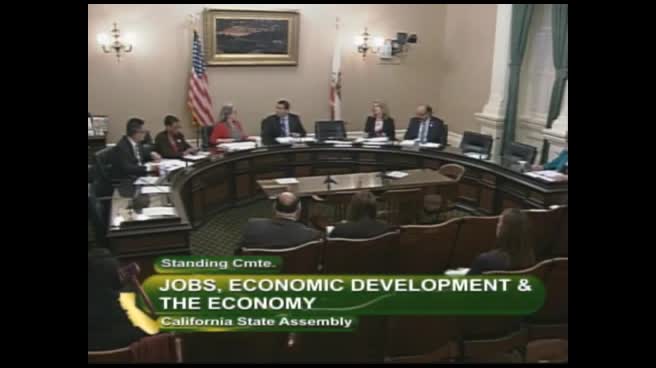 12MIN