AB 373: Peace officers: training.
- Session Year: 2015-2016
- House: Assembly
- Latest Version Date: 2015-02-17
Existing federal law, commonly known as Public Law 280 (PL-280), authorizes the state to exercise jurisdiction over offenses committed by or against Indians in the areas of Indian country within the state, and gives state criminal laws the same force and effect within Indian country as they have elsewhere in the state.
Existing state law creates the Commission on Peace Officer Standards and Training that, among other things, establishes levels of standards and training for peace officers, as specified. Existing law requires the commission to implement courses of training related to various topics applicable to peace officers.
This bill would require each police chief, county sheriff, or other head of a law enforcement agency to assess his or her jurisdiction to determine if any Indian tribal lands, as defined, lie within the jurisdiction. The bill would require, if the police chief, county sheriff, or other head of a law enforcement agency determines that Indian tribal lands exist within his or her jurisdiction, to ensure that those peace officers employed by the agency who work in, or adjacent to, Indian tribal lands, or who may be responsible for responding to calls for service on, or adjacent to, Indian tribal lands, complete a course that includes, but is not limited to, a review of PL-280. The bill would provide that this requirement may be satisfied by ensuring that those peace officers complete a course that includes a review of PL-280 that is approved by the commission. By creating new duties for local officials, the bill would impose a state-mandated local program.
The California Constitution requires the state to reimburse local agencies and school districts for certain costs mandated by the state. Statutory provisions establish procedures for making that reimbursement.
This bill would provide that, if the Commission on State Mandates determines that the bill contains costs mandated by the state, reimbursement for those costs shall be made pursuant to these statutory provisions.
(a)Each police chief, county sheriff, or other head of a law enforcement agency shall assess his or her jurisdiction to determine if any Indian tribal lands lie within the jurisdiction.
(b)(1)If the police chief, county sheriff, or other head of a law enforcement agency determines that Indian tribal lands exist within his or her jurisdiction, he or she shall ensure that those peace officers employed by the agency who work in, or adjacent to, Indian tribal lands, or who may be responsible for responding to calls for service on, or adjacent to, Indian tribal lands, complete a course that includes, but is not limited to, a review of the federal Public Law 280 (18 U.S.C. Sec 1162; 28 U.S.C. Sec 1360; and 25 U.S.C. Sec 1321 through 1326, inclusive).
(2)A police chief, county sheriff, or other head of a law enforcement agency may satisfy the requirements of paragraph (1) by ensuring that the peace officers described in that paragraph complete a course that includes a review of the federal Public Law 280 (18 U.S.C. Sec 1162; 28 U.S.C. Sec 1360; and 25 U.S.C. Sec 1321 through 1326, inclusive) that is approved by the Commission on Peace Officer Standards and Training, including, but not limited to, the course titled Policing Indian Lands.
(c)For purposes of this section, Indian tribal lands means real property belonging to, or held in trust for, a federally recognized or state-recognized Indian tribe.
SEC. 2.If the Commission on State Mandates determines that this act contains costs mandated by the state, reimbursement to local agencies and school districts for those costs shall be made pursuant to Part 7 (commencing with Section 17500) of Division 4 of Title 2 of the Government Code.
|
Date
|
Status
|
|---|---|
| Feb 17, 2015 | Read first time. To print. |
| Feb 18, 2015 | From printer. May be heard in committee March 20. |
| Mar 5, 2015 | Referred to Com. on PUB. S. |
| Mar 24, 2015 | From committee: Do pass and re-refer to Com. on APPR. (Ayes 6. Noes 1.) (March 24). Re-referred to Com. on APPR. |
| Apr 15, 2015 | In committee: Set, first hearing. Referred to suspense file. |
| May 28, 2015 | In committee: Held under submission. |
| Jan 31, 2016 | Died pursuant to Article IV, Sec. 10(c) of the Constitution. |
| Feb 1, 2016 | From committee: Filed with the Chief Clerk pursuant to Joint Rule 56. |
|
Date
|
Description
|
Location
|
Votes
|
|
|---|---|---|---|---|
| Mar 24, 2015 | Do pass and be re-referred to the Committee on [Appropriations] | Assembly Standing Committee on Public Safety |
Passed |
This list shows positions taken on this bill by organizations on the date displayed, which is linked to the original source.
Positions by individuals are not included.
|
Organization
|
Position
|
Date
|
|---|---|---|
| ABATE | * Support | Mar 24, 2015 |
| California Attorneys For Criminal Justice | * Support | Mar 24, 2015 |
| California Partnership To End Domestic Violence | * Support | Mar 24, 2015 |
| California State Sheriffs' Association | ** Against | Mar 24, 2015 |
| Modified Motorcycle Association Of California | * Support | Mar 24, 2015 |
| Riverside County Sheriff'S Department | * Support | Mar 24, 2015 |
| Twenty-Nine Palms Band Of Mission Indians | * Support | Mar 24, 2015 |
AB 373
Page 2
Date of Hearing: April 15, 2015
ASSEMBLY COMMITTEE ON APPROPRIATIONS
Jimmy Gomez, Chair
AB 373
(Medina) – As Introduced February 17, 2015
Policy Committee: |
Public Safety |
Vote: |
6 - 1 |
|
|
|
|
|
|
|
|
Urgency: No State Mandated Local Program: Yes Reimbursable: Yes
SUMMARY:
Requires that peace officers that work near or upon tribal land complete a course that includes a review of Public Law 280 (PL-280) that is approved by the Commission on Peace Officer Standards and Training (POST). Specifically, this bill:
Requires the head of the local law enforcement agency to determine if any Indian tribal lands, as defined, are within the agency's jurisdiction.
Requires the head of the law enforcement agency, if (1) applies, to ensure those peace officers employed by the agency who work in, or adjacent to, Indian tribal lands, or who may be responsible for responding to calls for service on, or adjacent to, Indian tribal lands, complete a course that includes, but is not limited to, a review of PL-280. This requirement may be satisfied by ensuring that those peace officers complete a course that includes a review of PL-280 that is approved by POST.
FISCAL EFFECT:
Potentially moderate state and local costs, and potentially state reimbursable, in excess of $180,000 (General Fund) to require the head of the local law enforcement agency to ensure local law enforcement personnel complete the required the course. The current DVD by POST on "Policing Indian Lands" is 117 minutes long. Assuming a reimbursement rate of $75 per hour, and 3 hours to prepare and review the DVD, the potential impact is $225 per officer; and $180,000 if the cost to train 800 officers (one percent of the approximately 80,000 sworn officers statewide) is reimbursed by the state. Some local agencies will not be reimbursed if the annual cost to comply with this mandate is less than $1,000. Also, if the commission on state mandates determines this bill imposes a reimbursable state mandate, costs currently incurred by local law enforcement agencies to comply with this measure will be reimbursable.
Minor absorbable costs to POST to make the telecourse available.
COMMENTS:
Background. POST was created by the Legislature in 1959 to set minimum selection and training standards for California law enforcement. POST'S's mandate includes establishing minimum standards for training of peace officers in California. According to POST, "Policing Indian lands in California presents unique issues and challenges. When enacted, Public Law 280 (PL280) required California to replace federal law enforcement and assume criminal jurisdiction over all Indian lands. Initially, California’s Indian tribes objected to PL280’s implementation, and without funding, law enforcement agencies often neglected to implement PL 280. Yet PL 280 remains the law and requires local law enforcement to enforce California’s criminal laws within Indian country. While the exercise of PL 280 jurisdiction is often a source of conflict between Indian and non-Indian communities, this training [Policing Indian Lands telecourse] shows California law enforcement how to make this relationship work. Cooperative agreements between law enforcement and tribal governments will improve services on Indian lands and can also make the peace officer’s job easier and safer."
According to the author, "Although such training should be mandatory for law enforcement officers servicing tribal lands, it is merely optional – if offered at all. Training for public safety personnel has failed to keep pace with federal mandates, directly creating ineffective and/or misapplied law enforcement on tribal lands. As a result, over half of all federally recognized Indian tribes have experienced jurisdictional confusion and frustration with the federal law, PL 280."
Argument in Support: According to the California Partnership to End Domestic Violence, "On behalf of the California Partnership to End Domestic Violence (the Partnership), I write today to express our support for AB 373, which will require peace officers employed by the agency who work in, or adjacent to, Indian tribal lands, or who may be responsible for responding to calls for service on, or adjacent to, Indian tribal lands, to receive training on Public Law 280 (PL 280).
"Law enforcement response to these shocking rates of domestic and sexual violence can be crucial to providing safety, resources, and protection for survivors and their families. An important foundation for an appropriate response by law enforcement is for peace offices to have a clear understand of PL 280 and its implications for their work in these communities. AB 373 (Medina) will help to ensure that officers who may be responding to calls for service on tribal lands have the information they need about PL 280. We believe this is a common-sense requirement that will help increase safety for tribal victims and enhance law enforcement’s response to these calls for service."
Argument in Opposition: According to the California State Sheriffs' Association, "We are concerned with the unfunded mandate on law enforcement agencies that this bill entails. Law enforcement agencies currently have the discretion to require and/or offer training contemplated by this bill (and several do), and we feel that strikes the appropriate balance. The training of law enforcement officers encompasses numerous topics and scenarios and we are concerned that this requirement could jeopardize the availability of other vital training.
"Additionally, the bill's language is ambiguous and likely overly broad in terms of which officers would be required to complete the training required by the bill. Ostensibly, officers whose main or regular duties have little or nothing to do with tribal lands could fall under the bill's reach."
Analysis Prepared by: Pedro R. Reyes / APPR. / (916) 319-2081
AB 373
Page 4
Date of Hearing: March 24, 2015
Counsel: Gabriel Caswell
ASSEMBLY COMMITTEE ON PUBLIC SAFETY
Bill Quirk, Chair
AB 373
(Medina) – As Introduced February 17, 2015
SUMMARY: Requires that peace officers that work near or upon tribal land complete a course that includes a review of Public Law 280 (PL-280) that is approved by the Commission on Peace Officer Standards and Training (POST). Specifically, this bill:
Requires each police chief, county sheriff, or other head of a law enforcement agency to assess his or her jurisdiction to determine if any "Indian tribal lands," as defined, lie within the jurisdiction.
Requires, if the police chief, county sheriff, or other head of a law enforcement agency determines that Indian tribal lands exist within his or her jurisdiction, to ensure that those peace officers employed by the agency who work in, or adjacent to, Indian tribal lands, or who may be responsible for responding to calls for service on, or adjacent to, Indian tribal lands, complete a course that includes, but is not limited to, a review of PL-280.
Provides that this requirement may be satisfied by ensuring that those peace officers complete a course that includes a review of PL-280 that is approved by the commission.
EXISTING FEDERAL LAW:
Provides
for state jurisdiction over offenses committed by or against Indians
in the Indian country as follows: (18 U.S.C. § 1162.)
States that each of the States or Territories listed in the following table shall have jurisdiction over offenses committed by or against Indians in the areas of Indian country listed opposite the name of the State or Territory to the same extent that such State or Territory has jurisdiction over offenses committed elsewhere within the State or Territory, and the criminal laws of such State or Territory shall have the same force and effect within such Indian country as they have elsewhere within the State or Territory: California - All Indian country within the State. (18 U.S.C. § 1162, subd. (a).)
Provides that nothing in this section shall authorize the alienation, encumbrance, or taxation of any real or personal property, including water rights, belonging to any Indian or any Indian tribe, band, or community that is held in trust by the United States or is subject to a restriction against alienation imposed by the United States; or shall authorize regulation of the use of such property in a manner inconsistent with any Federal treaty, agreement, or statute or with any regulation made pursuant thereto; or shall deprive any Indian or any Indian tribe, band, or community of any right, privilege, or immunity afforded under Federal treaty, agreement, or statute with respect to hunting, trapping, or fishing or the control, licensing, or regulation thereof. (18 U.S.C. § 1162, subd. (b).)
Provides that jurisdiction over those areas shall be concurrent among the Federal Government, State governments, and, where applicable, tribal governments. (18 U.S.C. § 1162, subd. (d)(2).)
EXISTING STATE LAW:
Requires all peace officers to complete an introductory course of training prescribed by POST, demonstrated by passage of an appropriate examination developed by POST. (Pen. Code, § 832, subd. (a).)
Establishes the Commission on Peace Officer Training and Standards. (Pen. Code, § 13500.)
Empowers POST to develop and implement programs to increase the effectiveness of law enforcement. (Pen. Code, §13503.)
Authorizes POST, for the purpose of raising the level of competence of local law enforcement officers, to adopt rules establishing minimum standards related to physical, mental and moral fitness and training that shall govern the recruitment of any peace officers in California. (Pen. Code, § 13510, subd. (a).)
Requires POST to conduct research concerning job-related educational standards and job-related selection standards to include vision, hearing, physical ability, and emotional stability and adopt standards supported by this research. (Pen. Code, § 13510, subd. (b).)
Requires POST to establish a certification program for peace officers, which shall be considered professional certificates. (Pen. Code § 13510.1, subd. (a).)
FISCAL EFFECT: Unknown
COMMENTS:
Author's Statement: According to the author, "Public safety is of high priority to tribal communities, yet many factors have contributed to the erosion of stable and safe neighborhoods for Native Americans. Initial communication with tribal governments revealed that most tribal communities had little interaction with or knowledge about public safety and the California criminal justice system. Conversely, public safety personnel who worked on tribal lands lacked training on pertinent laws specific to Indian country. Public Law 280, or PL 280 encompasses crucial criminal justice elements relating to: violence against Native American women; full faith and credit given to tribal court orders; protection of Native American children and tribal culture; and laws outlining how federal, state, and tribal law enforcement authorities are to work together for the common goal of public safety on tribal lands. Although such training should be mandatory for law enforcement officers servicing tribal lands, it is merely optional – if offered at all. Training for public safety personnel has failed to keep pace with federal mandates, directly creating ineffective and/or misapplied law enforcement on tribal lands. As a result, over half of all federally recognized Indian tribes have experienced jurisdictional confusion and frustration with the federal law, Public Law 83-280, (PL 280)."
POST Training Requirements: POST was created by the legislature in 1959 to set minimum selection and training standards for California law enforcement. (Pen. Code, § 13500, subd. (a).) Their mandate includes establishing minimum standards for training of peace officers in California. (Pen. Code § 13510, subd. (a).) As of 1989, all peace officers in California are required to complete an introductory course of training prescribed by POST, and demonstrate completion of that course by passing an examination. (Pen. Code, § 832, subd. (a).)
According to the POST Web site, the Regular Basic Course Training includes 42 separate topics, ranging from juvenile law and procedure to search and seizure. [POST, Regular Basic Course Training Specifications; <http://post.ca.gov/regular-basic-course-training-specifications.aspx>.] These topics are taught during a minimum of 664 hours of training. [POST, Regular Basic Course, Course Formats, available at: [<http://post.ca.gov/regular-basic-course.aspx.] Over the course of the training, individuals are trained not only on policing skills such as crowd control, evidence collection and patrol techniques, they are also required to recall the basic definition of a crime and know the elements of major crimes. This requires knowledge of the California Penal code specifically.
Public Law 280 (PL-280): Public Law 280 is a federal statute enacted by Congress in 1953. It enabled states to assume criminal, as well as civil, jurisdiction in matters involving Indians as litigants on reservation land. Previous to the enactment of Public Law 280, these matters were dealt with in either tribal and/or federal court. Essentially, Public Law 280 was an attempt by the federal government to reduce its role in Indian affairs. Enumerated in Public Law 280 were six states which were obligated to assume jurisdiction from the outset of the law: Alaska, California, Minnesota, Nebraska, Oregon, and Wisconsin. States that have assumed at least some jurisdiction since the enactment of Public Law 280 include: Nevada, South Dakota, Washington, Florida, Idaho, Montana, North Dakota, Arizona, Iowa, and Utah. Public Law 280 was initially enacted without the consent of the tribes affected. Although Public Law 280 was amended in 1968 requiring the consent of the tribe, consent was not required for states that had assumed jurisdiction up to 1968.
Argument in Support: According to the California Partnership to End Domestic Violence, "On behalf of the California Partnership to End Domestic Violence (the Partnership), I write today to express our support for AB 373, which will require peace officers employed by the agency who work in, or adjacent to, Indian tribal lands, or who may be responsible for responding to calls for service on, or adjacent to, Indian tribal lands, to receive training on Public Law 280 (PL 280).
"The Partnership is the federally recognized State Domestic Violence Coalition for California, representing over 200 organizations and individuals statewide, united in their commitment to safety and justice for victims. The Partnership believes that by sharing resources and expertise, advocates and policymakers can end domestic violence. Every day we inspire, inform and connect all those concerned with this issue, because together we’re stronger.
"Native women experience domestic violence and sexual assault at epidemic rates. American Indians and Alaska Natives are 2.5 times as likely to experience violent crimes – and at least 2 times more likely to experience rape or sexual assault crimes – compared to all other races.1 34 percent of American Indian and Alaska Native women will be raped in their lifetimes, and 39 percent of American Indian and Alaska Native women will be subjected to violence by an intimate partner in their lifetimes.
"Law enforcement response to these shocking rates of domestic and sexual violence can be crucial to providing safety, resources, and protection for survivors and their families. An important foundation for an appropriate response by law enforcement is for peace offices to have a clear understand of PL 280 and its implications for their work in these communities. AB 373 (Medina) will help to ensure that officers who may be responding to calls for service on tribal lands have the information they need about PL 280. We believe this is a common-sense requirement that will help increase safety for tribal victims and enhance law enforcement’s response to these calls for service."
Argument in Opposition: According to the California State Sheriffs' Association, "we must respectfully oppose your measure, Assembly Bill 373, which would require each police chief, county sheriff, or other head of law enforcement agency to assess his/her jurisdiction to determine if any Indian tribal lands lie within their agency's jurisdiction, and endure that officers who may interact with those tribal lands complete specified training.
"We are concerned with the unfunded mandate on law enforcement agencies that this bill entails. Law enforcement agencies currently have the discretion to require and/or offer training contemplated by this bill (and several do), and we feel that strikes the appropriate balance. The training of law enforcement officers encompasses numerous topics and scenarios and we are concerned that this requirement could jeopardize the availability of other vital training.
"Additionally, the bill's language is ambiguous and likely overly broad in terms of which officers would be required to complete the training required by the bill. Ostensibly, officers whose main or regular duties have little or nothing to do with tribal lands could fall under the bill's reach."
REGISTERED SUPPORT / OPPOSITION:
Support
California Attorneys for Criminal Justice
California Partnership to End Domestic Violence
Strong Hearted
Native Women's Coalition, Inc.
University of California, Los
Angeles
Opposition
California State Sheriffs' Association
Analysis Prepared by:
Gabriel Caswell / PUB. S. / (916) 319-3744
Discussed in Hearing
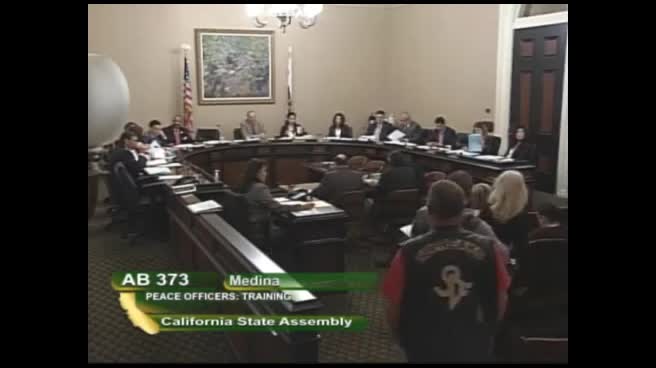 17MIN
Assembly Standing Committee on Public Safety
Bill Author

Bill Co-Author(s):