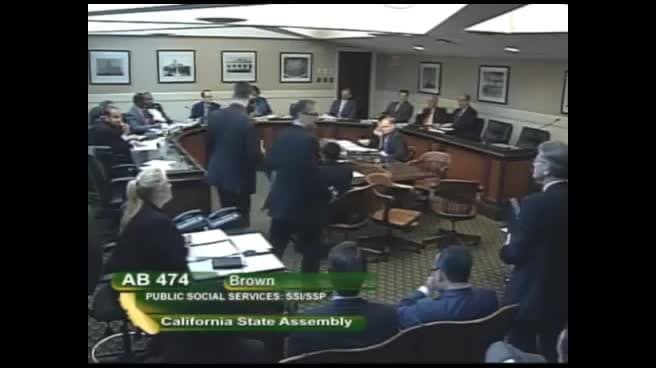
AB 474: Public social services: SSI/SSP.
- Session Year: 2015-2016
- House: Assembly
- Latest Version Date: 2015-04-07
Existing law provides for the State Supplementary Program for the Aged, Blind and Disabled (SSP), which requires the State Department of Social Services to contract with the United States Secretary of Health and Human Services to make payments to SSP recipients to supplement Supplemental Security Income (SSI) payments made available pursuant to the federal Social Security Act.
Under existing law, benefit payments under the SSP are calculated by establishing the maximum level of nonexempt income and federal SSI and state SSP benefits for each category of eligible recipient. The state SSP payment is the amount, when added to the nonexempt income and SSI benefits available to the recipient, which would be required to provide the maximum benefit payment.
This bill, for the 201516 fiscal year, and annually thereafter, would require the state maximum SSP grant for individuals to be readjusted and increased so that the state SSP payment and federal SSI payment, when combined, equal 112% of the federal poverty level. By increasing the amount of SSP payments, which are expended from a continuously appropriated fund, the bill would make an appropriation.
Existing law prohibits a licensee of a long-term health care facility from discriminating or retaliating in any manner against a complainant, or a patient or employee in its facility, based on the presentation of a grievance or complaint or activities related to a specified investigation or proceeding at the facility. Existing law makes the willful violation of these provisions punishable as a crime.
This bill would expand the antiretaliation protections to apply to all health care workers of a long-term health care facility. The bill would increase the civil penalties and criminal penalties that apply to licensees who violate the provisions. The bill would also specify that a complainant who has been discriminated against may recover attorneys fees and other legal costs.
Because this bill would expand the scope of a crime, it would impose a state-mandated local program.
The California Constitution requires the state to reimburse local agencies and school districts for certain costs mandated by the state. Statutory provisions establish procedures for making that reimbursement.
This bill would provide that no reimbursement is required by this act for a specified reason.
Discussed in Hearing
 26MIN
26MIN