SBX1 13: Office of the Transportation Inspector General.
- Session Year: 2015-2016
- House: Senate
- Latest Version Date: 2015-09-03
Existing law creates various state transportation agencies, including the Department of Transportation and the High-Speed Rail Authority, with specified powers and duties. Existing law provides for the allocation of state transportation funds to various transportation purposes.
This bill would create the Office of the Transportation Inspector General in state government government, as an independent office that would not be a subdivision of any other government entity, to build capacity for self-correction into the government itself and to ensure that all state agencies expending state transportation funds are operating efficiently, effectively, and in compliance with federal and state laws. The bill would provide for the Governor to appoint the Transportation Inspector General for a 6-year term, subject to confirmation by the Senate, and would provide that the Transportation Inspector General may not be removed from office during the term except for good cause. The bill would specify the duties and responsibilities of the Transportation Inspector General, would require an annual report to the Legislature and Governor, and would provide that funding for the office shall, to the extent possible, be from federal transportation funds, with other necessary funding to be made available from the State Highway Account and an account from which high-speed rail activities may be funded.
Existing law creates various state transportation agencies, including the Department of Transportation and the High-Speed Rail Authority, with specified powers and duties. Existing law provides for the allocation of state transportation funds to various transportation purposes.
This bill would create the Office of the Transportation Inspector General in state government as an independent office that would not be a subdivision of any other government entity, to ensure that all state agencies expending state transportation funds are operating efficiently, effectively, and in compliance with federal and state laws. The bill would provide for the Governor to appoint the Transportation Inspector General for a 6-year term, subject to confirmation by the Senate, and would provide that the Transportation Inspector General may not be removed from office during the term except for good cause. The bill would specify the duties and responsibilities of the Transportation Inspector General, would require an annual report to the Legislature and Governor, and would provide that funding for the office shall, to the extent possible, be from federal transportation funds, with other necessary funding to be made available from the State Highway Account and an account from which high-speed rail activities may be funded.
The Legislature finds and declares all of the following:
(a)Over the next 10 years, the state faces a $59 billion shortfall to adequately maintain the state highway system in a basic state of good repair.
(b)There is within the Department of Transportation (Caltrans) a culture of waste and fraud, as exemplified by exposure of the deficiencies in the construction of the replacement span of the San Francisco-Oakland Bay Bridge and the efforts to internally conceal those deficiencies, falsified data in the testing of bridge safety, and Caltrans employees consuming alcohol while on the job, misusing state assets, and moonlighting on state time.
(b)Numerous audits and reports over the past three years have highlighted inefficiencies and instances of waste within Californias transportation agencies.
(c)The 21st Annual Highway Report by the Reason Foundation, published in September 2014, found the following:
(1)California has 50,462 lane miles of highways under the administration of Caltrans. the Department of Transportation (Caltrans).
(2)Overall, California spent $501,136 per state mile of highway, more than three times the national average, yet Californias state highway system ranks 45th in overall performance and cost effectiveness.
(3)California spent $102,889 per state mile of highway specifically on maintenance, nearly four times the national average.
(4)California spent $48,754 per state mile of highway specifically on administration, more than four times the national average.
(d)The Legislative Analysts Office included the following concerns and recommendations related to Caltrans accountability and efficiency in the Capital Outlay Support Program Review report issued in May 2014:
(1)Data used to request budgetary resources for the program is largely unreliable due to a lack of internal control, lack of data collection, and an incentive to report inaccurate data.
(2)Steps should be taken to improve data quality for the program.
(e)A Transportation Inspector General should be established to independently investigate Caltrans, identify waste and inefficiencies, and report and make recommendations to the Legislature. Legislature, and build capacity for self-correction into the government itself.
SEC. 2.Part 5.1 (commencing with Section 14460) is added to Division 3 of Title 2 of the Government Code, to read:5.1.OFFICE OF THE TRANSPORTATION INSPECTOR GENERAL14460.(a)There is hereby created in state government the independent Office of the Transportation Inspector General, which shall not be a subdivision of any other governmental entity, to build capacity for self-correction into the government itself and to ensure that the Department of Transportation, the High-Speed Rail Authority, and all other state agencies expending state transportation funds are operating efficiently, effectively, and in compliance with applicable federal and state laws.
(b)The Governor shall appoint, subject to confirmation by the Senate, the Transportation Inspector General to a six-year term. The Transportation Inspector General may not be removed from office during that term, except for good cause.
14461.The Transportation Inspector General shall review policies, practices, and procedures, and conduct audits and investigations of activities involving state transportation funds in consultation with all affected state agencies. Specifically, the Transportation Inspector Generals duties and responsibilities shall include, but not be limited to, all of the following:
(a)To examine the operating practices of the Department of Transportation, the High-Speed Rail Authority, and all other state agencies expending state transportation funds to identify fraud and waste, opportunities for efficiencies, and opportunities to improve the data used to determine appropriate project resource allocations.
(b)To identify best practices in the delivery of transportation projects and develop policies or recommend proposed legislation enabling state agencies to adopt these practices when practicable.
(c)To provide objective analysis of, and when possible, offer solutions to, concerns raised by the public or generated within agencies involving the states transportation infrastructure and project delivery methods.
(d)To conduct, supervise, and coordinate audits and investigations relating to the programs and operations of all state transportation agencies with state-funded transportation projects.
(e)To recommend policies promoting economy and efficiency in the administration of programs and operations of all state agencies with state-funded transportation projects.
14462.The Transportation Inspector Generals office shall not conduct any an audit or investigation that would be redundant to or concurrent with any an audit or investigation of the same matter being conducted contemporaneously by another state entity, or planned to be initiated pursuant to state or federal law or adopted agency board policy, within 18 months of the notification of the intent to undertake the audit or investigation by the Transportation Inspector General. The state entity shall provide the Transportation Inspector General with a summary of the results of the audit or investigation upon its completion, if requested.
14463.(a)The Transportation Inspector General shall report annually to the Governor and Legislature with a summary of his or her findings, investigations, and audits. The summary shall be posted on the Transportation Inspector Generals Internet Web site and shall otherwise be made available to the public upon its release to the Governor and
Legislature. and Legislature. The summary shall include, but need not be limited to, significant problems discovered by the Transportation Inspector General and whether recommendations of the Transportation Inspector General relative to investigations and audits have been implemented by the affected agencies. The report shall be submitted to the Legislature pursuant to in compliance with Section 9795.
(b)The Transportation Inspector General shall, in consultation with the Department of Finance, develop a methodology for producing a workload budget to be used for annually adjusting the budget of the Office of the Transportation Inspector General, beginning with the budget for the 201617 fiscal year. To the extent possible, the office shall be funded with federal transportation funds. Should federal funding not be available to fully fund the office, funding shall be made available, in proportion to the activities of the office, from the State Highway Account and an account from which high-speed rail activities may be funded.
The Legislature finds and declares all of the following:
(a)Over the next 10 years, the state faces a $59 billion shortfall to adequately maintain the state highway system in a basic state of good repair.
(b)There is within the Department of Transportation (Caltrans) a culture of waste and fraud, as exemplified by exposure of the deficiencies in the construction of the replacement span of the San Francisco-Oakland Bay Bridge and the efforts to internally conceal those deficiencies, falsified data in the testing of bridge safety, and Caltrans employees consuming alcohol while on the job, misusing state assets, and moonlighting on state time.
(c)The 21st Annual Highway Report by the Reason Foundation, published in September 2014, found the following:
(1)California has 50,462 lane miles of highways under the administration of Caltrans.
(2)Overall, California spent $501,136 per state mile of highway, more than three times the national average, yet Californias state highway system ranks 45th in overall performance and cost effectiveness.
(3)California spent $102,889 per state mile of highway specifically on maintenance, nearly four times the national average.
(4)California spent $48,754 per state mile of highway specifically on administration, more than four times the national average.
(d)The Legislative Analysts Office included the following concerns and recommendations related to Caltrans accountability and efficiency in the Capital Outlay Support Program Review report issued in May 2014:
(1)Data used to request budgetary resources for the program is largely unreliable due to a lack of internal control, lack of data collection, and an incentive to report inaccurate data.
(2)Steps should be taken to improve data quality for the program.
(e)A Transportation Inspector General should be established to independently investigate Caltrans, identify waste and inefficiencies, and report and make recommendations to the Legislature.
SEC. 2.Part 5.1 (commencing with Section 14460) is added to Division 3 of Title 2 of the Government Code, to read:5.1.OFFICE OF THE TRANSPORTATION INSPECTOR GENERAL14460.(a)There is hereby created in state government the independent Office of the Transportation Inspector General, which shall not be a subdivision of any other governmental entity, to ensure that the Department of Transportation, the High-Speed Rail Authority, and all other state agencies expending state transportation funds are operating efficiently, effectively, and in compliance with applicable federal and state laws.
(b)The Governor shall appoint, subject to confirmation by the Senate, the Transportation Inspector General to a six-year term. The Transportation Inspector General may not be removed from office during that term, except for good cause.
14461.The Transportation Inspector General shall review policies, practices, and procedures, and conduct audits and investigations of activities involving state transportation funds in consultation with all affected state agencies. Specifically, the Transportation Inspector Generals duties and responsibilities shall include, but not be limited to, all of the following:
(a)To examine the operating practices of the Department of Transportation, the High-Speed Rail Authority, and all other state agencies expending state transportation funds to identify fraud and waste, opportunities for efficiencies, and opportunities to improve the data used to determine appropriate project resource allocations.
(b)To identify best practices in the delivery of transportation projects and develop policies or recommend proposed legislation enabling state agencies to adopt these practices when practicable.
(c)To provide objective analysis of, and when possible, offer solutions to, concerns raised by the public or generated within agencies involving the states transportation infrastructure and project delivery methods.
(d)To conduct, supervise, and coordinate audits and investigations relating to the programs and operations of all state transportation agencies with state-funded transportation projects.
(e)To recommend policies promoting economy and efficiency in the administration of programs and operations of all state agencies with state-funded transportation projects.
14462.The Transportation Inspector Generals office shall not conduct any audit or investigation that would be redundant to or concurrent with any audit or investigation of the same matter being conducted contemporaneously by another state entity, or planned to be initiated pursuant to state or federal law or adopted agency board policy, within 18 months of the notification of the intent to undertake the audit or investigation by the Transportation Inspector General. The state entity shall provide the Transportation Inspector General with a summary of the results of the audit or investigation upon its completion, if requested.
14463.(a)The Transportation Inspector General shall report annually to the Governor and Legislature with a summary of his or her findings, investigations, and audits. The summary shall be posted on the Transportation Inspector Generals Internet Web site and shall otherwise be made available to the public upon its release to the Governor and
Legislature. The summary shall include, but need not be limited to, significant problems discovered by the Transportation Inspector General and whether recommendations of the Transportation Inspector General relative to investigations and audits have been implemented by the affected agencies. The report shall be submitted to the Legislature pursuant to Section 9795.
(b)The Transportation Inspector General shall, in consultation with the Department of Finance, develop a methodology for producing a workload budget to be used for annually adjusting the budget of the Office of the Transportation Inspector General, beginning with the budget for the 201617 fiscal year. To the extent possible, the office shall be funded with federal transportation funds. Should federal funding not be available to fully fund the office, funding shall be made available, in proportion to the activities of the office, from the State Highway Account and an account from which high-speed rail activities may be funded.
|
Date
|
Status
|
|---|---|
| Jul 16, 2015 | Introduced. Read first time. Referred to Com. on T. & I.D. |
| Jul 16, 2015 | To print. |
| Jul 17, 2015 | From printer. |
| Aug 6, 2015 | Set for hearing August 19. |
| Aug 19, 2015 | From committee: Do pass and re-refer to Com. on APPR. (Ayes 12. Noes 0. Page 37.) (August 19). Re-referred to Com. on APPR. |
| Aug 19, 2015 | From committee: Do pass and re-refer to Com. on APPR. (Ayes 12. Noes 0.) (August 19). Re-referred to Com. on APPR. |
| Sep 3, 2015 | From committee with author's amendments. Read second time and amended. Re-referred to Com. on APPR. |
|
Date
|
Description
|
Location
|
Votes
|
|
|---|---|---|---|---|
| Aug 19, 2015 | Do pass, but first be re-referred to the Committee on [Appropriations] | Senate 1st Extraordinary Session on Transportation and Infrastructure Development |
Passed |
This list shows positions taken on this bill by organizations on the date displayed, which is linked to the original source.
Positions by individuals are not included.
|
Organization
|
Position
|
Date
|
|---|---|---|
| Sierra Club | * Against | Aug 19, 2015 |
| Transportation California | * Support | Aug 19, 2015 |
Discussed in Hearing
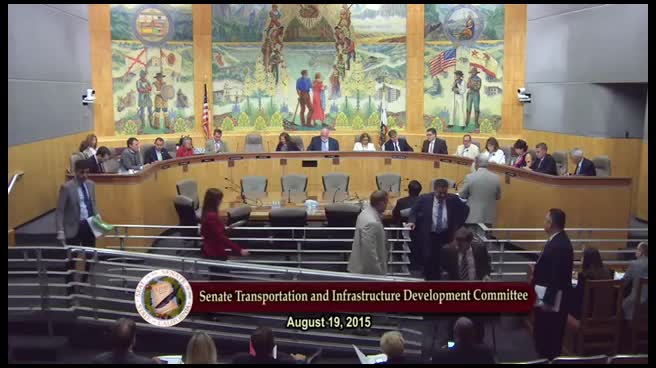 14MIN
Transportation and Infrastructure Development
Bill Author