AB 1931: Firearms: licenses to carry concealed firearms.
- Session Year: 2017-2018
- House: Assembly
- Latest Version Date: 2018-01-24
Existing law authorizes the sheriff of a county or a chief or other head of a police department of a city or a city and county to issue a license to carry a concealed firearm upon proof that the person applying for the license is of good moral character, that good cause exists for the issuance, that the applicant satisfies specified residency requirements, and that the applicant has completed a course of specified training. Under existing law, a license issued to carry a concealed firearm is generally valid for any period of time not to exceed 2 years.
This bill would make a license issued to carry a concealed firearm valid for any period of time not to exceed 5 years. The bill would make conforming changes.
(a)Except as otherwise provided in this section subdivision (b), and in subdivision (c) of Section 26210, a license issued pursuant to Section 26150 or 26155 is valid for any period of time not to exceed two five years from the date of the license.
(b)If the licensees place of employment or business was the basis for issuance of a license pursuant to Section 26150, the license is valid for any period of time not to exceed 90 days from the date of the license. The license shall be valid only in the county in which the license was originally issued. The licensee shall give a copy of this license to the licensing authority of the city, county, or city and county in which the licensee resides. The licensing authority that originally issued the license shall inform the licensee verbally and in writing in at least 16-point type of this obligation to give a copy of the license to the licensing authority of the city, county, or city and county of residence. Any application to renew or extend the validity of, or reissue, the license may be granted only upon the concurrence of the licensing authority that originally issued the license and the licensing authority of the city, county, or city and county in which the licensee resides.
(c)A license issued pursuant to Section 26150 or 26155 is valid for any period of time not to exceed three years from the date of the license if the license is issued to any of the following individuals:(1)A judge of a California court of record.(2)A full-time court commissioner of a California court of record.(3)A judge of a federal court.(4)A magistrate of a federal court.(d)A license issued pursuant to Section 26150 or 26155 is valid for any period of time not to exceed four years from the date of the license if the license is issued to a custodial officer who is an employee of the sheriff as provided in Section 831.5, except that the license shall be invalid upon the conclusion of the persons employment pursuant to Section 831.5 if the four-year period has not otherwise expired or any other condition imposed pursuant to this article does not limit the validity of the license to a shorter time period.(e)A license issued pursuant to Section 26170 to a peace officer appointed pursuant to Section 830.6 is valid for any period of time not to exceed four years from the date of the license, except that the license shall be invalid upon the conclusion of the persons appointment pursuant to Section 830.6 if the four-year period has not otherwise expired or any other condition imposed pursuant to this article does not limit the validity of the license to a shorter time period.|
Date
|
Status
|
|---|---|
| Apr 26, 2018 | From committee: Without further action pursuant to Joint Rule 62(a). |
| Apr 24, 2018 | In committee: Set, final hearing. Failed passage. |
| Apr 3, 2018 | In committee: Set, final hearing. Failed passage. Reconsideration granted. |
| Mar 20, 2018 | In committee: Set, second hearing. Hearing canceled at the request of author. |
| Mar 6, 2018 | In committee: Set, first hearing. Hearing canceled at the request of author. |
| Feb 5, 2018 | Referred to Com. on PUB. S. |
| Jan 25, 2018 | From printer. May be heard in committee February 24. |
| Jan 24, 2018 | Read first time. To print. |
|
Date
|
Description
|
Location
|
Votes
|
|
|---|---|---|---|---|
| Apr 24, 2018 | Do pass. | Assembly Standing Committee on Public Safety |
Failed |
|
| Apr 3, 2018 | Reconsideration. | Assembly Standing Committee on Public Safety |
Passed |
|
| Apr 3, 2018 | Do pass. | Assembly Standing Committee on Public Safety |
Failed |
This list shows positions taken on this bill by organizations on the date displayed, which is linked to the original source.
Positions by individuals are not included.
|
Organization
|
Position
|
Date
|
|---|---|---|
| American Academy Of Pediatrics, California | ** Against | Apr 23, 2018 |
| americans against gun violence | ** Against | Apr 23, 2018 |
| Brady Campaign to Prevent Gun Violence | * Against | Apr 3, 2018 |
| California Brady Campaign to Prevent Gun Violence | * Against | Apr 3, 2018 |
| California Civil Liberties Advocacy | * Support | Apr 3, 2018 |
| California Rifle and Pistol Association | ** Support | Apr 23, 2018 |
| California State Sheriffs' Association | ** Support | Apr 23, 2018 |
| Firearms Policy Coalition | ** Support | Apr 23, 2018 |
| Giffords Law Center | ** Against | Apr 23, 2018 |
| Gun Owners of California | ** Support | Apr 23, 2018 |
| National Rifle Association of America | ** Support | Apr 23, 2018 |
| Riverside Sheriffs' Association | ** Support | Apr 23, 2018 |
| Shasta County | * Support | Apr 3, 2018 |
Date of Hearing: April 24, 2018
Chief Counsel: Gregory Pagan
ASSEMBLY COMMITTEE ON
Reginald Byron Jones-Sawyer, Sr., Chair
ABPCA Bill Id:
Author:() – As Ver:
VOTE ONLY
SUMMARY: Makes a license to a carry a concealed firearm (CCW) valid for a period not to exceed five years rather than the existing period of up to two, three, or four years depending on the occupation of the applicant.
EXISTING LAW:
- Provides a county sheriff or municipal police chief may issue a CCW upon proof that:
- The person applying is of good moral character (Pen. Code, §§ 26150 & 26155, subd. (a)(1).);
- Good cause exists for the issuance (Pen. Code, §§ 26150 & 26155, subd. (a)(2).);
- The person applying meets the appropriate residency requirements (Pen. Code, §§ 26150 & 26155, subd. (a)(3).); and,
- The person has completed the appropriate training course (Pen. Code, §§ 26150 & 26155, subd. (a)(4).).
- The person applying is of good moral character (Pen. Code, §§ 26150 & 26155, subd. (a)(1).);
- Provides that the license may either:
- Allow the person to carry a concealed firearm on his or her person (Pen. Code, §§ 26150 & 26155, subd. (b)(1).); or
- Allow the person to carry a loaded and exposed firearm in a county whose population is less than 200,000 persons according to the most recent federal decennial census. (Pen. Code, §§ 26150 & 26155, subd. (b)(2).)
- Allow the person to carry a concealed firearm on his or her person (Pen. Code, §§ 26150 & 26155, subd. (b)(1).); or
- States that for a new applicant for a CCW, the course of training for issuance of a CCW may be any course acceptable to the licensing authority and shall not exceed 16 hours, and shall include instruction on at least firearm safety and the law regarding the permissible use of a firearm. (Pen. Code, § 26165, subd. (a).)
- Provides that a CCW license is valid for up to two years, three years for judicial officers, or four years in the case of a reserve or auxiliary peace officer. (Pen. Code, § 26220.)
- Provides that a license may include any reasonable restrictions or conditions that the issuing authority deems warranted, which shall be listed on the license. (Pen. Code § 26200, subds. (a) & (b).)
- Provides that the fingerprints of each applicant are taken and submitted to the Department of Justice (DOJ). Provides criminal penalties for knowingly filing a false application for a concealed weapon license. (Pen. Code, §§ 26180 &26185.)
- Specifies that applications for CCW licenses, applications for amendments to CCW licenses, amendments to CCW licenses, and CCW licenses under this article shall be uniform throughout the state, upon forms to be prescribed by the Attorney General. (Pen. Code, § 26175, subd (a)(1).)
- Provides that the Attorney General shall convene a committee composed of one representative of the California State Sheriffs' Association, one representative of the California Police Chiefs Association, and one representative of the Department of Justice to review, and as deemed appropriate, revise the standard application form for CCW licenses. The committee shall meet for this purpose if two of the committee's members deem that necessary. (Pen. Code, § 26175, subd (a)(2).)
- States that the application shall include a section summarizing the statutory provisions of state law that result in the automatic denial of a license. (Pen. Code, § 26175, subd (b).)
- Provides that the standard application form for CCW licenses shall require information from the applicant, including, but not limited to, the name, occupation, residence, and business address of the applicant, the applicant's age, height, weight, color of eyes and hair, and reason for desiring a license to carry the weapon. (Pen. Code, § 26175, subd (c).)
- Specifies that applications for licenses shall be filed in writing and signed by the applicant. (Pen. Code, § 26175, subd (d).)
- Provides that applications for amendments to CCW licenses shall be filed in writing and signed by the applicant, and shall state what type of amendment is sought and the reason for desiring the amendment. (Pen. Code, § 26175, subd (e).)
- States that the forms shall contain a provision whereby the applicant attests to the truth of statements contained in the application. (Pen. Code, § 26175, subd (f).)
- Provides that an applicant shall not be required to complete any additional application or form for a license, or to provide any information other than that necessary to complete the standard application form, except to clarify or interpret information provided by the applicant on the standard application form. (Pen. Code, § 26175, subd (g).)
- States that the standard application form is deemed to be a local form expressly exempt from the requirements of the Administrative Procedures Act. (Pen. Code, § 26175, subd (h).)
- Provides that any CCW license issued upon the application shall set forth the licensee's name, occupation, residence and business address, the licensee's age, height, weight, color of eyes and hair, and the reason for desiring a license to carry the weapon, and shall, in addition, contain a description of the weapon or weapons authorized to be carried, giving the name of the manufacturer, the serial number, and the caliber. The license issued to the licensee may be laminated. (Pen. Code, § 26175, subd (i).)
FISCAL EFFECT: Unknown
COMMENTS:
- Author's Statement: According to the author, "California's concealed carry weapon, (CCW) laws grants abiding citizens the ability to apply for a license to carry firearms if the applicant can show good moral character, “good cause”, meets residence requirements, and completes firearms training course. These permits are valid for two years and may be renewed. The short duration of the permit combined with a rigorous screening process creates an administrative burden for local officials and law enforcement entities that are already facing significant burdens. AB 1931 would extend the potential life of a CCW permit from two to up to five years, which will significantly reduce costs and administrative burdens while maintaining strong screening processes currently in place.
- Argument in Support: According to the California State Sheriff's Association, "The Penal Code dictates the provision under which a CCW license may be issued to an individual by the issuing agency. The Sheriff of each County, or the Chief of Police of a jurisdiction, is the individual responsible for the issuance of a CCW permit. Under existing law, a CCW license allows qualified citizens who demonstrate both “good cause” and “good moral character” to carry loaded, concealed firearms into public places. In compliance with current law, all current licensees must go through extensive background check s and satisfy training and safety requirements.
“In the past few years, requests for new CCW, have increased in many counties. The increase in new requests and renewals, combined with a rigorous screening process on the state and local level and the arbitrary two-year time line for how long a CCW is valid, creates an administrative burden in many agencies. The timing of this process can create a strain on limited resources and officers who need to make determinations regarding the new renewals based on the public good and safety”. - Argument in Opposition: According to the California Chapter of the Brady Campaign to Prevent Gun Violence, "Existing law gives sheriffs and chiefs of municipal police departments the discretion to issue licenses for the carrying of concealed and loaded firearms. Law enforcement must find that good cause exists, that the applicant is of good moral character, is a resident or employed within the jurisdiction, and has completed a course of training. Under existing law, a concealed carry license is valid for any period of time not to exceed two years from the date of the license. This bill would instead, make a license for any period of time not to exceed five years from the date of the license.
“The California Brady Campaign opposes extending the duration of a concealed carry license as the conditions under which the license was issued may have changed. For example, a person may no longer have good cause or a specific need for the license, or the person’s “good moral character” or behavior may have declined. Carrying a loaded, hidden gun in public is a great responsibility that can put both the public and the gun carrying individuals at risk. Completing a course of training and review by the issuing authority at least every two years is in the interest of public safety.”
REGISTERED SUPPORT / OPPOSITION:
Support
California State Sheriffs' Association (Sponsor)
California Rifle and Pistol Association
Firearms Policy Coalition
Gun Owners of California
National Rifle Association of America
Riverside Sheriffs' Association
Opposition
American Academy of Pediatrics, California
Americans Against Gun Violence
California Chapters of the Brady campaign to Prevent Gun Violence
Giffords Law Center
Analysis Prepared by:
Date of Hearing:
Chief Counsel: Gregory Pagan
ASSEMBLY COMMITTEE ON PUBLIC SAFETY
Reginald Byron Jones-Sawyer, Sr., Chair
ABPCA Bill Id:AB 1931
Author:(Fong) – As Introduced Ver:January 24, 2018
SUMMARY: Makes a license to a carry a concealed firearm (CCW) valid for a period not to exceed five years rather than the existing period of up to two, three, or four years depending on the occupation of the applicant.
EXISTING LAW:
- Provides a county sheriff or municipal police chief may issue a CCW upon proof that:
- The person applying is of good moral character (Pen. Code, §§ 26150 & 26155, subd. (a)(1).);
- Good cause exists for the issuance (Pen. Code, §§ 26150 & 26155, subd. (a)(2).);
- The person applying meets the appropriate residency requirements (Pen. Code, §§ 26150 & 26155, subd. (a)(3).); and,
- The person has completed the appropriate training course (Pen. Code, §§ 26150 & 26155, subd. (a)(4).).
- The person applying is of good moral character (Pen. Code, §§ 26150 & 26155, subd. (a)(1).);
- Provides that the license may either:
- Allow the person to carry a concealed firearm on his or her person (Pen. Code, §§ 26150 & 26155, subd. (b)(1).); or
- Allow the person to carry a loaded and exposed firearm in a county whose population is less than 200,000 persons according to the most recent federal decennial census. (Pen. Code, §§ 26150 & 26155, subd. (b)(2).)
- Allow the person to carry a concealed firearm on his or her person (Pen. Code, §§ 26150 & 26155, subd. (b)(1).); or
- States that for a new applicant for a CCW, the course of training for issuance of a CCW may be any course acceptable to the licensing authority and shall not exceed 16 hours, and shall include instruction on at least firearm safety and the law regarding the permissible use of a firearm. (Pen. Code, § 26165, subd. (a).)
- Provides that a CCW license is valid for up to two years, three years for judicial officers, or four years in the case of a reserve or auxiliary peace officer. (Pen. Code, § 26220.)
- Provides that a license may include any reasonable restrictions or conditions that the issuing authority deems warranted, which shall be listed on the license. (Pen. Code § 26200, subds. (a) & (b).)
- Provides that the fingerprints of each applicant are taken and submitted to the Department of Justice (DOJ). Provides criminal penalties for knowingly filing a false application for a concealed weapon license. (Pen. Code, §§ 26180 &26185.)
- Specifies that applications for CCW licenses, applications for amendments to CCW licenses, amendments to CCW licenses, and CCW licenses under this article shall be uniform throughout the state, upon forms to be prescribed by the Attorney General. (Pen. Code, § 26175, subd (a)(1).)
- Provides that the Attorney General shall convene a committee composed of one representative of the California State Sheriffs' Association, one representative of the California Police Chiefs Association, and one representative of the Department of Justice to review, and as deemed appropriate, revise the standard application form for CCW licenses. The committee shall meet for this purpose if two of the committee's members deem that necessary. (Pen. Code, § 26175, subd (a)(2).)
- States that the application shall include a section summarizing the statutory provisions of state law that result in the automatic denial of a license. (Pen. Code, § 26175, subd (b).)
- Provides that the standard application form for CCW licenses shall require information from the applicant, including, but not limited to, the name, occupation, residence, and business address of the applicant, the applicant's age, height, weight, color of eyes and hair, and reason for desiring a license to carry the weapon. (Pen. Code, § 26175, subd (c).)
- Specifies that applications for licenses shall be filed in writing and signed by the applicant. (Pen. Code, § 26175, subd (d).)
- Provides that applications for amendments to CCW licenses shall be filed in writing and signed by the applicant, and shall state what type of amendment is sought and the reason for desiring the amendment. (Pen. Code, § 26175, subd (e).)
- States that the forms shall contain a provision whereby the applicant attests to the truth of statements contained in the application. (Pen. Code, § 26175, subd (f).)
- Provides that an applicant shall not be required to complete any additional application or form for a license, or to provide any information other than that necessary to complete the standard application form, except to clarify or interpret information provided by the applicant on the standard application form. (Pen. Code, § 26175, subd (g).)
- States that the standard application form is deemed to be a local form expressly exempt from the requirements of the Administrative Procedures Act. (Pen. Code, § 26175, subd (h).)
- Provides that any CCW license issued upon the application shall set forth the licensee's name, occupation, residence and business address, the licensee's age, height, weight, color of eyes and hair, and the reason for desiring a license to carry the weapon, and shall, in addition, contain a description of the weapon or weapons authorized to be carried, giving the name of the manufacturer, the serial number, and the caliber. The license issued to the licensee may be laminated. (Pen. Code, § 26175, subd (i).)
FISCAL EFFECT: Unknown
COMMENTS:
- Author's Statement: According to the author, "California's concealed carry weapon, (CCW) laws grants abiding citizens the ability to apply for a license to carry firearms if the applicant can show good moral character, “good cause”, meets residence requirements, and completes firearms training course. These permits are valid for two years and may be renewed. The short duration of the permit combined with a rigorous screening process creates an administrative burden for local officials and law enforcement entities that are already facing significant burdens. AB 1931 would extend the potential life of a CCW permit from two to up to five years, which will significantly reduce costs and administrative burdens while maintaining strong screening processes currently in place.
- Argument in Support: According to the California State Sheriff's Association, "The Penal Code dictates the provision under which a CCW license may be issued to an individual by the issuing agency. The Sheriff of each County, or the Chief of Police of a jurisdiction, is the individual responsible for the issuance of a CCW permit. Under existing law, a CCW license allows qualified citizens who demonstrate both “good cause” and “good moral character” to carry loaded, concealed firearms into public places. In compliance with current law, all current licensees must go through extensive background check s and satisfy training and safety requirements.
“In the past few years, requests for new CCW, have increased in many counties. The increase in new requests and renewals, combined with a rigorous screening process on the state and local level and the arbitrary two-year time line for how long a CCW is valid, creates an administrative burden in many agencies. The timing of this process can create a strain on limited resources and officers who need to make determinations regarding the new renewals based on the public good and safety”. - Argument in Opposition: According to the California Chapter of the Brady Campaign to Prevent Gun Violence, "Existing law gives sheriffs and chiefs of municipal police departments the discretion to issue licenses for the carrying of concealed and loaded firearms. Law enforcement must find that good cause exists, that the applicant is of good moral character, is a resident or employed within the jurisdiction, and has completed a course of training. Under existing law, a concealed carry license is valid for any period of time not to exceed two years from the date of the license. This bill would instead, make a license for any period of time not to exceed five years from the date of the license.
“The California Brady Campaign opposes extending the duration of a concealed carry license as the conditions under which the license was issued may have changed. For example, a person may no longer have good cause or a specific need for the license, or the person’s “good moral character” or behavior may have declined. Carrying a loaded, hidden gun in public is a great responsibility that can put both the public and the gun carrying individuals at risk. Completing a course of training and review by the issuing authority at least every two years is in the interest of public safety.”
REGISTERED SUPPORT / OPPOSITION:
Support
California Rifle and Pistol Association
California State Sheriffs' Association
Gun Owners of California
National Rifle Association of America
Riverside Sheriffs' Association
Opposition
American Academy of Pediatrics, California
Americans Against Gun Violence
California Chapters of the Brady campaign to Prevent Gun Violence
Giffords Law Center
Analysis Prepared by:
Gregory Pagan / PUB. S. / (916) 319-3744
Discussed in Hearing
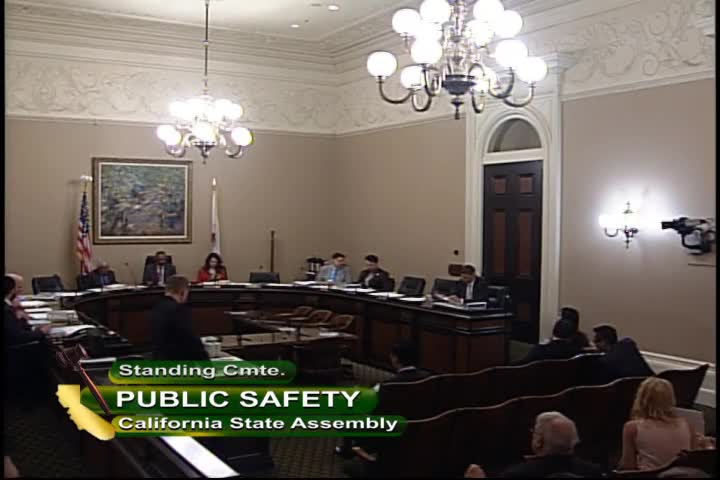 10MIN
Assembly Standing Committee on Public Safety
Bill Author

Bill Co-Author(s):