AB 2306: Student financial aid: Cal Grant Program.
- Session Year: 2017-2018
- House: Assembly
- Latest Version Date: 2018-02-13
Existing law, the Cal Grant Program, establishes the Cal Grant A and B Entitlement Awards, the California Community College Transfer Entitlement Awards, the Competitive Cal Grant A and B Awards, the Cal Grant C Awards, and the Cal Grant T Awards under the administration of the Student Aid Commission, and establishes eligibility requirements for awards under these programs for participating students attending qualifying institutions. The program prohibits an applicant from receiving one or a combination of program awards in excess of the amount equivalent to the award level for a total of a 4-year period of full-time attendance in an undergraduate program, except as provided.
This bill would increase this generally applicable maximum for total Cal Grant awards to a community college applicant to the award level for a 6-year period of full-time attendance. The bill would provide that this 6-year period of Cal Grant eligibility shall carry over to any 4-year qualifying institution if the applicant transfers from a community college to a 4-year qualifying institution, but shall not exceed the 6-year maximum in total.
A current community college applicant, or a former community college applicant who transfers to a four-year qualifying institution after having received a Cal Grant award while enrolled at a community college, who meets all other requirements to receive a Cal Grant award shall be eligible to receive the award in the amount equivalent to the award level for a total of six years of full-time attendance at an undergraduate program.
SEC. 2.Section 69433.5 of the Education Code is amended to read:69433.5.(a)Only a resident of California, as determined by the commission pursuant to Part 41 (commencing with Section 68000), is eligible for an initial Cal Grant award. The recipient shall remain eligible for award renewal only if he or she is a California resident, in attendance, and making satisfactory academic progress at a qualifying institution, as determined by the commission.
(b)A part-time student shall not be discriminated against in the selection of Cal Grant Program award recipients, and an award to a part-time student shall be approximately proportional to the time the student spends in the instructional program, as determined by the commission. A first-time Cal Grant Program award recipient who is a part-time student shall be eligible for a full-time renewal award if he or she becomes a full-time student.
(c)Cal Grant Program awards shall be awarded without regard to race, religion, creed, sex, sexual orientation, gender identity, gender expression, or age.
(d)An applicant shall not receive more than one type of Cal Grant Program award concurrently. An applicant shall not:
(1)Receive one or a combination of Cal Grant Program awards in excess of the amount equivalent to the award level for a total of four years years, or six years pursuant to Section 69433.4, of full-time attendance in an undergraduate program, except as provided in Section 69433.6.
(2)Have obtained a baccalaureate degree before receiving a Cal Grant Program award.
(e)A Cal Grant Program award, except as provided in Section 69440, may only be used for educational expenses of a program of study leading directly to an undergraduate degree or certificate, or for expenses of undergraduate coursework in a program of study leading directly to a first professional degree, but for which no baccalaureate degree is awarded.
(f)The commission shall, for students who accelerate college attendance, increase the amount of the award proportional to the period of additional attendance resulting from attendance in classes that fulfill requirements or electives for graduation during summer terms, sessions, or quarters. In the aggregate, the total amount a student may receive in a four-year period may period, or a six-year period pursuant to Section 69433.4, shall not be increased as a result of accelerating his or her progress to a degree by attending summer terms, sessions, or quarters.
(g)The commission shall notify Cal Grant award recipients of the availability of funding for the summer term, session, or quarter through prominent notice in financial aid award letters, materials, guides, electronic information, and other means that may include, but not necessarily be limited to, surveys, newspaper articles, or attachments to communications from the commission and any other published documents.
(h)The commission may require, by the adoption of rules and regulations, the production of reports, accounting, documents, or other necessary statements from the award recipient and the college or university of attendance pertaining to the use or application of the award.
(i)A Cal Grant Program award may be utilized only at a qualifying institution.
(j)A recipient who initially qualified for both a Cal Grant A award and a Cal Grant B award, and received a Cal Grant B award, may be awarded a renewal Cal Grant A award if that recipient subsequently became ineligible for a renewal Cal Grant B award and meets the applicable Cal Grant A financial need and income and asset criteria.
SEC. 3.Section 69433.6 of the Education Code is amended to read:69433.6.(a)Cal Grant A awards and Cal Grant B awards may be renewed for a total of the equivalent of four years years, or six years pursuant to Section 69433.4, of full-time attendance in an undergraduate program provided that minimum financial need as defined in paragraph (3) of subdivision (b) of Section 69432.9 continues to exist. Commencing with the 200102 academic year, the total number of years of eligibility for grants pursuant to this section shall be based on the students educational level in his or her course of study as designated by the institution of attendance when the recipient initially receives payment for a grant.
(b)(1)Commencing with the 201415 academic year, a recipient who was determined to be ineligible for a renewal award in the 201213 or 201314 academic year because he or she exceeded the maximum household income or asset level established by subdivision (k) of Section 69432.7, or failed to meet the minimum need threshold established by paragraph (3) of subdivision (b) of Section 69432.9, shall be eligible to receive a renewal award if the recipient meets all program eligibility requirements for the program from which he or she was previously disqualified and the recipient has remaining renewal award eligibility. For purposes of determining a students remaining renewal award eligibility, an academic year during which a student was ineligible shall reduce his or her renewal award eligibility by one full-time equivalent year.
(2)Commencing with the 201516 academic year, a recipient who is determined to be ineligible for a renewal award because, during the immediately preceding academic year, he or she exceeded the maximum household income or asset level established by subdivision (k) of Section 69432.7, or failed to meet the minimum need threshold established by paragraph (3) of subdivision (b) of Section 69432.9, shall be eligible to receive a renewal award if the recipient meets all program eligibility requirements for the program from which he or she was previously disqualified and the recipient has remaining renewal award eligibility. For purposes of determining a students remaining renewal award eligibility, an academic year during which a student was ineligible shall reduce his or her renewal award eligibility by one full-time equivalent year.
(c)For a student enrolled in an institutionally prescribed five-year undergraduate program, Cal Grant A awards and Cal Grant B awards may be renewed for a total of five years of full-time attendance, provided that minimum financial need, as defined in paragraph (3) of subdivision (b) of Section 69432.9, continues to exist.
(d)(1)A Cal Grant Program award recipient who has completed a baccalaureate degree, and who has been admitted to and is enrolled in a program of professional teacher preparation at an institution approved by the California Commission on Teacher Credentialing is eligible for, but not entitled to, renewal of a Cal Grant Program award for an additional year of full-time attendance, if minimum financial need, as defined in paragraph (3) of subdivision (b) of Section 69432.9, continues to exist.
(2)Payment for an additional year is limited to only those courses required for an initial teaching authorization. An award made under this subdivision may not be used for other courses.
(3)A students Cal Grant Program renewal eligibility shall not have lapsed more than 15 months before the payment of an award for purposes of this subdivision.
|
Date
|
Status
|
|---|---|
| May 25, 2018 | In committee: Held under submission. |
| Apr 18, 2018 | In committee: Set, first hearing. Referred to APPR. suspense file. |
| Apr 4, 2018 | From committee: Do pass and re-refer to Com. on APPR. (Ayes 9. Noes 2.) (April 3). Re-referred to Com. on APPR. |
| Mar 1, 2018 | Referred to Com. on HIGHER ED. |
| Feb 14, 2018 | From printer. May be heard in committee March 16. |
| Feb 13, 2018 | Read first time. To print. |
|
Date
|
Description
|
Location
|
Votes
|
|
|---|---|---|---|---|
| Apr 3, 2018 | Do pass and be re-referred to the Committee on [Appropriations] | Assembly Standing Committee on Higher Education |
Passed |
This list shows positions taken on this bill by organizations on the date displayed, which is linked to the original source.
Positions by individuals are not included.
|
Organization
|
Position
|
Date
|
|---|---|---|
| Alliance for Children's Rights | ** Support | Apr 2, 2018 |
| California Student Aid Commission | ** Support | Apr 2, 2018 |
| Community College League of California | ** Support | Apr 2, 2018 |
| Faculty Association Of California Community Colleges | ** Support | Apr 2, 2018 |
| Foothill-De Anza Community College District | ** Support | Apr 2, 2018 |
| Kern Community College District | ** Support | Apr 2, 2018 |
| Los Rios Community College District | ** Support | Apr 2, 2018 |
| North Orange Community College District | ** Support | Apr 2, 2018 |
| Peralta Community College District | ** Support | Apr 2, 2018 |
| San Diego Community College District | ** Support | Apr 2, 2018 |
| San Francisco Community College District | ** Support | Apr 2, 2018 |
| San Jose Evergreen Community Colleges | * Support | Apr 3, 2018 |
| San Jose-Evergreen Community College District | ** Support | Apr 2, 2018 |
| South Orange County Community College District | ** Support | Apr 2, 2018 |
| Yuba Community College District | ** Support | Apr 2, 2018 |
Date of Hearing: April 18, 2018
ASSEMBLY COMMITTEE ON APPROPRIATIONS
Lorena Gonzalez Fletcher, Chair
ABPCA Bill Id:AB 2306
Author:(Santiago) – As Introduced Ver:February 13, 2018
Policy Committee: | Higher Education | Vote: | 9 - 2 |
|
| ||
|
|
Urgency: No State Mandated Local Program: No Reimbursable: No
SUMMARY: This bill increases the amount of time a California Community College (CCC) student who transfers to a four-year institution may receive a Cal Grant award from the equivalent to four years of full-time attendance to the equivalent of six years of full-time attendance.
FISCAL EFFECT:
Ongoing annual General Fund costs of at least $20 million for the California Student Aid Commission to provide an additional two years of Cal Grant payments to CCC students who transfer to four-year institutions. This estimate likely is somewhat low because the state collects data only on the number of CCC students who apply for and receive Cal Grant awards then transfer to four-year institutions, not students who defer receipt of their Cal Grant award to save eligibility for four-year institutions, as described below.
COMMENTS:
- Purpose. The author believes extending the amount of time a CCC student transferring to a four-year institution can receive Cal Grants from four to six years would lead to more students opting to receive Cal Grants while completing their CCC studies and allow them to have sufficient remaining Cal Grant eligibility once they transfer to a four-year school.
- Cal Grants and CCC. The Cal Grant program is the state’s largest need-based financial aid program. It awards over $2 billion General Fund annually to undergraduate students at CCC, California State University, University of California, and some private institutions who meet certain income and eligibility criteria. Students may receive Cal Grants for up to four years of full-time college attendance if they continue to meet income and other requirements. Cal Grants awards may provide aid for both tuition and nontuition expenses. In the case of CCC, students receive Cal Grants awards designated for nontuition costs, such as books and housing. (The CCC generally covers tuition costs for needy students through institutional aid.) Annual maximum awards to qualifying CCC students are about $1,700. In 2017-18, about 120,000 students at CCC received Cal Grants.
In general, CCC students take four years or more to transfer to a four-year institution and, upon transfer, most take another three to four years to graduate. Consequently, some CCC students may not apply for a Cal Grant in order to preserve their financial aid eligibility at four-year schools. Delaying Cal Grant receipt while at CCC could lead students to increase their work hours and reduce their course loads in order to pay their expenses.
- Other Financial Aid Programs and CCC. Financially needy CCC students may be eligible to receive types of financial aid other than Cal Grants. At the federal level, students can receive up to $5,600 annually to apply toward educational costs for up to six years of full-time attendance. At the CCC, students enrolled full-time can receive up to $3,000 annually to cover educational costs for between two and four years.
- Financial Aid Programs at Four-Year Institutions. UC indicates it provides institutional aid, known as a “UC Grant,” to cover tuition and nontuition expenses for financially needy students after other aid is applied (such as Cal Grant and Pell Grants). Similarly, CSU indicates that it provides institutional aid, known as a “State University Grant,” to cover tuition expenses for financially needy students after other aid is applied. In 2016-17, the UC reports providing $746 million and CSU reports providing $586 million. Private institutions also may cover tuition and nontuition expenses for needy students after other aid is applied.
- Potential Offset to Institutional Aid Programs. Because four-year institutions cover tuition and sometimes nontuition expenses for needy students, providing additional Cal Grant coverage for students that transfer to these schools might offset their institutional aid expenditures by a similar amount.
- Behavioral Effects. The effect this policy change may have on the incentives of students is unclear. On one hand, students may finish their postsecondary education more quickly because they presumably could work less and successfully complete more courses in a shorter amount of time. On the other hand, students may take longer to complete their studies, because they would have two additional years of Cal Grant eligibility.
Analysis Prepared by: Natasha Collins / APPR. / (916) 319-2081
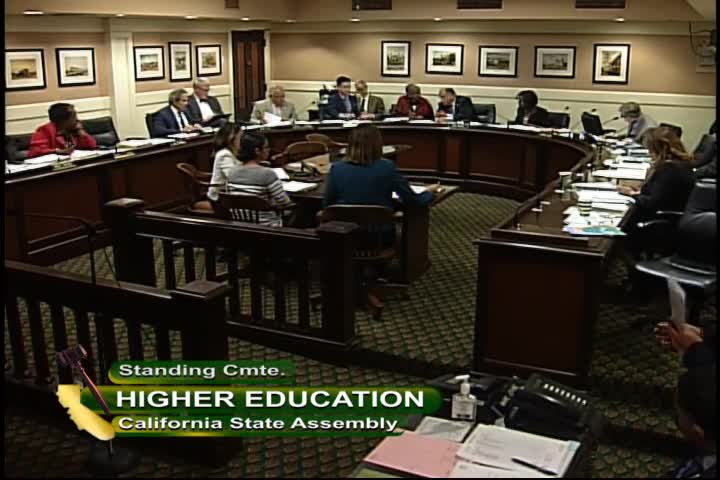
Date of Hearing: April 3, 2018
ASSEMBLY COMMITTEE ON HIGHER EDUCATION
Jose Medina, Chair
ABPCA Bill Id:AB 2306 (
Author:Santiago) – As Introduced Ver:February 13, 2018
SUBJECT: Student financial aid: Cal Grant Program
SUMMARY: Stipulates that a California Community College (CCC) applicant, or a former community college student who transfers to a four-year institution after having received a Cal Grant award while enrolled at a community college, and who meets all other Cal Grant eligibility criteria, shall be eligible to receive the Cal Grant award in the amount equivalent to six years of full-time attendance, instead of only four years of full-time attendance, in an undergraduate program, and makes conforming changes.
EXISTING LAW:
- Establishes the California Student Aid Commission (CSAC) for the purpose of administering specified student financial aid programs. (Education Code (EC) Section 69510, et seq.)
- Establishes the Cal Grant A and B Entitlement Programs, the California Community College (CCC) Transfer Cal Grant Program, the Competitive Cal Grant A and B Programs, the Cal Grant C Program, and the Cal Grant T Program, each with specified eligibility requirements related to the applicant's age, academic achievement, family income, maximum award amount limits, length of award eligibility, and other factors. (EC Sect. 69430, et seq.)
- Cal Grant B Awards. Students that meet income and asset thresholds and other eligibility requirements, have at least a 2.0 GPA are entitled to a living allowance and tuition and fee assistance. Awards for most first-year students are limited to an allowance for non-tuition costs (access award), such as books and living expenses (currently $1,672). In the second and subsequent years, the award also provides tuition and fee support. (EC Sect. 69435.)
- Provides for a waiver of CCC enrollment fees – the California College Promise Grant (formerly Board of Governors (BOG) fee waiver) – for certain types of students, including those with household incomes below certain thresholds established by the BOG or with demonstrated financial need, pursuant to federal law. (EC Sect. 66025.3.)
- CCC Full-Time Student Success Grant. Provides up to $1,000 annually to supplement the Cal Grant B or C access award for recipients who enroll in 12 or more credit units per semester. (Budget Act of 2015 and thereafter.)
- CCC Completion Grant. Provides up to $2,000 annually to supplement the access award and the Full-Time Student Success Grant for Cal Grant B or C recipients who develop a comprehensive education plan and enroll in 15 or more units per semester. (EC Sect. 88910, et seq.)
- Defines "part-time" enrollment, for purposes of eligibility for a partial Cal Grant award, as taking 6 to 11 semester units, inclusive, or the equivalent. (EC Sect. 69432.7(f) ((1))
- Defines "full-time" enrollment, for purposes of eligibility for a full Cal Grant award, as taking 12 or more semester units or the equivalent. (EC Sect. 69432.7(f) (2))
- Prohibits receipt of a Cal Grant award in excess of the amount equivalent to the award level for four years of full-time attendance in an undergraduate program. (EC Sect. 69433.5 (d) (1))
- Stipulates that, an individual selected for a Cal Grant A award who enrolls in a CCC may elect to have the award held in reserve for up to two academic years, except that the CSAC may extend this to three academic years if the commission determines that the rate of academic progress has been as rapid as could be expected for the personal and financial conditions that the student has encountered. (EC Sect. 69434.5)
- Under the CCC Transfer Cal Grant Entitlement Program, a student age 27 or less who was not awarded a Cal Grant A or B award at the time of his or her high school graduation but, at the time of transfer from a CCC to a qualifying baccalaureate program, or upon matriculation into the upper division coursework of a community college baccalaureate program, and who meets all other eligibility criteria, shall be entitled to a Cal Grant A or B award. (EC Sect. 69436)
- The federal Pell Grant provides aid to students who demonstrate financial need, and can be used for tuition and fees, books and supplies, transportation, and living expenses for the equivalent of up to six years of full-time enrollment. The maximum Pell Grant for 2017-18 is $5,920. (20 U.S. Code Sect. 1070.)
FISCAL EFFECT: Unknown, but likely very significant.
COMMENTS: Background and Purpose. In general, community college students take four years or more to transfer to a four-year institution, and upon transfer, most take another three to four years to graduate. (It should be noted that, in many cases, this extended time to earn a degree is due to many students' need for remedial education prior to commencing on a degree path, their inability to gain timely access to oversubscribed courses required for transfer, and to part-time enrollment.) Because Cal Grant eligibility extends to the equivalent of only four years of full-time enrollment, many community college students do not apply for a Cal Grant in order to preserve their financial aid eligibility at four-year schools, where tuition costs are higher and fully covered by the Cal Grant (in the case of the University of California (UC) and the California State University (CSU)). (In general, CCC students who are Cal Grant-eligible already receive a waiver of CCC per-credit fees via the California College Promise Grant (formerly the BOG fee waiver).
According to the author, the four-year limit on Cal Grant eligibility creates a barrier to the use of the Cal Grants that disadvantages community college students and prolongs their educational careers as they choose to “save” the Cal Grant for the university. The author describes the scope of this issue by comparing the relative use of three financial aid programs focused on low-income students. While nearly one million of the 2.4 million CCC students use the California Promise Grant, less than half a million receive a federal Pell Grant and only slightly more than 100,000 receive a Cal Grant award each year. This underutilization of the latter programs probably leads many financially disadvantaged community college students to increase their work hours and/or reduce their course loads.
To address the above issue, AB 2306 would extend Cal Grant eligibility for community college students to the equivalent of six years of full-time enrollment, thus aligning with the six-year eligibility period for the Pell Grant program. The author believes this will enable more community college students to receive a Cal Grant while completing their CCC studies and still have sufficient remaining Cal Grant eligibility at a four-year school.
What is the Current Situation? To examine the extent to which current CCC students use their Cal Grant awards, CSAC provided data on both currently-enrolled CCC students and former students who have transferred and have received a renewal Cal Grant award for the 2017-18 academic year. Of the 80,000 CCC students, about one-fourth will have used more than two years of their Cal Grant eligibility at the CCC, as of the end of this academic year, and about 4% have used more than three years of their eligibility so far while at the CCC. It is unknown how much longer each of these students will remain at the CCC prior to their transfer, but these 25,000 students will have used at least more than half of their Cal Grant eligibility prior to transferring to a four-year school. It is thus likely that their Cal Grant eligibility will be fully expended prior to their graduation. Since this data is just a snapshot, it is also unknown how much more of their Cal Grant eligibility the other 55,000 CCC students – who have thus far used less than two years of eligibility – will exhaust prior to transferring.
Data reviewed on transferred CCC students was limited. However, data from UC indicates that, of 1,500 new transfer enrollees in 2013-14 who received a Cal Grant award while enrolled at the CCC, one-third lost their Cal Grant eligibility within the first two years after transfer and another one-quarter lost their eligibility in the third year after transfer.
The discussion above covers only Cal Grant award recipients. It does not account for those CCC students who are deemed eligible for a Cal Grant but elect to delay getting an award in order to preserve their eligibility until they transfer in order to ensure that they will maintain eligibility through to graduation at a four-year school. Nor does the data account for likely eligible students who do not even apply for a Cal Grant.
Based on the data above and the large disparity between the usage of Cal Grants vs. Pell Grants at the CCC, it is likely that extending Cal Grant eligibility to six years would result in (1) more Cal Grant awardees actually utilizing more of their eligibility while at the CCC and (2) more otherwise eligible CCC students likely taking advantage of the Cal Grant program while attending a community college.
On the Other Hand. In recent years, the CCC has been implementing several initiatives to increase the likelihood of student success, including reducing the time required for students to achieve their educational goals. These efforts include: transformation of remedial education, enhanced assessment, orientation, and educational planning support, the development of associate degrees for transfer to CSU, and the use of guided pathways.
In addition, the state has provided additional funding to incentivize more intensive course-taking by Cal Grant recipients at the CCC. Specifically, students taking at least 12 units per semester receive a Full-Time Student Success Grant, which in the current year provides up to $500 per semester to supplement the Cal Grant B access award. Moreover, the CCC Completion Grant provides up to $1,000 per semester to supplement the access award and the Full-Time Student Success Grant for Cal Grant B recipients who develop a comprehensive educational plan and enroll in 15 or more units per semester. Thus a Cal Grant B student taking 30 units in an academic year can receive almost $4,700 in direct aid from the state to cover education expenses, in addition to receiving a fee waiver.
One must ask whether extending Cal Grant eligibility by two years as proposed by AB 2306 will provide a countervailing incentive for CCC transfer students to take fewer units and thus lengthen their time to transfer. For some students, this will probably be the case. The more desirable outcome with this bill, however, is that more CCC students will apply for, accept, and use their Cal Grant awards, reduce their work hours, increase their course loads – and in doing so take advantage of the additional, incentive grants – and thus transfer more quickly.
Related Legislation. AB 2248 (McCarty), also on today's committee agenda, redefines full-time enrollment, for purposes of determining Cal Grant eligibility, as taking at least 30 units per academic year. Cal Grant recipients would not be subject to the 30-unit requirement while attending a community college.
AB 3153 (Levine), pending in this committee, intends to allow Cal Grant recipients to receive additional Cal Grant awards for the equivalent of two summer sessions or terms of full-time attendance.
REGISTERED SUPPORT / OPPOSITION:
Support
Alliance for Children's Rights
California Student Aid Commission
Community College League of California
Faculty Association of California Community Colleges
Foothill-De Anza Community College District
Kern Community College District
Los Rios Community College District
North Orange Community College District
Peralta Community College District
San Diego Community College District
San Francisco Community College District
San Jose-Evergreen Community College District
South Orange County Community College District
Yuba Community College District
Opposition
None on file.
Analysis Prepared by: Chuck Nicol / HIGHER ED. / (916) 319-3960
Discussed in Hearing
View Older Hearings
Bill Author

Bill Co-Author(s):