AB 437: At-risk persons: first responders.
- Session Year: 2017-2018
- House: Assembly
- Latest Version Date: 2017-04-26
Existing law requires the Attorney General to establish and maintain the Violent Crime Information Center to assist in the identification and the apprehension of persons responsible for specific violent crimes and for the disappearance and exploitation of persons, particularly children and at-risk adults.
This bill would require the Attorney General to establish and maintain within the center a Voluntary Online At-Risk Community Network for purposes of providing information to first responders in order to prevent harmful interactions between first responders and seniors or persons with disabilities, as defined. The bill would prescribe the information that a senior, a person with a disability, a person with a limited conservatorship of a person with a developmental disability, or a parent or intellectual disability, as specified, or a parent or legal guardian of a minor child with a disability may voluntarily provide to the Attorney General for inclusion in the network, and prescribe how the network would be developed and communicated to the public, as specified. The bill would prohibit a conservator from submitting information on behalf of a conservatee if the conservatee directs the conservator not to submit information. The bill would require specified first responders to broadcast a Be on the Lookout bulletin within its jurisdiction under circumstances upon which a person in the network is missing or needs assistance. By imposing new duties on local entities under various provisions of the bill, the bill would create a state-mandated local program.
The California Constitution requires the state to reimburse local agencies and school districts for certain costs mandated by the state. Statutory provisions establish procedures for making that reimbursement.
This bill would provide that, if the Commission on State Mandates determines that the bill contains costs mandated by the state, reimbursement for those costs shall be made pursuant to the statutory provisions noted above.
Existing law requires the Attorney General to establish and maintain the Violent Crime Information Center to assist in the identification and the apprehension of persons responsible for specific violent crimes and for the disappearance and exploitation of persons, particularly children and at-risk adults.
This bill would require the Attorney General to establish and maintain within the center a Voluntary Online At-Risk Community Network for purposes of providing information to first responders in order to prevent harmful interactions between first responders and seniors or persons with disabilities, as defined. The bill would prescribe the information that a senior or senior, a person with a disability disability, a person with a limited conservatorship of a person with a developmental disability, or a parent of a minor child with a disability may voluntarily provide to the Attorney General for inclusion in the network, and prescribe how the network would be developed and communicated to the public, as specified. The bill would require specified first responders to broadcast a Be on the Lookout bulletin within its jurisdiction under circumstances upon which a person in the network is missing or needs assistance. By imposing new duties on local entities under various provisions of the bill, the bill would create a state-mandated local program.
The California Constitution requires the state to reimburse local agencies and school districts for certain costs mandated by the state. Statutory provisions establish procedures for making that reimbursement.
This bill would provide that, if the Commission on State Mandates determines that the bill contains costs mandated by the state, reimbursement for those costs shall be made pursuant to the statutory provisions noted above.
Existing law requires the Attorney General to establish and maintain the Violent Crime Information Center to assist in the identification and the apprehension of persons responsible for specific violent crimes and for the disappearance and exploitation of persons, particularly children and at-risk adults.
This bill would require the Attorney General to establish and maintain within the center a Voluntary Online At-Risk Community Network for purposes of providing information to first responders in order to prevent harmful interactions between first responders and seniors or persons with disabilities, as defined. The bill would prescribe the information that a senior or a person with a disability may voluntarily provide to the Attorney General for inclusion in the network, and prescribe how the network would be developed and communicated to the public, as specified. The bill would require specified first responders to broadcast a Be on the Lookout bulletin within its jurisdiction under circumstances upon which a person in the network is missing or needs assistance. By imposing new duties on local entities under various provisions of the bill, the bill would create a state-mandated local program.
The California Constitution requires the state to reimburse local agencies and school districts for certain costs mandated by the state. Statutory provisions establish procedures for making that reimbursement.
This bill would provide that, if the Commission on State Mandates determines that the bill contains costs mandated by the state, reimbursement for those costs shall be made pursuant to the statutory provisions noted above.
Existing law, the Warren-911-Emergency Act, provides for an emergency response system among city and county police and first responders to provide coordinated emergency services to persons in emergency situations.This bill would express the intent of the Legislature to enact legislation that would modify emergency response systems to improve interactions between people with disabilities and law enforcement and other first responders.Existing law, the Warren-911-Emergency Act, provides for an emergency response system among city and county police and first responders to provide coordinated emergency services to persons in emergency situations.
This bill would express the intent of the Legislature to enact legislation that would modify emergency response systems to improve interactions between people with disabilities and law enforcement and other first responders.
(a)The Attorney General shall establish and maintain within the center the Voluntary Online At-Risk Community Network. The purpose of this network is to rapidly provide information to first responders to prevent harmful interactions between seniors and persons with disabilities and first responders. The Attorney General shall design the network, using any one or more existing systems, including the California Law Enforcement Telecommunications system, secure web-portals, Internet Web portals, and emergency response systems.
(b)A senior or a person with a disability may voluntarily provide the Attorney General with information about themselves himself or herself to include in the network. The information voluntarily provided may include, but is not limited to, any of the following:
(1)The persons name.
(2)The persons date of birth.
(3)The persons height.
(4)The persons weight.
(5)The persons race or ethnicity.
(6)The persons physical description, including hair color, eye color, or body marks.
(7)How a disability manifests, such as memory loss, uneven gait, use of a wheelchair, or loss of hearing or vision, or the type of disability, such as autism, schizophrenia, dementia, blindness, deafness, or being hard of hearing.
(8)Known signs of distress, such as sweating, clenching of teeth or fists, pacing, breathing hard, or throwing or waving an object.
(9)Known actions that make the person respond with unfamiliar behavior, such as being touched, being surrounded, yelling, loud noise, isolation, or certain words.
(10)Calming strategies and things that give the person a sense of security, such as being wrapped in a blanket, drinking a beverage, objects, or certain words.
(11)Preferences regarding contact with others, including means of communication, such as sign language, Braille, supported communication, or preferred language.
(12)Any other information deemed appropriate by the Attorney General in consultation with stakeholders from the senior and disability communities.
(c)The Attorney General, in consultation with stakeholders from the senior and disability communities, shall develop a paper-based and electronic method to include information in the network.
(d)Information in the network shall only be made available to first responders for the sole purpose of preventing harm to seniors and persons with disabilities. At no point shall any information in the network be disclosed to the public.
(e)A senior or a person with a disability who voluntarily provides the Attorney General with information about themselves himself or herself to include in the network retains the right to remove this information from the network at any time.
(f)Only a senior or a person with a disability may voluntarily provide the Attorney General with information about themselves himself or herself to include in the network. Except as provided in paragraph (5) of subdivision (k), (k) and subdivision (l), at no time shall any law enforcement entity or first responder or any other public or private entity or individual provide the Attorney General with information to include in the network about a senior or a person with a disability.
(g)If a member of the public reports to a first responder that a person in the network is missing or needs assistance, the first responder shall broadcast a Be on the Lookout bulletin that references the persons profile in the network, without delay, within its jurisdiction.
(h)The Attorney General, in consultation with stakeholders from the senior and disability communities, shall develop a voluntary identification system that allows a senior or a person with a disability to voluntarily wear an object, such as a wristband, button, or lanyard that indicates the person is included in the network.
(i)The Attorney General shall issue an information bulletin to first responders to provide notice about the network.
(j)The Attorney General, in consultation with stakeholders from the senior and disability communities, shall notify the general public about the network.
(k)For purposes of this section, the following definitions shall apply:
(1)Disability or disabilities means any disability, as defined in Sections 12926 and 12926.1 of the Government Code.
(2)First responder means a state or local peace officer, emergency medical technician, or firefighter.
(3)Network means the network described in subdivision (a).
(4)Supported decisionmaking means a process of supporting and accommodating an adult with a disability to enable the adult to make life decisions without impeding the self-determination of the adult.
(5)Voluntarily means that the information was provided by any of the following:
(A)The senior or person with a disability in the absence of coercion and pursuant to his or her own free will.
(B)The person with a disability through the use of supported decisionmaking.
(C)A person with a limited conservatorship of a person with a developmental disability. or intellectual disability, but only if the conservatee is unable to make the decision to provide information as a result of his or her disability even with the use of supported decisionmaking.
(D)A parent or legal guardian of a minor child with a disability.
(l)(1)Before a conservator may submit information on behalf of a conservatee with a developmental or intellectual disability, the conservator shall inform the conservatee that he or she is considering submitting the information and that the conservatee may decide against submitting it. The conservator shall not submit the information if the conservatee directs the conservator not to submit it.
(2)After a conservator submits information on behalf of a conservatee with a developmental or intellectual disability, the conservator shall inform the conservatee that the conservator has done so and shall further inform him or her that, if the conservatee ever wants the information removed, the conservatee may request the removal of the information or direct the conservator to remove it, in which case the conservator shall then request that the information be removed.
SEC. 2.If the Commission on State Mandates determines that this act contains costs mandated by the state, reimbursement to local agencies and school districts for those costs shall be made pursuant to Part 7 (commencing with Section 17500) of Division 4 of Title 2 of the Government Code.
(a)The Attorney General shall establish and maintain within the center the Voluntary Online At-Risk Community Network. The purpose of this network is to rapidly provide information to first responders to prevent harmful interactions between seniors and persons with disabilities and first responders. The Attorney General shall design the network, using any one or more existing systems, including the California Law Enforcement Telecommunications system, secure web-portals, and emergency response systems.
(b)A senior or a person with a disability may voluntarily provide the Attorney General with information about themselves to include in the network. The information voluntarily provided may include, but is not limited to, any of the following:
(1)The persons name.
(2)The persons date of birth.
(3)The persons height.
(4)The persons weight.
(5)The persons race or ethnicity.
(6)The persons physical description, including hair color, eye color, or body marks.
(7)How a disability manifests, such as memory loss, uneven gait, use of a wheelchair, or loss of hearing or vision, or the type of disability, such as autism, schizophrenia, dementia, blindness, deafness, or being hard of hearing.
(8)Known signs of distress, such as sweating, clenching of teeth or fists, pacing, breathing hard, or throwing or waving an object.
(9)Known actions that make the person respond with unfamiliar behavior, such as being touched, being surrounded, yelling, loud noise, isolation, or certain words.
(10)Calming strategies and things that give the person a sense of security, such as being wrapped in a blanket, drinking a beverage, objects, or certain words.
(11)Preferences regarding contact with others, including means of communication, such as sign language, Braille, supported communication, or preferred language.
(12)Any other information deemed appropriate by the Attorney General in consultation with stakeholders from the senior and disability communities.
(c)The Attorney General, in consultation with stakeholders from the senior and disability communities, shall develop a paper-based and electronic method to include information in the network.
(d)Information in the network shall only be made available to first responders for the sole purpose of preventing harm to seniors and persons with disabilities. At no point shall any information in the network be disclosed to the public.
(e)A senior or a person with a disability who voluntarily provides the Attorney General with information about themselves to include in the network retains the right to remove this information from the network at any time.
(f)Only a senior or a person with a disability may voluntarily provide the Attorney General with information about themselves to include in the network. Except as provided in paragraph (5) of subdivision (k), at no time shall any law enforcement entity or first responder or any other public or private entity or individual provide the Attorney General with information to include in the network about a senior or a person with a disability.
(g)If a member of the public reports to a first responder that a person in the network is missing or needs assistance, the first responder shall broadcast a Be on the Lookout bulletin that references the persons profile in the network, without delay, within its jurisdiction.
(h)The Attorney General, in consultation with stakeholders from the senior and disability communities, shall develop a voluntary identification system that allows a senior or a person with a disability to voluntarily wear an object, such as a wristband, button, or lanyard that indicates the person is included in the network.
(i)The Attorney General shall issue an information bulletin to first responders to provide notice about the network.
(j)The Attorney General, in consultation with stakeholders from the senior and disability communities, shall notify the general public about the network.
(k)For purposes of this section, the following definitions shall apply:
(1)Disability or disabilities means any disability, as defined in Sections 12926 and 12926.1 of the Government Code.
(2)First responder means a state or local peace officer, emergency medical technician, or firefighter.
(3)Network means the network described in subdivision (a).
(4)Supported decisionmaking means a process of supporting and accommodating an adult with a disability to enable the adult to make life decisions without impeding the self-determination of the adult.
(5)Voluntarily means that the information was provided by any of the following:
(A)The senior or person with a disability in the absence of coercion and pursuant to his or her own free will.
(B)The person with a disability through the use of supported decisionmaking.
(C)A person with a limited conservatorship of a person with a developmental disability.
(D)A parent of a minor child with a disability.
SEC. 2.If the Commission on State Mandates determines that this act contains costs mandated by the state, reimbursement to local agencies and school districts for those costs shall be made pursuant to Part 7 (commencing with Section 17500) of Division 4 of Title 2 of the Government Code.
(a)The Attorney General shall establish and maintain within the center the Voluntary Online At-Risk Community Network. The purpose of this network is to rapidly provide information to first responders to prevent harmful interactions between seniors and persons with disabilities and first responders. The Attorney General shall design the network, using any one or more existing systems, including the California Law Enforcement Telecommunications system, secure web-portals, and emergency response systems.
(b)A senior or a person with a disability may voluntarily provide the Attorney General with information about themselves to include in the network. The information voluntarily provided may include, but is not limited to, any of the following:
(1)The persons name.
(2)The persons date of birth.
(3)The persons height.
(4)The persons weight.
(5)The persons race or ethnicity.
(6)The persons physical description, including hair color, eye color, or body marks.
(7)How a disability manifests, such as memory loss, uneven gait, use of a wheelchair, or loss of hearing or vision, or the type of disability, such as autism, schizophrenia, dementia, blindness, deafness, or being hard of hearing.
(8)Known signs of distress, such as sweating, clenching of teeth or fists, pacing, breathing hard, or throwing or waving an object.
(9)Known actions that make the person respond with unfamiliar behavior, such as being touched, being surrounded, yelling, loud noise, isolation, or certain words.
(10)Calming strategies and things that give the person a sense of security, such as being wrapped in a blanket, drinking a beverage, objects, or certain words.
(11)Preferences regarding contact with others, including means of communication, such as sign language, Braille, supported communication, or preferred language.
(12)Any other information deemed appropriate by the Attorney General in consultation with stakeholders from the senior and disability communities.
(c)The Attorney General, in consultation with stakeholders from the senior and disability communities, shall develop a paper-based and electronic method to include information in the network.
(d)Information in the network shall only be made available to first responders for the sole purpose of preventing harm to seniors and persons with disabilities. At no point shall any information in the network be disclosed to the public.
(e)A senior or a person with a disability who voluntarily provides the Attorney General with information about themselves to include in the network retains the right to remove this information from the network at any time.
(f)Only a senior or a person with a disability may voluntarily provide the Attorney General with information about themselves to include in the network. Except as provided in paragraph (5) of subdivision (k), at no time shall any law enforcement entity or first responder or any other public or private entity or individual provide the Attorney General with information to include in the network about a senior or a person with a disability.
(g)If a member of the public reports to a first responder that a person in the network is missing or needs assistance, the first responder shall broadcast a Be on the Lookout bulletin that references the persons profile in the network, without delay, within its jurisdiction.
(h)The Attorney General, in consultation with stakeholders from the senior and disability communities, shall develop a voluntary identification system that allows a senior or a person with a disability to voluntarily wear an object, such as a wristband, button, or lanyard that indicates the person is included in the network.
(i)The Attorney General shall issue an information bulletin to first responders to provide notice about the network.
(j)The Attorney General, in consultation with stakeholders from the senior and disability communities, shall notify the general public about the network.
(k)For purposes of this section, the following definitions shall apply:
(1)Disability or disabilities means any disability, as defined in Sections 12926 and 12926.1 of the Government Code.
(2)First responder means a state or local peace officer, emergency medical technician, or firefighter.
(3)Network means the network described in subdivision (a).
(4)Supported decisionmaking means a process of supporting and accommodating an adult with a disability to enable the adult to make life decisions without impeding the self-determination of the adult.
(5)Voluntarily means that the information was provided by any of the following:
(A)The senior or person with a disability in the absence of coercion and pursuant to his or her own free will.
(B)The person with a disability through the use of supported decisionmaking.
(C)A person with a limited conservatorship of a person with a developmental disability.
SEC. 2.If the Commission on State Mandates determines that this act contains costs mandated by the state, reimbursement to local agencies and school districts for those costs shall be made pursuant to Part 7 (commencing with Section 17500) of Division 4 of Title 2 of the Government Code.
SECTION 1.It is the intent of the Legislature to enact legislation that modifies emergency response systems to improve interactions between people with disabilities and law enforcement and other first responders.It is the intent of the Legislature to enact legislation that modifies emergency response systems to improve interactions between people with disabilities and law enforcement and other first responders.
|
Date
|
Status
|
|---|---|
| Feb 1, 2018 | From committee: Filed with the Chief Clerk pursuant to Joint Rule 56. |
| Jan 31, 2018 | Died pursuant to Art. IV, Sec. 10(c) of the Constitution. |
| May 26, 2017 | In committee: Hearing postponed by committee. |
| May 17, 2017 | In committee: Set, first hearing. Referred to APPR. suspense file. |
| Apr 27, 2017 | Re-referred to Com. on APPR. |
| Apr 26, 2017 | From committee chair, with author's amendments: Amend, and re-refer to Com. on APPR. Read second time and amended. |
| Apr 19, 2017 | From committee: Do pass and re-refer to Com. on APPR. (Ayes 6. Noes 1.) (April 18). Re-referred to Com. on APPR. |
| Apr 6, 2017 | Re-referred to Com. on PUB. S. |
| Apr 5, 2017 | From committee chair, with author's amendments: Amend, and re-refer to Com. on PUB. S. Read second time and amended. |
| Mar 23, 2017 | From committee chair, with author's amendments: Amend, and re-refer to Com. on PUB. S. Read second time and amended. |
| Mar 27, 2017 | Re-referred to Com. on PUB. S. |
| Mar 23, 2017 | Referred to Com. on PUB. S. |
| Feb 14, 2017 | From printer. May be heard in committee March 16. |
| Feb 13, 2017 | Read first time. To print. |
|
Date
|
Description
|
Location
|
Votes
|
|
|---|---|---|---|---|
| Apr 18, 2017 | Do pass and be re-referred to the Committee on [Appropriations] | Assembly Standing Committee on Public Safety |
Passed |
This list shows positions taken on this bill by organizations on the date displayed, which is linked to the original source.
Positions by individuals are not included.
|
Organization
|
Position
|
Date
|
|---|---|---|
| AFSCME Local 3930 | ** Support | Apr 17, 2017 |
| Arc and United Cerebral Palsy California Collaboration | * For If Amend | Apr 18, 2017 |
| Congress of California Seniors | ** Support | Apr 17, 2017 |
| Disability Rights California | ** Against | Apr 17, 2017 |
| SEIU California | ** Support | Apr 17, 2017 |
Date of Hearing: May 17, 2017
ASSEMBLY COMMITTEE ON APPROPRIATIONS
Lorena Gonzalez Fletcher, Chair
ABPCA Bill Id:AB 437
Author:(Rodriguez) – As Amended Ver:April 26, 2017
Policy Committee: | Public Safety | Vote: | 6 - 1 |
|
| ||
|
|
Urgency: No State Mandated Local Program: Yes Reimbursable: Yes
SUMMARY:
This bill requires the Attorney General (AG) to establish and maintain the Voluntary Online At-Risk Community Network, to provide information to first responders to prevent harmful interactions between seniors and persons with disabilities. Specifically, this bill:
- Requires the AG to establish and maintain within the Violent Crime Information Center (VCIC) the Voluntary Online At-Risk Community Network. The purpose of this network is to rapidly provide information to first responders to prevent harmful interactions between seniors and persons with disabilities and first responders. The AG is required to design the network, using any one or more existing systems, including the California Law Enforcement Telecommunications System (CLETS), secure Internet Web portals, and emergency response systems.
- Provides that a senior or a person with a disability may voluntarily provide the AG with information about himself or herself, and a conservator may provide the information on a conservatee, to include in the network, as specified.
- Requires the AG, in consultation with stakeholders from the senior and disability communities, to develop a voluntary identification system to allow the individual to wear an object that indicates the person is included in the network.
- Requires the first responder to broadcast a “Be on the Lookout” bulletin that references the persons profile if a member of the public reports to a first responder that an individual in the network is missing.
FISCAL EFFECT:
- Unknown GF costs in the hundreds of thousands of dollars for the DOJ to develop and maintain a database with the information requested in this bill. While this bill requires the AG to use any one or more of the existing systems, the fact is that these systems are for law enforcement personnel and not all responders are law enforcement personnel. The first responders referenced in this bill include fire fighters and emergency medical technicians (EMTs). The DOJ will incur significant costs to establish a network that will allow access to all first responders.
- Unknown but likely moderate reimbursable state-mandated costs (GF) in the hundreds of thousands of dollars to local agencies to train in the new system and to give all first responders access (equipment and programming) to DOJ’s network.
COMMENTS:
- Purpose. According to the author, the information contained in the network will provide crucial information to first responders such as how a disability manifests, calming and de-escalation techniques, and other information concerning how to appropriately interact with a senior or someone with a disability without resorting to deadly force.
- Background. Current law requires the AG to maintain various networks and databases to assist in the identification and the apprehension of persons responsible for specific violent crimes and for the disappearance and exploitation of persons, particularly children and dependent adults to enable the DOJ crime analysts with expertise in child abuse, missing persons, child abductions, and sexual assaults to electronically share their data, analysis, and findings on violent crime cases with each other, and to electronically provide law enforcement agencies with information to assist in the identification, tracking, and apprehension of violent offenders. The AG is also mandated to establish and maintain an automated violent crime method of operation system to facilitate the identification and apprehension of persons responsible for murder, kidnap, including parental abduction, false imprisonment, or sexual assault. The AG is required to establish and maintain a computer system designed to effect an immediate law enforcement response to reports of missing persons, and to establish the Missing and Exploited Children’s Recovery Network, an automated computerized system that has the capability to electronically transmit to all state and local law enforcement agencies, and all cooperating news media services, either by facsimile or computer modem, a missing child poster that includes the name, personal description data, and picture of the missing child. These networks and database are accessible, or available, to law enforcement agencies.
The AG’s networks and databases are generally not available to non-law enforcement personnel.
Current law defines a "Silver Alert" as a notification system, that can be activated as specified, and is designed to issue and coordinate alerts with respect to a person 65 years of age or older who is reported missing, if specified conditions are met.
- Support: According to UDW/AFSCME Local 3930, "In recent years, we have become painfully aware of numerous incidents between people with disabilities and first responders resulting in avoidable injury or death. These interactions often occur during high stakes emergencies-such as when a person with autism or dementia wanders or a person with mental illness undergoes a crisis. A staggering one-third to one-half of all police use-of –force incidents involve a civilian with disabilities, and the risk of being killed during a police incidents is sixteen times greater for individuals with a mental illness.”
“AB 437 would give people with disabilities the ability to voluntarily provide information about themselves to law enforcement in advance of a crisis-such as the nature of their disability, signals of distress, and calming strategies.”
Analysis Prepared by: Pedro Reyes / APPR. / (916) 319-2081
Date of Hearing:
Chief Counsel: Gregory Pagan
ASSEMBLY COMMITTEE ON PUBLIC SAFETY
Reginald Byron Jones-Sawyer, Sr., Chair
ABPCA Bill Id:AB 437
Author:(Rodriguez) – As Amended Ver:
SUMMARY:
Requires the Attorney General (AG) to establish and maintain the Voluntary Online At-Risk Community Network, which would provide information to first responders to prevent harmful interactions between seniors and persons with disabilities. Specifically, this bill:
- Requires the AG to establish and maintain within the Violent Crime Information Center (VCIC) the Voluntary Online At-Risk Community Network. The purpose of this network is to rapidly provide information to first responders to prevent harmful interactions between seniors and persons with disabilities and first responders. The Attorney General shall design the network, using any one or more existing systems, including the California Law Enforcement Telecommunications System (CLETS), secure web-portals, and emergency response systems.
- Provides that a senior or a person with a disability may voluntarily provide the AG with information about themselves to include in the network. The information voluntarily provided may include, but is not limited to, any of the following:
- The person's name;
- The person's date of birth;
- The person's height;
- The person's weight;
- The person's race or ethnicity;
- The persons physical description, including hair color, eye color, or body marks;
- How a disability manifests, such as memory loss, uneven gait, use of a wheelchair, or loss of hearing or vision, or the type of disability, such as autism, schizophrenia, dementia, blindness, deafness, or being hard of hearing;
- Known signs of distress, such as sweating, clenching of teeth or fists, pacing breathing hard, or throwing or waving objects;
- Known actions that make the person respond with unfamiliar behavior, such as being touched, being surrounded, yelling loud noise, isolation, or certain words;
- Calming strategies and things that give the person a sense of security, such as being wrapped in a blanket, drinking a beverage, objects, or certain words;
- Preferences regarding contact with others, including means of communication, including Braille, supported communication, or preferred language; and,
- Any other information deemed appropriate by the AG in consultation with stakeholders from the senior and disabilities communities.
- The person's name;
- States that the AG, in consultation with the senior and disability communities, shall develop a paper-based and electronic method of to include information in the network.
- Provides that information in the network shall only be made available to first responders for the sole purpose of preventing harm to seniors and persons with disabilities. At no point shall any information in the network be disclosed to the public.
- Allows a senior or a person with a disability who voluntarily provides the Attorney General with information about themselves to include in the network to remove this information from the network at any time.
- Authorizes only a senior or person with a disability to voluntarily provide the AG with information about themselves to include in the network. Except as specified, at no time shall any law enforcement entity or first responder or any other private or public entity or individual provide the AG with information to include in the network about a senior or a person with a disability.
- Provides that If a member of the public reports to a first responder that a person in the network is missing or needs assistance, the first responder shall broadcast a “Be on the Lookout” bulletin that references the person’s profile in the network, without delay, within its jurisdiction.
- Requires the AG, in consultation with stakeholders from the senior and disability communities to develop a voluntary identification system that allows a senior or a person with a disability to voluntarily wear an object, such as a wristband, button, or lanyard that indicates the person is included in the network.
- Requires the AG to issue an information bulletin to first responders to provide notice about the network.
- Provides that the AG, in consultation with stakeholders from the senior and disability communities, shall notify the general public about the network.
- States that for the purpose of the Voluntary Online At-Risk Community Network the following definitions shall apply;
- "Disability" or "disabilities" means any disability as defined in the California Government Code;
- "First responder" means a state or local peace officer, emergency medical technician, or firefighter;
- "Network" means the Voluntary Online At-Risk Community Network;
- "Supported decision making" means a process of supporting and accommodating an adult with a disability to enable the adult to make life decisions without impeding the self-determination of the adult; and,
- "Voluntarily" means that the information was provided by any of the following:
- The senior or person with a disability in the absence of coercion and pursuant to his or her own free will;
- The person with a disability through the use of supported decision making;
- A person with a limited conservatorship of a person of a person with a development disability; and,
- A parent of a minor child with a disability.
- The senior or person with a disability in the absence of coercion and pursuant to his or her own free will;
- "Disability" or "disabilities" means any disability as defined in the California Government Code;
EXISTING LAW:
- Requires the Attorney General (AG) to maintain the Violent Crime Information Center (VCIC) to assist in the identification and the apprehension of persons responsible for specific violent crimes and for the disappearance and exploitation of persons, particularly children and dependent adults. The center is required to assist local law enforcement agencies and county district attorneys by providing investigative information on persons responsible for specific violent crimes and missing person cases. (Pen. Code § 14200.)
- Establishes, upon appropriation of funds by the Legislature, the Violent Crime Information Network (VCIN) within the VCIC to enable the DOJ crime analysts with expertise in child abuse, missing persons, child abductions, and sexual assaults to electronically share their data, analysis, and findings on violent crime cases with each other, and to electronically provide law enforcement agencies with information to assist in the identification, tracking, and apprehension of violent offenders. The VCIN shall serve to integrate existing state, federal, and civilian data bases into a single comprehensive network. (Pen. Code § 14201.)
- Mandates the AG to establish and maintain an automated violent crime method of operation system to facilitate the identification and apprehension of persons responsible for murder, kidnap, including parental abduction, false imprisonment, or sexual assault. This unit shall be responsible for identifying perpetrators of violent felonies collected from the center and analyzing and comparing data on missing persons in order to determine possible leads which could assist local law enforcement agencies. This unit shall only release information about active investigations by police and sheriffs’ departments to local law enforcement agencies. (Pen. Code § 14203, subd. (a).)
- Requires the AG to establish and maintain a computer system designed to effect an immediate law enforcement response to reports of missing persons. This system must include an active file of information concerning persons reported to it as missing and who have not been reported as found. The computer system is to be made available to law enforcement agencies. However, the AG shall not release the information if the reporting agency requests the AG in writing not to release the information because it would impair a criminal investigation. (Pen. Code § 14204.)
- Requires the AG to establish the Missing and Exploited Children’s Recovery Network, an automated computerized system that has the capability to electronically transmit to all state and local law enforcement agencies, and all cooperating news media services, either by facsimile or computer modem, a missing child poster that includes the name, personal description data, and picture of the missing child. (Pen. Code § 14206.)
- Requires the VCIC to make accessible to the National Missing and Unidentified Persons System specific information authorized for dissemination and as determined appropriate by the center that is contained in law enforcement reports regarding missing or unidentified persons. (Pen. Code § 14209.)
- Requires all local police and sheriffs’ departments to accept any report, including any telephonic report, of a missing person, including runaways. Local police and sheriffs’ departments are required to give priority to the handling of these reports over the handling of reports relating to crimes involving property. In cases where the person making a report of a missing person or runaway, contacts the California Highway Patrol (CHP), the CHP may take the report, and must immediately advise the person making the report of the name and telephone number of the police or sheriff’s department having jurisdiction of the residence address of the missing person and of the name and telephone number of the police or sheriff’s department having jurisdiction of the place where the person was last seen. If the missing person is under 16 years of age, or there is evidence that the person is at risk, the department shall broadcast a “Be On the Look-Out” bulletin within its jurisdiction. (Pen. Code, § 14211, subds. (a)(b)&(d).)
- Requires that if the person reported missing is under 21 years of age, or if there is evidence that the person is at risk, the law enforcement agency receiving the report shall, within two hours after the receipt of the report, transmit the report to the DOJ for inclusion in the VCIC and the National Crime Information Center (NCIC) databases. (Pen. Code, § 14211, subd. (e).)
- Provides that in cases where the report is taken by a department, other than that of the city or county of residence of the missing person or runaway, the department, or division of the CHP taking the report shall, without delay, and, in the case of children under 21 years of age or where there was evidence that the missing person was at risk, within no more than 24 hours, notify, and forward a copy of the report to the police or sheriff’s department or departments having jurisdiction of the residence address of the missing person or runaway and of the place where the person was last seen. The report shall be submitted to the department or division of the CHP that took the report to the VCIC. (Pen. Code, § 14211, subd. (g).)
- Defines a “missing person” to include any of the following:
- An at-risk adult;
- A child who was taken, detained, concealed, enticed away, or retained by a parent illegally; and,
- A child who is missing voluntarily or involuntarily or under circumstances not conforming to his or her ordinary habits or behavior and who may be need of assistance. (Pen. Code, §14215, subd. (a).)
- An at-risk adult;
- Defines an “at-risk” to mean there is evidence of, or there are indications of, any of the following:
- The person missing is a victim of a crime or foul play;
- The person missing is in need of medical attention;
- The person missing has no pattern of running away or disappearing;
- The person missing may be a victim of parental abduction; or,
- The person missing may be mentally impaired. (Pen. Code, §14215, subd. (b).)
- The person missing is a victim of a crime or foul play;
- Defines a "Silver Alert" as a notification system, that can be activated as specified, and is designed to issue and coordinate alerts with respect to a person 65 years of age or older who is reported missing. (Gov. Code, § 8594.10, subd. (a).
- Provides that if a person is reported missing to a law enforcement agency, and that agency determines that specified requirements are met, the agency may request the CHP to activate a "Silver Alert". If the CHP concurs that the specified requirements are met, it shall activate a "Silver Alert" within the geographical area requested by the investigating law enforcement agency. (Gov. Code, § 8594.10, subd. (c).)
- States that a law enforcement agency may request a "Silver Alert" be activated if that agency determines that all of the following conditions are met in regard to the investigation of the missing person:
- The missing person is 65 years of age or older;
- The investigating law enforcement agency has utilized all available local resources;
- The law enforcement agency determines that that the person has gone missing under unexplained or suspicious circumstances;
- The law enforcement agency believes that the person is in danger because of age, health, mental or physical disability, environment or weather conditions, that the person is in the company of a potentially dangerous person, or there are other factors indicating that the person may be in peril; and
- There is information available that, if disseminated to the public, could assist in the safe recovery of the missing person. (Gov. Code, § 8594.10, subd. (c).)
- The missing person is 65 years of age or older;
FISCAL EFFECT:
Unknown
COMMENTS:
- Author's Statement: According to the author, "Approximately one-third to one-half of all police use-of-force incidents involve a person with a disability, and the risk of being killed during a police incident is sixteen times greater for individuals with a mental illness. This bill seeks to create a Voluntary Online At-Risk Community Network through the Office of the Attorney General to allow first responders to proactively access vital information that seniors and people with disabilities have voluntarily provided about themselves in advance of a crisis. The information contained in the network will provide crucial information to first responders such as how a disability manifests, calming and de-escalation techniques, and other information concerning how to appropriately interact with a senior or someone with a disability without resorting to deadly force."
- Argument in Support: According to UDW/AFSCME Local 3930, "In recent years, we have become painfully aware of numerous incidents between people with disabilities and first responders resulting in avoidable injury or death. These interactions often occur during high stakes emergencies-such as when a person with autism or dementia wanders or a person with mental illness undergoes a crisis. A staggering one-third to one-half of all police use-of –force incidents involve a civilian with disabilities, and the risk of being killed during a police incidents is sixteen times greater for individuals with a mental illness.
"Emergency first responders may unintentionally worsen the crisis and jeopardize the safety of an individual with a disability because they are simply unaware of the circumstances. During these crucial moments, first responders who are prepared to anticipate reactions can calmly assist and diffuse potentially volatile situations. AB 437 would give people with disabilities the ability to voluntarily provide information about themselves to law enforcement in advance of a crisis-such as the nature of their disability, signals of distress, and calming strategies. This bill would establish the Voluntary Online At-Risk Community Network for first responders to proactively access this vital information so they can make informed decisions during an emergency." - Argument in Opposition: According to Disability Rights California, "This bill would set up a voluntary registry of people with disabilities. The purpose of the registry would be for first responder to know, among other things, if a person has a disability, what may upset the person and what would calm the person.
"While generally we think this is a good idea as long as people can voluntarily sign up and remove their names when they want, we have concerns about allowing conservators to place conservatees on the registry.
"We see many situations where the conservatee could make the decision themselves, and should if they can; and we see the situations where the conservator is not always acting in the best interest of the conserved person. Your bill gives rights to good parent conservators; and it also gives rights to conservators who shouldn't have the ability to place someone on the registry because the conservatee can make the decision themselves. To address our concern, we believe the better approach is to be a right the judge can grant to the conservator when setting up the conservatorship."
REGISTERED SUPPORT / OPPOSITION:
Support
UDW/AFSCME Local 3930
SEIU California
American Federation of State, County, and Municipal Employees (AFSCME), AFL-CIO
Congress of California Seniors
Opposition
Disability Rights California
Analysis Prepared by:
Gregory Pagan / PUB. S. /
Discussed in Hearing
 1H
Assembly Standing Committee on Appropriations
 12MIN
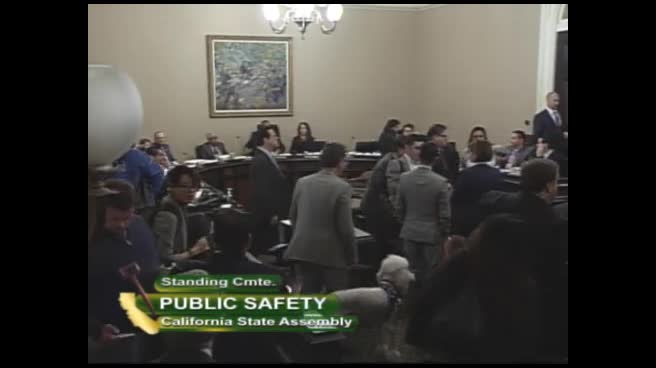
Assembly Standing Committee on Public Safety
Bill Author

Bill Co-Author(s):
