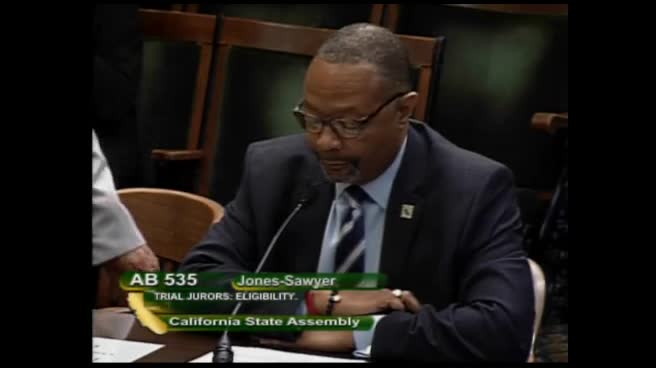
AB 535: Trial jurors: eligibility.
- Session Year: 2017-2018
- House: Assembly
- Latest Version Date: 2017-02-13
Existing law excludes from jury service a person who has been convicted of malfeasance in office. Existing law also excludes from jury service a felon whose civil rights have not been restored.
This bill would instead exclude a felon who has not completed probation, parole, post-release community supervision, or mandatory supervision. This bill would also categorically exclude a person who has been convicted of bribery, perjury, forgery, or other high crimes.
(a)All persons are eligible and qualified to be prospective trial jurors, except the following:
(1)Persons who are not citizens of the United States.
(2)Persons who are less than 18 years of age.
(3)Persons who are not domiciliaries of the State of California, as determined pursuant to Article 2 (commencing with Section 2020) of Chapter 1 of Division 2 of the Elections Code.
(4)Persons who are not residents of the jurisdiction wherein they are summoned to serve.
(5)Persons who have been convicted of bribery, perjury, forgery, malfeasance in office office, or a felony, and whose civil rights have not been restored. other high crimes.
(6)Persons who have not completed probation, parole, post-release community supervision, or mandatory supervision for the conviction of a felony.
(6)(7)Persons who are not possessed of sufficient knowledge of the English language, provided that no person shall be deemed incompetent solely because of the loss of sight or hearing in any degree or other disability which impedes the persons ability to communicate or which impairs or interferes with the persons mobility.
(7)(8)Persons who are serving as grand or trial jurors in any court of this state.
(8)(9)Persons who are the subject of conservatorship.
(b) No A person shall not be excluded from eligibility for jury service in the State of California, for any reason other than those reasons provided by this section.
|
Date
|
Status
|
|---|---|
| Feb 1, 2018 | Died on third reading file. |
| Jan 23, 2018 | From inactive file. |
| Jan 22, 2018 | Notice of intention to remove from inactive file given by Assembly Member Jones-Sawyer. |
| Jun 1, 2017 | Ordered to inactive file at the request of Assembly Member Jones-Sawyer. |
| Mar 22, 2017 | Read second time. Ordered to third reading. |
| Mar 21, 2017 | From committee: Do pass. (Ayes 8. Noes 3.) (March 21). |
| Feb 27, 2017 | Referred to Com. on JUD. |
| Feb 14, 2017 | From printer. May be heard in committee March 16. |
| Feb 13, 2017 | Read first time. To print. |
|
Date
|
Description
|
Location
|
Votes
|
|
|---|---|---|---|---|
| Mar 21, 2017 | Do pass. | Assembly Standing Committee on Judiciary |
Passed |
This list shows positions taken on this bill by organizations on the date displayed, which is linked to the original source.
Positions by individuals are not included.
|
Organization
|
Position
|
Date
|
|---|---|---|
| A New Way of Life Re-Entry Project | * Support | Mar 21, 2017 |
| All of Us or None | * Support | Mar 21, 2017 |
| American Civil Liberties Union of California | ** Support | Mar 17, 2017 |
| American Friends Service Committee | ** Support | Mar 17, 2017 |
| California District Attorneys Association | ** Against | Mar 17, 2017 |
| California Police Chiefs Association | ** Against | Mar 17, 2017 |
| Drug Policy Alliance | ** Support | Mar 17, 2017 |
| Fair Chance Project | ** Support | Mar 17, 2017 |
| Friends Committee On Legislation Of California | ** Support | Mar 17, 2017 |
| Numerous individuals | ** Support | Mar 17, 2017 |
| Reentry Solutions Group | ** Support | Mar 17, 2017 |
| Root & Rebound | ** Support | Mar 17, 2017 |
| VISUAL SCREENING | * Support | Mar 21, 2017 |
ASSEMBLY THIRD READING
ATR Bill Id:
Author:(Jones-Sawyer)
As Introduced Ver:February 13, 2017
Majority vote
Committee | Votes | Ayes | Noes |
Judiciary | 8-3 | Mark Stone, Chau, Chiu, Cristina Garcia, Holden, Kalra, Reyes, Ting | Cunningham, Kiley, Maienschein |
SUMMARY: Modifies the criteria for making a person ineligible to serve as a prospective juror. Specifically, this bill:
- Aligns Section 203 of the Code of Civil Procedure (CCP) with Article VII, Section 8 (b) of the California Constitution by specifying that certain types of felony offenses automatically disqualify a person from serving as a prospective juror: the crimes of perjury, forgery, malfeasance in office, or other high crimes.
- Excludes from eligibility to serve as prospective jurors all persons who have been convicted of felonies but have not completed probation, parole, post-release community supervision, or mandatory supervision for those convictions.
EXISTING LAW:
- Requires, pursuant to the California Constitution, laws to be made to exclude persons convicted of bribery, perjury, forgery, malfeasance in office, or other high crimes from office or serving on juries. (California Constitution, article VII, section 8, subdivision. (b).)
- Makes, pursuant to statute, all persons eligible and qualified to be prospective trial jurors, except the following, including, "Persons who have been convicted of malfeasance in office or a felony, and whose civil rights have not been restored." (CCP Section 203.)
- Provides that no person will be excluded from eligibility for jury service in the state, for any reason other than those provided in 2), above. (CCP Section 203.)
FISCAL EFFECT: None
COMMENTS: Article VII Section 8 (b) of the California Constitution requires laws "to be made to exclude persons convicted of bribery, perjury, forgery, malfeasance in office, or other high crimes from office or serving on juries." The California Legislature has responded to this constitutional requirement in what reasonably could be characterized as an over-inclusive manner. CCP Section 203 excludes from eligibility to serve on juries all persons "who have been convicted of . . . a felony, and whose civil rights have not been restored." A person's civil rights can only be fully restored when the person obtains not only a Certificate of Rehabilitation, but also a gubernatorial pardon. (See Penal Code Section 4853.) Such a process is not only lengthy and complicated, but also extremely rare. For example, as of December of 2016, Governor Brown has granted 854 pardons and commutations in his most recent terms as governor, a miniscule percentage of the number who have been released from prison, or discharged from probation or parole, during that same time period. (Cadelago, Gov. Jerry Brown pardons 112 ahead of Christmas holiday, Sacramento Bee, Dec. 23, 2016, http://www.sacbee.com/news/politics-government/capitol-alert/article122699224.html#storylink=cpy.) Brown's previous three predecessors issued a combined total of only 28 pardons during their administrations. (Ibid.)
This bill proposes to amend the current law governing eligibility for jury service—CCP Section 203—to align with the state constitution: excluding from jury services only those persons who have been convicted of the crimes of bribery, perjury, forgery, malfeasance in office, or other high crimes. In addition, the bill would exclude from eligibility to serve as prospective jurors all persons convicted of felonies but have not completed probation, parole, post-release community supervision, or mandatory supervision for those convictions.
The current practice of excluding felons from jury service in the United States. Thirty-one states, including California and the federal government, permanently exclude felons from serving as jurors (unless their civil rights have been restored). Maine is the only state in the nation that allows felons to participate in jury service without restriction. There is no evidence of negative consequences in either Maine, or the four states which allow jury service by former felons in some circumstances: Arizona (allowing first-time, but not repeat offenders to serve); Nevada (allowing nonviolent, but not violent offenders to serve); Colorado (allowing service on petit, but not grand juries); or Oregon (allowing service on civil, but not criminal cases). In fact, there is evidence to support positive impacts of allowing former felons to serve on juries. In Maine, for example, convicted felons generally held the jury and the jury process in high regard. Moreover, they viewed their eligibility as a measure of trust, placed in them by the state. In turn, they reported a desire to "live up to" that trust, suggesting that their eligibility enhanced their own views of themselves and the criminal justice system. Such evidence suggests that inclusion may serve to facilitate successful reentry.
Three common justifications for excluding former felons from jury service. One rationale for excluding former felons from jury service is that the character of a person who has committed a felony is forever compromised because of his or her involvement in criminal activity, showing the person's disrespect and disregard for the law. The problem with this theory is that it contradicts a primary purpose of the criminal justice system: to create an opportunity for correction and rehabilitation. Once a felon has served his or her time in confinement and completed the entirety of the sentencing requirements, including parole or probation and any conditions thereof, has not he or she paid penance for that prior societal wrong? Should the denial of one's civil rights last forever? Penal Code Section 4852.03 acknowledges that rehabilitation is possible and that both the passage of time and the nature of the crime are relevant to the question of whether a person is rehabilitated.
A second rationale for excluding ex-felons from jury service is the theory that a former felon, by the nature of his or her prior action, is inherently biased against the criminal justice system as a whole, including the government in general and law enforcement in particular. While this theory may have some emotional appeal, it lacks scientific support. In fact, one study compared the pretrial biases of convicted felons to those of non-felon jurors and non-felon jurors currently enrolled in law school and found that "…while convicted felons and law students are more likely to favor the defense than are the eligible jurors, the pretrial biases of convicted felons and law students do not differ statistically. Hence, it is as likely that a law student would harbor a pro-defense bias as strong as that of a convicted felon." (Binnall, supra, at p. 29.) Therefore, it would make just as much sense under the theory of inherent bias to disqualify law students from jury service as former felons because of their inherent bias.
A third common justification for excluding former felons from jury service is the belief that, by the nature of their prior actions, they lack the character and integrity required of a juror and do not have the ability to fairly consider evidence, follow the court's instructions, and recommend a verdict based only upon the evidence presented at trial. However, at least one study has refuted the validity of this theory, as well. The study, using a mock-jury design, compared homogenous juries (comprising only non-felon eligible jurors) to mixed juries (comprising non-felon eligible jurors and otherwise eligible jurors with felony convictions). The study found that there was "no negative impact" of a felony conviction on the deliberation process and that having former felons on juries may actually enhance deliberations.
Other ways to combat the potential bias of prospective jurors. Every prospective juror has some type of bias because of his or her individual life experience. Voir dire is a formal, pre-trial examination process that is used to determine the qualification and suitability of each potential juror to serve as a juror on a specific case. The process is intended to help the parties identify and exclude jurors from a case due to the facts and evidence involved in that case and the background and experience of that juror. The voir dire process allows the court to question prospective jurors and to allow the attorneys to use her skills to elicit, detect, and interpret verbal and non-verbal cues in order to gather information about that person's life, background, and experiences and make a judgment about whether a juror is biased or suitable to serve. The best jury is one that consists of persons who have a wealth of experiences and varying perspectives of the world. When a jury represents members who represent a wide spectrum of the community, there is a greater chance that the deliberations will be enhanced by their life experiences.
The racial impact of excluding felons from jury service. According to a report by the U.S. Bureau of Labor Statistics, 13 million people, including approximately 30% of black men, are banned for life from jury service because of felony convictions. According to a 2013 study by the Public Policy Institute of California (PPIC), African American men are dramatically more likely to be imprisoned than other minority groups. More than half of California's adult male population is nonwhite or Latino (56%), but these groups make up 75% of incarcerated men. Among adult men in 2010, African Americans were incarcerated at a rate of 5,525 per 100,000, compared to 1,146 for Latinos, 671 for non-Latino whites, and 43 for Asians. (Bureau of Justice Statistics, U.S. Department of Justice, Sourcebook of Criminal Justice Statistics 2001 tbl. 6.23 at p. 494 (2002).)
By allowing more former felons to participate in the jury process, this bill would allow more men of color to be included in the jury pool, creating a more representative sample of the state's diversity, and ultimately improving the fairness of juries.
Analysis Prepared by: Alison Merrilees / JUD. / (916) 319-2334 FN: 0000042
Date of Hearing: March 21, 2017
ASSEMBLY COMMITTEE ON JUDICIARY
Mark Stone, Chair
ABPCA Bill Id:AB 535 (
Author:Jones-Sawyer) – As Introduced Ver:February 13, 2017
SUBJECT: TRIAL JURORS: ELIGIBILITY
KEY ISSUE: SHOULD CURRENT LAW, WHICH PROHIBITS ALL PERSONS WHO HAVE BEEN CONVICTED OF FELONIES AND WHOSE CIVIL RIGHTS HAVE NOT BEEN RESTORED FROM SERVING AS JURORS AND HAS A DISPROPORTIONATELY NEGATIVE IMPACT ON BLACK AND LATINO MEN, BE MODIFIED TO ALIGN WITH THE CALIFORNIA CONSTITUTION SO THAT PERSONS WHO HAVE PAID THEIR DEBT TO SOCIETY CAN EXERCISE AN IMPORTANT CONSTITUTIONAL RIGHT?
SYNOPSIS
Current law bans any person who has been convicted of malfeasance in office or a felony, and whose civil rights have not been restored from jury service. The history of excluding former felons from eligibility to serve on juries and grand juries is almost as long as the history of juries themselves. In California, the practice of excluding persons with felony convictions from jury service dates back to the original drafting of the state constitution in 1849, which borrowed its language on the subject from the U.S. Constitution. Three theories are typically used to justify the exclusion: 1) the character of a person who has committed a felony is forever compromised because of his or her involvement in criminal activity, showing the person’s disrespect and disregard for the law; 2) that a former felon, by the nature of his or her prior action, is inherently biased against the criminal justice system as a whole, including the government in general and law enforcement in particular; and 3) that, by the nature of their prior actions, they lack the character and integrity required of a juror and do not have the ability to fairly consider evidence, follow the court’s instructions, and recommend a verdict based only upon the evidence presented at trial.
As far as the Committee knows, there is no empirical evidence to support any of these theories. Regarding 1), above, it contradicts a primary purpose of the criminal justice system: to create an opportunity for correction and rehabilitation and the rationale for the state law allowing a person convicted of a felony to apply to a superior court for a Certificate of Rehabilitation after a minimum of five years. Regarding 2), above, while this theory may have emotional appeal, it lacks scientific support. In fact, one study compared the pretrial biases of convicted felons to those of non-felon jurors and non-felon jurors currently enrolled in law school and found that “while convicted felons and law students are more likely to favor the defense than are the eligible jurors, the pretrial biases of convicted felons and law students do not differ statistically. Regarding 3), above, at least one study has refuted the validity of this theory, as well. The study found that there was “no negative impact” of a felony conviction on the deliberation process and that having former felons on juries may actually enhance deliberations. Furthermore, the current practice of excluding former felons from jury service has a disproportionately negative impact on minority communities, especially—as a result of their disproportionate rate of involvement with the criminal justice system—black men, 30% of whom are banned for life from jury service as a result felony convictions.
This bill proposes to amend state law regarding jury service to align with the state constitution: excluding from jury services only those persons who have been convicted of the crimes of bribery, perjury, forgery, malfeasance in office, or other “high crimes.” In addition, the bill would exclude from eligibility to serve as prospective jurors all persons who have been convicted of felonies but have not completed probation, parole, post-release community supervision, or mandatory supervision for those convictions. AB 535 is co-sponsored by A New Way of Life and Legal Services for Prisoners with Children. It is supported by civil rights and prisoner advocacy organizations, including the American Civil Liberties Union of California; American Friends Service Committee; Drug Policy Alliance; Reentry Solutions Group; and Root & Rebound, because they express that allowing formerly incarcerated individuals to serve on juries would contribute to their rehabilitation, among other reasons. The California District Attorneys Association and California Police Chiefs Association oppose the bill, alleging that it is inappropriate to allow former felons to serve on criminal juries because of their inherent bias and potentially serious criminal histories.
SUMMARY: Modifies the criteria for making a person ineligible to serve as a prospective juror. Specifically, this bill:
- Aligns Section 203 of the Code of Civil Procedure (CCP) with Article VII, Section 8 (b) of the California Constitution by specifying that certain types of felony offenses automatically disqualify a person from serving as a prospective juror: the crimes of perjury, forgery, malfeasance in office, or other high crimes.
- Excludes from eligibility to serve as prospective jurors all persons who have been convicted of felonies but have not completed probation, parole, post-release community supervision, or mandatory supervision for those convictions.
EXISTING LAW:
1) Requires, pursuant to the California Constitution, laws to be made to exclude persons convicted of bribery, perjury, forgery, malfeasance in office, or other high crimes from office or serving on juries. (Cal. Const., art. VII, sec. 8, subd. (b).)
2) Makes, pursuant to statute, all persons eligible and qualified to be prospective trial jurors, except the following:
a) Persons who are not citizens of the United States.
b) Persons who are less than 18 years old.
c) Persons who are not domiciled in California, as determined by Article 2 of Chapter 1 of Division 2 of the Elections Code.
d) Persons who are not residents of the jurisdiction where they have been summoned to serve.
e) Persons who have been convicted of malfeasance in office or a felony, and whose civil rights have not been restored.
f) Persons who do not possess sufficient knowledge of the English language.
g) Persons who are serving as grand or trial jurors in any court in the state.
h) Persons who are the subject of conservatorship. (Code of Civil Procedure (CCP) Section 203.)
3) Provides that no person will be excluded from eligibility for jury service in the state, for any reason other than those provided in 2), above. (CCP Section 203.)
4) Defines a felony as an offense punishable by death, imprisonment in state prison, or imprisonment in a county jail for 16 months, two years, or three years. (Penal Code Section 17.)
FISCAL EFFECT: As currently in print this bill is keyed non-fiscal.
COMMENTS: Article VII Section 8(b) of the California Constitution requires laws “to be made to exclude persons convicted of bribery, perjury, forgery, malfeasance in office, or other high crimes from office or serving on juries.” The California Legislature has responded to this constitutional requirement in what reasonably could be characterized as an over-inclusive manner. Section 203 excludes from eligibility to serve on juries all persons “who have been convicted of . . . a felony, and whose civil rights have not been restored.”
This bill proposes to amend the current law governing eligibility for jury service—CCP Section 203—to align with the state constitution: excluding from jury services only those persons who have been convicted of the crimes of bribery, perjury, forgery, malfeasance in office, or other “high crimes.” A “high crime” is the type of offense that “only appl[ies] to high persons, that is, to public officials, those who, because of their official status, are under special obligations that ordinary persons are not under, and which could not be meaningfully applied or justly punished if committed by ordinary persons.” (Jon Roland, Meaning of High Crimes and Misdemeanors, Constitutional Society (1999).) In addition, the bill would exclude from eligibility to serve as prospective jurors all persons convicted of felonies but have not completed probation, parole, post-release community supervision, or mandatory supervision for those convictions.
History of excluding former felons from jury service. The history of excluding former felons from eligibility to serve on juries and grand juries is almost as long as the history of juries themselves, apparently inspired by what Blackstone described as the idea of having a jury composed of “twelve good men and true” (which of course did not encompass women). (Kalt, Brian, The Exclusion of Felons from Jury Service: What Do We Know?, American University Law Review Vol. 53, Issue 1, Art. 2 (2003), p. 100, fn. 173.) For grand juries, felon exclusion dates back to the Assize of Clarendon in 1166 and, in more specific form, to a 1410 statute of Henry IV. (Ibid. at fn. 174.)
According to J. Abramsson in his book, We, The Jury: Jury Selection and the Cross-Sectional Ideal, courts at one time only empaneled “blue-ribbon juries.” The thought was that justice required service of citizens—all male and all white—who were all above the average level of “intelligence, morality, and integrity.” Rather than using a random selection process to select a jury pool, jury commissioners typically solicited the names of “men of recognized intelligence and probity” from notables or “key men” in the community. As recently as 1967, a majority of federal courts still relied on the so-called “key men” system for soliciting names of prospective jurors. It was not until 1968, when Congress enacted the Jury Selection and Service Act, that all federal courts were required to select jury pools from a “fair cross section of the community.”
In California, the practice of excluding persons with felony convictions from jury service dates back to the original drafting of the state constitution in 1849, which borrowed its language on the subject from the U.S. Constitution. From 1849 until 1974, both voting and jury service privileges were denied to persons who were convicted of felony offenses. In 1974, following the United States Supreme Court decision that found that the denial of the right to vote did not violate the Due Process Clause of the U.S. Constitution (Richardson v. Ramirez (1974) 418 U.S. 24), California voters approved Proposition 10, which amended the state constitution to restore voting rights to former felons. Proposition 10 did not include similar language to restore jury service rights to former felons, however. Therefore, Section 203 continues to limit the ability of persons with prior felony convictions to serve on juries, regardless of the specific offense and regardless of when and under what circumstances the conviction occurred, unless their civil rights have been restored.
The current practice of excluding felons from jury service in the United States. Thirty-one states, including California and the federal government, permanently exclude felons from serving as jurors (unless their civil rights have been restored). Maine is the only state in the nation that allows felons to participate in jury service without restriction. (Binnall, The Exclusion of Convicted Felons from Jury Service: What Do We Know?, Court Manager: Jury News, Vol. 3, Issue 1, p. 26.) Four states allow jury service by former felons in some circumstances, distinguishing first-time offenders from repeat offenders (Arizona), violent offenders from nonviolent offenders (Nevada), grand juries from petit juries (Colorado), and civil cases from criminal cases (Oregon). (Ibid.) In all remaining jurisdictions, felon jury-exclusion statutes are categorical, applying to all prospective jurors with prior felony convictions in all types of proceedings. (Ibid.) California allows all persons to serve on juries except any person who has been convicted of malfeasance in office or a felony, and whose civil rights have not been restored. (CCP Section 203 (a)(5).)
The author explains the reason for the bill as follows:
Jury service presents the opportunity for empowerment, the encouragement of civic duty, and commitment to governmental procedures. Excluding those who have had a previous felony conviction from this form of civic participation is inconsistent with the notion of fully restoring their dignity and rights, and most importantly, their rehabilitation toward becoming productive members of society. Ultimately, in order to have a jury that truly reflects the community’s population, it is imperative that formerly incarcerated persons who have served their debt to society are eligible to participate.
Three common justifications for excluding former felons from jury service. One rationale for excluding former felons from jury service is that the character of a person who has committed a felony is forever compromised because of his or her involvement in criminal activity, showing the person’s disrespect and disregard for the law. Therefore, according to this theory, the former felon should be denied some of the rights and privileges that are afforded to the general population, including the right to vote and to serve on a jury.
The problem with this theory is that it contradicts a primary purpose of the criminal justice system: to create an opportunity for correction and rehabilitation. Once a felon has served his or her time in confinement and completed the entirety of the sentencing requirements, including parole or probation and any conditions thereof, has not he or she paid penance for that prior societal wrong? Should the denial of one’s civil rights last forever? Penal Code Section 4852.03 acknowledges that rehabilitation is possible and that both the passage of time and the nature of the crime are relevant to the question of whether a person is rehabilitated. Section 4852.6 allows a person convicted of a felony to apply to a superior court for a Certificate of Rehabilitation after a minimum of five years, commencing “upon the discharge of the petitioner from custody due to his or her completion of the term to which he or she was sentenced or upon his or her release on parole, post-release community supervision, mandatory supervision, or probation, whichever is sooner” (with additional waiting periods for specific serious crimes).
A second rationale for excluding ex-felons from jury service is the theory that a former felon, by the nature of his or her prior action, is inherently biased against the criminal justice system as a whole, including the government in general and law enforcement in particular. While this theory may have some emotional appeal, it lacks scientific support. In fact, one study compared the pretrial biases of convicted felons to those of non-felon jurors and non-felon jurors currently enrolled in law school and found that “while convicted felons and law students are more likely to favor the defense than are the eligible jurors, the pretrial biases of convicted felons and law students do not differ statistically. Hence, it is as likely that a law student would harbor a pro-defense bias as strong as that of a convicted felon.” (Binnall, supra, at p. 29.) Therefore, it would make just as much sense under the theory of inherent bias to disqualify law students from jury service as former felons because of their inherent bias. Furthermore, to the extent that this theory has any logical—although unproven—appeal, it would only justify a barrier to service on a criminal jury and would have no relevance whatsoever to service as a juror in a civil matter.
A third common justification for excluding former felons from jury service is the belief that, by the nature of their prior actions, they lack the character and integrity required of a juror and do not have the ability to fairly consider evidence, follow the court’s instructions, and recommend a verdict based only upon the evidence presented at trial.
However, at least one study has refuted the validity of this theory, as well. The study, using a mock-jury design, compared homogenous juries (comprising only non-felon eligible jurors) to mixed juries (comprising non-felon eligible jurors and otherwise eligible jurors with felony convictions). The study found that there was “no negative impact” of a felony conviction on the deliberation process and that having former felons on juries may actually enhance deliberations.
Compared on several measures of deliberation quality, homogenous juries did not outperform mixed juries. Additionally, at the juror level, time spoken as a percentage of total deliberation time was higher for felon jurors. Felon jurors also raised more novel case facts than did their non-felon counterparts. Though this pilot study was hampered by the small size of its sample, its results, while not conclusive, do suggest that convicted felons would not taint the deliberation process in the manner the character rationale presumes. (Binnall, supra, at p. 29.)
Other ways to combat the potential bias of prospective jurors. Every prospective juror has some type of bias because of his or her individual life experience. A juror who has had a life-threatening experience with a hit and run driver probably would not be the best juror to sit on a jury for a case involving a hit and run accident. However, that same prospective juror might be perfect for a case involving a burglary, a white collar crime, or another type of crime. A person who had a bad experience with an employee of a local police department might have a bias against that employee or even that entire department, but that same person might be perfectly capable of being unbiased on a tax evasion case or a child endangerment matter. Bias depends on the past experiences of each individual, one reason why the jury selection process is so important to the entire court trial system.
Voir dire is a formal, pre-trial examination process that is used to determine the qualification and suitability of each potential juror to serve as a juror on a specific case. The process is intended to help the parties identify and exclude jurors from a case due to the facts and evidence involved in that case and the background and experience of that juror. The voir dire process allows the court to question prospective jurors and to allow the attorneys to use her skills to elicit, detect, and interpret verbal and non-verbal cues in order to gather information about that person’s life, background, and experiences and make a judgment about whether a juror is biased or suitable to serve. The best jury is one that consists of persons who have a wealth of experiences and varying perspectives of the world. When a jury represents members who represent a wide spectrum of the community, there is a greater chance that the deliberations will be enhanced by their life experiences.
The racial impact of excluding felons from jury service. According to a report by the U.S. Bureau of Labor Statistics, 13 million people, including approximately 30% of black men, are banned for life from jury service because of felony convictions. According to a 2013 study by the Public Policy Institute of California (PPIC), African American men are dramatically more likely to be imprisoned than other minority groups. More than half of California’s adult male population is nonwhite or Latino (56%), but these groups make up 75% of incarcerated men. Among adult men in 2010, African Americans were incarcerated at a rate of 5,525 per 100,000, compared to 1,146 for Latinos, 671 for non-Latino whites, and 43 for Asians. (Bureau of Justice Statistics, U.S. Department of Justice, Sourcebook of Criminal Justice Statistics 2001 tbl. 6.23 at p. 494 (2002).)
Existing law makes a person who is convicted of a felony, but whose civil rights have been restored, eligible to serve on a jury. (See CCP Section 203 (a)(5).) As briefly described above, a person can apply for and obtain a Certificate of Rehabilitation from a court and then apply for and obtain a gubernatorial pardon. As a result, all of her civil rights, including the right to serve on a jury, would be restored. (See Penal Code Section 4853.) But such a process is not only lengthy and complicated, but also extremely rare. For example, as of December of 2016, Governor Brown has granted 854 pardons and commutations in his most recent terms as governor, a miniscule percentage of the number who have been released from prison, or discharged from probation or parole, during that same time period. (Cadelago, Gov. Jerry Brown pardons 112 ahead of Christmas holiday, Sacramento Bee, Dec. 23, 2016, http://www.sacbee.com/news/politics-government/capitol-alert/article122699224.html#storylink=cpy.) Brown’s previous three predecessors issued a combined total of only 28 pardons during their administrations. (Ibid.)
Under this bill, on the other hand, the rare (and lucky) person who obtained a Certificate of Rehabilitation and a pardon would still be eligible for jury service. But a far larger segment of the population of former felons in our state would also be eligible to serve. In lieu of requiring restoration of rights, this bill proposes to align CCP Section 203 with the state constitution, exempting only those felons who have been convicted of certain offenses (the crimes of bribery, perjury, forgery, malfeasance in office, or other high crimes) and those who have not yet completed probation, parole, post-release community supervision, or mandatory supervision, which is far more fair and even-handed. It is also far more accessible to minority and disadvantaged communities given that the current process is virtually impossible without legal representation and the people who need representation likely do not have the resources to pay for it. Furthermore, after her criminal case and appeal rights are concluded, a former felon no longer has a 6th Amendment right to an attorney who is appointed to represent her at no expense.
Benefits of restoring the right of jury service to former felons. As mentioned above, only one state (Maine) allows felons to serve on jurors without condition, while four other states allow jury service by former felons in some circumstances. There is no evidence of negative consequences in either Maine, the only jurisdiction that places no restriction on convicted felons’ opportunity to serve on juries, or the four states which allow jury service by former felons in some circumstances: Arizona (allowing first-time, but not repeat offenders to serve); Nevada (allowing nonviolent, but not violent offenders to serve); Colorado (allowing service on petit, but not grand juries); or Oregon (allowing service on civil, but not criminal cases). In fact, there is evidence to support positive impacts of allowing former felons to serve on juries. In Maine, for example, convicted felons generally held the jury and the jury process in high regard. Moreover, they viewed their eligibility as a measure of trust, placed in them by the state. In turn, they reported a desire to “live up to” that trust, suggesting that their eligibility enhanced their own views of themselves and the criminal justice system. Such evidence suggests that inclusion may serve to facilitate successful reentry. (Binnell, supra, p. 29.)
By allowing more former felons to participate in the jury process, this bill would allow more men of color to be included in the jury pool, creating a more representative sample of the state’s diversity, and ultimately improving the fairness of juries.
ARGUMENTS IN SUPPORT: Numerous supporting organizations express that allowing formerly incarcerated individuals to serve on juries would contribute to their rehabilitation. For example, the American Friends Service Committee writes that “if we are serious about having people reintegrate into society in a positive way we must do all we can to encourage participate in decision making.” They also express that the prohibition on former felons serving on juries is discriminatory. According to the Drug Policy Alliance the exclusion not only perpetuates “harmful generalizations about the characteristics of “felons” and the place of people with felony convictions in society,” but also “disenfranchises significant number of black and Latino men and women.”
ARGUMENTS IN OPPOSITION: The California Police Chiefs Association writes that they “find it entirely inappropriate for individuals who have previously disregarded the law in committing felonies, including serious or violent felonies, to determine the guilt or innocence of a peer” especially in light of “recent sentencing reform initiatives [that] have allowed for individuals with a number of felony convictions, including felony narcotic and theft convictions, to petition the court to have their sentence lowered to a misdemeanor, leaving the cohort of crimes classified as felonies to be particularly egregious.” The California District Attorneys Association (CDAA) similarly expresses the bias rationale for excluding former felons from jury service, writing that, “We believe that the exclusion of felons from jury service protects the integrity of the process, particularly in criminal trials. It is not hard to imagine someone who has been convicted of a felony, harboring some amount of bias against the State.” Furthermore, CDAA expresses concern about the impact of the bill on judicial resources:
With the court controlling much of the time and nature of the voir dire process, attorneys have relatively little time to conduct individualized determinations of partiality. We believe that making felons eligible for jury service would have a negative fiscal impact on the courts, as more time would be spent trying to determine inherent bias, and would jeopardize the impartiality of criminal juries.
Although this aspect of the bill’s impact on the voir dire process is unclear, the bill would likely mean that prosecutors would choose to exercise their preemptory challenges on removing former felons from jury panels in criminal cases. It is noteworthy that both of these two opponents focus on criminal cases and neither express the opinion that former felons are inherently incapable of serving on juries in all cases, including civil cases.
PRIOR SIMILAR LEGISLATION: AB 324 (Jones-Sawyer, 2015-16) in its final form was identical to this bill. The bill was referred to this Committee, but died without being heard by the Committee.
AB 1401 (Committee on Judiciary) 2013, which was vetoed by the governor, would have allowed lawful permanent immigrants or citizens of the United States to serve on juries. Governor Brown cited in his veto message that jury duty, like voting is “quintessentially a prerogative and responsibility of citizenship. This bill would permit lawful permanent residents who are not citizens to serve on a jury, I don’t think that’s right.” None of the concerns about AB 1401 are applicable to this bill.
REGISTERED SUPPORT / OPPOSITION:
Support
A New Way of Life (co-sponsor)
Legal Services for Prisoners with Children (co-sponsor)
American Civil Liberties Union of California
American Friends Service Committee
Drug Policy Alliance
Fair Chance Project
Friends Committee on Legislation of California
Reentry Solutions Group
Root & Rebound
Numerous individuals
Opposition
California District Attorneys Association
California Police Chiefs Association
Analysis Prepared by: Alison Merrilees / JUD. / (916) 319-2334
Discussed in Hearing
 25MIN
Assembly Standing Committee on Judiciary
Bill Author

Bill Co-Author(s):