AB 917: Student health: student suicide prevention policies.
- Session Year: 2017-2018
- House: Assembly
- Latest Version Date: 2017-05-04
Existing law requires the governing board or body of a local educational agency that serves pupils in grades 7 to 12, inclusive, to, before the beginning of the 201718 school year, adopt a policy on pupil suicide prevention, as specified, that specifically addresses the needs of high-risk groups. Existing law establishes the University of California, under the administration of the Regents of the University of California, the California State University, under the administration of the Trustees of the California State University, and the California Community Colleges, under the administration of the Board of Governors of the California Community Colleges, as the 3 segments of public postsecondary education in this state.
This bill would require the Board of Governors of the California Community Colleges and the Trustees of the California State University, and encourage the Regents of the University of California, before the beginning of the 201819 school year, by January 1, 2019, to adopt, at a regularly scheduled meeting, a policy on student suicide prevention, as specified, that specifically addresses the needs of high-risk student groups. By imposing additional duties on community college districts, the bill would impose a state-mandated local program.
The California Constitution requires the state to reimburse local agencies and school districts for certain costs mandated by the state. Statutory provisions establish procedures for making that reimbursement.
This bill would provide that, if the Commission on State Mandates determines that the bill contains costs mandated by the state, reimbursement for those costs shall be made pursuant to the statutory provisions noted above.
Existing law requires the governing board or body of a local educational agency that serves pupils in grades 7 to 12, inclusive, to, before the beginning of the 201718 school year, adopt a policy on pupil suicide prevention, as specified, that specifically addresses the needs of high-risk groups. Existing law establishes the University of California, under the administration of the Regents of the University of California, the California State University, under the administration of the Trustees of the California State University, and the California Community Colleges, under the administration of the Board of Governors of the California Community Colleges, as the 3 segments of public postsecondary education in this state.
This bill would require the Board of Governors of the California Community Colleges and the Trustees of the California State University, and encourage the Regents of the University of California, before the beginning of the 201819 school year, to adopt, at a regularly scheduled meeting, a policy on student suicide prevention, as specified, that specifically addresses the needs of high-risk student groups. By imposing additional duties on community college districts, the bill would impose a state-mandated local program. The bill would require the State Department of Education to develop and maintain a model policy on student suicide prevention to serve as a guide for the Board of Governors of the California Community Colleges, the Trustees of the California State University, and the Regents of the University of California.
The California Constitution requires the state to reimburse local agencies and school districts for certain costs mandated by the state. Statutory provisions establish procedures for making that reimbursement.
This bill would provide that, if the Commission on State Mandates determines that the bill contains costs mandated by the state, reimbursement for those costs shall be made pursuant to the statutory provisions noted above.
Existing law requires the governing board or body of a local educational agency that serves pupils in grades 7 to 12, inclusive, to, before the beginning of the 201718 school year, adopt a policy on pupil suicide prevention, as specified, that specifically addresses the needs of high-risk groups. Existing law establishes the University of California, under the administration of the Regents of the University of California, the California State University, under the administration of the Trustees of the California State University, and the California Community Colleges, under the administration of the Board of Governors of the California Community Colleges, as the 3 segments of public postsecondary education in this state.
This bill would make nonsubstantive changes to that provision. require the Board of Governors of the California Community Colleges and the Trustees of the California State University, and encourage the Regents of the University of California, before the beginning of the 201819 school year, to adopt, at a regularly scheduled meeting, a policy on student suicide prevention, as specified, that specifically addresses the needs of high-risk student groups. By imposing additional duties on community college districts, the bill would impose a state-mandated local program. The bill would require the State Department of Education to develop and maintain a model policy on student suicide prevention to serve as a guide for the Board of Governors of the California Community Colleges, the Trustees of the California State University, and the Regents of the University of California.
The California Constitution requires the state to reimburse local agencies and school districts for certain costs mandated by the state. Statutory provisions establish procedures for making that reimbursement.
This bill would provide that, if the Commission on State Mandates determines that the bill contains costs mandated by the state, reimbursement for those costs shall be made pursuant to the statutory provisions noted above.
Existing law requires the governing board or body of a local educational agency that serves pupils in grades 7 to 12, inclusive, to, before the beginning of the 201718 school year, adopt a policy on pupil suicide prevention, as specified, that specifically addresses the needs of high-risk groups.
This bill would make nonsubstantive changes to that provision.
The Legislature finds and declares all of the following:
(a)College students are experiencing increased rates of mental health issues and demand for treatment services. According to the 2012 National Survey of Counseling Center Directors, suicide is the second leading cause of death among college students, at a rate of seven deaths by suicide per 100,000 students. This results in nearly 200 public college student deaths annually in California alone.
(b)According to the Center for Collegiate Mental Health Annual Report, 31 percent of undergraduate college students have seriously considered suicide and 10 percent of undergraduate college students have attempted suicide.
(c)The average lifetime cost of death by suicide for persons 20 to 24 years of age, inclusive, for work loss and medical costs is more than $1.89 million per make change person, according to the federal Centers for Disease Control and Prevention.
(d)A conservative estimate for the total cost to the state from public college student deaths by suicide is $350 million each year.
SEC. 2.Article 2.5 (commencing with Section 66265) is added to Chapter 4.5 of Part 40 of Division 5 of Title 3 of the Education Code, to read:2.5.Student Suicide Prevention Policies66265.(a)The Board of Governors of the California Community Colleges and the Trustees of the California State University shall, and the Regents of the University of California are encouraged to, before the beginning of the 201819 school year, by January 1, 2019, adopt, at a regularly scheduled meeting, a policy on student suicide prevention. The policy shall be developed in consultation with school and community stakeholders, school-employed mental health professionals, and suicide prevention experts and shall, at a minimum, address procedures relating to suicide prevention, intervention, and postvention.
(b)The policy shall specifically address the needs of high-risk groups, including, but not limited to, all of the following:
(1)Students bereaved by suicide.
(2)Students with disabilities, mental illness, or substance use disorders.
(3)Students experiencing homelessness or in out-of-home settings.
(4)Lesbian, gay, bisexual, transgender, or questioning students.
(5)Students with an Adverse Childhood Experiences (ACEs) score of 4 or higher.
(6)Bullied students.
(7)Unique needs of a student population.
(c)(1)The policy shall also address any training to be provided to employees on suicide awareness and prevention.
(2)Materials approved by the Board of Governors of the California Community Colleges, the Trustees of the California State University, or the Regents of the University of California for training shall include how to identify appropriate mental health services and suicide prevention programs, both at the campus and within the larger community, and when and how to refer students to those services and programs.
(3)Materials approved for training may also include programs that can be completed through self-review of suitable suicide prevention materials.
(d)The policy shall be written to ensure that an employee acts only within the authorization and scope of the employees employment terms or license. Nothing in this section shall be construed as authorizing or encouraging an employee to diagnose or treat mental illness unless the employee is specifically licensed and employed to diagnose or treat mental illness.
SEC. 3.If the Commission on State Mandates determines that this act contains costs mandated by the state, reimbursement to local agencies and school districts for those costs shall be made pursuant to Part 7 (commencing with Section 17500) of Division 4 of Title 2 of the Government Code.
The Legislature finds and declares all of the following:
(a)College students are experiencing increased rates of mental health issues and demand for treatment services. According to the 2012 National Survey of Counseling Center Directors, suicide is the second leading cause of death among college students, at a rate of seven deaths by suicide per 100,000 students. This results in nearly 200 public college student deaths annually in California alone.
(b)According to the Center for Collegiate Mental Health Annual Report, 31 percent of undergraduate college students have seriously considered suicide and 10 percent of undergraduate college students have attempted suicide.
(c)The average lifetime cost of death by suicide for persons 20 to 24 years of age, inclusive, for work loss and medical costs is more than $1.89 million per make change person, according to the federal Centers for Disease Control and Prevention.
(d)A conservative estimate for the total cost to the state from public college student deaths by suicide is $350 million each year.
SEC. 2.Article 2.5 (commencing with Section 66265) is added to Chapter 4.5 of Part 40 of Division 5 of Title 3 of the Education Code, to read:2.5.Student Suicide Prevention Policies66265.(a)The Board of Governors of the California Community Colleges and the Trustees of the California State University shall, and the Regents of the University of California are encouraged to, before the beginning of the 201819 school year, adopt, at a regularly scheduled meeting, a policy on student suicide prevention. The policy shall be developed in consultation with school and community stakeholders, school-employed mental health professionals, and suicide prevention experts and shall, at a minimum, address procedures relating to suicide prevention, intervention, and postvention.
(b)The policy shall specifically address the needs of high-risk groups, including, but not limited to, all of the following:
(1)Students bereaved by suicide.
(2)Students with disabilities, mental illness, or substance use disorders.
(3)Students experiencing homelessness or in out-of-home settings.
(4)Lesbian, gay, bisexual, transgender, or questioning students.
(5)Students with an Adverse Childhood Experiences (ACEs) score of 4 or higher.
(6)Bullied students.
(7)Unique needs of a student population.
(c)(1)The policy shall also address any training to be provided to employees on suicide awareness and prevention.
(2)Materials approved by the Board of Governors of the California Community Colleges, the Trustees of the California State University, or the Regents of the University of California for training shall include how to identify appropriate mental health services and suicide prevention programs, both at the campus and within the larger community, and when and how to refer students to those services and programs.
(3)Materials approved for training may also include programs that can be completed through self-review of suitable suicide prevention materials.
(d)The policy shall be written to ensure that an employee acts only within the authorization and scope of the employees employment terms or license. Nothing in this section shall be construed as authorizing or encouraging an employee to diagnose or treat mental illness unless the employee is specifically licensed and employed to diagnose or treat mental illness.
(e)To assist in developing policies for student suicide prevention, the State Department of Education shall develop and maintain a model policy in accordance with this section to serve as a guide for the Board of Governors of the California Community Colleges, the Trustees of the California State University, and the Regents of the University of California.SEC. 3.If the Commission on State Mandates determines that this act contains costs mandated by the state, reimbursement to local agencies and school districts for those costs shall be made pursuant to Part 7 (commencing with Section 17500) of Division 4 of Title 2 of the Government Code.
The Legislature finds and declares all of the following:
(a)College students are experiencing increased rates of mental health issues and demand for treatment services. According to the 2012 National Survey of Counseling Center Directors, suicide is the second leading cause of death among college students, at a rate of seven deaths by suicide per 100,000 students. This results in nearly 200 public college student deaths annually in California alone.
(b)According to the Center for Collegiate Mental Health Annual Report, 31 percent of undergraduate college students have seriously considered suicide and 10 percent of undergraduate college students have attempted suicide.
(c)The average lifetime cost of death by suicide for persons 20 to 24 years of age, inclusive, for work loss and medical costs is more than $1.89 million per make change person, according to the federal Centers for Disease Control and Prevention.
(d)A conservative estimate for the total cost to the state from public college student deaths by suicide is $350 million each year.
SEC. 2.Article 2.5 (commencing with Section 66265) is added to Chapter 4.5 of Part 40 of Division 5 of Title 3 of the Education Code, to read:2.5.Student Suicide Prevention Policies66265.(a)The Board of Governors of the California Community Colleges and the Trustees of the California State University shall, and the Regents of the University of California are encouraged to, before the beginning of the 201819 school year, adopt, at a regularly scheduled meeting, a policy on student suicide prevention. The policy shall be developed in consultation with school and community stakeholders, school-employed mental health professionals, and suicide prevention experts and shall, at a minimum, address procedures relating to suicide prevention, intervention, and postvention.
(b)The policy shall specifically address the needs of high-risk groups, including, but not limited to, all of the following:
(1)Students bereaved by suicide.
(2)Students with disabilities, mental illness, or substance use disorders.
(3)Students experiencing homelessness or in out-of-home settings.
(4)Lesbian, gay, bisexual, transgender, or questioning students.
(5)Students with an Adverse Childhood Experiences (ACEs) score of 4 or higher.
(6)Bullied students.
(c)(1)The policy shall also address any training to be provided to employees on suicide awareness and prevention.
(2)Materials approved by the Board of Governors of the California Community Colleges, the Trustees of the California State University, or the Regents of the University of California for training shall include how to identify appropriate mental health services and suicide prevention programs, both at the campus and within the larger community, and when and how to refer students to those services and programs.
(3)Materials approved for training may also include programs that can be completed through self-review of suitable suicide prevention materials.
(d)The policy shall be written to ensure that an employee acts only within the authorization and scope of the employees employment terms or license. Nothing in this section shall be construed as authorizing or encouraging an employee to diagnose or treat mental illness unless the employee is specifically licensed and employed to diagnose or treat mental illness.
(e)To assist in developing policies for student suicide prevention, the State Department of Education shall develop and maintain a model policy in accordance with this section to serve as a guide for the Board of Governors of the California Community Colleges, the Trustees of the California State University, and the Regents of the University of California.
SEC. 3.If the Commission on State Mandates determines that this act contains costs mandated by the state, reimbursement to local agencies and school districts for those costs shall be made pursuant to Part 7 (commencing with Section 17500) of Division 4 of Title 2 of the Government Code.
SECTION 1.Section 215 of the Education Code is amended to read:215.(a)(1)The governing board or body of a local educational agency that serves pupils in grades 7 to 12, inclusive, shall, before the beginning of the 201718 school year, adopt, at a regularly scheduled meeting, a policy on pupil suicide prevention in grades 7 to 12, inclusive. The policy shall be developed in consultation with school and community stakeholders, school-employed mental health professionals, and suicide prevention experts and shall, at a minimum, address procedures relating to suicide prevention, intervention, and postvention.(2)The policy shall specifically address the needs of high-risk groups, including, but not limited to, all of the following:(A)Youth bereaved by suicide.(B)Youth with disabilities, mental illness, or substance use disorders.(C)Youth experiencing homelessness or in out-of-home settings, such as foster care.(D)Lesbian, gay, bisexual, transgender, or questioning youth.(3)(A)The policy shall also address any training to be provided to teachers of pupils in grades 7 to 12, inclusive, on suicide awareness and prevention.(B)Materials approved by a local educational agency for training shall include how to identify appropriate mental health services, both at the schoolsite and within the larger community, and when and how to refer youth and their families to those mental health services.(C)Materials approved for training may also include programs that can be completed through self-review of suitable suicide prevention materials.(4)The policy shall be written to ensure that a school employee acts only within the authorization and scope of the employees credential or license. Nothing in this section shall be construed as authorizing or encouraging a school employee to diagnose or treat mental illness unless the employee is specifically licensed and employed to diagnose or treat mental illness.(5)To assist local educational agencies in developing policies for pupil suicide prevention, the department shall develop and maintain a model policy in accordance with this section to serve as a guide for local educational agencies.(b)For purposes of this section, local educational agency means a county office of education, school district, state special school, or charter school.(a)(1)The governing board or body of a local educational agency that serves pupils in grades 7 to 12, inclusive, shall, before the beginning of the 201718 school year, adopt, at a regularly scheduled meeting, a policy on pupil suicide prevention in grades 7 to 12, inclusive. The policy shall be developed in consultation with school and community stakeholders, school-employed mental health professionals, and suicide prevention experts and shall, at a minimum, address procedures relating to suicide prevention, intervention, and postvention.
(2)The policy shall specifically address the needs of high-risk groups, including, but not limited to, all of the following:
(A)Youth bereaved by suicide.
(B)Youth with disabilities, mental illness, or substance use disorders.
(C)Youth experiencing homelessness or in out-of-home settings, such as foster care.
(D)Lesbian, gay, bisexual, transgender, or questioning youth.
(3)(A)The policy shall also address any training to be provided to teachers of pupils in grades 7 to 12, inclusive, on suicide awareness and prevention.
(B)Materials approved by a local educational agency for training shall include how to identify appropriate mental health services, both at the schoolsite and within the larger community, and when and how to refer youth and their families to those mental health services.
(C)Materials approved for training may also include programs that can be completed through self-review of suitable suicide prevention materials.
(4)The policy shall be written to ensure that a school employee acts only within the authorization and scope of the employees credential or license. Nothing in this section shall be construed as authorizing or encouraging a school employee to diagnose or treat mental illness unless the employee is specifically licensed and employed to do so. diagnose or treat mental illness.
(5)To assist local educational agencies in developing policies for pupil suicide prevention, the department shall develop and maintain a model policy in accordance with this section to serve as a guide for local educational agencies.
(b)For purposes of this section, local educational agency means a county office of education, school district, state special school, or charter school.
|
Date
|
Status
|
|---|---|
| Feb 1, 2018 | From committee: Filed with the Chief Clerk pursuant to Joint Rule 56. |
| Jan 31, 2018 | Died pursuant to Art. IV, Sec. 10(c) of the Constitution. |
| May 26, 2017 | In committee: Held under submission. |
| May 10, 2017 | In committee: Set, first hearing. Referred to APPR. suspense file. |
| May 8, 2017 | Re-referred to Com. on APPR. |
| May 4, 2017 | From committee chair, with author's amendments: Amend, and re-refer to Com. on APPR. Read second time and amended. |
| Apr 26, 2017 | From committee: Do pass and re-refer to Com. on APPR. with recommendation: To Consent Calendar. (Ayes 15. Noes 0.) (April 25). Re-referred to Com. on APPR. |
| Apr 19, 2017 | From committee chair, with author's amendments: Amend, and re-refer to Com. on HEALTH. Read second time and amended. |
| Apr 20, 2017 | Re-referred to Com. on HEALTH. |
| Apr 19, 2017 | From committee: Do pass and re-refer to Com. on HEALTH. (Ayes 13. Noes 0.) (April 18). Re-referred to Com. on HEALTH. |
| Mar 22, 2017 | Re-referred to Com. on HIGHER ED. |
| Mar 21, 2017 | From committee chair, with author's amendments: Amend, and re-refer to Com. on HIGHER ED. Read second time and amended. |
| Mar 20, 2017 | Referred to Coms. on HIGHER ED. and HEALTH. |
| Feb 17, 2017 | From printer. May be heard in committee March 19. |
| Feb 16, 2017 | Read first time. To print. |
|
Date
|
Description
|
Location
|
Votes
|
|
|---|---|---|---|---|
| Apr 25, 2017 | Do pass and be re-referred to the Committee on [Appropriations] with recommendation: To Consent Calendar | Assembly Standing Committee on Health |
Passed |
|
| Apr 18, 2017 | Do pass and be re-referred to the Committee on [Health] | Assembly Standing Committee on Higher Education |
Passed |
This list shows positions taken on this bill by organizations on the date displayed, which is linked to the original source.
Positions by individuals are not included.
|
Organization
|
Position
|
Date
|
|---|---|---|
| National Association Of Social Workers, California Chapter | ** Support | Apr 21, 2017 |
| The Steinberg Institute | ** Support | Apr 21, 2017 |
Date of Hearing: May 10, 2017
ASSEMBLY COMMITTEE ON APPROPRIATIONS
Lorena Gonzalez Fletcher, Chair
ABPCA Bill Id:AB 917
Author:(Arambula) – As Amended Ver:May 4, 2017
Policy Committee: | Higher Education | Vote: | 13 - 0 |
Health | 15 - 0 | ||
|
|
Urgency: No State Mandated Local Program: Yes Reimbursable: Yes
SUMMARY:
This bill requires the California Community Colleges (CCC) Board of Governors (BOG) and the Trustees of the California State University (CSU), and encourages the Regents of the University of California (UC), to adopt policies on student suicide prevention. Specifically, this bill:
- Requires the CCC BOG and the CSU Trustees and encourages the UC Regents to develop policies in consultation with school and community stakeholders, school- employed mental health professionals, and suicide prevention experts to, at a minimum, address procedures relating to suicide prevention, intervention, and postvention.
- Requires the policy to address employee training to be provided on suicide awareness and prevention and materials to include how to identify appropriate mental health services and suicide prevention programs, both at the campus and within the larger community, and when and how to refer students. Authorizes approved training materials to include programs that can be completed through self-review.
- Requires the policy to be written to ensure that an employee acts only within the authorization and scope of their employment terms or license, and that nothing be construed as authorizing or encouraging an employee to diagnose or treat mental.
FISCAL EFFECT:
- Approximately $10,000 to create a policy on student suicide prevention. This workload would include convening a workgroup of school and community stakeholders, school-employed mental health professionals, and suicide prevention experts. However, the 113 CCC campuses would require resources to implement the policy. The CCC Chancellor’s Office estimates costs pressures of approximately $25 million in costs associated with providing suicide prevention and training programs. These costs could be considered reimbursable state mandates.
- Minor and absorbable cost to the CSU.
- Approximately, $115,000 in costs to the UC for a full-time analyst. Additional costs may be incurred by each of the individual campuses.
COMMENTS:
- Purpose. According to the author, suicide is the second leading cause of death among college students. In California alone, there are approximately 200 deaths among college students. Additionally, several states have enacted laws to establish suicide prevention policies in their college systems. The author contends that many college campuses offer various types and levels of mental health services, but that the, "high death toll shows that there is still a lack in this field due to the variations and inconsistences in the suicide prevention efforts statewide." The author argues that, "Creating a statewide model suicide prevention policy for institutes of higher education will create an effective, streamlined policy that can help us better serve college students across California in an equitable manner."
- Background. Existing law establishes the Mental Health Services Act (MHSA), enacted by voters in November 2004, as Proposition 63, to provide funds to counties to expand services, develop innovative programs, and integrate service plans for mentally ill children, adults, and seniors through a 1% income tax on personal income above $1 million. In October 2011, as part of Phase I of the Student Mental Health Initiative (SMHI), the CCC Chancellor’s Office (Chancellor) was awarded $7 million to establish the CCC Student Mental Health Program (SMHP). The CCC SMHP is a partnership between the Chancellor and the Foundation for Community Colleges. The goals of the CCC SMHP are to develop and implement prevention and early intervention strategies which address the mental health needs of students, and advance collaboration between educational settings, county services, and the community at large. In June of 2015, CCC SMHP was awarded $1.4 million ($700,000 per year) to support the CCC SMHP Phase II. Program implementation began on October 1, 2015 and will conclude on June 30, 2017.
- Related Legislation. AB 931 (McCarty) adds community college, four-year college, and university undergraduate and graduate students to the targeted populations served by the California Suicide Prevention Act of 2000, administered by DHCS to establish and implement a suicide prevention, education, and gatekeeper program to reduce the severity, duration, and incidence of suicidal behaviors for junior and high school students. AB 931 is pending in the Assembly Health Committee.
AB 2246 (O'Donnell), Chapter 642, Statues of 2016, requires local educational agencies that serve pupils in grades 7 to 12 to adopt policies on the prevention of student suicides and also required the CDE to develop and maintain a model suicide prevention policy.
Analysis Prepared by: Daisy Gonzales / APPR. / (916) 319-2081
Date of Hearing: April 25, 2017
ASSEMBLY COMMITTEE ON HEALTH
Jim Wood, Chair
ABPCA Bill Id:AB 917
Author:(Arambula) – As Amended Ver:April 19, 2017
SUBJECT: Student health: student suicide prevention policies.
SUMMARY: Requires the Board of Governors of the California Community Colleges (CCC) and the Trustees of the California State University (CSU), and encourages the Regents of the University of California (UC), to adopt policies on student suicide prevention. Specifically, this bill:
- Requires the CCC Board of Governors and the CSU Trustees and encourages the UC Regents to develop policies in consultation with school and community stakeholders, school-employed mental health professionals, and suicide prevention experts to, at a minimum, address procedures relating to suicide prevention, intervention, and postvention.
- Requires the policies to specifically address the needs of high-risk groups, including, but not limited to, students: bereaved by suicide; with disabilities, mental illness, or substance use disorders; experiencing homelessness; who are lesbian, gay, bisexual, transgender, or questioning; who have had adverse childhood experiences, as defined; and, those who are bullied.
- Requires the policy to address employee training to be provided on suicide awareness and prevention and materials to include how to identify appropriate mental health services and suicide prevention programs, both at the campus and within the larger community, and when and how to refer students. Authorizes approved training materials to include programs that can be completed through self-review.
- Requires the policy to be written to ensure that an employee acts only within the authorization and scope of their employment terms or license, and that nothing be construed as authorizing or encouraging an employee to diagnose or treat mental illness unless they are specifically licensed and employed to do so.
- Requires the California Department of Education (CDE) to assist in developing policies for student suicide prevention, by developing and maintaining a model policy as a guide for the CCC Board of Governors, CSU Trustees, and UC Regents.
EXISTING LAW:
- Establishes the California Suicide Prevention Act of 2000 which permits the Departent o Health Care Services (DHCS), upon an appropriation in the annual Budget Act, to establish and implement a suicide prevention, education, and gatekeeper training program to reduce the severity, duration, and incidence of suicidal behaviors.
- Requires DHCS, in developing and implementing the components of this program, to build upon the existing network of nonprofit suicide prevention programs in the state, and to utilize the expertise of existing suicide prevention programs that meet any of the following criteria:
- Have been identified by a county as providing suicide prevention services for that county;
- Are certified by the American Association of Suicidology;
- Meet criteria for suicide prevention programs that may be established by DHCS; and,
- Be consistent with the public health model proposed by the U.S. Surgeon General United States, and the system of care approach pursuant to the Bronzan-McCorquodale Act.
- Permits DHCS to establish and implement a targeted public awareness and education campaign on suicide prevention and treatment with a target population of junior high and high school students, as well as other selected populations known to be at high risk of suicide.
- Permits DHCS to contract with local mental health organizations and professionals with expertise in the assessment and treatment of suicidal behaviors to develop an evidence-based assessment and prevention program for suicide that may be integrated with local mental health departments or replicated by public or private suicide treatment programs, or both.
- Permits DHCS to establish and implement, or contract with an outside agency for the development of a multicounty, 24-hour, centralized suicide crisis line integrated network for the purpose of linking persons at risk of committing suicide with local suicide prevention and treatment resources. Permits existing crisis lines that meet specifications of DHCS and the American Association of Suicidology to be included in this integrated network.
- Establishes the Mental Health Services Act (MHSA), enacted by voters in November 2004, as Proposition 63, to provide funds to counties to expand services, develop innovative programs, and integrate service plans for mentally ill children, adults, and seniors through a 1% income tax on personal income above $1 million.
- Requires DHCS, pursuant to the MHSA and in coordination with counties, to establish a program designed to prevent mental illnesses from becoming severe and disabling and requires the program to emphasize strategies to reduce the following negative outcomes that may result from untreated mental illness:
- Suicide;
- Incarcerations;
- School failure or dropout;
- Unemployment;
- Prolonged suffering;
- Homelessness; and,
- Removal of children from their homes.
FISCAL EFFECT: This bill has not yet been analyzed by a fiscal committee.
COMMENTS:
- PURPOSE OF THIS BILL. According to the author, in California alone, there are close to 200 deaths in the public colleges systems each year. These are deaths that can be prevented by proper mental health and crisis intervention services. Though many college campuses do offer various types and levels of mental health services, the high death toll shows that there is still a lack of services in this field due to the variations and inconsistencies in the suicide prevention efforts statewide. Creating a statewide model suicide prevention policy for institutes of higher education will create an effective, streamlined policy that can help us better serve college students across California in an equitable manner.
- BACKGROUND. According to national data compiled by the Center for Collegiate Mental Health over six academic years (2009-15) from over 93 institutions, on average, the growth in the number of students seeking services at counseling centers (+29.6%) was more than five times the rate of institutional enrollment (+5.6%). Further, the growth in counseling center appointments (+38.4) is more than seven times the rate of institutional enrollment. The lifetime prevalence rate for serious suicidal ideation among college students (i.e., “I have seriously considered suicide”) has increased substantially over the last five years from 23.8% to more than 32.9%, which is a considerable change, especially in the context of other indices that are decreasing, at, or increasing only slightly.
According to data compiled by the California Electronic Violent Death Reporting System (CalEVDRS), a total of 6,471 individuals from 20 to 24 years of age were treated for a suicide attempt in 2014. This represents a 17% increase (from 5,553 to 6,471) from 2000 to 2014 in individuals who attempted suicide who received professional treatment by either being hospitalized or treated in an emergency department. CalEVDRS provides detailed information from participating counties on violent deaths, including homicides and suicides by linking data from vital statistics death files, supplementary homicide reports from the California Department of Justice, and coroners’ investigations.
- Proposition 63. The MHSA creates the 16 member Commission charged with overseeing the implementation of MHSA. For fiscal year 2015-16 Governor’s Budget projected that $1.776 billion would be deposited into the Mental Health Services Fund. The MHSA addresses a broad continuum of prevention, early intervention, and service needs, as well as provides funding for infrastructure, technology, and training needs for the community mental health system. In addition to local programs, the MHSA authorizes up to 5% of revenues for state administration. These include administrative functions performed by a variety of state entities such as the DHCS and the Office of Statewide Health Planning and Development (OSHPD). It also funds evaluation of the MHSA by the Commission.
- Student Mental Health Initiative (SMHI). In June 2007, the Commission voted to approve $60 million in statewide initiative funds for a SMHI in response to the mass shooting that occurred on the campus of Virginia Polytechnic Institute and State University where 32 people were killed and 17 people were wounded. The proposal allocated $34 million to higher education institutions and $26 million for K-12 programs for a period of four years. The higher education programs focused on three key strategic directions: training; peer support activities; and, suicide prevention. Any college, district, multi-campus collaborative, or system within one of the three California public higher education systems was eligible and program applications were based on demonstrated need that emphasized culturally relevant and appropriate approaches. According to the California Community College Student Mental Health Program (CCC SMHP) 2012-2015 Program Report, approximately 167,000 community college students, faculty, staff, and community members have been reached through prevention and early intervention trainings, presentations, events, and workshops. More than 38,000 students, faculty and staff have completed training to address chronic disease, Post-Traumatic Stress Disorder, behavioral health, suicide prevention, substance abuse, screening and brief intervention, and social change.
- CCC SMHP. In October 2011, as part of Phase I of the SMHI, the California Community Colleges Chancellor’s Office (Chancellor) was awarded $7 million by MHSA to establish the CCC SMHP. The CCC SMHP is a partnership between the Chancellor and the Foundation for Community Colleges. The goals of the CCC SMHP are to develop and implement prevention and early intervention strategies which address the mental health needs of students, and advance collaboration between educational settings, county services, and the community at large. In June of 2015, CCC SMHP was awarded $1.4 million ($700,000 per year) to support the CCC SMHP Phase II. Program implementation began on October 1, 2015 and will conclude on June 30, 2017.
- SUPPORT. The Steinberg Institute, sponsor of the bill, states that the College Suicide Prevention Program would dramatically improve access to services and information for public college students by instructing colleges and universities to adopt and implement a robust suicide prevention policy on every campus. The new suicide prevention policy will include information on signs and symptoms of suicide ideation, as well as information on how to access local, state and federal resources. This would be accomplished by directing the California Department of Education to develop a model suicide prevention policy for university and college campuses to implement.
The Steinberg Institute states that several states have already implemented similar policies within their university and college systems and this bill would give California the opportunity to demonstrate ongoing leadership in suicide prevention. This bill has the potential to create positive outcomes for tens of thousands of college students and California would reap the reward of improving access to suicide prevention services and meeting their mental health needs.
- RELATED LEGISLATION.
- AB 931 (McCarty) adds community college, four-year college, and university undergraduate and graduate students to the targeted populations served by the California Suicide Prevention Act of 2000, administered by DHCS to establish and implement a suicide prevention, education, and gatekeeper program to reduce the severity, duration, and incidence of suicidal behaviors for junior and high school students. AB 931 is pending in the Assembly Health Committee.
- AB 1372 (Levine) authorizes a crisis stabilization unit designated by a mental health plan (MHP), at the discretion of the MHP, to provide medically necessary crisis stabilization services to individuals beyond the service time of 24 hours in those cases in which the individual needs inpatient psychiatric care or outpatient care and crisis stabilization beds or outpatient services are not reasonably available, as specified. AB 1372 is pending in the Assembly Health Committee.
- PREVIOUS LEGISLATION. AB 2877 (Thompson), Chapter 93, Statutes of 2000, was the omnibus trailer bill for Health and Human Services implementing the policy in the 2000-2001 Budget Act including the California Suicide Prevention Act of 2000.
- DOUBLE REFERRAL. This bill is double referred and passed out of the Assembly Higher Education Committee on a 13-0 vote on April 18, 2017.
REGISTERED SUPPORT / OPPOSITION:
Support
The Steinberg Institute (sponsor)
National Association of Social Workers, California Chapter
Opposition
None on file.
Analysis Prepared by: Paula Villescaz / HEALTH / (916) 319-2097
Date of Hearing: April 18, 2017
ASSEMBLY COMMITTEE ON HIGHER EDUCATION
Jose Medina, Chair
ABPCA Bill Id:AB 917 (
Author:Arambula) – As Amended Ver:March 21, 2017
[Note: This bill is doubled referred to the Assembly Health Committee and will be heard by that Committee as it relates to issues under its jurisdiction.]
SUBJECT: Student health: student suicide prevention policies.
SUMMARY: Requires the California Community Colleges (CCC) Board of Governors (BOG) and the California State University (CSU) Trustees, and encourages the University of California (UC) Regents, before the start of the 2018-19 school year, to adopt a policy on student suicide prevention. Specifically, this bill:
- Finds and declares, among others, that college students are experiencing increased rates of mental health issues and demand for treatment services. According to the 2012 National Survey of Counseling Center Directors, suicide is the second leading cause of death among college students, at a rate of seven deaths by suicide per 100,000 students. This results in nearly 200 public college student deaths annually in California alone.
- Requires the CCC BOG, CSU Trustees, and encourages the UC Regents to, before the start of the 2018-19 school year, adopt, at a regularly scheduled meeting, a policy on student suicide prevention.
- Specifies that the policy shall be developed in consultation with school and community stakeholders, school-employed mental health professionals, and suicide prevention experts and shall, at a minimum address procedures relating to suicide prevention, intervention and postvention.
- Requires that the policy shall address the needs of high-risk groups, including, but not limited to, all of the following:
- Students bereaved by suicide;
- Students with disabilities, mental illness, or substance use disorders;
- Students experiencing homelessness or in out-of-home settings;
- Lesbian, gay, bisexual, transgender, or questioning students;
- Students with an Adverse Childhood Experiences (ACEs) score of 4 or higher; and,
- Bullied students.
- Requires that the policy must address any training to be provided to employees on suicide awareness and prevention.
- Stipulates that materials approved by the BOG, Trustees, or the Regents for training shall include how to identify appropriate mental health services and suicide prevention programs, both at the campus and within the larger community, and when and how to refer students to said services and programs.
- Authorizes materials approved for training to also include programs that can be completed through self-review of suitable suicide prevention materials.
- Requires the policy to be written to ensure that an employee acts only within the authorization and scope of the employee’s employment terms or license, and that nothing be construed as authorizing or encouraging an employee to diagnose or treat mental illness unless the employee is specifically licensed and employed to diagnose or treat mental illness.
- Requires the California Department of Education (CDE) to assist in developing policies for student suicide prevention, by developing and maintaining a model policy as a guide for the BOG, Trustees and Regents.
EXISTING LAW:
- Establishes the Donahoe Higher Education Act, setting forth the mission of the UC, CSU, and CCC (Education Code Section 66010, et seq.).
- Grants the UC Regents regulatory authority over the UC (EC Section 92440, et seq.).
- Grants CSU Trustees regulatory authority over the CSU (EC Section 89030, et seq.).
- Requires that the CCC shall be administered by the Board of Governors (EC Section 70901, et seq.).
FISCAL EFFECT: Unknown.
COMMENTS: Background. According to information provided by the author's office, suicide is the second leading cause of death among college students, claiming the lives of 1,100 students each other. It is found in California alone, there are approximately 200 deaths among college students.
Additionally, several states have enacted laws to establish suicide prevention policies in their college systems.
Need for the measure. The author contends that many college campuses offer various types and levels of mental health services, but that the, "high death toll shows that there is still a lack in this field due to the variations and inconsistences in the suicide prevention efforts statewide."
The author argues that, "Creating a statewide model suicide prevention policy for institutes of higher education will create an effective, streamlined policy that can help us better serve college students across California in an equitable manner."
Policy considerations. As presently drafted, this measure tasks CDE to assist the BOG, Trustees, and Regents in developing policies for postsecondary students and to maintain a model policy. Committee staff notes that CDE has no authority over the postsecondary institutions of higher learning nor their regulatory bodies. Additionally, CDE's mission, in part, is to ensure quality learning for pupils in pre-K through grade 12.
Committee staff recommends, and the author has agreed to accept the following amendment:
Strike lines 7 – 12 on page four of the bill.
Additionally, Committee staff understands that the author's intent is to ensure the varying needs of students' demographics is taken into consideration.
Committee staff recommends, and the author has agreed to accept the following amendment:
Add Section 66265 (b) (7) Unique needs of student population.
To note, due to upcoming legislative deadlines, the Assembly Health Committee will process the amendments referenced above.
Committee staff also understands that many campuses within the various segments have procedures in place to help identify students who may be experiencing a mental health crisis and struggling with thoughts of committing suicide. To note, according to the CCC Chancellor's Office (CCCCO), it has developed training materials to assist in what appears to be captured in this bill. The CCCCO utilizes a platform called KOGNITO, which provides online trainings on noticing signs of depression and other mental health issues.
Knowing that some community college districts have procedures in place and that the BOG would have limited enforcement methods should they create a policy; moving forward, the author may wish to instead require each community college district to establish and implement a policy.
Prior legislation. AB 2246 (O'Donnell), Chapter 642, Statues of 2016, required local educational agencies that serve pupils in grades 7 to 12 to adopt policies on the prevention of student suicides and also required the CDE to develop and maintain a model suicide prevention policy.
REGISTERED SUPPORT / OPPOSITION:
Support
National Association of Social Workers, California Chapter
The Steinberg Institute
Opposition
None on file
Analysis Prepared by: Jeanice Warden / HIGHER ED. / (916) 319-3960
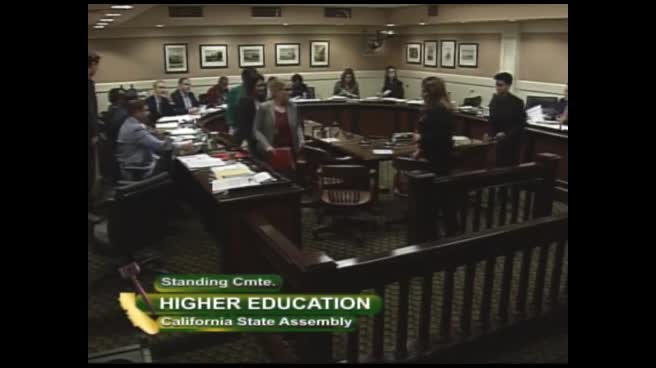
Discussed in Hearing
 1H
Assembly Standing Committee on Appropriations
 8MIN
Assembly Standing Committee on Higher Education
Bill Author

Bill Co-Author(s):