SB 1092: Firearms: silencers.
- Session Year: 2017-2018
- House: Senate
- Latest Version Date: 2018-03-22
Existing law makes it a felony to possess a silencer, as defined, for a firearm.
This bill would instead make it a felony to possess a silencer that is attached to a firearm with a barrel that measures less than 16 inches in length.
Existing law restricts the use of firearms in certain areas while hunting, prohibits hunting with a firearm while intoxicated, and requires the use of certain ammunition.
This bill would authorize hunting while using a lawfully possessed silencer that is attached to a firearm with a barrel measuring 16 inches or more in length.
Existing law makes it a felony to possess a silencer, as defined, for a firearm.
This bill would instead make it a felony to possess a silencer that is attached to a firearm with a barrel less than 16 inches in length.
Existing law restricts the use of firearms in certain areas while hunting, prohibits hunting with a firearm while intoxicated, and requires the use of certain ammunition.
This bill would authorize hunting while using a lawfully possessed silencer that is attached to a firearm with a barrel measuring 16 inches or more in length.
Where a firearm is authorized in this division to be used for the taking of a bird or mammal, a person may use a lawfully possessed silencer, as defined in Section 17210 of the Penal Code, if it is attached to a firearm with a barrel measuring 16 inches or more in length.
SEC. 2.Section 33410 of the Penal Code is amended to read:33410.Any person who within this state possesses a silencer that is attached to a firearm with a barrel measuring less than 16 inches in length is guilty of a felony and upon conviction thereof shall be punished by imprisonment pursuant to subdivision (h) of Section 1170 or by a fine not to exceed ten thousand dollars ($10,000), or by both that fine and imprisonment.
Where a firearm is authorized in this division to be used for the taking of a bird or mammal, a person may use a lawfully possessed silencer, as defined in Section 17210 of the Penal Code, if it is attached to a firearm with a barrel measuring 16 inches or more in length.
SEC. 2.Section 33410 of the Penal Code is amended to read:33410.Any person, firm, or corporation person who within this state possesses a silencer that is attached to a firearm with a barrel less than 16 inches in length is guilty of a felony and upon conviction thereof shall be punished by imprisonment pursuant to subdivision (h) of Section 1170 or by a fine not to exceed ten thousand dollars ($10,000), or by both that fine and imprisonment.
|
Date
|
Status
|
|---|---|
| Apr 11, 2018 | April 10 set for first hearing. Failed passage in committee. (Ayes 2. Noes 2.) Reconsideration granted. |
| Mar 29, 2018 | Set for hearing April 10. |
| Mar 22, 2018 | From committee with author's amendments. Read second time and amended. Re-referred to Com. on PUB. S. |
| Feb 22, 2018 | Referred to Coms. on PUB. S. and N.R. & W. |
| Feb 14, 2018 | From printer. May be acted upon on or after March 16. |
| Feb 13, 2018 | Introduced. Read first time. To Com. on RLS. for assignment. To print. |
|
Date
|
Description
|
Location
|
Votes
|
|
|---|---|---|---|---|
| Apr 10, 2018 | [04-10-2018] hearing: Motion to Reconsider. [Reconsideration Granted.] | Senate Standing Committee on Public Safety |
Passed |
|
| Apr 10, 2018 | Do pass, but first be re-referred to the Committee on [Natural Resources and Water] | Senate Standing Committee on Public Safety |
Passed |
This list shows positions taken on this bill by organizations on the date displayed, which is linked to the original source.
Positions by individuals are not included.
|
Organization
|
Position
|
Date
|
|---|---|---|
| California Chapters of The Brady Campaign to Prevent Gun Violence | * Against | Apr 10, 2018 |
| California Deer Association | * Support | Apr 10, 2018 |
| Firearms Policy Coalition | * Support | Apr 10, 2018 |
SENATE COMMITTEE ON PUBLIC SAFETY
Senator Nancy Skinner, Chair
2017 - 2018 Regular
Bill No: SB 1092 Hearing Date: April 10, 2018
Author: | Anderson | ||
Version: | March 22, 2018 | ||
Urgency: | No | Fiscal: | No |
Consultant: | GC | ||
Subject: Firearms: Silencers
HISTORY
Source: American Suppressor Association
Prior Legislation: SB 710 (Anderson), 2017, failed passage in Senate Public Safety
Support: California Rifle and Pistol Association; Giffords Law Center to Prevent Gun Violence; National Shooting Sports Foundation, Inc.
Opposition: American Academy of Pediatrics; California Chapters of the Brady Campaign; San Francisco Bay Area Physicians for Social Responsibility
PURPOSE
The purpose of this bill is to eliminate the felony for possession of a silencer, and instead make it a felony to possess a silencer that is attached to a handgun.
Existing federal law, under the National Firearms Act (NFA), imposes a tax on the making and transfer of firearms defined by the Act (26 USC 53; 27 CFR 479.)
Existing federal law states that the NFA applies to:
- a shotgun having a barrel or barrels of less than 18 inches in length;
- a weapon made from a shotgun if such weapon as modified has an overall length of less than 26 inches or a barrel or barrels of less than 18 inches in length;
- a rifle having a barrel or barrels of less than 16 inches in length;
- a weapon made from a rifle if such weapon as modified has an overall length of less than 26 inches or a barrel or barrels of less than 16 inches in length;
- any other weapon, as provided;
- a machinegun;
- any silencer; and,
- a destructive device.
(26 U.S.C. 5845; 27 CFR 479.11)
Existing federal law provides that there is a tax of $200 for the transfer of any firearm subject to the NFA except a firearm classified as an “any other weapon” which is $5. An unserviceable firearm may be transferred as a curio or ornament without payment of the transfer tax. (26 U.S.C. 5811, 5852(e) and 5845(h); 27 CFR 479.11, 479.82 and 479.91.)
Existing federal law states that “[t]he term “Firearm Silencer” or “Firearm Muffler” means any device for silencing, muffling, or diminishing the report of a portable firearm, including any combination of parts, designed or redesigned, and intended for the use in assembling or fabricating a firearm silencer or firearm muffler, any part intended only for use in such assembly or fabrication.” (18 U.S.C., § 921(A)(24).)
Existing California law provides that any person, firm, or corporation who within this state possesses a silencer is guilty of a felony and upon conviction thereof shall be punished by imprisonment pursuant to subdivision (h) of Section 1170 or by a fine not to exceed ten thousand dollars ($10,000), or by both that fine and imprisonment. (Penal Code § 33410.)
Existing California law exemptions the following from the prohibition on silencers: (Penal Code § 33415.)
- The sale to, purchase by, or possession of silencers by listed law enforcement agencies, or the military or naval forces of this state or of the United States, for use in the discharge of their official duties.
- The possession of silencers by regular, salaried, full-time peace officers who are employed by the listed law enforcement agencies, or by the military or naval forces of this state or of the United States, when on duty and when the use of silencers is authorized by the agency and is within the course and scope of their duties.
- The manufacture, possession, transportation, or sale or other transfer of silencers to listed law enforcement agencies by dealers or manufacturers, as specified.
Existing California law defines a “silencer” “as any device or attachment of any kind designed, used, or intended for use in silencing, diminishing, or muffling the report of a firearm. The term ‘silencer’ also includes any combination of parts, designed or redesigned, and intended for use in assembling a silencer or fabricating a silencer and any part intended only for use in assembly or fabrication of a silencer.” (Penal Code § 17210.)
This bill removes the felony prohibition on possession of a silencer and instead imposes a felony prohibition on possession of a handgun with a silencer attached.
This bill provides that where a firearm is authorized in this division to be used for the taking of a bird or mammal, a person may use a lawfully possessed silencer if it is attached to a firearm measuring 16 inches or more in length.
COMMENTS
1. Need for This Bill
According to the author:
Suppressors, also known as silencers, are legal to own in 42 states, and for hunting in 40 states. The terms “silencer” and “suppressor” refer to the same thing – a muffler for a firearm. It is important to note that nothing can actually silence the noise of a gunshot. Even the quietest suppressed gunshot is still as loud as a jackhammer (110 dB). Suppressors simply provide a safer hunting experience for both hunters and their companions - hunting dogs.
This bill would delete the felony prohibition in California and would authorize an individual in lawful possession of a suppressor to use that device for hunting for which the individual is licensed and lawfully in possession of the firearm to which the device is attached. The felony prohibition remains for any firearm less than 16 inches in total length (handguns).
Hearing Protection – Virtually all firearms generate impulse sound levels in excess of OSHA’s 140 dB “hearing safe” threshold. According to the CDC, “the only potentially effective noise control method to reduce students’ or instructors’ noise exposure from gunfire is through the use of noise suppressors.” Suppressors reduce the noise of a gunshot by an average of 20-35 dB, which is roughly the same as earplugs or earmuffs. By decreasing the peak impulse noise, suppressors help preserve the hearing of recreational shooters, hunters and hunting dogs around the world.
Hunting – Studies show that 70-80% of hunters never wear hearing protection in the field because they need to hear their surroundings. Suppressors allow hunters to maintain auditory situational awareness while still protecting their hearing. This results in a safer and more enjoyable experience for the hunter and those nearby, like hikers and/or birdwatchers. They also help mitigate noise complaints from those who live near shooting ranges hunting land.
Law enforcement/Noise complaints – Most criminals, including poachers, aren’t interested in suppressors because suppressed gunshots are still very loud, they remain easily identifiable as gunshots, and the regulations carry severe penalties for criminal use. Technology like ShotSpotter can still detect suppressed gunfire in cities. Fish and Wildlife officers are still able to pinpoint location in the field based on the sound of the gunshot.
Regulation – Suppressors are federally regulated under the National Firearms Act (NFA). There is no way to legally purchase a suppressor without a federal background check. In order to purchase a suppressor, buyers must send in an application including fingerprints and passport photos to the ATF, pay a $200 transfer tax, notify their local Chief Law Enforcement Officer (CLEO), and wait an indeterminate amount of time for the ATF to process the application. As of April 2018, wait times range from 5 to 14 months.
2. The National Firearms Act
The history of the National Firearms Act (NFA) is summarized by the Federal Bureau of Alcohol, Tobacco and Firearms:
The NFA was originally enacted in 1934. Similar to the current NFA, the original Act imposed a tax on the making and transfer of firearms defined by the Act, as well as a special (occupational) tax on persons and entities engaged in the business of importing, manufacturing, and dealing in NFA firearms. The law also required the registration of all NFA firearms with the Secretary of the Treasury. Firearms subject to the 1934 Act included shotguns and rifles having barrels less than 18 inches in length, certain firearms described as “any other weapons,” machineguns, and firearm mufflers and silencers.
While the NFA was enacted by Congress as an exercise of its authority to tax, the NFA had an underlying purpose unrelated to revenue collection. As the legislative history of the law discloses, its underlying purpose was to curtail, if not prohibit, transactions in NFA firearms. Congress found these firearms to pose a significant crime problem because of their frequent use in crime, particularly the gangland crimes of that era such as the St. Valentine’s Day Massacre. The $200 making and transfer taxes on most NFA firearms were considered quite severe and adequate to carry out Congress’ purpose to discourage or eliminate transactions in these firearms. The $200 tax has not changed since 1934.
As structured in 1934, the NFA imposed a duty on persons transferring NFA firearms, as well as mere possessors of unregistered firearms, to register them with the Secretary of the Treasury. If the possessor of an unregistered firearm applied to register the firearm as required by the NFA, the Treasury Department could supply information to state authorities about the registrant’s possession of the firearm. State authorities could then use the information to prosecute the person whose possession violated state laws. For these reasons, the Supreme Court in 1968 held in the Haynes case that a person prosecuted for possessing an unregistered NFA firearm had a valid defense to the prosecution — the registration requirement imposed on the possessor of an unregistered firearm violated the possessor’s privilege from self-incrimination under the Fifth Amendment of the U.S. Constitution. The Haynes decision made the 1934 Act virtually unenforceable.
Title II of the Gun Control Act (GCA) of 1968
Title II amended the NFA to cure the constitutional flaw pointed out in Haynes. First, the requirement for possessors of unregistered firearms to register was removed. Indeed, under the amended law, there is no mechanism for a possessor to register an unregistered NFA firearm already possessed by the person. Second, a provision was added to the law prohibiting the use of any information from an NFA application or registration as evidence against the person in a criminal proceeding with respect to a violation of law occurring prior to or concurrently with the filing of the application or registration. In 1971, the Supreme Court reexamined the NFA in the Freed case and found that the 1968 amendments cured the constitutional defect in the original NFA.
Title II also amended the NFA definitions of “firearm” by adding “destructive devices” and expanding the definition of “machinegun.”
Firearm Owners’ Protection Act
In 1986, this Act amended the NFA definition of “silencer” by adding combinations of parts for silencers and any part intended for use in the assembly or fabrication of a silencer. The Act also amended the GCA to prohibit the transfer or possession of machineguns. Exceptions were made for transfers of machineguns to, or possession of machineguns by, government agencies, and those lawfully possessed before the effective date of the prohibition, May 19, 1986.
(https://www.atf.gov/rules-and-regulations/national-firearms-act)
3. Federal Efforts to Amend the NFA
In January of 2017, Representative Jeff Duncan introduced H.R. 367, the Hearing Protection Act of 2017. This legislation: (1) eliminates the $200 transfer tax on firearm silencers, and (2) treats any person who acquires or possesses a firearm silencer as meeting any registration or licensing requirements of the National Firearms Act with respect to such silencer. According to Representative Duncan the purpose of Hearing Protection Act of 2017 is safety, specifically:
This legislation is about safety – plain and simple,” Congressman Duncan said after dropping the Duncan-Carter Hearing Protection Act on Monday. “I’m very active in sport shooting and hunting, and I can’t tell you how better off the shooting sports enthusiasts would be if we had easier access to suppressors to help protect our hearing.
“I’ve been shooting since I was a young child - beginning with plinking with a .22 rifle and dove hunting with my Dad. My hearing has been damaged because of gun noise. Had I had access to a suppressor, it may have protected me, as well as millions of other Americans, from this sort of hearing loss. This is a health issue even recognized in Europe. It just doesn’t make any sense to regulate suppressors the way we do presently. I think it certainly is questionable from a constitutional standpoint. It’s striking that even Britain, which has some of the strictest gun laws in the world, has no restrictions on suppressors.”
Rep. John Carter said, “Suppressors do not make guns silent or dangerous, they are simply a form of hearing protection, both for the shooter and their hunting dogs. The Duncan-Carter Hearing Protection Act is common sense legislation that increases safety while shooting, allowing people to easily hear and react to range safety officers and fellow hunters. I am proud to be an original sponsor of this important legislation, and to work with my colleague Rep. Duncan to increase the availability of suppressors to sportsmen.”
The Duncan-Carter Hearing Protection Act will fix the flawed federal over-regulation of suppressors, making it easier for hunters and sportsmen to protect their hearing in the 42 states where private suppressor ownership is currently legal, and the 40 states where hunting with a suppressor is legal. This legislation will remove suppressors from the onerous requirements of the NFA, and instead require purchasers to pass an instant NICS check, the same background check that is used to purchase a firearm. In doing so, law-abiding citizens will remain free to purchase suppressors, while prohibited persons will continue to be barred from purchasing or possessing these accessories.
(Rep. Jeff Duncan and Rep. John Carter release the Duncan-Carter Hearing Protection Act, Jan 9, 2017, http://jeffduncan.house.gov/press-release/rep-jeff-duncan-and-rep-john-carter-release-duncan-carter-hearing-protection-act.)
4. Effect of Legislation
This legislation would make silencers legal in California, unless they are attached to a handgun. The Firearms Policy Coalition, who supported SB 710 (Anderson) in 2017, which was very similar legislation, made the following arguments:
HEARING PROTECTION
Noise induced hearing loss and tinnitus are two of the most common afflictions for recreational shooters and hunters. Everyone knows that gunfire is loud, but very few people understand the repercussions that shooting can have on their hearing until it’s too late.
Suppressors reduce the noise of a gunshot by an average of 20 – 35 dB, which is roughly the same as earplugs or earmuffs. By decreasing the overall sound signature, suppressors help to preserve the hearing of recreational shooters, hunters, and hunting dogs around the world.
SAFER HUNTING
Most hunters do not wear hearing protection in the field because they want to hear their surroundings. The trouble is, exposure to even a single unsuppressed gunshot can, and often does, lead to permanent hearing damage. Suppressors allow hunters to maintain full situational awareness, while still protecting their hearing. The result is a safer hunting experience for the hunter, and for those nearby.
NOISE COMPLAINTS
As urban developments advance into rural areas, shooting ranges and hunting preserves across the country are being closed due to noise complaints. Although it can still be heard, suppressed gunfire helps mitigate noise complaints from those who live near shooting ranges and hunting land.
5. Argument in Support
According to the California Rifle and Pistol Association:
SB 1092 will authorize hunting while using a lawfully possessed silencer that is attached to a firearm measuring 16 inches or more in length. Commonly known as silencers, suppressors are the hearing protection of the 21st century recreational shooter and hunter. Despite common misconceptions perpetuated by Hollywood, suppressors do not render gunfire silent – rather they only muffle the report of a firearm. In addition to hearing protection, suppressors also mitigate noise complaints from those who live near shooting ranges and hunting areas. Largely due to these benefits, suppressors are currently legal to own in 42 states and legal to hunt with in 40 states.
Claims that legalizing suppressors would result in an increase in crime and poaching are untrue. In his whitepaper entitled “Options to Reduce or Modify Firearms Regulations”, Ronald Turk, Associate Deputy Director and Chief Operating Officer of the Bureau of Alcohol, Tobacco, Firearms and Explosives (ATF), stated that “silencers are very rarely used in criminal shootings. Given the lack of criminality associated with silencers, it is reasonable to conclude that they should not be viewed as a threat to public safety”. Further, according to Ralph Clark, the CEO of ShotSpotter, the law enforcement tool that helps police identify and localize gunshots, suppressed gunfire can still be detected by their technology. Lastly, because they add length and weight to their firearm and make them harder to conceal, criminals rarely, if ever, choose to use suppressors.
Even if legalized in California, suppressors will remain heavily regulated under the federal National Firearms Act. Currently, to acquire a suppressor in states where they are legal, prospective buyers must send in an application to the ATF, pay a $200 transfer tax per suppressor, undergo the same extensive background check required to purchase a machine gun, notify their local Chief Law Enforcement Officer, and wait several months for the ATF to process and approve the paperwork.
6. Argument in Opposition
According to the California Chapters of the Brady Campaign:
Existing California law makes the possession of a silencer a felony. SB 1092 would instead make it a felony to possess a silencer that is attached to a firearm that measures less than 16 inches in length and would authorize hunting while using a silencer that is attached to a firearm measuring 16 inches or more in length. Existing federal law imposes a tax on silencers and requires their registration with the Bureau of Alcohol, Tobacco, Firearms & Explosives. Currently, there are bills pending in Congress that, if passed, will deregulate silencers. SB 1092 effectively allows possession of silencers for long guns by Californians who meet the federal requirements, which may be weakened, whether they actually hunt or not.
In recent years, the gun lobby and manufacturers have been pushing silencers as a means to boost sales and profits. They claim that silencers are needed to protect the hearing of gun owners. However, there are many models of earmuffs, headsets, and earplugs on the market that provide better hearing protection and are worn routinely by hunters and sportsmen. Furthermore, law enforcement and the military are not acquiring silencers on a large scale for firing range use. Dual ear protection (earmuffs and earplugs) is considered the gold standard for any professional shooter, including police and members of the military. Silencers are not necessary for hearing protection purposes and have several negative impacts to public safety.
Silencers, which were invented in 1908, have been substantially regulated by federal law since 1934 under the National Firearms Act because of their historic use by organized crime to muffle the sound of gunfire related to criminal activity. Decades ago, California went further and prohibited outright the possession of silencers for very good reasons: silencers make it harder to recognize the sound of gunfire; they distort and diminish the sound, making it difficult for responding law enforcement to detect the location of an active shooter. It is clear why a criminal would want to use a silencer as in addition to noise reduction, manufacturers tout that silencers can “disguise the location of the shooter by reducing muzzle flash and minimizing environmental disturbances and reduce recoil and muzzle flip allowing for more accurate and faster follow-up shots.”[1] A silencer in criminal hands puts the public and law enforcement at risk.
Furthermore, many local jurisdictions in California now use gunshot detection technologies, such as “ShotSpotter”, which get law enforcement officers deployed to the exact location of a shooting more quickly. A quicker response time not only increases the chance of finding the shooter, but facilitates earlier medical care and assistance to the victim and impacted community. Silencers make it more difficult for gunshot detection technologies to pick up the sound of gunfire.
Semi-automatic long guns seem to be the weapon of choice for today’s mass shooters. In California, they could be grandfathered assault weapons or high-powered featureless long guns with exchangeable magazines. Adding a silencer to the situation could create even more havoc and death. If federal law becomes weakened, then, under SB 1092, silencers for long guns will proliferate in California. Once these silencers are common in civilian hands, they will end up in criminal hands. The story of Christopher Dorner, who, in February 2013, did a series of shootings in Los Angeles, Orange and Riverside Counties that left four people dead and others wounded, is a stark reminder of the danger of silencers when used in crime. Dormer fired 29 shots at officers in a patrol car with an AR-15 equipped with a silencer “to keep them from hearing the shots before they were hit.” When police finally tracked down Dorner, he fired at them with a silencer-equipped assault weapon, making it more difficult for responding officers to pinpoint the origin of the gunfire.[2] Clearly, silencers made a bad situation even worse.
-- END –
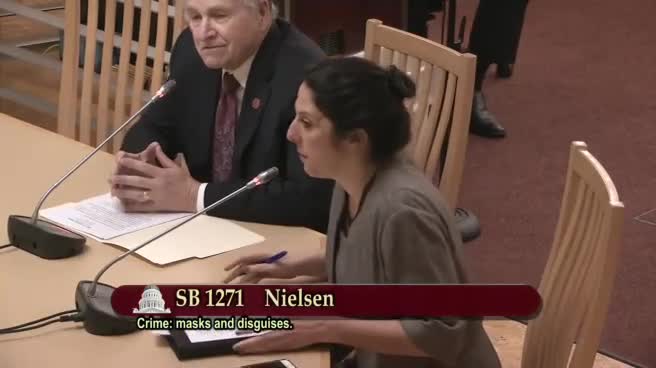
Discussed in Hearing
 27MIN
Senate Standing Committee on Public Safety
Bill Author





