SB 392: Parental Empowerment Pilot Project.
- Session Year: 2017-2018
- House: Senate
- Latest Version Date: 2018-05-07
Existing federal law provides for the allocation of federal funds through the federal Temporary Assistance for Needy Families (TANF) block grant program to eligible states. Existing law provides for the California Work Opportunity and Responsibility to Kids (CalWORKs) program under which, through a combination of state and county funds and federal funds received through the TANF program, each county provides cash assistance and other benefits to qualified low-income families.
This bill would require the State Department of Social Services, in consultation with the County Welfare Directors Association of California, no later than July 1, 2019, to design and implement a 5-year pilot project under which monetary grants are provided to organizations operating programs that assist individuals receiving CalWORKs benefits to achieve economic independence. The bill would require the department, in developing the pilot project, among other things, to develop a competitive review process for all grant proposals submitted, to develop eligibility requirements for organizations seeking a grant, and to develop an ongoing evaluation of the effectiveness of an organization receiving grant funding in teaching its program participants the skills necessary to achieve economic independence. The bill would authorize the department to enter into an agreement with an academic institution or other entity with sufficient expertise for the purpose of creating, performing, or both creating and performing, the evaluation.
This bill would authorize an organization receiving a grant to utilize the funds in any reasonable manner, as long as the funds are expended in furtherance of the organizations program or other requirements established by the department. The bill would require organizations receiving grant funding to collaborate and coordinate with the county human services agency or agencies that will be asked to refer CalWORKs recipients to the program in implementing procedures for referrals, regular progress reports, and other communications, as needed. The bill would require the department, or the academic institution or other entity the department contracted with, to send a report evaluating the effectiveness of the programs funded by the grants to the relevant policy and fiscal committees of the Legislature by December 31, 2023.
This bill would appropriate $50,000,000 from the General Fund for the purpose of funding these provisions.
This bill would make these provisions inoperative on July 1, 2024, and would repeal them as of January 1, 2025.
The Dental Practice Act provides for the licensure and regulation of dentists by the Dental Board of California within the Department of Consumer Affairs. The act, among other things, prescribes requirements for a dentist who administers or orders the administration of general anesthesia on an outpatient basis for dental patients, including a requirement that the dentist holds a valid anesthesia permit issued by the board.This bill, on or before January 1, 2019, would require the board to provide to the Legislature a report and analysis, as specified, of the effects on access to care for pediatric dental patients specifically as it relates to requiring the addition of a 2nd general anesthesia permitholder to be present during the administration of general anesthesia on a patient 7 years of age or younger, if the provider is currently a general anesthesia permitholder.(1)The
The Dental Practice Act provides for the licensure and regulation of dentists by the Dental Board of California within the Department of Consumer Affairs. The act, among other things, prescribes requirements for a dentist who administers or orders the administration of general anesthesia on an outpatient basis for dental patients, including a requirement that the dentist holds a valid anesthesia permit issued by the board.
This bill, on or before January 1, 2019, would require the board to provide to the Legislature a report and analysis, as specified, of the effects on access to care for pediatric dental patients specifically as it relates to requiring the addition of a 2nd general anesthesia permitholder to be present during the administration of general anesthesia on a patient 7 years of age or younger, if the provider is currently a general anesthesia permitholder.
(2)Existing law also authorizes the board to require licensees to complete continuing education hours as a condition of license renewal.This bill would require the board to develop, by January 1, 2019, a course in pediatric life support and airway management, as specified. The bill would provide the board with discretion over the solicitation and subsequent acceptance of proposals from continuing education vendors to provide the course.(1)The Dental Practice Act provides for the licensure and regulation of dentists by the Dental Board of California within the Department of Consumer Affairs. The act, among other things, prescribes requirements for a dentist who administers or orders the administration of general anesthesia on an outpatient basis for dental patients, including a requirement that the dentist holds a valid anesthesia permit issued by the board.
This bill, on or before January 1, 2019, would require the board to provide to the Legislature a report and analysis, as specified, of the effects on access to care for pediatric dental patients specifically as it relates to requiring the addition of a 2nd general anesthesia permitholder to be present during the administration of general anesthesia on a patient 7 years of age or younger, if the provider is currently a general anesthesia permitholder.
(2)Existing law also authorizes the board to require licensees to complete continuing education hours as a condition of license renewal.
This bill would require the board to develop, by January 1, 2019, a course in pediatric life support and airway management, as specified. The bill would provide the board with discretion over the solicitation and subsequent acceptance of proposals from continuing education vendors to provide the course.
The Dental Practice Act provides for the licensure and regulation of dentists by the Dental Board of California within the Department of Consumer Affairs. The act, among other things, prescribes requirements for dentists who administer or order a dentist who administers or orders the administration of general anesthesia and defines general anesthesia in this regard. anesthesia on an outpatient basis for dental patients, including a requirement that the dentist holds a valid anesthesia permit issued by the board.
This bill would make a nonsubstantive change to the provision that defines general anesthesia.This bill, on or before January 1, 2019, would require the board to provide to the Legislature a report and analysis, as specified, of the effects on access to care for pediatric dental patients specifically as it relates to requiring the addition of a 2nd general anesthesia permitholder to be present during the administration of general anesthesia on a patient 7 years of age or younger, if the provider is currently a general anesthesia permitholder.
The Dental Practice Act provides for the licensure and regulation of dentists by the Dental Board of California within the Department of Consumer Affairs. The act, among other things, prescribes requirements for dentists who administer or order the administration of general anesthesia and defines general anesthesia in this regard.
This bill would make a nonsubstantive change to the provision that defines general anesthesia.
The Legislature finds and declares all of the following:
(a)California is expected to spend $142 billion on health and human services programs this year, which is by far the largest state budget expenditure, while total education spending for kindergarten, grades 1 to 12, inclusive, and higher education programs is only $80 billion per year.
(b)California has the fifth largest Temporary Assistance for Needy Families (TANF) cash grant in the nation, and the second largest among the 10 largest states, yet poverty remains a persistent problem.
(c)We must recognize that Californias problems of poverty and inequality do not stem from a lack of safety net programs.
(d)Californias social safety net needs to invest in programs that elevate people out of poverty rather than helping people live better in poverty.
SEC. 2.The heading of Article 4.2 (commencing with Section 11355) is added to Chapter 2 of Part 3 of Division 9 of the Welfare and Institutions Code, to read:4.2.Parental Empowerment Pilot Project11355.(a)The State Department of Social Services, in consultation with the County Welfare Directors Association of California, shall, no later than July 1, 2019, design and implement a five-year pilot project under which monetary grants are provided to organizations operating programs that assist individuals receiving CalWORKs benefits to achieve economic independence.
(b)In developing the pilot project described in subdivision (a), the department shall, at a minimum, do all of the following:
(1)Develop a competitive review process for all grant proposals submitted and a methodology to determine grant amounts. To the extent possible, the competitive review process shall ensure that funding is granted to programs that are located in three total regions: one urban, one suburban, and one rural.
(2)Develop eligibility requirements for organizations seeking a grant. The eligibility requirements shall, at a minimum, require an organizations program to include all of the elements specified in subdivision (d). The eligibility requirements for organizations seeking a grant do not affect an individuals eligibility for CalWORKs benefits, as determined by the county.
(3)Develop an ongoing evaluation, utilizing objective criteria, of the effectiveness of an organization receiving grant funding in teaching its program participants the skills necessary to achieve economic independence. The evaluation criteria shall, at a minimum, include an examination of all of the following:
(A)The number and percentage of participants who complete the program.
(B)The number and percentage of program participants who begin the program with a high school diploma or equivalent.
(C)The number and percentage of program participants who achieve a high school diploma or equivalent while in the program.
(D)The number of program participants who obtain nonsubsidized employment of at least 20 hours per week by the time of program completion, with regular followups to determine if this minimum level of nonsubsidized employment is maintained for the duration of the ongoing evaluation required by this paragraph.
(E)The attainment of academic stability for the children of program participants. The department shall develop a definition of academic stability for purposes of this section.
(F)The number and percentage of program participants still receiving CalWORKs benefits upon completion of the program.
(G)The average income of program participants at the time of program completion.
(H)The number and percentage of program participants who achieve family reunification, when applicable.
(c)The department may enter into an agreement with an academic institution or other entity with sufficient expertise for the purpose of creating, performing, or both creating and performing, the evaluation required by paragraph (3) of subdivision (b). The department and any academic institution or other entity the department contracts with to create, perform, or both create and perform, the evaluation shall seek input from stakeholders during the development process.
(d)Organizations applying for grants shall not be required to provide all of the following services, but the department shall consider the extent to which an applicant provides these services when evaluating grant applications:
(1)Education focused on the attainment of a high school diploma or its equivalent.
(2)Mental health services.
(3)Employment training.
(4)Financial training.
(5)Parenting skills training.
(6)Life skills training.
(7)Child care services. Each participating child care provider shall obtain a criminal record clearance pursuant to Section 1596.871 of the Health and Safety Code. For purposes of this section, child care provider includes a paid employee or a volunteer. If the organization serves only pregnant women, the organization shall not be required to provide child care services to be eligible for grant funding.
(8)A clean and sober environment in a manner that is consistent with federal guidance and state law relating to the core components of Housing First, as described in Sections 8255 and 8256.
(9)Comprehensive, targeted case management to assist program participants.
(10)Ongoing monitoring of program participants for at least five years after they have completed the program for purposes of measuring long-term program effectiveness.
(11)Trauma-informed social work.
(12)Temporary housing on a 24-hours-a-day, seven-days-a-week basis, including food facilities.
(e)The organization shall demonstrate in its grant application how it will coordinate its program with CalWORKs requirements. In considering the applications received and determining which organizations shall be awarded grants, the department shall take into consideration the extent to which an organization seeking funding has conferred with, and is collaborating with, the county human services agency or agencies that would be asked to refer CalWORKs recipients to its program.
(f)An organization receiving a grant may utilize the grant funds in any reasonable manner, as long as the funds are expended in furtherance of the program elements or other requirements the department establishes. Housing, transportation, and child care expenses for program participants shall be considered an allowable use of grant funds.
(g)An organization receiving a grant shall not limit the ability of participants to access a full scope of physical, psychosocial, and mental health services.
(h)An organization receiving a grant shall comply with Section 11135 of the Government Code.
(i)(1)The benefits an individual may receive through participation in a program receiving grant funding are in addition to any other public assistance benefits for which the individual may be eligible.
(2)Organizations receiving grant funding may set their own eligibility criteria for their programs as long as the eligibility criteria are consistent with the goals of this pilot project. The criteria for eligibility set by the organization do not affect an individuals eligibility for CalWORKs benefits, as determined by the county.
(3)Organizations receiving grant funding shall collaborate and coordinate with the county human services agency or agencies that will be asked to refer CalWORKs recipients to the program in implementing procedures for referrals, regular progress reports, and other communications, as needed.
(j)Participation in a program administered by an organization receiving grant funding pursuant to this section is voluntary.
(k)(1)No later than December 31, 2023, the department, or the academic institution or other entity the department contracted with pursuant to subdivision (c), shall send a report evaluating the effectiveness of the programs funded by the grants to the relevant policy and fiscal committees of the Legislature. The report shall also be posted on the departments Internet Web site.
(2)The report required by paragraph (1) shall not reveal the identity of any program participant, nor shall it contain any personally identifiable information.
(3)The report required by paragraph (1) shall be submitted in compliance with Section 9795 of the Government Code.
11356.This article shall become inoperative on July 1, 2024, and, as of January 1, 2025, is repealed.
SEC. 3.The sum of fifty million dollars ($50,000,000) is hereby appropriated from the General Fund to the State Department of Social Services for purposes of funding the pilot program developed pursuant to Article 4.2 (commencing with Section 11355) of Chapter 2 of Part 3 of Division 9 of the Welfare and Institutions Code.
SECTION 1.Section 1601.7 is added to the Business and Professions Code, to read:1601.7.(a)On or before January 1, 2019, the board shall provide to the Legislature a report and analysis of the effects on access to care for pediatric dental patients specifically as it relates to requiring the addition of a second general anesthesia permitholder to be present during the administration of general anesthesia on a patient seven years of age or younger, if the provider is currently a general anesthesia permitholder. The analysis should include costs of sedation and anesthesia, resource constraints of the healthcare system, including Denti-Cal compared to private insurance, and feasibility issues that include, but are not limited to, time, skills, staff availability, and equipment availability for the provider to carry out necessary dental procedures. The board shall make the report publicly available on the boards Internet Web site.(b)(1)A report to be submitted pursuant to subdivision (a) shall be submitted in compliance with Section 9795 of the Government Code.(2)Pursuant to Section 10231.5 of the Government Code, this section is repealed on January 1, 2023.(a)On or before January 1, 2019, the board shall provide to the Legislature a report and analysis of the effects on access to care for pediatric dental patients specifically as it relates to requiring the addition of a second general anesthesia permitholder to be present during the administration of general anesthesia on a patient seven years of age or younger, if the provider is currently a general anesthesia permitholder. The analysis should include costs of sedation and anesthesia, resource constraints of the healthcare system, including Denti-Cal compared to private insurance, and feasibility issues that include, but are not limited to, time, skills, staff availability, and equipment availability for the provider to carry out necessary dental procedures. The board shall make the report publicly available on the boards Internet Web site.
(b)(1)A report to be submitted pursuant to subdivision (a) shall be submitted in compliance with Section 9795 of the Government Code.
(2)Pursuant to Section 10231.5 of the Government Code, this section is repealed on January 1, 2023.
SEC. 2.Section 1645.2 is added to the Business and Professions Code, to read:1645.2.By January 1, 2019, the board shall develop a course in pediatric life support and airway management equivalent to the American Academy of Pediatrics and American Academy of Pediatric Dentistry guidelines or guidelines determined by the board in order to protect the public health and safety consistent with Section 1601.2. The board shall have discretion, consistent with the guidelines, over the solicitation and subsequent acceptance of proposals from continuing education vendors to provide the course.(a)On or before January 1, 2019, the board shall provide to the Legislature a report and analysis of the effects on access to care for pediatric dental patients specifically as it relates to requiring the addition of a second general anesthesia permitholder to be present during the administration of general anesthesia on a patient seven years of age or younger, if the provider is currently a general anesthesia permitholder. The analysis should include costs of sedation and anesthesia, resource constraints of the healthcare system, including Denti-Cal compared to private insurance, and feasibility issues that include, but are not limited to, time, skills, staff availability, and equipment availability for the provider to carry out necessary dental procedures. The board shall make the report publicly available on the boards Internet Web site.
(b)(1)A report to be submitted pursuant to subdivision (a) shall be submitted in compliance with Section 9795 of the Government Code.
(2)Pursuant to Section 10231.5 of the Government Code, this section is repealed on January 1, 2023.
SEC. 2.Section 1645.2 is added to the Business and Professions Code, to read:1645.2.By January 1, 2019, the board shall develop a course in pediatric life support and airway management equivalent to the American Academy of Pediatrics and American Academy of Pediatric Dentistry guidelines or guidelines determined by the board in order to protect the public health and safety consistent with Section 1601.2. The board shall have discretion, consistent with the guidelines, over the solicitation and subsequent acceptance of proposals from continuing education vendors to provide the course.
(a)On or before January 1, 2019, the board shall provide to the Legislature a report and analysis of the effects on access to care for pediatric dental patients specifically as it relates to requiring the addition of a second general anesthesia permitholder to be present during the administration of general anesthesia on a patient seven years of age or younger, if the provider is currently a general anesthesia permitholder. The analysis should include costs of sedation and anesthesia, resource constraints of the healthcare system, including Denti-Cal compared to private insurance, and feasibility issues that include, but are not limited to, time, skills, staff availability, and equipment availability for the provider to carry out necessary dental procedures. The board shall make the report publicly available on the boards Internet Web site.
(b)(1)A report to be submitted pursuant to subdivision (a) shall be submitted in compliance with Section 9795 of the Government Code.
(2)Pursuant to Section 10231.5 of the Government Code, this section is repealed on January 1, 2023.
SECTION 1.Section 1646 of the Business and Professions Code is amended to read:1646.General anesthesia, as used in this article, is defined as a controlled state of depressed consciousness or unconsciousness, accompanied by partial or complete loss of protective reflexes, produced by a pharmacologic or nonpharmacologic method, or a combination thereof.General anesthesia, as used in this article, means is defined as a controlled state of depressed consciousness or unconsciousness, accompanied by partial or complete loss of protective reflexes, produced by a pharmacologic or nonpharmacologic method, or a combination thereof.
|
Date
|
Status
|
|---|---|
| May 7, 2018 | Re-referred to Com. on RLS. pursuant to Assembly Rule 96. |
| May 7, 2018 | From committee with author's amendments. Read second time and amended. Re-referred to Com. on B. & P. |
| Jun 12, 2017 | Referred to Com. on B. & P. |
| Jun 1, 2017 | In Assembly. Read first time. Held at Desk. |
| May 31, 2017 | Read third time. Passed. (Ayes 40. Noes 0. Page 1351.) Ordered to the Assembly. |
| May 26, 2017 | Read second time and amended. Ordered to third reading. |
| May 25, 2017 | From committee: Do pass as amended. (Ayes 7. Noes 0. Page 1183.) (May 25). |
| May 23, 2017 | Set for hearing May 25. |
| May 22, 2017 | May 22 hearing: Placed on APPR. suspense file. |
| May 16, 2017 | Set for hearing May 22. |
| May 11, 2017 | May 15 hearing postponed by committee. |
| May 4, 2017 | Set for hearing May 15. |
| Apr 25, 2017 | From committee: Do pass and re-refer to Com. on APPR. (Ayes 8. Noes 1. Page 824.) (April 24). Re-referred to Com. on APPR. |
| Apr 20, 2017 | Set for hearing April 24 in B., P. & E.D. pending receipt. |
| Apr 19, 2017 | Re-referred to Com. on B., P. & E.D. |
| Apr 17, 2017 | From committee with author's amendments. Read second time and amended. Re-referred to Com. on RLS. |
| Apr 4, 2017 | From committee with author's amendments. Read second time and amended. Re-referred to Com. on RLS. |
| Feb 23, 2017 | Referred to Com. on RLS. |
| Feb 16, 2017 | From printer. May be acted upon on or after March 18. |
| Feb 15, 2017 | Introduced. Read first time. To Com. on RLS. for assignment. To print. |
|
Date
|
Description
|
Location
|
Votes
|
|
|---|---|---|---|---|
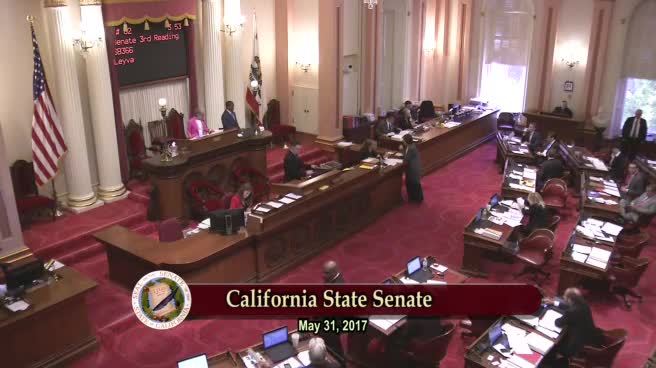
| May 31, 2017 | Senate 3rd Reading SB392 Bates | Senate Floor |
Passed |
|
| May 25, 2017 | Do pass as amended | Senate Standing Committee on Appropriations |
Passed |
|
| May 22, 2017 | Placed on suspense file | Senate Standing Committee on Appropriations |
Passed |
|
| Apr 24, 2017 | Do pass, but first be re-referred to the Committee on [Appropriations] | Senate Standing Committee on Business, Professions and Economic Development |
Passed |
This list shows positions taken on this bill by organizations on the date displayed, which is linked to the original source.
Positions by individuals are not included.
|
Organization
|
Position
|
Date
|
|---|---|---|
| American Academy Of Pediatrics, California | ** Against | May 27, 2017 |
| California Association Of Oral And Maxillofacial Surgeons | ** Support | May 27, 2017 |
| California Dental Association | ** Support | May 27, 2017 |
| Happy Bear Surgery Center | * Against | Apr 24, 2017 |
Office of Senate Floor Analyses (916) 651-1520 Fax: (916) 327-4478 | SB |
THIRD READING
Bill No: SB 392
:
SENATE BUS., PROF. & ECON. DEV. COMMITTEE: 8-1, 4/24/17
AYES: Hill, Fuller, Dodd, Galgiani, Glazer, Hernandez, Pan, Wilk
NOES: Newman
SENATE APPROPRIATIONS COMMITTEE: 7-0, 5/25/17
AYES: Lara, Bates, Beall, Bradford, Hill, Nielsen, Wiener
SUBJECT: Dentistry: report: access to care: pediatric dental patients
SOURCE: California Association of Oral and Maxillofacial Surgeons
DIGEST:
This bill requires the Dental Board of California to provide a report on access to care for pediatric patients requiring general anesthesia by January 1, 2019.
Existing law:
- Establishes the Dental Board of California (DBC) to administer and enforce the provisions of the Dental Practice Act. (Business and Professions Code (BPC) § 1601.1)
- Requires the DBC to provide a report to the Legislature as to whether current statutes and regulations for the administration and monitoring of pediatric anesthesia in dentistry provide adequate protection for pediatric dental patients by January 1, 2017. (BPC § 1601.4 (a))
- Requires the DBC to provide a report on pediatric deaths related to general anesthesia (GA) in dentistry at the time of its 2020 sunset review. (BPC § 1601.4)
- Establishes requirements for the administration of GA and conscious sedation in adults and pediatric patients. (BPC §§ 1646 et seq)
This bill:
- Requires the DBC to provide a report and analysis to the Legislature of the effects on access to care for pediatric dental patients specifically as it relates to requiring the addition of a second GA permitholder to be present during the administration of GA on a patient seven years of age or younger, if the provider is currently a general anesthesia permitholder, by January 1, 2019.
- Requires the analysis to include costs of sedation and anesthesia, resource constraints of the healthcare system, including Denti-Cal compared to private insurance, and feasibility issues that include, but are not limited to, time, skills, staff availability, and equipment availability for the provider to carry out necessary dental procedures.
- Requires the DBC to make the report publicly available on its Internet Web site.
Background
The DBC prepared its Pediatric Anesthesia Study, issued December 2016, in response to a February 8, 2016 letter from Senator Jerry Hill, Chair of this Committee, requesting a DBC subcommittee investigate California’s present laws, regulations and policies related to pediatric dental anesthesia to determine whether they were sufficient to ensure patient safety.
The report determined that California dental sedation and anesthesia laws are similar to laws in other states and differ primarily in the area of personnel requirements.
Although the subcommittee drafting the report noted that there are few, if any, high quality studies of pediatric dental sedation, they reviewed the available medical and dental literature and found that available data do not reveal an association between adverse outcomes and the type of provider or practice model.
DBC recommended updating terminology, staffing requirements, educational requirements, and monitoring standards in an effort to improve the safety of pediatric dental anesthesia and sedation. However, the subcommittee which wrote the report issued recommendations that differed from the full board’s recommendations in that the subcommittee did not require the presence of a separate GA provider for children under seven.
DBC acknowledged that “the manpower and economic considerations for pediatric dental sedation are beyond the scope of the present report. These considerations will be critical to the successful implementation of any changes to dental sedation laws. DBC therefore recommends that there be an analysis of the effects of any proposed new legislation or regulation on access to care for pediatric dental patients prior to the implementation of any changes.”
This bill directs the DBC to report to the Legislature on this issue by January 1, 2019.
FISCAL EFFECT: Appropriation: Fiscal Com.: Local:
According to the Senate Appropriations Committee, this bill will have one-time costs of about $1 million for the preparation of a report regarding the impact on access to care for pediatric dental patients (State Dentistry Fund).
California Association of Oral and Maxillofacial Surgeons (source)
California Dental Association
OPPOSITION: (Verified 5/25/17)
American Academy of Pediatrics, California
ARGUMENTS IN SUPPORT: The California Association of Oral and Maxillofacial Surgeons (CALAOMS) write, “While CALAOMS is very supportive of most of the DBC’s recent recommendations regarding pediatric dental anesthesia, there is one provision that is particularly problematic. The recommendation to require a second GA permit holder to be involved in GA procedures on patients under seven years of age, if the dental provider already has a GA permit, is not needed. CALAOMS is strongly committed to patient safety for all levels of anesthesia. However, the addition of a second GA permit holder in an over-abundance of caution will impede access to pediatric care. CALAOMS believes the DBC should analyze how that recommendation will affect access to pediatric dental care and report its findings to the Legislature prior to enacting any new GA permit requirements.”
ARGUMENTS IN OPPOSITION: The American Academy of Pediatrics, California writes, “SB 392’s requirement that the Dental Board provide to the Legislature a report and analysis of the effects on access to care for pediatric dental patients of these recommendations does a disservice to children undergoing dental anesthesia, who will be unnecessarily subjected to a lower and riskier standard of care during the report’s lengthy preparation time. Further, such a report is unnecessary, as current workforce data clearly show that implementing the Dental Board of California’s recommendations would NOT have a negative effect on access. There are ample qualified anesthesia providers in California to meet the Dental Board’s recommended staffing for anesthesia procedures in dental offices for children under age 7.”
5/27/17 17:21:30
**** END ****
SENATE COMMITTEE ON
Senator Ricardo Lara, Chair
2017 - 2018 Regular Session
SB 392 (Bates) - Dentistry: report: access to care: pediatric dental patients: continuing education
Version: | Policy Vote: |
Urgency: | Mandate: |
Hearing Date: | Consultant: |
*********** ANALYSIS ADDENDUM – SUSPENSE FILE ***********
The following information is revised to reflect amendments
adopted by the committee on May 25, 2017
Bill Summary:
SB 392 would require the Dental Board to report to the Legislature on access to care for pediatric dental patients. The bill would also require the Dental Board to develop a course in pediatric life support.
Fiscal Impact:
- One-time costs of about $1 million for the preparation of a report regarding the impact on access to care for pediatric dental patients (State Dentistry Fund).
Committee Amendments:
Delete the requirement that the Dental Board develop a course on pediatric life support.
-- END --
SENATE COMMITTEE ON APPROPRIATIONS
Senator Ricardo Lara, Chair
2017 - 2018 Regular Session
SB 392 (Bates) - Dentistry: report: access to care: pediatric dental patients: continuing education
Version: April 17, 2017 | Policy Vote: B., P. & E.D. 8 - 1 |
Urgency: No | Mandate: No |
Hearing Date: May 22, 2017 | Consultant: Brendan McCarthy |
This bill meets the criteria for referral to the Suspense File.
Bill Summary:
SB 392 would require the Dental Board to report to the Legislature on access to care for pediatric dental patients. The bill would also require the Dental Board to develop a course in pediatric life support.
Fiscal Impact:
- One-time costs of about $1 million for the preparation of a report regarding the impact on access to care for pediatric dental patients (State Dentistry Fund).
- Unknown costs for the Dental Board to develop a continuing education course in pediatric life support (State Dentistry Fund). Because the Dental Board does not currently create educational courses for dentists or dental assistants, the costs to develop the required course are not well known. According to the Dental Board, the costs could be as high as $1 million.
Background:
Under current law, dentists are licensed and regulated by the Dental Board of California. In order to administer general anesthesia to a dental patient, a licensed dentist must also have a General Anesthesia permit from the Dental Board. (This requirement also applies to licensed physicians who administer general anesthesia in a dental office.) In order for a dentist to administer drugs that result in conscious sedation, a dentist must have either a general anesthesia permit or a conscious sedation permit from the Dental Board. Current law and regulation provide for regulatory standards for the administration of both general anesthesia and conscious sedation by dentists (or physicians operating in a dental office).
AB 2235 (Thurmond, Statutes of 2016) requires the Dental Board to provide a report to the Legislature on current statutes and regulations relating to the use of anesthesia on pediatric dental patients, amongst other requirements. The Dental Board has completed the required report. In the development of the report, the Dental Board created a subcommittee of its members to study the issue and report to the full Board. The subcommittee report generally recommended changes to current law included in this bill and recommended a study be performed on the potential implications on access to dental care if current law was further amended to require a second dentist or physician with a general anesthesia permit to be present when anesthesia is used on a pediatric patient. The full Dental Board adopted the recommendations of the subcommittee, but also adopted a recommendation that a second permitted dentist or physician be present when general anesthesia is administered to a pediatric patient.
Proposed Law:
SB 392 would require the Dental Board to report to the Legislature on access to care for pediatric dental patients. Specifically, the report would focus on the effects on access to care as it relates to proposals to require a second general anesthesia permit holder to be present during the administration of general anesthesia to patients under seven years of age.
The bill would also require the Dental Board to develop a course in pediatric life support.
Related Legislation:
- SB 501 (Glazer) would revise the existing requirements for the administration of outpatient sedation by dentists. That bill includes a requirement for the Dental Board to prepare a report on access to care for pediatric patients. That bill will be heard in this committee.
- AB 224 (Thurmond) is substantially similar to SB 501 (Glazer) That bill is pending in the Assembly Appropriations Committee.
Staff Comments:
In recent years, there has been substantial interest by the Legislature regarding the use of anesthesia in pediatric dental patients and the implications of current law and regulation on patient safety. There have been several deaths in recent years of pediatric patients under anesthesia in dental offices. Under current law and regulation, a single dentist with a general anesthesia permit is allowed to both administer anesthesia and perform the underlying dental procedure. This is not the case for physicians performing surgery, where current law and regulation require a separate person to be responsible for administering general anesthesia and monitoring a patient’s vital signs during the operation.
-- END --
SENATE COMMITTEE ON
BUSINESS, PROFESSIONS AND ECONOMIC DEVELOPMENT
Senator Jerry Hill, Chair
2017 - 2018 Regular
Bill No: Hearing Date: April 24, 2017
Author: | |||
Version: | April 17, 2017 | ||
Urgency: | No | Fiscal: | Yes |
Consultant: | Sarah Huchel | ||
Subject:
SUMMARY:
Requires the Dental Board of California to provide a report on access to care for pediatric patients requiring general anesthesia, and to develop a course in pediatric life support by January 1, 2019.
Existing law:
- Establishes the Dental Board of California (DBC) to administer and enforce the provisions of the Dental Practice Act. (Business and Professions Code (BPC) § 1601.1)
- Requires the DBC to provide a report to the Legislature as to whether current statutes and regulations for the administration and monitoring of pediatric anesthesia in dentistry provide adequate protection for pediatric dental patients by January 1, 2017. (BPC § 1601.4 (a))
- Requires the DBC to provide a report on pediatric deaths related to general anesthesia (GA) in dentistry at the time of its 2020 sunset review. (BPC § 1601.4)
- Establishes requirements for the administration of GA and conscious sedation in adults and pediatric patients. (BPC §§ 1646 et seq)
This bill:
- Requires the DBC to provide a report and analysis to the Legislature of the effects on access to care for pediatric dental patients specifically as it relates to requiring the addition of a second GA permitholder to be present during the administration of GA on a patient seven years of age or younger, if the provider is currently a general anesthesia permitholder, by January 1, 2019.
- Requires the analysis to include costs of sedation and anesthesia, resource constraints of the healthcare system, including Denti-Cal compared to private insurance, and feasibility issues that include, but are not limited to, time, skills, staff availability, and equipment availability for the provider to carry out necessary dental procedures.
- Requires the DBC to make the report publicly available on its Internet Web site.
- Requires the DBC, by January 1, 2019, to develop a course in pediatric life support and airway management equivalent to the American Academy of Pediatrics and American Academy of Pediatric Dentistry guidelines, or guidelines determined by the DBC, in order to protect the public health and safety, as specified. The DBC shall have discretion, consistent with the guidelines, over the solicitation and subsequent acceptance of proposals from continuing education vendors to provide the course.
FISCAL EFFECT:
Unknown. This bill is keyed “fiscal” by the Legislative Counsel.
COMMENTS:
- Purpose. This bill is sponsored by the California Association of Oral and Maxillofacial Surgeons. According to the Author’s office, this bill is necessary because “In response to Assembly Bill 2235 (Thurmond, Chapter 519, Statutes of 2016), the DBC was required to provide to the Legislature a report on whether the current statutes and regulations for the administration and monitoring of pediatric anesthesia in dentistry provide adequate protection for pediatric dental patients.”
“As a result, the DBC prepared a letter on December 30, 2016, for the Senate Business, Professions & Economic Development Committee that outlined several enhancements to current statute to provide an even greater level of public protection.”
“Although most of the recommendations were approved and vetted by the Dental Board Subcommittee assigned to study the anesthesia statutes, the final recommendation about the additional general anesthesia permit holder was not vetted or researched as to its need or effect on access to pediatric dental care.”
- Background. The DBC prepared its Pediatric Anesthesia Study, issued December 2016, in response to a February 8, 2016 letter from Senator Jerry Hill, Chair of this Committee, requesting a DBC subcommittee investigate California’s present laws, regulations and policies related to pediatric dental anesthesia to determine whether they were sufficient to ensure patient safety.
The report determined that California dental sedation and anesthesia laws are similar to laws in other states and differ primarily in the area of personnel requirements.
Although the subcommittee drafting the report noted that there are few, if any, high quality studies of pediatric dental sedation, they reviewed the available medical and dental literature and found that available data do not reveal an association between adverse outcomes and the type of provider or practice model.
DBC recommended updating terminology, staffing requirements, educational requirements, and monitoring standards in an effort to improve the safety of pediatric dental anesthesia and sedation. However, the subcommittee that wrote the report issued recommendations that differed from the full board recommendations in that the subcommittee did not require the presence of a separate GA provider for children under seven.
DBC acknowledged that “the manpower and economic considerations for pediatric dental sedation are beyond the scope of the present report. These considerations will be critical to the successful implementation of any changes to dental sedation laws. DBC therefore recommends that there be an analysis of the effects of any proposed new legislation or regulation on access to care for pediatric dental patients prior to the implementation of any changes.”
This bill directs the examination of this issue and requires the DBC to develop a course in pediatric life support.
- Related Legislation. SB 501 (Glazer) requires a report similar to the one required in this bill, and places in statute the recommendations of the DBC subcommittee on issued December 1, 2016 as a result of the Pediatric Anesthesia Study. (Status: This bill is currently pending in the Senate Business, Professions and Economic Development Committee)
AB 224 (Thurmond) contains the recommendations of the full DBC as a result of the Pediatric Anesthesia Study, as voted on December 30, 2016. (Status: This bill is currently pending in the Assembly Business and Professions Committee.)
- Previous Legislation. AB 2235 (Thurmond, Chapter 519, Statutes of 2016) required the DBC to provide a report to the Legislature on whether current statutes and regulations for the administration and monitoring of pediatric anesthesia in dentistry provide adequate protection for pediatric dental patients; expands the definition of unprofessional conduct to include failure to notify the DBC about an adverse event relating to dental sedation; encourages DBC to support a third party public database of adverse events; establishes consent language for the administration of GA for a minor dental patient; requires the DBC to approve a form for the reporting of adverse event information; and authorizes a penalty for failure to report information to the DBC.
- Arguments in Support. The California Association of Oral and Maxillofacial Surgeons (CALAOMS) write, “While CALAOMS is very supportive of most of the DBC’s recent recommendations regarding pediatric dental anesthesia, there is one provision that is particularly problematic. The recommendation to require a second GA permit holder to be involved in GA procedures on patients under seven years of age, if the dental provider already has a GA permit, is not needed. CALAOMS is strongly committed to patient safety for all levels of anesthesia. However, the addition of a second GA permit holder in an over-abundance of caution will impede access to pediatric care. CALAOMS believes the DBC should analyze how that recommendation will affect access to pediatric dental care and report its findings to the Legislature prior to enacting any new GA permit requirements.”
SUPPORT AND OPPOSITION:
Support:
California Association of Oral and Maxillofacial Surgeons (Sponsor)
Opposition:
None on file as of April 19, 2017
-- END --
Discussed in Hearing
 4MIN
Senate Floor
 48MIN
Senate Standing Committee on Appropriations
 19MIN
Senate Standing Committee on Business, Professions and Economic Development
Bill Author

Bill Co-Author(s):