SB 689: Crimes: sporting events.
- Session Year: 2017-2018
- House: Senate
- Latest Version Date: 2017-05-02
Existing law makes it an infraction to throw an object on or across the court or field of play with the intent to interfere with play or distract a player or to enter upon the court or field of play without permission from an authorized person any time after the authorized participants of play have entered the court or field to begin the sporting event and until the participants of play have completed the playing time of the sporting event.
This bill would make the above crime an infraction, punishable by a fine not to exceed $1,000, or a misdemeanor, punishable by imprisonment in a county jail not to exceed 10 days, by a fine not exceeding $2,500, or by both that fine and imprisonment. The bill would make a 2nd or subsequent violation within 5 years of a prior violation of that prohibition a misdemeanor, punishable by imprisonment in a county jail for not more than 60 days, by a fine not exceeding $5,000, or by both that fine and imprisonment. By increasing the punishment for a crime, this bill would impose a state-mandated local program.
Existing law makes it a misdemeanor to commit battery against a sports official immediately prior to, during, or immediately following an organized athletic contest in which the sports official is participating.This bill would make it a misdemeanor to commit battery against a player immediately prior to, during, or immediately following an organized athletic contest in which the player is participating. The bill would define the term player to include any authorized participant of play, including, but not limited to, team members and support staff. By creating a new crime, this bill would impose a state-mandated local program.The California Constitution requires the state to reimburse local agencies and school districts for certain costs mandated by the state. Statutory provisions establish procedures for making that reimbursement.
This bill would provide that no reimbursement is required by this act for a specified reason.
Existing law makes it an infraction to throw an object on or across the court or field of play with the intent to interfere with play or distract a player or to enter upon the court or field of play without permission from an authorized person any time after the authorized participants of play have entered the court or field to begin the sporting event and until the participants of play have completed the playing time of the sporting event.
This bill would make technical, nonsubstantive changes to those provisions.This bill would make the above crime an infraction, punishable by a fine not to exceed $1,000, or a misdemeanor, punishable by imprisonment in a county jail not to exceed 10 days, by a fine not exceeding $2,500, or by both that fine and imprisonment. The bill would make a 2nd or subsequent violation within 5 years of a prior violation of that prohibition a misdemeanor, punishable by imprisonment in a county jail for not more than 60 days, by a fine not exceeding $5,000, or by both that fine and imprisonment. By increasing the punishment for a crime, this bill would impose a state-mandated local program.
Existing law makes it a misdemeanor to commit battery against a sports official immediately prior to, during, or immediately following an organized athletic contest in which the sports official is participating.
This bill would make it a misdemeanor to commit battery against a player immediately prior to, during, or immediately following an organized athletic contest in which the player is participating. The bill would define the term player to include any authorized participant of play, including, but not limited to, team members and support staff. By creating a new crime, this bill would impose a state-mandated local program.
The California Constitution requires the state to reimburse local agencies and school districts for certain costs mandated by the state. Statutory provisions establish procedures for making that reimbursement.
This bill would provide that no reimbursement is required by this act for a specified reason.
Existing law makes it an infraction to throw an object on or across the court or field of play with the intent to interfere with play or distract a player or to enter upon the court or field of play without permission from an authorized person any time after the authorized participants of play have entered the court or field to begin the sporting event and until the participants of play have completed the playing time of the sporting event.
This bill would make technical, nonsubstantive changes to those provisions.
(a)It is unlawful for a person attending a professional sporting event to do any of the following:
(1)Throw an object on or across the court or field of play with the intent to interfere with play or distract a player.
(2)Enter upon the court or field of play without permission from an authorized person any time after the authorized participants of play have entered the court or field to begin the sporting event and until before the participants of play have completed the playing time of the sporting event.
(b)(1)The owner of the facility in which a professional sporting event is to be held shall provide a notice specifying the unlawful activity prohibited by this section and the punishment for engaging in that prohibited activity.
(2)The notice shall be prominently displayed throughout the facility or may be provided in some other manner, including, but not limited to, on a big screen or by a general public announcement. In addition, notice shall be posted at all controlled entry areas of the sporting facility.
(3)Failure to provide the notice shall is not be a defense to a violation of this section.
(c)For the purposes of this section, the following terms have the following meanings:
(1)Player includes any authorized participant of play, including, but not limited to, team members, referees however designated, and support staff, whether or not any of those persons receive compensation.
(2)Professional sporting event means a scheduled sporting event involving a professional sports team or organization or a professional athlete for which an admission fee is charged to the public.
(d)A violation of subdivision (a) is an infraction, punishable by a fine not exceeding one thousand dollars ($1,000), or a misdemeanor, punishable by imprisonment in a county jail for not more than 10 days, by a fine not exceeding two thousand five hundred dollars ($2,500), or by both that fine and imprisonment. A second or subsequent violation of subdivision (a) within five years of a prior violation of that subdivision is a misdemeanor, punishable by imprisonment in a county jail for not more than 60 days, by a fine not exceeding five thousand dollars ($5,000), or by both that fine and imprisonment. A fine imposed pursuant to this subdivision is not subject to the penalty assessments imposed by Section 1464 or 1465.7 of this code or Section 76000 of the Government Code.
(e)This section applies to attendees at professional sporting events. This section does not apply to players or to sports officials, as defined in Section 243.8.
(f)Nothing in this This section shall be construed to does not limit or prevent prosecution under any applicable law.
SEC. 3.SEC. 2.No reimbursement is required by this act pursuant to Section 6 of Article XIIIB of the California Constitution because the only costs that may be incurred by a local agency or school district will be incurred because this act creates a new crime or infraction, eliminates a crime or infraction, or changes the penalty for a crime or infraction, within the meaning of Section 17556 of the Government Code, or changes the definition of a crime within the meaning of Section 6 of Article XIIIB of the California Constitution.
(a)When If a battery is committed against a sports official or player immediately prior to, during, or immediately following an interscholastic, intercollegiate, or any other organized amateur or professional athletic contest in which the sports official or player is participating, and the person who commits the offense knows or reasonably should know that the victim is engaged in the performance of his or her duties, the offense shall be punishable by a fine not exceeding two thousand dollars ($2,000), or by imprisonment in the county jail not exceeding one year, or by both that fine and imprisonment.
(b)For purposes of this section, sports official means any individual who serves as a referee, umpire, linesman, or who serves in a similar capacity but may be known by a different title or name and is duly registered by, or a member of, a local, state, regional, or national organization engaged in part in providing education and training to sports officials.
(c)For purposes of this section, player means any authorized participant of play, including, but not limited to, team members, however designated, and support staff, whether or not any of those persons receive compensation.
SECTION 1.SEC. 2.Section 243.83 of the Penal Code is amended to read:243.83.(a)It is unlawful for a person attending a professional sporting event to do any of the following:
(1)Throw an object on or across the court or field of play with the intent to interfere with play or distract a player.
(2)Enter upon the court or field of play without permission from an authorized person any time after the authorized participants of play have entered the court or field to begin the sporting event and until the participants of play have completed the playing time of the sporting event.
(b)(1)The owner of the facility in which a professional sporting event is to be held shall provide a notice specifying the unlawful activity prohibited by this section and the punishment for engaging in that prohibited activity.
(2)The notice shall be prominently displayed throughout the facility or may be provided in some other manner, including, but not limited to, on a big screen or by a general public announcement. In addition, notice shall be posted at all controlled entry areas of the sporting facility.
(3)Failure to provide the notice shall not be a defense to a violation of this section.
(c)For the purposes of this section, the following terms have the following meanings:
(1)Player includes any authorized participant of play, including, but not limited to, team members, referees however designated, and support staff, whether or not any of those persons receive compensation.
(2)Professional sporting event means a scheduled sporting event involving a professional sports team or organization or a professional athlete for which an admission fee is charged to the public.
(d)A violation of subdivision (a) is an infraction punishable by a fine not exceeding two hundred fifty dollars ($250). The fine shall not be subject to penalty assessments as provided in Section 1464 or 1465.7 of this code or Section 76000 of the Government Code.(d)A violation of subdivision (a) is an infraction, punishable by a fine not exceeding one thousand dollars ($1,000), or a misdemeanor, punishable by imprisonment in a county jail for not more than 10 days, by a fine not exceeding two thousand five hundred dollars ($2,500), or by both that fine and imprisonment. A second or subsequent violation of subdivision (a) within five years of a prior violation of that subdivision is a misdemeanor, punishable by imprisonment in a county jail for not more than 60 days, by a fine not exceeding five thousand dollars ($5,000), or by both that fine and imprisonment. A fine imposed pursuant to this subdivision is not subject to the penalty assessments imposed by Section 1464 or 1465.7 of this code or Section 76000 of the Government Code.
(e)This section applies to attendees at professional sporting events. This section does not apply to players or to sports officials, as defined in Section 243.8.
(f)Nothing in this section shall be construed to limit or prevent prosecution under any applicable law.
SEC. 3.No reimbursement is required by this act pursuant to Section 6 of Article XIIIB of the California Constitution because the only costs that may be incurred by a local agency or school district will be incurred because this act creates a new crime or infraction, eliminates a crime or infraction, or changes the penalty for a crime or infraction, within the meaning of Section 17556 of the Government Code, or changes the definition of a crime within the meaning of Section 6 of Article XIIIB of the California Constitution.
(a)It is unlawful for any a person attending a professional sporting event to do any of the following:
(1)Throw any an object on or across the court or field of play with the intent to interfere with play or distract a player.
(2)Enter upon the court or field of play without permission from an authorized person any time after the authorized participants of play have entered the court or field to begin the sporting event and until the participants of play have completed the playing time of the sporting event.
(b)(1)The owner of the facility in which a professional sporting event is to be held shall provide a notice specifying the unlawful activity prohibited by this section and the punishment for engaging in that prohibited activity.
(2)The notice shall be prominently displayed throughout the facility or may be provided by in some other manner, such as including, but not limited to, on a big screen or by a general public announcement. In addition, notice shall be posted at all controlled entry areas of the sporting facility.
(3)Failure to provide the notice shall not be a defense to a violation of this section.
(c)For the purposes of this section, the following terms have the following meanings:
(1)Player includes any authorized participant of play, including, but not limited to, team members, referees however designated, and support staff, whether or not any of those persons receive compensation.
(2)Professional sporting event means a scheduled sporting event involving a professional sports team or organization or a professional athlete for which an admission fee is charged to the public.
(d)A violation of subdivision (a) is an infraction punishable by a fine not exceeding two hundred fifty dollars ($250). The fine shall not be subject to penalty assessments as provided in Section 1464 or 1465.7 of this code or Section 76000 of the Government Code.
(e)This section shall apply applies to attendees at professional sporting events; this events. This section shall does not apply to players or to sports officials, as defined in Section 243.8.
(f)Nothing in this section shall be construed to limit or prevent prosecution under any applicable provision of law.
|
Date
|
Status
|
|---|---|
| Feb 1, 2018 | Returned to Secretary of Senate pursuant to Joint Rule 56. |
| May 25, 2017 | May 25 hearing: Held in committee and under submission. |
| May 23, 2017 | Set for hearing May 25. |
| May 22, 2017 | May 22 hearing: Placed on APPR. suspense file. |
| May 16, 2017 | Set for hearing May 22. |
| May 15, 2017 | May 15 hearing postponed by committee. |
| May 4, 2017 | Set for hearing May 15. |
| May 2, 2017 | Read second time and amended. Re-referred to Com. on APPR. |
| May 1, 2017 | From committee: Do pass as amended and re-refer to Com. on APPR. (Ayes 7. Noes 0. Page 856.) (April 25). |
| Apr 7, 2017 | Set for hearing April 25. |
| Apr 5, 2017 | Re-referred to Com. on PUB. S. |
| Mar 29, 2017 | From committee with author's amendments. Read second time and amended. Re-referred to Com. on RLS. |
| Mar 9, 2017 | Referred to Com. on RLS. |
| Feb 21, 2017 | From printer. May be acted upon on or after March 23. |
| Feb 17, 2017 | Introduced. Read first time. To Com. on RLS. for assignment. To print. |
|
Date
|
Description
|
Location
|
Votes
|
|
|---|---|---|---|---|
| May 22, 2017 | Placed on suspense file | Senate Standing Committee on Appropriations |
Passed |
|
| Apr 25, 2017 | Do pass as amended, but first amend, and re-refer to the Committee on [Appropriations] | Senate Standing Committee on Public Safety |
Passed |
This list shows positions taken on this bill by organizations on the date displayed, which is linked to the original source.
Positions by individuals are not included.
|
Organization
|
Position
|
Date
|
|---|---|---|
| 1. Need For This Bill | ** Against | Apr 24, 2017 |
| 3. Legislative History | ** Against | Apr 24, 2017 |
| 4. Argument In Support | ** Against | Apr 24, 2017 |
| 5. Argument In Opposition | ** Against | Apr 24, 2017 |
| American Civil Liberties Union | * Against Unless Amend | Apr 25, 2017 |
| California District Attorneys Association | * Support | Apr 25, 2017 |
| Los Angeles County Professional Peace Officers Association | * Support | Apr 25, 2017 |
| PURPOSE | ** Against | Apr 24, 2017 |
SENATE COMMITTEE ON APPROPRIATIONS
Senator Ricardo Lara, Chair
2017 - 2018 Regular Session
SB 689 (Wiener) - Crimes: sporting events
Version: May 2, 2017 | Policy Vote: PUB. S. 7 - 0 |
Urgency: No | Mandate: Yes |
Hearing Date: May 22, 2017 | Consultant: Shaun Naidu |
This bill meets the criteria for referral to the Suspense File.
Bill Summary:
SB 689 would increase to misdemeanor penalties the existing infraction of throwing an object or running onto a court or field during a professional sporting event without permission, as specified.
Fiscal Impact:
- Courts: Unknown, potentially-significant workload costs (General Fund*) in adjudicating new misdemeanor cases prosecuted. The volume of workload would be dependent on the number of new criminal filings brought for violations of this measure.
- County jail: Potentially minor non-reimbursable costs (local funds) to an individual county for incarcerating people for up to 10 days for the first offense or 60 days for a subsequent offense for violating this measure but potentially moderate to significant costs in the aggregate depending on the number of individuals sentenced to jail under this crime.
*Trial Court Trust Fund
Background:
Existing law makes it an infraction, punishable by a fine of up to $250 that is not subject to a penalty assessment, to throw an object on or across the court or field of play with the intent to interfere with play or distract a player or to enter upon the court or field of play without permission from an authorized person any time after the authorized participants of play have entered the court or field to begin the sporting event and until the participants of play have completed the playing time of the sporting event.
Proposed Law:
This bill would increase the penalty for the above conduct to an infraction punishable by a fine of up to $1,000 with the addition of penalty assessments or a misdemeanor punishable by imprisonment in the county jail for up to 10 days, a fine of up to $2,500, or both the imprisonment and fine. For any subsequent misdemeanor conviction within five years of a prior misdemeanor conviction for this offense, the penalty is increased to a misdemeanor punishable by up to 60 days in county jail, a fine of up to $5,000, or both the imprisonment and fine.
Related Legislation:
AB 2464 (Gatto, Ch. 261, Stats. 2012) required owners of professional sports facilities to post notices of emergency contact information.
AB 245 (Cohn, Ch. 818, Stats. 2003) made it a crime, punishable as an infraction, for individuals at professional sporting events who intentionally throw any object on or across the court or field of play with the intent to interfere with or distract a player and for individuals at sporting events who enter upon the court or field of play without permission from an authorized person.
Staff Comments:
The bill would increase the penalty for interfering with a sporting event to distract players by throwing an object or running onto a court or field to include a sentence in jail for up to 10 days for the first offense and up to 60 days in jail for subsequent offenses within a five-year period. Misdemeanor offenses require more court resources and time as, if they exhaust the full course of proceedings, can include the requirement of a court-appoint counsel, a jury trial, and multiple hearings to adjudicate the charges. Consequently, the court could incur additional workload to review misdemeanor cases that otherwise would have been filed as an infraction or may not have been filed at all. In the absence of available statewide data to determine the volume of cases that the court would be required to hear, the magnitude of the additional court workload is unknown at this time. Staff has been informed, however, that at least in one professional sports venue, there have been at least 15 charges of this crime cited.
-- END --
SENATE COMMITTEE ON PUBLIC SAFETY
Senator Nancy Skinner, Chair
2017 - 2018 Regular
Bill No: SB 689 Hearing Date: April 25, 2017
Author: | Wiener | ||
Version: | March 29, 2017 | ||
Urgency: | No | Fiscal: | Yes |
Consultant: | SC | ||
Subject: Crimes: Sporting Events
HISTORY
Source: San Francisco Giants
Oakland Athletics
Los Angeles Angels
San Jose Earthquakes
Prior Legislation: AB 2464 (Gatto), Ch. 261, Stats. 2012
AB 245 (Cohn), Ch. 818, Stats. 2003
Support: Anaheim Arena Management, LLC; Anaheim Ducks Hockey Club, LLC; Golden State Warriors, LLC; Los Angeles Dodgers, LLC; Major League Baseball, Office of the Commissioner; San Francisco 49ers; San Francisco Giants Baseball Club; San Francisco Police Officers Association; San Jose Sharks
Opposition: American Civil Liberties Union of California; California Attorneys for Criminal Justice
PURPOSE
The purpose of this bill is to authorize misdemeanor penalties for the existing infraction of throwing an object or running onto a court or field during a professional sporting event without permission and to increase punishment for battery on a “player” as defined.
Existing law states that it is an infraction punishable by a fine of up to $250 for any person attending a professional sporting event to throw an object on or across the court or field of play with the intent to interfere with play or distract a player or to enter upon the court or field of play without permission from an authorized person any time after the authorized participants of play have entered the court or field to begin the sporting event and until the participants of play have completed the playing time of the sporting event. (Pen. Code § 243.83, subd. (a).)
This bill would authorize a violation of the above provision to be punished as either an infraction or a misdemeanor with the following graduated penalties:
- A first violation would be punishable as an infraction with a fine not exceeding $1,000, or as a misdemeanor punishable by imprisonment in a county jail for not more than 10 days, by a fine not exceeding $2,500, or by both that fine and imprisonment;
- A second violation or subsequent violation within five years of a prior violation would be a misdemeanor, punishable by imprisonment in a county jail for not more than 60 days, by a fine not exceeding $5,000, or by both that fine and imprisonment.
Existing law generally provides that it is a misdemeanor to commit battery against another person and punishes that crime by imprisonment in the county jail for up to six months, or a fine up to $2000, or both the fine and imprisonment. (Pen. Code § 243, subd. (a).)
Existing law provides that battery against a sports official immediately prior to, during, or immediately following an organized athletic contest in which the sports official is participating is a misdemeanor punishable by imprisonment up to one year in county jail, or a fine of up to $2000, or both the fine and imprisonment. (Pen. Code § 243.8, subd. (a).)
Existing law defines “sports official” to mean a referee, umpire, linesman, or who serves in a similar capacity but may be known by a different title or name and is duly registered by, or a member of, a local, state, regional, or national organization engaged in part in providing education and training to sports officials. (Pen. Code § 243.8, subd. (a).)
This bill makes it a misdemeanor punishable by imprisonment up to one year in county jail, or a fine of up to $2000, or both the fine and imprisonment, to commit battery against a player immediately prior to, during, or immediately following an organized athletic contest in which the player is participating.
This bill would define “player” to include any authorized participant of play, including, but not limited to, team members and support staff.
COMMENTS
1. Need for This Bill
According to the author:
Senate Bill 689 offers modest, but important changes to current California law to protect players, coaches, other on-field personnel, and fans at sporting events. In California, unlike many other states, persons trespassing on the field and potentially confronting or injuring a player or a coach, or throwing an object onto the field to interfere with play is punishable as a mere infraction with a fine of $250.00. With such lenient penalties, it is more likely that offending behavior will continue to occur unless a change is made. Senate Bill 689 proposes to increase the criminal penalties associated with (i) trespassing on the field and throwing objects onto the field with the intent to interfere with play by making each punishable as either an infraction with a fine up to $1,000.00 or a misdemeanor with up to ten days in county jail and a fine of $2,500 for the first offense and (ii) committing a battery on a player or coach by making it punishable by a fine not exceeding $2,000, or by imprisonment in the county jail up to one year, or by both that fine and imprisonment, matching existing criminal penalties for committing battery against a referee during a sporting event.
Law enforcement, teams, venue operators, and organizations, such as Major League Baseball, have had a longstanding concern about the vulnerability of players and coaches during play and California’s lack of criminal penalties to protect vulnerable players and coaches. Given world events, many sports organizations and venue operators have been working on a series of security measures and protocols large and small to help ensure the safe operation of venues and to protect fans, players, and employees. As a result, Senate Bill 689 has been proposed to deter activities that pose threats to the safety and security of players, coaches, and fans at sporting events, and to bring California in line with other states’ criminal penalties.
2. Existing Law Authorizes Misdemeanor Penalties for Conduct Targeted by this Bill
This bill authorizes misdemeanor penalties for the offense of running out onto a field or throwing an object with the intent to interfere with play. Currently, the applicable statute states that the offense is an infraction punishable by a fine of up to $250. However, this conduct may be prosecuted under other statutes that authorize misdemeanor penalties. Running onto a sports field or court may be prosecuted as disorderly conduct or trespassing, which are both misdemeanors. (Pen. Code, §§ 647, 602.) Additionally, throwing an object at any person is punishable as assault which is generally a misdemeanor. (Pen. Code, § 240.) If the object thrown is likely to produce great bodily injury, it could be charged as a felony even the thrown object did not cause great bodily injury. (Pen. Code, § 245.) If an object is thrown and it hits someone, for example if someone throws beer at a player, that person could be charged with battery, which is generally a misdemeanor, but could also be charged as a felony if injury has been inflicted. (Pen. Code, § 243.)
Prosecutors have discretion to charge defendants with any crime that is supported by the facts of the case. Thus, in cases where a prosecutor believes that a misdemeanor is appropriate, one of the existing misdemeanor crimes may be charged, whereas an infraction may be more appropriate in the majority of other cases. One consideration in deciding whether to charge something as an infraction or misdemeanor may be court and attorney resources.
Prosecution of a misdemeanor gives a defendant the right to a jury trial because the person may be punished by imprisonment, whereas infractions are not punishable by imprisonment, thus a person charged with an infraction would not be entitled to a jury trial. (Pen. Code, § 19.6.) Furthermore, a person charged with an infraction is not be entitled to have the public defender or other counsel appointed at public expense to represent him or her, whereas misdemeanants would be entitled to counsel at county expense. Thus, even if the law was amended to authorize misdemeanor penalties for the specified offense of running out onto a field or throwing an object, prosecutors may elect not to charge the misdemeanor due to the added time and cost of prosecuting the case.
3. Legislative History
One of the statutes that this bill amends, Penal Code section 243.83, was enacted in 2003 by AB 245 (Cohn). When the bill was introduced, the criminal penalty specified was a misdemeanor. However, due to concerns raised in the Assembly Committee’s analysis regarding the availability of existing misdemeanor penalties and the potential costs of jury trials for the new misdemeanor, the bill was amended to create an infraction instead of a misdemeanor.
This bill would amend that statute to authorize either an infraction or a misdemeanor to be charged.
4. Argument in Support
Major League Baseball writes in support of this bill:
The Player Safety & Security Act offers modest but important changes to the current law, making field trespassers subject to arrest and enhanced penalties (e.g., infraction or misdemeanor depending on the circumstances). This approach, while not as punitive as some other jurisdictions where consequences are more severe, still creates a meaningful deterrent that will likely result in fewer incidents at our California ballparks. Senate Bill 689 will give our teams and local law enforcement important tools to more effectively confront problems and provide a safer environment for our field personnel.
5. Argument in Opposition
The California Attorneys for Criminal Justice, opposes this bill, and writes:
[C]urrent law adequately penalizes assault and battery, especially given the discretion of judges to consider the particular circumstances of the crime and the perpetrator. Any intended extra deterrent or punishment effect of SB 689 is defeated by the arbitrary distinctions set forth in the bill, as described above. In 2015, the Governor vetoed a passel of bills that would have created new crimes and imposed new penalties for specialized crimes. His veto message for those bills rings equally true with respect to SB 689:
“Each of these bills creates a new crime -- usually by finding a novel way to characterize and criminalize conduct that is already proscribed. This multiplication and particularization of criminal behavior creates increasing complexity without commensurate benefit.
“Over the last several decades, California's criminal code has grown to more than 5,000 provisions covering every almost conceivable form of human misbehavior.
“During the same period, our jail and prison populations have exploded.
“Before we keep going down this road, I think we should pause and reflect how our system of criminal justice could be made more human, more just and more cost-effective.”
-- END –
Discussed in Hearing
 48MIN
Senate Standing Committee on Appropriations
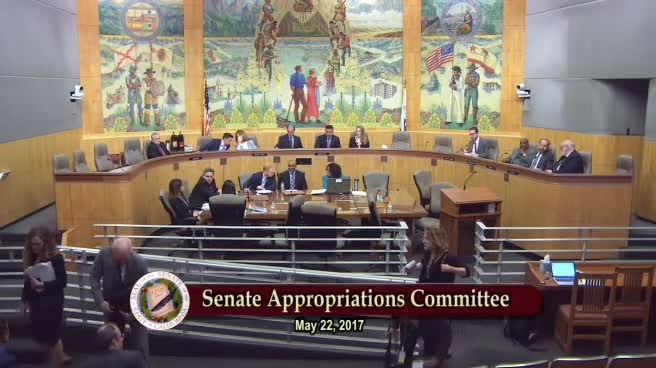 19SEC
Senate Standing Committee on Appropriations
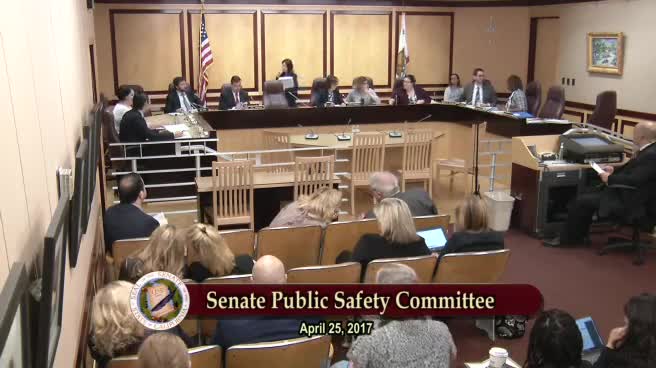 14MIN
Senate Standing Committee on Public Safety
Bill Author






