SR 125
- Session Year: 2017-2018
- House: Senate
- Latest Version Date: 2018-09-06
WHEREAS, The short-lived climate pollutants methane, hydrofluorocarbons and other fluorinated gases (F-gases), and black carbon are known as powerful super pollutants with tens to thousands of times more global warming potential than carbon dioxide; and
WHEREAS, Super pollutants contribute about 40 percent to the current anthropogenic global radiative forcing; and
WHEREAS, Reducing super pollutant emissions can immediately mitigate climate change and improve the public health; and
WHEREAS, In the past several years, California and the international community have enacted laws and implemented policies to reduce super pollutant emissions; and
WHEREAS, In 2014, with the passage of Senate Bill 605, California initiated development of a statewide super pollutant emissions reduction strategy; and
WHEREAS, In 2015, the European Union and Japan began enforcing new F-gas regulations, and multiple countries developed incentive programs to reduce hydrofluorocarbon emissions; and
WHEREAS, In 2016, with the passage of Senate Bill 1383, California committed to reducing statewide emissions of methane and hydrofluorocarbons by 40 percent below 2013 levels, and anthropogenic black carbon by 50 percent below 2013 levels, by 2030; and
WHEREAS, In 2016, nearly 200 countries negotiated and agreed to the Kigali amendment to the Montreal Protocol on Substances that Deplete the Ozone Layer to reduce production and consumption of hydrofluorocarbons; and
WHEREAS, In 2017, with the passage of Senate Bill 563, and in 2018, in the Budget Act of 2018, California established and funded the Woodsmoke Reduction Program, an incentive program to reduce black carbon emissions by phasing out the use of old, inefficient woodstoves and other wood-burning devices; and
WHEREAS, In 2018, as hydrofluorocarbons have become the fastest-growing source of greenhouse gas emissions, California is strengthening policies to reduce hydrofluorocarbon emissions by promoting investments in alternative cooling technologies; and
WHEREAS, Among super pollutants, methane is estimated to be responsible for 20 percent of current net climate forcing; and
WHEREAS, Methane emission from dairies is a concern in regions throughout the world; and
WHEREAS, Out of all of Californias climate-action programs, methane emissions reduction programs have the potential to achieve the states most significant reductions in greenhouse gas emissions; and
WHEREAS, Over the past three years, California has made investments of over $240 million to reduce methane emissions from dairies, including through alternative manure management strategies, development of dairy digesters at small and large dairies, and research projects to develop additional methane reduction strategies; and
WHEREAS, To date, California methane reduction grant programs that target dairy emissions are oversubscribed and highly cost effective in comparison to other statewide climate-action programs, and recently funded projects create a pathway for captured methane to become a carbon-neutral fuel for trucks and buses; and
WHEREAS, Californias leadership on super pollutant emissions reduction is consistent with broad international efforts to reduce greenhouse gas emissions; and
WHEREAS, International meetings provide a mechanism by which national and state governments can refine policies to further address super pollutant emissions; and
WHEREAS, Californias policies may serve as a blueprint for other state and regional governments; and
WHEREAS, At the upcoming Global Climate Action Summit in San Francisco, international organizers have scheduled an entire day to understanding the problem of super pollutant emissions and identifying solutions; now, therefore, be it
Resolved by the Senate of the State of California, That the Senate hereby proclaims the week of September 9, 2018, through September 15, 2018, inclusive, as Super Pollutant Reduction Week, to coincide with the Global Climate Action Summit; and be it further
Resolved, That the Secretary of the Senate transmit copies of this resolution to the author for appropriate distribution.
|
Date
|
Status
|
|---|---|
| Aug 30, 2018 | Read. Adopted. (Ayes 34. Noes 0.) |
| Aug 29, 2018 | From committee: Ordered to third reading. |
| Aug 28, 2018 | Introduced. Referred to Com. on RLS. |
|
Date
|
Description
|
Location
|
Votes
|
|
|---|---|---|---|---|
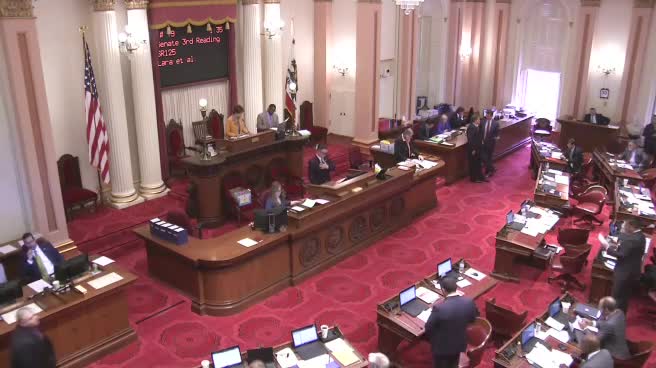
| Aug 30, 2018 | Senate 3rd Reading SR125 Lara et al. | Senate Floor |
Passed |
This list shows positions taken on this bill by organizations on the date displayed, which is linked to the original source.
Positions by individuals are not included.
Office of Senate Floor Analyses (916) 651-1520 Fax: (916) 327-4478 | SR 125 |
THIRD READING
Bill No: SR 125
Author: Lara (D), Allen (D), Jackson (D), Skinner (D), Stern (D), Wieckowski (D), Wiener (D)
Introduced: 8/28/18
SUBJECT: Super Pollutant Reduction Week
DIGEST:
This resolution proclaims the week of September 9, 2018, through September 15, 2018, inclusive, as Super Pollutant Reduction Week, to coincide with the Global Climate Action Summit.
ANALYSIS: This resolution makes the following legislative findings:
- The short-lived climate pollutants methane, hydrofluorocarbons and other fluorinated gases, and black carbon are known as powerful super pollutants with tens to thousands of times more global warming potential than carbon dioxide.
- Reducing super pollutant emissions can immediately mitigate climate change and improve the public health.
- In the past several years, California and the international community have enacted laws and implemented policies to reduce super pollutant emissions.
- Out of all of California’s climate-action programs, methane emissions reduction programs have the potential to achieve the state’s most significant reductions in greenhouse gas emissions.
- Among super pollutants, methane is estimated to be responsible for 20% of current net climate forcing. Methane emission from dairies is a concern in regions throughout the world.
- Over the past three years, California has made investments of over $240 million to reduce methane emissions from dairies, including through alternative manure management strategies, development of dairy digesters at small and large dairies, and research projects to develop additional methane reduction strategies.
- To date, California methane reduction grant programs that target dairy emissions are oversubscribed and highly cost effective in comparison to other statewide climate-action programs, and recently funded projects create a pathway for captured methane to become a carbon-neutral fuel for trucks and buses.
- California’s policies may serve as a blueprint for other state and regional governments.
This resolution proclaims the week of September 9, 2018, through September 15, 2018, inclusive, as Super Pollutant Reduction Week, to coincide with the Global Climate Action Summit.
Comments
According to the author, “The short-lived climate pollutants methane, hydrofluorocarbons and other fluorinated gases (F-gases), and black carbon are known as powerful super pollutants. Black carbon has a global warming potential over 3,000 times more than carbon dioxide, hydrofluorocarbons have global warming potentials 1400-4000 times higher than carbon dioxide, and methane has a global warming potential 80 times higher than carbon dioxide. In efforts to address climate change, governments and businesses initially focused on emissions from vehicles and power plants. These chemicals are all around us. For example, each year the HFCs leaked from an average supermarket represent the equivalent emissions to 300 cars on the roads. Although these are critical, it is only recently that super pollutants have become the focus for the development of policies and alternative technologies. Starting in 2014, California began addressing super pollutants by developing a super pollutant strategy. Further legislation in 2016 established 2030 targets for emissions reductions, and since that time specific incentive programs have been established to accelerate the adoption of alternative technologies. California has shown leadership, in particular, when it comes to engaging with dairies to reduce methane emissions. Because super pollutants are such strong climate forcers, the UN Climate and Clean Air Coalition has devoted an entire day of the upcoming Global Climate Action Summit to highlight the problems and solutions related to super pollutants. California’s leadership on super pollutant emissions reduction is consistent with broad international efforts to reduce greenhouse gas emissions. This resolution shines a light on these lesser known but extremely harmful superpollutants and furthers the opportunity for California to highlight its successes and work with other subnational governments on how to best improve policies to address these powerful pollutants.
FISCAL EFFECT: Appropriation: No Fiscal Com.: No Local: No
None received
OPPOSITION: (Verified 8/29/18)
None received
Prepared by: Melissa Ward / SFA / (916) 651-1520
8/29/18 23:19:28
**** END ****






Bill Co-Author(s):