SR 49
- Session Year: 2017-2018
- House: Senate
- Latest Version Date: 2017-07-18
WHEREAS, President Harry S. Truman issued Executive Order 9981 on July 26, 1948, which called for the desegregation of the Armed Forces, and in 1963 full integration was achieved with the Department of Defense Directive 5120.36 entitled Equal Opportunity in the Armed Forces; and
WHEREAS, In 1940, the United States Army was the nations largest minority employer. Executive Order 9981 states that there shall be equality of treatment and opportunity for all persons in the armed forces without regard to race, color, religion, or national origin and also established an advisory committee to examine the rules, practices, and procedures of the armed services and recommended ways to make desegregation a reality; and
WHEREAS, In December 1946, President Truman appointed a distinguished panel to serve on the Presidents Committee on Civil Rights, which recommended more adequate means and procedures for the protection of the civil rights of the people of the United States. When the committee issued its report, among other things, President Truman instructed the United States Secretary of Defense to look into alleged discrimination in the military and to see that it was stopped as soon as possible; and
WHEREAS, A. Philip Randolph organized and led the Brotherhood of Sleeping Car Porters, the first predominantly African American labor union, which, after successfully advocating for President Franklin D. Roosevelt to issue Executive Order 8802 in 1941, banning discrimination in the defense industries, successfully advocated for President Truman to issue Executive Order 9981; and
WHEREAS, It concerned A. Philip Randolph, who exerted political pressure on President Truman, that despite the recommendations of the Committee on Civil Rights, by late 1947, draft legislation and a Universal Military Training Bill were before Congress with Jim Crow law still very much in place. A. Philip Randolph reminded President Truman of the recommendation of the committee that the proposed draft law end segregation, and that he was disturbed that the desegregation clause had been deleted from the bill at the request of the army; and
WHEREAS, A. Philip Randolph told President Truman, Negroes are in no mood to shoulder a gun for democracy abroad so long as they are denied democracy here at home, and honed in on the point that he and others were calling for an executive order abolishing segregation in the Armed Forces; and
WHEREAS, On May 7, 1948, A. Philip Randolph and others marched in front of the White House. This dignified and regal man carried a sign with his slogan, If we must die for our country let us die as free mennot as Jim Crow slaves, and distributed buttons inscribed, Dont Join a Jim Crow Army; and
WHEREAS, As A. Philip Randolph became increasingly politically visible and consistently advocated in numerous letters to the President for an executive order to desegregate the Armed Forces, the military began to realize that the voices of African Americans must be taken into account; and
WHEREAS, On July 15, 1948, A. Philip Randolph and others formed a picket line in front of the Democratic National Convention in Philadelphia where President Truman gave his speech accepting the Democratic nomination for president. Although he had recommended only a mild civil rights plank in the Democratic Party platform, he stated his support for the civil rights program, and following his speech he instructed his staff to draft an executive order that would end segregation in the Armed Forces; and
WHEREAS, As a product of political pressure applied by A. Philip Randolph, on July 26, 1948, President Truman signed Executive Order 9981. According to the language of the order, It is hereby declared to be the policy of the President that there shall be equality of treatment and opportunity for all persons in the armed services without regard to race, color, religion, or national origin. This policy shall be put into effect as rapidly as possible, having due regard to the time required to effectuate any necessary changes without impairing efficiency or morale. The order also established the Presidents Committee on Equality of Treatment and Opportunity in the Armed Services, which was to determine that the rules, procedures, and practices of the armed services matched the new policy; now, therefore, be it
Resolved by the Senate of the State of California, That the Senate recognizes July 26, 2017, as the 69th anniversary of the desegregation of the United States Armed Forces; and be it further
Resolved, That the Secretary of the Senate transmit copies of this resolution to the author for appropriate distribution.
|
Date
|
Status
|
|---|---|
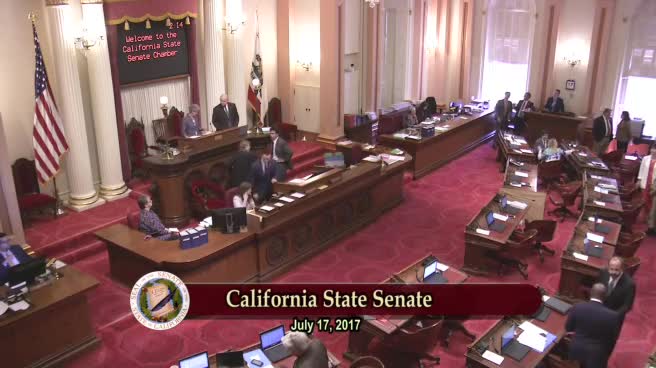
| Jul 17, 2017 | Read. Adopted. (Ayes 40. Noes 0.) |
| Jul 13, 2017 | From committee: Ordered to third reading. |
| Jul 11, 2017 | Introduced. Referred to Com. on RLS. |
|
Date
|
Description
|
Location
|
Votes
|
|
|---|---|---|---|---|
| Jul 17, 2017 | Local Bills | Senate Floor |
Passed |
This list shows positions taken on this bill by organizations on the date displayed, which is linked to the original source.
Positions by individuals are not included.
|
Organization
|
Position
|
Date
|
|---|---|---|
| AFSCME, AFL-CIO | ** Support | Jul 14, 2017 |
Office of Senate Floor Analyses (916) 651-1520 Fax: (916) 327-4478 | SR 49 |
THIRD READING
Bill No: SR 49
Introduced: 7/11/17
SUBJECT: Desegregation of the Armed Forces
DIGEST:
This resolution recognizes July 26, 2017, as the 69th anniversary of the desegregation of the United States Armed Forces.
ANALYSIS: This resolution makes the following legislative findings:
- President Truman issued Executive Order 9981 on July 26, 1948, which called for the desegregation of the Armed Forces, and in 1963 full integration was achieved with the Department of Defense Directive 5120.36 entitled “Equal Opportunity in the Armed Forces”.
- In December 1946, the President’s Committee on Civil Rights recommended “more adequate means and procedures for the protection of the civil rights of the people of the United States.” When the committee issued its report, President Truman instructed the Secretary of Defense to look into alleged discrimination in the military and to see that it was stopped as soon as possible.
- A. Philip Randolph organized and led the Brotherhood of Sleeping Car Porters, the first predominantly African American labor union, which, after successfully advocating for President Franklin D. Roosevelt to issue Executive Order 8802 in 1941, banning discrimination in the defense industries, successfully advocated for President Truman to issue Executive Order 9981.
- It concerned A. Philip Randolph, who exerted political pressure on President Truman, that despite the recommendations of the Committee on Civil Rights, by late 1947, draft legislation and a Universal Military Training Bill were before Congress with “Jim Crow” law still very much in place. A. Philip Randolph reminded President Truman of the recommendation of the committee that the proposed draft law end segregation, and that he was disturbed that the desegregation clause had been deleted from the bill at the request of the army.
- As A. Philip Randolph became increasingly politically visible and consistently advocated in numerous letters to the President for an executive order to desegregate the Armed Forces, the military began to realize that the voices of African Americans must be taken into account.
- On July 15, 1948, A. Philip Randolph and others formed a picket line in front of the Democratic National Convention in Philadelphia where President Truman gave his speech accepting the Democratic nomination for president. Although he had recommended only a mild civil rights plank in the Democratic Party platform, he stated his support for the civil rights program, and following his speech he instructed his staff to draft an executive order that would end segregation in the Armed Forces.
- As a product of political pressure applied by A. Philip Randolph, President Truman signed Executive Order 9981. According to the language of the order, “It is hereby declared to be the policy of the President that there shall be equality of treatment and opportunity for all persons in the armed services without regard to race, color, religion, or national origin. This policy shall be put into effect as rapidly as possible, having due regard to the time required to effectuate any necessary changes without impairing efficiency or morale.” The order also established the President’s Committee on Equality of Treatment and Opportunity in the Armed Services, which was to determine that the rules, procedures, and practices of the armed services matched the new policy.
This resolution recognizes July 26, 2017, as the 69th anniversary of the desegregation of the United States Armed Forces.
Related/Prior Legislation
HR 45 (Holden, 2017) recognizes July 26, 2017, as the 69th anniversary of the desegregation of the United States Armed Forces. The resolution is pending action on the Assembly Floor.
FISCAL EFFECT: Appropriation: No Fiscal Com.: No Local: No
AFSCME, AFL-CIO
OPPOSITION: (Verified 7/13/17)
None received
Prepared by: Melissa Ward / SFA / (916) 651-1520
7/14/17 13:48:43
**** END ****
Bill Author

Bill Co-Author(s):