AB 1180: Emergency medical services.
- Session Year: 2023-2024
- House: Assembly
- Latest Version Date: 2023-04-20
Current Status:
Failed
(2024-02-01: From committee: Filed with the Chief Clerk pursuant to Joint Rule 56.)
Introduced
In Committee
First Chamber
In Committee
Second Chamber
Enacted
Existing law establishes the Emergency Medical Services Authority, and requires the authority to be headed by a director who is a licensed physician and surgeon with substantial experience in the practice of emergency medicine.
This bill would remove the requirement that the director be a licensed physician and surgeon with substantial experience in the practice of emergency medicine and would instead require the director to have substantial experience in emergency medicine, emergency medical services, emergency management, or other related background. The bill would require the authority to have a chief medical officer who is appointed by the Governor upon nomination by the Secretary of California Health and Human Services. The bill would require the chief medical officer to be a physician and surgeon who has substantial experience in the practice of emergency medicine. The bill would require the chief medical officer to direct clinical, treatment, education, and other matters involving medical decisionmaking and delivery of patient care, as specified.
Existing law establishes the Emergency Medical Services Authority, and requires the authority to be headed by a director who is a licensed physician and surgeon with substantial experience in the practice of emergency medicine.
This bill would remove the requirement that the director be a licensed physician and surgeon with substantial experience in the practice of emergency medicine and would instead require the director to have substantial experience in the practice of emergency preparedness, response, and recovery. in emergency medicine, emergency medical services, emergency management, or other related background. The bill would require the authority to have a chief medical officer who is appointed by the Governor upon nomination by the Secretary of California Health and Human Services. The bill would require the chief medical officer to be a physician and surgeon who has substantial experience in the practice of emergency medicine.
Existing law establishes the Emergency Medical Services Authority, and requires the authority to be headed by a director who is a licensed physician and surgeon with substantial experience in the practice of emergency medicine.
This bill would remove the requirement that the director be a licensed physician and surgeon with substantial experience in the practice of emergency medicine and would instead require the director to have substantial experience in the practice of emergency preparedness, response, and recovery.
(a)The Emergency Medical Services Authority shall be headed by the Director of the Emergency Medical Services Authority who shall be appointed by the Governor upon nomination by the Secretary of California Health and Human Services. The director shall have substantial experience in emergency medicine, emergency medical services, emergency management, or other related background.
(b)(1)The Emergency Medical Services Authority shall have a chief medical officer of the Emergency Medical Services Authority who shall be appointed by the Governor upon nomination by the Secretary of California Health and Human Services. The chief medical officer shall be a physician and surgeon licensed in California pursuant to the provisions of Chapter 5 (commencing with Section 2000) of Division 2 of the Business and Professions Code, and who has substantial experience in the practice of emergency medicine.
(2)The chief medical officer shall direct clinical, treatment, education, and other matters involving medical decisionmaking and delivery of patient care, including, but not limited to, scope of practice, trauma system organization, stroke and STEMI requirements, and first aid and CPR training.
(a)The Emergency Medical Services Authority shall be headed by the Director of the Emergency Medical Services Authority who shall be appointed by the Governor upon nomination by the Secretary of California Health and Human Services. The director shall have substantial experience in the practice of emergency preparedness, response, and recovery. emergency medicine, emergency medical services, emergency management, or other related background.
(b)The Emergency Medical Services Authority shall have a chief medical officer of the Emergency Medical Services Authority who shall be appointed by the Governor upon nomination by the Secretary of California Health and Human Services. The chief medical officer shall be a physician and surgeon licensed in California pursuant to the provisions of Chapter 5 (commencing with Section 2000) of Division 2 of the Business and Professions Code, and who has substantial experience in the practice of emergency medicine.
The Emergency Medical Services Authority shall be headed by the Director of the Emergency Medical Services Authority who shall be appointed by the Governor upon nomination by the Secretary of California Health and Human Services. The director shall be a physician and surgeon licensed in California pursuant to the provisions of Chapter 5 (commencing with Section 2000) of Division 2 of the Business and Professions Code, and who has have substantial experience in the practice of emergency medicine. preparedness, response, and recovery.
|
Date
|
Status
|
|---|---|
| Feb 1, 2024 | From committee: Filed with the Chief Clerk pursuant to Joint Rule 56. |
| Jan 31, 2024 | Died pursuant to Art. IV, Sec. 10(c) of the Constitution. |
| May 18, 2023 | In committee: Held under submission. |
| May 18, 2023 | Joint Rule 62(a), file notice suspended. (Page 1580.) |
| May 17, 2023 | In committee: Set, first hearing. Referred to APPR. suspense file. |
| Apr 24, 2023 | Re-referred to Com. on APPR. |
| Apr 20, 2023 | Read second time and amended. |
| Apr 19, 2023 | From committee: Amend, and do pass as amended and re-refer to Com. on APPR. (Ayes 15. Noes 0.) (April 18). |
| Mar 30, 2023 | Re-referred to Com. on HEALTH. |
| Mar 29, 2023 | From committee chair, with author's amendments: Amend, and re-refer to Com. on HEALTH. Read second time and amended. |
| Mar 2, 2023 | Referred to Com. on HEALTH. |
| Feb 17, 2023 | From printer. May be heard in committee March 19. |
| Feb 16, 2023 | Read first time. To print. |
|
Date
|
Description
|
Location
|
Votes
|
|
|---|---|---|---|---|
| Apr 18, 2023 | Do pass as amended and be re-referred to the Committee on [Appropriations] | Assembly Standing Committee on Health |
Passed |
This list shows positions taken on this bill by organizations on the date displayed, which is linked to the original source.
Positions by individuals are not included.
|
Organization
|
Position
|
Date
|
|---|---|---|
| American College of Emergency Physicians - California Chapter | * Against Unless Amend | Apr 18, 2023 |
| Berkeley Fire Department | * Support | Apr 18, 2023 |
| California Fire Chief's Association | * Support | Apr 18, 2023 |
| California Professional Firefighters | * Support | Apr 18, 2023 |
| Fire District Association of California | * Support | Apr 18, 2023 |
| Health Officers Association Of California | * Against Unless Amend | Apr 18, 2023 |
| Lakeside Fire Protection Disctrict | * Support | Apr 18, 2023 |
| Newport Beach Fire | * Support | Apr 18, 2023 |
| Sacramento Metropolitan Fire District | * Support | Apr 18, 2023 |
| Santee Lakeside Emergency Medical Services | * Support | Apr 18, 2023 |
Date of Hearing: May 17, 2023
ASSEMBLY COMMITTEE ON APPROPRIATIONS
Chris Holden, Chair
ABPCA Bill Id:AB 1180
Author:(Rodriguez) – As Amended Ver:April 20, 2023
Policy Committee: | Health | Vote: | 15 - 0 |
|
| ||
|
|
Urgency: No State Mandated Local Program: No Reimbursable: No
SUMMARY:
This bill removes the requirement that the director of the Emergency Medical Services Authority (EMSA) be a licensed physician and surgeon with substantial experience in the practice of emergency medicine, and instead requires the director to have substantial experience in the practice of emergency preparedness, response, and recovery. The bill requires EMSA to have a chief medical officer (CMO) who is appointed by the Governor upon nomination by the Secretary of California Health and Human Services Agency and who is a physician who has substantial experience in the practice of emergency medicine.
FISCAL EFFECT:
EMSA states it would need up to $341,000 for the CMO (General Fund).
COMMENTS:
- Purpose. According to the author:
Current statute requires the EMSA Director to be a licensed physician and surgeon. While medical experience is useful for this role, physicians are only one portion of the EMS community. Other EMS professionals include paramedics, EMTs, firefighters, dispatchers, nurses, logisticians, administrators, and more. The duties of the EMSA Director span many areas of expertise, but with the current requirements, professionals with applicable experience are automatically ineligible from becoming EMSA Director. A prime example is current EMSA Acting Director Elizabeth “Liz” Basnett. Acting Director Basnett is not a physician, but rather an emergency management professional. She has successfully led EMSA through the majority of the COVID-19 pandemic and several statewide emergencies, clearly demonstrating that if you have the relevant experience and are well qualified, you can succeed in this role without being a physician or surgeon.
- Background. EMSA is the lead agency and centralized resource to oversee emergency and disaster medical services. Day-to-day EMS system management is the responsibility of the local and regional EMS agencies (LEMSAs). California has 34 LEMSAs that provide EMS for California's 58 counties.
The EMS Act of 1980 comprehensively regulates emergency medical care in California. The EMS Act provides for the creation of emergency medical procedures and protocols, certification of emergency medical personnel, and coordination of emergency responses by fire departments, ambulance services, hospitals, specialty care centers, and other providers within the local EMS system. - Proposed Budget Trailer Bill language. The Governor’s proposed budget for 2023 includes language removing the requirement that the EMSA director be a physician and requiring the appointment of a CMO.
According to background information provided by the Newsom administration to the Assembly Budget Committee, removing the MD requirement for EMSA’s director will assist EMSA with tapping into a broader candidate pool while focusing on the appropriate skillset with regards to public administration. The administration expects the creation of a CMO position within the leadership team to address the clinical components needed for patient safety and care while bringing substantial experience in the practice of emergency medicine. The EMSA director role requires a high-level of public administration experience to effectively manage all aspects of the statewide EMS system, including non-clinical programs that include policy development and implementation, personnel licensure, disaster response operations, system design and organization, and legal review.
Analysis Prepared by: Allegra Kim / APPR. / (916) 319-2081
Date of Hearing: April 18, 2023
ASSEMBLY COMMITTEE ON HEALTH
Jim Wood, Chair
ABPCA Bill Id:AB 1180
Author:(Rodriguez) – As Amended Ver:March 29, 2023
SUBJECT: Emergency medical services.
SUMMARY: Removes the requirement that the Director of the Emergency Medical Services Authority (EMSA) be a licensed physician and surgeon with substantial experience in the practice of emergency medicine and instead requires the Director to have substantial experience in the practice of emergency preparedness, response, and recovery. Requires EMSA to have a chief medical officer (CMO) who is appointed by the Governor upon nomination by the Secretary of California Health and Human Services Agency (CHHSA). Requires the CMO to be a physician and surgeon who has substantial experience in the practice of emergency medicine.
EXISTING LAW:
- Establishes the Emergency Medical Services (EMS) System and the Prehospital Emergency Medical Care Personnel Act (EMS Act) to provide for a statewide system for EMS, and establishes the Emergency Medical Services Authority (EMSA), which is responsible for the coordination and integration of all state activities concerning EMS, including the establishment of minimum standards, policies, and procedures. [Health and Safety Code (HSC) §1797, et seq.]
- Requires EMSA to be headed by the Director of EMSA who must be appointed by the Governor upon nomination by the Secretary of CHHSA. Requires the director to be a physician and surgeon licensed in California. [HSC § 1797.101]
- Requires EMSA, utilizing regional and local information, to assess each EMS area or the system’s service area for the purpose of determining the need for additional EMS, coordination of EMS, and the effectiveness of EMS. [HSC § 1797.102]
- Requires EMSA to develop planning and implementation guidelines for EMS systems which address the following components:
- Manpower and training;
- Communications;
- Transportation;
- Assessment of hospitals and critical care centers;
- System organization and management;
- Data collection and evaluation;
- Public information and education; and,
- Disaster response. [HSC § 1797.103]
- Requires EMSA to provide technical assistance to existing agencies, counties, and cities for the purpose of developing the components of EMS systems. [HSC § 1797.104]
FISCAL EFFECT: Unknown. This bill has not yet been analyzed by a fiscal committee.
COMMENTS:
- PURPOSE OF THIS BILL. According to the author, current law requires the EMSA Director to be a licensed physician and surgeon. While medical experience is useful for this role, physicians are only one portion of the EMS community. Other EMS professionals include paramedics, emergency medical technicians (EMTs), firefighters, dispatchers, nurses, logisticians, administrators, and more. The author notes that the duties of the EMSA Director span many areas of expertise, but with the current requirements, professionals with applicable experience are automatically ineligible from becoming EMSA Director. A prime example is current EMSA Acting Director Elizabeth “Liz” Basnett. Acting Director Basnett is not a physician, but rather an emergency management professional. She has successfully led EMSA through the majority of the COVID-19 pandemic and several statewide emergencies, clearly demonstrating that if you have the relevant experience and are well qualified, you can succeed in this role without being a physician or surgeon.
- BACKGROUND.
- EMSA. EMSA is the lead agency and centralized resource to oversee emergency and disaster medical services. Day-to-day EMS system management is the responsibility of the local and regional local EMS agencies (LEMSAs). California has 34 LEMSA systems that provide EMS for California's 58 counties. Regional systems are usually comprised of small, more rural, less-populated counties and single-county systems generally exist in the larger and more urban counties. There are seven regional EMS agencies comprised of 32 counties and 26 single-county LEMSAs. Both single and multi-county LEMSAs develop and submit five-year EMS plans and annual updates to EMSA for a local emergency EMS system according to the state system standards and guidelines. The purpose of the local EMS plans is to meet community EMS needs through the effective utilization of local resources. Between 2019 and June 2022, there were 33 LEMSAs. In July 2022, Stanislaus County separated from Mountain-Valley EMS (a multi-county LEMSA) bringing the total number of LEMSAs to 34.
The EMS Act comprehensively regulates emergency medical care in California. Enacted in 1980, the EMS Act provides for the creation of emergency medical procedures and protocols, certification of emergency medical personnel, and coordination of emergency responses by fire departments, ambulance services, hospitals, specialty care centers, and other providers within the local EMS system. - Governor’s proposed Budget Trailer Bill language. The Governor’s proposed Budget for 2023 includes identical language that would remove the medical doctor (MD) requirement for the EMSA Director and require the appointment of a CMO.
Existing law requires EMSA’s Director to be a licensed MD with substantial experience in the practice of emergency medicine. EMSA proposes to remove the MD requirement as a part of the requisite criteria to serve as the Director, and proposes to create a CMO who is an MD licensed in California with substantial experience in the practice of emergency medicine and who will be appointed by the Governor upon nomination by the Secretary of CHHSA.
According to background information provided by the Administration to the Assembly Budget Committee, removing the MD requirement for EMSA’s Director will assist EMSA with tapping into a broader candidate pool while at the same time focusing on the appropriate skillset with regards to public administration. This does not eliminate the importance of having physicians as part of the leadership team and as such, the creation of a CMO position within the leadership team will address the clinical components needed for patient safety and care while bringing substantial experience in the practice of emergency medicine. The EMSA Director role requires a high-level of public administration experience to effectively manage all aspects of the statewide EMS system. This includes non-clinical programs that include policy development and implementation, personnel licensure, disaster response operations, system design and organization, and legal review.
- EMSA. EMSA is the lead agency and centralized resource to oversee emergency and disaster medical services. Day-to-day EMS system management is the responsibility of the local and regional local EMS agencies (LEMSAs). California has 34 LEMSA systems that provide EMS for California's 58 counties. Regional systems are usually comprised of small, more rural, less-populated counties and single-county systems generally exist in the larger and more urban counties. There are seven regional EMS agencies comprised of 32 counties and 26 single-county LEMSAs. Both single and multi-county LEMSAs develop and submit five-year EMS plans and annual updates to EMSA for a local emergency EMS system according to the state system standards and guidelines. The purpose of the local EMS plans is to meet community EMS needs through the effective utilization of local resources. Between 2019 and June 2022, there were 33 LEMSAs. In July 2022, Stanislaus County separated from Mountain-Valley EMS (a multi-county LEMSA) bringing the total number of LEMSAs to 34.
- SUPPORT. The California Fire Chiefs Association and the Fire Districts Association of California are in support of this bill. The supporters note that EMSA is the heart of the administration and coordination of the vital emergency service system for all Californians. EMSA leads in developing and setting critical training standards for those engaged in emergency services and coordinates and supports local personnel responding to emergency incidents. Current law requires the Director to be an MD even though the EMS includes a vast array of professionals beyond doctors including paramedics, EMTs, firefighters, nurses, dispatchers, logisticians, emergency management experts, and many more. Currently, any of these professionals, despite their extensive training and experience, are automatically eliminated from eligibility from being the EMSA Director. The supporters state that since 2021, Acting Director Elizabeth Basnett has led EMSA. Ms. Basnett is not a physician but is an emergency management professional. She has also served the state as the Assistant Secretary of CHHSA where she has been responsible for leading the coordination of emergency preparedness, response, and recovery for CHHSA. The supporters conclude that Ms. Basnett not only has the qualifications to enable her to be successful as the EMSA Director, she already has proven to be a brilliant administrator in her acting capacity.
- OPPOSE UNLESS AMENDED. The California Chapter of the American College of Emergency Physicians is requesting amendments to require EMSA to have a CMO, who will be appointed by the Governor, and notes that the statute should also require that this officer be a physician with emergency medicine experience as well as experience in the pre-hospital arena who will act as ultimate medical authority at the organization.
The Health Officers Association of California (HOAC) opposes this bill unless it is amended to ensure that the CMO has sufficient authority and resources, and the organizational structure does not impede the CMO from carrying out the duties required. HOAC notes that medical oversight ensures that medical care provided by EMS is of high quality and consistent with established medical standards, and that personnel have the support, resources, and guidance they need to provide effective and safe care to patients. - RELATED LEGISLATION.
- AB 55 (Rodriguez) increases the Medi-Cal fee-for-service reimbursement rate for emergency medical transports, as specified. AB 55 is pending in the Assembly Health Committee.
- AB 296 (Rodriguez) establishes a 9-1-1 public education campaign within the California Office of Emergency Services. AB 296 is pending in the Assembly Communications and Conveyance Committee.
- AB 379 (Rodriguez) requires LEMSAs to adopt policies and procedures for calculating and reporting ambulance patient offload times, as specified. AB 379 is pending in the Assembly Committee on Emergency Management.
- AB 55 (Rodriguez) increases the Medi-Cal fee-for-service reimbursement rate for emergency medical transports, as specified. AB 55 is pending in the Assembly Health Committee.
- PREVIOUS LEGISLATION.
- AB 662 (Rodriguez) of 2021 would have required CHHSA to convene a working group no later than July 1, 2022, to examine existing dispatch and response protocols when providing EMS to an individual who may require evaluation and treatment for a mental health disorder. AB 662 was subsequently amended to address a different subject matter.
- AB 1229 (Rodriguez) of 2021 would have required the Director of EMSA to convene an advisory task force and to recommend a project plan for the task force that includes an evaluation relating to ambulance patient offload delays due to the COVID-19 pandemic. AB 1229 was held in the Assembly Appropriations Committee.
- AB 662 (Rodriguez) of 2021 would have required CHHSA to convene a working group no later than July 1, 2022, to examine existing dispatch and response protocols when providing EMS to an individual who may require evaluation and treatment for a mental health disorder. AB 662 was subsequently amended to address a different subject matter.
- SUGGESTED AMENDMENT. The Committee may wish to amend this bill to require to that the CMO will direct clinical, treatment, education and other matters involving medical decision making and delivery of patient care. These matters include but are not limited to scope of practice, trauma system organization, stroke and ST-Elevation Myocardial Infarction requirements, first aid, and CPR training.
REGISTERED SUPPORT / OPPOSITION:
Support
California Fire Chiefs Association
Fire Districts Association of California
Opposition
None on file.
Analysis Prepared by: Lara Flynn / HEALTH / (916) 319-2097
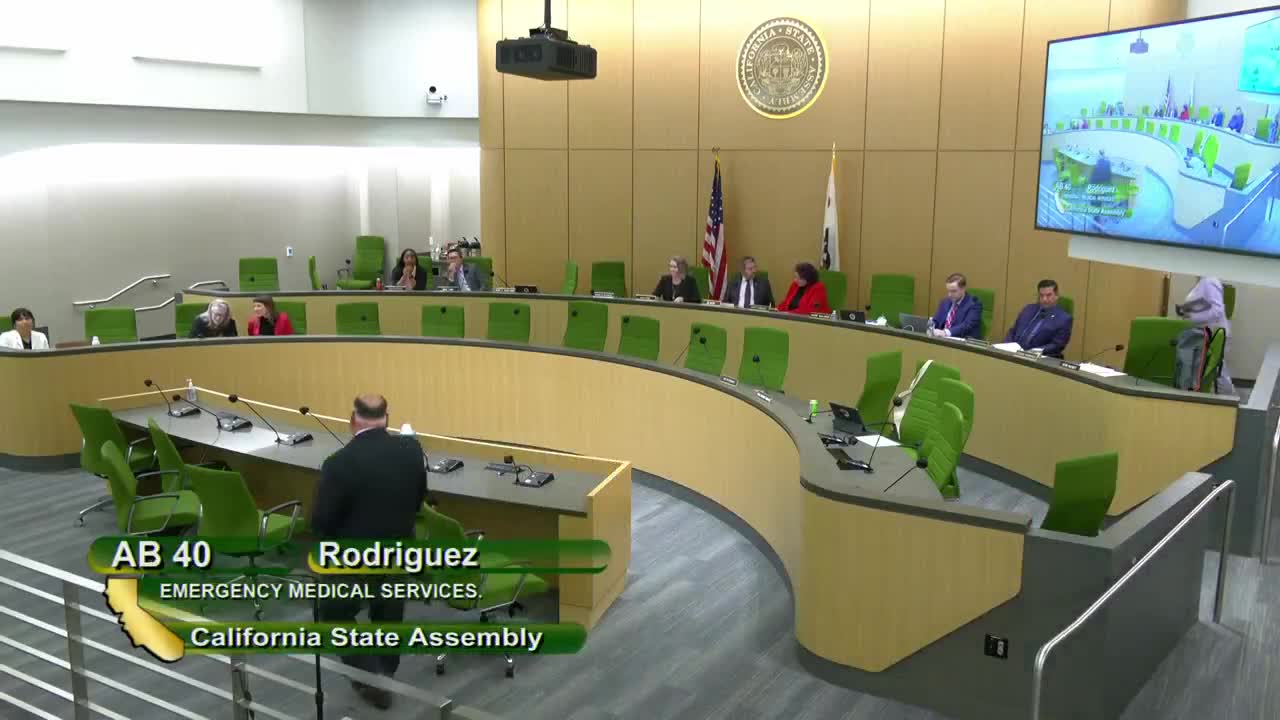
Bill Author

Bill Co-Author(s):