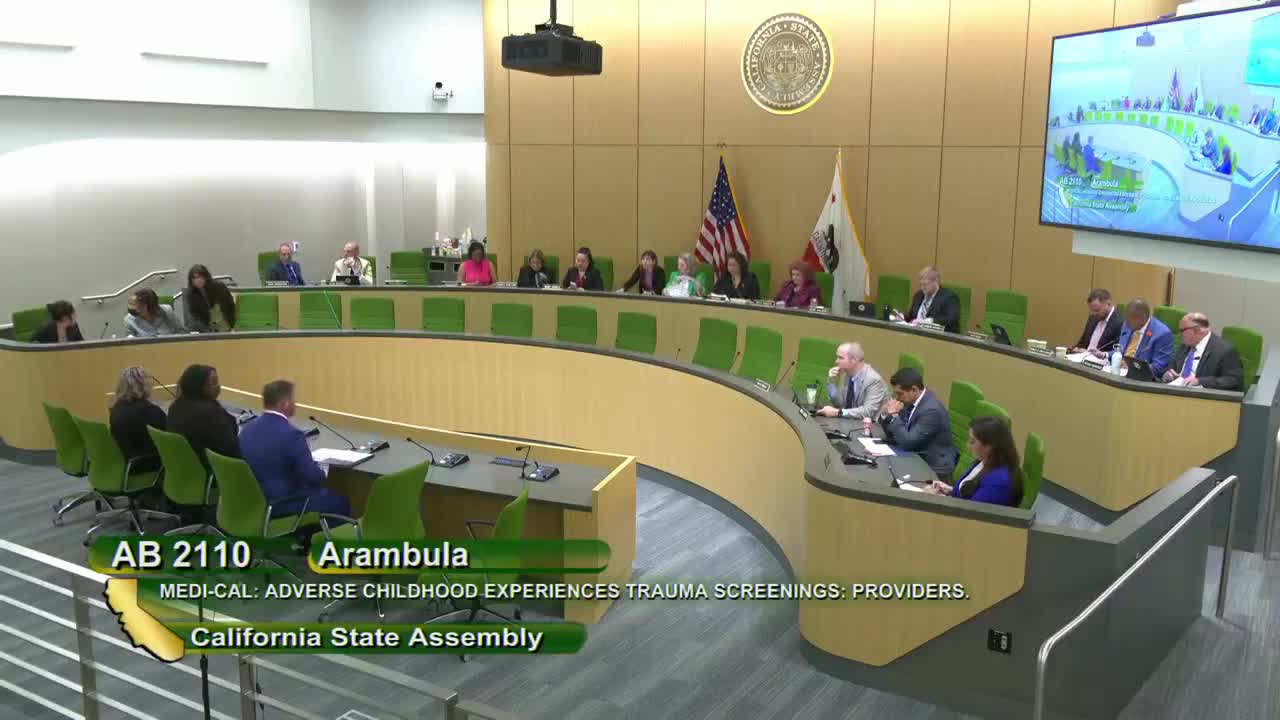
AB 2110: Medi-Cal: Adverse Childhood Experiences trauma screenings: providers.
- Session Year: 2023-2024
- House: Assembly
- Latest Version Date: 2024-02-05
Current Status:
Failed
(2024-05-16: In committee: Held under submission.)
Introduced
In Committee
First Chamber
In Committee
Second Chamber
Enacted
Existing law establishes the Medi-Cal program, which is administered by the State Department of Health Care Services and under which qualified low-income individuals receive health care services. The Medi-Cal program is, in part, governed and funded by federal Medicaid program provisions.
Existing law requires that Medi-Cal provider payments and payments for specified non-Medi-Cal programs be reduced by 10% for dates of service on and after June 1, 2011, and conditions implementation of those payment reductions on receipt of any necessary federal approvals. Existing law, for dates of service on and after July 1, 2022, authorizes the maintenance of the reimbursement rates or payments for specified services, including, among others, Adverse Childhood Experiences (ACEs) trauma screenings and specified providers, using General Fund or other state funds appropriated to the State Department of Health Care Services as the state share, at the payment levels in effect on December 31, 2021, as specified, under the California Healthcare, Research and Prevention Tobacco Tax Act of 2016 that were implemented with funds from the Healthcare Treatment Fund, as specified. Existing law requires the department to develop the eligibility criteria, methodologies, and parameters for the payments and rate increases maintained, and would authorize revisions, as specified.
This bill would require the department, as part of its above-described duties, to include (1)community-based organizations and local health jurisdictions that provide health services through community health workers and (2)doulas, that are enrolled Medi-Cal providers, as providers qualified to provide, and eligible to receive payments for, ACEs trauma screenings pursuant to the provisions described above. The bill would require the department to file a state plan amendment and seek any federal approvals it deems necessary to implement these provisions and condition implementation on receipt of any necessary federal approvals and the availability of federal financial participation. The bill would also require the department to update its internet website and the ACEs Aware internet website to reflect the addition of the Medi-Cal providers described above as authorized to provide ACEs screenings.
(a)The department shall, as part of its requirements under subdivision (d) of Section 14105.197, include the following enrolled Medi-Cal providers as providers qualified to provide, and eligible to receive payments for, Adverse Childhood Experiences (ACEs) trauma screenings pursuant to Section 14105.197:
(1)Community-based organizations and local health jurisdictions that provide health services through community health workers.
(2)Doulas.
(b)The department shall file a state plan amendment and seek any federal approvals it deems necessary to implement this section. This section shall be implemented only to the extent that any necessary federal approvals are obtained and federal financial participation is available and is not otherwise jeopardized.
(c)The department shall update its internet website and the ACEs Aware website to reflect the addition of the Medi-Cal providers described in subdivision (a) as qualified to provide ACEs trauma screenings.
|
Date
|
Status
|
|---|---|
| May 16, 2024 | In committee: Held under submission. |
| May 1, 2024 | In committee: Set, first hearing. Referred to APPR. suspense file. |
| Apr 10, 2024 | From committee: Do pass and re-refer to Com. on APPR. (Ayes 16. Noes 0.) (April 9). Re-referred to Com. on APPR. |
| Feb 20, 2024 | Referred to Com. on HEALTH. |
| Feb 6, 2024 | From printer. May be heard in committee March 7. |
| Feb 5, 2024 | Read first time. To print. |
|
Date
|
Description
|
Location
|
Votes
|
|
|---|---|---|---|---|
| Apr 9, 2024 | Do pass and be re-referred to the Committee on [Appropriations] | Assembly Standing Committee on Health |
Passed |
This list shows positions taken on this bill by organizations on the date displayed, which is linked to the original source.
Positions by individuals are not included.
|
Organization
|
Position
|
Date
|
|---|---|---|
| ACE Overcomers of Merced County | ** Support | |
| Alliance for Children's Rights | ** Support | |
| Beloved Survivors Trauma Recovery Center | ** Support | |
| Black Wellness & Prosperity Center | ** Support | |
| California Family Resource Association | ** Support | |
| California Pan - Ethnic Health Network | ** Support | |
| California State Association of Psychiatrists | * Support | Apr 9, 2024 |
| Centro La Familia Advocacy Services | ** Support | |
| Child Abuse Prevention Center | ** Support | |
| Children Now | * Support | Apr 9, 2024 |
| Common Good Solutions LLC | ** Support | |
| County Health Executives Association Of California | * Support | Apr 9, 2024 |
| Cultiva La Salud | * Support | Apr 9, 2024 |
| Easterseals Central California | ** Support | |
| First 5 Fresno County | ** Support | |
| Fresno Community Health Improvement Partnership | * Support | Apr 9, 2024 |
| Frontline Perinatal Liberation LLC | ** Support | |
| Jakara Movement | ** Support | |
| Jurupa Valley Doulas | ** Support | |
| Local Health Plans Of California | * Support | Apr 9, 2024 |
| Pathways Community Hub Institute | ** Support | |
| Prevent Child Abuse California | ** Support | |
| Safe Kids California | ** Support | |
| State Center Community College District | ** Support | |
| The Western Center on Law and Poverty | * Support | Apr 9, 2024 |
| West Fresno Healthcare Coalition | ** Support |
Date of Hearing: May 1, 2024
ASSEMBLY COMMITTEE ON APPROPRIATIONS
Buffy Wicks, Chair
ABPCA Bill Id:AB 2110
Author:(Arambula) – As Introduced Ver:February 5, 2024
Policy Committee: | Health | Vote: | 16 - 0 |
|
| ||
|
|
Urgency: No State Mandated Local Program: No Reimbursable: No
SUMMARY:
This bill makes (1) community-based organizations (CBOs) and local health jurisdictions (LHJs) that provide health services through community health workers (CHWs) and (2) doulas eligible to provide, and be reimbursed by Medi-Cal for, Adverse Childhood Experiences (ACEs) trauma screenings.
Specifically, this bill requires the Department of Health Care Services (DHCS) to:
- Include CBOs and LHJs with CHWs as providers of ACEs screenings.
- Include doulas as providers of ACEs screenings.
- File a state plan amendment and seek any federal approvals it deems necessary to implement the bill, and conditions implementation on the availability of federal financial participation and receipt of any necessary federal approvals.
- Update its website and the ACEs Aware website to reflect the addition of the Medi-Cal providers in 1 and 2, above, as qualified to provide ACEs trauma screenings.
FISCAL EFFECT:
Costs of an unknown amount, likely exceeding $150,000 per year (General Fund, federal funds).
According to the Legislative Analyst’s Office, the General Fund faces a structural deficit in the tens of billions of dollars over the next several fiscal years.
COMMENTS:
- Purpose. This bill is sponsored by Black Wellness and Prosperity Center (BWPC) and the Fresno Community Health Improvement Partnership (FCHIP). According to the author:
All Californians should have access to trauma-informed Adverse Childhood Experiences screenings by health care providers they trust. Adverse Childhood Experiences, also known as ACEs, can have life-long negative impact on physical and behavioral health. ACEs screenings enable providers to identify patients who are at higher risk for toxic stress and develop a trauma-informed care plan. Because community health workers and doulas are trusted messengers in the communities they serve, AB 2011 will authorize them to receive Medi-Cal reimbursement for ACEs screenings.
- Related Legislation.
- AB 2250 (Weber) requires a health plan, health insurer, and Medi-Cal to provide coverage for, and provider reimbursement of, social determinants of health (SDOH) screenings, and requires a health plan or insurer to provide certain physicians with adequate access to peer support specialists, lay health workers, social workers, or CHWs. AB 2250 also provides for reimbursement of SDOH screenings at the Medi-Cal fee-for-service rate for certain primary care clinics. AB 2250 is pending in this committee.
- AB 85 (Weber) is similar to AB 2250 (Weber), above, and requires the Department of Health Care Access and Information to convene a working group. AB 85 was vetoed by Governor Newsom, who argued the proposal was duplicative of existing efforts, such as ACEs screenings and the work DHCS is doing through the CalAIM initiative, and that the bill might be premature, given the absence of a standardized SDOH screening tool.
- AB 1110 (Arambula) requires DHCS and the California Office of the Surgeon General to develop guidance for culturally and linguistically competent ACEs screenings. AB 1110 was held in Senate Appropriations Committee.
- AB 2250 (Weber) requires a health plan, health insurer, and Medi-Cal to provide coverage for, and provider reimbursement of, social determinants of health (SDOH) screenings, and requires a health plan or insurer to provide certain physicians with adequate access to peer support specialists, lay health workers, social workers, or CHWs. AB 2250 also provides for reimbursement of SDOH screenings at the Medi-Cal fee-for-service rate for certain primary care clinics. AB 2250 is pending in this committee.
- Prior Legislation.
- AB 2697 (Aguiar-Curry), Chapter 488, Statutes of 2022, codifies CHW services as a covered Medi-Cal benefit.
- SB 428 (Hurtado), Chapter 641, Statutes of 2021, requires health plans and insurers that cover pediatric services and preventive care to also cover ACEs screenings.
- SB 184 (Committee on Budget and Fiscal Review), Chapter 47, Statutes of 2022, authorizes the use of General Fund, in place of funds from Proposition 56 (the California Healthcare, Research and Prevention Tobacco Tax Act of 2016), for supplemental payments for specified Medi-Cal providers, for, ACEs screenings among other services.
- ACR 8 (Jones-Sawyer), of 2017, recognized ACEs, also known as post-traumatic “street” disorder in communities of color, as having lasting negative outcomes to both physical and mental health with growing implications for our state.
- AB 2697 (Aguiar-Curry), Chapter 488, Statutes of 2022, codifies CHW services as a covered Medi-Cal benefit.
Policy Question. The Assembly Health Committee analysis questioned whether, given the unique features of ACEs screening and the value of incorporating the results into clinical care, should the state encourage or allow nonclinical providers to independently provide and bill for ACEs screening, outside of a clinical setting.
Analysis Prepared by: Allegra Kim / APPR. / (916) 319-2081
Date of Hearing: April 9, 2024
ASSEMBLY COMMITTEE ON HEALTH
Mia Bonta, Chair
ABPCA Bill Id:AB 2110
Author:((Arambula) – As Introduced Ver:February 5, 2024
SUBJECT: Medi-Cal: Adverse Childhood Experiences trauma screenings: providers.
SUMMARY: Allows doulas, as well as community-based organizations (CBOs) and local health jurisdictions (LHJs) that provide health services through community health workers (CHWs), to provide Adverse Childhood Experiences trauma screenings (ACEs screening) and makes them eligible for Medi-Cal reimbursement for the screening. Specifically, this bill requires the Department of Health Care Services (DHCS) to:
- Include CBOs/LHJs and doulas as providers of ACE screenings.
- File a state plan amendment and seek any federal approvals it deems necessary to implement the bill, and conditions implementation on the availability of federal financial participation and receipt of any necessary federal approvals.
- Update its internet website and the ACEs Aware website to reflect the addition of the Medi-Cal providers described in subdivision (a) as qualified to provide ACEs trauma screenings.
EXISTING LAW:
- Establishes the Medi-Cal Program, administered by DHCS, to provide comprehensive health benefits to low-income individuals who meet specified eligibility criteria. [Welfare and Institutions Code (WIC) §14000 et seq.]
- Establishes a schedule of benefits under the Medi-Cal program. [WIC §14132]
- Establishes CHW services as a Medi-Cal benefit. [WIC §14132.36]
- Requires DHCS to convene a workgroup to examine the implementation of the Medi-Cal doula benefit and to, by July 1, 2025, publish a report on utilization of the benefit that identifies any barriers that impede access to doula services and make recommendations to reduce any identified barriers. [WIC §14132.24]
- For services provided on or after July 1, 2022, allows General Fund or other state funds to be used to maintain payment levels for ACEs screenings under Medi-Cal at the payment levels in effect on December 31, 2021, inclusive of supplemental payments established under Proposition 56, an initiative measure approved in 2016. [WIC §14105.197]
- Requires DHCS, in consultation with the State Department of Social Services (DSS) and stakeholders, to convene an advisory working group to update, amend, or develop, if appropriate, tools and protocols for the screening of children for trauma, within the Early and Periodic Screening, Diagnostic and Treatment benefit, consistent with existing law and this section. [WIC §14132.19]
- Defines trauma as the result of an event, series of events, or set of circumstances that is experienced by an individual as physically or emotionally harmful or threatening and that has lasting adverse effects on the individual’s functioning and physical, social, emotional, or spiritual well-being. [Ibid.]
- Requires a health care service plan contract issued, amended, or renewed on or after January 1, 2022, that provides coverage for pediatric services and preventive care, to include coverage for ACEs screenings. [Health & Safety Code Section 1367.34]
- Permits the Department of Managed Health Care (DMHC) to adopt guidance to health care service plans to implement 8) above. Requires DMHC’s guidance to apply the rules and regulations for screening for trauma as set forth in the Medi-Cal program as the minimum ACEs coverage requirements for health care service plans. Specifies that this provision does not prohibit a health care service plan from exceeding the Medi-Cal program’s rules and regulations for trauma screening. [Ibid.]
FISCAL EFFECT: Unknown. This bill has not yet been analyzed by a fiscal committee.
COMMENTS:
- PURPOSE OF THIS BILL. According to the author, all Californians should have access to trauma-informed ACEs screenings by health care providers they trust. ACEs can have life-long negative impact on physical and behavioral health. The author indicates ACEs screenings enable providers to identify patients who are at higher risk for toxic stress and develop a trauma-informed care plan. Accordingly, because CHWs and doulas are trusted messengers in the communities they serve, this bill will authorize them to receive Medi-Cal reimbursement for ACEs screenings. This bill is sponsored by the BLACK Wellness & Prosperity Center (BWPC) and the Fresno Community Health Improvement Partnership (FCHIP).
- BACKGROUND.
- ACES. Addressing ACEs has been a signature state initiative of the California Office of the Surgeon General (CA-OSG). According to the CA-OSG, the term “ACEs” refers to 10 categories of childhood experience across three domains that were identified in a landmark 1998 study by the Centers for Disease Control and Prevention (CDC) and Kaiser Permanente. The experiences measured by ACEs screening, by domain, are abuse (physical, emotional, or sexual abuse), neglect (physical or emotional), and “household dysfunction” (parental incarceration, mental illness, substance dependence, parental separation or divorce, and intimate partner violence).
According to a 2023 CDC article in the Morbidity and Mortality Weekly Report, “Prevalence of Adverse Childhood Experiences Among U.S. Adults — Behavioral Risk Factor Surveillance System, 2011–2020,” among U.S. adults from all 50 states and the District of Columbia surveyed during 2011–2020, approximately two thirds reported at least one ACE; one in six reported four or more ACEs. ACEs were highest among women, persons aged 25 to 34 years, non-Hispanic American Indian or Alaska Native adults, non-Hispanic multiracial adults, adults with less than a high school education, and adults who were unemployed or unable to work. The prevalence of individual and total number of ACEs varied across jurisdictions.
- ACES. Addressing ACEs has been a signature state initiative of the California Office of the Surgeon General (CA-OSG). According to the CA-OSG, the term “ACEs” refers to 10 categories of childhood experience across three domains that were identified in a landmark 1998 study by the Centers for Disease Control and Prevention (CDC) and Kaiser Permanente. The experiences measured by ACEs screening, by domain, are abuse (physical, emotional, or sexual abuse), neglect (physical or emotional), and “household dysfunction” (parental incarceration, mental illness, substance dependence, parental separation or divorce, and intimate partner violence).
According to the California ACEs Aware initiative, ACEs screening has been successfully integrated into a wide range of clinical settings, including pediatric primary care, adult primary care, family medicine, and women’s health and prenatal care. Prominent health care and public health organizations, such as the National Academies of Science, Engineering, and Medicine, CDC, and American Academy of Pediatrics now recommend screening for ACEs.
- Why are ACEs Important to Health Care? CA-OSG indicates understanding the science of ACEs and toxic stress, and how it can manifest in the body, is critical to effective treatment planning for patients. High levels of adversity, without the buffering protections of trusted caregivers and safe, stable environments, lead to changes in brain structure and function, how genes are read, functioning of the immune and inflammatory systems, and growth and development. These changes comprise the “toxic stress response.”
According to the Harvard Center for the Developing Child (Center), toxic stress response can occur when a child experiences strong, frequent, and/or prolonged adversity. Toxic stress is distinguished from “positive stress responses,” which are normal and essential part of healthy development, characterized by brief increases in heart rate and mild elevations in hormone levels, and “tolerable stress response,” in which the body’s alert systems are activated to a greater degree as a result of more severe, longer-lasting difficulties, such as the loss of a loved one, a natural disaster, or a frightening injury. If the activation from tolerable stress response is time-limited and buffered by relationships with adults who help the child adapt, the brain and other organs recover from what might otherwise be damaging effects.
- Why are ACEs Important to Health Care? CA-OSG indicates understanding the science of ACEs and toxic stress, and how it can manifest in the body, is critical to effective treatment planning for patients. High levels of adversity, without the buffering protections of trusted caregivers and safe, stable environments, lead to changes in brain structure and function, how genes are read, functioning of the immune and inflammatory systems, and growth and development. These changes comprise the “toxic stress response.”
The Center indicates the more adverse experiences in childhood, the greater the likelihood of developmental delays and later health problems, including heart disease, diabetes, substance abuse, and depression.
While the mechanism of exactly how toxic stress impacts the brain and body are still somewhat unclear, ACEs have been described as having a dose-response effect where higher ACE scores are more strongly associated with poor health outcomes at a population level. In adults, experiencing four or more ACEs is associated with significantly increased risk for nine out of 10 leading causes of death in adulthood, such as heart disease, stroke, cancer, chronic obstructive pulmonary disease, diabetes, Alzheimer’s, and suicide. Research indicates ACEs can follow a generational pattern, where children of parents of ACEs can be at greater risk themselves. For children, having two or more ACEs has been associated with poor health, sleep disturbance, somatic complaints, reduced cognitive ability, childhood obesity, asthma symptoms and hospitalization, higher likelihood of being bullied, higher probability of affected males perpetrating bullying, reduced levels of school engagement, and being more likely to repeat a grade in school.
Although ACEs are associated with a high number of negative health outcomes at a population level, screening for ACEs has not yet shown an ability to predict risk for negative health outcomes on an individual basis. While health conditions associated with ACEs can precede, coincide with, or follow ACEs occurring, the California Health Benefits Review Program notes that none of these studies have identified a direct, causal link between an ACE and a particular health outcome. Rather, the cumulative effect of an elevated stress response over an extended period of time can put individuals at higher risk for a variety of poor outcomes.
- ACEs Aware Initiative. The ACEs Aware Initiative offers Medi-Cal providers training and clinical protocols for screening children and adults for ACEs. The training educates Medi-Cal providers about the importance of incorporating ACE screenings into their clinical practices, how to conduct ACE screenings, how to use clinical protocols to determine treatment plans, and best practices in providing trauma-informed care.
According to the ACEs Aware training materials, non-licensed providers like CHWs often play important roles in facilitating the screenings, which are often provided in a team-based care environment. For example, non-licensed staff can review records to determine if the ACEs screen is indicated, provide the questionnaire to the patient or caregiver, and transcribe the ACEs score into the medical record. Staff then transmit this information to a licensed clinician (the billing provider) who documents that the completed screen was reviewed, interprets the results (including assessing whether the patient has any ACE-Associated Health Conditions), discusses the results with the patient, and integrates this ACE screening information into the treatment plan for the patient.
ACEs Aware also provides an “ACEs and Toxic Stress Risk Assessment Algorithm” that helps a provider assess whether a patient is at low, intermediate, or high risk of a toxic stress physiology, based on the ACE score and the presence or absence of ACE-associated health conditions. According to the algorithm, a patient with an ACEs score of one to three without associated health conditions is at intermediate risk, while a patient with an ACEs score of one to three with associated health conditions is at high risk, of toxic stress. A patient's status as intermediate risk or high risk, and the presence or absence of ACE-associated health conditions, has implications for the education and guidance that is offered by the provider after the assessment, and it also informs treatment planning and follow-up care. In other words, the algorithm indicates that conducting the Pediatric ACEs and Related Life-events Screener (PEARLS) or other assessment tool is just a portion of the ACEs screening—the other portions include the clinical assessment of the interplay between ACEs, risk of toxic stress, and ACE-associated health conditions, incorporation of the results into the patient’s care plan, and documentation of the results in the patient’s medical record along with the provider’s notes.
- ACEs Medi-Cal Screening Data. On January 1, 2020, California became the first state to screen for ACEs through the state’s Medi-Cal program. Medi-Cal reimburses for ACEs screenings for both children and adults up to 65 years of age.
According to the February 2024 ACE Screening and Clinician Training Data Quarterly Progress Report, between the launch of ACEs Aware Initiative in December 2019 and March 31, 2023, Medi-Cal clinicians conducted more than 2.3 million ACE screenings of over 1.5 million unique Medi-Cal members. More than 35,000 individuals completed the Becoming ACEs Aware in California training, including approximately 17,100 Medi-Cal clinicians who are ACEs Aware-certified and eligible to receive Medi-Cal payment for conducting ACE screenings.
Of the 1.2 million unique Medi-Cal members ages 0 to 20 screened for ACEs, 5% had an ACE score of four or more. Of the nearly 300,000 unique Medi-Cal members ages 21 to 64 screened for ACEs, 15% had an ACE score of four or more.
- Current Medi-Cal Reimbursement Policy for ACEs. Providers must meet the requirements of the billing code in order to be reimbursed for Medi-Cal covered services. DHCS defines these requirements as follows:
- Billing Codes and Required Components. To be reimbursed for ACEs screening, providers bill one of the following Healthcare Common Procedure Coding System (HCPCS) codes:
- G9919: ACEs score of four or greater, high risk. Screening performed – result indicates patient at high risk for toxic stress; education and interventions (as necessary) provided; or,
- G9920: ACEs score of 0 to three, lower risk. Screening performed – result indicates patient at lower risk for toxic stress; education and interventions (as necessary) provided.
- Billing Codes and Required Components. To be reimbursed for ACEs screening, providers bill one of the following Healthcare Common Procedure Coding System (HCPCS) codes:
- Current Medi-Cal Reimbursement Policy for ACEs. Providers must meet the requirements of the billing code in order to be reimbursed for Medi-Cal covered services. DHCS defines these requirements as follows:
Providers must document the following: completed screen was reviewed, appropriate tool was used, ACEs screening results, interpretation of results, discussion with the beneficiary and/or family, and any appropriate actions taken. This documentation should remain in the beneficiary’s medical record and be available upon request. Clinical risk assessment and management should be pursued according to the ACEs Aware Screening Clinical Workflows, ACEs and Toxic Stress Risk Assessment Algorithm, and ACE-Associated Health Conditions guidelines.
DHCS notes, in a training presentation on ACEs screening, that the clinical response to identification of ACEs and increased risk of toxic stress should include the following:
- Applying principles of trauma-informed care;
- Identification and treatment of ACE-associated health conditions;
- Patient education about toxic stress and buffering interventions, including supportive relationships, mental health treatment, exercise, sleep hygiene, healthy nutrition, and mindfulness and medication practices;
- Validation of existing strengths and protective factors;
- Referral to patient resources; and,
- Follow-up as necessary.
- Providers. Screening is reimbursable for providers who have taken a certified training and self-attested to their completion of the training. ACE screening is reimbursable in all inpatient and outpatient settings in which billing occurs through Medi-Cal fee-for-service (FFS) or to network providers of a Medi-Cal managed care plan (MCP). Providers who are eligible to bill for ACEs screening include the following; however, the provider must meet all requirements of the billing code:
- Certified Nurse Midwife;
- Certified Nurse Practitioner;
- Group Certified Nurse Practitioners;
- Early and Periodic Screening, Diagnostic, and Treatment Services Providers;
- Licensed Clinical Social Worker – Individual, Group;
- Licensed Nurse Midwife;
- Licensed Professional Clinical Counselor – Individual, Group;
- Marriage and Family Therapist – Individual, Group;
- Physician;
- Physician Group;
- Psychologist;
- County Hospital – Outpatient;
- County Clinics not associated with a Hospital;
- Indian Health Services/Memorandum of Agreement;
- Otherwise Undesignated Clinic;
- Outpatient Heroin Detox Center;
- Rehabilitation Clinic;
- Rural Health Clinic (RHC)/Federally Qualified Health Center (FQHC); and,
- In-state and border providers.
- Screening Tools. For children, providers must use the PEARLS tool. There are versions of the tool based upon age: PEARLS for children ages 0 to 11, to be completed by a caregiver; PEARLS for teenagers 12 to 19, to be completed by a caregiver; and PEARLS for teenagers 12 to 19, self-reported. For adults, providers must use the ACE Assessment Tool adapted from the work of Kaiser Permanente and the CDC, or a similar alternative.
- Frequency Limits. Children under age 21 may receive periodic rescreening as determined appropriate and medically necessary, not more than once per year, per provider, or per provider per managed care plan (for beneficiaries enrolled in plans) Adults age 21 and over may be screened once in their adult lifetime up to age 65, per provider, or per provider per managed care plan (for beneficiaries enrolled in plans).
- Payments. Providers can bill and be reimbursed at a rate of $29 by FFS Medi-Cal and by MCPs. ACEs screenings performed in federally qualified health centers, rural health clinics, and certain Indian Health Services clinics are paid at the $29 rate.
- CHWs and Doulas. In an effort to improve health equity and outcomes, Medi-Cal recently began covering the services of CHWs and doulas through the CHW and doula Medi-Cal benefits. These new provider types and benefits can often offer a more tailored and culturally relevant care experience. CHWs and doulas can also improve health equity by offering support, education, advocacy and linkages to resources to Medi-Cal enrollees who may be at particular risk for worse health outcomes. Although there is some overlap in the allowable services, CHWs and doulas are distinct in their training and experience, as well as the specific services Medi-Cal covers under each benefit. Key provisions of both benefits, as described in the Medi-Cal provider manual, are listed below. Neither CHW services or doula services are required to be covered by commercial plans and insurers, although statute encourages coverage for doulas as part of required maternal mental health programs, and AB 2250 (Weber), which is currently under consideration in the Legislature, would require commercial plans and insurers to provide access to CHWs.
- Doula Services. Doulas are defined as birth workers who provide health education, advocacy, and physical, emotional and nonmedical support for pregnant and postpartum persons before, during and after childbirth (perinatal period) including support during miscarriage, stillbirth and abortion. Doulas are not licensed or clinical providers, and they do not require supervision.
Doula services encompass health education, advocacy, and physical, emotional and nonmedical support provided before, during and after childbirth or end of a pregnancy, including throughout the postpartum period. Doulas offer various types of support, including perinatal support and guidance; health navigation; evidence-based education and practices for prenatal, postpartum, childbirth, and newborn/infant care; lactation support; development of a birth plan; and linkages to community-based resources. Coverage also includes comfort measures and physical, emotional, and other nonmedical support provided during labor and delivery and for miscarriage and abortion.
Doulas bill as independent providers, or as part of a group. Doulas are allowed to bill, for a single pregnancy: One initial visit; Up to eight additional visits that may be provided in any combination of prenatal and postpartum visits; Support during labor and delivery (including labor and delivery resulting in a stillbirth), abortion or miscarriage; and up to two extended three-hour postpartum visits after the end of a pregnancy.
Doula services are defined as a “preventive service” under federal regulation; therefore, services must be recommended by a licensed health care provider. To increase access to services, on November 1, 2023, the DHCS Medical Director, Karen Mark, MD, PhD, issued a standing recommendation for doula services, which fulfills the requirement for a recommendation for an individual who is pregnant or was pregnant within the past year.
- CHW Services. DHCS added CHW services, including violence prevention services, as a Medi-Cal benefit starting July 1, 2022. The benefit was codified through AB 2697 (Aguiar-Curry), Chapter 488, Statutes of 2022. CHW services are defined to include those delivered by promotores, community health representatives who work in tribal communities, navigators, and other non-licensed public health workers. Like doula services, CHW services are also defined as preventive services and services must therefore be recommended by a licensed health care provider. There is no standing recommendation in place for CHW services, but CHW services are defined as medically necessary for individuals with a broad range of health conditions.
With respect to billing procedures, the supervising provider, who submits claims for services, is an enrolled Medi-Cal provider who oversees the services provided and ensures a CHW meets the defined qualifications. The supervising provider can be a licensed provider, a hospital, an outpatient clinic, a LHJ, or a CBO. CBO or LHJ do not need a licensed provider on staff in order to supervise CHWs. CHWs cannot bill independently; CHW services are always billed by the supervising provider.
CHW services include health education; navigation to health care and other community resources that address health-related social needs; screening and assessment that does not require a license and that assists a beneficiary to connect to appropriate services to improve their health; and individual support and advocacy that assists a beneficiary in preventing a health condition, injury, or violence.
CHWs can address a range of health conditions, including but not limited to control and prevention of chronic conditions or infectious diseases; mental health conditions and substance use disorders; perinatal health conditions; sexual and reproductive health; environmental and climate-sensitive health issues; child health and development; oral health; aging; injury; domestic violence; and violence prevention.
- CHW and Doula Qualifications. Unlike most health care professionals, there are no required qualifications for CHWs or doulas at the state level, such as a license or certificate. Accordingly, minimum qualifications for CHWs and doulas were defined through the Medi-Cal State Plan Amendment that added the service.
CHWs must demonstrate minimum qualifications through either earning a certificate of completion that attests to skills and/or training in defined core competencies, or meeting the requirements for an experience pathway based on 2,000 hours of work, whereby an experienced individual can provide services for a maximum of 18 months without a certificate of completion. A Violence Prevention Certificate allows individuals to provide CHW violence prevention services. CHWs must also have lived experience that aligns with and provides a connection between the CHW and the community being served.
Similarly, doulas must prove qualification either through a training pathway that includes 16 hours of training and providing support at a minimum of three births, or an experience pathway that requires at least five years of active doula experience and attestation to skills in prenatal, labor, and postpartum care as demonstrated by client testimonial letters or professional letters of recommendation from a health care provider or CBO.
These qualifications only apply to CHWs and doulas for purposes of Medi-Cal billing; there are no minimum qualifications one must meet to work as a CHW or doula outside of Medi-Cal.
- Social Determinants of Health (SDOH) Screening versus ACEs Screening. SDOH screening is another type of screening that identifies social challenges that create barriers to good health. It is useful to understand and contrast the two types of screening, particularly in the context of considering the ability of nonclinical personnel like CHWs and doulas to conduct, interpret, and act on these different types of screening.
With respect to SDOH screening, various tools have been developed to help identify patients’ “health-related social needs” (HRSN) and their risks for developing social needs. According to the Agency for Healthcare Research and Quality (AHRQ), health care systems are increasingly trying to assess the specific social needs of their patients and help meet those needs. AHRQ notes SDOH can be categorized into five domains:- Social context;
- Economic context;
- Education;
- Physical infrastructure; and,
- Healthcare context.
- Social Determinants of Health (SDOH) Screening versus ACEs Screening. SDOH screening is another type of screening that identifies social challenges that create barriers to good health. It is useful to understand and contrast the two types of screening, particularly in the context of considering the ability of nonclinical personnel like CHWs and doulas to conduct, interpret, and act on these different types of screening.
HRSN can be, for instance, physical safety issues, need for mold remediation, or lack of housing. AHRQ indicates that once needs are identified, clinical-community linkages help to connect healthcare providers, community organizations, and public health agencies improve patients' access to services.
Although experience of ACEs can be considered a social determinant, or driver, of health outcomes, screenings for ACEs and SDOH have different purposes. SDOH screening is designed to assess and address present or recent HRSN that pose barriers to good health. Some SDOH screens also assess violence and psychological abuse, but the questions are generally designed to assess the patient’s current situation and identify appropriate resources, in contrast to ACEs screenings, which, for an adult, are a retrospective assessment of one’s traumatic childhood experiences, including abuse. SDOH screenings can help providers address the present needs of the “whole person,” for instance, offer referrals to other health care or community resources or programs; assist in developing an effective treatment plan, such as addressing transportation barriers that would prevent someone from receiving twice-weekly infusions; and ensure health care system and providers understand the overall complexity of the patient’s needs and the level of resources the patient will need to maintain and improve their health. ACEs screening, in contrast, can identify the role of toxic stress in ACEs-associated health conditions, assist with mitigation of toxic stress, and inform treatment planning and follow-up care.
For children, ACEs screenings may have more overlap with SDOH screenings, as identifying traumatic experiences a child is experiencing may offer a chance to intervene. After all, an ultimate goal of the state’s ACEs-related efforts—providing ACEs screenings and building provider and community awareness of the impact of ACEs on health outcomes— is to prevent childhood trauma and its later health impacts, including preventing multigenerational trauma. Some traumatic experiences measured by the screening tool, such as parental incarceration, can also trigger a HRSN, such as the need to maintain stable housing in the face of a loss household income associated with the incarceration. The close relation of ACEs and SDOH screening for children is also demonstrated in the PEARLS screening tool, which includes two parts: Part 1, produces the ACEs “score” and is mandatory for children’s ACEs screening, and Part 2, which is a SDOH screening and is not required to be used with the ACEs screening.
In conclusion, ACEs and SDOH screenings share some similar features, in that they both offer additional information to clinical providers that allow them to contextualize a patient’s conditions and better care for the patient. This is especially true in a pediatric setting, given the potential ability to intervene to prevent or mitigate the effects of trauma. However, they are distinct in that they ask different questions and have different goals; while SDOH screenings are used primarily to identify HRSN, connect patients with resources, and inform differential diagnostics and treatment planning, ACEs screening is focused on identifying and mitigating the effects of toxic stress. Finally, as discussed above, CHWs and doulas in Medi-Cal can both provide navigation and linkage to community-based resources, such as those that may be identified through SDOH screening, under their scope of services as defined in the applicable Medi-Cal provider manual.
- SUPPORT. This bill is supported by a large number of consumer, public health, children’s and ethnic-focused health advocacy groups. Cosponsors BWPC and the FCHIP write in support that this bill can enhance access to mental health services, reduce the stigma associated with mental health, and promote healthier communities. Cosponsors note CHWs and doulas offer culturally and linguistically appropriate care and are uniquely positioned to conduct ACEs screenings. They note many provider types, such as physicians, psychologists, and certified nurse practitioners, can bill for ACEs screenings to help providers assess patient risk of toxic stress and that although CHWs and Doulas are not eligible for Medi-Cal reimbursement, they have a unique advantage in conducting ACEs screenings due to their highly trusted provider status and their emphasis on the two-generation approach. Cosponsors emphasize this is important because ACEs can result in a cycle of intergenerational trauma, where children of parents with ACEs can be at a higher risk themselves. CHWs and Doulas insert their personal experience into their practice, which enhances the quality and cultural competence of their services. Children Now writes in support that conducting ACEs screenings outside of the trusted provider-patient relationship can hinder patients’ willingness to share their full history and may be re-traumatizing.
- RELATED LEGISLATION. AB 2250 (Weber) requires a health plan, health insurer, and Medi-Cal to provide coverage for, and provider reimbursement of, SDOH screenings. Requires a health plan or insurer to provide to physicians who provide primary care services with adequate access to peer support specialists, lay health workers, social workers, or CHWs, as defined. Provides for reimbursement of SDOH screenings at the Medi-Cal FFS rate for FQHCs and RHCs. AB 2250 passed the Assembly Health Committee on April 2, 2024, on a vote of 15 to 0.
- PREVIOUS LEGISLATION.
- AB 85 (Weber), of 2023, was similar to AB 2250 (Weber), above, and required the Department of Health Care Access and Information to convene a working group. AB 85 was vetoed by Governor Newsom, who expressed support for the overall goal of this proposal, but that it is duplicative of existing efforts, such as ACEs screenings and the work DHCS is doing through the CalAIM initiative. The Governor also cited that the bill may be premature given a standardized SDOH screening tool does not yet exist.
- AB 1110 (Arambula) of 2023 would have required, subject to an appropriation, the DHCS and CA-OSG to develop guidance for culturally and linguistically competent ACEs screenings through improved data collection methods, as specified. AB 1110 was held on the suspense file of the Senate Appropriations Committee.
- AB 2697 (Aguiar-Curry) Chapter 488, Statutes of 2022, codifies CHW services as a covered Medi-Cal benefit.
- SB 428 (Hurtado), Chapter 641, Statutes of 2021, requires health plans and insurers that cover pediatric services and preventive care to also cover ACEs screenings.
- SB 184 (Committee on Budget and Fiscal Review), Chapter 47, Statutes of 2022, authorizes the use of General Fund, in place of funding from Proposition 56 (the California Healthcare, Research and Prevention Tobacco Tax Act of 2016) for supplemental payments for specified Medi-Cal providers, for, among other services, ACEs screenings.
- ACR 8 (Jones-Sawyer), of 2017, recognized ACEs, also known as post-traumatic “street” disorder in communities of color, as having lasting negative outcomes to both physical and mental health with growing implications for our state.
- ACR 235 (Arambula), of 2018, designated May 22, 2018, as Trauma-Informed Awareness Day in California, in conjunction with National Trauma-Informed Awareness Day, to highlight the impact of trauma and the importance of prevention and community resilience through trauma-informed care.
- AB 74 (Ting), Chapter 23, Statutes of 2019, among other things, appropriates Proposition 56 funding for ACEs screening in Medi-Cal.
- AB 340 (Arambula), Chapter 700, Statutes of 2017, requires screening services provided under the Early and Periodic Screening, Diagnostic and Treatment Program to include screening for trauma, as defined for the purpose of screening. AB 340 requires DHCS, in consultation with DSS, behavioral health experts, child welfare experts, and stakeholders to adopt, employ, and develop tools and protocols for the screening of children for trauma, as specified.
- AB 2691 (Jones-Sawyer) of 2018, would have established within the State Department of Education the Trauma-Informed Schools Initiative to address the impact of ACEs on the educational outcomes of California pupils. AB 2691 was vetoed by Governor Brown. The veto message concurred that schools should be sensitive to the unique and diverse characteristics of all students; however, it noted alarm at the amount of “jargon” the bill would have created and “inevitable labeling” it would have encouraged. The Governor indicated these issues are best handled by local schools.
- POLICY COMMENT. According to state guidance, the use of the ACEs screening tool is only one component of the recommended care and clinical workflow. Conducting the full screen also includes an assessment for clinical manifestations of toxic stress and protective factors, development of treatment plan and follow-up plan, and review an update of the treatment plan at the next visit.
As part of an integrated team-based care setting and under current policy, doulas and CHWs can be involved in screening for ACEs and can also conduct other activities that may be related to results of the screen. In addition, although SDOH screening is not currently reimbursable through a separate billing code, to the extent such a screening is conducted, a CHW or doula can assist with follow-up related to the results of a SDOH screen as part of their existing Medi-Cal services. For instance, a CBO can bill for CHW services of health education and navigation of a family to community-based services, based on ACEs or SDOH screening of a child that identifies that a family needs particular types of support. A doula can also provide linkages to community-based resources to address the HRSN of pregnant and postpartum people as part of their existing services.
However, as discussed above, ACEs screening is distinct from broader SDOH screening, as it is, by definition, more intertwined with clinical manifestations of toxic stress. Informed by an expert advisory group, the state has developed detailed protocols and workflows for ACEs screening that include clinical components as an inextricable part of the billing code requirements. It does not appear CBO, LHJ, and doula providers that are not integrated with a clinical setting would be able to meet the requirements of the ACEs screening billing code as currently defined.
Ultimately, the policy question raised by this bill is not about the value of CHWs or doulas—there is broad consensus about the value of these personnel and the tremendous benefit of the services they provide to Medi-Cal enrollees in improving health equity and outcomes. CHWs and doulas could and hopefully will play an even greater role in addressing health education, support, and other health-related social needs in the Medi-Cal program as the workforce of CHWs and doulas expands. The policy question is narrow: given the unique features of ACEs screening and the value of incorporating the results into clinical diagnosis, treatment planning, and follow-up, should the state encourage or allow nonclinical providers to independently provide and bill for ACEs screening based on their status as trusted providers, outside of a clinical setting?
The author may wish to engage with DHCS and CA-OSG as well as other experts and stakeholders in this space to discuss approaches to address the mismatch between the CHW/doula training and scope of services, and the requirements of the ACEs screening billing code, as defined by the state. Potential options include allowing a modified billing code for ACEs screening that is appropriate to be conducted by non-licensed personnel, or requiring the ACEs screening be conducted in a team-based clinical environment or otherwise integrated with an enrollee’s clinical providers, to avoid fragmentation and duplication in assessing ACEs that can be difficult and traumatic for patients to discuss.
REGISTERED SUPPORT / OPPOSITION:
Support
ACE Overcomers of Merced County
Alliance for Children's Rights
Beloved Survivors Trauma Recovery Center
Black Wellness & Prosperity Center
California Family Resource Association
Centro LA Familia Advocacy Services
Child Abuse Prevention Center
California Pan - Ethnic Health Network
Children Now
Common Good Solutions LLC
County Health Executives Association of California (CHEAC)
Cultiva LA Salud
Easterseals Central California
First 5 Fresno County
Frontline Perinatal Liberation LLC
Jakara Movement
Jurupa Valley Doulas
Pathways Community Hub Institute
Prevent Child Abuse California
Safe Kids California
State Center Community College District
West Fresno Healthcare Coalition
Western Center on Law & Poverty, Inc.
Opposition
None on file.
Analysis Prepared by: Lisa Murawski / HEALTH / (916) 319-2097
Bill Author

Bill Co-Author(s):