AB 2506: Property taxation: local exemption: possessory interests: publicly owned housing.
- Session Year: 2023-2024
- House: Assembly
- Latest Version Date: 2024-02-13
Current Status:
Failed
(2024-04-29: In committee: Set, first hearing. Hearing canceled at the request of author.)
Introduced
In Committee
First Chamber
In Committee
Second Chamber
Enacted
The California Constitution authorizes the Legislature to authorize, pursuant to a 2/3 vote of the Legislature, county boards of supervisors to exempt real property having a full value so low that, if not exempt, the total taxes and applicable subventions on the property would amount to less than the cost of assessing and collecting them. Existing property tax law sets forth procedures for a county board of supervisors to make that exemption for such property.
Existing property tax law requires that all property subject to tax be assessed at its full cash value, and includes certain possessory interests among those property interests that are subject to tax.
This bill would authorize a county board of supervisors to exempt from property taxation any possessory interest held by a tenant of publicly owned housing, as defined, with a value so low that the total taxes and applicable subventions on the property would amount to less than the cost of assessing and collecting them, except as provided. The bill would provide that there is a rebuttable presumption that the property taxes and applicable subventions on a possessory interest held by a tenant in publicly owned housing are less than the costs of assessing and collecting those taxes and applicable subventions. The bill would set forth procedures for granting or denying those exemptions and for implementing the exemption. The bill would provide that the board shall be deemed to have agreed with the rebuttable presumption and the exemption shall be deemed granted if the board does not take any action, if the board agrees, by a majority vote, to grant the exemption at a public hearing, or if the board fails to reach a majority vote for or against the exemption at the public hearing. By imposing additional duties on county boards of supervisors and local tax officials, the bill would impose a state-mandated local program.
Existing property tax law provides that there is a rebuttable presumption affecting the burden of proof in favor of the taxpayer or assessee who has supplied all information as required by law to the assessor in any administrative hearing involving the imposition of a tax on an owner-occupied single-family dwelling, the assessment of an owner-occupied single-family dwelling as specified, or the appeal of an escape assessment.
This bill would provide that there is a rebuttable presumption affecting the burden of proof in favor of a taxpayer or assessee who is a tenant in publicly owned housing, as defined, in any administrative hearing involving the disputed existence or value of a possessory interest alleged to be held by that tenant.
The California Constitution requires the state to reimburse local agencies and school districts for certain costs mandated by the state. Statutory provisions establish procedures for making that reimbursement.
This bill would provide that, if the Commission on State Mandates determines that the bill contains costs mandated by the state, reimbursement for those costs shall be made pursuant to the statutory provisions noted above.
Existing law requires the state to reimburse local agencies annually for certain property tax revenues lost as a result of any exemption or classification of property for purposes of ad valorem property taxation.
This bill would provide that, notwithstanding those provisions, no appropriation is made and the state shall not reimburse local agencies for property tax revenues lost by them pursuant to the bill.
This bill would take effect immediately as a tax levy.
The Legislature finds and declares all of the following:
(a)California has a housing supply and affordability crisis of historic proportions which is compounding inequality and limiting advancement opportunities for many Californians.
(b)The majority of California renters, who represent more than 3,000,000 households, pay more than 30 percent of their income toward rent. Nearly one-third of renters, who represent more than 1,500,000 households, pay more than 50 percent of their income towards rent.
(c)There is continued need for housing at all income levels, including missing middle-income housing that will provide a variety of housing options and configurations to allow every Californian to live near where they work. Expanding the availability of government-owned housing, including those own through Joint Powers Agreements (JPAs) formed by local government entities is an important part of the strategy to provide adequate low- and moderate-income rental residential opportunities.
(d)Since the New Deal era, when the California Supreme Court concluded in Housing Authority of Los Angeles County v. Dockweiler (1939) 14 Cal.2d 437, that publicly owned affordable housing projects are public uses and purposes, publicly owned affordable housing has served as a partial solution to the unaffordability of housing in California.
(e)Publicly owned affordable housing projects are exempt from property taxation under Section 3 of Article XIII of the California Constitution. Possessory interests in publicly owned property, however, are generally subject to property taxation.
(f)The imposition of a property tax, however modest, on tenants of publicly owned housing directly contradicts and interferes with the achievement of the important governmental housing goals discussed above.
(g)For over 40 years it had been the consistent opinion of the State Board of Equalization that tenants of government-owned housing are not subject to property taxes on their occupancy because it would defeat the purpose of publicly owned affordable housing and undercut the property tax exemption under Section 3 of Article XIII of the California Constitution.
(h)During this period, the boards consistent policy has been applied to residents of property exempt under the welfare and the college exemptions, including housing for elderly persons, hospital staff, and college and university staff, and to residents of public housing.
(i)Relying on the boards longstanding interpretation of the law, and on the statements of the California Supreme Court in California Assn. of Psychology Providers v. Rank (1990) 51 Cal.3d 1, 23 that a longstanding, consistent interpretation of the constitution by the administrative agency charged with its administration is to be afforded great weight, the Legislature adopts and endorses the reasoning of the conclusions of the board as expressed in Letter to Assessors 80/48 (1980), Annotations 660.0225 (1988) and 660.0155 (2010), and the documents contained therein. It is the intent of the Legislature to clarify that under existing law, the tenancies in publicly owned affordable housing and other publicly owned housing occupied by public beneficiaries are not subject to property taxation.
(j)Section 7 of Article XIII of the California Constitution states that the Legislature may authorize county boards of supervisors to exempt property where the property taxes due on that property are less than the costs of assessing and collecting those taxes. In that capacity, the Legislature also finds and declares that even if a tenant in publicly owned housing has a property interest in the dwelling unit they occupy, there are unique circumstances which affect both the value of any such interest as well as the costs of assessing and collecting property taxes on that property. These circumstances include, but are not limited to, the reasonably short-term nature of the interest, the rental income stream which is fixed at submarket rates by the government entity owning the property and the fact that any taxes due from a tenant would not be secured by a lien on real property which makes collection more costly in the event of a default.
(k)For these reasons, the Legislature finds and determines that a statute concerning these issues as they relate to tenants of publicly owned housing is needed.
SEC. 2.Section 155.30 is added to the Revenue and Taxation Code, to read:155.30.(a)(1)Notwithstanding any law and subject to the limitations of this section, a county board of supervisors may exempt from property taxation any possessory interest held by a tenant of publicly owned housing with a value so low that the total taxes and applicable subventions on the property would amount to less than the cost of assessing and collecting them.
(2)Notwithstanding paragraph (1), the board shall not exempt possessory interests with a total base year value, as adjusted by an annual inflation factor pursuant to subdivision (f) of Section 110.1, or full value of more than fifty thousand dollars ($50,000).
(b)Notwithstanding Section 155.20 and subject to the limitations in this section, there shall be a rebuttable presumption that the property taxes and applicable subventions on a possessory interest held by a tenant in publicly owned housing are less than the costs of assessing and collecting those taxes and applicable subventions.
(c)A county board of supervisors may grant an exemption for a possessory interest pursuant to this section as follows:
(1)By inaction. If the board does not hold a public hearing pursuant to paragraph (2) and does not take a vote to apply, or to deny the application of, the exemption under this section to the possessory interest at issue, then the board shall be deemed to have agreed with the presumption described in subdivision (b) and the exemption shall be deemed granted by the board with respect to the possessory interest.
(2)By action. Alternatively, on or before the lien date the board shall consider in a public hearing whether to apply the exemption under this section to the possessory interest. The county shall provide sufficient prior notice of the public hearing and provide an opportunity for the public to be heard at the hearing. A majority vote of the board shall be required to apply or to decline to apply the exemption described in subdivision (b) to the possessory interest. However, if the board takes a vote pursuant to this paragraph but fails to reach a majority vote either in favor of or against the application of the exemption for the possessory interest, the board shall be deemed to have agreed with the presumption described in subdivision (b) and the exemption shall be deemed granted by the board with respect to the possessory interest.
(d)If the board holds a hearing pursuant to paragraph (2) of subdivision (c) and votes to deny the exemption for a possessory interest of a tenant in publicly owned housing, prior to the assessor enrolling the possessory interest, the county assessor shall send, by registered United States Mail, notice to each applicable tenant that does all of the following:
(1)Informs the tenant of the countys intention to impose property tax on their possessory interest.
(2)Displays the valuation proposed to be assessed by the assessor and the methodology to support the proposed value.
(3)Provides information regarding the assessment appeals process for contesting both the existence of a possessory interest and the valuation of any such interest.
(e)If the board grants the exemption for the possessory interest, as described in subdivision (c), the following apply:
(1)In administering the exemption authorized by this section, the assessor shall not enroll the tenants possessory interest on the assessment roll.
(2)The exemption shall apply to lien dates following the granting of the exemption for the possessory interest and may, at the option of the board, continue in effect for succeeding fiscal years. Any revision or rescission of the exemption shall be adopted by the board on or before the lien date for the fiscal year to which that revision or rescission is to apply.
(3)The exemption of possessory interests held by tenants in publicly owned housing pursuant to this section shall apply to all open property tax years and shall apply prior to any regular property tax assessments of tenant possessory interests in publicly owned housing made pursuant to Chapter 2 (commencing with Section 2601) of Part 5 and prior to escape assessments of possessory interests to tenants of publicly owned housing issued pursuant to Section 531, whether placed on the regular or supplemental roll or on the secured or unsecured roll.
(f)For purposes of this section, the following definitions apply:
(1)Board means a county board of supervisors.
(2)Costs of assessing and collecting shall include, but are not limited to, the costs to the assessors and treasurer-tax collectors office for potential administrative disputes before an assessment appeals board to contest the existence or value of a possessory interest by the tenant, determination of value in accordance with this section, the cost of notifying each residential tenant of the countys intent to assess property taxes as required by this section, the costs of the treasurer-tax collector in preparing and sending a tax bill, and a reasonable estimate of potential legal or other costs and risks of noncollection of property taxes from residential tenants because the taxes are not secured by a lien on property and because of the limited financial resources of the tenant.
(3)Property taxes and applicable subventions shall not include any non-ad valorem property taxes or similar charges based on ownership of a residential possessory interest in publicly owned housing.
(4)Publicly owned housing means an apartment or condominium multifamily residential project that is owned, as of January 1, 2025, by an agency that is exempt from property taxation under either subdivision (a) or subdivision (b) of Section 3 of Article XIII of the California Constitution.
(5)Tenant means the occupant of a residential unit in publicly owned housing. Tenant shall not include holders of a commercial lease of real property in publicly owned housing.
(6)Value means the valuation of the possessory interest as determined by subparagraph (A) of paragraph (3) of subdivision (e) of Section 21 of Chapter 1 of Division 1 of Title 18 of the California Code of Regulations, as that section read on January 1, 2023, where the term of possession is conclusively presumed to be the stated term of possession in the lease agreement plus any express options for the tenant to unilaterally extend the lease that are part of the written lease agreement, and where the rent to be capitalized is the contract rent paid by the tenant over the term of possession.
SEC. 3.Section 167.5 is added to the Revenue and Taxation Code, to read:167.5.Notwithstanding any law, there shall be a rebuttable presumption affecting the burden of proof in favor of a taxpayer or assessee who is a tenant in publicly owned housing, as defined in Section 155.30, in any administrative hearing involving the disputed existence or value of a possessory interest alleged to be held by that tenant.
SEC. 4.If the Commission on State Mandates determines that this act contains costs mandated by the state, reimbursement to local agencies and school districts for those costs shall be made pursuant to Part 7 (commencing with Section 17500) of Division 4 of Title 2 of the Government Code.
SEC. 5.Notwithstanding Section 2229 of the Revenue and Taxation Code, no appropriation is made by this act and the state shall not reimburse any local agency for any property tax revenues lost by it pursuant to this act.
SEC. 6.This act provides for a tax levy within the meaning of Article IV of the California Constitution and shall go into immediate effect.
|
Date
|
Status
|
|---|---|
| Apr 29, 2024 | In committee: Set, first hearing. Hearing canceled at the request of author. |
| Apr 24, 2024 | From committee: Do pass and re-refer to Com. on REV. & TAX. (Ayes 9. Noes 0.) (April 24). Re-referred to Com. on REV. & TAX. |
| Mar 14, 2024 | Re-referred to Coms. on H. & C.D. and REV. & TAX. pursuant to Assembly Rule 96. |
| Mar 4, 2024 | Referred to Coms. on REV. & TAX. and H. & C.D. |
| Feb 14, 2024 | From printer. May be heard in committee March 15. |
| Feb 13, 2024 | Read first time. To print. |
|
Date
|
Description
|
Location
|
Votes
|
|
|---|---|---|---|---|
| Apr 24, 2024 | Do pass and be re-referred to the Committee on [Revenue and Taxation] | Assembly Standing Committee on Housing and Community Development |
Passed |
This list shows positions taken on this bill by organizations on the date displayed, which is linked to the original source.
Positions by individuals are not included.
|
Organization
|
Position
|
Date
|
|---|---|---|
| Axiom Advisors | ** Support | Apr 24, 2024 |
| California Association of County Treasurers and Tax Collectors | ** Support | |
| California Housing Partnership | * For If Amend | Apr 24, 2024 |
| Waterford Property Company | * Support | Apr 24, 2024 |
Date of Hearing: April 29, 2024
ASSEMBLY COMMITTEE ON REVENUE AND TAXATION
Jacqui Irwin, Chair
ABPCA Bill Id:AB 2506 (
Author:Lowenthal) – As Introduced Ver:February 13, 2024
2/3 vote. Tax levy. Fiscal committee.
SUBJECT: Property taxation: local exemption: possessory interests: publicly owned housing
SUMMARY: Presumes, rebuttably, that certain possessory interests arising from tenancies in publicly owned housing are below the value threshold for the low-value ordinance exemption (LVOE). Specifically, this bill:
- Authorizes a county board of supervisors to exempt any possessory interest held by a tenant in publicly owned housing with a value so low that the total taxes and applicable subventions on the property would amount to less than the cost of assessing and collecting them, except that the board of supervisors may not exempt possessory interests with a total base year value or full value in excess of $50,000.
- Provides a rebuttable presumption that the amount of property taxes and applicable subventions on a possessory interest held by a tenant in publicly owned housing is less than the costs of assessing and collecting those amounts.
- Requires a county to implement this authorization, unless the county board of supervisors affirmatively denies the implementation by a greater than 50% majority vote. If a board of supervisors votes to deny the exemption, that county's assessor must send a notice to each applicable tenant that:
- Informs the tenant of the county's intention to impose property tax on their possessory interest;
- Displays the valuation proposed to be assessed by the assessor and the methodology to support the proposed value; and,
- Provides information regarding the assessment appeals process for contesting both the existence of a possessory interest, and the valuation of such interest.
- Requires, if the exemption is adopted, that:
- An assessor not enroll the tenant's possessory interest on the assessment roll, when administering this exemption;
- The exemption applies to lien dates following the granting of the exemption for the possessory interest and may, at the option of the board, continue in effect for succeeding fiscal years. Any revision or rescission of the exemption must be adopted by the board on or before the lien date of the fiscal year to which that revision or recession applies; and,
- The exemption applies to all open property tax years, applies before any regular property tax assessments of tenant possessory interests in publicly owned housing are delivered to the tax collector for collection, and applies before any escape assessments are issued, regardless of whether the property is on the regular or supplemental roll, and the secured or unsecured roll.
- Defines a "board" as a county board of supervisors.
- Defines the "costs of assessing and collecting" as including, but not limited to, the following:
- The costs to the assessor's and treasurer-tax collector's office for potential administrative disputes before an assessment appeals board to contest the existence or value of a possessory interest by the tenant;
- The determination of value in accordance with this bill;
- The cost of notifying each residential tenant of the county's intent to assess property taxes as required by this bill;
- The costs of the treasurer-tax collector in preparing and sending a tax bill; and,
- A reasonable estimate of potential legal or other costs and risks of non-collection of property taxes from residential tenants because the taxes are not secured by a lien on property, and because of the limited financial resources of the tenant.
- Provides that "property taxes and applicable subventions" excludes any non-ad valorem property taxes or similar charges based on ownership of a residential possessory interest in publicly owned housing.
- Defines "publicly owned housing" as an apartment or condominium multifamily residential project that is owned, as of January 1, 2025, by an agency that is exempt from property taxation under specified provisions of the California Constitution.
- Defines a "tenant" as an occupant of a residential unit in publicly owned housing, excluding holders of a commercial lease of real property in publicly owned housing.
- Defines "value" as the valuation of the possessory interest using the direct income method, where the term of possession is conclusively presumed to be the stated term of the possession in the lease agreement plus any express options for the tenant to unilaterally extend the lease that are part of the written lease agreement, and where the rent to be capitalized is the contract rent paid by the tenant over the term of possession.
- Presumes, rebuttably, that the burden of proof in any administrative hearing involving the disputed existence or value of a possessory interest alleged to be held by a tenant in publicly owned housing is in favor of the taxpayer or assessee who is that tenant.
- Requires reimbursement to local agencies and school districts for costs mandated by the state if the Commission on State Mandates determines that this bill contains costs mandated by the state.
- Prohibits the state from reimbursing local agencies for any lost property tax revenues resulting from this bill.
- Makes findings and declarations.
- Takes immediate effect as a tax levy.
EXISTING LAW:
- Provides that all property is taxable, unless otherwise provided by the California Constitution or laws of the United States. (California Constitution, Article XIII, Section 1.)
- Authorizes the Legislature to partially or fully exempt property used for certain purposes, including charitable and educational purposes, owned by a nonprofit organization organized and operated for those certain purposes if no part of the organization's earnings inure to the benefit of any private shareholder or individual. (California Constitution, Article XIII, Section 4.) Properties with buildings under construction, land required for convenient use of the buildings, and equipment in the buildings qualify for the exemption. (California Constitution, Article XIII, Section 5.) Existing statute implements this authorization by requiring that eligible property is irrevocably dedicated, and used, for the exempt purpose, and that property is used in an amount reasonably necessary to accomplish the exempt purpose. This exemption is commonly referred to as the "welfare exemption." (Revenue and Taxation Code (R&TC) Section 214(a).)
- Limits the maximum amount of ad valorem property taxation to 1% of the full cash value of the property. Generally, the Constitution restricts the full cash value of a property to the assessed value upon a change of ownership in, or new construction on, the property. This is referred to as the base year value, which may be adjusted upwards for inflation at no more than 2% annually. (California Constitution, Article XIIIA, Sections 1 and 2.)
- Exempts certain property from taxation, including property owned by the state or a local government, as provided. (California Constitution, Article XIII, Section 3.)
- Permits the Legislature, by a 2/3 vote, to authorize a county board of supervisors to exempt real property having a full value so low that, if not exempt, the total taxes and applicable subventions on the property would amount to less than the cost of assessing and collecting them. This authorization is termed the "LVOE." (California Constitution, Article XIII, Section 7.) The Legislature implements this authority, in the case of possessory interests, by authorizing a county to exempt up to $50,000 in value, for lien dates occurring on or after January 1, 2020, and before January 1, 2025. (R&TC Section 155.20(b)(1)(B)(ii).)
- Provides that property owned by a qualifying non-profit organization that is used exclusively for rental housing and related facilities is a charitable purpose eligible for the welfare exemption if the property is funded with certain financing mechanisms, and rented to low-income households at affordable rents, as defined. (R&TC Section 214(g).)
- Defines a "possessory interest" as the possession of, claim to, or right to the possession of land or improvements that is "independent", "durable", "and exclusive" of rights held by others in the property, except when coupled with ownership of the land or improvements in the same person. (R&TC Section 107.)
- Defines "independent" as the ability to exercise authority and exert control over the management or operation of the property or improvements, separate and apart from the policies, statutes, ordinances, rules, and regulations of the public owner of the property or improvements. (R&TC Section 107.)
- Defines "durable" as a determinable period with a reasonable certainty that the use, possession, or claim with respect to the property or improvements will continue for that period. (R&TC Section 107.)
- Defines "exclusive" as the enjoyment of a beneficial use of land or improvements, together with the ability to exclude from occupancy by means of legal process others who may interfere with that enjoyment, as specified. (R&TC Section 107.)
- Authorizes, under the Joint Exercise of Powers Act (JEPA), two or more "public agencies" to enter into an agreement to jointly exercise any power common to the contracting parties. This agreement is referred to as a "joint powers authority" (JPA). (Government Code Section 6502.) A public agency includes the federal government or any federal department or agency, this state, another state or any state department or agency, a county, city, public corporation, public district, regional transportation commission, a federally recognized Indian tribe, or any joint powers authority formed pursuant to the JEPA, among others. (Government Code Section 6500.)
FISCAL EFFECT: Unknown, but potential revenue losses in excess of this Committee's Suspense File threshold.
COMMENTS:
- The author has provided the following statement in support of this bill:
In recent years, the Legislature has made its views clear about the severity of the housing crisis. (See, e.g., Stats. 2019, ch. 654, § 2, subd. (a)(5)["The housing crisis has particularly exacerbated the need for affordable homes at prices below market rates"]). Much of the state's focus has been on requiring local governments to approve more market-rate and affordable housing. Government owned housing and JPA owned housing allows local governments to create affordable housing, to serve a population that is not served by traditional public and private programs, and to avoid the displacement that might otherwise be caused by the affordability crisis. The JPAs have been wildly successful, collectively converting over 14,000 market-rate units into housing that is affordable to low-, median-, and moderate-income households. The efforts of the JPAs and their members are highly aligned with current legislative activities and sentiments. (See Senate Bill No. 6, enrolled Sept. 1, 2022 (2021—2022 Leg. Sess.) [Section] 1 [adding Government Code section 65852.24: "There is continued need for housing development at all income levels, including missing middle housing that will provide a variety of housing options and configurations to allow every Californian to live near where they work"].)
- The California Association of County Treasurers and Tax Collectors, writing in support, states, in part:
The benefit of this legislation is two-fold: it will prevent undue financial and emotional stress on individuals who already are income-eligible to reside in public housing, but then receive a property tax bill from the County for their occupancy of that unit. AB 2506 makes it clear that county boards of supervisors can act to exempt that tenancy from possessory interest taxation. Secondly, by establishing that the board of supervisors can act to do this exemption, it will reduce the workload for county tax collectors to generate, print, and mail these bills.
- Committee Staff Comments:
- JPAs: Authorized under the JEPA, JPAs often take the form of agreements between two or more cities or counties for purposes that the jurisdictions are jointly pursuing. One such purpose is the issuing of bonds to finance public projects. While JPAs generally issue government bonds to pay for airports and hospitals, several JPAs in the state issue private activity bonds (PABs) to fund affordable housing. The amount of PABs that can be issued in a state is federally capped, but there is no corresponding cap on the amount of government bonds that can be issued by JPAs.
- Possessory interest: A possessory interest is a private interest held in public property and constitutes that portion of a public property that is exclusively, independently, and durably vested in a private entity. The California Constitution provides that property of the state and of local governments is not taxable. However, a possessory interest in that state or local government property can be considered taxable. In these instances, the portion of the property's value that can be attributed to benefit a private entity is taxed. This case is often referred to as a "taxable possessory interest."
- JPAs and housing: Committee staff is aware of three JPAs in the state that are currently engaged in developing or acquiring and rehabilitating middle-income housing: the California Community Housing Agency, the California Municipal Finance Authority, and the California Statewide Communities Development Authority. There are additional numerous regional JPAs that have implemented this model. In essence, this model generally starts with a "project administrator," often a private real estate developer, that identifies a multi-family residential property for purchase. The project administrator then approaches the local jurisdiction where the property is cited. If the jurisdiction is interested in pursuing the JPA-financed model, the city council or county board of supervisors must vote to form the JPA and enter a contract detailing the powers of the JPA. Subsequently, the project administrator assembles financing, prepares acquisition of the property, and manages the property. The JPA issues the bond financing, purchases the property, and applies affordability restrictions on the units. After a pre-determined period, the local jurisdiction can choose to purchase any outstanding debt on the property and take ownership, allowing the local government to realize any appreciated equity in the property. The direct impact to the jurisdiction is a loss of property tax revenue as these JPAs have typically been considered tax-exempt government properties, pursuant to the state Constitution.
- Critiques of this model: While the JPA-financed housing model may seem to address a deepening housing affordability crisis in the state, there are concerns regarding whether the benefits this model provides are commensurate with the cost of forgone property tax revenue. A brief published in June 2022 by the Terner Center for Housing at UC Berkeley, "The ABCs of JPAs", outlines five overarching concerns regarding this model. First, these developments may not have affordability restrictions that are sufficiently stringent. The vast majority of affordable housing restricts rents to 30% of the income of the tenant as this is generally considered the threshold for a household to be "rent burdened." Initial JPA properties applied rents that were 35% of a household's income, in excess of the 30% limit generally required for affordable housing under existing law. Second, the fees imposed by administrators and financing managers may be exorbitant. A host of parties is involved in the issuing of bonds and property management. These parties can cumulatively charge fees ranging up to $5 million. Additionally, this financing structure includes other types of higher interest financing with riskier positions. Third, underwriting may be overly aggressive, with some loan-to-value ratios exceeding 100% and debt service coverage ratios equal to or below one. Given that the regulatory agreements governing the affordability restrictions of these projects are often lifted if a foreclosure occurs, greater oversight of these transactions may be required. Fourth, the potential for JPAs to compete on purchasing the same property may be occurring, which artificially inflates the already high cost of financing property acquisition. Finally, there appears to be a lack of a strong affordability enforcement mechanism to ensure ongoing compliance.
- Opinion letters from the State Board of Equalization (BOE): Committee staff is aware of three letters authored by the BOE's counsel providing guidance to counties on the assessment practices of possessory interests in JPAs; first in 1999, again in 2010, and the last in 2022. In all three instances, the BOE held that low-income units in JPAs should be exempt. The most recent letter, which specifically addressed the JPA model focused on moderate-income housing, validated this position. The letter noted that leasehold units in government owned property generally do constitute a taxable possessory interest, but that low-income units should not be taxed.
- This bill: This bill would expand the LVOE to provide that the taxable possessory interests of tenants in publicly owned housing are rebuttably presumed to have a value so low that it would not outweigh the costs to collect that tax. This bill would further provide that this exemption takes effect unless a county board of supervisors votes to deny the exemption by a greater than majority vote, after which that county's assessor would be required to provide notice to tenants containing specified information. If the exemption is granted, this bill prescribes the manner in which the assessor must apply the exemption. Finally, this bill provides definitions for certain terms and phrases, including the term "value" and the phrase "costs of assessing and collecting."
- Lights, camera, inaction: As currently drafted, a county board of supervisors must affirmatively deny this bill's exemption, otherwise the exemption is granted. This upends the existing process for the LVOE. Under current law, counties may adopt an ordinance to implement the low-value exemption, hence the name "LVOE". A county is not required to adopt the exemption; and if they take no action, no exemption is granted. This bill inverts that process and would, in essence, automatically grant the exemption unless a board of supervisors votes to deny its application in that county. This provision may be constitutionally dubious as the Constitution merely permits the Legislature to authorize counties to adopt this exemption. Thus, it may be found that this exemption is essentially required which may be impermissible under the Constitution.
- Favorable valuation methodology: While existing law is clear regarding what constitutes a possessory interest, county assessors may value those interests in a number of different manners. Assessors' Handbook 510, regarding possessory interests, states that the valuation of possessory interests is not generally specified, and a possessory interest's value is generally considered its fair market value. Arguably, the most significant factor in valuing a possessory interest is the term of possession as this governs the period over which value may be derived by the private party. Property Tax Rule 21 defines the term of possession for a possessory interest as the "reasonably anticipated term of possession," including any options to extend that possession if the assessor can reasonably assume that the option will be exercised. Generally, the property value attributable to the possessory interest, or the return that a private party can expect that is subject to taxation, is determined by the direct income approach to value, which capitalizes the net income over the anticipated term of possession. Thus, this bill limits an assessor's ability to value these possessory interests in a manner they best see fit. While this bill does stipulate that an assessor use the most common method of valuation for possessory interests, this bill would still limit an assessor's ability to use a different method should that assessor determine that other method is more appropriate.
Additionally, this bill goes well beyond existing law by conclusively presuming that the term of possession is the stated term in the lease, plus any option for a tenant to unilaterally extend the lease. Committee staff has reviewed a sample lease used by the project manager of these types of JPAs and was unable to find an option for the tenant to unilaterally extend the lease beyond the stated terms. Additionally, the lease period appears to be a one-year lease with an automatic month-to-month renewal. Thus, this bill would essentially provide that the income derived from these possessory interests is the rent charged for that year; this counters typical terms of possession in affordable housing. Generally, assessors use a three-year term of possession for affordable housing as affordable housing is generally restricted to that affordability for an extended period of time. Therefore, this bill would almost certainly result in any tenant's taxable possessory interest being valued as below the general LVOE threshold amount.
- A costly definition: This bill defines the phrase "costs of assessing and collecting" by including an exhaustive list of potential costs that a county could theoretically incur by assessing these possessory interests. The definition provided in this bill is not generally prescribed under the LVOE and includes considering costs that may never even arise, such as "the costs to the assessor's and treasurer-tax collector's office for potential administrative disputes before an assessment appeals board to contest the existence or value of a possessory interest by a tenant."
- Erroneous references to past BOE publications: This bill finds and declares that the BOE has long held that possessory interests in publicly owned housing are not subject to property taxes, and points to certain material published by the BOE as evidence. This claim, however, is unfounded. The BOE Letter to Assessors 80/48 (1980), in a question and answer format, specifically asks whether low-income housing in government-owned properties have a taxable possessory interest, to which the BOE answers "no." Regarding Property Tax Annotation 660.0225 (1988), the BOE provided that a specified possessory interest in student family housing on property owned by the University of California was within the welfare exemption as that property was used for an educational purpose. Property Tax Annotation 660.0155 (2010) provides that low-income tenancies in public housing projects should not be considered to hold a possessory interest, consistent with the Letters to Assessors noted earlier in this analysis. Thus, the claim that the BOE has long held moderate-income households in publicly owned housing have been exempt from a taxable possessory interest prior to 2022 is erroneous.
- Open-ended exemption: An exemption authorized pursuant to this bill would apply to all open property tax years. In other words, any existing taxable possessory interest in these JPAs would almost certainly be exempt pursuant to this bill. Moreover, this treatment would apply prospectively, such that these types of JPAs would receive the same incentive as other models that provide much deeper affordability, as Committee staff understands these JPA projects are predominantly occupied by moderate-income households. In other words, this would dilute existing exemptions intended to promote affordable housing. There are few contexts in existing property tax law where moderate-income households may receive an exemption from property taxation. These instances, however, all relate to eventual homeownership by the household, which results in that property being subject to property tax when that household assumes ownership of that unit. No such change in ownership occurs with rental housing, and the exemption provided by this bill would effectively extend in perpetuity.
- Related legislation: AB 1553 (Lowenthal) is identical to this bill. AB 1553 was never heard by this Committee.
REGISTERED SUPPORT / OPPOSITION:
Support
California Association of County Treasurers and Tax Collectors
Opposition
None on file
Analysis Prepared by: Harrison Bowlby / REV. & TAX. / (916) 319-2098
Date of Hearing: April 24, 2024
ASSEMBLY COMMITTEE ON HOUSING AND COMMUNITY DEVELOPMENT
Christopher M. Ward, Chair
ABPCA Bill Id:AB 2506 (
Author:Lowenthal) – As Introduced Ver:February 13, 2024
SUBJECT: Property taxation: local exemption: possessory interests: publicly owned housing
SUMMARY: Authorizes a county board of supervisors to exempt from property taxation any possessory interest held by a tenant of publicly owned housing with a value so low that the total taxes and applicable subventions on the property would amount to less than the cost of assessing and collecting them. Specifically, this bill:
- Includes the following definitions:
- “Board” means a county board of supervisors;
- “Costs of assessing and collecting” shall include, but are not limited to, the costs to the assessor’s and treasurer-tax collector’s office for potential administrative disputes before an assessment appeals board to contest the existence or value of a possessory interest by the tenant, determination of value in accordance with this bill, the cost of notifying each residential tenant of the county’s intent to assess property taxes as required by this bill, the costs of the treasurer-tax collector in preparing and sending a tax bill, and a reasonable estimate of potential legal or other costs and risks of non-collection of property taxes from residential tenants because the taxes are not secured by a lien on property and because of the limited financial resources of the tenant;
- “Property taxes and applicable subventions” shall not include any non-ad valorem property taxes or similar charges based on ownership of a residential possessory interest in publicly owned housing;
- “Publicly owned housing” means an apartment or condominium multifamily residential project that is owned, as of January 1, 2025, by an agency that is exempt from property taxation under either subdivision (a) or subdivision (b) of Section 3 of Article XIII of the California Constitution;
- “Tenant” means the occupant of a residential unit in publicly owned housing. “Tenant” shall not include holders of a commercial lease of real property in publicly owned housing; and
- “Value” means the valuation of the possessory interest as determined by subparagraph (A) of paragraph (3) of subdivision (e) of Section 21 of Chapter 1 of Division 1 of Title 18 of the California Code of Regulations, as that section read on January 1, 2023, where the term of possession is conclusively presumed to be the stated term of possession in the lease agreement plus any express options for the tenant to unilaterally extend the lease that are part of the written lease agreement, and where the rent to be capitalized is the contract rent paid by the tenant over the term of possession.
- Authorizes a county board of supervisors to exempt from property taxation any possessory interest held by a tenant of publicly owned housing with a value so low that the total taxes and applicable subventions on the property would amount to less than the cost of assessing and collecting them.
- Prohibits a board of supervisors from exempting any possessory interests with a total base year value, as adjusted by an annual inflation factor, or full value of more than $50,000.
- Creates a rebuttable presumption that the property taxes and applicable subventions on a possessory interest held by a tenant in publicly owned housing are less than the costs of assessing and collecting those taxes and applicable subventions.
- Provides that a county board of supervisors may grant an exemption for a possessory interest as follows:
- By inaction. If the board does not hold a public hearing and does not take a vote to apply, or to deny the application of, the exemption to the possessory interest at issue, then the board shall be deemed to have agreed with the presumption and the exemption shall be deemed granted by the board with respect to the possessory interest;
- By action. The board of supervisors shall consider in a public hearing whether to apply the exemption to the possessory interest. The board may approve by a majority to apply or to decline to apply the exemption to the possessory interest. However, if the board takes a vote but fails to reach a majority vote either in favor of or against the application of the exemption for the possessory interest, the board shall be deemed to have agreed with the presumption and the exemption shall be deemed granted by the board with respect to the possessory interest.
- Provides that if the board votes to deny the exemption for a possessory interest of a tenant in publicly owned housing, prior to the assessor enrolling the possessory interest, the county assessor shall send, by registered mail, notice to each applicable tenant that does all of the following:
- Informs the tenant of the county’s intention to impose property tax on their possessory interest;
- Displays the valuation proposed to be assessed by the assessor and the methodology to support the proposed value; and
- Provides information regarding the assessment appeals process for contesting both the existence of a possessory interest and the valuation of any such interest.
- Provides that if the board of supervisors grants the exemption for the possessory interest the following applies:
- In administering the exemption the assessor shall not enroll the tenant’s possessory interest on the assessment roll;
- The exemption shall apply to lien dates following the granting of the exemption for the possessory interest and may, at the option of the board, continue in effect for succeeding fiscal years. Any revision or rescission of the exemption shall be adopted by the board on or before the lien date for the fiscal year to which that revision or rescission is to apply; and
- The exemption of possessory interests held by tenants in publicly owned housing shall apply to all open property tax years and shall apply prior to any regular property tax assessments of tenant possessory interests in publicly owned housing and prior to escape assessments of possessory interests to tenants of publicly owned housing, whether placed on the regular or supplemental roll or on the secured or unsecured roll.
EXISTING LAW:
- Provides that all property is taxable, unless otherwise provided by the California Constitution or laws of the United States. (California Constitution, Article XIII, Section 1)
- Exempts certain property from taxation, including property owned by the State or a local government, as provided. (California Constitution, Article XIII, Section 3)
- Allows the Legislature, by two-thirds vote, to authorize county boards of supervisors to exempt real property having a full value so low that, if not exempt, the total taxes and applicable subventions on the property would amount to less than the cost of assessing and collecting them. (California Constitution, Article XIII, Section 7)
- Enacts the Personal Income Tax (PIT) Law, which imposes a tax at specified percentages on a taxpayer's taxable income, as defined, and the Corporation Tax (CT) Law, which generally imposes a tax at the rate of 8.84% on the net income of a corporation. (Revenue and Taxation Code (R&TC) Section 17041 et seq. and R&TC Section 23151 et seq.)
- Imposes a tax on the gross premiums, as specified, of insurers, as defined, at the rate of 2.35%. (California Constitution, Article XIII, Section 28)
- Authorizes, under the tax on the gross premiums of insurers, the PIT Law, and the CT Law, a state Low-Income Housing Tax Credit (LIHTC) that is calculated in partial conformity with the federal LIHTC and may only be claimed over a period of four years. (R&TC Sections 12206, 17058, and 23610.5)
- Authorizes, under the Joint Exercise of Powers Act (JEPA), two or more “public agencies” to enter into an agreement to jointly exercise any power common to the contracting parties. This agreement is referred to as a “joint powers authority” (JPA). (Government Code (GOV) Section 6502) A public agency includes the federal government or any federal department or agency, this state, another state or any state department or agency, a county, city, public corporation, public district, regional transportation commission, a federally recognized Indian tribe, or any joint powers authority formed pursuant to the JEPA, among others. (GOV 6500)
- Authorizes the Legislature to partially or fully exempt property used for certain purposes, including charitable purposes, owned by a nonprofit organization organized and operated for those certain purposes if no part of the organization's earnings inure to the benefit of any private shareholder or individual. (California Constitution, Article XIII, Section 4.) Existing statute implements this authorization by requiring that eligible property is irrevocably dedicated, and used, for the exempt purpose. This exemption is commonly referred to as the “welfare exemption.” (R&TC Section 214(a).)
- Defines a “possessory interest” as the possession of, claim to, or right to the possession of land or improvements that is “independent,” “durable,” and “exclusive” of rights held by others in the property, except when coupled with ownership of the land or improvements in the same person. (R&TC Section 107.)
- Defines “independent” as the ability to exercise authority and exert control over the management or operation of the property or improvements, separate and apart from the policies, statutes, ordinances, rules, and regulations of the public owner of the property or improvements. (R&TC Section 107.)
- Defines “durable” as a determinable period with a reasonable certainty that the use, possession, or claim with respect to the property or improvements will continue for that period. (R&TC Section 107.)
- Defines “exclusive” as the enjoyment of a beneficial use of land or improvements, together with the ability to exclude from occupancy by means of legal process others who may interfere with that enjoyment, as specified. (R&TC Section 107.)
- Defines “affordable rents” as no more than 30% of a tenant's income. (Health and Safety Code Section 50093.)
- Defines “low-income household” as a household that does not exceed 80% of the area median income (AMI). (HSC 50079.5)
FISCAL EFFECT: Unknown.
COMMENTS:
Author’s Statement: According to the author, “California is in the midst of a housing crisis where nearly half of the state’s renters are housing burdened (renters that spend more than 30% of their monthly income on rent are housing burdened as defined by HUD). JPA owned and government owned rental properties are filling a need to help provide much needed housing for California’s disenfranchised communities. Legislation is required to negate a potential possessory interest tax for these communities in government owned assets.”
Joint Power Authorities (JPAs): The Joint Exercise of Powers Act allows two or more cities or counties to form a Joint Powers Authority (JPA) for a variety of purposes, including issuing bonds to pay for public projects. To pay for infrastructure such as airports and public hospitals, JPAs issue government bonds. Several JPAs in the state fund affordable housing projects by issuing private activity bonds (PABs) which are paired with 4% federal low-income housing tax credits and government bonds. The Federal government caps the amount of PABs a state can issue, but no volume cap exists for tax-exempt government bonds issued by JPAs. JPAs outsource their bond issuance to private financiers or private administrators.
In addition to these traditional bonding approaches, recently JPAs have begun to partner with private entities to purchase existing multi-family housing. According to media reports, since 2019, JPAs have authorized $6 billion in government bonds to acquire more than 35 apartment buildings. The process works as follows:
- A private entity identifies a property, places a deposit on the property and approaches a JPA about purchasing the property;
- The JPA issues government bonds and purchases the property. JPAs outsource their bond issuance to private financiers or private administrators; and
- The private entity that initially approached the JPA about buying the property acts as project administrator and asset manager. Because a JPA, a governmental entity, owns the property, it is not subject to property taxes.
Public housing owned by a city, county, or housing authority is 100% affordable to lower income households. Although some units in developments purchased by the JPAs described above may be rented to lower income households, it is likely that many are rented to moderate-income households and above moderate-income households. There is no requirement that the JPA’s units be rented to lower income households or that the units be offered at an affordable rent, defined as 30% of a renter’s income.
Property Taxes: Cities collect property taxes from market-rate rental and ownership housing and distribute a portion of those taxes to the other taxing entities – counties, special districts, and schools. The California Constitution authorizes a welfare exemption from property taxes if a property is used for a charitable purpose. Revenue and Taxation Code Section 214 (g) defines a charitable purpose to include units in an affordable housing developments that are offered for households making 80% of AMI or less. The property tax savings from the welfare exemption is intended to reduce the overall cost of the units and to be passed on to lower income households as rent savings.
The California Constitution also authorizes an exemption from property taxes for government-owned property. The purpose of exempting buildings owned by governments from property taxes is to reduce the overall cost of using the building – for example, if the bonds are used to build a library or a public hospital that is not producing income.
Unrestricted, multifamily housing owned by JPAs via the purchasing scheme outlined above are exempt from paying property taxes, because the property is owned by a public entity. However, not all of the units qualify for the welfare exemption because some may be rented to households that are over the 80% household income cap.
Possessory Interest: A possessory interest is a private interest held in public property and constitutes that portion of a public property which is exclusively, independently, and durably vested in a private entity. The California Constitution provides that property of the state and of local governments are not taxable. However, a possessory interest in that state or local government property can be considered taxable. In these instances, the portion of the property's value that can be attributed to benefit a private entity is taxed. This case is often referred to as a “taxable possessory interest.”
Tenants in the JPAS described above have a possessory interest because although the development they live in is owned by a public entity, they are receiving part of the value from the property in the form of housing. If renters were at or below 80% of AMI, then the unit would qualify for the welfare exemption and no taxes would be due, but as discussed earlier, there is no income limit on these units. As a result, county assessors in some counties have sent tax bills to tenants in JPAs to recover the property taxes owed for their possessory interest.
SB 734 (Rubio), Chapter 734, Statutes of 2023: Last year, SB 734 codified guidance from BOE that lower income tenants (those who are at or below 80% of AMI) do not have a possessory interest in a unit they are renting in a JPA. This guidance is consistent with the welfare exemption that exempts units rented to tenants who are lower income. The welfare exemption does not apply to moderate income or market-rate units. This bill would, essentially, expand the welfare exemption to those units by waiving any possessory interest on rental housing units in a JPA rented to a moderate-income or above moderate-income tenant.
Process For Exemption: Article 13, Section 7 of the California Constitution allows the Legislature, by two-thirds vote, to authorize county boards of supervisors to exempt real property having a full value so low that, if not exempt, the total taxes and applicable subventions on the property would amount to less than the cost of assessing and collecting them. This bill would create a process for a Board of Supervisors to vote to exempt from property taxation any possessory interest held by a tenant of publicly owned housing with a value so low that the total taxes and applicable subventions on the property would amount to less than the cost of assessing and collecting them. The amount of value that can be exempt is $50,000. The Board could do this either by action or inaction. The Board could vote by majority to exempt the unit, or if the board takes a vote but fails to reach a majority vote either in favor of or against the application of the exemption for the possessory interest, the board shall be deemed to have agreed with the presumption and the exemption shall be deemed granted by the board with respect to the possessory interest. To create additional certainty that the Board will take action, this bill creates a rebuttable presumption that the property taxes and applicable subventions on a possessory interest held by a tenant in publicly owned housing are less than the costs of assessing and collecting those taxes and applicable subventions. This bill provides a process for the assessor to inform a tenant if the Board votes to approve or disprove the exemption and how to appeal if it is denied. The Board can vote to exempt past due property taxes as well as future taxes for as many years as the Board decides.
Arguments in Support: The California Association of County Treasurers and Tax Collectors (CACTTC) “deeply appreciates the collaboration with stakeholders to craft language that authorizes a county board of supervisors to exempt from property taxation any possessory interest held by a tenant of publicly owned housing with a value so low that the total taxes and applicable subventions on the property would amount to less than the cost of assessing and collecting them. The benefit of this legislation is two-fold: it will prevent undue financial and emotional stress on individuals who already are income-eligible to reside in public housing, but then receive a property tax bill from the County for their occupancy of that unit. AB 2506 makes it clear that county boards of supervisors can act to exempt that tenancy from possessory interest taxation. Secondly, by establishing that the board of supervisors can act to do this exemption, it will reduce the workload for county tax collectors to generate, print, and mail these bills. The question of generating and issuing property tax bills for individuals living in publicly-owned housing has created challenges and inconsistent practices across counties. Establishing a clear path and process by which a board can elect to not assess taxation on these tenants, and subsequently reduce the workload on county staff generating and collecting tax bills is worthy of support.”
Arguments in Opposition: None on file.
Related Legislation:
SB 734 (Rubio), Chapter 734, Statutes of 2023 codified guidance from Board of Equalization (BOE) that lower income tenants (those who are at or below 80% of AMI) do not have a possessory interest in a unit they are renting in a JPA.
AB 850 (Ward) (2023) would have prohibits a city, county, or joint powers authority (JPA) from acquiring unrestricted, multifamily housing unless each unit in the development was restricted to 55 year affordability requirements and rent limits published by the California Tax Credit allocation Committee (TCAC). This bill died in Senate Governance and Finance Committee.
Double Referred: This bill was also referred to the Assembly Committee on Revenue and Taxation, where it will be heard should it pass out of this committee.
REGISTERED SUPPORT / OPPOSITION:
Support
California Association of County Treasurers and Tax Collectors
Support If Amended
California Housing Partnership Corporation
Opposition
None on file.
Analysis Prepared by: Lisa Engel / H. & C.D. / (916) 319-2085
Discussed in Hearing
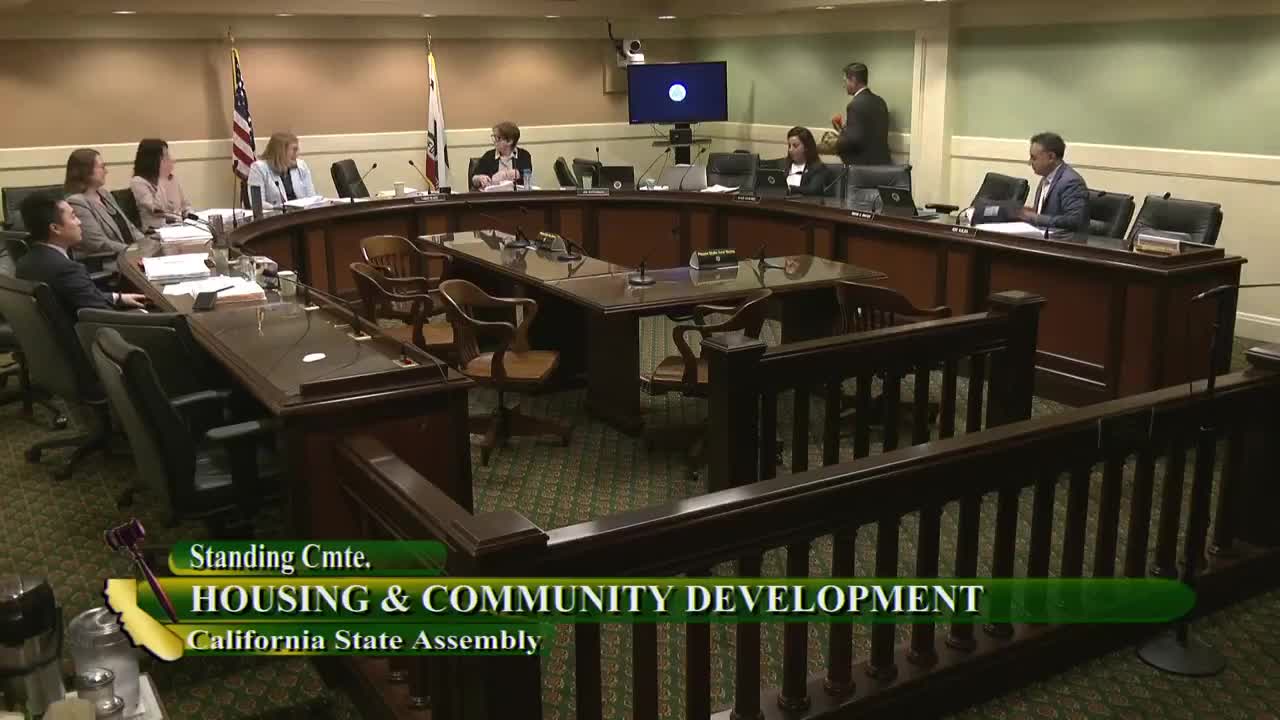 5MIN
Assembly Standing Committee on Housing and Community Development
Bill Author

Bill Co-Author(s):