AB 2685: Older individuals: case management services.
- Session Year: 2023-2024
- House: Assembly
- Latest Version Date: 2024-04-08
Current Status:
Failed
(2024-05-16: In committee: Held under submission.)
Introduced
In Committee
First Chamber
In Committee
Second Chamber
Enacted
Existing law requires the California Department of Aging to administer the Mello-Granlund Older Californians Act, which establishes various programs that serve older individuals, defined as persons 60 years of age or older except as specified. The act requires the department to designate various private nonprofit or public agencies as area agencies on aging to work within a planning and service area and provide a broad array of social and nutritional services. Under the act, the departments mission is to provide leadership to those agencies in developing systems of home- and community-based services that maintain individuals in their own homes or least restrictive homelike environments.
This bill would, until January 1, 2031, and subject to an appropriation, require the department to establish a case management services pilot program. Under the bill, the purpose of the program demonstration project in up to 4 counties located in varying regions of the state, based on a process of selection by the department and voluntary participation by the selected counties. Under the bill, the purpose of the project would be to expand statewide the local capacity of supportive services programs by providing case management services to older individuals who need assistance to maintain health and economic stability. The bill would require the Counties of Alameda, Marin, and Sonoma to participate in the pilot program.
The bill would require an area agency on aging corresponding to a participating county to assume the lead role in coordination with county agencies and local partner organizations within the county, as appropriate, and would authorize the area agency on aging to deliver the services directly or through coordination, as specified.
The bill would require the 3 counties to coordinate with their respective area agencies on aging or other county- or community-based entities to deliver the services. The bill would also require those participating counties to measure performance outcomes during the course of implementing the program. project. The bill would require those counties, the participating area agencies on aging, on an annual basis, for the first 5 years during which an appropriation is made, to submit reports to the department containing data on the performance outcomes, in order to determine program project efficacy and to inform and shape solutions under a master plan for aging that has been established pursuant to a specified executive order. By creating new duties for the 3 counties relating to participation in the pilot program, the bill would impose a state-mandated local program.
This bill would make legislative findings and declarations as to the necessity of a special statute for the Counties of Alameda, Marin, and Sonoma.The California Constitution requires the state to reimburse local agencies and school districts for certain costs mandated by the state. Statutory provisions establish procedures for making that reimbursement.This bill would provide that, if the Commission on State Mandates determines that the bill contains costs mandated by the state, reimbursement for those costs shall be made pursuant to the statutory provisions noted above.Existing law requires the California Department of Aging to administer the Mello-Granlund Older Californians Act, which establishes various programs that serve older individuals, defined as persons 60 years of age or older except as specified. The act requires the department to designate various private nonprofit or public agencies as area agencies on aging to work within a planning and service area and provide a broad array of social and nutritional services. Under the act, the departments mission is to provide leadership to those agencies in developing systems of home- and community-based services that maintain individuals in their own homes or least restrictive homelike environments.
This bill would, until January 1, 2031, and subject to an appropriation, require the department to establish a case management services pilot program. Under the bill, the purpose of the program would be to expand statewide the local capacity of supportive services programs by providing case management services to older individuals who need assistance to maintain health and economic stability. The bill would require the Counties of Alameda, Marin, and Sonoma to participate in the pilot program.
The bill would require the 3 counties to coordinate with their respective area agencies on aging or other county- or community-based entities to deliver the services. The bill would also require those counties to measure performance outcomes during the course of implementing the program. The bill would require those counties, on an annual basis, for the first 5 years during which an appropriation is made, to submit reports to the department containing data on the performance outcomes, in order to determine program efficacy and to inform and shape solutions under a master plan for aging that has been established pursuant to a specified executive order. By creating new duties for the 3 counties relating to participation in the pilot program, the bill would impose a state-mandated local program.
This bill would make legislative findings and declarations as to the necessity of a special statute for the Counties of Alameda, Marin, and Sonoma.
The California Constitution requires the state to reimburse local agencies and school districts for certain costs mandated by the state. Statutory provisions establish procedures for making that reimbursement.
This bill would provide that, if the Commission on State Mandates determines that the bill contains costs mandated by the state, reimbursement for those costs shall be made pursuant to the statutory provisions noted above.
The Legislature finds and declares all of the following:
(a)Case management services help older individuals with complex issues to navigate financial, housing, and care issues and to implement solutions.
(b)Together, these These services are powerfully effective at improving health outcomes and preventing crises.
(c)Case management services focus on the social determinants of health and help older individuals to set a plan for stability.
(d)Demonstrating the effectiveness of providing dedicated state funding for case management services for older individuals is a worthy pursuit that can inform and shape solutions under the master plan for aging described in Section 9850 and future funding decisions in the annual Budget Act of this state.
9581.(a)(1)Subject to an appropriation made for the express purpose of implementing this section, the department shall establish a case management services pilot program. The purpose of the program shall demonstration project in up to four counties located in varying regions of the state, based on a process of selection by the department and voluntary participation by the selected counties.
(2)The area agency on aging corresponding to a participating county shall assume the lead role in coordination with county agencies and local partner organizations within the county, as appropriate.
(3)The purpose of the demonstration project shall be to expand statewide the local capacity of supportive services programs under this division by providing case management services to older individuals, as defined in Section 9018, who need assistance to maintain health and economic stability.
(b)The Counties of Alameda, Marin, and Sonoma shall participate in the pilot program described in subdivision (a).(c)The three counties participating in the pilot program shall coordinate with their respective area agencies on aging or other county- or community-based entities to deliver the case management services.(b)Only counties with area agencies on aging that have an existing case management program may participate in the demonstration project described in subdivision (a).
(c)The area agencies on aging in each participating county may deliver case management services directly, or coordinate with other county- or community-based entities to deliver those services, pursuant to the demonstration project.
(d)(1)The three participating counties shall measure performance outcomes during the course of implementing this section.
(2)On an annual basis, for the first five years during which an appropriation is made for implementing this section, the participating counties area agencies on aging shall submit reports to the department containing data on the performance outcomes, in order to determine the efficacy of the pilot program demonstration project and to inform and shape solutions under the master plan for aging described in Section 9850.
9582.This chapter shall remain in effect only until January 1, 2031, and as of that date is repealed.
SEC. 2.The Legislature finds and declares that a special statute is necessary and that a general statute cannot be made applicable within the meaning of Section 16 of Article IV of the California Constitution because of the unique circumstances of the Counties of Alameda, Marin, and Sonoma with regard to those counties readiness to participate in the pilot program described in this act based on the counties programmatic and administrative infrastructure of case management services for older individuals.SEC. 3.If the Commission on State Mandates determines that this act contains costs mandated by the state, reimbursement to local agencies and school districts for those costs shall be made pursuant to Part 7 (commencing with Section 17500) of Division 4 of Title 2 of the Government Code.The Legislature finds and declares all of the following:
(a)Case management services help older individuals with complex issues to navigate financial, housing, and care issues and to implement solutions.
(b)Together, these services are powerfully effective at improving health outcomes and preventing crises.
(c)Case management services focus on the social determinants of health and help older individuals to set a plan for stability.
9581.(a)Subject to an appropriation made for the express purpose of implementing this section, the department shall establish a case management services pilot program. The purpose of the program shall be to expand statewide the local capacity of supportive services programs under this division by providing case management services to older individuals, as defined in Section 9018, who need assistance to maintain health and economic stability.
(b)The Counties of Alameda, Marin, and Sonoma shall participate in the pilot program described in subdivision (a).
(c)The three counties participating in the pilot program shall coordinate with their respective area agencies on aging or other county- or community-based entities to deliver the case management services.
(d)(1)The three participating counties shall measure performance outcomes during the course of implementing this section.
(2)On an annual basis, for the first five years during which an appropriation is made for implementing this section, the participating counties shall submit reports to the department containing data on the performance outcomes, in order to determine the efficacy of the pilot program and to inform and shape solutions under the master plan for aging described in Section 9850.
9582.This chapter shall remain in effect only until January 1, 2031, and as of that date is repealed.
SEC. 2.The Legislature finds and declares that a special statute is necessary and that a general statute cannot be made applicable within the meaning of Section 16 of Article IV of the California Constitution because of the unique circumstances of the Counties of Alameda, Marin, and Sonoma with regard to those counties readiness to participate in the pilot program described in this act based on the counties programmatic and administrative infrastructure of case management services for older individuals.
SEC. 3.If the Commission on State Mandates determines that this act contains costs mandated by the state, reimbursement to local agencies and school districts for those costs shall be made pursuant to Part 7 (commencing with Section 17500) of Division 4 of Title 2 of the Government Code.
|
Date
|
Status
|
|---|---|
| May 16, 2024 | In committee: Held under submission. |
| May 1, 2024 | In committee: Set, first hearing. Referred to APPR. suspense file. |
| Apr 17, 2024 | From committee: Do pass and re-refer to Com. on APPR. (Ayes 5. Noes 0.) (April 16). Re-referred to Com. on APPR. |
| Apr 9, 2024 | Re-referred to Com. on AGING & L.T.C. |
| Apr 8, 2024 | From committee chair, with author's amendments: Amend, and re-refer to Com. on AGING & L.T.C. Read second time and amended. |
| Mar 4, 2024 | Referred to Com. on AGING & L.T.C. |
| Feb 15, 2024 | From printer. May be heard in committee March 16. |
| Feb 14, 2024 | Read first time. To print. |
|
Date
|
Description
|
Location
|
Votes
|
|
|---|---|---|---|---|
| Apr 16, 2024 | Do pass and be re-referred to the Committee on [Appropriations] | Assembly Standing Committee on Aging and Long-Term Care |
Passed |
This list shows positions taken on this bill by organizations on the date displayed, which is linked to the original source.
Positions by individuals are not included.
|
Organization
|
Position
|
Date
|
|---|---|---|
| Alameda County Social Services Agency | * Support | Apr 16, 2024 |
| California Association Of Area Agencies On Aging | * Support | Apr 16, 2024 |
| City of West Hollywood | * Support | Apr 16, 2024 |
| City of West Hollywood Disabilities Advisory Board | * Support | Apr 16, 2024 |
| Senior Services Coalition of Alameda County | * Support | Apr 16, 2024 |
Date of Hearing: May 1, 2024
ASSEMBLY COMMITTEE ON APPROPRIATIONS
Buffy Wicks, Chair
ABPCA Bill Id:AB 2685
Author:(Ortega) – As Amended Ver:April 8, 2024
Policy Committee: | Aging and Long Term Care | Vote: | 5 - 0 |
|
| ||
|
|
Urgency: No State Mandated Local Program: No Reimbursable: No
SUMMARY:
This bill requires the California Department of Aging (CDA), upon appropriation by the Legislature, to establish a case management services demonstration project in up to four counties to expand local capacity to provide case management services to older adults.
Specifically, this bill:
- Requires CDA, upon appropriation by the Legislature, to establish a case management services demonstration project to expand statewide the local capacity of supportive services programs by providing case management services to older adults who need assistance to maintain health and economic stability.
- Requires CDA to establish the demonstration project in up to four counties located in varying regions of the state based on CDA’s selection process and voluntary participation by the selected counties.
- Requires the area agency on aging (AAA) corresponding to a participating county to assume the lead role in coordinating with county agencies and local partners within the county.
- Specifies only a county with an AAA that has an existing case management program may participate in the demonstration project.
- Authorizes the AAA in each participating county to deliver case management services directly or in coordination with other county or community-based entities.
- Requires participating counties to measure performance outcomes, and, for the first five years during which an appropriation is made, requires participating AAAs to annually submit performance reports to CDA.
- Sunsets the demonstration project on January 1, 2031.
FISCAL EFFECT:
- Subject to an appropriation by the Legislature, CDA estimates ongoing General Fund (GF) costs of approximately $4.6 million to $6.6 million annually in fiscal year (FY) 2025-26 through FY 2029-30, and $2.3 million to $3.3 million in FY 2030-31. These costs include $4 million to $6 million annually for four counties to establish and administer the demonstration project and approximately $575,000 annually for three CDA staff positions to provide overall project management, establish standards and criteria for the project, provide technical assistance, develop performance outcomes, collect data from the demonstration sites, and provide training as necessary.
- To the extent the demonstration project is expanded to become either permanent or statewide, CDA anticipates additional cost pressures of an unknown amount but would be significant and ongoing.
The author is seeking $9 million in the 2024-25 state budget for this program. The author made a similar request last year that went unfunded.
According to the Legislative Analyst’s Office, the General Fund faces a structural deficit in the tens of billions of dollars over the next several fiscal years.
COMMENTS:
- Purpose. This bill is sponsored by the Senior Services Coalition of Alameda County. According to the author:
Case management services for seniors are already provided as funded under the Older Americans Act and, more recently, certain groups under the CalAIM waiver being implemented by the California Department of Health Care Services. However, significant service gaps remain. AB 2685 would create a pathway to demonstrate the effectiveness of providing dedicated state General Fund dollars for case management services targeting older Californians, including those at an income level whose incomes remain low, but are above the threshold for Medi-Cal eligibility (and thus not eligible for CalAIM-funded services).
- Background. Case management services help older individuals with complex issues navigate financial, housing, and care issues and work towards person-centered solutions. These services focus on the social determinants of health and help older individuals develop plans for stability. Case management has also been shown to significantly and positively affect the emotional health of caregivers.
Federal Title III B funding supports a range of supportive service programs that enable older adults to live independently and safely in their homes and communities and avoid hospitalization and nursing home care. Services can include transportation, case management, legal assistance, personal care, homemaker services, home repair, telephone reassurance, and more. During fiscal year 2018-19, these programs served nearly 1.3 million people.
Funding for case management is limited to Title III B funding. This bill seeks to demonstrate the effectiveness of state-funded case management services with the goal of expanding statewide the local capacity of supportive services programs.
California’s senior population is growing faster than any other age group. By 2030, over 25% of the population in California will be 60 and older. In January of 2021, the Governor released his MPA, which prioritizes the health and well-being of older Californians and the need for policies that promote healthy aging. This bill advances the goals of the MPA regarding care needs of older Californians by providing older adults with expanded access to case management services to assist them with maintaining independence.
- Prior Legislation. AB 1313 (Ortega), of this legislative session, was similar to this bill. AB 1313 was held on the suspense file in the Senate Committee on Appropriations.
Analysis Prepared by: Jennifer Swenson / APPR. / (916) 319-2081
Date of Hearing: April 16, 2024
ASSEMBLY COMMITTEE ON AGING AND LONG-TERM CARE
Jasmeet Bains, Chair
ABPCA Bill Id:AB 2685 (
Author:Ortega) – As Amended Ver:April 8, 2024
SUBJECT: Older individuals: case management services
SUMMARY: Establishes a case management services demonstration project within the California Department on Aging (CDA). Specifically, this bill:
- Makes legislative findings and declarations on the benefits of case management for older adults.
- Requires CDA to establish a demonstration project in up to four counties.
- Requires selection of counties to be determined by CDA.
- Only counties with area agencies on aging (AAAs) that have an existing case management program may participate in the demonstration project.
- AAAs in each participating county may deliver case management services directly or coordinate with other county or community based entities to deliver services as laid out in the demonstration project.
- Requires participation by the selected counties to be voluntary.
- Requires selection of counties to be determined by CDA.
- Directs the AAAs corresponding to a participating county to assume the lead role in coordination with county agencies or local partner organizations within the county or community-based entities to deliver the case management services.
- Mandates performance outcome measures during the course of implementing this section.
- Instructs the participating AAAs to submit periodic reports to CDA containing data on those performance outcomes.
- Aims to inform and create solutions under the state’s Master Plan for Aging (MPA).
- Expands local capacity of supportive services programs under this division by providing case management services to older individuals, who need assistance to maintain health and economic stability.
- Provides that implementation is contingent on an appropriation for this express purpose.
- Requires the demonstration project to report performance outcome measurements to CDA on an annual basis for the first five years of the appropriation to highlight efficacy.
- Sunsets the demonstration project on January 1, 2031.
EXISTING LAW:
- Establishes, in federal law, the Older Americans Act (OAA), which promotes the well-being of Americans 60 years old and above through services and programs designed to meet their needs. (42 United States Code (USC.) § 3001, et seq.)
- Establishes the Mello-Granlund Older Californians Act (Act), which establishes CDA, and sets forth its duties and powers, including, among other things, entering into a contract for the development of information and materials to educate Californians on the concept of “aging in place.” (WIC § 9100 et seq.)
- Under the Act, requires CDA to designate various private nonprofit or public agencies as AAAs to work within a planning and service area and provide a broad array of social and nutritional services.
- Under the Act directs the CDA’s mission to provide leadership to AAAs to develop systems of home and community-based services that maintain individuals in their own homes or least restrictive homelike environments.
- Defines “Older individual” or “elderly” as a person 60 years of age or older, except where this provision is inconsistent with federal requirements. (WIC § 9018)
- Requires the Secretary of the California Health and Human Services Agency, in coordination with the Director of CDA, to lead the development and implementation of the MPA established pursuant to Executive Order N-14-19. (WIC § 9850)
FISCAL EFFECT: This bill has not yet been analyzed by a fiscal committee.
COMMENTS:
Author’s Statement: “Case management services for seniors are already provided as funded under the Older Americans Act and, more recently, certain groups under the CalAIM waiver being implemented by the California Department of Health Care Services. However, significant service gaps remain. AB 2685 would create a pathway to demonstrate the effectiveness of providing dedicated state General Fund dollars for case management services targeting older Californians, including those at an income level whose incomes remain low, but are above the threshold for Medi-Cal eligibility (and thus not eligible for CalAIM-funded services).
Funding for case management programs has been flat for more than a decade since budget cuts in 2008. As a result, there was a significant decrease of 42% in total clients served from 2008-2019. While funding has begun to rebound, the General Fund dollars being provided to Area Agencies on Aging through the Older Californians Act Modernization are not solely for case management and must be apportioned among multiple needed types of services. If dedicated case management funding was provided statewide, an estimated 10,000 seniors could be served. The pilot project proposed by this bill will help the California Department of Aging and community service providers assess how these services could benefit older adults in the systems of care organized by the Master Plan on Aging.
Without necessary supports that case management provides, an illness, relationship loss, isolation, cognitive decline or other stressor can destabilize an older adult, putting them at high risk for repeated hospitalizations, falls, depression, anxiety, housing loss and homelessness.”
BACKGROUND
California’s aging population is growing faster than any other age group. By 2030, over 25 percent of the population in California will be 60 and older.[1] The population in the state is becoming more racially and ethnically diverse, and yet the COVID-19 pandemic impacted Californians disparately.
California is projected to be one of the fastest growing States in the nation in total population. In 2016, California comprised 12 percent of the nation's population[2] and is expected to grow 30 percent by the year 2060 (an increase of 11.7 million people.[3] In California, the population aged 60 years and over is expected to grow more than three times as fast as the total population and this growth will vary by region.
The population over age 60 will have an overall increase of 166 percent during the period from 2010 to 2060. More than half the counties will have over a 100 percent increase in this age group. Nearly half of these counties will have growth rates of over 150 percent. These counties are located throughout the central and southern areas of the State. The influence of the 60 and over age group on California is expected to emerge most strongly between 2010 to 2030.3
The population over age 85 will increase at an even a faster rate than those over 60 years of age, having an overall increase of 489 percent during the period from 2010 to 2060. Counties can expect to experience even higher growth rates after 2020. In particular, the influence of the 85 and over age group on California will emerge most strongly between 2030 to 2040 as the first of the baby boomers reach 85 years of age.3
Life expectancy continues to rise,[4] however during 2019-2021 overall life expectancy for Californians fell from 81.4 years to 78.4 years. For Hispanics, life expectancy declined by nearly 6 years, a difference three times greater than their white counterparts. And the difference between those in California’s highest and lowest income brackets increased by three-and-a-half years to greater than 15 years (11.5 years before the pandemic to more than 15 years in 2021).[5]
The World Health Organization defines health as “a state of complete physical, mental and social well-being and not merely the absence of disease or infirmity.”[6]
According to the California Older Americans Act: State Plan on Aging 2021-2025, Older Americans Act Core Programs Supportive Services (Title III B) programs provide a variety of services that facilitate access to information and assistance, help people maintain health and independence, and support home and community living. Services can include transportation, case management, legal assistance, personal care, homemaker services, home repair, telephone reassurance, and more. During State Fiscal Year 2018-19, these programs served almost 1.3 million people. The following year, they served 809,093 people. (Note: during 2020, the pandemic impacted many programs’ ability to provide services.)
Funding for case management only comes through Title III B funding. Funding restrictions during the recession have never been restored. Meanwhile, population trends have older Californians making up a quarter of the population by the end of the decade. OOA Title III B funding supports a range of supportive service programs that enable older adults to live independently and safely in their homes and communities of choice and avoid hospitalization and nursing home care.
Case management services help older individuals with complex issues navigate financial, housing, and care issues and work towards person-centered solutions.
Case management services focus on the social determinants of health and help older individuals develop plans for stability. Case management has also been shown to significantly and positively affect the emotional health of caregivers, highlighting the far reaching impact of the program.[7]
Master Plan for Aging: In January of 2021, the Governor released his Master Plan for Aging (MPA). The MPA prioritizes the health and well-being of older Californians and the need for policies that promote healthy aging. The MPA serves as a blueprint for state government, local government, the private sector, and philanthropy to prepare the state for the coming demographic changes and continue California’s leadership in aging, disability, and equity.
After work began on the MPA, the COVID-19 pandemic reached California. The virus disproportionately harmed older and other at-risk adults, and it strained aging and disability services that were perpetually underfunded. Worldwide, older adults have experienced unprecedented death rates. California’s diverse population saw disproportionate numbers, particularly among Latino, Black and Asian Pacific Islander communities and those living in nursing homes. The pandemic intensified social isolation.
The work plan laid out in the MPA three years after its release continues to highlight the urgent needs facing California’s older adults, people with disabilities, their families, caregivers, advocates and the workforce supporting these populations..
In 2024-5, the MPA outlines five bold goals and currently seeks to advance 95 initiatives to build a California for All Ages by 2030. Each initiative features a designated area of focus; to deliver, to analyze and to communicate. It also includes a Data Dashboard on Aging to measure progress. AB 2685 can be linked to all of the five bold goals:
- Goal One: Housing for All Ages and Stages
- Goal Two: Health Reimagined
- Goal Three: Inclusion and Equity, Not Isolation
- Goal Four: Caregiving That Works
- Goal Five: Affording Aging
Legislative History: The language in AB 2685 was requested by Assemblymembers Bonta and Bauer–Kahan for inclusion in the 2022-23 budget. The request was not funded.
AB 1313, of 2023, authored by Assemblymember Ortega included similar language. The measure was held in Senate Appropriations.
Budget: There is a corresponding budget ask related to AB 2685 for $9 million dollars in the 2024-25 legislative budget.
Argument in Support: Senior Services Coalition of Alameda County writes in support “Case management under the CDA is imperative for older adults facing complex circumstances. It transcends assistance and helpful information; it offers viable solutions to uphold their independence in day-to-day routines. The gamut of services provided arranging transportation, facilitating access to medical care, linking clients with public and community-based resources, addressing hygiene needs, ensuring access to nutritious meals, and facilitating social connections with friends and family. The clients served are individuals grappling with physical, cognitive, and health challenges, as well as those confronting economic insecurity—an older adult demographic that is growing rapidly.
Economic insecurity of older adult households in California increases with age. The rate of older adults unable to afford supportive interventions and daily services to meet their needs continues to grow yearly. Without support, an illness, relationship loss, isolation, cognitive decline, or other stressors can destabilize them, putting them at high risk for repeat hospitalizations, housing loss, and institutionalization.”
Argument in Opposition: None.
REGISTERED SUPPORT / OPPOSITION:
Support
Senior Services Coalition of Alameda County
Opposition
None on file.
Analysis Prepared by: Elizabeth Fuller / AGING & L.T.C. / (916) 319-3990
http://www.dof.ca.gov/Forecasting/Demographics/Projections ↑
https://longevity.stanford.edu/the-new-map-of-life-initiative/ ↑
https://newsroom.ucla.edu/releases/covid-life-expectancy-drops-by-race-and-income ↑
Berthelsen, Connie Bøttcher, and Jimmie Kristensson. "The content, dissemination and effects of case management interventions for informal caregivers of older adults: a systematic review." International journal of nursing studies 52.5 (2015): 988-1002. ↑
Discussed in Hearing
 10MIN
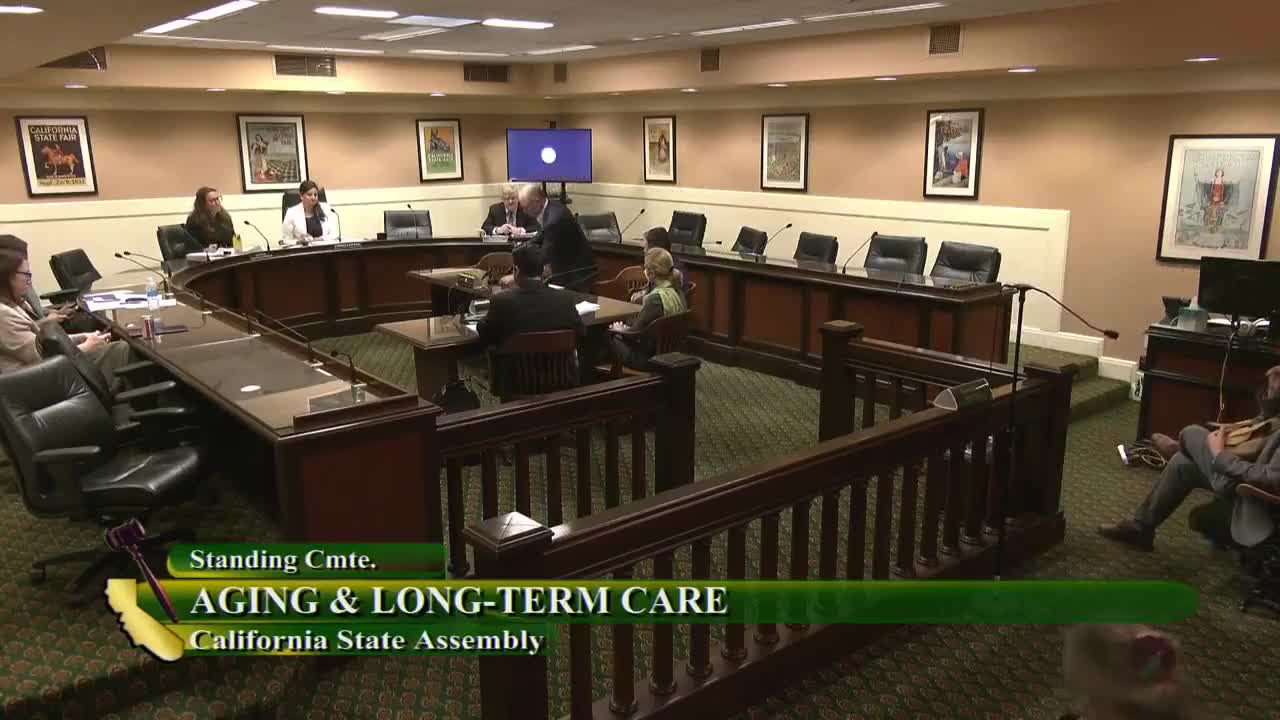
Assembly Standing Committee on Aging and Long-Term Care
Bill Author

Bill Co-Author(s):