AB 2699: Hazardous materials: reporting: civil liability.
- Session Year: 2023-2024
- House: Assembly
- Latest Version Date: 2024-04-01
Current Status:
Failed
(2024-05-16: In committee: Held under submission.)
Introduced
In Committee
First Chamber
In Committee
Second Chamber
Enacted
What does this bill do?
The bill shifts responsibility for reporting hazardous material releases and for writing and overseeing the reporting rules from the Office of Emergency Services to the California Environmental Protection Agency, makes CalEPA the agency that adopts required forms and guidance, and requires local unified program agencies to keep nonemergency communication methods current with CalEPA. It also raises daily civil and administrative fines for businesses and stationary sources that break hazardous materials rules to up to $20,000 per day and up to $30,000 per day for knowing violations.
The summary is provided by generative AI which can make mistakes. For original language, please view the details in the table below.
(1)Existing law requires the Secretary for Environmental Protection to implement a unified hazardous waste and hazardous materials management regulatory program, known as the unified program. Existing law requires every county to apply to the secretary to be certified to implement the unified program, and authorizes a city or local agency that meets specified requirements to apply to the secretary to be certified to implement the unified program, as a certified unified program agency. Existing law authorizes a state or local agency that has a written agreement with a certified unified program agency, and is approved by the secretary, to implement or enforce one or more of the unified program elements as a participating agency. Existing law defines unified program agency to mean a certified unified program agency or its participating agencies, as provided.
Existing law requires a business that handles a hazardous material, or an employee, authorized representative, agent, or designee of that business, to, upon discovery, immediately report any release or threatened release of a hazardous material, or an actual release of a hazardous substance, as defined, to the unified program agency and the Office of Emergency Services, as provided. Existing law requires the Office of Emergency Services, on or before January 1, 2022, to adopt regulations to implement these reporting requirements.
This bill would require this reporting to be made to the California Environmental Protection Agency instead of the Office of Emergency Services. The bill would delete the requirement on the Office of Emergency Services to adopt regulations, and would instead require the California Environmental Protection Agency, Agency to be responsible for the adoption and revision of the regulations and for the oversight of the enforcement of the regulations. The bill would require the California Environmental Protection Agency, on or before January 1, 2028, to review and revise the regulations that implement the reporting requirements.
This bill would require the Office of Administrative Law, on or before January 1, 2025, to report to the Legislature on whether the Office of Emergency Services has adopted certain regulations, as specified. The bill would define certain terms for purposes of the regulations that implement the reporting requirements if the Office of Administrative Laws report indicates that those regulations have not been adopted by the Office of Emergency Services. The bill would authorize the California Environmental Protection Agency to revise those definitions by revising the regulations.
(2)Existing law requires the unified program agency to maintain one or more nonemergency contact numbers for release reports that do not require immediate agency response and requires the unified program agency to promptly communicate changes to this contact information to the Office of Emergency Services.
This bill would require the unified program agency to maintain one or more nonemergency methods of communication, instead of phone numbers, and would require the unified program agency to promptly communicate changes to the California Environmental Protection Agency, instead of the Office of Emergency Services.
(3)Existing law requires the Office of Emergency Services to approve a form for use by a business that is required to submit a followup emergency notice pursuant to federal law regarding a release of an extremely hazardous substance. Existing law authorizes the Office of Emergency Services to adopt guidelines for the use of the approved form.
This bill would instead require the California Environmental Protection Agency to adopt regulations to approve the form and would require the followup emergency notice to be provided on the form.
(4)Existing law requires the Office of Emergency Services to develop informational guidelines for facilities required to comply with the reporting requirements and with certain federal reporting requirements regarding the release of extremely hazardous substances. Existing law requires the Office of Emergency Services to assist the unified program agency in ensuring full distribution of the guidelines to those facilities.
This bill would instead require the California Environmental Protection Agency to develop the informational guidelines and to assist the unified program agency in distributing the guidelines.
(5)Existing law provides that a business that violates the unified program laws is liable to a unified program agency for an administrative penalty not greater than $2,000 for each day that the violation occurs and that a business that knowingly violates the unified program laws is liable for an administrative penalty not greater than $5,000 for each day that the violation occurs.
This bill would, beginning January 1, 2026, 2025, increase those penalties to be not greater than $20,000 for each day that the violation occurs and not greater than $30,000 for each day that the violation occurs knowingly.
(6)Existing law requires a stationary source, as defined, with one or more processes that have certain substances present in more than a threshold quantity to prepare and submit a risk management plan, if the unified program agency makes a specified determination. Existing law requires the owner or operator of a stationary source submitting a risk management plan to submit the plan to the unified program agency after the plan is certified as complete, and requires the unified program agency to review the plan. Existing law imposes various requirements related to the submission and contents of a risk management plan. Existing law imposes civil or administrative liability on a person or stationary source that violates these provisions in an amount of not more than $5,000 for each day that the violation occurs, and in an amount of not more than $25,000 for each day that the violation occurs if the person or stationary source knowingly violates these provisions after reasonable notice of the violation.
This bill would increase those penalties to be not greater than $20,000 for each day that the violation occurs and not greater than $30,000 for each day that the violation occurs knowingly.
(7)To the extent this bill would require unified program agencies to provide new programs or higher levels of service, the bill would impose a state-mandated local program.
The California Constitution requires the state to reimburse local agencies and school districts for certain costs mandated by the state. Statutory provisions establish procedures for making that reimbursement.
This bill would provide that, if the Commission on State Mandates determines that the bill contains costs mandated by the state, reimbursement for those costs shall be made pursuant to the statutory provisions noted above.
(1)Existing law requires the Secretary for Environmental Protection to implement a unified hazardous waste and hazardous materials management regulatory program, known as the unified program. Existing law requires every county to apply to the secretary to be certified to implement the unified program, and authorizes a city or local agency that meets specified requirements to apply to the secretary to be certified to implement the unified program, as a certified unified program agency. Existing law authorizes a state or local agency that has a written agreement with a certified unified program agency, and is approved by the secretary, to implement or enforce one or more of the unified program elements as a participating agency. Existing law defines unified program agency to mean a certified unified program agency or its participating agencies, as provided.
Existing law requires a business that handles a hazardous material, or an employee, authorized representative, agent, or designee of that business, to, upon discovery, immediately report any release or threatened release of a hazardous material, or an actual release of a hazardous substance, as defined, to the unified program agency and the Office of Emergency Services, as provided. Existing law requires the Office of Emergency Services, on or before January 1, 2022, to adopt regulations to implement these reporting requirements.
This bill would require this reporting to be made to the California Environmental Protection Agency instead of the Office of Emergency Services. The bill would delete the requirement on the Office of Emergency Services to adopt regulations, and would instead require the California Environmental Protection Agency, on or before January 1, 2028, to review and revise the regulations that implement the reporting requirements.
This bill would require the Office of Administrative Law, on or before January 1, 2025, to report to the Legislature on whether the Office of Emergency Services has adopted certain regulations, as specified. The bill would define certain terms for purposes of the regulations that implement the reporting requirements if the Office of Administrative Laws report indicates that those regulations have not been adopted by the Office of Emergency Services. The bill would authorize the California Environmental Protection Agency to revise those definitions by revising the regulations.
(2)Existing law requires the unified program agency to maintain one or more nonemergency contact numbers for release reports that do not require immediate agency response and requires the unified program agency to promptly communicate changes to this contact information to the Office of Emergency Services.
This bill would require the unified program agency to maintain one or more nonemergency methods of communication, instead of phone numbers, and would require the unified program agency to promptly communicate changes to the California Environmental Protection Agency, instead of the Office of Emergency Services.
(3)Existing law requires the Office of Emergency Services to approve a form for use by a business that is required to submit a followup emergency notice pursuant to federal law regarding a release of an extremely hazardous substance. Existing law authorizes the Office of Emergency Services to adopt guidelines for the use of the approved form.
This bill would instead require the California Environmental Protection Agency to adopt regulations to approve the form and would require the followup emergency notice to be provided on the form.
(4)Existing law requires the Office of Emergency Services to develop informational guidelines for facilities required to comply with the reporting requirements and with certain federal reporting requirements regarding the release of extremely hazardous substances. Existing law requires the Office of Emergency Services to assist the unified program agency in ensuring full distribution of the guidelines to those facilities.
This bill would instead require the California Environmental Protection Agency to develop the informational guidelines and to assist the unified program agency in distributing the guidelines.
(5)Existing law provides that a business that violates the unified program laws is liable to a unified program agency for an administrative penalty not greater than $2,000 for each day that the violation occurs and that a business that knowingly violates the unified program laws is liable for an administrative penalty not greater than $5,000 for each day that the violation occurs.
This bill would, beginning January 1, 2026, increase those penalties to be not greater than $20,000 for each day that the violation occurs and not greater than $30,000 for each day that the violation occurs knowingly.
(6)Existing law requires a stationary source, as defined, with one or more processes that have certain substances present in more than a threshold quantity to prepare and submit a risk management plan, if the unified program agency makes a specified determination. Existing law requires the owner or operator of a stationary source submitting a risk management plan to submit the plan to the unified program agency after the plan is certified as complete, and requires the unified program agency to review the plan. Existing law imposes various requirements related to the submission and contents of a risk management plan. Existing law imposes civil or administrative liability on a person or stationary source that violates these provisions in an amount of not more than $5,000 for each day that the violation occurs, and in an amount of not more than $25,000 for each day that the violation occurs if the person or stationary source knowingly violates these provisions after reasonable notice of the violation.
This bill would increase those penalties to be not greater than $20,000 for each day that the violation occurs and not greater than $30,000 for each day that the violation occurs knowingly.
(7)To the extent this bill would require unified program agencies to provide new programs or higher levels of service, the bill would impose a state-mandated local program.
The California Constitution requires the state to reimburse local agencies and school districts for certain costs mandated by the state. Statutory provisions establish procedures for making that reimbursement.
This bill would provide that, if the Commission on State Mandates determines that the bill contains costs mandated by the state, reimbursement for those costs shall be made pursuant to the statutory provisions noted above.
Existing law, the Knox-Keene Health Care Service Plan Act of 1975, provides for the licensure and regulation of health care service plans. Existing law requires plans to publish and maintain provider directories, as specified.This bill would make technical, nonsubstantive changes to those provisions.Existing law, the Knox-Keene Health Care Service Plan Act of 1975, provides for the licensure and regulation of health care service plans. Existing law requires plans to publish and maintain provider directories, as specified.
This bill would make technical, nonsubstantive changes to those provisions.
(a)The secretary shall adopt, after public hearing and consultation with the Office of the State Fire Marshal and other appropriate public entities, regulations for minimum standards for business plans. The secretary shall adopt, after public hearing and consultation with the appropriate public entities, regulations for minimum standards for area plans. All business plans and area plans shall meet the standards adopted by the secretary.
(b)The standards for business plans in the regulations adopted pursuant to subdivision (a) shall do all of the following:
(1)Set forth minimum requirements of adequacy, and not preclude the imposition of additional or more stringent requirements by local government.
(2)Take into consideration and adjust for the size and nature of the business, the proximity of the business to residential areas and other populations, and the nature of the damage potential of its hazardous materials in establishing standards for paragraphs (3) and (4) of subdivision (a) of Section 25505.
(3)Take into account the existence of local area and business plans that meet the requirements of this article so as to minimize the duplication of local efforts, consistent with the objectives of this article.
(c)A unified program agency shall, in consultation with local emergency response agencies, establish an area plan for emergency response to a release or threatened release of a hazardous material within its jurisdiction. An area plan is not a statute, ordinance, or regulation for purposes of Section 669 of the Evidence Code. The standards for area plans in the regulations adopted pursuant to subdivision (a) shall provide for all of the following:
(1)Procedures and protocols for emergency response personnel, including the safety and health of those personnel.
(2)Preemergency planning.
(3)Notification and coordination of onsite activities with state, local, and federal agencies, responsible parties, and special districts.
(4)Training of appropriate employees.
(5)Onsite public safety and information.
(6)Required supplies and equipment.
(7)Access to emergency response contractors and hazardous waste disposal sites.
(8)Incident critique and followup.
(9)Requirements for notification to the California Environmental Protection Agency of reports made pursuant to Section 25510.
(d)(1)The unified program agency shall submit to the secretary for the secretarys review a copy of the proposed area plan within 180 days after adoption of regulations by the secretary. The secretary shall notify the unified program agency as to whether the area plan is adequate and meets the area plan standards. The unified program agency shall submit a corrected area plan within 45 days of this notice.
(2)The unified program agency shall certify to the secretary every three years that it has conducted a complete review of its area plan and has made any necessary revisions. If a unified program agency makes a substantial change to its area plan, it shall forward the changes to the secretary within 14 days after the changes have been made.
(e)The inspection and enforcement program established pursuant to paragraphs (2) and (3) of subdivision (a) of Section 25404.2, shall include the basic provisions of a plan to conduct onsite inspections of businesses subject to this article by the unified program agency. These inspections shall ensure compliance with this article and shall identify existing safety hazards that could cause or contribute to a release and, where appropriate, enforce any applicable laws and suggest preventative measures designed to minimize the risk of the release of hazardous material into the workplace or environment. The requirements of this subdivision do not alter or affect the immunity provided to a public entity pursuant to Section 818.6 of the Government Code.
SEC. 2.Section 25510 of the Health and Safety Code is amended to read:25510.(a)(1)Except as provided in subdivision (b), a hazardous material, hazardous waste, or hazardous substance release or threatened release shall be reported by the handler, or an employee, authorized representative, agent, or designee of the handler, to the UPA and to the California Environmental Protection Agency in accordance with the regulations adopted pursuant to this section, as follows:
(A)For facilities subject to this chapter, the reporting shall be made immediately upon the discovery of a release or threatened release.
(B)(i)For facilities not subject to this chapter, the reporting shall be made upon the discovery of an actual release that results in an emergency response.
(ii)For purposes of this subparagraph, emergency response means the activation of any public emergency response personnel, as defined in Section 25501, who are responsible for response, mitigation, or recovery activities in a hazardous material incident where public health, public safety, or the environment may be affected.
(2)Except as provided in subdivision (b), the handler, or an employee, authorized representative, agent, or designee of those entities, shall provide state, city, or county fire or public health or safety personnel and emergency response personnel with access to the handlers facility if there is a release or threatened release of a hazardous material, hazardous waste, or hazardous substance.
(b)Subdivision (a) does not apply to a person engaged in the transportation of a hazardous material on a highway that is subject to Sections 2453 and 23112.5 of the Vehicle Code.
(c)On (1)The California Environmental Protection Agency is responsible for the adoption and revision of the regulations that implement this section, and for the oversight of the enforcement of those regulations.
(2)On or before January 1, 2028, the California Environmental Protection Agency shall review and revise the regulations that implement this section. In reviewing and revising these regulations, the California Environmental Protection Agency shall closely consult with representatives from regulated entities, appropriate trade associations, fire service organizations, federal, state, and local organizations, including UPAs, and other interested parties. The regulations shall define what releases and threatened releases are required to be reported pursuant to this section and the California Environmental Protection Agency shall consider the existing federal reporting requirements in determining a definition of reporting releases.
(d)A UPA shall maintain one or more nonemergency methods of communication for release reports that do not require immediate agency response. The UPA shall promptly communicate changes to this information to regulated facilities, to the secretary, and to the California Environmental Protection Agency.
(e)(1)Notwithstanding any other law, and except as provided in paragraph (2), if a release, spill, escape, or entry, as described in paragraph (2) of subdivision (b) of Section 101075, of a hazardous material, hazardous waste, as defined in Section 101075, or hazardous substance, as defined in subdivision (a) of Section 78075, occurs and a UPA, in consultation with the local health officer, reasonably determines that the release, spill, escape, or entry poses an imminent and substantial endangerment to public health due to factors, including, but not limited to, carcinogenicity, acute toxicity, chronic toxicity, bioaccumulative properties, or persistence in the air or environment, the UPA may take either or both of the following actions to protect the health and safety of the public:
(A)Issue an order to the responsible party to immediately suspend or discontinue the activity causing or contributing to the release, spill, escape, or entry of the hazardous material, hazardous waste, or hazardous substance. The order shall remain in effect until the UPA determines that the imminent and substantial endangerment to public health has been abated or the order is overturned pursuant to the appeal procedures described in subdivision (g).
(B)Coordinate with other appropriate regulatory agencies that may take any other action necessary to protect the public health, including, but not limited to, environmental investigations and temporary relief to, or relocation of, affected individuals.
(2)(A)The UPA shall not issue an order pursuant to paragraph (1) if the release, spill, escape, or entry of the hazardous material, hazardous waste, or hazardous substance falls below a reporting threshold established in regulation.
(B)If regulations do not establish a reporting threshold, then the UPA shall be guided by Section 5192, and the appendices to that section, of Title 8 of the California Code of Regulations.
(f)An order issued by the UPA pursuant to subparagraph (A) of paragraph (1) of subdivision (e) shall be supported by written findings, including evidence of local health officer consultation, and be consistent with criteria developed by UPAs to determine whether an imminent and substantial endangerment to public health has occurred.
(g)(1)Any order issued by a UPA pursuant to subparagraph (A) of paragraph (1) of subdivision (e) shall be served by personal service or certified mail and shall inform the person served of the right to a hearing. The order shall state whether the hearing procedure specified in subparagraph (B) of paragraph (3) may be requested by the person receiving the order.
(2)A person served with an order issued by a UPA pursuant to subparagraph (A) of paragraph (1) of subdivision (e) who has been unable to resolve any violation with the UPA, may, within 15 days after service of the order, request a hearing pursuant to this subdivision by filing with the UPA a notice of defense. The notice shall be filed with the UPA office that issued the order. A notice of defense shall be deemed filed within the 15-day period provided by this paragraph if it is postmarked within that 15-day period. If no notice of defense is filed within the time limits provided by this paragraph, the order shall become final.
(3)Except as provided in clause (ii) of subparagraph (B), a person requesting a hearing on an order issued pursuant to subparagraph (A) of paragraph (1) of subdivision (e) may select the hearing officer specified in either subparagraph (A) or (B) in the notice of defense filed with the UPA pursuant to this subdivision. If a notice of defense is filed, but no hearing officer is selected, the UPA may select the hearing officer. Within 90 days of receipt of the notice of defense by the UPA, the hearing shall be scheduled using one of the following:
(A)An administrative law judge of the Office of Administrative Hearings of the Department of General Services, who shall conduct the hearing in accordance with Chapter 4.5 (commencing with Section 11400) of Part 1 of Division 3 of Title 2 of the Government Code, and the UPA shall have all the authority granted to an agency by those provisions.
(B)(i)A hearing officer designated by the UPA, who shall conduct the hearing in accordance with Chapter 4.5 (commencing with Section 11400) of Part 1 of Division 3 of Title 2 of the Government Code, and the UPA shall have all the authority granted to an agency by those provisions. When a hearing is conducted by a UPA hearing officer pursuant to this clause, the UPA shall issue a decision within 60 days after the hearing is conducted. Each hearing officer designated by a UPA shall meet the requirements of Section 11425.30 of the Government Code and any other applicable restriction.
(ii)A UPA, or a person requesting a hearing on an order issued by a UPA, may select the hearing process specified in this subparagraph in a notice of defense filed pursuant to this subdivision only if the UPA has, as of the date the order is issued pursuant to subparagraph (A) of paragraph (1) of subdivision (e), selected a designated hearing officer and established a program for conducting a hearing in accordance with this subparagraph.
(4)The hearing decision issued pursuant to subparagraph (B) of paragraph (3) shall be effective and final upon issuance by the UPA. A copy of the decision shall be served by personal service or by certified mail upon the party served with the order, or their representative, if any.
(5)The order issued pursuant to subparagraph (A) of paragraph (1) of subdivision (e), or a provision of the order, shall take effect upon issuance by the UPA if the UPA finds that the violation or violations of law associated with the order, or a provision of the order, may pose an imminent and substantial endangerment to the public health or safety or the environment. A request for a hearing shall not stay the effect of the order or that provision of the order pending a hearing decision. However, if the UPA determines that any or all provisions of the order are so related that the public health or safety or the environment can be protected only by immediate compliance with the order as a whole, the order as a whole shall take effect upon issuance by the UPA. A request for a hearing shall not stay the effect of the order as a whole pending a hearing decision.
(6)A decision issued pursuant to subparagraph (B) of paragraph (3) may be reviewed by a court pursuant to Section 11523 of the Government Code. In all proceedings pursuant to this subdivision, the court shall uphold the decision of the UPA if the decision is based upon substantial evidence in the record as a whole. The filing of a petition for writ of mandate shall not stay any action required pursuant to this section. This subdivision does not prohibit the court from granting any appropriate relief within its jurisdiction.
SEC. 3.Section 25510.1 of the Health and Safety Code is amended to read:25510.1.(a)A business required to submit a followup emergency notice pursuant to Section 11004(c) of Title 42 of the United States Code shall submit the notice on a form required by regulation.
(b)The California Environmental Protection Agency shall adopt regulations specifying the forms required by subdivision (a).
SEC. 4.Section 25512.4 is added to the Health and Safety Code, to read:25512.4.(a)Subject to subdivisions (b) and (c), the following definitions shall apply to the regulations described in subdivision (c) of Section 25510:
(1)(A)Facility means all contiguous land and structures, other appurtenances, and improvements on the land that are subject to the requirements listed in subdivision (c) of Section 25404.
(B)For the purpose of release reporting, facility includes motor vehicles, rolling stock, and aircraft.
(2)Immediate means upon discovery of a release or threatened release of a hazardous material. Notification shall be made immediately, unless the notification impedes control of the release or threatened release, or immediate emergency medical measures, pursuant to Section 2631 of Title 19 of the California Code of Regulations.
(3)Office means the Office of Emergency Services.
(4)(A)Release has the same meaning as provided in Section 25501.
(B)Release includes the abandonment or discarding of barrels, containers, and other closed receptacles containing hazardous substances, pollutants, or contaminants that may harm people, the environment, or property, unless permitted or authorized by a regulatory agency.
(C)Release includes spills into the workplace that may threaten harm to facility personnel.
(5)Release reporting means the handler or person shall, upon discovery, immediately report any significant release or threatened release of a hazardous material to the unified program agency, and to the office, unless the release is contained or incidental. The handler or person shall provide all state, city, or county fire, public health, or safety personnel, or emergency response personnel with access to the area affected by the release.
(6)Threatened release has the same meaning as provided in Section 25501 and means that a release is imminent. If the threatened release is not contained, stopped, or removed, the threatened release would pose a significant hazard to people in the immediate area or in areas in the path of the threatened release, or from byproducts or its effects, such as vapors, fire, overpressurization, toxic gases, or toxic particulates.
(b)The California Environmental Protection Agency may revise the definitions provided in subdivision (a) by adopting regulations in accordance with the Administrative Procedure Act (Chapter 3.5 (commencing with Section 11340) of Part 1 of Division 3 of Title 2 of the Government Code).
(c)This section shall become operative if the report submitted to the Legislature pursuant to Section 25512.5 indicates that the Office of Emergency Services has not adopted regulations in accordance with the Administrative Procedure Act (Chapter 3.5 (commencing with Section 11340) of Part 1 of Division 3 of Title 2 of the Government Code) to define all the terms that are defined in subdivision (a).
SEC. 5.Section 25512.5 is added to the Health and Safety Code, to read:25512.5.(a)On or before January 31, 2025, the Office of Administrative Law shall report to the Legislature whether the Office of Emergency Services has adopted regulations in accordance with the Administrative Procedure Act (Chapter 3.5 (commencing with Section 11340) of Part 1 of Division 3 of Title 2 of the Government Code) to define the terms that are defined in subdivision (a) of Section 25512.4.
(b)(1)A report to be submitted pursuant to subdivision (a) shall be submitted in compliance with Section 9795 of the Government Code.
(2)Pursuant to Section 10231.5 of the Government Code, this section is repealed on January 1, 2029.
SEC. 6.Section 25515.2 of the Health and Safety Code is amended to read:25515.2.(a)Notwithstanding Section 25515, a business that violates this article is liable to a unified program agency for an administrative penalty not greater than two thousand dollars ($2,000) for each day that the violation occurs. If the violation results in, or significantly contributes to, an emergency, including a fire or health or medical problem requiring toxicological, health, or medical consultation, the business shall also be assessed the full cost of the county, city, fire district, local EMS agency designated pursuant to Section 1797.200, or poison control center as defined by Section 1797.97, emergency response, and the cost of cleaning up and disposing of the hazardous materials.
(b)Notwithstanding Section 25515, a business that knowingly violates this article after reasonable notice of the violation is liable for an administrative penalty, not greater than five thousand dollars ($5,000) for each day that the violation occurs.
(c)When a unified program agency issues an enforcement order or assesses an administrative penalty, or both, for a violation of this article, the unified program agency shall use the administrative enforcement procedures, including the hearing procedures, specified in Sections 25404.1.1 and 25404.1.2.
(d)This section shall remain in effect only until January 1, 2026, 2025, and as of that date is repealed.
SEC. 7.Section 25515.2 is added to the Health and Safety Code, to read:25515.2.(a)Notwithstanding Section 25515, a business that violates this article is liable to a unified program agency for an administrative penalty not greater than twenty thousand dollars ($20,000) for each day that the violation occurs. If the violation results in, or significantly contributes to, an emergency, including a fire or health or medical problem requiring toxicological, health, or medical consultation, the business shall also be assessed the full cost of the county, city, fire district, local EMS agency designated pursuant to Section 1797.200, or poison control center as defined by Section 1797.97, emergency response, and the cost of cleaning up and disposing of the hazardous materials.
(b)Notwithstanding Section 25515, a business that knowingly violates this article after reasonable notice of the violation is liable for an administrative penalty, not greater than thirty thousand dollars ($30,000) for each day that the violation occurs.
(c)When a unified program agency issues an enforcement order or assesses an administrative penalty, or both, for a violation of this article, the unified program agency shall use the administrative enforcement procedures, including the hearing procedures, specified in Sections 25404.1.1 and 25404.1.2.
(d)This section shall become operative on January 1, 2026. 2025.
SEC. 8.Section 25540 of the Health and Safety Code is amended to read:25540.(a)A person or stationary source that violates this article shall be civilly or administratively liable to the unified program agency in one of the following amounts, as applicable:
(1)Not more than twenty thousand dollars ($20,000) for each day that the violation occurs, unless paragraph (2) applies.
(2)For a violation committed knowingly, not more than thirty thousand dollars ($30,000) for each day that the violation occurs.
(b)If a violation of this article results in, or significantly contributes to, an emergency, including a fire, the person or stationary source shall also be assessed the full cost of the county or city emergency response, and the cost of cleaning up and disposing of any hazardous materials, in addition to the applicable amount require pursuant to subdivision (a).
(c)Subdivisions (a) and (b) do not apply to a violation of Section 25536.6, 25536.7, or 25536.9 that occurs on or after January 1, 2019.
(d)When a unified program agency issues an enforcement order or assesses an administrative penalty, or both, for a violation of this article, the unified program agency shall use the administrative enforcement procedures, including the hearing procedures, specified in Sections 25404.1.1 and 25404.1.2.
SEC. 9.Section 25545 of the Health and Safety Code is amended to read:25545.The California Environmental Protection Agency shall develop informational guidelines for facilities required to comply with Chapter 116 (commencing with Section 11001) of Title 42 of the United States Code and with this chapter, and shall assist the unified program agencies in ensuring full distribution of these guidelines to those facilities.
SEC. 10.If the Commission on State Mandates determines that this act contains costs mandated by the state, reimbursement to local agencies and school districts for those costs shall be made pursuant to Part 7 (commencing with Section 17500) of Division 4 of Title 2 of the Government Code.
(a)The secretary shall adopt, after public hearing and consultation with the Office of the State Fire Marshal and other appropriate public entities, regulations for minimum standards for business plans. The secretary shall adopt, after public hearing and consultation with the appropriate public entities, regulations for minimum standards for area plans. All business plans and area plans shall meet the standards adopted by the secretary.
(b)The standards for business plans in the regulations adopted pursuant to subdivision (a) shall do all of the following:
(1)Set forth minimum requirements of adequacy, and not preclude the imposition of additional or more stringent requirements by local government.
(2)Take into consideration and adjust for the size and nature of the business, the proximity of the business to residential areas and other populations, and the nature of the damage potential of its hazardous materials in establishing standards for paragraphs (3) and (4) of subdivision (a) of Section 25505.
(3)Take into account the existence of local area and business plans that meet the requirements of this article so as to minimize the duplication of local efforts, consistent with the objectives of this article.
(c)A unified program agency shall, in consultation with local emergency response agencies, establish an area plan for emergency response to a release or threatened release of a hazardous material within its jurisdiction. An area plan is not a statute, ordinance, or regulation for purposes of Section 669 of the Evidence Code. The standards for area plans in the regulations adopted pursuant to subdivision (a) shall provide for all of the following:
(1)Procedures and protocols for emergency response personnel, including the safety and health of those personnel.
(2)Preemergency planning.
(3)Notification and coordination of onsite activities with state, local, and federal agencies, responsible parties, and special districts.
(4)Training of appropriate employees.
(5)Onsite public safety and information.
(6)Required supplies and equipment.
(7)Access to emergency response contractors and hazardous waste disposal sites.
(8)Incident critique and followup.
(9)Requirements for notification to the Office of Emergency Services California Environmental Protection Agency of reports made pursuant to Section 25510.
(d)(1)The unified program agency shall submit to the secretary for the secretarys review a copy of the proposed area plan within 180 days after adoption of regulations by the secretary. The secretary shall notify the unified program agency as to whether the area plan is adequate and meets the area plan standards. The unified program agency shall submit a corrected area plan within 45 days of this notice.
(2)The unified program agency shall certify to the secretary every three years that it has conducted a complete review of its area plan and has made any necessary revisions. If a unified program agency makes a substantial change to its area plan, it shall forward the changes to the secretary within 14 days after the changes have been made.
(e)The inspection and enforcement program established pursuant to paragraphs (2) and (3) of subdivision (a) of Section 25404.2, shall include the basic provisions of a plan to conduct onsite inspections of businesses subject to this article by the unified program agency. These inspections shall ensure compliance with this article and shall identify existing safety hazards that could cause or contribute to a release and, where appropriate, enforce any applicable laws and suggest preventative measures designed to minimize the risk of the release of hazardous material into the workplace or environment. The requirements of this subdivision do not alter or affect the immunity provided to a public entity pursuant to Section 818.6 of the Government Code.
SEC. 2.Section 25510 of the Health and Safety Code is amended to read:25510.(a)(1)Except as provided in subdivision (b), a hazardous material, hazardous waste, or hazardous substance release or threatened release shall be reported by the handler, or an employee, authorized representative, agent, or designee of the handler, to the UPA and to the Office of Emergency Services California Environmental Protection Agency in accordance with the regulations adopted pursuant to this section, as follows:
(A)For facilities subject to this chapter, the reporting shall be made immediately upon the discovery of a release or threatened release.
(B)(i)For facilities not subject to this chapter, the reporting shall be made upon the discovery of an actual release that results in an emergency response.
(ii)For purposes of this subparagraph, emergency response means the activation of any public emergency response personnel, as defined in Section 25501, who are responsible for response, mitigation, or recovery activities in a hazardous material incident where public health, public safety, or the environment may be affected.
(2)Except as provided in subdivision (b), the handler, or an employee, authorized representative, agent, or designee of those entities, shall provide state, city, or county fire or public health or safety personnel and emergency response personnel with access to the handlers facility if there is a release or threatened release of a hazardous material, hazardous waste, or hazardous substance.
(b)Subdivision (a) does not apply to a person engaged in the transportation of a hazardous material on a highway that is subject to Sections 2453 and 23112.5 of the Vehicle Code.
(c)On or before January 1, 2022, the Office of Emergency Services shall adopt regulations to 2028, the California Environmental Protection Agency shall review and revise the regulations that implement this section. In developing reviewing and revising these regulations, the Office of Emergency Services California Environmental Protection Agency shall closely consult with representatives from regulated entities, appropriate trade associations, fire service organizations, federal, state, and local organizations, including UPAs, and other interested parties. The Office of Emergency Services regulations shall define what releases and threatened releases are required to be reported pursuant to this section and the California Environmental Protection Agency shall consider the existing federal reporting requirements in determining a definition of reporting releases.
(d)A UPA shall maintain one or more nonemergency contact numbers methods of communication for release reports that do not require immediate agency response. The UPA shall promptly communicate changes to this information to regulated facilities, to the secretary, and to the Office of Emergency Services. California Environmental Protection Agency.
(e)(1)Notwithstanding any other law, and except as provided in paragraph (2), if a release, spill, escape, or entry, as described in paragraph (2) of subdivision (b) of Section 101075, of a hazardous material, hazardous waste, as defined in Section 101075, or hazardous substance, as defined in subdivision (a) of Section 78075, occurs and a UPA, in consultation with the local health officer, reasonably determines that the release, spill, escape, or entry poses an imminent and substantial endangerment to public health due to factors, including, but not limited to, carcinogenicity, acute toxicity, chronic toxicity, bioaccumulative properties, or persistence in the air or environment, the UPA may take either or both of the following actions to protect the health and safety of the public:
(A)Issue an order to the responsible party to immediately suspend or discontinue the activity causing or contributing to the release, spill, escape, or entry of the hazardous material, hazardous waste, or hazardous substance. The order shall remain in effect until the UPA determines that the imminent and substantial endangerment to public health has been abated or the order is overturned pursuant to the appeal procedures described in subdivision (g).
(B)Coordinate with other appropriate regulatory agencies that may take any other action necessary to protect the public health, including, but not limited to, environmental investigations and temporary relief to, or relocation of, affected individuals.
(2)(A)The UPA shall not issue an order pursuant to paragraph (1) if the release, spill, escape, or entry of the hazardous material, hazardous waste, or hazardous substance falls below a reporting threshold established by the Office of Emergency Services in any in regulation.
(B)If the Office of Emergency Services has not established a reporting threshold in any regulation, regulations do not establish a reporting threshold, then the UPA shall be guided by Section 5192, and the appendices to that section, of Title 8 of the California Code of Regulations.
(f)An order issued by the UPA pursuant to subparagraph (A) of paragraph (1) of subdivision (e) shall be supported by written findings, including evidence of local health officer consultation, and be consistent with criteria developed by UPAs to determine whether an imminent and substantial endangerment to public health has occurred.
(g)(1)Any order issued by a UPA pursuant to subparagraph (A) of paragraph (1) of subdivision (e) shall be served by personal service or certified mail and shall inform the person served of the right to a hearing. The order shall state whether the hearing procedure specified in subparagraph (B) of paragraph (3) may be requested by the person receiving the order.
(2)A person served with an order issued by a UPA pursuant to subparagraph (A) of paragraph (1) of subdivision (e) who has been unable to resolve any violation with the UPA, may, within 15 days after service of the order, request a hearing pursuant to this subdivision by filing with the UPA a notice of defense. The notice shall be filed with the UPA office that issued the order. A notice of defense shall be deemed filed within the 15-day period provided by this paragraph if it is postmarked within that 15-day period. If no notice of defense is filed within the time limits provided by this paragraph, the order shall become final.
(3)Except as provided in clause (ii) of subparagraph (B), a person requesting a hearing on an order issued pursuant to subparagraph (A) of paragraph (1) of subdivision (e) may select the hearing officer specified in either subparagraph (A) or (B) in the notice of defense filed with the UPA pursuant to this subdivision. If a notice of defense is filed, but no hearing officer is selected, the UPA may select the hearing officer. Within 90 days of receipt of the notice of defense by the UPA, the hearing shall be scheduled using one of the following:
(A)An administrative law judge of the Office of Administrative Hearings of the Department of General Services, who shall conduct the hearing in accordance with Chapter 4.5 (commencing with Section 11400) of Part 1 of Division 3 of Title 2 of the Government Code, and the UPA shall have all the authority granted to an agency by those provisions.
(B)(i)A hearing officer designated by the UPA, who shall conduct the hearing in accordance with Chapter 4.5 (commencing with Section 11400) of Part 1 of Division 3 of Title 2 of the Government Code, and the UPA shall have all the authority granted to an agency by those provisions. When a hearing is conducted by a UPA hearing officer pursuant to this clause, the UPA shall issue a decision within 60 days after the hearing is conducted. Each hearing officer designated by a UPA shall meet the requirements of Section 11425.30 of the Government Code and any other applicable restriction.
(ii)A UPA, or a person requesting a hearing on an order issued by a UPA, may select the hearing process specified in this subparagraph in a notice of defense filed pursuant to this subdivision only if the UPA has, as of the date the order is issued pursuant to subparagraph (A) of paragraph (1) of subdivision (e), selected a designated hearing officer and established a program for conducting a hearing in accordance with this subparagraph.
(4)The hearing decision issued pursuant to subparagraph (B) of paragraph (3) shall be effective and final upon issuance by the UPA. A copy of the decision shall be served by personal service or by certified mail upon the party served with the order, or their representative, if any.
(5)The order issued pursuant to subparagraph (A) of paragraph (1) of subdivision (e), or a provision of the order, shall take effect upon issuance by the UPA if the UPA finds that the violation or violations of law associated with the order, or a provision of the order, may pose an imminent and substantial endangerment to the public health or safety or the environment. A request for a hearing shall not stay the effect of the order or that provision of the order pending a hearing decision. However, if the UPA determines that any or all provisions of the order are so related that the public health or safety or the environment can be protected only by immediate compliance with the order as a whole, the order as a whole shall take effect upon issuance by the UPA. A request for a hearing shall not stay the effect of the order as a whole pending a hearing decision.
(6)A decision issued pursuant to subparagraph (B) of paragraph (3) may be reviewed by a court pursuant to Section 11523 of the Government Code. In all proceedings pursuant to this subdivision, the court shall uphold the decision of the UPA if the decision is based upon substantial evidence in the record as a whole. The filing of a petition for writ of mandate shall not stay any action required pursuant to this section. This subdivision does not prohibit the court from granting any appropriate relief within its jurisdiction.
SEC. 3.Section 25510.1 of the Health and Safety Code is amended to read:25510.1.(a)A business required to submit a followup emergency notice pursuant to Section 11004(c) of Title 42 of the United States Code shall submit the notice on a form approved by the Office of Emergency Services. required by regulation.
(b)The Office of Emergency Services may adopt guidelines for the use of the California Environmental Protection Agency shall adopt regulations specifying the forms required by subdivision (a).
SEC. 4.Section 25512.4 is added to the Health and Safety Code, to read:25512.4.(a)Subject to subdivisions (b) and (c), the following definitions shall apply to the regulations described in subdivision (c) of Section 25510:
(1)(A)Facility means all contiguous land and structures, other appurtenances, and improvements on the land that are subject to the requirements listed in subdivision (c) of Section 25404.
(B)For the purpose of release reporting, facility includes motor vehicles, rolling stock, and aircraft.
(2)Immediate means upon discovery of a release or threatened release of a hazardous material. Notification shall be made immediately, unless the notification impedes control of the release or threatened release, or immediate emergency medical measures, pursuant to Section 2631 of Title 19 of the California Code of Regulations.
(3)Office means the Office of Emergency Services.
(4)(A)Release has the same meaning as provided in Section 25501.
(B)Release includes the abandonment or discarding of barrels, containers, and other closed receptacles containing hazardous substances, pollutants, or contaminants that may harm people, the environment, or property, unless permitted or authorized by a regulatory agency.
(C)Release includes spills into the workplace that may threaten harm to facility personnel.
(5)Release reporting means the handler or person shall, upon discovery, immediately report any significant release or threatened release of a hazardous material to the unified program agency, and to the office, unless the release is contained or incidental. The handler or person shall provide all state, city, or county fire, public health, or safety personnel, or emergency response personnel with access to the area affected by the release.
(6)Threatened release has the same meaning as provided in Section 25501 and means that a release is imminent. If the threatened release is not contained, stopped, or removed, the threatened release would pose a significant hazard to people in the immediate area or in areas in the path of the threatened release, or from byproducts or its effects, such as vapors, fire, overpressurization, toxic gases, or toxic particulates.
(b)The California Environmental Protection Agency may revise the definitions provided in subdivision (a) by adopting regulations in accordance with the Administrative Procedure Act (Chapter 3.5 (commencing with Section 11340) of Part 1 of Division 3 of Title 2 of the Government Code).
(c)This section shall become operative if the report submitted to the Legislature pursuant to Section 25512.5 indicates that the Office of Emergency Services has not adopted regulations in accordance with the Administrative Procedure Act (Chapter 3.5 (commencing with Section 11340) of Part 1 of Division 3 of Title 2 of the Government Code) to define all the terms that are defined in subdivision (a).
SEC. 5.Section 25512.5 is added to the Health and Safety Code, to read:25512.5.(a)On or before January 31, 2025, the Office of Administrative Law shall report to the Legislature whether the Office of Emergency Services has adopted regulations in accordance with the Administrative Procedure Act (Chapter 3.5 (commencing with Section 11340) of Part 1 of Division 3 of Title 2 of the Government Code) to define the terms that are defined in subdivision (a) of Section 25512.4.
(b)(1)A report to be submitted pursuant to subdivision (a) shall be submitted in compliance with Section 9795 of the Government Code.
(2)Pursuant to Section 10231.5 of the Government Code, this section is repealed on January 1, 2029.
SEC. 6.Section 25515.2 of the Health and Safety Code is amended to read:25515.2.(a)Notwithstanding Section 25515, a business that violates this article is liable to a unified program agency for an administrative penalty not greater than two thousand dollars ($2,000) for each day in which that the violation occurs. If the violation results in, or significantly contributes to, an emergency, including a fire or health or medical problem requiring toxicological, health, or medical consultation, the business shall also be assessed the full cost of the county, city, fire district, local EMS agency designated pursuant to Section 1797.200, or poison control center as defined by Section 1797.97, emergency response, as well as and the cost of cleaning up and disposing of the hazardous materials.
(b)Notwithstanding Section 25515, a business that knowingly violates this article after reasonable notice of the violation is liable for an administrative penalty, not greater than five thousand dollars ($5,000) for each day in which that the violation occurs.
(c)When a unified program agency issues an enforcement order or assesses an administrative penalty, or both, for a violation of this article, the unified program agency shall utilize use the administrative enforcement procedures, including the hearing procedures, specified in Sections 25404.1.1 and 25404.1.2.
(d)This section shall remain in effect only until January 1, 2026, and as of that date is repealed.
SEC. 7.Section 25515.2 is added to the Health and Safety Code, to read:25515.2.(a)Notwithstanding Section 25515, a business that violates this article is liable to a unified program agency for an administrative penalty not greater than twenty thousand dollars ($20,000) for each day that the violation occurs. If the violation results in, or significantly contributes to, an emergency, including a fire or health or medical problem requiring toxicological, health, or medical consultation, the business shall also be assessed the full cost of the county, city, fire district, local EMS agency designated pursuant to Section 1797.200, or poison control center as defined by Section 1797.97, emergency response, and the cost of cleaning up and disposing of the hazardous materials.
(b)Notwithstanding Section 25515, a business that knowingly violates this article after reasonable notice of the violation is liable for an administrative penalty, not greater than thirty thousand dollars ($30,000) for each day that the violation occurs.
(c)When a unified program agency issues an enforcement order or assesses an administrative penalty, or both, for a violation of this article, the unified program agency shall use the administrative enforcement procedures, including the hearing procedures, specified in Sections 25404.1.1 and 25404.1.2.
(d)This section shall become operative on January 1, 2026.
SEC. 8.Section 25540 of the Health and Safety Code is amended to read:25540.(a)A person or stationary source that violates this article shall be civilly or administratively liable to the unified program agency in one of the following amounts, as applicable:
(1)For a violation that occurs on or before December 31, 2018, not more than two thousand dollars ($2,000) for each day in which the violation occurs, unless paragraph (3) applies.(2)For a violation that occurs on or after January 1, 2019, not more than five thousand dollars ($5,000) for each day in which the violation occurs, unless paragraph (4) applies.(3)For a violation committed knowingly after reasonable notice on or before December 31, 2018, not more than twenty-five thousand dollars ($25,000) for each day in which the violation occurs.(4)For a violation committed knowingly on or after January 1, 2019, not more than twenty-five thousand dollars ($25,000) for each day in which the violation occurs.(1)Not more than twenty thousand dollars ($20,000) for each day that the violation occurs, unless paragraph (2) applies.
(2)For a violation committed knowingly, not more than thirty thousand dollars ($30,000) for each day that the violation occurs.
(b)If a violation of this article results in, or significantly contributes to, an emergency, including a fire, the person or stationary source shall also be assessed the full cost of the county or city emergency response, as well as and the cost of cleaning up and disposing of any hazardous materials, in addition to the applicable amount require pursuant to subdivision (a).
(c)Subdivisions (a) and (b) shall do not apply for to a violation of Section 25536.6, 25536.7, or 25536.9 that occurs on or after January 1, 2019.
(d)When a unified program agency issues an enforcement order or assesses an administrative penalty, or both, for a violation of this article, the unified program agency shall utilize use the administrative enforcement procedures, including the hearing procedures, specified in Sections 25404.1.1 and 25404.1.2.
SEC. 9.Section 25545 of the Health and Safety Code is amended to read:25545.The Office of Emergency Services California Environmental Protection Agency shall develop informational guidelines for facilities required to comply with Chapter 116 (commencing with Section 11001) of Title 42 of the United States Code and with this chapter, and shall assist the unified program agencies in ensuring full distribution of these guidelines to those facilities.
SEC. 10.If the Commission on State Mandates determines that this act contains costs mandated by the state, reimbursement to local agencies and school districts for those costs shall be made pursuant to Part 7 (commencing with Section 17500) of Division 4 of Title 2 of the Government Code.
SECTION 1.Section 1367.27 of the Health and Safety Code is amended to read:1367.27.(a)Commencing July 1, 2016, a health care service plan shall publish and maintain a provider directory or directories with information on contracting providers that deliver health care services to the plans enrollees, including those that accept new patients. A provider directory shall not list or include information on a provider that is not currently under contract with the plan.(b)A health care service plan shall provide the directory or directories for the specific network offered for each product using a consistent method of network and product naming, numbering, or other classification method that ensures the public, enrollees, potential enrollees, the department, and other state or federal agencies can easily identify the networks and plan products in which a provider participates. By July 31, 2017, or 12 months after the date provider directory standards are developed under subdivision (k), whichever occurs later, a health care service plan shall use the naming, numbering, or classification method developed by the department pursuant to subdivision (k).(c)(1)An online provider directory or directories shall be available on the internet website of the plan to the public, potential enrollees, enrollees, and providers without any restrictions or limitations. The directory or directories shall be accessible without any requirement that an individual seeking the directory information demonstrate coverage with the plan, indicate interest in obtaining coverage with the plan, provide a member identification or policy number, provide any other identifying information, or create or access an account.(2)The online provider directory or directories shall be accessible on the public internet website of the plan through an identifiable link or tab and in a manner that is accessible and searchable by enrollees, potential enrollees, the public, and providers. By July 31, 2017, or 12 months after the date provider directory standards are developed under subdivision (k), whichever occurs later, the public internet website of the plan shall allow provider searches by, at a minimum, name, practice address, city, ZIP Code, California license number, National Provider Identifier number, admitting privileges to an identified hospital, product, tier, provider language or languages, provider group, hospital name, facility name, or clinic name, as appropriate.(d)(1)A health care service plan shall allow enrollees, potential enrollees, providers, and members of the public to request a printed copy of the provider directory or directories by contacting the plan through the plans toll-free telephone number, electronically, or in writing. A printed copy of the provider directory or directories shall include the information required in subdivisions (h) and (i). The printed copy of the provider directory or directories shall be provided to the requester by mail postmarked no later than five business days following the date of the request and may be limited to the geographic region in which the requester resides or works or intends to reside or work.(2)A health care service plan shall update its printed provider directory or directories at least quarterly, or more frequently, if required by federal law.(e)(1)The plan shall update the online provider directory or directories, at least weekly, or more frequently, if required by federal law, when informed of and upon confirmation by the plan of any of the following:(A)A contracting provider is no longer accepting new patients for that product, or an individual provider within a provider group is no longer accepting new patients.(B)A provider is no longer under contract for a particular plan product.(C)A providers practice location or other information required under subdivision (h) or (i) has changed.(D)Upon completion of the investigation described in subdivision (o), a change is necessary based on an enrollee complaint that a provider was not accepting new patients, was otherwise not available, or whose contact information was listed incorrectly.(E)Any other information that affects the content or accuracy of the provider directory or directories.(2)Upon confirmation of any of the following, the plan shall delete a provider from the directory or directories when:(A)A provider has retired or otherwise has ceased to practice.(B)A provider or provider group is no longer under contract with the plan for any reason.(C)The contracting provider group has informed the plan that the provider is no longer associated with the provider group and is no longer under contract with the plan.(f)The provider directory or directories shall include both an email address and a telephone number for members of the public and providers to notify the plan if the provider directory information appears to be inaccurate. This information shall be disclosed prominently in the directory or directories and on the internet website of the plan.(g)The provider directory or directories shall include the following disclosures informing enrollees that they are entitled to both of the following:(1)Language interpreter services, at no cost to the enrollee, including how to obtain interpretation services in accordance with Section 1367.04.(2)Full and equal access to covered services, including enrollees with disabilities as required under the federal Americans with Disabilities Act of 1990 and Section 504 of the Rehabilitation Act of 1973.(h)A full service health care service plan and a specialized mental health plan shall include all of the following information in the provider directory or directories:(1)The providers name, practice location or locations, and contact information.(2)Type of practitioner.(3)National Provider Identifier number.(4)California license number and type of license.(5)The area of specialty, including board certification, if any.(6)The providers office email address, if available.(7)The name of each affiliated provider group currently under contract with the plan through which the provider sees enrollees.(8)A listing for each of the following providers that are under contract with the plan:(A)For physicians and surgeons, the provider group, and admitting privileges, if any, at hospitals contracted with the plan.(B)Nurse practitioners, physician assistants, psychologists, acupuncturists, optometrists, podiatrists, chiropractors, licensed clinical social workers, marriage and family therapists, professional clinical counselors, qualified autism service providers, as defined in Section 1374.73, nurse midwives, and dentists.(C)For federally qualified health centers or primary care clinics, the name of the federally qualified health center or clinic.(D)For any provider described in subparagraph (A) or (B) who is employed by a federally qualified health center or primary care clinic, and to the extent their services may be accessed and are covered through the contract with the plan, the name of the provider, and the name of the federally qualified health center or clinic.(E)Facilities, including, but not limited to, general acute care hospitals, skilled nursing facilities, urgent care clinics, ambulatory surgery centers, inpatient hospice, residential care facilities, and inpatient rehabilitation facilities.(F)Pharmacies, clinical laboratories, imaging centers, and other facilities providing contracted health care services.(9)The provider directory or directories may note that authorization or referral may be required to access some providers.(10)Non-English language, if any, spoken by a health care provider or other medical professional as well as non-English language spoken by a qualified medical interpreter, in accordance with Section 1367.04, if any, on the providers staff.(11)Identification of providers who no longer accept new patients for some or all of the plans products.(12)The network tier to which the provider is assigned, if the provider is not in the lowest tier, as applicable. Nothing in this section shall be construed to require the use of network tiers other than contract and noncontracting tiers.(13)All other information necessary to conduct a search pursuant to paragraph (2) of subdivision (c).(i)A vision, dental, or other specialized health care service plan, except for a specialized mental health plan, shall include all of the following information for each provider directory or directories used by the plan for its networks:(1)The providers name, practice location or locations, and contact information.(2)Type of practitioner.(3)National Provider Identifier number.(4)California license number and type of license, if applicable.(5)The area of specialty, including board certification, or other accreditation, if any.(6)The providers office email address, if available.(7)The name of each affiliated provider group or specialty plan practice group currently under contract with the plan through which the provider sees enrollees.(8)The names of each allied health care professional to the extent there is a direct contract for those services covered through a contract with the plan.(9)The non-English language, if any, spoken by a health care provider or other medical professional as well as non-English language spoken by a qualified medical interpreter, in accordance with Section 1367.04, if any, on the providers staff.(10)Identification of providers who no longer accept new patients for some or all of the plans products.(11)All other applicable information necessary to conduct a provider search pursuant to paragraph (2) of subdivision (c).(j)(1)The contract between the plan and a provider shall include a requirement that the provider inform the plan within five business days when either of the following occurs:(A)The provider is not accepting new patients.(B)If the provider had previously not accepted new patients, the provider is currently accepting new patients.(2)If a provider who is not accepting new patients is contacted by an enrollee or potential enrollee seeking to become a new patient, the provider shall direct the enrollee or potential enrollee to both the plan for additional assistance in finding a provider and to the department to report any inaccuracy with the plans directory or directories.(3)If an enrollee or potential enrollee informs a plan of a possible inaccuracy in the provider directory or directories, the plan shall promptly investigate, and, if necessary, undertake corrective action within 30 business days to ensure the accuracy of the directory or directories.(k)(1)On or before December 31, 2016, the department shall develop uniform provider directory standards to permit consistency in accordance with subdivision (b) and paragraph (2) of subdivision (c) and development of a multiplan directory by another entity. Those standards shall not be subject to the Administrative Procedure Act (Chapter 3.5 (commencing with Section 11340) of Part 1 of Division 3 of Title 2 of the Government Code), until January 1, 2021. No more than two revisions of those standards shall be exempt from the Administrative Procedure Act (Chapter 3.5 (commencing with Section 11340) of Part 1 of Division 3 of Title 2 of the Government Code) pursuant to this subdivision.(2)In developing the standards under this subdivision, the department shall seek input from interested parties throughout the process of developing the standards and shall hold at least one public meeting. The department shall take into consideration any requirements for provider directories established by the federal Centers for Medicare and Medicaid Services and the State Department of Health Care Services.(3)By July 31, 2017, or 12 months after the date provider directory standards are developed under this subdivision, whichever occurs later, a plan shall use the standards developed by the department for each product offered by the plan.(l)(1)A plan shall take appropriate steps to ensure the accuracy of the information concerning each provider listed in the plans provider directory or directories in accordance with this section, and shall, at least annually, review and update the entire provider directory or directories for each product offered. Each calendar year the plan shall notify all contracted providers described in subdivisions (h) and (i) as follows:(A)For individual providers who are not affiliated with a provider group described in subparagraph (A) or (B) of paragraph (8) of subdivision (h) and providers described in subdivision (i), the plan shall notify each provider at least once every six months.(B)For all other providers described in subdivision (h) who are not subject to the requirements of subparagraph (A), the plan shall notify its contracted providers to ensure that all of the providers are contacted by the plan at least once annually.(2)The notification shall include all of the following:(A)The information the plan has in its directory or directories regarding the provider or provider group, including a list of networks and plan products that include the contracted provider or provider group.(B)A statement that the failure to respond to the notification may result in a delay of payment or reimbursement of a claim pursuant to subdivision (p).(C)Instructions on how the provider or provider group can update the information in the provider directory or directories using the online interface developed pursuant to subdivision (m).(3)The plan shall require an affirmative response from the provider or provider group acknowledging that the notification was received. The provider or provider group shall confirm that the information in the provider directory or directories is current and accurate or update the information required to be in the directory or directories pursuant to this section, including whether or not the provider or provider group is accepting new patients for each plan product.(4)If the plan does not receive an affirmative response and confirmation from the provider that the information is current and accurate or, as an alternative, updates any information required to be in the directory or directories pursuant to this section, within 30 business days, the plan shall take no more than 15 business days to verify whether the providers information is correct or requires updates. The plan shall document the receipt and outcome of each attempt to verify the information. If the plan is unable to verify whether the providers information is correct or requires updates, the plan shall notify the provider 10 business days in advance of removal that the provider will be removed from the provider directory or directories. The provider shall be removed from the provider directory or directories at the next required update of the provider directory or directories after the 10-business-day notice period. A provider shall not be removed from the provider directory or directories if the provider responds before the end of the 10-business-day notice period.(5)General acute care hospitals shall be exempt from the requirements in paragraphs (3) and (4).(m)A plan shall establish policies and procedures with regard to the regular updating of its provider directory or directories, including the weekly, quarterly, and annual updates required pursuant to this section, or more frequently, if required by federal law or guidance.(1)The policies and procedures described under this subdivision shall be submitted by a plan annually to the department for approval and in a format described by the department pursuant to Section 1367.035.(2)Every health care service plan shall ensure processes are in place to allow providers to promptly verify or submit changes to the information required to be in the directory or directories pursuant to this section. Those processes shall, at a minimum, include an online interface for providers to submit verification or changes electronically and shall generate an acknowledgment of receipt from the health care service plan. Providers shall verify or submit changes to information required to be in the directory or directories pursuant to this section using the process required by the health care service plan.(3)The plan shall establish and maintain a process for enrollees, potential enrollees, other providers, and the public to identify and report possible inaccurate, incomplete, or misleading information currently listed in the plans provider directory or directories. This process shall, at a minimum, include a telephone number and a dedicated email address at which the plan will accept these reports, as well as a hyperlink on the provider directory internet website of the plan linking to a form where the information can be reported directly to the plan through its internet website.(n)(1)This section does not prohibit a plan from requiring its provider groups or contracting specialized health care service plans to provide information to the plan that is required by the plan to satisfy the requirements of this section for each of the providers that contract with the provider group or contracting specialized health care service plan. This responsibility shall be specifically documented in a written contract between the plan and the provider group or contracting specialized health care service plan.(2)If a plan requires its contracting provider groups or contracting specialized health care service plans to provide the plan with information described in paragraph (1), the plan shall continue to retain responsibility for ensuring that the requirements of this section are satisfied.(3)A provider group may terminate a contract with a provider for a pattern or repeated failure of the provider to update the information required to be in the directory or directories pursuant to this section.(4)A provider group is not subject to the payment delay described in subdivision (p) if all of the following occurs:(A)A provider does not respond to the provider groups attempt to verify the providers information. As used in this paragraph, verify means to contact the provider in writing, electronically, and by telephone to confirm whether the providers information is correct or requires updates.(B)The provider group documents its efforts to verify the providers information.(C)The provider group reports to the plan that the provider should be deleted from the provider group in the plan directory or directories.(5)Section 1375.7, known as the Health Care Providers Bill of Rights, applies to any material change to a provider contract pursuant to this section.(o)(1)Whenever a health care service plan receives a report indicating that information listed in its provider directory or directories is inaccurate, the plan shall promptly investigate the reported inaccuracy and, no later than 30 business days following receipt of the report, either verify the accuracy of the information or update the information in its provider directory or directories, as applicable.(2)When investigating a report regarding its provider directory or directories, the plan shall, at a minimum, do the following:(A)Contact the affected provider no later than five business days following receipt of the report.(B)Document the receipt and outcome of each report. The documentation shall include the providers name, location, and a description of the plans investigation, the outcome of the investigation, and any changes or updates made to its provider directory or directories.(C)If changes to a plans provider directory or directories are required as a result of the plans investigation, the changes to the online provider directory or directories shall be made no later than the next scheduled weekly update, or the update immediately following that update, or sooner if required by federal law or regulations. For printed provider directories, the change shall be made no later than the next required update, or sooner if required by federal law or regulations.(p)(1)Notwithstanding Sections 1371 and 1371.35, a plan may delay payment or reimbursement owed to a provider or provider group as specified in subparagraph (A) or (B), if the provider or provider group fails to respond to the plans attempts to verify the providers or provider groups information as required under subdivision (l). The plan shall not delay payment unless it has attempted to verify the providers or provider groups information. As used in this subdivision, verify means to contact the provider or provider group in writing, electronically, and by telephone to confirm whether the providers or provider groups information is correct or requires updates. A plan may seek to delay payment or reimbursement owed to a provider or provider group only after the 10-business day notice period described in paragraph (4) of subdivision (l) has lapsed.(A)For a provider or provider group that receives compensation on a capitated or prepaid basis, the plan may delay no more than 50 percent of the next scheduled capitation payment for up to one calendar month.(B)For any claims payment made to a provider or provider group, the plan may delay the claims payment for up to one calendar month beginning on the first day of the following month.(2)A plan shall notify the provider or provider group 10 business days before it seeks to delay payment or reimbursement to a provider or provider group pursuant to this subdivision. If the plan delays a payment or reimbursement pursuant to this subdivision, the plan shall reimburse the full amount of any payment or reimbursement subject to delay to the provider or provider group according to either of the following timelines, as applicable:(A)No later than three business days following the date on which the plan receives the information required to be submitted by the provider or provider group pursuant to subdivision (l).(B)At the end of the one-calendar month delay described in subparagraph (A) or (B) of paragraph (1), as applicable, if the provider or provider group fails to provide the information required to be submitted to the plan pursuant to subdivision (l).(3)A plan may terminate a contract for a pattern or repeated failure of the provider or provider group to alert the plan to a change in the information required to be in the directory or directories pursuant to this section.(4)A plan that delays payment or reimbursement under this subdivision shall document each instance a payment or reimbursement was delayed and report this information to the department in a format described by the department pursuant to Section 1367.035. This information shall be submitted along with the policies and procedures required to be submitted annually to the department pursuant to paragraph (1) of subdivision (m).(5)With respect to plans with Medi-Cal managed care contracts with the State Department of Health Care Services pursuant to Chapter 7 (commencing with Section 14000), Chapter 8 (commencing with Section 14200), or Chapter 8.75 (commencing with Section 14591) of Part 3 of Division 9 of the Welfare and Institutions Code, this subdivision shall be implemented only to the extent consistent with federal law and guidance.(q)In circumstances where the department finds that an enrollee reasonably relied upon materially inaccurate, incomplete, or misleading information contained in a health plans provider directory or directories, the department may require the health plan to provide coverage for all covered health care services provided to the enrollee and to reimburse the enrollee for any amount beyond what the enrollee would have paid, had the services been delivered by an in-network provider under the enrollees plan contract. Prior to requiring reimbursement in these circumstances, the department shall conclude that the services received by the enrollee were covered services under the enrollees plan contract. In those circumstances, the fact that the services were rendered or delivered by a noncontracting or out-of-plan provider shall not be used as a basis to deny reimbursement to the enrollee.(r)Whenever a plan determines as a result of this section that there has been a 10 percent change in the network for a product in a region, the plan shall file an amendment to the plan application with the department consistent with subdivision (f) of Section 1300.52 of Title 28 of the California Code of Regulations.(s)This section applies to plans with Medi-Cal managed care contracts with the State Department of Health Care Services pursuant to Chapter 7 (commencing with Section 14000), Chapter 8 (commencing with Section 14200), or Chapter 8.75 (commencing with Section 14591) of Part 3 of Division 9 of the Welfare and Institutions Code to the extent consistent with federal law and guidance and state law guidance issued after January 1, 2016. Notwithstanding any other provision to the contrary in a plan contract with the State Department of Health Care Services, and to the extent consistent with federal law and guidance and state guidance issued after January 1, 2016, a Medi-Cal managed care plan that complies with the requirements of this section shall not be required to distribute a printed provider directory or directories, except as required by paragraph (1) of subdivision (d).(t)A health plan that contracts with multiple employer welfare agreements regulated pursuant to Article 4.7 (commencing with Section 742.20) of Chapter 1 of Part 2 of Division 1 of the Insurance Code shall meet the requirements of this section.(u)This section shall not be construed to alter a providers obligation to provide health care services to an enrollee pursuant to the providers contract with the plan.(v)As part of the departments routine examination of the fiscal and administrative affairs of a health care service plan pursuant to Section 1382, the department shall include a review of the health care service plans compliance with subdivision (p).(w)For purposes of this section, provider group means a medical group, independent practice association, or other similar group of providers.(a)Commencing July 1, 2016, a health care service plan shall publish and maintain a provider directory or directories with information on contracting providers that deliver health care services to the plans enrollees, including those that accept new patients. A provider directory shall not list or include information on a provider that is not currently under contract with the plan.
(b)A health care service plan shall provide the directory or directories for the specific network offered for each product using a consistent method of network and product naming, numbering, or other classification method that ensures the public, enrollees, potential enrollees, the department, and other state or federal agencies can easily identify the networks and plan products in which a provider participates. By July 31, 2017, or 12 months after the date provider directory standards are developed under subdivision (k), whichever occurs later, a health care service plan shall use the naming, numbering, or classification method developed by the department pursuant to subdivision (k).
(c)(1)An online provider directory or directories shall be available on the plans Internet Web site internet website of the plan to the public, potential enrollees, enrollees, and providers without any restrictions or limitations. The directory or directories shall be accessible without any requirement that an individual seeking the directory information demonstrate coverage with the plan, indicate interest in obtaining coverage with the plan, provide a member identification or policy number, provide any other identifying information, or create or access an account.
(2)The online provider directory or directories shall be accessible on the plans public Internet Web site public internet website of the plan through an identifiable link or tab and in a manner that is accessible and searchable by enrollees, potential enrollees, the public, and providers. By July 31, 2017, or 12 months after the date provider directory standards are developed under subdivision (k), whichever occurs later, the plans public Internet Web site public internet website of the plan shall allow provider searches by, at a minimum, name, practice address, city, ZIP Code, California license number, National Provider Identifier number, admitting privileges to an identified hospital, product, tier, provider language or languages, provider group, hospital name, facility name, or clinic name, as appropriate.
(d)(1)A health care service plan shall allow enrollees, potential enrollees, providers, and members of the public to request a printed copy of the provider directory or directories by contacting the plan through the plans toll-free telephone number, electronically, or in writing. A printed copy of the provider directory or directories shall include the information required in subdivisions (h) and (i). The printed copy of the provider directory or directories shall be provided to the requester by mail postmarked no later than five business days following the date of the request and may be limited to the geographic region in which the requester resides or works or intends to reside or work.
(2)A health care service plan shall update its printed provider directory or directories at least quarterly, or more frequently, if required by federal law.
(e)(1)The plan shall update the online provider directory or directories, at least weekly, or more frequently, if required by federal law, when informed of and upon confirmation by the plan of any of the following:
(A)A contracting provider is no longer accepting new patients for that product, or an individual provider within a provider group is no longer accepting new patients.
(B)A provider is no longer under contract for a particular plan product.
(C)A providers practice location or other information required under subdivision (h) or (i) has changed.
(D)Upon completion of the investigation described in subdivision (o), a change is necessary based on an enrollee complaint that a provider was not accepting new patients, was otherwise not available, or whose contact information was listed incorrectly.
(E)Any other information that affects the content or accuracy of the provider directory or directories.
(2)Upon confirmation of any of the following, the plan shall delete a provider from the directory or directories when:
(A)A provider has retired or otherwise has ceased to practice.
(B)A provider or provider group is no longer under contract with the plan for any reason.
(C)The contracting provider group has informed the plan that the provider is no longer associated with the provider group and is no longer under contract with the plan.
(f)The provider directory or directories shall include both an email address and a telephone number for members of the public and providers to notify the plan if the provider directory information appears to be inaccurate. This information shall be disclosed prominently in the directory or directories and on the plans Internet Web site. internet website of the plan.
(g)The provider directory or directories shall include the following disclosures informing enrollees that they are entitled to both of the following:
(1)Language interpreter services, at no cost to the enrollee, including how to obtain interpretation services in accordance with Section 1367.04.
(2)Full and equal access to covered services, including enrollees with disabilities as required under the federal Americans with Disabilities Act of 1990 and Section 504 of the Rehabilitation Act of 1973.
(h)A full service health care service plan and a specialized mental health plan shall include all of the following information in the provider directory or directories:
(1)The providers name, practice location or locations, and contact information.
(2)Type of practitioner.
(3)National Provider Identifier number.
(4)California license number and type of license.
(5)The area of specialty, including board certification, if any.
(6)The providers office email address, if available.
(7)The name of each affiliated provider group currently under contract with the plan through which the provider sees enrollees.
(8)A listing for each of the following providers that are under contract with the plan:
(A)For physicians and surgeons, the provider group, and admitting privileges, if any, at hospitals contracted with the plan.
(B)Nurse practitioners, physician assistants, psychologists, acupuncturists, optometrists, podiatrists, chiropractors, licensed clinical social workers, marriage and family therapists, professional clinical counselors, qualified autism service providers, as defined in Section 1374.73, nurse midwives, and dentists.
(C)For federally qualified health centers or primary care clinics, the name of the federally qualified health center or clinic.
(D)For any provider described in subparagraph (A) or (B) who is employed by a federally qualified health center or primary care clinic, and to the extent their services may be accessed and are covered through the contract with the plan, the name of the provider, and the name of the federally qualified health center or clinic.
(E)Facilities, including, but not limited to, general acute care hospitals, skilled nursing facilities, urgent care clinics, ambulatory surgery centers, inpatient hospice, residential care facilities, and inpatient rehabilitation facilities.
(F)Pharmacies, clinical laboratories, imaging centers, and other facilities providing contracted health care services.
(9)The provider directory or directories may note that authorization or referral may be required to access some providers.
(10)Non-English language, if any, spoken by a health care provider or other medical professional as well as non-English language spoken by a qualified medical interpreter, in accordance with Section 1367.04, if any, on the providers staff.
(11)Identification of providers who no longer accept new patients for some or all of the plans products.
(12)The network tier to which the provider is assigned, if the provider is not in the lowest tier, as applicable. Nothing in this section shall be construed to require the use of network tiers other than contract and noncontracting tiers.
(13)All other information necessary to conduct a search pursuant to paragraph (2) of subdivision (c).
(i)A vision, dental, or other specialized health care service plan, except for a specialized mental health plan, shall include all of the following information for each provider directory or directories used by the plan for its networks:
(1)The providers name, practice location or locations, and contact information.
(2)Type of practitioner.
(3)National Provider Identifier number.
(4)California license number and type of license, if applicable.
(5)The area of specialty, including board certification, or other accreditation, if any.
(6)The providers office email address, if available.
(7)The name of each affiliated provider group or specialty plan practice group currently under contract with the plan through which the provider sees enrollees.
(8)The names of each allied health care professional to the extent there is a direct contract for those services covered through a contract with the plan.
(9)The non-English language, if any, spoken by a health care provider or other medical professional as well as non-English language spoken by a qualified medical interpreter, in accordance with Section 1367.04, if any, on the providers staff.
(10)Identification of providers who no longer accept new patients for some or all of the plans products.
(11)All other applicable information necessary to conduct a provider search pursuant to paragraph (2) of subdivision (c).
(j)(1)The contract between the plan and a provider shall include a requirement that the provider inform the plan within five business days when either of the following occurs:
(A)The provider is not accepting new patients.
(B)If the provider had previously not accepted new patients, the provider is currently accepting new patients.
(2)If a provider who is not accepting new patients is contacted by an enrollee or potential enrollee seeking to become a new patient, the provider shall direct the enrollee or potential enrollee to both the plan for additional assistance in finding a provider and to the department to report any inaccuracy with the plans directory or directories.
(3)If an enrollee or potential enrollee informs a plan of a possible inaccuracy in the provider directory or directories, the plan shall promptly investigate, and, if necessary, undertake corrective action within 30 business days to ensure the accuracy of the directory or directories.
(k)(1)On or before December 31, 2016, the department shall develop uniform provider directory standards to permit consistency in accordance with subdivision (b) and paragraph (2) of subdivision (c) and development of a multiplan directory by another entity. Those standards shall not be subject to the Administrative Procedure Act (Chapter 3.5 (commencing with Section 11340) of Part 1 of Division 3 of Title 2 of the Government Code), until January 1, 2021. No more than two revisions of those standards shall be exempt from the Administrative Procedure Act (Chapter 3.5 (commencing with Section 11340) of Part 1 of Division 3 of Title 2 of the Government Code) pursuant to this subdivision.
(2)In developing the standards under this subdivision, the department shall seek input from interested parties throughout the process of developing the standards and shall hold at least one public meeting. The department shall take into consideration any requirements for provider directories established by the federal Centers for Medicare and Medicaid Services and the State Department of Health Care Services.
(3)By July 31, 2017, or 12 months after the date provider directory standards are developed under this subdivision, whichever occurs later, a plan shall use the standards developed by the department for each product offered by the plan.
(l)(1)A plan shall take appropriate steps to ensure the accuracy of the information concerning each provider listed in the plans provider directory or directories in accordance with this section, and shall, at least annually, review and update the entire provider directory or directories for each product offered. Each calendar year the plan shall notify all contracted providers described in subdivisions (h) and (i) as follows:
(A)For individual providers who are not affiliated with a provider group described in subparagraph (A) or (B) of paragraph (8) of subdivision (h) and providers described in subdivision (i), the plan shall notify each provider at least once every six months.
(B)For all other providers described in subdivision (h) who are not subject to the requirements of subparagraph (A), the plan shall notify its contracted providers to ensure that all of the providers are contacted by the plan at least once annually.
(2)The notification shall include all of the following:
(A)The information the plan has in its directory or directories regarding the provider or provider group, including a list of networks and plan products that include the contracted provider or provider group.
(B)A statement that the failure to respond to the notification may result in a delay of payment or reimbursement of a claim pursuant to subdivision (p).
(C)Instructions on how the provider or provider group can update the information in the provider directory or directories using the online interface developed pursuant to subdivision (m).
(3)The plan shall require an affirmative response from the provider or provider group acknowledging that the notification was received. The provider or provider group shall confirm that the information in the provider directory or directories is current and accurate or update the information required to be in the directory or directories pursuant to this section, including whether or not the provider or provider group is accepting new patients for each plan product.
(4)If the plan does not receive an affirmative response and confirmation from the provider that the information is current and accurate or, as an alternative, updates any information required to be in the directory or directories pursuant to this section, within 30 business days, the plan shall take no more than 15 business days to verify whether the providers information is correct or requires updates. The plan shall document the receipt and outcome of each attempt to verify the information. If the plan is unable to verify whether the providers information is correct or requires updates, the plan shall notify the provider 10 business days in advance of removal that the provider will be removed from the provider directory or directories. The provider shall be removed from the provider directory or directories at the next required update of the provider directory or directories after the 10-business-day notice period. A provider shall not be removed from the provider directory or directories if he or she the provider responds before the end of the 10-business-day notice period.
(5)General acute care hospitals shall be exempt from the requirements in paragraphs (3) and (4).
(m)A plan shall establish policies and procedures with regard to the regular updating of its provider directory or directories, including the weekly, quarterly, and annual updates required pursuant to this section, or more frequently, if required by federal law or guidance.
(1)The policies and procedures described under this subdivision shall be submitted by a plan annually to the department for approval and in a format described by the department pursuant to Section 1367.035.
(2)Every health care service plan shall ensure processes are in place to allow providers to promptly verify or submit changes to the information required to be in the directory or directories pursuant to this section. Those processes shall, at a minimum, include an online interface for providers to submit verification or changes electronically and shall generate an acknowledgment of receipt from the health care service plan. Providers shall verify or submit changes to information required to be in the directory or directories pursuant to this section using the process required by the health care service plan.
(3)The plan shall establish and maintain a process for enrollees, potential enrollees, other providers, and the public to identify and report possible inaccurate, incomplete, or misleading information currently listed in the plans provider directory or directories. This process shall, at a minimum, include a telephone number and a dedicated email address at which the plan will accept these reports, as well as a hyperlink on the plans provider directory Internet Web site provider directory internet website of the plan linking to a form where the information can be reported directly to the plan through its Internet Web site. internet website.
(n)(1)This section does not prohibit a plan from requiring its provider groups or contracting specialized health care service plans to provide information to the plan that is required by the plan to satisfy the requirements of this section for each of the providers that contract with the provider group or contracting specialized health care service plan. This responsibility shall be specifically documented in a written contract between the plan and the provider group or contracting specialized health care service plan.
(2)If a plan requires its contracting provider groups or contracting specialized health care service plans to provide the plan with information described in paragraph (1), the plan shall continue to retain responsibility for ensuring that the requirements of this section are satisfied.
(3)A provider group may terminate a contract with a provider for a pattern or repeated failure of the provider to update the information required to be in the directory or directories pursuant to this section.
(4)A provider group is not subject to the payment delay described in subdivision (p) if all of the following occurs:
(A)A provider does not respond to the provider groups attempt to verify the providers information. As used in this paragraph, verify means to contact the provider in writing, electronically, and by telephone to confirm whether the providers information is correct or requires updates.
(B)The provider group documents its efforts to verify the providers information.
(C)The provider group reports to the plan that the provider should be deleted from the provider group in the plan directory or directories.
(5)Section 1375.7, known as the Health Care Providers Bill of Rights, applies to any material change to a provider contract pursuant to this section.
(o)(1)Whenever a health care service plan receives a report indicating that information listed in its provider directory or directories is inaccurate, the plan shall promptly investigate the reported inaccuracy and, no later than 30 business days following receipt of the report, either verify the accuracy of the information or update the information in its provider directory or directories, as applicable.
(2)When investigating a report regarding its provider directory or directories, the plan shall, at a minimum, do the following:
(A)Contact the affected provider no later than five business days following receipt of the report.
(B)Document the receipt and outcome of each report. The documentation shall include the providers name, location, and a description of the plans investigation, the outcome of the investigation, and any changes or updates made to its provider directory or directories.
(C)If changes to a plans provider directory or directories are required as a result of the plans investigation, the changes to the online provider directory or directories shall be made no later than the next scheduled weekly update, or the update immediately following that update, or sooner if required by federal law or regulations. For printed provider directories, the change shall be made no later than the next required update, or sooner if required by federal law or regulations.
(p)(1)Notwithstanding Sections 1371 and 1371.35, a plan may delay payment or reimbursement owed to a provider or provider group as specified in subparagraph (A) or (B), if the provider or provider group fails to respond to the plans attempts to verify the providers or provider groups information as required under subdivision (l). The plan shall not delay payment unless it has attempted to verify the providers or provider groups information. As used in this subdivision, verify means to contact the provider or provider group in writing, electronically, and by telephone to confirm whether the providers or provider groups information is correct or requires updates. A plan may seek to delay payment or reimbursement owed to a provider or provider group only after the 10-business day notice period described in paragraph (4) of subdivision (l) has lapsed.
(A)For a provider or provider group that receives compensation on a capitated or prepaid basis, the plan may delay no more than 50 percent of the next scheduled capitation payment for up to one calendar month.
(B)For any claims payment made to a provider or provider group, the plan may delay the claims payment for up to one calendar month beginning on the first day of the following month.
(2)A plan shall notify the provider or provider group 10 business days before it seeks to delay payment or reimbursement to a provider or provider group pursuant to this subdivision. If the plan delays a payment or reimbursement pursuant to this subdivision, the plan shall reimburse the full amount of any payment or reimbursement subject to delay to the provider or provider group according to either of the following timelines, as applicable:
(A)No later than three business days following the date on which the plan receives the information required to be submitted by the provider or provider group pursuant to subdivision (l).
(B)At the end of the one-calendar month delay described in subparagraph (A) or (B) of paragraph (1), as applicable, if the provider or provider group fails to provide the information required to be submitted to the plan pursuant to subdivision (l).
(3)A plan may terminate a contract for a pattern or repeated failure of the provider or provider group to alert the plan to a change in the information required to be in the directory or directories pursuant to this section.
(4)A plan that delays payment or reimbursement under this subdivision shall document each instance a payment or reimbursement was delayed and report this information to the department in a format described by the department pursuant to Section 1367.035. This information shall be submitted along with the policies and procedures required to be submitted annually to the department pursuant to paragraph (1) of subdivision (m).
(5)With respect to plans with Medi-Cal managed care contracts with the State Department of Health Care Services pursuant to Chapter 7 (commencing with Section 14000), Chapter 8 (commencing with Section 14200), or Chapter 8.75 (commencing with Section 14591) of the 14591) of Part 3 of Division 9 of the Welfare and Institutions Code, this subdivision shall be implemented only to the extent consistent with federal law and guidance.
(q)In circumstances where the department finds that an enrollee reasonably relied upon materially inaccurate, incomplete, or misleading information contained in a health plans provider directory or directories, the department may require the health plan to provide coverage for all covered health care services provided to the enrollee and to reimburse the enrollee for any amount beyond what the enrollee would have paid, had the services been delivered by an in-network provider under the enrollees plan contract. Prior to requiring reimbursement in these circumstances, the department shall conclude that the services received by the enrollee were covered services under the enrollees plan contract. In those circumstances, the fact that the services were rendered or delivered by a noncontracting or out-of-plan provider shall not be used as a basis to deny reimbursement to the enrollee.
(r)Whenever a plan determines as a result of this section that there has been a 10 percent change in the network for a product in a region, the plan shall file an amendment to the plan application with the department consistent with subdivision (f) of Section 1300.52 of Title 28 of the California Code of Regulations.
(s)This section applies to plans with Medi-Cal managed care contracts with the State Department of Health Care Services pursuant to Chapter 7 (commencing with Section 14000), Chapter 8 (commencing with Section 14200), or Chapter 8.75 (commencing with Section 14591) of the 14591) of Part 3 of Division 9 of the Welfare and Institutions Code to the extent consistent with federal law and guidance and state law guidance issued after January 1, 2016. Notwithstanding any other provision to the contrary in a plan contract with the State Department of Health Care Services, and to the extent consistent with federal law and guidance and state guidance issued after January 1, 2016, a Medi-Cal managed care plan that complies with the requirements of this section shall not be required to distribute a printed provider directory or directories, except as required by paragraph (1) of subdivision (d).
(t)A health plan that contracts with multiple employer welfare agreements regulated pursuant to Article 4.7 (commencing with Section 742.20) of Chapter 1 of Part 2 of Division 1 of the Insurance Code shall meet the requirements of this section.
(u)This section shall not be construed to alter a providers obligation to provide health care services to an enrollee pursuant to the providers contract with the plan.
(v)As part of the departments routine examination of the fiscal and administrative affairs of a health care service plan pursuant to Section 1382, the department shall include a review of the health care service plans compliance with subdivision (p).
(w)For purposes of this section, provider group means a medical group, independent practice association, or other similar group of providers.
|
Date
|
Status
|
|---|---|
| May 16, 2024 | In committee: Held under submission. |
| May 16, 2024 | Joint Rule 62(a), file notice suspended. (Page 5215.) |
| May 15, 2024 | In committee: Set, first hearing. Referred to APPR. suspense file. |
| Apr 16, 2024 | From committee: Do pass and re-refer to Com. on APPR. (Ayes 9. Noes 3.) (April 16). Re-referred to Com. on APPR. |
| Apr 10, 2024 | From committee: Do pass and re-refer to Com. on JUD. (Ayes 5. Noes 2.) (April 9). Re-referred to Com. on JUD. |
| Apr 2, 2024 | Re-referred to Com. on E.S. & T.M. |
| Apr 1, 2024 | From committee chair, with author's amendments: Amend, and re-refer to Com. on E.S. & T.M. Read second time and amended. |
| Apr 1, 2024 | Re-referred to Com. on E.S. & T.M. |
| Mar 21, 2024 | From committee chair, with author's amendments: Amend, and re-refer to Com. on E.S. & T.M. Read second time and amended. |
| Mar 21, 2024 | Referred to Coms. on E.S. & T.M. and JUD. |
| Feb 15, 2024 | From printer. May be heard in committee March 16. |
| Feb 14, 2024 | Read first time. To print. |
|
Date
|
Description
|
Location
|
Votes
|
|
|---|---|---|---|---|
| Apr 16, 2024 | Do pass and be re-referred to the Committee on [Appropriations] | Assembly Standing Committee on Judiciary |
Passed |
|
| Apr 9, 2024 | Do pass and be re-referred to the Committee on [Judiciary] | Assembly Standing Committee on Environmental Safety and Toxic Materials |
Passed |
This list shows positions taken on this bill by organizations on the date displayed, which is linked to the original source.
Positions by individuals are not included.
|
Organization
|
Position
|
Date
|
|---|---|---|
| California Association of Environmental Health Administrators | ** Support | |
| California Cooper Foreign Board | * Support | Apr 16, 2024 |
| California Council for Environment and Economic Balance | * For If Amend | Apr 9, 2024 |
| CUPA Forum Board | * Support | Apr 9, 2024 |
| CUPA Forum Board | * Support | Apr 9, 2024 |
| Sacramento County Environmental Management Department | * Support | Apr 16, 2024 |
Date of Hearing: May 15, 2024
ASSEMBLY COMMITTEE ON APPROPRIATIONS
Buffy Wicks, Chair
ABPCA Bill Id:AB 2699
Author:(Wendy Carrillo) – As Amended Ver:April 1, 2024
Policy Committee: | Environmental Safety and Toxic Materials | Vote: | 5 - 2 |
Judiciary | 9 - 3 | ||
|
|
Urgency: No State Mandated Local Program: Yes Reimbursable: No
SUMMARY:
This bill requires the California Environmental Protection Agency (CalEPA) to be responsible for the adoption and revision of regulations establishing reporting requirements for a hazardous material, hazardous waste, or hazardous substance release or threatened release, and enhances specified penalties.
Specifically, this bill, among other things:
- Revises and redirects the responsibility for the adoption and revision of regulations, and for the oversight and enforcement of those regulations, that establish reporting requirements for a hazardous material, hazardous waste, or hazardous substance release or threatened release from the Office of Emergency Services (Cal OES) to CalEPA. Requires CalEPA, on or before January 1, 2028, to review and revise these regulations, as specified.
- Requires the Office of Administrative Law, on or before January 1, 2025, to report to the Legislature whether Cal OES has previously adopted regulations establishing the aforementioned reporting requirements.
- Provides that, in the event OES has not adopted the aforementioned regulations, the following occurs: a) the definitions for "facility," "immediate," "office," "release," "release reporting," and "threatened release" established in the bill take effect, and b) CalEPA is authorized to revise the definitions through regulations.
- Requires CalEPA, instead of OES, to adopt regulations to approve a specified form and develop specified informational guidelines.
- Sunsets the existing administrative penalty amounts for the Hazardous Materials Business Plan (HMBP) program on January 1, 2025. Enacts, commencing January 1, 2025, new administrative penalty amounts for the HMBP program of not more than $20,000 for each day of a violation resulting in, or significantly contributing to, an emergency, and of not more than $30,000 each day for a business that knowingly violates the provisions of the HMBP program.
- Increases the civil or administrative penalty amounts for the California Accidental Release Prevention (CalARP) program, from not more than $2,000 each day to not more than $20,000 each day. And, for a violation committed knowingly, from not more than $25,000 each day to not more than $30,000 each day.
FISCAL EFFECT:
1) CalEPA estimates ongoing annual costs of approximately $1.5 million to implement and further develop the spill reporting program and to support the development of regulations, informational guidelines, investigation and enforcement actions for non-compliance, program oversight, and outreach to and training of governmental and non-governmental stakeholders (Unified Program Account). For more information about the Unified Program state surcharges, see comment 2, below.
Currently, Cal OES maintains the state’s Warning Center – staffed 24 hours a day, seven days a week – which serves as a central intelligence hub for statewide emergency communications and notifications. This bill potentially bifurcates reporting between Cal OES and CalEPA, and it is not clear if CalEPA would be required to maintain its own Warning Center, which would result in significant ongoing costs, in the millions of dollars.
2) To the extent this bill requires Certified Unified Program Agencies (CUPAs) to provide new programs or higher levels of service, the bill imposes a state-mandated local program. However, these costs are not reimbursable by the state. The CUPAs’ activities are funded by fees charged to regulated businesses. The governing body of each CUPA is required to establish the fee amount at a level sufficient to pay the necessary and reasonable costs incurred by the CUPA to administer and implement the Unified Hazardous Waste and Hazardous Materials Management Regulatory Program (Unified Program) in their jurisdiction.
3) Likely one-time costs of an unknown amount to Cal OES to facilitate the transition of specified authorities from Cal OES to CalEPA (General Fund or special fund). According to the Legislative Analyst’s Office, the General Fund faces a structural deficit in the tens of billions of dollars over the next several fiscal years.
COMMENTS:
1) Purpose. According to the author:
The California Accidental Release Program (CalARP) aims to prevent accidental releases of hazardous substances, minimize damages, and increase public awareness of when accidental releases occur. AB 2699 will ensure greater compliance with the California Accidental Release Program (CalARP) by raising daily maximum penalties for noncompliance, while also ensuring greater regulatory clarity about when a release needs to be reported. This bill will help mitigate environmental impacts that historically affect vulnerable communities.
2) Background.
Unified Program. CUPAs are local agencies certified by CalEPA to implement and enforce the Unified Program. Currently, there are 81 CUPAs in the state. Two of the programs under the Unified Program are relevant to this bill: the HMBP program and the CalARP program.
The HMBP program is designed to prevent or minimize damage to public health and the environment stemming from a release or threatened release of hazardous materials. Among the aspects of the business plan that must be created by those handling hazardous materials are public alert procedures in the event of a release, as well as information on chemicals at individual facilities and their uses to assist first responders deployed to the site of a release or potential release.
The CalARP program is designed to prevent accidental releases of substances that can cause serious harm to the public and the environment, minimize damage if releases do occur, and satisfy community right-to-know laws. This program requires a business that handles and stores certain chemicals to develop a risk management plan and submit the plan to its CUPA.
SB 1261 (Jackson), Chapter 715, Statutes of 2014, made several changes to the Unified Program including requiring Cal OES to adopt, by January 1, 2016, regulations establishing reporting requirements for a hazardous material, hazardous waste, or hazardous substance release or threatened release. AB 148 (Committee on Budget), Chapter 115, Statutes of 2021, transferred the responsibility for the HMBP and CalARP programs from Cal OES to CalEPA. CalEPA recently finalized regulations reflecting this transfer of authority. AB 148 also moved the reporting deadline set by SB 1261 to January 1, 2022. To date, Cal OES has not promulgated these regulations.
The California Association of Environmental Health Administrators (CAEHA) writes in support:
Given that the Secretary of Environmental Protection overseas the entire Unified Program and has adopted implementing regulations for other aspects of the multi-faceted Unified Program, CAEHA proposes that the responsibility of rulemaking and enforcement oversight for release reporting be transferred from OES to CALEPA.
The Accidental Release Prevention Program (CalARP) facilities represent the highest risk and pose the greatest potential threat of immediate harm to public health and the environment from accidental releases for chemicals. Because the current CalARP civil and administrative penalties do not adequately reflect this threat and are significantly lower than penalties for the hazardous waste generator program and the USEPA’s Risk Management Plan Rule, CAEHA is proposing a commensurate increase in these penalties.
Unified Program Account. The Unified Program state surcharge is an assessment on each entity regulated under the Unified Program and is used to fund the necessary and reasonable costs of all state agencies – including CalEPA – responsible for program implementation, ongoing maintenance, and oversight of the Unified Program. CUPAs are responsible for collecting and remitting surcharges to CalEPA. The 2023-24 state budget authorized four permanent positions for CalEPA to support its administration of the Unified Program, including its responsibilities for the HMBP and the CalARP programs. To support the necessary and reasonable costs of the Unified Program, CalEPA recently revised and increased some of the state surcharges. It is not clear if CalEPA has sufficient funding to cover its implementation costs resulting from this bill or if CalEPA will need to increase one or more of the state surcharges.
Analysis Prepared by: Nikita Koraddi / APPR. / (916) 319-2081
Date of Hearing: April 16, 2024
ASSEMBLY COMMITTEE ON JUDICIARY
Ash Kalra, Chair
ABPCA Bill Id:AB 2699
Author:(Wendy Carrillo) – As Amended Ver:April 1, 2024
SUBJECT: Hazardous materials: reporting: civil liability
KEY ISSUE: should the civil penalties for specified violations of california’s hazardous materials laws be enhanced?
SYNOPSIS
In order to protect public health and the environment from the risks associated with the release of hazardous materials into the environment, existing law establishes six hazardous waste and hazardous materials management programs. To streamline regulatory enforcement, existing law vests oversight of these programs with Certified Unified Program Agencies, or CUPAs, which are overseen at the state level by the California Environmental Protection Agency and the Office of Emergency Services. In 2014, the Office of Emergency Services was tasked with updating several regulations regarding CUPAs, but, to date, has not finished these regulatory updates. Furthermore, in 2021, the Legislature began shifting additional oversight of the CUPAs to the California Environmental Protection Agency.
This bill makes several additional reforms to the laws governing hazardous materials in California. First, this measure requires the Office of Administrative Law to report to the Legislature whether or not the Office of Emergency Services has finished updating the CUPA regulations. If the Office has not completed this work, the bill adopts several statutory definitions in lieu of regulations and authorizes the California Environmental Protection Agency to take over the regulatory process and override the definitions in statute, if necessary. The bill also increases the civil penalties associated with a violation of the California Accidental Release Prevention Program, one of the six regulatory programs overseen by the CUPAs, from a $2,000 to $5,000 per violation per day, depending on the nature of the violation, to $20,000 to $30,000 per violation per day. Although significant, these increases are appropriate given the nature of the harms that may arise from a violation of the California Accidental Release Prevention Program.
This bill is sponsored by the California Association of Environmental Health Administrators, representing the 81 CUPAs in California. The Association highlights the need for regulatory certainty in the hazardous materials management field and the need for greater civil penalties to ensure compliance with existing law. This measure has no known opposition and was previously approved by the Committee on Environmental Safety and Toxic Materials by a vote of 5-2.
SUMMARY: Revises and recasts provisions of existing law to task the California Environmental Protection Agency with the adoption and revision of regulations establishing reporting requirements for a hazardous material, hazardous waste, or hazardous substance release or threatened release and enhances civil penalties for violations of the California Accidental Release Prevention Program. Specifically, this bill:
- Revises and redirects the responsibility for the adoption and revision of regulations establishing reporting requirements for a hazardous material, hazardous waste, or hazardous substance release or threatened release from the Office of Emergency Services to the California Environmental Protection Agency (Cal EPA).
- Requires, on or before January 1, 2028, Cal EPA to review and revise regulations establishing reporting requirements for a hazardous material, hazardous waste, or hazardous substance release or threatened release.
- Requires, on or before January 1, 2025, the Office of Administrative Law to report to the Legislature whether or not the Office of Emergency Services has adopted regulations establishing reporting requirements for a hazardous material, hazardous waste, or hazardous substance release or threatened release.
- Provides that, in the event the Office of Emergency Services has not adopted regulations establishing reporting requirements for a hazardous material, hazardous waste, or hazardous substance release then the following occurs:
- The definitions for "facility", "immediate", "office", "release", "release reporting", and "threatened release" established in the bill take effect; and,
- Cal EPA is authorized to revise the definitions through regulations.
- Sunsets the existing administrative penalty amounts for the Hazardous Materials Business Plan Program on January 1, 2025.
- Authorizes, commencing January 1, 2025, administrative penalties for violations of the Hazardous Materials Business Plan Program of not greater than $20,000 for each day for a violation resulting in, or significantly contributing to, an emergency, and of not greater than $30,000 for each day for a business that knowingly violates the provisions of the Plan.
- Increases the civil or administrative penalty amounts for the California Accidental Release Prevention Program, from not more than $2,000 for each day to not more than $20,000 for each day and for a violation committed knowingly, from not more than $5,000 each day to not more than $30,000 each day.
- Defines, subject to the provisions of 4) the following terms:
- “Release” means any spilling, leaking, pumping, pouring, emitting, emptying, discharging, injecting, escaping, leaching, dumping, or disposing into the environment, unless permitted or authorized by a regulatory agency, and includes the abandonment or discarding of barrels, containers, and other closed receptacles containing hazardous substances, pollutants, or contaminants that may harm people, the environment, or property, unless permitted or authorized by a regulatory agency, as well as spills into the workplace that may threaten harm to facility personnel;
- “Release reporting” means that the handler of hazardous materials must, upon discovery, immediately report any significant release or threatened release of a hazardous material to the unified program agency, and to the office, unless the release is contained or incidental, and requires the handler to provide all state, city, or county fire, public health, or safety personnel, or emergency response personnel with access to the area affected by the release;
- “Threatened release” means a condition, circumstance, or incident making it necessary to take immediate action to prevent, reduce, or mitigate a release that has the potential to cause damage or harm to persons, property, or the environment;
- “Facility” means all contiguous land and structures, other appurtenances, and improvements on the land, as specified;
- “Immediate” means upon discovery of a release or threatened release of a hazardous material, as specified; and
- “Office” means the Office of Emergency Services.
EXISTING LAW:
- Defines "Certified Unified Program Agency" or "CUPA" as the agency certified by the Secretary of the Cal EPA to implement the unified program within a jurisdiction. (Health and Safety Code Section 25404 (a)(1)(A).)
- Defines "Unified Program Agency" or "UPA" as the CUPA to implement or enforce a particular Unified Program element, and provides that UPAs have the responsibility and authority to implement and enforce the unified program requirements and implementing regulations. (Health and Safety Code Section 25404 (a)(1)(C).)
- Requires the Cal EPA Secretary to adopt, after public hearing and consultation with the Office of the State Fire Marshal and other appropriate public entities, regulations for minimum standards for business plan and regulations for minimum standards for area plans. (Health and Safety Code Section 25503 (a).)
- Requires the regulations promulgated pursuant to 3) to include standards for the business plans that, at minimum, do the following:
- Set forth minimum requirements of adequacy, and not preclude the imposition of additional or more stringent requirements by local government;
- Take into consideration and adjust for the size and nature of the business, the proximity of the business to residential areas and other populations, and the nature of the damage potential of its hazardous materials; and
- Take into account the existence of statutorily adequate local area and business plans so as to minimize the duplication of local efforts. (Health and Safety Code Section 25503 (b).)
- Requires a UPA in consultation with local emergency response agencies, to establish an area plan for emergency response to a release or threatened release of a hazardous material within its jurisdiction that contains the following:
- Procedures and protocols for emergency response personnel, including the safety and health of those personnel;
- Preemergency planning;
- Notification and coordination of onsite activities with state, local, and federal agencies, responsible parties, and special districts;
- Training of appropriate employees;
- Onsite public safety and information;
- Required supplies and equipment;
- Access to emergency response contractors and hazardous waste disposal sites;
- Incident critique and follow-up;
- Requirements for notification to the Office of Emergency Services. (Health and Safety Code Section 25503 (c).)
- Requires a hazardous material, hazardous waste, or hazardous substance release or threatened release to be reported by the handler, or an employee, authorized representative, agent, or designee of the handler, to the UPA and to the Office of Emergency Services. (Health and Safety Code Section 25510 (a)(1).)
- Requires, on or before January 1, 2022, the Office of Emergency Services to adopt regulations establishing reporting requirements for a hazardous material, hazardous waste, or hazardous substance release or threatened release. (Health and Safety Code Section 25510 (c).)
- Provides an administrative penalty for violations of a Hazardous Materials Business Plan Program of not greater than $2,000 for each day for a violation resulting in, or significantly contributing to, an emergency, and of not greater than $5,000 for each day for a business that knowingly violates the provisions of the Plan. (Health and Safety Code Section 25540.)
FISCAL EFFECT: As currently in print this bill is keyed fiscal.
COMMENTS: In order to protect public health and the environment, California law enacts a series of hazardous materials spill prevention and reporting programs. The programs are generally administered by local CUPAs under the authority and guidance of Cal EPA. This bill makes modest reforms to some of the programs and enhances the penalties imposed on violators. In support of this measure, the author states:
The California Accidental Release Program (CalARP) aims to prevent accidental releases of hazardous substances, minimize damages, and increase public awareness of when accidental releases occur. AB 2699 will ensure greater compliance with the California Accidental Release Program (CalARP) by raising daily maximum penalties for noncompliance, while also ensuring greater regulatory clarity about when a release needs to be reported. This bill will help mitigate environmental impacts that historically affect vulnerable communities.
Local CUPAs oversee several of California’s hazardous materials laws. Local CUPAs are governmental agencies certified by Cal EPA to provide a unified entity to implement and enforce California’s six different hazardous waste and hazardous materials regulatory programs. Because of the complexity of these programs, having a unified body oversee the program at a local level helps streamline compliance for the both the regulator and the regulated entities. Two of these six programs are of note to this measure: the Hazardous Materials Business Plan Program and the California Accidental Release Prevention Program.
The Hazardous Materials Business Plan Program is designed to prevent or minimize damage to public health and the environment stemming from a release or threatened release of hazardous materials. The program was created in the 1980s to comply with federal law. Among the aspects of the business plan that must be created by those handling hazardous materials are public alert procedures in the event of a release as well as information on chemicals at individual facilities and their uses to assist first responders deployed to the site of a release or potential release. In 2021, state-level oversight of this program was transferred from the Office of Emergency Service to Cal EPA. (AB 148 (Committee on Budget) Chap. 115, Stats. 2021.) Cal EPA recently promulgated regulations to reflect the new oversight of the program.
The California Accidental Release Prevention Program is designed to prevent accidental releases of substances that can cause serious harm to the public and the environment, to minimize the damage if releases do occur, and to satisfy community right-to-know laws. This program requires businesses that handle and store specified chemicals to develop risk management plans and submit the plan to the CUPA. The risk management plans must contain detailed engineering assessments of the risk factors behind a potential release of these chemicals and the mitigation measures that can be implemented to reduce this accident potential. The risk management plans must also take into account the impacts on the surrounding community stemming from a hazardous substances release.
The Office of Emergency Services has failed to enact regulations to update hazardous materials laws in a timely manner. In 2014, seeking to improve hazardous materials oversight in the state, the Legislature adopted SB 1261 (Jackson) Chap. 715, Stats. 2014. That bill tasked the Office of Emergency Services with updating unified program regulations to improve reporting requirements for a hazardous material, hazardous waste, or hazardous substance release or threatened release. The deadline for compliance was moved from 2016 to 2022. However, to date it appears that the Office of Emergency Services has yet to promulgate these regulations despite having been tasked with the regulatory update a decade ago.
This bill recognizes the Legislature’s efforts to move greater oversight of hazardous waste safety protocols from the Office of Emergency Services to Cal EPA. Building on AB 148, this bill requires the Office of Emergency services to complete the regulations required by SB 1261 by January 1, 2025 or else imposes statutory language to set the direction of these programs. Should the Office of Emergency Services fail to meet this deadline, the responsibility for promulgating the regulations will transfer to Cal EPA who can opt to keep the statutorily provided guidance or adopt its own version of these rules. A greater discussion of the issues related to this rulemaking can be found in the analysis of this bill by the Committee on Environmental Safety and Toxic Materials.
Of note to this Committee, this bill increases civil penalties for failing to adhere to the California Accidental Release Prevention Program from penalties of $2,000 to $5,000 per day depending on the nature of the violation to $20,000 to $30,000 per day.
While not necessarily within the jurisdiction of this Committee, it should be noted that this measure tasks the Office of Administrative Law with certifying to the Legislature whether or not the Office of Emergency Services has completed the SB 1261 regulations. This Committee is unaware of other statutes placing such a requirement on the Office of Administrative Law, and requiring such an update may implicate attorney-client privilege concerns between administrative agencies. Accordingly, the author may wish to consider amending this bill to simply require the Office of Emergency Services to inform the Legislature if it has successfully completed the SB 1261 regulations by January 1, 2025.
Although significant, the increased civil penalties appear reasonable and appropriate. The Eight Amendment to the United States Constitution prohibits the imposition of cruel and unusual punishment, as well as excessive fines. This prohibition has been applied to prohibit extreme civil penalties. (Hudson v. United States (1997) 522 U.S. 93.) Given the bill’s proposed nearly tenfold increase in civil penalties for violations of the California Accidental Release Prevention Program, one may question if this bill runs afoul of the Eighth Amendment. However, the case law in this area generally requires a court to look at the proportionality of the penalty amount in comparison to the underlying violation. (United States v. Bajakajian (19989) 524 U.S. 321.) When applying the Bajakajian standard to this bill, these penalties appear reasonable. In fact, the existing law seems unreasonably lenient on violators. Given the potential harm of a release of hazardous materials and the fact that the California Accidental Release Prevention Program is designed to prevent these releases and minimize damage should they occur, a penalty of $20,000 to $30,000 per day seems entirely reasonable. Thus, this bill appears to pose little risk of violating the Eighth Amendment.
ARGUMENTS IN SUPPORT: This bill is sponsored by the California Association of Environmental Health Administrators, representing the 81 CUPAs in California. In support of this bill the Association writes:
Pursuant to SB 1261 (Jackson) the Office of Emergency Services (OES) was directed to adopt, by January 1, 2016, regulations detailing what releases are to be reported to the CUPAs. This measure passed out of ESTM Committee yesterday.
These regulations have yet to be adopted, leaving both the regulated community and local regulators unsure of how to implement the law. Given that the Secretary of Environmental Protection overseas the entire Unified Program and has adopted implementing regulations for other aspects of the multi-faceted Unified Program, AB 2699 will transfer the responsibility of rulemaking and enforcement oversight for release reporting from OES to CALEPA on January 1, 2025.
The Accidental Release Prevention Program (CalARP) facilities represent the highest risk and pose the greatest potential threat of immediate harm to public health and the environment from accidental releases for chemicals. Because the current CalARP civil and administrative penalties do not adequately reflect this threat and are significantly lower than penalties for the hazardous waste generator program and the USEPA’s Risk Management Plan Rule, CAEHA is proposing a commensurate increase in these penalties.
To ensure that the regulated community has time to adjust to the new regulations, AB 2699 would delay the increase in the penalties for the release reporting under Section 25510 for 12 months after the final adoption of the regulations referred to above.
REGISTERED SUPPORT / OPPOSITION:
Support
California Association of Environmental Health Administrators (sponsor)
Opposition
None on file
Analysis Prepared by: Nicholas Liedtke / JUD. / (916) 319-2334
Date of Hearing: April 9, 2024
ASSEMBLY COMMITTEE ON ENVIRONMENTAL SAFETY AND TOXIC MATERIALS
Eduardo Garcia, Chair
ABPCA Bill Id:AB 2699 (
Author:Wendy Carrillo) – As Amended Ver:April 1, 2024
SUBJECT: Hazardous materials: reporting: civil liability
SUMMARY: Requires the California Environmental Protection Agency (CalEPA) to be responsible for the adoption and revision of regulations establishing reporting requirements for a hazardous material, hazardous waste, or hazardous substance release or threatened release. Increases administrative penalties for violations under the Hazardous Materials Business Plan (HBMP) Program and increases penalties for civil and administrative violations under the California Accidental Release Prevention (CalARP) Program. Specifically, this bill:
1) Requires CalEPA to be responsible for the adoption and revision of regulations establishing reporting requirements for a hazardous material, hazardous waste, or hazardous substance release or threatened release.
2) Requires, on or before January 1, 2028, CalEPA to review and revise regulations establishing reporting requirements for a hazardous material, hazardous waste, or hazardous substance release or threatened release.
3) Requires, on or before January 1, 2025, the Office of Administrative Law (OAL) to report to the Legislature whether or not the Office of Emergency Services (OES) has adopted regulations establishing reporting requirements for a hazardous material, hazardous waste, or hazardous substance release or threatened release.
4) Provides the following, if in its report to the Legislature OAL indicates that OES has not adopted regulations establishing reporting requirements for a hazardous material, hazardous waste, or hazardous substance release or threatened release:
(a) Establishes definitions for "facility", "immediate", "office", "release", "release reporting", and "threatened release"; and,
(b) Authorizes CalEPA to revise these definitions.
5) Provides that the existing administrative penalty amounts for the HMBP Program-of not greater than $2,000 for each day for a violation resulting in, or significantly contributing to, an emergency, and of not greater than $5,000 for each day for a business that knowingly violates the provisions of the HMBP-shall expire on January 1, 2025.
6) Enacts new administrative penalty amounts for the HMBP Program-of not greater than $20,000 for each day for a violation resulting in, or significantly contributing to, an emergency, and of not greater than $30,000 for each day for a business that knowingly violates the provisions of the HMBP-beginning on January 1, 2025.
7) Increases the civil or administrative penalty amounts for the CalARP Program, from not more than $2,000 for each day to not more than $20,000 for each day and for a violation committed knowingly, from not more than $25,000 each day to not more than $30,000 each day.
EXISTING LAW:
- Enacts the Emergency Planning and Community Right-to-Know Act (EPCRA) of 1986 which was created to help communities plan for chemical emergencies. EPCRA requires industry to report on the storage, use, and releases of hazardous substances to federal, state, and local governments. It also requires state and local governments, and Indian tribes to use this information to prepare their community for potential risks. (42 United States Code § 11001 et seq.)
- Defines "Certified Unified Program Agency" or "CUPA" as the agency certified by the Secretary of the CalEPA to implement the unified program within a jurisdiction. (Health and Safety Code (HSC) § 25404(a)(1)(A))
- Defines "Unified Program Agency" or "UPA" as the CUPA to implement or enforce a particular Unified Program element. UPAs have the responsibility and authority to implement and enforce the unified program requirements and implementing regulations. (HSC § 25404(a)(1)(C))
- Requires the Secretary of CalEPA to adopt implementing regulations and implement a unified hazardous waste and hazardous materials management regulatory program, known as the unified program. (HSC § 25404(b))
- Requires, on or before January 1, 2022, OES to adopt regulations establishing reporting requirements for a hazardous material, hazardous waste, or hazardous substance release or threatened release. (HSC 25510 § (c))
FISCAL EFFECT: Unknown.
COMMENTS:
Need for the bill: According to the author: "The California Accidental Release Program (CalARP) aims to prevent accidental releases of hazardous substances, minimize damages, and increase public awareness of when accidental releases occur. AB 2699 will ensure greater compliance with the California Accidental Release Program (CalARP) by raising daily maximum penalties for noncompliance, while also ensuring greater regulatory clarity about when a release needs to be reported. This bill will help mitigate environmental impacts that historically affect vulnerable communities."
Certified Unified Program Agencies (CUPAs): CUPAs are local agencies certified by the Secretary of CalEPA to implement and enforce six "unified hazardous waste and hazardous materials management" regulatory programs (Unified Program). Currently, there are 81 CUPAs in California tasked with implementation and enforcement of the following:
- Hazardous Materials Release Response Plans and Inventories (HMBP);
- California Accidental Release Prevention (CalARP) Program;
- Underground Storage Tank Program (USTP);
- Aboveground Petroleum Storage Act (APSA);
- Hazardous Waste Generator and Onsite Hazardous Waste Treatment Programs; and,
- California Uniform Fire Code: Hazardous Material Management Plans and Hazardous Material Inventory Statements.
Hazardous Materials Business Plan (HMBP) program: The HMBP program was enacted in 1986 with the purpose of preventing or minimizing the damage to public health and safety and the environment that can be caused by a release or threatened release of hazardous materials. The HMBP satisfies community right-to-know laws, mandated by the 1986 federal EPCRA. Community right-to-know provisions help increase the public's knowledge and access to information on chemicals at individual facilities, their uses, and releases into the environment. Crucially, the HMBP enables first responders to make informed decisions in the event of an emergency to protect public health, safety, and the environment.
California Accidental Release Prevention (CalARP) program: The goal of the CalARP program is to prevent accidental releases of substances that can cause serious harm to the public and the environment, to minimize the damage if releases do occur, and to satisfy community right-to-know laws. CalARP requires businesses that produce, handle, process, distribute, or store certain chemicals over a threshold quantity to develop a Risk Management Program, prepare a Risk Management Plan (RMP), and submit the RMP to their CUPA. Regulated substances are those listed either on the federal list (40 Code of Federal Regulations § 68.130) or the state list (22 California Code of Regulations § 2770.5). An RMP is a detailed engineering analysis of the potential accidental factors present at a business and the mitigation measures that can be implemented to reduce this accident potential. The RMP contains safety information; a hazard review; operating procedures; training requirements; maintenance requirements; compliance audits; and, incident investigation procedures. The RMP must also consider proximity to sensitive populations such as children or seniors and external factors such as seismic activity.
Changes to the HMBP and CalARP Title 19 Regulations: On March 6, 2024, approved a rulemaking package that was submitted by CalEPA pursuant to California Code of Regulations, Title 1, Section 100. This rulemaking package was filed with the Secretary of State on March 6, 2024. The changes reflected in the rulemaking were needed as a result of Assembly Bill 148 (Chapter 115, Statutes of 2021), which transferred the responsibility for the HMBP and CalARP programs from the California Governor’s Office of Emergency Services (Cal OES) to CalEPA. These updates did not materially alter any requirement, right, responsibility, condition, prescription, or other regulatory element.
Requirements on OES to adopt reporting regulations: SB 1261 (Jackson, Chapter 715, Statutes of 2014) made several changes to the Unified Program including requiring Cal OES to adopt, by January 1, 2016, regulations establishing reporting requirements for a hazardous material, hazardous waste, or hazardous substance release or threatened release. This deadline was moved to January 1, 2022 by AB 148. As of the date of this hearing the regulations to establish reporting requirements for the release or threatened release of a hazardous material, hazardous waste, or hazardous substance have not been submitted to OAL.
This bill: AB 2699 requires the Administration (either OES or CalEPA) to complete regulations establishing reporting requirements for a hazardous material, hazardous waste, or hazardous substance release or threatened release. These regulations are over 8 years past their original statutory deadline. Having these regulations completed is important for both the regulators and the regulated community. Additionally, this bill increases administrative penalties for violations under the HBMP Program and increases penalties for civil and administrative violations under the CalARP Program.
Issues to be worked out: This bill incorporates some definitions and terms into statute that are a part of a discussion draft of potential regulations for reporting requirements for a hazardous material, hazardous waste, or hazardous substance release or threatened release. Given that this draft language has not been through a public process, as the bill moves through the process, the author may wish to continue discussions with stakeholders and the Administration to further clarify and refine these terms and definitions. Additionally, the timing of the reporting regulations and the timing of the penalty increases may not align and the author may wish to continue a dialogue with stakeholders on these penalty amounts as well.
Arguments in Support: According to the California Association of Environmental Health Administrators (CAEHA):
"We are pleased to sponsor and strongly support AB 2699 (Carrillo) which seeks to expedite the adoption of regulations that will clarify the thresholds for the reporting of hazardous material releases across the State. Pursuant to SB 1261 (Hannah-Beth Jackson) the Office of Emergency Services (OES) was directed to adopt, by January 1, 2016, regulations detailing what releases are to be reported to the CUPAs.
These regulations have yet to be adopted, leaving both the regulated community and local regulators unsure of how to implement the law.
Given that the Secretary of Environmental Protection overseas the entire Unified Program and has adopted implementing regulations for other aspects of the multi-faceted Unified Program, CAEHA proposes that the responsibility of rulemaking and enforcement oversight for release reporting be transferred from OES to CALEPA.
The Accidental Release Prevention Program (CalARP) facilities represent the highest risk and pose the greatest potential threat of immediate harm to public health and the environment from accidental releases for chemicals. Because the current CalARP civil and administrative penalties do not adequately reflect this threat and are significantly lower than penalties for the hazardous waste generator program and the USEPA’s Risk Management Plan Rule, CAEHA is proposing a commensurate increase in these penalties. We are proposing that the increase in the penalties for the release reporting under Section 25510 be delayed for 12 months after the final adoption of the regulations referred to above."
Arguments in Opposition:
None on file.
Double-referral: Should this bill pass out of the Assembly Environmental Safety and Toxic Materials Committee it will be re-referred to the Assembly Judiciary Committee.
Related Legislation:
1) AB 1716 (ESTM Committee, Chapter 207, Statutes of 2023). Makes various technical changes to the six unified hazardous waste and hazardous materials management regulatory programs that are overseen by the CUPAs.
2) AB 148 (Budget Committee, Chapter 115, Statutes of 2021). Transferred the responsibility for the HMBP and CalARP programs from OES to CalEPA.
3) SB 1261 (Jackson, Chapter 715, Statutes of 2014). Revises and recasts the area and business plan requirements for CUPAs.
REGISTERED SUPPORT / OPPOSITION:
Support
California Association of Environmental Health Administrators (CAEHA) (Sponsor)
Opposition
None on file.
Analysis Prepared by: Josh Tooker / E.S. & T.M. /
Discussed in Hearing
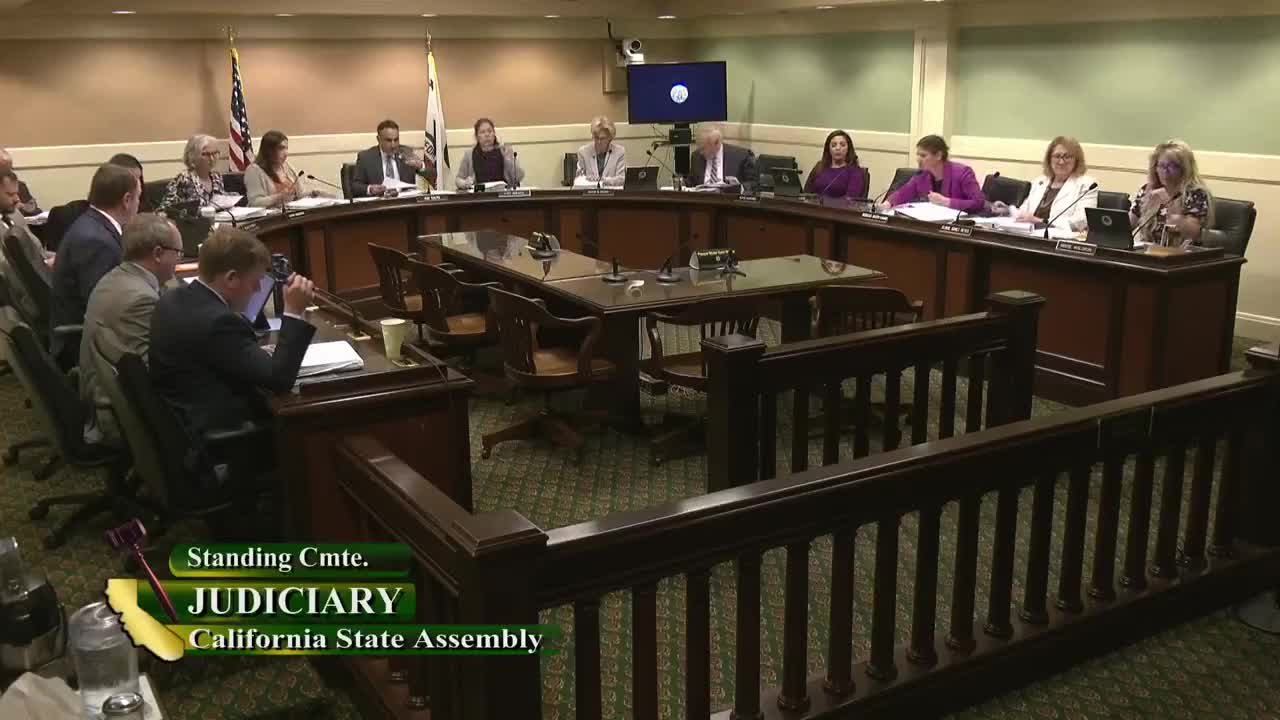 6MIN
Assembly Standing Committee on Judiciary
 10MIN
Assembly Standing Committee on Environmental Safety and Toxic Materials
Bill Author

Bill Co-Author(s):