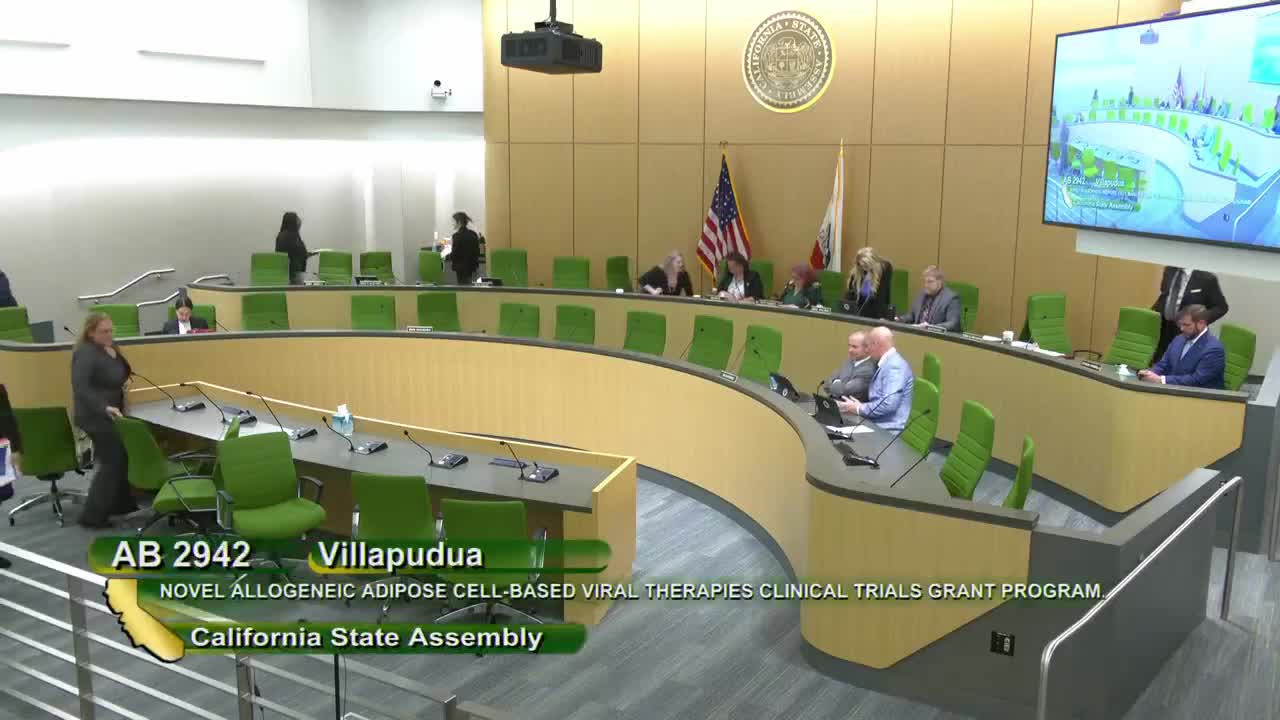
AB 2942: Novel Allogeneic Adipose Cell-Based Viral Therapies Clinical Trials Grant Program.
- Session Year: 2023-2024
- House: Assembly
- Latest Version Date: 2024-04-25
Current Status:
Failed
(2024-05-16: In committee: Held under submission.)
Introduced
In Committee
First Chamber
In Committee
Second Chamber
Enacted
What does this bill do?
Creates a state grant program, run by the Treasurer, to fund clinical trials of novel donor‑derived (allogeneic) fat‑cell therapies that use a virus to treat cancer. Grants go to health facilities that provide patient safety data and show early proof of concept from phase 1 studies. The program directs at least $20 million to phase 1 trials, prioritizes work in low‑income communities, requires participant supports like transportation, childcare, and paid medical leave, and requires the Treasurer to report to the Legislature on trial progress.
The summary is provided by generative AI which can make mistakes. For original language, please view the details in the table below.
Existing law provides various programs and funding to prevent and mitigate the impacts of cancer and other diseases in this state. Existing law defines the duties of the Treasurer, which include, but are not limited to, keeping an account of all money received and disbursed.
This bill would establish, upon appropriation by the Legislature, the Novel Allogeneic Adipose Cell-Based Viral Therapies Clinical Trials Grant Program to provide funding for clinical trials of novel allogeneic adipose cell-based viral therapies for cancer treatment. The program would be administered by the Treasurer, who would be required to award competitive grants to health facilities that meet specific requirements, including providing the Treasurer with specific patient safety data. The bill would require the Treasurer to award a significant amount of grant money to clinical trials conducted in low-income communities, traditionally excluded from leading-edge clinical trials. The bill would require the Treasurer to submit a report to the Legislature on the progress of clinical trials funded pursuant to the program, as specified.
This bill would repeal these provisions on January 1, 2031. The bill would make related findings and declarations.
Existing law establishes the California Firefighter Cancer Prevention and Research Program, pursuant to which the Legislature requests the University of California, in consultation with the FIRESCOPE Program, to develop and administer a competitive grant program to award grants to eligible educational institutions to conduct research on the California fire service using a community-based participatory research model in collaboration with California firefighters. Existing law requires research conducted by program grantees to include, but not be limited to, understanding biomarkers of exposure that quantify chemical carcinogens absorbed and metabolized by firefighters and studying biomarkers of effect that quantify cancer-promoting cellular changes that ultimately lead to a cancer diagnosis. Existing law defines eligible institutions and community-based participatory research for purposes of the program.This bill would make a technical, nonsubstantive change to the provision that defines those terms.Existing law establishes the California Firefighter Cancer Prevention and Research Program, pursuant to which the Legislature requests the University of California, in consultation with the FIRESCOPE Program, to develop and administer a competitive grant program to award grants to eligible educational institutions to conduct research on the California fire service using a community-based participatory research model in collaboration with California firefighters. Existing law requires research conducted by program grantees to include, but not be limited to, understanding biomarkers of exposure that quantify chemical carcinogens absorbed and metabolized by firefighters and studying biomarkers of effect that quantify cancer-promoting cellular changes that ultimately lead to a cancer diagnosis. Existing law defines eligible institutions and community-based participatory research for purposes of the program.
This bill would make a technical, nonsubstantive change to the provision that defines those terms.
The Legislature finds and declares all of the following:
(a)Over 2,000,000 new cancer cases are expected to be diagnosed in the United States in 2024.
(b)Cancer survival is described by relative survival rate, which is the measure of life expectancy among cancer patients compared to that of the general population of the same age, race, and sex.
(c)Novel allogenic adipose cell-based cancer therapies are noninvasive alternatives to chemotherapy and radiation for triple negative breast cancer, ovarian cancer, nonresectable melanoma, squamous cell head and neck carcinoma, basal cell carcinoma, prostate cancer, sarcoma, and thyroid cancer.
(d)Currently, commercial and Medicaid insurance do not provide coverage for clinical trials of the novel allogenic adipose cell-based therapies.
(e)Racial disparities in cancer in the United States are striking and persistent. The death rate for Black people with prostate, stomach, and uterine cancer is double that of Caucasian people.
(f)American Indian and Alaska Native people have death rates for liver, stomach, or kidney cancer that are two times higher than Caucasian people.
(g)Black men have the highest overall cancer death rate.
(h)American Indian and Alaska Native people have the highest overall incidence and mortality rate for men and women combined.
(i)Black women with endometrial cancer have a death rate that is two times higher than that of White women despite similar incidence of the disease, partly because they are diagnosed later and have worse chances of survival.
(j)Most participants in clinical trials are White males. This calls into question the applicability of trial results across diverse populations.
(k)To close racial disparities in cancer treatment and increase access to care, barriers must be removed to accessing clinical trials.
(l)Typical trials require patients to repeatedly travel to a central site for assessments, administration of therapies, tests to monitor results, and medications to take at home. Clinical trials require patients to invest several hours per trip and to pay for transportation and food. These requirements create a selection bias by precluding from trials many people with little disposable income, few transportation options, inflexible work hours, and family care obligations.
SEC. 2.Article 5 (commencing with Section 104211) is added to Chapter 2 of Part 1 of Division 103 of the Health and Safety Code, to read:5.Novel Allogeneic Adipose Cell-Based Viral Therapies Clinical Trials Grant Program104211.(a)The Novel Allogeneic Adipose Cell-Based Viral Therapies Clinical Trials Grant Program is hereby established.
(b)The purpose of the grant program is to provide funding for clinical trials of novel allogeneic adipose cell-based viral therapies for cancer treatment.
104211.1.(a)The Novel Allogeneic Adipose Cell-Based Viral Therapies Clinical Trials Grant Program shall be administered by the Treasurer.
(b)The Treasurer shall award grants on a competitive basis. The Treasurer shall establish minimum standards, funding schedules, and procedures for awarding grants. The Treasurer shall prioritize awarding grants to health facilities with a demonstrated commitment to patient safety and ethical research practices.
(c)A health facility that applies for a grant shall meet all of the following requirements:
(1)The health facility shall provide to the Treasurer patient safety data on adipose stem cells combined with vaccinia virus.
(2)The health facility shall have a proof of concept using allogeneic adipose cell-based viral therapies via a phase 1 safety or clinical trial.
104211.2.Grants awarded pursuant to this article shall be used pursuant to the following requirements:
(a)The first twenty million dollars ($20,000,000) of awarded grants shall be allocated for phase 1 of a clinical trial conducted pursuant to this article.
(b)A significant portion of grant money shall be used in clinical trials conducted in low-income communities, traditionally excluded from leading-edge clinical trials.
(c)Clinical trials funded pursuant to this article shall include wraparound services for participants from low-income communities. Wraparound services may include transportation, childcare, and paid medical leave.
104211.3.On or before July 1, 2026, or 18 Eighteen months following future appropriations by the Legislature, the Treasurer shall submit a report to the Legislature, in compliance with Section 9795 of the Government Code, on the progress of clinical trials funded pursuant to this article, including the impact on underserved communities and the success of wraparound services.
104211.4.This article shall be operative upon an appropriation by the Legislature to fund these provisions.
104211.5.This article shall remain in effect only until January 1, 2031, and as of that date is repealed.
The Legislature finds and declares all of the following:
(a)Over 2,000,000 new cancer cases are expected to be diagnosed in the United States in 2024.
(b)Cancer survival is described by relative survival rate, which is the measure of life expectancy among cancer patients compared to that of the general population of the same age, race, and sex.
(c)Novel allogenic adipose cell-based cancer therapies are noninvasive alternatives to chemotherapy and radiation for triple negative breast cancer, ovarian cancer, nonresectable melanoma, squamous cell head and neck carcinoma, basal cell carcinoma, prostate cancer, sarcoma, and thyroid cancer.
(d)Currently, commercial and Medicaid insurance do not provide coverage for clinical trials of the novel allogenic adipose cell-based therapies.
(e)Racial disparities in cancer in the United States are striking and persistent. The death rate for Black people with prostate, stomach, and uterine cancer is double that of Caucasian people.
(f)American Indian and Alaska Native people have death rates for liver, stomach, or kidney cancer that are two times higher than Caucasian people.
(g)Black men have the highest overall cancer death rate.
(h)American Indian and Alaska Native people have the highest overall incidence and mortality rate for men and women combined.
(i)Black women with endometrial cancer have a death rate that is two times higher than that of White women despite similar incidence of the disease, partly because they are diagnosed later and have worse chances of survival.
(j)Most participants in clinical trials are White males. This calls into question the applicability of trial results across diverse populations.
(k)To close racial disparities in cancer treatment and increase access to care, barriers must be removed to accessing clinical trials.
(l)Typical trials require patients to repeatedly travel to a central site for assessments, administration of therapies, tests to monitor results, and medications to take at home. Clinical trials require patients to invest several hours per trip and to pay for transportation and food. These requirements create a selection bias by precluding from trials many people with little disposable income, few transportation options, inflexible work hours, and family care obligations.
SEC. 2.Article 5 (commencing with Section 104211) is added to Chapter 2 of Part 1 of Division 103 of the Health and Safety Code, to read:5.Novel Allogeneic Adipose Cell-Based Viral Therapies Clinical Trials Grant Program104211.(a)The Novel Allogeneic Adipose Cell-Based Viral Therapies Clinical Trials Grant Program is hereby established.
(b)The purpose of the grant program is to provide funding for clinical trials of novel allogeneic adipose cell-based viral therapies for cancer treatment.
104211.1.(a)The Novel Allogeneic Adipose Cell-Based Viral Therapies Clinical Trials Grant Program shall be administered by the Treasurer.
(b)The Treasurer shall award grants on a competitive basis. The Treasurer shall establish minimum standards, funding schedules, and procedures for awarding grants. The Treasurer shall prioritize awarding grants to health facilities with a demonstrated commitment to patient safety and ethical research practices.
(c)A health facility that applies for a grant shall meet all of the following requirements:
(1)The health facility shall provide to the Treasurer patient safety data on adipose stem cells combined with vaccinia virus.
(2)The health facility shall have a proof of concept using allogeneic adipose cell-based viral therapies via a phase 1 safety or clinical trial.
104211.2.Grants awarded pursuant to this article shall be used pursuant to the following requirements:
(a)The first twenty million dollars ($20,000,000) of awarded grants shall be allocated for phase 1 of a clinical trial conducted pursuant to this article.
(b)A significant portion of grant money shall be used in clinical trials conducted in low-income communities, traditionally excluded from leading-edge clinical trials.
(c)Clinical trials funded pursuant to this article shall include wraparound services for participants from low-income communities. Wraparound services may include transportation, childcare, and paid medical leave.
104211.3.On or before July 1, 2026, or 18 months following future appropriations by the Legislature, the Treasurer shall submit a report to the Legislature, in compliance with Section 9795 of the Government Code, on the progress of clinical trials funded pursuant to this article, including the impact on underserved communities and the success of wraparound services.
104211.4.This article shall be operative upon an appropriation by the Legislature to fund these provisions.
104211.5.This article shall remain in effect only until January 1, 2031, and as of that date is repealed.
SECTION 1.Section 104210 of the Health and Safety Code is amended to read:104210.The following definitions apply for purposes of this section:(a)Eligible educational institutions means University of California campuses that meet the eligibility criteria developed pursuant to Section 104210.1.(b)Community-based participatory research means a mechanism by which academic partners establish a meaningful and ongoing collaboration with the population of interest to ensure that the research is relevant and needed in the community and is conducted in a responsible and respectful manner. The research engages communities at different times during the research process.For the purposes of this article, the following definitions apply: The following definitions apply for purposes of this section:
(a)Eligible educational institutions means University of California campuses that meet the eligibility criteria developed pursuant to Section 104210.1.
(b)Community-based participatory research means a mechanism by which academic partners establish a meaningful and ongoing collaboration with the population of interest to ensure that the research is relevant and needed in the community and is conducted in a responsible and respectful manner. The research engages communities at different times during the research process.
|
Date
|
Status
|
|---|---|
| May 16, 2024 | In committee: Held under submission. |
| May 16, 2024 | Joint Rule 62(a), file notice suspended. (Page 5215.) |
| May 15, 2024 | In committee: Set, first hearing. Referred to APPR. suspense file. |
| Apr 29, 2024 | Re-referred to Com. on APPR. |
| Apr 25, 2024 | Read second time and amended. |
| Apr 24, 2024 | From committee: Amend, and do pass as amended and re-refer to Com. on APPR. (Ayes 16. Noes 0.) (April 23). |
| Apr 1, 2024 | Re-referred to Com. on HEALTH. |
| Mar 21, 2024 | From committee chair, with author's amendments: Amend, and re-refer to Com. on HEALTH. Read second time and amended. |
| Mar 21, 2024 | Referred to Com. on HEALTH. |
| Feb 16, 2024 | From printer. May be heard in committee March 17. |
| Feb 15, 2024 | Read first time. To print. |
|
Date
|
Description
|
Location
|
Votes
|
|
|---|---|---|---|---|
| Apr 23, 2024 | Do pass as amended and be re-referred to the Committee on [Appropriations] | Assembly Standing Committee on Health |
Passed |
This list shows positions taken on this bill by organizations on the date displayed, which is linked to the original source.
Positions by individuals are not included.
|
Organization
|
Position
|
Date
|
|---|---|---|
| Calidi Biotherapeutics Inc | * Support | Apr 23, 2024 |
| Calidi Biotherapeutics, Inc. | ** Support | |
| City of Hope National Cancer Center | * Support | Apr 23, 2024 |
Date of Hearing: May 15, 2024
ASSEMBLY COMMITTEE ON APPROPRIATIONS
Buffy Wicks, Chair
ABPCA Bill Id:AB 2942
Author:(Villapudua) – As Amended Ver:April 25, 2024
Policy Committee: | Health | Vote: | 16 - 0 |
|
| ||
|
|
Urgency: No State Mandated Local Program: No Reimbursable: No
SUMMARY:
This bill establishes, upon appropriation by the Legislature, the Novel Allogeneic Adipose Cell-Based Viral Therapies Clinical Trials Grant Program (Program) to provide funding for clinical trials of novel allogeneic adipose cell-based viral therapies for cancer treatment. The bill requires the Treasurer to award competitive grants to health facilities that meet specific requirements, and to award a significant amount of grant money to clinical trials in low-income communities.
Specifically, this bill:
- Establishes the Novel Allogeneic Adipose Cell-Based Viral Therapies Clinical Trials Grant Program for the purpose of providing funding for clinical trials of novel allogeneic adipose cell-based viral therapies for cancer treatment.
- Requires the Treasurer to award grants on a competitive basis and to establish minimum standards, funding schedules, and procedures for awarding grants.
- Requires the Treasurer to prioritize awarding grants to health facilities with a demonstrated commitment to patient safety and ethical research practices.
- Requires a health facility that applies for a grant to provide to the Treasurer patient safety data on adipose stem cells combined with vaccinia virus and have a proof of concept using allogeneic adipose cell-based viral therapies via a phase 1 safety or clinical trial.
- Requires grants awarded to be used as follows:
- The first $20,000,000 for phase 1 of a clinical trial.
- A significant portion of grant money will be used in trials in low-income communities.
- Clinical trials will include wraparound services, which may include transportation, childcare, and paid medical leave.
- Requires the Treasurer to submit, on or before July 1, 2026, or 18 months following future appropriations by the Legislature, a report to the Legislature on the progress of the clinical trials, including the impact on underserved communities and the success of wraparound services.
- Is operative upon an appropriation by the Legislature, and as of January 1, 2031is repealed.
FISCAL EFFECT:
The California Health Facilities Financing Authorities reports it would need six staff positions and one medical consultant, at costs of $1.2 million per year (General Fund).
According to the Legislative Analyst’s Office, the General Fund faces a structural deficit in the tens of billions of dollars over the next several fiscal years.
COMMENTS:
- Purpose. According to the author:
The American Cancer Society reports that 2 million new cancer cases are expected in 2024 alone and from this approximately 611,720 deaths are anticipated. Typical cancer trials are costly and require patients to repeatedly travel to a central site for assessments, administration of therapies, tests to monitor results, and medications to take at home. These requirements create a selection bias by eliminating many people with little disposable income, few transportation options, inflexible work hours, and family-care obligations. This bill establishes a grant program that will provide the non-invasive novel allogenic adipose cell-based cancer therapies to low-income individuals, people of color and women, who would otherwise go without.
- Background. Novel allogenic adipose cell-based viral therapies are used in the treatment of several types of cancer, including breast cancer, ovarian cancer, prostate cancer, thyroid cancer, and squamous cell head and neck carcinoma.
- Budget Request. The author has requested an allocation of $20 million in the state budget for this bill. The request seeks to fund two clinical trials and all wrap-around services for a total of eighty patients.
Analysis Prepared by: Allegra Kim / APPR. / (916) 319-2081
Date of Hearing: April 23, 2024
ASSEMBLY COMMITTEE ON HEALTH
Mia Bonta, Chair
ABPCA Bill Id:AB 2942
Author:(Villapudua) – As Amended Ver:March 21, 2024
SUBJECT: Novel Allogeneic Adipose Cell-Based Viral Therapies Clinical Trials Grant Program.
SUMMARY: Establishes the Novel Allogeneic Adipose Cell-Based Viral Therapies Clinical Trials Grant Program to be administered by the State Treasurer for the purpose of providing funding for clinical trials of novel allogeneic adipose cell-based viral therapies for cancer treatment. Specifically, this bill:
- Establishes the Novel Allogeneic Adipose Cell-Based Viral Therapies Clinical Trials Grant Program to be administered by the Treasurer.
- Requires the Treasurer to award grants on a competitive basis. Requires the Treasurer establish minimum standards, funding schedules, and procedures for awarding grants.
- Requires the Treasurer to prioritize awarding grants to health facilities with a demonstrated commitment to patient safety and ethical research practices.
- Requires a health facility that applies for a grant to meet both of the following requirements:
- Provide to the Treasurer patient safety data on adipose stem cells combined with vaccinia virus; and,
- Possess a proof of concept using allogeneic adipose cell-based viral therapies via a phase 1 safety or clinical trial.
- Requires grants to be used pursuant to the following requirements:
- Requires the first $20 million of awarded grants to be allocated for phase 1 of a clinical trial;
- Requires a significant portion of grant money to be used in clinical trials conducted in low-income communities, traditionally excluded from leading-edge clinical trials;
- Requires clinical trials funded by the grant program to include wraparound services for participants from low-income communities;
- Allows wraparound services to include transportation, childcare, and paid medical leave; and,
- Requires on or before July 1, 2026, or 18 months following future appropriations by the Legislature, the Treasurer to submit a report to the Legislature, in compliance with existing law, on the progress of clinical trials funded pursuant to this article, including the impact on underserved communities and the success of wraparound services.
- Specifies that this bill is operative upon an appropriation by the Legislature.
- Specifies the provisions of this bill are in effect only until January 1, 2031, and as of that date are repealed.
- Makes related findings and declarations.
EXISTING LAW:
- Requests the University of California (UC) to establish and administer the Breast Cancer Research Program, as a comprehensive grant and contract program to support research efforts into the cause, cure, treatment, earlier detection, and prevention of breast cancer. [Health and Safety Code (HSC) § 104145.
- Requires State Department of Health Care Services (DHCS) to develop and maintain the Breast and Cervical Cancer Treatment Program to expand and ensure quality breast and cervical cancer treatment for low-income uninsured and underinsured individuals who are diagnosed with breast or cervical cancer. [HSC § 104145]
- Establishes the Human Leukocyte Antigen Testing Fund within the State Treasury, to be administered by the State Department of Health Services (now administered by DHCS). [HSC § 104170]
- Establishes the Cancer Research Fund within the State Treasury. Requires moneys in the fund to be made available for expenditure by DHCS, upon appropriation by the Legislature. Requires the fund to consist of money accepted by DHCS from grants and donations from private entities and of public moneys transferred to the fund. [HSC § 104180}
- Establishes the California Firefighter Cancer Prevention and Research Program, administered by the Department of Public Health to award grants to eligible institutions to conduct research on biomarkers of exposure that quantify chemical carcinogens absorbed and metabolized by firefighters that ultimately lead to a cancer diagnosis. [HSC § 104210.1]
- Defines the duties of the Treasurer, which include, but are not limited to, keeping an account of all money received and disbursed to and from the Treasury. [Government Code § 12320 – 12334]
FISCAL EFFECT: Unknown. This bill has not yet been analyzed by a fiscal committee.
COMMENTS:
- PURPOSE OF THIS BILL. According to the author, the American Cancer Society reports that 2 million new cancer cases are expected in 2024 alone and from this approximately 611,720 deaths are anticipated. The author notes that typical cancer trials are costly and require patients to repeatedly travel to a central site for assessments, administration of therapies, tests to monitor results, and medications to take at home. The author states that these requirements create a selection bias by eliminating many people with little disposable income, few transportation options, inflexible work hours, and family-care obligations. The author concludes that this bill establishes a grant program that will provide the non-invasive novel allogenic adipose cell-based cancer therapies to low-income individuals, people of color and women, who would otherwise go without.
- BACKGROUND.
- Novel allogenic adipose cell-based viral therapies. Novel allogenic adipose cell-based viral therapies are used in the treatment of several types of cancer including but not limited to, breast cancer, ovarian cancer, prostate cancer, thyroid cancer, and squamous cell head and neck carcinoma. This treatment is non-invasive and costs significantly less per-dose than radiation and chemotherapy. Calidi Biotherapeutics (Calidi), who supports this bill, manufactures this kind of treatment. Other vendors include Akamis Bio; GCG oncology; Genelux; IconOVir Bio; KaliVir Immunotherapeutic; and, TILT Biotherapeutics. This bill establishes a statutory framework for a grant program to fund clinical trials for this treatment.
- Barriers to access clinical trials. According to the National Cancer Institute, when it comes to paying for clinical trials, the sponsor of the study and health insurance plans cover many of the costs. Patient costs in clinical trials are costs such as doctor visits, hospital stays, standard cancer treatments, treatments to improve symptoms of cancer or side effects from treatment, lab tests, X-rays and other imaging tests. These costs are often covered by health insurance. Research costs are those related to taking part in the trial. Examples of research costs include the study drug; lab tests performed purely for research purposes; added X-rays and imaging tests performed solely for the trial; and, extra doctor visits that patients would not have with usual care. These costs are often not covered by health insurance, but may be covered by the trial’s sponsors. Before participating in a clinical trial, patients are encouraged to learn about which costs are covered by the study, which costs they or their health plan need to pay. Participants may be asked to pay for treatments and procedures not covered by insurance. The typical trial also requires patients to repeatedly travel to a central site — such as a university hospital — for assessments, administration of therapies, tests to monitor results, and medications to take at home. This often involves several hours per trip as well as paying for transportation, food, child and elder care. These requirements create a selection bias by eliminating many people with little disposable income, few transportation options, inflexible work hours, and family-care obligations.
- Racial disparities in clinical trial participation. Given barriers to access clinical trials, these trials are often limited to those who have the resources to afford participating in the trial, leading to disparities in participation for low-income communities of color. A 2020 report from the U.S. Food and Drug Administration showed, 75% of research participants are white, while white people are 60% of the population in the U.S.; 8% of research participants are African-American/Black, while African-American/Black people are 13% of the population in the U.S.; 11% of research participants are Latino/Hispanic, while Latino/Hispanic people are 18% of the population in the U.S.; 6% of research participants are Asian, while Asian Americans are 6% of the population in the U.S.
- Importance of diversity in clinical trials. According to Hopkins Medicine, it is critical to advance diversity in clinical trials for the following reasons: i) race, disability and socioeconomic status, and other demographic factors can affect people’s risk of developing certain conditions. It also can impact their responses to medical interventions and their overall health outcomes. The more that participants who take part in clinical research make up a diverse group, the more likely that the research results — and any decisions to start or stop clinical treatments — will apply to a diverse group of patients; and, ii) It is important that research participants represent the people who are most impacted by the disease or condition being studied. For example, certain cancers and sickle cell disease are much more common among people of color, making it crucial that people of color take part in clinical studies of these serious illnesses.
- Novel allogenic adipose cell-based viral therapies. Novel allogenic adipose cell-based viral therapies are used in the treatment of several types of cancer including but not limited to, breast cancer, ovarian cancer, prostate cancer, thyroid cancer, and squamous cell head and neck carcinoma. This treatment is non-invasive and costs significantly less per-dose than radiation and chemotherapy. Calidi Biotherapeutics (Calidi), who supports this bill, manufactures this kind of treatment. Other vendors include Akamis Bio; GCG oncology; Genelux; IconOVir Bio; KaliVir Immunotherapeutic; and, TILT Biotherapeutics. This bill establishes a statutory framework for a grant program to fund clinical trials for this treatment.
The author contends that the intent of this bill is to increase access to clinical trials for underrepresented populations by providing funding for clinical trials as well as wrap-around services for participants. The bill includes a report back to the legislature on the success of the program.
- SUPPORT. Calidi writes in support, stating that currently clinical trials in California are almost exclusively funded by consumers, directly out-of-pocket. This does not account for the limited availability of trials in facilities across California and this means that access to clinical trials is severely limited. Calidi continues that this bill establishes a pilot program that when funded would provide two clinical trials and all wrap-around services for 80 total patients for novel allogenic adipose cell-based viral therapies. Calidi notes that without this pilot program this extraordinary treatment remains available only for those who have the economic and geographic resource to locate a trial and pay out-of-pocket. According to Calidi, by including wrap-around services in this bill is the first of its kind, making this treatment obtainable for single mothers, veterans, non-native speakers, and those lacking access to consistent transportation. Calidi concludes that this bill is essential to advancing California’s long-term goal of increasing access to care and innovating through diverse clinical trials.
- PREVIOUS LEGISLATION.
- SB 184 (Committee on Budget and Fiscal Review), Chapter 47, Statutes of 2022, i) expands, effective July 1, 2022, the routine patient care coverage requirements for qualifying clinical cancer trials for purposes of the Medi-Cal program, to conform to the federal Medicaid definition of a qualifying clinical trial; ii) requires treatment to be provided in a qualifying clinical trial, which means a clinical trial, in any clinical phase of development, that is conducted in relation to the prevention, detection, or treatment of any serious or life-threatening disease or condition and is described in Section 1396d(gg)(2)(A) of Title 42 of the United States Code; and, iii) implements this section only if federal approvals are obtained, and federal financial participation is available and not otherwise jeopardized.
- AB 1810 (Committee on Budget), Chapter 34, Statutes of 2018, eliminates length-of-treatment caps for breast and cervical cancer treatments within the Breast and Cervical Cancer Treatment Program.
- AMENDMENTS. The author wishes to amend the bill to strike the reference to the report’s July 1, 2026 due date to instead make the report due 18 months following funding for the program upon appropriation by the legislature.
REGISTERED SUPPORT / OPPOSITION:
Support
Calidi Biotherapeutics, Inc.
One individual
Opposition
None on file.
Analysis Prepared by: Eliza Brooks / HEALTH / (916) 319-2097
Bill Author

Bill Co-Author(s):
