AB 638: Golden State Teacher Grant Program.
- Session Year: 2023-2024
- House: Assembly
- Latest Version Date: 2023-04-20
Current Status:
Failed
(2024-02-01: From committee: Filed with the Chief Clerk pursuant to Joint Rule 56.)
Introduced
In Committee
First Chamber
In Committee
Second Chamber
Enacted
What does this bill do?
This bill changes the Golden State Teacher Grant so that new recipients awarded on or after January 1, 2024 must commit to teach for four years in a teacher shortage area designated by the Commission on Teacher Credentialing at any California public or nonpublic school. It also requires the Student Aid Commission to collect and annually report recipients’ demographic data to the Legislature and extends the deadline to use funds from the 2022–23 Budget Act to June 30, 2028.
The summary is provided by generative AI which can make mistakes. For original language, please view the details in the table below.
Existing law establishes the Golden State Teacher Grant Program under the administration of the Student Aid Commission to award grants to students enrolled in professional preparation programs leading to a preliminary teaching credential or a pupil personnel services credential who commit to work at a priority school for 4 years, as provided. Existing law defines priority school as a school with 55% or more of its pupils being unduplicated pupils, as defined. Existing law makes funds appropriated for the program in the Budget Acts of 2020 and 2021 available for encumbrance or expenditure by the commission until June 30, 2026.
This bill would instead require, commencing with new grants awarded on or after January 1, 2024, the student candidates to commit to work for 4 years in a shortage area, as designated by the Commission on Teacher Credentialing, at any California public or private nonpublic school, as provided. The bill would make funds appropriated for the Golden State Teacher Grant Program in the Budget Acts of 2022 and 2023 available for encumbrance or expenditure by the commission until June 30, 2028.
Existing law requires the commission to conduct an evaluation of the program to determine the effectiveness of the program to recruit and employ credential candidates and credentialholders at priority schools, and to provide a report to the Legislature on or before December 31, 2025, and every 2 years thereafter, as provided.
This bill would revise and conform requirements regarding the evaluation of the program, and would require the Student Aid Commission to annually collect demographic data on the recipients of the grant programs, commencing with new grants awarded on or after January 1, 2024, and to annually report that information to the Legislature, as provided.
Existing law establishes the Golden State Teacher Grant Program under the administration of the Student Aid Commission to award grants to students enrolled in professional preparation programs leading to a preliminary teaching credential or a pupil personnel services credential who commit to work at a priority school for 4 years, as provided. Existing law defines priority school as a school with 55% or more of its pupils being unduplicated pupils, as defined. Existing law makes funds appropriated for the program in the Budget Acts of 2020 and 2021 available for encumbrance or expenditure by the commission until June 30, 2026.
This bill would instead require, commencing with new grants awarded on or after January 1, 2024, the student candidates to commit to work for 4 years in a shortage area, as designated by the Commission on Teacher Credentialing, at any California public or private school, as provided. The bill would make funds appropriated for the Golden State Teacher Grant Program in the Budget Acts of 2022 and 2023 available for encumbrance or expenditure by the commission until June 30, 2028.
Existing law requires the commission to conduct an evaluation of the program to determine the effectiveness of the program to recruit and employ credential candidates and credentialholders at priority schools, and to provide a report to the Legislature on or before December 31, 2025, and every 2 years thereafter, as provided.
This bill would revise and conform requirements regarding the evaluation of the program, and would require the Student Aid Commission to annually collect demographic data on the recipients of the grant programs, commencing with new grants awarded on or after January 1, 2024, and to annually report that information to the Legislature, as provided.
Existing law establishes the Golden State Teacher Grant Program under the administration of the Student Aid Commission to award grants to students enrolled in professional preparation programs leading to a preliminary teaching credential or a pupil personnel services credential who commit to work at a priority school for 4 years, as provided. Existing law makes funds appropriated for the program in the Budget Acts of 2020 and 2021 available for encumbrance or expenditure by the commission until June 30, 2026.
This bill would make funds appropriated for the Golden State Teacher Grant Program in the Budget Acts of 2022 and 2023 available for encumbrance or expenditure by the commission until June 30, 2028.
(a)(1)Subject to moneys appropriated by the Legislature for purposes of this section, the commission shall administer the Golden State Teacher Grant Program. Under the program, the commission shall provide one-time grant funds of up to twenty thousand dollars ($20,000) to each student enrolled, or who has applied for enrollment, on or after January 1, 2020, in a professional preparation program leading to a preliminary teaching credential or a pupil personnel services credential, at either a qualifying institution, as defined in subdivision (l) of Section 69432.7, or a professional preparation program approved by the Commission on Teaching Credentialing that has a main campus location or administrative entity that resides in California, including professional preparation programs operated by local educational agencies in California, if the student commits to working in a shortage area at any California public or private nonpublic school for four years within the eight years following the date the student completes the professional preparation program.
(2)Funds appropriated for the Golden State Teacher Grant Program in the Budget Act of 2020 and the Budget Act of 2021 shall be available for encumbrance or expenditure by the commission until June 30, 2026.
(3)Funds appropriated for the Golden State Teacher Grant Program in the Budget Act of 2022 and the Budget Act of 2023 shall be available for encumbrance or expenditure by the commission until June 30, 2028.
(4)Grant funds shall be used to supplement and not supplant other sources of grant financial aid, and may be disbursed in more than one academic year, provided that the total amount of funds granted to an applicant does not exceed twenty thousand dollars ($20,000).
(b)The one-time grant funds issued pursuant to this section shall not exceed the amount appropriated for the Golden State Teacher Grant Program in the Budget Act of 2020, the Budget Act of 2021, the Budget Act of 2022, and the Budget Act of 2023.
(c)(1)A grant recipient shall agree to serve in a shortage area at any California public or private nonpublic school for four years and shall have eight years, upon completion of the recipients professional preparation program, to meet that obligation. Except as provided in paragraph (4), a grant recipient shall agree to repay the state 25 percent of the total received grant funds annually, up to full repayment of the received grant funds, for each year the recipient fails to do one or more of the following:
(A)Be enrolled in or have successfully completed a professional preparation program approved by the Commission on Teacher Credentialing.
(B)While enrolled in the professional preparation program, maintain good academic standing.
(C)Before or upon completion of the professional preparation program, satisfy the state basic skills requirement pursuant to Sections 44252 and 44252.5.
(D)Complete the required teaching service or clinical practice following completion of the recipients professional preparation program.
(E)Complete their teacher preparation program and earn a preliminary credential within three years after the first distribution of grant funds.
(2)Nonperformance of the commitment to serve in a shortage area for four years shall be certified by the commission.
(3)Nonperformance of the commitment to earn a preliminary teaching credential or pupil personnel services credential shall be certified by the Commission on Teacher Credentialing to the Student Aid Commission.
(4)Any exceptions to the requirement for repayment shall be defined by the commission, and may include, but shall not necessarily be limited to, counting a school year towards the required four-year service requirement if a grant recipient is unable to complete the school year when any of the following occur:
(A)The grant recipient has completed at least one-half of the school year.
(B)The employer deems the grant recipient to have fulfilled the grant recipients contractual requirements for the school year for the purposes of salary increases, probationary or permanent status, and retirement.
(C)The grant recipient was not able to serve due to the financial circumstances of the school district, including a decision to not reelect the employee for the next succeeding school year.
(D)The grant recipient has a condition covered under the federal Family and Medical Leave Act of 1993 (29 U.S.C. Sec. 2601 et seq.) or similar state law.
(E)The grant recipient was called or ordered to active duty status for more than 30 days as a member of a reserve component of the Armed Forces of the United States.
(d)The commission may use up to 1.5 percent of funding appropriated for purposes of this section for outreach and administration.
(e)The commission shall develop a process by which students interested in a professional preparation program leading to a preliminary teaching credential or a pupil personnel services credential may submit a request for a preenrollment conditional award notice from the commission. The notice shall provide information regarding the Golden State Teacher Grant Program award amount the student may be eligible to receive upon enrollment in the professional preparation program and formal application to the commission to participate in the Golden State Teacher Grant Program.
(f)(1)A shortage area means a subject area designated annually by the Commission on Teacher Credentialing based on an analysis of the availability of teachers in California pursuant to Section 44225.6, at a California public or private nonpublic school.
(2)The commission, in coordination with the State Department of Education, shall publish a list of shortage areas pursuant to paragraph (1) by April 15 of each year.
(g)(1)The commission may adopt regulations, including any amendments to regulations, necessary for the implementation of the Golden State Teacher Grant Program. The commission may adopt emergency regulations it deems necessary for the implementation of this program, in accordance with the rulemaking provisions of the Administrative Procedure Act (Chapter 3.5 (commencing with Section 11340) of Part 1 of Division 3 of Title 2 of the Government Code). For purposes of the Administrative Procedure Act, including Section 11349.6 of the Government Code, the adoption of those regulations or amendments to those regulations shall be deemed to be an emergency and necessary for the immediate preservation of the public peace, health and safety, or general welfare, notwithstanding subdivision (e) of Section 11346.1 of the Government Code.
(2)Notwithstanding any other law and without further compliance with the Administrative Procedure Act (Chapter 3.5 (commencing with Section 11340) of Part 1 of Division 3 of Title 2 of the Government Code), any emergency regulations and amendments to the emergency regulations adopted pursuant to paragraph (1) shall remain in force and effect until June 30, 2025.
(3)No rule, policy, or standard of general application issued by the commission in implementing this section shall be subject to the requirements of the Administrative Procedure Act (Chapter 3.5 (commencing with Section 11340) of Part 1 of Division 3 of Title 2 of the Government Code).
(h)(1)The commission shall conduct, in partnership with the Commission on Teacher Credentialing, an evaluation of the Golden State Teacher Grant Program to determine the effectiveness of the program in recruiting, developing support systems for, and retaining teachers and credentialholders prepared to serve in commission-designated shortage areas, using data and evaluation guidelines that are consistent with the evaluation conducted of teacher residency programs established under Article 16 (commencing with Section 44415) of Chapter 2 of Part 25 of Division 3 of Title 2. Notwithstanding Section 10231.5 of the Government Code, the commission shall provide, with respect to the evaluation, a report to the Department of Finance and the appropriate fiscal and policy committees of the Legislature on or before December 31, 2025, and every two years thereafter.
(2)(A)Notwithstanding Section 10231.5 of the Government Code, the commission shall annually collect demographic data on grant award recipients, and shall annually report the demographic data to the Legislature.
(B)The report submitted pursuant to subparagraph (A) shall be submitted in compliance with Section 9795 of the Government Code.
(i) The commission shall accept applications for the Golden State Teacher Grant Program beginning on September 1 for the following academic year and shall establish a process and timeline that allows institutions of higher education to provide applicants with grant eligibility determinations before the deadline for enrolling in their professional preparation program.
(j)The commission shall permit grant recipients to receive funds in more than one academic year, provided the total amount of funds granted to any applicant does not exceed twenty thousand dollars ($20,000).
(k)The changes made to this section by Assembly Bill 638 of the 202324 Regular Session shall apply only to new grants awarded pursuant to this section on or after January 1, 2024.
(a)(1)Subject to moneys appropriated by the Legislature for purposes of this section, the commission shall administer the Golden State Teacher Grant Program. Under the program, the commission shall provide one-time grant funds of up to twenty thousand dollars ($20,000) to each student enrolled, or who has applied for enrollment, on or after January 1, 2020, in a professional preparation program leading to a preliminary teaching credential or a pupil personnel services credential, at either a qualifying institution, as defined in subdivision (l) of Section 69432.7, or a professional preparation program approved by the Commission on Teaching Credentialing that has a main campus location or administrative entity that resides in California, including professional preparation programs operated by local educational agencies in California, if the student commits to working at a priority school in a shortage area at any California public or private school for four years within the eight years following the date the student completes the professional preparation program.
(2)Funds appropriated for the Golden State Teacher Grant Program in the Budget Act of 2020 and the Budget Act of 2021 shall be available for encumbrance or expenditure by the commission until June 30, 2026.
(3)Funds appropriated for the Golden State Teacher Grant Program in the Budget Act of 2022 and the Budget Act of 2023 shall be available for encumbrance or expenditure by the commission until June 30, 2028.
(4)Grant funds shall be used to supplement and not supplant other sources of grant financial aid, and may be disbursed in more than one academic year, provided that the total amount of funds granted to an applicant does not exceed twenty thousand dollars ($20,000).
(b)The one-time grant funds issued pursuant to this section shall not exceed the amount appropriated for the Golden State Teacher Grant Program in the Budget Act of 2020, the Budget Act of 2021, the Budget Act of 2022, and the Budget Act of 2023.
(c)(1)A grant recipient shall agree to serve at a priority school in a shortage area at any California public or private school for four years and shall have eight years, upon completion of the recipients professional preparation program, to meet that obligation. Except as provided in paragraph (4), a grant recipient shall agree to repay the state 25 percent of the total received grant funds annually, up to full repayment of the received grant funds, for each year the recipient fails to do one or more of the following:
(A)Be enrolled in or have successfully completed a professional preparation program approved by the Commission on Teacher Credentialing.
(B)While enrolled in the professional preparation program, maintain good academic standing.
(C)Before or upon completion of the professional preparation program, satisfy the state basic skills requirement pursuant to Sections 44252 and 44252.5.
(D)Complete the required teaching service or clinical practice following completion of the recipients professional preparation program.
(E)Complete their teacher preparation program and earn a preliminary credential within three years after the first distribution of grant funds.
(2)Nonperformance of the commitment to serve at a priority school in a shortage area for four years shall be certified by the commission.
(3)Nonperformance of the commitment to earn a preliminary teaching credential or pupil personnel services credential shall be certified by the Commission on Teacher Credentialing to the Student Aid Commission.
(4)Any exceptions to the requirement for repayment shall be defined by the commission, and may include, but shall not necessarily be limited to, counting a school year towards the required four-year service requirement if a grant recipient is unable to complete the school year when any of the following occur:
(A)The grant recipient has completed at least one-half of the school year.
(B)The employer deems the grant recipient to have fulfilled the grant recipients contractual requirements for the school year for the purposes of salary increases, probationary or permanent status, and retirement.
(C)The grant recipient was not able to serve due to the financial circumstances of the school district, including a decision to not reelect the employee for the next succeeding school year.
(D)The grant recipient has a condition covered under the federal Family and Medical Leave Act of 1993 (29 U.S.C. Sec. 2601 et seq.) or similar state law.
(E)The grant recipient was called or ordered to active duty status for more than 30 days as a member of a reserve component of the Armed Forces of the United States.
(d)The commission may use up to 1.5 percent of funding appropriated for purposes of this section for outreach and administration.
(e)The commission shall develop a process by which students interested in a professional preparation program leading to a preliminary teaching credential or a pupil personnel services credential may submit a request for a preenrollment conditional award notice from the commission. The notice shall provide information regarding the Golden State Teacher Grant Program award amount the student may be eligible to receive upon enrollment in the professional preparation program and formal application to the commission to participate in the Golden State Teacher Grant Program.
(f)(1)A priority school shortage area means a school with 55 percent or more of its pupils being unduplicated pupils, as defined in subdivision (b) of Section 42238.02. a subject area designated annually by the Commission on Teacher Credentialing based on an analysis of the availability of teachers in California pursuant to Section 44225.6, at a California public or private school.
(2)The commission, in coordination with the State Department of Education, shall publish a list of priority schools shortage areas pursuant to paragraph (1) by April 15 of each year.
(g)(1)The commission may adopt regulations, including any amendments to regulations, necessary for the implementation of the Golden State Teacher Grant Program. The commission may adopt emergency regulations it deems necessary for the implementation of this program, in accordance with the rulemaking provisions of the Administrative Procedure Act (Chapter 3.5 (commencing with Section 11340) of Part 1 of Division 3 of Title 2 of the Government Code). For purposes of the Administrative Procedure Act, including Section 11349.6 of the Government Code, the adoption of those regulations or amendments to those regulations shall be deemed to be an emergency and necessary for the immediate preservation of the public peace, health and safety, or general welfare, notwithstanding subdivision (e) of Section 11346.1 of the Government Code.
(2)Notwithstanding any other law and without further compliance with the Administrative Procedure Act (Chapter 3.5 (commencing with Section 11340) of Part 1 of Division 3 of Title 2 of the Government Code), any emergency regulations and amendments to the emergency regulations adopted pursuant to paragraph (1) shall remain in force and effect until June 30, 2025.
(3)No rule, policy, or standard of general application issued by the commission in implementing this section shall be subject to the requirements of the Administrative Procedure Act (Chapter 3.5 (commencing with Section 11340) of Part 1 of Division 3 of Title 2 of the Government Code).
(h)(1)The commission shall conduct, in partnership with the Commission on Teacher Credentialing, an evaluation of the Golden State Teacher Grant Program to determine the effectiveness of the program in recruiting credential candidates and employing credentialholders at priority schools. The commission is encouraged to use qualitative and quantitative measures to quantify the number of credential candidates the program recruited into professional preparation programs, disaggregated by program and institution type, and the number of credentialholders employed at priority schools, disaggregated by subject matter placement, and to describe the effects of the program on the decisions of credential candidates to enter and remain in the education field. The recruiting, developing support systems for, and retaining teachers and credentialholders prepared to serve in commission-designated shortage areas, using data and evaluation guidelines that are consistent with the evaluation conducted of teacher residency programs established under Article 16 (commencing with Section 44415) of Chapter 2 of Part 25 of Division 3 of Title 2. Notwithstanding Section 10231.5 of the Government Code, the commission shall provide, with respect to the evaluation, a report to the Department of Finance and the appropriate fiscal and policy committees of the Legislature on or before December 31, 2025, and every two years thereafter.(2)(A)Notwithstanding Section 10231.5 of the Government Code, the commission shall annually collect demographic data on grant award recipients, and shall annually report the demographic data to the Legislature.
(B)The report submitted pursuant to subparagraph (A) shall be submitted in compliance with Section 9795 of the Government Code.
(i) The commission shall accept applications for the Golden State Teacher Grant Program beginning on September 1 for the following academic year and shall establish a process and timeline that allows institutions of higher education to provide applicants with grant eligibility determinations before the deadline for enrolling in their professional preparation program.(j)The commission shall permit grant recipients to receive funds in more than one academic year, provided the total amount of funds granted to any applicant does not exceed twenty thousand dollars ($20,000).(k)The changes made to this section by Assembly Bill 638 of the 202324 Regular Session shall apply only to new grants awarded pursuant to this section on or after January 1, 2024.
(a)(1)Subject to moneys appropriated by the Legislature for purposes of this section, the commission shall administer the Golden State Teacher Grant Program. Under the program, the commission shall provide one-time grant funds of up to twenty thousand dollars ($20,000) to each student enrolled, or who has applied for enrollment, on or after January 1, 2020, in a professional preparation program leading to a preliminary teaching credential or a pupil personnel services credential, at either a qualifying institution, as defined in subdivision (l) of Section 69432.7, or a professional preparation program approved by the Commission on Teaching Credentialing that has a main campus location or administrative entity that resides in California, including professional preparation programs operated by local educational agencies in California, if the student commits to working at a priority school for four years within the eight years following the date the student completes the professional preparation program.
(2)Funds appropriated for the Golden State Teacher Grant Program in the Budget Act of 2020 and the Budget Act of 2021 shall be available for encumbrance or expenditure by the commission until June 30, 2026.
(3)Funds appropriated for the Golden State Teacher Grant Program in the Budget Act of 2022 and the Budget Act of 2023 shall be available for encumbrance or expenditure by the commission until June 30, 2028.
(3)(4)Grant funds shall be used to supplement and not supplant other sources of grant financial aid, and may be disbursed in more than one academic year, provided that the total amount of funds granted to an applicant does not exceed twenty thousand dollars ($20,000).
(b)The one-time grant funds issued pursuant to this section shall not exceed the amount appropriated for the Golden State Teacher Grant Program in the Budget Act of 2020 and 2020, the Budget Act of 2021. 2021, the Budget Act of 2022, and the Budget Act of 2023.
(c)(1)A grant recipient shall agree to serve at a priority school for four years and shall have eight years, upon completion of the recipients professional preparation program, to meet that obligation. Except as provided in paragraph (4), a grant recipient shall agree to repay the state 25 percent of the total received grant funds annually, up to full repayment of the received grant funds, for each year the recipient fails to do one or more of the following:
(A)Be enrolled in or have successfully completed a professional preparation program approved by the Commission on Teacher Credentialing.
(B)While enrolled in the professional preparation program, maintain good academic standing.
(C)Before or upon completion of the professional preparation program, satisfy the state basic skills requirement pursuant to Sections 44252 and 44252.5.
(D)Complete the required teaching service or clinical practice following completion of the recipients professional preparation program.
(E)Complete their teacher preparation program and earn a preliminary credential within three years after the first distribution of grant funds.
(2)Nonperformance of the commitment to serve at a priority school for four years shall be certified by the commission.
(3)Nonperformance of the commitment to earn a preliminary teaching credential or pupil personnel services credential shall be certified by the Commission on Teacher Credentialing to the Student Aid Commission.
(4)Any exceptions to the requirement for repayment shall be defined by the commission, and may include, but shall not necessarily be limited to, counting a school year towards the required four-year service requirement if a grant recipient is unable to complete the school year when any of the following occur:
(A)The grant recipient has completed at least one-half of the school year.
(B)The employer deems the grant recipient to have fulfilled the grant recipients contractual requirements for the school year for the purposes of salary increases, probationary or permanent status, and retirement.
(C)The grant recipient was not able to serve due to the financial circumstances of the school district, including a decision to not reelect the employee for the next succeeding school year.
(D)The grant recipient has a condition covered under the federal Family and Medical Leave Act of 1993 (29 U.S.C. Sec. 2601 et seq.) or similar state law.
(E)The grant recipient was called or ordered to active duty status for more than 30 days as a member of a reserve component of the Armed Forces of the United States.
(d)The commission may use up to 1.5 percent of funding appropriated for purposes of this section for outreach and administration.
(e)The commission shall develop a process by which students interested in a professional preparation program leading to a preliminary teaching credential or a pupil personnel services credential may submit a request for a preenrollment conditional award notice from the commission. The notice shall provide information regarding the Golden State Teacher Grant Program award amount the student may be eligible to receive upon enrollment in the professional preparation program and formal application to the commission to participate in the Golden State Teacher Grant Program.
(f)(1)A priority school means a school with 55 percent or more of its pupils being unduplicated pupils, as defined in subdivision (b) of Section 42238.02.
(2)The commission, in coordination with the State Department of Education, shall publish a list of priority schools by April 15 of each year.
(g)(1)The commission may adopt regulations, including any amendments to regulations, necessary for the implementation of the Golden State Teacher Grant Program. The commission may adopt emergency regulations it deems necessary for the implementation of this program, in accordance with the rulemaking provisions of the Administrative Procedure Act (Chapter 3.5 (commencing with Section 11340) of Part 1 of Division 3 of Title 2 of the Government Code). For purposes of the Administrative Procedure Act, including Section 11349.6 of the Government Code, the adoption of those regulations or amendments to those regulations shall be deemed to be an emergency and necessary for the immediate preservation of the public peace, health and safety, or general welfare, notwithstanding subdivision (e) of Section 11346.1 of the Government Code.
(2)Notwithstanding any other law and without further compliance with the Administrative Procedure Act (Chapter 3.5 (commencing with Section 11340) of Part 1 of Division 3 of Title 2 of the Government Code), any emergency regulations and amendments to the emergency regulations adopted pursuant to paragraph (1) shall remain in force and effect until June 30, 2025.
(3)No rule, policy, or standard of general application issued by the commission in implementing this section shall be subject to the requirements of the Administrative Procedure Act (Chapter 3.5 (commencing with Section 11340) of Part 1 of Division 3 of Title 2 of the Government Code).
(h)The commission shall conduct, in partnership with the Commission on Teacher Credentialing, an evaluation of the Golden State Teacher Grant Program to determine the effectiveness of the program in recruiting credential candidates and employing credentialholders at priority schools. The commission is encouraged to use qualitative and quantitative measures to quantify the number of credential candidates the program recruited into professional preparation programs, disaggregated by program and institution type, and the number of credentialholders employed at priority schools, disaggregated by subject matter placement, and to describe the effects of the program on the decisions of credential candidates to enter and remain in the education field. The commission shall provide, with respect to the evaluation, a report to the Department of Finance and the appropriate fiscal and policy committees of the Legislature on or before December 31, 2025, and every two years thereafter.
(i)The commission shall accept applications for the Golden State Teacher Grant Program beginning on September 1 for the following academic year and shall establish a process and timeline that allows institutions of higher education to provide applicants with grant eligibility determinations before the deadline for enrolling in their professional preparation program.
(j)The commission shall permit grant recipients to receive funds in more than one academic year, provided the total amount of funds granted to any applicant does not exceed twenty thousand dollars ($20,000).
|
Date
|
Status
|
|---|---|
| Feb 1, 2024 | From committee: Filed with the Chief Clerk pursuant to Joint Rule 56. |
| Jan 31, 2024 | Died pursuant to Art. IV, Sec. 10(c) of the Constitution. |
| May 18, 2023 | In committee: Held under submission. |
| May 3, 2023 | In committee: Set, first hearing. Referred to APPR. suspense file. |
| Apr 24, 2023 | Re-referred to Com. on APPR. |
| Apr 20, 2023 | Read second time and amended. |
| Apr 19, 2023 | From committee: Amend, and do pass as amended and re-refer to Com. on APPR. (Ayes 11. Noes 0.) (April 18). |
| Apr 11, 2023 | Re-referred to Com. on HIGHER ED. |
| Apr 10, 2023 | From committee chair, with author's amendments: Amend, and re-refer to Com. on HIGHER ED. Read second time and amended. |
| Feb 17, 2023 | Referred to Com. on HIGHER ED. |
| Feb 10, 2023 | From printer. May be heard in committee March 12. |
| Feb 9, 2023 | Read first time. To print. |
|
Date
|
Description
|
Location
|
Votes
|
|
|---|---|---|---|---|
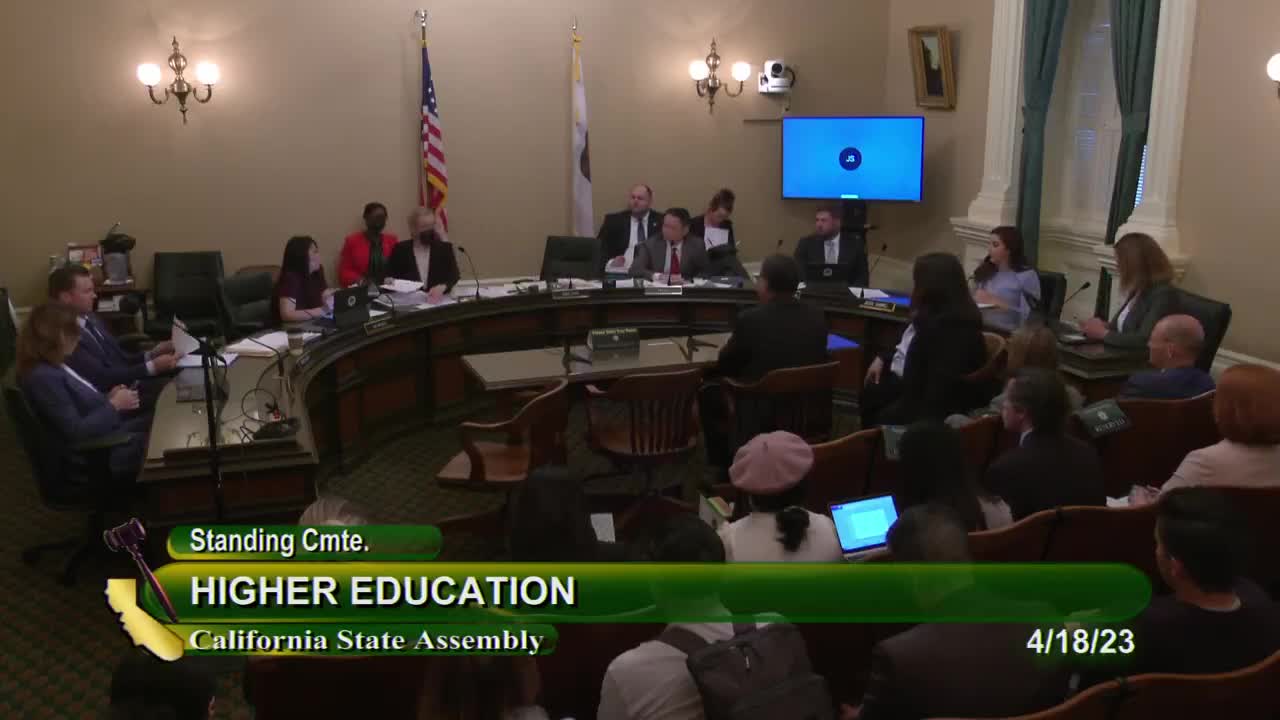
| Apr 18, 2023 | Do pass as amended and be re-referred to the Committee on [Appropriations] | Assembly Standing Committee on Higher Education |
Passed |
This list shows positions taken on this bill by organizations on the date displayed, which is linked to the original source.
Positions by individuals are not included.
|
Organization
|
Position
|
Date
|
|---|---|---|
| Ed Voice | * Against | Apr 18, 2023 |
| Education Trust West | * Against | Apr 18, 2023 |
| Government for California | * Against | Apr 18, 2023 |
| Los Angeles Unified School District | * Support | Apr 18, 2023 |
| Public Advocates | * Against | Apr 18, 2023 |
Date of Hearing: May 3, 2023
ASSEMBLY COMMITTEE ON APPROPRIATIONS
Chris Holden, Chair
ABPCA Bill Id:AB 638
Author:(McCarty) – As Amended Ver:April 20, 2023
Policy Committee: | Higher Education | Vote: | 11 - 0 |
|
| ||
|
|
Urgency: No State Mandated Local Program: No Reimbursable: No
SUMMARY:
This bill changes various aspects of the Golden State Teacher Grant Program administered by the California Student Aid Commission (CSAC).
Specifically, this bill:
- Allows a grant recipient to commit to working for four years in a shortage area at any school, rather than only a priority school.
- Defines “shortage area” to mean a subject area designated annually by the Commission on Teacher Credentialing based on an analysis of the availability of teachers in California.
- Makes changes to an existing report due December 31, 2024, and every two years thereafter to focus on shortage areas rather than priority schools.
- Requires CSAC to annually collect demographic data on grant award recipients and annually report the demographic data to the Legislature.
- Specifies that funds appropriated for the Golden State Teacher Grant Program in the Budget Act of 2022 and the Budget Act of 2023 shall be available for encumbrance or expenditure by CSAC until June 30, 2028.
- Specifies these changes are to apply only to new grants awarded on or after January 1, 2024.
FISCAL EFFECT:
- Ongoing General Fund costs, of about $495,000 in year one and about $410,000 ongoing, to CSAC to administer the program. According to CSAC, because this bill would only apply changes to new grants, CSAC would essentially be administering two different grant programs: one grant program with a set of eligibility requirements and IT needs for grants awarded prior to January 1, 2024, and a second set of eligibility requirements and IT needs for grants awarded after January 1, 2024.
- Fund shifts from certain grant recipients to other grant recipients made newly eligible by this bill. Total amount of grant shifting would depend on the amount of funding still available if this bill becomes law.
- Potential General Fund cost pressure to provide additional funding for the grant program, as the bill specifies encumbrance deadlines for grant funding to be provided in the Budget Act of 2023, which has yet to be enacted.
COMMENTS:
- Purpose. According to the author, “AB 638 ensures high-need schools are prioritized and teachers are not forced to shoulder preparation course costs.”
- Background. According to the Legislative Analyst’s Office, the Budget Act of 2019 created the Golden State Teacher Grant program to be administered by CSAC. The program provides grants of up to $20,000 to students in professional teacher preparation programs who commit to a certain service requirement. Under current law, the service requirement involves working for four years at a “priority school,” defined as a school where at least 55% of students are low‑income, English learners, or foster youth. Originally, recipients were also required to commit to teaching in certain subject areas, defined as special education; science, technology, engineering, and math; bilingual education; elementary school; and transitional kindergarten (TK). However, the Budget Act of 2022 expanded eligibility to recipients who agree to teach in any subject area and made several other changes.
The Budget Act of 2021 provided $500 million in one‑time General Fund for the program and administration. Trailer legislation requires the funding be spread evenly over five years, through the 2025-26 school year. CSAC projects it will fully spend the $500 million allocation before the end of the five‑year period under current program requirements.
The Governor proposes to change the requirements for the program again as part of the Budget Act of 2023. Specifically, he proposes to make two changes to the current requirement for Golden State Teacher Grant recipients to commit to working for four years at a priority school: (a) to allow recipients to commit to working for four years at any school, rather than only a priority school, and (b) to reduce the length of the service requirement for recipients who still choose to work at a priority school from four years to three years. In addition, the Governor proposes to expand program eligibility to individuals pursuing certain child development permits.
- Opposition. This bill is opposed by various organizations, including the Education Trust-West, who write:
Students in high-need communities face the greatest challenges in accessing high quality teachers. The Golden State Teacher Grant Program should remain focused on incentivizing service to these students as was the original intent of the program and the legislation that preceded it.
Analysis Prepared by: Natasha Collins / APPR. / (916) 319-2081
Date of Hearing: April 18, 2023
ASSEMBLY COMMITTEE ON HIGHER EDUCATION
Mike Fong, Chair
ABPCA Bill Id:AB 638 (
Author:McCarty) – As Amended Ver:April 10, 2023
SUBJECT: Golden State Teacher Grant Program.
SUMMARY: Requires, commencing on or after January 1, 2024, student candidates of the Golden State Teacher Grant (GSTG) Program to commit to work for four years in a shortage area, as designated by the Commission on Teacher Credentialing (CTC), at any California public or private school. Specifically, this bill:
- Stipulates that funds appropriated for the GSTG Program in the Budget Act of 2022, and the Budget Act of 2023, must be available for encumbrance or expenditure by the California Student Aid Commission (CSAC) until June 30, 2028.
- Stipulates that a GSTG recipient must agree to serve in a shortage area at any California public or private school for four years.
- Stipulates that the one-time GSTG funds issued, as specified, must not exceed the amount appropriated for the GSTG Program in the Budget Act of 2020, the Budget Act of 2021, the Budget Act of 2022, and the Budget Act of 2023.
- Defines “shortage area” as a subject area designated annually by the CTC based on an analysis of the availability of teachers in California, as specified, at a California public or private school.
- Requires the CSAC, in coordination with the California Department of Education (CDE), to publish a list of shortage areas, as specified, but April 15 of each year.
- Requires the CSAC, in partnership with the CTC, when conducting an evaluation determining the effectiveness of the GSTG Program to look at efforts on recruiting, developing support systems for, and retaining teachers and credentialholders prepared to serve in CTC-designated shortage areas, using data and evaluation guidelines that are consistent with the evaluation conducted of teacher residency programs.
- Requires that CSAC must annually collect demographic data on GSTG recipients, and must annually report the demographic data to the Legislature.
- Stipulates that changes made to the GSTG Program, pursuant to this measure, will apply only to new GSTG awards on or after January 1, 2024.
- Makes technical and clarifying changes to existing law.
EXISTING LAW:
- Establishes the CSAC for the purpose of administering specified student financial aid programs (Education Code (EC) Section 69510, et seq.).
- Establishes the GSTG Program, subject to moneys appropriated by the Legislature for the GSTG Program. Requires that CSAC administer the GSTG Program. Requires CSAC to provide one-time grant funds of up to $20,000 to each student enrolled, or who has applied for enrollment, on or after January 1, 2020, in a professional preparation program leading to a preliminary teaching credential or a pupil personnel services credential, at either a qualifying institution, as specified, or a professional preparation program approved by the CTC that has a main campus location or administrative entity that resides in California, including professional preparation programs operated by local educational agencies in California, if the student commits to working at a priority school for four years within the eight years following the date the student completes the professional preparation program.
Stipulates that funds appropriated for the GSTG Program in the Budget Act of 2020 and the Budget Act of 2021 must be available for encumbrance or expenditure by the CSAC until June 30, 2026.
Stipulates that GSTG funds can only be used to supplement and not supplant other sources of grant financial aid, and may be disbursed in more than one academic year, provided that the total amount of funds granted to an applicant does not exceed $20,000
Requires CSAC, in partnership with the CTC, to conduct an evaluation of the GSTG Program to determine the effectiveness of the GSTG Program in recruiting credential candidates and employing credentialholders at priority schools. The CSAC is encouraged to use qualitative and quantitative measures to quantify the number of credential candidates the program recruited into professional preparation programs, disaggregated by program and institution type, and the number of credentialholders employed at priority schools, disaggregated by subject matter placement, and to describe the effects of the program on the decisions of credential candidates to enter and remain in the education field. The CSAC must provide, with respect to the evaluation, a report to the Department of Finance and the appropriate fiscal and policy committees of the Legislature on or before December 31, 2025, and every two years thereafter (EC Section 69617).
- Defines “unduplicated pupils” as pupils enrolled in a school district or charter school who are either classified as English learners, eligible for free or reduced-price meals, or foster youth (EC Section 42238.02).
FISCAL EFFECT: Unknown
COMMENTS: Purpose of this measure. According to the author, “California is facing a significant teacher shortage, if not addressed, will hamper our students’ academic growth. Investing in recruitment and retention of qualified educators is more crucial than ever. The GSTG Program is an effective tool to encourage teacher preparation program enrollment.”
Further, the author states that, “teachers of color have been disproportionately affected by the statewide teacher shortage. This bill would help recruit and retain qualified teachers of color, who have been discouraged from enrolling in preparation programs due to high costs. It would particularly help early and education educators, a majority of whom are women of color.”
According to data provided by the author, approximately 40% of public school students throughout the nation are Black or Latinx, but only 16% of public school teachers are Black or Latinx.
The author contends that, “AB 638 ensures high-need schools are prioritized and teachers are not forced to shoulder preparation course costs.”
Golden State Teacher Grant Program. The GSTG Program was authorized in the 2019-20 Budget Act, to fund scholarship awards to aspiring teachers in high need fields and incentivize those new teachers to serve in high need public schools. Statute defined “high-need field” as: bilingual education, mathematics or science, technology, engineering, and mathematics (STEM), including career technical education in STEM areas, Special education, multiple subject instruction, and “other” subjects as designated annually by the CTC based on an analysis of the availability of teachers in California.
The final 2020-2021 Budget Act only allocated $15 million from the federal Individuals with Disabilities Education Act (IDEA) funds to the CSAC to provide only for candidates enrolled in special education teacher preparation programs who agree to teach at a priority school. These funds are available through the 2025-2026 fiscal year. In contrast to most other state financial aid programs, this program does not have financial eligibility criteria (such as an income ceiling).
The final 2021-2022 Budget Act made an additional $500 million one-time General Fund investment in the GSTG Program through 2026, and redefined priority schools.
Per statute, CSAC describes GSTG Program eligibility as follows:
- All applicants must be currently enrolled in a professional teacher preparation program, leading to a preliminary teaching credential or pupil personnel services credential, within an accredited California institution of higher education or through a local education agency, approved by the CTC.
- One-time GSTG funds of up to $20,000 will be awarded if a candidate commits to the following:
- Teach at a “priority school,” as determined by the CTC, for four years, within eight years after you receive the teaching credential.
- A “priority school” means a school with 55% or more of its pupils being unduplicated pupils. [“Unduplicated pupils” are defined in EC Section 42238.02, as pupils enrolled in a school district or charter school who are either classified as English learners, eligible for free or reduced-price meals, or foster youth.] The CTC in consultation with the CDE will publish a list of priority schools, based on the most recent data available to the CTC and CDE; and,
- Repay the Commission 25% of the total award annually, up to full repayment of the award, for each year if an awardee fails to meet program requirements.
- Teach at a “priority school,” as determined by the CTC, for four years, within eight years after you receive the teaching credential.
Since the creation of this program, CSAC has awarded a total of more than $146 million to students seeking to become credentialed staff at California’s priority schools. Below is CSAC’s summary chart that depicts how many applications have been received for the GSTG, by segment, for the 2021-2022 and 2022-2023 academic years (AY). CSAC has received more than 13,049 applications so far for GSTG awards in 2021-2022, and 2022-2023.
At the current rate of applications, eligibility for awards, and expenditure, the CSAC analysis suggests that up to $157.7 million could ultimately be awarded in the 2022-2023 year. At a minimum, CSAC would expend at least $112.2 million in 2022-2023, based on applications received and other renewal payments due. For the $500 million in the General Fund that was appropriated in 2021-2022, CSAC was directed by the Administration to expend $100 million each year over a five year period.
Should current application/award rates continue with the current program requirements, CSAC anticipates awarding the entire $500 million appropriation sometime in the 2024- 2025 academic year.
Current Budget proposal. The 2023-2024 Governor’s Budget Proposal seeks to make two changes to the existing requirement for GTSG recipients to commit to working for four years at a priority school. According to the Legislative Analyst’s Office (LAO), it would allow recipients to instead commit to working for four years at any school, beyond only priority schools and, for GTSG recipients who still choose to work at a priority school, the budget proposal would reduce the length of their service requirement from four to three years.
The Administration indicates the aforementioned changes are intended to ensure sufficient demand for the GTSG Program, while also maintaining some incentive for GTSG recipients to teach at a priority school.
This measure, in part, appears to be aligned to the Budget Proposal. Committee Staff understands that the author has made continued funding of the GTSG Program a budget priority.
California Commission on Teacher Credentialing. Created in 1970, by the Ryan Act, the CTC is the oldest of the autonomous state teachers’ standards boards in the nation. The major purposes of the agency are to serve as the standards board for educator preparation for the public schools of California, the licensing and credentialing of professional educators in the state, the enforcement of professional practices of educators, and the discipline of credential holders in the State of California.
Committee comments. Committee Staff understands that the author’s intent is to allow teacher candidates to serve at any public school in California or at a nonpublic school in California to fulfill their teaching commitment after receiving a GSTG award. However, as presently drafted, this measure does not fully capture the author’s intent.
According to the Assembly Committee on Education, nonpublic schools serve public school students with exceptional needs on a contract basis through a school district or charter school. Historically, nonpublic school special education teachers are well prepared and are often hired by school districts after their service at a nonpublic school. Because nonpublic schools serve public school students, they are an appropriate school for a teacher candidate to fulfill their teaching commitment after receiving a GSTG. Moreover, nonpublic schools would be an excellent training opportunity for special education teachers, who are often hired later by school districts and charter schools.
To address the aforementioned, Committee Staff recommends, and the author has accepted, an amendment that changes the reference of “private schools” to “nonpublic schools.”
Arguments in support. According to the Los Angeles Unified School District, “the GSTG Program is essential tool for recruiting and retaining of new educators in Los Angeles Unified. Under the existing program, over 900 priority schools, defined as having over 55 percent unduplicated pupils, are located within the district alone. The change to ‘shortage areas’ will expand eligibility based on subject areas and has the potential to expand the programs reach. Additionally, by extending the encumbrance date without additional appropriations, AB 638 will ensure that existing investments in the Golden State Teacher Grant Program continue to be available to aspiring teachers and counselors who commit to serving in the hardest to staff subjects.”
Arguments in opposition. According to EdVoice, “we understand that schools serving every demographic are facing staffing challenges and that there are subject areas that are disproportionately impacted more than others. We believe the state can do more to address staffing challenges and would likely support measures to increase targeted funding for shortage areas, such as those proposed in these amendments. However, AB 638 doesn’t propose additional funding to tackle this issue, but rather reorders existing funding in a way that we believe conflicts with the important mission of addressing the inequitable impact of the teacher shortage. Staffing challenges are most alarming and most damaging in schools serving a high percentage of children from low-income homes, and thus we oppose changes to the GSTG program that take away the requirement to work in a low-income school.”
Prior legislation. AB 1623 (Robert Rivas and O’Donnell) of 2019, which, per request of the authors, was not heard in the Senate Committee on Education, and subsequently died, sought to establish, subject to appropriation, the GSTG Program under administration of the CSAC. The Program would provide one-time grant funds of $20,000 to each student enrolled on or after January 1, 2020, in a professional preparation program leading to a preliminary teaching credential, if the student committed to working in a high-need subject area field for four years after they received a teaching credential. To this end, the bill required the CTC to certify if the recipient had not earned a credential and required the CDE to certify if the recipient had not taught for four years in a high-need subject area field.
AB 169 (O’Donnell) of 2017, which, per the author’s request, was not heard in the Senate Committee on Education, and subsequently died, was very similar in nature to AB 1623 (as described above).
REGISTERED SUPPORT / OPPOSITION:
Support
Los Angeles Unified School District
Opposition
EdVoice
The Education Trust – West
Analysis Prepared by: Jeanice Warden / HIGHER ED. / (916) 319-3960
Discussed in Hearing
 9MIN
Assembly Standing Committee on Higher Education
Bill Author

Bill Co-Author(s):