SB 1326: Electricity: fixed charges.
- Session Year: 2023-2024
- House: Senate
- Latest Version Date: 2024-02-16
Current Status:
Failed
(2024-04-23: April 22 set for first hearing. Failed passage in committee. (Ayes 4. Noes 0. Page 3701.) Reconsideration granted.)
Introduced
In Committee
First Chamber
In Committee
Second Chamber
Enacted
Existing law vests the Public Utilities Commission (PUC) with regulatory authority over public utilities, including electrical corporations. Existing law authorizes the commission to adopt new, or expand existing, fixed charges, as defined, for the purpose of collecting a reasonable portion of the fixed costs of providing electrical service to residential customers. Under existing law, the commission may authorize fixed charges for any rate schedule applicable to a residential customer account, and is required, no later than July 1, 2024, to authorize a fixed charge for default residential rates. Existing law requires these fixed charges to be established on an income-graduated basis, with no fewer than 3 income thresholds, so that low-income ratepayers in each baseline territory would realize a lower average monthly bill without making any changes in usage.
Existing law requires the PUC to continue the California Alternative Rates for Energy (CARE) program to provide assistance to low-income electric and gas customers with annual household incomes that are no greater than 200% of the federal poverty guideline levels, as specified.
This bill would require the PUC to require each electrical corporation to offer default rates to residential customers with at least 2 usage tiers, as provided. The bill would eliminate the requirement that the fixed charges be established on an income-graduated basis as described above, repeal related findings and declarations of the Legislature, and authorize the commission to instead authorize fixed charges that, as of January 1, 2015, do not exceed $10 per residential customer account per month for customers not enrolled in the CARE program and $5 per residential customer account per month for customers enrolled in the CARE program. The bill would authorize the maximum allowable fixed charge to be adjusted by no more than the annual percentage increase in the Consumer Price Index for the prior calendar year, as specified.
Under existing law, a violation of the Public Utilities Act or any order, decision, rule, direction, demand, or requirement of the commission is a crime.
Because certain provisions of this bill would be a part of the act and a violation of a commission action implementing the above-described requirements would be a crime, the bill would impose a state-mandated local program.
The California Constitution requires the state to reimburse local agencies and school districts for certain costs mandated by the state. Statutory provisions establish procedures for making that reimbursement.
This bill would provide that no reimbursement is required by this act for a specified reason.
This bill would declare that it is to take effect immediately as an urgency statute.
This bill shall be known, and may be cited, as the Cost of Living Reduction Act.
SEC. 2.Section 739.9 of the Public Utilities Code is amended to read:739.9.(a)Fixed charge means any fixed customer charge, basic service fee, demand differentiated basic service fee, demand charge, or other charge not based on the volume of electricity consumed.
(b)Increases to electrical rates and charges in rate design proceedings, including any reduction in the California Alternate Rates for Energy (CARE) program discount, shall be reasonable and subject to a reasonable phase-in schedule relative to the rates and charges in effect before January 1, 2014.
(c)Except as provided in subdivision (c) of Section 745, the commission shall require each electrical corporation to offer default rates to residential customers with at least two usage tiers. The first tier shall include electricity usage of no less than the baseline quantity established pursuant to paragraph (1) of subdivision (d) of Section 739.
(c)(d)Consistent with the requirements of Section 739, the commission may modify the seasonal definitions and applicable percentage of average consumption for one or more climatic zones.
(d)(e)The commission may adopt new, or expand existing, fixed charges for the purpose of collecting a reasonable portion of the fixed costs of providing electrical service to residential customers. The commission shall ensure that any approved charges do all of the following:
(1)Reasonably reflect an appropriate portion of the different costs of serving small and large customers.
(2)Not unreasonably impair incentives for conservation, energy efficiency, conservation and beneficial electrification and greenhouse gas emissions reduction. energy efficiency.
(3) Are set at levels that do not Not overburden low-income customers.
(e)(1)For the purposes of this section and Section 739.1, the commission may authorize fixed charges for any rate schedule applicable to a residential customer account. The fixed charge shall be established on an income-graduated basis with no fewer than three income thresholds so that a low-income ratepayer in each baseline territory would realize a lower average monthly bill without making any changes in usage. The commission shall, no later than July 1, 2024, authorize a fixed charge for default residential rates.(2)For purposes of this subdivision, income-graduated means that low-income customers pay a smaller fixed charge than high-income customers.(f)Notwithstanding the requirements of subdivision (d) of Section 739 and Section 739.7, the commission shall not apply the composite tier method to the treatment of any revenues resulting from any fixed charge adopted pursuant to this section.(f)For purposes of this section and Section 739.1, the commission may, beginning January 1, 2015, authorize fixed charges that do not exceed ten dollars ($10) per residential customer account per month for customers not enrolled in the CARE program and five dollars ($5) per residential customer account per month for customers enrolled in the CARE program. Beginning January 1, 2016, the maximum allowable fixed charge may be adjusted by no more than the annual percentage increase in the Consumer Price Index for the prior calendar year. This subdivision applies to any default rate schedule, at least one optional tiered rate schedule, and at least one optional time variant rate schedule.
(g)This section does not require the commission to approve any new or expanded fixed charge.
(h)The commission may consider whether minimum bills are appropriate as a substitute for any fixed charges.
SEC. 3.Section 2827.1 of the Public Utilities Code is amended to read:2827.1.(a)For purposes of this section, eligible customer-generator, large electrical corporation, and renewable electrical generation facility have the same meanings as defined in Section 2827.
(b)Notwithstanding any other law, the commission shall develop a standard contract or tariff, which may include net energy metering, for eligible customer-generators with a renewable electrical generation facility that is a customer of a large electrical corporation no later than December 31, 2015. The commission may develop the standard contract or tariff prior to before December 31, 2015, and may require a large electrical corporation that has reached the net energy metering program limit of subparagraph (B) of paragraph (4) of subdivision (c) of Section 2827 to offer the standard contract or tariff to eligible customer-generators. A large electrical corporation shall offer the standard contract or tariff to an eligible customer-generator beginning July 1, 2017, or prior to before that date if ordered to do so by the commission because it has reached the net energy metering program limit of subparagraph (B) of paragraph (4) of subdivision (c) of Section 2827. The commission may revise the standard contract or tariff as appropriate to achieve the objectives of this section. In developing the standard contract or tariff, the commission shall do all of the following:
(1)Ensure that the standard contract or tariff made available to eligible customer-generators ensures that customer-sited renewable distributed generation continues to grow sustainably and include specific alternatives designed for growth among residential customers in disadvantaged communities.
(2)Establish terms of service and billing rules for eligible customer-generators.
(3)Ensure that the standard contract or tariff made available to eligible customer-generators is based on the costs and benefits of the renewable electrical generation facility.
(4)Ensure that the total benefits of the standard contract or tariff to all customers and the electrical system are approximately equal to the total costs.
(5)Allow projects greater than one megawatt that do not have significant impact on the distribution grid to be built to the size of the onsite load if the projects with a capacity of more than one megawatt are subject to reasonable interconnection charges established pursuant to the commissions Electric Rule 21 and applicable state and federal requirements.
(6)Establish a transition period during which eligible customer-generators taking service under a net energy metering tariff or contract prior to before July 1, 2017, or until the electrical corporation reaches its net energy metering program limit pursuant to subparagraph (B) of paragraph (4) of subdivision (c) of Section 2827, whichever is earlier, shall be eligible to continue service under the previously applicable net energy metering tariff for a length of time to be determined by the commission by March 31, 2014. Any rules adopted by the commission shall consider a reasonable expected payback period based on the year the customer initially took service under the tariff or contract authorized by Section 2827.
(7)The commission shall determine which rates and tariffs are applicable to customer generators only during a rulemaking proceeding. Any fixed charges for residential customer generators that differ from the fixed charges allowed pursuant to subdivision (e) (f) of Section 739.9 shall be authorized only in a rulemaking proceeding involving every large electrical corporation. The commission shall ensure customer generators are provided electric service at rates that are just and reasonable.
(c)Beginning July 1, 2017, or when ordered to do so by the commission because the large electrical corporation has reached its capacity limitation of subparagraph (B) of paragraph (4) of subdivision (c) of Section 2827, all new eligible customer-generators shall be subject to the standard contract or tariff developed by the commission and any rules, terms, and rates developed pursuant to subdivision (b). There shall be no limitation on the amount of generating capacity or number of new eligible customer-generators entitled to receive service pursuant to the standard contract or tariff after July 1, 2017. An eligible customer-generator that has received service under a net energy metering standard contract or tariff pursuant to Section 2827 that is no longer eligible to receive service shall be eligible to receive service pursuant to the standard contract or tariff developed by the commission pursuant to this section.
SEC. 4.Section 14 of Chapter 61 of the Statutes of 2022 is repealed.SEC. 14.(a)In regards to Section 739.9 of the Public Utilities Code, as amended by this act, the Legislature finds and declares all of the following:(1)The Public Utilities Commission has found that electrical corporation customers are facing two areas of increasing cost pressures: growing electric transmission and distribution infrastructure and operation costs, including wildfire mitigation costs, and equitable recovery of utility fixed costs.(2)The majority of an electrical corporations revenue requirement, including funds for electric generation, transmission and distribution investments, and operations and maintenance work, is recovered from customers by a volumetric rate. However, only a portion of the electrical corporations costs directly vary based on how much electricity a customer consumes, while many infrastructure and operational costs do not.(3)The current default residential customer rate structure in electrical corporation territories leads to a situation in which rates must rise to recover sufficient revenue to support certain fixed utility costs and can lead to year-to-year rate increase volatility, especially with declines in electricity sales that result from greater adoption of distributed energy resources.(4)The disparity between volumetric revenue recovery and fixed costs that do not vary with electricity consumption also contributes to potential inequities among customers.(b)In regards to Section 739.9 of the Public Utilities Code, as amended by this act, it is the intent of the Legislature to do both of the following:(1)Authorize the Public Utilities Commission to establish reasonable fixed charges on default residential customer rates to help stabilize rates and equitably allocate and recover costs among residential customers in each electrical corporations service territory.(2)If the Public Utilities Commission establishes fixed charges on default residential customer rates, ensure that the fixed charges are established to more fairly distribute the burden of supporting the electric system and achieving Californias climate change goals through the fixed charge.SEC. 5.No reimbursement is required by this act pursuant to Section 6 of Article XIIIB of the California Constitution because the only costs that may be incurred by a local agency or school district will be incurred because this act creates a new crime or infraction, eliminates a crime or infraction, or changes the penalty for a crime or infraction, within the meaning of Section 17556 of the Government Code, or changes the definition of a crime within the meaning of Section 6 of Article XIIIB of the California Constitution.
SEC. 6.This act is an urgency statute necessary for the immediate preservation of the public peace, health, or safety within the meaning of Article IV of the California Constitution and shall go into immediate effect. The facts constituting the necessity are:
Due to the July 1, 2024, deadline for the Public Utilities Commission to authorize a fixed charge for default residential rates, as described in subdivision (e) of Section 739.9 of the Public Utilities Code, it is necessary for this act to go into immediate effect.
|
Date
|
Status
|
|---|---|
| Apr 23, 2024 | April 22 set for first hearing. Failed passage in committee. (Ayes 4. Noes 0. Page 3701.) Reconsideration granted. |
| Apr 4, 2024 | Set for hearing April 22. |
| Feb 29, 2024 | Referred to Com. on E., U. & C. |
| Feb 20, 2024 | From printer. May be acted upon on or after March 18. |
| Feb 16, 2024 | Introduced. Read first time. To Com. on RLS. for assignment. To print. |
|
Date
|
Description
|
Location
|
Votes
|
|
|---|---|---|---|---|
| Apr 22, 2024 | [First] hearing set for [04-23-2024]: Failed passage in Committee. Reconsideration granted | Senate Standing Committee on Energy, Utilities and Communications |
Passed |
|
| Apr 22, 2024 | Do pass, but first be re-referred to the Committee on [Appropriations] | Senate Standing Committee on Energy, Utilities and Communications |
Failed |
This list shows positions taken on this bill by organizations on the date displayed, which is linked to the original source.
Positions by individuals are not included.
|
Organization
|
Position
|
Date
|
|---|---|---|
| California Solar & Storage Association | ** Support | |
| California Solar and Storage Association | * Support | Apr 22, 2024 |
| California State Association Of Electrical Workers | * Against | Apr 22, 2024 |
| California State Pipe Trades Council | * Against | Apr 22, 2024 |
| Coalition of California Utility Employees | * Against | Apr 22, 2024 |
| Lajos Pacific Gas and Electric Company | * Against | Apr 22, 2024 |
| Natural Resources Defense Counsel | * Against | Apr 22, 2024 |
| Pacific Gas And Electric Company | ** Against | |
| San Diego Gas and Electric | * Against | Apr 22, 2024 |
| San Diego Gas and Electric Company | ** Against | |
| Southern California Edison | ** Against | |
| Southern California Edison | * Against | Apr 22, 2024 |
| Stone Advocacy | ** Support | Apr 22, 2024 |
| Utility Reform Network | * Against | Apr 22, 2024 |
SENATE COMMITTEE ON ENERGY, UTILITIES AND COMMUNICATIONS
Senator Steven Bradford, Chair
2023 - 2024 Regular
Bill No: Hearing Date: 4/22/2024
Author: | |||
Version: | Introduced | ||
Urgency: | Fiscal: | ||
Consultant: | |||
SUBJECT:
DIGEST: This bill repeals the provisions adopted in AB 205 (Committee on Budget, Chapter 61, Statutes of 2022) which requires the California Public Utilities Commission (CPUC) to implement an income-graduated fixed charge for electric investor-owned utility (IOU) rates, and replaces with the language that existed prior to the passage of AB 205, which authorized and capped fixed charges.
ANALYSIS:
Existing law:
- Establishes and vests the CPUC with regulatory authority over public utilities, including electrical corporations. (Article XII of the California Constitution)
- Authorizes the CPUC to adopt new, or expand existing, fixed charges, as defined, for the purpose of collecting a reasonable portion of the fixed costs of providing electrical service to residential customers. (Public Utilities Code §739.9(d))
- Authorizes the CPUC to establishes fixed charges for any rate schedule applicable to a residential customer account, and is required, no later than July 1, 2024, to authorize a fixed charge for default residential rates. Requires these fixed charges to be established on an income-graduated basis, with no fewer than three income thresholds, so that low-income ratepayers in each baseline territory would realize a lower average monthly bill without making any changes in usage. (Public Utilities Code §739.9(e))
- Requires the CPUC to continue the California Alternative Rates for Energy (CARE) program to provide assistance to low-income electric and gas customers with annual household incomes that are no greater than 200 percent of the federal poverty guideline levels, and exempts any fixed charge from the discount. (Public Utilities Code §739.1)
This bill:
- Requires the CPUC to require each electrical corporation to offer default rates to residential customers with at least two usage tiers, as provided.
- Eliminates the requirement that the fixed charges be established on an income-graduated basis as described above, repeal related findings and declarations of the Legislature, and authorize the CPUC to instead authorize fixed charges that, as of January 1, 2015, do not exceed $10 per residential customer account per month for customers not enrolled in the CARE program and $5 per residential customer account per month for customers enrolled in the CARE program.
- Authorizes the maximum allowable fixed charge to be adjusted by no more than the annual percentage increase in the Consumer Price Index for the prior calendar year, as specified.
Background
About fixed charges. Fixed charges provide utilities the ability to recover certain costs via a consistent charge on utility bills that is unrelated to usage, as opposed to recovering these costs via volumetric usage (the amount of electricity used) on the utility bill. These costs might include those related to utility billing systems, wildfire mitigation, public purpose programs, and others. Fixed charges are employed by many utilities as part of their rate design, including many water utilities, and some electric utilities (e.g. Sacramento Municipal Utility District (SMUD) has a $20+/month fixed charge) to recover costs that may be unaffected by usage and which are used to support the operation of the utility system. However, the CPUC has largely declined to adopt fixed charges on electric utility bills, as consumer organizations have largely opposed such proposals. Historically, the CPUC has approved very limited fixed charges (under $2/month) for default residential rates and largely opted for alternative rate designs that don’t include a fixed charge but instead collect most costs based on usage.
AB 327 (Perea, Chapter 611, Statutes of 2013). Prior to the adoption of AB 205, existing law, as adopted by AB 327, provided the CPUC could authorize electric IOUs to adopt a fixed charge but capped at no more than $10 per month for residential customers and $5 per month for eligible low-income customers participating in the low-income assistance program CARE. The fixed charges would apply to residential customers of electric IOUs, such as Pacific Gas & Electric (PG&E), San Diego Gas & Electric (SDG&E), Southern California Edison (SCE), and a few smaller utilities in the state, which are rate-regulated by the CPUC. These changes in legislation do NOT apply to publicly-owned utilities (POUs), such as SMUD, Silicon Valley Power, Los Angeles Department of Water and Power (LA DWP) whose governing board sets rates. However, in many instances POUs have adopted fixed charges.
Income-based fixed charges. The idea of basing the fixed charge on income was proposed by academic researchers, and published in two reports by Next10 and Energy Institute at Haas, several years ago and has received traction with some stakeholders who are concerned that the increasing costs of electric utility bills are hampering efforts to encourage customers to shift from fossil fuel uses to electricity (e.g. gasoline for vehicles, natural gas for home space and water heating). Many of these stakeholders contend that utility cost recovery based on volumetric usage is more regressive than a specified fixed charge applied to all customers, with the amount of the charge varying by income, where lower income customers pay a lower fixed charge as compared to higher income customers. They contend that a fixed charge will help reduce the volumetric rate to encourage customers to transition to electrification.
AB 205 fixed charge electric rate provisions. In 2022, the Legislature passed a budget trailer bill, AB 205, which included language that had been proposed by the Administration earlier that year and which requires the CPUC to authorize a “fixed-charge” for default residential electric utility rates established on an income-graduated basis. Pursuant to the language, the income-graduated basis must have no fewer than three income thresholds so that low-income customers realize a lower average monthly bill without making any changes in usage and that low-income customers pay a smaller fixed charge than higher-income customers.
CPUC proceeding (Rulemaking 22-07-005). Since the adoption of AB 205, the CPUC has been conducting an active proceeding on how best to adopt the income-graduated fixed charge. The proceeding involves several stakeholders with multiple proposals, workshops, and solicitations for comments. Parties to the proceeding are proposing various rate designs with a spectrum of fixed charge amounts (ranging from the $5 to over $100) in order to satisfy the requirements of AB 205. The CPUC has been working towards ultimately adopting an income-graduated fixed charge by July 1, 2024 (as required by the statute).
CPUC issues proposed decision. On March 27, the CPUC issued the proposed decision in the proceeding with the following elements:
Large electric IOUs are required to adopt billing structure changes that require:
- Tier 1: Customers enrolled in the CARE program will pay $6 per month.
- Tier 2: Customers enrolled in the Family Electric Rate Assistance (FERA) program or who live in affordable housing restricted with incomes below 80 percent area median income will pay $12 per month.
- Tier 3: All other customers will pay a fixed amount of $24.15 per month.
The proposed decision requires SCE and SDG&E to apply the fixed charges between October 1, 2025 and December 15, 2025, and requires PG&E to apply fixed charges to residential customers’ bills between January 1, 2026 and March 31, 2026. The proposed decision is open for comments and the earliest a decision can be made is at the May 9, 2024 CPUC business meeting.
Comments
Need for this bill. This bill proposes to delete the provisions adopted in the AB 205 budget trailer bill and largely replace with language that reverts to the statute as it existed prior to the adoption of the budget trailer bill. As such, this bill would cap the fixed charges the CPUC could adopt for electric IOUs to $10 per month for residential customers and $5 per month for CARE-eligible residential customers (as adopted in AB 327) and eliminates the requirement to adopt the income-graduated fixed charges by July 1, 2024.
Why income-graduated fixed charges? Proponents of income-graduated fixed charges, including electric IOUs, Natural Resources Defense Council, The Utility Reform Network, Public Advocates’ Office, and the Administration, suggest that not implementing the income-based fixed charges will hamper efforts to address electric utility bill affordability in the rate design. These proponents express concerns that a lack of affordability of electric utility bills will deter customers from electrifying current fossil-fueled applications (including adopting electric vehicles, electric space and water heating, electric cooking, etc.). They contend that customers’ reluctance to electrify these applications will thwart the state’s efforts to achieve its greenhouse gas reduction goals. The supporters of income-graduated fixed charges acknowledge a fixed charge can diminish the price signal for energy conservation, but contend the need to transition to electrification and to structure rates to better protect low-income customers, particularly those in inland areas that require more electricity to cool their homes. They express concerns about the growing costs of utility bills and the dependence on usage rates to recover the fixed costs of the system, including infrastructure and wildfire mitigation, that is unaffected by usage.
In opposition to income-graduated fixed charges. On the other hand, other the author and supporter of this bill support capping the fixed charges to the $10 previously in the statute. The California Solar and Storage Association who supports this bill, opposes proposals in the CPUC proceeding for much higher fixed charges as the ability of customers to control the utility bill costs and provide the incentives to encourage solar adoption. These stakeholders worry that a high fixed charge amount will reduce the value of installing solar or energy efficiency upgrades for customers, as the payback periods could be longer than with a lower or non-existent fixed charge amount. Some opponents of income-based fixed charges also take issue with the income-based distinctions in utility bills that would be managed by utilities and could require customers’ income information, beyond those of voluntary rate assistance programs.
Allocating utility costs. A rate design is not intended to affect the amount a utility can recover, as the process to determine a utility’s just and reasonable costs is unaffected by the design. However, a rate design will affect customers differently depending on their usage. There has been substantial attention to the various proposals in the CPUC proceeding, including those by utilities which at various times proposed $70 to upwards of $100 per month fixed charges, as well as, concerns about how a utility would manage customer income information. However, the CPUC has now issued a proposed decision that tends to fall closer to the fixed charge more closely aligned with that of SMUD – at $24 per month – and a phase in schedule over multiple years. The income tiers proposed by the CPUC rely on the income eligibility of existing rate assistance programs – CARE and FERA. The CPUC’s proposed decision is structured to reduce the usage (volumetric) rate by 5 to 7 cents per kilowatt hour. The proposed decision is also structured with the intent to reduce the average low-income customers’ utility bill in every baseline territory compared to what their bill would have been without the fixed charge. This bill, if passed, would immediately take effect, thereby eliminating the CPUC proposed decision and reverting to the pre-2022 authorized fixed charges.
Prior/Related Legislation
SB 1292 (Bradford, 2024) requires a report on learnings and challenges of the first phase of the CPUC’s adoption of income-graduated fixed charges and prohibits adoption of a second phase until after the report is provided. The bill is pending before this committee.
AB 205 (Committee on Budget, Chapter 61, Statutes of 2022) among its provisions, repealed the $10 fixed charge cap for residential electric IOU customers. Authorized the CPUC to use fixed charges for any rate schedule for residential customers, as specified. The bill required the fixed charge to be established on an income-graduated basis with no fewer than three income thresholds, such that a low-income ratepayer would realize lower average monthly bill without making any chances in usage, as specified.
AB 327 (Perea, Chapter 611, Statutes of 2013) among its provisions, included language authorizing fixed charges for electric IOU rates, but capped the fixed charge to $10 per month for residential non-CARE customers, and $5 per month for CARE customers.
FISCAL EFFECT: Appropriation: Fiscal Com.: Local:
SUPPORT:
California Solar & Storage Association
OPPOSITION:
Pacific Gas and Electric Company
San Diego Gas and Electric Company
Southern California Edison
ARGUMENTS IN SUPPORT: The California Solar and Storage Association states:
This bill would place a statutory cap on the residential fixed charge, helping to rein in out of control utility spending while protecting energy efficiency, conservation and local solar energy and energy storage resources. High fixed charges, such as those under consideration at the California Public Utilities Commission (CPUC) unfairly raise monthly bills for low energy users in order to lower monthly bills for high energy users. This hurts working-class and middle-class families who can least afford yet another increase in their utility bills. It also hurts any consumer who takes steps to lower their energy consumption either through conservation, energy efficiency, or distributed solar and storage technologies.
ARGUMENTS IN OPPOSITION: In opposition to this bill, San Diego Gas & Electric states:
Without reasonable fixed charges, the state will not be able to lower the cost to operate electric technologies to get the level of electrification we need to reach California’s climate goals. A customer will not want to electrify unless they see overall energy savings. If the recently released commission PD was approved, the estimated per kilowatt hour cost that SDG&E customers pay could be reduced by approximately 10%.
Additionally, reinstituting the cap on the fixed charge, as SB 1326 mandates impedes the implementation of the CPUC’s recent proposed decision on AB 205. It would limit the ability of the Commission to do its job. Adoption of a reasonable fixed charge will protect low-income customers and in fact their bills would be lower under the Commission’s PD. This would not be possible if the $10 fixed charge cap is reinstated. Not only would the fixed charge be unable to capture the full operational and maintenance utility costs, but the charge would also not be flexible enough to shift some of those fixed costs away from the lower-income customers.
-- END --
Discussed in Hearing
 15MIN
Senate Standing Committee on Energy, Utilities and Communications
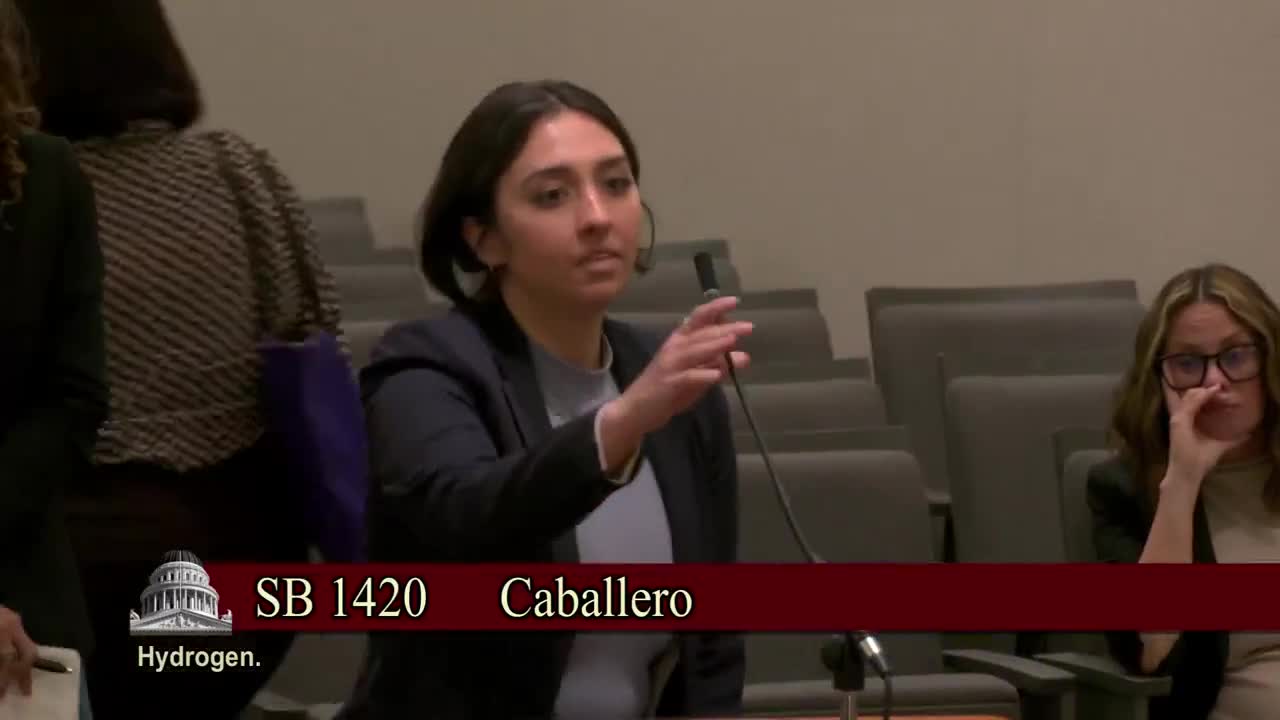 1MIN
Senate Standing Committee on Energy, Utilities and Communications
Bill Author

Bill Co-Author(s):