SB 1393: Advanced Clean Fleets Regulation Appeals Advisory Committee.
- Session Year: 2023-2024
- House: Senate
- Latest Version Date: 2024-02-16
Current Status:
Failed
(2024-04-03: April 3 set for first hearing. Failed passage in committee. (Ayes 3. Noes 1. Page 3468.) Reconsideration granted.)
Introduced
In Committee
First Chamber
In Committee
Second Chamber
Enacted
Existing law requires the State Air Resources Board to adopt and implement motor vehicle emission standards, in-use performance standards, and motor vehicle fuel specifications for the control of air contaminants and sources of air pollution that the state board has found necessary, cost effective, and technologically feasible. The California Global Warming Solutions Act of 2006 establishes the state board as the state agency responsible for monitoring and regulating sources emitting greenhouse gases and requires the state board to adopt rules and regulations to achieve the maximum technologically feasible and cost-effective greenhouse gas emission reductions from those sources.
Pursuant to its authority, the state board has adopted the Advanced Clean Fleets Regulation, which imposes various requirements for transitioning local, state, and federal government fleets of medium- and heavy-duty trucks, other high-priority fleets of medium- and heavy-duty trucks, and drayage trucks to zero-emission vehicles. The Advanced Clean Fleets Regulation authorizes entities subject to the regulation to apply for exemptions from its requirements under certain circumstances.
This bill would require the state board to establish the Advanced Clean Fleets Regulation Appeals Advisory Committee by an unspecified date for purposes of reviewing appeals of denied requests for exemptions from the requirements of the Advanced Clean Fleets Regulation. The bill would require the committee to include representatives of specified state agencies, other state and local government representatives, and representatives of private fleet owners, the electric vehicle manufacturing industry, and electrical corporations, as provided. The bill would require the committee to meet monthly and would require recordings of its meetings to be made publicly available on the state boards internet website. The bill would require the committee to consider, and make a recommendation on, an appeal of an exemption request denial no later than 60 days after the appeal is made. The bill would require specified information relating to the committees consideration of an appeal to be made publicly available on the state boards internet website. The bill would require the state board to consider a recommendation of the committee at a public meeting no later than 60 days after the recommendation is made.
For purposes of this article, the following definitions apply:
(a)Advanced Clean Fleets Regulation means Article 3.2 (commencing with Section 2013), Article 3.3 (commencing with Section 2014), Article 3.4 (commencing with Section 2015), and Article 3.5 (commencing with Section 2016) of Chapter 1 of Division 3 of Title 13 of the California Code of Regulations.
(b)Committee means the Advanced Clean Fleets Regulation Appeals Advisory Committee established pursuant to Section 43851.
(c)Electrical corporation has the same meaning as defined in Section 218 of the Public Utilities Code.
43851.(a)(1)On or before ____, the state board shall establish the Advanced Clean Fleets Regulation Appeals Advisory Committee.
(2)The committee shall review appeals of denied requests for exemptions from the requirements of the Advanced Clean Fleets Regulation and make recommendations to the state board with respect to the denial of the exemption request.
(b)The committee shall be composed of all of the following:
(1)One representative of the state board who is appointed by the state board.
(2)One representative of the Public Utilities Commission who is appointed by the Public Utilities Commission.
(3)One representative of the State Energy Resources Conservation and Development Commission who is appointed by the State Energy Resources Conservation and Development Commission.
(4)One representative of the Department of General Services who is appointed by the Director of General Services.
(5)One representative of the Department of Transportation who is appointed by the Director of Transportation.
(6)One representative of a transit agency who is appointed by the state board.
(7)One representative of a regional transportation agency who is appointed by the state board.
(8)(A)No fewer than 13 and no more than 21 members selected by the state board from any of the following categories:
(i)(I)Private fleet owners.
(II)No less than 25 percent of the members appointed pursuant to this paragraph shall be private fleet owners.
(ii)State and local government representatives with expertise relating to government fleets.
(iii)Representatives of electrical corporations.
(iv)Electric vehicle manufacturing industry experts.
(B)Members appointed pursuant to this paragraph shall serve on the committee for a minimum of one year and a maximum of three years.
43852.(a)The committee shall meet monthly on an evenly spaced schedule.
(b)(1)Meetings of the committee shall be open to the public in accordance with the requirements of the Bagley-Keene Open Meeting Act (Article 9 (commencing with Section 11120) of Chapter 1 of Part 1 of Division 3 of Title 2 of the Government Code).
(2)Meetings of the committee shall be recorded and the recording of each meeting shall be made publicly available on the state boards internet website.
(3)It is the intent of the Legislature that members of the committee review materials relating to committee meetings and engage in constructive dialogue in all meetings.
(c)The representative of the state board shall be the nonvoting chair of the committee.
(d)A quorum shall consist of a majority of the voting members appointed to the committee at the time of a meeting. Any action requires a majority vote of the members present at a meeting at which there is a quorum.
43853.(a)If the state board denies an application for an exemption from any requirement of the Advanced Clean Fleets Regulation, the applicant may appeal the denial to the committee.
(b)No later than 60 days after the applicant appeals the denial of the exemption request to the committee, the committee shall consider the appeal at a meeting and make a recommendation to the state board regarding whether the exemption request should have been denied.
(c)The chair of the committee shall serve as the liaison between the committee and the state board, and shall report the actions and recommendations of the committee to the state board.
(d)For each appeal to the committee, all of the following information shall be made publicly available on the state boards internet website:
(1)The applicants original request for an exemption from any requirement of the Advanced Clean Fleets Regulation and any accompanying information submitted by the applicant.
(2)All materials of the state board relating to the denial of the exemption request.
(3)The appeal and any accompanying information submitted by the applicant.
(4)The minutes of the meeting during which the appeal was considered.
(e)No later than 60 days after the committee makes a recommendation pursuant to subdivision (b), the state board shall consider the recommendation at a public meeting of the state board.
|
Date
|
Status
|
|---|---|
| Apr 3, 2024 | April 3 set for first hearing. Failed passage in committee. (Ayes 3. Noes 1. Page 3468.) Reconsideration granted. |
| Mar 8, 2024 | Set for hearing April 3. |
| Feb 29, 2024 | Referred to Coms. on E.Q. and TRANS. |
| Feb 20, 2024 | From printer. May be acted upon on or after March 18. |
| Feb 16, 2024 | Introduced. Read first time. To Com. on RLS. for assignment. To print. |
|
Date
|
Description
|
Location
|
Votes
|
|
|---|---|---|---|---|
| Apr 3, 2024 | [First] hearing set for [04-03-2024]: Failed passage in Committee. Reconsideration granted | Senate Standing Committee on Environmental Quality |
Passed |
|
| Apr 3, 2024 | Do pass, but first be re-referred to the Committee on [Transportation] | Senate Standing Committee on Environmental Quality |
Failed |
This list shows positions taken on this bill by organizations on the date displayed, which is linked to the original source.
Positions by individuals are not included.
|
Organization
|
Position
|
Date
|
|---|---|---|
| Associated General Contractors | ** Support | |
| CalBroadband | ** Support | |
| Califonrnia Construction & Industrial Materials Association | * Support | Apr 3, 2024 |
| California Alliance for Jobs | ** Support | |
| California Chamber Of Commerce | * Support | Apr 3, 2024 |
| California Check in Association | * Support | Apr 3, 2024 |
| California Cotton Ginners and Growers Association | ** Support | |
| California Electric Transportation Coalition | * Support | Apr 3, 2024 |
| California Environmental Voters | * Against | Apr 3, 2024 |
| California Farm Bureau | * Support | Apr 3, 2024 |
| California League of Food Producers | ** Support | |
| California Manufacturers & Technology Association | * Support | Apr 3, 2024 |
| California Special Districts Association | ** Support | Apr 3, 2024 |
| California State Association Of Counties | * Support | Apr 3, 2024 |
| California Tow Truck Association | * Support | Apr 3, 2024 |
| Coalition For Clean Air | ** Against | |
| County of Santa Barbara | ** Support | |
| Dairy Institute Of California | ** Support | |
| East Bay Clean Cities Coalition | ** Support | |
| Granite Construction | ** Support | |
| Housing Contractors Of California | ** Support | |
| League Of California Cities | * Support | Apr 3, 2024 |
| Nafa | ** Support | |
| NAFA Fleet Management Association | * Support | Apr 3, 2024 |
| National Resources Defense Council | ** Against | |
| Northern California Power Agency | ** Support | |
| NRDC | * Against | Apr 3, 2024 |
| Public Works | * Support | Apr 3, 2024 |
| San Bernardino County | * Support | Apr 3, 2024 |
| Union Of Concerned Scientists | * Against | Apr 3, 2024 |
| United Contractors | ** Support | |
| Vulcan Materials Company | ** Support | |
| Western Agricultural Processors Association | ** Support | |
| Western Growers Association | * Support | Apr 3, 2024 |
| Western State Trucking Association | * Support | Apr 3, 2024 |
| Western States Trucking Association | ** Support |
SENATE COMMITTEE ON ENVIRONMENTAL QUALITY
Senator Allen, Chair
2023 - 2024 Regular
Bill No: SB 1393
Author: | Niello | ||
Version: | 2/16/2024 | Hearing Date: | 4/3/2024 |
Urgency: | No | Fiscal: | Yes |
Consultant: | Eric Walters | ||
SUBJECT: Advanced Clean Fleets Regulation Appeals Advisory Committee
DIGEST: This bill establishes an advisory committee of 20-28 specified members who must meet monthly to hear appeals from individuals who sought exemption from the Advanced Clean Fleets regulations; the committee must then consider and report to the California Air Resources Board its recommendations on those appeals.
ANALYSIS:
Existing law:
- Establishes California Air Resources Board (CARB) as the air pollution control agency in California and requires CARB, among other things, to control emissions from a wide array of mobile sources and coordinate with local air districts to control emission from stationary sources in order to implement the Federal Clean Air Act. (HSC § 39602; HSC § 39602.5)
- Requires CARB, pursuant to California Global Warming Solutions Act of 2006 (AB 32 (Núñez), Chapter 488, Statutes of 2006) to adopt a statewide greenhouse gases (GHG) emissions limit equivalent to 1990 levels by 2020 and to develop a scoping plan for achieving the maximum technologically feasible and cost effective reductions in GHGs. (HSC § 38500)
- Requires, pursuant to SB 32 (Pavley), Chapter 249, Statutes of 2016 that CARB ensure that statewide GHG emissions are reduced to at least 40% below 1990 levels by 2030. (HSC § 38566)
- Provides, pursuant to the California Climate Crisis Act (AB 1279 (Muratsuchi), Chapter 337, Statutes of 2022) that it is the policy of the state to achieve net zero GHG emissions as soon as possible but no later than 2045; and ensure that by 2045, GHG emissions are reduced to at least 85% below 1990 levels.
- Establishes, the Advanced Clean Fleets (ACF) Regulation, Title 13 California Code of Regulations (CCR), Article 3.2 et seq.
This bill:
- Establishes the Advanced Clean Fleets Regulation Appeals Advisory Committee (“Committee”) to:
- Review appeals of denied requests for exemptions from ACF; and
- Make recommendations to CARB regarding the denial of exemption requests.
- Stipulates the composition, terms, and appointing agencies of the 20-28 member Committee, including representatives from CARB (who is to be nonvoting), the California Public Utilities Commission (CPUC), the State Energy Resources Conservation and Development Commission (Energy Commission or CEC), Department of General Services (DGS), Department of Transportation (CalTrans), a transit agency, a regional transportation agency, and 13-21 members who are fleet owners, state and local government representatives, representatives of electrical corporations, or Electric Vehicle (EV) manufacturing industry experts.
- Directs the Committee to meet monthly, as specified, and establishes that any action requires a majority of members present at a meeting at which there was established a majority quorum.
- Permits anyone who requests an exemption from any requirement of ACF and has their request rejected by CARB to appeal the denial to the Committee, and further requires:
- The Committee to consider the appeal at a meeting within 60 days and make a recommendation to CARB on whether the request should have been denied; and
- The chair of the Committee to liaise between the Committee and CARB.
- Requires CARB to, within 60 days of the Committee making a recommendation, consider the recommendation at a public CARB meeting, and separately to publish on CARB’s website the following:
- The applicants original request for an exemption and any materials provided;
- All materials from CARB relating to the denial of the request;
- The appeal and any accompanying material; and
- The minutes of the meeting during which the appeal was considered.
Background
- Medium- and heavy-duty ZEV rules. Nearly 40% of California's GHG emissions are generated by the transportation sector, which includes both the light-duty (passenger) and medium- and heavy-duty fleets. Heavy-duty diesel trucks also contribute to unhealthy levels of ozone, inhalable particulate matter, carbon monoxide, NOx, and sulfur dioxide, affecting local air quality. Trucks make up only 6% of the state’s vehicle population, but they represent almost a quarter of the state's transportation GHG emissions and nearly half the NOx emissions. In the transportation sector, measures to reduce GHG emissions include requiring the use of low carbon fuels, cleaner vehicles, and strategies to promote sustainable communities and improved transportation choices that reduce growth in number of vehicle miles traveled.
CARB finalized the Advanced Clean Truck (ACT) regulation in June 2020. ACT accelerates a large-scale transition of medium and heavy-duty vehicles such as diesel trucks and vans to zero-emission vehicles (ZEVs). One component of the regulation is a manufacturer sales requirement based on vehicle weight classes which range from Class 2b to Class 8 for medium and heavy duty vehicles. Manufacturers who certify Class 2b-8 chassis or complete vehicles with combustion engines would be required to sell zero-emission trucks as an increasing percentage of their annual California sales from 2024 to 2035. By 2035, zero-emission truck/chassis sales would need to be 55% of Class 2b – 3 truck sales, 75% of Class 4 – 8 straight truck sales, and 40% of truck tractor sales.
To further the transition to a zero-emission fleet, at the end of 2020, Governor Newsom issued Executive Order (EO) N-79-20, which requires 100% of medium-and heavy-duty vehicles in the state be zero-emission by 2045 for all operations where feasible and by 2035 for drayage trucks. EO N-79-20 charges CARB with developing and proposing medium- and heavy-duty vehicle regulations requiring increasing volumes of new zero-emission trucks and buses sold and operated in the state towards that goal. To this end, and in furtherance of their mandate to reduce emissions from mobile sources to help reach the state’s climate and air quality goals, CARB recently unanimously approved the Advanced Clean Fleet (ACF) regulations. - Advanced Clean Fleets. Approved unanimously by the CARB Board in April 2023, ACF requires a phased-in transition toward zero-emission medium-and-heavy duty vehicles. The rule is expected to generate $26.6 billion in health savings from reduced asthma attacks, emergency room visits and respiratory illnesses. Furthermore, fleet owners will save an estimated $48 billion in their total operating costs from the transition through 2050.
Under the new rule, fleet owners operating vehicles for private services such as last-mile delivery and federal fleets such as the Postal Service, along with state and local government fleets, will begin their transition toward zero-emission vehicles starting in 2024. The rule includes the ability to continue operating existing vehicles through their useful life. Due to the impact that truck traffic has on residents living near heavily trafficked corridors, drayage trucks will need to be zero-emissions by 2035. All other fleet owners will have the option to transition a percentage of their vehicles to meet expected zero-emission milestones, which gives owners the flexibility to continue operating combustion-powered vehicles as needed during the move toward cleaner technology. The flexibility is intended to take into consideration the available technology and the need to target the highest-polluting vehicles. For example, last mile delivery and yard trucks must transition by 2035, work trucks and day cab tractors must be zero-emission by 2039, and sleeper cab tractors and specialty vehicles must be zero-emission by 2042. - Tailoring ACF: accommodations and exemptions. California’s vehicle fleet is massive, complex, and (in some instances) absolutely vital to a safely functioning society. In much the same way as California’s clean energy goals include careful consideration of grid reliability, so too does ACF carefully balance the need to move rapidly towards a zero emission vehicle (ZEV) fleet with the need to respond to emergencies and maintain all utility services.
While, the CARB regulations broadly address the ZEV transition for medium- and heavy-duty vehicles, not all vehicles are used for the same purpose and have the same operating requirements. Publicly owned utilities operate under unique and often challenging circumstances and their medium-and heavy-duty vehicle fleets are essential to effectively provide communities with services such as water and power. Publicly owned utilities operate specialty vehicles over long distances, in remote areas, on difficult terrain, and for extended periods — sometimes at the same time. These vehicles often are needed for rapid response or emergency situations and require refueling in the field.
While ACF includes purchase mandates for all fleets, it also provides an alternative, flexible compliance option for state and local agencies called the ZEV milestone option. The ZEV milestone option requires a certain number of vehicles in the overall fleet to be zero-emissions by key milestone dates. As long as the ZEV milestones are met, fleet owners have considerable flexibility with the rest of the fleet. Fleets can continue purchasing some internal combustion engine (ICE) vehicles, and the mileage and age of existing trucks do not matter. For example, if a fleet meets the ZEV milestones and purchases an ICE vehicle in 2028, they will be able to operate it up to 2039, even when the rest of the fleet will need to be ZEVs. For specialty vehicles, such as those operated by some utilities, the ZEV milestone option means they will not actually need to have 100% ZEV fleets until 2042.
Beyond the ZEV milestone option, ACF also includes a number of specifically tailored exemptions and delays. Most of these were proposed and further expanded or refined over the course of the three-year process by which ACF was developed. Briefly, there are exemptions from ACF allowing fleets to:- Purchase ICE replacement vehicles if a functionally-comparable ZEV is unavailable in the year of or the year before the compliance date;
- Purchase ICE replacement vehicles if available ZEVs do not meet the fleet’s duty cycle needs;
- Delay implementation if infrastructure installation was delayed for reasons outside their control;
- Delay implementation if an ordered vehicle is not delivered in time;
- Completely exempt vehicles operated for under 1,000 miles a year from the regulation;
- (Only for fleets with mutual aid agreements – i.e. utilities) Reserve up to 25% of their vehicles to remain exempt from the regulation’s requirements, once they reach certain thresholds of ZEVs purchased;
- Calculate their fleet size in ways that accommodate the unique demands on rental fleets;
- Exempt vehicles that are in California for less than five days per year;
- Delay implementation for waste and wastewater fleets who are implementing organic waste diversion programs by roughly three years;
- Purchase new ICE vehicles if the original vehicle was totaled in an accident;
- Exempt snow removal vehicles from the regulation until 2030; and
- Exempt maintenance and support vehicles owned by transit agencies until 2030 so they can focus their efforts on moving transit operations to ZEVs.
Through this painstaking process, CARB developed a first-in-the-world regulation to help accelerate the transition of the transportation sector to ZEVs while minimizing disruptions to essential services. After three years of active development, the ACF regulations were adopted unanimously by the CARB Board and approved by the Office of Administrative Law.
- Tailoring ACF: allowing further tweaks. Despite all the accommodations and exemptions above, CARB still recognized that small issues and details may still need to be worked out in the regulation before it was adopted. In adopting the regulation, the Board resolved to direct the Executive Officer to determine if additional sufficiently-related modifications to the regulations are appropriate. The Board delegated to the Executive Officer the authority to both either approve or disapprove proposed changes in regulatory language, as specified, or present any further changes to the Board if their consideration is warranted.
Comments
- Purpose of Bill. According to the author, “SB 1393 would require CARB to establish an appeals advisory committee. This bill would require the committee to meet monthly on an evenly spaced schedule to recommend actions to CARB staff regarding all denied appeals submitted to CARB for exemptions and extensions as allowed for and permitted under the ACF regulation.
“The creation of this committee will enable multiple entities to work together, share best practices and advise CARB on the ACF regulation so real time decisions and adjustments can be made to help make the program successful.
“Implementing a regulation of this magnitude needs to have some checks, balances and communication. Having industry experts and government agencies alike be a part of this process is crucial in improving the regulation so that the rules and goals set by the state are attainable.” - What is left up to interpretation? In constructing ACF exemptions CARB—as with all regulations—would have every reason to make the language unambiguous. Even without an appeals advisory committee, avoiding costly and lengthy legal challenges should be reason enough to be entirely clear about who is in, who is out, and how all parties are expected to comply.
Consider the daily usage exemption. In plain English, this exemption is provided when no new BEV is available to purchase that can meet the usage needs of an existing ICE vehicle in the fleet. In the ACF regulation, this exemption spells out in painstaking detail what fleet owners must submit to CARB, including certain information about the ICE vehicle to be replaced, the highest-rated energy capacity ZEV available to replace it, the calculated range of that BEV (as specified), a daily usage report from 30 consecutive workdays of the existing ICE vehicle, a description of daily assignments or routes, and an explanation of why the ZEV does not suit those needs.
While this process may be laborious, it lends itself to the fleet owner and CARB operating off the same basis of facts. If, after reviewing all of that information, CARB chooses to reject the application for an exemption, what more is left to be said? Moreover, if a fleet owner believes themself to be eligible for an exemption but has their application rejected by CARB, why would they ever not turn to the appeals advisory committee? In short, it is not clear what value would be provided by the proposed committee but to relitigate every unfavorable decision CARB makes, even when they are required to consider extensive information provided by the fleet owners. - Not without recourse. ACF is not carved in stone; CARB is actively amending the ACF regulation. A public workshop was held on March 25th, 2024, to discuss amendments to implement AB 1594 (Garcia, Chapter 585, Statutes of 2023). In the case of that bill, a specific stakeholder group developed a specific fix that addressed a specific concern. The bill was evaluated by this committee (as well as three other policy committees and two fiscal committees), supported broadly by the Legislature, and signed into law by the Governor.
In contrast to that targeted approach, SB 1393 stands up a new committee, requires it to convene monthly to hear appeals, directs the chair to make non-binding recommendations to CARB regularly, and requires CARB to consider such recommendations at public board meetings. As mentioned above and in contrast to the specific nature of AB 1594, the Committee created by this bill could be expected to hear from any fleet owner who has their request for an exemption rejected. Given the non-binding nature of the recommendations, it is not clear what relief would be provided to fleet owners by making their case to the Committee. - Limited resources. As written, the Committee would be expected to take action on appeals as often as once a month, and the resulting recommendations to CARB would need to be addressed at a public board meeting at least once every two months. This committee is well aware of the volume and importance of the work CARB has been tasked with in decarbonizing the state’s economy, cleaning the worst air districts in the country, and implementing an ever-increasing number of legislative directives.
At a time where state government is being asked to do less with more, it seems unwise to require the members of CARB to dedicate time each month to hear an airing of grievances from fleet owners whose requests for ACF exemptions were denied. Those fleet owners face very real challenges in moving away from combustion technologies. So too do most sectors in our state’s economy.
With all respect to the difficulties that will likely arise in moving the state’s vehicle fleet to ZEVs to stave off the worst impacts of climate change and local air pollution, the committee may wish to reject this measure and recognize that the existing ACF exemption process created by CARB strikes a balance between addressing valid issues and pushing fleets forward.
Related/Prior Legislation
AB 1594 (Garcia, Chapter 585, Statutes of 2023) requires any state regulation that seeks to require the procurement of medium- and heavy-duty ZEVs to authorize public agency utilities to purchase replacements for traditional utility-specialized vehicles that are at the end of life, as determined by CARB in consultation with public agency utilities, when needed to maintain reliable service and respond to major foreseeable events, including severe weather, wildfires, natural disasters, and physical attacks, as specified.
AB 1372 (Alvarez, 2023) would have prohibited CARB, prior to January 1, 2026, from enforcing any regulation requiring the purchase and use of zero-emission trucks heavier than 8,500 pounds operating at a land port of entry within a commercial zone, as defined. This bill was held in the Assembly Transportation Committee.
SOURCE:
NAFA Fleet Management Association
SUPPORT:
Associated General Contractors
Cal Chamber
Calbroadband
California Alliance for Jobs
California Chamber of Commerce
California Construction & Industrial Materials Association
California Cotton Ginners and Growers Association
California Electric Transportation Coalition
California League of Food Producers
California Manufacturers and Technology Association
California Special Districts Association
California State Association of Counties (CSAC)
California Tow Truck Association
California Trucking Association
County of Santa Barbara
Dairy Institute of California
East Bay Clean Cities Coalition
Granite Construction
Housing Contractors of California
League of California Cities
Nafa
Northern California Power Agency
San Bernardino County
United Contractors
Vulcan Materials Company
Western Agricultural Processors Association
Western States Trucking Association
OPPOSITION:
Coalition for Clean Air
National Resources Defense Council
Union of Concerned Scientists
ARGUMENTS IN SUPPORT:
According to a coalition including the sponsor and thirteen other business, trucking, and energy organizations, “SB 1393 specifies a formal process by which fleets may request a review of exemption request denials from an ACF Appeals Advisory Committee that is comprised of government officials from relevant agencies and private sector representatives with relevant fleet, vehicle and utility expertise. It also specifies transparency in the decision-making process. These improvements to the ACF will ensure that fleets can continue to work diligently to decarbonize their operations and comply with the ACF without being penalized for factors beyond their control.
“In cases where a regulation allows for exemptions and extensions, best practices necessitate an appeals process. Such a process can be particularly helpful and impactful by offering clear and feasible pathways to compliance without diminishing CARB's authority as this committee only operates in an advisory role.
“The creation of this committee will enable relevant stakeholders to work together, share best practices and advise CARB on the ACF regulation to ensure real time decisions and adjustments can be made possible to safeguard the program’s success.”
ARGUMENTS IN OPPOSITION:
According to a coalition of the three environmental groups in opposition, “The overarching goal of the ACF regulation is to increase the use of zero-emission medium and heavy duty vehicles for fleets meeting certain criteria, in an effort to mitigate harmful transportation sector emissions and better protect public health. Alongside the health benefits of the ACF regulation, financial benefits are also predicted for regulated fleets, with CARB estimates indicating savings of nearly $50 billion through 2050. The Advanced Clean Fleets regulation was carefully crafted at the California Air Resources Board to ensure that flexibility was available to regulated fleets, and this is widely represented by the many exceptions and exemptions under ACF, as well as the multiple pathways for compliance available to fleet operators.
“SB 1393 creates an appeals advisory committee, comprised of representatives from several state agencies, as well as local and industry representatives, with a monthly meeting requirement to review denied requests for an exemption from compliance with the ACF regulation. It is concerning that the composition of the appeals committee is crafted in a manner that includes representatives from entities that did not participate in the extensive rulemaking process for the ACF regulation, and do not regulate matters related to commercial transportation sector emissions, yet would be required to evaluate exemption criteria for the CARB regulation. Additionally, given the wide range of straightforward exemptions and extensions associated with compliance, including an exemption for fleets that are unable to meet the requirements of ACF due to a lack of availability of vehicles or infrastructure, an appeals advisory committee would only serve to unnecessarily delay compliance for large fleets that are capable of conforming with the requirements under the regulation.”
-- END --
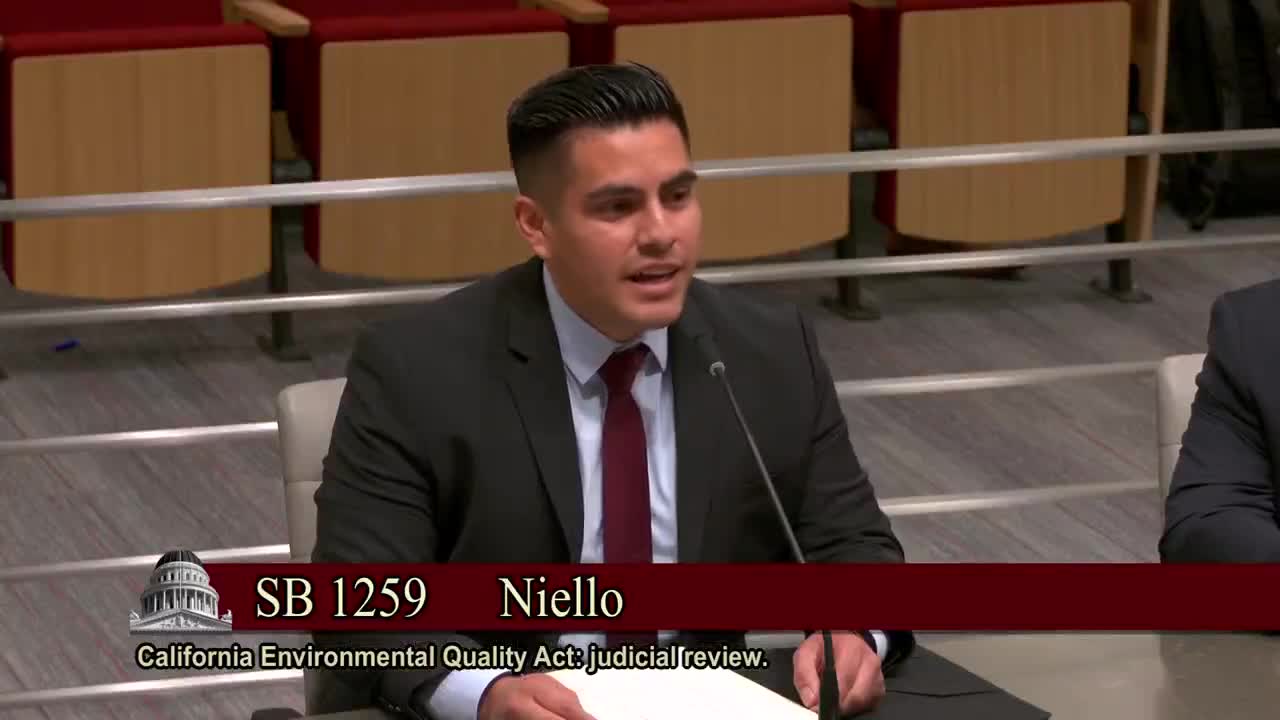
Discussed in Hearing
 28MIN
Senate Standing Committee on Environmental Quality
Bill Author
Bill Co-Author(s):
