SB 32: Motor vehicle fuel tax: greenhouse gas reduction programs: suspension.
- Session Year: 2023-2024
- House: Senate
- Latest Version Date: 2022-12-05
Current Status:
Failed
(2024-02-01: Returned to Secretary of Senate pursuant to Joint Rule 56.)
Introduced
In Committee
First Chamber
In Committee
Second Chamber
Enacted
What does this bill do?
The bill temporarily (one year) suspends California’s Low Carbon Fuel Standard (the rule that limits carbon in fuels) and the state motor vehicle fuel tax, affecting fuel suppliers and people who buy gasoline and diesel. It exempts suppliers from market-based compliance rules, requires any savings to wholesalers or suppliers be passed on to retail fuel buyers, mandates receipts showing the tax that would have applied, and lets consumers sue businesses that don’t pass on the savings after a required notice-and-fix period.
The summary is provided by generative AI which can make mistakes. For original language, please view the details in the table below.
(1)The California Global Warming Solutions Act of 2006 establishes the State Air Resources Board as the state agency responsible for monitoring and regulating sources emitting greenhouse gases. The act requires the state board to adopt rules and regulations to achieve the maximum technologically feasible and cost-effective greenhouse gas emissions reductions to ensure that the statewide greenhouse gas emissions are reduced to at least 40% below the statewide greenhouse gas emissions limit, as defined, no later than December 31, 2030. Pursuant to the act, the state board has adopted the Low Carbon Fuel Standard regulations.
The act authorizes the state board to include in its regulation of those emissions the use of market-based compliance mechanisms. Existing law requires all moneys, except for fines and penalties, collected by the state board from the auction or sale of allowances as part of a market-based compliance mechanism to be deposited in the Greenhouse Gas Reduction Fund.
This bill would suspend the Low Carbon Fuel Standard regulations for one year. The bill would also exempt suppliers of transportation fuels from regulations for the use of market-based compliance mechanisms for one year.
This bill would direct the Controller to transfer a specified amount from the General Fund to the Greenhouse Gas Reduction Fund. By transferring General Fund moneys to a partially continuously appropriated fund, this bill would make an appropriation.
(2)Existing law, the Motor Vehicle Fuel Tax Law, imposes a tax upon each gallon of motor vehicle fuel removed from a refinery or terminal rack in this state, entered into this state, or sold in this state, at a specified rate per gallon.
This bill would suspend the imposition of the tax on motor vehicle fuels for one year. The bill would require a seller of motor vehicle fuels to provide a receipt to a purchaser that indicates the amount of tax that would have otherwise applied to the transaction.
This bill would also direct the Controller to transfer a specified amount from the General Fund to the Motor Vehicle Fuel Account in the Transportation Tax Fund. By transferring General Fund moneys to a continuously appropriated account, this bill would make an appropriation.
(3)Existing unfair competition laws establish a statutory cause of action for unfair competition, including any unlawful, unfair, or fraudulent business act or practice and unfair, deceptive, untrue, or misleading advertising and acts prohibited by false advertisement laws.
This bill would require that all savings realized based on the suspension of the motor vehicle fuels tax, the suspension of the Low Carbon Fuel Standard regulations, and the exemption of suppliers of transportation fuels from regulations for use of market-based compliance mechanisms by a person other than an end consumer, as defined, be passed on to the end consumer, and would make the violation of this requirement an unfair business practice, in violation of unfair competition laws, as provided.
(4)This bill would declare that it is to take effect immediately as an urgency statute.
(a)For purposes of this section, the following definitions apply:
(1)End consumer means a purchaser of motor vehicle fuels for the purpose of consumption, and not for resale.
(2)Low Carbon Fuel Standard means the Low Carbon Fuel Standard regulations (Subarticle 7 (commencing with Section 95480) of Title 17 of the California Code of Regulations).
(b)The Low Carbon Fuel Standard is suspended for the period beginning on the effective date of this section and ending on the date one year after the effective date of this section.
(c)(1)All savings realized on the purchase of transportation fuel by any party other than an end consumer, due to the suspension of the Low Carbon Fuel Standard pursuant to this section, shall be passed on to the end consumer.
(2)Any violation of this subdivision shall constitute an unfair business practice punishable pursuant to Chapter 5 (commencing with Section 17200) of Part 2 of Division 7 of the Business and Professions Code.
(3)Notwithstanding any other law, a prospective plaintiff shall provide written notice of an alleged violation of this subdivision at least 60 days prior to bringing any enforcement action in order to give the defendant opportunity to remedy any deficiency.
(4)If a party receiving a notice pursuant to paragraph (3) responds in writing within 60 days, and the response offers an explanation for the deficiency and expresses an intent to remedy the deficiency, the opportunity to remedy a deficiency prior to initiating an enforcement action shall be extended an additional 30 days.
(5)Any remediation of a deficiency during the waiting period described in this subdivision shall be an affirmative defense against an enforcement action.
SEC. 2.Section 38572 is added to the Health and Safety Code, to read:38572.(a)Beginning on the effective date of this section and ending on the date one year after the effective date of this section, the regulations adopted pursuant to Section 38562 for the use of market-based compliance mechanisms do not apply to suppliers of transportation fuels.
(b)(1)The Controller, no later than 60 days after the effective date of this section, shall transfer an amount equal to the amount collected by the state board from the auction or sale of allowances to the suppliers of transportation fuels pursuant to a market-based compliance mechanism in the 202122 fiscal year, adjusted for inflation, from the General Fund to the Greenhouse Gas Reduction Fund in accordance with Section 16428.8 of the Government Code.
(2)The transfer amount described in paragraph (1) is continuously appropriated in accordance with Section 39719.
(3)Notwithstanding paragraph (2), no portion of the amount transferred pursuant to this subdivision to the Greenhouse Gas Reduction Fund shall be appropriated to the High-Speed Rail Authority pursuant to paragraph (2) of subdivision (b) of Section 39719.
(c)(1)All savings realized on the purchase of transportation fuel by any party other than an end consumer, due to the exemption of suppliers of transportation fuels from regulations adopted pursuant to Section 38562 for the use of market-based compliance mechanisms pursuant to this section, shall be passed on to the end consumer.
(2)Any violation of this subdivision shall constitute an unfair business practice punishable pursuant to Chapter 5 (commencing with Section 17200) of Part 2 of Division 7 of the Business and Professions Code.
(3)Notwithstanding any other law, a prospective plaintiff shall provide written notice of an alleged violation of this subdivision at least 60 days prior to bringing any enforcement action in order to give the defendant opportunity to remedy any deficiency.
(4)If a party receiving a notice pursuant to paragraph (3) responds in writing within 60 days, and the response offers an explanation for the deficiency and expresses an intent to remedy the deficiency, the opportunity to remedy a deficiency prior to initiating an enforcement action shall be extended an additional 30 days.
(5)Any remediation of a deficiency during the waiting period described in this subdivision shall be an affirmative defense against an enforcement action.
(d)For purposes of this section, end consumer means a purchaser of motor vehicle fuels for the purpose of consumption, and not for resale.
SEC. 3.Section 7360 of the Revenue and Taxation Code is amended to read:7360.(a)(1)A Except as provided in Section 7374, a tax of eighteen cents ($0.18) is hereby imposed upon each gallon of fuel subject to the tax in Sections 7362, 7363, and 7364.
(2)If the federal fuel tax is reduced below the rate of nine cents ($0.09) per gallon and federal financial allocations to this state for highway and exclusive public mass transit guideway purposes are reduced or eliminated correspondingly, the tax rate imposed by paragraph (1), on and after the date of the reduction, shall be recalculated by an amount so that the combined state rate under paragraph (1) and the federal tax rate per gallon equal twenty-seven cents ($0.27).
(3)If any person or entity is exempt or partially exempt from the federal fuel tax at the time of a reduction, the person or entity shall continue to be so exempt under this section.
(b)(1)On Except as provided in Section 7374, on and after July 1, 2010, in addition to the tax imposed by subdivision (a), a tax is hereby imposed upon each gallon of motor vehicle fuel, other than aviation gasoline, subject to the tax in Sections 7362, 7363, and 7364 in an amount equal to seventeen and three-tenths cents ($0.173) per gallon.
(2)For the 201112 fiscal year and each fiscal year thereafter, the board shall, on or before March 1 of the fiscal year immediately preceding the applicable fiscal year, adjust the rate in paragraph (1) in that manner as to generate an amount of revenue that will equal the amount of revenue loss attributable to the exemption provided by Section 6357.7, based on estimates made by the board, and that rate shall be effective during the states next fiscal year.
(3)In order to maintain revenue neutrality for each year, beginning with the rate adjustment on or before March 1, 2012, the adjustment under paragraph (2) shall also take into account the extent to which the actual amount of revenues derived pursuant to this subdivision and, as applicable, Section 7361.1, the revenue loss attributable to the exemption provided by Section 6357.7 resulted in a net revenue gain or loss for the fiscal year ending prior to the rate adjustment date on or before March 1.
(4)The intent of paragraphs (2) and (3) is to ensure that the act adding this subdivision and Section 6357.7 does not produce a net revenue gain in state taxes.
(5)Commencing July 1, 2019, the adjustments in paragraphs (2) and (3) shall cease, and the rate imposed by this subdivision shall be the rate in paragraph (1).
(c)On Except as provided in Section 7374, on and after November 1, 2017, in addition to the taxes imposed by subdivisions (a) and (b), a tax is hereby imposed upon each gallon of motor vehicle fuel, other than aviation gasoline, subject to the tax in Sections 7362, 7363, and 7364, in an amount equal to twelve cents ($0.12) per gallon.
(d)On July 1, 2020, and every July 1 thereafter, the board shall adjust the taxes imposed by subdivisions (a), (b), and (c), with the adjustment to apply to both to the base tax rates specified in those provisions and to any previous adjustment in rates made pursuant to this subdivision, by increasing the taxes by a percentage amount equal to the increase in the California Consumer Price Index, as calculated by the Department of Finance with the resulting taxes rounded to the nearest one-tenth of one cent ($0.01). The first adjustment pursuant to this subdivision shall be a percentage amount equal to the increase in the California Consumer Price Index from November 1, 2017, to November 1, 2019. Subsequent annual adjustments shall cover subsequent 12 month periods. The incremental change shall be added to the associated rate for that year.
(e)Any increases to the taxes imposed under subdivisions (a), (b), and (c) that are enacted by legislation subsequent to July 1, 2017, shall be deemed to be changes to the base tax rates for purposes of the California Consumer Price Index calculation and adjustment performed pursuant to subdivision (d).
SEC. 4.Section 7362 of the Revenue and Taxation Code is amended to read:7362.The Except as provided in Section 7374, the tax specified in Section 7360 is imposed on the removal of motor vehicle fuel in this state from a terminal if the motor vehicle fuel is removed at the rack.
SEC. 5.Section 7363 of the Revenue and Taxation Code is amended to read:7363.The Except as provided in Section 7374, the tax specified in Section 7360 is also imposed on all of the following:
(a)The removal of motor vehicle fuel in this state from any refinery if either of the following applies:
(1)The removal is by bulk transfer and the refiner or the owner of the motor vehicle fuel immediately before the removal is not a licensed supplier.
(2)The removal is at the refinery rack.
(b)The entry of motor vehicle fuel into this state for sale, consumption, use, or warehousing if either of the following applies:
(1)The entry is by bulk transfer and the enterer is not a licensed supplier.
(2)The entry is not by bulk transfer.
(c)The removal or sale of motor vehicle fuel in this state to an unlicensed person unless there was a prior taxable removal, entry, or sale of the motor vehicle fuel.
(d)The removal or sale of blended motor vehicle fuel in this state by the blender thereof. The number of gallons of blended motor vehicle fuel subject to tax is the difference between the total number of gallons of blended motor vehicle fuel removed or sold and the number of gallons of previously taxed motor vehicle fuel used to produce the blended motor vehicle fuel.
SEC. 6.Section 7364 of the Revenue and Taxation Code is amended to read:7364.The Except as provided in Section 7374, the tax specified in Section 7360 is imposed as a backup tax as follows:
(a)On the delivery into the fuel tank of a motor vehicle fuel-powered highway vehicle of:
(1)Any motor vehicle fuel on which a claim for refund has been allowed; or
(2)Any liquid on which tax has not been imposed by this part, Part 3 (commencing with Section 8601), or Part 31 (commencing with Section 60001).
(b)On the sale of any motor vehicle fuel on which a claim for refund has been allowed.
(c)On the sale and delivery into the fuel tank of a motor vehicle fuel-powered highway vehicle of any liquid on which tax has not been imposed by this part, Part 3 (commencing with Section 8601), or Part 31 (commencing with Section 60001).
SEC. 7.Section 7374 is added to the Revenue and Taxation Code, to read:7374.(a)The imposition of taxes under Sections 7360, 7362, 7363, and 7364 is suspended for the period beginning on the effective date of this section and ending on the date one year after the effective date of this section.
(b)(1)All savings realized on the purchase of motor vehicle fuel by any party other than an end consumer due to the suspension of taxes pursuant to this section shall be passed on to the end consumer.
(2)Any violation of this subdivision shall constitute an unfair business practice punishable pursuant to Chapter 5 (commencing with Section 17200) of Part 2 of Division 7 of the Business and Professions Code.
(3)Notwithstanding any other law, a prospective plaintiff shall provide written notice of an alleged violation of this subdivision at least 60 days prior to bringing any enforcement action in order to give the defendant opportunity to remedy any deficiency.
(4)If a party receiving a notice pursuant to paragraph (3) responds in writing within 60 days, and the response offers an explanation for the deficiency and expresses an intent to remedy the deficiency, the opportunity to remedy a deficiency prior to initiating an enforcement action shall be extended an additional 30 days.
(5)Any remediation of a deficiency during the waiting period described in this subdivision shall be an affirmative defense against an enforcement action.
(c)Upon any sale of motor vehicle fuels to which this section applies, the seller shall provide a receipt to the purchaser that clearly indicates the amount of motor vehicle fuel tax that would have applied to the sale if not for this section.
(d)For purposes of this section, end consumer means a purchaser of motor vehicle fuels for the purpose of consumption, and not for resale.
(e)The Controller, no later than 60 days after the effective date of this section, shall transfer an amount equal to the amount collected pursuant to Sections 7360, 7362, 7363, and 7364 in the 202122 fiscal year, adjusted for inflation, from the General Fund to the Motor Vehicle Fuel Account in the Transportation Tax Fund. This transfer amount is continuously appropriated in accordance with Section 8352.
SEC. 8.This act is an urgency statute necessary for the immediate preservation of the public peace, health, or safety within the meaning of Article IV of the California Constitution and shall go into immediate effect. The facts constituting the necessity are:
In order to provide much needed relief to Californians struggling with inflation, high gas prices, and high unemployment rates, it is necessary for this act to take immediate effect.
|
Date
|
Status
|
|---|---|
| Feb 1, 2024 | Returned to Secretary of Senate pursuant to Joint Rule 56. |
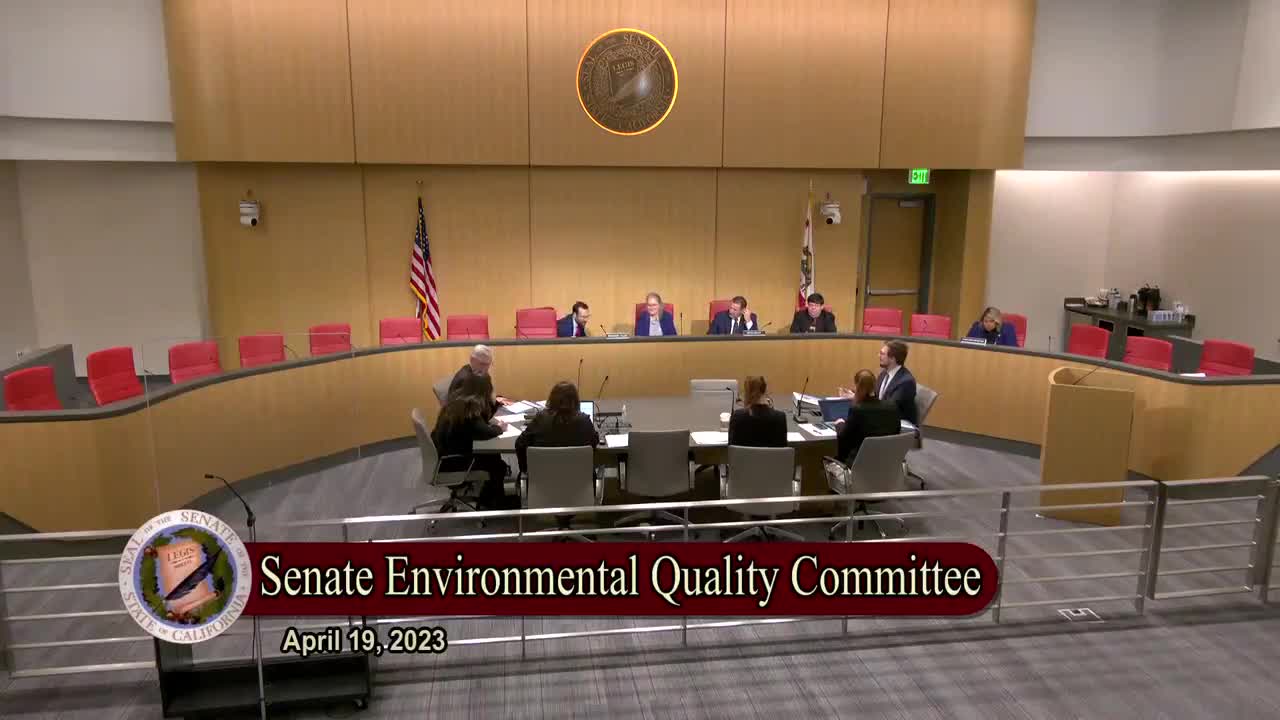
| Apr 19, 2023 | April 19 set for first hearing. Failed passage in committee. (Ayes 2. Noes 3. Page 793.) Reconsideration granted. |
| Mar 27, 2023 | Set for hearing April 19. |
| Mar 8, 2023 | Referred to Coms. on E.Q. and GOV. & F. |
| Dec 6, 2022 | From printer. May be acted upon on or after January 5. |
| Dec 5, 2022 | Introduced. Read first time. To Com. on RLS. for assignment. To print. |
|
Date
|
Description
|
Location
|
Votes
|
|
|---|---|---|---|---|
| Apr 19, 2023 | [First] hearing set for [04-19-2023]: Failed passage in Committee. Reconsideration granted | Senate Standing Committee on Environmental Quality |
Passed |
|
| Apr 19, 2023 | Do pass, but first be re-referred to the Committee on [Governance and Finance] | Senate Standing Committee on Environmental Quality |
Failed |
This list shows positions taken on this bill by organizations on the date displayed, which is linked to the original source.
Positions by individuals are not included.
|
Organization
|
Position
|
Date
|
|---|---|---|
| California Federation of Teachers, AFL-CIO | ** Against | |
| Howard Jarvis Taxpayers Association | * Support | Apr 19, 2023 |
| Plug In America | ** Against | |
| Sierra Club California | ** Against | |
| State Building and Construction Trades Council of California | ** Against | |
| Transportation Agency For Monterey County | ** Against |
SENATE COMMITTEE ON ENVIRONMENTAL QUALITY
Senator Allen, Chair
2023 - 2024 Regular
Bill No: SB 32
Author: | Jones | ||
Version: | 12/5/2022 | Hearing Date: | 4/19/2023 |
Urgency: | Yes | Fiscal: | Yes |
Consultant: | Eric Walters | ||
SUBJECT: Motor vehicle fuel tax: greenhouse gas reduction programs: suspension
DIGEST: This bill exempts transportation fuel suppliers from California’s cap-and-trade program, the Low-Carbon Fuel Standard, and gas tax for one year.
ANALYSIS:
Existing law:
- Establishes the California Air Resources Board (CARB) as the air pollution control agency in California and requires CARB, among other things, to control emissions from a wide array of mobile sources and coordinate, encourage, and review the efforts of all levels of government as they affect air quality. (Health and Safety Code (HSC) §39500 et seq.)
- Requires CARB to ensure that statewide GHG emissions are reduced to at least 40% below the 1990 level by December 31, 2030 (i.e., SB 32); and allows CARB, until December 31, 2030, to adopt regulations that utilize market-based compliance mechanisms (i.e., the cap-and-trade program) to reduce GHG emissions. (HSC §§ 38566, 38562)
- Establishes the Low-Carbon Fuel Standard (LCFS) regulations to encourage the innovation, use, and production of cleaner, low-carbon fuels in California in order to reduce GHG emissions. (Subarticle 7 (commencing with Section 95480) of Title 17 of the California Code of Regulations).
This bill:
- Suspends the Low Carbon Fuel Standard (LCFS) as defined, for one year, and further:
- Stipulates that savings must be passed on to the end consumer; and
- Provides details of how violations will be handled.
- Exempts transportation fuel suppliers from California’s Cap-and-Trade program for one year, and further:
- Backfills an amount (equal to 2021-2022 fiscal year Greenhouse Gas Reduction Fund (GGRF) revenue from fuel suppliers) of funds from the General Fund to GGRF, with the exception of funding to the High-Speed Rail Authority;
- Stipulates that savings must be passed on to the end consumer; and
- Provides details of how violations will be handled.
- Suspends specified taxes on motor vehicle fuels for one year, and further:
- Requires any sale of a motor vehicle fuels includes a receipt that indicates the amount of motor vehicle fuel tax that otherwise would have applied;
- Backfills an amount (equal to the amount collected pursuant to the suspended taxes in the 2021-2022 fiscal year) of funds from the General Fund to the Motor Vehicle Fuel Account in the Transportation Tax Fund.
- Stipulates that savings must be passed on to the end consumer; and
- Provides details of how violations will be handled.
Background
- Why’s California gas so expensive? Higher prices on gasoline fuel can have crippling effects for residents on fixed or limited incomes, especially those who rely on long commutes to get to work or home, or those who require driving as part of their job.
Californians generally pay higher prices for gasoline compared to the rest of the country, which is the result of, according to the CEC, five main reasons: (1) higher taxes on gasoline, (2) higher gasoline production costs, (3) environmental program costs, (4) California’s shorter winter season, and (5) the isolated nature of the California fuels market.
Even beyond the explainable differences, there is also a so-called “mystery gasoline surcharge.” For example, in February 2020, the fact that California had higher taxes and environmental fees and a cleaner gas formulation could account for only 72 cents of the $1.18 price differential between us and other states. Dr. Severin Borenstein—who coined the term mystery gasoline surcharge—has said that the cost is hidden within “refining, marketing, and retailing” and has been kept in place by gasoline suppliers charging more because they can.
As of Monday, March 27th, California’s average statewide price for a gallon of gas was $4.82, about $1.38 more than the national average, according to AAA. Prices have fallen in recent months after spiking to a statewide average of about $6.42 in early fall, at least $2.61 more per gallon than drivers nationwide were paying at the time.
State taxes and fees account for only half of the roughly $1.38 difference in the average price, according to Consumer Watchdog. Thus, even without any state taxes and fees, Californians would still be paying 69 cents per gallon more than the national average. - Special session. As oil companies evaded questions about unexplained gas price increases, Governor Gavin Newsom convened a special session of the California Legislature on December 5 to pass a so-called “price gouging penalty” on oil companies.
The Governor’s action came on the heels of a state hearing – which five major oil refiners refused to attend – to investigate 2022’s unprecedented spike in gasoline prices. The spike in gasoline prices had resulted in record refiner profits of $63 billion in just 90 days, disproportionately affecting low- and middle-income families. In calling for the special session, Governor Newsom said, “Big oil is ripping Californians off, and the deafening silence from the industry yesterday is the latest proof that a price gouging penalty is needed to hold them accountable for profiteering at the expense of California families.”
This bill, co-authored by the entirety of the Senate Republican Caucus, was also introduced as SBX1-1 on the first day of the extraordinary session, and appears to be a counterpoint to the price gouging penalty called for by the Governor. - SBX1-2. Introduced by Senator Skinner the first day of the special session and amended into its current form on March 20, 2023, SBX1-2 proposes several policies to address gasoline supply and pricing. These include authorizing the California Energy Commission (CEC) to establish a maximum gross gasoline refining margin and penalty on gasoline sold by refiners in the state. The bill requires pricing transparency from gasoline refiners, directs an independent watchdog division at CEC to detect efforts to manipulate gas prices, and authorizes CEC to impose a price-gouging penalty.
The bill passed the Senate on a 30-8 vote, the Assembly on a 52-19 vote, and was signed by the Governor on March 28th, 2023. Upon SB1X-2’s passage out of the Legislature, ACR 1X (Rendon, 2023) was adopted by both houses, thereby adjourning the special session. This action also effectively killed SBX1-1—the identical bill to SB 32 that was introduced in the special session—without that bill receiving a hearing. - Climate programs and fuel suppliers. As a world leader on climate policy, California has a number of policies that financially affect the suppliers of transportation fuel. Two major programs are specifically named in this bill, the Low-Carbon Fuel Standard (LCFS), and cap-and-trade.
- LCFS. The Low Carbon Fuel Standard is designed to decrease the carbon intensity of California's transportation fuel pool and provide an increasing range of low-carbon and renewable alternatives, which reduce petroleum dependency and achieve air quality benefits. It was established pursuant to AB 32 (Nunez, 2006) as an “early action GHG emission reduction measure” and has been administered by CARB—with several regulatory amendments—since its adoption in 2007.
The program sets a declining target of carbon intensity and, briefly, requires conventional fossil fuel-based transportation fuel (i.e. gasoline and diesel) producers to purchase “credits” from low-carbon fuel (i.e. biofuels, hydrogen, electricity, etc.) producers. Thus, fossil fuel-based transportation fuel producers directly subsidize the production of lower-carbon alternative fuels by buying credits from them. - Cap-and-trade. Also established pursuant to AB 32 (Nunez, 2006), California’s cap-and-trade program is a market-based compliance mechanism that requires certain polluters (totaling roughly 80% of the state’s overall emissions) to obtain an allowance for each ton of GHG emissions they release. Those allowances can be traded between entities, purchased at auction from the state, or are allocated freely to certain industries. Over time, the total number of allowances issued declines, which should reduce statewide emissions accordingly.
Moreover, the proceeds from allowance auctions are collected in the GGRF. In turn, the GGRF supports a plethora of state efforts to equitably and rapidly decarbonize the state’s economy and address the impacts of air pollution. In the past several years, GGRF proceeds have hovered around $4 billion annually.
In 2021, Cap-and-Trade covered 292 million tons of GHG emissions; 139 million of all covered emissions were from fuel suppliers—roughly 48%.
- LCFS. The Low Carbon Fuel Standard is designed to decrease the carbon intensity of California's transportation fuel pool and provide an increasing range of low-carbon and renewable alternatives, which reduce petroleum dependency and achieve air quality benefits. It was established pursuant to AB 32 (Nunez, 2006) as an “early action GHG emission reduction measure” and has been administered by CARB—with several regulatory amendments—since its adoption in 2007.
- Proposition 6. In 2018, Californian voters were given the opportunity to repeal the SB 1 gas tax (as well as require any future fuel taxes or vehicle fees approved by the Legislature to also be approved by the voters) with Proposition 6. The voters roundly rejected the measure by an over 13-point margin.
In opposition to the proposition, the Los Angeles Times’ editorial board wrote, “It’s hard to overstate how destructive Proposition 6 would be for California. It would eliminate $5 billion a year from the state budget, wiping out funds that could be used to fill potholes on local streets, smooth highways and stabilize bridges. It would cancel funding for highway and rail projects designed to move cargo more cleanly and efficiently, hurting the state’s vital freight industry. It would slash money for light rail lines and commuter rail service, meaning fewer trains for people trying to get to work.”
Although the gas tax revenues lost through SB 32 would be backfilled by General Fund revenues, California’s current budget problem means the General Fund is already unable to cover all existing obligations, even without this proposal.
Comments
- Purpose of Bill. According to the author, “Gas prices in California are going up again and one way the Legislature can offer immediate relief to motorists is to suspend the State’s gasoline tax. A state gas tax suspension would immediately lower the price of gasoline in California by $1 per gallon! Many other states have successfully relieved their residents gas costs by suspending their gas taxes. Even President Biden came out in favor of states suspending their gas taxes.
“Additionally, SB 32 has two built in important safeguards: 1) Any programs/projects currently being funded by the state’s gas tax would still be covered during the suspension by the state’s general fund; and 2) the suspension of the state’s gas tax must be passed on to consumers.
“SB 32 will immediately help California’s consumers by offering immediate relief from high prices at the pump.”
- Taxes and fees. SB 32 proposes to pause three surcharges on gasoline for one year: the gas tax, cap-and-trade, and LCFS. According to information provided by the author, in November 2022—when California gas averaged roughly $5 per gallon as compared to the national average of $3.50 per gallon—the gas tax accounted for 53.9 cents per gallon, cap-and-trade accounted for 25 cents per gallon, and LCFS for 22 cents per gallon.
Should this measure be passed by the committee today, it will go to the Senate Governance and Finance committee, which will be the more appropriate venue for discussion of the gas tax suspension. The remainder of this analysis will discuss the impacts of the proposed pause on the two climate programs named in this bill. - Fatal pause. Despite the fact that SB 32 proposes to suspend cap-and-trade and the LCFS for only one year, the bill would have ramifications far beyond that year. As noted in the background, almost half of the emissions produced in 2021 were from transportation fuel providers. It is notable that those millions of tons of GHG emissions are important to the state’s cap-and-trade program for two reasons: the auction proceeds provided to the GGRF, but also the demand for 139 million allowances to be claimed for the associated emissions.
Under SB 32, the lost GGRF revenues would be backfilled from the General Fund, but no such accommodations are made for the impacts on the market for allowances.
According to recent data from CARB at the end of the latest cap-and-trade compliance period (as reported on by the Legislative Analyst’s Office) there are already over 300 million allowances banked to meet future compliance obligations. These 300 million banked allowances alone will make meeting our 2030 GHG emission reduction goal difficult, and doing so is a topic of significant ongoing discussions and deliberations. All of the concerns raised about the stringency of these programs would be worsened by reducing demand by 139 million tons of GHGs for a year.
Under current levels of demand, there are likely too many allowances available at too low of a price to achieve the state’s emission reductions goals. If SB 32 passed, what impact would it have on the sale (and banking) of allowances for the year of the pause? Would covered entities and speculators purchase even more low-cost allowances to bank for future compliance obligations without truly reducing emissions? Would other industries reduce their decarbonization ambitions because of the abundance of cheap allowances? SB 32 includes no direction for addressing any of these potential issues.
For LCFS, the impacts to the compliance instrument market are different but still massively harmful. The price of LCFS credits is a product of supply and demand, without any of the additional containment mechanisms cap-and-trade has. If fuel suppliers were not required to purchase credits for one year, there would be virtually zero demand. This would cause the value of credits to plummet. Any producers who could weather the storm and still produce fuels and credits for that year would find that even once fuel suppliers are required to purchase credits again, their struggles would not be over. Thanks to a year of producing LCFS credits without any demand for them, there may be such a glut of surplus credits that the value of those credits may be slow to restore its current price, if ever.
Market-based compliance mechanisms are complicated, and their success depends on careful tuning over time of compliance instrument supply, demand, and banking. It is not clear if solutions could be developed to reconcile any of the above issues with the contents of this bill. It is not clear if the author intends to work towards developing such solutions.
Ultimately then, the question before the committee is whether these potentially foundational, lasting damages to two of the state’s biggest climate programs are justified by reducing a portion of the California-specific surcharges on gasoline sales for one year. Again, according to information provided by the author, the fees for cap-and-trade and LCFS would reduce the cost of $5 gasoline to $4.53 a gallon: not quite 10% in savings.
Especially given the recent efforts in SBX1-2 to address the price of California gasoline without potentially crippling these vital programs, SB 32 may be the wrong solution to this important problem.
DOUBLE REFERRAL:
If this measure is approved by the Senate Environmental Quality Committee, the do pass motion must include the action to re-refer the bill to the Senate Governance and Finance Committee.
Related/Prior Legislation
SBX1-2 (Skinner, 2023) authorized the CEC to establish a maximum gross gasoline refining margin and penalty on gasoline sold by refiners in the state. The bill also required pricing transparency from gasoline refiners, directed an independent watchdog division at CEC to detect efforts to manipulate gas prices, and authorized CEC to impose a price-gouging penalty. SBX1-2 was signed by the Governor on March 28th, 2023.
SBX1-1 (Jones, 2023) is identical to SB 32. SBX1-1 has not been referred to committee in the Senate.
ABX1-1 (Fong, 2023) would suspend the gas tax and backfill the funds from the General Fund. ABX1-1 has not been referred to committee in the Assembly.
AB 53 (Fong, 2023) is identical to ABX1-1. It has been referred to the Assembly Transportation committee.
SOURCE:
Author
SUPPORT:
None received
OPPOSITION:
California Federation of Teachers AFL-CIO
Plug In America
Sierra Club California
State Building and Construction Trades Council of California
Transportation Agency for Monterey County (TAMC)
-- END --
Discussed in Hearing
 8MIN
Senate Standing Committee on Environmental Quality
Bill Author
Bill Co-Author(s):