SB 415: Air quality: rules and regulations: socioeconomic impacts assessment.
- Session Year: 2023-2024
- House: Senate
- Latest Version Date: 2023-04-10
Current Status:
Failed
(2024-02-01: Returned to Secretary of Senate pursuant to Joint Rule 56.)
Introduced
In Committee
First Chamber
In Committee
Second Chamber
Enacted
Existing law requires a local air pollution control district or an air quality management district (local air district) that intends to propose the adoption, amendment, or repeal of a rule or regulation that will significantly affect air quality or emissions limitations to perform, except as specified, an assessment of the socioeconomic impacts of the proposed adoption, amendment, or repeal of the rule or regulation, as provided. Existing law defines socioeconomic impacts to include, among other things, the type of industries or business, including small business, affected by the rule or regulation, the impact of the rule or regulation on employment and the economy of the region affected by the adoption of the rule or regulation, and the range of probable costs, including costs to industry or business, including small business, of the rule or regulation.
This bill would authorize a local air district to contract with a third party to conduct the required assessment of socioeconomic impacts, or portion thereof, as provided. The bill would require a local air district to ensure that a prospective third-party contractor includes in its proposal for the assessment specified information, including, among other things, a conflicts statement and a proposed schedule and budget for the assessment. This bill would expand the definition of socioeconomic impacts to include the disproportionate impact, if any, of the proposed adoption, amendment, or repeal of the rule or regulation on Black, African American, Hispanic, Latino, Asian, Pacific Islander, Native American, Native Hawaiian, Alaska Native, gay, lesbian, bisexual, and transgender individuals and women. The bill would require a local air district or the third-party contractor, if no disproportionate impact is identified, to describe the basis for its conclusion that there is no disproportionate impact. By expanding the definition of socioeconomic impact for purposes ofThis bill would require a local air district, whenever it intends to propose the adoption, amendment, or repeal of a rule or regulation that will significantly affect air quality or emissions limitations, to perform an assessment of the socioeconomic impacts of the proposed action on the rule or regulation on families living within the jurisdiction whose annual income is less than $100,000. The bill would change the definition of socioeconomic impacts to, among other things, remove from consideration the types of industry and business, other than small business, that is affected, to remove from consideration the impact of the proposed change on the economy of the region affected, and to include the range of probable costs for families living within the jurisdiction with an annual income of less than $100,000. By creating an income threshold and changing the parameters of a socioeconomic impacts assessment conducted by a local air district, this bill would increase the requirements on local officials, thereby imposing a state-mandated local program.
This bill would additionally require the State Air Resources Board, except as specified, to conduct an assessment of the socioeconomic impacts, as defined, on families living within the jurisdiction whose annual income is less than $100,000, of a proposed adoption, amendment, or repeal of a rule or regulation that will significantly affect air quality or emissions limitations, as provided, and similarly authorize the state board to contract with a third party to conduct the required assessment of socioeconomic impacts, or portion thereof, as provided. The bill would specify minimum standards for the assessment of socioeconomic impacts, and would require the state board or a third-party contractor to include in the assessment of socioeconomic impacts, impacts specified information and analysis, including, but not limited to, the disproportionate impacts analysis described above. including an econometric analysis that includes, among other things, a baseline estimate of the costs on families living within the jurisdiction whose annual income is less than $100,000, as provided. The bill would prohibit the state board from approving an assessment of socioeconomic impacts that fails to meet those requirements.
The California Constitution requires the state to reimburse local agencies and school districts for certain costs mandated by the state. Statutory provisions establish procedures for making that reimbursement.
This bill would provide that, if the Commission on State Mandates determines that the bill contains costs mandated by the state, reimbursement for those costs shall be made pursuant to the statutory provisions noted above.
Existing law requires a local air pollution control district or an air quality management district (local air district) that intends to propose the adoption, amendment, or repeal of a rule or regulation that will significantly affect air quality or emissions limitations to perform, except as specified, an assessment of the socioeconomic impacts of the proposed adoption, amendment, or repeal of the rule or regulation, as provided. Existing law defines socioeconomic impacts to include, among other things, the type of industries or business, including small business, affected by the rule or regulation, the impact of the rule or regulation on employment and the economy of the region affected by the adoption of the rule or regulation, and the range of probable costs, including costs to industry or business, including small business, of the rule or regulation.
This bill would authorize a local air district to contract with a third party to conduct the required assessment of socioeconomic impacts, or portion thereof, as provided. The bill would require a local air district to ensure that a prospective third-party contractor includes in its proposal for the assessment specified information, including, among other things, a conflicts statement and a proposed schedule and budget for the assessment. This bill would expand the definition of socioeconomic impacts to include the disproportionate impact, if any, of the proposed adoption, amendment, or repeal of the rule or regulation on Black, African American, Hispanic, Latino, Asian, Pacific Islander, Native American, Native Hawaiian, Alaska Native, gay, lesbian, bisexual, and transgender individuals and women. The bill would require a local air district or the third-party contractor, if no disproportionate impact is identified, to describe the basis for its conclusion that there is no disproportionate impact. By expanding the definition of socioeconomic impact for purposes of a socioeconomic impacts assessment conducted by a local air district, this bill would increase the requirements on local officials, thereby imposing a state-mandated local program.
This bill would additionally require the State Air Resources Board, except as specified, to conduct an assessment of the socioeconomic impacts, as defined, of a proposed adoption, amendment, or repeal of a rule or regulation that will significantly affect air quality or emissions limitations, as provided, and similarly authorize the state board to contract with a third party to conduct the required assessment of socioeconomic impacts, or portion thereof, as provided. The bill would specify minimum standards for the assessment of socioeconomic impacts, and would require the state board or a third-party contractor to include in the assessment of socioeconomic impacts, specified information and analysis, including, but not limited to, the disproportionate impacts analysis described above. The bill would prohibit the state board from approving an assessment of socioeconomic impacts that fails to meet those requirements.
The California Constitution requires the state to reimburse local agencies and school districts for certain costs mandated by the state. Statutory provisions establish procedures for making that reimbursement.
This bill would provide that, if the Commission on State Mandates determines that the bill contains costs mandated by the state, reimbursement for those costs shall be made pursuant to the statutory provisions noted above.
(a) Whenever a district intends to propose the adoption, amendment, or repeal of a rule or regulation that will significantly affect air quality or emissions limitations, the district board shall, to the extent data are available, perform an assessment of the socioeconomic impacts of the proposed adoption, amendment, or repeal of the rule or regulation. The district board shall actively consider the socioeconomic impacts of the proposed adoption, amendment, or repeal of the rule or regulation regulation on families living within the jurisdiction whose annual income is less than one hundred thousand dollars ($100,000) and make a good faith effort to minimize adverse socioeconomic impacts. This section does not apply to the adoption, amendment, or repeal of a rule or regulation that results in a less restrictive emissions limit if the action does not interfere with the districts adopted plan to attain ambient air quality standards, or does not result in any significant increase in emissions.
(b) To the extent that information on the socioeconomic impacts of the proposed adoption, amendment, or repeal of a rule or regulation is required to be developed by a district pursuant to other provisions of this division, the district board may use or reference that information in the assessment of socioeconomic impacts required pursuant to subdivision (a) to comply with the requirements of this section.
(c)Upon the approval by a majority vote of the district board, a county district is not required to include in its assessment of socioeconomic impacts required pursuant to subdivision (a) the analysis specified in paragraphs (2) and (4) of subdivision (f) for a rule or regulation that only adopts a requirement that is substantially similar to, or is required by, a state or federal statute, regulation, or applicable formal guidance document. Examples of state and federal formal guidance documents include, but are not limited to, federal Control Techniques Guidelines, state and federal reasonably available control technology determinations, state best available retrofit control technology determinations, and state air toxic control measures.
(d)This section does not apply to a district with a population of less than 500,000 persons.
(e)(1)A district board may contract with a third-party contractor, consistent with applicable state and local laws, rules, and regulations, to conduct a socioeconomic impacts assessment, or portion thereof, and shall require the prospective third-party contractor to include all of the following in the prospective third-party contractors proposal for the assessment:
(A)A conflicts statement that includes both of the following:
(i)A description of all work performed by the prospective third-party contractor in the last five years that potentially relates to or could potentially be directly impacted by the proposed action.
(ii)All financial, personal, or familial relationships of any person employed by the prospective third-party contractor with either of the following:
(I)An employee of the district that holds a designated position listed in Appendix A of Section 95000 of Title 17 of the Code of Regulations.
(II)An executive officer of any business or corporation that could potentially be directly impacted by the proposed action.
(B)A statement of the prospective third-party contractors experience and key staffs expertise in conducting socioeconomic impact studies, or similar studies that involve cost analysis of environmental rules and regulations and their economic and demographic impacts, impacts on families living within the jurisdiction whose annual incomes is less than one hundred thousand dollars ($100,000), that includes both of the following:
(i)A list of socioeconomic impact studies or similar studies conducted by the prospective third-party contractor in the last five years.
(ii)The curriculum vitae of the team leader and key professional team members whom the prospective third-party contractor proposes to conduct the assessment that includes the relevant expertise, education, and certifications, if any, of the proposed team leader and key professional team members.
(C)A proposed schedule for the assessment that includes the date by which the prospective third-party contractor will provide a draft assessment to the district board for review.
(D)A proposed budget for the assessment.
(2)The district board may disqualify a prospective third-party contractor if the district board determines either of the following:
(A)The prospective third-party contractors conflicts statement submitted pursuant to subparagraph (A) of paragraph (1) reveals a material conflict of interest that violates Section 18730 of Title 2 of the California Code of Regulations.
(B)The experience and qualifications of the prospective third-party contractor or its employees identified pursuant to subparagraph (B) of paragraph (1) are insufficient to conduct the assessment.
(f)For purposes of this chapter, section, socioeconomic impacts means all of the following:
(1)The types of industry and business, including small business, small business affected by the rule or regulation proposed to be adopted, amended, or repealed.
(2)The impact of the proposed adoption, amendment, or repeal of the rule or regulation on employment and the economy of the region affected by the proposed action. employment.
(3)The range of probable costs, including costs to industry and business, including small business, of the rule or regulation proposed to be adopted, amended, or repealed. costs for families living within the jurisdiction whose annual income is less than one hundred thousand dollars ($100,000).
(4)The availability and cost-effectiveness of alternatives to the rule or regulation proposed to be adopted, amended, or repealed.
(5)The emissions reduction potential of the rule or regulation proposed to be adopted, amended, or repealed.
(6)The necessity of adopting, amending, or repealing the rule or regulation to attain state and federal ambient air standards pursuant to Chapter 10 (commencing with Section 40910).
(7)The disproportionate impact, if any, of the proposed action on Black, African American, Hispanic, Latino, Asian, Pacific Islander, Native American, Native Hawaiian, Alaska Native, gay, lesbian, bisexual, and transgender individuals and women. If no disproportionate impact is identified, the district board or the third-party contractor shall describe the basis for its conclusion that there is no disproportionate impact.SEC. 2.Section 40728.7 is added to the Health and Safety Code, to read:40728.7.(a)Whenever the state board intends to propose the adoption, amendment, or repeal of a rule or regulation that will significantly affect air quality or emissions limitations, the state board shall, to the extent data are available and, consistent with Section 40728.9, perform an assessment of the socioeconomic impacts of the proposed adoption, amendment, or repeal of the rule or regulation. The state board shall actively consider the socioeconomic impacts of the proposed adoption, amendment, or repeal of the rule or regulation regulation on families living within the jurisdiction whose annual income is less than one hundred thousand dollars ($100,000), and make a good faith effort to minimize adverse socioeconomic impacts.
(b)To the extent that information on the socioeconomic impacts of the proposed adoption, amendment, or repeal of a rule or regulation is required to be developed by the state board pursuant to other provisions of this division, the state board may use or reference that information in the assessment of socioeconomic impacts required pursuant to subdivision (a) to comply with the requirements of this section.
(c)The state board may contract with a third party, consistent with Section 40728.9 and with applicable state and local laws, rules, and regulations, to conduct the assessment of socioeconomic impacts, or a portion thereof, required pursuant to subdivision (a). Nothing in this section, however, requires the state board to contract with a third party to conduct the assessment.
(d)This section does not apply to either of the following:
(1)The proposed adoption, amendment, or repeal of a rule or regulation that results in a less restrictive emissions limit if the proposed action does not interfere with the state boards adopted plan to attain ambient air quality standards or does not result in any significant increase in emissions.
(2)The proposed adoption, amendment, or repeal by the state board of a rule or regulation that has an economic impact of less than ten million dollars ($10,000,000).
(e)For purposes of this chapter, section, socioeconomic impacts means all of the following:
(1)The type of industry and business, including small business, Small business affected by the rule or regulation proposed to be adopted, amended, or repealed.
(2)The impact of the proposed adoption, amendment, or repeal of the rule or regulation on employment and the economy of the region affected by the proposed action. employment.
(3)The range of probable costs, including costs to industry and business, including small business, of the rule or regulation proposed to be adopted, amended, or repealed. costs for families living within the jurisdiction whose annual income is less than one hundred thousand dollars ($100,000).
(4)The availability and cost-effectiveness of alternatives to the rule or regulation proposed to be adopted, amended, or repealed.(5)The emissions reduction potential of the rule or regulation proposed to be adopted, amended, or repealed.(6)(4)The necessity of adopting, amending, or repealing the rule or regulation to attain state and federal ambient air standards pursuant to Chapter 10 (commencing with Section 40910).
SEC. 3.Section 40728.9 is added to the Health and Safety Code, to read:40728.9.(a)For purposes of this section, the following terms have the following meanings:
(1)Assessment means the assessment of socioeconomic impacts of a proposed adoption, amendment, or repeal of a rule or regulation required to be conducted by the state board pursuant to subdivision (a) of Section 40728.7.
(2)Proposed action means the proposed adoption, amendment, or repeal of a rule or regulation being contemplated by the state board.
(3)Third-party contractor means a third party with whom the state board contracts, consistent with state and local laws, rules, and regulations, to conduct an assessment, or portion thereof.
(b)(1)This section outlines the minimum standards applicable to the state board when it is required to conduct an assessment of socioeconomic impacts required pursuant to subdivision (a) of Section 40728.7. Nothing in this section prohibits the state board from creating or imposing additional requirements on a third-party contractor relating to an assessment.
(2) The state board shall not approve an assessment pursuant to Section 40728.7 if the assessment does not comply with the requirements of this section.
(3)Nothing in this section shall be construed to supersede, modify, or otherwise affect, or exempt the state board from, applicable state or local laws, rules, or regulations relating to the ability or authority of the state board to contract with an outside third party to conduct the assessment, including, but not limited to, the State Contract Act (Chapter 1 (commencing with Section 10100) of Part 2 of Division 2 of the Public Contract Code).
(c)(1)A state board may contract with a third-party contractor, consistent with applicable state laws, rules, and regulations, to conduct an assessment, or portion thereof, and shall require the prospective third-party contractor to include all of the following in the prospective third-party contractors proposal for the assessment:
(A)A conflicts statement that includes both of the following:
(i)A description of all work performed by the prospective third-party contractor in the last five years that potentially relates to or could potentially be directly impacted by the proposed action.
(ii)All financial, personal, or familial relationships of any person employed by the prospective third-party contractor with either of the following:
(I)An employee of the state board that holds a designated position listed in Appendix A of Section 95000 of Title 17 of the Code of Regulations.
(II)An executive officer of any business or corporation that could potentially be directly impacted by the proposed action.
(B)A statement of the prospective third-party contractors experience and key staffs expertise in conducting socioeconomic impact studies, or similar studies that involve cost analysis of environmental rules and regulations and their economic and demographic impacts, impacts on families living within the jurisdiction whose annual income is less than one hundred thousand dollars ($100,000), that includes both of the following:
(i)A list of socioeconomic impact studies or similar studies conducted by the prospective third-party contractor in the last five years.
(ii)The curriculum vitae of the team leader and key professional team members whom the prospective third-party contractor proposes to conduct the assessment that includes the relevant expertise, education, and certifications, if any, of the proposed team leader and key professional team members.
(C)A proposed schedule for the assessment that includes the date by which the prospective third-party contractor will provide a draft assessment to the state board for review.
(D)A proposed budget for the assessment.
(2)The state board may disqualify a prospective third-party contractor if the state board determines either of the following:
(A)The prospective third-party contractors conflicts statement submitted pursuant to subparagraph (A) of paragraph (1) reveals a material conflict of interest that violates Section 18730 of Title 2 of the California Code of Regulations.
(B)The experience and qualifications of the prospective third-party contractor or its employees identified pursuant to subparagraph (B) of paragraph (1) are insufficient to conduct the assessment.
(d)The state board shall include, or require a third-party contractor with whom the state board contracts to include, at a minimum, all of the following in the assessment:
(1)All of the information and analysis required pursuant to subdivision (e) of Section 40728.7.
(2)(A)A description of the specific methodologies employed by the state board or the third-party contractor to conduct the assessment.
(B)The state board and the third-party contractor shall comply with the Department of Finances methodological standards for state agencies outlined in Chapter 1 (commencing with Section 2000) of Division 3 of Title 1 of the California Code of Regulations in conducting the assessment.
(3)An analysis of the disproportionate impact, if any, of the proposed action on Black, African American, Hispanic, Latino, Asian, Pacific Islander, Native American, Native Hawaiian, Alaska Native, gay, lesbian, bisexual, and transgender individuals and women. If no disproportionate impact is identified, the state board or the third-party contractor shall describe the basis for its conclusion that there is no disproportionate impact.(4)(3)An econometric analysis that includes all of the following:
(A)A baseline estimate of the costs, revenues, income, and other relevant economic factors for businesses and consumers affected by the proposed action. costs on families living within the jurisdiction whose annual income is less than one hundred thousand dollars ($100,000). The baseline estimate shall take into account economic and regulatory factors based on data available to the state board.
(B)A detailed description of the assumptions supporting the baseline estimate required pursuant to subparagraph (A), and which assumptions shall be based on the conditions specific to the region affected by the proposed action.
(C)An estimate of the impacts of the proposed action on the baseline estimate developed pursuant to subparagraph (A).
(D)An estimate of the impact that the proposed action will have on state revenues.(5)(4)A citation to each data source relied on in the assessment so that any person can view the original data source.
(6)(5)Identification of the key assumptions and inputs entered into any model created or used for the assessment, including, but not limited to, assumptions regarding the responsiveness of labor supply to changes in wage rates and the responsiveness of consumer spending to changes in product or service prices.
(7)(6)(A)Except as provided in subparagraph (B), a detailed description of any manipulation, calculation, interpolation, or extrapolation of original source data so that any person can reproduce the same estimates presented in the assessment.
(B)Complex calculations using generally accepted and publicly available input-output econometric models, such as the Regional Input-Output Modeling System (RIMS II) published by the Bureau of Economic Analysis of the United States Department of Commerce and the proprietary Economic Impact Analysis for Planning (IMPLAN), are exempt from the requirement in subparagraph (A) if the state board or the third-party contractor documents all inputs.
(e)In developing the estimate of the impacts of the proposed actions on baseline estimates pursuant to subparagraph (C) of paragraph (4) (3) of subdivision (d), the state board or the third-party contractor shall do all of the following:
(1)Identify the direct cost of the proposed action on the entities impacted by the proposed action, including separately identifying the costs for permitting, planning, purchasing, installation, and ongoing operations associated with any major investment needed to comply with the proposed action. families living within the jurisdiction whose annual income is less than one hundred thousand dollars ($100,000).
(2)Identify the basis for each component of the estimate.
(3)Consider input from entities affected by the proposed action in developing the estimate.
(4)Ensure that the estimate reflects statewide market conditions.
(5)Include the basis for the assumptions used for the estimate, develop a reasonable range surrounding the estimate, and describe in detail the impacts of the range on the costs and benefits of the proposed action.
(6)Analyze the likely behavioral changes by affected entities and individuals in response to the proposed action, including, but not limited to, the extent to which costs or benefits are retained by the affected entities or are passed on to others, including customers and employees.
(7)Take into account the types of occupations that would be impacted by job cutbacks or increases associated with the proposed action.
(8)Estimate direct, indirect, and induced impacts on consumers by income level. families living within the jurisdiction whose annual income is less than one hundred thousand dollars ($100,000).
(f)The provisions of this section are severable. If any provision of this section or its application is held invalid, that invalidity shall not affect other provisions or applications that can be given effect without the invalid provision or application.
SEC. 4.If the Commission on State Mandates determines that this act contains costs mandated by the state, reimbursement to local agencies and school districts for those costs shall be made pursuant to Part 7 (commencing with Section 17500) of Division 4 of Title 2 of the Government Code.
(a) Whenever a district intends to propose the adoption, amendment, or repeal of a rule or regulation that will significantly affect air quality or emissions limitations, that agency the district board shall, to the extent data are available, perform an assessment of the socioeconomic impacts of the proposed adoption, amendment, or repeal of the rule or regulation. The district board shall actively consider the socioeconomic impact of regulations impacts of the proposed adoption, amendment, or repeal of the rule or regulation and make a good faith effort to minimize adverse socioeconomic impacts, as defined below. impacts. This section does not apply to the adoption, amendment, or repeal of any a rule or regulation that results in any a less restrictive emissions limit if the action does not interfere with the districts adopted plan to attain ambient air quality standards, or does not result in any significant increase in emissions.
(b) For purposes of this section, socioeconomic impact means the following:(1) The type of industries or business, including small business, affected by the rule or regulation.(2) The impact of the rule or regulation on employment and the economy of the region affected by the adoption of the rule or regulation.(3) The range of probable costs, including costs to industry or business, including small business, of the rule or regulation.(4) The availability and cost-effectiveness of alternatives to the rule or regulation being proposed or amended.(5) The emission reduction potential of the rule or regulation.(6) The necessity of adopting, amending, or repealing the rule or regulation to attain state and federal ambient air standards pursuant to Chapter 10 (commencing with Section 40910).(c)(b) To the extent that information on the socioeconomic impact of a impacts of the proposed adoption, amendment, or repeal of a rule or regulation is required to be developed by a district pursuant to other provisions of this division, the district board may use or reference that information may be used or referenced in the assessment in order of socioeconomic impacts required pursuant to subdivision (a) to comply with the requirements of this section.
(d) This section does not apply to any district with a population of less than 500,000 persons.(e)(c)Upon the approval by a majority vote of the district board, a county district is not required to include in its assessment of socioeconomic impacts required pursuant to subdivision (a) the analysis specified in paragraphs (2) and (4) of subdivision (b) in any assessment of socioeconomic impacts for any (f) for a rule or regulation that only adopts a requirement that is substantially similar to, or is required by, a state or federal statute, regulation, or applicable formal guidance document. Examples of state or and federal formal guidance documents include, but are not limited to, federal Control Techniques Guidelines, state and federal reasonably available control technology determinations, state best available retrofit control technology determinations, and state air toxic control measures.
(d)This section does not apply to a district with a population of less than 500,000 persons.
(e)(1)A district board may contract with a third-party contractor, consistent with applicable state and local laws, rules, and regulations, to conduct a socioeconomic impacts assessment, or portion thereof, and shall require the prospective third-party contractor to include all of the following in the prospective third-party contractors proposal for the assessment:
(A)A conflicts statement that includes both of the following:
(i)A description of all work performed by the prospective third-party contractor in the last five years that potentially relates to or could potentially be directly impacted by the proposed action.
(ii)All financial, personal, or familial relationships of any person employed by the prospective third-party contractor with either of the following:
(I)An employee of the district that holds a designated position listed in Appendix A of Section 95000 of Title 17 of the Code of Regulations.
(II)An executive officer of any business or corporation that could potentially be directly impacted by the proposed action.
(B)A statement of the prospective third-party contractors experience and key staffs expertise in conducting socioeconomic impact studies, or similar studies that involve cost analysis of environmental rules and regulations and their economic and demographic impacts, that includes both of the following:
(i)A list of socioeconomic impact studies or similar studies conducted by the prospective third-party contractor in the last five years.
(ii)The curriculum vitae of the team leader and key professional team members whom the prospective third-party contractor proposes to conduct the assessment that includes the relevant expertise, education, and certifications, if any, of the proposed team leader and key professional team members.
(C)A proposed schedule for the assessment that includes the date by which the prospective third-party contractor will provide a draft assessment to the district board for review.
(D)A proposed budget for the assessment.
(2)The district board may disqualify a prospective third-party contractor if the district board determines either of the following:
(A)The prospective third-party contractors conflicts statement submitted pursuant to subparagraph (A) of paragraph (1) reveals a material conflict of interest that violates Section 18730 of Title 2 of the California Code of Regulations.
(B)The experience and qualifications of the prospective third-party contractor or its employees identified pursuant to subparagraph (B) of paragraph (1) are insufficient to conduct the assessment.
(f)For purposes of this chapter, socioeconomic impacts means all of the following:
(1)The types of industry and business, including small business, affected by the rule or regulation proposed to be adopted, amended, or repealed.
(2)The impact of the proposed adoption, amendment, or repeal of the rule or regulation on employment and the economy of the region affected by the proposed action.
(3)The range of probable costs, including costs to industry and business, including small business, of the rule or regulation proposed to be adopted, amended, or repealed.
(4)The availability and cost-effectiveness of alternatives to the rule or regulation proposed to be adopted, amended, or repealed.
(5)The emissions reduction potential of the rule or regulation proposed to be adopted, amended, or repealed.
(6)The necessity of adopting, amending, or repealing the rule or regulation to attain state and federal ambient air standards pursuant to Chapter 10 (commencing with Section 40910).
(7)The disproportionate impact, if any, of the proposed action on Black, African American, Hispanic, Latino, Asian, Pacific Islander, Native American, Native Hawaiian, Alaska Native, gay, lesbian, bisexual, and transgender individuals and women. If no disproportionate impact is identified, the district board or the third-party contractor shall describe the basis for its conclusion that there is no disproportionate impact.
SEC. 2.Section 40728.7 is added to the Health and Safety Code, to read:40728.7.(a)Whenever the state board intends to propose the adoption, amendment, or repeal of a rule or regulation that will significantly affect air quality or emissions limitations, the state board shall, to the extent data are available and, consistent with Section 40728.9, perform an assessment of the socioeconomic impacts of the proposed adoption, amendment, or repeal of the rule or regulation. The state board shall actively consider the socioeconomic impacts of the proposed adoption, amendment, or repeal of the rule or regulation and make a good faith effort to minimize adverse socioeconomic impacts.
(b)To the extent that information on the socioeconomic impacts of the proposed adoption, amendment, or repeal of a rule or regulation is required to be developed by the state board pursuant to other provisions of this division, the state board may use or reference that information in the assessment of socioeconomic impacts required pursuant to subdivision (a) to comply with the requirements of this section.
(c)The state board may contract with a third party, consistent with Section 40728.9 and with applicable state and local laws, rules, and regulations, to conduct the assessment of socioeconomic impacts, or a portion thereof, required pursuant to subdivision (a). Nothing in this section, however, requires the state board to contract with a third party to conduct the assessment.
(d)This section does not apply to either of the following:
(1)The proposed adoption, amendment, or repeal of a rule or regulation that results in a less restrictive emissions limit if the proposed action does not interfere with the state boards adopted plan to attain ambient air quality standards or does not result in any significant increase in emissions.
(2)The proposed adoption, amendment, or repeal by the state board of a rule or regulation that has an economic impact of less than ten million dollars ($10,000,000).
(e)For purposes of this chapter, socioeconomic impacts means all of the following:
(1)The type of industry and business, including small business, affected by the rule or regulation proposed to be adopted, amended, or repealed.
(2)The impact of the proposed adoption, amendment, or repeal of the rule or regulation on employment and the economy of the region affected by the proposed action.
(3)The range of probable costs, including costs to industry and business, including small business, of the rule or regulation proposed to be adopted, amended, or repealed.
(4)The availability and cost-effectiveness of alternatives to the rule or regulation proposed to be adopted, amended, or repealed.
(5)The emissions reduction potential of the rule or regulation proposed to be adopted, amended, or repealed.
(6)The necessity of adopting, amending, or repealing the rule or regulation to attain state and federal ambient air standards pursuant to Chapter 10 (commencing with Section 40910).
SEC. 3.Section 40728.9 is added to the Health and Safety Code, to read:40728.9.(a)For purposes of this section, the following terms have the following meanings:
(1)Assessment means the assessment of socioeconomic impacts of a proposed adoption, amendment, or repeal of a rule or regulation required to be conducted by the state board pursuant to subdivision (a) of Section 40728.7.
(2)Proposed action means the proposed adoption, amendment, or repeal of a rule or regulation being contemplated by the state board.
(3)Third-party contractor means a third party with whom the state board contracts, consistent with state and local laws, rules, and regulations, to conduct an assessment, or portion thereof.
(b)(1)This section outlines the minimum standards applicable to the state board when it is required to conduct an assessment of socioeconomic impacts required pursuant to subdivision (a) of Section 40728.7. Nothing in this section prohibits the state board from creating or imposing additional requirements on a third-party contractor relating to an assessment.
(2) The state board shall not approve an assessment pursuant to Section 40728.7 if the assessment does not comply with the requirements of this section.
(3)Nothing in this section shall be construed to supersede, modify, or otherwise affect, or exempt the state board from, applicable state or local laws, rules, or regulations relating to the ability or authority of the state board to contract with an outside third party to conduct the assessment, including, but not limited to, the State Contract Act (Chapter 1 (commencing with Section 10100) of Part 2 of Division 2 of the Public Contract Code).
(c)(1)A state board may contract with a third-party contractor, consistent with applicable state laws, rules, and regulations, to conduct an assessment, or portion thereof, and shall require the prospective third-party contractor to include all of the following in the prospective third-party contractors proposal for the assessment:
(A)A conflicts statement that includes both of the following:
(i)A description of all work performed by the prospective third-party contractor in the last five years that potentially relates to or could potentially be directly impacted by the proposed action.
(ii)All financial, personal, or familial relationships of any person employed by the prospective third-party contractor with either of the following:
(I)An employee of the state board that holds a designated position listed in Appendix A of Section 95000 of Title 17 of the Code of Regulations.
(II)An executive officer of any business or corporation that could potentially be directly impacted by the proposed action.
(B)A statement of the prospective third-party contractors experience and key staffs expertise in conducting socioeconomic impact studies, or similar studies that involve cost analysis of environmental rules and regulations and their economic and demographic impacts, that includes both of the following:
(i)A list of socioeconomic impact studies or similar studies conducted by the prospective third-party contractor in the last five years.
(ii)The curriculum vitae of the team leader and key professional team members whom the prospective third-party contractor proposes to conduct the assessment that includes the relevant expertise, education, and certifications, if any, of the proposed team leader and key professional team members.
(C)A proposed schedule for the assessment that includes the date by which the prospective third-party contractor will provide a draft assessment to the state board for review.
(D)A proposed budget for the assessment.
(2)The state board may disqualify a prospective third-party contractor if the state board determines either of the following:
(A)The prospective third-party contractors conflicts statement submitted pursuant to subparagraph (A) of paragraph (1) reveals a material conflict of interest that violates Section 18730 of Title 2 of the California Code of Regulations.
(B)The experience and qualifications of the prospective third-party contractor or its employees identified pursuant to subparagraph (B) of paragraph (1) are insufficient to conduct the assessment.
(d)The state board shall include, or require a third-party contractor with whom the state board contracts to include, at a minimum, all of the following in the assessment:
(1)All of the information and analysis required pursuant to subdivision (e) of Section 40728.7.
(2)(A)A description of the specific methodologies employed by the state board or the third-party contractor to conduct the assessment.
(B)The state board and the third-party contractor shall comply with the Department of Finances methodological standards for state agencies outlined in Chapter 1 (commencing with Section 2000) of Division 3 of Title 1 of the California Code of Regulations in conducting the assessment.
(3)An analysis of the disproportionate impact, if any, of the proposed action on Black, African American, Hispanic, Latino, Asian, Pacific Islander, Native American, Native Hawaiian, Alaska Native, gay, lesbian, bisexual, and transgender individuals and women. If no disproportionate impact is identified, the state board or the third-party contractor shall describe the basis for its conclusion that there is no disproportionate impact.
(4)An econometric analysis that includes all of the following:
(A)A baseline estimate of the costs, revenues, income, and other relevant economic factors for businesses and consumers affected by the proposed action. The baseline estimate shall take into account economic and regulatory factors based on data available to the state board.
(B)A detailed description of the assumptions supporting the baseline estimate required pursuant to subparagraph (A), and which assumptions shall be based on the conditions specific to the region affected by the proposed action.
(C)An estimate of the impacts of the proposed action on the baseline estimate developed pursuant to subparagraph (A).
(D)An estimate of the impact that the proposed action will have on state revenues.
(5)A citation to each data source relied on in the assessment so that any person can view the original data source.
(6)Identification of the key assumptions and inputs entered into any model created or used for the assessment, including, but not limited to, assumptions regarding the responsiveness of labor supply to changes in wage rates and the responsiveness of consumer spending to changes in product or service prices.
(7)(A)Except as provided in subparagraph (B), a detailed description of any manipulation, calculation, interpolation, or extrapolation of original source data so that any person can reproduce the same estimates presented in the assessment.
(B)Complex calculations using generally accepted and publicly available input-output econometric models, such as the Regional Input-Output Modeling System (RIMS II) published by the Bureau of Economic Analysis of the United States Department of Commerce and the proprietary Economic Impact Analysis for Planning (IMPLAN), are exempt from the requirement in subparagraph (A) if the state board or the third-party contractor documents all inputs.
(e)In developing the estimate of the impacts of the proposed actions on baseline estimates pursuant to subparagraph (C) of paragraph (4) of subdivision (d), the state board or the third-party contractor shall do all of the following:
(1)Identify the direct cost of the proposed action on the entities impacted by the proposed action, including separately identifying the costs for permitting, planning, purchasing, installation, and ongoing operations associated with any major investment needed to comply with the proposed action.
(2)Identify the basis for each component of the estimate.
(3)Consider input from entities affected by the proposed action in developing the estimate.
(4)Ensure that the estimate reflects statewide market conditions.
(5)Include the basis for the assumptions used for the estimate, develop a reasonable range surrounding the estimate, and describe in detail the impacts of the range on the costs and benefits of the proposed action.
(6)Analyze the likely behavioral changes by affected entities and individuals in response to the proposed action, including, but not limited to, the extent to which costs or benefits are retained by the affected entities or are passed on to others, including customers and employees.
(7)Take into account the types of occupations that would be impacted by job cutbacks or increases associated with the proposed action.
(8)Estimate direct, indirect, and induced impacts on consumers by income level.
(f)The provisions of this section are severable. If any provision of this section or its application is held invalid, that invalidity shall not affect other provisions or applications that can be given effect without the invalid provision or application.
SEC. 4.If the Commission on State Mandates determines that this act contains costs mandated by the state, reimbursement to local agencies and school districts for those costs shall be made pursuant to Part 7 (commencing with Section 17500) of Division 4 of Title 2 of the Government Code.
|
Date
|
Status
|
|---|---|
| Feb 1, 2024 | Returned to Secretary of Senate pursuant to Joint Rule 56. |
| May 18, 2023 | May 18 hearing: Held in committee and under submission. |
| May 12, 2023 | Set for hearing May 18. |
| May 1, 2023 | May 1 hearing: Placed on APPR suspense file. |
| Apr 21, 2023 | Set for hearing May 1. |
| Apr 19, 2023 | From committee: Do pass and re-refer to Com. on APPR. (Ayes 5. Noes 1. Page 793.) (April 19). Re-referred to Com. on APPR. |
| Apr 10, 2023 | From committee with author's amendments. Read second time and amended. Re-referred to Com. on E.Q. |
| Mar 27, 2023 | Set for hearing April 19. |
| Mar 20, 2023 | March 29 set for first hearing canceled at the request of author. |
| Mar 7, 2023 | Set for hearing March 29. |
| Feb 22, 2023 | Referred to Com. on E.Q. |
| Feb 10, 2023 | From printer. May be acted upon on or after March 12. |
| Feb 9, 2023 | Introduced. Read first time. To Com. on RLS. for assignment. To print. |
|
Date
|
Description
|
Location
|
Votes
|
|
|---|---|---|---|---|
| May 1, 2023 | Placed on suspense file | Senate Standing Committee on Appropriations |
Passed |
|
| Apr 19, 2023 | Do pass, but first be re-referred to the Committee on [Appropriations] | Senate Standing Committee on Environmental Quality |
Passed |
This list shows positions taken on this bill by organizations on the date displayed, which is linked to the original source.
Positions by individuals are not included.
|
Organization
|
Position
|
Date
|
|---|---|---|
| Bay Area Air Quality Management District | * Against Unless Amend | Apr 19, 2023 |
| California State Council Of Laborers | ** Support | |
| Central Valley Air Quality Coalition | * Support | Apr 19, 2023 |
| Los Angeles Alliance for a New Economy | * Support | Apr 19, 2023 |
SENATE COMMITTEE ON APPROPRIATIONS
Senator Anthony Portantino, Chair
2023 - 2024 Regular Session
SB 415 (Durazo) - Air quality: rules and regulations: socioeconomic impacts assessment
Version: April 10, 2023 | Policy Vote: E.Q. 5 - 1 |
Urgency: No | Mandate: Yes |
Hearing Date: May 1, 2023 | Consultant: Ashley Ames |
Bill Summary:
This bill would make changes to the required California Air Resources Board (ARB) assessment of the socioeconomic impacts for any proposed adoption, amendment, or repeal of a rule or regulation, and it adjusts standards for the air districts’ required socioeconomic analysis as well, both largely to increase focus on households with under $100,000 in annual income.
Fiscal Impact:
- ARB estimates costs of $653,000 in FY 2023-24, $650,000 in FY 2024-25, and $4.3 million annually thereafter (General Fund) to develop a rulemaking, prepare a socioeconomic impact assessment for each applicable ARB regulation, and complete market conditions analyses as identified in SB 415, among other things.
Background:
Health impacts of air pollution and climate change. Depending on exposure, air pollution alone can cause an increased risk of cardiovascular and respiratory illness, lung disease, cancerous tumors, birth defects, premature births, developmental disorders, central nervous system damage, intellectual disability, persistent memory impairments, epilepsy, dementia, and premature death. In short, exposure to air pollution causes tremendous harm to people from pre-birth to old age.
A recent study by UC researchers in Berkeley and San Francisco reported that for every dollar the state has spent controlling air pollution (between 1990 and 2014) it has generated $38 in benefits attributable to lower rates of illness, premature death, and lost productivity attributable to air pollution.
Beyond the impacts on people’s lungs, climate change is expected to affect health in all aspects of life. The World Health Organization conservatively estimates that climate change will cause some 250,000 additional deaths per year by the 2030s. The main health risks are more intense heatwaves and fires; the increased prevalence of food-, water- and vector-borne diseases; increased likelihood of undernutrition resulting from diminished food production in poor regions; and lost work capacity in vulnerable populations. Uncertain but potentially more serious risks include a breakdown in food systems, violent conflict associated with resource scarcity and population movement, and exacerbation of poverty. Overall, climate change is expected to widen existing health inequalities, both between and within populations.
Health equity impacts of air pollution. Climate change exacerbates the health inequities that are disproportionately harming the most vulnerable populations. Communities that have experienced systemic neglect and environmental racism have the least responsibility for climate pollution, but they are the most affected. These communities have less access to the political, economic, and social resources that enable them to cope with climate threats and face potentially unmanageable pressures as the impacts of climate change mount.
For example, another joint UC Berkeley-UCSF study found that redlining—the discriminatory practice that began in the 1930s of denying home loans and other forms of investment in areas largely defined by the race and social class of their occupants—was still highly predictive of air pollution exposure in 2019. Their analysis of eight California cities showed that residents of historically redlined neighborhoods were still more than twice as likely as their peers to visit emergency rooms for asthma. Previously redlined neighborhoods also continue to breathe significantly higher levels of diesel particulate matter.
Socioeconomic assessments in rulemakings. Local air districts have a statutory requirement to perform a socioeconomic assessment of the impact of a proposed regulatory action that will significantly affect air quality or emissions limitations. The specific components of an analysis may differ between air districts, but they are all required to address the same basic concerns about the impact of the regulation on industries or businesses, employment, and the economy in the region.
At the state level, if a proposed rule is estimated to have an economic impact exceeding $50 million then ARB, like all state agencies, must conduct a standardized regulatory impact assessment which includes an assessment of the socioeconomic impact of the policy. As a part of this assessment, ARB conducts a robust socioeconomic impact analysis that includes considering how “the effects of the regulation are distributed, for example, by industry, income, race, sex, or geography.”
However, ARB’s analysis of socioeconomic benefits has also recently received condemnation from the State Auditor. That is to say, while work is being done on this, the current socioeconomic analyses done by regulators are by no means perfect.
Income as a climate vulnerability indicator. California has recognized that climate change is likely to cause not only environmental catastrophes but public health crises as well. It is because of this understanding that the Climate Change and Health Equity Section (CCHES) was formed within the California Department of Public Health (CDPH). CCHES has developed climate change and health indicators, narratives, and data to provide local health departments and partners tools to better understand the people and places in their jurisdictions that are more susceptible to adverse health impacts associated with climate change, specifically extreme heat, wildfire, sea level rise, drought, and poor air quality. The assessment data can be used to screen and prioritize where to focus deeper analysis and plan for public health actions to increase resilience.
Part of CCHES’s work has been the development of the Climate Change and Health Vulnerability Assessment Framework. The Framework looks at how projected environmental exposures, population sensitivity, and adaptive capacity vary widely for populations across the state. Specifically, the Framework considers poverty (<$55,000) as a predictor of increased climate vulnerability.
People in poverty are more likely to live in dangerous or under-resourced environments and to work in hazardous conditions, with greater risk of injury, and greater exposure to pesticides, lead, and outdoor air pollution. Low-income people are more likely to be uninsured and to have limited access to quality health care; are more likely to suffer from chronic diseases like diabetes and heart disease, acute and chronic stress, and to die prematurely. It has been estimated that 133,250 (6%) of the 2.4 million U.S. deaths in 2000 were attributable to poverty.
Cost-benefit analyses. Thoughtful policymaking is ultimately a balancing of trade-offs: who will be better off, who will be worse off, and when considered in totality, do those effects merit the proposed action? “Cost-benefit analysis” is a more formalized method for assessing the economic efficiency of proposed public policies through the systematic prediction of social costs and social benefits. In theory, comprehensively valuing effects and aggregating across all members of society yields the net social benefits of the policy. In practice, this is often easier said than done.
Despite the best efforts of economists and policymakers, these costs and benefits are typically not objective truths. In an April 2022 interview with David Roberts of the climate podcast Volts, Elizabeth Popp Berman, a professor of Organizational Studies and Sociology at the University of Michigan and the author of Thinking Like an Economist: How Efficiency Replaced Equality in U.S. Public Policy, summarized the issue thusly:
Cost-benefit analysis sounds straightforward: you're tallying up the costs and tallying up the benefits and comparing the difference between the two. But the devil is in the details, and there's no simple way to account for costs or benefits. Any decisions that you make are going to involve many assumptions about who's being affected and what the costs of those effects are.
It creates a bigger opportunity for people who have a stake in the game to try to ensure that their preferred methods of calculating costs and benefits are going to be the ones that are taken into account. Historically, it's often been industry interests that have had a lot of money and a lot invested in making sure that costs are very apparent and are being counted as expansively as possible.
That can be one way that a cost-benefit analysis that's intended to be neutral can in effect tilt the playing field toward the people who have the most resources to devote to ensuring that the costs are counted and the benefits are not.
Proposed Law:
This bill would make changes to the required ARB assessment of the socioeconomic impacts for any proposed adoption, amendment, or repeal of a rule or regulation, and it adjusts standards for the air districts’ required socioeconomic analysis as well, both largely to increase focus on households with under $100,000 in annual income. Specifically, this bill would:
- Require the board of an air district with a population of 500,000 people or more, to the extent data are available, to perform an assessment of the impacts on families whose annual incomes are less than $100,000 of a rulemaking that increases the stringency of an emissions limit or improves air quality.
- Replace several existing requirements for air districts to consider the impacts of regulatory activities with a consideration of families whose annual income is less than $100,000.
- Make a variety of specifications regarding how ARB, air districts, and third-party contractors:
- May use existing information;
- May meet substantially similar requirements to comply;
- May contract the preparation of the socioeconomic analyses; and
- Must comply with the Department of Finance’s methodological standards.
- Require the air district, or a third-party contractor, to include the following specified information in the socioeconomic impact assessment:
- The types of small businesses affected by the proposed regulatory action;
- The impact of the proposed regulatory action on employment;
- The range of probable costs, to families whose annual income is less than $100,000;
- The availability and cost-effectiveness of alternatives to the proposed regulatory action;
- The emissions reduction potential of the proposed regulatory action; and
- The necessity of the proposed regulatory action to attain specified state and federal ambient air standards.
- Require ARB to similarly assess the impacts of specified proposed regulatory actions on families whose annual income is less than $100,000.
Related Legislation:
SB 1095 (Durazo, 2022) was identical to a previous version of this bill that stipulated details around socioeconomic benefits to emphasize businesses, the economy, and specified racial and gender groups. SB 1095 was help on the Suspense File in this committee.
-- END --
SENATE COMMITTEE ON ENVIRONMENTAL QUALITY
Senator Allen, Chair
2023 - 2024 Regular
Bill No: SB 415
Author: | Durazo | ||
Version: | 4/10/2023 | Hearing Date: | 4/19/2023 |
Urgency: | No | Fiscal: | Yes |
Consultant: | Eric Walters | ||
SUBJECT: Air quality: rules and regulations: socioeconomic impacts assessment
DIGEST: This bill would make changes to the required California Air Resources Board (CARB) assessment of the socioeconomic impacts for any proposed adoption, amendment, or repeal of a rule or regulation, and it adjusts standards for the air districts’ required socioeconomic analysis as well, both largely to increase focus on households with under $100,000 in annual income.
ANALYSIS:
Existing law:
- Establishes the California Air Resources Board (CARB) as the air pollution control agency in California and requires CARB, among other things, to control emissions from a wide array of mobile sources and coordinate, encourage, and review the efforts of all levels of government as they affect air quality. (Health and Safety Code (HSC) §39500 et seq.)
- Requires, subject to the powers and duties of the CARB, local air pollution control districts and air quality management districts (air districts) to adopt and enforce rules and regulations to achieve and maintain the state and federal ambient air quality standards in all areas affected by emission sources under their jurisdiction, and to enforce all applicable provisions of state and federal law. (HSC §40001)
- Requires air districts with populations over 500,000 to perform an assessment of the socioeconomic impacts of any proposed adoption, amendment, or repeal of a rule or regulation unless it results in less restrictive emission limits and does not interfere with the district’s plan to attain ambient air quality standards or does not result in any significant increase in emissions. (HSC §40728.5)
- Requires air district boards to actively consider the socioeconomic impact of regulations and make a good-faith effort to minimize adverse socioeconomic impacts.
- Defines the socioeconomic impact for these assessments in terms of the:
- Type of industries or business, including small business, affected by the rule or regulation;
- Impact of the rule or regulation on employment and the economy of the region;
- Range of probable costs, including costs to industry or business, including small business, of the rule or regulation;
- Availability and cost-effectiveness of alternatives to the rule or a being proposed or amended;
- Emission reduction potential of the rule or regulation; and
- Necessity of adopting, amending, or repealing the rule or regulation to attain state and federal ambient air standards.
This bill:
- Requires the board of an air district with a population of 500,000 people or more, to the extent data are available, to perform an assessment of the impacts on families whose annual incomes are less than $100,000 of a rulemaking that increases the stringency of an emissions limit or improves air quality.
- Replaces several existing requirements for air districts to consider the impacts of regulatory activities with a consideration of families whose annual income is less than $100,000.
- Makes a variety of specifications regarding how CARB, air districts, and third-party contractors:
- May use existing information;
- May meet substantially similar requirements to comply;
- May contract the preparation of the socioeconomic analyses; and
- Must comply with the Department of Finance’s methodological standards.
- Requires the air district, or a third-party contractor, to include the following specified information in the socioeconomic impact assessment:
- The types of small businesses affected by the proposed regulatory action;
- The impact of the proposed regulatory action on employment;
- The range of probable costs, to families whose annual income is less than $100,000;
- The availability and cost-effectiveness of alternatives to the proposed regulatory action;
- The emissions reduction potential of the proposed regulatory action; and
- The necessity of the proposed regulatory action to attain specified state and federal ambient air standards.
- Requires CARB to similarly assess the impacts of specified proposed regulatory actions on families whose annual income is less than $100,000.
Background
- Health impacts of air pollution and climate change. Depending on exposure, air pollution alone can cause an increased risk of cardiovascular and respiratory illness, lung disease, cancerous tumors, birth defects, premature births, developmental disorders, central nervous system damage, intellectual disability, persistent memory impairments, epilepsy, dementia, and premature death. In short, exposure to air pollution causes tremendous harm to people from pre-birth to old age.
A recent study by UC researchers in Berkeley and San Francisco reported that for every dollar the state has spent controlling air pollution (between 1990 and 2014) it has generated $38 in benefits attributable to lower rates of illness, premature death, and lost productivity attributable to air pollution.
Beyond the impacts on people’s lungs, climate change is expected to affect health in all aspects of life. The World Health Organization conservatively estimates that climate change will cause some 250,000 additional deaths per year by the 2030s. The main health risks are more intense heatwaves and fires; the increased prevalence of food-, water- and vector-borne diseases; increased likelihood of undernutrition resulting from diminished food production in poor regions; and lost work capacity in vulnerable populations. Uncertain but potentially more serious risks include a breakdown in food systems, violent conflict associated with resource scarcity and population movement, and exacerbation of poverty. Overall, climate change is expected to widen existing health inequalities, both between and within populations. - Health equity impacts of air pollution. Climate change exacerbates the health inequities that are disproportionately harming the most vulnerable populations. Communities that have experienced systemic neglect and environmental racism have the least responsibility for climate pollution, but they are the most affected. These communities have less access to the political, economic, and social resources that enable them to cope with climate threats and face potentially unmanageable pressures as the impacts of climate change mount.
For example, another joint UC Berkeley-UCSF study found that redlining—the discriminatory practice that began in the 1930s of denying home loans and other forms of investment in areas largely defined by the race and social class of their occupants—was still highly predictive of air pollution exposure in 2019. Their analysis of eight California cities showed that residents of historically redlined neighborhoods were still more than twice as likely as their peers to visit emergency rooms for asthma. Previously redlined neighborhoods also continue to breathe significantly higher levels of diesel particulate matter. - Socioeconomic assessments in rulemakings. Local air districts have a statutory requirement to perform a socioeconomic assessment of the impact of a proposed regulatory action that will significantly affect air quality or emissions limitations. The specific components of an analysis may differ between air districts, but they are all required to address the same basic concerns about the impact of the regulation on industries or businesses, employment, and the economy in the region.
At the state level, if a proposed rule is estimated to have an economic impact exceeding $50 million then CARB, like all state agencies, must conduct a standardized regulatory impact assessment which includes an assessment of the socioeconomic impact of the policy. As a part of this assessment, CARB conducts a robust socioeconomic impact analysis that includes considering how “the effects of the regulation are distributed, for example, by industry, income, race, sex, or geography.”
However, CARB’s analysis of socioeconomic benefits has also recently received condemnation from the State Auditor. That is to say, while work is being done on this, the current socioeconomic analyses done by regulators are by no means perfect. - Income as a climate vulnerability indicator. California has recognized that climate change is likely to cause not only environmental catastrophes but public health crises as well. It is because of this understanding that the Climate Change and Health Equity Section (CCHES) was formed within the California Department of Public Health (CDPH). CCHES has developed climate change and health indicators, narratives, and data to provide local health departments and partners tools to better understand the people and places in their jurisdictions that are more susceptible to adverse health impacts associated with climate change, specifically extreme heat, wildfire, sea level rise, drought, and poor air quality. The assessment data can be used to screen and prioritize where to focus deeper analysis and plan for public health actions to increase resilience.
Part of CCHES’s work has been the development of the Climate Change and Health Vulnerability Assessment Framework. The Framework looks at how projected environmental exposures, population sensitivity, and adaptive capacity vary widely for populations across the state. Specifically, the Framework considers poverty (<$55,000) as a predictor of increased climate vulnerability.
People in poverty are more likely to live in dangerous or under-resourced environments and to work in hazardous conditions, with greater risk of injury, and greater exposure to pesticides, lead, and outdoor air pollution. Low-income people are more likely to be uninsured and to have limited access to quality health care; are more likely to suffer from chronic diseases like diabetes and heart disease, acute and chronic stress, and to die prematurely. It has been estimated that 133,250 (6%) of the 2.4 million U.S. deaths in 2000 were attributable to poverty. - Cost-benefit analyses. Thoughtful policymaking is ultimately a balancing of trade-offs: who will be better off, who will be worse off, and when considered in totality, do those effects merit the proposed action? “Cost-benefit analysis” is a more formalized method for assessing the economic efficiency of proposed public policies through the systematic prediction of social costs and social benefits. In theory, comprehensively valuing effects and aggregating across all members of society yields the net social benefits of the policy. In practice, this is often easier said than done.
Despite the best efforts of economists and policymakers, these costs and benefits are typically not objective truths. In an April 2022 interview with David Roberts of the climate podcast Volts, Elizabeth Popp Berman, a professor of Organizational Studies and Sociology at the University of Michigan and the author of Thinking Like an Economist: How Efficiency Replaced Equality in U.S. Public Policy, summarized the issue thusly:
Cost-benefit analysis sounds straightforward: you're tallying up the costs and tallying up the benefits and comparing the difference between the two. But the devil is in the details, and there's no simple way to account for costs or benefits. Any decisions that you make are going to involve many assumptions about who's being affected and what the costs of those effects are.
It creates a bigger opportunity for people who have a stake in the game to try to ensure that their preferred methods of calculating costs and benefits are going to be the ones that are taken into account. Historically, it's often been industry interests that have had a lot of money and a lot invested in making sure that costs are very apparent and are being counted as expansively as possible.
That can be one way that a cost-benefit analysis that's intended to be neutral can in effect tilt the playing field toward the people who have the most resources to devote to ensuring that the costs are counted and the benefits are not.
Comments
- Purpose of Bill. According to the author, “SB 415 will ensure air districts take account of the disproportionate impact of their proposed rules on racial, ethnic, and gender subgroups.
“Often aimed at changing behavior, air districts approve programs that have profound consequences for working families and low-income families. Many climate solutions disproportionately burden the poor and communities of color. Communities most harmed by pollution deserve well-designed, informed policies.
“When the legislature adopted California’s recycling programs decades ago they left out anything related to wage policy. It was left to ordinary people to organize the “green jobs” that immigrant workers did. They sorted through dangerous waste without safety gloves and for wages that are a societal disgrace. That would not have happened if the Legislature had tied economic justice to environmental sustainability.
“And now, many years later, when the Legislature passed the climate package at the end of last year’s session, these bills again failed to provide a fiscal analysis of socio-economic impacts.” - Families whose annual income is less than $100,000. Recent amendments to SB 415 center on “families whose annual income is less than $100,000,” in an attempt to tip the scales of regulatory activity toward lower-income residents. But who exactly would this change cause air districts and CARB to focus on? Outside CARB’s Scoping Plan Update, the $100,000 threshold does not appear to be a commonly used number, but poverty rates more generally are considered in many contexts.
The Public Policy Institute of California (PPIC) published a Poverty in California fact sheet in October 2022, which characterized the population within the “California Poverty Measure”—about $36,900 for a family of four. In terms of racial demographics, the PPIC report found that 13.5% of Latinos, 12.6% of African Americans, 11.8% of Asian Americans/Pacific Islanders, and 9.9% of whites lived in poverty. PPIC also found that poverty varied widely with immigration status; 10% of US-born Californians, 16.1% of immigrant Californians, and 25.1% of undocumented immigrant Californians lived in poverty. Again, these values are all based on a significantly lower threshold than the $100,000 number used in this bill, but the trends are indicative of the intersection between income, race, and immigration status. - Under $100,000 families and the Scoping Plan Update. As part of the comprehensive Scoping Plan Update process, last completed in December of 2022, CARB considered the income impacts by California household income group in 2035 and 2045 under the modeled scenario.
The Scoping Plan Update found that “While in 2035... total income for households that make less than $100,000 per year is estimated to decline by $4.1 billion dollars, and the total income for households that make more than $100,000 per year will increase by $3.5 billion under the Scoping Plan Scenario. ... Because more than 60% of households in the race/ethnicity categories of Hispanic, Black alone, Native Hawaiian (HI) or Pacific Islander, American Indian or Alaskan Native, Other, and Two or More make less than $100,000 per year, these populations generally are likely to experience reduced income.” Simply put, under the proposed scenario to achieve the state’s climate goals, the rich get richer, and the poor get poorer. This should give policymakers pause.
CARB’s response within the Scoping Plan Update to these numbers reads:
“The state recognizes the need to ensure that accessibility to clean technology and energy do not further exacerbate health and opportunity gaps for low-income households and communities of color. The Climate Change Investments program exceeds the statutory minimums to invest in projects to benefit disadvantaged communities. Utilities implement programs for reduced energy bills for qualifying low-income customers. There are also resources for waste and water bills that leverage federal funds. CARB also coordinated with the CPUC to ensure that the Climate Credit funded from the sale of Cap-and-Trade allowances provided to utilities on behalf of ratepayers is credited equally to households and not based on how much energy is used. These are just a few examples of how the state is designing and implementing programs to avoid increasing existing disparities. The state must continue to find ways to relieve economic burdens on low-income households.”
Redistribution of wealth and state support to those who need it most is not an inherent feature of climate policymaking; it must be intentionally included. The examples CARB provides are encouraging, but given the numbers in the Scoping Plan Update scenario are clearly not enough. At the same time, this committee should be no stranger to the position that CARB’s Scoping Plan Update lacks meaningful strategies to meet the state’s climate goals, so we must not delay further.
As made clear by the work done by the CCHES under the auspices of the Climate Change and Health Vulnerability Indicators Framework, the very same populations this bill seeks to center on “cost” side of the cost-benefit equation also have the most potential “benefit,” insofar as they are also likely to be the hardest hit by the worst impacts of climate change.
As this bill continues to be further refined and integrated with existing practices for the air districts and CARB, the author should strive to ensure that state and local efforts to mitigate climate change are not inadvertently slowed in the pursuit of minimizing costs to lower-income Californians.
Moreover, particularly given concerns from the air districts that this may conflict with their other requirements on socioeconomic analyses, the author may even wish to consider narrowing the focus of the bill to CARB exclusively to address the specific finding (from the 2022 Scoping Plan Update) regarding household income discrepancies below versus above $100,000.
Related/Prior Legislation
SB 1095 (Durazo, 2022) was identical to a previous version of this bill that stipulated details around socioeconomic benefits to emphasize businesses, the economy, and specified racial and gender groups. SB 1095 died in the Senate Appropriations Committee.
SOURCE:
Author
SUPPORT:
California State Council of Laborers
Central Valley Air Quality Coalition (CVAQ)
Laane (Los Angeles Alliance for A New Economy)
OPPOSITION:
Bay Area Air Quality Management District
ARGUMENTS IN SUPPORT:
According to the Central Valley Air Quality Coalition, “… Current plans to achieve our climate goals exacerbate income inequality. While CARB has been tasked with considering socioeconomic impacts, a report from the California State Auditors showed that “CARB has not consistently collected or analyzed data to determine whether some of its programs provide the socioeconomic benefits that CARB has identified for those programs” and that “CARB must do more to measure and demonstrate specific benefits to disadvantaged communities and low-income communities and households that the programs intend to serve”. This raises the need to require better assessments of socioeconomic impacts, which is one of many reasons that the AB 32 Environmental Justice Advisory Committee – on which CVAQ served – recommended that CARB consider more robust analyses to understand the impact their decisions have on public health and racial disparities.
“We need a clear understanding of the inequities in our current programs in order to make these critical programs more effective at serving these communities, who are often the ones most severely hurt by climate change impacts.”
ARGUMENTS IN OPPOSITION:
According to an “Oppose Unless Amended” letter from the Bay Area Air Quality Management District, “SB 415 would significantly change the longstanding requirements for socioeconomic impact analysis done by air pollution control districts and air quality management districts. The bill would change the definition of “socioeconomic impacts” to remove analysis requirements on impacts to industry and business, other than small business, to remove from consideration the impact of the proposed change on the economy of the region affected, and instead to focus on the range of probable costs for families living within the jurisdiction with an annual income of less than $100,000.
“As you know, the Health and Safety Code (HSC) currently requires air districts serving large populations to perform socioeconomic analyses on proposed adoptions, amendments, and repeals of rules that affect air quality or emissions limitations, including the effects on industry, employment, and economy of the region. The analyses must also include a range of probable costs to industry or business, including small business. As noted above, SB 415 proposes to eliminate these longstanding requirements, however, it is unclear what existing problem the bill seeks to correct. It is additionally confusing that the April 10 amendments make the bill significantly different from the introduced version of the bill, but purport to solve the same unidentified problem. And finally, we note that the proposed amendments to HSC 40728.5 in SB 415 seem to directly conflict with HSC 40440.8 and create vastly different socioeconomic analysis requirements for different parts of the state. Given this, we ask that the sections of SB 415 amending local air district socioeconomic analysis requirements (HSC 40728.5) be removed from the bill.”
-- END --
Discussed in Hearing
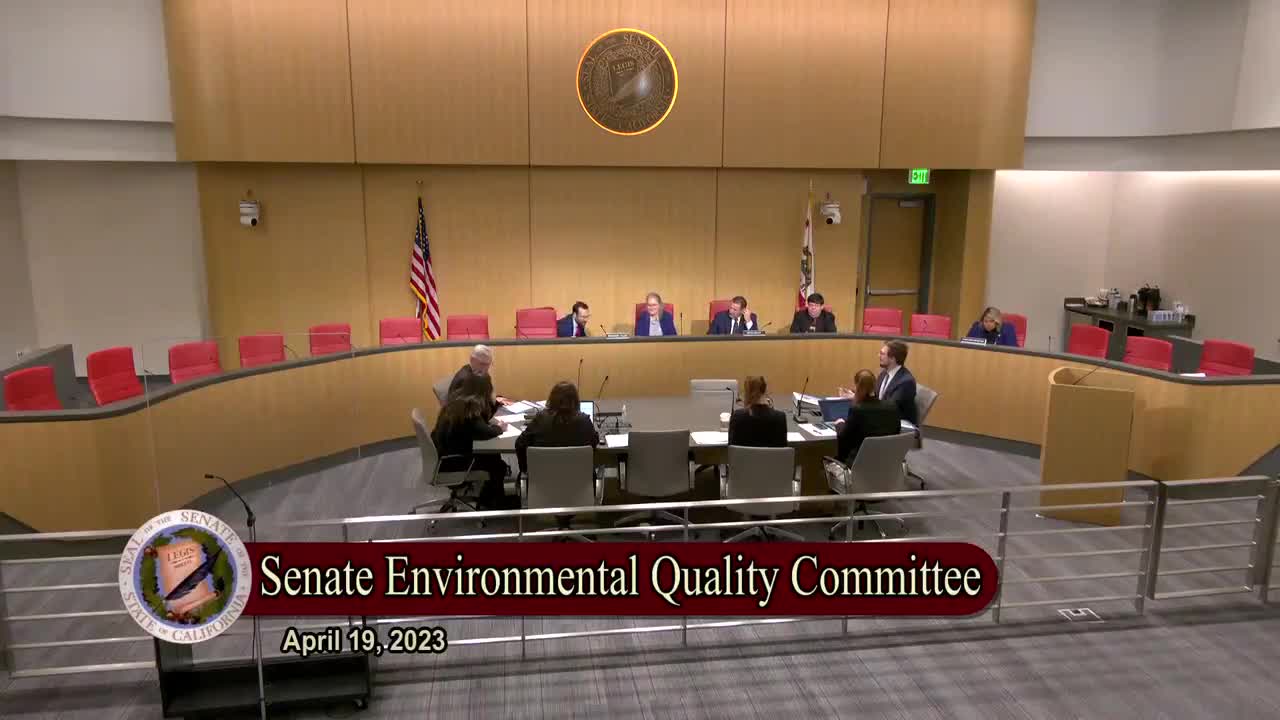 17MIN
Senate Standing Committee on Environmental Quality
Bill Author
Bill Co-Author(s):