AB 1006: Firearms: concealed carry.
- Session Year: 2025-2026
- House: Assembly
- Latest Version Date: 2025-04-10
Current Status:
Failed
(2026-02-02: From committee: Filed with the Chief Clerk pursuant to Joint Rule 56.)
Introduced
In Committee
Awaiting First Chamber Vote
Passed First Chamber
In Committee
Awaiting Second Chamber Vote
Passed Second Chamber
Enacted
Existing law prohibits a person from carrying a concealed firearm or carrying a loaded firearm in public. Existing law requires a licensing authority to issue or renew a license for a person to carry a concealed firearm if specified conditions are met, including, among others, that the applicant is not a disqualified person for the license, as specified, and the applicant is the recorded owner of the firearm with the Department of Justice. Existing law deems an applicant to be a disqualified person and cannot receive or renew a license if, among other reasons, the applicant is reasonably likely to be a danger to self, others, or the community at large, or, in the 10 years prior to the licensing authority receiving the completed application, the applicant has been charged with any certain offense that was dismissed pursuant to a plea or dismissed with a waiver, as specified. Under existing law, a license issued pursuant to these provisions is valid for a period not to exceed 2 years from the date of the license, and any person who files an application knowing that any statement in the application is false is guilty of a misdemeanor.
This bill would also treat the spouse of the recorded owner of the firearm as the recorded owner for licensing purposes. The bill would include additional specified acts that would deem an applicant as a disqualified person, including providing any information that the applicant knew or should have known was inaccurate or incomplete information in connection with the application or, in the 10 years prior to the licensing authority receiving the completed application for a new license or a license renewal, the applicant has been charged with convicted of certain offenses, including knowingly and willingly threatening the life of any elected public official and other specified persons. By expanding the application of an existing crime and expanding the scope of the crime of perjury, this bill would create a state-mandated local program. The bill would make other conforming changes.
The bill would make these provisions severable.
The California Constitution requires the state to reimburse local agencies and school districts for certain costs mandated by the state. Statutory provisions establish procedures for making that reimbursement.
This bill would provide that no reimbursement is required by this act for a specified reason.
Existing law prohibits a person from carrying a concealed firearm or carrying a loaded firearm in public. Existing law requires a licensing authority to issue or renew a license for a person to carry a concealed firearm if specified conditions are met, including, among others, that the applicant is not a disqualified person for the license, as specified, and the applicant has completed a specified course of training. is the recorded owner of the firearm with the Department of Justice. Existing law deems an applicant to be a disqualified person and cannot receive or renew a license if, among other reasons, the applicant is reasonably likely to be a danger to self, others, or the community at large, or, in the 10 years prior to the licensing authority receiving the completed application, the applicant has been charged with any certain offense that was dismissed pursuant to a plea or dismissed with a waiver, as specified. Under existing law, a license issued pursuant to these provisions is valid for a period not to exceed 2 years from the date of the license, and any person who files an application knowing that any statement in the application is false is guilty of a misdemeanor.
This bill would make a technical, nonsubstantive change to these provisions.This bill would also treat the spouse of the recorded owner of the firearm as the recorded owner for licensing purposes. The bill would include additional specified acts that would deem an applicant as a disqualified person, including providing any inaccurate or incomplete information in connection with the application or, in the 10 years prior to the licensing authority receiving the completed application for a new license or a license renewal, the applicant has been charged with certain offenses, including knowingly and willingly threatening the life of any elected public official and other specified persons. By expanding the application of an existing crime and expanding the scope of the crime of perjury, this bill would create a state-mandated local program. The bill would make other conforming changes.
The California Constitution requires the state to reimburse local agencies and school districts for certain costs mandated by the state. Statutory provisions establish procedures for making that reimbursement.
This bill would provide that no reimbursement is required by this act for a specified reason.
Existing law prohibits a person from carrying a concealed firearm or carrying a loaded firearm in public. Existing law requires a licensing authority to issue or renew a license if specified conditions are met, including, among others, that the applicant is not a disqualified person for the license, as specified, and the applicant has completed a specified course of training.
This bill would make a technical, nonsubstantive change to these provisions.
(a)If a person applies for a new license or license renewal to carry a pistol, revolver, or other firearm capable of being concealed upon the person, the sheriff of a county shall issue or renew a license to that person upon proof of all of the following:
(1)The applicant is not a disqualified person to receive such a license, as determined in accordance with the standards set forth in Section 26202.
(2)The applicant is at least 21 years of age, and presents clear evidence of the persons identity and age, as defined in Section 16400.
(3)The applicant is a resident of the county or a city within the county, or the applicants principal place of employment or business is in the county or a city within the county and the applicant spends a substantial period of time in that place of employment or business. Prima facie evidence of residency within the county or a city within the county includes, but is not limited to, the address where the applicant is registered to vote, the applicants filing of a homeowners property tax exemption, and other acts, occurrences, or events that indicate presence in the county or a city within the county is more than temporary or transient. The presumption of residency in the county or city within the county may be rebutted by satisfactory evidence that the applicants primary residence is in another county or city within the county.
(4)The applicant has completed a course of training as described in Section 26165.
(5)The applicant is the recorded owner, with the Department of Justice, of the pistol, revolver, or other firearm for which the license will be issued, or the spouse of the recorded owner.
(b)The sheriff shall issue or renew a license under subdivision (a) in either of the following formats:
(1)A license to carry concealed a pistol, revolver, or other firearm capable of being concealed upon the person.
(2)Where the population of the county is less than 200,000 persons according to the most recent federal decennial census, a license to carry loaded and exposed in only that county a pistol, revolver, or other firearm capable of being concealed upon the person.
(c)(1)Nothing in this chapter shall preclude the sheriff of the county from entering into an agreement with the chief or other head of a municipal police department of a city to process all applications for licenses, renewals of licenses, or amendments to licenses pursuant to this chapter, in lieu of the sheriff.
(2)This subdivision shall only apply to applicants who reside within the city in which the chief or other head of the municipal police department has agreed to process applications for licenses, renewals of licenses, and amendments to licenses, pursuant to this chapter.
SEC. 2.Section 26155 of the Penal Code is amended to read:26155.(a)When a person applies for a new license or license renewal to carry a pistol, revolver, or other firearm capable of being concealed upon the person, the chief or other head of a municipal police department of any city or city and county shall issue or renew a license to that person upon proof of all of the following:
(1)The applicant is not a disqualified person to receive such a license, as determined in accordance with the standards set forth in Section 26202.
(2)The applicant is at least 21 years of age, and presents clear evidence of the persons identity and age, as defined in Section 16400.
(3)The applicant is a resident of that city or city and county. Prima facie evidence of residency within the county or a city within the county includes, but is not limited to, the address where the applicant is registered to vote, the applicants filing of a homeowners property tax exemption, and other acts, occurrences, or events that indicate presence in the county or a city within the county is more than temporary or transient. The presumption of residency in the county or city within the county may be rebutted by satisfactory evidence that the applicants primary residence is in another county or city within the county.
(4)The applicant has completed a course of training as described in Section 26165.
(5)The applicant is the recorded owner, with the Department of Justice, of the pistol, revolver, or other firearm for which the license will be issued, or the spouse of the recorded owner.
(b)The chief or other head of a municipal police department shall issue or renew a license under subdivision (a) in either of the following formats:
(1)A license to carry concealed a pistol, revolver, or other firearm capable of being concealed upon the person.
(2)Where the population of the county in which the city is located is less than 200,000 persons according to the most recent federal decennial census, a license to carry loaded and exposed in only that county a pistol, revolver, or other firearm capable of being concealed upon the person.
(c)Nothing in this chapter shall preclude the chief or other head of a municipal police department of any city from entering an agreement with the sheriff of the county in which the city is located for the sheriff to process all applications for licenses, renewals of licenses, and amendments to licenses, pursuant to this chapter.
SEC. 3.Section 26162 of the Penal Code is amended to read:26162.(a)Prior to the issuance of a license, renewal of a license, or amendment to a license, each licensing authority with direct access to the designated Department of Justice system shall determine if the applicant is the recorded owner or the spouse of the recorded owner of the particular pistol, revolver, or other firearm capable of being concealed upon the person reported in the application for a license or the application for the amendment to a license under this chapter.
(b)An agency with direct access to the designated Department of Justice system shall confirm the applicants information with firearm ownership maintained in the system. An agency without access to the system shall confirm this information with the sheriff of the county in which the agency is located.
SEC. 4.Section 26200 of the Penal Code is amended to read:26200.(a)While carrying a firearm as authorized by a license issued pursuant to this chapter, a licensee shall not do any of the following:
(1)Consume an alcoholic beverage or controlled substance as described in Sections 11053 to 11058, inclusive, of the Health and Safety Code.
(2)Be in a place having a primary purpose of dispensing alcoholic beverages for onsite consumption.
(3)Be under the influence of any alcoholic beverage, medication, or controlled substance as described in Sections 11053 to 11058, inclusive, of the Health and Safety Code.
(4)Carry a firearm not listed on the license or a firearm for which they are not the recorded owner or the spouse of the recorded owner. This paragraph does not apply to a licensee who was issued a license pursuant to Section 26170, in which case they may carry a firearm that is registered to the agency for which the licensee has been deputized or appointed to serve as a peace officer, and the licensee carries the firearm consistent with that agencys policies.
(5)Falsely represent to a person that the licensee is a peace officer.
(6)Engage in an unjustified display of a deadly weapon.
(7)Fail to carry the license on their person.
(8)Impede a peace officer in the conduct of their activities.
(9)Refuse to display the license or to provide the firearm to a peace officer upon demand for purposes of inspecting the firearm.
(10)Violate any federal, state, or local criminal law.
(b)In addition to the restrictions and conditions listed in subdivision (a), a license issued pursuant to this chapter may also include any reasonable restrictions or conditions that the licensing authority deems warranted, including restrictions as to the time, place, manner, and circumstances under which a licensee may carry a pistol, revolver, or other firearm capable of being concealed upon the person.
(c)Any restrictions imposed pursuant to subdivision (b) shall be indicated on any license issued.
(d)A licensee authorized to carry a firearm pursuant to this chapter shall not carry more than two firearms under the licensees control at one time.
SEC. 5.Section 26202 of the Penal Code is amended to read:26202.(a)Unless a court makes a contrary determination pursuant to Section 26206, an applicant shall be deemed to be a disqualified person and cannot receive or renew a license pursuant to Section 26150, 26155, or 26170 if the applicant:
(1)Is reasonably likely to be a danger to self, others, or the community at large, as demonstrated by anything in the application for a license or through the investigation described in subdivision (b), or as shown by the results of any psychological assessment, including, but not limited to, the assessment described in subdivision (e) of Section 26190.
(2)Has been convicted of contempt of court under Section 166.
(3)Has been subject to any restraining order, protective order, or other type of court order issued pursuant to the following statutory provisions, unless that order expired, was dismissed, or was vacated or otherwise canceled more than five years prior to the licensing authority receiving the completed application:
(A)Section 646.91 or Part 3 (commencing with Section 6240) of Division 10 of the Family Code.
(B)Part 4 (commencing with Section 6300) of Division 10 of the Family Code.
(C)Sections 136.2 and 18100.
(D)Section 527.6, 527.8, or 527.85 of the Code of Civil Procedure.
(E)Section 213.5, 304, 362.4, 726.5, or 15657.03 of the Welfare and Institutions Code.
(4)In the 10 years prior to the licensing authority receiving the completed application for a new license or a license renewal, has been convicted of an offense listed in Section 422.6, 422.7, 422.75, or 29805.
(5)Has engaged in an unlawful or reckless use, display, or brandishing of a firearm.
(6)In the 10 years prior to the licensing authority receiving the completed application for a new license or a license renewal, has been charged with any offense listed in Section 290, 667.5, 1192.7, 1192.8, or 29805 that was dismissed pursuant to a plea or dismissed with a waiver pursuant to People v. Harvey (1979) 25 Cal.3d 754.
(7)In the five years prior to the licensing authority receiving the completed application for a new license or a license renewal, has been committed to or incarcerated in county jail or state prison for, or on probation, parole, postrelease community supervision, or mandatory supervision as a result of, a conviction of an offense, an element of which involves controlled substances, as described in Sections 11053 to 11058, inclusive, of the Health and Safety Code, or alcohol.
(8)Is currently abusing controlled substances, as described in Sections 11053 to 11058, inclusive, of the Health and Safety Code, or alcohol.
(9)In the 10 years prior to the licensing authority receiving the completed application for a new license or a license renewal, has experienced the loss or theft of multiple firearms due to the applicants lack of compliance with federal, state, or local law regarding storing, transporting, or securing the firearm. For purposes of this paragraph, multiple firearms includes a loss of more than one firearm on the same occasion, or the loss of a single firearm on more than one occasion.
(10)Failed to report a loss of a firearm as required by Section 25250 or any other state, federal, or local law requiring the reporting of the loss of a firearm.
(11)Provided any information that the applicant knew or should have known was inaccurate or incomplete information in connection with an application for a new license or a license renewal.
(12)In the 10 years prior to the licensing authority receiving the completed application for a new license or a license renewal, has been charged with convicted of an offense listed in Section 71, 76, 422, or 626.8.
(13)Is a validated gang member.
(14)In the 10 years prior to the licensing authority receiving the completed application for a new license or a license renewal, has been convicted of an offense that does not preclude the persons lawful possession of a firearm but is an offense involving violence against a person, a crime of moral turpitude, an offense that could be charged as a felony or misdemeanor that is adjudicated as a misdemeanor, or an offense charged as a felony that is adjudicated as a misdemeanor. person.
(b)In determining whether an applicant is a disqualified person and cannot receive or renew a license in accordance with subdivision (a) of this section, the licensing authority shall conduct an investigation that meets all of the following minimum requirements:
(1)An in-person interview with the applicant. For renewal applications, the licensing authority may elect to forgo this requirement.
(2)In-person, virtual, or telephonic interviews with at least three character references, at least one of whom must be a person described in subdivision (b) of Section 273.5, if applicable, and at least one of whom must be the applicants cohabitant, if applicable. For renewal applications, the licensing authority may elect to forgo this requirement.
(3)A review of publicly available information about the applicant, including publicly available statements published or posted by the applicant.
(4)A review of all information provided in the application for a license.
(5)A review of all information provided by the Department of Justice in accordance with subdivision (a) of, paragraph (2) of subdivision (b) of, and paragraph (3) of subdivision (c) of Section 26185, as well as firearms eligibility notices or any other information subsequently provided to the licensing authority regarding the applicant.
(6)A review of the information in the California Restraining and Protective Order System accessible through the California Law Enforcement Telecommunications System.
(c)In determining whether an applicant is a disqualified person and cannot receive or renew a license in accordance with subdivision (a), nothing in this section precludes the licensing authority from engaging in investigative efforts in addition to those listed in subdivision (b).
(d)Within 90 days of receiving the completed application for a new license or a license renewal, the licensing authority shall give written notice to the applicant of the licensing authoritys initial determination, based on its investigation thus far, of whether an applicant is a disqualified person pursuant to Section 26150, 26155, or 26170 as follows:
(1)If the licensing authority makes an initial determination that, based on its investigation thus far, the applicant is not a disqualified person, the notice shall inform the applicant to proceed with the training requirements specified in Section 26165. The licensing authority shall then submit the applicants fingerprints or the renewal notification to the Department of Justice in accordance with Section 26185.
(2)If, within 90 days of receiving the completed application for a new license or a license renewal, the licensing authority determines that the applicant is a disqualified person, the notice shall inform the applicant that the request for a license has been denied, state the reason as to why the determination was made, and inform the applicant that they may request a hearing from a court, as outlined in Section 26206. A licensing authority providing notice under this paragraph informing the applicant that the request for a license has been denied satisfies the requirement to provide notice of a denial of a license pursuant to Section 26205.
(e)The prohibitions listed in subdivision (a) shall apply whether or not the relevant conduct, order, conviction, charge, commitment, or other relevant action took place or was issued or entered before the effective date of the act that added this subdivision.
SEC. 6.Section 26220 of the Penal Code is amended to read:26220.(a)Except as otherwise provided in this section and in subdivision (c) of Section 26210, a license issued on or after January 1, 2026, pursuant to Section 26150 or 26155 is valid for any period of time not to exceed four years from the date of the license.(b)If the licensees place of employment or business was the basis for issuance of a license pursuant to Section 26150, the license is valid for any period of time not to exceed 90 days from the date of the license, unless the license was issued pursuant to subdivision (d). The license shall be valid only in the county in which the license was originally issued. The licensee shall give a copy of this license to the licensing authority of the city, county, or city and county in which the licensee resides. The licensing authority that originally issued the license shall inform the licensee verbally and in writing in at least 16-point type of this obligation to give a copy of the license to the licensing authority of the city, county, or city and county of residence. Any application to renew or extend the validity of, or reissue, the license may be granted only upon the concurrence of the licensing authority that originally issued the license and the licensing authority of the city, county, or city and county in which the licensee resides.(c)A license issued pursuant to Section 26150 or 26155 is valid for any period of time not to exceed four years from the date of the license if the license is issued to a custodial officer who is an employee of the sheriff as provided in Section 831.5, except that the license shall be invalid upon the conclusion of the persons employment pursuant to Section 831.5 if the four-year period has not otherwise expired or any other condition imposed pursuant to this article does not limit the validity of the license to a shorter time period.(d)A license issued pursuant to Section 26170 to a peace officer appointed pursuant to Section 830.6 is valid for any period of time not to exceed four years from the date of the license, except that the license shall be invalid upon the conclusion of the persons appointment pursuant to Section 830.6 if the four-year period has not otherwise expired or any other condition imposed pursuant to this article does not limit the validity of the license to a shorter time period.SEC. 6.The provisions of this act are severable. If any provision of this act or its application is held invalid, that invalidity shall not affect other provisions or applications that can be given effect without the invalid provision or application.
SEC. 7.No reimbursement is required by this act pursuant to Section 6 of Article XIIIB of the California Constitution because the only costs that may be incurred by a local agency or school district will be incurred because this act creates a new crime or infraction, eliminates a crime or infraction, or changes the penalty for a crime or infraction, within the meaning of Section 17556 of the Government Code, or changes the definition of a crime within the meaning of Section 6 of Article XIIIB of the California Constitution.
(a)If a person applies for a new license or license renewal to carry a pistol, revolver, or other firearm capable of being concealed upon the person, the sheriff of a county shall issue or renew a license to that person upon proof of all of the following:
(1)The applicant is not a disqualified person to receive such a license, as determined in accordance with the standards set forth in Section 26202.
(2)The applicant is at least 21 years of age, and presents clear evidence of the persons identity and age, as defined in Section 16400.
(3)The applicant is a resident of the county or a city within the county, or the applicants principal place of employment or business is in the county or a city within the county and the applicant spends a substantial period of time in that place of employment or business. Prima facie evidence of residency within the county or a city within the county includes, but is not limited to, the address where the applicant is registered to vote, the applicants filing of a homeowners property tax exemption, and other acts, occurrences, or events that indicate presence in the county or a city within the county is more than temporary or transient. The presumption of residency in the county or city within the county may be rebutted by satisfactory evidence that the applicants primary residence is in another county or city within the county.
(4)The applicant has completed a course of training as described in Section 26165.
(5)The applicant is the recorded owner, with the Department of Justice, of the pistol, revolver, or other firearm for which the license will be issued. issued, or the spouse of the recorded owner.
(b)The sheriff shall issue or renew a license under subdivision (a) in either of the following formats:
(1)A license to carry concealed a pistol, revolver, or other firearm capable of being concealed upon the person.
(2)Where the population of the county is less than 200,000 persons according to the most recent federal decennial census, a license to carry loaded and exposed in only that county a pistol, revolver, or other firearm capable of being concealed upon the person.
(c)(1)Nothing in this chapter shall preclude the sheriff of the county from entering into an agreement with the chief or other head of a municipal police department of a city to process all applications for licenses, renewals of licenses, or amendments to licenses pursuant to this chapter, in lieu of the sheriff.
(2)This subdivision shall only apply to applicants who reside within the city in which the chief or other head of the municipal police department has agreed to process applications for licenses, renewals of licenses, and amendments to licenses, pursuant to this chapter.
SEC. 2.Section 26155 of the Penal Code is amended to read:26155.(a)When a person applies for a new license or license renewal to carry a pistol, revolver, or other firearm capable of being concealed upon the person, the chief or other head of a municipal police department of any city or city and county shall issue or renew a license to that person upon proof of all of the following:
(1)The applicant is not a disqualified person to receive such a license, as determined in accordance with the standards set forth in Section 26202.
(2)The applicant is at least 21 years of age, and presents clear evidence of the persons identity and age, as defined in Section 16400.
(3)The applicant is a resident of that city or city and county. Prima facie evidence of residency within the county or a city within the county includes, but is not limited to, the address where the applicant is registered to vote, the applicants filing of a homeowners property tax exemption, and other acts, occurrences, or events that indicate presence in the county or a city within the county is more than temporary or transient. The presumption of residency in the county or city within the county may be rebutted by satisfactory evidence that the applicants primary residence is in another county or city within the county.
(4)The applicant has completed a course of training as described in Section 26165.
(5)The applicant is the recorded owner, with the Department of Justice, of the pistol, revolver, or other firearm for which the license will be issued. issued, or the spouse of the recorded owner.
(b)The chief or other head of a municipal police department shall issue or renew a license under subdivision (a) in either of the following formats:
(1)A license to carry concealed a pistol, revolver, or other firearm capable of being concealed upon the person.
(2)Where the population of the county in which the city is located is less than 200,000 persons according to the most recent federal decennial census, a license to carry loaded and exposed in only that county a pistol, revolver, or other firearm capable of being concealed upon the person.
(c)Nothing in this chapter shall preclude the chief or other head of a municipal police department of any city from entering an agreement with the sheriff of the county in which the city is located for the sheriff to process all applications for licenses, renewals of licenses, and amendments to licenses, pursuant to this chapter.
SEC. 3.Section 26162 of the Penal Code is amended to read:26162.(a)Prior to the issuance of a license, renewal of a license, or amendment to a license, each licensing authority with direct access to the designated Department of Justice system shall determine if the applicant is the recorded owner or the spouse of the recorded owner of the particular pistol, revolver, or other firearm capable of being concealed upon the person reported in the application for a license or the application for the amendment to a license under this chapter.
(b)An agency with direct access to the designated Department of Justice system shall confirm the applicants information with firearm ownership maintained in the system. An agency without access to the system shall confirm this information with the sheriff of the county in which the agency is located.
SEC. 4.Section 26200 of the Penal Code is amended to read:26200.(a)While carrying a firearm as authorized by a license issued pursuant to this chapter, a licensee shall not do any of the following:
(1)Consume an alcoholic beverage or controlled substance as described in Sections 11053 to 11058, inclusive, of the Health and Safety Code.
(2)Be in a place having a primary purpose of dispensing alcoholic beverages for onsite consumption.
(3)Be under the influence of any alcoholic beverage, medication, or controlled substance as described in Sections 11053 to 11058, inclusive, of the Health and Safety Code.
(4)Carry a firearm not listed on the license or a firearm for which they are not the recorded owner. owner or the spouse of the recorded owner. This paragraph does not apply to a licensee who was issued a license pursuant to Section 26170, in which case they may carry a firearm that is registered to the agency for which the licensee has been deputized or appointed to serve as a peace officer, and the licensee carries the firearm consistent with that agencys policies.
(5)Falsely represent to a person that the licensee is a peace officer.
(6)Engage in an unjustified display of a deadly weapon.
(7)Fail to carry the license on their person.
(8)Impede a peace officer in the conduct of their activities.
(9)Refuse to display the license or to provide the firearm to a peace officer upon demand for purposes of inspecting the firearm.
(10)Violate any federal, state, or local criminal law.
(b)In addition to the restrictions and conditions listed in subdivision (a), a license issued pursuant to this chapter may also include any reasonable restrictions or conditions that the licensing authority deems warranted, including restrictions as to the time, place, manner, and circumstances under which a licensee may carry a pistol, revolver, or other firearm capable of being concealed upon the person.
(c)Any restrictions imposed pursuant to subdivision (b) shall be indicated on any license issued.
(d)A licensee authorized to carry a firearm pursuant to this chapter shall not carry more than two firearms under the licensees control at one time.
SEC. 5.Section 26202 of the Penal Code is amended to read:26202.(a)Unless a court makes a contrary determination pursuant to Section 26206, an applicant shall be deemed to be a disqualified person and cannot receive or renew a license pursuant to Section 26150, 26155, or 26170 if the applicant:
(1)Is reasonably likely to be a danger to self, others, or the community at large, as demonstrated by anything in the application for a license or through the investigation described in subdivision (b), or as shown by the results of any psychological assessment, including, but not limited to, the assessment described in subdivision (e) of Section 26190.
(2)Has been convicted of contempt of court under Section 166.
(3)Has been subject to any restraining order, protective order, or other type of court order issued pursuant to the following statutory provisions, unless that order expired expired, was dismissed, or was vacated or otherwise canceled more than five years prior to the licensing authority receiving the completed application:
(A)Section 646.91 or Part 3 (commencing with Section 6240) of Division 10 of the Family Code.
(B)Part 4 (commencing with Section 6300) of Division 10 of the Family Code.
(C)Sections 136.2 and 18100.
(D)Section 527.6, 527.8, or 527.85 of the Code of Civil Procedure.
(E)Section 213.5, 304, 362.4, 726.5, or 15657.03 of the Welfare and Institutions Code.
(4)In the 10 years prior to the licensing authority receiving the completed application for a new license or a license renewal, has been convicted of an offense listed in Section 422.6, 422.7, 422.75, or 29805.
(5)Has engaged in an unlawful or reckless use, display, or brandishing of a firearm.
(6)In the 10 years prior to the licensing authority receiving the completed application for a new license or a license renewal, has been charged with any offense listed in Section 290, 667.5, 1192.7, 1192.8, or 29805 that was dismissed pursuant to a plea or dismissed with a waiver pursuant to People v. Harvey (1979) 25 Cal.3d 754.
(7)In the five years prior to the licensing authority receiving the completed application for a new license or a license renewal, has been committed to or incarcerated in county jail or state prison for, or on probation, parole, postrelease community supervision, or mandatory supervision as a result of, a conviction of an offense, an element of which involves controlled substances, as described in Sections 11053 to 11058, inclusive, of the Health and Safety Code, or alcohol.
(8)Is currently abusing controlled substances, as described in Sections 11053 to 11058, inclusive, of the Health and Safety Code, or alcohol.
(9)In the 10 years prior to the licensing authority receiving the completed application for a new license or a license renewal, has experienced the loss or theft of multiple firearms due to the applicants lack of compliance with federal, state, or local law regarding storing, transporting, or securing the firearm. For purposes of this paragraph, multiple firearms includes a loss of more than one firearm on the same occasion, or the loss of a single firearm on more than one occasion.
(10)Failed to report a loss of a firearm as required by Section 25250 or any other state, federal, or local law requiring the reporting of the loss of a firearm.
(11)Provided any inaccurate or incomplete information in connection with an application for a new license or a license renewal.
(12)In the 10 years prior to the licensing authority receiving the completed application for a new license or a license renewal, has been charged with an offense listed in Section 71, 76, 422, or 626.8.
(13)Is a validated gang member.
(14)In the 10 years prior to the licensing authority receiving the completed application for a new license or a license renewal, has been convicted of an offense that does not preclude the persons lawful possession of a firearm but is an offense involving violence against a person, a crime of moral turpitude, an offense that could be charged as a felony or misdemeanor that is adjudicated as a misdemeanor, or an offense charged as a felony that is adjudicated as a misdemeanor.
(b)In determining whether an applicant is a disqualified person and cannot receive or renew a license in accordance with subdivision (a) of this section, the licensing authority shall conduct an investigation that meets all of the following minimum requirements:
(1)An in-person interview with the applicant. For renewal applications, the licensing authority may elect to forgo this requirement.
(2)In-person, virtual, or telephonic interviews with at least three character references, at least one of whom must be a person described in subdivision (b) of Section 273.5, if applicable, and at least one of whom must be the applicants cohabitant, if applicable. For renewal applications, the licensing authority may elect to forgo this requirement.
(3)A review of publicly available information about the applicant, including publicly available statements published or posted by the applicant.
(4)A review of all information provided in the application for a license.
(5)A review of all information provided by the Department of Justice in accordance with subdivision (a) of, paragraph (2) of subdivision (b) of, and paragraph (3) of subdivision (c) of Section 26185, as well as firearms eligibility notices or any other information subsequently provided to the licensing authority regarding the applicant.
(6)A review of the information in the California Restraining and Protective Order System accessible through the California Law Enforcement Telecommunications System.
(c)In determining whether an applicant is a disqualified person and cannot receive or renew a license in accordance with subdivision (a), nothing in this section precludes the licensing authority from engaging in investigative efforts in addition to those listed in subdivision (b).
(d)Within 90 days of receiving the completed application for a new license or a license renewal, the licensing authority shall give written notice to the applicant of the licensing authoritys initial determination, based on its investigation thus far, of whether an applicant is a disqualified person pursuant to Section 26150, 26155, or 26170 as follows:
(1)If the licensing authority makes an initial determination that, based on its investigation thus far, the applicant is not a disqualified person, the notice shall inform the applicant to proceed with the training requirements specified in Section 26165. The licensing authority shall then submit the applicants fingerprints or the renewal notification to the Department of Justice in accordance with Section 26185.
(2)If, within 90 days of receiving the completed application for a new license or a license renewal, the licensing authority determines that the applicant is a disqualified person, the notice shall inform the applicant that the request for a license has been denied, state the reason as to why the determination was made, and inform the applicant that they may request a hearing from a court, as outlined in Section 26206. A licensing authority providing notice under this paragraph informing the applicant that the request for a license has been denied satisfies the requirement to provide notice of a denial of a license pursuant to Section 26205.
(e)The prohibitions listed in subdivision (a) shall apply whether or not the relevant conduct, order, conviction, charge, commitment, or other relevant action took place or was issued or entered before the effective date of the act that added this subdivision.
SEC. 6.Section 26220 of the Penal Code is amended to read:26220.(a)Except as otherwise provided in this section and in subdivision (c) of Section 26210, a license issued on or after January 1, 2026, pursuant to Section 26150 or 26155 is valid for any period of time not to exceed two four years from the date of the license.
(b)If the licensees place of employment or business was the basis for issuance of a license pursuant to Section 26150, the license is valid for any period of time not to exceed 90 days from the date of the license, unless the license was issued pursuant to subdivision (d). The license shall be valid only in the county in which the license was originally issued. The licensee shall give a copy of this license to the licensing authority of the city, county, or city and county in which the licensee resides. The licensing authority that originally issued the license shall inform the licensee verbally and in writing in at least 16-point type of this obligation to give a copy of the license to the licensing authority of the city, county, or city and county of residence. Any application to renew or extend the validity of, or reissue, the license may be granted only upon the concurrence of the licensing authority that originally issued the license and the licensing authority of the city, county, or city and county in which the licensee resides.
(c)A license issued pursuant to Section 26150 or 26155 is valid for any period of time not to exceed three years from the date of the license if the license is issued to any of the following individuals:(1)A judge of a California court of record.(2)A full-time court commissioner of a California court of record.(3)A judge of a federal court.(4)A magistrate of a federal court.(d)(c)A license issued pursuant to Section 26150 or 26155 is valid for any period of time not to exceed four years from the date of the license if the license is issued to a custodial officer who is an employee of the sheriff as provided in Section 831.5, except that the license shall be invalid upon the conclusion of the persons employment pursuant to Section 831.5 if the four-year period has not otherwise expired or any other condition imposed pursuant to this article does not limit the validity of the license to a shorter time period.
(e)(d)A license issued pursuant to Section 26170 to a peace officer appointed pursuant to Section 830.6 is valid for any period of time not to exceed four years from the date of the license, except that the license shall be invalid upon the conclusion of the persons appointment pursuant to Section 830.6 if the four-year period has not otherwise expired or any other condition imposed pursuant to this article does not limit the validity of the license to a shorter time period.
SEC. 7.No reimbursement is required by this act pursuant to Section 6 of Article XIIIB of the California Constitution because the only costs that may be incurred by a local agency or school district will be incurred because this act creates a new crime or infraction, eliminates a crime or infraction, or changes the penalty for a crime or infraction, within the meaning of Section 17556 of the Government Code, or changes the definition of a crime within the meaning of Section 6 of Article XIIIB of the California Constitution.
(a)When If a person applies for a new license or license renewal to carry a pistol, revolver, or other firearm capable of being concealed upon the person, the sheriff of a county shall issue or renew a license to that person upon proof of all of the following:
(1)The applicant is not a disqualified person to receive such a license, as determined in accordance with the standards set forth in Section 26202.
(2)The applicant is at least 21 years of age, and presents clear evidence of the persons identity and age, as defined in Section 16400.
(3)The applicant is a resident of the county or a city within the county, or the applicants principal place of employment or business is in the county or a city within the county and the applicant spends a substantial period of time in that place of employment or business. Prima facie evidence of residency within the county or a city within the county includes, but is not limited to, the address where the applicant is registered to vote, the applicants filing of a homeowners property tax exemption, and other acts, occurrences, or events that indicate presence in the county or a city within the county is more than temporary or transient. The presumption of residency in the county or city within the county may be rebutted by satisfactory evidence that the applicants primary residence is in another county or city within the county.
(4)The applicant has completed a course of training as described in Section 26165.
(5)The applicant is the recorded owner, with the Department of Justice, of the pistol, revolver, or other firearm for which the license will be issued.
(b)The sheriff shall issue or renew a license under subdivision (a) in either of the following formats:
(1)A license to carry concealed a pistol, revolver, or other firearm capable of being concealed upon the person.
(2)Where the population of the county is less than 200,000 persons according to the most recent federal decennial census, a license to carry loaded and exposed in only that county a pistol, revolver, or other firearm capable of being concealed upon the person.
(c)(1)Nothing in this chapter shall preclude the sheriff of the county from entering into an agreement with the chief or other head of a municipal police department of a city to process all applications for licenses, renewals of licenses, or amendments to licenses pursuant to this chapter, in lieu of the sheriff.
(2)This subdivision shall only apply to applicants who reside within the city in which the chief or other head of the municipal police department has agreed to process applications for licenses, renewals of licenses, and amendments to licenses, pursuant to this chapter.
|
Date
|
Status
|
|---|---|
| Feb 2, 2026 | From committee: Filed with the Chief Clerk pursuant to Joint Rule 56. |
| Jan 31, 2026 | Died pursuant to Art. IV, Sec. 10(c) of the Constitution. |
| May 23, 2025 | In committee: Held under submission. |
| Apr 30, 2025 | In committee: Set, first hearing. Referred to suspense file. |
| Apr 21, 2025 | Re-referred to Com. on APPR. |
| Apr 10, 2025 | Read second time and amended. |
| Apr 9, 2025 | From committee: Amend, and do pass as amended and re-refer to Com. on APPR. (Ayes 9. Noes 0.) (April 8). |
| Mar 25, 2025 | Re-referred to Com. on PUB. S. |
| Mar 24, 2025 | From committee chair, with author's amendments: Amend, and re-refer to Com. on PUB. S. Read second time and amended. |
| Mar 24, 2025 | Referred to Com. on PUB. S. |
| Feb 21, 2025 | From printer. May be heard in committee March 23. |
| Feb 20, 2025 | Read first time. To print. |
|
Date
|
Description
|
Location
|
Votes
|
|
|---|---|---|---|---|
| Apr 8, 2025 | Do pass as amended and be re-referred to the Committee on [Appropriations] | Assembly Standing Committee on Public Safety |
Passed |
This list shows positions taken on this bill by organizations on the date displayed, which is linked to the original source.
Positions by individuals are not included.
|
Organization
|
Position
|
Date
|
|---|---|---|
| Arcadia Police Officers' Association | ** Support | |
| Brady California | ** Against | |
| Brady Campaign | ** Against | |
| Brea Police Association | ** Support | |
| Burbank Police Officers' Association | ** Support | |
| California Association of School Police Chiefs | ** Support | |
| California Coalition of School Safety Professionals | ** Support | |
| California Narcotic Officers' Association | ** Support | |
| California Reserve Peace Officers Association | ** Support | |
| California Rifle And Pistol Association, Inc. | ** Against | |
| California State Sheriffs' Association | ** Support | |
| CLAREMONT POLICE OFFICERS ASSOCIATION | ** Support | |
| Corona Police Officers Association | ** Support | |
| Culver City Police Officers' Association | ** Support | |
| Fullerton Police Officers' Association | ** Support | |
| Los Angeles School Police Management Association | ** Support | |
| los angeles school police officers association | ** Support | |
| Murrieta Police Officers' Association | ** Support | |
| Newport Beach Police Association | ** Support | |
| Palos Verdes Police Officers Association | ** Support | |
| PLACER COUNTY DEPUTY SHERIFFS ASSOCIATION | ** Support | |
| Pomona Police Officers' Association | ** Support | |
| RIVERSIDE POLICE OFFICERS ASSOCIATION | ** Support | |
| Riverside Sheriffs' Association | ** Support | |
| Santa Ana Police Officers Association | ** Support |
Date of Hearing: April 30, 2025
ASSEMBLY COMMITTEE ON APPROPRIATIONS
Buffy Wicks, Chair
ABPCA Bill Id:AB 1006
Author:(Ramos) – As Amended Ver:April 10, 2025
Policy Committee: | Public Safety | Vote: | 9 - 0 |
|
| ||
|
|
Urgency: No State Mandated Local Program: Yes Reimbursable: No
SUMMARY:
This bill permits joint registration of a firearm by two spouses and adds new circumstances in which a conceal carry weapons (CCW) licensing authority must deny a person’s application for a CCW license.
Specifically, this bill:
- Permits joint registration of a firearm by two spouses so the firearm may be listed on each spouse’s CCW license.
- Disqualifies a person from obtaining or renewing a CCW license if any of the following apply, unless a court makes a contrary determination:
- The person provided any information they knew or should have known was inaccurate or incomplete when applying for a new license or a license renewal.
- The person is a validated gang member.
- In the 10 years prior to the person’s CCW application, the person was convicted of criminal threats, interfering with a public official’s duties, threatening a public official, or interfering with school operations.
- In the 10 years prior to the person’s CCW application, the person was convicted of an offense involving violence against a person.
FISCAL EFFECT:
- Costs (General Fund, special funds) to the Department of Justice (DOJ), to update its CCW database and firearms registration database to accommodate joint registration of firearms. DOJ was unable to provide information about its costs before this analysis was prepared. Based on costs reported for similar database changes in the past, DOJ’s costs may be in the hundreds of thousands of dollars to make the updates required by this bill.
- Cost pressures (Trial Court Trust Fund, General Fund) to the courts to hear cases arising from this bill. This bill adds additional bases upon which a licensing authority may deny a person’s application for a CCW license. Existing law permits a person whose CCW application is denied to seek court review of the licensing authority’s decision. Actual costs will depend on the number of applications denied and the amount of court time needed to resolve each case. Although courts are not funded on the basis of workload, increased pressure on the Trial Court Trust Fund may create a demand for increased funding for courts from the General Fund. The fiscal year 2024-25 state budget provides $37.3 million ongoing General Fund to backfill declining revenue to the Trial Court Trust Fund.
COMMENTS:
DOJ is responsible for education, regulation, and enforcement pertaining to the manufacture, sales, ownership, and transfer of firearms. The department also maintains databases that contain statewide information about CCWs and firearm ownership. However, CCW licenses are issued by local law enforcement agencies (LEAs), which are responsible for evaluating and approving or denying applications for CCW licenses.
In 2022, in New York Rifle and Pistol Association v. Bruen, the U.S. Supreme Court struck down New York’s CCW licensing statute, holding the statute was not sufficiently grounded in the historical understanding of the Second Amendment. This case established a new legal test for whether a firearm restriction may be deemed unconstitutional, and invalidated California’s CCW licensing standards. In 2023, the Legislature enacted SB 2 (Portantino), Chapter 249, Statutes of 2023, which established new requirements for CCW licensure and new standards for LEAs to use when investigating and issuing CCW licenses. SB 2 also included a mechanism for court review when an applicant is denied a license because an LEA determined the applicant was disqualified from obtaining a license.
This bill makes several changes to the CCW licensing scheme established by SB 2. First, it permits a married couple that co-owns a firearm to register it jointly, so the firearm may be listed on each spouse’s CCW license. Under existing law, a firearm may have only one registered owner, and a person must be registered as the owner of a firearm to list the firearm on their CCW license. This bill allows for joint ownership of one firearm by two spouses. Second, this bill adds additional circumstances that justify an LEA’s denial of a person’s application to obtain or renew a CCW license. An LEA’s denial of a person’s CCW application is subject to review by the court, so even if one of these circumstances is present, a court may determine an LEA’s denial was unfounded and permit the person to obtain a CCW license.
Analysis Prepared by: Annika Carlson / APPR. / (916) 319-2081
Date of Hearing: April 8, 2025
Counsel: Dustin Weber
ASSEMBLY COMMITTEE ON
Nick Schultz, Chair
ABPCA Bill Id:
Author:() – As Ver:
As Proposed to be Amended in Committee
SUMMARY:
Expands criteria for disqualified applicants of a concealed carry weapons (CCW) license and would provide for joint spousal firearm registration. Specifically, this bill:
- States that if a person applies for a new license or license renewal to carry a pistol, revolver, or other firearm capable of being concealed upon the person, the sheriff of a county shall issue or renew a license to that person upon proof the applicant is the recorded owner of the pistol, revolver, or other firearm for which the license will be issued, or the spouse of the recorded owner.
- Provides that when a person applies for a new CCW license or license renewal, the chief or other head of a municipal police department of any city or city and county shall issue or renew a license to that person upon proof of the applicant is the recorded owner of the pistol, revolver, or other firearm for which the license will be issued, or the spouse of the recorded owner.
- Establishes that prior to the issuance of a CCW license, renewal of a license, or amendment to a license, each licensing authority shall determine if the applicant is the recorded owner or the spouse of the recorded owner of the particular pistol, revolver, or other firearm capable of being concealed upon the person reported in the application.
- States that a licensee shall not carry a firearm not listed on the license or a firearm for which they are not the recorded owner or the spouse of the recorded owner.
- Provides that unless a court makes a contrary determination, as defined, an applicant shall be deemed to be a disqualified person and cannot receive or renew a license if the applicant has been subject to any restraining order, protective order, or other type of court order issued pursuant to specified statutory provisions, unless that order expired, was dismissed, or was vacated or otherwise canceled more than five years prior to the licensing authority receiving the completed application.
- States that unless a court makes a contrary determination, as defined, an applicant shall be deemed to be a disqualified person and cannot receive or renew a license if the applicant provided any inaccurate or incomplete information, having known or should have known the information was inaccurate, in connection with an application for a new license or a renewal.
- Provides that unless a court makes a contrary determination, as defined, an applicant shall be deemed to be a disqualified person and cannot receive or renew a license if the applicant in the 10 years prior to the licensing authority receiving the completed application, has been convicted of a specified offense.
- States that unless a court makes a contrary determination, as defined, an applicant shall be deemed to be a disqualified person and cannot receive or renew a license if the applicant is a validated gang member.
- Provides that unless a court makes a contrary determination, as defined, an applicant shall be deemed to be a disqualified person and cannot receive or renew a license if the applicant in the 10 years prior to the licensing authority receiving the completed application, has been convicted of an offense that does not preclude the person’s lawful possession of a firearm but is an offense involving violence against a person.
- Establishes that a license issued on or after January 1, 2026, as defined, is valid for any period of time not to exceed two years from the date of the license.
EXISTING LAW:
- States that if a person applies for a new CCW license or license renewal, the sheriff of a county shall issue or renew a license to that person upon proof of all of the following:
- The applicant is not a disqualified person to receive such a license, as determined in accordance with the standards, as defined.
- The applicant is at least 21 years of age, and presents clear evidence of the person’s identity and age, as defined.
- The applicant is a resident of the county or a city within the county, or the applicant’s principal place of employment or business is in the county or a city within the county and the applicant spends a substantial period of time in that place of employment or business. Prima facie evidence of residency within the county or a city within the county includes, but is not limited to, the address where the applicant is registered to vote, the applicant’s filing of a homeowner’s property tax exemption, and other acts, occurrences, or events that indicate presence in the county or a city within the county is more than temporary or transient. The presumption of residency in the county or city within the county may be rebutted by satisfactory evidence that the applicant’s primary residence is in another county or city within the county.
- The applicant has completed a course of training as described.
- The applicant is the recorded owner, with the Department of Justice, of the pistol, revolver, or other firearm for which the license will be issued. (Pen. Code, § 26150, subd. (a)(1)-(5).)
- Provides that the sheriff shall issue or renew a license under subdivision (a) in either of the following formats:
- A license to carry concealed a pistol, revolver, or other firearm capable of being concealed upon the person.
- Where the population of the county is less than 200,000 persons according to the most recent federal decennial census, a license to carry loaded and exposed in only that county a pistol, revolver, or other firearm capable of being concealed upon the person. (Pen. Code, § 26150, subd. (b)(1)-(2).)
3) States that when a person applies for a new CCW license or license renewal, the chief or other head of a municipal police department of any city or city and county shall issue or renew a license to that person upon proof of all of the following:
a) The applicant is not a disqualified person to receive such a license, as determined in accordance with defined standards.
b) The applicant is at least 21 years of age, and presents clear evidence of the person’s identity and age, as defined.
c) The applicant is a resident of that city or city and county. Prima facie evidence of residency within the county or a city within the county includes, but is not limited to, the address where the applicant is registered to vote, the applicant’s filing of a homeowner’s property tax exemption, and other acts, occurrences, or events that indicate presence in the county or a city within the county is more than temporary or transient. The presumption of residency in the county or city within the county may be rebutted by satisfactory evidence that the applicant’s primary residence is in another county or city within the county.
d) The applicant has completed a course of training, as defined.
e) The applicant is the recorded owner, with the Department of Justice, of the pistol, revolver, or other firearm for which the license will be issued. (Pen. Code, § 26155, subd. (a)(1)-(5).)
4) Provides that the chief or other head of a municipal police department shall issue or renew a license under subdivision (a) in either of the following formats:
a) A license to carry concealed a pistol, revolver, or other firearm capable of being concealed upon the person.
b) Where the population of the county in which the city is located is less than 200,000 persons according to the most recent federal decennial census, a license to carry loaded and exposed in only that county a pistol, revolver, or other firearm capable of being concealed upon the person. (Pen. Code, § 26155, subd. (b)(1)-(2).)
- Establishes that prior to the issuance of a license, renewal of a license, or amendment to a license, each licensing authority shall determine if the applicant is the recorded owner of the particular pistol, revolver, or other firearm capable of being concealed upon the person reported in the application for a license or the application for the amendment to a license. (Pen. Code, § 26162, subd. (a).)
- States that while carrying a firearm as authorized by a CCW, a licensee shall not do any of the following:
- Consume an alcoholic beverage or controlled substance, as defined.
- Be in a place having a primary purpose of dispensing alcoholic beverages for onsite consumption.
- Be under the influence of any alcoholic beverage, medication, or controlled substance as defined.
- Carry a firearm not listed on the license or a firearm for which they are not the recorded
- Falsely represent to a person that the licensee is a peace officer.
- Engage in an unjustified display of a deadly weapon.
- Fail to carry the license on their person.
- Impede a peace officer in the conduct of their activities.
- Refuse to display the license or to provide the firearm to a peace officer upon demand for purposes of inspecting the firearm.
- Violate any federal, state, or local criminal law. (Pen. Code, § 26200, subd. (a)(1)-(10).)
- Establishes that a license may also include any reasonable restrictions or conditions that the licensing authority deems warranted, including restrictions as to the time, place, manner, and circumstances under which a licensee may carry a pistol, revolver, or other firearm capable of being concealed upon the person. (Pen. Code, § 26200, subd. (b).)
8) States that any restrictions imposed pursuant to subdivision (b) shall be indicated on any license issued. (Pen. Code, § 26200, subd. (c).)
9) Provides that a licensee authorized to carry a firearm shall not carry more than two firearms under the licensee’s control at one time. (Pen. Code, § 26200, subd. (d).)
10) Specifies that unless a court makes a contrary determination, as defined, an applicant shall be deemed to be a disqualified person and cannot receive or renew a license if the applicant:
- Is reasonably likely to be a danger to self, others, or the community at large, as demonstrated by anything in the application, or as shown by the results of any psychological assessment.
- Has been convicted of contempt of court, as defined.
- Has been subject to any restraining order, protective order, or other type of court order, as defined, issued pursuant to the following statutory provisions, unless that order expired or was vacated or otherwise canceled more than five years prior to the licensing authority receiving the completed application
- In the 10 years prior to the licensing authority receiving the completed application for a new license or a license renewal, has been convicted of a defined offense.
- Has engaged in an unlawful or reckless use, display, or brandishing of a firearm.
- In the 10 years prior to the licensing authority receiving the completed application for a new license or a license renewal, has been charged with any offense, as defined, that was dismissed pursuant to a plea or dismissed with a waiver pursuant to People v. Harvey (1979) 25 Cal.3d 754.
- In the five years prior to the licensing authority receiving the completed application for a new license or a license renewal, has been committed to or incarcerated in county jail or state prison for, or on probation, parole, postrelease community supervision, or mandatory supervision as a result of, a conviction of an offense, an element of which involves controlled substances, as defined.
- Is currently abusing controlled substances or alcohol, as defined.
- In the 10 years prior to the licensing authority receiving the completed application for a new license or a license renewal, has experienced the loss or theft of multiple firearms due to the applicant’s lack of compliance with federal, state, or local law regarding storing, transporting, or securing the firearm.
- Failed to report a loss of a firearm, as defined, or any other state, federal, or local law requiring the reporting of the loss of a firearm. (Pen. Code, § 26202, subd. (a)(1)-(10).)
- States that in determining whether an applicant is a disqualified person and cannot receive or renew a license, the licensing authority shall conduct an investigation that meets all of the following minimum requirements:
- An in-person interview with the applicant. For renewal applications, the licensing authority may elect to forgo this requirement.
- In-person, virtual, or telephonic interviews with at least three character references, as defined. For renewal applications, the licensing authority may elect to forgo this requirement.
- A review of publicly available information about the applicant, including publicly available statements published or posted by the applicant.
- A review of all information provided in the application for a license.
- A review of all information provided by the Department of Justice, as defined, as well as firearms eligibility notices or any other information subsequently provided to the licensing authority regarding the applicant.
- A review of the information in the California Restraining and Protective Order System accessible through the California Law Enforcement Telecommunications System. (Pen. Code, § 26202, subd. (b)(1)-(6).)
- Establishes that within 90 days of receiving the completed application for a new license or a license renewal, the licensing authority shall give written notice to the applicant of the licensing authority’s initial determination of whether an applicant is a disqualified person, as defined:
- If the licensing authority makes an initial determination that, based on its investigation thus far, the applicant is not a disqualified person, the notice shall inform the applicant to proceed with the defined training requirements. The licensing authority shall then submit the applicant’s fingerprints or the renewal notification to the Department of Justice.
- If, within 90 days of receiving the completed application for a new license or a license renewal, the licensing authority determines that the applicant is a disqualified person, the notice shall inform the applicant that the request for a license has been denied, state the reason as to why the determination was made, and inform the applicant that they may request a hearing from a court. A licensing authority providing notice under this paragraph informing the applicant that the request for a license has been denied satisfies the requirement to provide notice of a denial of a license. (Pen. Code, § 26202, subd. (d)(1)-(2).)
- Specifies that the listed prohibitions shall apply whether the relevant conduct, order, conviction, charge, commitment, or other relevant action took place or was issued or entered before the effective date of the act adding this subdivision. (Pen. Code, § 26202, subd. (e).)
- States that except as otherwise provided, a license is valid for any period of time not to exceed two years from the date of the license. (Pen. Code, § 26220, subd. (a).)
- Provides that if the licensee’s place of employment or business was the basis for issuance of a license, the license is valid for any period of time not to exceed 90 days from the date of the license, unless the license was issued. The license shall be valid only in the county in which the license was originally issued. The licensee shall give a copy of this license to the licensing authority in which the licensee resides. (Pen. Code, § 26220, subd. (b).)
- Establishes that a license issued, as defined, is valid for any period of time not to exceed three years from the date of the license if the license is issued to any of the following individuals:
- A judge of a California court of record.
- A full-time court commissioner of a California court of record.
- A judge of a federal court.
- A magistrate of a federal court. (Pen. Code, § 26220, subd. (c)(1)-(4).)
- States that a license issued, as defined, is valid for any period of time not to exceed four years from the date of the license if the license is issued to a custodial officer who is an employee of the sheriff, except that the license shall be invalid upon the conclusion of the person’s employment if the four-year period has not otherwise expired or any other condition imposed pursuant to this article does not limit the validity of the license to a shorter time period. (Pen. Code, § 26220, subd. (d).)
- States that a license issued, as defined, to a peace officer appointed as a reserve officer is valid for any period of time not to exceed four years from the date of the license, except that the license shall be invalid upon the conclusion of the person’s appointment if the four-year period has not otherwise expired or any other condition imposed pursuant to this article does not limit the validity of the license to a shorter time period. (Pen. Code, § 26220, subd. (e).)
FISCAL EFFECT:
Unknown
COMMENTS:
- Author's Statement: According to the author, “Following the U.S. Supreme Court ruling in New York Rifle and Pistol Association v. Bruen, the legislature passed SB 2 which was aimed at addressing the issues raised in the case. Unfortunately, SB 2 did not address certain CCW issues and other implementation challenges have come to light since its enactment. AB 1006 allows spouses to jointly register firearms they co-own so both could list them on their CCW. Without this change, and pursuant to existing law, married couples wherein both spouses have CCWs each have to own their own firearm since SB 2 requires the CCW holder to be the recorded owner of the firearm. The bill also clarifies conditions and criminal history that disqualify a CCW applicant from being issued a license, including when an applicant lies on an application or has been convicted of specified crimes. Finally, in order to address the resources and time needed to undertake the rigorous application and renewal process, the bill permits CCWs to be valid for up to four years, instead of the current two years.”
- Effect of the Bill: This bill would allow spouses to jointly register firearms for the purpose of CCW licensure and expand the criteria for denying a CCW license to an applicant.
Authorizing joint registration of firearms would allow each spouse to list the same firearm on their respective CCW license. Given that California is a community property state (Fam. Code, § 720), authorizing joint registration would add some natural consistency to how property is treated among spouses. This could also provide some measure of relief in potential administrative burdens that would otherwise accrue from re-register of the same firearm for legal co-owners. There appears to be no research suggesting an impact on public safety resulting from permitting joint registration.
This bill would additionally expand the disqualifying criteria for denying issuance or renewal of a CCW license. Carefully constructed, there may be no constitutional issues with expanding these criteria. Properly tailoring these criteria can help stay within Bruen’s constitutional boundaries. As amended, this bill’s expansion of disqualification criteria appears to more closely adhere to our constitutional mandate by maintaining focus for disqualification on elements of potential dangerousness.
- The Bruen Analysis: This bill would prevent certain disqualified persons from acquiring a CCW license. Since this bill would regulate plain text Second Amendment conduct, completing a Bruen analysis should help evaluate the law’s constitutionality.
To justify a law or regulation that purports to place restrictions on protected Second Amendment conduct, the government must demonstrate the law is “consistent with the nation’s historical tradition of firearms regulation.” (New York State Rifle & Pistol Association, Inc. v. Bruen, (2022) 597 U.S. 1.) A firearms regulation is constitutional under the Second Amendment if the government establishes the proposed law is “relevantly similar” to historical laws, regulations, and traditions. (Ibid.) Relevantly similar means laws that have historical analogues, how the proposed law comparatively burdens a person’s Second Amendment rights, and how the proposed law is comparatively justified. (Ibid.)
The expansion of the disqualifying criteria in this bill largely focuses on precluding issuance of a license to a person with a history of dangerousness. American history is replete with relevantly similar examples prohibiting people with a history of dangerous behavior from possessing, purchasing, and owning weapons of all kinds, including firearms.[1]
The US Supreme Court has already ruled on a similar issue. In a 2023 case, the Court held that when an individual has been found by a court to pose a credible threat to the physical safety of another, that individual may be temporarily disarmed consistent with the Second Amendment. (United States v. Rahimi, (2024) 602 U.S. 680, 685.) Including additional disqualifying criteria that are rooted in an applicant’s history of dangerousness appears consistent with current Second Amendment jurisprudence.
Since this bill proposes comparable burdens on Second Amendment conduct, which is disarmament of people who are dangerous, this bill would likely fit within the nation’s historical tradition of Second Amendment regulations.
- Additional Considerations: This bill would permit license denial to a validated gang member. Validation of gang membership may be too ambiguous to deny exercise of a constitutional right. While there are certain standards for validating gang members, these criteria remain undefined and undirected in the bill, as currently written.
- Committee Amendments: As amended, this bill would retain the two-year licensure duration for most CCW’s, include a severability provision, establish a mens rea requirement for inaccurate information being entered onto a CCW application, clarify that a person must have been convicted of, not simply charged with, certain defined crimes to become disqualified, and eliminate other defined penalties being sufficient for CCW disqualification.
- Argument in Support: According to multiple law enforcement organizations, “California’s law enforcement organizations are in support of AB 1006 which will allow spouses to jointly register firearms they co-own so both could list them on their carry concealed weapons (CCW) license, clarify conditions and criminal history that disqualify a CCW applicant from being issued a license, and allow CCWs to be valid for up to four years, instead of the current two years. California enacted legislation altering the process by which licenses to CCW are issued.
“While this legislation addressed issues created by case law, it neglected to solve other pre-existing issues with CCW law. Additionally, the implementation of this legislation has sparked questions regarding implementation and identified issues that need to be addressed further. AB 1006 will enable spouses to jointly register firearms they co-own, allowing both to include them on their CCW permits.
“Additionally, clarify the specific conditions and criminal history that would disqualify an applicant from obtaining a CCW, and extend the validity of CCWs to four years, rather than the current two-year limit.”
- Argument in Opposition: According to the California Rifle and Pistol Association (CRPA), “The author is bringing forth legislation that is problematic in supporting law-abiding citizens defending themselves. AB1006 seeks to expand the concept of “Disqualifying Criteria” through several amendments to the current law. The 5-year prohibition is wholly unconstitutional in prohibiting a person from obtaining a CCW simply because they had a civil restraining order issued against them. Given the relative ease to make an allegation and obtain a Temporary Restraining Order (TRO) that is found meritless after a hearing.
“The Amendment to: SEC. 5. Section 26202 of the Penal Code (11) is amended to read: Provided any inaccurate or incomplete information in connection with an application for a new license or a license renewal. This amendment is not only wholly subjective, but also unconstitutional under the 2022 United States Supreme Court decision New York State Rifle & Pistol Association, Inc. v. Bruen. In speaking with several Sheriff’s department, the simple act of forgetting to mention on the application a speeding ticket from over a decade would result in being prohibited from obtaining a CCW and denial of a constitutional right.
“The Amendment to: SEC. 5. Section 26202 of the Penal Code (12) In the 10 years prior to the licensing authority receiving the completed application for a new license or a license renewal, has been charged with an offense listed in Section 71, 76, 422, or 626.8. This amendment uses the term “has been charged”. The act of being charged is a mere allegation and should not be a prohibition, some of those penal codes are infractions (meaning the person is only fined a monetary amount)!
“The Amendment to: SEC. 5. Section 26202 of the Penal Code (13) Is a validated gang member. What does “validated” mean? The way its worded makes this highly subjective, at the very least should also be “currently,” otherwise its over inclusive and a lifetime bar.
“The Amendment to: SEC. 5. Section 26202 of the Penal Code A (14) In the 10 years prior to the licensing authority receiving the completed application for a new license or a license renewal, has been convicted of an offense that does not preclude the person’s lawful possession of a firearm but is an offense involving violence against a person, a crime of moral turpitude, an offense that could be charged as a felony or misdemeanor that is adjudicated as a misdemeanor, or an offense charged as a felony that is adjudicated as a misdemeanor. This amendment is wholly subjective. What does “violence against a person” mean? What does “crime of moral turpitude” mean? His is a blatant attempt to reestablish “good moral character” which is again subjective and in direct contradiction to the 2022 United States Supreme Court decision New York State Rifle & Pistol Association, Inc. v. Bruen. Finally, using a 10-year ban from obtaining a CCW based on any wobbler offense is another attempt by the author to unreasonably deny a constitutional right.”
- Related Legislation:
- SB 15 (Blakespear) would authorize the Department of Justice to remove a person from the centralized list who has willfully failed to comply with specified licensing requirements or who, among other things, failed to remedy violations discovered as a result of an inspection within 90 days of the inspection. This bill is set to be heard in the Senate Appropriations Committee.
- SB 704 (Arreguin) would prohibit the sale or transfer of a firearm barrel, unless the transaction is completed in person by a licensed firearms dealer. The bill would require the licensed firearms dealer to conduct a background check of the purchaser or transferee and to record specified information pertaining to the transaction, including the date of the sale or transfer. This bill is set to be heard in the Assembly Public Safety Committee.
- AB 1092 (Castillo) would extend the concealed carry weapon license window from two to four years, beginning on January 1, 2027. This bill is set to be heard in the Assembly Public Safety Committee.
- Prior Legislation:
- SB 1002 (Blakespear), Chapter 526, Statutes of 2024, expands prohibitions for the ownership, possession, custody, or control of ammunition. Requires a person subject to the prohibition, because they are a danger to themselves or others as a result of a mental health disorder, to relinquish a firearm, other deadly weapon, or ammunition they own, possess, or control within 72 hours of discharge from a facility.
- AB 303 (Davies), Chapter 161, Statutes of 2023, requires the Attorney General to provide specific information to local law enforcement agencies involving prohibited persons, including, but not limited to, personal identifying information, case status, and information regarding previous contact with the prohibited person.
- AB 1133 (Schiavo), of the 2023-2024 Legislative Session, would have required the Department of Justice to develop, evaluate, update, maintain, and publish a standardized curricula for a license to carry a concealed firearm. This bill was held in the Senate Appropriations Committee.
- SB 715 (Portantino), Chapter 250, Statutes of 2021, amended the available exceptions to include new requirements for loans based upon the type of firearm and the age of the minor. This bill also prohibits the dealer from returning a firearm to the person making the sale, transfer, or loan, if that person was prohibited from obtaining a firearm.
REGISTERED SUPPORT / OPPOSITION:
Support
Arcadia Police Officers' Association
Brea Police Association
Burbank Police Officers' Association
California Association of School Police Chiefs
California Coalition of School Safety Professionals
California Narcotic Officers' Association
California Reserve Peace Officers Association
California State Sheriffs' Association
Claremont Police Officers Association
Corona Police Officers Association
Culver City Police Officers' Association
Fullerton Police Officers' Association
Los Angeles School Police Management Association
Los Angeles School Police Officers Association
Murrieta Police Officers' Association
Newport Beach Police Association
Palos Verdes Police Officers Association
Placer County Deputy Sheriffs' Association
Pomona Police Officers' Association
Riverside Police Officers Association
Riverside Sheriffs' Association
Santa Ana Police Officers Association
1 private individual
Oppose
Brady California
Brady Campaign
California Rifle and Pistol Association, INC.
Analysis Prepared by:
Kopel & Greenlee, The History on Bans of Types of Arms Before 1900 (2024) University of Denver Journal of Legislation <https://scholarship.law.nd.edu/jleg/vol50/iss2/3/> [as of Mar. 25, 2025]. ↑
Discussed in Hearing
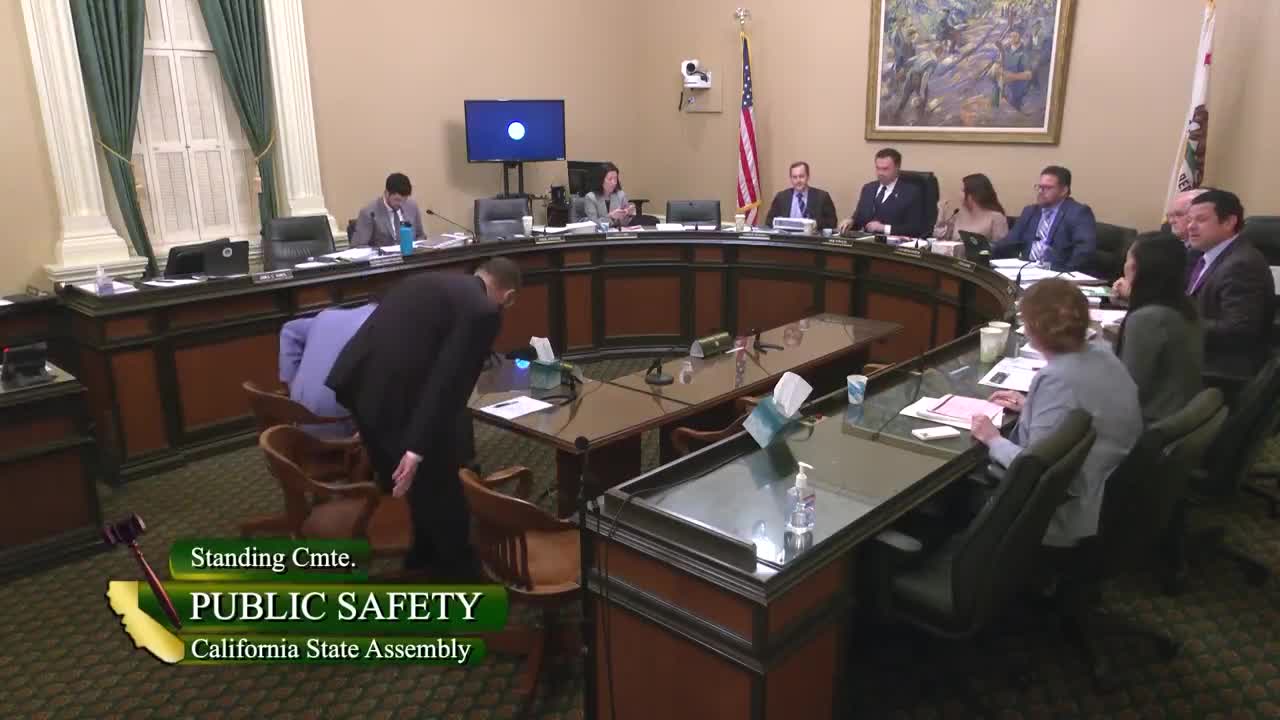 10MIN
Assembly Standing Committee on Public Safety
Bill Author

Bill Co-Author(s):