AB 1396: Crimes: sexual assault.
- Session Year: 2025-2026
- House: Assembly
- Latest Version Date: 2025-04-28
Current Status:
Failed
(2026-02-02: From committee: Filed with the Chief Clerk pursuant to Joint Rule 56.)
Introduced
In Committee
Awaiting First Chamber Vote
Passed First Chamber
In Committee
Awaiting Second Chamber Vote
Passed Second Chamber
Enacted
What does this bill do?
The bill makes it a felony punishable by 5, 7, or 9 years in state prison when a caretaker or other adult who has care or custody of a dependent person assaults that dependent with the intent to commit rape, sodomy, oral copulation, or other serious sexual offenses, and knows or should reasonably know the victim is dependent. A “dependent person” means someone who relies on others for care under existing law.
The summary is provided by generative AI which can make mistakes. For original language, please view the details in the table below.
Existing law provides that, except as specified, a person who assaults another with the intent to commit, among other things, mayhem, rape, sodomy, or oral copulation, shall be punished by imprisonment in the state prison for 2, 4, or 6 years. Existing law provides that a person who commits those offenses against a person under 18 years of age shall be punished by imprisonment for 5, 7, or 9 years.
This bill would additionally punish assault with the intent to commit those specified offenses when committed against a dependent person, as defined, by a caretaker or other adult who has care or custody of the dependent person, if the caretaker or other adult knows or should reasonably know that the victim is a dependent person, with imprisonment for 5, 7, or 9 years. By expanding the definition of a crime, this bill would impose a state-mandated local program.
The California Constitution requires the state to reimburse local agencies and school districts for certain costs mandated by the state. Statutory provisions establish procedures for making that reimbursement.
This bill would provide that no reimbursement is required by this act for a specified reason.
Existing law provides that, except as specified, a person who assaults another with the intent to commit, among other things, mayhem, rape, sodomy, or oral copulation, shall be punished by imprisonment in the state prison for 2, 4, or 6 years. Existing law provides that a person who commits those offenses against a person under 18 years of age shall be punished by imprisonment for 5, 7, or 9 years.
This bill would additionally punish assault with the intent to commit those specified offenses when committed against a dependent person, as defined, with imprisonment for 5, 7, or 9 years. By expanding the definition of a crime, this bill would impose a state-mandated local program.
The California Constitution requires the state to reimburse local agencies and school districts for certain costs mandated by the state. Statutory provisions establish procedures for making that reimbursement.
This bill would provide that no reimbursement is required by this act for a specified reason.
(a)(1)Except as provided in subdivision (b), any person who assaults another with intent to commit mayhem, rape, sodomy, oral copulation, or any violation of Section 264.1, 288, or 289 shall be punished by imprisonment in the state prison for two, four, or six years.
(2)Except as provided in subdivision (b), any person who assaults another person under 18 years of age, or a dependent person, age with the intent to commit rape, sodomy, oral copulation, or any violation of Section 264.1, 288, or 289 shall be punished by imprisonment in the state prison for five, seven, or nine years.
(3)Except as provided in subdivision (b), any person who is a caretaker or other adult who has care or custody of a dependent person who assaults that dependent person with the intent to commit rape, sodomy, oral copulation, or any violation of Section 264.1, 288, or 289 and who knows or should reasonably know that the victim is a dependent person shall be punished by imprisonment in the state prison for five, seven, or nine years.
(b)Any person who, in the commission of a burglary of the first degree, as defined in subdivision (a) of Section 460, assaults another with intent to commit rape, sodomy, oral copulation, or any violation of Section 264.1, 288, or 289 shall be punished by imprisonment in the state prison for life with the possibility of parole.
(c)For the purposes of subdivision (a), dependent person has the same meaning as in Section 288.
SEC. 2.No reimbursement is required by this act pursuant to Section 6 of Article XIIIB of the California Constitution because the only costs that may be incurred by a local agency or school district will be incurred because this act creates a new crime or infraction, eliminates a crime or infraction, or changes the penalty for a crime or infraction, within the meaning of Section 17556 of the Government Code, or changes the definition of a crime within the meaning of Section 6 of Article XIIIB of the California Constitution.
(a)(1)Except as provided in subdivision (b), any person who assaults another with intent to commit mayhem, rape, sodomy, oral copulation, or any violation of Section 264.1, 288, or 289 shall be punished by imprisonment in the state prison for two, four, or six years.
(2)Except as provided in subdivision (b), any person who assaults another person under 18 years of age age, or a dependent person, with the intent to commit rape, sodomy, oral copulation, or any violation of Section 264.1, 288, or 289 shall be punished by imprisonment in the state prison for five, seven, or nine years.
(b)Any person who, in the commission of a burglary of the first degree, as defined in subdivision (a) of Section 460, assaults another with intent to commit rape, sodomy, oral copulation, or any violation of Section 264.1, 288, or 289 shall be punished by imprisonment in the state prison for life with the possibility of parole.
(c)For the purposes of subdivision (a), dependent person has the same meaning as in Section 288.
SEC. 2.No reimbursement is required by this act pursuant to Section 6 of Article XIIIB of the California Constitution because the only costs that may be incurred by a local agency or school district will be incurred because this act creates a new crime or infraction, eliminates a crime or infraction, or changes the penalty for a crime or infraction, within the meaning of Section 17556 of the Government Code, or changes the definition of a crime within the meaning of Section 6 of Article XIIIB of the California Constitution.
|
Date
|
Status
|
|---|---|
| Feb 2, 2026 | From committee: Filed with the Chief Clerk pursuant to Joint Rule 56. |
| Jan 31, 2026 | Died pursuant to Art. IV, Sec. 10(c) of the Constitution. |
| May 23, 2025 | In committee: Held under submission. |
| May 7, 2025 | In committee: Set, first hearing. Referred to APPR. suspense file. |
| Apr 29, 2025 | Re-referred to Com. on APPR. |
| Apr 28, 2025 | Read second time and amended. |
| Apr 24, 2025 | From committee: Amend, and do pass as amended and re-refer to Com. on APPR. (Ayes 9. Noes 0.) (April 22). |
| Mar 13, 2025 | Referred to Com. on PUB. S. |
| Feb 24, 2025 | Read first time. |
| Feb 22, 2025 | From printer. May be heard in committee March 24. |
| Feb 21, 2025 | Introduced. To print. |
|
Date
|
Description
|
Location
|
Votes
|
|
|---|---|---|---|---|
| Apr 22, 2025 | Do pass as amended and be re-referred to the Committee on [Appropriations] | Assembly Standing Committee on Public Safety |
Passed |
This list shows positions taken on this bill by organizations on the date displayed, which is linked to the original source.
Positions by individuals are not included.
|
Organization
|
Position
|
Date
|
|---|---|---|
| Aclu California Action | ** Against | |
| All of Us or None Los Angeles | ** Against | |
| Arcadia Police Officers' Association | ** Support | |
| Brea Police Association | ** Support | |
| Burbank Police Officers' Association | ** Support | |
| California Association of School Police Chiefs | ** Support | |
| California Coalition of School Safety Professionals | ** Support | |
| California District Attorneys Association | ** Support | |
| California Narcotic Officers' Association | ** Support | |
| California Police Chiefs Association | ** Support | |
| California Public Defenders Association | ** Against | |
| California Reserve Peace Officers Association | ** Support | |
| California State Sheriffs' Association | ** Support | |
| Californians United for a Responsible Budget | ** Against | |
| CLAREMONT POLICE OFFICERS ASSOCIATION | ** Support | |
| Corona Police Officers Association | ** Support | |
| Crime Victims United Of California | ** Support | |
| Culver City Police Officers' Association | ** Support | |
| Ella Baker Center For Human Rights | ** Against | |
| Fullerton Police Officers' Association | ** Support | |
| Initiate Justice | ** Against | |
| Initiate Justice Action | ** Against | |
| LA Defensa | ** Against | |
| Legal Services for Prisoners with Children | ** Against | |
| Local 148 La County Public Defenders Union | ** Against | |
| Los Angeles School Police Management Association | ** Support | |
| los angeles school police officers association | ** Support | |
| Murrieta Police Officers' Association | ** Support | |
| Newport Beach Police Association | ** Support | |
| Palos Verdes Police Officers Association | ** Support | |
| PLACER COUNTY DEPUTY SHERIFFS ASSOCIATION | ** Support | |
| Pomona Police Officers' Association | ** Support | |
| RIVERSIDE POLICE OFFICERS ASSOCIATION | ** Support | |
| Riverside Sheriffs' Association | ** Support | |
| San Francisco Public Defender | ** Against | |
| Santa Ana Police Officers Association | ** Support | |
| Smart Justice California, a project of Tides Advocacy | ** Against |
Date of Hearing: May 7, 2025
ASSEMBLY COMMITTEE ON APPROPRIATIONS
Buffy Wicks, Chair
ABPCA Bill Id:AB 1396
Author:(Macedo) – As Amended Ver:April 28, 2025
Policy Committee: | Public Safety | Vote: | 9 - 0 |
|
| ||
|
|
Urgency: No State Mandated Local Program: Yes Reimbursable: No
SUMMARY:
This bill increases, to five, seven, or nine years in prison, the punishment for a defendant convicted of assault with intent to commit a sex crime against a dependent adult victim if the defendant was a caretaker or had care or custody of the dependent adult victim.
FISCAL EFFECT:
Costs (General Fund) to the California Department of Corrections and Rehabilitation (CDCR) to incarcerate affected defendants for longer periods of time. Actual incarceration costs will depend on the number of convictions and the length of each sentence. The annual incidence of convictions for assault with intent to commit a sex offense where the victim is a dependent adult is unknown. Data from CDCR shows 53 new felony admissions in 2024 for which assault with intent to commit mayhem or a sex offense was the primary offense. The Legislative Analyst’s Office estimates the average annual cost to incarcerate one person in state prison is $133,000. If this bill results in higher sentences for five new defendants, and each defendant must serve an additional two years in prison, the additional incarceration cost to CDCR for this bill would be approximately $1.3 million.
COMMENTS:
- Background. Under existing law, assault with intent to commit rape, sodomy, oral copulation, or other specified sex offenses is a felony punishable by two, four, or six years in prison. This bill increases the punishment to five, seven, or nine years in prison if the defendant was a caregiver or otherwise had care or custody of the dependent adult victim, and the defendant knew or should have known the victim is a dependent person. This bill aligns the punishment for this offense with the existing punishment for assault on a minor with intent to commit a sex offense, which is already punishable by five, seven, or nine years in prison.
Research shows that lengthy criminal sentences, which are costly to state and local governments, do not effectively deter crime. In general, the certainty that someone will be punished for an offense plays a larger role in deterring their criminal activity, rather than the length of their potential punishment.
- Support and Opposition. In support of this bill, the California District Attorneys Association writes:
[T]he current law already takes into consideration the increased egregiousness of crimes committed against minors, ensuring that sexual assaults against minors are met with stricter penalties. However, the law does not similarly reflect the vulnerability of dependent adults, who, like minors, are often unable to fully protect themselves due to physical or mental limitations. Dependent adults, many of whom are elderly or living with disabilities, are just as vulnerable to exploitation and abuse as children, and their protection under the law should be equally prioritized.
In opposition, Smart Justice California writes:
Existing law already imposes significant sentences for the crime of sexual assault, including sexual assault that occurs against dependent persons. Sexual assault is a felony that is punishable by 2, 4, or 6 years in state prison. Existing law also includes a wide range of additional charges and enhancements that can be applied to further increase punishment. For example, under Penal Code section 288(b)(2), a caretaker who committee lewd acts on a dependent person faces up to ten years in prison. Current law already recognizes the harm of sexual assault against dependent persons and treats it with an appropriate level of seriousness. Increased penalties will not provide any additional public safety for dependent persons.
Analysis Prepared by: Annika Carlson / APPR. / (916) 319-2081
Date of Hearing:
Deputy Chief Counsel: Stella Choe
ASSEMBLY COMMITTEE ON PUBLIC SAFETY
Nick Schultz, Chair
ABPCA Bill Id:AB 1396
Author:(Macedo) – As Introduced Ver:February 21, 2025
As Proposed to be Amended in Committee
SUMMARY:
Increases the penalty for the crime of assault with intent to commit specified sex crimes when committed against a dependent person if committed by a caretaker or other adult who has care or custody of the dependent person, as defined. Specifically, this bill:
- Increases, from 2, 4, or 6 years in state prison, to 5, 7, or 9 years in state prison, the punishment for assault with intent to commit rape, sodomy, oral copulation, or any violation of acting in concert with another person to commit rape or sexual penetration, lewd and lascivious act on a minor or a dependent person, or sexual penetration when committed against a dependent person by a caretaker or other adult who has care or custody of the dependent person and who knows or should have known that the victim is a dependent person..
- Defines “dependent person” to mean a person, regardless of whether the person lives independently, who has a physical or mental impairment that substantially restricts their ability to carry out normal activities or to protect their rights, including, but not limited to, persons who have physical or developmental disabilities or whose physical or mental abilities have significantly diminished because of age. The term also includes a person who is admitted as an inpatient to a 24-hour health facility, as defined.
EXISTING LAW:
- States, except as provided, any person who assaults another with intent to commit mayhem, rape, sodomy, oral copulation, or any violation of acting in concert with another person to commit rape or sexual penetration, lewd and lascivious acts on a minor or a dependent person, or sexual penetration shall be punished by imprisonment in the state prison for 2, 4, or 6 years. (Pen. Code, § 220, subd. (a).)
- States, except as provided, that any person who assaults another person under 18 years of age with the intent to commit rape, sodomy, oral copulation, or any violation of acting in concert with another person to commit rape or sexual penetration, lewd and lascivious acts on a minor or a dependent person, or sexual penetration shall be punished by imprisonment in the state prison for 5, 7 or 9 years. (Pen. Code, § 220, subd. (b).)
- Provides that any person who, in the commission of a burglary of the first degree, assaults another with intent to commit rape, sodomy, oral copulation, or any violation of acting in concert with another person to commit rape or sexual penetration, lewd and lascivious acts on a minor or a dependent person, or sexual penetration shall be punished by imprisonment in the state prison for life with the possibility of parole. (Pen. Code, § 220, subd. (a).)
- States that a person who willfully and lewdly commits any lewd or lascivious act upon or with the body or part of the party of a child who is under the age of 14, with the intent of arousing, appealing to, or gratifying the lust, passions, or sexual desires of that person or the child, is guilty of a felony and shall by imprisonment in the state prison for 3, 6, or 8 years. (Pen. Code, § 288, subd. (a).)
- States that a person who commits a lewd and lascivious act on a child who is under 14 as described above but uses force, violence, duress, menace, or fear of immediate and unlawful bodily injury on the victim or another person with intent of arousing, appealing to, or gratifying the lust, passions, or sexual desires of that person or the child, is guilty of a felony and shall be punished by imprisonment in the state prison for 5, 8, or 10 years. (Pen. Code, § 288, subd. (b)(1).)
- States that a person who is a caretaker, as defined, and commits a lewd and lascivious act as described above upon a dependent person, as defined, by use of force, violence, duress, menace, or fear of immediate and unlawful bodily injury on the victim or another person, with the intent of arousing, appealing to, or gratifying the lust, passions, or sexual desires of that person or the dependent person is guilty of a felony and shall be punished by imprisonment in the state prison for 5, 8, or 10 years. (Pen. Code, § 288, subd. (b)(2).)
- Defines “dependent person” for purposes of the lewd and lascivious acts on a minor or dependent person statute to mean a person, regardless of whether the person lives independently, who has a physical or mental impairment that substantially restricts his or her ability to carry out normal activities or to protect his or her rights, including, but not limited to, persons who have physical or developmental disabilities or whose physical or mental abilities have significantly diminished because of age. “Dependent person” includes a person who is admitted as an inpatient to a 24-hour health facility, as defined. (Pen. Code, § 288, subd. (f)(3).)
- Defines “caretaker” for purposes of the lewd and lascivious acts on a minor or dependent person statute to mean an owner, operator, administrator, employee, independent contractor, agent, or volunteer of specified public or private facilities when the facilities provide care for elder or dependent persons, including, among other types of facilities, 24-hour health facilities, secondary schools and postsecondary educational institutions, community care facilities, board and care facilities, home health agencies, foster homes and private residences. (Pen. Code, § 288, subd. (f)(1)-(2).)
FISCAL EFFECT:
Unknown
COMMENTS:
- Author's Statement: According to the author, "Dependent individuals are defenseless against predators. It’s our duty to protect them. Assembly Bill 1396 is an important step in the right direction in protecting dependent people – individuals with mental or physical disabilities, seniors with diminished capacity, and others who cannot defend themselves—who are particularly susceptible to sexual assault and other heinous crimes. This bill will make predators who harm the most vulnerable face the consequences.”
- Assault with Intent to Commit Specified Crimes: The crime of assault with intent to commit rape is an aggravated form of attempted rape. (People v. Kimball (1953) 122 Cal.App.2d 211, 264.) The crime requires an assault accompanied by the specific intent to commit the act of forcible rape. The intent must be to have intercourse against the victim's will. It is not enough to prove merely a purpose to have intercourse. (People v. May (1989) 213 Cal.App.3d 118, 128.)
The law punishing this conduct was enacted in 1872 and was later amended several times to change the penalty from indeterminate sentence to a determinate sentence and to add eligible crimes. In 2006, the Legislature passed Sex Offender Punishment, Control, and Containment Act that, among other things, provided that the punishment for assaulting another person with intent to commit several specified sex acts while in the commission of a first degree burglary is imprisonment for life with the possibility of parole. (SB 1128 (Alquist) Ch. 337, Stats. 2006.) That same year, voters approved Proposition 83, known as Jessica’s Law which, among other things also provided that punishment for assaulting another person with intent to commit several specified sex acts while in the commission of a first degree burglary is imprisonment for life with the possibility of parole. In 2010, the Legislature enacted the Chelsea King Child Predator Prevention Act which, among other things, made assault with intent to commit specified sex crimes on a person under 18 years of age punishable by imprisonment in state prison for 5, 7, or 9 years. (AB 1844 (Fletcher) Ch. 219, Stats. 2010.)
The jury instructions for the crime of assault with intent to commit specified sex crimes requires the prosecution to prove the following elements (CALCRIM No. 890):
- The defendant did an act that by its nature would directly and probably result in the application of force to a person;
- The defendant did that act willfully;
- When the defendant acted, (he/she) was aware of facts that would lead a reasonable person to realize that (his/her) act by its nature would directly and probably result in the application of force to someone;
- When the defendant acted, (he/she) had the present ability to apply force to a person; and,
- When the defendant acted, (he/she) intended to commit (insert crime specified).
This bill increases the punishment for assault with intent to commit specified sex crimes when committed on an adult dependent person, as defined, by a caretaker or other adult who has care or custody of the dependent person and who knows or should reasonably know that the victim is a dependent person, to match the punishment for the crime when committed against a minor.
- Longer Sentences’ Impact on Recidivism and Deterrence: Research shows that increasing the severity of the punishment does little to deter the crime.[1] According to the National Institute of Justice, “Laws and policies designed to deter crime by focusing mainly on increasing the severity of punishment are ineffective partly because criminals know little about the sanctions for specific crimes. More severe punishments do not ‘chasten’ individuals convicted of crimes, and prisons may exacerbate recidivism… Studies show that for most individuals convicted of a crime, short to moderate prison sentences may be a deterrent but longer prison terms produce only a limited deterrent effect.”[2] Rather, increasing the perception that an individual will be caught and prosecuted is a vastly more effective deterrent than increased punishment. Studies also show that custodial sanctions have no effect on recidivism or slightly increase it when compared with the effects of noncustodial sanctions such as probation.[3]
- Argument in Support: According to California District Attorneys Association, “As you are aware, the current law already takes into consideration the increased egregiousness of crimes committed against minors, ensuring that sexual assaults against minors are met with stricter penalties. However, the law does not similarly reflect the vulnerability of dependent adults, who, like minors, are often unable to fully protect themselves due to physical or mental limitations. Dependent adults, many of whom are elderly or living with disabilities, are just as vulnerable to exploitation and abuse as children, and their protection under the law should be equally prioritized. By giving the same penalties for sexual assaults against dependent adults as those for crimes committed against minors, this bill would ensure that individuals who commit such heinous acts against dependent adults face appropriate and significant consequences.”
- Argument in Opposition: According to Smart Justice California, “Existing law already imposes significant sentences for the crime of sexual assault, including sexual assault that occurs against dependent persons. Sexual assault is a felony that is punishable by 2, 4, or 6 years in state prison. Existing law also includes a wide range of additional charges and enhancements that can be applied to further increase punishment. For example, under Penal Code section 288(b)(2), a caretaker who committee lewd acts on a dependent person faces up to ten years in prison.
“Current law already recognizes the harm of sexual assault against dependent persons and treats it with an appropriate level of seriousness. Increased penalties will not provide any additional public safety for dependent persons.”
- Related Legislation: None
- Prior Legislation:
- AB 329 (Cervantes), of the 2017-2018 Legislative Session, would make it a felony for a person to willfully cause or permit any elder or dependent adult to suffer or inflict thereon unjustifiable physical pain or mental suffering and expand the definition of “dependent adult.” AB 329 was never heard by committee.
- AB 1844 (Fletcher), Chapter 219, Statutes of 2010, among other things, increased the punishment for assault with intent to commit specified sex crimes on a person under 18 years of age.
- SB 1128 (Alquist), Chapter 337, Statutes of 2006, among other things, provided that punishment for assaulting another person with intent to commit specified sex acts while in the commission of a first degree burglary is imprisonment for life with the possibility of parole.
REGISTERED SUPPORT / OPPOSITION:
Support
Arcadia Police Officers' Association
Brea Police Association
Burbank Police Officers' Association
California Association of School Police Chiefs
California Coalition of School Safety Professionals
California District Attorneys Association
California Narcotic Officers' Association
California Police Chiefs Association
California Reserve Peace Officers Association
California State Sheriffs' Association
Claremont Police Officers Association
Corona Police Officers Association
Crime Victims United of California
Culver City Police Officers' Association
Fullerton Police Officers' Association
Los Angeles School Police Management Association
Los Angeles School Police Officers Association
Murrieta Police Officers' Association
Newport Beach Police Association
Palos Verdes Police Officers Association
Placer County Deputy Sheriffs' Association
Pomona Police Officers' Association
Riverside Police Officers Association
Riverside Sheriffs' Association
Santa Ana Police Officers Association
Oppose
ACLU California Action
All of Us or None Los Angeles
California Public Defenders Association (CPDA)
Californians United for A Responsible Budget
Ella Baker Center for Human Rights
Initiate Justice
Initiate Justice Action
LA Defensa
Legal Services for Prisoners With Children
Local 148 LA County Public Defenders Union
San Francisco Public Defender
Smart Justice California, a Project of Tides Advocacy
Analysis Prepared by:
Stella Choe / PUB. S. / (916) 319-3744
National Institute of Justice, Five Things about Deterrence <https://www.ojp.gov/pdffiles1/nij/247350.pdf> [accessed Apr. 14, 2025]. ↑
Ibid. ↑
D.M. Petrich, et al., Custodial Sanctions and Reoffending: A Meta-Analytic Review (2021). ↑
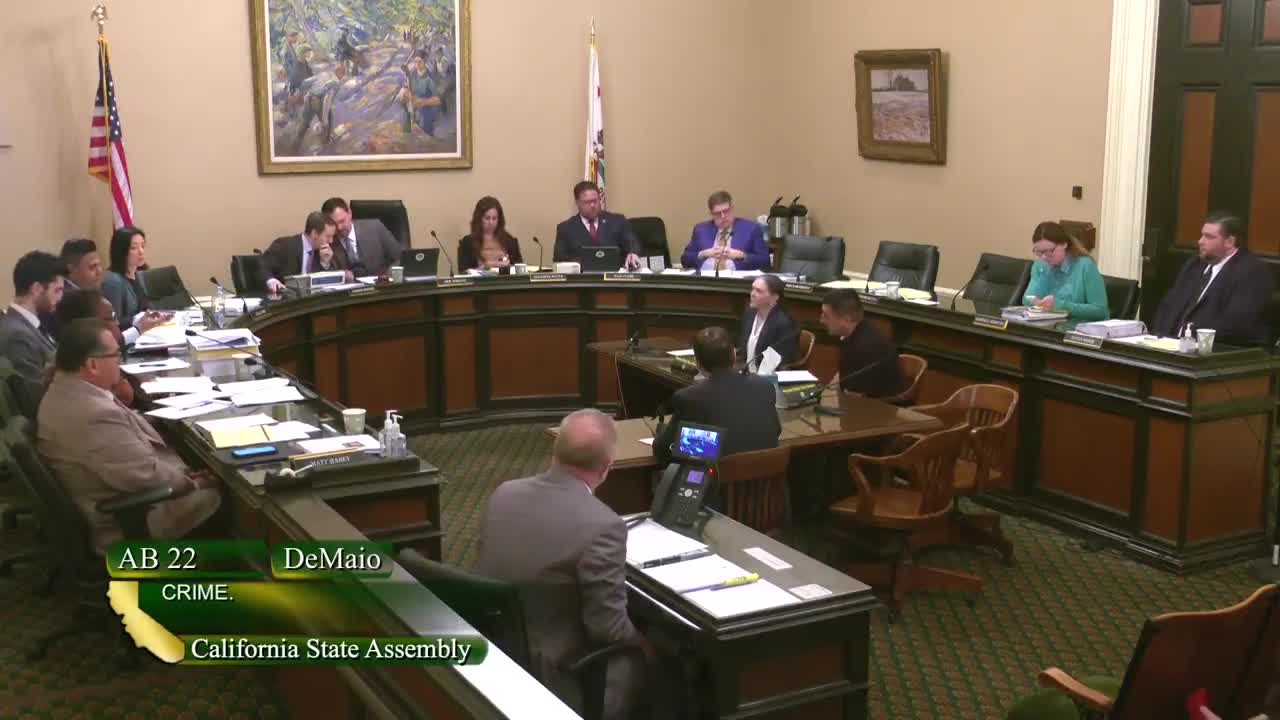
Discussed in Hearing
 23MIN
Assembly Standing Committee on Public Safety
Bill Author

Bill Co-Author(s):