AB 1489: Peace officers.
- Session Year: 2025-2026
- House: Assembly
- Latest Version Date: 2025-04-22
Current Status:
Failed
(2026-02-02: From committee: Filed with the Chief Clerk pursuant to Joint Rule 56.)
Introduced
In Committee
Awaiting First Chamber Vote
Passed First Chamber
In Committee
Awaiting Second Chamber Vote
Passed Second Chamber
Enacted
What does this bill do?
The bill requires law enforcement agencies that employ peace officers (police officers and others with arrest powers) to have a policy banning those officers from carrying any firearm if they have any alcohol in their system — a blood alcohol concentration above 0.00% — whether on or off duty. It defines “carry” as having direct physical control of a gun, including a holstered weapon attached to the person, and exempts officers who are on duty and working undercover.
The summary is provided by generative AI which can make mistakes. For original language, please view the details in the table below.
Existing law defines persons who are peace officers and the entities authorized to appoint them. Existing law prescribes certain minimum standards for a person to be appointed as a peace officer, including moral character and physical and mental condition, and certain disqualifying factors for a person to be employed as a peace officer, including a felony conviction.
This bill would require a law enforcement agency that issues a firearm to a peace officer it employs that employs a peace officer to have a policy prohibiting that officer from carrying the firearm issued by the agency with any firearm when the officer has a blood alcohol concentration greater than 0.00%, whether the officer is on duty or off duty. duty, unless the officer is on duty and engaged in an undercover assignment in the course of their employment as a peace officer. By imposing new duties on local law enforcement, the bill would impose a state-mandated local program.
The California Constitution requires the state to reimburse local agencies and school districts for certain costs mandated by the state. Statutory provisions establish procedures for making that reimbursement.
This bill would provide that, if the Commission on State Mandates determines that the bill contains costs mandated by the state, reimbursement for those costs shall be made pursuant to the statutory provisions noted above.
Existing law defines persons who are peace officers and the entities authorized to appoint them. Existing law prescribes certain minimum standards for a person to be appointed as a peace officer, including moral character and physical and mental condition, and certain disqualifying factors for a person to be employed as a peace officer, including a felony conviction.
This bill would require a law enforcement agency that issues a firearm to a peace officer it employs to have a policy prohibiting that officer from carrying the firearm issued by the agency with a blood alcohol concentration greater than 0.00%, whether the officer is on duty or off duty. By imposing new duties on local law enforcement, the bill would impose a state-mandated local program.
The California Constitution requires the state to reimburse local agencies and school districts for certain costs mandated by the state. Statutory provisions establish procedures for making that reimbursement.
This bill would provide that, if the Commission on State Mandates determines that the bill contains costs mandated by the state, reimbursement for those costs shall be made pursuant to the statutory provisions noted above.
(a)As used in this section, carry means to have direct physical control of or be physically connected to a firearm, including, but not limited to, when it is in a holster and that hostler holster is affixed to an individuals person.
(b)A law enforcement agency that issues a firearm to a peace officer it employs a peace officer shall have a policy prohibiting that peace officer from carrying the firearm issued by the agency with a firearm when the officer has a blood alcohol concentration greater than 0.00 percent, whether the officer is on duty or off duty.
(c)This section does not apply to an officer who is on duty and engaged in an undercover assignment in the course of their employment as a peace officer.
SEC. 2.If the Commission on State Mandates determines that this act contains costs mandated by the state, reimbursement to local agencies and school districts for those costs shall be made pursuant to Part 7 (commencing with Section 17500) of Division 4 of Title 2 of the Government Code.
(a)As used in this section, carry means to have direct physical control of or be physically connected to a firearm, including, but not limited to, when it is in a holster and that hostler is affixed to an individuals person.
(b)A law enforcement agency that issues a firearm to a peace officer it employs shall have a policy prohibiting that peace officer from carrying the firearm issued by the agency with a blood alcohol concentration greater than 0.00 percent, whether the officer is on duty or off duty.
SEC. 2.If the Commission on State Mandates determines that this act contains costs mandated by the state, reimbursement to local agencies and school districts for those costs shall be made pursuant to Part 7 (commencing with Section 17500) of Division 4 of Title 2 of the Government Code.
|
Date
|
Status
|
|---|---|
| Feb 2, 2026 | From committee: Filed with the Chief Clerk pursuant to Joint Rule 56. |
| Jan 31, 2026 | Died pursuant to Art. IV, Sec. 10(c) of the Constitution. |
| May 23, 2025 | In committee: Held under submission. |
| May 7, 2025 | In committee: Set, first hearing. Referred to APPR. suspense file. |
| Apr 30, 2025 | From committee: Do pass and re-refer to Com. on APPR. (Ayes 5. Noes 1.) (April 29). Re-referred to Com. on APPR. |
| Apr 23, 2025 | Re-referred to Com. on PUB. S. |
| Apr 22, 2025 | From committee chair, with author's amendments: Amend, and re-refer to Com. on PUB. S. Read second time and amended. |
| Apr 22, 2025 | In committee: Set, first hearing. Hearing canceled at the request of author. |
| Mar 13, 2025 | Referred to Com. on PUB. S. |
| Feb 24, 2025 | Read first time. |
| Feb 22, 2025 | From printer. May be heard in committee March 24. |
| Feb 21, 2025 | Introduced. To print. |
|
Date
|
Description
|
Location
|
Votes
|
|
|---|---|---|---|---|
| Apr 29, 2025 | Do pass and be re-referred to the Committee on [Appropriations] | Assembly Standing Committee on Public Safety |
Passed |
This list shows positions taken on this bill by organizations on the date displayed, which is linked to the original source.
Positions by individuals are not included.
|
Organization
|
Position
|
Date
|
|---|---|---|
| Association Of Orange County Deputy Sheriffs | ** Against | |
| Brady California | ** Support | |
| Brady Campaign | ** Support | |
| California Association Of Highway Patrolmen | ** Against | |
| California Fraternal Order of Police | ** Against | |
| California Public Defenders Association | ** Support | |
| California Statewide Law Enforcement Association | ** Against | |
| Californians United for a Responsible Budget | ** Support | |
| Communities United for Restorative Youth Justice | ** Support | |
| Courage California | ** Support | |
| Everytown for Gun Safety Action Fund | ** Support | |
| Giffords Law Center To Prevent Gun Violence | ** Support | |
| Initiate Justice | ** Support | |
| Initiate Justice Action | ** Support | |
| Justice2jobs Coalition | ** Support | |
| LA Defensa | ** Support | |
| Long Beach Police Officers Association | ** Against | |
| Los Angeles Police Protective League | ** Against | |
| Moms Demand Action for Gun Sense in America | ** Support | |
| Peace Officers Research Association Of California | ** Against | |
| Prc Baker Places / Black Leadership Council | ** Support | |
| PRC/Black Leadership Council | ** Support | |
| Rubicon Programs | ** Support | |
| sacramento county deputy sheriff's association | ** Against | |
| Sheriff's Employee Benefits Association | ** Against | |
| Students Demand Action for Gun Sense in America | ** Support |
Date of Hearing: May 7, 2025
ASSEMBLY COMMITTEE ON APPROPRIATIONS
Buffy Wicks, Chair
ABPCA Bill Id:AB 1489
Author:(Bryan) – As Amended Ver:April 22, 2025
Policy Committee: | Public Safety | Vote: | 5 - 1 |
|
| ||
|
|
Urgency: No State Mandated Local Program: Yes Reimbursable: Yes
SUMMARY:
This bill requires a law enforcement agency (LEA) that employs peace officers to have a policy prohibiting a peace officer from carrying a firearm when the officer has a blood alcohol concentration (BAC) greater than 0.00 percent, whether the officer is on duty or off duty.
The bill exempts an officer who is on duty and engaged in an undercover assignment in the course of their employment as a peace officer.
FISCAL EFFECT:
Potentially significant costs to LEAs to update policies and procedures in compliance with the bill. There are multiple state LEAs, 58 sheriff’s offices, and hundreds of police departments in California. Costs to each individual agency may be relatively minor, but in the aggregate, costs may be in the hundreds of thousands of dollars statewide. Any state LEA costs will be paid by the General Fund or relevant special fund. The state must reimburse local LEA costs from the General Fund if the Commission on State Mandates determines the duties imposed by this bill constitute a reimbursable state mandate.
COMMENTS:
Generally, each LEA may set its own policy governing a peace officer’s use of alcohol while on duty or while carrying a firearm. According to the author of this bill:
There is no standardized and consistent policy prohibiting police officers from carrying firearms while consuming alcohol, creating significant risks to public safety and law enforcement accountability. Los Angeles Police Department (LAPD) have only partially addressed the issue by lowering the legal blood-alcohol limit for armed officers from 0.08% to 0.04%. Unfortunately, this approach does not fully prevent firearm-related incidents, as seen in multiple cases where officers used their weapons while under the influence, leading to harmful consequences, internal investigations, and erosion of public trust.
Some LEAs have policies that prohibit an officer from consuming alcohol or being under the influence of alcohol while wearing their uniform or carrying a firearm. Others have policies that specify a BAC above which an officer may not carry a firearm. This bill requires each LEA in the state that employs peace officers to adopt a policy prohibiting an officer from carrying a firearm when the officer’s BAC is above 0.00, regardless of whether the officer is on duty or not. As noted in the analysis of this bill by the Assembly Committee on Public Safety, the bill’s restraint on an officer’s ability to carry a firearm while off duty may not be constitutional. In 2022, the U.S. Supreme Court held that a court should uphold a restriction on someone’s right to bear arms only if there is a tradition of similar regulation in U.S. history. (NYSRPA v. Bruen (2022) 142 S.Ct. 2111.) The Supreme Court refined the Bruen standard somewhat in its 2024 decision in U.S. v. Rahimi (2024) 602 S.Ct. 680, but the court’s approach to firearms restrictions remains uncertain.
Analysis Prepared by: Annika Carlson / APPR. / (916) 319-2081
Date of Hearing:
Counsel: Kimberly Horiuchi
ASSEMBLY COMMITTEE ON PUBLIC SAFETY
Nick Schultz, Chair
ABPCA Bill Id:AB 1489
Author:(Bryan) – As Amended Ver:April 22, 2025
SUMMARY:
Requires a law enforcement agency that issues a firearm to have a policy prohibiting a peace officer from carrying a firearm on or off duty, if their blood alcohol concentration is greater than 0.0 percent. Specifically, this bill:
- Defines “carry” as having direct physical control of, or be physically connected to a firearm, including, but not limited to, when it is in a holster and that hostler is affixed to an individual’s person.
- States the requirement that an officer not have a BAC greater than 0.0 percent does not apply to an undercover officer on duty in the course of their employment.
EXISTING LAW:
- Requires, commencing January 1, 2020, the Commission on Peace Officer Standards and Training (POST) and each local law enforcement agency to conspicuously post on their Internet Web sites all current standards, policies, practices, operating procedures, and education and training materials that would otherwise be available to the public if a request was made pursuant to the California Public Records Act. (Pen. Code, § 13650.)
- Allows a person who is a peace officer or a custodial officer, as defined, if authorized by and under the terms and conditions as are specified by the person’s employing agency, to purchase, possess, or transport any less lethal weapon or ammunition for any less lethal weapon, for official use in the discharge of the person’s duties. (Pen. Code, § 19400.)
- Allows a person who is a peace officer or a custodial officer, as defined, if authorized by and under the terms and conditions as are specified by the person’s employing agency, to purchase, possess, or transport firearms. (Pen. Code, §§ 830.3 - 831.6.)
- Requires each law enforcement agency to maintain a policy that provides a minimum standard on the use of force which shall include comprehensive and specific guidelines regarding approved methods and devices available for the application of force. (Gov. Code, § 7286, subd. (b).)
- Requires peace officer and custodial officers, as defined, who are permitted to carry firearms to satisfactorily complete the training course prescribed by POST prior to being assigned to perform their duties. (Pen. Code, §§ 830.3 - 831.6.)
- States it is unlawful for an employer to discriminate against a person in hiring, termination, or any term or condition of employment, or otherwise penalizing a person, if the discrimination is based upon any of the following:
- The person’s use of cannabis off the job and away from the workplace.
- This prohibition does not prohibit an employer from discriminating in hiring, or any term or condition of employment, or otherwise penalize a person based on scientifically valid pre-employment drug screening conducted through methods that do not screen for non-psychoactive cannabis metabolites.
- An employer-required drug screening test that has found the person to have non-psychoactive cannabis metabolites in their hair, blood, urine, or other bodily fluids. (Gov. Code, § 12954, subd. (a)(1)(A)-(B).)
- The person’s use of cannabis off the job and away from the workplace.
- Prohibits discrimination based on a person’s use of cannabis off the job and away from the workplace unless the employer is permitted to consider or inquire about that information, as specified. (Gov. Code, § 12954, subd. (c).)
- States this prohibition does not permit an employee to possess, to be impaired by, or to use, cannabis on the job, or affect the rights or obligations of an employer to maintain a drug- and alcohol-free workplace, as specified in existing law. (Gov. Code, § 12954, subd. (d).)
- Specifies if the definition of “disability” used in the federal Americans with Disabilities Act of 1990 would result in broader protection of the civil rights of individuals with a mental disability or physical disability, as defined, or would include any medical condition not included within those definitions, then that broader protection or coverage shall be deemed incorporated by reference into, and shall prevail over conflicting provisions, as specified. (Gov. Code, § 12926, subd. (n).)
FISCAL EFFECT:
Unknown
COMMENTS:
- Author's Statement: According to the author, “There is no standardized and consistent policy prohibiting police officers from carrying firearms while consuming alcohol, creating significant risks to public safety and law enforcement accountability. Los Angeles Police Department (LAPD) have only partially addressed the issue by lowering the legal blood-alcohol limit for armed officers from 0.08% to 0.04%. Unfortunately, this approach does not fully prevent firearm-related incidents, as seen in multiple cases where officers used their weapons while under the influence, leading to harmful consequences, internal investigations, and erosion of public trust.
“AB 1489 addresses the absence of a standardized policy by mandating all law enforcement agencies to implement a policy prohibiting officers—on or off duty—from carrying their firearms while consuming alcohol. By closing this dangerous loophole, the bill ensures that officers abide by clear, enforceable guidelines that protect both themselves and the communities they serve. National firearm safety organizations, including the NRA, emphasize that alcohol should never be used while handling weapons. Yet police officers, entrusted with public safety, currently operate without a universal prohibition. AB 1489 will align law enforcement practices with fundamental firearm safety principles, preventing tragic, avoidable incidents and reinforcing trust and accountability between law enforcement and the public.”
- Existing Policies: Cities in California vary regarding whether an officer may consume alcohol while in possession of a firearm. San Francisco Police Department General Order 2.02 prohibits any officer from consuming alcohol, being impaired or being under the influence of alcohol while carrying any firearm. (See SFPD General Order 2.02.03, subd. (D).) The City of Los Angeles recently changed its policy regarding consumption of alcohol when handling firearms in 2023. LAPD Manual, section 610.93 states “Sworn personnel carrying or handling any firearm while off-duty shall not consume alcoholic beverages to the extent in which it causes impairment. In addition, sworn personnel shall not be impaired when carrying or handling any firearm. For the evaluation of impairment, only those personnel who exhibit objective symptoms of being under the influence of alcohol, or where there is a reasonable and articulable suspicion that the employee has consumed an alcoholic beverage shall be required to submit to testing.”
The Los Angeles County Sheriff’s Department only prohibits consumption of alcohol while on duty, in uniform, or at a Department-sponsored or related event. (LASD Manual, 3-01/030.40 - Use of Alcohol). The City of Sacramento is similar to Los Angeles in that it prohibits carrying a firearm on or off duty when impaired due to being under the influence of alcohol, medication, or other substance. (See SPD General Order 210.04, General and Professional Conduct, subd. (H)(1)(e).)
This bill would set a state standard that prohibits consumption of alcohol at all while carrying a firearm. A total of 15 states prohibit police officers or any other person from possessing a firearm in an establishment that serves alcohol.[1] However, most states do not prohibit law enforcement officers from consuming alcohol at all when carrying a firearm off duty.
- Law Enforcement Officers Safety Act of 2004: When a police officer is off duty, it is likely, if they carry a firearm, they carry it in a concealed fashion, since they are not wearing their uniform. However, federal law allows qualified law enforcement to conceal carry in all fifty states. The FBI Law Enforcement Bulletin, acknowledged as much in 2011, in describing the Law Enforcement Officers Safety Act:[2]
The Law Enforcement officers Safety Act of 2004 (LEOSA) allows officers to carry concealed weapons not only in their jurisdictions but in all 50 states, and the territories of the United States, provided certain conditions are met. (18 U.S.C. § 926 B and C.) On July 22, 2004, President George W. Bush signed into law H.R. 218, which created a general nationwide recognition that the public is better served by allowing law enforcement officers to carry their firearms outside of their jurisdictions whether they are on or off duty. The theory behind LEOSA was recognized among a number of states. That is, law enforcement officers retain their identity, training, experience, and dedication to the safety and welfare of the community regardless of whether they are on duty in their employer’s jurisdiction, going home to another community, or merely traveling for leisure purposes. However, LEOSA creates a limited privilege to carry concealed weapons for law enforcement officers, not a right to bear arms.
LEOSA applies to qualified active duty and retired officers. Qualification under LEOSA requires employment by or retirement from a local, state, or federal law enforcement agency as someone charged with the ability to investigate, prosecute, and arrest people for violations of law.
If an agency has firearms proficiency standards, the officer must meet them to qualify to carry. The statute also prohibits carrying firearms when under the influence of alcohol or any intoxicating or hallucinatory substance. (See 18 U.S.C. § 926C(c)(6).) If a current or retired officer is prohibited by federal law from possessing a firearm, they are not qualified to carry one under this legislation. It also is important to note that if an officer is under a disciplinary action that may result in suspension or termination by their agency, they are not qualified to carry under the LEOSA. Qualified retired officers must have retired in good standing for reasons other than mental instability and served at least an aggregate of 15 years.
- Practical Considerations: Prohibiting any law enforcement officer from consuming any alcohol while carrying a firearm may create employment and discipline issues in enforcement. If an employer learns an officer had anything to drink, the agency will have to take disciplinary action against them. Demonstrating an officer is impaired is difficult enough. It ordinarily involves seeing indicia of being of under the influence (bloodshot, watery eyes, slurred speech, unsteady gait, etc.) and asking the officer to submit to a medical exam for a blood draw or preliminary alcohol screening test. (See Kraslawsky v. Upper Deck Co. (1997) 56 Cal.App.4th 179, 186.) That may be difficult to enforce if an officer is off duty. Any officer that faces discipline is entitled to numerous procedural rights before discipline may be imposed. (See Gov. Code, § 3304.) Any violation of policy or law usually requires showing the violation occurred by a preponderance of evidence. (Chamberlin v. Ventura County Civil Service Commission (1977) 69 Cal.App.3d 362.) Demonstrating an officer drank anything off duty while carrying a firearm would be difficult to prove by a preponderance of the evidence unless there were witnesses willing to testify at an administrative hearing, some sort of video recording, or an admission of guilt. This may be difficult to demonstrate and would likely not involve significant discipline.
Additionally, peace officers are not prohibited from using marijuana, so long as the officer’s use of cannabis is off the job and away from the workplace. (Gov. Code, § 12954, subd. (a)(1-2).) Presumably, that includes when carrying a firearm off duty. So, this bill would prohibit use of any alcohol, but allow for use of marijuana. Furthermore, a law enforcement agency may not take an adverse action against an officer so long as the person is found to have non-psychoactive cannabis metabolites in their hair, blood, urine, or other bodily fluids. (Ibid.) It is possible that only a mere allegation of alcohol use off duty while an officer is carrying a firearm would result in proposed discipline. That would create an uneven standard.
This bill makes sense from a safety point of view. Use of alcohol and firearms is clearly very dangerous. A study released by John Hopkins Bloomberg School of Public Health found that just over thirty percent of victims and a similar number of perpetrators of homicide using a gun had been drinking heavily just before the fatal event.[3] The report also notes that one-fourth of those who died by suicide using a firearm had been drinking heavily before their death. Clearly, alcohol use combined with gun availability represents an avoidable safety threat. However, the practical implications may make it difficult to enforce.
- Possible Constitutional Concern: This bill prohibits a peace officer from carrying a firearm at any time if a BAC of more than 0.00 percent. However, since the U.S. Supreme Court’s decision in Bruen v. New York Rifle & Pistol Association, Inc., (2022) 597 U.S. 1, this prohibition likely violates the Second Amendment because it does not rest on a sufficiently acceptable historical basis at the time of the Framers of the Constitution.
“If laws at the Founding regulated firearm use to address particular problems, that will be a strong indicator that contemporary laws imposing similar restrictions for similar reasons fall within a permissible category. [A] law may not be compatible with the right if it is regulated to an extent beyond what was done at the Founding, even when that law regulates arms-bearing for a permissible reason.” (United States v. Connelly (5th Cir. 2024) 117 F.4th 269, 273, citing Bruen, at 17.)
The 5th Circuit in Connelly, in interpreting part of the Gun Control Act of 1968 related to possession of a firearm if a person is an unlawful user of alcohol or a controlled substance, held that a person may be prohibited from possessing a firearm if they are “under the influence,” but may not simply prohibit someone from possessing a firearm short of that. (Connelly, 117 F.4th at 282 rejecting 18 U.S.C. 922, subd. (g)(3) as applied to the defendant.) Given this bill would prohibit a peace officer from carrying a firearm with any amount of alcohol in their body, this bill may be vulnerable to constitutional attack on Second Amendment grounds.[4]
- Argument in Support: According to Courage California, “Police officers have a responsibility to protect the public while maintaining the highest standards of professionalism and safety. In California, there is no requirement that police departments prohibit officers from carrying their agency-issued firearms while consuming alcohol, whether on or off duty. Departments across the state take inconsistent approaches to regulating this practice. Predictably, firearms and alcohol make an incredibly dangerous combination, and that combination has led to preventable firearm-related incidents.
“In 2019, the Los Angeles County Office of Inspector General created a report on the Safety of Firearms. The report cited some examples of law enforcement agencies with strict firearms policies, including the Albuquerque Police Department, which has a zero-tolerance policy when it comes to drinking while armed and applies to on and off-duty personnel. Additionally, in San Francisco, police officers cannot consume alcohol or be impaired while armed. In 2023, the Los Angeles Police Department (LAPD) lowered its blood-alcohol limit for armed officers from 0.08% to 0.04%. These piecemeal approaches have failed to prevent dangerous situations in which officers under the influence have used their firearms irresponsibly.
“Mixing firearms and alcohol is a recipe for disaster, and police officers are not immune from those risks. And this risk is not simply theoretical. Across California, there have been far too many cases of police officers misusing their weapons while under the influence of alcohol, endangering themselves, civilians, and fellow officers.”
- Argument in Opposition: According to the California Fraternal Order of Police, “While well-intentioned in theory, AB 1489 overreaches and creates serious risks for both peace officers and the public they serve when confronted with reality. By imposing a zero-tolerance alcohol policy for officers carrying a firearm—on or off duty—the bill criminalizes personal behavior with no connection to misconduct or public safety concerns.
“This bill would penalize officers performing undercover work, where carrying a firearm is often essential. A blood alcohol concentration (BAC) of just 0.01%—a single drink or less—could put an officer’s career at risk under this proposal. Worse, it could discourage officers from carrying their firearm when off duty, potentially compromising public safety in moments when their intervention is urgently needed.
“Under AB 1489, departments would bear the burden of monitoring, training, and disciplining officers over a policy that addresses no documented, widespread issue. Current laws and departmental policies already ensure accountability without overreaching into the work and personal lives of law enforcement professionals by mandating a zero-tolerance policy.”
- Prior Legislation:
- AB 2188 (Quirk), Chapter 392, Statutes of 2022, makes it unlawful for an employer to discriminate against a person in hiring or any term or condition of employment, if the discrimination is based upon the person’s use of cannabis off the job and away from the workplace or an employer-required drug screening test that has found the person to have non-psychoactive cannabis metabolites in their urine, hair, or bodily fluids.
- SB 700 (Bradford), Chapter 408, Statutes of 2023, made it unlawful for an employer to request information from an applicant for employment relating to the applicant’s prior use of cannabis.
- AB 2188 (Quirk), Chapter 392, Statutes of 2022, makes it unlawful for an employer to discriminate against a person in hiring or any term or condition of employment, if the discrimination is based upon the person’s use of cannabis off the job and away from the workplace or an employer-required drug screening test that has found the person to have non-psychoactive cannabis metabolites in their urine, hair, or bodily fluids.
REGISTERED SUPPORT / OPPOSITION:
Support
Brady California
Brady Campaign
California Public Defenders Association (CPDA)
Californians United for a Responsible Budget
Communities United for Restorative Youth Justice (CURYJ)
Courage California
Everytown for Gun Safety Action Fund
Giffords Law Center to Prevent Gun Violence
Initiate Justice
Initiate Justice Action
Justice2jobs Coalition
LA Defensa
Moms Demand Action for Gun Sense in America
Prc Baker Places / Black Leadership Council
Prc/black Leadership Council
Rubicon Programs
Students Demand Action for Gun Sense in America
Oppose
Association of Orange County Deputy Sheriffs
California Association of Highway Patrolmen
California Fraternal Order of Police
California Statewide Law Enforcement Association
Long Beach Police Officers Association
Los Angeles Police Protective League
Peace Officers Research Association of California (PORAC)
Sacramento County Deputy Sheriff's Association
Sheriff's Employee Benefits Association (SEBA)
Analysis Prepared by:
Kimberly Horiuchi / PUB. S. / (916) 319-3744
https://everytownresearch.org/rankings/law/no-guns-in-bars/ ↑
https://leb.fbi.gov/articles/legal-digest/legal-digest-off-duty-officers-and-firearms ↑
https://publichealth.jhu.edu/sites/default/files/2023-05/2023-may-cgvs-alcohol-misuse-and-gun-violence.pdf ↑
While the 5th Circuit’s rulings are only persuasive authority to the 9th Circuit, who have not ruled on this issue so far, the Supreme Court in Bruen and United States v. Rahimi (2024) 602 U.S. 680, 692, clearly laid out the historical requirements for constitutional approval. Connelly takes great pains to recount the possible historical bases for prohibition based on use of alcohol and controlled substances such that the Court could persuasively argue to any other court that such prohibition is not constitutional in most cases. Connelly was not appealed to the U.S. Supreme Court. ↑
Date of Hearing:
Counsel: Kimberly Horiuchi
ASSEMBLY COMMITTEE ON PUBLIC SAFETY
Nick Schultz, Chair
ABPCA Bill Id:AB 1489
Author:(Bryan) – As Introduced Ver:February 21, 2025
SUMMARY:
Requires a law enforcement agency that issues a firearm to have a policy prohibiting a peace officer from carrying a firearm issued by the agency on or off duty, if their blood alcohol concentration is greater than 0.0 percent; and defines “carry” as having direct physical control of, or be physically connected to a firearm, including, but not limited to, when it is in a holster and that hostler is affixed to an individual’s person.
EXISTING LAW:
- Requires, commencing January 1, 2020, the Commission on Peace Officer Standards and Training (POST) and each local law enforcement agency to conspicuously post on their Internet Web sites all current standards, policies, practices, operating procedures, and education and training materials that would otherwise be available to the public if a request was made pursuant to the California Public Records Act. (Pen. Code, § 13650.)
- Allows a person who is a peace officer or a custodial officer, as defined, if authorized by and under the terms and conditions as are specified by the person’s employing agency, to purchase, possess, or transport any less lethal weapon or ammunition for any less lethal weapon, for official use in the discharge of the person’s duties. (Pen. Code, § 19400.)
- Allows a person who is a peace officer or a custodial officer, as defined, if authorized by and under the terms and conditions as are specified by the person’s employing agency, to purchase, possess, or transport firearms. (Pen. Code, §§ 830.3 - 831.6.)
- Requires each law enforcement agency to maintain a policy that provides a minimum standard on the use of force which shall include comprehensive and specific guidelines regarding approved methods and devices available for the application of force. (Gov. Code, § 7286, subd. (b).)
- Requires peace officer and custodial officers, as defined, who are permitted to carry firearms to satisfactorily complete the training course prescribed by POST prior to being assigned to perform their duties. (Pen. Code, §§ 830.3 - 831.6.)
- States it is unlawful for an employer to discriminate against a person in hiring, termination, or any term or condition of employment, or otherwise penalizing a person, if the discrimination is based upon any of the following:
- The person’s use of cannabis off the job and away from the workplace.
- This prohibition does not prohibit an employer from discriminating in hiring, or any term or condition of employment, or otherwise penalize a person based on scientifically valid pre-employment drug screening conducted through methods that do not screen for non-psychoactive cannabis metabolites.
- An employer-required drug screening test that has found the person to have non-psychoactive cannabis metabolites in their hair, blood, urine, or other bodily fluids. (Gov. Code, § 12954, subd. (a)(1)(A)-(B).)
- The person’s use of cannabis off the job and away from the workplace.
- Prohibits discrimination based on a person’s use of cannabis off the job and away from the workplace unless the employer is permitted to consider or inquire about that information, as specified. (Gov. Code, § 12954, subd. (c).)
- States this prohibition does not permit an employee to possess, to be impaired by, or to use, cannabis on the job, or affect the rights or obligations of an employer to maintain a drug- and alcohol-free workplace, as specified in existing law. (Gov. Code, § 12954, subd. (d).)
- Specifies if the definition of “disability” used in the federal Americans with Disabilities Act of 1990 would result in broader protection of the civil rights of individuals with a mental disability or physical disability, as defined, or would include any medical condition not included within those definitions, then that broader protection or coverage shall be deemed incorporated by reference into, and shall prevail over conflicting provisions, as specified. (Gov. Code, § 12926, subd. (n).)
FISCAL EFFECT:
Unknown
COMMENTS:
- Author's Statement: According to the author, “There is no standardized and consistent policy prohibiting police officers from carrying agency-issued firearms while consuming alcohol, creating significant risks to public safety and law enforcement accountability. Los Angeles Police Department (LAPD) have only partially addressed the issue by lowering the legal blood-alcohol limit for armed officers from 0.08% to 0.04%. Unfortunately, this approach does not fully prevent firearm-related incidents, as seen in multiple cases where officers used their weapons while under the influence, leading to harmful consequences, internal investigations, and erosion of public trust.
“AB 1489 addresses the absence of a standardized policy by mandating all law enforcement agencies to implement a policy prohibiting officers—on or off duty—from carrying their service firearms while consuming alcohol. By closing this dangerous loophole, the bill ensures that officers abide by clear, enforceable guidelines that protect both themselves and the communities they serve. National firearm safety organizations, including the NRA, emphasize that alcohol should never be used while handling weapons—yet police officers, entrusted with public safety, currently operate without a universal prohibition. AB 1489 will align law enforcement practices with fundamental firearm safety principles, preventing tragic, avoidable incidents and reinforcing trust and accountability between law enforcement and the public.”
- Existing Policies: Cities in California vary regarding whether an officer may consume alcohol while in possession of a firearm. San Francisco Police Department General Order 2.02 prohibits any officer from consuming alcohol, being impaired or being under the influence of alcohol while carrying any firearm. (See SFPD General Order 2.02.03, subd. (D).) The City of Los Angeles recently changed its policy regarding consumption of alcohol when handling firearms in 2023. LAPD Manual, section 610.93 states “Sworn personnel carrying or handling any firearm while off-duty shall not consume alcoholic beverages to the extent in which it causes impairment. In addition, sworn personnel shall not be impaired when carrying or handling any firearm. For the evaluation of impairment, only those personnel who exhibit objective symptoms of being under the influence of alcohol, or where there is a reasonable and articulable suspicion that the employee has consumed an alcoholic beverage shall be required to submit to testing.”
The Los Angeles County Sheriff’s Department only prohibits consumption of alcohol while on duty, in uniform, or at a Department-sponsored or related event. (LASD Manual, 3-01/030.40 - Use of Alcohol). The City of Sacramento is similar to Los Angeles in that it prohibits carrying a firearm on or off duty when impaired due to being under the influence of alcohol, medication, or other substance. (See SPD General Order 210.04, General and Professional Conduct, subd. (H)(1)(e).)
This bill would set a state standard that prohibits consumption of alcohol at all while carrying a firearm. A total of 15 states prohibit police officers or any other person from possessing a firearm in an establishment that serves alcohol.[1] However, most states do not prohibit law enforcement officers from consuming alcohol at all when carrying a firearm off duty.
- Law Enforcement Officers Safety Act of 2004: When a police officer is off duty, it is likely, if they carry a firearm, they carry it in a concealed fashion, since they are not wearing their uniform. However, federal law allows qualified law enforcement to conceal carry in all fifty states. The FBI Law Enforcement Bulletin, acknowledged as much in 2011, in describing the Law Enforcement Officers Safety Act:[2]
The Law Enforcement officers Safety Act of 2004 (LEOSA) allows officers to carry concealed weapons not only in their jurisdictions but in all 50 states, and the territories of the United States, provided certain conditions are met. (18 U.S.C. § 926 B and C.) On July 22, 2004, President George W. Bush signed into law H.R. 218, which created a general nationwide recognition that the public is better served by allowing law enforcement officers to carry their firearms outside of their jurisdictions whether they are on or off duty. The theory behind LEOSA was recognized among a number of states. That is, law enforcement officers retain their identity, training, experience, and dedication to the safety and welfare of the community regardless of whether they are on duty in their employer’s jurisdiction, going home to another community, or merely traveling for leisure purposes. However, LEOSA creates a limited privilege to carry concealed weapons for law enforcement officers, not a right to bear arms.
LEOSA applies to qualified active duty and retired officers. Qualification under LEOSA requires employment by or retirement from a local, state, or federal law enforcement agency as someone charged with the ability to investigate, prosecute, and arrest people for violations of law.
If an agency has firearms proficiency standards, the officer must meet them to qualify to carry. The statute also prohibits carrying firearms when under the influence of alcohol or any intoxicating or hallucinatory substance. (See 18 U.S.C. § 926C(c)(6).) If a current or retired officer is prohibited by federal law from possessing a firearm, they are not qualified to carry one under this legislation. It also is important to note that if an officer is under a disciplinary action that may result in suspension or termination by their agency, they are not qualified to carry under the LEOSA. Qualified retired officers must have retired in good standing for reasons other than mental instability and served at least an aggregate of 15 years.
- Practical Considerations: Prohibiting any law enforcement officer from consuming any alcohol while carrying a firearm may create employment and discipline issues in enforcement. If an employer learns an officer had anything to drink, the agency will have to take disciplinary action against them. Demonstrating an officer is impaired is difficult enough. It ordinarily involves seeing indicia of being of under the influence (bloodshot, watery eyes, slurred speech, unsteady gait, etc.) and asking the officer to submit to a medical exam for a blood draw or preliminary alcohol screening test. (See Kraslawsky v. Upper Deck Co. (1997) 56 Cal.App.4th 179, 186.) That may be difficult to enforce if an officer is off duty. Any officer that faces discipline is entitled to numerous procedural rights before discipline may be imposed. (See Gov. Code, § 3304.) Any violation of policy or law usually requires showing the violation occurred by a preponderance of evidence. (Chamberlin v. Ventura County Civil Service Commission (1977) 69 Cal.App.3d 362.) Demonstrating an officer drank anything off duty while carrying a firearm would be difficult to prove by a preponderance of the evidence unless there were witnesses willing to testify at an administrative hearing, some sort of video recording, or an admission of guilt. This may be difficult to demonstrate and would likely not involve significant discipline.
Additionally, peace officers are not prohibited from using marijuana, so long as the officer’s use of cannabis is off the job and away from the workplace. (Gov. Code, § 12954, subd. (a)(1-2).) Presumably, that includes when carrying a firearm off duty. So, this bill would prohibit use of any alcohol, but allow for use of marijuana. Furthermore, a law enforcement agency may not take an adverse action against an officer so long as the person is found to have non-psychoactive cannabis metabolites in their hair, blood, urine, or other bodily fluids. (Ibid.) It is possible that only a mere allegation of alcohol use off duty while an officer is carrying a firearm would result in proposed discipline. That seems to be fairly uneven standard.
This bill makes sense from a safety point of view. Use of alcohol and firearms is clearly very dangerous. A study released by John Hopkins Bloomberg School of Public Health found that just over thirty percent of victims and a similar number of perpetrators of homicide using a gun had been drinking heavily just before the fatal event.[3] The report also notes that one-fourth of those who died by suicide using a firearm had been drinking heavily before their death. Clearly, alcohol use combined with gun availability represents an avoidable safety threat. However, the practical implications may make it difficult to enforce.
- Argument in Support: According to Courage California: “Police officers have a responsibility to protect the public while maintaining the highest standards of professionalism and safety. In California, there is no requirement that police departments prohibit officers from carrying their agency-issued firearms while consuming alcohol, whether on or off duty. Departments across the state take inconsistent approaches to regulating this practice. Predictably, firearms and alcohol make an incredibly dangerous combination, and that combination has led to preventable firearm-related incidents.
“In 2019, the Los Angeles County Office of Inspector General created a report on the Safety of Firearms. The report cited some examples of law enforcement agencies with strict firearms policies, including the Albuquerque Police Department, which has a zero-tolerance policy when it comes to drinking while armed and applies to on and off-duty personnel. Additionally, in San Francisco, police officers cannot consume alcohol or be impaired while armed. In 2023, the Los Angeles Police Department (LAPD) lowered its blood-alcohol limit for armed officers from 0.08% to 0.04%. These piecemeal approaches have failed to prevent dangerous situations in which officers under the influence have used their firearms irresponsibly.
“Mixing firearms and alcohol is a recipe for disaster, and police officers are not immune from those risks. And this risk is not simply theoretical. Across California, there have been far too many cases of police officers misusing their weapons while under the influence of alcohol, endangering themselves, civilians, and fellow officers.”
- Argument in Opposition: According to the California Fraternal Order of Police: “While well-intentioned in theory, AB 1489 overreaches and creates serious risks for both peace officers and the public they serve when confronted with reality. By imposing a zero-tolerance alcohol policy for officers carrying a firearm—on or off duty—the bill criminalizes personal behavior with no connection to misconduct or public safety concerns.
“This bill would penalize officers performing undercover work, where carrying a firearm is often essential. A blood alcohol concentration (BAC) of just 0.01%—a single drink or less—could put an officer’s career at risk under this proposal. Worse, it could discourage officers from carrying their firearm when off duty, potentially compromising public safety in moments when their intervention is urgently needed.
“Under AB 1489, departments would bear the burden of monitoring, training, and disciplining officers over a policy that addresses no documented, widespread issue. Current laws and departmental policies already ensure accountability without overreaching into the work and personal lives of law enforcement professionals by mandating a zero-tolerance policy.”
- Prior Legislation:
- AB 2188 (Quirk), Chapter 392, Statutes of 2022, makes it unlawful for an employer to discriminate against a person in hiring or any term or condition of employment, if the discrimination is based upon the person’s use of cannabis off the job and away from the workplace or an employer-required drug screening test that has found the person to have non-psychoactive cannabis metabolites in their urine, hair, or bodily fluids.
- SB 700 (Bradford), Chapter 408, Statutes of 2023, made it unlawful for an employer to request information from an applicant for employment relating to the applicant’s prior use of cannabis.
- AB 2188 (Quirk), Chapter 392, Statutes of 2022, makes it unlawful for an employer to discriminate against a person in hiring or any term or condition of employment, if the discrimination is based upon the person’s use of cannabis off the job and away from the workplace or an employer-required drug screening test that has found the person to have non-psychoactive cannabis metabolites in their urine, hair, or bodily fluids.
REGISTERED SUPPORT / OPPOSITION:
Support
Californians United for a Responsible Budget
Communities United for Restorative Youth Justice (CURYJ)
Courage California
Initiate Justice
Initiate Justice Action
Justice2jobs Coalition
LA Defensa
Prc Baker Places / Black Leadership Council
Prc/black Leadership Council
Rubicon Programs
Oppose
Association of Orange County Deputy Sheriffs
California Association of Highway Patrolmen
California Fraternal Order of Police
California Statewide Law Enforcement Association
Long Beach Police Officers Association
Sacramento County Deputy Sheriff's Association
Sheriff's Employee Benefits Association (SEBA)
Analysis Prepared by:
Kimberly Horiuchi / PUB. S. / (916) 319-3744
Discussed in Hearing
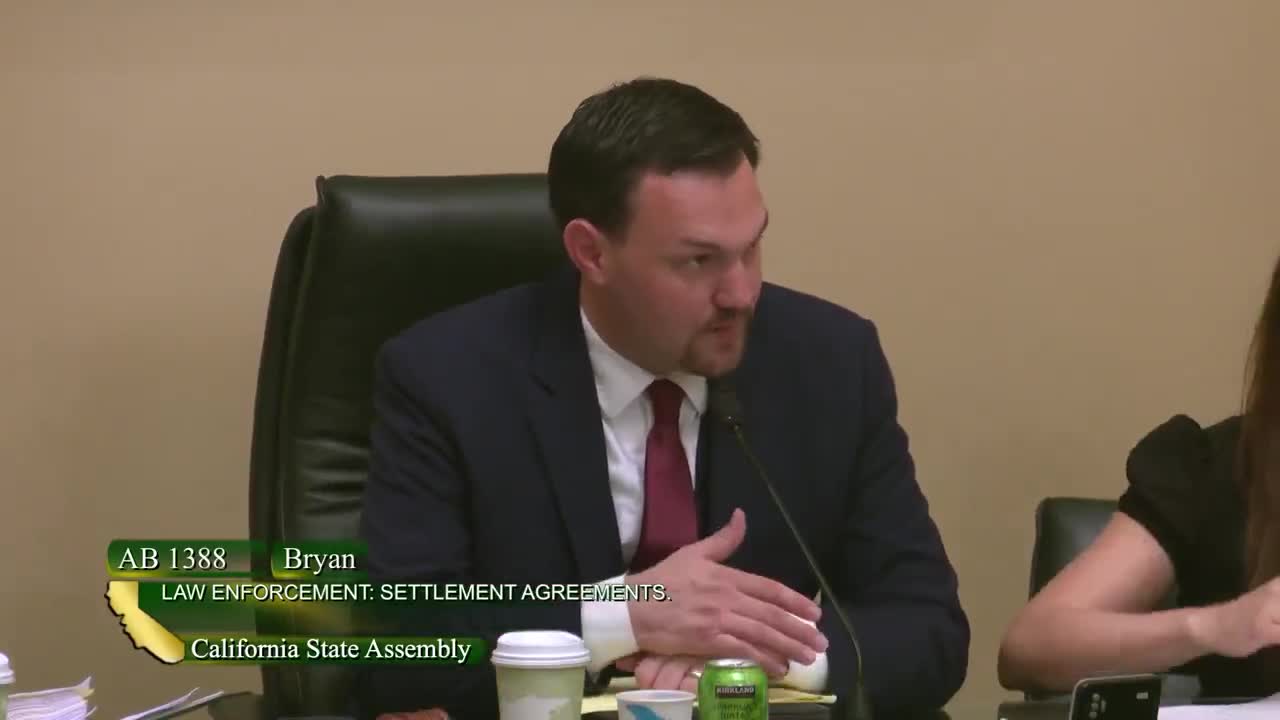 18MIN
Assembly Standing Committee on Public Safety
Bill Author

Bill Co-Author(s):