AB 2040: Juveniles: transfer to court of criminal jurisdiction.
- Session Year: 2025-2026
- House: Assembly
- Latest Version Date: 2026-02-17
Current Status:
Failed
(2026-04-21: From committee: Without further action pursuant to Joint Rule 62(a).)
Introduced
In Committee
Awaiting First Chamber Vote
Passed First Chamber
In Committee
Awaiting Second Chamber Vote
Passed Second Chamber
Enacted
What does this bill do?
This bill lowers the burden of proof in juvenile transfer hearings from “clear and convincing” to a “preponderance of the evidence” (more likely than not) when prosecutors seek to move certain 16‑year‑olds and some 14–15‑year‑olds accused of serious felonies into adult criminal court. The court would still have to find the young person cannot be rehabilitated in juvenile court and consider factors like age, history, trauma, and the seriousness of the offense before ordering a transfer.
The summary is provided by generative AI which can make mistakes. For original language, please view the details in the table below.
Existing law, as amended by the Public Safety and Rehabilitation Act of 2016, enacted by Proposition 57 at the November 8, 2016, statewide general election, authorizes the district attorney or other prosecuting officer to make a motion to transfer a minor from juvenile court to a court of criminal jurisdiction in a case in which a minor is alleged to have committed a felony when the minor was 16 years of age or older, or in a case in which a specified serious offense is alleged to have been committed by a minor when the minor was 14 or 15 years of age, but the minor was not apprehended prior to the end of juvenile court jurisdiction. Under existing law, in order to find that the minor should be transferred to a court of criminal jurisdiction, the court is required to find by clear and convincing evidence that the minor is not amenable to rehabilitation while under the jurisdiction of the juvenile court.
This bill would instead require that the court find by a preponderance of the evidence that the minor is not amenable to rehabilitation while under the jurisdiction of the juvenile court.
(a)(1)In any case in which a minor is alleged to be a person described in Section 602 by reason of the violation, when the minor was 16 years of age or older, of any offense listed in subdivision (b) or any other felony criminal statute, the district attorney or other appropriate prosecuting officer may make a motion to transfer the minor from juvenile court to a court of criminal jurisdiction. The motion shall be made prior to the attachment of jeopardy. Upon the motion, the juvenile court shall order the probation officer to submit a report on the behavioral patterns and social history of the minor. The report shall include any written or oral statement offered by the victim pursuant to Section 656.2.
(2)In any case in which an individual is alleged to be a person described in Section 602 by reason of the violation, when the individual was 14 or 15 years of age, of any offense listed in subdivision (b), but was not apprehended prior to the end of juvenile court jurisdiction, the district attorney or other appropriate prosecuting officer may make a motion to transfer the individual from juvenile court to a court of criminal jurisdiction. The motion shall be made prior to the attachment of jeopardy. Upon the motion, the juvenile court shall order the probation officer to submit a report on the behavioral patterns and social history of the individual. The report shall include any written or oral statement offered by the victim pursuant to Section 656.2.
(3)Following submission and consideration of the report, and of any other relevant evidence that the petitioner or the minor may wish to submit, the juvenile court shall decide whether the minor should be transferred to a court of criminal jurisdiction. In order to find that the minor should be transferred to a court of criminal jurisdiction, the court shall find by clear and convincing a preponderance of the evidence that the minor is not amenable to rehabilitation while under the jurisdiction of the juvenile court. In making its decision, the court shall consider the criteria specified in subparagraphs (A) to (E), inclusive. If the court orders a transfer of jurisdiction, the court shall recite the basis for its decision in an order entered upon the minutes, which shall include the reasons supporting the courts finding that the minor is not amenable to rehabilitation while under the jurisdiction of the juvenile court. In any case in which a hearing has been noticed pursuant to this section, the court shall postpone the taking of a plea to the petition until the conclusion of the transfer hearing, and a plea that has been entered already shall not constitute evidence at the hearing.
(A)(i)The degree of criminal sophistication exhibited by the minor.
(ii)When evaluating the criterion specified in clause (i), the juvenile court shall give weight to any relevant factor, including, but not limited to, the minors age, maturity, intellectual capacity, and physical, mental, and emotional health at the time of the alleged offense; the minors impetuosity or failure to appreciate risks and consequences of criminal behavior; the effect of familial, adult, or peer pressure on the minors actions; the effect of the minors family and community environment; the existence of childhood trauma; the minors involvement in the child welfare or foster care system; and the status of the minor as a victim of human trafficking, sexual abuse, or sexual battery on the minors criminal sophistication.
(B)(i)Whether the minor can be rehabilitated prior to the expiration of the juvenile courts jurisdiction.
(ii)When evaluating the criterion specified in clause (i), the juvenile court shall give weight to any relevant factor, including, but not limited to, the minors potential to grow and mature.
(C)(i)The minors previous delinquent history.
(ii)When evaluating the criterion specified in clause (i), the juvenile court shall give weight to any relevant factor, including, but not limited to, the seriousness of the minors previous delinquent history and the effect of the minors family and community environment and childhood trauma on the minors previous delinquent behavior.
(D)(i)Success of previous attempts by the juvenile court to rehabilitate the minor.
(ii)When evaluating the criterion specified in clause (i), the juvenile court shall give weight to any relevant factor, including, but not limited to, the adequacy of the services previously provided to address the minors needs.
(E)(i)The circumstances and gravity of the offense alleged in the petition to have been committed by the minor.
(ii)When evaluating the criterion specified in clause (i), the juvenile court shall give weight to any relevant factor, including, but not limited to, the actual behavior of the person, the mental state of the person, the persons degree of involvement in the crime, the level of harm actually caused by the person, and the persons mental and emotional development.
(iii)When evaluating the criterion specified in clause (i), the court shall consider evidence offered that indicates that the person against whom the minor is accused of committing an offense trafficked, sexually abused, or sexually battered the minor.
(b)This subdivision is applicable to any case in which a minor is alleged to be a person described in Section 602 by reason of the violation of one of the following offenses:
(1)Murder.
(2)Arson, as provided in subdivision (a) or (b) of Section 451 of the Penal Code.
(3)Robbery.
(4)Rape with force, violence, or threat of great bodily harm.
(5)Sodomy by force, violence, duress, menace, or threat of great bodily harm.
(6)A lewd or lascivious act as provided in subdivision (b) of Section 288 of the Penal Code.
(7)Oral copulation by force, violence, duress, menace, or threat of great bodily harm.
(8)An offense specified in subdivision (a) of Section 289 of the Penal Code.
(9)Kidnapping for ransom.
(10)Kidnapping for purposes of robbery.
(11)Kidnapping with bodily harm.
(12)Attempted murder.
(13)Assault with a firearm or destructive device.
(14)Assault by any means of force likely to produce great bodily injury.
(15)Discharge of a firearm into an inhabited or occupied building.
(16)An offense described in Section 1203.09 of the Penal Code.
(17)An offense described in Section 12022.5 or 12022.53 of the Penal Code.
(18)A felony offense in which the minor personally used a weapon described in any provision listed in Section 16590 of the Penal Code.
(19)A felony offense described in Section 136.1 or 137 of the Penal Code.
(20)Manufacturing, compounding, or selling one-half ounce or more of a salt or solution of a controlled substance specified in subdivision (e) of Section 11055 of the Health and Safety Code.
(21)A violent felony, as defined in subdivision (c) of Section 667.5 of the Penal Code, which also would constitute a felony violation of subdivision (b) of Section 186.22 of the Penal Code.
(22)Escape, by the use of force or violence, from a county juvenile hall, home, ranch, camp, or forestry camp in violation of subdivision (b) of Section 871 if great bodily injury is intentionally inflicted upon an employee of the juvenile facility during the commission of the escape.
(23)Torture as described in Sections 206 and 206.1 of the Penal Code.
(24)Aggravated mayhem, as described in Section 205 of the Penal Code.
(25)Carjacking, as described in Section 215 of the Penal Code, while armed with a dangerous or deadly weapon.
(26)Kidnapping for purposes of sexual assault, as punishable in subdivision (b) of Section 209 of the Penal Code.
(27)Kidnapping as punishable in Section 209.5 of the Penal Code.
(28)The offense described in subdivision (c) of Section 26100 of the Penal Code.
(29)The offense described in Section 18745 of the Penal Code.
(30)Voluntary manslaughter, as described in subdivision (a) of Section 192 of the Penal Code.
|
Date
|
Status
|
|---|---|
| Apr 21, 2026 | From committee: Without further action pursuant to Joint Rule 62(a). |
| Apr 21, 2026 | In committee: Set, final hearing. Failed passage. |
| Apr 14, 2026 | In committee: Set, final hearing. Failed passage. Reconsideration granted. |
| Apr 7, 2026 | In committee: Set, second hearing. Hearing canceled at the request of author. |
| Mar 18, 2026 | In committee: Set, first hearing. Hearing canceled at the request of author. |
| Mar 2, 2026 | Referred to Com. on PUB. S. |
| Feb 18, 2026 | From printer. May be heard in committee March 20. |
| Feb 17, 2026 | Read first time. To print. |
|
Date
|
Description
|
Location
|
Votes
|
|
|---|---|---|---|---|
| Apr 21, 2026 | Do pass and be re-referred to the Committee on [Appropriations] | Assembly Standing Committee on Public Safety |
Failed |
|
| Apr 14, 2026 | Do pass and be re-referred to the Committee on [Appropriations] | Assembly Standing Committee on Public Safety |
Failed |
This list shows positions taken on this bill by organizations on the date displayed, which is linked to the original source.
Positions by individuals are not included.
|
Organization
|
Position
|
Date
|
|---|---|---|
| A New Way of Life Reentry Project | ** Against | |
| Aclu California Action | ** Against | |
| All of US or None (HQ) | ** Against | |
| Alliance for Boys and Men of Color | ** Against | |
| Alliance for Children's Rights | ** Against | |
| Arts for Healing and Justice Network | ** Against | |
| Bridges of Hope CA | ** Against | |
| California Association of Black Lawyers | ** Against | |
| California Attorneys For Criminal Justice | ** Against | |
| California Coalition for Women Prisoners | ** Against | |
| California District Attorneys Association | ** Support | |
| California for Safety and Justice | ** Against | |
| California Police Chiefs Association | ** Support | |
| California Public Defenders Association | ** Against | |
| California State Sheriffs' Association | ** Support | |
| California Tribal Families Coalition | ** Against | |
| California Youth Defender Center | ** Against | |
| Californians United for a Responsible Budget | ** Against | |
| Care First California | ** Against | |
| Center on Juvenile and Criminal Justice | ** Against | |
| CHIEF PROBATION OFFICERS' OF CALIFORNIA (CPOC) | ** Support | |
| Chief Probation Officers' of California (CPOC) (Sponsor) | ** Support | |
| Children'S Law Center Of California | ** Against | |
| Communities United for Restorative Youth Justice (CURYJ) | ** Against | |
| Community Works West | ** Against | |
| Crime Victims United Of California | ** Support | |
| Dignity and Power Now | ** Against | |
| Disability Rights California | ** Against | |
| Ella Baker Center For Human Rights | ** Against | |
| Empowering Women Impacted by Incarceration | ** Against | |
| Felony Murder Elimination Project | ** Against | |
| Fresh Lifelines for Youth (FLY) | ** Against | |
| Fresno County Public Defender's Office | ** Against | |
| Friends Committee On Legislation Of California | ** Against | |
| Hang Out Do Good | ** Against | |
| Haywood Burns Institute | ** Against | |
| Immigrant Legal Resource Center | ** Against | |
| Initiate Justice | ** Against | |
| Integral Community Solutions Institute | ** Against | |
| Justice2jobs Coalition | ** Against | |
| LA Defensa | ** Against | |
| Legal Services for Prisoners with Children | ** Against | |
| Local 148 Los Angeles County Public Defender's Union | ** Against | |
| Milpa Collective | ** Against | |
| National Institute for Criminal Justice Reform | ** Against | |
| Peace and Justice Law Center | ** Against | |
| Peace Officers Research Association of California (PORAC) | ** Support | |
| san francisco public defender's office | ** Against | |
| Smart Justice California, a Project of Beyond Impact | ** Against | |
| The California Youth Justice Project | ** Against | |
| The Collective for Liberatory Lawyering | ** Against | |
| The Translatin@ Coalition | ** Against | |
| Urban Peace Institute | ** Against | |
| Urban Peace Movement | ** Against | |
| WONDER WOOD RANCH | ** Against | |
| Young Women's Freedom Center | ** Against | |
| Youth Justice Coalition | ** Against | |
| Youth Justice Education Clinic, Center for Juvenile Law and Policy, Loyola Law School | ** Against |
Date of Hearing:
Deputy Chief Counsel: Stella Choe
ASSEMBLY COMMITTEE ON PUBLIC SAFETY
Nick Schultz, Chair
ABPCA Bill Id:AB 2040
Author:(Macedo) – As Introduced Ver:February 17, 2026
VOTE ONLY
SUMMARY:
Lowers the burden of proof, from clear and convincing evidence to a preponderance of the evidence, to find that a minor is not amenable to rehabilitation while under the jurisdiction of the juvenile court for purposes of transfer to adult criminal court.
EXISTING LAW:
- Provides, generally, that a minor who is between 12 years of age and 17 years of age, inclusive, when the minor violates any law defining a crime, is subject to the jurisdiction of the juvenile court and to adjudication as a ward. (Welf. & Inst. Code, § 602, subd. (a).)
- Establishes criteria to determine whether to transfer a minor from juvenile court to adult criminal court. (Welf. & Inst. Code, § 707.)
- States that in a case in which a minor is alleged to have committed any felony or any of the enumerated felonies, as specified, when the minor was 16 years of age or older, the prosecutor may make a motion to transfer the minor from juvenile court to a court of criminal jurisdiction. (Welf. & Inst. Code, § 707, subd. (a)(1).)
- States that in a case in which a minor is alleged to have committed any of the enumerated felonies, as specified, when the minor was 14 or 15 years of age, but was not apprehended prior to the end of juvenile court jurisdiction, the prosecutor may make a motion to transfer the minor from juvenile court to a court of criminal jurisdiction. (Welf. & Inst. Code, § 707, subd. (a)(2), emphasis added.)
- States that in order to find that the minor should be transferred to a court of criminal jurisdiction, the court shall find by clear and convincing evidence that the minor is not amenable to rehabilitation while under the jurisdiction of the juvenile court. In making its decision, the court shall consider the following criteria, inclusive:
- The degree of criminal sophistication exhibited by the minor. The juvenile court shall give weight to any relevant factor, including, but not limited to, the minor’s age, maturity, intellectual capacity, and physical, mental, and emotional health at the time of the alleged offense; the minor’s impetuosity or failure to appreciate risks and consequences of criminal behavior; the effect of familial, adult, or peer pressure on the minor’s actions; the effect of the minor’s family and community environment; the existence of childhood trauma; the minor’s involvement in the child welfare or foster care system; and the status of the minor as a victim of human trafficking, sexual abuse, or sexual battery on the minor’s criminal sophistication;
- Whether the minor can be rehabilitated prior to the expiration of the juvenile court’s jurisdiction. The juvenile court shall give weight to any relevant factor, including, but not limited to, the minor’s potential to grow and mature;
- The minor’s previous delinquent history. The juvenile court shall give weight to any relevant factor, including, but not limited to, the seriousness of the minor’s previous delinquent history and the effect of the minor’s family and community environment and childhood trauma on the minor’s previous delinquent behavior;
- Success of previous attempts by the juvenile court to rehabilitate the minor. The juvenile court shall give weight to any relevant factor, including, but not limited to, the adequacy of the services previously provided to address the minor’s needs; and,
- The circumstances and gravity of the offense alleged in the petition to have been committed by the minor. The juvenile court shall give weight to any relevant factor, including, but not limited to, the actual behavior of the person, the mental state of the person, the person’s degree of involvement in the crime, the level of harm actually caused by the person, and the person’s mental and emotional development. The court shall consider evidence offered that indicates that the person against whom the minor is accused of committing an offense trafficked, sexually abused, or sexually battered the minor. (Welf. & Inst. Code, § 707, subd. (a)(3), emphasis added.)
- Enumerates the following offenses which permit transfer of a juvenile to adult court for a crime committed when the person 16 years of age, or was 14 or 15 years of age and was not apprehended until after the jurisdiction of the juvenile court had ended:
- Murder;
- Arson;
- Robbery;
- Rape with force, violence, or threat of great bodily harm;
- Sodomy by force, violence, or threat of great bodily harm;
- A lewd or lascivious act on a minor under 14 years of age by force, violence, or threat of great bodily harm;
- Oral copulation by force, violence, duress, menace, or threat of great bodily harm;
- Sexual penetration by force, violence, duress, menace, or threat of great bodily harm;
- Kidnapping for ransom;
- Kidnapping for purposes of robbery;
- Kidnapping with bodily harm;
- Attempted murder;
- Assault with a firearm or destructive device;
- Assault by means of force likely to produce great bodily injury;
- Discharge of a firearm into an inhabited or occupied building;
- Causing great bodily injury in the commission of specified offenses against a person who is 60 years of age or older; or against a person who is blind, a paraplegic, a quadriplegic, or a person confined to a wheelchair;
- Personal use of a firearm during the commission of a felony;
- Personal use of a weapon;
- Dissuading a witness or influencing testimony;
- Manufacturing, compounding, or selling one-half ounce or more of a salt or solution of a specified controlled substance;
- A “violent” felony committed for the benefit of a criminal street gang;
- Escape, by use of force or violence, from a county juvenile hall, home, ranch, camp or forestry camp if great bodily injury is intentionally inflicted upon an employee of the juvenile facility during the escape;
- Torture;
- Aggravated mayhem;
- Carjacking while armed with a dangerous and deadly weapon;
- Kidnapping for purposes of sexual assault;
- Kidnapping in the course of a carjacking;
- Drive by shooting;
- Exploding a destructive device with intent to commit murder; and,
- Voluntary manslaughter. (Welf. & Inst. Code, § 707, subd. (b).)
FISCAL EFFECT:
Unknown
COMMENTS:
- Author's Statement: According to the author, “Rehabilitation is part of a fair and just society; it must remain a goal of our juvenile justice system. But in the most severe cases, the system must be capable of delivering accountability that matches the seriousness of the harm committed. Families in our district have experienced the devastating consequences of violent juvenile crime and have been left feeling that California’s current framework is failing to bring the most violent criminals to justice.
“AB 2040 is driven by concerns of grieving families who see the lack of accountability in the juvenile system. When a juvenile commits a grave offense, like murder, and the case is already eligible for transfer consideration under existing law, courts should be able to make that determination under a workable evidentiary standard. Our communities deserve a system that still values rehabilitation, but also recognizes that public safety, justice for victims, and accountability matter.”
- Juvenile Court Jurisdiction: As a general rule, any person between the age of 12 and 17 who commits a crime falls within the jurisdiction of the juvenile court. (Welf. & Inst. Code, § 602.) This extends to a youth alleged to have committed a crime before their 18th birthday, even if they were an adult at the time of arrest or commencement of proceedings. (Welf. & Inst. Code, § 603.) For example, if someone commits a crime at age 17, but it is not discovered or tried until the person is 20, the person can still be tried in juvenile court. The jurisdiction of the juvenile court continues until the youth is 23 years old, unless the youth would have, in criminal court, faced a sentence of 7 years or more, in which case the juvenile court’s jurisdiction continues until the youth turns 25. (Welf. & Inst. Code, § 607.)
The creation of the juvenile court, now over 100 years old, was rooted in the idea that adolescents, who are not fully developed or mature, are less culpable than adults. Accordingly, the focus of the juvenile court was rehabilitation, not punishment. (See e.g., In re Gault (1967) 387 U.S. 1, 15-16.) The purpose of the juvenile law is to provide for the protection and safety of the public and each minor under the jurisdiction of the court and to preserve and strengthen family ties when possible. (Welf. & Inst. Code, § 202, subd. (a).) Minors under the jurisdiction of the juvenile court as a consequence of delinquent conduct receive care, treatment, and guidance that is consistent with their best interest, that holds them accountable for their behavior, and that is appropriate for their circumstances. This may include punishment that is consistent with rehabilitative objectives. (Welf. & Inst. Code, § 202, subd. (b).) The juvenile court has a wide range of options available for placing its wards, including probation, placement in a relative's home, foster home, licensed community care facility, or group home, and commitment to “a juvenile home, ranch, camp, or forestry camp” or “the county juvenile hall.” (Welf. & Inst. Code, §§ 727, subd. (a); 730, subd. (a)(1).) - History of Juvenile Transfer Policies: In 1961, the Legislature set 16 years old as the minimum age that a minor could be transferred to adult criminal court. (O.G. v. Superior Court (2021) 11 Cal.5th 82, 88.) In 1995, the state began to move away from this rule by permitting some 14- and 15-year-olds to be transferred to criminal court. (Ibid.) In 2000, the voters passed Proposition 21 which required prosecutors to charge minors 14 years or older directly in criminal court for specified murder and sex crimes. Additionally, the Proposition gave prosecutors discretion to charge minors 14 or older directly in adult criminal court for other serious specified offenses. (Ibid.)
In the years following the passage of Proposition 21, the United State Supreme Court issued several opinions regarding the need to treat juveniles differently from adults in the criminal justice system. Developments in scientific research on adolescent brain development confirmed that children are different from adults in their relative culpability and rehabilitation possibilities and that such differences are critical to identifying age-appropriate sentences. (See, e.g., Roper v. Simmons (2005) 543 U.S. 551, 569–571 [prohibited capital punishment for juveniles]; Graham v. Florida (2010) 560 U.S. 48, 68–75 [prohibited life without the possibility of parole (LWOP) for juveniles in non-homicide cases]; Miller v. Alabama (2012) 567 U.S. 460, 469–470 [prohibited mandatory LWOP sentences for juveniles].) The Court summarized those differences in Miller:
Roper and Graham establish that children are constitutionally different from adults for purposes of sentencing. Because juveniles have diminished culpability and greater prospects for reform, we explained, “they are less deserving of the most severe punishments.” Graham, 560 U.S., at 68, 130 S.Ct. 2011, 176 L.Ed. 2d 825. Those cases relied on three significant gaps between juveniles and adults. First, children have a “‘lack of maturity and an underdeveloped sense of responsibility,’” leading to recklessness, impulsivity, and heedless risk-taking. Roper, 543 U.S., at 569, 125 S.Ct. 1183, 161 L.Ed. 2d 1. Second, children “are more vulnerable . . . to negative influences and outside pressures,” including from their family and peers; they have limited “contro[l] over their own environment” and lack the ability to extricate themselves from horrific, crime-producing settings. Ibid. And third, a child’s character is not as “well formed” as an adult’s; his traits are “less fixed” and his actions less likely to be “evidence of irretrievabl[e] deprav[ity].” (Miller, supra, 567 U.S. at 570.)
The California Supreme Court, relying on Graham and Miller, found that a determinate sentence that exceeds the expected lifetime of the juvenile defendant violates the Eighth Amendment because it effectively denies a juvenile any opportunity to demonstrate rehabilitation (People v. Caballero (2012) 55 Cal.4th 262, 267) and that a law that provides a presumption in favor of LWOP for juveniles also violates the Eighth Amendment (People v. Gutierrez (2014) 58 Cal.4th 1354, 1375-1376).
Following this body of research and case law, several measures were adopted to reflect the scientific evidence and constitutional mandate to treat juveniles differently than adults. In 2016, Proposition 57 eliminated direct filing in adult court by amending Welfare and Institutions Code section 707 to require a transfer hearing to be held before a minor can be prosecuted in adult court. In 2018, the Legislature raised the youngest age a minor could be tried as an adult back to 16. (SB 1391 (Lara), Ch. 1012, Stats. 2018.)
The age change was challenged as an invalid amendment to Proposition 57 but the California Supreme Court ultimately ruled that SB 1391 furthered the ameliorative purposes of Proposition 57 and the proposition authorized such amendments by a majority vote of the Legislature. (People v. Superior Court (O.G.) (2021) 11 Cal.5th 82.)
- Transfer Criteria: The issue in a juvenile transfer hearing “is not whether the minor committed a specified act, but rather whether [they are] amendable to the care, treatment and training program available through the juvenile court facilities….” (People v. Chi Ko Wong (1976) 18 Cal.3d 698, 717, disapproved on another point in People v. Green (1980) 27 Cal.3d 1, 33.) Under current law, the prosecution may move to transfer to adult criminal court any minor 16 years of age or older who is alleged to have committed a felony criminal offense. (Welf. & Inst. Code, § 707, subd. (a)(1).) The prosecution may also move to transfer to adult court a person who was 14 or 15 years of age at the time the person was alleged to have committed a specified serious or violent felony, but who was not apprehended prior to the end of juvenile court jurisdiction. (Welf. & Inst. Code, §§ 707, subds. (a)(2) & (b).) Existing law requires the juvenile court to find by clear and convincing evidence that the minor is not amenable to rehabilitation while under the jurisdiction of the juvenile court in order to find that the minor should be transferred to adult criminal court. (Welf. & Inst. Code § 707, subd. (a)(3).)
In making its transfer decision, the court must consider the following: the minor’s degree of criminal sophistication, whether the minor can be rehabilitated in the time before the juvenile court would lose jurisdiction over the minor, the minor’s prior history of delinquency, the success of prior attempts by the juvenile court to rehabilitate the minor, and the circumstances and gravity of the charged offense. (Welf. & Inst. Code, § 707, subd. (a)(3)(A)-(E).) Existing law provides guidance to the juvenile court when considering each of these criteria. Existing law specifies that when evaluating the degree of criminal sophistication exhibited by the minor, the juvenile court may give weight to any relevant factor, including, but not limited to, the minor’s age, maturity, intellectual capacity, and physical, mental, and emotional health at the time of the alleged offense, the minor’s impetuosity or failure to appreciate risks and consequences of criminal behavior, the effect of familial, adult, or peer pressure on the minor’s actions, and the effect of the minor’s family and community environment and childhood trauma on the minor’s criminal sophistication. (Welf. & Inst. Code, § 707, subd. (a)(3)(A)(ii).) Existing law additionally specifies that when evaluating the minor’s previous delinquent history, the juvenile court may give weight to any relevant factor, including, but not limited to, the seriousness of the minor’s previous delinquent history and the effect of the minor’s family and community environment and childhood trauma on the minor’s previous delinquent behavior. (Welf. & Inst. Code, § 707, subd. (a)(3)(C)(ii).) Existing law states that in evaluating the circumstances and gravity of the offense alleged in the petition to have been committed by the minor, the juvenile court shall give weight to any relevant factor, including, but not limited to, the actual behavior of the person, the mental state of the person, the person’s degree of involvement in the crime, the level of harm actually caused by the person, and the person’s mental and emotional development. The court shall consider evidence offered that indicates that the person against whom the minor is accused of committing an offense trafficked, sexually abused, or sexually battered the minor. (Welf. & Inst. Code, § 707, subd. (a)(3)(E).)
In 2022, the Legislature passed AB 2361, which, among other things, raised the legal standard for transfer hearings from preponderance of evidence to clear and convincing evidence.[1] “Clear and convincing” means that the evidence is highly and substantially more likely to be true than untrue; the trier of fact must have an abiding conviction that the truth of the factual contention is highly probable. (Colorado v. New Mexico (1984) 467 U.S. 310.) Prior to 2023, the law required the court to make this finding by a preponderance of the evidence. The “preponderance of the evidence standard” is met if the trier of fact (judge or jury) believes the evidence shows that a fact is more likely than not—more than 50% likely to be—true. (Braud v. Kinchen (1975) 310 So.2d 657.) The bill passed out of both Legislative houses without any registered opposition. According to a committee analysis of AB 2361[2]:
The California Supreme Court has called the transfer of a minor from juvenile court for prosecution in adult court “the worst punishment the juvenile system is empowered to inflict.” (Ramona R. v. Superior Court (1985) 37 Cal.3d 802, 810.) Despite the enormous consequence of the transfer decision, current statutory provisions provide insufficient guidance as to how the juvenile court should make its determination.
Over 50 years ago, the California Supreme Court held that “the dispositive question [at a transfer hearing] is the minor’s amenability to treatment through the facilities available to the juvenile court.” (Jimmy H. v. Superior Court (1970) 3 Cal.3d 709, 714; see also People v. Chi Ko Wong (1976) 18 Cal.3d 698, 717 (holding that the issue at a transfer hearing “is not whether the minor committed a specified act, but rather whether he is amenable to the care, treatment and training program available through juvenile court facilities”); J.N. v. Superior Court (2018) 23 Cal.App.5th 706, 714 (“There must be substantial evidence adduced at the hearing that the minor is not a fit and proper subject for treatment as a juvenile before the court may certify him to the superior court for prosecution.”) However, current statutory provisions do not explicitly reflect this principle, nor do they direct how the juvenile court should exercise its discretion.
By providing a clear legal standard, AB 2361 will reduce arbitrary determinations, ensure that youth amenable to treatment and rehabilitation will be retained in juvenile court, and will allow appellate courts more effectively to review the lower court’s holdings to determine whether the transfer was based on clear and convincing evidence.
This bill would undo the recent change in the law made by AB 2361 by lowering the standard of proof by which the juvenile court is to make the determination that a minor should be transferred to adult criminal court, from clear and convincing evidence to a preponderance of the evidence, that the minor is not amenable to rehabilitation while under the jurisdiction of the juvenile court.
Reducing the burden of proof would likely result in more youth transferred to adult court which studies show have negative impacts on the youth including likelihood of victimization, behavioral issues, recidivism and rehabilitation than youth who are retained in the juvenile system.[3]
The reversal back to a lower burden of proof after only three years of implementation raises questions of how this may be applied to cases that required retroactive review under the Estrada rule[4] after the standard was increased by AB 2361 in 2022. Estrada’s inference of retroactivity has been applied when the Legislature creates “a concrete avenue for certain individuals charged with a criminal offense to be treated more leniently or to avoid punishment altogether.” (People v. Burgos (2024)16 Cal.5th 1, 13 citing People v. Frahs (2020) 9 Cal.5th 618, 624; see also People v. Wright (2006) 40 Cal.4th 81 [newly enacted affirmative defense applies retroactively].) Because the change made by AB 2361 arguably made it harder to transfer juveniles to adult criminal court, this would be considered an ameliorative change in the law,[5] thus Estrada’s inference of retroactivity would apply to nonfinal cases without specific direction from the Legislature.
Following the change in the law, courts ordered new fitness hearings for nonfinal cases to apply the higher standard. (See In re E.P. (2023) 89 Cal.App.5th 409, 416.) It is unclear how many of cases may still be pending transfer hearings or received new transfer hearings with a different result than under the lower standard.
- Juvenile Justice Data: In 2020, the Legislature passed Senate Bill 823 (Committee on Budget and Fiscal Review) which established a process for realigning California’s juvenile system by phasing out the state’s youth prison system, the Division of Juvenile Justice (DJJ), and transferring the responsibility for managing all youthful offenders to local jurisdictions.[6] SB 823 established the Office of Youth and Community Restoration (OYCR) within the California of Health and Human Services Agency to guide the transition from state-run youth incarceration to the counties by providing support and technical assistance.
SB 823 also stated the intent of the Legislature to establish a separate dispositional track for higher-need youth by March 1, 2021. In order to implement Senate Bill 823, in 2021, the Legislature passed Senate Bill 92 (Committee on Budget and Fiscal Review) which authorized counties to establish secure youth treatment facilities (SYTFs) for the placement of wards who were adjudicated for specified serious offenses, listed in Welfare and Institutions Code section 707, subdivision (b), when the juvenile was age 14 or older, and after the court has determined a less restrictive alternative disposition is unsuitable. (Welf. & Inst. Code, § 875, subd. (a).)
Following juvenile justice realignment, AB 102 (Ting), Chapter 38, Statutes of 2023, was enacted to require county probation department to provide the Office of Youth and Community Restoration (OYCR), within the California Health and Human Services Agency, with data regarding: the number of youth and their commitment offense or offenses committed to an SYTF; the number of individual youth in the county who were adjudicated for a Section 707(b) or a registerable sex offense; the number of youth and their commitment offense or offenses transferred from an SYTF to a less restrictive program; and the number of youth who had a transfer hearing as well as the number of youth whose jurisdiction was transferred to adult criminal court. The data requirements are designed to provide a better understanding of the impacts of the state’s juvenile justice realignment.
According to the most recent OYCR data, in fiscal year 2023-2024, 130 transfer hearings were held and 50 youth were transferred to adult court (38.46%). In fiscal year 2022-2034, 117 transfer hearings were held and 35 youth were transferred to adult court (29.9%). In fiscal year 2021-2022, which would include numbers prior to the enactment of AB 2361 in 2022, 102 transfer hearings were held and 48 youth were transferred (47.05%).[7] Comparatively, the Department of Justice’s juvenile justice data for 2021 reports 78 fitness hearings reported and 28 were transferred (35.9%).[8]
The data also indicates that both Black and Latino youth are consistently overrepresented at multiple decision points in the juvenile justice system. Over the three-year period for which OYCR reported data under AB 102[9]:
[A]pproximately 61% of youth transferred to adult court were Hispanic/Latino, 23% were Black, 6% were White, and 10% were some other race or unknown (4% were Asian American, 3% were AI/AN [American Indian/Alaskan Native], and less than 1% were Pacific Islander). Among youth transferred to adult court, Black and AI/AN
youth are vastly overrepresented relative to their population size (5% and less than 1% respectively). Hispanic/Latino youth are also overrepresented, while White and Asian American youth are underrepresented relative to their youth population sizes in California.
Notably, the proportion of Black youth rose from 17% of transfers to adult court in FY 2021/22 and FY 2022/23, to 36% of youth transferred to adult court in FY 2023/24.
- Argument in Support: According to the Chief Probation Officers of California, the sponsor of this bill, “When voters passed Proposition 57 (2016), which retained court discretion in making transfers for serious and violent juvenile offenders, the standard of proof was preponderance of the evidence - the lowest burden of proof - a standard that guaranteed the court pathway was still an option for serious and violent juvenile offenses. Subsequent legislation in 2022 changed what the standard was at the time voters approved the other limitations for moving a juvenile case to adult court and increased the standard to clear and convincing evidence.
“It is important to note within the context of this bill that our support for this change should not be construed as opining on whether youth should be transferred to adult court; in fact, as a profession we have supported judicial discretion and frameworks to work with youth in the juvenile system to balance all factors.”
- Argument in Opposition: According to the Children’s Law Center of California, “Under current law, a juvenile court may transfer a young person to adult criminal court only upon clear and convincing evidence that the youth is not amenable to rehabilitation within the juvenile system. AB 2040 would lower that evidentiary standard, requiring only that the court find by a preponderance of the evidence that a young person is not amenable to rehabilitation. The preponderance of the evidence standard is the lowest burden of proof used in the legal system. It requires only a showing that something is “more likely than not” to be true (essentially just over a 50% likelihood). Because it sets such a minimal threshold, this standard is typically reserved for ordinary civil disputes where the consequences do not involve severe deprivations of liberty. AB 2040 proposes a significant regression that would increase racial disparities, expose more youth to the documented harms of adult incarceration, and undermine public safety.
“Transfer to adult court is the most severe sanction available in the juvenile system and warrants a high evidentiary standard.
“The California Supreme Court described transfer to adult court as "the worst punishment the juvenile system is empowered to inflict." (Ramona R. v. Superior Court (1985)). Transfer forecloses a young person's opportunity for rehabilitation, exposes them to adult prosecution and sentencing, and carries lifelong collateral consequences that cannot be undone.
“What makes that severity especially significant here is what transfer hearings actually require courts to decide. They do not ask what a young person did. They ask who that young person will become— whether they are capable of rehabilitation within the juvenile system. That is an inherently uncertain, predictive judgment about future development, made about a person whose brain is still developing and whose capacity for growth science tells us is routinely underestimated. Compounding this problem, transfer hearings take place before the alleged offense has been proven under any legal standard. Courts may therefore rely on unproven allegations when deciding whether to send a young person to the very system that will later determine their guilt. Lowering the evidentiary standard to preponderance would make that threshold decision even easier to reach based in part on conduct the law has not yet found true.
“Standards of proof exist to allocate the risk of erroneous outcomes. When a determination is both irreversible in consequence and uncertain by nature, the need for a high evidentiary standard is strongest. A preponderance standard — "more likely than not" — means a court could transfer a young person even when the evidence is nearly evenly balanced. That is not a standard commensurate with “the worst punishment” the juvenile court can impose.”
- Related Legislation:
- AB 1647 (Bryan) would require the court to find beyond a reasonable doubt, instead of by clear and convincing evidence, that a minor is not amenable to rehabilitation while under the jurisdiction of the juvenile court for purposes of transfer to adult criminal court. The hearing on AB 1647 was canceled at the request of the author.
- AB 1902 (Pellerin) would make various changes to the process that authorizes a court to order extended detention of a person confined in an SYTF. AB 1902 is pending hearing by this Committee.
- AB 1959 (Patel) would authorize a prosecuting attorney to file a transfer motion for a person who was previously convicted in adult criminal court for a crime committed at the age of 14 or 15 who is now subject to resentencing by the juvenile court as specified. AB 1959 is pending hearing in Assembly Appropriations Committee.
- AB 1968 (Gallagher) would add the crime of conspiracy to commit murder to the list of specified offenses for which a person may be committed to an SYTF for an offense committed at the age of 14 or older, or transferred to adult criminal court for a crime committed at the age of 14 or 15 if they were not apprehended prior to the end of juvenile court jurisdiction. AB 1968 failed passage in this committee and was granted reconsideration.
- Prior Legislation:
- AB 22 (DeMaio), of the 2025-2026 Legislative Session, among other things, would have removed from the juvenile court’s jurisdiction over specified crimes committed by minors, requiring those crimes to be tried in a court of criminal jurisdiction. AB 22 was held in this Committee.
- AB 2361 (Bonta), Chapter 330, Statutes of 2022, increased the burden of proof from preponderance of the evidence to clear and convincing evidence for a court to find that a minor should be transferred to adult criminal court.
- AB 624 (Bauer-Kahan), Chapter 195, Statutes of 2021, made an order transferring a minor from a juvenile court to a court of criminal jurisdiction subject to appeal, as specified.
- AB 1423 (Wicks), Chapter 583, Statutes of 2019, created a mechanism for the return of a case back to the juvenile court from the criminal court under certain circumstances.
- AB 2865 (Wicks), of the 2019-2020 Legislative Session, would have required a court to find that a minor is not amenable to rehabilitation while under the jurisdiction of the juvenile court in order to find that the minor should be transferred to a court of criminal jurisdiction. AB 2865 was held in this Committee without a hearing.
- SB 439 (Mitchell), Chapter 1006, Statutes of 2018, prohibited the prosecution of a minor under the age of 12, unless the minor is alleged to have committed specified violent crimes.
- SB 1391 (Lara), Chapter 1012, Statutes of 2018, repealed the authority of a district attorney to make a motion to transfer a minor from juvenile court to a court of criminal jurisdiction in a case in specified cases, unless the individual was not apprehended prior to the end of juvenile court jurisdiction.
- SB 382 (Lara), Chapter 382, Statutes of 2015, enumerated certain factors that may be given weight within each of the criteria to be determined by a court in order to find that the minor should be transferred to a court of criminal jurisdiction.
- SB 1151 (Kuehl), of the 2003-2004 Legislative Session, would have clarified the definition of the “circumstances and gravity of the offense” for purposes of evaluating the fitness of a minor for juvenile court jurisdiction. SB 1151 was vetoed.
- AB 560 (Peace), Chapter 453, Statutes of 1994, lowered the age from 16 to 14 at which a juvenile could be transferred to adult criminal court and be tried as an adult for committing certain crimes.
REGISTERED SUPPORT / OPPOSITION:
Support
Chief Probation Officers' of California (CPOC) (Sponsor)
California District Attorneys Association
California Police Chiefs Association
California State Sheriffs' Association
Crime Victims United of California
Peace Officers Research Association of California (PORAC)
Opposition
A New Way of Life Reentry Project
ACLU California Action
All of US or None (HQ)
Alliance for Boys and Men of Color
Alliance for Children's Rights
Arts for Healing and Justice Network
Bridges of Hope CA
California Association of Black Lawyers
California Attorneys for Criminal Justice
California Coalition for Women Prisoners
California for Safety and Justice
California Public Defenders Association
California Tribal Families Coalition
California Youth Defender Center
Californians United for a Responsible Budget
Care First California
Center on Juvenile and Criminal Justice
Children's Law Center of California
Communities United for Restorative Youth Justice (CURYJ)
Community Works West
Dignity and Power Now
Disability Rights California
Ella Baker Center for Human Rights
Empowering Women Impacted by Incarceration
Felony Murder Elimination Project
Fresh Lifelines for Youth (FLY)
Fresno County Public Defender's Office
Friends Committee on Legislation of California
Hang Out Do Good
Haywood Burns Institute
Immigrant Legal Resource Center
Initiate Justice
Integral Community Solutions Institute
Justice2jobs Coalition
LA Defensa
Legal Services for Prisoners With Children
Local 148 Los Angeles County Public Defender's Union
Milpa Collective
National Institute for Criminal Justice Reform
Peace and Justice Law Center
San Francisco Public Defender's Office
Smart Justice California, a Project of Beyond Impact
The California Youth Justice Project
The Collective for Liberatory Lawyering
The Translatin@ Coalition
Urban Peace Institute
Urban Peace Movement
Wonder Wood Ranch
Young Women's Freedom Center
Youth Justice Coalition
Youth Justice Education Clinic, Center for Juvenile Law and Policy, Loyola Law School
Analysis Prepared by:
Stella Choe / PUB. S. / (916) 319-3744
AB 2361 (Bonta), Chapter 330, Statutes of 2022. ↑
Sen. Comm. On Pub. Safety, Analysis of Assem. Bill No. 2361 (2021-2022 Reg. Sess.) as amended Mar. 31, 2022, p. 4. ↑
Technical Assistance: Maintaining Youth in Juvenile Court: Published Research, OYCR (May 2023). ↑
If a defendant’s case is still pending at the time of the change and the law seeks to lessen a criminal penalty, they may be eligible for application of the new law. (In re Estrada (1965) 63 Cal.2d 740, 746.) ↑
See People v. Superior Court (Lara) (2018) 4 Cal.5th 299, 302 where California Supreme Court held that “[t]he possibility of being treated as a juvenile in juvenile court—where rehabilitation is the goal—rather than being tried and sentenced as an adult can result in dramatically different and more lenient treatment,” and concluded “[f]or this reason, Estrada's inference of retroactivity applies.” ↑
See Sen. Comm. on Budget and Fiscal Review. Floor Analysis of Sen. Bill No. 823 (2019-2020 Reg. Sess.) as amended August 28, 2020, p. 1. ↑
AB 102 Report, OYCR (2025), pp. 40 & 43, see https://oycr.ca.gov/wp-content/uploads/sites/346/2025/09/2025-AB-102-Report_FINAL.pdf. ↑
Juvenile Justice in California, 2021, CA Department of Justice, p. 38, see https://data-openjustice.doj.ca.gov/sites/default/files/2022-08/Juvenile%20Justice%20In%20CA%202021_0.pdf. ↑
Id. at p. 45. ↑
Date of Hearing:
Deputy Chief Counsel: Stella Choe
ASSEMBLY COMMITTEE ON PUBLIC SAFETY
Nick Schultz, Chair
ABPCA Bill Id:AB 2040
Author:(Macedo) – As Introduced Ver:February 17, 2026
SUMMARY:
Lowers the burden of proof, from clear and convincing evidence to a preponderance of the evidence, to find that a minor is not amenable to rehabilitation while under the jurisdiction of the juvenile court for purposes of transfer to adult criminal court.
EXISTING LAW:
- Provides, generally, that a minor who is between 12 years of age and 17 years of age, inclusive, when the minor violates any law defining a crime, is subject to the jurisdiction of the juvenile court and to adjudication as a ward. (Welf. & Inst. Code, § 602, subd. (a).)
- Establishes criteria to determine whether to transfer a minor from juvenile court to adult criminal court. (Welf. & Inst. Code, § 707.)
- States that in a case in which a minor is alleged to have committed any felony or any of the enumerated felonies, as specified, when the minor was 16 years of age or older, the prosecutor may make a motion to transfer the minor from juvenile court to a court of criminal jurisdiction. (Welf. & Inst. Code, § 707, subd. (a)(1).)
- States that in a case in which a minor is alleged to have committed any of the enumerated felonies, as specified, when the minor was 14 or 15 years of age, but was not apprehended prior to the end of juvenile court jurisdiction, the prosecutor may make a motion to transfer the minor from juvenile court to a court of criminal jurisdiction. (Welf. & Inst. Code, § 707, subd. (a)(2), emphasis added.)
- States that in order to find that the minor should be transferred to a court of criminal jurisdiction, the court shall find by clear and convincing evidence that the minor is not amenable to rehabilitation while under the jurisdiction of the juvenile court. In making its decision, the court shall consider the following criteria, inclusive:
- The degree of criminal sophistication exhibited by the minor. The juvenile court shall give weight to any relevant factor, including, but not limited to, the minor’s age, maturity, intellectual capacity, and physical, mental, and emotional health at the time of the alleged offense; the minor’s impetuosity or failure to appreciate risks and consequences of criminal behavior; the effect of familial, adult, or peer pressure on the minor’s actions; the effect of the minor’s family and community environment; the existence of childhood trauma; the minor’s involvement in the child welfare or foster care system; and the status of the minor as a victim of human trafficking, sexual abuse, or sexual battery on the minor’s criminal sophistication;
- Whether the minor can be rehabilitated prior to the expiration of the juvenile court’s jurisdiction. The juvenile court shall give weight to any relevant factor, including, but not limited to, the minor’s potential to grow and mature;
- The minor’s previous delinquent history. The juvenile court shall give weight to any relevant factor, including, but not limited to, the seriousness of the minor’s previous delinquent history and the effect of the minor’s family and community environment and childhood trauma on the minor’s previous delinquent behavior;
- Success of previous attempts by the juvenile court to rehabilitate the minor. The juvenile court shall give weight to any relevant factor, including, but not limited to, the adequacy of the services previously provided to address the minor’s needs; and,
- The circumstances and gravity of the offense alleged in the petition to have been committed by the minor. The juvenile court shall give weight to any relevant factor, including, but not limited to, the actual behavior of the person, the mental state of the person, the person’s degree of involvement in the crime, the level of harm actually caused by the person, and the person’s mental and emotional development. The court shall consider evidence offered that indicates that the person against whom the minor is accused of committing an offense trafficked, sexually abused, or sexually battered the minor. (Welf. & Inst. Code, § 707, subd. (a)(3), emphasis added.)
- Enumerates the following offenses which permit transfer of a juvenile to adult court for a crime committed when the person 16 years of age, or was 14 or 15 years of age and was not apprehended until after the jurisdiction of the juvenile court had ended:
- Murder;
- Arson;
- Robbery;
- Rape with force, violence, or threat of great bodily harm;
- Sodomy by force, violence, or threat of great bodily harm;
- A lewd or lascivious act on a minor under 14 years of age by force, violence, or threat of great bodily harm;
- Oral copulation by force, violence, duress, menace, or threat of great bodily harm;
- Sexual penetration by force, violence, duress, menace, or threat of great bodily harm;
- Kidnapping for ransom;
- Kidnapping for purposes of robbery;
- Kidnapping with bodily harm;
- Attempted murder;
- Assault with a firearm or destructive device;
- Assault by means of force likely to produce great bodily injury;
- Discharge of a firearm into an inhabited or occupied building;
- Causing great bodily injury in the commission of specified offenses against a person who is 60 years of age or older; or against a person who is blind, a paraplegic, a quadriplegic, or a person confined to a wheelchair;
- Personal use of a firearm during the commission of a felony;
- Personal use of a weapon;
- Dissuading a witness or influencing testimony;
- Manufacturing, compounding, or selling one-half ounce or more of a salt or solution of a specified controlled substance;
- A “violent” felony committed for the benefit of a criminal street gang;
- Escape, by use of force or violence, from a county juvenile hall, home, ranch, camp or forestry camp if great bodily injury is intentionally inflicted upon an employee of the juvenile facility during the escape;
- Torture;
- Aggravated mayhem;
- Carjacking while armed with a dangerous and deadly weapon;
- Kidnapping for purposes of sexual assault;
- Kidnapping in the course of a carjacking;
- Drive by shooting;
- Exploding a destructive device with intent to commit murder; and,
- Voluntary manslaughter. (Welf. & Inst. Code, § 707, subd. (b).)
FISCAL EFFECT:
Unknown
COMMENTS:
- Author's Statement: According to the author, “Rehabilitation is part of a fair and just society; it must remain a goal of our juvenile justice system. But in the most severe cases, the system must be capable of delivering accountability that matches the seriousness of the harm committed. Families in our district have experienced the devastating consequences of violent juvenile crime and have been left feeling that California’s current framework is failing to bring the most violent criminals to justice.
“AB 2040 is driven by concerns of grieving families who see the lack of accountability in the juvenile system. When a juvenile commits a grave offense, like murder, and the case is already eligible for transfer consideration under existing law, courts should be able to make that determination under a workable evidentiary standard. Our communities deserve a system that still values rehabilitation, but also recognizes that public safety, justice for victims, and accountability matter.”
- Juvenile Court Jurisdiction: As a general rule, any person between the age of 12 and 17 who commits a crime falls within the jurisdiction of the juvenile court. (Welf. & Inst. Code, § 602.) This extends to a youth alleged to have committed a crime before their 18th birthday, even if they were an adult at the time of arrest or commencement of proceedings. (Welf. & Inst. Code, § 603.) For example, if someone commits a crime at age 17, but it is not discovered or tried until the person is 20, the person can still be tried in juvenile court. The jurisdiction of the juvenile court continues until the youth is 23 years old, unless the youth would have, in criminal court, faced a sentence of 7 years or more, in which case the juvenile court’s jurisdiction continues until the youth turns 25. (Welf. & Inst. Code, § 607.)
The creation of the juvenile court, now over 100 years old, was rooted in the idea that adolescents, who are not fully developed or mature, are less culpable than adults. Accordingly, the focus of the juvenile court was rehabilitation, not punishment. (See e.g., In re Gault (1967) 387 U.S. 1, 15-16.) The purpose of the juvenile law is to provide for the protection and safety of the public and each minor under the jurisdiction of the court and to preserve and strengthen family ties when possible. (Welf. & Inst. Code, § 202, subd. (a).) Minors under the jurisdiction of the juvenile court as a consequence of delinquent conduct receive care, treatment, and guidance that is consistent with their best interest, that holds them accountable for their behavior, and that is appropriate for their circumstances. This may include punishment that is consistent with rehabilitative objectives. (Welf. & Inst. Code, § 202, subd. (b).) The juvenile court has a wide range of options available for placing its wards, including probation, placement in a relative's home, foster home, licensed community care facility, or group home, and commitment to “a juvenile home, ranch, camp, or forestry camp” or “the county juvenile hall.” (Welf. & Inst. Code, §§ 727, subd. (a); 730, subd. (a)(1).) - History of Juvenile Transfer Policies: In 1961, the Legislature set 16 years old as the minimum age that a minor could be transferred to adult criminal court. (O.G. v. Superior Court (2021) 11 Cal.5th 82, 88.) In 1995, the state began to move away from this rule by permitting some 14- and 15-year-olds to be transferred to criminal court. (Ibid.) In 2000, the voters passed Proposition 21 which required prosecutors to charge minors 14 years or older directly in criminal court for specified murder and sex crimes. Additionally, the Proposition gave prosecutors discretion to charge minors 14 or older directly in adult criminal court for other serious specified offenses. (Ibid.)
In the years following the passage of Proposition 21, the United State Supreme Court issued several opinions regarding the need to treat juveniles differently from adults in the criminal justice system. Developments in scientific research on adolescent brain development confirmed that children are different from adults in their relative culpability and rehabilitation possibilities and that such differences are critical to identifying age-appropriate sentences. (See, e.g., Roper v. Simmons (2005) 543 U.S. 551, 569–571 [prohibited capital punishment for juveniles]; Graham v. Florida (2010) 560 U.S. 48, 68–75 [prohibited life without the possibility of parole (LWOP) for juveniles in non-homicide cases]; Miller v. Alabama (2012) 567 U.S. 460, 469–470 [prohibited mandatory LWOP sentences for juveniles].) The Court summarized those differences in Miller:
Roper and Graham establish that children are constitutionally different from adults for purposes of sentencing. Because juveniles have diminished culpability and greater prospects for reform, we explained, “they are less deserving of the most severe punishments.” Graham, 560 U.S., at 68, 130 S.Ct. 2011, 176 L.Ed. 2d 825. Those cases relied on three significant gaps between juveniles and adults. First, children have a “‘lack of maturity and an underdeveloped sense of responsibility,’” leading to recklessness, impulsivity, and heedless risk-taking. Roper, 543 U.S., at 569, 125 S.Ct. 1183, 161 L.Ed. 2d 1. Second, children “are more vulnerable . . . to negative influences and outside pressures,” including from their family and peers; they have limited “contro[l] over their own environment” and lack the ability to extricate themselves from horrific, crime-producing settings. Ibid. And third, a child’s character is not as “well formed” as an adult’s; his traits are “less fixed” and his actions less likely to be “evidence of irretrievabl[e] deprav[ity].” (Miller, supra, 567 U.S. at 570.)
The California Supreme Court, relying on Graham and Miller, found that a determinate sentence that exceeds the expected lifetime of the juvenile defendant violates the Eighth Amendment because it effectively denies a juvenile any opportunity to demonstrate rehabilitation (People v. Caballero (2012) 55 Cal.4th 262, 267) and that a law that provides a presumption in favor of LWOP for juveniles also violates the Eighth Amendment (People v. Gutierrez (2014) 58 Cal.4th 1354, 1375-1376).
Following this body of research and case law, several measures were adopted to reflect the scientific evidence and constitutional mandate to treat juveniles differently than adults. In 2016, Proposition 57 eliminated direct filing in adult court by amending Welfare and Institutions Code section 707 to require a transfer hearing to be held before a minor can be prosecuted in adult court. In 2018, the Legislature raised the youngest age a minor could be tried as an adult back to 16. (SB 1391 (Lara), Ch. 1012, Stats. 2018.)
The age change was challenged as an invalid amendment to Proposition 57 but the California Supreme Court ultimately ruled that SB 1391 furthered the ameliorative purposes of Proposition 57 and the proposition authorized such amendments by a majority vote of the Legislature. (People v. Superior Court (O.G.) (2021) 11 Cal.5th 82.)
- Transfer Criteria: The issue in a juvenile transfer hearing “is not whether the minor committed a specified act, but rather whether [they are] amendable to the care, treatment and training program available through the juvenile court facilities….” (People v. Chi Ko Wong (1976) 18 Cal.3d 698, 717, disapproved on another point in People v. Green (1980) 27 Cal.3d 1, 33.) Under current law, the prosecution may move to transfer to adult criminal court any minor 16 years of age or older who is alleged to have committed a felony criminal offense. (Welf. & Inst. Code, § 707, subd. (a)(1).) The prosecution may also move to transfer to adult court a person who was 14 or 15 years of age at the time the person was alleged to have committed a specified serious or violent felony, but who was not apprehended prior to the end of juvenile court jurisdiction. (Welf. & Inst. Code, §§ 707, subds. (a)(2) & (b).) Existing law requires the juvenile court to find by clear and convincing evidence that the minor is not amenable to rehabilitation while under the jurisdiction of the juvenile court in order to find that the minor should be transferred to adult criminal court. (Welf. & Inst. Code § 707, subd. (a)(3).)
In making its transfer decision, the court must consider the following: the minor’s degree of criminal sophistication, whether the minor can be rehabilitated in the time before the juvenile court would lose jurisdiction over the minor, the minor’s prior history of delinquency, the success of prior attempts by the juvenile court to rehabilitate the minor, and the circumstances and gravity of the charged offense. (Welf. & Inst. Code, § 707, subd. (a)(3)(A)-(E).) Existing law provides guidance to the juvenile court when considering each of these criteria. Existing law specifies that when evaluating the degree of criminal sophistication exhibited by the minor, the juvenile court may give weight to any relevant factor, including, but not limited to, the minor’s age, maturity, intellectual capacity, and physical, mental, and emotional health at the time of the alleged offense, the minor’s impetuosity or failure to appreciate risks and consequences of criminal behavior, the effect of familial, adult, or peer pressure on the minor’s actions, and the effect of the minor’s family and community environment and childhood trauma on the minor’s criminal sophistication. (Welf. & Inst. Code, § 707, subd. (a)(3)(A)(ii).) Existing law additionally specifies that when evaluating the minor’s previous delinquent history, the juvenile court may give weight to any relevant factor, including, but not limited to, the seriousness of the minor’s previous delinquent history and the effect of the minor’s family and community environment and childhood trauma on the minor’s previous delinquent behavior. (Welf. & Inst. Code, § 707, subd. (a)(3)(C)(ii).) Existing law states that in evaluating the circumstances and gravity of the offense alleged in the petition to have been committed by the minor, the juvenile court shall give weight to any relevant factor, including, but not limited to, the actual behavior of the person, the mental state of the person, the person’s degree of involvement in the crime, the level of harm actually caused by the person, and the person’s mental and emotional development. The court shall consider evidence offered that indicates that the person against whom the minor is accused of committing an offense trafficked, sexually abused, or sexually battered the minor. (Welf. & Inst. Code, § 707, subd. (a)(3)(E).)
In 2022, the Legislature passed AB 2361, which, among other things, raised the legal standard for transfer hearings from preponderance of evidence to clear and convincing evidence.[1] “Clear and convincing” means that the evidence is highly and substantially more likely to be true than untrue; the trier of fact must have an abiding conviction that the truth of the factual contention is highly probable. (Colorado v. New Mexico (1984) 467 U.S. 310.) Prior to 2023, the law required the court to make this finding by a preponderance of the evidence. The “preponderance of the evidence standard” is met if the trier of fact (judge or jury) believes the evidence shows that a fact is more likely than not—more than 50% likely to be—true. (Braud v. Kinchen (1975) 310 So.2d 657.) The bill passed out of both Legislative houses without any registered opposition. According to a committee analysis of AB 2361[2]:
The California Supreme Court has called the transfer of a minor from juvenile court for prosecution in adult court “the worst punishment the juvenile system is empowered to inflict.” (Ramona R. v. Superior Court (1985) 37 Cal.3d 802, 810.) Despite the enormous consequence of the transfer decision, current statutory provisions provide insufficient guidance as to how the juvenile court should make its determination.
Over 50 years ago, the California Supreme Court held that “the dispositive question [at a transfer hearing] is the minor’s amenability to treatment through the facilities available to the juvenile court.” (Jimmy H. v. Superior Court (1970) 3 Cal.3d 709, 714; see also People v. Chi Ko Wong (1976) 18 Cal.3d 698, 717 (holding that the issue at a transfer hearing “is not whether the minor committed a specified act, but rather whether he is amenable to the care, treatment and training program available through juvenile court facilities”); J.N. v. Superior Court (2018) 23 Cal.App.5th 706, 714 (“There must be substantial evidence adduced at the hearing that the minor is not a fit and proper subject for treatment as a juvenile before the court may certify him to the superior court for prosecution.”) However, current statutory provisions do not explicitly reflect this principle, nor do they direct how the juvenile court should exercise its discretion.
By providing a clear legal standard, AB 2361 will reduce arbitrary determinations, ensure that youth amenable to treatment and rehabilitation will be retained in juvenile court, and will allow appellate courts more effectively to review the lower court’s holdings to determine whether the transfer was based on clear and convincing evidence.
This bill would undo the recent change in the law made by AB 2361 by lowering the standard of proof by which the juvenile court is to make the determination that a minor should be transferred to adult criminal court, from clear and convincing evidence to a preponderance of the evidence, that the minor is not amenable to rehabilitation while under the jurisdiction of the juvenile court.
Reducing the burden of proof would likely result in more youth transferred to adult court which studies show have negative impacts on the youth including likelihood of victimization, behavioral issues, recidivism and rehabilitation than youth who are retained in the juvenile system.[3]
The reversal back to a lower burden of proof after only three years of implementation raises questions of how this may be applied to cases that required retroactive review under the Estrada rule[4] after the standard was increased by AB 2361 in 2022. Estrada’s inference of retroactivity has been applied when the Legislature creates “a concrete avenue for certain individuals charged with a criminal offense to be treated more leniently or to avoid punishment altogether.” (People v. Burgos (2024)16 Cal.5th 1, 13 citing People v. Frahs (2020) 9 Cal.5th 618, 624; see also People v. Wright (2006) 40 Cal.4th 81 [newly enacted affirmative defense applies retroactively].) Because the change made by AB 2361 arguably made it harder to transfer juveniles to adult criminal court, this would be considered an ameliorative change in the law,[5] thus Estrada’s inference of retroactivity would apply to nonfinal cases without specific direction from the Legislature.
Following the change in the law, courts ordered new fitness hearings for nonfinal cases to apply the higher standard. (See In re E.P. (2023) 89 Cal.App.5th 409, 416.) It is unclear how many of cases may still be pending transfer hearings or received new transfer hearings with a different result than under the lower standard.
- Juvenile Justice Data: In 2020, the Legislature passed Senate Bill 823 (Committee on Budget and Fiscal Review) which established a process for realigning California’s juvenile system by phasing out the state’s youth prison system, the Division of Juvenile Justice (DJJ), and transferring the responsibility for managing all youthful offenders to local jurisdictions.[6] SB 823 established the Office of Youth and Community Restoration (OYCR) within the California of Health and Human Services Agency to guide the transition from state-run youth incarceration to the counties by providing support and technical assistance.
SB 823 also stated the intent of the Legislature to establish a separate dispositional track for higher-need youth by March 1, 2021. In order to implement Senate Bill 823, in 2021, the Legislature passed Senate Bill 92 (Committee on Budget and Fiscal Review) which authorized counties to establish secure youth treatment facilities (SYTFs) for the placement of wards who were adjudicated for specified serious offenses, listed in Welfare and Institutions Code section 707, subdivision (b), when the juvenile was age 14 or older, and after the court has determined a less restrictive alternative disposition is unsuitable. (Welf. & Inst. Code, § 875, subd. (a).)
Following juvenile justice realignment, AB 102 (Ting), Chapter 38, Statutes of 2023, was enacted to require county probation department to provide the Office of Youth and Community Restoration (OYCR), within the California Health and Human Services Agency, with data regarding: the number of youth and their commitment offense or offenses committed to an SYTF; the number of individual youth in the county who were adjudicated for a Section 707(b) or a registerable sex offense; the number of youth and their commitment offense or offenses transferred from an SYTF to a less restrictive program; and the number of youth who had a transfer hearing as well as the number of youth whose jurisdiction was transferred to adult criminal court. The data requirements are designed to provide a better understanding of the impacts of the state’s juvenile justice realignment.
According to the most recent OYCR data, in fiscal year 2023-2024, 130 transfer hearings were held and 50 youth were transferred to adult court (38.46%). In fiscal year 2022-2034, 117 transfer hearings were held and 35 youth were transferred to adult court (29.9%). In fiscal year 2021-2022, which would include numbers prior to the enactment of AB 2361 in 2022, 102 transfer hearings were held and 48 youth were transferred (47.05%).[7] Comparatively, the Department of Justice’s juvenile justice data for 2021 reports 78 fitness hearings reported and 28 were transferred (35.9%).[8]
The data also indicates that both Black and Latino youth are consistently overrepresented at multiple decision points in the juvenile justice system. Over the three-year period for which OYCR reported data under AB 102[9]:
[A]pproximately 61% of youth transferred to adult court were Hispanic/Latino, 23% were Black, 6% were White, and 10% were some other race or unknown (4% were Asian American, 3% were AI/AN [American Indian/Alaskan Native], and less than 1% were Pacific Islander). Among youth transferred to adult court, Black and AI/AN
youth are vastly overrepresented relative to their population size (5% and less than 1% respectively). Hispanic/Latino youth are also overrepresented, while White and Asian American youth are underrepresented relative to their youth population sizes in California.
Notably, the proportion of Black youth rose from 17% of transfers to adult court in FY 2021/22 and FY 2022/23, to 36% of youth transferred to adult court in FY 2023/24.
- Argument in Support: According to the Chief Probation Officers of California, the sponsor of this bill, “When voters passed Proposition 57 (2016), which retained court discretion in making transfers for serious and violent juvenile offenders, the standard of proof was preponderance of the evidence - the lowest burden of proof - a standard that guaranteed the court pathway was still an option for serious and violent juvenile offenses. Subsequent legislation in 2022 changed what the standard was at the time voters approved the other limitations for moving a juvenile case to adult court and increased the standard to clear and convincing evidence.
“It is important to note within the context of this bill that our support for this change should not be construed as opining on whether youth should be transferred to adult court; in fact, as a profession we have supported judicial discretion and frameworks to work with youth in the juvenile system to balance all factors.”
- Argument in Opposition: According to the Children’s Law Center of California, “Under current law, a juvenile court may transfer a young person to adult criminal court only upon clear and convincing evidence that the youth is not amenable to rehabilitation within the juvenile system. AB 2040 would lower that evidentiary standard, requiring only that the court find by a preponderance of the evidence that a young person is not amenable to rehabilitation. The preponderance of the evidence standard is the lowest burden of proof used in the legal system. It requires only a showing that something is “more likely than not” to be true (essentially just over a 50% likelihood). Because it sets such a minimal threshold, this standard is typically reserved for ordinary civil disputes where the consequences do not involve severe deprivations of liberty. AB 2040 proposes a significant regression that would increase racial disparities, expose more youth to the documented harms of adult incarceration, and undermine public safety.
“Transfer to adult court is the most severe sanction available in the juvenile system and warrants a high evidentiary standard.
“The California Supreme Court described transfer to adult court as "the worst punishment the juvenile system is empowered to inflict." (Ramona R. v. Superior Court (1985)). Transfer forecloses a young person's opportunity for rehabilitation, exposes them to adult prosecution and sentencing, and carries lifelong collateral consequences that cannot be undone.
“What makes that severity especially significant here is what transfer hearings actually require courts to decide. They do not ask what a young person did. They ask who that young person will become— whether they are capable of rehabilitation within the juvenile system. That is an inherently uncertain, predictive judgment about future development, made about a person whose brain is still developing and whose capacity for growth science tells us is routinely underestimated. Compounding this problem, transfer hearings take place before the alleged offense has been proven under any legal standard. Courts may therefore rely on unproven allegations when deciding whether to send a young person to the very system that will later determine their guilt. Lowering the evidentiary standard to preponderance would make that threshold decision even easier to reach based in part on conduct the law has not yet found true.
“Standards of proof exist to allocate the risk of erroneous outcomes. When a determination is both irreversible in consequence and uncertain by nature, the need for a high evidentiary standard is strongest. A preponderance standard — "more likely than not" — means a court could transfer a young person even when the evidence is nearly evenly balanced. That is not a standard commensurate with “the worst punishment” the juvenile court can impose.”
- Related Legislation:
- AB 1647 (Bryan) would require the court to find beyond a reasonable doubt, instead of by clear and convincing evidence, that a minor is not amenable to rehabilitation while under the jurisdiction of the juvenile court for purposes of transfer to adult criminal court. The hearing on AB 1647 was canceled at the request of the author.
- AB 1902 (Pellerin) would make various changes to the process that authorizes a court to order extended detention of a person confined in an SYTF. AB 1902 is pending hearing by this Committee.
- AB 1959 (Patel) would authorize a prosecuting attorney to file a transfer motion for a person who was previously convicted in adult criminal court for a crime committed at the age of 14 or 15 who is now subject to resentencing by the juvenile court as specified. AB 1959 is pending hearing in Assembly Appropriations Committee.
- AB 1968 (Gallagher) would add the crime of conspiracy to commit murder to the list of specified offenses for which a person may be committed to an SYTF for an offense committed at the age of 14 or older, or transferred to adult criminal court for a crime committed at the age of 14 or 15 if they were not apprehended prior to the end of juvenile court jurisdiction. AB 1968 failed passage in this committee and was granted reconsideration.
- Prior Legislation:
- AB 22 (DeMaio), of the 2025-2026 Legislative Session, among other things, would have removed from the juvenile court’s jurisdiction over specified crimes committed by minors, requiring those crimes to be tried in a court of criminal jurisdiction. AB 22 was held in this Committee.
- AB 2361 (Bonta), Chapter 330, Statutes of 2022, increased the burden of proof from preponderance of the evidence to clear and convincing evidence for a court to find that a minor should be transferred to adult criminal court.
- AB 624 (Bauer-Kahan), Chapter 195, Statutes of 2021, made an order transferring a minor from a juvenile court to a court of criminal jurisdiction subject to appeal, as specified.
- AB 1423 (Wicks), Chapter 583, Statutes of 2019, created a mechanism for the return of a case back to the juvenile court from the criminal court under certain circumstances.
- AB 2865 (Wicks), of the 2019-2020 Legislative Session, would have required a court to find that a minor is not amenable to rehabilitation while under the jurisdiction of the juvenile court in order to find that the minor should be transferred to a court of criminal jurisdiction. AB 2865 was held in this Committee without a hearing.
- SB 439 (Mitchell), Chapter 1006, Statutes of 2018, prohibited the prosecution of a minor under the age of 12, unless the minor is alleged to have committed specified violent crimes.
- SB 1391 (Lara), Chapter 1012, Statutes of 2018, repealed the authority of a district attorney to make a motion to transfer a minor from juvenile court to a court of criminal jurisdiction in a case in specified cases, unless the individual was not apprehended prior to the end of juvenile court jurisdiction.
- SB 382 (Lara), Chapter 382, Statutes of 2015, enumerated certain factors that may be given weight within each of the criteria to be determined by a court in order to find that the minor should be transferred to a court of criminal jurisdiction.
- SB 1151 (Kuehl), of the 2003-2004 Legislative Session, would have clarified the definition of the “circumstances and gravity of the offense” for purposes of evaluating the fitness of a minor for juvenile court jurisdiction. SB 1151 was vetoed.
- AB 560 (Peace), Chapter 453, Statutes of 1994, lowered the age from 16 to 14 at which a juvenile could be transferred to adult criminal court and be tried as an adult for committing certain crimes.
REGISTERED SUPPORT / OPPOSITION:
Support
Chief Probation Officers' of California (CPOC) (Sponsor)
California District Attorneys Association
California Police Chiefs Association
California State Sheriffs' Association
Crime Victims United of California
Peace Officers Research Association of California (PORAC)
3 Private Individuals
Opposition
A New Way of Life Reentry Project
ACLU California Action
All of US or None (HQ)
Alliance for Boys and Men of Color
Alliance for Children's Rights
Arts for Healing and Justice Network
Bridges of Hope CA
California Attorneys for Criminal Justice
California Coalition for Women Prisoners
California for Safety and Justice
California Public Defenders Association
California Tribal Families Coalition
California Youth Defender Center
Californians United for a Responsible Budget
Care First California
Center on Juvenile and Criminal Justice
Children's Law Center of California
Communities United for Restorative Youth Justice (CURYJ)
Community Works West
Dignity and Power Now
Disability Rights California
Ella Baker Center for Human Rights
Empowering Women Impacted by Incarceration
Felony Murder Elimination Project
Fresh Lifelines for Youth (FLY)
Fresno County Public Defender's Office
Friends Committee on Legislation of California
Hang Out Do Good
Haywood Burns Institute
Immigrant Legal Resource Center
Initiate Justice
Integral Community Solutions Institute
Justice2jobs Coalition
LA Defensa
Legal Services for Prisoners With Children
Local 148 Los Angeles County Public Defender's Union
Milpa Collective
National Institute for Criminal Justice Reform
Peace and Justice Law Center
San Francisco Public Defender's Office
Smart Justice California, a Project of Beyond Impact
The California Youth Justice Project
The Collective for Liberatory Lawyering
The Translatin@ Coalition
Urban Peace Institute
Urban Peace Movement
Wonder Wood Ranch
Young Women's Freedom Center
Youth Justice Coalition
Youth Justice Education Clinic, Center for Juvenile Law and Policy, Loyola Law School
1 Private Individual
Analysis Prepared by:
Stella Choe / PUB. S. / (916) 319-3744
AB 2361 (Bonta), Chapter 330, Statutes of 2022. ↑
Sen. Comm. On Pub. Safety, Analysis of Assem. Bill No. 2361 (2021-2022 Reg. Sess.) as amended Mar. 31, 2022, p. 4. ↑
Technical Assistance: Maintaining Youth in Juvenile Court: Published Research, OYCR (May 2023). ↑
If a defendant’s case is still pending at the time of the change and the law seeks to lessen a criminal penalty, they may be eligible for application of the new law. (In re Estrada (1965) 63 Cal.2d 740, 746.) ↑
See People v. Superior Court (Lara) (2018) 4 Cal.5th 299, 302 where California Supreme Court held that “[t]he possibility of being treated as a juvenile in juvenile court—where rehabilitation is the goal—rather than being tried and sentenced as an adult can result in dramatically different and more lenient treatment,” and concluded “[f]or this reason, Estrada's inference of retroactivity applies.” ↑
See Sen. Comm. on Budget and Fiscal Review. Floor Analysis of Sen. Bill No. 823 (2019-2020 Reg. Sess.) as amended August 28, 2020, p. 1. ↑
AB 102 Report, OYCR (2025), pp. 40 & 43, see https://oycr.ca.gov/wp-content/uploads/sites/346/2025/09/2025-AB-102-Report_FINAL.pdf. ↑
Juvenile Justice in California, 2021, CA Department of Justice, p. 38, see https://data-openjustice.doj.ca.gov/sites/default/files/2022-08/Juvenile%20Justice%20In%20CA%202021_0.pdf. ↑
Id. at p. 45. ↑
Discussed in Hearing
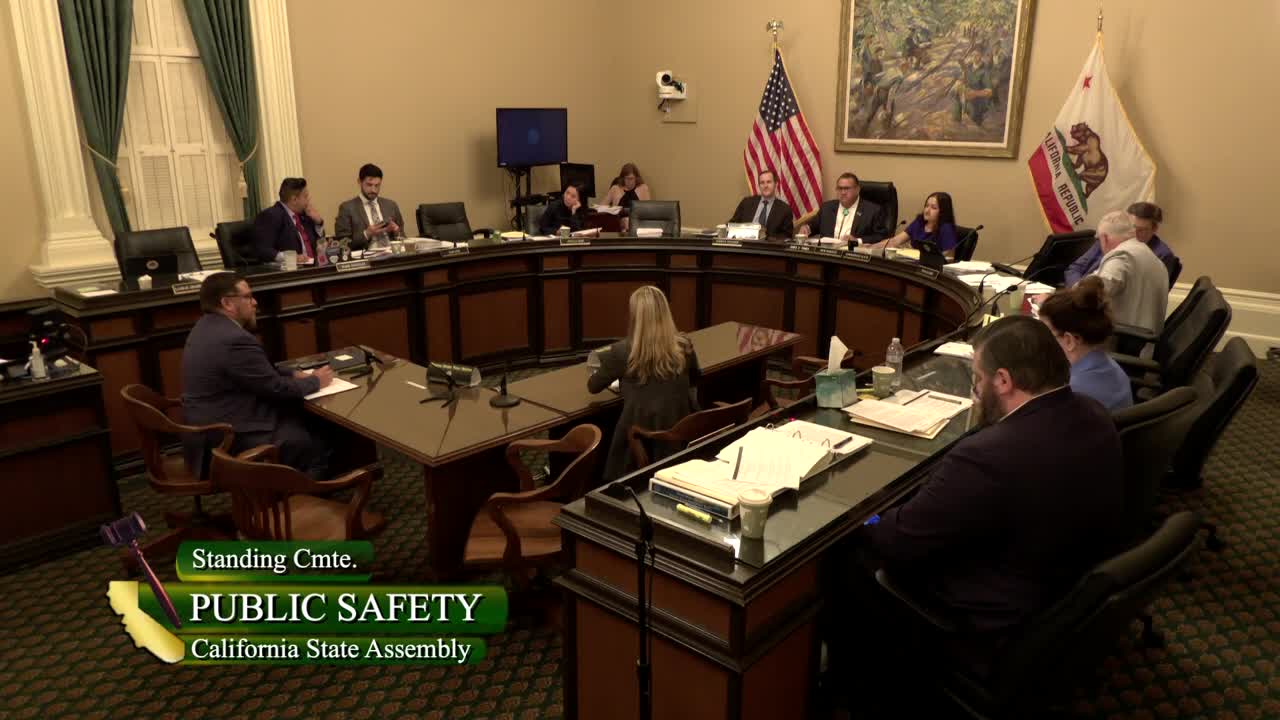 23MIN
Assembly Standing Committee on Public Safety
Bill Author

Bill Co-Author(s):