AB 2114: Public postsecondary education: nonresident tuition fee exemption: educational asylum program.
- Session Year: 2025-2026
- House: Assembly
- Latest Version Date: 2026-04-23
Current Status:
In Progress
(2026-05-14: In committee: Held under submission.)
Introduced
In Committee
Awaiting First Chamber Vote
Passed First Chamber
In Committee
Awaiting Second Chamber Vote
Passed Second Chamber
Enacted
Existing law establishes the California Community Colleges, under the administration of the Board of Governors of the California Community Colleges, the California State University, under the administration of the Trustees of the California State University, and the University of California, under the administration of the Regents of the University of California, as the 3 segments of public postsecondary education in the state. Existing law establishes uniform residency requirements for purposes of ascertaining the amount of tuition and fees to be paid by students of public postsecondary educational institutions. Existing law requires a student classified as a nonresident to pay nonresident tuition, in addition to other fees required by the institution, except as provided. These provisions apply to the University of California only to the extent that the regents, by appropriate resolution, make them applicable.
This bill would authorize a participating public postsecondary educational institution to administer an educational asylum program, in collaboration with the State Department of Education, the Regents of the University of California, the Trustees of the California State University, and the Board of Governors of the California Community Colleges. The bill would require the State Department of Education to maintain a list of restricted states and inform public postsecondary educational institutions of changes to the list. The bill would require a participating institution to grant educational asylum status to a transfer student who meets specified requirements, including residing in a restricted state included on the above-described list. state, as defined. The bill, commencing with the 202728 school year, would exempt a transfer student who is granted educational asylum status from paying nonresident tuition at a participating institution and would require the transfer student to only pay resident tuition and fees.
Existing law establishes the California Community Colleges, under the administration of the Board of Governors of the California Community Colleges, the California State University, under the administration of the Trustees of the California State University, and the University of California, under the administration of the Regents of the University of California, as the 3 segments of public postsecondary education in the state. Existing law establishes uniform residency requirements for purposes of ascertaining the amount of tuition and fees to be paid by students of public postsecondary educational institutions. Existing law requires a student classified as a nonresident to pay nonresident tuition, in addition to other fees required by the institution, except as provided. These provisions apply to the University of California only to the extent that the regents, by appropriate resolution, make them applicable.
This bill would authorize a participating public postsecondary educational institution to administer an educational asylum program, in collaboration with the State Department of Education, the Regents of the University of California, the Trustees of the California State University, and the Board of Governors of the California Community Colleges. The bill would require the State Department of Education to maintain a list of restricted states and inform public postsecondary educational institutions of changes to the list. The bill would require a participating institution to grant educational asylum status to a transfer student who meets specified requirements, including residing in a restricted state included on the above-described list. The bill, commencing with the 202728 school year, would exempt a transfer student who is granted educational asylum status from paying nonresident tuition at a participating institution and would require the transfer student to only pay resident tuition and fees.
(a)The Legislature finds and declares all of the following:
(1)California values diversity and inclusion in its educational systems and seeks to foster learning environments that reflect these principles.
(2)Recent legislative trends in certain states restrict academic freedom, particularly concerning the teaching of diversity, equity, and inclusion and critical race theory, which are critical to preparing students for the diverse realities of the global workforce.
(3)California aims to be a sanctuary state, offering transfer students from restrictive states the opportunity to study in inclusive environments.
(4)Providing access to top tier education to a diverse body of transfer students bolsters Californias economy and supports a skilled workforce that drives innovation and growth.
(b)It is the intent of the Legislature to establish an educational asylum program that allows qualified out-of-state transfer students to apply to Californias public higher education institutions without incurring nonresident tuition costs. By doing so, California reaffirms its commitment to inclusive education and provides a safe haven for transfer students seeking freedom in academic exploration.
SEC. 2.Section 68130.6 is added to the Education Code, to read:68130.6.(a)For purposes of this section, the following definitions apply:
(1)Participating institution means a community college district, a campus of the California State University, or a campus of the University of California.
(2)Restricted state means a state where recently enacted legislation limits the teaching of diversity, equity, and inclusion, critical race theory, or similar subjects in postsecondary educational institutions. Restricted state includes, but is not limited to, the States of Alabama, Arkansas, Florida, Idaho, Indiana, Iowa, Kentucky, North Dakota, Ohio, Oklahoma, Tennessee, Texas, Utah, West Virginia, and Wyoming.
(b)A participating institution may administer an educational asylum program consistent with this section, in collaboration with the State Department of Education, the Regents of the University of California, the Trustees of the California State University, and the Board of Governors of the California Community Colleges.
(c)The State Department of Education shall maintain a list of restricted states and inform public postsecondary educational institutions of changes to the list.(d)(c)Subject to subdivision (e), (d), a participating institution shall grant educational asylum status to a transfer student who meets all of the following requirements:
(1)The transfer student resides in a restricted state that is included on the list maintained pursuant to subdivision (c). state.
(2)The transfer student satisfies all of the academic admissions standards of, and has been admitted by, the participating institution.
(3)The transfer student has applied for educational asylum status on their application to the participating institution and demonstrated their intent to pursue education in a state that promotes inclusive learning.
(e)(d)A participating institution may establish criteria and limits for admitting transfer students under an educational asylum program based on its resources and enrollment capacities.
(f)(e)Notwithstanding any other law, commencing with the 202728 school year, a transfer student who is granted educational asylum status pursuant to subdivision (d) (c) shall be exempt from paying nonresident tuition, and shall only be required to pay resident tuition and fees, at a participating institution.
(g)(f)It is the intent of the Legislature that participating institutions consider the fiscal impact of an educational asylum program and use existing funds to administer an educational asylum program.
(a)The Legislature finds and declares all of the following:
(1)California values diversity and inclusion in its educational systems and seeks to foster learning environments that reflect these principles.
(2)Recent legislative trends in certain states restrict academic freedom, particularly concerning the teaching of diversity, equity, and inclusion and critical race theory, which are critical to preparing students for the diverse realities of the global workforce.
(3)California aims to be a sanctuary state, offering transfer students from restrictive states the opportunity to study in inclusive environments.
(4)Providing access to top tier education to a diverse body of transfer students bolsters Californias economy and supports a skilled workforce that drives innovation and growth.
(b)It is the intent of the Legislature to establish an educational asylum program that allows qualified out-of-state transfer students to apply to Californias public higher education institutions without incurring nonresident tuition costs. By doing so, California reaffirms its commitment to inclusive education and provides a safe haven for transfer students seeking freedom in academic exploration.
SEC. 2.Section 68130.6 is added to the Education Code, to read:68130.6.(a)For purposes of this section, the following definitions apply:
(1)Participating institution means a community college district, a campus of the California State University, or a campus of the University of California.
(2)Restricted state means a state where recently enacted legislation limits the teaching of diversity, equity, and inclusion, critical race theory, or similar subjects in postsecondary educational institutions.
(b)A participating institution may administer an educational asylum program consistent with this section, in collaboration with the State Department of Education, the Regents of the University of California, the Trustees of the California State University, and the Board of Governors of the California Community Colleges.
(c)The State Department of Education shall maintain a list of restricted states and inform public postsecondary educational institutions of changes to the list.
(d)Subject to subdivision (e), a participating institution shall grant educational asylum status to a transfer student who meets all of the following requirements:
(1)The transfer student resides in a restricted state that is included on the list maintained pursuant to subdivision (c).
(2)The transfer student satisfies all of the academic admissions standards of, and has been admitted by, the participating institution.
(3)The transfer student has applied for educational asylum status on their application to the participating institution and demonstrated their intent to pursue education in a state that promotes inclusive learning.
(e)A participating institution may establish criteria and limits for admitting transfer students under an educational asylum program based on its resources and enrollment capacities.
(f)Notwithstanding any other law, commencing with the 202728 school year, a transfer student who is granted educational asylum status pursuant to subdivision (d) shall be exempt from paying nonresident tuition, and shall only be required to pay resident tuition and fees, at a participating institution.
(g)It is the intent of the Legislature that participating institutions consider the fiscal impact of an educational asylum program and use existing funds to administer an educational asylum program.
|
Date
|
Status
|
|---|---|
| May 14, 2026 | In committee: Held under submission. |
| May 6, 2026 | In committee: Set, first hearing. Referred to APPR. suspense file. |
| Apr 27, 2026 | Re-referred to Com. on APPR. |
| Apr 23, 2026 | Read second time and amended. |
| Apr 22, 2026 | From committee: Amend, and do pass as amended and re-refer to Com. on APPR. (Ayes 7. Noes 3.) (April 21). |
| Apr 13, 2026 | In committee: Hearing postponed by committee. |
| Mar 9, 2026 | Referred to Com. on HIGHER ED. |
| Feb 19, 2026 | From printer. May be heard in committee March 21. |
| Feb 18, 2026 | Read first time. To print. |
|
Date
|
Description
|
Location
|
Votes
|
|
|---|---|---|---|---|
| Apr 21, 2026 | Do pass as amended and be re-referred to the Committee on [Appropriations] | Assembly Standing Committee on Higher Education |
Passed |
This list shows positions taken on this bill by organizations on the date displayed, which is linked to the original source.
Positions by individuals are not included.
|
Organization
|
Position
|
Date
|
|---|---|---|
| California Association For Bilingual Education | ** Support | |
| California Faculty Association | ** Support | |
| CFT – a Union of Educators & Classified Professionals, AFT, AFL-CIO | ** Support | |
| PRC/Black Leadership Council | ** Support | |
| UC Student Association (UCSA) | ** Support |
Date of Hearing: May 6, 2026
ASSEMBLY COMMITTEE ON APPROPRIATIONS
Buffy Wicks, Chair
ABPCA Bill Id:AB 2114
Author:(Bryan) – As Amended Ver:April 23, 2026
Policy Committee: | Higher Education | Vote: | 7 - 3 |
|
| ||
|
|
Urgency: No State Mandated Local Program: No Reimbursable: No
SUMMARY:
This bill authorizes a community college district (CCD), campus of the California State University (CSU), or a campus of the University of California (UC), beginning with the 2027-28 school year, to exempt eligible out-of-state transfer students under an education asylum program from paying nonresident tuition and fees.
Specifically, this bill provides for an education asylum program for out-of-state transfer students from a restricted state including, but not limited to, the states of Alabama, Arkansas, Florida, Idaho, Indiana, Iowa, Kentucky, North Dakota, Ohio, Oklahoma, Tennessee, Texas, Utah, West Virginia, and Wyoming, which has enacted legislation limiting teaching in specified subjects.
FISCAL EFFECT:
Ongoing General Fund and Proposition 98 General Fund cost pressures of an unknown amount, but likely in the millions to tens of millions of dollars annually, for participating institutions to provide resident tuition and fees costs to eligible out-of-state transfer students.
Exact costs depend on the number of participating institutions and number of students provided resident tuition and fees costs. The resident to out-of-state tuition differential in academic year 2025-26 for a student at the UC is over $39,000. To the extent that participating campuses of the UC enroll 100 students under the program, cumulatively statewide, costs would be $3.9 million.
COMMENTS:
- Purpose. Under the current presidential administration, there has been a growing ideological divide across the country regarding what is appropriate in education and some states having adopted legislation to limit institutions of higher education’s ability to teach subjects such as critical race theory or promote programs supporting diversity, equity, and inclusion efforts. According to the UC Student Association (UCSA):
These actions are aggressive, widespread, and growing across the states, disproportionately impacting students whose educational focuses have been challenged by conservative ideologies, leading to upsetting interruptions in their education. AB 2114 gives the UC, CSU, and CCC the opportunity to launch programs that grant eligible transfer students, should they meet the credit requirements, with a safe haven at one of their campuses. Even as America has become increasingly polarized, this bill ensures that any student in crisis at their respective institution has a pathway to be educated fairly without political bias and with consistency in their degree journey.
- Background. Current law defines a resident student for purposes of enrollment at the CCC, CSU, or UC as a student having residence in California for more than one year immediately preceding the residence determination date. A student not satisfying this definition must be classified as a nonresident student and pay higher costs for tuition and fees, except under specified exemptions such as those provided to recently discharged members of the U.S. Armed Forces. This bill creates a pathway for out-of-state transfer students, otherwise eligible for admission at a campus of the CCC, CSU, UC, to apply for educational asylum at a participating institution and pay only resident tuition and fees.
Analysis Prepared by: Aaron Heredia / APPR. / (916) 319-2081
Date of Hearing: April 21, 2026
ASSEMBLY COMMITTEE ON HIGHER EDUCATION
Mike Fong, Chair
ABPCA Bill Id:AB 2114 (
Author:Bryan) – As Introduced Ver:February 18, 2026
SUBJECT: Public postsecondary education: nonresident tuition fee exemption: educational asylum program.
SUMMARY: Authorizes California public postsecondary institutions to administer an educational asylum program for certain out-of-state transfer students and, beginning in the 2027–28 school year, exempts participating students granted educational asylum status from paying nonresident tuition. Specifically, this bill:
- Authorizes a participating institution—defined as a California Community Colleges (CCC) district (CCD), California State University (CSU) campus, or University of California (UC) campus—to administer an educational asylum program.
- Defines a “restricted state” as a state where recently enacted legislation limits instruction on diversity, equity, and inclusion, critical race theory, or similar subjects in postsecondary education.
- Requires the State Department of Education (SDE) to maintain a list of restricted states and notify public postsecondary institutions of changes to that list.
- Requires a participating institution to grant educational asylum status to a transfer student who: resides in a restricted state, meets admissions requirements, and applies for the status while expressing an intent to pursue education in a state that promotes inclusive learning.
- Allows a participating institution to set criteria and limits for admitting transfer students under the program based on available resources and enrollment capacity.
- Provides that, commencing with the 2027–28 school year, a transfer student granted educational asylum status is exempt from nonresident tuition and must pay only resident tuition and fees at a participating institution.
- States several legislative findings and declarations.
EXISTING LAW:
- Establishes the Donahoe Higher Education Act and assigns the missions of the CCC, the CSU, and the UC (Education Code (EC) Section 66010, et seq.).
- Makes the following definitions:
- "Resident" is a student who has residence in California for more than one year immediately preceding the residence determination date (EC Section 68017).
- "Resident classification" means classification as a resident at the UC, the CSU, or the CCC (EC Section 68022).
- "Residence determination date" is a date established by the university or community college district governing boards for each semester or quarter to determine a student's residence (EC Section 68023).
- Requires each student to be classified as a resident or nonresident (EC Section 68040).
- Requires the segment governing boards to adopt regulations for determining a student's residence classification, which are to include provisions requiring the financial independence of a student classified as a nonresident and seeking reclassification as a resident as a factor to be considered in the determination of residency, and establishes financial independence criteria (EC Section 68044).
- Requires students classified as nonresidents to pay nonresident tuition in addition to other required fees, unless a statutory exemption applies (EC Section 68050, et seq.).
- Exempts an Armed Forces member—stationed in the state on active duty for more than one year immediately prior to being discharged—from nonresident tuition at CSU and the CCC for the length of time he or she lives in the state after being discharged up to the minimum time necessary to become a resident (EC Section 68075.5(a)).
FISCAL EFFECT: Unknown
COMMENTS: Purpose of the measure. According to the author, “while other states are limiting education opportunities and punishing scholars who study history, culture, diversity, and inclusion, California remains open to teaching the students other states are actively discarding.”
Further the author states that, “AB 2114 authorizes the California Community Colleges and the California State University, and requests the University of California, to establish an Educational Asylum Program. Under the bill, qualifying transfer students from states identified as having restrictions on certain academic subject areas may be granted educational asylum status.”
The author contends that “AB 2114 supports underrepresented students by preserving access to programs, services, and academic environments that promote inclusion, retention, and academic success. Research shows that culturally relevant curriculum and institutional support programs improve student engagement, persistence, and completion rates, particularly for first-generation and historically marginalized students.”
According to the UC Student Association (UCSA), co-sponsors of this measure, because of an increasing ideological divide in concept and theory, “schools and colleges across the country have been caving to conservative influence and abandoning decades of academic principles, faculty autonomy, and education equity rooted in student success. For example, in Oklahoma, the process to apply to become a teacher now involves a 34 question test that intrusively examines their political views. This test contains hostile questions such as who has the ‘...ultimate right to direct a child’s education,’ to what is the ‘...fundamental biological distinction between males and females?’ Additionally, the New College of Florida, once a liberal arts school, is now facing a politically-charged siege which has limited race and gender classes from being taught.[1]”
The UCSA contends that, “these actions are aggressive, widespread, and growing across the states, disproportionately impacting students whose educational focuses have been challenged by conservative ideologies, leading to upsetting interruptions in their education. AB 2114 gives the UC, CSU, and CCC the opportunity to launch programs that grant eligible transfer students, should they meet the credit requirements, with a safe haven at one of their campuses. Even as America has become increasingly polarized, this bill ensures that any student in crisis at their respective institution has a pathway to be educated fairly without political bias and with consistency in their degree journey.”
Lastly, UCSA states that, “as more and more schools and colleges have been abandoning their students for conservative approval, it’s become increasingly important for California to step up and support them in their academic endeavors.”
Committee comments and author amendments. As drafted, the measure would add a novel nonresident tuition exemption not based on domicile, military status, immigration-related residency provisions, or other traditional categories. Instead, eligibility would turn on the student’s residence in a “restricted state” and their admission as a transfer student to a participating institution.
Additionally, this measure authorizes institutions to administer the program, suggesting participation is discretionary. However, once an institution participates, the measure states that it must grant educational asylum status to transfer students who satisfy the statutory requirements, subject to campus-established criteria and capacity limits.
Further, this measure assigns the SDE responsibility for maintaining a list of restricted states and informing public postsecondary institutions of changes. It is presently unclear why SDE is tasked to maintain said list and inform CCC, CSU, and UC of changes to the list.
Lastly, the measure’s legislative findings expressly connect the proposal to concerns about laws in other states restricting instruction related to diversity, equity, inclusion, and critical race theory, and to California’s interest in fostering inclusive learning environments and supporting innovation through a diverse student body. The core policy questions the author and Committee may wish to explore are the following:
- How a “restricted state” will be determined in practice?
- Whether using resident tuition as an incentive is fiscally sustainable?
- How institutions will prioritize students if demand exceeds capacity?
- Whether this measure creates precedent for tuition policy based on another state’s educational policy choices?
In order to address some of the aforementioned comments, the author has provided the Committee with the following amendments:
68130.6. (2) “Restricted state” means a state where recently enacted legislation limits the teaching of diversity, equity, and inclusion, critical race theory, or similar subjects in postsecondary educational institutions. This includes, but is not limited to, the states of Texas, Indiana, Florida, Utah, Iowa, Ohio, Idaho, Oklahoma, Alabama, North Dakota, Tennessee, West Virginia, Wyoming, Kentucky, and Arkansas.
(b) A participating institution may administer an educational asylum program consistent with this section, in collaboration with the State Department of Education, the Regents of the University of California, the Trustees of the California State University, and the Board of Governors of the California Community Colleges.
(c) The State Department of Education shall maintain a list of restricted states and inform public postsecondary educational institutions of changes to the list.
(d) (c) Subject to subdivision (e) (d), a participating institution shall grant educational asylum status to a transfer student who meets all of the following requirements:
(1) The transfer student resides in a restricted state. that is included on the list maintained pursuant to subdivision (c).
Arguments in support. According to California Association for Bilingual Education (CABE), “California has long been a national leader in promoting diversity, equity, and inclusion within its educational institutions. AB 2114 supports this tradition by allowing California’s public higher education institutions to provide opportunities for transfer students seeking to continue their academic pursuits in inclusive learning environments.”
CABE states that, “for multilingual learners and students from diverse linguistic and cultural backgrounds, access to educational environments that value diversity and promote inclusive academic discourse is particularly important. Institutions that embrace diverse perspectives and encourage the study of history, culture, and language help prepare students for participation in an increasingly global society. AB 2114 aligns with California’s broader educational priorities to expand access to higher education, strengthen pathways for historically underserved students, and support the development of a diverse and globally prepared workforce.”
REGISTERED SUPPORT / OPPOSITION:
Support
California Association for Bilingual Education
California Faculty Association
CFT – a Union of Educators & Classified Professionals, AFT, AFL-CIO
PRC/Black Leadership Council
University of California Student Association (Co-Sponsor)
Opposition
None on file.
Analysis Prepared by: Jeanice Warden / HIGHER ED. / (916) 319-3960
Discussed in Hearing
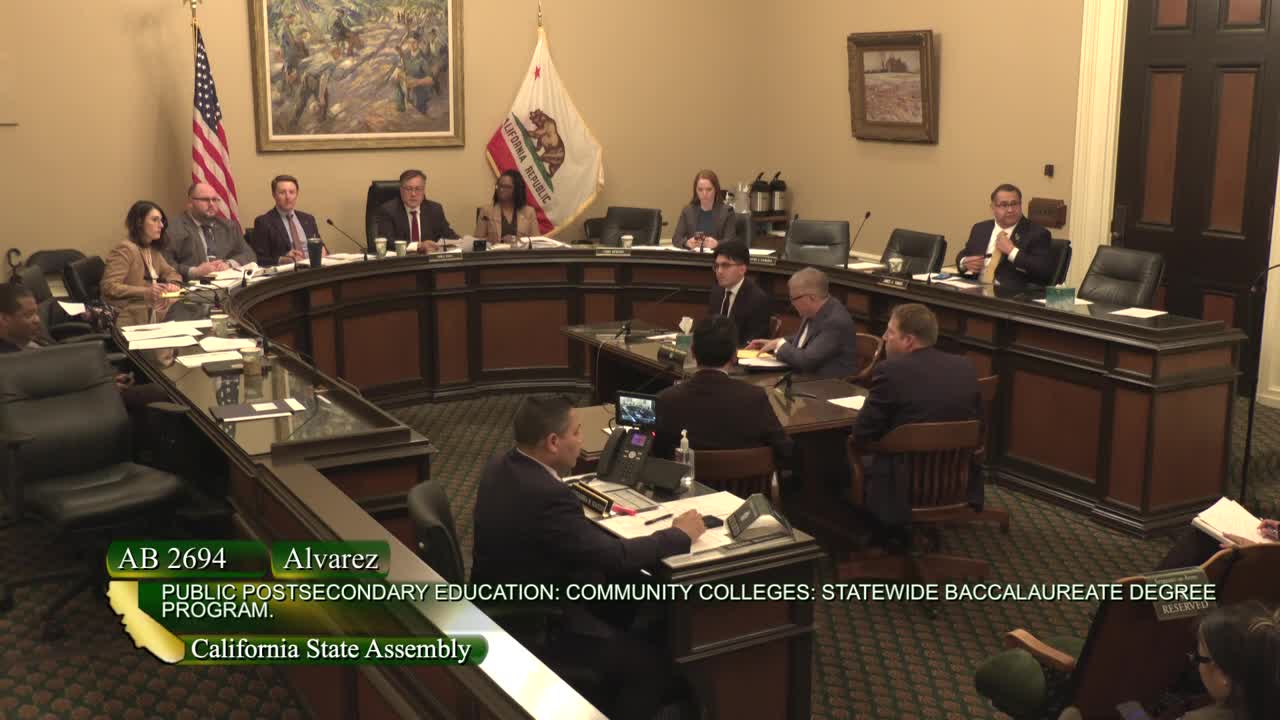 9MIN
Assembly Standing Committee on Higher Education
Bill Author

Bill Co-Author(s):